Showing posts with label paul manship. Show all posts

Thursday, July 27, 2023

The 1934 Prometheus Sculpture - Rockefeller Center


photo by David Shankbone

In 1918 Paul Howard Manship completed a bronze bust of  John D. Rockefeller, Sr.  The sculptor had been recommended to the millionaire by portrait artist John Singer Sargent.  Unfortunately, Rockefeller hated the finished piece and refused to have it displayed.  John D. Rockefeller, Jr. later explained, "Father feels so strongly that the bust gives an impression of weakness."  The younger Rockefeller, however, disagreed, saying, "If I were contemplating having a bust made myself, I should be inclined to select Mr. Manship."

Paul Manship, from the collection of the Library of Congress

As Rockefeller formulated plans for his 22-acre Rockefeller Center, the sculptor came to mind.  According to Daniel Okrent, in his 2002 book Great Fortune, The Epic of Rockefeller Center:

Given Junior's regard for him...it's little wonder that Manship was granted the most prominent outdoor spot for his piece, a fountain to be placed at the western end of a sunken plaza, down the long axis of the Channel Gardens where the eye stops before racing up the facade of the RCA Building.  His subject was Prometheus, the god who gave fire to mankind.

With little fanfare, on January 19, 1934 The New York Times reported, "The giant central figure of Prometheus was set in place yesterday in the fountain group which constitutes the chief decorative feature of the sunken plaza of Rockefeller Center."  Manship's 18-foot tall, eight-ton Prometheus could be seen from Fifth Avenue.  The god is captured plummeting to earth through a ring 
inscribed with the signs of the zodiac that depicts the heavens.  Below him are mountain peaks and the fountain pool, representing the sea.  Held in his upraised hand is the gift of flame.

Prometheus was originally not alone.  The New York Times added, "Two smaller bronze figures, completing the fountain group, recently were set in ledges on each side of the upper basin."  Along the granite wall behind the grouping, a quotation from Aeschylus reads: "Prometheus, teacher in every art, brought the fire that hath proved to mortals a means to mighty ends."

Manship's two gilded figures, Youth and Maiden, representing mankind receiving the fire, originally flanked Prometheus.  photo by Carl Van Vechten, from the collection of the Museum of the City of New York.

About a year after the grouping was set in place, Manship had misgivings.  In 1935 he told Rockefeller Center Weekly that he felt he had been "hurried" by the one-year schedule he was given, and said, "I'd naturally welcome the opportunity of doing the whole fountain group over again."  Around the same time, Youth and Maiden were removed.  The New York Times reported later, "Manship had second thoughts about their placement and felt that they detracted from Prometheus."  Their gilt finishes were covered with a bronze patina and they were placed in the Palazzo d'Italia garden above the International Building.

Manship was not the only person who questioned Prometheus.  Although some critics, like Edward Alden Jewel of The New York Times, praised it (he called it "a genuine masterpiece, beautiful in its rhythm"), others like Frank Craven deemed the sculpture "a boudoir knickknack."  It was generally the subject of derision.  

Daniel Okrent wrote, "From the day of its unveiling [Prometheus] was considered more of an amusement than a work of art."  He explained, "A critic said Prometheus 'look[s] like he [has] just sprung from a bowl of hot soup,'" and said the sculpture "quickly acquired a variety of nicknames and variety of bemused characterizations: he was 'Leapin' Louie,' who looked like the Daring Young Man on the Flying Trapeze," or maybe a "young man escaping from his marriage ties."  In his August 14, 1942 syndicated column, Walter Winchell mentioned the statue "which a wag once labeled 'Sliding into Second.'"

On April 17, 1940, workmen prepared to turn the fountain on again after being shut down for the winter.  They were surprised to discover that two pair of birds had beaten them to the site.  The workers found two nests with eggs nestled in crannies of the Prometheus statue.  New Yorkers and tourists would have to wait weeks to enjoy the running waters.  The Times Record of Troy, New York reported, "Nelson Rockefeller, president of the center, ordered that they were not to be disturbed until the eggs hatched, which will be some time in May."

An interesting and short-lived scheme was introduced in the summer of 1941.  The Little Falls Herald reported, "The baby sea lions that have been placed in the Prometheus Fountain at Rockefeller Center for the amusement of diners at the adjoining Promenade Outdoor Cafe has [sic] impressed."

The Prometheus fountain was the victim of a college-type prank in 1956.  On July 9, The Times Record reported, "Prometheus, the god of fire, took a bubble bath yesterday, when someone poured a liquid cleanser in the fountain at the base of his gilded statue in Rockefeller Center."

In 1958, The New York Times explained that the statue "receives an annual cleaning before Good Friday."  Its tissue-thin coating of 24-karat gold required frequent maintenance.  The laborious process of regilding was first done in 1947, then again in 1958, 1974, and 1983.

On April 8, 1984, The New York Times reported that Youth and Maiden "are being cleansed of a half-century of weather-encrusted grit and will be restored to their places beside the 18-foot figure of Prometheus this week."  The move coincided with a major renovation of the plaza to accommodate three new restaurants.  The six-foot sculptures did not stay, however.  In 2001 they were moved to the top of the staircase to the plaza, at the western end of the Channel Gardens.

Maiden originally gilded, sat at the right of Prometheus in 1934.  photograph by Elisa.rolle

Once derided as a joke, Paul Manship's Prometheus is today beloved.  According to Daniel Okrent, "Prometheus became arguably the fourth most famous piece of sculpture in America, trailing only...the Statue of Liberty, Mount Rushmore, and Daniel Chester French's seated Lincoln in Washington."

photo by Rob Young

Nevertheless, one critic who never warmed up to the artwork was its creator.  When asked what he thought of it in 1959, Paul Manship said, "I don't like it too well, no.  I don't think too well of it."

LaptrinhX.com has no authorization to reuse the content of this blog

Tuesday, July 18, 2023

Paul Manship's Lehman Gates - Central Park


On June 16, 1960, The New York Times reported that Governor Herbert H. Lehman and his wife, Edith Louise Altschul, had donated $500,000 "to build a children's zoo in Central Park."  The gift was in celebration of the Lehmans' 50th wedding anniversary.  The article said that Park Commissioner Newbold Morris, "had no hesitancy in accepting the gift.  He was sure there would be no opposition to the children's zoo as an 'encroachment'" on Central Park.  

Ironically, were they still around, Park architects Frederick Law Olmsted and Calvert Vaux would have most heartily opposed the project.  From the beginning, they had denounced the idea of a zoo, charging that one would upset the natural beauty of the park.  (The gradual establishment of the Menagerie behind the Armory beginning in 1858 was a fluke, begun when a lost bear cub was left there.)

The New York Times remarked that the architects of the Children's Zoo project, Aymar Embury 2d and Edward C. Embury, "envision an ornamental gateway leading down a landscaped, tree-shaded path to low, glass-walled, small-scale buildings."  It was the one element of the project they would not design.  Instead, sculptor Paul Manship took charge of what would be known as the Lehman Gates.

Manship's most notable work in Manhattan is his gilded 1934 Prometheus above the lower plaza of Rockefeller Central.  The Lehman Gates would not be the first project he created for Central Park.  In 1932 he designed the bronze Art Deco sundial for the Waldo M. Hutchins Bench, and in 1953 created The Osborn Gates to the Osborn playground (today's Ancient Playground). 

The Waldo M. Hutchins Bench sundial.

The design of the Lehman Gates was patently Paul Manship.  Harking to his earlier Art Deco works, they consist of three granite plinths connected by swirling bronze stylized vines.  Two small boy figures sit upon the outer gateposts playing flutes while above the center post an older youth frolics with goats.


The Children's Zoo opened on September 28, 1961.  The New York Times reported, "The world of Hansel and Gretel, the Three Little Pigs and the White Rabbit will come alive today in Central Park."  The sophisticated Lehman Gates were noticeably unlike the zoo proper.  The New York Times article called the zoo a "Disneyland-like scene," including a "walk-in whale," Noah's Ark, and Hansel and Gretel's candy cane cottage.


Exactly three decades after the facility opened, in 1991 padlocks were placed on the Lehman Gates.  The Children's Zoo was closed after having "degenerated into what was widely considered a pitiful aggregation of overcrowded animals," according to The New York Times.  Four years later, on September 28, 1995, the newspaper said the padlocked one-acre site was "a repository of beer cans and rotting kitsch."

At the time of the article, the Wildlife Conservation Society had announced plans to replace the Children's Zoo with a modern facility.  It sparked backlash from preservationist groups like the Friends of the Upper East Side Historic Districts who pushed to save and restore the fairy tale based buildings.  They called the structures like the candy cane cottage and the Three Little Pigs' houses "arty treasures."  Unmoved, the Wildlife Conservation Society described Noah's Ark and Jonah the Whale as involving "inappropriate religious messages," said the old zoo's "storybook ways" of exhibiting animals did not promote conservation, and, finally, asserted that "restoration would be too costly."

It was a drawn-out and somewhat bitter battle that the preservationists lost.  On August 11, 1996, The New York Times reported that "hundreds of New Yorkers streamed into Central Park's Children's Zoo yesterday to say goodbye to an old friend."  They were allowed three hours to visit, after which the Lehman Gates were again shut and workmen began demolition on the degraded buildings.

Not one person had ever suggested that the Lehman Gates should be part of the process.  Manship's handsome sculptural portal transcended the debate.  But it would not be long before it did play a significant role in another conflict.

Edith and Henry Everett donated $3 million--half the cost of the new zoo.  But then, in the spring of 1997, the Everetts and the Wildlife Conservation Society became deadlocked over a single detail.  On May 15, The New York Times reported, "A 36-year-old granite gate at the zoo entrance turned out to be the lightning rod in the dispute."  The article said, "Last month, the New York City Art Commission approved a plan to place a plaque commemorating the Everetts' gift on the center pier of the gateway, with two smaller plaques on the flanking piers, one noting the Lehmans' gift of the gateway and the other noting the Lehmans' gift of the original zoo."  The Everetts' balked at the Lehmans' names being there at all.  

"We're not talking about neon lights," Edith Everett told a reporter.  "Be that as it may, they have the final word."

Reba White Williams of the Art Commission, who had presided over the negotiations, explained, "We can't go around erasing the past.  What does this say to donors, if you can't respect the history of a gift?"

The Everetts withdrew their donation, Edith telling a reporter from The New York Times, "We'll take our $3 million someplace else that will be happy to have it."

Coincidentally or not, days earlier the Everetts had openly denounced the appointment of James S. Tisch as the head of the UJA-Federation of New York, calling him "unfit to head the giant charity."  Now, a week after they recalled their funding, The New York Times reported that the Tisch Foundation had agreed "to replace the donation and add up to $1.5 million more."  Allison Power of the Wildlife Conservation Society announced, "the new zoo will be called the Tisch Children's Zoo, not the Everett Children's Zoo.


Seemingly innocent to fiery controversy, Paul Manship's bronze boys continue to play their flutes and frolic with goats as visitors stream into the zoo below.  The Lehman Gates comprise a striking civic artwork within the park.

 photographs by the author
LaptrinhX.com has no authorization to reuse the content of this blog

Thursday, October 25, 2018

The Waldo M. Hutchins Bench - Central Park


In an article about civic memorials in 1913, The Lookout magazine lamented "in a busy, careless city the average person soon forgets."  That short civic memory is responsible for statues and monuments throughout the city in honor of persons--like John Purroy Mitchel, Roscoe Conkling, and Samuel S. Cox--once renowned, but now essentially forgotten.  And like Waldo M. Hutchins.

Hutchins and his wife, the former Elizabeth Ellsworth, had four children--Julia, Augustus, Waldo and William.  Born in Brooklyn, Connecticut on September 30, 1822, he traced both sides of his family to the first settlement of Connecticut.

Hutchins's career was impressive and wide-flung.  In 1842, the year he graduated from Amherst College, he relocated to New York City and entered the law office of Slosson & Schell, "as a student."  He was admitted to the bar in 1845 and in 1852 became a partner in the law firm with John Slosson and Augustus Schell.

His meteoric legal career would have been enough to earn him wealth and fame.  At just 29 years old, he was chairman of the Judiciary Committee of the State Assembly.  But seemingly indefatigable, he branched out into railroads, insurance, banking and politics.  The same year he was made a partner in Slosson, Schell & Hutchins, he was elected to the New York Assembly.

Decades later the New York State Bar Association Reports noted, "Soon after the passage of the act of 1853, providing for the construction in the city of New York of the Central Park, he was appointed one of the Commissioners."  Hutchins deftly juggled his various responsibilities.  In 1865 he successfully represented the City of New York in its fight to establish a professional fire department; and in 1867, following his term in the Assembly, he made time to serve as a delegate to the State constitutional convention.

In 1878 Alexander Smith won the Democratic nomination for Congress.  But on the night before the election, he died.  On October 5, 1879, The New York Times reported that Waldo Hutchins had been nominated as his replacement.  He was elected on November 4 and served until March 3, 1885.

Now back home in New York City, he resumed his law practice.  On November 27, 1881, The Times reported that he had been elected to the post of president of the New-York Park Association.  The article mentioned its object was "to secure increased park area for the City of New-York."  A report read that the meeting noted "the park acreage of New-York as compared with that of other great cities...had been completely outstripped in providing such places of creation for her citizens."

His tireless fight to acquire more parkland for the city was in part responsible for his being re-elected as a Park Commissioner in June 1887.  Two years later he was chosen its president.  The New York State Bar Association Report of 1889 made note "it is proof of the interest he took in those breathing spaces and pleasure grounds of the people, that, although his connection with the board was interrupted by duties in Congress and business interests, he returned to it in later years."

While Hutchins's creating of green space and roads was overwhelmingly popular, his support of using Central Park as the site of a world exhibition in 1889 fell flat.  The New York Times, on July 8, railed against the idea, equating it to "the condemnation of Central Park" and saying that while New Yorkers would welcome a world's fair they were "irrevocably opposed to the destruction of the advantages they already possess in their only completed park."  The fair did not happen.

Hutchins received another disappointment that year after he offered a position to Frederick Law Olmstead as a consulting landscape architect on retainer.  Olmstead did not respond warmly.  Writing from his home in Brookline, Massachusetts on June 8, 1889, he said in part:

I do not wish to be called in occasionally to prepare or aid in preparing details of design for works with regard to which I have no continuous or comprehensive responsibility...Judging from the experiences to which I have referred it seems to me probably that what I have thus said will make it unnecessary that you should be put to the expense of my visiting New York at this time.

Although Hutchins had incurred the ire of The New York Times over the world's exhibition concept, he won its admiration when he fought against the relocation of the precursor of the Central Park Zoo in 1890.  An editorial on June 27 said partly "Mr. Waldo Hutchins really deserves the thanks of his fellow-citizens for preventing two of his associates in the Park Commission from voting the removal of the menagerie to the North Meadow."  The editors accused Commissioners Gallup and Borden of being detached.  "There is something grotesque in the notion that the general promiscuous public takes a more intelligent interest in the park, has a greater pride in it, and is much more concerned to prevent its spoliation that the men who are its official guardians."

In January 1891 Hutchins became ill.  On February 5 The Evening World announced "Park Commissioner Waldo Hutchins is lying seriously ill at the Park Avenue Hotel...It began with a severe cold, complicated with a bilious attack, and later developed into a slight attack of pneumonia."  The article added "Should he recover, he will not be able to leave his room for ten days or more."

He did not recover.  On February 9, 1891 The New York Times reported "Mr. Hutchins made a hard fight and passed the night safely...A little after 5:30 o'clock yesterday morning a change for the worse was noticed, and half an hour afterward he sank into a stupor.  At 7:20 o'clock he died."

The following day The Brooklyn Daily Eagle wrote "Seldom do so many venerable New Yorkers come together to pay homage to the memory of the dead as there were assembled this morning in the Madison Square Presbyterian church in New York, during the services over the remains of the late Park Commissioner Waldo Hutchins.  The body of the church was filled."

The name of Waldo M. Hutchins was well on the road to obscurity when his son, Augustus S. Hutchins, stepped in.  Like his father's his was a broad-based career.  An attorney, he was also a vice president in the Metropolitan Savings Bank; and director in the North River Insurance Co., the United States Fire Insurance Co., and the Williamsburgh City Fire Insurance Co.


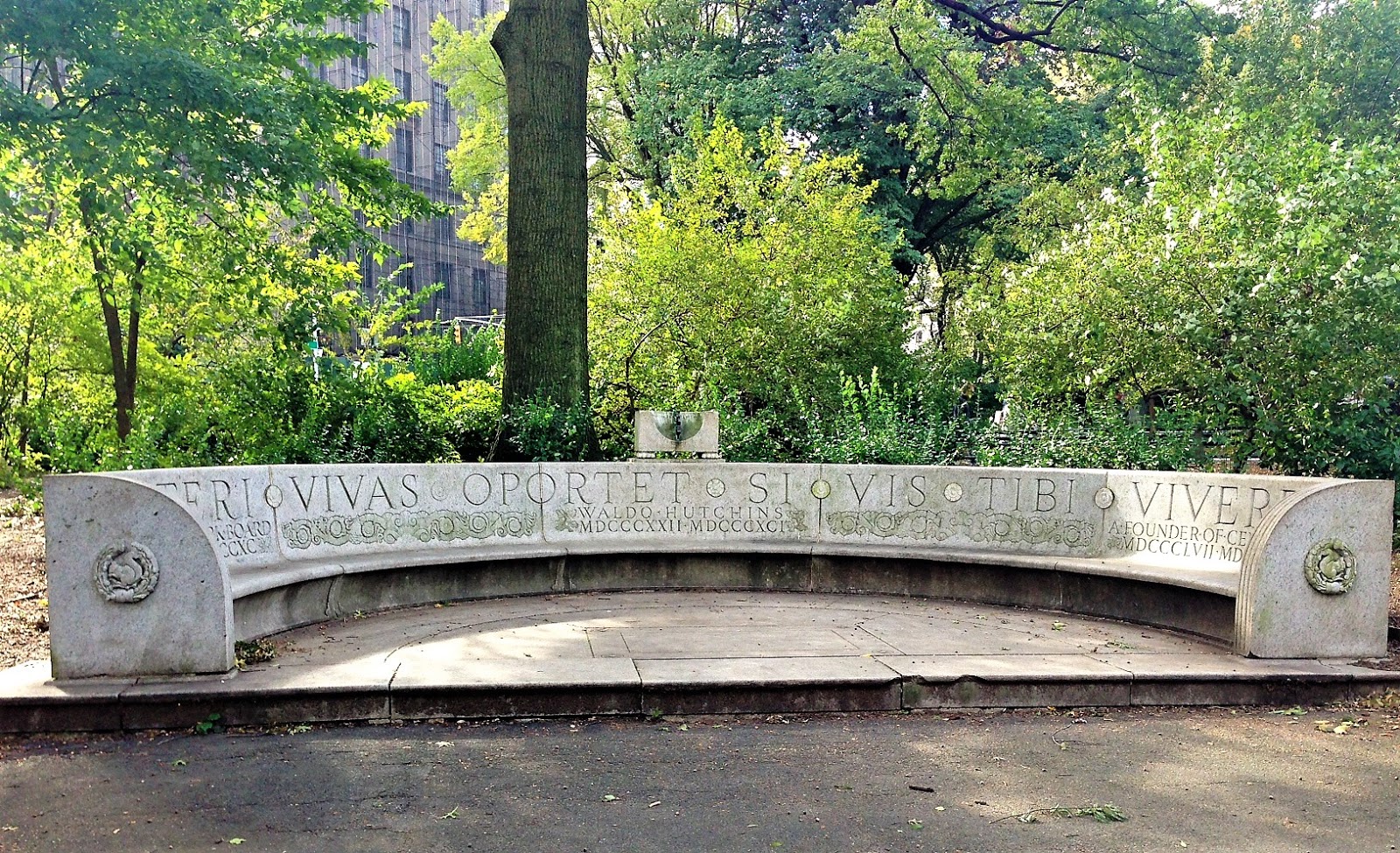
In 1932 he hired architect Eric Gugler to design a granite bench for Central Park in memory of his father.  Costing $15,000 (about $270,000 in 2018), it would be more than a mere seating area.

The semicircular (or exedral) shape has a secondary purpose--it is a clock of sorts.  Twice a year on the vernal and autumnal equinoxes its shadow precisely coincides with three arcs incised into the platform--at 10:00 a.m., at noon, and at 2:00 p.m.  Additionally, a sundial, incorporating an Art Deco bronze figure, perches on the back of the bench.  The sculpture, attributed to Paul Manship (who created the monumental Prometheus statue at Rockefeller Center), depicts a female dancer trailing flowing scarves.


Echoing Waldo Hutchins's life-long work for the citizens of the city, a Latin inscription along the back of the bench translates "One must live for another if he wishes to live for himself."  The inscription within the sundial translates "Let it not be destroyed by the passage of time."

The fascinating astronomical bench sits greatly unnoticed on a slope near the Conservatory Water, or model boat pond.  And despite his son's valiant efforts, Waldo M. Hutchins's name is largely forgotten.


photographs by the author