Showing posts with label j. e. r. carpenter. Show all posts

Friday, February 27, 2026

The 1931 Dumont Building - 515 Madison Avenue


image via redesignarchitects.com

Architect James Edwin Ruthven Carpenter, Jr. (who went professionally as J. E. R. Carpenter) was three years older than his brother, real estate developer James H Carpenter.  The two collaborated on several significant Manhattan structures, and in 1930, just months after the Stock Market crash, they embarked on another: a 42-story, $2 million office building at the northeast corner of Madison Avenue and 53rd Street.  (The construction cost would translate to $41.2 million in 2026.)

Completed in 1931, J. E. R. Carpenter's Gothic-inspired Art Deco pile was faced in gray brick above a three-story limestone base.  The deeply recessed entrance, flanked with storefronts, sat below a bronze-and-glass marquee and was framed by a gold-veined stone arch, carved with Gothic motifs.

The groined Gothic-style ceiling of the lobby can be glimpsed.  photo by Carole Teller

Terra cotta Gothic tracery sat atop the openings of the third floor, and cast Gothic-style spandrel panels decorated the upper facade.  Setbacks began at the 14th floor, rising to an offset tower.

photograph by Americasroof

Opened in October 1931, the building quickly drew advertising and publishing firms.  Among the first tenants were the offices of the Plumbers Trade Journal, Spur Publishing Company (which occupied the 11,000-square-foot 13th floor), Outlook Publishing Company, and Advertising Digest

An interesting tenant was The Blue Cockade.  On May 10, 1932, The New York Times explained it was "a recently formed organization favoring repeal of the prohibition amendment."  The membership was different from other anti-Prohibition groups.  A representative told The Times, "Several department stores in the city have been organized '100 per cent' in membership in The Blue Cockade."

Real estate agent Jules Spiegel opened his "well-furnished" office here in August 1933.  Just days later, the 40-year-old was taken out in handcuffs.  The New York Times reported that he, "looked back wistfully as he departed with the detectives," adding, "The last thing he saw in his office as he closed the door was a large floral horseshoe.  It bore the inscription 'Success.'"

Spiegel had been accused by Frank Nagel of larceny.  He told authorities that he had paid $225 to Spiegel in his "luxuriously furnished office" here as security for a rent collector's job.  It was a significant amount in the Depression years, and Nagel got neither the job nor his money back.  As it turned out, Nagel was only one of several victims.  The assistant district attorney revealed in court that Spiegel "had swindled many others by the same means in the last ten years."

Among the tenants of the storefronts as early as 1933 was the Michaelyan Galleries.  It held an exhibition of Oriental rugs that November, assembled from the collection of the Textile Museum of Washington and from H. Michaelyan's personal collection.

A much more controversial tenant at the time was the Second Spanish Republic Consulate.  The government had been formed on April 14, 1931 after the deposition of King Alfonso XIII.  In 1933, a "revolutionary uprising" by Spanish Socialists was put down and the rebels imprisoned.  It sparked a backlash among some Americans.  

On October 10, 1934, The New York Times reported that "about 200 men and women stalked and shouted for an hour yesterday afternoon demonstrating their support of the Spanish revolt," and on November 24, 1934, The Daily Worker reported that the Young Communist League had called for "mass picketing to demand the release of the imprisoned Socialist and Communist workers of Spain" in front of 515 Madison Avenue that day.

Another sometimes controversial tenant at the time was the New York State Birth Control Federation.  Two years later, on May 14, 1936, the formation of the National Medical Council on Birth Control was announced here.

Theatrical producer Jules Alberti operated from 515 as early as 1934.  On the afternoon of January 23, 1935, 23-year-old John Days, Jr. entered the office, "brandished a pistol and demanded $1,000," according to The New York Times.  The article described Days as "a WPA worker" and said his wife had formerly worked as a domestic servant in Alberti's home.

At gunpoint, Alberti was forced to make out a promissory note for the money.  He promised to meet Day at the corner of 54th Street and Lexington at 7:00 that evening to give him "an installment."  Not surprisingly, when Day showed up, two detectives were waiting for him.

More turmoil within the Spanish Consulate was to come.  In 1936, civil war resulted in the overthrow of the government and the installation of General Francisco Franco as the country's ruler.  On August 6, 1936, The New York Times reported that the consul, Felix de Iturriaga had been replaced "because he apparently was 'not in sympathy' with the present Spanish Government."  And six months later, on January 13, 1937, the new consul, Luis Careaga, announced that the Official Spanish Chamber of Commerce was "no longer authorized."  He told reporters that the functions of the chamber would now be exercised at 515 Madison Avenue.

As early as 1936, the burgeoning television industry was represented in 515 Madison Avenue by The Television Corporation of America.  It was joined by the Allen B. Dumont Laboratories, Inc., "manufacturers of television equipment."  In 1938, Dumont installed a broadcasting antenna on the building and in May 1939 The New York Times reported it would erect an "outdoor studio" for "the transmission of tele-pictures."  The article said it "will be equipped on a setback of the building to receive the benefit of daylight.  It will be roofed with glass so that inclement weather will not interfere with the schedule."

Licensing of the Dumont Laboratories television station was granted in April 1940.  Later that year, the station made history.  On November 10, The New York Times reported:

Television has just played with honor and acclaim its most striking role in America's greatest political show.  Last Tuesday it took its place alongside that more mature trouper of twenty-odd years of Presidential elections, the microphone.

According to the article, "nearly 4,000 television sets were in use," as the results of the Presidential election came in.

The firm's visible presence here gave the building its nickname, the Dumont Building.  The following January, the Allen B. Dumont Laboratories, Inc. demonstrated a "625 line definition" receiver here that produced enhanced clarity to the image.  The firm made history again that year by initiating "commercial" television.  The New York Times reported on May 11, "The DuMont station will specialize in outside pick-ups, such as baseball and football games and events."

As turmoil swept Europe, the newly-formed American First Committee took space here in 1941.  Perhaps its most visible member was Colonel Charles A. Lindbergh.  He made an appeal in April "to keep the United States out of the war."  In response, 3,000 membership applications were received the next day.  "Each member is required to subscribe to a declaration that he has no affiliation with any foreign power," noted The New York Times on April 25.

On June 16, 1941, the Government closed the United States consulates in Germany.  The Anti-Nazi League reacted, "It's about time.  The league has long advocated just such a course."  The New York Times reported, "The America First Committee, 515 Madison Avenue, declined to make any statement."

The Dumont Television Laboratories continued to break ground.  On September 30, 1943, it announced it had teamed with Police Headquarters.  "Pictures of missing persons will be broadcast over [the] television system," reported The New York Times.  And on November 5 that year, the newspaper said, "When Senator Robert F. Wagner goes on the air at 8:15 o'clock tonight over Station WABD, it will be the first time in the history of the nation that a candidate for major public office has used television as a means of appealing for votes on election day."

In 1945, with the war ended, the Society for the Prevention of World War III, Inc. established an office here.  And resumption of protests against the Franco regime resumed.  On March 3, 1946, The New York Times reported on the 700 pickets outside, "demanding that the United States sever diplomatic relations with Franco Spain."

On May 18, 1950, the Dumont Laboratories announced the "invention of an all-color all-electronic direct-view television tube."  And while the headquarters continued to operate from 515 Madison Avenue, in December 1951 it announced the opening of its "$4,000,000 Tele-Centre" at 205 East 67th Street.  The seven-story structure would house five studios.  In the move, the WABD antenna was removed and relocated to the Empire State Building.  The headquarters in the Dumont Building was now named the Dumont Television Company.

In 1958, the former Dumont rooftop station became home to the Columbia University WKCR-FM radio station.  It would remain until 1977.

The Dumont Building was sold in May 1962 to Aaron Rabinowitz, chairman of the board of the Fred F. French Management Company.  The New York Times reported that he purchased it "for family investment."

Among the tenants at the time was the national headquarters of the Anti-Defamation League of B'nai B'rith, founded in 1912.  It held an annual awards dinner on January 31, 1963 in Washington D.C. where it awarded President John F. Kennedy its America's Democratic Legacy Award, established in 1948.

An alarming incident occurred here on September 21, 1974.  Brothers Caro and Isaac Yamaoka ran the jewelry business, Caro Yamaoka Company, on the 13th floor.  Just after noon that day, two males posing as deliverymen entered.  They "drew guns, handcuffed the owner, his brother and an employee and escaped with about $150,000 in pearls," according to police.  The heist would equal more than $950,000 today.

image via marketplace.vts.com

The renovations to the ground floor of 515 Madison Avenue--always the first to be brutalized--have been made with some sympathy to the 1931 architecture, and the magnificent entrance is beautifully intact.  The building's "stepped-back shape," was described by The New York Times architectural critic Paul Goldberger on February 8, 1987, "a genial eclectic relic from the 1920's."

many thanks to artist Carole Teller for suggesting this post

Thursday, October 5, 2023

J. E. R. Carpenter's 3 East 85th Street


image via sreeteasy.com

Spencer Fullerton Weaver already had a broad career by 1913.  Born in 1880 to James Buchanan Weaver and Mary Fullerton Weaver, his great-great-grand uncle was President James Buchanan.  He earned his engineering degree at the University of Pennsylvania in 1902.  After traveling extensively, he settled in New York City in 1910 and turned his attention to real estate, forming the Fullerton Weaver Realty Co.  He would later add architect to his resume, partnering with Leonard Schultze to form Schultze & Weaver, well-known for their hotel designs.

In 1912, Weaver hired architect J. E. R. Carpenter to design an upscale apartment house at 3 East 85th Street, steps from fashionable Fifth Avenue and Central Park.  Completed in 1913, the nine-story Renaissance Revival building featured a three-story rusticated base.  A projecting bandcourse below the fourth floor and a prominent intermediate cornice below the seventh defined the three sections.  Venetian style windows at the fifth floor and Renaissance carved panels at the ninth added to the Italian motif.  A deeply overhanging copper cornice with close-set brackets completed the design.

An advertisement in November 1913 touted, "Extremely attractive apartments, one to a floor.  Magnificent view of Central Park and Reservoir, unobstructed outlook East, South and West."  The typical apartment had eleven rooms, although there were suites of twelve and one of eight (that one most likely on the ground floor).  Living at 3 East 85th Street was not inexpensive.  Rent for a twelve-room apartment with three baths in 1913 ranged from $3,000 to $4,500 per year--around $11,400 per month in 2023.

Among the building's first residents were its builder, Spencer Fullerton Weaver, and his family.  He and his wife, the former Emily Stokes had three children.  The couple were both avid tennis players, although Emily seems to have outshone her husband.  In 1914 and 1918 she won the national indoor tennis doubles championship.

The American Architect, June 21, 1922

Perhaps the most socially visible couple were the Lucien Hamilton Tyngs.  Born in Illinois in 1873, Lucien had married Ethel Hunt on February 9, 1907.  The couple's sprawling country estate was in Southampton.  They had barely moved in before Ethel began entertaining.  An announcement in The Sun on December 14, 1913 noted that she would be giving a "dansant for Miss Blanche Tyng," and a week later The New York Times reported, "Mrs. Lucien Hamilton Tyng gave a tea at her new home, 3 East Eighty-fifth Street yesterday to introduce her husband's cousin, Miss Blanche E. Tyng, a daughter of James A. Tyng."

It may have been Blanche's recently established role in society that prompted an interesting gathering in the Tyng apartment on January 4, 1915.  The New York Press reported that Ethel, "entertained at tea yesterday afternoon in her home. No. 3 East Eighty-fifth street, for the young members of society.  A feature of the afternoon was the recitation in costume of 'Haensel and Gretel' by Miss Margaret Sumner."

Later that year resident Margaret Krebs Shope Busk would be busy planning debutante entertainments.  Margaret had married Frederick Thielcke Busk in 1891.  In 1913, the year they moved into 3 East 85th Street, the couple purchased their country estate, Spruce Brook Farm, in Litchfield, Connecticut.  

Margaret and Frederick had four children, Mary Laird, Frederick Wadsworth, Joseph Richard, and Margaret Krebs (known familiarly as Peggy).  The winter social season of 1915-1916 was Peggy's debutante season.  It started on November 27, 1915, when, as reported by the New York Herald, she "made her debut at a reception given by her mother at their house, No. 3 East Eighty-fifth street, which was followed by a dinner.  Mrs. Busk took the members of the receiving party and some young men who were guests at dinner to the Belasco Theatre to see 'The Boomerang.'"

A young woman's introduction to society was often closely followed by an engagement, and such was the case with Peggy.  On June 23, 1916, The New York Times reported that the Busks had announced her engagement to Edward Allen Whitney, adding that since her debut she "has been prominent in the doings of the younger set."  The wedding took place in St. James's Church on Madison Avenue on April 15, 1917.

The American Architect, June 21, 1922

America entered World War I that year, and Spencer Fullerton Weaver answered his country's call.  He joined the U.S. Army and served with the 306th Infantry in France.  He returned safely to 3 East 85th Street in February 1919 with the rank of major.  He immediately turned his attention to ensuring that his fellow veterans would not find themselves jobless.  On February 19, he told a reporter from the New-York Tribune, "All of the men of the division, except 5,600, have been assured they will get their old jobs back when they return.  Other officers and myself are going to see to it those 5,600 get theirs or others equally as good."

The Busk's sons, Frederick Wadsworth and Joseph R., had also served in the war.  A 1916 graduate of Harvard, Frederick was a captain in the 310th Infantry; and Joseph was a second lieutenant with the 38th Infantry.  They, too, returned to 3 East 85th Street safely, and in August 1919 Frederick's engagement to Harriet Lee Fessenden was announced.

Joseph Busk had seen more intense action than his brother or landlord.  His actions during the battle at Chateau-Thierry, France on June 17, 1918, earned him a Distinguished Service Cross "for extraordinary heroism."

In the meantime, there had been some changes in the tenant list at 3 East 85th Street.  On August 4, 1917, The Sun reported that John Hudson Poole and his wife had taken, "a large apartment occupying the entire top floor and part of another floor, with a large outdoor playground on the roof."  The Tyngs moved out in 1918, and their apartment was taken by the Robert McKelvys.  Also living here were Charles Edwin Mitchell, president of the National City Company (the investment branch of the National City Bank), and his wife; and leasing an apartment in September 1919 were the Benjamin Princes, whose summer home was in East Hampton.

Mitchell and his wife were sitting in the living room with Mitchell's secretary, Edward Barrett, on the evening of May 3, 1919.  When the butler, Andrew Salo, entered the room at 7:00, they assumed he was there to announce dinner.  He was not.

Salo was born in Finland, a country ravaged by civil war since Lenin's Bolsheviks took power in 1917.  Sympathetic with the Bolshevik movement, he no doubt closely followed the news reports about the ongoing tumult in his homeland.  A friend had given Salo a bottle of whiskey, and about an hour before the Mitchell's dinner was ready, the butler began imbibing.  After an hour, said the New-York Tribune, he "began to feel proletarian corpuscles running red in his arteries."

He walked into the living room and "declared himself a Bolshevik, and announced his intention of demonstrating to all present 'how we do things in my country,'" reported the New-York Tribune.  As his three-person audience listened thunderstruck, he declared "his fellow countrymen would come over to America and carry on where he left off."

The article said that at 7:02, "Mr. Mitchell made an announcement himself.  He announced that Andrew was discharged."  The inebriated Salo was not going quietly.  "Andrew allowed that the announcement was an emanation of capital and was null and void; he was going to stick around and play Bolshevik."

Edward Barrett slipped out of the living room and called the East 88th Police Station.  When Patrolman Heitman arrived and sized up "the 6-foot Finn," he called for back-up.  The two policeman managed to removed Salo from the apartment "by main force."

Charles Edwin Mitchell, Who's Who in Banking, 1922 

By the time Salo appeared before Magistrate Tobias in night court, he had noticeably sobered up.  He admitted to being drunk, but denied being a Bolshevik.  The judge was not swayed, saying he believed "the spirits had moved Andrew to speak the truth."  But, just as he was about to send Salo to the workhouse, Edward Barrett intervened on the part of his employer, and asked for leniency.  Salo was fined $10 instead, but unfortunately had lost his job.

Known as "Sunshine Charley," in 1921 Mitchell was elected president of National City Bank (later Citibank) and president of National City Company.  It would not end well, however.  At the dawn of the Great Depression, in November 1929 Senator Carter Glass claimed "Mitchell more than any 50 men is responsible for this stock crash."

The building continued to see wealthy families come and go.  On October 31, 1930, the Emil Kluges leased an apartment, and two years later announced the engagement of their daughter Thais, to Eric Holzer.  And on November 28, 1936, The New York Sun reported that "Mr. and Mrs. Edwin Boynton Dickinson...are host and hostess this afternoon at a large reception to introduce their debutante daughter, Miss Frances Boynton Dickinson."

Then, in 1946, no leases were renewed and in early 1947 the building was vacant as the owners made renovations and converted the structure to cooperative apartments.  The changes resulted in four apartments on the first floor, four each on the second through fifth, three apartments each on the sixth through eighth floors, and one on the ninth.  

The exterior of J. E. R. Carpenter's dignified building has remained unchanged since it opened in 1913.

no permission to reuse the content of this blog has been granted to LaptrinhX.com

Thursday, September 1, 2022

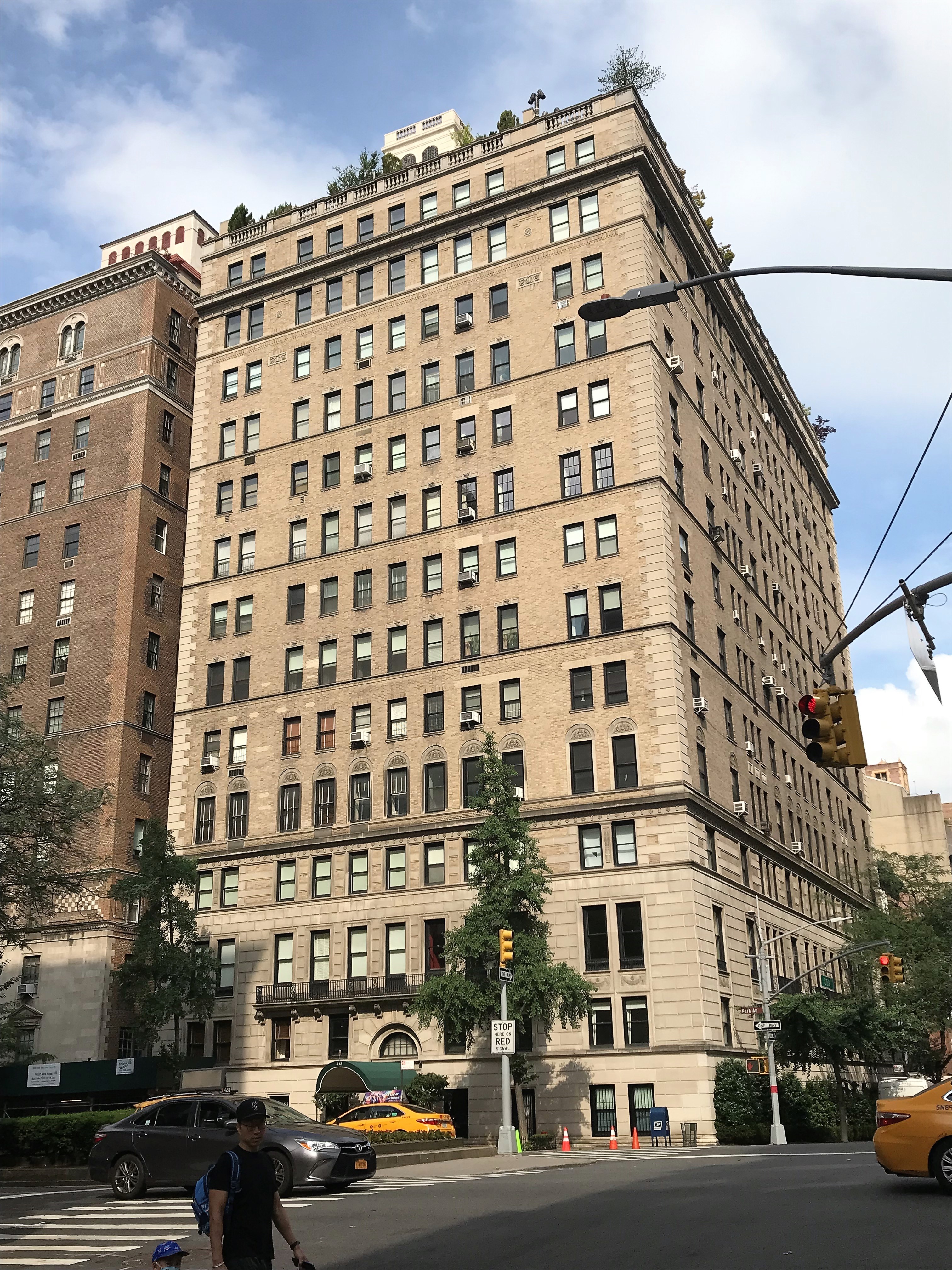
J. E. R. Carpenter's 1927 812 Park Avenue


The carefree 1920's saw luxurious apartment buildings rising along Park Avenue, Upper Fifth Avenue and Central Park West.  In 1927 the newly formed 812 Park Avenue Corp. demolished nine rowhouses at the corner of East 75th Street and Park Avenue and hired J. E. R. Carpenter to design another.  

Construction was completed before the end of the year.   Carpenter's tripartite neo-Renaissance design forewent ostentation in favor of quiet dignity.  Sitting upon a stone base sparsely decorated with carved swags, the upper floors were faced in beige brick.  In place of a terminal cornice, Carpenter crowned the building with a balustraded parapet.  His sedate design won him the 1927 Institute of Architects Apartment House Medal and Certificate for apartment houses over six stories.

The building was a cooperative structure from the beginning.  Its sprawling apartments, many of them two levels, had all the space and amenities of a private house without the worries of maintaining a large domestic staff.  An advertisement for 812 Park Avenue noted that a four-story house would cost $125,00 "plus a $100,00 mortgage," with operating expenses of about $15,000 per year.  An eleven-room suite at 812 Park Avenue, on the other hand, cost "only" $66,000 (about $983,000 today), with $6,600 annual maintenance costs.

Wealthy New Yorkers were convinced.  While the building was still under construction, leases were being signed.   On October 16, 1927 The New York Times reported that Peter Grimm, the president of the Real Estate Board of New York, had just purchased a duplex apartment.  "Other residents in the house will be E. H. H. Simmons, President of the Stock Exchange; William C. Breed of Bree, Abbott & Morgan; and Colonel Lloyd C. Griscom," said the article.  On April 5, 1928, the newspaper reported that stock broker Peter C. Maloney had purchased the "apartment occupying the corners of the thirteenth, fourteenth and penthouse floors," noting, "The apartment contains fourteen rooms and six baths."

photo by Wurts Bros., from the collection of the Museum of the City of New York

Among the early residents were sisters Elizabeth and Virginia Nicholas.  Their widowed father, wine and liquor importer George S. Nicholas, had died on September 13, 1922.  The women had three brothers, George Jr., Ridgely (who lived in Big Horn, Wyoming), and Grosvenor.

When the women moved into 812 Park Avenue, the family was engaged in a bitter court battle.  Grosvenor had been a partner in his father's firm, but problems arose and Nicholas closed the firm.  The New York Times explained, "then the son engaged in the importing business on his own account."  The tensions between Nicholas and Grosvenor became obvious when the will was read.  Nicholas's $2.75 million estate (in the neighborhood of $42.5 million today) was divided in four parts, ignoring Grosvenor, who was disinherited "because of his unfilial attitude."  Grosvenor fought the will in court for eight years.  Finally, in August 1930 it was upheld and Elizabeth and Virginia received their significant inheritances.

Decorated in the Renaissance period, the stone-walled lobby featured a coffered ceiling.  photo by Wurts Bros., from the collection of the Museum of the City of New York

Another unmarried resident at the time was Hardinge Scholle, the director of the Museum of the City of New York since 1926.  A 1918 graduate of Harvard College, he had earlier studied in Switzerland and Germany.  Following his service in World War I, he joined the staff of the Metropolitan Museum of Art, then briefly served as assistant curate of of the decorative arts department of the Chicago Art Institute.

When Scholle was appointed director of the Museum of the City of New York, it was located within Gracie Mansion.  (He later said that at the time he knew "just about as much about the history of New York as I knew about the history of Timbuctoo.")  He was responsible for the museum's relocation to its new building on Fifth Avenue between 103rd and 104th Streets.

Scholle's marriage to Elizabeth Klapp had failed.  But on April 23, 1930 The New York Sun reported that the 34-year-old was engaged to marry Eleanor Peabody.  The article noted, "The wedding is to take place the end of this month, and the couple will sail for Europe."  Perhaps the pair felt Scholle's eight-room, four bath apartment was too tight for two.  One week later the newspaper reported that Scholle had sold it to Mrs. J. B. Peake.

Merlin Hall Aylesworth was the initial president of the National Broadcasting Company, the only national network in the country when he took the role in 1926.  He and his wife, the former Blanche Minnie Parrett, had two children, Barton Jerome, born in 1910, and Dorothy, born in 1919.  The family's summer home, Dune Villa, was in East Hampton, Long Island.

Dorothy Aylesworth epitomized the young heiresses who lived at 812 Park Avenue.  On March 30, 1934, The New York Sun reported:

Miss Dorothy Aylesworth will give a dinner and theater party tonight for a group of the younger set at the home of her parents...This is to be a farewell party before Miss Dorothy returns to Miss Masters's School, at Dobbs Ferry, at the close of the Easter holidays.

After having spent the summer in Europe, Dorothy was introduced to society with a ball in the Starlight Roof Garden of the Waldorf-Astoria on November 24, 1937.  The New York Times reported, "The guests entered the roof garden through an avenue of formal trees, interspersed with tall vases of Spring flowers, which had been placed in the long foyer."

One year later, nearly to the day, Blanche Aylesworth hosted a "small tea," according to The New York Sun, for Dorothy, who was engaged to Robert G. Knott.  On November 25, 1938 The New York Times reported that Dorothy had completed the wedding plans, saying she "will have eighteen attendants" in the ceremony in St. Bartholomew's Church.  "A reception will be given at Sherry's."

Living in a 10-room duplex in the early 1950's were Leon Livingston and his wife Sara Rosen Parnis, who went professionally by Mollie Parnis.  In 1933 the couple had started a clothing firm, Parnis Livingston Inc.  Mollie's designs and her husband's expertise in fabrics made it a success.  In the 1940's Mollie Parnis began designing under her own name, and would become known for designing fashions worn by several First Ladies, including Mamie Eisenhower's inauguration suit.

On January 31, 1952 The Times Record of Troy, New York reported, "Jewel robbers struck the swank East Side again yesterday.  A three-man team looted fashion designer Mollie Parnis' Park Avenue apartment of $114,000 in jewels."  The burglars gained entrance by telling a maid that a package had been delivered to the apartment in error.  When she turned her back, they barged in.

They held two servants at gunpoint and locked Mollie and her secretary in a bathroom.  The newspaper recounted the designer's back-and-forth with one of them:

"Don't take my jewelry--it's hard to get," she pleaded.

"Yeah, but my mother needs an operation."

"If your mother needs an operation, I'll give you the money and won't tell the police," she said, directing him to a dresser drawer containing $1,500 in cash.

It turned out to be a foolish move.  The robbers took the jewels and the cash.  The heist netted them over $1.1 million in today's money.

Living here at the time were Bulgarian-born writer and playwright Michael Arlen, his wife, the former Countess Atalanta Mercati, and their daughter Venetia.  Known for his meticulous manners, The New York Times said of him, "He was admired and lionized in the fashionable circles of London and the Continent and enjoyed the prestige of a modern arbiter elegantarium on the latest styles in waistcoats and 'wisecracks.'"

Arlen's fame earned him a cigarette card.

The social circles in which the Arlens moved were evident in Venitia's introduction to society on December 19, 1951.  The New York Times reported that her mother "gave an old-fashioned reception" in the apartment.  "At the tea table during the afternoon were Princess Kyril Scherbatow and Mrs. Philip Kip Rhinelander."  Other guests were Sir Cedric and Lady Hardwicke, Cole Porter and his wife, Mrs. Vincent Astor, Princess Aga Khan, the Paul Felix Warburgs, the Edward C. Delafields and many others.

Michael Arlen's health began to fail around 1955, and he died in the apartment on June 23, 1956 at the age of 60.  His widow spent each summer afterward in Greece, visiting her family (her parents were Count Alexander Mereati and the former Harriet Wright of Cleveland, Ohio).  She was in Athens in September 1964 when she succumbed to cancer.


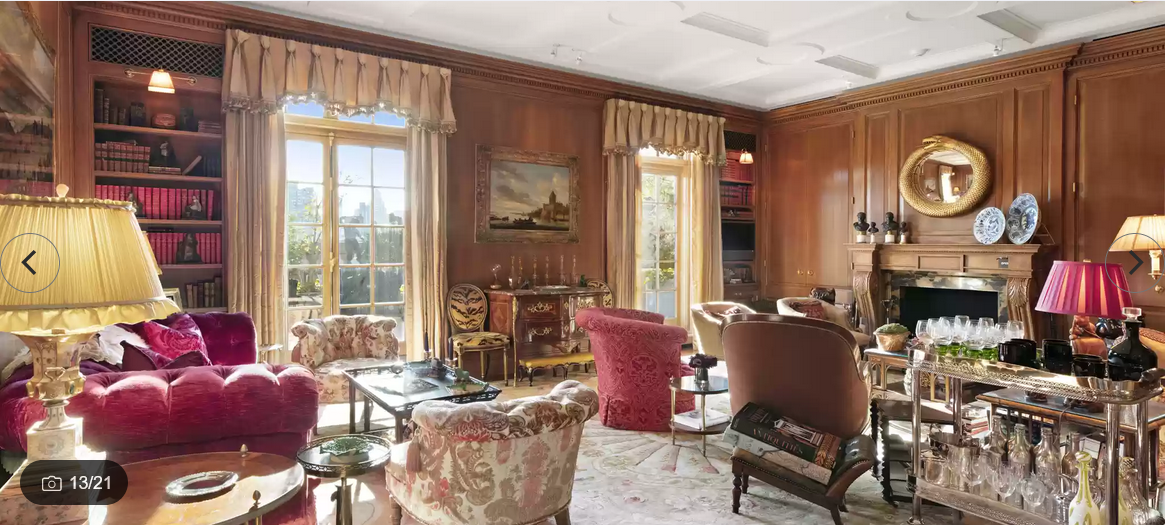
Two views of a recently-sold apartment.  images for realtor.com

Like the other luxurious Jazz Age apartment buildings along the avenue, 812 Park Avenue never lost its fashionable prestige.  Among the residents in the early 2000's were Julian J. Aberbach and his wife, Anne Marie.  Their apartment was filled with European and Latin American artworks (as was their home in the Hamptons).  


A co-founder of the music publishing firm Hill & Range, Aberbach had published the music of iconic artists like Johnny Cash, Edith Piaf, and Elvis Presley.  He owned the publishing rights to Presley's music when he died of heart failure in 2004 at the age of 95.  Following Anne Marie's death, her apartment was sold in August 2021 for $5.3 million.

photographs by the author
no permission to reuse the content of this blog has been granted to LaptrinhX.com

Wednesday, November 2, 2016

A Scandal, a Prince and a Reclusive Heiress -- 907 Fifth Avenue


photograph by the author
In the spring of 1915 the mansion of the late James A. Burden, Sr. sat on the corner of 72nd Street and Fifth Avenue.  Senator Nelson W. Aldrich was currently leasing the residence.  Directly behind it, on 72nd Street, was an undeveloped plot owned by Cornelius Vanderbilt.  Seth Barton French had intended to erect his mansion on that site; but then moved into the former William H. Vanderbilt house on Fifth Avenue and 51st Street, following Vanderbilt's death.

The Real Estate Record & Builders' Guide pointed out, "The Vanderbilt plot has been used by the Inter-Club Baseball Association during the last winter, and games were played there several times a week, weather permitting."

The baseball organization and Senator Aldrich would soon have to fine other accommodations.  A few years earlier the Burden and French families had formed a syndicate with plans to demolish the mansion and erect a lavish apartment building on the two properties.  Cass Gilbert had prepared plans for the structure.  But backlash from the millionaire neighbors put a halt to the project.

Now new owners had resurrected the idea.  The Guide noted they "will improve the site with a twelve-story apartment house, which will have specially designed suites to met the desires of the prospective tenants.  The entire investment, including the cost of the building, is estimated to be in the neighborhood of $3,000,000."  That figure would be more like $73 million in 2016.

On October 2, 1915 The Record & Guide explained "Apartment houses in the exclusive section of Fifth avenue?  Yes, although prior to the completion of the one at 998 Fifth avenue, the mere thought of such a possibility struck horror to the hearts of the residents of that thoroughfare."

The site was, indeed, squarely amid the palaces of Manhattan's wealthiest citizens.  Directly across 72nd Street were the homes of Oliver Gould Jennings, James Stillman (in the former Henry T. Sloane house), and nearby lived Louis C. Tiffany, Henry A. C. Taylor, W. Bayard Cutting and Nathalie E. Baylies.  One block to the south on Fifth Avenue was the newly-completed home of Henry C. Frick.


Architect J. E. R. Carpenter (who was also an investor) received the commission.  The Record & Guide described him as having "a wide experience in the design of multi-family houses of the better class."  This one, however, would be his crowning achievement.
A 1917 advertisement depicted the completed building.  Real Estate Record & Guide March 31, 1917 (copyright expired)

His 12-story, limestone-faced building was Italian Renaissance in style.  The owners, 907 Fifth Avenue Company, promised "Throughout the structure workmanship and materials will be the finest obtainable."  And that would have to be so--in general there was no more than one apartment per floor.  There would also be duplexes and triplexes available.  "The individual suites will consist of from 14 to 30 rooms, having five to nine bathrooms," noted The Record & Guide.

The journal said "The architect has borne in mind that the tenants of this building will no doubt entertain largely and he has reserved sufficient space for that purpose."  To that end, some of the largest apartments included a ballroom.

Regarding the "servant problem," Carpenter designed "comfortable and cheerful rooms for the servants."  In addition, tenants could lease additional rooms for butlers and valets in another part of the building.

The original tenants were able to dictate the style and decoration of their apartments.  Those signing leases while the building was under construction could choose the wood finishes, wall hangings, lighting fixtures and other elements.  Living at 907 Fifth Avenue would not come cheaply.  The least expensive apartment would cost $10,000 per year; a full floor apartment $30,000 (nearly $61,000 per month today).

On August 5, 1915 the New-York Tribune described certain amenities in Carpenter's plans.  Regarding the central courtyard, it reported "This court will be treated architecturally in the Italian style and will give an air of spaciousness as one enters the building."  As for the apartments themselves, the article noted "The rooms are of unusual size the drawing room being 21x38 feet and the dining rooms 20x26 feet.  The larger apartments have rooms for sixteen servants, while the others have rooms for seven and eight servants."

Moneyed New Yorkers were quick to sign leases.  On December 4, 1915 Herbert L. Pratt, Vice President of the Standard Oil Company, took a 28-room apartment.   In January 1916 a "prominent New Yorker" leased a 23-room, six bath apartment," and in March Charles A. Stone, President of the American International Corporation signed a lease for the largest apartment--30 rooms, including seven baths.  By now other apartments had been taken by Daniel G. Reid, Mrs. Paul Morton, Victor Morawetz and Henry Sanderson.  The building's architect and his family were also residents.

Mrs. Marcus Daly got one of the last leases, signing for her 16-room apartment in December.  Henry F. Sinclair, founder of Sinclair Oil Company, was another of the late renters, as was General Motors executive Billy Durant and his wife, who moved in in 1917.

The completed structure was not only the most exclusive apartment building in Manhattan, it was architecturally one of the finest.  J. E. R. Carpenter was awarded the 1916 Gold Medal from the American Institute of Architecture for the design.  A decade later he would receive a Diploma of Merit from the International Exhibition at Turin for the building.

For several years 907 Fifth Avenue appeared in the newspapers only as millionaire tenants gave dances and dinners, debutante entertainments, and weddings and receptions.  As they closed their Fifth Avenue apartments for the summer, newspapers followed them.  George Rives, Corporate counsel of New York City, and his wife, Sara, summered in their Newport estate; the aging E Matilda Ziegler, widow of baking powder mogul William Ziegler, had a summer residence in Noroton, Connecticut.  Her husband had left a fortune of more than $13 million in 1905.

It was Daniel G. Reid who first brought an unwanted spotlight to the exclusive address.  Reid had managed to monopolize the tin plate industry, earning himself the name "The Tin Plate King."  He had an eye for actresses and by the time he moved into 907 Fifth Avenue, he was on his third wife, former showgirl "and Casino favorite," Mabel Carrier.

Millionaire Daniel G. Reid had an eye for the showgirls.  photo from the collection of the Library of Congress

The Reids maintained an additional apartment in Paris, and a summer estate in Irvington, New York.  The Fifth Avenue apartment was filled with priceless antiques and artwork, and Margaret Reid (as she was now known) enjoyed a lavish lifestyle.  Her husband gave her a $12,000 automobile for Christmas in 1919; and her custom-designed French underwear was valued at $2,000.

It was that underwear that would cause upheaval in the Reid household.  Margaret Reid's dressmaker was Madame Gorgette, an attractive divorcee.  Margaret's personal maid, Amanda Gunnerson, later revealed "Madame Gorgette got into the habit of coming in to the Reid apartments to show Mrs. Reid samples of lingerie, and that she often interested Mr. Reid in these creations."

Daniel G. Reid, it turns out, was very interested in the frilly underthings.

Amanda Gunnerson testified that on one occasion the modiste arrived only to find that Margaret had gone to the theater.  She nevertheless displayed the lingerie to Daniel Reid, who asked if she had brought "any models."  Allegedly, Madame Gorgette replied "No, I prefer to be my own model."

The maid said that then, "Madame Gorgette showed Mr. Reid a transparent petticoat."

As Mabel Carrier, Margaret C. Reid was "the centre of lavish attention," according to The Evening World on March 1, 1919 (copyright expired)

Things got steamier after Margaret Reid left on the morning of December 5, 1918 for a week in Atlantic City.  Her good friend and dressmaker, Madame Gorgette, accompanied her to the train station, then turned around and returned to the Reid apartment.  She did not leave the entire week.

Infuriated, Margaret Reid sued for divorce.  The scandalous affair made headlines long after the divorce was granted on February 26, 1920.  The Evening World said it took the jury less than five minutes to award the divorce to Margaret.  The judge had instructed that "the only question to be answered was whether or not Reid, between Aug. 24, 1910, and June 4, 1919, had been unduly intimate with various women.  This question was answered in the affirmative."

Despite her $200,000 award and $30,000 per year alimony, Margaret wanted more.  On May 8, 1920 she sued for $325,000 worth of "several hundred items of furniture, household articles, wearing apparel and art objects" in the Fifth Avenue and Irvington residences; and $15,000 in furnishings of the Paris apartment, which Reid retained in the court decision.

Margaret's list of items filled 15 pages.  Certain of them were clearly understandable--her furs and gowns, for instance.  Others including oil paintings, Flemish tapestries, and Italian Renaissance period furnishings required discussion.  But neither Margaret nor Daniel Reid would relent on two items: a $30,000 painting of King George I, by Sir Thomas Lawrence; and their pet Pekingese purchased in London.

Reid offered to pay his ex-wife the value of the dog and portrait, as he had done for the silverware, linens, china, and antiques.  But her lawyer said that she "valued that painting personally in such a way that she will not consent to part with it for any consideration.  It is that way, too, with the 'Peke.'" The bitter contest lasted through 1921.

The ugly affair, publicized in newspapers nationally, took a serious toll on the millionaire.  He was repeatedly treated for health problems and traveled to White Sulphur Springs to recuperate.  In August 1924 his doctor, Charles F. Stokes, explained "the dominating feature" of Reid's case "was chronic alcoholism with acute exacerbations brought about by stresses incident to his marital difficulties."

On January 17, 1925, after having been bedridden in his apartment for about a week, Daniel Gray Reid died of pneumonia at the age of 66.  His estate was valued at approximately $50 million.

Another of the wealthy residents of No. 907 during the messy Reid affair was Russian Prince Vladimir Nicolaievitch Engalitcheff.  Known popularly as Val, his family had escaped the Bolsheviks.  On August 31, 1922 The New York Times informed readers that the Prince "has returned from abroad and is now at 907 Fifth Avenue."  On that voyage he and his wife, a Chicago heiress, had made friends with author F. Scott Fitzgerald and his wife, Zelda.  

Within six months the 21-year old Prince was dead in his Fifth avenue bedroom.  His obituary gave heart disease as the cause of death.  But, according to Sarah Churchwell in her Careless People: Murder, Mayhem, and the Invention of the Great Gatsby, Fitzgerald noted in his January 1923 ledger "Val Engalitcheff kills himself."

Newspapers, naturally, followed the scandalous divorce, the mysterious royal death, and other attention-grabbing stories; like the the $200,000 suit filed by Mrs. Mabel Gunther in 1922 against residents Carl Vietor and his wife (she charged them with alienating the affections of her two teen-aged children whom, she said, the Vietors conspired to "make German") and the 1926 suicide of the Charles Stone family's governess, Nancy Bamlet, who threw herself from an 11th story window on January 21, 1926.
Before Mrs. Charles J. Liebman moved into her duplex apartment, she had it remodeled in Art Deco style.  photos by Sigurd Fischer from the collection of the Museum of the City of New York

So when Anna Eugenia La Chapelle Clark and her daughter moved into No. 907 Fifth Avenue in 1926, it drew little notice.  Like Mabel Carrier, Anna had been a showgirl before she met former Montana Senator  and copper tycoon William C. Clark.  When the much-despised millionaire died in his gargantuan mansion on Fifth Avenue and 77th Street on March 25, 1925, Anna Clark wasted little time in searching for new accommodations.

Anna and her daughter, Huguette Marcelle Clark, moved into a 14-room apartment which included four bedrooms.  According to Meryl Gordon in her The Phantom of Fifth Avenue, "In November 1926 Anna went on a spending spree to decorate the new abode, buying antiques from the London firm Charles, including a $3,500 Queen Anne walnut wing chair with needlepoint and a $4,000 William and Mary sofa covered with seventeenth-century tapestry.  She also spent $13,500 for a Louis XV sofa and five armchairs, and ordered thirty yards of blue chenille carpet for Huguette's suite of rooms.  The soothing color matched Huguette's eyes."

The Clarks' 12th floor apartment --floorplan via Brown Harris Stevens

Hugette was born in 1903, two years after her sister Andree.  Although Clark reported that he and Anna had secretly married prior to the first pregnancy, no documentation was ever found.  Huguette's legitimacy was, therefore, long a matter of speculation.  The $150 million estate left by her father, however, prompted society to ignore the issue.

By the time the Clark women moved in, J. Edwin R Carpenter had become President of the 907 Fifth Avenue Company.  He and his family still lived here, and on October 22, 1921 the wedding of daughter Marion Stires Carpenter to Milton Dorland Doyle took place in the apartment.  Now, the same month that Anna Clark was shopping for furnishings, Carpenter sold the building to William Ziegler, Jr. for $3.25 million.

Huguette, in the meantime, was visible in society.  That same month, on November 22, 1926, she hosted a debutante luncheon at Pierre's for Carolyn Storrs.  (Carolyn was the daughter of Frank Vance Storrs, the founder of Playbill.)  Huguette's own introduction to society happened that same season.

Huguette (left) and her mother, Anna.  photo via finda grave.com

The following year, on December 13, 1927, Anna Clark announced the engagement of Huguette to William Macdonald Gower.  The Times noted "The engagement is of wide interest to society here and in California."  In preparation, Anna leased and decorated an 8th floor apartment for herself, so that the newlyweds could take over the 12th floor suite.

All of New York society anticipated a fashionable Fifth Avenue wedding.  Instead, Huguette and Gower were married quietly in the Clarks' Santa Barbara estate, Bellosguardo, on August 17, 1928.  A local newspaper explained "The wedding will be extremely quiet, with only members of the family present and there will be no attendants."

The wedding, in fact, was nearly an arranged marriage.  Anna Clark agreed to pay William Gower a $1 million dowry.  And the sheltered Huguette had not been prepared for marriage.  Not realizing what sex was about, the wedding night was disastrous.  According to biographer Meryl Gordon, she later told a confidante, "It hurt, I didn't like it." 

Although the couple moved into 907 Fifth Avenue and appeared in public as Mr. and Mrs. William MacDonald Gower, Huguette focused on her painting.  (Seven of her works had been exhibited at The Corcoran Gallery from April 28 to May 19, 1928.)  But domestic life was not good in the 12th floor apartment.

On June 23, 1928 The New York Times mentioned "Mrs. William Andrews Clark and Miss Huguette Clark of 907 Fifth Avenue will leave late next week for Santa Barbara, Cal., where they will remain for the Summer."  No mention was made of Bill Gower and society column readers could not have missed the fact that Huguette was using her maiden name.


She and her husband separated in 1929 and divorced in Reno on August 12, 1930.  She claimed desertion and he said that the marriage had never been consummated.  The New York Times reported "Her mother accompanied her to Reno and they brought half a dozen servants, including a butler and a secretary, with them."

The exclusive apartment building was thrown into panic on July 22, 1931.  Most of the sprawling apartments were closed for the summer as the residents went off to their country estates.  The family of Cornelius F. Kelley, President of the Anaconda Copper Mining Company, had recently left for Butte, Montana.  Their 23-room duplex apartment was filled with "a library of many books, works of art, and valuable furniture," according to The Times.

By the time smoke was discovered seeping out of the apartment that morning, a fire had made substantial headway inside.  Firemen found "the foyer, the huge music room, and the library a mass of charred ruins.  The costly carved oak paneling on the walls was glowing charcoal.  All that remained of a grand piano were the metal strings  The morocco-bound works of famous authors were paper embers."

Although the Kelley apartment suffered $200,000 in damages; no other apartments were affected.  Samuel Herzog, owner of the building, said "the fireproof structure, one of the finest in Fifth Avenue, had stood the test."

Although Anna Clark's name continued to appear in the newspapers as she made generous charitable donations over the decades, both she and her daughter withdrew from society.  There were no entertainments given.  Nevertheless, one staff member, according to Warren Allen Smith's Unforgettable New Canaanites, "thought the two were not 'odd or strange,' but rather 'quiet, loving, giving ladies.  Allegedly distrusting outsiders as well as her family thinking that they were after her money, [Huguette] conversed in French because others would likely not understand."

In October 1950 the owners of the building began a "remodeling operation" which would more than double the number of apartments.  It was a nice way of saying they were dividing the mansion-sized apartments.

Anna Eugenia La Chapelle Clark died in her apartment on October 11, 1963 at the age of 83.  Huguette lived on at No. 907 Fifth Avenue, keeping the 12th floor apartment and the two which made up the 8th floor, including her mother's.  She had, in total, 42 rooms in the building.

By now she had essentially been lost to society's memory, and she withdrew into her personal reality.  Along with her painting, Huguette occupied her time with doll collecting--a collection valued in the millions of dollars by the time of her death.

The last residents and staff of 907 Fifth Avenue would see of Huguette Clark was in 1991 when she was admitted to Beth Israel Medical Center for skin cancer.   Following treatment she decided to live there.  Her Fifth Avenue apartments, her Santa Barbara estate, and her country residence in New Canaan, Connecticut, were staffed and maintained for decades as if she would be returning the following day.  (She bought the Connecticut residence in 1951, but never slept a night there.)

Building staff at 907 Fifth Avenue were instructed to accept packages, flowers and mail as if she were still there.  No information was to be given out regarding her whereabouts or condition.

The name of Huguette Marcelle Clark would be finally thrown into the spotlight following her death, just two weeks before her 105th birthday.  The public was consumed by the story of the eccentric recluse who left an estate of $400 million.

In 2012, even while her estate was being hotly contested, the three apartment were put on the market for a total of $55 million.

Despite the 1951 downsizing of the apartments, 907 Fifth Avenue continues to be one of Manhattan's most exclusive addresses.  And J. E. R. Carpenter's award winning design continues to draw praise.

photographs by the author
many thanks to reader John Chalupa for suggesting this post