Showing posts with label east 77th street. Show all posts

Friday, December 12, 2025

The Edward T. and Viola B. Cockcroft House - 59 East 77th Street


When John McNerney commissioned architect Thomas S. Godwin to design eight rowhouses on the north side of East 77th Street between Madison and Park Avenues, their resulting brownstone faced, high-stooped design was all the rage.  Nathan and Sophia Meyer occupied 59 East 77th Street in the 1890s.  The couple held "one of the large entertainments of the week," as described by the New York Herald, to celebrate their anniversary on December 30, 1899.

In 1907 Nathan Meyer sold 59 East 77th Street to Edward T. and Viola B. Cockcroft.  Before the new owners moved in, the Meyers arranged an auction of the home's "rich household furnishings."  Among the items were a "gold drawing room suit in Belleville tapestry, gold Vernis-Martin and mahogany specimen cabinets," and a "rosewood and bronze mounted Chickering upright piano."

The English basement--or high-stooped--design had fallen from fashion by now.  The Cockcrofts hired the architectural firm of Albro & Lindeberg (which had designed their country home on Long Island, "Little Burlees," in 1905) to bring their townhouse into the Edwardian era.  Plans were filed on May 25 and the following day the New-York Tribune reported, "It will be made over into a five story building with a facade of the early English style of the Tudor period, with a tall ornamental bay with a balcony."

The Cockcrofts moved temporarily into the Hotel Leonari while the $20,000 project progressed.  (The figure would translate to about $689,000 in 2025.)  The transformation was staggering.  Albro & Lindeberg removed the stoop and replaced the brownstone with variegated Flemish bond brick.  The tripartite design included a stone-framed centered entrance, above which was a dramatic two-story metal infill of multi-paned windows fronted by a faux balcony with a filigree railing.  A touch of Arts & Crafts was introduced at the fourth floor with inset diamond patterns and a projecting cornice with elongated brackets.  The architects recessed the fifth floor behind a brick parapet, thereby providing a terrace.

The American Architect, October 16, 1908 (copyright expired)

Architectural critic Montgomery Schuyler, writing in The American Architect, addressed Albro & Lindeberg's motive in melding the second and third floors "into a single feature."

This composition assumes that the two selected stories are of equal importance and equally worthy of signalization, which is often true in case, for example, one contains the drawing-room and the other the library.

The second, or piano nobile, of the Cockcroft house was considered the first floor at the time.  It held the drawing room and dining room, separated by a generous stair hall.  On the third floor were the main bedroom and library, while the fourth contained bedrooms.

The American Architect, October 16, 1908 (copyright expired)

Edward T. Cockcroft was an antiques dealer and decorator.  If he and Viola intended to live in their remodeled home, they changed their minds.  On October 25, 1908, The New York Times reported that they had leased the house to newlyweds Michael Dreicer and his wife, the former Maisie Saville Shainwald.  The article noted that the couple had just "returned from Europe, where they have been motoring for several months."  (The trip was, in fact, their honeymoon.)

Born in Russia in 1867, Dreicer was a partner in the jewelry firm founded by his father, Jacob Dreicer.  During the couple's one-year residency, their names repeatedly appeared in the society columns.  On November 15, 1908, for instance, The New York Times reported, "Mr. and Mrs. Michael Dreicer will give an at home on Saturday at 59 East Seventy-seventh Street."  And on February 14, 1909, the newspaper announced, "Mr. and Mrs. Michael Dreicer...sailed a short time ago for a trip which will include London, Paris, Monte Carlo, and the Riviera."

Upon their return, the Dreicers purchased the mansion at 1046 Fifth Avenue.  On July 17, 1909, the Record & Guide reported that the Cockcrofts had sold 59 East 77th Street.  It was purchased by Samuel Owen Edmonds and his wife, the former Lillian Coles.  Born in 1869 and 1872 respectively, they had a daughter, Helene Ormonde.  Edmonds was a patent attorney and the counsel for the General Electric Company.

The Edmonds' family was increased in 1913 by a horrific tragedy.  Lillian's sister, Gertrude Schermerhorn Coles, was married to architect Robert A. Raetze.  The couple had two sons, one-year-old Stuart Coles, and two-year-old Griswold.  The family's country home was in Stamford, Connecticut.

On the afternoon of January 5, the Raetzes were entertaining Professor John Darnall.  The family's Christmas tree was still up, and, according to The Sun, "It was aglow with candles."  While the three were at tea, the nurse, Mary Gould, prepared the boys' bath.  Suddenly, Raetze ran upstairs, yelling to the nurse to get the children out, "The Christmas tree has set fire to the house!"  He was followed closely by his frantic wife.

Mary went to a rear window and screamed for help.  A maid from next door, Kate Kenny, ran out onto the roof of the extension of that house.  "She held out her hands and the Raetzes' nurse handed little [Stuart] to her," said The Sun.  "Then Miss Gould swung herself across and was safe."  In the meantime, Professor Darnall had found Griswold and carried him to the street.  Tragically, the bodies of Robert and Gertrude Raetze were found together on the third floor of the ruins.  

The article said, "The two children went to the home of their aunt, Mrs. Samuel Owen Edmunds [sic]."  Stuart and Griswold would remain with the Edmonds and were soon adopted by the couple.

Eleven years later came Helene's debut.  During Christmas week 1924, the Edmonds hosted a dance at Sherry's.  It was followed on New Year's Day by a reception, "where they will introduce to the older friends of the family, their daughter, Miss Helene Ormonde Edmonds," according to The New York Times on January 1, 1925.

Now introduced, Helene's name would be included in the society columns.  On May 1, 1925, The New York Times announced, "Mrs. Samuel Owen Edmonds and her daughter, Miss Helene Ormonde Edmonds, of 59 East Seventy-seventh Street have gone to their country place at Stamford, Conn."

That year, however, Stuart Coles Edmonds would steal Helene's social spotlight.  On February 14, 1925, his engagement to Audrey Barclay Ulman was announced.  The New York Times remarked, "The engagement is of wide interest in New York, with which city the ancestors of both young people have been identified for generations."  Stuart was by now associated with Standard Oil Company.  The article noted, "Mr. Edmonds is a grandnephew of the late Mrs. Elizabeth Coles, whose mansion was at 677 Fifth Avenue and among whose legacies was the gift of a set of tapestries now hanging in the Cathedral of St. John the Divine."

Stuart gave "his bachelor dinner" in the East 77th Street house four days before his wedding on April 21, 1925 in St. Bartholomew's Church.  The newlyweds moved into 65 East 96th Street where their first child, Audrey, was born on March 27, 1926.  The christening was held in the East 77th Street drawing room on New Year's Day 1927.

It was the last happy gathering that the Edmonds would host in the house.  Nineteen days later, on January 20, 1927, Samuel Owen Edmonds died at the age of 57.  His funeral was held in the drawing room two days later.

Soon afterward, Lillian sold the house to Walter Palmer Anderton and his wife, the former Ethel W. Kingsland.  The couple had two daughters, Audrey Kingsland and Helen Elizabeth, eleven and one year old respectively.  Anderton had been an Assistant Visiting Physician for the Presbyterian Hospital since 1918.  Ethel was a cousin of millionaire Newbold Morris and the granddaughter of Ambrose C. Kingsland, Mayor of New York from 1851 to 1853.  A year after moving into the 77th Street house, Walter Anderton was appointed chief of Vanderbilt Clinic.  

Shortly before noon on November 8, 1940, Audrey, who was now 24, went to 340 East 57th Street to visit her cousin, Countess Seherr-Thoss.  (The countess before her marriage was Marian Kingsland.)  The women planned to have luncheon at 1:15.  According to the countess, Audrey "was in good spirits and spoke with pleasure of the Bundles for Britain Ball that she had attended the night before at the Hotel Waldorf-Astoria," as reported in The New York Times.  At one point the countess and her maid walked to a different part of the apartment.  When they returned a few minutes later, Audrey was gone.

The women looked out the open window and saw Audrey's body on the pavement.  The New York Times reported, "As she fell to the courtyard, which was below street level, she screamed, attracting the attention of neighbors and passers-by."  Audrey was under the care of a nerve specialist and the police listed her death as "fell or jumped."

The Andertons sold 59 East 77th Street to W. Boulton Newbold & Associates in April 1956.  The New York Times reported they "plan to convert the structure into a five-unit cooperative apartment building."  The configuration lasted until a renovation completed in 2001 returned it to a single family home.


The mansion was offered for sale in May 2011 at $18.7 million.  It was finally sold in April 2012 for the reduced price of $11 million.

photographs by the author

Friday, November 21, 2025

The Emanuel Kaplan House - 67 East 77th Street


John McNerney completed construction of eight four-story-and-basement homes on East 77th Street between Park and Madison Avenues in 1877.  Designed by Thomas S. Godwin, they were three bays wide and faced in brownstone.  Godwin likely designed the row in the Italianate or neo-Grec design.


67 East 77th Street would have been similar to this house, across the street.  from the collection of the New York Public Library.

John Owen Mott and his wife, the former Caroline E. Mors, purchased 67 East 77th Street.  The couple had three young children, Augusta, Joshua Mors, and Nellie.

An attorney, Mott was born in Half Moon, New York on October 18, 1829.  After serving in the Civil War, he was elected Assistant United State District Attorney for the Southern District of New York.  

John O. Mott gained a reputation for his unbending discipline and harsh sentences.  In 1882, he charged that New York Police Captain Gunner was negligent.  The New-York Tribune explained, "The charges were that the police had allowed dirt to be dumped in the streets, in front of private residences, in violation of the city ordinances."  Gunner retaliated, telling the Police Board on June 2:

For the most of the last week the roadway in front of No. 67 East Seventy-seventh-st. was strewn with about three cart-loads of old plaster and other rubbish taken from Mr. Mott's house, while it was being repaired.  To my surprise, on visiting that house today, I found nine empty lime barrels and some old lumber in the street immediately in front of it.

In 1891, 17-year-old Joshua Mors Mott contracted "consumption"--the 19th century term for tuberculosis.  Rather than send him to a sanitarium, which were often grim, his parents opted to have him treated at home.  Three years later, on November 27, 1894, the New-York Tribune reported, "Joshua M. Mott, only son of Assistant United States District-Attorney John O. Mott, died yesterday at his home, No. 67 East Seventy-seventh-st."  His funeral was held in the parlor on the 28th.

The following year was much more positive for the family.  In 1895, John O. Mott was appointed a city magistrate, and on December 8, The New York World reported, "One of the big home weddings of the week will be that of Miss Nellie Mott and Mr. Stephen K. Watts."  The article said that the house would be "trimmed with a profusion of choice flowers and exotics" and noted, "There will be as many as five hundred guests."  On December 13, the day after the ceremony, the New-York Tribune reported it was, "followed by a large reception."

By the turn of the century, John Mott was experiencing health problems.  On June 27, 1901, The New York Times reported, "City Magistrate John O. Mott who has been ill at his home, 67 East Seventy-seventh Street, from a heart affection, was improved last evening, and it was said he would probably go to the country today."  Caroline's health, too, was failing.

On August 25, 1902, Mott did not attend court, "owing to the serious illness of his wife," according to The New York Times.  The article said, "Mrs. Mott has been ill for some time, but on Thursday night her condition took a turn for the worse, and last evening it was said at the house that she was not expected to recover."  Caroline died on August 30 at the age of 62.  The New York Times reported, "Magistrate Mott, who has been ill for some time, was reported yesterday to be much improved, and it is expected that he will be well enough to attend his wife's funeral."

Now only he and Augusta remained in the house.  Mott's continuing health problems became untenable for some of his colleagues.  On June 23, 1903, attorney Charles P. Blaney filed papers seeking Mott's removal from the bench.  They charged that he had "been for eight months past physically and mentally incapable of attending [his] duties."  Three months later, on September 25, The New York Times reported, "Magistrate Mott, who entered a sanitarium in Darien [Connecticut] several weeks ago almost a total wreck physically and mentally, has been gaining wonderfully in mental and physical vigor."  Nevertheless, the respected jurist would never leave the facility.  He died on August 11, 1905 and his body was returned to the East 77th Street house for his funeral.  

John O. Mott's estate sold 67 East 77th Street in April 1906 to Julia K. Benjamin.  In May 1908, she hired architect Charles A. Rich, whose plans called for "enlarging and partly remodelling [sic]" the house.  (The "enlarging" most likely was an addition to the rear.)  Benjamin leased the remodeled residence to attorney Dudley Davis and his wife, the former Alice M. Grosvenor."

The couple maintained a home in Newport.  While living here, their three children were born--Dudley in 1909, Rose Grosvenor in 1912, and William Grosvenor in 1914.

Emanuel Kaplan purchased 67 East 77th Street in August 1922.  A month later, on September 16, the Record & Guide reported that he had hired George and Edward Blum to "alter" the architecturally outdated house.  The architects removed the stoop and the brownstone front and gave it a neo-Colonial remake.  The centered entrance sat within the understated, limestone-faced ground floor.  The upper floors were clad in red brick and trimmed in limestone.  At the second floor, a triple arcade of French windows opened onto a faux balcony.  The third and fourth floor windows wore splayed lintels with layered keystones.  The renovations cost Kaplan the equivalent of $281,000 in 2025.

via the NYC Dept of Records & Information Services.

Kaplan's residency would be short-lived.  In May 1926 he sold it to Rembrandt Peale, Jr.  Born on July 18, 1895, Peale was the grandson of the famous artist Rembrandt Peale.  He and his wife, the former Helena Daly, had two children.  It does not appear that the family ever resided here, but leased it.  Living here in 1927 was lawyer and author Eliot Norton and his wife, the former Margaret P. Meyer.  A writer of broad interests, among his works were On Sales of Securities Through a Stock Broker and Lincoln, Lover of Men.

Adrienne Fogg purchased the house around 1941.  He sold it in 1951 to Manfred Landers who converted the basement to an apartment.  Industrialist, film producer, poet and philanthropist Hyman J. Sobiloff and his wife, Adelaide, lived in the main portion in the 1960s.  Sobiloff's first film,  the 1959 Montauk, was nominated for an Academy Award; and his second, the 1960 Central Park, was selected as a United States entry in the International Film Festival in Venice.

A colorful chapter in the history of the house began in 1981 when Morris Levy purchased it for $525,000, according to Richard Carlin's Godfather of the Music Business.  Levy was a co-founder of Roulette Records and of the Birdland jazz club.  According to the Philadelphia Inquirer on June 25, 1987, Levy eventually owned more than 90 businesses with 900 employees.

Also highly involved in Levy's businesses was gangland boss Vincent "the Chin" Gigante, head of the Genovese crime family.  Gigante lived in Greenwich Village with his wife, Olympia Grippa, whom he married in 1950.  His long-term mistress, Olympia Esposito, was listed as a vice president of Roulette Records.  (FBI agents referred to Gigante's wife as "Olympia 1" and Esposito as "Olympia 2.")  In 1982, a year after purchasing 67 East 77th Street, Levy sold it to Olympia Esposito.  The real estate records reflected that she paid  $490,000, although a later investigation by The Village Voice revealed the price was actually $16,000.

Richard Carlin writes,

After she moved in, Gigante visited the apartment secretly each night after midnight to sleep with Esposito and stage private meetings with his cohorts.  However, after discovering a small pile of plaster dust on the dining room floor, Gigante realized the house was not secure; the FBI had rented an apartment next door and had attempted to plant a bug by drilling through Esposito's ceiling.

Gigante and his wife had five children, Andrew, Salvatore, Yolanda, Roseanne and Rita; and he and Olympia Esposito had three children, Vincent, Lucia and Carmella.  

Vincent Gigante's 1960 mugshot.  via the United States Department of Justice.

Olympia Esposito died in June 1985.  Despite her death, the mobster continued to use 67 East 77th Street.  In reporting on Gigante's sanity hearings on December 29, 1989, The New York Times reported, "Detectives say he has often spent evenings in a white-brick, four-story town house at 67 East 77th Street, near Park Avenue.  City real-estate records list the owner of the building as Olympia Esposito."  

Vincent Louis Gigante was convicted of racketeering and conspiracy in 2003.  He died in the United States Medical Center for Federal Prisoners on December 19, 2005.  His and Olympia's son, Vincent, had inherited the East 77th Street house.  He sold it in 2002 to Nantasit Chitpredakon for $420,000.


Regrettably painted today, the house still has an apartment in the basement level.

photographs by the author

Saturday, April 20, 2024

Boak & Paris's 1940 170 East 77th Street


Bronx natives, brothers Sidney R. and Arthur W. Diamond both held law degrees from Columbia University.  But they turned their focus to real estate, becoming major players in the erection and management of apartment buildings.

In 1939, the Diamonds hired the architectural firm of Boak & Paris to design a 10-story-and-penthouse apartment building on the site of four vintage brownstones at 166 through 172 East 77th Street between Third and Lexington Avenues.  Clad in beige brick, it was completed the following year.  Typical of Boak & Paris's designs, the central portion was recessed, allowing for dramatic chamfered corner windows.


The cover of the 1940 real brochure showed the original casement windows.

Potential residents could choose apartments of 3, 3-1/2 or 4 rooms with one or two baths.  A brochure boasted, "unusually large rooms, dropped living rooms, dinettes, glass-enclosed stall showers" and "modern steel casement windows specially equipped with fresh air ventilators."  A modern amenity was the "radio outlet in each living room."

Each of the six penthouse apartments had a terrace.  On June 22, 1940, The New York Times reported that Arthur David, president of Edward Davis, Inc., meat dealers, had taken a penthouse "which is to be built to his specification by Sidney and Arthur Diamond."  The article noted, "the house is nearing completion."

Penthouse floor plan -- from the 1941 real estate brochure

Four months later, William H. B. Cooper and his wife, the former Gertrude Cooper, leased the last penthouse.  At the time, The New York Times reported that the building was 95 per cent rented.  Cooper was the son of Senator Charles Cooper.  He and Gertrude had been prominent in Brooklyn society before moving to Manhattan, and owned a summer home in Hempstead, Long Island.

Living here at mid-century were insurance agent James L. Feder, his wife, the former Irma Rosenberger, and their daughter Jane.  Jane had attended the Riverdale Country School before entering Wellesley College.


Theodore C. Garfiel and his wife lived here by the early 1960s.  Born on May 1, 1905, Garfiel graduated from Columbia in 1924 and remained highly involved in the school's alumni activities.  From 1962 to 1964 he served as vice chairman of the board of the Association of the Alumni of Columbia College, and in 1964 was elected president of the association and chairman of the board.

Resident Daniel Greenberg was the only patron in the Golden Goose Bar and Restaurant on West 23rd Street at 10:30 on the morning of February 9, 1971 when a gas explosion tore through the building.  The New York Times reported, "The blast ripped out almost all of the roof of the 20-by-100-f0ot one-story structure, shattered the masonry floor and blew out the windows."  The shock of the explosion broke windows on both sides of the little structure and across the street.

Amazingly, no one was killed.  Five employees were rescued by firefighters.  One of them, waitress Marie Colocrai, was pinned under a table under a pile of debris.  All but one were admitted to Bellevue Hospital.  Daniel Greenberg escaped with head injuries and cuts.

Living in a fifth-floor apartment at the time were Frank and Mildred Knight.  During the 1930s and '40s, Knight was a well-known radio personality, the announcer for the Longines  sponsored Symphonette, a weekly program of light classical music, and its Choraliers program.  In the 1950s he was the announcer of the Columbia Broadcasting System's television program Chronoscope.

Born in St. John's, Newfoundland, Knight served with the Royal Newfoundland Regiment during World War I, and studied medicine at McGill University before turning to acting.  He landed several Broadway roles, but discovered his voice was best suited to radio.  He first worked as a news reporter in 1926.

In 1952, The New York Times television editor Jack Gould said that Knight delivered his commercials "with an almost cathedral formality.  They tend to induce such a feeling of social inadequacy that a viewer might be forgiven if he found himself wondering whether he was really eligible to buy the product."

In 1970, Knight teamed with Jack Benny to narrate the recording The Golden Age of Radio, produced by the Longines Symphonette Society.


At around 9:45 on the evening of October 9, 1973, a fire broke out in the Knights' bedroom.  Mildred, who was 77 years old, had been bedridden for several years.  Knight, who was two years older, was unable to get her out of the apartment as the fire spread.  She was burned to death and Knight seriously injured.  The fire was confined to the couple's apartment.

Ten days later, The New York Times reported, "Frank Knight, who was a radio and television personality in the days of Graham McNamee, Ted Husing and Kate Smith, died yesterday at the Lenox Hill Hospital.


Known today as Diamond House, at some point its multi-paned casement windows, so important to the Boak & Paris design, were replaced.

many thanks to reader Lowell Cochran for suggesting this post
photographs by the author
no permission to reuse the content of this blog has been granted to LaptrinhX.com

Saturday, April 13, 2024

Boak & Paris's 1941 177 East 77th Street


Russell M. Boak and Hyman F. Paris both worked in the office of architect Emery Roth.  They struck out on their own and in 1927 established the office of Boak & Paris.  Like Roth's, the firm quickly became known for designing apartment buildings.

In 1940, developers Sidney and Arthur Diamond hired Boak & Paris to design an 11-story-and-penthouse building on East 77th Street, just west of Third Avenue.  The New York Times noted, "The plot runs through to Seventy-eighth Street, and on that side will be transformed into a large garden for the benefit of the tenants."  The architects introduced two innovations--one structural, the other aesthetic.  On July 6, 1941, the newspaper headlined an article, "Bolting Replaces Riveting on New Building; Each Suite in East Side House Has Terrace."

The foregoing of riveting in favor of bolting the girders and columns together made the process nearly noiseless.  Sidney and Arthur Diamond told the reporter that the exterior brickwork, completed within 30 days, had "set something of a record for this type of work."  The article explained the rapid process.

As the steel construction progressed from floor to floor the concrete workers poured the concrete floor in at a pace that kept them constantly within two floors of the steel workers.  When the concrete workers reached the seventh floor the bricklayers started their task, and when the brick work reach the sixth floor, work on the partitions began.

The reporter noted, "For a while the steel men, concrete men and bricklayers were all working at the same time."  At the time of the article, fully 50 percent of the apartments had been leased.  The renting manager, Charleton Otis, explained, "The private terraces for every apartment, the 11,000 square feet of landscaped, private garden adjoining the building, the spaciousness of the rooms and the architectural design of the building have been strong attractions."

The abundance of balconies was possible because the Goelet family, from whom the Diamonds purchased the plot, had erected a two-story store-and-apartment building on the Third Avenue blockfront in 1936.  The Diamonds took the bold gamble that no tall building would replace it.

Clad in sandy-colored brick, Boak & Paris's streamlined Art Moderne design included an understated entrance with incised Mayan-type designs.  No other ornamentation graced the facade.  The architects used 45-degree chamfered corners on the sides of the recessed section above the entrance--a feature they had used on another Stanley and Arthur Diamond building at 160 East 89th Street in 1937.

from the 1941 real estate brochure "177 East 77th", in the collection of the Columbia University Libraries

An advertisement in September 1941 touted, "52 apartments, each with private terrace.  Already 90% rented.  11,000 sq. ft. of private garden, roof garden, 3-4 rooms each."  The real estate brochure boasted, "seven large closets in four room apartments...five large closets in three room apartments...glass enclosed stall showers."

Among those who signed leases during construction were two physicians, Dr. Mary Dunne Walsh and Dr. Jules Victor Coleman; and Malcolm S. McNaught, a sales manager for the McGraw-Hill Publishing Company.

Mary Dunne Walsh had received her medical degree from Johns Hopkins in 1921.  Seven years before she moved into 177 East 77th Street, her name had appeared in newspapers nationwide for decidedly non-medical reasons.  She sued a socially-prominent female stockbroker and exposed a corrupt scheme.

In 1924, Edna V. O'Brien opened a private stockbrokerage business.  Time magazine described her as "an energetic, middle-aged spinster who had fought the good fight for women's votes, who was a lieutenant in an ambulance unit but did not get to France, who was a good friend and committee-mate of many of Manhattan's ablest socialites."

Boak & Paris managed to wrangle a balcony or terrace to every apartment.  from the 1941 real estate brochure "177 East 77th", in the collection of the Columbia University Libraries

Among O'Brien's clients were Anne Morgan, Elizabeth Marbury and Amelia Earhart Putnam.  Dr. Walsh had entrusted her with $80,000 to invest.  In December 1932, according to Time, "On the complaint of Dr. Mary Dunne Walsh...Miss O'Brien was hauled before the New York State Bureau of Securities.  She refused to answer questions." 

Investigators discovered that Amelia Earhart Putnam had lost $150,000, according to the article.  On February 11, 1933, The New York Times reported that Edna V. O'Brien had been arrested after the grand jury issued "four indictments charging theft of between $50,000 and $80,000 in securities from Dr. Mary Dunne Walsh."  (Dr. Walsh's loss would translate to as much as $1.9 million in 2024.)

Dr. Victor Coleman had earned his B.A. degree at Cornell University in 1928, and his medical degree in Vienna, Austria in 1934.  America's entry into World War II drastically changed his life.  He was sent with the U.S. Army Medical Corps overseas as a psychiatrist attached to the 38th Infantry Division.  The United States Army's Neuropsychiatry in World War II later explained that while working "with combat casualties in the forward area during the Luzon Campaign, [he] was able to return 70 percent of his patients directly to duty from the clearing station."

Dr. Jules Victor Coleman, Journal of the Kansas Medical Society, 1950

Coleman was listed at 177 East 77th Street as late as 1943, when he was promoted from First Lieutenant to Captain.  But it does not appear he returned here following the war.  In 1950, he was living in Denver, Colorado where he was president of the American Association of Psychiatric Clinics for Children.

In 1946, Sidney and Arthur Diamond bought the two-story building on Third Avenue from the Goelet family, preserving the eastern exposure of 177 East 77th Street at least for the foreseeable decades.


A celebrated resident was violist Max Rosen, who lived here with his sculptor wife, the former Gertrude Buchbinder.  Born in Romania in 1900, Rosen's family emigrated to New York when he was eight months old.  They lived in the impoverished Lower East Side where Max's father ran a barber shop at Rivington and Forsyth Streets.  According to The New York Times, "It was in the rear of this barber shop that Max Rosen learned the rudiments of the violin from his father," and he was "able to play difficult compositions at the age of 7."  Friends of his father, astonished at the boy's playing, arranged to send him to the Music School Settlement.

There he continued to amaze professional musicians.  When the banker and founder of the Flonzale Quartet, Eduard de Koppe, heard the 12-year-old play, he sent him to Dresden, Germany to study with famed violinist and instructor Leopold Auer.  Max Rosen returned to New York in 1917 and debuted as a soloist with the New York Philharmonic Orchestra on January 12, 1918 at the age of 18.

Max Rosen at the age of 18.  from the collection of the Library of Congress

Rosen appeared throughout the world with major symphonic ensembles before his retirement, after which he used his 77th Street apartment to teach.  He died from a cerebral hemorrhage on December 16, 1956 at the age of 56.

Not only did television and motion picture producer William A. Berns live here, but so did his brother and partner Samuel D. Berns.  

In the 1940s William Berns joined the National Broadcasting Company, producing the show While Berns Roams and acting as emcee for the radio game show Say It With Acting.  In the 1950s, he worked with several radio and television stations.

Then, in 1960, he joined the staff of Robert Moses's New York World's Fair 1964-65 Corporation as vice president in charge of communications.  That year he traveled internationally to promote the fair to other nations.  During the second year of the fair he served as its director of television, radio and motion picture publicity.

At the fair's end, Berns again turned to producing.  He produced the 1970 film The Gamblers, and was executive producer of Mel Brook's The Twelve Chairs, released the same year.  In 1970, he also partnered with Samuel Bern in film importing and packaging.

The Bern brothers were born in Philadelphia.  Samuel D. Bern lived here with his wife, the former Ruth Horne.  Before going into business with William, he had been on the staffs of Film Daily and Variety, and was at one point the West Coast editor for Quigley Publications.


The 1941 real estate brochure for 177 East 77th Street had touted, "steel casement windows specially equipped with fresh air ventilators."  Unfortunately, those windows--so important in Boak & Paris's design--have been replaced.  Otherwise, the building is little changed and--at least for now--the low-rise buildings on Third Avenue survive, affording light and views to the eastern-facing balconies.

many thanks to reader Lowell Cochrane for requesting this post
photographs by the author
no permission to reuse the content of this blog has been granted to LaptrinhX.com

Thursday, July 8, 2021

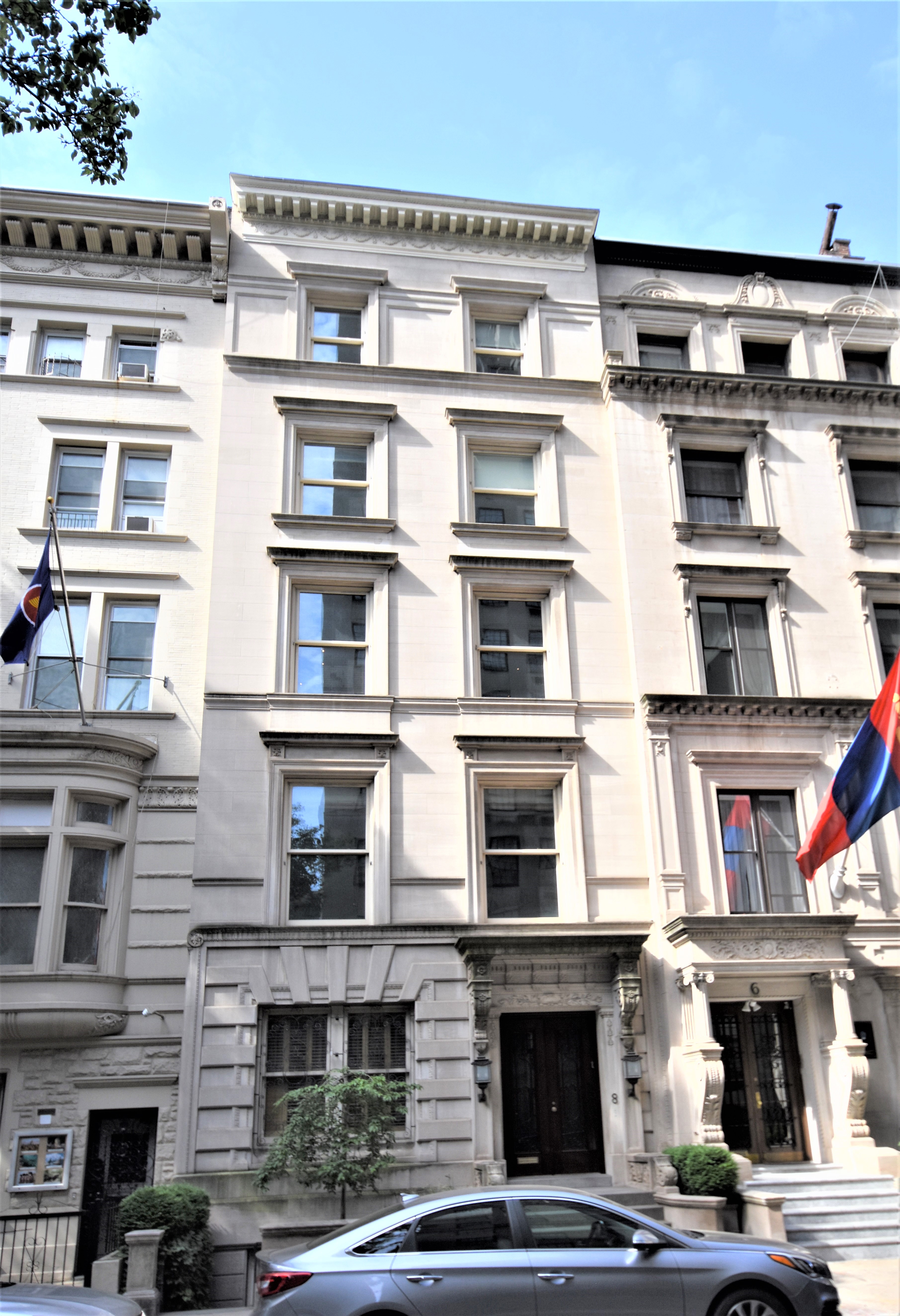
The Mary T. Penniman House - 8 East 77th Street


Not only was Richard W. Buckley a partner with Robert McCafferty in the development firm of  McCafferty & Buckley, he was the firm’s architect—a significant cost savings.  In 1895 the partners started construction of seven high-end homes at 4 through 16 East 77th Street.  Unlike the nearly identical high-stoop brownstones erected a generation earlier, each of Buckley’s handsome neo-Renaissance style residences, completed in 1897, was given its own personality.  Perhaps to compensate for the sloop of the street, the two eastern-most houses were designed on the English basement plan, which provided them with high stone stoops.  


8 East 77th Street is the third from right.  Record & Guide, April 11, 1896 (copyright expired)

Like its neighbors, 8 East 77th Street was 25-feet wide and rose five stories.  An American basement house, its entrance sat above a short stoop.  The restrained ornamentation depended almost entirely on the banded facade of the first floor, Renaissance-inspired carvings around the upper part of the doorway, and a neo-Classical frieze below the cornice.

The house was sold in 1897 to Mary Talcott Penniman, the widow of Samuel Judd Penniman.   Born on January 8, 1841 to Edmund and Harriet Strong Knower, Mary traced her lineage on her mothers side to the Mayflower, and was listed as the "eighth in descent from William Bradford."   

Mary had met Samuel J. Penniman on a transatlantic crossing with her mother in 1859.  During that same voyage she and her mother met with the English novelist Anthony Trollope.  The chance meetings would result in her marriage to Penniman and a life-long friendship with the famous author.

Penniman, who was a widower, was an oil merchant and the principal in the Judd Linseed Oil Company.  The newlyweds moved into a house at 44 East 22nd Street.  He died in 1876 at the age of 43, leaving his 36-year-old widow a significant fortune.

Mary lived quietly in the 77th Street house, her name appearing in print most often for her charitable contributions.  Shortly before moving in, for instance, she donated $5,000 to the New York Cancer Hospital "to endow a bed in memory of Samuel J. Penniman and Mrs. Knower," according to The Evening Post.  The value of the gift would be around $157,000 today.

The house was the scene of a socially important wedding on January 15, 1901, when Mary's cousin, Elisa Strong, was married to William V. B. Kip.  The New York Times reported, "The house was beautifully decorated with palms and flowers, pink roses being used in all the rooms save the drawing room on the second floor, where the wedding took place, there the decorations were Bride roses and ferns and palms."  The article hinted at the layout of the Mary's home:

The suite of rooms on the second floor were thrown together and the bridal party, which formed in the library, passed through an aisle formed of broad satin ribbons to the drawing room to a bower of green and white, where the ceremony was performed.

The long list of guests included some of the most prominent families in New York society, like Rhinelander, Livingston, Rutherford, Schieffelin, Kingsland, Rockefeller, Goodrich and de Peyster.

Mary spent her summers in the White Mountains, New Hampshire.  She preferred to stay at fashionable resort hotels rather than to rent or own a cottage.  On July 17, 1921, for instance, the New-York Tribune notified its society page readers that she "is summering at the Profile House."

The aging widow lived quietly on in the house with her servants as the decades passed.  She died on February 13, 1931 at the age of 90 and her funeral was held in the house three days later.

Mary left an estate valued at $1.11 million, according to the Daily News (nearly $21 million in today's money).   Much of it was bequeathed to charitable institutions, but her will was very generous to her servants, as well.  Her personal maid, Hila Dahlgren, for instance, received $25,000 "and personal effects."  It was a Depression Era windfall equal to about $420,000 in today's money.

The 77th Street mansion was sold in 1940 and the new owners announced plans to alter it to apartments.  The completed renovations resulted in two apartments per floor.  

Living on the fourth floor in the mid-1950's was Leo Castelli.  Although not an artist, he was a member of the Club, a group founded in 1949 that included William de Kooning, Franz Klein, and Robert Rauschenberg.  Castelli's first venture into art dealing came in 1951, and in 1957 he opened the Leo Castelli Gallery in his apartment here.  According to the Wall Street Journal's Daniel Grant in 2011, through the 1960's and '70's the gallery was the most prominent commercial venue for art in the world.

Living here in the late 1960's was the family of Dr. Guillermo Salazar.  A psychiatrist, he had fled Cuba after having served as Fidel Castro's former Ambassador to Switzerland.  He and his wife, Caroline, had one child, Isabel, who attended the private Miss Hewitt's School.  

Now associated with Gracie Square Hospital, Salazar specialized in the treatment of narcotic addicts.  In a tragically ironic twist, Isabel was an addict.  In 1970 Salazar explained she had been introduced to drugs by acquaintances in Central Park when she was just 11. 

Not long afterward Isabel dropped out of school "because of her serious drug habit," according to The New York Times.  Her parents understandably panicked when the 12-year-old disappeared on Monday, January 26, 1970.  

At the same time police were conducting a citywide search for a man believed to control "teams" of underage narcotic dealers.  The arrest of three heroin peddlers on January 28--one merely 11-years-old--led police to a search of an Upper West Side apartment building.  There, reported The New York Times, Isabel "was found dazed in a hallway."

Caroline Salazar blamed her daughter's addiction on the United States.  "Now Isabel and I are leaving the country forever," she told reporters.  "This is a jungle, this country.  It's going down the drain faster than anyone realizes."  She saw a brighter future for her daughter in Hong Kong.


General contractor Steve Mark purchased the 10,000-square-foot mansion in 1999.  Upon the expiration of his tenants' leases he initiated a renovation to return it to a single-family dwelling for his family of six.   The project was officially completed in 2009.

photographs by the author
LaptrinhX.com has no authorization to reuse the content of this blog

Thursday, October 24, 2019

The John Junius Morgan House - 64 East 77th Street


Around 1877 a row of skinny houses was erected on the southern side of East 77th Street, for (it seems) developer James. V. S. Woolley.  They were located just east of the soot-belching trains of Fourth Avenue (later Park Avenue) which would not be lowered below ground for years.  The residences, which were a mere 12-feet, 6-inches wide, were literally considered to be on the wrong side of the tracks.  Yet at four stories tall they were intended for upper-middle class families.  Faced in brownstone they were most likely designed in the pervasive Italianate style.

No. 64 became home to the Robert J. Clyde family.  Clyde and his wife, Julia, had a daughter, also named Julia.  He was perhaps best known for his military involvements.  He was a lieutenant in "The First Brigade of the Boys in Blue" which was made up of the First, Second, and Third Regiments of the New York Reserves.  They were Black regiments but their officers, like Clyde, were all white.

The difficulties of living in a still-developing neighborhood taxed Clyde's patience in the spring of 1881.  He fired off an indignant letter to Alderman Perley on March 11 that read:

Won't you use your utmost endeavors to have a crosswalk laid at Seventy-seventh street and Fourth avenue, both, crossing Fourth avenue; the mud is at least eight to twelve inches deep.  You promised all last year to have this done, but did not do it; please hurry it through.
                         
By 1888 Martin Logan lived in the house.  That year he obtained a patent for his improved "self-draining floor for stalls."  His design placed a recess in the center of the horse stalls fitted with wooden, detachable slats.  The waste flushed out in the cleaning of the stalls ran directly into a covered gutter that ran along the front.


Scientific American, Architects and Builders Edition, November 1888 (copyright expired)
No. 64 was sold in October of 1903 to Josephine Lazarus.  She contracted architect George A. Freeman to update the house.  The significant project, which included adding indoor plumbing, took more than a year to complete.

Josephine sold the updated residence in April 1908 to Mary Tooker Best, the widow of Army Colonel Clermont Livingston Best.  Mary's purchase of No. 64 was, perhaps, prompted by her daughter, Annie Livingston Best's upcoming marriage to Elizur Yale Smith.  

Nearly two decades earlier, when Mary and Clermont were married in Mary's Newport "cottage" on Bellevue Avenue on September 29, 1884, The New York Times raised an eyebrow at the lop-sided social match.  It entitled the announcement "Col. Best Secures A Bride Worth a Million," and ended the article saying "Col. Best is a native of New-York and a graduate of West Point.  The bride is about 33 years of age, and is worth $1,000,000 at least in her own right."  (The groom was, incidentally, 27 years older than his bride.)

Col. Best died on April 7, 1897 at the age of 73.  Annie was 10 years old at the time.  Mary sent her to France to be educated.  By the time of her debut into society in 1905 she was an accomplished pianist--so much so that Mrs. William Astor pointed her out for "special attention" at her mid-season ball.

Now the Bests moved into No. 64 East 77th Street and Annie's wedding took place seven months later, in November 1908.  But the mother and daughter would soon share the house again.  Annie left Elizur Yale Smith after a few months.

Following her divorce, Annie got permission to resume her maiden name, but the appellation "Mrs." remained.   Her engagement to Arthur Carroll was announced on June 10, 1910.

The wedding took place in the 77th Street house on September 10.  The following day The Sun explained "It was intended to have the wedding in Newport, where Mrs. Best has had a cottage during the past summer.  It was found impossible however, for Mrs. Best to find quarters for all the guests she expected to invite."  The article added "Mrs. Annie Best is a very fair blond with a delicate complexion."

The New York Herald noted "the house was simply decorated with palms, ferns and cut flowers...After the ceremony there was a small reception and a luncheon."  The article mentioned that after their "short wedding trip" the couple would "make their home in this city."  They moved in with Mary in No. 64.

Mary ceded the social spotlight to her daughter, who entertained often and lavishly.  An amusing diversion among society women in the early years of the 20th century was the recreation of famous paintings by dressing in costume and posing before appropriate backdrops within an enormous frame.   Annie held what the Amsterdam Evening Recorder called "a picturesque carnival of antics" at No. 64 on January 30, 1912.

"Famous women stepped from portraits by old masters and joined grand dames of the Colonial period in patches and powdered hair, Turkish noblemen and gypsies, German peasants, fanciful characters, French students and even the typical Parisian apache.  It was as colorful a company as has gathered in any house in New York this winter, although it numbered less than a hundred all told."  

Annie dressed as the Goddess of Night in black chiffon gown glittering with gold and silver stars.  Arthur wore the costume of a Turkish nobleman "which his grandfather had brought from the Orient complete in all its details."  Mr. and Mrs. Irving Brokaw arrived as "Spaniards of the sixteenth century."  Other guests included the Reginald C. Vanderbilts, the Dudley Olcotts, James Deering and his wife, and society architect Francis L. V. Hoppin and his wife.

Later that year, just days before leaving the Newport cottage, the family faced near tragedy.  Mary had already sent most of the servants back to New York, along with much of the silverware.  On the night of September 24 Annie smelled smoke and rushed through the hallways to awaken the others.   She went into hero mode as the blaze worsened.

The New York Times reported "She rushed to her mother's room and carried her to safety.  She then got an old colored cook out of the burning house."  Annie rushed back to her own room, threw cash and jewelry into a bag and tossed it out the window before escaping.  (The bag was never found.)  The mansion with its expensive furnishings, tapestries and artwork was completely destroyed.

Annie's entertainments always included the highest echelons of society, as well as visiting European titles.  She gave a reception in the 77th Street house on the afternoon of December 18, 1913 for Condessa del Sera, for instance, and a month later, on January 14, 1914, The New York Herald reported "bringing together more than a hundred of her friends, Mrs. Arthur Carroll gave a dinner and dance last night at her house, No. 64 East Seventy-seventh street, for Count and Condessa Emllio del Sera."

By 1916 Mary had transferred the title to No. 64 to Annie.  On December 3, 1917 The Evening Post reported that she had leased the house to Charles Astor Bristed and his wife, the former Grace Ashbury.  A nephew of John Jacob Astor and had inherited the millionaire's former country estate, Hell Gate, on the Upper East Side.  He demolished the Astor mansion just after the Civil War and was responsible for laying out 88th and 89th Streets on the former estate.

Because of the war in Europe Grace and her daughters M. Symphorosa and Grace Astor moved into the rented house without Charles.  On January 27, 1918 The Sun reported "Mrs. Charles Astor Bristen and the Misses Bristed have left Lenox and are at 64 East Seventy-seventh street.  Mr. Bristed is with the United States forces in France."

Grace was active in the war effort, most notably the Junior Book Committee which gathered new and used books to send to the front.  She pleaded in an article in April 1918 "There are hundreds of thousands of books lying idle here at home doing no one any good.  Let's give them to our men' it's a way of doing our bit."  The Sun advised "books old and new may be sent to the Junior Book Committee's president, Miss Grace Astor Bristed, at 64 East Seventy-seventh street."

On June 10, 1919 the New-York Tribune reported that Sherman Post Haight had purchased No. 64.  It came at the breaking point in Annie's marriage to Arthur Carroll.

They divorced and on January 21, 1920 Annie married William Sackett Duel.  Her new husband had two sons, 15-year old William, Jr. and 13-year old Robert Ensor.  The family, including Mary, moved to the Duell estate, Hillcroft, in Meadowbrook, Pennsylvania.

The family sold Hillcroft in 1923 and returned to New York--surprisingly back to East 77th Street.  On May 24, 1923 The New York Times reported "Mrs. Mary Tooker Best...died of heart disease yesterday at the home of her son-in-law, W. Sackett Duell, 64 East Seventy-seventh Street."

Annie's luck with marriage was not good.  She divorced Duell on February 15, 1925 and would go on to have two more husbands.  

That year William Card Moore, described by The New York Times as a "wealthy New York broker and Yale graduate," purchased No. 64.  He and his wife, Virginia, hired the architectural firm of Treanor & Fatio to give the vintage home a total makeover.  

The stoop was removed and the entrance moved slightly below street level.   The brownstone facade was stripped off to be replaced by two stories of red brick.  A steep, two-story mansard sat back, providing outdoor space.

It does not appear that the Moores ever lived in the house, but leased it to well-do-to tenants.  Immediately after the renovations were completed it was rented to William MacNeil Rodewald, and the following year was sold to Henry J. Simonson, president of the United States Bond & Mortgage Corporation, and his wife Helen.  They paid the Moores $68,000 for the house, approximately $965,000 today.

And then in May 1931 Simonson sold No. 64 to John Junius Morgan.  He was the only child of Juliet Pierpont Morgan and the Rev. John B. Morgan.  Juliet was the sister of financier J. Pierpont Morgan (her marriage to someone with the same surname eliminated the nuisance of changing her stationery and calling cards).  Upon his mother's death in 1923 Morgan had inherited her entire estate.


By the time John Junius Morgan moved in, the skinny house was hemmed in by soaring apartment buildings.  via NYC Department of Records & Information Services

Morgan shared the house by the mid-1940's with Gertrude Bigelow, the widow of wealthy real estate man Talmon Bigelow.  He had committed suicide in 1927 at the age of 29; officials attributing his action to "shell shock" from World War I--what today we would call post traumatic stress disorder.

It seems that Gertrude's adult son also lived in the house.  On January 16, 1945 The New York Sun's society page featured a photo of a handsome couple with the caption "Miss Dale Thompson...in the Wedgwood Room of the Waldorf-Astoria with Talmon Bigelow, son of Mrs. Talmon Bigelow of 64 East 77th Street."

The exact relationship between John and Gertrude is unclear.  Following his death at his country estate in West Chilington, Sussex, England on March 16, 1949, The New York Times reported "To Gertrude J. Bigelow of 64 East Seventy-seventh Street, he bequeathed the use of his house at that address for a period of five years, without rent or other charges."


Perhaps because of its narrow proportions, the house was never divided into apartments.  In 2008 plans were filed for "interior demolition" of the single-family house.  Today the Luxembourg & Dayan Gallery discreetly operates from the home.

photographs by the author