Showing posts with label alonzo b. kight. Show all posts

Tuesday, September 8, 2026

The Theodore and Florence Sutro House - 320 West 102nd Street

 
image via streeteasy.com

Alonzo B. Kight began his career in 1891, acting as both real estate developer and architect.  The 1898 A History of Real Estate, Building and Architecture in New York City said that, perhaps, no other architect had "accomplished so much for the general appearance" of the Upper West Side.  The article noted that he worked "generally west of West End avenue."

In 1896, Kight filed plans for a trio of limestone-faced dwellings on West 102nd Street between Riverside and West End Avenues.  Like his other projects, the speculative homes would be targeted at wealthy owners.  The cost to construct each was projected at $25,000, or just under $990,000 in 2026.

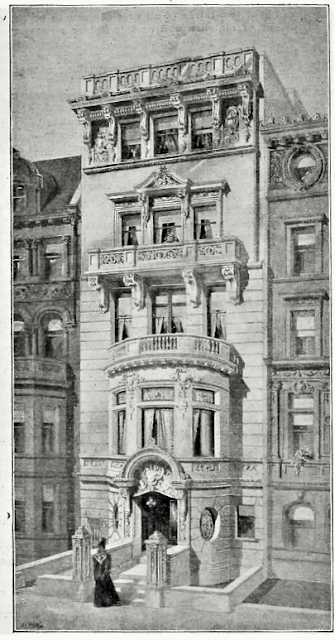
The homes were completed in 1897.  Kight designed the 20-foot-wide American basement residences in the Renaissance Revival style.  (American basement plans forewent the high stoops of the waning English basement plan.)  Like its architectural siblings, the westernmost house, 320 West 102nd Street, was five stories tall.  A faceted, three-story bay provided a balcony to the fourth floor.  Balustraded faux balconies clung to the corners of the second floor and another fronted the center windows of the third.  The grouped and paired windows of the top two floors sat within molded surrounds.

When the Real Estate Record & Guide published this rendering on April 10, 1897, it noted that 320 West 102nd Street was "recently sold."  (copyright expired)

Attorney and financier Theodore B. Sutro and his wife, the former Florence Edith Clinton, purchased 320 West 102nd Street in March 1897.  The price, according to The New York Times, was "about $40,000."  (The figure would translate to about $1.6 million today.)  Born in Germany, Sutro was brought to America by his parents at the age of five.  He graduated from Harvard College in 1871 and from the Columbia Law School in 1873.  

Theodore Sutro, Schlegel's German-American Families in the United States, 1917 (copyright expired)

Florence Clinton Sutro, born in England in 1865, was (astonishingly for the period) also a lawyer, as well as an artist and accomplished musician.  A prodigy, she had won the $1,000 first prize for her piano playing of Franz Liszt's Hungarian Rhapsody No. 2 at the age of 12, and was the first woman to graduate with a doctorate of music from the Grand Conservatory of New York.  Her paintings were regularly exhibited at the National Academy of Design.  She graduated valedictorian of the 1891 class of the City College of New York where she received her law degree.  Two years prior to the Sutros' purchasing 320 West 102nd Street, she wrote Women in Music and Law.

Florence Clinton Sutro,  Schlegel's German-American Families in the United States, 1917 (copyright expired)

Florence Sutro's involvement with art and music interfered with her decorating of the new mansion.  On June 20, 1897, the New-York Tribune reported that the Music Teachers' National Association had established its first woman's department.  The association's president, Herbert Wilber Greene, asked Florence "to take charge of the new department."  The article said:

Mrs. Sutro, who was preparing to move into her beautiful new house at No. 320 West One-hundred-and-second-st., at first thought it would be impossible for her to undertake the work; but the request was repeated with such urgency that she consented, and is putting off the furnishing of her house as much as possible until afterward.

Of course, Florence did get around to furnishing the home.  It was soon filled with costly furniture and an impressive collection of art, including historic marine paintings by Edward Moran.


Two views of the foyer with its marble floor and groined ceiling.  images via Byron Company from the collection of the Museum of the City of New York.

Entertainments in the Sutro residence were frequent.  One early gathering was especially important for the couple.  On October 3, 1899, The New York Times reported, "Mr. and Mrs. Theodore Sutro celebrated their crystal wedding Sunday by giving an afternoon and evening reception."  The article said, "The gifts were numerous, and several hundred friends called to pay their respects to the couple."  

An article in The New York Times on April 22, 1900 announced that Florence had given her last "at home" for the winter season.  It gave a hint of the couple's recurrent entertaining.  "For the past seven months Mr. and Mrs. Sutro have been entertaining on Wednesdays.  Mrs. Sutro has given several small dances, and the young people of the upper west side have enjoyed these occasions."

The dining room (top) and breakfast room.   images via Byron Company from the collection of the Museum of the City of New York.

Florence's last at home (the days on which a socialite was available for receiving calls) that was mentioned in The New York Times article had everything to do with the end of the winter social season.  Like all wealthy New Yorkers, the Sutros left the city in the warm months.  At the end of the summer social season of 1901, for instance, The New York Press announced:

Mr. and Mrs. Theodore Sutro, after a sojourn in the maritime provinces of Canada, Bar Harbor, Rangeley Lakes, Poland Springs, Maine and Lenox, have returned to their city residence, No. 320 West 102d street, for the winter.

The Sutros were active patrons of the arts and every social gathering in their home had elaborate music.  On March 23, 1902, for instance, the New-York Tribune reported on Florence's recent at home, saying she "was assisted in a delightful musical programme by Giuseppe Aldo Randegger, Miss Tilden, Miss Beatrice Eberhard, Mrs. Ernest L. Thibault, Edard J. Calthrop, F. Howard Warner, John P. Boruff, Mrs. Silas G. Pratt and Lewis Williams."  The article was quick to point out, "This was not a special at home, but was one of Mrs. Sutro's regular days."

An informal sitting room.  Notice the handsome arched pocket doors in the background and the interesting wicker furniture.  The upright piano was one of several pianos throughout the house, including one in a guest room.   image via Byron Company from the collection of the Museum of the City of New York.

As early as 1905, Theodore's unmarried niece, Edyth Martyn, lived with the Sutros.  In reporting on Florence's recent "delightful Washington's Birthday reception," the New-York Tribune remarked on February 26, 1905, "Mrs. Sutro was assisted in receiving by her husband and Miss Edyth Martyn."

The drawing room had a painted and stenciled ceiling.   image via Byron Company from the collection of the Museum of the City of New York.

In September 1905, Florence became ill.  In January, Theodore took her to Hot Springs, Virginia "for the baths," according to The Evening World.  On February 12, the newspaper reported that she "lies dangerously ill in the John Hopkins Hospital, Baltimore, to which she was taken...by Mr. Sutro yesterday to be operated upon for violent pleurisy."  Astonishingly, said the newspaper, "She has been operated upon four times to relieve her lungs of the accumulation of water, and is now very nearly exhausted."

Somewhat off topic, The Evening World noted, "Mr. and Mrs. Sutro have an ideal home...where Mrs. Sutro has entertained the famous men and women of two hemispheres."

Florence was brought back to 320 West 102nd Street where she died "of pleurisy and a complication of diseases" on April 27, 1906.  Newspapers filled columns with her achievements, her talents, and her numerous positions.

The funeral was held in the mansion on April 30.  The details had been planned by Florence herself five years earlier prior to an operation.  She had written in part, "it would be pleasant if I could contemplate a string orchestra, with an organ and a harp to play for the last obsequies, and that some living woman should sing a solo."  Her body was dressed in the "the gown Mrs. Sutro had worn as a bride," said the New-York Tribune Florence Sutro would be posthumously disappointed in one detail.  The New York Times reported, "Mrs. Sutro had desired that Miss Adele Rafter and Miss Emma Thursby should sing at her funeral, but they were unable to be present."

Edyth Martyn took over the duties of the mistress of her uncle's residence.  She became a heroine, as well, on the night of February 18, 1908.  The Evening World reported that a fire from an overturned lamp in Theodore Sutro's bedroom quickly grew.  When the flames "spread to the bedclothing, Miss Martin [sic] ran in, smothered the flaming sheets with blankets and carried water with which to completely extinguish the fire."

In 1912, Theodore Sutro was ready to walk away from his mansion and the magnificent artworks and furnishings he had accumulated with his wife.  The New York Times reported on March 17 that he intended to sell the house, giving "the purchaser the privilege of buying any part or all of the furnishings."

image via the NYC Dept of Records & Information Services.

Instead, Sutro moved to 416 West 118th Street and leased the West 102nd Street mansion.  Franklin Haines and his family were his first tenants.  Born in 1862, Haines married Frances Way in 1885 and they had three children, Dallas Way, Marion, and Margaret Dallas.  Dallas Way Haines graduated from Columbia University in 1913.

The family was still here in October 1919 when Franklin and Frances announced Marion's engagement to Hewitt White Rundle.

Theodore Sutro continued to lease 320 West 102nd Street until his death at the age of 82 on August 28, 1927.  In reporting his demise, The New York Times described him as "one of the leading German-born citizens of New York."

The Alpearl Realty Company purchased 320 West 102nd Street in 1928 and leased it to Ladislaus Rogasky in 1929.  The house was sold a few times before Arthur Holland sold it in December 1946.  The New York Times remarked, "The new owner is altering the building into small apartments."

photograph by Deansfa

The first and second floors were converted to the Barbara Smith Nursery School, and the upper floors to one apartment each.  The configuration lasted until 2012 when 320 West 102nd Street was reconverted to a single family home.

Monday, August 30, 2021

The Lost Gabriel Du Val Clark Mansion - 41 West 72nd Street


Real Estate Record & Guide, February 11, 1899 (copyright expired)


Alonzo B. Kight acted both as developer and architect in the 1890's, designing and erecting extremely high-end private homes.  In 1898 he began construction on a limestone-faced mansion at 41 West 72nd Street, between Central Park West and Columbus Avenue.  

The street was already filling with lavish residences.  West 72nd Street had been deemed a "park street" by the city, meaning that it was maintained by the Parks Department.  Traffic was limited to the carriages of residents and the vehicles of tradesmen with business on the street--like coal deliverymen.

Completed early in 1899, 41 West 72nd Street fit well into the exclusive neighborhood.  The Beaux-Arts style mansion was 25-feet wide and five stories tall.  The Real Estate Record & Guide said it was "very carefully planned and constructed of the best materials."  A short stoop led to the entrance within a centered, two-story bowed bay.  The bay provided a balcony to the third floor, and another bracketed balcony with pierced railings graced the fourth.  The stone cornice was crowned with a paneled parapet.

The house briefly was home to S. L. Schoonmaker, a partner in the Carnegie Steel Company.  He sold it in November 1900 to Gabriel Du Val Clark and his wife, the former Josephine A. Godien.

Born in Baltimore in 1837, Clark had graduated from Princeton Univerity at the age of 17, the youngest graduate in the school's history at the time.  Although he earned a law degree, he never practiced.  Instead he managed his father's substantial estate and provided legal advice to his extensive businesses.

Josephine was Clark's second wife.  His first, Emma Edmonson, whom he married in 1869, died in 1872.  Their grown daughter, Gabrielle Edmonson Gambrill, lived in Baltimore.

Clark filled the 72nd Street house with costly furniture and decorative items.   The 1912 book Baltimore, Its History and Its People said of him:

His record as a transatlantic traveler is equaled by few and excelled, perhaps, by none.  No fewer than seventy times had he crossed the ocean, having made the first voyage in a sailing vessel, and during his sojourns in the art centers of Europe he had become possessed of many valuable paintings and other treasures dear to the soul of a connoisseur, trophies of travel, which were used to beautify the New York residence.

Like other wealthy passengers, when the Clarks traveled abroad they took along at least a valet and a private maid.  A skeleton staff was kept on in the townhouse, but others were let go.  As the couple prepared to sail in 1903 Josephine tried to aid her cook in finding a new position.  Her ad read, "A lady wishes position for her cook; elderly woman; can highly recommend her."

The Clarks frequently stayed overseas for extended periods.  On November 17, 1907, for instance, The New York Times announced, "Mr. and Mrs. Gabriel Du Val Clark, 41 West Seventy-second Street, have planned to spend a year in travel on the Continent.  They will sail on Saturday, Jan. 4, on the steamship Hamburg."

In January 1910 Clark became ill.  Perhaps hoping that the sea air would improve his condition, he and Josephine went to Atlantic City that summer.  He died there on September 19 at the age of 72.  In reporting his death, The New York Times mentioned, "He was an extensive traveler and had been around the world several times." 

Clark's will suggests there was tension between his daughter and his wife.  Josephine received the "the use of their home" for life, as well as "the pictures, plate, furniture etc."  She also received the income from $200,000 in bonds held in trust.  (The value of the bonds would be about $5.6 million in today's money.)  The rest of the estate went to Gabrielle.

In order to make sure his daughter got her substantial inheritance, Clark added a caveat to the will.  He said, "While I am confident that it will always be the desire of my wife to respect my wishes," he suggested that "unwise or evil counsel" might influence her to contest the will.  Should she do that, she would forfeit everything.

Josephine lived on in the 72nd Street mansion, and resumed entertaining following her mourning period.  On February 6, 1912, for instance, The New York Times reported she "will give a bridge, followed by a reception, on Monday, Feb. 12."

On the afternoon of March 26, 1913, three years after Gabriel's death, Josephine's marriage to William Vail Martin took place in the Waldorf-Astoria.  Born on July 8, 1852, Martin was a director in the Lehigh and Hudson River Railway Co.   

The couple entertained frequently.  On January 11, 1914 The Sun reported, "Mrs. William Vail Martin of 41 West Seventy-second street will give a dansant at the St. Regis on Saturday afternoon."  (A dansant was an afternoon dance during which tea was served.)  And only a week later she hosted another.  The New York Times reported that at that event "There were about two hundred guests, Mrs. Martin receiving in the Louis XVI suite, the dancing being held in the marble ballroom."

As she had done with Gabriel, Josephine traveled often with William.  They spent the summer of 1917 at White Sulphur Springs, and the following summer season in Newport.  On January 3, 1920 the New-York Tribune reported that the Martins "sail for Europe-today to remain abroad until next fall," and on September 18, 1922 the New York Herald advised, "Mr. and Mrs. William Vail Martin of New York, who spent the summer in Switzerland, have returned to Paris and are at the Hotel Ritz."

By then West 72nd Street had drastically changed.  Once a restricted residential thoroughfare, its mansions were quickly being transformed to boarding houses, converted for commercial purposes, or being razed for apartment houses.  

By 1925 the former Clark mansion held upscale apartments.  Among the tenants was Metropolitan Opera soprano Helen Gagliasso.  She was expecting a valuable package that summer--a $400 platinum wrist watch--but it never arrived.  Suspicious, the she did some sleuthing.

On August 13 the Daily News reported, "The singer learned from postal authorities the watch, a gift from Milan, Italy, had been signed for at the opera house.  No one there admitted knowing anything about it."  Helen obtained a "John Doe summons" that "permits her to have some employee of the opera house in court Monday for questioning."

Helen Gagliasso was one of the last occupants of 41 West 72nd Street.  By April 1926 it and the three houses at 43 through 47 West 72nd Street had been purchased by the newly-formed 41 West Seventy-second Street Corporation.  The once-lavish homes were demolished to make way for a 16-story apartment building designed by Jacob M. Felson.

photo via compass.com

LaptrinhX.com has no authorization to reuse the content of this blog

Tuesday, August 28, 2018

The Fanny Brice House - 306 West 76th Street


The entrance, relocated when the house was converted to apartments, was originally centered.

Alonzo B. Kight acted both as developer and architect in the 1890's.  By the turn of the century he would be president of the Barnard Realty Co., but in 1896 when he started construction on two upscale homes on West 76th Street, he worked alone.

His plans, filed on April 10, 1896, projected two four-story limestone-faced houses, each an imposing 25 feet wide.   The upscale amenities included "hot air heating, parquet flooring, hardwood trim, tiled bathrooms and exposed plumbing."  Each were expected to cost $50,000 to construct--more than $1.5 million today.

Kight changed his mind at some point, making the two homes even grander.  When completed in 1897 they both rose five stories.   No. 306 featured a full-width, three-story angled bay which increased both ventilation and light inside.  A prominent, bracketed cornice above the first floor provided corner balconies behind solid stone railings.   Above the third floor a stone balustrade protected the ample terrace created by the projecting bay.

The new home was purchased by Gilbert Colgate in November 1897 for "about $70,000," according to the Real Estate Record & Guide.  (Kight raked in a substantial profit of about $610,000 in today's dollars in the deal.)

Born on December 15, 1858, Colgate was a major player in American business and manufacturing.  A year before buying No. 306 he had been made a partner in Colgate & Company, founded by his grandfather, William Colgate, in 1806.  Gilbert's brothers, Richard, Sidney and Austin, were also partners.

In the Colgates' music room hung Samuel F. B. Morse's The Goldfish Bowl (at left), which is in the Smithsonian American Art Museum today. photo courtesy of James P. Colgate, great-grandson of Gilbert and Florance Colgate

Originally a starch, soap and candle manufacturer, by now Colgate & Company made perfumes, essences and perfumed soap.  In 1873 it had added toothpaste, sold in a jar, to its product line.

Gilbert's wife was the former Florance Buckingham Hall.  When they moved in they had three children, eight-year-old Elizabeth, four-year-old Florance, and baby Grace, at one.  The family would grow in 1899 with the birth of Gilbert and in 1902 with the arrival of Robert.


Another view of the music room.  The Colgates' furnishings ranged from American Empire to Victorian Rococo Revival pieces.  photo courtesy of James P. Colgate, great-grandson of Gilbert and Florance Colgate

The drawing room of No. 306 was the scene of the wedding of Florance's sister, Mabel Scott Hall, to Chicagoan Sherwood Johnston Larned on October 25, 1899.  The New York Journal reported "Three little ribbon maids also were in attendance upon the bride, forming an aisle with white ribbon, through which she passed.  They were her nieces, Elizabeth, Florance and Grace Colgate."

Grace and Mabel were flower girls in another family wedding in the house on May 23, 1902.  Florance's niece, Mary Hall Putnam married Ira Mallory Remsen, that afternoon.

Both Gilbert and Florance were involved in philanthropies and social issues.  They were members of The Indian Rights Association, for instance.

The gentleman's portrait above the sideboard is of William Colgate, Gilbert's grandfather and founder of Colgate & Company.  photo courtesy of James P. Colgate, great-grandson of Gilbert and Florance Colgate

By the time the couple announced Elizabeth's engagement on April 22, 1911, Gilbert was vice-president of Colgate & Company.   Elizabeth had fallen in love with Stanley Maddox Rumbough who came from a military family.  Rumbough's grandfather was General David S. Stanley and his father was Colonel David  J. Rumbough.  The groom-to-be was a lieutenant in the 15th Cavalry and was currently service as a junior aid at the White House.

In May 1916 Colgate hired architect Harry N. Paradies to install an elevator in the house.  The alterations cost him about $7,000 in today's dollars, but the increase in convenience was no doubt invaluable.

The following year, in July, Florance's engagement was announced.  Like her sister, her fiancé was in the military, Major Edwin St. John Greble, Jr.  With war raging in Europe, there was no time for long engagements.   The wedding took place two days later, on July 28 in the Rutgers Presbyterian Church.

It was a military ceremony.  The groom was the son of Brigadier General Edwin St. John Grebel, and the ushers included two captains, two majors, and a lieutenant.  The New-York Tribune reported "Major Greble is a member of the 2d Field Artillery of Pennsylvania, and he and his bride will start this week for camp."


A gate-legged table with strikingly carved legs served as a desk in the library.  The photograph of the man in uniform on the desk is of Elizabeth's husband, Stanley Maddox Rumbough.  photo courtesy of James P. Colgate, great-grandson of Gilbert and Florance Colgate

Gilbert Colgate rose to president of the firm in 1920; but the year was marked by sorrow when Florance died on February 24 at the age of 56.  The Colgate boys were away at school at the time.  Gilbert Jr. was a sophomore at Yale and Robert was away at the exclusive Phillips-Andover Academy.  Her funeral was held in the 76th Street house three days later.

Grace Hall Colgate was married on June 6, 1922, and she not only married a military man like her sisters, she married Major Joseph Wright Rumbough, the brother of Elizabeth's husband.  He was in charge of the field artillery instruction at Camp Benning, Georgia.  In reporting on the wedding The New York Herald said "there were present many relatives and friends of the bride, and also persons prominent in army circles."

Two months later Gilbert Colgate sold No. 306.  Newspapers and journals made note that he had owned the house for a quarter of a century, but were vague about the new owner.  It was not until October 21 that the Real Estate Record & Guide announced "Fanny Brice, the actress, is the buyer of the former Gilbert Colgate residence."

The popular entertainer's marriage was already troubled.  Her husband, Julius "Nicky" Arnstein, was a professional gambler and con artist, who had no fewer than six aliases.  The couple had two children, Frances and William.

In 1915, while he was still married to Carrie Arnstein, he was imprisoned in Sing Sing Prison and Fannie visited him every week.  After Carrie divorced him in 1918 they married.

Arnstein's past followed the family to West 76th Street.  According to biographer Herbert G. Goldman in his Fannie Brice: The Original Funny Girl, "Fannie's immediate plans for the townhouse were settled, not by her, but by Arnold Rothstein.  The famous gangster gambler insisted Fanny buy her furnishings from him.  He himself, what's more, would make all the selections."

Fannie had little choice in the matter.  Rothstein had supplied Arnstein's $100,000 bail money.  Although the amount had been repaid, Fannie recognized the new demand as "interest."  The furnishings came with a $50,000 invoice.  An appraiser placed the value at between $10,000 and $13,000.

A month after she purchased the house the Record & Guide reported that Fannie Brice Arnstein, had commissioned architect Samuel Cohen to make $15,000 in renovations.  While retaining the first three floors as the family's residence, she transformed the upper two floors into apartments for friends like actresses Valeska Suratt and May Weston.

Two years after moving in Arnstein was again imprisoned, convicted this time for conspiracy to carry stolen securities into Washington DC.  He was sentenced to three years in Leavenworth prison.


The often-zany comedienne as she appeared in the 1924 Ziegfeld Follies while living in the 76th Street house.  from the collection of the New York Public Library 


Immediately upon his release Arnstein began seeing other women.  The humiliation became too much to bear for Brice.  On September 17, 1927 The New York Times reported that she had filed for divorce in Chicago, adding "Miss Brice's suit makes what is said to be the first instance of plastic surgery being held responsible for alienating the affections of a husband."

The article explained that since having work done on her nose in 1923, "Arnstein developed an inferiority complex, repeatedly informing her that [because] she was so much more beautiful he was uncomfortable in her presence; that he, thereupon began seeking the society of other women and told her that plainer women appealed to him more."

"At her home, 306 West Seventy-sixth Street," said The New York Times, "where her children are being cared for by a governess, the report was denied."  But, of course, it was all very true.

Journalists and photographers camped out at Grand Central Terminal that week, awaiting Fannie's arrival from Chicago.  The New York Times said "Miss Brice appeared tired and worn when she stepped from the Lake Shore Limited...Reluctantly she posed for the newspaper photographers."  She repeatedly pleaded, "I'm all in.  I want to get home and see the children."

But when her taxicab arrived at the 76th Street house, it was already a mob scene.  While the children waited inside, she answered a barrage of questions.  The New York Times recounted:

"Why go to Paris?" she said.  "I have a good lawyer in Chicago, and he got me a divorce in forty-eight hours."
When she was asked if she contemplated marriage a second time, she flashed back:
"Isn't that a silly thing to ask me?  How do I know?"
Then she made a comic grimace, although her eyes were filling with tears, and said:
"Haven't I had enough?"

Before the year was out Fanny Brice and her children had left West 76th Street.

Although the house continued to be home to moneyed residents, none would have recognizable names like Colgate and Brice.  By mid-century it had been converted to unofficial apartments and not all of the tenants were model citizens.

Jack Bernstein lived here in 1955.  The 48-year-old was arrested and held without bail on May 7 that year, facing life imprisonment after already having been convicted three times for felony burglary.  He had a record of 14 previous arrests.

The New York Times reported "When he was arrested last Friday, the police found $100,000 in stocks and bonds and $20,000 in furs, jewels and silverware in his car and his apartment at 306 West Seventy-sixth Street.  A fully loaded .38-caliber automatic and a set of lock picks were also found in the car."

In 2006 the house was converted to 14 apartments: three on the first floor, two on the second, three each on the third and fourth, and a duplex on the first and penthouse level (installed in 2000 and invisible from the street).


photographs by the author