Showing posts with label west 102nd street. Show all posts

Tuesday, September 8, 2026

The Theodore and Florence Sutro House - 320 West 102nd Street

 
image via streeteasy.com

Alonzo B. Kight began his career in 1891, acting as both real estate developer and architect.  The 1898 A History of Real Estate, Building and Architecture in New York City said that, perhaps, no other architect had "accomplished so much for the general appearance" of the Upper West Side.  The article noted that he worked "generally west of West End avenue."

In 1896, Kight filed plans for a trio of limestone-faced dwellings on West 102nd Street between Riverside and West End Avenues.  Like his other projects, the speculative homes would be targeted at wealthy owners.  The cost to construct each was projected at $25,000, or just under $990,000 in 2026.

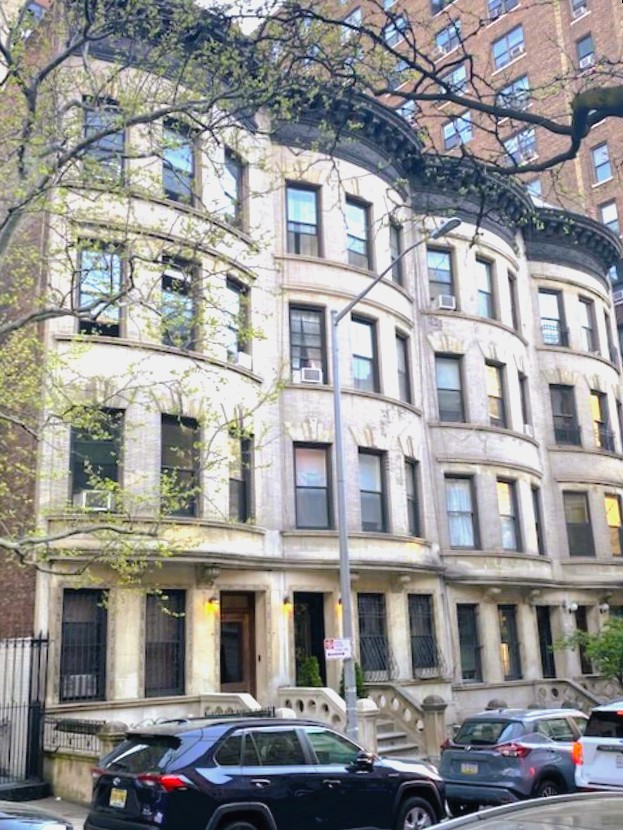
The homes were completed in 1897.  Kight designed the 20-foot-wide American basement residences in the Renaissance Revival style.  (American basement plans forewent the high stoops of the waning English basement plan.)  Like its architectural siblings, the westernmost house, 320 West 102nd Street, was five stories tall.  A faceted, three-story bay provided a balcony to the fourth floor.  Balustraded faux balconies clung to the corners of the second floor and another fronted the center windows of the third.  The grouped and paired windows of the top two floors sat within molded surrounds.

When the Real Estate Record & Guide published this rendering on April 10, 1897, it noted that 320 West 102nd Street was "recently sold."  (copyright expired)

Attorney and financier Theodore B. Sutro and his wife, the former Florence Edith Clinton, purchased 320 West 102nd Street in March 1897.  The price, according to The New York Times, was "about $40,000."  (The figure would translate to about $1.6 million today.)  Born in Germany, Sutro was brought to America by his parents at the age of five.  He graduated from Harvard College in 1871 and from the Columbia Law School in 1873.  

Theodore Sutro, Schlegel's German-American Families in the United States, 1917 (copyright expired)

Florence Clinton Sutro, born in England in 1865, was (astonishingly for the period) also a lawyer, as well as an artist and accomplished musician.  A prodigy, she had won the $1,000 first prize for her piano playing of Franz Liszt's Hungarian Rhapsody No. 2 at the age of 12, and was the first woman to graduate with a doctorate of music from the Grand Conservatory of New York.  Her paintings were regularly exhibited at the National Academy of Design.  She graduated valedictorian of the 1891 class of the City College of New York where she received her law degree.  Two years prior to the Sutros' purchasing 320 West 102nd Street, she wrote Women in Music and Law.

Florence Clinton Sutro,  Schlegel's German-American Families in the United States, 1917 (copyright expired)

Florence Sutro's involvement with art and music interfered with her decorating of the new mansion.  On June 20, 1897, the New-York Tribune reported that the Music Teachers' National Association had established its first woman's department.  The association's president, Herbert Wilber Greene, asked Florence "to take charge of the new department."  The article said:

Mrs. Sutro, who was preparing to move into her beautiful new house at No. 320 West One-hundred-and-second-st., at first thought it would be impossible for her to undertake the work; but the request was repeated with such urgency that she consented, and is putting off the furnishing of her house as much as possible until afterward.

Of course, Florence did get around to furnishing the home.  It was soon filled with costly furniture and an impressive collection of art, including historic marine paintings by Edward Moran.


Two views of the foyer with its marble floor and groined ceiling.  images via Byron Company from the collection of the Museum of the City of New York.

Entertainments in the Sutro residence were frequent.  One early gathering was especially important for the couple.  On October 3, 1899, The New York Times reported, "Mr. and Mrs. Theodore Sutro celebrated their crystal wedding Sunday by giving an afternoon and evening reception."  The article said, "The gifts were numerous, and several hundred friends called to pay their respects to the couple."  

An article in The New York Times on April 22, 1900 announced that Florence had given her last "at home" for the winter season.  It gave a hint of the couple's recurrent entertaining.  "For the past seven months Mr. and Mrs. Sutro have been entertaining on Wednesdays.  Mrs. Sutro has given several small dances, and the young people of the upper west side have enjoyed these occasions."

The dining room (top) and breakfast room.   images via Byron Company from the collection of the Museum of the City of New York.

Florence's last at home (the days on which a socialite was available for receiving calls) that was mentioned in The New York Times article had everything to do with the end of the winter social season.  Like all wealthy New Yorkers, the Sutros left the city in the warm months.  At the end of the summer social season of 1901, for instance, The New York Press announced:

Mr. and Mrs. Theodore Sutro, after a sojourn in the maritime provinces of Canada, Bar Harbor, Rangeley Lakes, Poland Springs, Maine and Lenox, have returned to their city residence, No. 320 West 102d street, for the winter.

The Sutros were active patrons of the arts and every social gathering in their home had elaborate music.  On March 23, 1902, for instance, the New-York Tribune reported on Florence's recent at home, saying she "was assisted in a delightful musical programme by Giuseppe Aldo Randegger, Miss Tilden, Miss Beatrice Eberhard, Mrs. Ernest L. Thibault, Edard J. Calthrop, F. Howard Warner, John P. Boruff, Mrs. Silas G. Pratt and Lewis Williams."  The article was quick to point out, "This was not a special at home, but was one of Mrs. Sutro's regular days."

An informal sitting room.  Notice the handsome arched pocket doors in the background and the interesting wicker furniture.  The upright piano was one of several pianos throughout the house, including one in a guest room.   image via Byron Company from the collection of the Museum of the City of New York.

As early as 1905, Theodore's unmarried niece, Edyth Martyn, lived with the Sutros.  In reporting on Florence's recent "delightful Washington's Birthday reception," the New-York Tribune remarked on February 26, 1905, "Mrs. Sutro was assisted in receiving by her husband and Miss Edyth Martyn."

The drawing room had a painted and stenciled ceiling.   image via Byron Company from the collection of the Museum of the City of New York.

In September 1905, Florence became ill.  In January, Theodore took her to Hot Springs, Virginia "for the baths," according to The Evening World.  On February 12, the newspaper reported that she "lies dangerously ill in the John Hopkins Hospital, Baltimore, to which she was taken...by Mr. Sutro yesterday to be operated upon for violent pleurisy."  Astonishingly, said the newspaper, "She has been operated upon four times to relieve her lungs of the accumulation of water, and is now very nearly exhausted."

Somewhat off topic, The Evening World noted, "Mr. and Mrs. Sutro have an ideal home...where Mrs. Sutro has entertained the famous men and women of two hemispheres."

Florence was brought back to 320 West 102nd Street where she died "of pleurisy and a complication of diseases" on April 27, 1906.  Newspapers filled columns with her achievements, her talents, and her numerous positions.

The funeral was held in the mansion on April 30.  The details had been planned by Florence herself five years earlier prior to an operation.  She had written in part, "it would be pleasant if I could contemplate a string orchestra, with an organ and a harp to play for the last obsequies, and that some living woman should sing a solo."  Her body was dressed in the "the gown Mrs. Sutro had worn as a bride," said the New-York Tribune Florence Sutro would be posthumously disappointed in one detail.  The New York Times reported, "Mrs. Sutro had desired that Miss Adele Rafter and Miss Emma Thursby should sing at her funeral, but they were unable to be present."

Edyth Martyn took over the duties of the mistress of her uncle's residence.  She became a heroine, as well, on the night of February 18, 1908.  The Evening World reported that a fire from an overturned lamp in Theodore Sutro's bedroom quickly grew.  When the flames "spread to the bedclothing, Miss Martin [sic] ran in, smothered the flaming sheets with blankets and carried water with which to completely extinguish the fire."

In 1912, Theodore Sutro was ready to walk away from his mansion and the magnificent artworks and furnishings he had accumulated with his wife.  The New York Times reported on March 17 that he intended to sell the house, giving "the purchaser the privilege of buying any part or all of the furnishings."

image via the NYC Dept of Records & Information Services.

Instead, Sutro moved to 416 West 118th Street and leased the West 102nd Street mansion.  Franklin Haines and his family were his first tenants.  Born in 1862, Haines married Frances Way in 1885 and they had three children, Dallas Way, Marion, and Margaret Dallas.  Dallas Way Haines graduated from Columbia University in 1913.

The family was still here in October 1919 when Franklin and Frances announced Marion's engagement to Hewitt White Rundle.

Theodore Sutro continued to lease 320 West 102nd Street until his death at the age of 82 on August 28, 1927.  In reporting his demise, The New York Times described him as "one of the leading German-born citizens of New York."

The Alpearl Realty Company purchased 320 West 102nd Street in 1928 and leased it to Ladislaus Rogasky in 1929.  The house was sold a few times before Arthur Holland sold it in December 1946.  The New York Times remarked, "The new owner is altering the building into small apartments."

photograph by Deansfa

The first and second floors were converted to the Barbara Smith Nursery School, and the upper floors to one apartment each.  The configuration lasted until 2012 when 320 West 102nd Street was reconverted to a single family home.

Tuesday, March 12, 2024

S. B. Ogden & Co.'s 306 West 102nd Street


photo by Anthony Bellov

In March 1901, the architectural firm of S. B. Ogden & Co. filed plans for a six-story "brick and stone flat" for developer Gerald Fountain at 306 West 102nd Street.  The block between Riverside Drive and West End Avenue was lined with opulent rowhouses built a generation earlier.

Unlike almost all apartment buildings on the Upper West Side, Fountain did not give 306 West 102nd Street a name.  Completed in 1902, its Colonial Revival design included an engaged portico above a short stoop and splayed lintels with layered keystones.  S. B. Odgen & Co. added interest by gently curving the facade and by alternating brick and and stone bands at the first, second and sixth floors to create a striped effect.  A prominent cast metal cornice crowned the design.

photograph by Anthony Bellov

There were just six apartments of eight rooms in the building--one per floor.  An advertisement boasted, "servants' bathrooms, elevator, electric lights," with some rooms 25-feet-wide.  Yearly rents averaged $1,200--or about $3,300 per month by today's conversion.

The building filled with professionals like J. M. Ross, a 1901 graduate of Harvard and member of the Ross, Sprague Sugar Co.; and attorneys Walter Fargo Wood, a graduate of Yale; and Amos Evans.

Evans and his wife had two young adult children, Jack and Eloise.  In 1907, Eloise was engaged to Harvard graduate William F. Eastman, who worked in the advertising department of a fashion magazine.  Both he and his roommate, Barnett Barnett-Powers (who had also been his roommate at Harvard), were frequent guests at the Evans apartment.  Their welcomes, however, were cut short in June 1907.

According to The New York Times, Eastman "had confided to the mother of the girl that he was desperately in love with Miss Evans and wished to marry her."  He invited Eloise and her mother to luncheon at the Waldorf-Astoria on June 26, 1907.  Mrs. Evans declined, while Eloise accepted.  After tea, Eastman proclaimed that he could not wait another moment to marry, and suggested they immediately go to the Church of the Transfiguration to be wed.  

Eloise initially agreed, but when the maid answered the bell of the rectory, she backed down, explaining later, "I got frightened, and decided that it had gone too far."  As they were headed back to the Waldorf-Astoria, they ran into Barnett Barnett-Powers and told him the story of their trip to the rectory.

Barnett-Powers worked for a morning newspaper and had long hoped that a "scoop" would make a name for himself as a reporter.  He and Evans had plotted the incident so Barnett-Powers could report on the elopement.  When that fell through, he concocted a new story.  The New York Times explained, "Barnett-Powers hastened back to the newspaper...and wrote the story, a 'scoop'--the first scoop he had delivered since he entered the field of journalism.  But in the story he made it appear that it was Eastman and not Miss Evans who lost courage at the rectory."  The story made it seem that Eloise "could not get her suitor into the rectory.

When the article was read at the Evans breakfast table the following morning "a stormy scene ensued," according to the newspaper.  Amos Evans demanded revenge against the men who had embarrassed his daughter, and Jack Evans "got out his automobile and started to look for Eastman and Barnett-Powers."

Before Evans could track them down, a reporter went to the young men's apartment and told them of Amos Evans's fury.  Eastman, who already had a business trip to Europe planned, quickly began packing and Barnett-Powers followed suit.  "They did not stop for breakfast," said The New York Times.  Back on 102nd Street, Amos Evans vowed, "Such things as that cannot go unpunished.  I know it will cost me a lot of money and time, but I will have satisfaction from these two," adding, "When I get hold of either one there will be enough material for several scoops."

Among the well-heeled residents in 1929 was Mrs. Anna Costigan and her contractor husband.  On July 16 that year, she was arrested "while kneeling at prayer in a pew in the Church of Our Lady of Good Counsel at 90th st. and 2d ave," according to the Daily News.  Mrs. Sally Nolan accused her of stealing her purse.  Anna Costigan explained she "merely had mistaken Mrs. Nolan's purse for her own."

As it turned out, however, Anna Costigan's journey all the way across town to pray had a nefarious purpose.  A detective told the judge that about 20 purses had been stolen from neighborhood churches in the past three months.  The humiliated woman was held on $500 bail awaiting a hearing.

In 1938, architect Samuel Roth was hired to renovate the building to a convalescent home known as the Lynwood Nursing Home.  The facility initially had ten rooms per floor.  A subsequent renovation, completed in 1951, added a mortuary to the basement level and modern amenities like a television room.

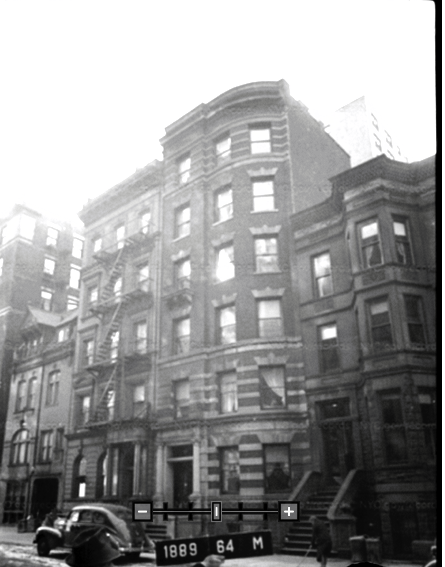
The cornice was intact in 1941.  image via the NYC Dept of Records & Information Services.

An impressive list of residents lived at the Lynwood Nursing Home over the decades.  Among them was journalist Franklin Pierce Adams, who came to New York from a Chicago newspaper in 1903.  His column, "The Conning Tower," successively appeared in the New-York Tribune, the World, the New York Herald Tribune, and the New York Evening Post.  In 1938, he joined the panel of the radio and television program Information Please.  He was, as well, the author of eleven books, and co-wrote the musical comedy Lo with short-story writer O. Henry.

A fascinating resident was Alice G. Palmer.  Born in 1887, she never married.  In 1930, she was appointed director of the Episcopal Mission Society's port and immigration service.  She interrupted that work during World War II to serve with the Motor Corps of the American Red Cross.  Afterward, according to The New York Times, she "found herself in the unusual position of helping men who were not citizens and who remained here illegally after World War II.  In many cases they had obtained jobs here and started to raise families."  

Alice G. Palmer, The New York Times April 11, 1964

Palmer represented them at deportation proceedings, and was often successful in their obtaining permanent visas.  The New York Times recalled, "She enjoyed serving as a witness when many of them were sworn in as citizens."

Broadway producer Richard Skinner lived at the Lynwood Nursing Home until his death on August 3, 1971 at the age of 71.  Born in Watertown, Massachusetts, he started his career as an actor--his Broadway debut came with a minor role in Hamlet starring John Barrymore.  He discovered, however, that his short stature made finding roles difficult.  He turned to producing summer stock in places like Westport, Connecticut, New Hope, Pennsylvania and Philadelphia.

Another theatrical figure here was actress Olive Reeves-Smith.  Born in Surrey, England, she played on Broadway with stars like Ethel Barrymore and George M. Cohan.  She also had roles on radio and television, including appearances on dramatic shows like Studio 1, The Kraft TV Theater, and Death Valley Days.

Olive Reeves-Smith in her role as Dolly in Bloomer Girl.  from the collection of the Museum of the City of New York.


Olive Reeves-Smith died here in 1972.  At the time, the Lynwood Nursing Home was experiencing problems.  On March 19, 1974, The New York Times reported that the Department of Health, Education and Welfare had warned the facility that it faced the loss of Medicare certification if it did not correct violations within two weeks.  A spokesman said that, in addition to fire hazards, there were deficiencies in "nursing services, physicians' services, patient-care policies, dietary services and medical record-keeping."

The Lynwood Nursing Home closed within five years, replaced by Saint Luke's Halfway House, an alcoholism treatment facility, which still occupies the former apartment building.

photograph by Anthony Bellov

At some point in the second half of the 20th century, the metal cornice was removed and the windows replaced.  Otherwise, little outwardly has changed to S. B. Ogden & Co.'s unusual, high-end flat building.

many thanks to historian Anthony Bellov for suggesting this post
no permission to reuse the content of this blog has been granted to LaptrinhX.com

Tuesday, March 5, 2024

A Public Enemy #1's Last Stand - 304 West 102nd Street


photo by Anthony Bellov

The block of West 102nd Street between Riverside Drive and West End Avenue was declared a "private block" in the last decade of the 19th century.  The restriction meant that no commercial building could invade the upscale enclave.  In 1895, developer John F. Kohler hired architect Ralph S. Townsend to design an upscale, brick-and-stone-faced apartment building at 304 West 102 Street amid the rising mansions on the block.

Townsend placed the cost of construction at $30,000--just over $1 million in 2024.  On March 2, 1895, the Record & Guide listed the amenities included in his plans.  Among them were:

...electric wiring, steam-heating plant and apparatus, combination gas and electric fixtures, ranges, dumb-waiter, electric bells, speaking-tubes, cabinet mantles, annunciators, inside blinds, concrete, marble and pine flooring, hardwood interior trim.

Electric bells, speaking tubes and annunciators were all means of communication--both within the apartments (between residents and their servants)--and with the building staff.

Townsend's dignified Renaissance Revival design bespoke affluence.  The arched entrance sat within a portico supported by polished granite Scamozzi columns.  The second floor windows were flanked by carved, paneled pilasters and capped by arched Renaissance style pediments.  Molded intermediate cornices relieved the verticality of the five-story structure.

photo by Anthony Bellov

Construction was completed early in 1896.  An advertisement on March 8 touted the views from above the surrounding residences.

Strictly High-Class
New Single apartments; richly decorated; 25x90; overlooking Riverside Drive; surrounded by private dwellings; eight rooms and bath; containing every comfort and convenience, including polite attendance; open evenings.

The "polite attendance" referred to staff like the uniformed hallboys on hand to run errands and help in general.  The eight-room apartments leased for $500 a year--an affordable $1,500 per month by today's standards. 

One family was looking for a chamber maid in 1898, their advertisement in the New York Herald reading, "Wanted--girl for general housework; must live in neighborhood and sleep home."  (How they expected to find someone who could afford to live in the mansion-filled neighborhood willing to do domestic work is puzzling.)

The tenants of 304 West 102nd Street were, of course, professional.  Among the earliest were newlyweds Robert Leslie and Lillian Moffett, who were married on February 26, 1896.  Born in Mineral Point, Wisconsin in 1866, Moffett had graduated from Columbia in 1891, and then received his law degree from Columbia Law School. 

Living on the fifth floor in 1903 was the family of Louis H. Muller and his wife, the former Anna Kimmerli.  Born in 1856, Muller was a clerk in the Hall of Records downtown.  The couple had four children, Edith, Harry Louis, Albert Edward and Isabella.   

That year the youngest, Isabella (who was 12 years old), won a prize in the New York Herald's Higglety Pigglety Puzzle Contest for children, while her brother, Albert, was looking for a job.  His ad in the New York Herald on October 14 read, "Young man (22) desires position as salesman or outside man; references unquestionable.  A. E. Muller, 304 West 102d St."

Tragedy visited the Muller apartment four years later.  On Christmas Eve 1907, the family visited a relative in the Bronx and stayed over for the holiday.  For some reason, Harry and Albert remained home.  On Christmas night, Albert arose from bed up to get more ventilation into the room.  The New York Press reported, 

He tried to lower the upper section of a window, but failed.  Kneeling on a couch he lifted the lower part; then, reaching out, he clutched the upper part and tried to draw it down.  But his hand slipped and, as he was leaning too far out of the window, he plunged to the street.  The brother, hearing Albert scream, jumped out of bed and sprang to the window.  He saw his brother on the side walk.

Neighbors also heard Albert's scream and a crowd had gathered around his body by the time Harry got outside.  The New York Press reported, "The parents of the victim did not learn of the accident until they came home, and both collapsed when they heard the news."  Albert's funeral was held in the Muller apartment.

It was common for funerals to be held in the families' spacious apartments.  On March 30, 1909, for instance, the funeral of 20-year-old Ernest J. Lohsen was held in his family's apartment.  Following his family's period of morning, his sister reentered society.  On October 2, 1910, the New York Herald reported, "Eta Pi Club will hold its first meeting of the season at the home of Miss Stella Lohsen, No. 304 West 102d street, on Saturday evening."

In 1933 the floor-engulfing apartments were divided.  There were now three apartments per floor.  Three years later a young man and his girlfriend moved into a ground floor apartment, initiating the most sensational chapter in the building's history.

In July 1936, 25-year-old Harry Walter Brunette and 29-year-old Merle Vandenbush escaped from an Ohio state prison and embarked on an armed bank robbing spree from Ohio to New York.  On November 11, 1936, they kidnapped New Jersey state trooper William A. Tumbull.   The FBI listed both as "public enemies."

Looking like college boys, Harry Brunette (left) and Merle Vandenbush (right) were the the targets of a nationwide FBI search.  The Rhinelander Daily News, November 11, 1936

Early in December New York detectives staked out 304 West 102nd Street, then notified the FBI that Brunette was holed up there.  Like a scene from a gangster movie, on December 15, 1936, The New York Times reported that Harry Brunette "stood off twenty-five G-men under the personal command of J. Edgar Hoover, their chief, and 100 patrolmen and detectives surrounding the flat at 304 West 102d Street early this morning."   The army of FBI and police officers tossed tear gas cannisters into the apartment, which inadvertently started a fire.  "Brunette exchanged shots from a hall closet with the Federal men, armed with submachine guns, and the police, while the flames roared from furniture and draperies in the room in which he had been trapped."

The entire block essentially became a battle zone, while neighbors huddled in their homes cringing in fear.  "Bullets tore at the wall surrounding the closet from the stairway above and from the stoops of apartment houses across the street, where the Federal Bureau of Investigation agents had outposts," said the article.  "Smoke poured from the room."

Buffalo Evening News, December 16, 1936

At one point, Arlene LeBeau, Brunette's 25-year-old girlfriend, "staggered into the hallway, her face grimacing in pain," said the article.  An FBI agent "darted into the hall, caught up the girl, and carried her to an upstairs apartment."  Finally, at 2:05 a.m., Brunette ran out of ammunition after having fired more than fifty rounds.  He stepped into the hallway with his hands raised, sneering, "What a brave bunch of guys."

Four days later, on December 19, 1936, the Chicago Daily Tribune reported, 

Harry Brunette, Wisconsin bad man, was taken to the federal prison in Lewisburg, Pa., today to begin a life sentence for kidnaping.  Later, it was said, he will be transferred to bleak Alcatraz Island in San Francisco bay.  There he will join others (among them Al Capone), who, like himself, have had fleeting notoriety as public enemy No. 1 in their day.

The article noted, "He received the life sentence in bored silence just 62 hours and 40 minutes after his arrest by Federal agents in a spectacular raid on his apartment at 304 West 102d street."

photo by Anthony Bellov

With the drama over, 304 West 102nd Street returned to normal.  There are three apartments per floor today, just as when Public Enemy No. 1 fought it out with machine gun wielding FBI agents nearly 90 years ago. 

many thanks to historian Anthony Bellov for suggesting this post
no permission to reuse the content of this blog has been granted to LaptrinhX.com

Tuesday, April 18, 2023

The 1899 Edward "Ned" Harrigan House - 249 West 102nd Street


An advertisement in The Evening Post on October 21, 1899 was titled, "Only Four Left" and offered 243 through 249 West 102nd Street as "The best laid out Private Houses on the West Side."  The "four-story American basement" houses, it said, were owned and had been built by James Livingston.

The six Renaissance Revival style houses had been designed for Livingston by the architectural firm of Neville & Bagge.  The 18-foot-wide, residences sat above short stone stoops, their bowed upper portions, faced in beige Roman brick, resulted in an undulating motion.  Neville & Bagge designed them in three mirror-image pairs, the subtle differences being in the placement of the splayed lintels of the middle pair at the third floor, rather than the second and fourth as in the other four homes.

Four of the original six houses survive.  249 West 102nd Street is second from right.

Real estate operator Alois Gutwillig purchased three of the houses, including 249 West 102nd Street.  He quickly resold it to Meta Reincke, who in turn sold it in 1902 to Ferdinand Kuhn and his wife Therese.  Kuhn was highly involved in the Jewish community in New York.  The couple had a daughter, also named Therese.  

Their residency would be relatively short-lived.  In 1907 they sold the house to Edward Harrigan and his wife Annie Theresa.  The couple had seven children, apparently six of whom moved into the house with them--Edward Jr., Dr. Anthony Hart Harrigan (named for Harrigan's former partner, Tony Hart), William, Philip, Nolan, and Grace.  (Adelaide was married to Michael Louis Loughran and lived elsewhere).  

Born on October 26, 1843, Harrigan was by now among the most recognizable names in show business.  The son of Irish immigrants, his father was a ship's carpenter.  The boy, who, according to The Mixer and Server in 1911, "wasn't fond of schooling," ran away to work at sea, eventually landing at San Francisco.  By chance he found a job in a minstrel show there in 1867 and his career on the stage was fixed.  The Mixer and Server said, "Harrigan made good by leaps and bounds.  He had the trick of making people laugh."

In 1870 Harrigan met Anthony J. Cannon, whose stage name was Tony Hart.  The pair formed the duo Harrigan & Hart.  Harrigan wrote the sketches which featured comic ethnic characters--Irish, German and Black--pulled from everyday life.  An all-around entertainer--actor, singer, playwright, lyricist, dancer and producer--Harrigan haunted the docks, beer halls and social events, making mental notes of the sayings and personalities of common citizens.

The duo's first hit was the 1873 The Mulligan Guard, with music by David Braham.  Braham would go on to be Harrigan's musical director.  He would also become Harrigan's father-in-law when Edward married Annie Therese Braham on November 18, 1876.  The success of The Mulligan Guard resulted in a series of Mulligan Guard plays.  Harrigan & Hart was one of the most celebrated partnerships in 19th century American theatrical history.

Harrigan in costume for a Mulligan sketch.  from the collection of the New York Public Library

In 1881 Harrigan hired architect Francis H. Kimball to remodel the old Church of the Messiah at 728 Broadway into a theater, the Theatre Comique.  Sadly, it burned to the ground three years later.  Not long after that Tony Hart retired.

Undaunted, in 1889 Harrigan hired Kimball once again to design a theater, this one on the site of an abandoned church near the northeast corner of Broadway and 35th Street.   By the time the Harrigans moved into 249 West 102nd Street, Harrigan's Theatre was being leased to actor Richard Mansfield, who had named it the Garrick Theatre.  

The family's summer home was in Long Beach, New Jersey.  Harrigan was essentially retired by now.  In 1911 The Mixer and Server noted, "In recent years, Mr. Harrigan appeared now and then in revivals of his old pieces...but practically all of his time in late years was spent at the home in West 102d street or summering at Long Beach."  In fact, Harrigan was quietly convinced that American audiences had forgotten him.

In 1909 Edward Harrigan suffered a heart attack.  His condition continued to be tenuous.  On January 18, 1910, The New York Times reported, "Edward Harrigan, the actor, is seriously ill at his home, 249 West 102d Street.  He is suffering from an attack of grip which recently has developed several complications."  (Grip, or the grippe, was the current term for influenza.)

Harrigan had been ill for months.  He had appeared at the Lambs Gambol in May 1909 at the Metropolitan Opera House and became sick soon afterward.  The New York Times said, "Election night last year there was a turn for the worse, and since then he has been under the care of physicians."  Attending him with the family doctor, of course, was Harrigan's son, Dr. Anthony Hart Harrigan.

At one point, death seemed imminent.  But when a reporter knocked on the door of the 102nd Street house on January 17, 1910 Annie Harrigan was reassuring.  "Mr. Harrigan during the last few months has taken many setbacks, but now he is much improved, and we are looking toward a complete recovery."

On June 4, 1911 an old friend, actress Annie Yeamans who had appeared in many of the Harrigan & Hart productions, visited.  The two reminisced about old times and when Annie left, Edward Harrigan was in a good mood.  The next morning, however, he was very weak.  According to The Mixer and Server on July 15, 1911, he called Annie into the room and asked to see a bound volume of programs.  Taking out the program of The Mulligan Guards' Picnic, he wrote on the margin:

My Dear Annie:  My ambition is satisfied.  We own a beautiful theatre which brought to us a home for ourselves and children.  Ned

According to the article, as he handed the program to his wife, he said, "The last curtain is about to ring down, Annie."

At 11:30 on the morning of June 6, 1911, Edward Harrigan died, "with his hand in his wife's and a smile for his children grouped around the bed," as reported by the Mixer and Server.  His coffin sat in the drawing room for two days, visited by a steady stream of actors, producers and theater managers.  He was 66 years old.

The Evening Telegram reported on June 9, "More than a thousand persons, including several score of old time actors, attended the funeral services for Edward Harrigan, better known as 'Ned' Harrigan, the actor, to-day at the Church of the Ascension in West 107th street, near Broadway."  The article said, "As the body was taken from the residence many white haired men followed the hearse through the streets to the church, which was crowded with friends of the old popular actor."  Annie Yeamans, who had sat and reminisced with Harrigan just two evenings before his death, "was unable to be present," said The Evening Telegram.  "Mr. Harrigan's death had been such a shock to her that she was unable to attend."

Pierced limestone wingwalls flank the stoops.

The Harrigan family continued to live in the 102nd Street house for another five years.  In 1916 Philip Braham Harrigan was attending a Federal military training camp.  His brother, Anthony, was an attending surgeon at Fordham and St. Francis's Hospital.  Perhaps because of Annie's declining health, in 1917 249 West 102nd Street was leased to a Mrs. Hamburger, who operated it as a boarding house for unmarried men.

Her advertisement in The New York Times on September 6 that year read:

Real Home for Bachelors: valet service; elegantly furnished private home, table of bountiful excellence, traveling facilities unsurpassed, individual attention and service, quiet, refine, homelike environment, every modern convenience; high class in every detail.  

Annie Braham Harrigan died at the Alston Sanitarium on West 61st Street on March 24, 1918 at the age of 59.  In reporting her death, The New York Times noted, "Mrs. Harrigan aided her husband often in the writing and construction of his plays."  Somewhat surprisingly, Annie left the 102nd Street house to her mother, Annie Braham.  Two years later, on October 23, 1920, the Real Estate Record & Guide reported that Dr. Anthony Hart Harrigan had purchased the house from his grandmother.

If Harrigan had anticipated moving back into his former home, he quickly changed his mind.  Before the year was out he resold it to another physician, Dr. Charles Edmund Carr.

Mrs. Hamburger still had a lease and continued to operate her boarding house through 1920.  She ran, as well, a 16-room vacation home in Far Rockaway.  In May 1920 she advertised, "Mrs. Hamburger wishes to inform her patrons that she is ready for booking for Summer and Winter in Far Rockaway.  Write or phone for appointment, 249 West 102d."

Delicate foliate carving frames the windows and door.

Following the expiration of Mrs. Hamburger's lease, the Carrs moved in.  Born in Monroe County, Indiana in 1883, Carr was a 1905 graduate of Indiana University and of Columbia University in 1913.  He was associated with St. Luke's Hospital.  The family's country home was on the grounds of the Carmel Country Club in Carmel, New York.

The Carrs, of course, had a domestic staff, and in June 1925 were looking for a "Girl, light colored, experienced, general housework."

Charles Edmund Carr died in the West 102nd Street house on May 17, 1933.  His funeral was held in the drawing room two evenings later.

The following year, in November 1934, Carr's estate sold 249 West 102nd Street to Percy Howard Secor and his wife, Miriam.  The couple maintained a country home in Poughkeepsie, New York.

At 10:30 on the night of December 4, 1937 Secor was driving near Peekskill, New York when his vehicle was struck by a drunk driver.  The Poughkeepsie Eagle-News said Secor's car was "forced against the stone ledge at the by-pass."  Secor was taken to the Peekskill Hospital and treated for multiple injuries, but he survived.  Both the driver, Jack Becker, and his passenger were arrested--Becker for driving while intoxicated and Robert Colwell for "public intoxication."

By 1942 the house was being operated as unofficial apartments.  One tenant that year had troubles with a drunk driver, as well, but her experience was much different than Secor's.  Helen Cavanaugh was riding in a taxicab driven by Edward Eberstein on March 21, when it crashed into another automobile at 30th Street and Madison Avenue.  Both drivers were arrested for driving while intoxicated.  Happily, Helen escaped without injury.

The Harrigan house is second from right.

In 1978 the former Harrigan house was officially converted to apartments, two per floor.  One of four surviving of the original row of six, it retains most of its 1899 appearance.

photographs by Anthony Bellov
many thanks to historian Anthony Bellov for suggesting this post
no permission to reuse the content of this blog has been granted to LaptrinhX.com

Monday, March 27, 2023

The Lost William F. Foster "Iron House" - 300 Riverside Drive


A delicate and delightful iron fence surrounded by property.  (original source unknown)

Born in Taunton, England in 1841, William Fowler Foster arrive in America in 1856, first settling in Chicago.  Foster began a silk business in the burgeoning frontier city, amassing a fortune.  Then, like so many businessmen, he saw everything he had worked for wiped out when downtown Chicago burned for two days on October 8 through 10, 1871.

The resolute Foster started over, turning his attention from selling silk to the manufacturing of gloves.  Around the time he married Bertha M. Fox, he invented what The Sun would describe as "a fastening for gloves which was instrumental in building up his fortune."  He and Bertha relocated to New York City where he established a glove factory, Foster, Paul & Co., in Harlem.  The Sun said he "extended it until he had become one of the largest manufacturers of gloves in America."

Foster's invention made the gloves secure, and their donning and removal simple.

Within three years, Foster, Paul & Co. had relocated his offices to 84 Reade Street and established a large factory on East 14th Street.  Before the turn of the century the firm would own a substantial building at 365-367 Broadway where it employed 150 women.

William and Bertha M. Foster lived at 533 East 120th Street in 1887.  That year they laid plans for an opulent home to the west, along the developing Riverside Drive with its magnificent views and refreshing breezes.  The northern part of the Drive was just beginning to see the rise of magnificent mansions, like the Samuel Gamble Bayne house at 108th Street, completed that year.  The Fosters purchased the southern half of the block between 102nd and 103rd Streets and commissioned architect Halstead Parker Fowler to design their home.  His plans, filed in January 1888, estimated construction costs at $70,000, or just over $2 million by 2023 conversions.

Whether it was Foster or his architect who decided to use cast iron in the construction is unclear, but it was a bold step and almost unheard of in domestic construction.  Using a cast iron facade accelerated the building process and the mansion was completed within a few months.  Fowler's three-story, Renaissance Revival design was intended to catch the breezes from the river, with faceted bays on the front and side elevations.  The panels were cast to resemble undressed stone and a broad, complex Renaissance Revival frieze ran below the balustraded cornice.  A deep, columned porch provided support for a second story solarium.  The unusual residence quickly earned the nickname "the Iron House."

The Fosters had only just moved in when, in July, they brought Fowler back to enlarge the house with a "one-story brick and iron extension."  The "glass and iron roof" mentioned in the plans suggests a conservatory.  The addition cost Foster the equivalent of $59,000 today.  Two months later Fowler would design a two-story brick stable to the rear of the property.

Foster's greatest pride was his massive library in his new mansion.  The Sun mentioned, "many of his friends were surprised when he showed them a catalogue of over 1,400 volumes, which he had carefully selected while deeply immersed in business affairs."  The Fosters additionally owned a valuable collection of oil paintings.

In 1893 Bertha's unmarried sisters, Carrie and Emma Gertrude Fox, were visiting from Chicago.  On the afternoon of December 17 William took them for a carriage ride along Riverside Drive.  "Their carriage was driven by Mr. Foster's coachman, and was drawn by a pair of big black horses, that were both gentle and valuable," said The Sun.  At around 5:00, as they were returning home, disaster struck.

"As they were nearing Seventy-third street," reported The Sun, "the coachman saw two buggies come racing down the avenue, each drawn by a fast horse.  Neither driver would let the other pass."  Foster's coachman pulled the carriage as far to the curb as possible and stopped.  Nevertheless, one of the racing buggies crashed into the carriage "with tremendous force."  The coachman was tossed into the gutter.  Foster jumped out and called to the women to do the same, but they were too shocked and unnerved to move.

William Foster pulled Carrie from the carriage.  As he had her about half way out, the horses became frightened and started off.  "Mr. Foster held tight to the young woman, but he could not prevent her falling, and she was struck by the wheel of the coach and whirled about."  A terrified Emma Fox was still in the carriage as the two panicked horses galloped away, with the coachman and Foster running behind.

At one point, the carriage struck a metal fence upheld by iron posts.  The article said, "Then followed a display of fireworks that is likened to the blaze and sparkle the trolley leaves in its train.  The steel axles of the heavy carriage struck the wire posts one after another and raised a stream of sparks."  Emma's screams of terror only added to the fright of the horses.  The runaway carriage destroyed the fence for three blocks.  Each time it struck a fencepost, another explosion of sparks occurred.  At 76th Street one of the horses became tangled up in the wire of the fencing.  "The other dragged its mate along for ten or fifteen feet," said The Sun, "and then was seized by three men who had been walking down the footpath."

Emma was removed from the carriage, unhurt but shaken.  The racing drivers had disappeared, their buggies left in pieces on the Drive.  Foster's carriage, which he said had cost the equivalent of $37,300 in 2023 money, "was a wreck."  Perhaps worse, one of the horses had a deep, 18-inch cut on hits flank.  According to Foster, it "was one of quite a famous pair which were owned by the son of Gen. John A. Logan."  It was unclear at the time if the horse could be saved.  Luckily, while Foster  had bruised his knee and Carrie Fox was "somewhat bruised and shaken," none of the party was seriously injured.

The following year the Fosters seriously considered another move.  On October 6, 1894, the Record & Guide reported that William had purchased the country estate of Laura B. Field at Hastings-0n-Hudson for $45,000.  The eight-acre property included a "stone mansion and outbuildings."  He simultaneously paid $40,000 for an adjoining 11 acres and "is said to contemplate the erection of a costly residence."  

The Sun explained that his intention was "to build there a Roman villa."  But his vision of what The New York Times described as "an extensive country place, to be known as Sabine Farm," would not come to pass.  Just as the plans were finalized, in March 1895 Foster was diagnosed with cancer.  The Sun reported later, "recognizing the fatal nature of his disease, he had to forego the realization of his idea."

Foster's death came quickly.  He died on December 3, 1895 at the age of 54.  His will was extremely generous to his employees.  In reporting on its terms on January 16, 1896, The New York Times said, "It is with his former employes [sic] that the deceased millionaire's will is liberal beyond parellel [sic]."  To 11 of his business employees he gave annuities of $500, and to 13 others annuities of $300.  To 27 others and to five of his domestic staff, he gave annuities of $100 each.  For an employer to provide an annual income to his employees after his death was nearly unheard of.  (There was a total of 150 annuities in his will.)

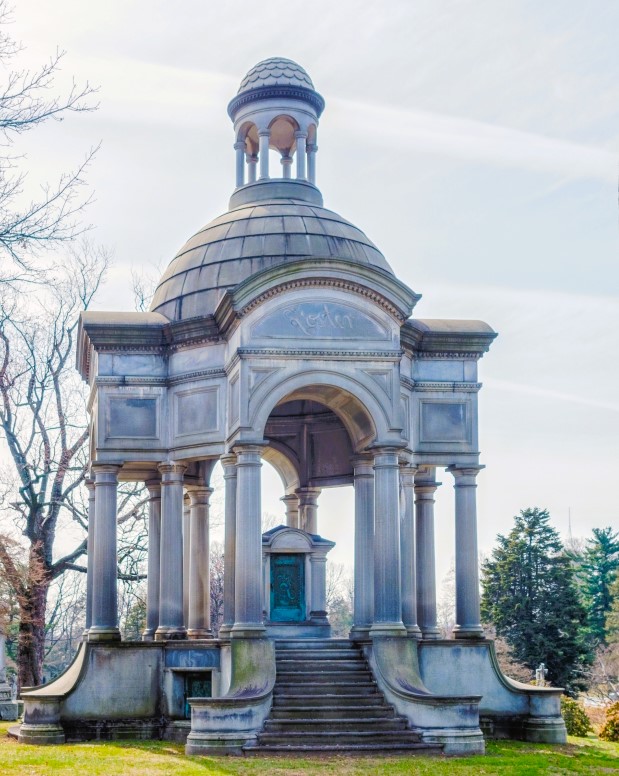
Bertha erected this handsome monument for her husband in Woodlawn Cemetery.  photo by Howard Dale.

Bertha remained in the iron-clad house.  It was the scene of Emma Gertrude Fox's marriage to Roberto Friedrich Bahmann of Cincinnati on October 29, 1905.  Carrie, now married, was the matron of honor and Bertha gave the bride away.  The New-York Tribune reported that the ceremony "took place in a bower of palms and under a lovely bell of white chrysanthemums.  The house was beautifully decorated with smilax, Southern laurel and white chrysanthemums."

On March 9, 1917, New York Herald noted that Bertha's home, "known as 'the iron house,' is one of the show places of the Drive.  There are about fifteen servants living in the house."  Several weeks before that article, a burglar had entered the residence and had partially cut a valuable painting from its frame before being discovered and running off.  Immediately after the incident, Bertha installed burglar alarms.  They soon proved to be a valuable investment.

At around 7:30 on March 8, while Bertha was at dinner, a maid on the third floor, Annie Girlke, saw a man who had shimmied up a drain pipe entering a window.  The New York Herald reported that the burglar alarms "were set in operation by the maid the moment she saw the burglar climb in the window."  Hearing the gongs, coachman Carl Peterson and his two sons rushed into the house and up the stairs, where they came face-to-face with the intruder.  The thief drew a revolver and threatened to shoot if anyone made a sound.

The New York Herald wrote, "Nevertheless Peterson called for help, and Mrs. Foster and [the] servants promptly locked themselves in rooms."  The burglar climbed out the library window on the second floor, dropped to the ground and fled.  The ringing of the burglar alarms drew scores of people from homes and apartment houses.  By the time police arrived, the burglar was long gone.  "So terror stricken were those within, however, that it was almost fifteen minutes bef0re they recovered sufficiently to admit the policemen."  The newspaper noted, "Although Mrs. Foster kept much valuable silver and jewelry in the house, the police believe that the thief was after some of the paintings in the library."

On March 2, 1922 the New York Herald reported that developers Harris, Albert and Samuel Sokolski had purchased the Riverside Drive property, "on which is the large residence of Mrs. Bertha M. Foster."  The article noted, "The buyers will erect on the corner...a fourteen story apartment house and a nine-story apartment adjoining the street."

Calling the Foster mansion "one of the residential landmarks of Riverside Drive," The New York Times said the property was "the largest site in that section overlooking the Hudson under single ownership."  The mansion and outbuildings were demolished later that year and replaced with the 300 Riverside Drive apartment building.

photo by Deansfa

Bertha died two years later at the age of 66 and was buried in Woodlawn Cemetery in the memorial she had erected for her husband 27 years earlier.

LaptrinhX.com has no authorization to reuse the content of this blog