Showing posts with label west 80th street. Show all posts

Tuesday, October 29, 2024

Charles See's 1895 200 West 80th Street


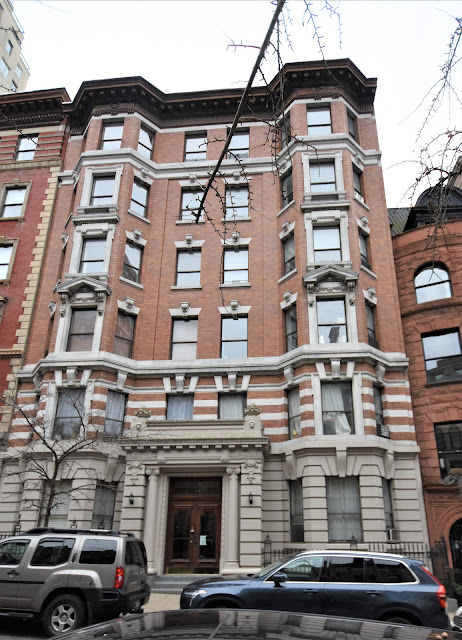
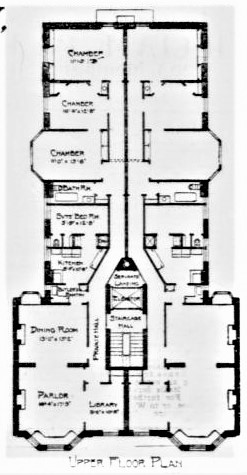
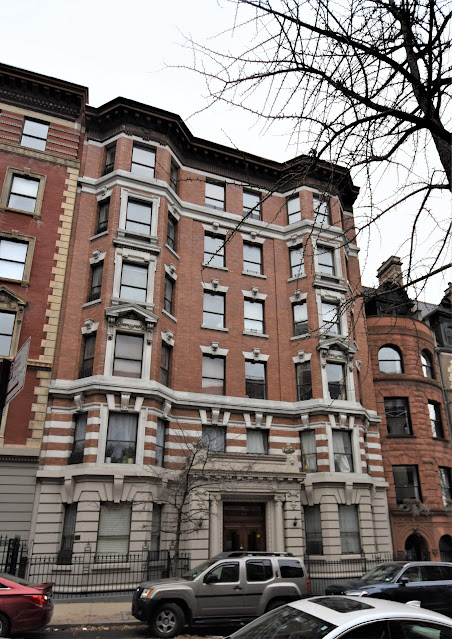
Real estate developers Noble & Gauss hired architect Charles See in 1894 to design an ambitious project at the southwest corner of Amsterdam Avenue and West 80th Street--four five-story apartment buildings with stores.  Interestingly, the corner building, with its residential entrance at 200 West 80th Street, stood apart from its fraternal siblings.  Instead of their arched fourth floor openings and dramatic splayed voussoirs at the second floor, its windows were all square-headed.  Only at 200 West 80th Street were decorative spandrels between the third and fourth floors carved with wreaths and ribbons.


Among the initial residents was Civil War veteran General John Hayes, who had served on the staff of General Ulysses S. Grant.  He was now, unfortunately, an alcoholic.  On August 24, 1897, the New York Press began an article saying, "Age, a need for stimulants to make up the waste of nature, and the loss of comrades were the excuses for drunkenness which a tall, soldierly looking man gave to the police yesterday."  The article noted, "He was drunk at Trinity place and Rector street."

The police, who described Hayes as "a man with a brilliant record," would have released him as soon "as sleep would have sobered him" if this had not been his second offense within a week.  And so he was incarcerated for the night.  When asked to confirm for police court records that he was General John Hayes, he responded, "'John Hayes' was near enough to be correct."  The New York Press recounted, "He said that he had reached the stage when he considered stimulants a necessity, and yet had not strength of body to withstand them as he could in the years ago."

The corner building is subtly different from the other three buildings.

The corner store became a James Butler Grocery in 1901, opening on April 6.  The first American chain of grocery stores, this newest branch was the 97th James Butler Grocery Company store. 

In the meantime, Arnold Daly was perhaps the first resident involved in the entertainment industry.  Born on October 4, 1875, he debuted in The Jolly Squire with Fanny Rice in 1892.  He opened in the role of Hamilton Travers in Are You a Mason? at Wallack's Theatre on April 1, 1901.  But his name appeared in newspapers for other than theatrical reasons when Marie Christie, the maid of actress Fay Templeton, called police after a man "poked his cane through a window."

When arrested, Daly initially gave his name as James Reilly, but his true identity was quickly discerned.  The New York Times reported, "He said he had gone to Miss Templeton's house in reference to business, but had not been able to see her."  Why he had resorted to breaking a pane of glass was never explained.

Arnold Daly in the role of Eugene Marchbanks in Candida.  from The American Stage of To-Day, 1910 (copyright expired)

While living here in 1903, Daly introduced American audiences to playwright George Bernard Shaw with his Candida.  It was the first of several Shaw plays in which Daly would appear.  With the emergence of silent films, Daly became a matinee idol known to audiences nationwide.

Also living here was actor Jerome Sykes and his wife, Jessie Wood.  Born in Washington, D.C. in 1868, the well-rounded entertainer was a singer, comedian and actor.  He debuted in Baltimore in The Mikado.  The New York Times described him as being "known for his strength and agility as an athlete.  Though a large man, he was very graceful and an expert dancer."

Jerome Sykes, The Players Blue Book, 1901 (copyright expired)

While living here, Sykes opened in The Billionaire in 1902.  It would be his greatest Broadway success.  Sadly, it would also be the cause of his death.  After playing a year on Broadway, The Billionaire went on the road in 1903, opening at the Illinois Theatre in Chicago.  On Christmas Eve, Sykes hosted a dinner for the cast.  The New York Times said he was "thinly clad during an amateur theatrical performance" that night, and he caught pneumonia.  The 35-year-old died at the Stratford Hotel in Chicago four days later.

The Billionaire closed following Sykes's death.  Ironically, several of the cast members skipped his memorial service on December 30, 1903, going instead to the matinee at the Iroquois Theatre.  A horrendous blaze broke out, killing 602 of the 1,700 patrons, two of whom were The Billionaire cast members.

Coloratura prima donna Julia Allen lived at 200 West 80th Street by 1908.  She arrived in New York around the turn of the century and became soprano at the Church of the Holy Name of Jesus at Amsterdam Avenue and 96th Street.  In June 1903, she debuted in the role of Micaela in Carmen.  Five months later, The Sun titled an article, "This New York Girl A Singer," and said the unknown's "voice and her method of singing attracted favorable attention.  Miss Allen seemed worth finding out about."  The singer traveled to England that summer to study.  On November 1, The Sun reported, "She has no idea of returning to her own country until she has made a reputation in all the European countries."

Having done that, she returned to New York and moved into 200 West 80th Street.  In 1908 she was a member of the Italian Grand Opera Co.

The building became the scene of what the Daily News called "a bizarre murder mystery" in 1938.  The night of January 19 was described by the newspaper as "one of the Winter's coldest nights."  Mrs. Amelia Holm, who lived on the fifth floor, heard footsteps on the roof at around 4 a.m., "followed by a rattling of ropes and a crash," said the article.  Around the same time, nine-year-old Theresa D'Arcy, whose family lived in the basement apartment, was awakened by cries of help.

The building superintendent, Louis Mielitez, had left the large dumbwaiter on the fifth floor.  The following afternoon, at around 4:00, he discovered it was in the basement with its rope off the pulley.  The North Shore Daily Journal reported on January 20, "On the roof of the box-like compartment, police found [an] overcoat and suitcoat, neatly folded."  There were also a derby hat and another coat, also neatly folded.  When the dumbwaiter was raised, the body of 40-year-old Ruland Thompson was discovered.  He was described by the North Shore Daily Journal as a "sales executive and member of a wealthy Manhasset family."

image via the NYC Dept of Records & Information Services

The Yale-educated Thompson, who was recently estranged from his wife, was living in the Tudor Hotel.  The Daily News said, "To fall into the shaft accidentally would be impossible.  Tenants told of hearing the cry of 'Help!' three times at 4 A. M. yesterday.  They also heard footsteps on the roof, followed by a crash.  But no one investigated, they told police."  Despite the wide-spread coverage of the mysterious murder, it does not appear that the case was ever solved.

Born later that same year, Dorothy Pitman Hughes was living here by the third quarter of the century.  The indefatigable woman was a feminist, child-welfare advocate, author, entrepreneur, and activist.  She organized New York City's first shelter for abused women; co-founded the New York City Agency for Child Development; and with Gloria Steinem founded the Women's Action Alliance.  In 1972, she signed the Ms. magazine campaign, "We Have Had Abortions," which demanded an end to "archaic laws" that limited reproductive freedoms.  

Gloria Steinem and Dorothy Pitman Hughes in 1971.  Dan Wynn Archive and Farmani Group, Co.Ltd

In her 2000 book Wake Up and Smell The Dollars!  Whose Inner City is This Anyway!, Hughes includes several letters addressed to her at 200 West 80th Street from the likes of Hubert Humphrey, Hugh L. Carey, and Charles S. Rangel.

While its storefronts have been brutalized over the decades, 200 West 80th Street retains its architectural integrity after nearly 130 years.

photographs by the author
no permission to reuse the content of this blog has been granted to LaptrinhX.com

Tuesday, April 11, 2023

The Edward J. O'Brien House - 313 West 80th Street


Developer Bernard S. Levy was prolific on the Upper West Side in the last decades of the 19th century.  He created long rows of residences as well as several "flat," or apartment buildings.  In 1894 he started on another project--a row of six houses on West 80th Street, just steps from elegant Riverside Drive.

Given the upscale neighborhood filled with spacious mansions, Levy's decision to squeeze six homes into the property is a bit surprising.   While other developers may have filled the parcel with four 25-foot wide mansions, Levy's six residences were 16- and 18-feet wide.

But what the homes lacked in width they made up for in architectural charisma.  Architect Charles Israels designed them in the Gothic Revival style.  Their rough-cut stone bases upheld three floors of beige Roman brick.  Israels configured them in an A-B-A-A-B-A pattern, the A models boasting angled oriels at the second floor and sharp gables at the fourth.  The houses were replete with stained glass.  It filled the first and second floor transoms, and announced the street number above the doorway.

Bernard Levy priced the houses at $24,500 to $26,000--the higher price equal to about $807,000 in 2023.  A brochure described:

On the low stoop entrance plan, with dining room, butler's pantry and kitchen on the same floor.  Two bathrooms, exposed plumbing, parlors in red mahogany, dining rooms quarter oak, second story oak, third and fourth stories ash, 17 rooms in each house.
 
Among the A models was 313 West 80th Street.  In June 1895 Levy sold it to Edward J. O'Brien and his wife, the former Nellie C. Mulgrew.  O'Brien was a member of M. O'Brien & Son, founded by his father Michael in 1852.  The New York Hotel Record called the firm "the well-known purveyors of first-class vegetables" and "one of the oldest firms in business in New York."

The O'Briens enjoyed a merchant class lifestyle.  On January 30, 1897, for instance, The Evening Telegram announced, "Mr. and Mrs. E. J. O'Brien, after an extended tour through Canada and the States, have returned to their New York residence, No. 313 West Eightieth street."  And on September 6, 1903 the New York Herald reported, "Mr. and Mrs. J. O'Brien and their granddaughter, Miss Cecelia A. Stallman, have returned from a stay in the North Woods."  (The O'Briens' daughter Mary A. O'Brien was married to Arthur C. Stallman.)

Nellie C. O'Brien died of pneumonia on January 8, 1907.  Her funeral was held in Holy Trinity Church on West 82nd Street.  The pain of his wife's death may have prompted Edward to leave their West 80th Street house.  Only weeks later, on February 23, The Evening Post reported that he had sold it.

313 West 80th Street is third from left within the charming row.

The house saw a relatively quick turnover in owners.  It was offered for sale again in September 1912.  An advertisement in The New York Times noted it contained "11 rooms, 2 baths and 3 toilets."  It was purchased by J. V. W. Du Bois, who resold the house three years later to Clinton M. Cruikshank.  He sold it to a tenant, French-born harpist, pianist and composer Carlos Salzedo, in September 1919.

Famed German-American conductor Walter Damrosch had said of Salzedo, "I do not think there is a man living today who is a greater exponent of the harp than Salzedo."  He had begun studying at the Paris Conservatory at the age of nine, and won the premir prix in harp and piano at 16 years old.  He moved to the United States when he was 24, playing harp at the Metropolitan Opera House.

Salzedo had just returned from fighting in World War I when he and his wife, pianist and singer Viola Gramm, moved into 313 West 80th Street.  His fame afforded them the ability to summer at fashionable resorts.  On April 19, 1918, while still renting 313 West 80th Street, Salzedo's advertisement in Musical America read, "Special Summer Classes and private instruction on the harp, in solo and ensemble playing, at Seal Harbor, Maine."

Carlos Salzedo, Shadowland magazine, November 1922

Renting a room with the Salzedos was voice coach Clara Novello Davies.  Her advertisement in Musical Courier magazine on August 21, 1919 promised, "All can sing if they know how to breathe."  She was the mother of actor, singer, and composer Ivor Novello.

About a week before that advertisement appeared, a crisis had erupted at 313 West 80th Street.  On August 12, The Evening World reported, "Devey has deserted the hearthstones of Madame Navello [sic] Davies, a vocal instructor, No. 313 West 80th Street, and probably is associating with other dogs not in his set at all.  Devey is a small brown Griffon dog that slipped out of the Davis home on Friday and has not been heard of since despite an offer of a reward."

Clara Novello Davies, Notable Welsh Musicians of Today, December 31, 1896

A friend of Clara Davies, millionaire brewer Jacob Ruppert, placed an advertisement in the New York Tribune reading:

Lost--A small brown Griffon dog, answers to the name Devey.  Friday, at Riverside Drive and 80th st; liberal reward.  Jacob Ruppert, 1639 Third ave...or Mme. Davies 313 West 80th st.

It is unclear whether Devey was ever returned to Clara Davies.

In his book Carlos Salzedo: From Aeolian to Thunder, A Biography, author Dewey Owens writes that by the 1920's, Salzedo and Viola (whom he called Mimine) were growing apart, she spending more and more time in Europe and he having "lightly concealed liaisons."  Although they would not divorce until 1926, the domestic circumstances may have prompted Salzedo to sell 313 West 80th Street in 1922.

The New York Herald reported on August 5 that the buyer was Max Schulman, "a physician who will alter it for his occupancy."  The renovations, which apparently were limited to the ground floor, resulted in two doctor's offices.  An advertisement appeared in The New York Medical Week on September 22, 1923 offering, "For Rent--Attractive office and furnished waiting room.  Dr. M. Schulman, 313 West 80th St."

Perhaps because of its narrow proportions, just 16-feet wide, the former O'Brien house was never converted to apartments.   In 2007 a gut renovation was initiated which resulted in the interiors being "modernized to perfection," according to a realtor.  Happily, because the house sits within a historic district, the exterior was preserved.  


Restauranteur Jeffrey Lefcourt, owner of The Smith, placed it on the market in 2017 for $8.3 million.

 photographs by the author
LaptrinhX.com has no authorization to reuse the content of this blog

Tuesday, August 30, 2022

The 1898 Winchester Fitch House - 319 West 80th Street


Clarence F. True was among the most prolific architects working on the Upper West Side in the late 19th century.  He would eventually design more than 400 houses in the district, almost all of them a playful take on historic styles.  He turned to the Elizabethan period in 1897 when he designed seven houses that wrapped the northeast corner of Riverside Drive and West 80th Street.

The easternmost of the row was 319 West 80th Street, which, like its fraternal siblings, was four-and-a-half-stories tall.  The arched entrance, flanked by two large, Elizabethan-style brackets, sat atop a two-step stoop.  The understated, bowed facade, faced in limestone, rose to a slate shingled mansard with a pedimented dormer.  Flemish stepped gables separated each house of the row at this level.

The newly-completed house was purchased by Winchester Fitch and his wife, the former Florence Hopper in February 1899.  An attorney, Fitch was the son of well-known lawyer Edward H. Fitch.  The couple had been married in 1897, a year after Winchester joined his father's law office.

Winchester Fitch.  from Field Genealogy, 1901 (copyright expired)

Florence threw herself into entertaining.  On April 6, 1902, the New York Herald reported, "Mrs. Winchester Fitch, of No. 319 West Eightieth street, recently gave a charming breakfast for several visiting friends from the West.  Mrs. Fitch is a sister of Mrs. Nicholas, of the Dorilton, and has entertained much this winter."

The Fitches' summer home was Hillbrook, in Greenwich, Connecticut.  Both Winchester and Florence were amateur musicians, and their gatherings in both homes often centered around music.  On February 13, 1904, for instance, The Evening Telegram reported, "This afternoon Mr. and Mrs. Winchester Fitch, of No. 319 West Eightieth street, will give a musicale in honor of the members of the Shakespear [sic] Club."

It may have been their increasing family (they would eventually have three daughters and a son) that prompted the Fitches to upsize in July 1905.   They purchased the five-story, 25-foot wide residence on the corner of West End Avenue and 81st Street.  Their former home was purchased by retired broker Jennings Stockton Cox.

Jennings Stockton Cox  from The Cox Family In America, 1912 (copyright expired)

For years Cox had been associated with Jay Gould and Rufus Hatch.  In 1873 Gould had sent him to San Francisco as an agent of the Pacific Mail Steamship Company.  Upon his return to New York, he joined the brokerage firm of John H. Davis & Co.  He was a former president of the New York Athletic Club, and had memberships in the Larchmont Yacht Club, the New York Yacht Club, the Southern Society, and the Maryland Society of New York.   

He and his wife, the former Mary McJilton, three grown sons, Arthur M., William, Jennings, Jr.; and a daughter, Mrs. R. C. Fisher.  Arthur and his wife lived in the West 80th Street house, as well.

Despite Jennings's elevated status within the social and financial communities, it was his son, Jennings Stockton Cox, Jr. who is best remembered among the family.  A graduate of the Columbia University School of Mines, Cox, Jr. was an engineer in the Daiquiri mine in southeast Cuba in the 1890's.  He supposedly concocted a cocktail of rum, sugar and lime juice while entertaining guests, which he named after the mine.  Although his father was included in the 1899 Notable New Yorkers of 1896-1899, it is Jennings Stockton Cox's contribution to American mixology that is best remembered.

In the meantime, Arthur and his family maintained a summer home near Gloucester, Massachusetts.  On August 27, 1907 their 11-year-old son, Arthur J. Cox, was in a boat in the Bass River near the house.  The New York Times explained that the river, "empties into the sea, some 200 yards beyond" the Cox property.  That afternoon, said the article, "three servant girls, bathing in the river, were swept out into deep water."

Walter J. Byrne, a life guard, rushed into action, but he could rescue only two of the women.  "Arthur Cox, who was not far away in a small boat, quickly rowed to where the third girl was going down for the last time.  The little boy jumped in, caught her around the head with one arm, and held on to the boat with the other until Byrne got back."  The newspaper noted, "The cottagers at the time made a fuss over young Cox, which so bored him that he took to the woods for a couple of days."

Jennings Stockton Cox, Sr. died of pneumonia in the West 80th Street house on October 21, 1913 at the age of 79.  In reporting his death, the San Francisco Chronicle said, "In the course of his life he was at one time and another a well-known figure in San Francisco, Baltimore and New York."  Ironically, Jennings, Jr. had died just six weeks earlier.

Four months later, Arthur Cox leased the house to Madame Louise Homer, "who will occupy the house while filling her engagement at the Metropolitan Opera House," said The Sun on February 21, 1914.

Louise Homer, from The Victor Book of the Opera, 1912 (copyright expired) 

When Homer's lease expired, Arthur Cox leased the house to the Frederick Richard Gillespie family.   Born in Ireland in 1845, Gillespie was the head of Hammill & Gillespie, importers and manufacturers of clays.  He had been associated with the firm since 1867.  He and his wife, the former Julia Mendel, had three sons, Edward Stanley, Hilliard Mendell, George Maitland, and a daughter, Edith.  The family's summer home was at Shippan Point, near Stamford, Connecticut.

Edward was associated with his father's business, as well as being the treasurer of the Toronto Fur Company.  Still unmarried, he moved into 319 West 80th Street with his parents, most likely because of a serious physical condition.  

The New York Herald explained that he was "an automobile enthusiast."  On October 12, 1915, the newspaper said, "While cranking his automobile at his father's country home in Stamford, Conn., three years ago, he ruptured a cardiac valve."  Edward never recovered from the injury and he died in the house only months after moving in, on October 11, 1915.  He was 37 years old.

Frederick R. Gillespie died in 319 West 80th Street on January 28, 1919 at the age of 74.  In reporting his death, The American Perfumer recalled that the Irish immigrant had started his career as a messenger boy.

Julia almost immediately left West 80th Street.  Arthur Cox converted the house to ten "non-housekeeping" apartments the following year.  Although the term "non-housekeeping," technically mean there could be no cooking on premises, an advertisement in the New York Herald on April 1, 1920 offered, "Two rooms, kitchenette and bath." 


Cox retained possession of the property until December 1930, when he sold it to Adele Linder "for investment."  A renovation completed in 2005 resulted in two apartments per floor.  Expectedly, very little of Clarence F. True's 1898 interior detailing remains, nor does much of the exterior decoration.

photographs by the author
LaptrinhX.com has no authorization to reuse the content of this blog

Tuesday, March 15, 2022

The Leyland - 306-308 West 80th Street


On December 3, 1898 the Real Estate Record & Builder's Guide reported that developer Michael Tully had commissioned the architectural firm of Janes & Leo to design a six-story "brick and stone apartment house" on West 80th Street, between Riverside Drive and West End Avenue.  Both avenues were seeing the rise of opulent private homes, and so The Leyland would be a high-end residential building.

Completed in 1899, its rusticated stone base upheld five floors of red brick trimmed in limestone.  The sophisticated Renaissance Revival design included bellflower carved pilasters that flanked the second floor windows, classical pediments with elaborate cartouches above the third floor openings, and terra cotta banding at the sixth floor.

An advertisement for The Leyland said it sat within the "most aristocratic location on the west side."  The seven- or eight-room apartments included a private servants' entrance, electric lights, and "hall service."  The term referred to uniformed hallboys who ran errands, carried packages and performed other such services.

Among the initial residents were Carl Von Goeben, a construction engineer, and his wife; and dry goods importer Victor Erbacher and his wife and son.  Born in Vienna in 1863, Erbacher had come to America as a child, and was now a partner in Erbacher & Byram.

Stock broker Howard Crosby Foster and his wife, the former Ethel Emmagene Pratt, were married in 1903.  An 1898 graduate of Princeton University, Foster was a member of the firm of Foster & Adams (formed the year of his marriage).  The couple maintained a summer home in Plainfield, New Jersey.   When they moved into The Leyland, they had a daughter, Marion, born in 1905, and a baby son, Howard, Jr., born on April 13, 1908.

Howard Crosby Foster--Class of Eighteen Ninety Eight Twenty Fifth Year Book 1898-1923 (copyright expired)
Ethel Pratt Foster--from the collection of the Plainfield Garden Club

Tragically, their apartment would be the scene of 14-month-old Howard's funeral in May 1909.  There would be another funeral in the apartment two years later, on December 18, 1911--that of Ethel's mother, Emma Leffingwell Pratt.

A more joyful event was the wedding of Lola Pauline Kalman, the daughter of the Adolph and Julia Kalman, to Maurice Adelsheim on February 22, 1912.  Kalman was born in Hungary and had originally immigrated to Minnesota where he became a partner in the August Oppenheimer Company, makers of millinery and fancy goods.  The family still maintained a home in St. Paul, Minnesota.   Now, with Lola married, the Kalmans, only 15-year-old Emil remained with his parents.

At the time of the wedding, residents were paying $1,400 per year for an eight-room apartment--about $3,000 per month in today's money.  

Among the residents in 1915 was Francisco Urquidi, the Villista Consul to New York City.  Former bandit Pancho Villa had become a general during the Mexican Revolution that forced out President Porfirio Diaz.  Now Villa was one of two figures seeking recognition as the legitimate authority over Mexico, the other being Venustiano Carranza.  

A reporter from The New York Press who interviewed Urquidi in his apartment on September 19, 1915 was told, "General Villa does not expect to be recognized by the United States."  His expectations were met.  After Villa raided the border town of Columbus, New Mexico, in hopes of goading the United States into invading Mexico, he was regarded as an outlaw.  Presumably, Francisco Urquidi gave up his apartment in The Leyland soon afterward.

The Leyland continued to be home to upscale families in the post World War I years.  The residents appeared in the society columns' reports of weddings and funerals.  The engagement and wedding of Helen Marie Henderson, the daughter of Ernest Kirtland Henderson and his wife, for instance, in 1920, was followed by the social writers for months.

But the Hendersons' lease and those of the other residents would not be renewed.  On May 29, 1920 The New York Times reported that the building had been sold to the Weiss-Green Realty Company, "which will alter the property into small apartments."

The smaller apartments, coupled with the advent of the Great Depression, changed the tenor of the once-refined Leyland.  Resident Dominick Ceninati was arrested with Florence Maldine on September 34, 1934 for passing counterfeit bills.  Their mistake was in targeting the same store twice.  When Florence took items to the counter of an Astoria, Queens store in August, the owner recognized her as having previously passed a fake bill.  The New York Press reported that Cleon Psmopoulous "pulled out a revolver...when the woman started to pay for purchases and kept her covered until police arrived."

And 43-year-old Joseph Miller was arrested three years later for fraud.  Irving Winokur had placed an advertisement asking for a job "and saying he was prepared to invest money in a good business."  It caught the eye of Miller, who offered him a position at $25 per week, "if he posted $1,000 as a guarantee of faithful performance."  After working three months, Winokur became suspicious and demanded his money back.  "It was not forthcoming," said The New York Times.

Things got worse in 1947 when the building was converted to 16 and 17 single occupancy rooms per floor--commonly referred to as a flop house.  

On September 15, 1974 The New York Times began an article saying, "At least 16 persons have been murdered in single-room occupancy hotels in Manhattan's West Side in the last 12 months, according to [police] records."  Among them was 52-year-old Nora Cancel, who was murdered in The Leyland shortly after 1 a.m. on February 2.  She had been strangled to death by her 33-year-old live-in boyfriend, Jose Muniz.

The following year, just before noon May 6, 1975, Jackie Coleman forced his way into the fifth-floor room of 65-year-old Cobie Wheeler.  He not only robbed her of $15, but attacked her, trying "several times to push her out the window," according to police.  Police Officer Arthur J. Esposito was on  patrol on West 80th Street, when he heard Cobie's screams, and then saw Coleman run from the building.  He chased him down and "after a scuffle," disarmed him.  The New York Times reported, "He was charged with attempted murder, robbery, possession of a weapon, burglar tools and stolen property, and resisting arrest."

Redemption came as the neighborhood turned around in the next decade.  A renovation completed in 1987 resulted in "class A apartments" throughout, with a penthouse addition, unseen from the street, that included the upper halves of two duplex apartments.

Despite its renaissance, The Leyland still had one more unsavory connection.  In September Federal investigators busted a Columbian cocaine smuggling ring that "acquired apartments in quiet residential section of Manhattan for stashing drugs, money and weapons," according to agents.   One of those was The Leyland.  The New York Times reported, "In late June, Drug Enforcement Administration agents recovered $2.5 million in drug earnings from apartment 1-D at 306 West 80th Street."


Other than replacement windows and gray paint on the ground floor limestone, The Leyland retains its aristocratic 1899 appearance.

photographs by the author
no permission to reuse the content of this blog has been granted to LaptrinhX.com

Tuesday, February 15, 2022

Ralph S. Townsend's 1900 303-305 West 80th Street


Architect Herbert Spencer Styne-Harde (who most often dropped the "Styne" from his surname, professionally) would partner with Richard Thomas Short in 1901 to form the firm of Harde & Short.  They would be responsible for 
lavish apartment buildings, like the Alwyn Court and Red House.  

But three years before that partnership began, in the summer of 1898, Harde began a significant project with Charles H. Lowen to erect two apartment buildings at the northwest corner of West End Avenue and 80th Street.  Surprisingly, the men hired Ralph S. Townsend to design the structures, with the plans listing Styne-Harde merely as "associate architect."

Completed in 1900, 303-305 West 80th Street was the little brother of the larger corner structure.  Narrower and one story shorter, it was architecturally harmonious with an identical enclosed portico, Roman brick and limestone facade, and rounded bays.  Townsend flexed the Italian Renaissance motif with heavily carved classical pediments at the third floor a romantic stone balcony at the fourth. 

There were two apartments per floor in the new building, containing either seven or eight rooms.  They filled with well-to-do residents.  Among the first was Peter Gilsey, the grandson of hotelier Peter Gilsey.  Although only 22 years old when the building opened, Gilsey was a highly-successful real estate operator and partner in Gilsey Brothers.  In 1903 The Finance and Commerce of New York and United States said, "Among the properties the firm controls are a number of large hotels, office buildings and apartment houses in the city, most of them situated along Broadway."

Peter Gilsey.  from The Finance and Commerce of New York and United States, 1903 (copyright expired)

In 1873 the British Consul to the United States, Thomas Henry Whitney, married Lucy Williams Hallam.  He had co-founded the firm of Suzarte & Whitney in 1877.  The wealthy importer died in their home on West End Avenue in February 26, 1907.  Lucy almost immediately moved into 305-305 West 80th Street.

Somewhat surprisingly, mourning did not get in the way of Lucy's many social activities.  On April 3, only five weeks after Whitney's death, she headed what The Indian's Friend described as "a Programme Meeting of the New York State Chapter of the Colorado Cliff Dwellings Association" at Duryea's restaurant.  The group had been founded in 1900 with the sole purpose of preserving the cliff dwellings of the Mesa Verde area.  That afternoon, the new song The Breath of the Forest was performed, and the article advised, "This beautiful song can be obtained from Mrs. Thomas Henry Whitney, 303 West Eightieth Street, New York City.  Price 75 cents."

Lucy was proud of her deep American roots and was a member of the Colonial Dames, the Daughters of the American Revolution, and the Society of Mayflower Descendants (she descended, in fact, from three Mayflower passengers).

Equally visible in club and charity work was Mary Farrell Lerscher, the wife of John N. Lerscher.  Lerscher had been a clerk in the Supreme Court since 1890.  Mary was treasurer of the Guild of the Infant Savior on East 22nd Street, the object of which was "to support, care for or maintain destitute mothers and infants."

Neither Lucy Whitney nor Mary Lerscher outshone the colorful Adelaide Dorn Wallerstein.  She and her husband, Henry (known as Harry), moved into the building in 1907.  On October 29 the New York Herald announced, "Beginning with the first Monday of next month, Mrs. Harry Wallerstein, formerly of No. 121 West Eighty-sixth street, and now of No. 305 West Eightieth street, will be informally at home after four o'clock."

Adelaide was an intriguing woman.  She balanced her role as socialite with attorney and physician.  She had earned her law degree from New York University in 1898, and her medical degree from the New York Medical College in 1905.  That year she founded the East Side Clinic for Children and would head it for 25 years.

Dr. Adelaide Wallerstein approved of high-necked garments for women.  Marsh's Magazine, October 1908 (copyright expired)

While it would appear that Adelaide Wallerstein was a thoroughly modern Edwardian woman, she had one foot firmly planted in the Victorian era.   On November 16, 1907, The New York Times reported that she and 23 other women had founded the Philocalian Club, "to wage a crusade against girls who ride from the theatre in hansom cabs, drink highballs, and wear décolletée gowns and openwork waists."  (The plunging décolletée, or décolletage, neckline was made famous in John Singer Sergeant's portrait, Madam X.)

While insisting she was not a reformer, Adelaide told the reporter in part:

We have all pledged ourselves not to wear décolletée gowns--that is, so décolletée that the neck will be cut lower than the collarbone...Then, we have pledged ourselves not to drink highballs or cocktails.  And about hansom cabs.  It is wrong for two young people to ride about in hansom cabs at night.  A couple should go straight home from the theatre, instead of seeking the bright lights of a restaurant.

New York socialites were shocked on December 3, 1910 when they picked up their morning newspapers.  An article on the front page of The Post-Standard began, "Dr. Adelaide Wallerstein of No. 305 West Eightieth street, who is said to hold membership in more clubs than any other New York woman and who is a prominent society woman of independent wealth, has been a divorcee for six weeks."  The proceedings had been conducted "with extreme secrecy," and when Adelaide's attorney was asked about grounds, he replied, "the doctor had a naughty husband and that is all there is to it."

Adelaide would not remain single for long.  Six months later, on June 28, 1911, she married Noble McConnell and left West 80th Street.  

In the meantime, Lucy Whitney had died in her apartment on April 27, 1910 at the age of 68.  The Evening Post remembered her as being "active in church and charitable work."

Architect Max G. Heidelberg of Heidelberg & Levy, lived here in 1915.  That year he attended a conference at City Hall "on 'the boy problem,'" as reported by The Sun on November 23.  He was one of 100 "prominent men" who had received invitations from Acting Mayor George McAneny regarding a campaign to raise a fund of $200,000 for the Boy Scouts of America.

Considering conditions in Europe at the time, Heidelberg was suspicious of the group, founded five years earlier.  The Sun said he "startled" the assembly "by demanding to know whether or not the Boy Scout organization, concerning which many fine things were being said, was a military body."  The New York Herald added, "The speaker said he knew the State and city heads of the schools were opposed to militarism in the schools."  Heidelberg was advised that the "movement was military only in its outward appearance."

The days of society teas and charity gatherings along the block had passed by the World War II era.  In 1941, 303-305 West 80th Street was converted to a warren of single room occupancy spaces--16 per floor.  As the building became seedier with the passage of decades, the down-and-out residents were sometimes violent.

On October 27, 1973, The New York Times reported that 32-year-old Dianne Brown, who had been arrested for robbing an elderly man three weeks earlier, had snatched a woman's purse on Broadway between 82nd and 83rd Streets.  Brown was armed with a razor.  "A bystander tried to intercede and was slashed across the face," said the article.  "Another man then tried to intercede and was slashed on the hand."  Police officers who pursued Brown caught her in the hallway of a building at 312 West 80th Street.

Six years later John West and Lester Prather lived in the building, when they were arrested on April 21, 1979.  They had beaten a homeless man to death with a pipe just around the block on West End Avenue between 80th and 81st Street.

In the early 1980's the ground floor windows and doorway were bricked up.  photo by the Landmarks Preservation Commission

That year Arthur Leeds and Morton Corwin contracted to buy the building, but litigation tied up the transaction until 1982.  The partners laid plans to convert the beleaguered building into 30 rental apartments.  But a sequence of circumstances changed their plans, and in 1983 they began a renovation to condominium apartments, including wood burning fireplaces.


Although the limestone base has been painted gray, and the once-rounded window panes in the curved bays are now flat, Ralph S. Townsend's building has regained the prim appearance that attracted affluent residents in 1900.

photographs by the author
LaptrinhX.com has no authorization to reuse the content of this blog

Tuesday, January 25, 2022

The 1901 Fontenay--310 West 80th Street


When real estate developer Michael Tully purchased the two vacant building plots on West 80th Street near Riverside Drive in 1899, the neighborhood was filling with upscale private homes.  He, however, had other plans for the parcel.  Early in December the architectural firm of James E. Ware & Son filed plans for a "brick and stone flat" at 310 West 80th Street.  It would be only marginally less luxurious that its neighbors, The New York Times reporting that the cost of construction would top $4 million in today's money.


Completed in 1901, The Fontenay was a dignified, reined-in version of the Beaux Arts style.  The entrance, recessed within an elaborate, closed portico was centered in the rusticated limestone base.  The upper floors were faced in ruddy red brick and trimmed in limestone.  The architects' rigidly symmetrical  design included two faceted bays that caught river breezes during warmer months.

Each floor held two apartments of eight rooms and bath.  An advertisement in 1900 boasted, "The woodwork, plumbing and general decorative effects of the apartments excel those of any similar house in the city."  It stressed the "virtual isolation" of the kitchen and servant's room and noted there was a separate servants' entrance and "special servants' toilet" in the building.  Rent for the most expensive apartments was $1,500 per year, or about $4,000 a month today.

There were two mirror-image apartments per floor, each with a private hall off the elevator.  New-York Tribune, September 9, 1900 (copyright expired)

Expectedly, the residents were professionals, like chemist and author Ferdinand Gerhard Wiechmann.  Born in Brooklyn in 1858, he was a chemistry instructor at Columbia University and the author of several academic books.  His wife, the former Marie Helen Damrosch, was the daughter of renowned composer and conductor Leopold Damrosch.

Around 1904 Jacob Henry Rothschild took an apartment.  The son of German-Jewish immigrants, his first wife, Eliza Annie Marston, had died in 1898.  He married Eleanor F. Lewis in 1900, but she died three years later.  A founder and partner in the cloak manufacturing firm of Meyer Jonasson & Co., he later became a partner in Bloomenthal Bros., a similar firm.  He was a member of the exclusive Progress Club and the Criterion Club.

Rothschild had four children, two sons and two daughters.  Both boys were young adults, but certainly Dorothy (known as Dottie), who was 11-years old in 1904, and Helen, who was 16, lived with their father.  (Dorothy, however, was seen little by The Fontenay residents until 1908.  Until then she was enrolled in Miss Dana's Academy in Morristown, New Jersey.)

Jacob Henry Rothschild died at the age of 62 on December 27, 1913.  The funeral was held in the parlor of the Rothschild's Fontenay apartment on December 30.  Reportedly Dorothy told friends she was now "an orphan."  Four years later she married Wall Street broker Edwin Pond Parker II.  Dorothy Parker would become legendary in American literature as a poet, writer, critic and satirist.

In 1912 Richard S. Steinhart and his wife hired a new servant, Sophie Beckendorf.   After working for the couple a few weeks (and living with them), Sophie disappeared.  A handgun belonging to Richard and $500 in jewelry and other valuables also went missing.

On November 19, 1912 The Sun reported, "This girl, who has been in the country two years, managed in that time to get the reputation of being one of the sharpest crooks in the country at the dishonest servant girl game."  The article explained, "Her method was simply to apply for a position as a cook, [and] do work which would lead a family to believe that they had at last obtained a real jewel of a servant.  When suspicion was lulled Sophie would take anything she could find and skip out."

The financial loss that the Steinharts suffered paled in comparison to some other victims.  Sophie Beckendorf was deemed "the dupe" of gangster Henry Vogel.  She turned over to him all the loot she stole.  She was arrested, admitted to the robberies, and gave police information as to Vogel's whereabouts.

The handgun Sophie had stolen from the Steinharts had tragic consequences.  On the night of November 18, 1912, police raided the seedy hotel called the Elsmere Wine and Liquor House where Vogel lived.  Vogel pulled out Richard Steinhart's gun and in the shoot-out that followed, two men--a police officer and a waiter--were instantly killed and three others fatally shot.  Vogel and a girl in the apartment with him committed suicide.

Other residents of The Fontenay at the time were jeweler Harry Z. Oppenheimer, and retired stock broker Jennings S. Cox.  Formerly a partner in John Davis & Co., Cox shared his apartment with his adult son, Arthur M. Cox.


Alfred Lewis and his wife, Ruby, lived here during the World War I years.  Ruby was collecting funds for the Red Cross in the lobby of the Ansonia Hotel, on Broadway and 74th Street, on the night of May 21, 1918, when, according to The Sun, "a man who for several years had been a friend of her family appeared and walked toward the elevators of the hotel."  She had earlier seen him on the street and he ignored her, so she now avoided him.

Another worker approached him at the elevator and he donated $5.  But then he caught Ruby watching.  He shouted at her, "What do you mean by looking at me?  You reported me as a spy."  Ruby attempted to walk away, but he followed.

The Sun reported that Ruby turned and said, "If you insult women that way, you must be a Prussian."  The comment was not well received.  The man spat, "You are a dirty liar!"

Witnessing the affray were several members of the Chicago White Sox baseball team.  Hoping to teach the lout a lesson about how to speak to a lady, they loitered around the lobby.  When he reappeared and he headed for the Broadway entrance, they "hurried past him and were waiting when he reached the street."  The players hailed a taxicab for him, and helped his female companion into the cab.  But then, just as the man was about to get in, "one player stepped forward quickly and shot the stranger a solid blow to his chin.  The man dropped into the gutter."

Ruby Lewis declined to identify the man (who had lost at least one tooth in the ambush).  The Sun added, "she became mysterious when she was asked pointedly whether she had reported him as a spy."

Residents Henry Bernstein and his wife suffered a horrifying incident early in 1923.  Among their friends was Dr. Carl V. Woegerer, a former Austrian baron who had renounced his title to become an American citizen.  The three were crossing West End Avenue at 80th Street on February 23, when an automobile swerved toward them while attempting to avoid a collision with another car.  They ran back onto the sidewalk, but the driver of the car, in trying to drive around them, also veered onto the sidewalk.  All three were hit.  They were taken to the A. R. Stern Hospital on West End Avenue where Dr. Woegerer died.

The Great Depression and World War II years were not kind to the once refined neighborhood.  In 1942 The Fontenay was converted to a single-room-occupancy hotel.  Where there had been just two commodious apartments, there were now 16 furnished rooms per floor.  When it was sold 1946, The New York Times described it as "a furnished rooming house," saying it "contains ninety-four rooms."

Among those living here in 1978 was Charles F. Brown, an unemployed plumber.  He made money by making and selling pipe bombs for $130 each.  The 25-year-old was the victim of a Treasury Department sting on June 19 after a three-month investigation.  Brown arrived at a spot in Riverside Drive at 80th Street that day to deliver five bombs to a buyer.  Two men lounging in the grass, two men sitting in a nearby car, and the buyer were all agents of the Bureau of Alcohol, Tobacco and Firearms. 


The dark days of The Fontenay eventually passed and today there are six apartments per floor in the building.  The facade has been cleaned and its dignity restored.

photographs by the author
LaptrinhX.com has no authorization to reuse the content of this blog