Showing posts with label nippon club. Show all posts

Tuesday, April 22, 2025

The Nippon Club (Iglesia Adventista) -- 161 West 93rd Street


photograph by Jim Henderson

On May 14, 1905, The New York Times reported, “Leading Japanese residents of New York yesterday organized the Nippon Club, which will occupy a handsome house at 44 West Eighty-fifth Street, now a private residence.”  The newspaper noted that the Nippon Club would be the only large organization of its kind outside Japan.  “The membership will include Japanese bankers and merchants, those represented in the professions and the Government service.”  The club was founded by Japanese chemist Jōkichi Takamine.  (His development of the enzyme taka diastase, which breaks down starch, had garnered him a fortune of $30 million, according to the Japan Times decades later.)

After having leased the West 85th Street house for six years, on November 18, 1911, the Record & Guide reported that the Nippon Club had purchased the houses at 161 through 165 West 93rd Street, noting, "A 3-story clubhouse will be erected from designs by John V. Van Pelt."  Instead of demolishing the structures, however, on March 1, 1912, The Sun reported that Van Pelt had "filed plans for extensive alterations to the three three story dwellings," adding, "The entire interior will be remodelled [sic] and the facade rebuilt."

The interior, after the removal of all party walls, will have a large public dining room on the main floor, with a Sukiyaki room on the third floor and several large reception rooms.  All of these rooms are to be finished in cedar wood, being carved and designed in the Japanese style.  The three buildings will be converted into one structure, with the main entrance in the middle.

The renovations cost the club $30,000, or about $972,000 in 2025 terms.  Van Pelt blended the Chicago School and Arts & Crafts styles.  Interestingly, his plans included faience (glazed ceramic tiles) "under and over each window."  Instead, the final geometric designs were all done in two-toned brick.  Stealing Van Pelt's architectural show was the projecting cornice, described by Edison Monthly in 1915 as "the only discoverable hint of Asia."  Indeed, according to The Sun, "The roof will be of the peaked style covered with corrugated terra cotta tile, thereby giving the building its pagoda appearance."

image by frog17 via wikimapia.org

The Nippon Club moved into its new home in September 1912.  The Japan Society Bulletin said it, "boasts all American fittings from billiard room to office, in addition to several floors furnished in Japanese style, where the tired business men feel again the spell of home in far Nippon."  As the bulletin suggested, the motif was expectedly Japanese with fusuma, or sliding screen doors, and Japanese-style furnishings including teakwood tables, bronze statues, and hand-made Japanese lanterns.  There were a ballroom, billiards room, library, dining room, smoking room, and parlors.  

Obviously, not all of the furnishings were Japanese in style.  postcard image courtesy of Lynne Miller

Items brought from the former clubhouse, according to The Sun, were "paintings on silk and velvet, fine specimens of the pillar print or kakemono-ye, a lot of tableware, including sets of beautiful, fragile Imari and lacquered tables and dishes."  The article noted, "The thing that the club places most value upon, for patriotic reasons, is a scroll from the Mikado presented to the club by Admiral Count Togo, last and most distinguished of Japanese visitors."

The club was fashioned after exclusive New York gentlemen's clubs, and The Sun remarked on January 21, 1912, "The first thing that will strike the curious inquirer is the astonishing resemblance the club bears to American clubs of the best type."  One notable difference, however, was the tradition that members honored upon arriving.  "But the Japanese member is not so likely to insist upon its ranking as upon the great comfort if affords.  To the Nippon he may go at evening after the day's work is done and slip on his night gown and rest," said The Sun.  The article explained:

Not our kind of night gown, but a ukata [sic], which is a loosely, hanging kimono of light weight material that drops straight from the shoulders and is girt about the waist by a thin cord.  The ukata [sic] is cool and comfortable.

The club routinely hosted dignitaries and countrymen.  On the evening of February 24, 1915, the Nippon Club held a dinner for visiting officers of the Japanese Navy.  Among the members present were the Consulate General of Japan, T. Nakamura; and several Japanese-born bankers.  Not invited was a young man, Yataro Tanaka, who "wanted to pay his respects to the officers," according to The Sun.  In attempting to do so, he upset the traditional decorum within the club.  According to the club's manager, A. H. Ohnishi, at 10:30, "He rushed into our parlor, where was thirty-one full dressed guests, and spoiled all their happiness."  

Tanaka was ousted, but two hours later he returned.  He broke into the front door, creating chaos amid the dignified event.  In the West Side Court, A. H. Ohnishi complained that he, "broke our front door and got into our club house.  He threatened our men by the violation at so late last night and there was no reason with him to do such things."  Tanaka was fined $5 for disorderly conduct.

postcard image courtesy of Lynne Miller

Consul General Nakamura and other members hosted a dinner on November 30 that year in honor of Baron Ei-ichi Shibusawa.  He was described by The Sun as the "foremost business man of Japan" and "to whom more than to any other his nation owes her commercial and industrial transformation, hater of jingoes, friend of peace and of America."  Shibusawa spoke on the ongoing war in Europe, congratulating America "on being the only world power that is not in the great war."  Ironically, given the events that would unfold nearly three decades later, he predicted that Japan and America "will be able to do much in preventing the recurrence of such disastrous calamities to humanity in the future."

The Nippon Club continued to host eminent visitors.  In September 1917, Viscount Ishii "and the other members of the Imperial Japanese Commission" were guests here; on the evening of July 23, 1918, a dinner was held in honor of Prince Yoshihisa Tokugawa; and on November 17 that year, the club hosted a dinner for visiting retired Japanese Army Colonel H. H. Hirayama.

On July 23, 1922, The New York Times reported that Jōkichi Takamine had died, saying he "founded the Nippon Club" and was "widely known for his work for friendly relations between Japan and United States."  Takamine's body was brought to the Nippon Club for a memorial service on July 24.  The New York Times reported that his casket, upon which were crossed Japanese and United States flags, was "surrounded by more than three hundred floral pieces from prominent Japanese and American friends."  The following morning, Takamine's body was taken to St. Patrick's Cathedral for his funeral.

postcard image courtesy of Lynne Miller

Prince and Princess Tokugawa visited New York in 1931.  On April 13, The New York Times reported, "The Nippon Club at 161 West Ninety-third Street, composed of leading members of the Japanese colony here, was eager to have the royal couple visit their clubhouse, and the Prince and Princess found time to do it."  

Three years later, the Prince was back.  On February 27, 1934, The New York Times announced, "Prince Iyesato Tokugawa last night extended greetings to his countrymen in New York at a dinner held in the Nippon Club...The speeches were in Japanese."

On February 11, 1940, a celebration of the 2,600th anniversary of the founding of the Japanese Empire was held here.  The New York Times said that 250 members made "solemn pledges of fealty to Emperor Hirohito."  Consul General Kaname Wakasugi conducted the event.  "Later they rejoiced over buffet tables laden with native delicacies, sang folk songs and toasted the world's oldest dynasty in sake, a rice wine."
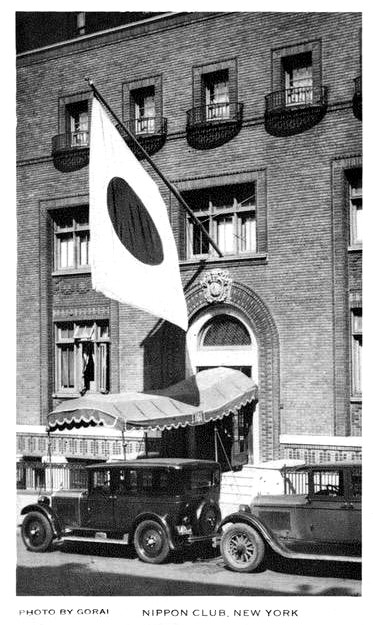
A Japanese flag hangs above the entrance awning.  postcard image courtesy by Lynne Miller

Later that year, the clubhouse became involved in at least one Nazi espionage incident.  Born in Germany, William Sebold  became a naturalized U.S. citizen in 1936 and worked in aircraft and industrial plants.  Three years later, he was approached by the Gestapo who persuaded him to cooperate with the Reich.  In the meantime, Everett Minster Roeder was a draftsman who designed materials for the U.S. Army and Navy.  Sebold delivered German instructions to Roeder in various places throughout the city.  According to Norman Ridley in his Spying for Hitler: Nazis Who Infiltrated America, "At the end of October 1940, Sebold received instructions from Germany to send Roeder to a rendezvous at the Nippon Club at 161 West 93rd Street.  This would reveal yet another method that the Abwehr were employing to have stolen documents transported safely back to Germany."

On December 7, 1941, the Japanese launched a surprise attack on the United States fleet at Pearl Harbor.  American reaction was swift.  The next day, The New York Times published a photograph of the steward of the Nippon Club locking the doors under the watchful glare of a policeman.

The New York Times, December 8, 1941

The newspaper reported, "The Nippon Club at 161 West Ninety-third Street was closed by the police.  Twelve Japanese who were there when the police came were escorted to their homes.  Silent crowds watched their departure.  There were no demonstrations."

The clubhouse was seized by the Office of the Alien Property Custodian and it sat dark for more than two years.  On February 6, 1944, The New York Times reported that the Alien Property Custodian had sold the building to the Benevolent and Protective Order of Elks.  The article noted that the lodge "would be occupied some time in April after alterations."

Two weeks later, on February 21, an auction of the contents of the Nippon Club was held.  Rampant anti-Japanese sentiments, however, greatly affected the bidding of the rare and valuable items, including eight ceremonial Japanese swords and the custom-made furniture.  A spokesman said, "nobody seemed to be very interested."

The prediction that the Elks would move into the clubhouse in April was optimistic.  It was not until December 16, 1944 that "the mother lodge of Elkdom" dedicated the building, as reported by The New York Times.  The structure and the renovations had cost the fraternal organization $75,000--about $1.3 million today.

Fourteen years later, the Elks sold the property to the American Theatre Wing.  Renovations resulted in rehearsal halls in the basement, first and second floors; offices and half of a duplex apartment on the third; and the top floor of the duplex on the fourth.

On September 15, 1958, Mayor Robert F. Wagner officiated at the dedication of the new headquarters.  According to its president, Helen Menkin, the new building would permit "our organization to carry out our expansion ideas more effectively."  It held full-time classes for 400 students with a faculty of 40 teachers.  Among the well-known names of the theater who attended the event were Ed Begley, Lawrence Lagner, Miriam Hopkins, and Mrs. Bert Lytell.

photograph by frog17 from wikimapia.org

The American Theatre Wing sold the property in 1968 to a Seventh-Day Adventist Church, Iglesia Adventista Broadway.  The congregation converted the lower floors for worship purposes with residential spaces on the upper floors.

many thanks to reader Lynne Miller who suggested this post

Friday, January 16, 2015

Twin Whimsies -- 44 and 46 West 85th Street


In 1886, construction began on two adjoining houses for developer Charles H. Bliss.  The plots at 44 and 46 West 85th Street were located in a quickly developing area where upscale residences were filling the blocks.  Bliss had commissioned Edward L. Angell to design the homes.  The architect was busy at the time creating Upper West Side homes with his personal take on historical styles.

For Bliss’s two speculative mansions he turned to the recently popular Queen Anne style—for the most part.  Never one to be reined in by architectural purity of style, he splashed the facades with touches of neo-Tudor.  The resulting, mirror-image homes, completed a year later were fanciful, delightful and impressive.

The brownstone-clad facades were trimmed with contrasting stone quoins.  Whimsical decorative carvings and imaginary heraldic ornaments vied for attention with the aggressive second floor bays (which provided a balconies at the third floor), and the tiled mansard roofs with their scalloped dormers.  Stained glass transoms enhanced many of the openings, and graceful dogleg stoops turned to face one another at sidewalk level.

Heraldic shields, florid carvings, Tudor bays and quoins, and dormers that smacked of Flemish created a fanciful whole.  The mansard of No. 46 (right) was originally the same height as its neighbor.

It was perhaps the steep price of the 25-foot-wide homes that resulted in sluggish sales.  Bliss listed them at $67,500 (about $1.75 million in today’s dollars) and neither sold until 1889.  Bliss sold No. 46 in December to James Kearney.  In reporting on the sale, the Real Estate Record & Builders’ Guide called it an “elegant four-story Ohio stone front dwelling.”

In the meantime, the Spaulding family was living next door at No. 44.  Young Morrel Boughton Spaulding was attending the School of Mines in 1892.  But the lifespan of No. 44 as a private home would be very short lived.

The stoops of the mirror-image homes turn to face one another  Note the charming group of white-dressed girls with their wicker doll carriage.  photograph 1905, Library of Congress

On May 14, 1905, The New York Times reported, “Leading Japanese residents of New York yesterday organized the Nippon Club, which will occupy a handsome house at 44 West Eighty-fifth Street, now a private residence.”  The newspaper noted that the Nippon Club would be the only large organization of its kind outside Japan.  “The membership will include Japanese bankers and merchants, those represented in the professions and the Government service.”

The members had decided not to go overboard in remaking the house in Japanese style.  “In point of furnishings the Nippon clubhouse will be finely equipped.  While the American style will prevail a Japanese atmosphere will be maintained by handsome bronzes, teakwood tables, and exquisite Japanese silks, hangings and bric-a-brac.”  A second-floor room was designated as “the Japanese room.”  Edward Angell’s mantelpieces were removed, replaced by Japanese tokomoma with silk panels.  Japanese artists were commissioned to produce the sliding doors and windows, decorated “in the Fusuma style.”  All of the furnishings in this room were covered in Japanese silks and embroideries.

A Japanese chef, “experienced in the mysteries of Japanese delicacies,” was brought from Japan and arrangements were made for the importation of Japanese foods—dried mushrooms, bamboo shoots, chicory, Japanese fish, rice, Giokuro coffee, sake-rui, Japanese cocktails and chrysanthemum masamune.”  The members told the press that the menu would be “such as is served only in the houses of Japan’s aristocracy.”

The renovations included “billiard rooms, smoking room, parlors, library, and a banquet and ball room,” said The New York Times.  When the clubhouse was opened in June 1905, the Nippon Club had 75 members.

As the club was being organized, Japan was at war with Russia.  Two months after moving into No. 44, the defeat of the Russians seemed inevitable.  On July 31, 1905, 300 proud Japanese businessmen assembled in the clubhouse “to listen to addresses by some of the heroes of the fleet that smashed the Russian navy about Port Arthur and in the Sea of Japan,” reported The New York Times.  Traditional Japanese deportment did not allow for boisterous celebration and self-applause.

The Japanese naval officers, Commander Kamimura, Commander Oguro, and Lieut. Commander Sato, told the stories of their exploits in the simplest and most unassuming manner.  The guests sat silent, as they listened to the stories of their country’s triumphs, with lips apart like children listening to the story of Jack the Giant Killer.  There were no shouts of "Banzai.”

Western journalists had a difficult time reporting on the club’s activities without exposing a hint of Edwardian racism.  In 1906, the American Druggist and Pharmaceutical Record began its report on a dinner held at the club with the line, “A typical Japanese dinner, in which chop sticks played an important part, was tendered Wednesday evening, March 21, to Oscar W. Smith.”

Nevertheless, there was much to report over the years.  Every important Japanese political or military figure who visited New York was entertained here.  On June 11, 1909, Vice-Admiral Sotokicci Uriu of the Imperial Japanese Navy and his wife were guests at a glittering reception.  “The entire clubhouse was festooned with green branches and the national flower of Japan, the cherry blossom.  Japanese lanterns hung from the ceilings and everywhere were the crossed flags of Japan and the United States,” reported The Sun the following day.

The newspaper called the manner in which the club served refreshments “unusual,” saying “Each room was given up to one particular kind of refreshment.  Rice cakes were served in one room, fruits and wines in another, while in the reception room, which is furnished wholly in Japanese style, ice cream and cake were served.”

Upper floors in the Nippon Club were used by some members as sleeping rooms or apartments.  In 1908, Shinguro Arakawa, a silk merchant with a store at 109 Prince Street, was living here.  On October 30 that year, R. Fukui, a traveling salesman for a Tokyo novelty house, had taken the room next door.  That night Ceceilia Ohnishi, the 15-year old daughter of the club’s manager, heard a noise in an unoccupied room.  When she peeked into the doorway, she discovered a burglar.

“Her screams aroused thirty-five members of the club, who were in the billiard room and dining rooms, and the burglar ran to the roof with all the Japanese in pursuit,” reported The Times the following day.  A policeman on the street heard the commotion and ran into the club.  He exited a fourth floor window and saw the burglar running across the roofs.  Policeman Weckerson “started after him, but ran into a clothesline, which he did not see in the dark, and, falling backward, was stunned by striking his head on the roof.  The burglar got away,” reported the newspaper.

Sadly for Arakawa and Fukui, the robber made off with some of their possession.  Arakawa lost a $150 watch, three stickpins worth $100 and expensive Japanese silks.  The novelty salesman lost a set of pearl vest buttons set with emeralds.  He told officials they were worth $200.

None of the club’s visitors would be more important than that of Yoichi Katsura, son of Prince Katsura, ex-premier of Japan, who arrived in New York in August 1912.  The young man had been accompanying his father on a tour to Russia and then the United States, when the Prince was recalled to Japan following the death of Emperor Meiji.  Now in New York, newspapers said that he had been offered “the hospitality of the Nippon Club, 44 West Eighty-fifth Street.”

At the time the Nippon Club was putting the finishing touches on its new clubhouse on West 93rd Street, designed by John V. Van Pelt.  After leasing the house on 85th Street for seven years, it had now decided to purchase its own property.

The house next became home to well-known violinist Herwegh von Ende and his wife, Adrienne.  Born in Budapest, Adrienne was the god-daughter of Franz Liszt.  Her father, Edward Remenyi had been a Hungarian patriot and, like her husband, was a violinist.  The couple’s entertainments were most-often music-related; such as their reception in February 1914 for renowned pianist and composer Leopold Godowsky.

But more importantly, Von Ende transformed the former clubhouse to the Von Ende School of Music.  Adrienne taught voice and other instructors, deemed by the school’s advertisements to be “masters of celebrity,” provided a full range of musical instruction.  The American College and Private School Directory noted that the school was “co-ed” and offered both “board and day” classes.

The house was the scene of regular recitals and concerts open to the public.  The highlight of the year, however, was the annual concert of the Von Ende School of Music held at the Waldorf-Astoria. 

Following Herwegh von Ende’s death in 1919, Andrienne moved to the Wellington Hotel where she died in 1945.

In the meantime, the house next door had had a rocky start.  After James Kearney purchased it in 1889, he resold to John A. Rochford.  Rochford sold it in February 1890 to John P. Paulison who resold it 20 days later to Peter J. Brady.  A week later Brady sold it to J. S. Robinson for $65,000--$2,500 less than Kearny had paid for it a year earlier.  Nevertheless the Real Estate Record & Guide still described the home as “elegant.”

Robinson offered the house for lease and on April 14, 1891 an advertisement appeared in the New-York Tribune describing it as, “Full-size, four-story basement and cellar, stone-front, cabinet-finish private dwelling…with two-story extension.  Box-stoop, steam heat, modern plumbing; immediate possession.”

Before the turn of the century William Hyde and Mary B. Simonson had purchased No. 46.  William’s widowed mother, also named Mary, moved in with the large family, which included his physician son, Jeremiah T. Simonson.  It was no doubt the Simonson family who sympathetically raised the level of the mansard, thankfully lifting the ornamentation of the dormer rather than replacing it.  The extra height made the smaller dormer look oddly diminished.

photo New York Lumber Trade Journal, September 15, 1917 (copyright expired)

William Hyde Simonson’s ancestors had been among the first settlers on Staten Island and Manhattan soon after the Dutch arrived.  The New York Lumber Trade Journal said that his family “had always been engaged in the shipbuilding and lumber business.”  He had joined his father’s lumber firm in 1866 and, following his father’s death in 1883, expanded the business to one of the major lumber concerns in the city.  An avid yachtsman, he was active in both the New Rochelle and Larchmont Yacht Clubs and owned several yachts.

Dr. J. T. Simonson set up his office in the 85th Street house, publishing his office hours as 10:00 to 12:00 and Sundays by appointment only.  The doctor focused on diseases of children and by the turn of the century was listed as an "instructor in paediatry."  Eventually he would become a Professor of Pediatrics at New York Medical College.

On October 10, 1899, William H. Simonson’s 85-year-old mother died in the house.  Her funeral was held here two days later at 11 a.m.

While the house next door changed from Japanese clubhouse to music school, the Simonson family lived on in No. 46.  Another funeral would be held in the house on September 8, 1917.  William Hyde Simonson died in his bedroom at the age of 74 on September 5. 

A year later, in August 1918, daughter Mary Hyde Simonson was married to Caleb Rowland Nash.  It signaled the beginning of the end of No. 46 as a private home.  On September 19, 1919, an advertisement appeared in The Sun:  “46 West 85th Street, near Central Park West; one, two, three rooms, kitchenette and regular housekeeping; new and modern improvements.”  A few months earlier two of Mary’s brothers, George and H. S. Simonson, had formed the 46 West Eighty-fifth Street, Inc. realty firm.

Interestingly, however, 25 years later when Dr. Jeremiah T. Simonson died in 1944, his obituary noted that two sisters, Mrs. Caleb R. Nash and Sarah A. Simonson, were still living at No. 46 West 85th Street, “the family home.”


As with the Simonson home, rooms in No. 44 were now being rented as apartments, listed in 1948 as a “five-story apartment house for 13 families.”  In 1956, 36-year-old Elynore Rich was living here when she came up with a regrettable way of making extra money.

On September 5, she walked into the Chemical Corn Exchange Bank on Columbus Avenue near 81st Street.  She passed a note to the teller that read, “Give me $500.  Don’t turn the alarm.  My little girl needs clothes.”

According to The New York Times, the teller, Eileen Higgens, merely smiled and said, “I can’t.”  She then returned to her work.  Elynore walked out of the bank and was arrested across the street soon after.

Although the tall stoops have been removed, the stained glass transoms pulled out, and the stone facades painted pastel colors, Edward Angell’s whimsical yet “elegant” twin houses still do what he intended—they force the passerby to pause and wonder.

photographs by the author