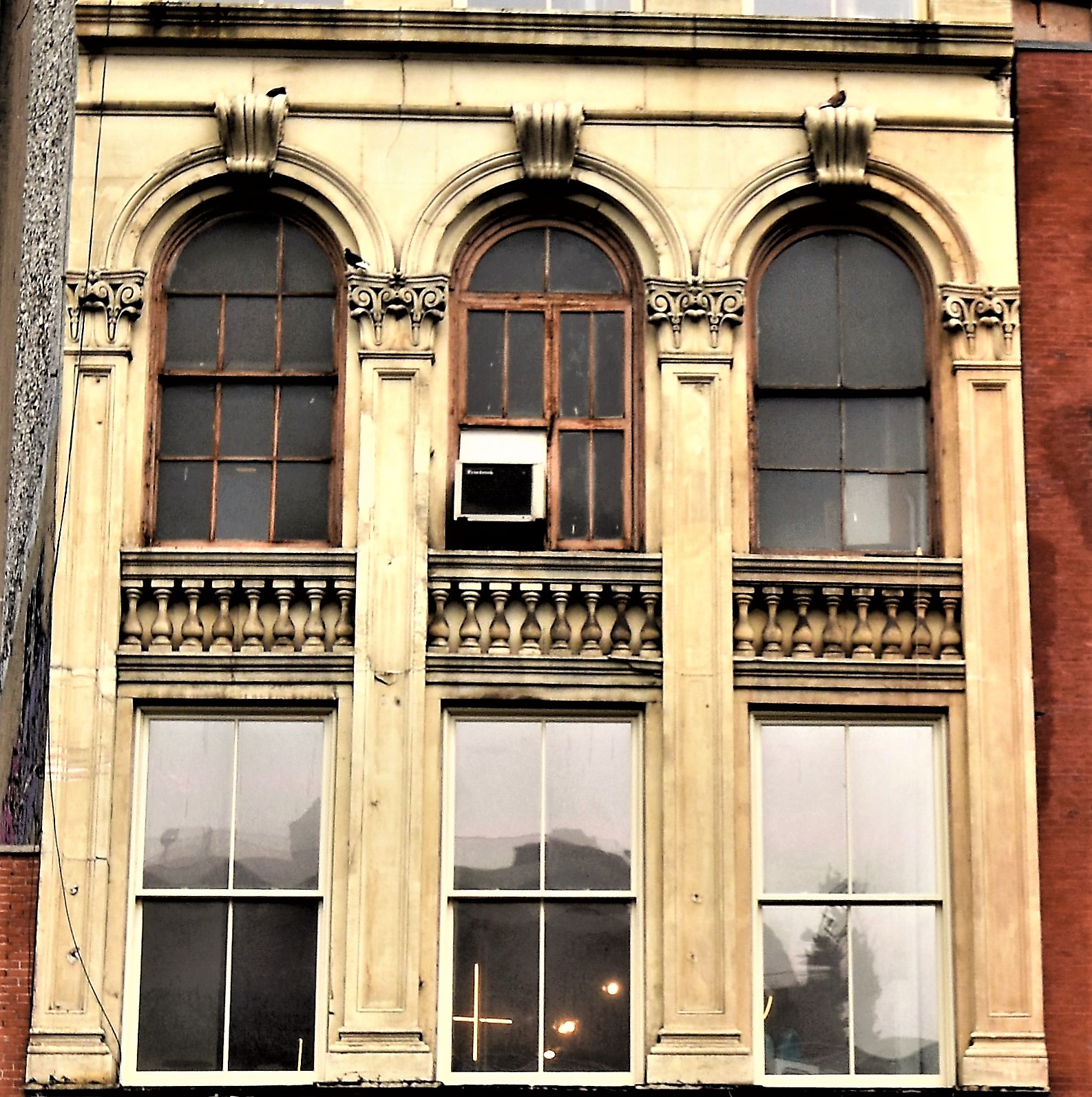
Showing posts with label lispenard street. Show all posts

Thursday, August 29, 2019

William Widmayer's 1875 No. 319 Church Street


Charles E. Appleby and Aaron H. Rathbone were professionals--Appleby an attorney and Rathbone and insurance broker.  But they recognized the potential profits in the rampant development taking place in Manhattan following the Civil War.  In 1875 the men commissioned architect William Widmayer to replace the old structures at No. 36 Lispenard and 319 Church Streets with a modern five-story loft and store building.

At the time George F. Dodd ran his store at No. 36 Lispenard Street.  Erected around 1825, the now-converted residence had been home to staunch abolitionist David Ruggles by the mid-1830's.  A reported 600 runaway slaves found temporary haven in the house, including Frederick Douglass who recalled in an 1882 article in The Century “With Mr. Ruggles, on the corner of Lispenard and Church Streets, I was hidden several days."

Ruggles died in 1849 before seeing the emancipation of slaves.  By then his neighborhood showed signs decline and by the mid-1850's his former home was a low-rate rooming house.  An article in the New-York Daily Times on June 22, 1857, began "A young woman, giving her name as Emma Jewett, and her residence No. 36 Lispenard Street, applied yesterday morning, at the Lower Police Court, for a warrant for the arrest of John Moore, whom she charged with committing a felonious assault upon her.  Her face was much blackened and bruised, and her head was covered with deep wounds from which the blood yet oozed."

Now that storied house and the property at No. 319 Church Street were demolished.  Widmayer gave their replacement building with little ornamentation.  The openings of the upper floors sat on simple stone sills upheld by tiny brackets, and were capped by molded cornices.  The architect gave the building an up-to-date neo-Grec style storefront facing Church Street.  Unlike so many other commercial buildings going up in the neighborhood, there were no Corinthian capitals nor pretentious ornamentation; just the no-nonsense geometric lines of the neo-Grec style.  The entrance to the upper floors was around the corner and took the address of No. 36 Lispenard.  

Appleby and Rathbone quickly filled their new building.  In 1876 Henry W. and Clarence Perine's woolen goods firm, Perine & Co. was here; as was Isaac Shackman, "clothing."  Berliner & Strause were another initial tenant, manufacturers of ties.

The location continued to attract apparel and accessory manufacturers.  In the early 1880's it was home to three necktie makers--Weil & Ahronson, Isaac L. Reizenstein, and Henry Lasch--as well as Herbst & Goldstein Brothers, hosiery manufacturers.

One business owner suffered what was diplomatically termed "a reversal" at the end of the decade.  The Evening Star of Washington D.C. reported on October 11, 1890 that Max Wolff, "a manufacturer of cloaks at No. 36 Lispenard Street, New York, has failed."  The article added "Wolf has disappeared."

A day earlier the New York Herald had also reported on the situation, one which his creditors were not taking lightly.  "His numerous creditors have been taking all the means within their power to protect them.  They are all looking for Mr. Wolff with diligence.  Mr. Wolff, however, has disappeared, and not even his wife seems to know where he is.  It is supposed that he has cleared out to escape the consequences of his acts."  Disappearing along with Wolff was almost all of his stock.

In the meantime, the Church Street store was operated as a saloon-restaurant.  By 1897 it was owned by Samuel Goldman, who listed it as an "eatinghouse" in directories.  Goldman's restaurant would give way to Charles Weisner's "soda water stand" in 1901.

Camelia, Inc., dealers in linens, moved in around the end of World War I and would remain for several years.  The fortunes many dry goods business owners reaped was evidenced when J. S. Camelia offered his 16-room home in the "high class residential section in Williamsburg" for sale in May 1922.  It engulfed a full block front and Camelia described it as "A palatial home at a reasonable price."


A tax photograph from around 1940 shows the original storefront and neo-Grec style cornice.  photo via the NYC Department of  Records & Information Services

At some point the cornice was removed, leaving an unsightly scar along the upper rim of the building.  Change in the Tribeca neighborhood in the last quarter of the 20th century was noticeable in at least one tenant by 1978--the New York School for the Circus Arts.  It remained at least through 1983.

The storefront where Samuel Goldman had run his eating-house was home to the Spring Corner Coffee Shop by the mid-1980's.  The restaurant was slapped with repeated health code violations in 1987.  That all changed in 2007 when Philadelphia coffee importer and roaster Jean-Phillippe Iberti and his partners opened La Colombe Torrefaction.  The New York Times food critic Florence Fabricant described it on August 21 as "a relaxed but very focused brick-walled cafe...where well-made espresso, cappuccino, latte, American coffee and some teas are served, properly, in china cups."


In 2015 a renovation was completed which resulted in office space on the second floor, and one residential unit on each of the upper floors.  La Colombe remains at street level.  And despite the lost cornice, an unnecessary coat of red paint and the altered cast iron store front, William Widmayer's structure retains its staid 1875 personality.

Thursday, December 6, 2018

From Sweat Shop to Sumptuous Living - 44 Lispenard Street


Not long after New York's labor force returned from fighting in the South a building boom engulfed the Tribeca area as vintage homes and shops were replaced by tall loft buildings.  Among the most prolific of the architects working in the area was Isaac F. Duckworth, who routinely made use of the increasingly popular cast iron facades.   In 1866 he was hired by Emanuel Ehlfelder to design a five story structure on the site of a one-story brick building at No. 44 Lispenard Street.

Ehlfelder had made his fortune as a merchant of "fancy goods and trimmings."  He intended to continue his business at his Broadway address, erecting the Lispenard loft as an investment.   Completed in 1867, Duckworth had turned to the relatively new French Second Empire style.  Flat Corinthian pilasters separated the openings of the storefront, while the identical upper floors--each defined by prominent cornices--featured flat-arched openings with curved corners and paneled piers.  The upmost, or terminal, cornice incorporated an arched pediment which announced "ERECTED 1866."

(Interestingly, Duckworth would recycle the foundry molds, creating identical structures at No. 315-317 Church Street, No. 54 Lispenard Street, and No. 38 Lispenard Street.)

Ehlfelder's new building filled with a variety of tenants.  Among the first was M. Bleha, listed as "manufacturer and importer of artificial flowers, ostrich and fancy feathers."   His listing in The Merchants' Directory in 1867 promised "Feathers cleaned and repaired equal to new."

Other initial tenants were dry goods dealer Emanuel Buchstein, silk merchants Despres, Hartley & Co., and cloak manufacturer S. Heineman & Co.  Like some other businessmen in the area, all three would have problems with burglars and thieves

The first to be burglarized was Buchstein.  Soon after he moved his operation into the building, on the night of July 8, 1867, thieves broke into his space making off with four pieces of cloth valued at $300--more than $5,000 today.  Detectives quickly nabbed Charles Mayflower and Henry Schleabach who were found guilty and sentenced to four years and six month in the State Prison exactly one month later.

At the time of the crime construction was nearing completion on No. 42 Lispenard, next door.  Five months later, at around midnight on December 11, Police Office Kerns noticed a "suspicious individual" within the construction site.  When Kerns moved in to investigate, he became the target of loose bricks.  Officer McInerny, responding to Kerns's whistle, fired two shots at the trespasser, who jumped down 17 feet and tried to escape, but was immediately captured.

Inside the uncompleted building the officers found bundles of silk and other goods from Despres, Hartley & Co., later valued at more than $25,500 in today's dollars.  Inside No. 44 other goods had been packed up, ready for removal.  The New York Herald identified the burglar as "a young Frenchman named Alphonse Deplechon and reported "It is supposed that Deplechon had some confederates in the burglary, but they managed to make their escape."

In the meantime, S. Heineman & Co. seems to have been doing well.  On July 9, 1868 it advertised "Wanted--A few first class operators on W. & W. [sewing] machines, accustomed to work on cloaks."  And a year later it was again increasing its staff, promising "good pay and constant employment to competent hands."

S. Heineman & Co. was the victim of crime in the fall of 1870; not by burglary but a slick 15-year old and an irresponsible mailman.  Augustus Mockers offered to deliver some of letter carrier Thomas W. Parson's mail, including an envelope addressed to S. Heineman & Co.   Instead, he opened the letters and removed anything of value, including the $16 draft (about $300 today) made out to Heineman & Co.  The teen discovered that stealing from the mails was a bad idea when it was not S. Heineman & Co. who landed him in court, but Special Agent James W. Taylor of the Post-Office Department.

At the same time another tenant was having problems.  Wm. Maas & Co. dealt in novelties, and in the winter of 1870 had been "constantly missing small packages of goods" little by little for months.  Simultaneously, two other novelty dealers in the immediate neighborhood were experiencing identical losses.  Detective Field concocted a trap to discover the culprit.  In February 1871 he hid in the store and waited.   The New York Times reported that he "detected the charwoman, named Catharine Lehan, in the act of stealing a small quantity of cheap jewelry."  She was arrested and in her rooms on Watts Street the detective found "a large quantity of miscellaneous goods which had been stolen from the stores in which she had been employed."

By 1875 linen dealer and accessory maker Emil S. Levi was in the building.  That year he interviewed potential workers in his office for his social club.  An advertisement in The New York Herald on February 18 read "Wanted--A caterer (German) for a first class club, composed of over 230 members.  Applicants call on S. Levi, 44 Lispendard st."

Levi's business was doing well enough that he needed a manager the following year.  In June 1876 he was looking for "Forewoman on Ladies' Collars and Cuffs."  He shared the building at the time with Isidor Rosenthal, woolens dealer, and Isidor Bloom, maker of ladies underwear.

In 1878 Bloom's business failed and the courts named Joseph Biernoff its assignee.  Within months he had formed Biernoff & Livingston with Lewis M. Livingston, at the same address.  A want ad on August 8, 1879 suggests that they had turned the old firm around.  "Wanted--Experienced hands on all kinds of ladies' underwear; study work."

At the same time S. & G. Lorsch was in the building.  The firm manufactured children's dresses and infants' robes.

Dry goods and apparel firms would continue to call No. 44 home over the decades.  In the 1885 Bischoff & Rodats, "embroidery material," moved its offices and salesroom here.  Founded in 1835, its mills and factory were in Hamburg, Germany.  New York's Great Industries called the firm in 1885 "a house of standard and in fact world-wide reputation."

As the 1890's neared, S. & M. Stern, cloak and jersey maker, was here, as were woolens dealer M. McCrossan and Berg Brothers Co., "fancy goods wholesalers."  (An overheated register caused a scare for M. McCrossan on February 2, 1889, when it sparked a small fire.)

Leo Moses had been a traveling salesman for S. & M. Stern for two years at the time.  His territory engulfed parts of New England and Canada.  On October 21, 1889 he boarded the steamer Cumberland headed, according to Fur Trade Review, to Eastport, Maine.  He never made it there.  When the vessel arrived at St. John, New Brunswick the following day the 55-year old was found dead in his stateroom.

Neither foul play nor suicide was suspected.  Before boarding the Cumberland Moses had sent a letter to the office with orders and confirming he had received his pay in the mail.  The esteem in which he was held by the firm was evidenced when Solomon Stern, senior partner, accompanied Moses's nephew to St. John's to recover the body.

Berg Brothers Co. hired 14-year old Joseph Silver as an errand boy in 1890.  His short-lived employment ended when he was fired in June that same year.  It was not the last the firm would hear of the enterprising lad, however.  As The New York Times worded it, "he had learned more than how to run errands."

Within a week or two Berg Brothers Co. began receiving invoices from the Clark Spool Thread Company.  On July 20 The Times reported "A watch was set and Silver came to grief when he presented an order apparently signed by Berg Brothers calling for $38 worth of goods.  It is thought that he obtained fully $400 worth of goods before his scheme was discovered."

Berg Brothers Co. and S. & M. Stern were joined in 1891 by Jacob Seligman, shirts, and I. Goodman, makers of "wrappers and tea gowns."  The latter's operation was substantial, employing 52 workers, only five of which were men.  Included in the work staff were 20 females under 21, two under 16, and one "child who cannot read or write English."  They worked 10 hours per day, according to the State Factory inspector that year.  Jacob Seligman's factory would remain in the building for more than a decade.

Another clothing firm here at the turn of the century was Levin & Zutalove, run by Meyer Levin, Jefferson M. Levy and Bernard Zatulove.  The trio provided what was apparently a most unpleasant working environment.  In 1902 all three were individually cited for "failure to clean, disinfect and ventilate water closets."

Surprisingly, Levy was a well-respected politician and former Congressman.  He soon left Levin & Zutalove and partnered with former Mayer Smith Ely to form the National Novelty Clothing Co.  The shirt-making firm also took space in No. 44 Lispenard.  A change of name did not improve Levy's practices, however.  In 1908 he was cited for "failure to provide water closet for female employees" and for "failure to ventilate and screen and keep in sanitary condition water closets at premises 44 Lispenard st."

Levy was persuaded to run for Congress again that year.  The disgusting facilities in his factory became an issue.  On August 9, 1908 The New York Times reported "In reference to the report that he had been arrested for violating the factory laws at 44 Lispenard Street, the headquarters of the National Novelty Clothing Company, ex-Congressman Jefferson M. Levy said yesterday that he was not the President of the company, but simply a part owner of the property."  He told reporters that "alterations requested by the factory inspectors were being carried out."

Presumably with improved restroom facilities, the National Novelty Clothing Co. was still in the building in 1910 when fire broke out on May 16.  Berg Brothers Co. suffered $15,000 in damages and National Novelty Clothing and Epstein & Brother lost a combined $10,000.  The total in damages would equal about about $665,000 today.

Berg Brothers would stay at No. 44 at least through 1914.  Following the fire it was joined by S. Hollander & Son, makers of children's wear and dealers in bridal accessories.

The Millinery Trade Review, July 1911 (copyright expired)
About the time that Berg Brothers left the building, a far different type tenant moved in.  Nicholas E. Marcoglou was a tobacco dealer and manufacture of Arabesca cigarettes.  His packaging drew the legal ire of Junius Parker, another manufacturer, in 1915.  Parker's letter to Marcoglou, dated September 1, complained in part of the "noticable, and, as we thought, unquestionable resemblance of these packages to our Pall Mall cigarettes."  Despite the conflict, which ended up in court, Marcoglou remained in business at No. 44 at least through 1921.

In 1920 two firms leased the building, the Efanef Fur Dyeing Co. and the Columbia Doll & Toy Co.  Only a few months later Columbia Doll & Toy Co. purchased the property.  The toy manufacturer leased space over the coming years to a mixed bag of tenants including the Signode System, Inc., which made strapping for textile bales and boxes; and the Grand Union Equipment Company, dealers in soft goods.

Like so many of its predecessors in the building, Grand Union Equipment Company was the victim of extensive theft beginning in 1930.  Over a period of years inventory mysteriously disappeared.  Then, in October 1934, the firm's president, Samuel Sackett, dropped into Frank J. Wolfram's engraving shop next door at No. 46.  He happened to notice towels bearing his label there.   He notified police who obtained a search warrant for Wolfram's furnished room at No. 135 East 104th Street.   Not only did they check Wolfram's, but all 95 of the rooms in that building.  After a five-hour search, they determined that "virtually all of the furnishings in the house" had been stolen from the Grand Union Equipment Company," according to The New York Times on October 30.  Wolfram had hired burglars to make off with an estimated $20,000 in goods over the years.  The value of the haul would equal about $366,000 today.

Even as the garment district moved north of 34th Street there was at least one hanger-on on No. 44.  Lichiman & Son Mfg. Co., makers of children's wear, was here in the early 1940's.  When the building was sold to the newly-formed 44 Lispenard Street Corporation in October 1942, The New York Times reported that the building would "be altered by the buyers for their general merchandise business."


Throughout the decades of varying use, the cast iron facade remained essentially unaltered.  In the mid-1990's two art galleries--Thicket and Kurt Mundahl--moved in, signifying the arrival of the Tribeca rebirth.  A renovation completed in 2018 resulted in one loft residence on the second floor and a sprawling triplex above.  That 3,000 square foot residence was offered for sale in 2018 for $7.05 million.

photographs by the author

Thursday, August 9, 2018

Isaac Duckworth's 1868 54 Lispenard Street


Louis Duhain, Jr. was born in 1829 in "a hotel then standing at Bowling Green," according to the New-York Tribune.   After being  educated in Richmond, Virginia he joined his father's artificial flower and millinery feathers importing business.

Following Duhain, Sr.'s death, Louis and his brother, August D. Duhain, took over the business, now named L. Duhain, Jr. & Co.  August moved to Paris to oversee that branch office while Louis ran the Broadway-based business.

Louis's interests went beyond feathers and flowers.  In May 1868 he was awarded a patent for a new "mode of ornamenting fabrics."  The clever process used small translucent beads made of "gum arabic or other gum" secured to the fabric, to give the appearance of drops of water.

Construction in Manhattan had come to a near stop during the Civil War while the blue collar workforce was off fighting.  Peace brought a building boom.  It was mere months after the final shot was fired when Duhain hired architect Isaac F. Duckworth to design a five story loft building at No. 54 Lispenard Street in 1866.

Completed in 1868 the iron-faced building was designed in the new French Second Empire style.  Paneled piers ran up the sides and flat Corinthian-crowned pilasters separated the openings.  As he often did, Duckworth consummated the design with an elaborate cornice with an arched pediment announcing the construction date.

The project was purely an investment for Duhain.  His business remained on Broadway as the Lispenard building filled with textile and apparel firms.  Among the first were J. Gottscho & Brothers, silk merchants.

The six tenants in the mid-1870's reflected the dry goods district that now engulfed the Lispenard block.  Lipe, Nearing & Co. dealt in "woollens;" as did Josephus Hill.  Morris Nathanson and Leo Kaufman were both listed merely as "clothing" merchants; and Julius Schroeder and Ansell Hecht dealt in "trimmings" and "rufflings" respectively.

On July 1, 1881 Duhain sold No. 54 to Thomas H. O'Connor for $45,000--just over $1 million today.   The wealthy O'Connor was a trustee of the Emigrant Industrial Savings Bank.  His family operated a steel and hardware firm in San Francisco.

The last decade of the century saw more apparel than textile firms in the building.  Suspender manufacturers Carl Winderman and Equitable Suspender Co. shared the building with Samuel Platt, "wrappers" (the informal morning apparel worn by women, often to breakfast); and Abramovics & Eisner, makers of ladies' cloaks.  Not fitting the mold was Brodsky Bros., manufacturers of pocketbooks.

The tradition continued through the first decades of the 20th century.  But as the textile and garment industries moved north of 34th Street by mid-century, the Lispenard Street block saw significant decline.  The certificate of occupancy in 1962 demanded that the second story be used only for storage and that the upper floors were "to remain vacant."  The restriction was possibly for fire and safety reasons in the nearly century-old structure.

Eventually the Tribeca renaissance caught up with No. 54.  In 1977 Women in the Trades had its offices here.  Described as an "organization of skilled craftswomen that serves as a resource and information center and as a support group," it worked with the National Council of Neighborhood Women to obtain funds to operate an outreach program.

The building next door at No. 52 had been completed the same year at No. 54 and was also five stories tall.  but a 1937 fire had left a two-story stub.   In 2002, with Tribeca's old loft buildings being converted to galleries, restaurants and upscale housing, the owners sought to demolish the little building and erect a five-story apartment building.  The plans were shot down by the Landmarks Preservation Commission.

The owners' architects, Studio JS2, went back to the drawing board and came up with a design that would connect Nos. 52 and 54 and add a two-story addition above.  The plans received what The TribecaTrib called "a scathing rejection."  LPC Commissioner Diana Chapin said "this is very bland."

A mutually-acceptable compromise was finally achieved in an unapologetically modern, yet handsomely harmonizing three story addition to No. 52, completed in 2017.   While the combined structures share the address of No. 52 today, they maintain their separate personalities.  Amazingly, other than replacement windows, the 1868 storefront of No. 54 is virtually intact.

photograph by the author

Wednesday, May 2, 2018

The 1883 Clark Building - 332 Canal Street


There was, no doubt, originally an eye-catching Queen Anne pediment above the cornice.
In 1883 John J. Clark was on the top of the world.  He was a partner with his brother, Joseph, in Clark Bros., which ran several restaurants throughout the city, including a well-known oyster bar on Fulton Street.   John personally owned and operated the popular Bijou Restaurant at No. 504 Sixth Avenue, as well.  His tremendous success allowed Clark to invest heavily on Wall Street.  The Evening World said he was "known as a successful and daring operator."

Clark commissioned architect Jobst Hoffman to design a six-story loft and store building at No. 332 Canal Street, running through the block to 39-41 Lispenard Street.   Drawing mostly from the popular Queen Anne style, Hoffman embellished the brick and stone piers with Renaissance Revival panels and included neo-Classical swags in the decorations.   Cast iron elements allowed for vast openings which poured natural light into the factory spaces.

Hoffman's attention to detail included faces--one male and one female--within the second story capitals.  The sunbursts directly above were common Queen Anne motifs.
Clark used the ground floor for his Oyster & Chop House.  Like all his restaurants, it catered to middle-class diners and businessmen.  It offered "a quick business lunch" from 11 to 2:00, and dinner from 5:00 to 8:00.

The upper floors were leased to Plock & Hoffstadt, "manufacturers of lace, muslin and embroidery caps, infants' cloaks, etc." according to New York's Great Industries in 1884.   The firm, which employed between 100 and 150 workers, had been located nearby at No. 359 Canal.  New York's Great Industries called the new location "very eligible and central premises."

The principal of Plock & Hoffstadt was, somewhat surprisingly for the period, a woman.  Charlotte Plock was termed "an amiable and talented business lady, possessed of vast practical experience in her line, and recognized as producing the finest quality of goods in the market."  Her partner, William Hoffstadt, focused on the books and was described as being "noted in financial circles for his honorable methods and sterling integrity."

The rear of the structure, on Lispendard Street, is double the wide of the Canal Street side.  
Only four years after moving in Plock & Hoffstadt was gone.  On November 1, 1888 Fur Trade Review reported "Messrs. Freedman Brothers, the well-known cloak manufacturers, now occupy the entire building at 332 Canal street."   The Lispenard Street storefront was renovated as its showroom.  The magazine said "The firm has fitted up the store floor, their increased room, in grand style, and are showing an enlarged stock of goods to meet the requirements of their many customers."

A clerk was surprised to see a man preparing to load a truck in front of the store in January 1893.  When he shouted to the John Lover to stop, the culprit drove off, leaving the goods on the sidewalk.  But Lispenard street was crowded with other horse-drawn drays, so Lover abandoned his truck and ran.  He was caught and arrested by a policeman.

The case he had abandoned contained $460 worth of worsted fabrics.  Lover's trial was held on January 9, and its outcome enraged the judge.  After deliberating four hours, the jury arrived at a verdict of not guilty.  Judge Martine told them "I want to say, gentlemen, that your verdict of not guilty in this case is of the kind that does much to encourage crime.  The verdict is not in accordance with the evidence."

At the time, Freedman Bros. was battling the labor movement, which sought to improve working conditions and salaries through unionizing.  The Consolidated Board of Cloak-Cutters and Operators alleged in August 1891 that the firm underpaid its approximate 150 workers.

Union delegate Dion W. Burke, told an Evening World reporter on August 13 that year "The firm of Friedman [sic] Brothers have been paying lower wages than any other firm, and they have consequently been able to undersell other houses.  We have been trying to make terms with the Friedmans [sic] for some time, but failed."

The New York Times added that not only did the firm pay "much lower wages than did other firms...the Superintendents deducted a percentage from their wages.  The tailors were made to pay $2 a week to the pressers, which was not done i any other shop."

When representatives tried to meet with Freedman on August 13, he tossed them out.  His entire workforce followed.  Almost unbelievably, it would not be until May 27, 1897 that the garment firm and the union came to a final agreement.

In the meantime, Clark Brothers had sold No. 332 to Herman Wronkow in December 1893 for "about $100,000," according to The New York Times (about $2.8 million today).   John J. Clark would soon need the cash, as it turned out.

Less than two months later, on Friday night, February 2, 1894, he was arrested in the Bijou Restaurant with his manager and two waiters.  The New-York Tribune reported the shocking news.  He was "charged with keeping a disorderly house."  It was a polite term for a brothel.

Clark's trouble continued when his only daughter, Annie, committed suicide by throwing herself under a Sixth Avenue elevated train after a failed romance.  In January 1895 Clark lost his liquor license and by the turn of the century the man who erected No. 332 Canal Street was earning $15 a week as a waiter in a small Broadway restaurant.

Wronkow leased the Oyster & Chop House space to Hugo E. Hertel in 1894.  Hertel, it seems, focused more on alcohol than food here.  He had gone into business with F. G. Roebling on January 6, 1892, opening a sumptuous saloon on Third Avenue.  A Souvenir of New York's Liquor Interests had described that location a year earlier saying "The decorations are elegant and costly, comprising a highly ornamental ceiling--which alone cost $1000--cherry and mahogany fittings, fine plate mirrors, tiled floors, sporting ticker, and every modern improvement incidental to a high-class establishment."

A few months before Freedman Brothers signed the contract with the union in 1897, it had left No. 332 Canal Street (the firm would dissolve in 1901).  For the first time since its completion, the building had more than one tenant in the upper floors.

L. Kerster & Son's clothing factory shared the building with a somewhat surprising tenant, "Bornstein," who dealt in scrap.  How long Bornstein remained at the address is unclear.

The sun, June 6, 1897 (copyright expired)

On January 17, 1897 14-year old Max Cohen left No. 25 Allen Street where he lived with his mother to look for a job.  On Canal Street a man approached him and said "I saw you were in a store around the corner looking for a job.  I'll give you work if you come with me."

The gullible teen followed him to L. Kerster & Son's factory.  According to The Sun "The boy was ordered to tie some clothing up in bundles and the man who employed him went away saying he was going after an express wagon."  Because it was the end of the day, most of the workers had already left.

While Max worked diligently at his task, Bernard Kerster closed the shop.  To his great surprise, he came across the boy, still working hard.  "He caused the boy's arrest, charging him with burglary," reported The Sun.

Five days later Max was sentenced to the Elmira Reformatory.  The fate of most boys convicted of such a crime in the 1890's would have been sealed.  Surprisingly, though, District Attorney Olcott looked closer into the facts and was convinced that Max had been hoodwinked by a clever professional criminal.

He sent his private secretary, Colonel Swords, to "lay the matter before the Governor" and request the boy's release.   Ten months after he was sent away, on November 12, he was pardoned by Governor Frank S. Black.

At the turn of the century No. 332 was filled mostly with garment manufacturers.  The Net Spot Cash Pants Co. employed 26 men and 5 women in 1901.  Stuetz & Mink, clothing makers, were in the building, as were the Bargain Knee Pants Co., and Cooper & Lambert, skirt makers.  Employees in each of the factories worked 54 hours per week.

One tenant not involved in the apparel trade was P. H. Gross & Sons, manufacturers' representatives.  Among its clients was the American Safe Co.  The firm would remain in the building from 1900 through 1902.

New-York Tribune, December 27, 1900 (copyright expired)
The first years of the 20th century brought problems to several of the tenants of No. 332.  Maisel Brothers & Drusin, cloak manufacturers, had moved in by 1902 when Charles Maisel was arrested and held in $100 bail.  The New-York Tribune reported he "was charged with employing a fourteen-year-old girl, Sarah Lipkind, without a permit."

Charles Maisel did not learn his lesson from the arrest.  In 1904 he and his partners were fined again for "employing children under 16 without board of health certificates."

And in March that year Maisel Brothers & Druisin was hit with a violation from the Board of Health because of the filthy conditions of the bathrooms.  They were not the only tenant who failed the inspection.  Inspectors found Sam and Max Hirsch guilty of three violations--"Failure to provide suitable and separate water-closets," "failure to lime wash walls and ceilings," and "failure to clean and keep clean water-closets."

While the two firms scrubbed their toilets and painted their walls, another was facing a financial crisis.  The owners solved the problem by sneaking out and disappearing.  On August 11, 1904 The New York Times reported "The place of business of Brody & Eisenberg, manufacturers of cloaks and suits at 332 Canal Street, has been closed up since Saturday last, and it is said that everything has been removed from the place."

Herman Wronkow lost No. 332 to foreclosure in 1908.  It was purchased at auction by Anna Woerishoffer on January 6 for the $75,000--about $2 million in today's dollars.   She still owned the building on May 18, 1920 when disaster struck.

At around 2:00 in the morning fire broke out in No. 326 Canal Street.  Before a second alarm could be sent in, the building was "a furnace," as described by a witness; and the blaze had spread to No. 332.   The New York Times reported "The building at 332 Canal Street was occupied by three dry goods firms, and within twenty minutes after the fire spread to the premises it was a mass of flames."

Anna Woerishoffer sold the burned out structure to Charles Laue four months later.  But rather than renovate, he resold it in March the following year to Cross Siclare Special Paper Cutting Company.  The New-York Tribune reported "extensive alterations are to be made to the premises by the purchaser for occupancy."

Cross Siclare leased space to Malis Powers Supply Co. in 1922  The Evening World, February 10, 1922 (copyright expired)

Cross Siclare and his brother, Nathan Siclare, used all of the building for their extensive paper cutting operation except the top floor, which was leased to Malis-Powers Supply Co.  In 1923, however, they took over that floor for a side business which quite possibly made even more money for the pair.

On Tuesday afternoon, December 4, 1923 John Kerrigan met with Cross Siclare regarding the prospective purchase of paper stock.  Saying he was in a hurry to finish things up, Kerrigan confided to Siclare that he had an appointment to meet a man who could sell him alcohol.  Siclare's attention was sparked and he pressed Kerrigan for more information.  It turned out that Kerrigan was not interested in buying a bottle of scotch or gin for his own consumption, but wanted 500 gallons.

Siclare dropped a bombshell.  He could provide that amount of good alcohol, he said.  Kerrigan wavered, then "he agreed to consider the offer if Siclare would furnish a 5-gallon sample," according to The New York Times two days later.

Cross Siclare provided the sample and Kerrigan left.  But when he returned the following day he was not alone.  John Kerrigan was an undercover Prohibition Agent who had originally come to No. 332 Canal Street on a tip.  What the raid uncovered was staggering.  The Times reported on the "seizure of fifteen stills and $50,000 worth of alcohol."  Both of the Siclare brothers and their shipping clerk, Edward A. Dorney, were arrested.  The article revealed that the entire top floor was set aside "for distilling the denatured alcohol."

Canal Street was a bit seedier by mid-century as hardware and plastics companies filled the street level shops.  In the mid 1950's No. 322 was home to Hercules Chemical Co., dealers in supplies like pipe threading cutting oil and liquid solder.

Popular Mechanics magazine, October 1955
But change came to the Tribeca and Soho neighborhoods in the last quarter of the century.  In 1978 The City Dump opened in the space where John J. Clark's Oyster & Chop House had been nearly a century earlier.   The store sold new goods at bargain prices ranging from tools to hair dryers, and from wok sets to camping gear.  It was a destination for shoppers for more than a decade.

The capitals of all but one of the engaged columns on the three upper floors have sadly been lost.
Then in 2000 a renovation by architect Jung Wor Chin resulted in two apartments per floor above the second floor.  The project restored the facade, but fell short of replacing lost elements like cast iron capitals or of simulating the decorative parapet.  Nevertheless, the integrity of Jobst Hoffman's handsome Queen Anne design mostly survives.

photographs by the author

Friday, April 27, 2018

The 1867 Kingsland Building - 315 Church Street


In 1866 the Civil War had ended and New York City's young men returned to the workplace.  Wealthy attorney Daniel C. Kingsland wasted no time in getting in on the building boom that immediately followed.   Before his death in 1873 he erected several commercial structures within the emerging mercantile district just south of Canal Street.

Among the earliest was Nos. 315-317 Church Street.   He commissioned Isaac F. Duckworth to design the structure; an architect who had early-on embraced cast iron construction.  Faced with an L-shaped plot--its Lispenard Street side about half the width of that on Church Street--Duckworth created two near-matching facades.  The restrained French Second Empire loft building rose five stories.  Above the storefront adorned with Corinthian pilasters, each floor was sharply delineated by its own cornice.  The shallow pilasters and the elliptical openings echoed the design of the base.  Close inspection reveals delicate rope molding framing each window.   The subtle differences of the two facades--other their widths--appeared at the top.  The triangular pediment on Church Street announced the date of construction and Kingland Buildings; while the arched pediment on Lispenard read "Erected 1867."

Rope molding runs around each window.  The stub of what was an ornate finial survives on the pediment.
Factory buildings often included interior "hatchways," or shafts by which bundles could be hoisted up.  They were sometimes the cause of serious accidents, as was the case here on October 2, 1878.  The New York Times reported "Jacob Schwartz , a lad 15 years old...was found in a mangled and dying condition yesterday afternoon on the first floor of No. 38 Lispenard-street, having fallen from an upper floor through the hatchway.  He died before an ambulance could be summoned."

Like most buildings in the area, the Kingsland Building filled with garment makers.  Around 1884 McCoun & Lee, which had operated from the corner of Franklin and Elm (later Lafayette) Streets for years, moved in.  Its significant operation required 50 sewing machines and two "sets of knitting machines."   Listed in directories under the generic heading "cloak manufacturers," it more specifically added "cardigan jackets, jerseys, etc." to advertisements.

The company would coin a term that became permanently ingrained in the American lexicon.  In 1917 the American Cloak and Suit Review mentioned "We first come across the word blouse, a line of which was shown in 1888 by McCoun & Lee, 315 Church Street."  Even at the time of the article, the word was still catching on; and "shirtwaist" or "waist" was much more commonly used.

The Lispenard Street cornice is slightly different from its Canal Street couterpart.

Demeanor among Victorian factory owners was not always gentlemanly.  Such was the case in 1895 when David L. Fineman, a partner in Simon & Fineman, read newspaper accounts of Gustave Meyers's testimonies before several Grand Juries regarding a rash of recent factory fires.  Meyers fingered several arsonists, including Isaac Zucher, a close friend of Fineman.

Irritated, Fineman sent a message to Meyers, suggesting that he had a job opening for him.  When Meyers showed up on June 15, Fineman and a salesman, Thomas Hall, attacked.  They savagely beat the unsuspecting man.

Meyers had Fineman arrested that afternoon.  No stranger to a courtroom, Meyers appeared the following day against David L. Fineman.  "He had several cuts in the face and on his head which he said he had received during the conflict," reported The New York Times.   And when he saw Thomas Hall sitting in the courtroom, he had him arrested as well.

Fineman, of course, had his own version of the affair.  He purported, according to the article, "Meyers had been pestering him by calling at this store.  When he came yesterday he told him to get out, and Meyers called him a foul name.  Then he kicked Meyers out of the store."  He asserted that Hall had not be involved at all, and had merely go in search of a policeman.

Both men were held on $5,000 bail (nearly $150,000 each in today's dollars) awaiting trial.

Charles Lewis & Brothers, dealers in woolen goods, had been in the building since its opening.  Partner George Lewis, too, had a violent confrontation that year.   On November 16 he walked around the corner to No. 49 Lispenard Street.  He stepped onto the elevator with three young men.

The The Sun reported that shortly after the elevator started upwards, the youths "began skylarking, punching each other and annoying Mr. Lewis.  When he remonstrated with them, [Joseph] Sheehan flew at the old gentleman and blackened his eye."

The feisty man fought back, but Sheehan's comrades jumped into the fray.  "A general rough-and-tumble ensued, in which the merchant was very roughly handled," said the report.  In the excitement and confusion, the elevator boy was distracted and the elevator hit the top of the shaft, throwing everyone to the floor.

Joseph Sheehan was arrested for assault and Lewis was taken to the Hudson Street Hospital where his wounds were dressed and he was sent home in a coach "suffering much shock and bruises and concussions," according to The Sun.

But, as might be expected, when the youths appeared in court on November 18, the judge heard a different story.  Sheehan, who worked in the Lispenard Street building as a shipping clerk, said he had entered the elevator with a load of packages.  An unknown boy knocked over the packages and when the two got into an argument about it, the elevator operator, Hugh Clark, inexplicably struck Sheehan.  Sheehan punched back.

According to The Sun's recount, "Lewis, who is a friend of Clark, went to the engineer's assistance and grabbed Sheehan by the throat.  Sheehan's throat still shows the marks of finger nails.  Then Owen Fitzgerald and John Meehan, who work in the same place with Sheehan, ran down stairs to Sheehan's rescue."

George Lewis had not appeared in court; but when he heard that the case had been dismissed, he was no doubt miffed and a bit embarrassed.

He and his brothers would have much more to worry about in the summer of 1898.  It all started when Charles, the senior member, died unexpectedly.  "At 4 o'clock yesterday morning he arose and complained of the heat.  He died in a few moments," explained The Sun on June 16.  The 50-year old was the was the main force in Charles Lewis & Bros. and most in the industry believed it was his money that kept the firm operating.

With seeming callousness, worried creditors pounced.  Three days after Charles's death, the first sued for an outstanding loan of $7,350.  "Friends of the firm in the trade think that there will be enough assets to pay all claims and leave a handsome surplus for the partners," said The Sun.

But other panicked creditors piled on.  On July 20 The Sun noted that so far the executions had reached $13,251 and "Two of the merchandise creditors began replevin proceedings yesterday to get their goods."  More creditors joined the rush to retrieve their money or goods, until there was no hope the firm could survive.

Its more than three decades of doing business on  Church Street ended for Charles Lewis & Bros. on July 26, 1898, just 11 days after Charles's death.   A Sheriff's sale that day liquidated the stock and netted $5,700--a mere fraction of the amount the creditors claimed.

At the turn of the century Charles Robinson's shirt waist factory was in the building.  Among his employees in 1901 was 18-year old Louis Finkelstein, who tried his hand at the stock market.  Instead of making his fortune, he lost what little money he had.  To make up for his substantial losses, he stole finished garments.

Finkelstein would bundle up quantities of blouses, then drop them down what was probably the same hatchway where Jacob Schwartz had met his doom in 1878.  At the bottom, Louis Cohen was waiting.  Cohen ran a rag-picking business which was a front for selling the stolen goods.

The scheme could only work for so long, of course, and on July 15, 1901 both men were arrested.  Finkelstein was charged as an accomplice and Cohen for "operating a 'fence' of large proportions at this home."  A Charles Robinson representative inspected the booty at the police station, and valued it at between $3,000 to $6,000--as much at $175,000 today.

Turn of the century factory work was often grueling.  Other employers in the building at the time were New York Millinery & Supply Co., whose three men and two women worked 53 hours per week; and the Novelty Skirt Co., which employed 10 men and one woman.  Their week was slightly longer at 54 hours.

Cloak makers Edelson & Shipiro occupied space by 1904.  The following year 50 of its employees, members of the United Garment Workers of America, went on strike.  When another manufacturer, Max Lacher on Canal Street, helped out by filling some of its orders "while it is in a crippled condition," as described by The New York Times, the strikers became enraged.

Early 20th century labor disputes often became violent, and on July 20 all 50 strikers stormed the Lacher factory.  The mob was too large for the sole policeman on the beat to handle, and reinforcements from the Leonard Street Station were called in.

"The strikers tried to escape and half of them got away.  They swarmed out of the windows, up and down the fire escapes, and over the roofs to adjoining buildings....The police gathered in twenty-five and took them to the station, in several patrol wagon loads."  The men were held on a charge of rioting.  The Times article ended saying "The police said the strikers wrecked Lacher's establishment."

In April 1911 the Kingsland estate sold numerous properties, including 315 Church Street, at auction.  The new owner found several new tenants, including Barish & Schwartz, which moved in that year.

By 1915 the Caledonian Publishing Co. was here, producing books as well as the popular The Caledonian, An Illustrated Family Magazine.  Also leasing space was the Plato Art Co.  While the printer was best known for its wall calendars, advertising calendars and almanacs, that year it came out with a unique invention--the "Mirrored Hand."

The Automobile Trade Directory, 1915 (copyright expired)

Automobile operators wearing this mirror on the back of their driving gloves could get a rear-view glance by simply raising that hand and glancing at the image.  An ad promised the invention would prevent distractions.  Apparently it was not long before someone realized that mounting the mirror on the car frame worked better, causing the Mirrored Hand to be a short-lived venture.

William E. Wright & Sons, Co. moved in in 1917 from just around the corner at No. 40 Lispenard.  Wright had started out selling cut fabric door to door, until he invented an item that would become a staple for garment manufacturers--bias tape.  He opened a store in 1897 and moved his operation into 315 Church Street in 1915.  The firm's astounding success was reflected in his lease--William E. Wright & Co. took all four floors above the storefront.  Later that year it augmented its marketing by publishing a pamphlet which illustrated uses for bias tape.

Wright & Sons' moving announcement pictured both the old and new locations.  Dry Goods Economist, January 27, 1917 (copyright expired)

William E. Wright & Sons was still here in the early 1920's; but by the 1930's the building was home to the Baker Linen Co., wholesalers of hospital linens.  That firm would remain at least until mid-century.

By the mid 1970's, the ground floor of No. 315 (left) had already been sadly modernized.  photo by Edmund V. Gillon from the collection of the Museum of the City of New York
The changing face of the Tribeca neighborhood was perhaps best exemplified when former factory space became offices in the last quarter of the 20th century.  Here the International League for the Repatriation of Russian Jews established its headquarters in the early 1980's.   In the early 1990's the ground floor was home to Biblio's Bookstore and Cafe, where poetry readings were sometimes held.  By 1995 Bierenbroodspot Gallery had moved in.

Other tenants at the turn of the century were MIA Records, which moved from Houston to New York in 1999; and Mucca Design, here in 2005, and OBRA Architects, USA, in 2007.  In 2010 T & T Plastic Land, Inc. was a "source for canvas carrying bags; also an extensive supply of props," according to Food Styling: The Art of Preparing Food for the Camera.

Today, above the ghastly ground floor modernization, the peeling paint of the Duckworth's cast iron facade disguises luxury residences--another element in the ever-changing personality of the Tribeca neighborhood.

photographs by the author

Wednesday, April 4, 2018

Brutalized Elegance--324 Canal Street


In 1863 Canal Street was a major shopping thoroughfare where emporiums like the massive Arnold, Constable & Company, known popularly as "Marble House," catered to shoppers like Mary Todd Lincoln.   That year George T. Jackson demolished the three-story former house at No. 324 Canal Street to make way for a modern store and loft building.

Completed the following year, the five story structure was faced in marble above the cast iron storefront.  Jackson's unknown architect designed the 20-foot wide edifice in the popular Italianate style.  The central section of the tripartite design featuring three two-story arches separated by paneled Corinthian pilasters.  The elegant spandrel panels contained blind balustrades.  Heavy scrolled keystones broke like waves over the molded arches.  The top two floors mimicked the lower section with slightly less grandeur.

Jackson was a glass merchant, whose business was on Maiden Lane.  The new building was apparently an investment only, for he never moved his operation to the address.   His handsome Canal Street building was connected internally to the old structure directly behind at No. 43 Lispenard Street.  Among his first tenants was Bernstein Brothers, makers and importers of dress trimmings, who listed both addresses for the convenience of its customers.

Bernstein Brothers listed both addresses.  Herald of Health, August 1865 (copyright expired)
Ira Beard was another initial tenant.  On September 28, 1866 he was robbed of $100 worth of silk ribbons from the store--a heist worth a little over $1,500.  Beard may have been disappointed when John Howe was put on trial for grand larceny on November 22, and was acquitted.

Beard would not be the last ribbon merchant to suffer thefts.  On July 21, 1874 The New York Times reported "Early on Friday morning last a gang of unknown burglars effected an entrance to the wholesale store of Libby & Riker, No. 324 Canal street, and succeeded in carrying off a quantity of silk goods and ribbons to the value of $2,500."   The robbers had broken off the outside padlock, then forced the door open with a crowbar.

The Times reported that the police had little to go on in the case.  "The robbery was not discovered until the burglars had made their escape with the goods, and the Police have thus far failed to obtain any clue to the thieves or the whereabouts of the property."

Exactly one year later an attempted burglary was thwarted entirely by chance.  Thomas Mott assumed that there would be no one in the building on Sunday morning, July 28, 1875.  He broke into the upholstery firm of F. W. Leonard & Co. on the second floor at around 8:00.  But unbeknownst to him D. B. Louden was working in his office directly above.

Hearing a noise, Louden headed down the stairs to investigate.  He ran into Mott, who fled down the stairs and onto the street.  Louden chased him, catching the attention of Police Office O'Donoghue.  Mott was arrested and held at a staggering $2,000 bail awaiting trial for burglary.

That same year Jackson tore down the old two-story building at No. 43 Lispenard Street and replaced it with a proper five-story annex to the Canal Street building.  The architect carried over the architectural motif in brick and stone in the two two-story arches, the beefy keystones and the cast iron storefront.

The rear building exhibits elements of the emerging Queen Anne style.
The new section was the scene of tragedy in the summer of 1883.  Loft buildings which did not have elevators routinely used shafts, or "hatchways," to hoist freight up and down.  Workers, often teen-aged boys, hauled crates up using heavy ropes and pulleys.  The system worked, but was dangerous.

On August 29, 1883 The Times reported "Max Strauss, aged 28 yeas, a German, fell through a hatchway at No. 43 Lispenard-street yesterday afternoon and was killed."

The building continued to house apparel and textile related firms.  A. & W. W. Shumway, dressmakers, had been in the building since, at least, 1870.  Cloak maker Jacob Herman had been here at least a decade in 1897 when he was employed five males and ten females.  State inspectors noted that minors worked 60 hours per week, plus "10 hours on Saturday or Sunday."

At some point a marble keystone dropped from a top floor window.

As the turn of the century neared, the store space on Canal Street was converted to P. Von Elm's restaurant.  In 1902 it became the Perils & Hochberg Restaurant.  The cafe was run by A. Mollenick in 1904.

In the meantime, the conditions for apparel workers upstairs were miserable.  Garment workers in the first years of the 20th century endured not only long hours, but insufferably hot conditions in the summer.  Too many shop owners cared little for the comfort or safety of their employees.

In 1905 clothing manufacturer Jacob Schinberg was directed by the Board of Health to remedying "conditions which were dangerous to life and health."  When he ignored the violation he was arrested and forced to appear before a General Sessions jury on January 11, 1906.

Recorder Goff told the jury it was "a lamentable thing...that the employees of this defendant should have been compelled to work under the horrible unsanitary and unclean conditions."  Schinberg's attorney did not dwell on the charges, but focused on the Board of Health, alleging that his client had been duped and was never informed of the violations.

The judge begrudgingly released Schinberg on the supposed technicality.  But he added that "the Board of health should not lose one moment in compelling you to remedy those conditions."

The surviving elements hint at the building's former elegance.
By now the fashionable shopping areas had moved northward, up Broadway and Sixth Avenue.  No. 324 Canal Street changed hands three times in 1909.  On December 4 that year owners Chas. A. Cowen & Co. leased the entire building to J. Richman & Co. and set about upgrading the aging structure.   Architect C. A. Kehoe was hired to rearrange the interior walls and install new show windows.

For the next few decades the building would continued to house garment and textile dealers.  Nearly half a century after moving in A. & W. W. Shumway was still in the building in 1917.  J. A. Richman Co., dealers in "grey dyed and bleached cotton goods," was here that year as well.

But mid-century brought a new personality to Canal Street.   The Garment District had moved north of 34th Street and Canal Street was fast becoming the center of electric goods and plastics.  In the 1950's No. 324 was home to the University General Corp., and to the Industrial Plastic Supply company in the 1960's through the 1980's.

As the 21st century dawned, Music Center, Inc. called No. 324 home.  But the years and the changes to Canal Street have not been kind.  While the battered marble-faced upper stories still exude its former elegance, the ground floor has been brutally and tragically molested.

photographs by the author

Wednesday, February 14, 2018

The 1868 Judson & Leary Bldg - 56 Lispenard Street


photograph by the author

By the end of the 1860s the block of Lispenard Street between Broadway and Church Streets had seen the encroachment of commerce.   Decades later, in 1919, Henry Theodore Lutz described the block in his article, "Reminiscences of the Fifth Ward," in Valentine's Manual of Old New York.  His family moved into No. 56 Lispenard, he said, in 1861.  "The house was owned and the lower part occupied by a French jeweler, Mr. Victor Marchand.  Next door was Moon's stable, where the express wagons of Harndon's express were kept, and next to 58 was John Ireland's chop house, occupying 60 and 62."

Victor Marchand's house and shop would not last many more years.  On May 17, 1867 The New York Times remarked on what it called the "extraordinary transformation" of the neighborhood.  The newspaper attributed the construction boom to the "vast fortunes accumulated during the war by down-town traders."  Included in the long list of structures under construction was No. 56 Lispenard Street.

Construction had started in August of 1866.  The newspaper placed its cost at $25,000 (about $418,000 today) and identified its owner as Judson & Leary.  And there the mystery begins.

The arcane partners were possibly dry goods dealers or merely two businessmen dabbling in real estate.  The Landmarks Preservation Commission simply describes them saying "about whom nothing is known."  Equally puzzling is their architect of record, J. Van Riper.  If, indeed, Van Riper drew the plans for the structure, he most likely drew his inspiration entirely from style books.  His listed profession was not architect, but contractor; a partner in J. & J. Van Riper, "masons and builders."

The building was completed in 1868.  The four-story, brick-faced Italianate style structure was a humble bedfellow among its rather grand stone and cast iron neighbors.  The three floors above the cast iron storefront, manufactured in the foundry of Tice & Jacob's, appeared more domestic than commercial.   The bracketed cast metal cornice and the stone lintels could have as easily appeared on a middle-class house.

If Judson & Leary ever occupied their new building, they do not appear in directories and were most certainly gone by 1869 when the newly-formed Arnold & Banning moved in.   Listing itself as "dry goods and commission merchants," Arnold & Banning represented firms like the Connecticut-based Harmon, Baldwin & Foy.  For years Arnold & Banning would market that company's Madame Foy's Corset Skirt Supporter.

from The Phrenological Journal and Life Illustrated, August 1872 (copyright expired)

The first Arnold of Arnold & Banning was Edward Arnold, whose brother, Franklin, joined the firm in 1871.  Edward diversified his business interests when he became an officer in the Day Manufacturing Co around 1874.  Manufacturers and dealers in silk, the firm's offices and showrooms moved into No. 56 as well.  Its silk mills were in Paterson, New Jersey.

Edward and Franklin were not the only members of the Arnold family in the building.  At the time Pennsylvania was the site of America's first oil boom as "rock oil" was discovered throughout the state.  The machines of the Industrial Revolution had made petroleum highly valuable for purposes like lubrication.   Around 1866 the Shafer Farm Oil Co. was founded in Pennsylvania and by 1876 its offices were in No. 56 Lispenard Street.  Daniel S. Arnold was its treasurer.

The following decade the Arnolds and their various business were gone, replaced by apparel manufacturers.  M. Bouton made "cloaks" here as early as 1887; and E. Biesenthal & Co., owned by Edward Biesenthal and Morris Kirstein, manufactured wrappers.  Also known as "tea gowns," the ornate dressing gowns were made to be worn over petticoats.  Tailored to fit like a dress, women arising in the morning might even wear them to the breakfast table without risking her respectability.

Wrappers preserved a woman's respectability before getting fully dressed.  original source unknown (copyright expired)
In 1898 there were three tenants in the building--A. Schuler & Co., maker of shirtwaists; Nathan Schwenk (who had started his men's neckwear business the year before); and Louis Baerlein & Co., wholesale dealers in hosiery, "furnishing goods" and gloves.  Founded in 1870, Louis Baerlein & Co. moved here from No. 540 Broadway, several blocks to the north. 

In 1908 Samuel L. Abrams had been a partner with his father in the menswear company M. H. Abrams & Son at No. 38 Walker Street.  But there appears to have been some discontent within the family that year.  Men's Wear magazine noted on June 10 that he had left the company and his brother, Jacob, had taken his place.  The article said that Samuel had "started in business for himself at 56 Lispenard street."

S. L. Abrams manufactured men's pants and would remain in the building for decades.  It was joined by 1910 by dry goods jobbers L. Kleban & Co. and Schey & Co.   Apparel and textile related firms continued to lease space following World War I.  Sharing the building in 1918 with S. L. Abrams were The Washington Mills, jobbers of men's wear, and Morris L. Polansky, "silks, trims, and woolens."

By mid-century the nearly century-old building was suffering from age and neglect.  In 1962 Department of Building documents listed a store on the ground floor, but demanded that "above floors to remain vacant," most likely because of safety reasons.

The Tribeca renaissance made its first mark on the brick building in 1978 when Gibby Goldbas's Loft opened.  The tiny off-Broadway theater offered original stagings, like the double bill in January 1979.  Gibby Goldbas's own Ghosttown was followed by Stuart Sherman's 11th Spectacle.  Tickets were an affordable $2.50 each.

Three years later a renovation of the upper floors resulted in one spacious apartment on each.  As had been the case since 1868, the ground floor was home to a store.  In 2007 Custom Frame Factory, a discount art frame store, was in the space.

photograph via hotpads.com

The somewhat time-worn appearance of the exterior belies the upscale residential spaces inside.  Where once young immigrant girls sewed together women's tea dresses and men's pants, occupants live in much more comfortable surroundings.  And the great mystery of who built the structure remains unsolved.

Saturday, October 7, 2017

Isaac Duckworth's 1868 46-48 Lispenard Street


In 1846 Daniel D. Badger moved to New York City with his innovative concept of prefabricated cast iron facades.  The idea caught on--especially in the districts that would be later called Soho and Tribeca where commercial buildings were rapidly taking the place of three-story brick houses.  Among the architects who embraced cast iron was Isaac F. Duckworth.

Duckworth was prolific in the downtown area, sometimes acting as both architect and developer.   He was commissioned in 1866 by Pierre Keff Francis (who by now had Anglicized his name in directories as Peter) to design a five-story loft building on the site of the two three-story structures at Nos. 46 and 48 Lispenard Street.  Francis listed his profession as "tailor."  His home address on 32nd Street, just off Fifth Avenue, and this ambitious building project suggest his was an exclusive custom tailoring business catering to the carriage trade.

Daniel Badger's Architectural Iron Works manufactured the facade for the French Second Empire style structure.   Unlike some of the elaborate examples pictured in the firm's 1865 catalogue, Duckworth had designed a comparatively no-nonsense series of flat-arched openings separated by Corinthian pilasters.  Handsome paneled end piers added visual interest.  It was the robust bracketed cornice that stood out.  Here cast lettering announced the construction date within the pediment.

On a side note, when Duckworth was hired later that same year to design a building for Daniel C. Kingsland around the corner at Nos. 315-317 Church Street, he may have pitched a cost-savings idea.  By re-using the foundry molds, Kingsland would save considerable money.  Whether or not that was the motivation, that building, completed in 1869, is a duplicate of the Lispenard Street structure.

The Kingsland Building reused the foundry molds to create its facade.

Among the first tenants of Nos. 46-48 Lispenard Street was Bradley, Keefer, Welty & Co., dealers in dry goods.   The firm had barely moved in when it was the target of a con man.  On June 8, 1869 fast-talking Isaac Marks walked into the store, saying he represented Marks & Cohen, a company at No. 124 Chambers Street.  He boasted that the firm had cash of $23,000, a "very few debts," and he added that he had a personal bank account with a $2,000 balance.

Marks convinced Edson Bradley that he was preparing to opening a branch retail store in Paterson, New Jersey for which he needed stock.  He walked out having purchased $1,144 worth of dry goods and cloth (nearly $21,000 today) promising to pay within 60 days.   Shortly after the goods were delivered, Bradley, Keefer, Welty & Co. discovered Marks sold everything at auction far below their value.   Edson Bradley had Marks arrested on June 25.  The New York Times noted "The prisoner failed to make any proper explanation of his conduct."

Not long after the incident Edson Bradley, along with his son and son-in-law, took over the partnership, renaming it Edson Bradley & Co.  He was looking to add to his sales staff in 1871, especially hoping to hire those with an existing customer base.  His ad on December 17 read "Wanted--Several experienced salesmen to sell woollens, flannels and blankets; to those controlling a trade liberal terms will be offered."

In 1873 Edson Bradley & Co. moved to No. 495 Broadway.  That year nation was thrown into the most severe financial depression it would endure until the 1929 Stock Market crash.  The thriving firm was ruined and the Bradley men all ended up in jail following a sensational attempt to escape with company funds.

In the meantime, Adolphus Lecour had moved his linens business into the Lispenard Street building by 1871.  The prosperous merchant lived in a fine home on Waverley Place, just off Washington Square.  He was understandably upset when he lost his valuable watch that year  He offered a $25 reward (over $500 today) for the return of his "gold watch (hunting case), with name Adolphe Lecour engraved on the inside."

By 1874 Lucas Thompson & Co., linen dealers, was in the building.   Bad luck seems to have plagued both Thompson and his firm.   In February that year an employee (or possibly Thompson himself) stepped off a Lexington Avenue streetcar leaving a package "containing law papers" on the seat.

Thompson's troubles continued the following February when his wife, Charlotte, sued for "separation from bed and board."  She claimed "cruel and inhuman treatment."  Thompson denied that, admitting only to "occasional exhibitions of temper."

Charlotte was exacting in providing examples.  Once, she claimed, her husband objected to her playing the piano.  When she did not stop "the unwelcome music," he slammed the piano cover on her fingers.  She brought up the time when she asked him to bring her bird cage in from the porch.  The New York Times reported "he refused to be disturbed for that purpose while taking his ease on two chairs before the window outside of which the bird-cage was hanging."   And, she added, "he had shocked her nerves by ringing the door-ball late at night."

The judge, however, was not sympathetic to Charlotte's complaints.  He felt that partners in marriage undertook "to bear the infirmities of humanity" and it was not for the court to "weigh with nicety how far each is to blame in the matter."

Three months later troubles continued when, on the morning of May 19, 1875 expensive "black silk guipure Laces" were stolen from Lucas Thompson & Co.  The firm offered a massive $500 reward for their return.

Lucas Thompson & Co. remained here at least through 1877.  By then S. Brill & Co. had been in the building for at least a year, as had Ehrlich & Steinfeld, "fancy dry goods."
 
Simon Brill had started out with a small retail dry goods store at No. 327 Canal Street.  By now his firm was a major player in the dry goods business, manufacturing women's apparel as well.  In 1877 the company advertised for experienced sewing machine operators for "ladies' underwear, &c."

Other firms renting space in the building that year were the Independent Comb Co., and and the dry goods operation of brothers Solomon and Moses Hyman.

Serious trouble came to Ehrlich & Steinfeld when its partners, Ferdinand Ehrlich and Salomon Steinfeld were arrested in August 1876.  Their capture came just in time, according to their accuser, William Zimmermann who swore before a judge on August 11 that the men were "about to abscond and depart out of the State for the purpose of avoiding the service of a summons and defrauding their creditors."

Zimmerman was an officer in Dieckerhoff, Raffloer & Co., importers of dress trimmings and dry goods.  The firm had made five deliveries to Ehrlich & Steinfeld that July amounting to $1,311.25, only to find their Lispenard Street offices vacant soon afterward.  Investigations showed that it was a mere fraction of the massive fraud operation which totaled "in the neighborhood of $50,000" according to a newspaper--more than $1 million today.

The New York Times showed no sympathy to the swindlers, saying on August 15 "The firm of Ehrlich & Steinfeld, dealers in fancy dry goods, No. 46 Lispenard street, has come to grief within a few days, an occurrence which it is claimed has happened none too soon for the welfare of the dry goods dealers of New-York."

Interestingly, as the century drew to an end, the dry goods and apparel firms in the building were joined by at least two leather manufacturers.  Adolph Loewenhein was here by 1889 as was Townshend, Baker & Co., harness makers.

Frank Lewis and his sons Joseph and Henry ran Frank Lewis & Sons were here in the 1890s.  Makers of men's apparel like shirts and underwear, the substantial operation employed 92 workers in 1896--6 men, 56 women, and 24 girls and 6 boys.  The staff worked 53 hours during the week and 8 hours on Saturdays.

By now the "notion house" of Berg Bros., run by David and Isaac Berg, had moved in.  The firm imported and dealt in "fancy notions and small wares," a catch-all term that included buttons, snaps, "toilet and hair pins," and millinery supplies.

Dry Goods Reporter, December 19, 1908 (copyright expired)

Among the firm's employees in 1903 was 52-year old Samuel Goodman.  Tragedy struck on December 14 that year when he suffered a heart attack while helping a customer.  The Sun ran the indelicate headline FELL DEAD IN STORE and explained "He had made a sale and was wrapping up the goods when he fell and died."

In 1912 Berg Bros. was cited for employing children under 16 years of age "without Board of Health certificate," apparently what today would be termed a Work Permit.  The firm was apparently little phased and was cited again the following year.

Berg Bros. moved to No. 478 Broadway in 1913.  The building continued to house apparel and dry goods firms until 1922 when the newly-formed Hardware Dealers Building, Inc. purchased it.   Headed by W. H. Sterling, the firm announced its intention "to provide quarters for firms affiliated with the hardware trade.  Extensive alterations will be made."

By 1930 the Grand Union Equipment Company, dealers in soft home goods like bed linens and rugs, was in the building, as was the small engraving shop of Frank J. Wolfram.   The Grand Union Equipment Company suffered continued burglaries until by October 1934 the losses had amounted to about $20,000.

Then, the firm's president, Samuel Sackett, dropped into Wolfram's shop and happened to notice towels bearing his label there.   He notified police who obtained a search warrant for Wolfram's furnished room at No. 135 East 104th Street.   Not only did they check Wolfram's room, but all 95 of the rooms in that building.  After a five-hour search, they determined that "virtually all of the furnishings in the house" had been stolen from the Grand Union Equipment Company."

On October 30 Wolfram and the manager of the building, Merwin Marshall, were arrested.   In court, the 38-year old Wolfram provided a doubtful resume.  He described himself as "a steel engraver and a captain in the army intelligence service in the World War" as well as a State game warden.  The jury was unimpressed.  It took 10 minutes to arrive at a guilty verdict.  The Times explained how he managed to steal the goods.  "He was accused of having used a rear fire escape to invade the company's plant at night and carry loot away in his automobile."

The year that Wolfram was sentenced to between one and four years in prison the Maplewood Paper Mills was doing business from the Lispenard Street building.  Among the goods it produced were "nurses' Pocket Packages"--portable toilet paper.

At mid-century firms like the Crown Leather Co. were in the building, but by the 1990s Tribeca's renaissance was making its mark.  The building was home now to mostly fashion companies.

Like so many of Tribeca factory and loft buildings Nos. 46-48 Lispenard Street soon became upscale housing.  In 2014 a renovation was completed that resulted in two sprawling apartments per floor,  A duplex addition on the roof is invisible from street level.  The sympathetic re-make preserved the building's appearance of 150 years ago.

photographs by the author