Showing posts with label isaac f. duckworth. Show all posts

Saturday, March 23, 2024

Isaac F. Duckworth's 1865 41 Worth Street


Around 1802, a three-story frame house was built at 41 Worth Street between West Broadway and Church Streets.  In the rear yard was a two-story house.  By around 1810, the main building was operated as a boarding house, and in 1821  it became the Eclipse House, a porterhouse (a tavern and restaurant where malt liquor, such as porter, was sold).  

Among the residents in 1857 was Rose Buchett.  On February 13, 1857, the New-York Tribune reported, "At a late hour on Wednesday night a fire broke out in the apartment of Rose Buchett, No. 41 Worth street, but it was extinguished before much damage occurred to the building. The police say that the occupant, while in a state of intoxication, set fire to her bed. The woman was badly burned."

At the time of Rose Buchett's horrific accident, change was again taking place in the Worth Street neighborhood.  Dry goods merchants were encroaching into what today is known as Tribeca, replacing domestic structures with modern loft and store buildings.  In 1862 Phil Laos Mills, a successful dry goods merchant, inherited 41 Worth Street.  Three years later, he partnered with John Gibb to established Mills & Gibb.  Around the same time, Mills demolished the old building at 41 Worth Street and hired architect Isaac F. Duckworth to design a replacement.

Duckworth had only been listed professionally in directories since 1858, and then as a carpenter.  But he would design several striking commercial buildings in the dry goods district, some of which--like 41 Worth Street--with facades cast by Daniel D. Badger's Architectural Iron Works.  For Mills, he designed a five-story store-and-loft building in the Venetian-inspired Italianate style.  

The use of cast iron streamlined the construction process, while allowing Duckworth to embellish the facade with elaborate details.  While the storefront has been brutally altered, it almost assuredly had fluted Corinthian columns.  Blind balustrades ran below the second floor openings, and  quoins with projecting panels ran up the sides.  Above each arcade of windows, the iron was cast to imitate stone blocks.  The intermediate cornices between floors were given rope molding, which was duplicated around the windows and lintels.  Fluted columns, complex keystones (each with a finial), and intricate corbels below each intermediate cornice added to Duckworth's splendid design.


Upon the building's completion, Mills sold it to brothers Samuel and Abraham Wood, whose family would retain ownership until 1954.  Among the first tenants of 41 Worth Street was Frothingham & Co., dry goods commission merchants.  Headed by William Frothingham, the size of Frothingham & Co.'s operation was evidenced on June 29, 1865, when The New York Times reported the firm's sales for the previous year at $1,224.926, or about $22.7 million in 2024.

Sharing the building with Frothingham & Co. in 1866 were Steinberg & Friedberg, importers of "hosiery, gloves, and gentlemen's furnishing goods;" and Thorn & De Camp, auctioneers.  Like other auctioneers in the district, Thorn & De Camp normally liquidated the stock of dry goods firms, like the auction on June 5, 1867 of straw goods "comprising full assortments, in the latest and most desirable shapes, for ladies', misses' and men's wear."  But that was not always the case.  A month earlier, on May 9, Thorn & De Camp had held a "special sale of cigars, wines and liquors."

Occupying space here in 1875 were Thomas P. Remington, Jr. and his partner Charles Westerman.  Remington had established his American Manufactured Goods dry goods business by 1856.  He would come to regret taking Westerman into his firm.  On September 16, 1876, the New York Herald reported that the latter had been arrested.  The article explained that on January 21 the previous year, Westerman had stolen "a $5,000 life assurance policy...valued at $1,300, from Thomas P. Remington, Jr."

Before Elisha Otis's elevators became commonplace, heavy crates of machinery, stock, and other items were hoisted up hatchways--open shafts outfitted with a block and tackle.  The hatchways were dangerous in themselves, often resulting in workers falling to injury or death.  But the hoisting process added to the danger by necessitating at least one employee to position himself below the item being raised.  One such operation ended tragically at 41 Worth Street on November 15, 1878.

With winter nearing, one of the tenants purchased a cast iron stove.  The New York Times reported, "While James Ekin, aged 50, was engaged in hoisting a stove up the hatchway of the premises No. 41 Worth-street, yesterday, the stove slipped from the rope and fell with terrible force on his head, crushing his skull in a frightful manner."  Ekin was taken to the Chambers Street Hospital where he died soon after being admitted.

Working in the building as a porter at the time was Emil J. Deckenbach.  Described by the New York Herald as "a young man of good character and steady habits," he went to Sea Cliff, Long Island, on October 14, 1879 to visit his mother and sister.  According to his sister, he left on the train for Hunter's Point at around 5:00 that afternoon, "taking with him two peach baskets which contained fruit, and about sixty-three cents besides his railroad fare."  Emil would not make it home alive.

The following day, Emil's sister received a note from an undertaker telling her that he was dead and that his body was awaiting burial at the morgue.  According to the New York Daily Graphic, he had been found in an unconscious condition at the 34th Street Ferry.  The New York Herald added, "He was placed in a hand cart and removed to the Twenty-first precinct station house, where it was supposed that he was suffering from the effects of alcoholism.  The odor of his breath, however, did not confirm the suspicion."  He died at the stationhouse.

Emil's sister did some investigating of her own.  When she retrieved the body, the "face was scratched and swollen, as if from a fall.  The nose was cut, and there was a contused wound on the side of the head, besides a discoloration beneath the left eye," she told a reporter.  With police attributing his death to alcoholism and knowing he left her home "in good health and spirts," she went to the 34th Street ferry where she found deckhand Thomas McFarland, who told of finding Emil on the Hunter's Point side of the ferry too feeble to board without assistance.  He was placed in a ladies' cabin, "where he vomited and became unconscious," reported the New York Herald.  

The sister's sleuthing reopened the case.  On October 23, the New York Daily Graphic reported, "Coroner Woltnian said to-day that he would make a thorough and searching investigation in the case of Emil J. Deckenbach.  It is now believed from the bruises found on his body that after alighting from the train at Hunter's Point he was either knocked down for the purpose of robbery or fell from the train."

The Waterloo Woolen Mfg. Co. moved into the building by 1881.  Organized in 1836,  the firm's mills, which were in Waterloo, New York, produced "woolen goods for men's wear; shawls; carriage cloths."

In 1894, Herbert Barton Stevens co-founded the dry goods commission firm of Stevens, Sanford & Hardy, which moved into 41 Worth Street.  Born in Newton, Massachusetts in 1855, Stevens had entered the woolen business at the age of 16.  Typical of the wealthy business owners in the dry goods district, he was a member of the exclusive Union League Club and owned a Newport, Rhode Island estate.

Herbert B. Stevens, Brooklyn Life, July 6, 1895 (copyright expired)

The dry goods commission firm of Schoff, Fairchild & Co., occupied space by 1888.  The New York Times said it "represents some of the largest manufacturers of woolen[s] in the country."  As the Presidential election neared, on August 22, 1888 the newspaper reported that George M. Fairchild, Jr. "is strongly in favor of the re-election of President Cleveland, as are the other members of his firm."

Among those partners was Frederick L. Holmquist, who had been made a member of the firm in 1883.  The Sun said of him, "Mr. Helmquist's reputation has always been excellent."  But he would be the undoing of Schoff, Fairchild & Co.

On April 3, 1891, The Sun reported "Frederick L. Holmquist is no longer a member of the firm of Schoff, Fairchild & Co...A small strip of brass has been tacked up over Holmquist's name on the sign in front of the door, and experts are at work on the books."

A month earlier, bills which the ledgers showed as having been paid were presented as being past due, "and notes given by Holmquist in the firm name were discovered," said the article.  Internal investigation revealed that Holmquist had been "speculating in Wall street."  He turned out to be a poor investor.  The Sun reported, "It was estimated yesterday that Holmquist's losses by speculation were over $50,000."  (The amount would translate to about $1.6 million today.)

Schoff, Fairchild & Co. quickly attempted damage control, saying "Holmquist's speculations would not in any way [financially] embarrass them, and that there would be no prosecution of their ex-partner."  Nevertheless, eleven days later the Evening Herald of Duluth, Minnesota reported that Schoff, Fairchild & Co. had gone under.

A significant tenant moved into 41 Worth Street on May 1, 1902.  The Travers Brothers Company started out as a twine store at 104 Duane Street.  Now, according to Hardware magazine on September 10, 1906, it was "a large distributing and manufacturing concern, with three large plants."

One of the Traverse Brother factories was at 542 West 52nd Street, between Tenth and Eleventh Avenues.  King's Views of New York, 1906 (copyright expired)

In 1911 the H. W. Baker Linen Company took over the entire building.  Hiram Wilson Baker had co-founded the Boyce & Baker company in 1882, and in 1902 bought out his partner's share to establish the current firm.  It manufactured commercial grade linens for hospitals and hotels.

A problem with being affluent and well-known socially in the early years of the 20th century was that one's personal business was considered public.  And so when Baker and his wife Ella separated in 1912, the messy details became fodder for newspaper articles.  On June 15, the New-York Tribune reported that he had obtained a divorce in Reno, Nevada on the grounds of desertion.  The article said, "Owing to his wife's alleged persistent discontent, which, he testified, resulted in the breaking up of the home, they went to boarding.  Later she insisted on going to her mother's, in Brooklyn, and did so."  

Working for the H. W. Baker Linen Company in 1916 was 26-year-old bookkeeper Henry L. Steul, who was married that year.  The cheeriness of his new marriage turned to despair when, on the day he returned to work following his honeymoon, police walked up to his desk and arrested him.  The Bridgeport, Connecticut Evening Farmer reported on December 15, " He was charged with taking a $300 money order two days before his marriage.  According to the police, Steul said he spent the money in presents for his bride and for the honeymoon."

In December 1918, the National Hotel Men's Exposition took place in Madison Square Garden.  The Sun noted that H. W. Baker Linen Company "had one of the largest booths in the Garden."  At the exposition banquet at the Hotel Biltmore on December 20, Hiram Baker "was taken suddenly ill."  The Sun reported two days later, "He went at once to his home at 114th street and Riverside Drive, where he died yesterday morning."  Baker was 56 years old.

Association Men, June 1922 (copyright expired)

The firm continued to operate from 41 Worth Street for more than a decade.  Then, on October 20, 1939, The New York Sun reported, "Marcus Bros., cotton goods converters...have leased the five-story building at 41 Worth street...As soon as present alterations are completed, the lessees will take possession of the structure."

Marcus Bros. remained at 41 Worth Street through 1954, when, after owning the property for nearly nine decades, the Wood family sold it.  The building continued to be home to textile firms until the 1970s, when the Tribeca Renaissance saw artists, galleries and trendy restaurants taking over the former loft buildings.  


By 1975 the upper floors of 41 Worth Street were being used as residences, although the building was not officially converted to four cooperative residences until 1981.  In 2019 a rooftop addition, unseen from the street, added a fifth apartment to the structure.  The building was designated an individual New York City landmark in 2013.

photographs by the author
no permission to reuse the content of this blog has been granted to LaptrinhX.com

Thursday, December 28, 2023

Isaac Duckworth's Cast Iron 39 Worth Street


Only months apart, architect Isaac F. Duckworth received commissions from James Smith and Philo Laos Mills to design side-by-side, five-story store-and-loft buildings at 39 and 41 Worth Street, respectively.  For both, Duckworth turned to Daniel D. Badger's Architectural Iron Works to cast his facades.

Ground was broken for 39 Worth Street on March 1, 1862 and construction was completed on January 28, 1863.  The Superintendent of Building's Semi-Annual Report to the Board of Aldermen described it as a "first-class storehouse."  Duckworth's commercial take on the Italianate style included Corinthian pilasters between each of the upper floor openings, and prominent intermediate cornices defined each floor.  The gently rounded upper corners of the windows drew on the emerging Second Empire style.  Duckworth crowned the building with a robust cornice composed of a corbel table, paneled fascia, and large and small foliate brackets.

The area was rapidly becoming Manhattan's dry goods district.  Among the early tenants of 39 Worth Street was E. Waitzhelder & Co., "commission merchants and dealers in dry goods and cottons."  The New York Herald called the company "old and reputable," adding "The firm have a cotton factory in Philadelphia which cost them about $100,000."  That figure would translate to about $2.75 million in 2023.

The Financial Panic of 1873 devastated banks and businesses, and E. Waitzhelder & Co. was not an exception.  On November 27, 1875, the New York Herald reported that the firm's failure had "created a great deal of excitement in the Cotton Exchange" the previous day.  

Importantly, the article noted that E. Waitzhelder & Co. "have made an assignment to Abraham Backer."  He was a partner in the cotton commission firm of Backer & Cohen, which was also in 39 Worth Street.  That firm survived the depression and would remain in the building for years.  Backer's personal fortune survived as well.  When the Jersey City Finance Committee secretly sold off large amounts of city bonds in 1880, The New York Times reported "Mr. Backer, a capitalist, at No. 39 Worth-street...took $400,000 of the issue."  The amount would equal about $11.8 million today.

Although freight elevators were being installed in commercial buildings in the last quarter of the 19th century, that was not the case at 39 Worth Street.  Tenants used a "hatchway"--an open shaft outfitted with a pulley system by which crates and bundles were hoisted up and down.  It was a dangerous process which resulted in tragedy in 1882.  

Fourteen-year-old James Sullivan lived on Bayard Street in the impoverished Five Points district.  Like most teen boys of needy families, he dropped out of school to work.  The New York Times reported on January 6 that he "fell through the hatchway of the building No. 39 Worth-street, from the third to the first floor, yesterday, and was killed."

By now, Abraham Backer had established a second firm in the building, Arkwright Mills, A. Backer & Co.  The company's mills in Manayunk, Pennsylvania manufactured "ginghams and checks."  Also here by 1886 were the New York buying office of I. Epstein & Bro., and importers Lipman & Co.  

I. Epstein & Bro. was a Savannah-based firm established in 1854.  The Industries of Savannah described it as "an example of the better class of business houses doing business out of Savannah, and will compare well with any similar concern elsewhere located."

The list of items Lipman & Co. imported was exhausting, including "linen and jute goods, burlaps, sackings, and yarns, Aberdeen, French elastic, pelissier, military, double warp and other clothiers' canvases," according to the New York Stock Exchange Historical Review in 1886.  Established in 1840 in Dundee, Scotland, the firm now had branches in Germany, Ireland, England, Chicago, Minneapolis and New York.

One tenant decidedly not in the dry goods trade in 1886 was George M. Jacocks & Co.  Among the items it marketed was the Rubber Marking Pen, for labeling crates and mail.

The American Stationery, April 15, 1886 (copyright expired)

The Persian and East India Co. occupied the store space in 1888.  That year it advertised "Holiday Presents Extraordinary," including exotic "Rugs, table-cloths, tea-cloths, antique arms, antique shawls, portieres, draperies, benares-ware, armor, tea gowns."  The advertisement said the items were available "at the Bungalow of the Persian and East India Co."

William E. Harrop did business from 39 Worth Street in 1890.  That fall he traveled to Syracuse, New York on business, staying at the Leland Hotel there.  The Leland was described by The New York Times as "the largest hotel in Central New-York."  On October 16, the newspaper began an article saying, "What proved to be the most disastrous fire that has visited Syracuse for many years was discovered in the Leland Hotel at 12:30 o'clock this morning."  The journalist, who was writing the article at 2:00 a.m., said "the fire is still burning fiercely...The hotel is entirely destroyed."

Twenty-five persons perished, and among them was William E. Harrop.  The Morning Telegram explained, "he was coming down from the fourth floor on the fire escape when the rope broke and he fell.  He died at St. Joseph's hospital at 4 o'clock."

By the early 1890s, the massive Carl A. Evertz company operated from at least one floor of 39 Worth Street.  In 1894 it employed 25 men, 11 teenaged boys, 49 women, 45 teen girls, and one "child who cannot read or write English."  The staff worked 59 hours throughout the week and another 9 hours on Saturdays.

Carl A. Evertz was born in Germany in 1856 and came to New York as a boy.  His firm manufactured "sample books, sample cards, and card cases."  Like most successful immigrants, he had not forgotten his roots.  He was for years the president of the Frederick Gluech Quartet Club, was a member of the Arion Singing Society (a German-language singing group), a member of the German-American Municipal League, and president of the German Hospital Society.

The first decade of the 20th century continued to see dry goods firms occupy the building, including Edward Scheitlin Co., dealers in hosiery, underwear and gloves; the Worchester Woolen Mills Company, which manufactured "uniform cloths;"  the dry goods commission merchants Textile Commission Company; and Nathan & Greer.
 
Dry Goods Economist, December 23, 1911 (copyright expired)

The post-World War I years saw Henry C. Kelley Co., dealers in rope and cord; Haslin Mills, which advertised its Spring 1920 line of "clever cotton fabrics for dresses and costumes;" and H. Wertheim, cotton fabrics, in the building.

Wertheim was stopped on the street in September 1924 by a reporter from The Sun.  Each day, the newspaper's "Inquiring Reporter" asked five random persons a question.  Wertheim was asked, "Has prohibition accomplished what its advocates claimed for it?"  His answer left no question as to his stance.  "Why don't the advocates of prohibition, who claimed so much, go out and acknowledge frankly that it was a gigantic mistake and modify the law?" 

Morris and Edward E. Scher took a loft in 1935 for their newly formed Scher Textiles, Inc.  The brothers had been brought to America from Russia by their parents as children.

In 1938 the ground floor store space became home to the Weeping Willow Tea Room.  It was possibly at this time that the the Daniel Badger storefront, which would have had fluted iron columns, was replaced with a masonry front with a vast window.


The building continued to house textile firms for decades.  Slowly, beginning in the third quarter of the 20th century, the Tribeca neighborhood saw change, as artists and shops took over the vintage loft structures.  In 2002, 39 Worth Street was converted to residential above the store space.

photographs by the author
no permission to reuse the content of this blog has been granted to LaptrinhX.com

Saturday, November 12, 2022

Isaac F. Duckworth's 1862 97-101 Reade Street


Carpet merchant Alvin Higgins quietly bought up the three Federal style houses at 97 through 101 Reade Street between 1855 and 1858.  The block between Church Street and West Broadway had become increasingly commercial, and each of the homes had been converted for businesses.  Late in 1861 he demolished the vintage buildings and hired architect Isaac F. Duckworth to design three loft-and-store buildings.  Within the next ten years, Duckworth would design numerous buildings in the Tribeca neighborhood.  

He designed these three buildings in the Italianate style, and deftly disguised them to appear as a single structure.  Above cast iron storefronts manufactured by Daniel D. Badger's Architectural Iron Works were four floors of white marble, divided into two sections by an intermediate cornice.  Each section consisted of Duckworth's take on the popular "sperm candle" arcade--so named because the thin, two-story columns appeared similar to the candles made from sperm whale oil.  But in this case, Duckworth replaced the columns with paneled pilasters.  The ornate terminal cornice included a paneled frieze, leafy scrolled brackets and a row of dentils below a secondary corbel table.


Among the initial tenants of 97 Reade Street were Charles W. Timpson, listed simply as "merchant," and H. & A. Stursberg, an importing firm.  (Herman Stursberg lived on Staten Island and oversaw the New York operation, while Albert lived in Europe where he handled the firm's purchases.)  Importers Julius and Richard Forstman were the earliest occupants of 101 Reade Street.

By 1865 Convex Weaving Co. leased space in 97 Reade Street.  The firm won a gold medal at the American Institute Fair that year for its "loom for weaving irregular shapes."  It was about this time that the three buildings were joined internally, so now tenants could rent more expansive lofts, if needed.  Such was the case with Keller & Linogg, importers of a wide variety of wares like "fancygoods," musical instruments, cutlery, china, and thread.

The buildings continued to house mostly textile-related firms through the 1860's.  And then, starting around 1876, wholesale grocers made an appearance.  That year Francis H. Leggett & Co., operated by Francis H. and Theodore Leggett, occupied space in 97 Reade Street, and next door at 99 were Stephen L. Bardash and Henry T. McCoun, also wholesale grocers.

Even grocery firms were the targets of nocturnal burglaries, and so the Leggetts hired the American District Telegraph Company to provide a watchman.  The private security men would make their rounds throughout the night, testing the doors of establishments and checking to ensure everything was secure.

At around 10:00 on the night of June 18, 1879, John O'Halloran was doing just that.  Simultaneously, Patrolman Thomas J. Sullivan was making his rounds across the street.  He confronted O'Halloran, who explained what he was doing.  Sullivan called the watchman "a damned liar," and said he was aware that Leggett & Brothers was guarded by a burglar alarm company.  He warned O'Halloron he would "take in any one of his company who tried doors" on his beat.

The security guard reported the incident to the District Telegraph Company, and was told to continue his duties as normal.  And at 11:00, when O'Halloran tested the door again, Sullivan was waiting in the shadows.  He dashed across Reade Street and again accosted the guard.  O'Halloran said, "I told you I had the authority to watch this store, and I intend to do so.  You'd better go about your business now, and I'll go about mine."  Things got heated and The New York Times reported, "the two exchanged some angry epithets."  Officer Sullivan pushed O'Halloran back with his club and then struck him on the nose.

The newspaper wrote, "Thereupon, O'Halloran assumed the aggressive, and, as the patrolman flourished his club above his head, lifted his own locust [i.e., nightstick] and disarmed him instantly, striking him on the jaw as he did so."  The policeman stood stunned as the night watchman calmly walked away.  After recovering from his shock, he made a formal complaint and O'Halloran was arrested the following day.  When the facts came out before Justice Flammer, Sullivan was censured, the case against O'Halloran was dismissed, and a complaint against the officer was filed with the Police Commissioners.

By 1880 Leggett & Brothers had spread into all three buildings.  In October that year, the firm hired John Duffy a temporary delivery driver.  The married 38-year-old had been a pilot on a Long Branch steamboat and took the job while he looked for a similar position.  He found one at the end of the month, and on his last day, October 30, a perfect storm of coincidences created severe problems for him.

That day shipping clerk William T. Houser loaded a $41 order of groceries into Duffy's cart.  The goods were intended for 520 Grand Street, but had been mislabeled for New Haven, Connecticut.  Duffy delivered the shipment to the dock, returned the empty cart, and quit his job, prepared to start his pilot's position the next day.

When the customer had not received his goods by November 3, he complained.  Francis Leggett, discovering that the driver had disappeared after receiving the shipment, pressed charges of grand larceny against Duffy.  That night, Duffy was arrested at his house on East 10th Street.  He appeared in court the following afternoon, insisting "that the goods in question had been given him, with instructions to deliver them at the New-Haven boat...These instructions he had obeyed," according to The New York Times.  The judge believed him, said the article, but Leggett insisted he be held.  He was locked up again awaiting trial.

In the meantime, the grocery firm "made inquiries, and discovered that Duffy's story was correct."  It dropped the charges on Sunday, November 7 and he was released.  Unfortunately, in the four days he had been locked up, he lost his new job.  He announced his intentions of suing the firm for false imprisonment.  The New York Times reported on November 8, 1880 that Francis H. Leggett & Co. "offered to pay him $300 in cash and a permanent situation provided he would abandon his intention to see legal redress, but he asserted that he would do nothing of the kind, and declared he would not on any consideration again enter into the service of the firm."

Within a few years the Reade Street area would see an influx of shoe and leather manufacturers and wholesalers.  The trend first appeared here around 1887 with Rose, McAlpin & Co. in 97 and 99 Reade Street.   It would be joined by shoe dealers Roberts & Vaughn and S. G. Meeteer by the early 1890's.

The American Bookmaker, December 1887 (copyright expired)

Early in 1898, Rose, McAlpin & Co. "wanted an expert bookkeeper," as reported by the Syracuse, New York Evening Herald.  Former Confederal Army Colonel William Carrere "answered the advertisement, was engaged and gave perfect satisfaction," said the newspaper on October 27.  What the firm did not realize was that Carrere was a notorious forger, described by officials as "a remarkably fine penman."  The Evening Herald reminded readers, "Carrere is the man who in 1877 flooded the market with forged bonds of St. Louis County, Missouri."   After serving a term in prison, had been arrested again on August 19, 1894 for grand larceny and forgery.  The World called him at the time "notorious."  And it did not take him long to be back to his old ways.

On October 24, 1898, George L. Rose was called to the Nassau Bank.  There a "poorly dressed man" had attempted to cash a $100 check ostensibly signed by Rose.  (It was a significant amount, nearly $3,700 by 2022 standards.)  Rose immediately denounced it as a forgery.  Trapped, the unemployed man said he had gotten the check from Carrere, and that a few days earlier he had cashed a similar check, with Carrere giving him half of the proceeds.  Once again, Carrere found himself behind bars awaiting trial.  And, once again, he pleaded not guilty.

At the time of the incident, the three Reade Street buildings had become home to several more industrial tenants.  The Dexter Folder Company was already at 97 Reade Street in 1896 when, in February, the newly formed Phonograph Record & Supply Co. moved int0 97 through 101.  They were joined later that year by printing firms F. L. Montague & Co. and the Michele Printing Press & Manufacturing Company.  Charles E. Miller opened his bicycle store at 97 Reade Street that year.

Phonograph Record & Supply Co. signed a valuable contract with tenor George J. Gaskin, one of America's most popular singers, in 1896.  In August the firm announced: 

We are pleased to inform our patrons that we have secured the services of this famous Tenor, and have now in stock a full line of his songs.  These records are marvels of loudness, distinctness, brilliancy of tone, and execution.  They possess all of the qualities essential to perfect reproduction through either horn or hearing tube.

Among the popular songs by Gaskin released that year were "Drill, Ye Tarriers, Drill," "The Fatal Wedding," and "We Were Sweethearts, Nell and I."

The Printer and Bookmaker, September 1898 (copyright expired)

The industrial nature of the tenant list increased in 1897 with the arrival of the Cleveland Twist Drill Co. and C. A. Baynon, Co., hardware dealers.  

An advertisement pretending to be a scientific article in the May 1903 issue of The Medical World asked, "What do you rely on in troubles affecting the brain, nerve centres and spinal cord, and where a safe but powerful aphrodisiac is needed?"  The article suggested trying Freligh's Tonic.  "It is made by the well-known firm of I. O. Woodruff & Co., 99 Reade street, New York, N.Y., who also make Freligh's Liver Medicine and Freligh's Heart Drops."  I. O. Woodruff & Co. had been in the building about three years at the time of the advertisement.

Another "manufacturing chemist" in 97-101 Reade Street in 1903 was Kenzel Manufacturing Co., which marketed itself as "the firm that made Rouge famous."  Lipstick and rouge were worn only by actresses at the time--any woman seen in public wearing makeup would be deemed a "painted lady," a term that suggested low morals at best.  And advertisement for Kenzel's Rouge in The New York Clipper in 1903 said in part:

No manager knows how good your act is until he see it, and you don't know how good our rouge is until you try it.  Let's get acquainted.  We also make Kenzel's face powder, Kenzel's face bleach, Kenzel's cucumber milk, and Kenzel's toilet powder.

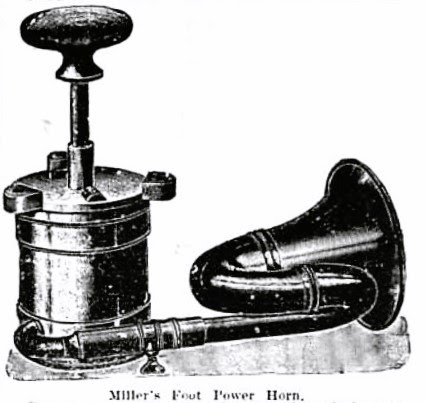
By 1900 Charles E. Miller had moved from bicycles to motor vehicle accessories.  The Horseless Age explained that when he opened his store at the height of the bicycle craze, "he even then realized that the future must inevitably be occupied by the mechanically propelled vehicle, which at that time was just being introduced from abroad."  Because he was among the first to recognize the potential of the industry, his success was phenomenal.  In 1903 the Cycle and Automobile Trade Journal said the firm represented "probably the largest collection of automobile parts, fittings and sundris to be found in the world."  Among the items he sold that year was the Miller's Foot Power Horn.  The magazine explained that an air pump fastened under the automobile's floorboard could easily be operated by the driver's foot.  The firm also introduced "an entirely new line of imported automobile goggles, covering twenty-five or thirty different styles.  Some of these goggles are lined with otter and other furs."

Cycle and Automobile Trade Journal, February 1, 1903 (copyright expired)

Charles E. Miller's business flourished.  By 1911 there were 15 stores throughout the nation, and in its January 15, 1917 issue, The Horseless Age called him "The wise man of Reade Street" and "America's pioneer automobile accessory jobber."

The 1862 cornice can be seen in this 1941 photograph.  image via the NYC Dept of Records & Information Services

Following World War I, other automotive firms would join Miller in the buildings.  In 1922 P. & F. Auto Supply Co. was here, and by 1926 Pederson & Glanagan tire wholesalers operated from 97 Reade Street.  

And in 1939 the New York Stationery Manufacturers moved, as did the Associated Footwear Company.

image via loopnet.com

Change came in 1988 when the cornice was removed and two additional floors added.  Sadly, the renovation, completed in 1989, was done with no interest in honoring Isaac F. Duckworth's marble structure.  Instead, the addition sits as a blatant 20th century afterthought.

uncredited photographs by the author
no permission to reuse the content of this blog has been granted to LaptrinhX.com

Thursday, January 16, 2020

The Wm. Clark Company Building - 295 Church Street


In the 1840's, when James and Ellen Bingham lived in the two-story wooden house at No. 201 Church Street, the neighborhood was still respectable.  But within the decade things would drastically change.  Operated as a rooming house in 1853, it was home to multiple tenants, including Sarah Johnson.

On August 23 that year the New-York Daily Tribune reported that residents "yesterday morning found a dead body of an infant in the sink in the rear of the premises."  There was little doubt that the child was Sarah's, and its paternity may very well have been behind the its cruel death.  "Suspicion rested upon a mulatto girl in the house, named Sarah Johnson, as it was ascertained that she had given birth to a child on the previous night.  The infant, however, is white."  Sarah claimed that she accidentally dropped the baby into the sink.  "She is however charged with doing it willfully," said the article.

The Tribeca neighborhood continued to change as, following the end of the Civil War, factory buildings rapidly replaced the old houses.  In 1867 William G. Hackstaff, Jr. hired the well-known architect Isaac F. Duckworth to design a five-story replacement structure at No. 201 Church Street. Although Duckworth attached cast iron facades to many of his striking buildings throughout the district, this one was faced in sandstone above the cast iron storefront.   His Italianate design of arched openings with molded surrounds was repeated on each floor.  


Paneled side piers and carved keystones add to the elegance of the utilitarian structure.

A renumbering of Church Street gave the building its new address of No. 295.  It was home to various dry goods-related businesses in the subsequent years, like Milmo Cotton Co.; Bondy Bros., apparel manufacturers; and Herman Levy & Co., makers of cloaks.  In 1890 J. R. Leeson & Co., thread merchant, was in the building, and the following year it would become home to another, more visible, thread dealer.

For more than 25 years William Clark had been the general manager of the Clark Thread Company of Newark, New Jersey.  In January 1891 he incorporated the William Clark Company and leased the store here for his sales room.

Two years later King's Handbook of New York City remarked "The thread manufactured by this company is distinguished from others by the letters N-E-W, and notwithstanding the fact that it has been on the market but a short time, it has been favorably received, owing to its meritorious qualities."  The 74-year old Clark, whom the handbook called "one of the oldest living thread manufacturers," handed over the active management of the firm to his two sons, William, Jr. and Robert K. Clark.   It was Robert who oversaw the Church Street office while William managed the mills at Westerly, Rhode Island.

There the firm had erected a village of sorts for its factory workers.  Small houses provided "all the comforts of a refined homelife can be enjoyed," according to King's Handbook, and there was a building used as a chapel and night school, as well.  (The need for a night school suggests that children were employed during the day.)


King's Handbook of New York City, 1893 (copyright expired)

William Clark and his brother, George, had been sent to America from Scotland in 1866 to expand the company business, J. J. Clark & Co., later renamed Clark Thread.  By George's death in 1873 they employed more than 1,000 employees in the only thread factory in the country.  Exactly why William broke away to start his own firm is unclear--he certainly had amassed a significant fortune in the existing company.  But the schism would cause problems down the road.

In 1897 the Clark family had had enough of William's trademark infringements.  They sued to stop William Clark Company from using the "Clark's" name in the same typeface and identical logo.  They further complained that his "N-E-W" was unacceptably similar to their "O-N-T" (for Our New Thread).


Clark Thread Co. complained that the round logo was deceptively similar to its own. The Dry Goods Economist, 1893 (copyright expired) 

In the meantime the upper floors continued to house garment and textile related firms.  Tenants in the 1890's included cloak manufacturer Adolph Rosezweig, and Korn & Haber, another clock and suit maker.

In 1902--the year that William Clark died on his yacht near his home in Paisley, Scotland where he had retired--Meyer Brothers occupied the store and basement which had housed the William Clark Company showroom.  The upper floors, according to The New York Times, were "occupied by hosiery concerns."

On the night of February 3, 1902 Policeman Boll saw smoke escaping from the cellar level.  "When the firemen broke in the door the smoke overcame them so fast that all retired to the street," reported the newspaper.   Six fire fighters were overcome by the smoke and a second alarm was called in.  The damages were estimated at more than $600,000 in today's dollars.

Only three years later the building would be damaged by flames again.  During a blizzard at 4:00 on the morning of January 25, 1905 fire broke in the kitchen of Mrs. Grace's restaurant at No. 35 Walker Street.  "The flames were discovered at the very height of the blizzard," reported the Brooklyn Daily Standard Union, and "threatened to destroy the wholesale dry goods' district before it was extinguished."

Fueled by the high winds, the inferno spread to Church Street.  Heavy damages were suffered in No. 297, and at No. 295 the International Suspender Company was dealt significant losses.

While most of the tenants continued to be apparel-related, one was strikingly different.  By 1917 the Salvage Disposal Corporation operated from No. 295.  An advertisement the following year read "We buy old, new iron, metal, machinery, merchandise of every description."  It was perhaps the first hint of change in the Tribeca neighborhood as the apparel trade began moving northward.

That migration was complete by the last quarter of the century.  In the early 1980's Reven Service Company operated from No. 295, offering a service to homes and businesses using the currently popular Venetian blinds.  On July 7, 1983 The New York Times advised "Reven will wash and refurbish custom-made blinds only.  The charge for washing, retaping and re-cording two-inch blinds is $8 per tape; the charge for washing one-inch blinds is $5 per tape.  In Manhattan, Reven will pick up for orders over $30."


The 19th century garment workers would be shocked at the appearance of interiors of the upper floors.  photo via Brown Harris Stevens
Reven Service Company would have to find new accommodations when, like so many vintage Tribeca loft buildings, No. 295 was converted to residential space above the store level in 2002.  

photographs by the author

Thursday, March 7, 2019

Cloakings, Tar and Controversial Art - 223 West Broadway


In November 1868 Isaac F. Duckworth, one of the most significant architects of the day, filed plans for an L-shaped "dry goods store" for William D. Mann.   It would replace two structures on West Broadway, Nos. 109 and 110 (renumbered 221-223 in 1897) and three on White Street--Nos. 3 through 7.   The up-to-date six-story design drew from the Italianate and French Second Empire styles--the latter most evident in a slate-shingled mansard roof.

Duckworth's plans called for a cast iron base and "the rest Dorchester and Ohio stone."  The cream-colored sandstone facades on both streets were essentially identical; although the White Street plot was one-third wider.  Paneled piers ran up the sides and stone sill courses defined each floor.  The segmentally-arched windows were separated by stoic pilasters.  The plans projected the construction cost at $100,000, around $1.78 million today.  

Although William D. Mann was a wealthy dealer in military goods it does not appear he ever moved his operation into the new building.   Bauendahl & Co. was an initial tenant, listed here in 1869.  The commission merchants represented New England fabric manufacturers.  Among their clients were the Wanskuck Company of Providence, Rhode Island, makers of "ladies' fancy cloakings; Merrimack Mills of Lowell, Massachusetts, makers of "fancy cassimeres;" Pittsfield Woolen Company, based in Pittsfield Massachusetts; and the Barrows Woolen Company of Dedham, Massachusetts.

Herman August operated his menswear store in Nos. 5 and 7 White Street.  While his back was turned on August 30, 1870 a supposed customer John Dolan snatched six coats and ran out of the store.  A clerk, Isaac Strauss, was close behind and all three men were in the Tombs court later that afternoon.  August testified that the goods were valued at $65 (about $1,260 today).  "Justice Dowling held John Dolan to answer, reported The New York Herald.

Horace Galpin was employed by one of the firms here in 1874.  He was in the wrong place at the wrong time in August that year.   And so too, possibly, was Thomas Lanihan.

On August 24 Lanihan stood before Judge Donohue in Supreme Court, charged with assaulting Galpin with a lead pipe on near Fifth Avenue.  According to Lanihan, he had been waiting for his fiancée at the corner of Fifth Avenue and 54th Street that evening.  Suddenly he heard a man cry out and he began running towards the sounds.

Lanihan passed a policeman who asked what the matter was.  "Don't you hear the cries?" he replied, no stopping.  When he got to 48th Street he was arrested and "to his surprise," according to The New York Herald, was charged with the brutal assault.

The would-be good Samaritan provided two eye witnesses, "one of whom gave chase after the real assailant" and "stood ready to prove that Lanihan had nothing to do with the assault."  

But the arresting policeman testified that Lanihan was fleeing the scene of the beating, not heading toward it.   He was held at an astounding $5,000 bail.  

Herman August had vacated the White Street store by the summer of 1875.  With businesses reeling from the Financial Panic of 1873, the store and basement were offered at "half price" according to an August 22 advertisement.


The matching White Street facade matched the West Broadway elevation, other than its wider proportions.

The 1880's continued to see apparel and textile firms occupy the building.  By 1880 B. Goldman, makers of "silk webbing," was here and Goldsmith & Plaut, cloak manufacturer operated here by 1885.

But the first years of the 1890's saw a far different type of tenant.  The Improved Pine Product Co. made a protective tar product used on street railroad cables.  In 1891 the Third Avenue Railway Co. switched to the product.  The satisfactory results prompted The Street Railway Journal to say in January 1892, "Cable railway managers who find it difficult to procure a satisfactory dressing for wire ropes will do well to follow the practice of the Third Avenue Railway Co."  


"This is distilled tar, free from moisture and acid and can be used pure," said the article.  While the price per barrel was the same as ordinary tar, the Third Avenue Railway's mechanical engineer, F. L. Hart, confirmed the firm was using less than half as many barrels as before.

The buildings continued to house mostly dry goods firms through most of the 20th century.  In 1925 the building was renovated by architect Harold F. Smith.  He removed the handsome mansard roof and replaced it with a spartan brick-faced sixth floor crowned with a decorative parapet.  The scrolled consoles which once upheld the galvanized iron cornice were left clinging to the facade with nothing left to do.

The Tribeca Renaissance arrived in the 1980's when Artists Space opened an auxiliary gallery to its main Hudson Street space here.    Founded in 1972, it provided space for "emerging artists and emerging ideas alike," according to its website.  The often edgy art which brought contemporary and sometimes uncomfortable issues to the forefront often caused controversy.

Such was the case in November 1989 when Artists Space prepared to launch an exhibition about AIDS entitled "Witnesses:  Against Our Vanishing."  At a time when tens of thousands of men were dying, the artists and the organization itself were unafraid to speak out.   The exhibition catalog made "remarks" about John Cardinal O'Connor, conservative Senator Jesse Helms and Representative William E. Dannemeyer which prompted the National Endowment for the Arts to rescind a $10,000 grant.  The New York Times commented on November 10, saying that the decision "has thrust Artists Space into the middle of a storm over Government support of the arts."

When the exhibition opened on November 15 The New York Times art critic was moved.  He described several of the artworks, some of them by artists suffering from the malignant disease.  And then he turned frank:

These are not people who go quietly and obediently.  When they die, they die in rage.  Foul in mouth and sometimes foul in body, they speak in hatred, and chocking.  Who are we to reproach them for "questionable taste"?  The traditional rules of mourning nowhere apply.  To have watched them die is, as one witness says, "like surgery without anesthetic."  Notions of "taste" can play no part in it.

Artists Space remained in the building at least through 1992.  In 1997 renovations to the ground floor resulted in a restaurant, Paggio, which opened in 1998.    The name was an amalgamation of the names of owners Pasquale Cervera and Georgio Meriggi.   The name did not last long, however.

The Times columnist William Grimes explained on March 8, 2000 that Paggio had "with touching naivete, unveiled a menu that made it absolutely indistinguishable from, oh, about 398 other Italian restaurants in New York."  So the owners reorganized, renamed it Gubbio and revamped the menu.  Grimes was pleased.  "A much better restaurant, with something resembling an actual personality, has emerged from the reshuffling."

But despite the critic's warm review, only four years later Florence Fabricant reported "Churrascaria Plataforma, the Brazilian barbecue restaurant in the theater district, now has a downtown branch, Churrascaria Plataforma Tribeca, at 221 West Broadway."

Surprisingly, the vintage building was not converted to residential use as so many of the Tribeca lofts were.  A 2011 renovation simply updated what the Department of Buildings still defined as "factory space."  In 2014 White Street restaurant moved into the ground floor.


Through it all, other than the gruesome 1925 replacement of the mansard level, Isaac Duckworth's 1869 beauty remains mostly intact.

photographs by the author