Showing posts with label hudson street. Show all posts

Friday, October 3, 2025

W. H. Hoffman's 1870 577 Hudson Street


Henry Romer's coal yard sat at 577 Hudson Street at the end of the Civil War.  On January 11, 1869, George Stevens and a companion entered Romer's office and asked about the price of stove coal.  Concerned about its quality, Stevens asked to examine the coal and Romer took him into the yard.  A moment later Romer heard his office door slam.  He discovered that Stevens's friend had stolen $50 and fled.  The New York Times reported, "Stevens seemed then to have no further need of the coal, and left."  Romers chased Stevens, who was arrested.  The other man escaped.

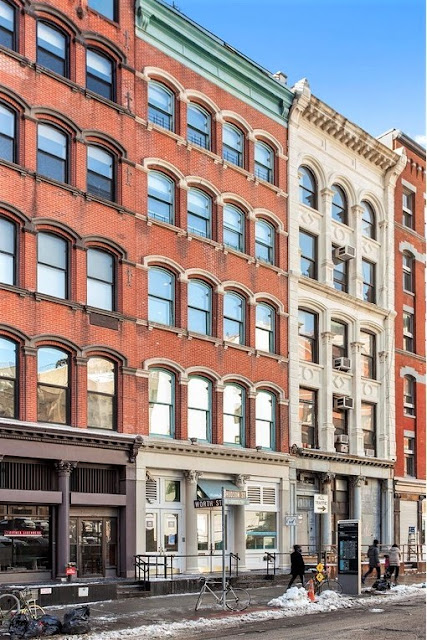
Romer's coal yard would not survive much longer.  One year later, in February 1870, architect W. H. Hoffman filed plans for two "3 story brick tenements" for H. P. Holzderber at 577 and 579 Hudson Street.  Completed that year, the buildings were faced in brick above storefronts.  Modest, block-like brackets upheld their cornices.

Holzderber leased the store at No. 577 to Phillip Gross, a tailor, while the upper two floors were shared by Charles Hellerman, a clerk; and Ogden H. Tyler, who ran a saloon at 89 Hudson Street.

In 1873, Celestine S. Smith began operating the upper floors as a boarding house.  The widow of William H. Smith, her adult son, William F., who was a ticket agent, also lived here.  Celestine's boarders that year were real estate agent C. D. Moore; and Edward A. Nelson, a candy maker.

The multi-talented Mrs. E. Munroe Hill took over the operation in 1875.  Her advertisement in the New York Herald on May 2 read:

577 Hudson Street, near Eleventh street--Mrs. E. Munroe Hill, electrician and nurse: Board for lady.

Living with Mrs. Hill and her boarders were her daughter and son-in-law, Sarah J. and Jacob Herman.  

By then, William N. Lewis ran a bakery in the ground floor.  He decided to give up the business in the spring of 1875.  His ad in The Sun offered "a bakery for sale," calling it, "a first-rate chance for a young couple."

When, apparently, no one responded to his ad, Lewis reinvented his business.  He converted the former bakery to an "eatinghouse."  On May 27, 1875, he advertised in the same newspaper:  "A Woman cook in an oyster and dining saloon; must be neat and willing.  Apply at 577 Hudson st."

A tragedy occurred here later that year.  Sarah J. Herman died at the age of 28 on December 17.  The notice of her death in the New York Herald noted, "The funeral will take place from the residence of her mother, 577 Hudson street, on Sunday, December 19."

Two months earlier, on October 2, 1875, boarder Henry Menager "left his room at Mrs. Hill's, at 577 Hudson-st.," as reported by the New-York Tribune, "to start for Gallipolis, Ohio, on a visit to his relatives."  Menager was a tea merchant at Church and Vesey Streets.  Concerns were first raised early in January when Mrs. Hill received a letter from his Ohio relatives asking about him.  On January 11, the New-York Tribune reported, "It is said that Mr. Menager carried a large sum of money with him and that he always wore considerable jewelry, which would attract the attention of thieves."

Fearing that he had been robbed and murdered, friends and relatives initiated a search.  Inquiries were made at each town along on the train's route to Gallipolis, "but nothing has been learned that would give any clew to the missing man," said the New-York Tribune.  The newspaper gave a detailed description of Menager, and noted that "he was doing a good business and that his books have been found to be correct."

Then, a possible explanation of Menager's disappearance came to light.  The United States Tea Company filed suit against him for a $1,875 loan it had given Menager.  The loan was due  on October 7, 1875--five days after the tea merchant left town.

On January 27, 1876, the Gallipolis Journal published a one-line article:  "Mr. Henry Menager, whose mysterious disappearance from New York City we noticed a few weeks since has turned up at Selma, Alabama, all right."  Three months later, the Ohio newspaper followed up with an equally succinct article:  "Mr. Henry Menager is in the city."  It does not appear that Menager ever returned to his rooms at Mrs. Hill's.

In the meantime, William N. Lewis's restaurant was successful.  He advertised for, "A woman to wash dishes and assist in kitchen of restaurant," in 1876.  The business was taken over by Samuel S. Davis in 1879.  Living upstairs by then were John Felter and Henry K. Williams.

Upon the death of H. P. Holzderber around 1877, his sons Philip J. and John P. Holzderber had inherited 577 and 579 Hudson Street in equal shares.  They sold 577 Hudson Street to George W. and Josephine L. Sherman on May 18, 1880 for $10,000 (about $317,000 in 2025 terms).

Basil Stearn, who operated a cigar store, boarded here in 1882.  Suspiciously, he ceased restocking his shop.  So by the time a fire broke out at 11:00 on December 21 that year, the New-York Tribune noted, "Stearn's stock had been sold out gradually until many of the cigar boxes were empty."  The newspaper said that the stock was insured for $700, however, "the value of the cigars in the store at the time of the fire was not large."

Stearn was arrested that night "on suspicion of having set fire to his cigar store," as reported by the New-York Tribune.  However, on December 24, the New York Herald reported that he "was discharged yesterday by Justice Ford, as there was no evidence against him."  Stearn did not get away totally free.  The New-York Tribune reported that he paid "a fine of $10 for having a revolver in his possession."

John Felter was still living here when he died on February 22, 1883.  His funeral was held in his rooms on February 24.

By then, the former restaurant space was home to a crockery store.  William F. White leased the building in 1891 and took over the operation of the crockery and hardware store and the renting of the upstairs room.  Before moving in, he had the show windows updated at a cost of $50--about $1,780 today.

White had a country place, as well.  He placed an advertisement in the New York Herald on March 27, 1904 that would certainly raise eyebrows today:  "Country Board for girl, six to eight; $1 week.  W. White, 577 Hudson st."

William F. White finally purchased the building in October 1910.  He would continue to operate the hardware store through the 1920s.

The building was renovated in 1929.  Now, on each floor above the store of John Migladsky, "John the Shoe Man," were two apartments.

In 1941 the Village Restaurant occupied the ground floor.  The building's once identical twin at 579 still survived.  image via the NYC Dept of Records & Information Services.

The Depression years saw a restaurant in the commercial space, and by the last quarter of the 20th century, a bar occupied the ground floor here.  

In the early 1980s, the AIDS epidemic began.  Health officials initiated preventative steps, closing down bathhouses where indiscriminate gay sex was performed.  On February 28, 1981, The Villager reported, "Bathhouses, though, are not the only violators" and said that among the locations of which locals had complained was 577 Hudson Street.


The space quickly became Abingdon Square, a jazz bar.  It was replaced by Village West, which would be a destination for jazz music for years.  Today the Hudson Hound, an Irish-style pub occupies the space.  Above the oft-altered storefront, W. H. Hoffman's 1870 facade remains unchanged.

photographs by the author

Monday, June 23, 2025

The Lost James Kearney House and Saloon - 81 Hudson Street


The ground floor was an outstanding example of a 19th century saloon front.  photograph by Edward Loomis Davenport Seymour from the collection of the Museum of the City of New York.

George Harrison owned a sprawling estate on the west side of Manhattan Island in the 18th century.  In 1797, two roads--Harrison Street and Hudson Street--appeared on city maps on his property.  In the first half of the 19th century, houses first began appearing in the area.  

One of the earliest was 1 Harrison Street at the southwest corner of Hudson Street.  A substantial, three-and-a-half story building, it was faced in brick and trimmed in stone.  A early example of Federal architecture, its windows on Hudson Street displayed layered keystones.  The peaked attic had three windows on the Harrison Street elevation--an arched window flanked by two quarter-round openings.  A double-wide dormer pierced the roof to the front.

The first occupant was "Mr. Whale," who listed himself as "Professor of Dancing."  Whale operated a dancing school in the City Hotel.  His four instructors included "Mr. Degville, ballet master at the Opera House in London," and "Mr. Nouvarre, principal dancer at the Grand Opera in Paris."  A November 1818 advertisement said that Mr. Whale's students would learn "new Dances and a variety of Cotillion Steps, as is now danced by the fashionable circles in London and Paris."  Each Tuesday, "practicing balls" were held, where young society people learned the proper steps and the accompanying, expected decorum.

On November 20, 1818, Mr. Whale announced he had "commenced at his residence No. 1 Harrison Street, corner of Hudson, for the reception of those young ladies and gentlemen who may consider his public school at the City Hotel too great a distance to attend."  The classes were segregated by gender--young ladies being instructed on Mondays and Friday from 3 to 5, and gentlemen the same days from 5 until 7.

Mr. Whale staged his "grand annual ball" at the City Hotel.  An announcement in The Evening Post on March 22, 1819 listed the locations where the $1 tickets could be obtained, including "Mr. Whale's residence No. 1 Harrison street, corner of Hudson street."

Mr. Whale was followed by Miss Squires in the house.  On October 26, 1822, an advertisement in The Evening Post read: "Miss Squires informs her friends, that she will re-open her Seminary on Monday the 28th of October, at No. 1 Harrison street, corner of Hudson street."

By 1830, the ground floor of the house had been converted to business.  The residential address remained 1 Harrison Street and the store became 81 Hudson Street.  Thomas L. Jackson operated his grocery store in the space that year.  John Adams ran the store from 1836 through 1841, followed by Bruce C. Smith.  Smith and his family lived above the grocery store.

Henry Meyer took over the grocery around 1850.  He and his family shared the upper floors with boarders.  Living with the Meyers in 1853 were Patrick Crenan, a carman; Michael Garaty, a coachman; civil engineer David C. Nodwell; and Simon Strahlheim, an importer.

In 1859, Patrick Kehoe converted the long-time grocery space to a saloon.  (He operated a second saloon at 322 Greenwich Street where he and his family lived.)  By then, the neighborhood was bustling and the following year, on September 3, 1860, the Board of Aldermen approved the resolution "to flag and set curb and gutter stones in front of No. 81 Hudson street, and No. 1 Harrison street."

Robert G. Stevenson and Walter Taylor moved their Taylor & Stevenson saloon into the space in 1861.  They were the first to list the commercial space at 81 Hudson Street.  Neither of the proprietors lived upstairs.  Stevenson lived at 13 Harrison Street and Taylor at 3 Harrison Street.

Stevenson also operated a produce business at 395 West Washington Market.  In 1864, Benjamin Emerson, who lived upstairs at 1 Harrison Street, was also in the produce business at 395 West Washington Market, possibly a partner.  That year the two men partnered in the saloon, changing its name to Stevenson & Emerson.

Most substantial saloons had rear rooms for meetings.  On August 3, 1864, The Sun reported that the Dry Goods Porters and Packers, an early version of a labor union, had met here.  The article said, "It was decided that it was necessary, in order to have justice done them, to organize into a permanent Protective Association."

In 1867, James Kearney took over the saloon and moved his family into the upper floors.  He and his wife, Elizabeth, would eventually have three children in the house: Cornelius P., born in 1869; , Mary A., born in 1870; and Katherine, who arrived in 1871.

Sadly, Cornelius died at the age of four on February 25, 1873.  His funeral was held in the house the following day.

The Kearneys were Roman Catholics and the girls attended St. Peter's Academy rather than a public school.  Mary graduated in 1887, when Katherine was a junior.

Elizabeth and the girls were at Spring Valley, New York that summer.  Families who could afford to spent the hot months in the country.  In many cases, the fathers of the families remained in the city to attend to business, and traveled back and forth on the weekends.  On the evening of July 27, 1887, James Kearney was met at the train station at Spring Valley by devastating news.

That afternoon, Mary and Katherine, who were now 17 and 16 years old respectively, "went with a party of girls of about their age to bathe at Distillery Lake," reported The Sun.  The article said,

They could not swim.  Mary slipped from a small raft into 15 feet of water, and her frightened sister plunged in to save her.  Both girls sank together.

The screams of the other girls attracted workmen in a nearby field, but their attempts were futile.  The Sun reported, "Their bodies were recovered two hours later, still locked together in their last embrace."  On July 29, the newspaper reported that the teens' bodies had been brought to the city and a mass at St. Peter's Church would be held that morning after the funeral at 1 Harrison Street.

In the 1880s, the Temperance Movement began lobbying for public drinking fountains.  Proponents believed that by making healthful, clean water available to the working classes, the temptations of alcohol could be thwarted.  It was most likely that pressure that resulted in the Commissioners of Public Works to install a "free drinking-hydrant" at 81 Hudson Street in 1891.

By 1894, Henry Steinhardt, who also ran a saloon at 315 Bowery, had taken over Kearney's operation.  In February that year, he made $2,500 in alterations to the building.  The cost would translate to about $94,000 in 2025.  The renovations involved the installation of a superb saloon front with four double-doored entrances with stained and wheel-cut glass.  They projected away from the facade under curved metal hoods.

The neighborhood continued to change, and at the turn of the century the Hudson-Harrison Street corner sat amid the "egg and butter" district.  On March 19, 1908, an auction was held "of bar and back bar, and all other goods then on said premises," at 81 Hudson Street.  After having housed a saloon for nearly 80 years, the ground floor became home to the Wisconsin Condensed Milk Co.

When this photograph was taken in 1919, demolition of the venerable building had been begun.  from the collection of the New York Public Library

An advertisement appeared in The Evening World on June 17, 1918 that read simply, "81 Hudson Street, Corner Harrison St.  We offer this desirable corner for sale."  It was purchased by Henry Mason Day, Jr.  On March 1, 1919, the Record & Guide reported that he would replace it with "a new 3-story building" for his export and import food supply business.  Designed by Schwartz & Gross, the terra cotta-clad Henry M. Day Building was completed within the year.  

photograph by the author

Friday, January 5, 2024

The 1827 Isaac C. Blauvelt House - 531 Hudson Street


Thousands of citizens fled New York City to Greenwich Village following the outbreak of yellow fever in 1822.  The population explosion necessitated a flurry of construction.  Established builders were soon joined by unexpected speculators like bakers, hat makers and other businessmen.  In 1826 two carmen--drivers of horse-drawn delivery drays--purchased plots on the west side of Hudson Street, just south of Charles Street.

Tunis Banta and Isaac C. Blauvelt erected two-and-a-half story, Federal style homes on the sites, completed in 1827.  Isaac C. Blauvelt's house, 531 Hudson Street, had handsome Federal details like the delicate, openwork stoop newels with pineapple finials, and paneled brownstone lintels.  Originally, one or two dormers pierced the peaked roof.

Blauvelt originally leased the property to James Chamberlain and his family.  They left in 1833, and a hint of their comfortable lifestyle can be gleaned from the auction notice on April 9.  It included items like "Brussels, Ingrain and Venetian carpets, stair carpets and rods, mahogany chairs, high post mahogany carved bedsteads," a "pillar and claw table," and "fancy cane seat chairs."

The family of Jacob Cole lived here by the mid-1840s, and in 1851 the George A. Steele family was leasing the house.  George was a typefounder.  Living with him and his wife were their adult sons, Manning, John H., and James and their families.  John was a printer of "blankbooks" and Manning was a clerk.  What James did for a living is unclear.

Despite what must have been snug conditions, the Steeles rented a room.  In 1853, their tenant was Lockwood K. Campbell, an inspector at the New York Custom House; and the following year F. B. Marvin, an officer in the Croton Aqueduct Department lived with the family.  An advertisement in the New York Herald that year offered "partial board," meaning that only one meal was provided.

In 1856, many New Yorkers still recalled the horrors of the 1822 yellow fever epidemic.  Those memories were no doubt awakened that spring.  On April 30, The New York Times reported on the arrival of the ship Empire State with 516 passengers.  The article said it "had on board during her passage 33 cases of small-pox, eight of whom died on the passage, and 235 of whom were sent by the Health Officer to the Marine Hospital."  The article added that two days earlier, the brig General Taylor had arrived from Port au Prince with half of her crew dead of yellow fever.

By fall, it appears, one of the deadly diseases had reached Greenwich Village.  On November 9, 1856, John and Mary Steele's four-year-old son William Henry died "after a short and severe illness."  His funeral was held in the house two days later.  The following year, on August 5, James and Margaret's only child, five-month-old Julia Maria died; and three months later, on November 13 John and Mary's two-year-old daughter Mary Augusta succumbed. 

After having leased the house for decades, around 1861 Isaac C. Blauvelt and his family moved into 531 Hudson Street.  Living with him and his wife, the former Rachel Powels, were James H. Blauvelt, who was a clerk; and John who worked as a driver.

The Blauvelts, too, leased rooms.  In 1861 Frank D. Karr, his wife, Sarah J., and their son Frank Jr. boarded with the family.  Frank was a clerk in a Broadway firm.  Sadly, as had been the case so many times before, the parlor was the scene of Frank Jr.'s funeral on August 24, 1862.

Tragedy continued to visit 531 Hudson Street.  In 1864 the family of Edward S. and Sarah C. Allaire boarded with the Blauvelts.  On April 2, the couple's five-month-old daughter Margaret Christie died of scarlet fever.  Her tiny casket was placed in the parlor and her funeral was announced for April 5.  It would be delayed by one day, however.  On April 4, three-year-old Edward Parkes Allaire died.  The children's double funeral was held here on April 6.  (In 1865, Edward and Susan Allaire purchased 534 Hudson Street, almost directly across the street.)  

Around 1870 Isaac Blauvelt converted the basement level to a commercial space.  On May 2, 1871, an announcement in the New York Herald read, "James Cagney, auctioneer, real estate and loan broker, has removed from his late business place (194 Broadway) to 531 Hudson street, where he will carry on the above business as usual."  Cagney remained at least through 1875, advertising properties like "an excellent corner liquor store," and "a most desirably located long and well patronized down town wholesale and retail grocery."

Isaac C. Blauvelt died on April 15, 1878.  The Hudson Street house was sold to Jeremiah W. Dimmick in June 1881 for $20,943 (about $618,000 in 2024 terms).  He hired architect John H. Whitensch to modernize the building.  Completed in 1882, the renovations raised the attic to a full-height third floor, and converted the basement and parlor levels for business.  While the Federal ironwork and second story lintels were preserved, modern Italianate entrance doors were installed.  The new cornice was surprisingly understated, with simple brackets and dentils. 

Dimmick rented space on the upper floors to several families, including (somewhat surprisingly) that of John Blauvelt in 1884.  Other tenants that year were Charles Kerr, a "fitter" (a person who assembled pieces of machinery), and Charles Keech, a driver.  John Pesham lived here on February 23, 1888 when he was arrested as one of the proprietors of a gambling house on West 30th Street.

At the time of Pesham's arrest, a woman named Armstrong operated the upper portion of the house.  In December that year she took pity on a woman from Hoboken, New Jersey who had suffered horrific domestic abuse.  On December 15, 1888, according to The Adirondack News, Sadie Burd was "terribly beaten by her husband," Edward Burd, the captain of  the excursion barge Caledonia.  The article said, "Then taking her little Lizzie, she left home and found refuge with Mrs. Armstrong in Hudson Street."  Although she was now safe from her abusive husband, she had no means by which to take care of herself and her daughter.  

On January 5, 1889, said the article, Sadie Burd "was found by the police of the Charles street station recently, in a room at 531 Hudson street, New York city, suffering from cold and hunger and from a broken rib that she said was the result of her husband's brutality."  The article noted, "The child had been well cared for by the neighbors, but Mrs. Burd said that for four days she had not tasted food, had no fire in her room and had had no medical attendance since she received her injuries.  The little one was taken charge of by Agent Gleason of Mr. Gerry's society."

Dimmick made interior alterations in the summer of 1891.  The plans filed by builders Ryan & Sons included "walls altered."

The family of Fred (most likely an anglicization of Frederico) Lorenzo, a barber, lived in the building by 1892.  Living with him and his wife was their son, Lecurgo, who was also a barber.  Another son, David Lorenz, lived nearby at 121 Christopher Street.  (Both sons had dropped the "o" from their surnames.)  

On the afternoon of Sunday, March 18, 1894, Lecurgo and David paid a call on a young woman.  To their displeasure, another man, street car conductor James Early, had the same idea.  The adage of "three's a crowd" turned violent.  On March 21, The Evening World reported that a fistfight occurred during which Early "got the better of a fight over a woman whom the three men had called to see."

Things got worse when police were called.  The Evening World reported, "Lecurgo was arrested after threatening the officers with a razor.  David turned out to be a man whom the police have been after for some time, for assaulting a woman."

At the time, the real estate office of Hammond & Gruet had operated from 531 Hudson Street for several years.  In an interesting turn of events, among their agents in 1895 was F. D. Lorenzo, quite possibly the former barber, Fred Lorenzo.  In the meantime, another Italian-born barber, Rafael Decresenzi, lived in the building. 

Real estate firms continued to operate in the commercial spaces for decades.   In 1896 King & Co. occupied the parlor floor, while G. Funk's printing shop was in the basement level.  In 1901, he employed 15 men in what must have been tight quarters.

In February 1906, Engineering Review reported that Maurice W. Lewis "has opened a plumbing business" at 531 Hudson Street, taking over the former printing shop.  He would remain throughout the World War I years, with Kanavan Real Estate occupying the second floor space by 1910.

In 1941, the paneled lintels at the second floor and the handsome Italianate entrance doors survived.  image via the NYC Dept of Records & Information Services.

The post-World War I years saw a grocery store in the building through, at least, 1922.  The basement and parlor floors remained distinct commercial spaces until 1970, when The Wine Cellar restaurant opened.  The New York Times journalist Jean Hewitt wrote on November 27, "This informal, split level dining-pub gets its name from the wine rack décor against bare brick, old wood and antiques rather than from any outstanding offerings on its wine list."

It was most likely at this time that the building was given a pseudo-Tudor facade, with a coating of stucco and pretend half-timbering, and a cedar shake awning over the parlor floor.

The space became the Village Green in 1977.  It was described by New York Magazine on January 14, 1980.  "It would be difficult to imagine a firelit setting of refined rusticity more beautiful than at Village Green."  It was replaced in December 1992 by Mesa Verde, which rapidly gave way to Rubyfruit Bar & Grill.  On November 30, 1994, Newsday called it "a bar and restaurant with a focus on women.  Women run it, lots of women meet at the bar, and there's chardonnay and merlot from Bonverre, a California winery run by gay women."

There would be two more restaurants in the space--RF Lounge and Swine--before the Japanese bar-restaurant Katana Kitten, opened.


In the meantime, the last visible vestiges of Isaac C. Blauvelt's design--the delicate iron stoop railings and newels somehow survive.  And, most likely, beneath the 20th century Tudor facing, are the paneled second floor lintels.

photographs by the author
no permission to reuse the content of this blog has been granted to LaptrinhX.com

Friday, December 9, 2022

The 1839 Samuel P. Archer House - 599 Hudson St (16 Abingdon Square)


The northward extension of Eighth Avenue through Greenwich Village left behind a triangular-shaped plot between it and Bank Street, and Hudson and Troy (later West 12th) Streets.  On March 4, 1812 the Common Council agreed to make the otherwise useless plot a park.  Because it sat within the former 300-acre estate of Sir Peter Warren, whose eldest daughter had married the Earl of Abingdon, it was named Abingdon Square.  The city spent $3,000 to acquire the land and enclose the park within a cast iron fence. 

The block of Hudson Street facing the park was named, in turn, Abingdon Square.  Houses built along the block would have a pleasant view, as well as guaranteed light and sunlight.  In 1839 Samuel P. Archer erected a 28-foot-wide residence at 16 Abingdon Square (which had the alternative address of 599 Hudson Street).  

Three-and-a-half stories tall above an English basement, the Greek Revival style house featured intricate stoop ironwork that wrapped the newels atop brownstone drums.  The handsome doorway, within a pilastered entrance, included paneled pilasters, sidelights, and an ample transom.  Most unusual was the attic level, where the windows were inset within a brownstone (rather than wooden) fascia with recessed panels.

It is unclear how long (or if) Samuel Archer resided at 16 Abington Square.  By the early 1840's it was home to the Vaneps family.  John P. Vaneps was the principal in J. P. Vaneps & Co., "fancygoods," at 103 Pearl Street.  His son, George K. Vaneps, was listed as a clerk by 1844.  Boarding with the family was Deborah Plum, a widow, and George T. Plum, who was employed at 87 Water Street as a bookkeeper.

The Vaneps had left by 1847, when an advertisement appeared in the Morning Courier and New-York Enquirer that read:  

Board in Abingdon Square--Board and very pleasant rooms, with good pantries, suitable for families and for single gentlemen, may be obtained at 16 Abingdon Square, Hudson street.  The situation is a desirable one, and convenient to the stages.

Among the boarders that year were Julius A. Durie, a clerk; physician James B. Nelson; and Jonathan Leeks.  Their relative affluence was reflected in the arrest of Alice Ridley on August 19.  She was charged with "having stolen a gold watch, valued at $60, from Mr. Jonathan Leeks of 16 Abingdon square," according to the New-York Tribune.  The equivalent value of the watch today would be around $2,000.

In 1856 the house was returned to a single-family home.  Balthazer Malick was a director in The Greenwich Insurance Company.  He and his wife, the former Charlotte S. Hall, had seven children.

Despite the large family, plus at lease one or two live-in servants, the Malick's rented space in 1865.  Their advertisement clearly announced that roomers would have to take their meals elsewhere:

A private family will let one or two large, newly furnished Rooms, with closets, gas and bath, to gentlemen only, without board; house first class; references exchanged.

The Malicks moved on around 1868, when the house was once again briefly operated as a boarding house.  Then, in April 1871, Henry Corse purchased it for $16,100--just under $370,000 by 2022 standards.  Like the Maliks, the Corse family was a large one.  Henry and his wife Lydia Ann had eight children.  (Their son, Henry Jr., would go on to become a recognized architect, responsible for several Long Island estates.)

Henry Corse was a real estate agent and ran his business from the Abingdon Square house.  He, as well, accumulated a large among of Greenwich Village property.

The Corses would remain here for a decade, moving to Jane Street in 1884.  Henry  retained possession of 16 Abingdon Square, and leased it that year to the Greenwich Literary Society.  Appleton's Dictionary of New York and its Vicinity described it in 1887 saying it "unites the features of a social club with those of a literary and dramatic association.  The club-rooms are at 16 Abingdon sq., west, which are opened nightly."

The Greenwich Literary Society produced events like the "grand concert" at Steinway Hall on February 6, 1885.  A more surprising entertainment was held in the clubhouse three months later.  On May 12 The Evening Telegram announced, "The Greenwich Literary Society will give a stag party at their rooms, No. 16 Abingdon Square, this evening."

By the spring of 1889 the house had become the headquarters of the Ninth Ward Pioneer Corps.  Rooms on the upper floors were rented to bachelor members.  

A Republican political group, it had rallied for the election of Benjamin Harrison.  It and other political clubs had badges fashioned for his inauguration.  The club's president, Robert B. Miller, sent one to the new First Lady, who wrote back on April 3, 1889:

Please accept my thanks for the beautiful badge which was received some time ago.  Sickness has prevented my acknowledging it sooner.  I am very grateful to receive these badges.  I desire to lay them aside for future years.
                                    Carrie A. Harrison

In the 1890's a popular pastime swept the nation--bicycling.  Riverside Drive and Central Park became a popular destinations for bicyclers, called wheelmen, and social organizations formed bicycling groups.   On July 31, 1892 The Press reported on new bicycle clubs that were "crowding the older ones hard for honors."  The article said, "Among them none is more promising that the Pioneer Corps Wheelmen, which was made up of members of the Ninth Ward Pioneer Corps, May 15, 1891."  Although "their handsome and commodious club house, at No. 16 Abingdon square" was "located in the lower part of the city," the article noted that Eighth Avenue "is asphalted all the way to Central Park."

The bicycle club had 40 members and wore blue uniforms "with the letters N.W.P.C. worked in gold letters on the coat collar."  In order to join, potential members "must be of age, Republicans, and members of the corps proper."

In February 1893 the Ninth Ward Pioneer Corps moved to 240 West 14th Street.  The Abingdon Square house next became home to another political group, the Old State Democracy of the Ninth Assembly District.  A Democratic group, it was shockingly anti-Tammany.  During a meeting on March 14, 1894, Otto Kempner asked, "How could the party be reorganized to overthrow the bosses?  It cannot be done with the old organization.  It is necessary to build up a new organization which will respect the wishes of the people."

The group leased the house through 1899.  In 1900 the Corse family rented it to the Republic Club of the 7th District.  Unlike its predecessors, it leased rooms in the upper floors to non-members. 

Among the tenants at the turn of the century were Johanna O'Connor and her teenaged daughter, Julia Robinson.  Julia yearned for a life on the stage.  It resulted in a serious rift between mother and daughter in the summer of 1900.  

On July 14 Johanna took Julia to court.  The Morning Telegraph began an article saying, "Julia Robinson, 19 years old, is an actress who has not yet learned that to fall in love with a married man is dangerous."   Julia had fallen for married actor Bert C. Thayer and had left the rooms on Abingdon Square she shared with her mother.

Johanna told the magistrate, "I can't do anything with her.  She insists upon constantly seeking his company, although I have warned her time and again that she will get into trouble if she doesn't cease."  Julia insisted that although she was just 19, she could take care of herself, adding, "I did not leave home to be with any married man, but because my mother ordered me from the house."

The stage manager of the New York Theatre had accompanied Julia to court.  He testified to her "excellent character."  Johanna O'Connor would return to 16 Abingdon Square frustrated.  The Morning Telegraph reported, "The Court, relying upon the stage manager's experienced career in studying character released the girl, who went on her way rejoicing."

After having owned the house for four decades, the Corse estate sold it in 1911 for $15,700 (about $463,000 today).  By the Depression years it was owned by the 16 Abingdon Square Realty Corp.  The owners completed a renovation in 1931 which resulted in a club in the basement through second floors, and a duplex apartment on the top two.  

The tradition of political clubs continued with the Third Assembly District, Jeffersonian Club in the remodeled space.  The upstairs apartment became home to Thomas J. Culkin and his family.  Culkin was well-connected politically, the son of former Tammany Hall sheriff Charles W. Culkin.  He and his wife Ann Theresa had married in 1920 and now had four children.

A veteran of World War I, Culkin had served in several clerical civic positions.  On April 6, 1933 The New York Sun reported that he had been appointed Deputy Fire Commissioner in charge of Manhattan, the Bronx and Staten Island.  Three years later he was appointed as ordinance clerk to the Board of Aldermen with a yearly salary of $4,250 (around $83,100 in 2022).

As late as 1941 the Greek Revival stoop ironwork survived.  A sign on the facade announces the Jeffersonian Club.  image via the NYC Dept of Records & Information Services.

The club remained in the building through 1954.  Then, a renovation completed the following resulted in two apartments in the basement, four on the parlor floor, three each on the second and third floors, and four on the fourth.  By the last quarter of the century, things had declined in the once-elegant home.

Joseph Stiletto, known to his friends as Kelly, was provided with a studio apartment by Jayco Realty as an act of charity.  The elderly man had been evicted from another building the company owned when he could not pay rent.  Irving Bush told a reporter, "I felt sorry for the old man," and let him live here without paying rent.

Stiletto became known around the neighborhood, doing odd jobs like cleaning up in a restaurant and helping in a card shop.  His past was sketchy at best.  The New York Times noted, "The police said he had accumulated nine convictions and had served 20 days in jail between the 1960's and the 1980's."

By the 1960's the ironwork had been replaced and the brick painted, most likely an attempt to modernize the appearance.  image via the NYC Dept of Records & Information Services.

By 1987 Stiletto was less and less able to care for himself.  Unable to pay the bill, his electricity was cut off.  His tiny apartment was littered with garbage.  Two neighbors gave him money to buy food, and they ran an extension cord to his apartment.  Through their efforts, the city's Human Resources Administration arranged a home attendant, money to pay for the $90-a-month rent, and basic bills.

An apartment visit had been scheduled for January 11, 1988 and so the night before neighbor Jeanne Atkin stuck a note on the 80-year-old's door to remind him.  The next morning it was still there.  She and a friend, Apu Guecia, entered the apartment (there was no lock on the door).  The New York Times reported that inside, among the "filthy clothing and sheets, soiled mattresses and paint chips," they found the frozen body of Stiletto.  The frigid January wind came through a broken window and the apartment was so cold that a half can of beer had frozen solid.

The incident sparked a probe into the actions of the Human Resources Administration, which found a "massive cover-up to hide its mistakes," according to Newsday on April 17, 1988.


The Archer house has seen improvements in recent years.  The late 20th century coat of paint has been removed and weather-tight replacement windows installed.  It is the last intact house of the period to survive on Abington Square.

photographs by the author
LaptrinhX.com has no authorization to reuse the content of this blog

Friday, September 16, 2022

Donnelly Brothers' Saloon - 597 Hudson Street (14 Abingdon Square)


In the early 19th century, the block-long stretch of Hudson Street between Bethune and West 12th Streets took the name of the little park it faced--Abingdon Square.  Like the others on the block, the upscale house at the corner of Bethune, 14 Abingdon Square, was four-stories tall and faced in brick.  By the end of the century, however, the affluent personality of the neighborhood had greatly changed.  In 1893 developer James W. Ketchum purchased the vintage residence, and replaced it with a store-and-apartment building.

Designed by architect Thomas E. Goodwin, the five-story structure was his somewhat commercial take on the Romanesque Revival style.  Faced in yellow brick and sparsely trimmed in brownstone, most of its ornamentation was executed in brick--the rustication of the second floor, the voussoirs and arched eyebrows of the third and fourth floor windows, and the striped effect of the fifth floor.  Somewhat surprisingly, Goodwin's configuration of the openings on the Abingdon Square elevation followed that of livery stables.

The four- or five-room apartments were marketed as "elegant" with "bath & all improvements."  Rent for a five-room corner apartment was $27, or about $775 per month by 2022 standards.  Perhaps confusing to visitors was that the building had three addresses--14 Abingdon Square, 597 Hudson Street, and (for the westerly store) 6 Bethune Street.

Kethum sold the building to Meyer I. Sire, who, in turn, leased it to Thomas and Michael Donnelly.  The Irish-born brothers opened Donnelly Bros. saloon in the corner space.  They lived in the building, as did their brother James (who would work as a bartender downstairs for years), and sisters Ellen and Catharine.

Senator John Raines had a problem with saloons like the Donnellys'.   In 1896 he wrote a new state liquor tax legislation, known as the Raines Law.  It increased the cost of liquor licenses, raised the legal drinking age from 16 to 18, and banned liquor sales on Sunday, except in hotels with at least 10 rooms and which served the drinks with a meal.  It sparked the nearly omnipresent "Free Lunch" signs that hung over saloon bars.

The Donnellys responded by deeming 14 Abingdon Square a hotel and providing sandwiches with drinks on Sundays.  At 9:00 p.m. on Sunday, July 26, 1896, a plain clothes policeman named Geraghty walked in and ordered a beer and sandwich.  As he lingered, he took note of the other patrons.  He would later swear he saw "people who were drinking in the place, without the formality of also ordering sandwiches," and that he overheard Thomas Donnelly "telling a friend how easy it was to beat the present law by simply serving a sandwich, whether ordered or not."

After about 20 minutes, Geraghty walked to the door, but returned to his seat and ordered a second beer.  When he was served without a sandwich, he arrested Thomas Donnelly.  In court two days later, Donnelly insisted that because Geraghty had not left the saloon, he could legally sell him a second beer with his initial sandwich.  The magistrate agreed; however he held Donnelly on $1,000 bail awaiting trial "on the sworn statement of the policeman that he saw drinks served without a sandwich, and also, that he heard the defendant explaining how he beat the law."

Despite such problems, the brothers' success was such that in 1899 Michael and Thomas Donnelly purchased the building.  As was common among saloon owners, they partnered with a brewery, agreeing to sell only that firm's beers and ales.  For years they did business only with the Bernheimer & Schwartz Brewery.

Among the Donnellys' upstairs tenants at the turn of the century was Augustave Duffy, who made his living as a clerk.  It seems he had the day off on Wednesday, June 24, 1903, because he traveled to Stimmel's Park, in Whitestone, Queens to play baseball.  His day of recreation did not end well.  The 25-year-old Duffy was pitching, when he "was struck under the chin by a ball and received a lacerated wound that required the attention of Dr. B. Folzer," according to The Brooklyn Daily Eagle.  It was a significant injury, the article noting, "He was taken home by friends."

In July 1915 Michael and Thomas Donnelly transferred the title of the building to their sisters, Ellen and Catharine.  (Interestingly, the liquor license for the saloon had been in Ellen's name since 1908.)  Two months later, on July 12, The New York Press reported that the women had sold the property to "the No. 14 Abingdon Square Company, a new concern."  

The following year, H. J. Goodwin, an electrical contractor, took the commercial space at 6 Bethune.  The Donnellys' saloon continued in the corner space for years.

Despite the onset of Prohibition on January 17, 1920, the Donnelly Brothers' saloon forged on, apparently still selling contraband beer.  Michael Nesil was tending bar on the night of November 30, 1922.  He was chatting with his two customers when three armed men walked in and announced a stick-up.  One walked out again and stood watch.  Nesil was held at gunpoint while the third crook went behind the bar, headed for the cash register.  Nesil picked up a beer bottle and smashed it over the thief's head, who cried out, "Let him have it!"

The gunman fired two shots, both of which entered Nesil's stomach.  As the bartender fell to the floor, the robber opened the cash register and took out the $30.  The two joined their accomplice outside where they were confronted by members of the V.F. W. Michael Lynch Post next door who had heard the shots.  One, Patrick Heney, grabbed the gunman, "but the bandit twisted the gun upward, jabbed it against Heney's stomach and pulled the trigger," reported the New York Herald.  Amazingly, this time the firearm jammed.  The crook managed to free himself and the trio ran down Bethune Street, making their escape in a waiting car on Greenwich Street.

Within minutes Patrolman Shaw arrived.  He sent for an ambulance for Michael Nesil, who was taken to St. Vincent's Hospital.  He died there shortly after midnight.

Seven months later, on June 17, 1923, Ed Sheeran was arrested, accused with five other men of assaulting and attempting to rob Thomas Drayton.  The Sun and The Globe reported, "Screams of nurse girls out with children of the neighborhood for the early morning air saved the life of Drayton."  Sheeran gave his name as John McGuiness, but his fingerprints proved his true identity.  They also linked him to the Nesil murder.

The Sun and The Globe reported, "he did not deny that he was in the saloon of Thomas Donnelly, 597 Hudson street, when the bartender Michael Naasel [sic] was killed.  Sheeran is the man alleged to have done the shooting."

The tenants of the building, for the most part, came and went without drawing attention.  That was not the case with Walter Forster and his wife Annetta, who lived here in the early Depression years.  On January 6, 1936 they were arrested with four others in what the Long Island Daily Press called "One of the biggest life insurance fraud rings ever uncovered--a ring which may even have dealt in murder."

Knowing that his brother, Frederick, was dying of cancer and that he had no communication with his estranged wife, Paul Bottiger conceived a scheme.  Using the name Ewald Rottiger, Walter Forster underwent physical examinations, and took out 30 life insurance policies on himself, totaling more than $1 million (nearly 20 times that much in today's money).  When Bottiger died, Paul had him cremated under the name of Ewald Rottiger.  

The scam fell apart when Clara Bottinger discovered her husband had died and tried to cash in the legitimate life insurance police.  The Long Island Daily Press said she "could not collect on it because her husband's name had been changed on the death certificate."

As it turned out, the scheme went even further.  The newspaper reported, "The Forsters, who were the first to be questioned by police, said...that there were 'many other dead men' upon whom policies had been taken."


In the 1960's the former Donnelly Brothers' saloon space became home to the Bus Stop Coffee Shop.  Like its predecessor, it would become a fixture on the corner, still there six decades later.

photograph by the author
LaptrinhX.com has no authorization to reuse the content of this blog

Wednesday, December 29, 2021

The 1867 Brooklyn Flint Glass Works Bldg - 73 Hudson Street


image via elliman.com

In the first years of the 1860's the five-story building at 73 Hudson Street was home to The Union Glass Co., which made pressed glass tableware (like bowls and tumblers), lamps and utilitarian items.  The property had been in the family of ship chandler William Hustace since 1839.  

The Commercial Register, May 1, 1862 (copyright expired)

In March 1866, Hustace signed an agreement with the Brooklyn Flint Glass Works to buy the building for $45,200--about $760,000 in today's money.  That sizable debt, coupled with bad luck would have dramatic consequences later that year.

According to authors Davis Dyer and Daniel Gross in their 2001 book The Generations of Corning, "...the Brooklyn Flint Glass Works teetered on the brink.  In the fall of 1866, a Dun's correspondent reported that the company 'is in a bad way.'"  The firm's troubles were compounded when, on December 3 that year, fire destroyed the Hudson Street building.

It is unclear whether William Hustace had already foreclosed on his property, but it was he who immediately rebuilt.  Because the roof was already on in January 1867, it appears that much of the gutted structure was salvaged.  Completed that year, the five-story, Italianate style building was faced in red brick above the cast iron storefront.  The windows sat upon stone cornices and continuous moldings linked the segmentally-arched openings.  The terminal cornice was upheld by unexpectedly understated brackets, only two of which survive.

The Brooklyn Flint Glass Works got back on its feet and later in 1867 announced:

The subscribers would respectfully inform you that their WORKS having been rebuilt and greatly enlarged, they are now prepared with increased facilities to furnish all kinds of Rich Cut, Plain Blown, and Pressed Glassware. 

With a new building and much better luck, the firm quickly expanded and in 1868 moved to Corning, New York, changing its name to the Corning Glass Works.

Small manufactories took space in the building, while Michael Foley ran a grocery business from the ground floor store space.  The threat of fire plagued William Hustace's building.  At 4:30 on the morning of March 13, 1872 fire broke out in the tin can factory of Brown, Cole & Co.  It was extinguished before extensive damage was done.   Then, four months later on July 26, another fire "from an unknown cause" occurred in Michael Foley's grocery store.  Oddly, The New York Times reported it had originated in a window.  "Mr. Foley's stock was damaged to the extent of $2,000," said the article.  The loss would equal nearly $44,000 today.

The "Cole" in Brown, Cole & Co. was Jonah R. Cole, who was apparently the inventive end of the business.  In 1874 he received two awards from the American Institute, one for his "portable cooking apparatus," and the other for a "strainer cover for pots and kettles."

The other tenants at the time were W. D. & A. S. Nicols, makers of "marble, slate and wood mantels" and cast iron "cresting, stable fixtures, fence, grates, weather vanes, &c;" and Ludgren & Frier, manufacturers of "general house-furnishing tinware."  The firm made "large and butter pails and boxes for home and shipping purposes."


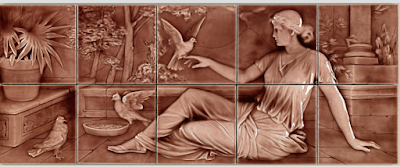
In May 1880 the Ohio-based American Encaustic Tiling Company announced it had moved into 73 Hudson Street.  The  colorful architectural tiles it made were vivid and durable, since the colors were not the result of glazes, but of tinted clay.  Encaustic tiles were widely used for flooring, fireplace surrounds, and even wainscoting.

A catalog page showed several designs of encaustic floor tiles.

The American Encaustic Tiling Company produced these shallow relief wall tiles around 1885.  from the collection of the Minneapolis Museum of Art

Troubles between the partners resulted in W. D. & A. S. Nichols going their separate ways.  On October 28, 1882 the Real Estate Record & Guide announced that the business, "will hereafter be carried on by Adelbert S. Nichols," adding, "This concern has a reputation second to none in the trade."  The firm remained at 73 Hudson Street for another four years, moving to 15 West 27th Street in April 1886."

Brown, Cole & Co. was still operating from the building at the time and Jonah B. Cole was still inventing.  In its July 3 issue that year Scientific American reported that he had patented a new folding box.  The bottom and sides were made of a single piece, and the corners contained eyelets for a drawstring, "so that by drawing up the ends of the string, the box may be drawn to folded position and so tied."

By the 1890's the neighborhood had become the center of the butter, eggs and cheese district.  In 1894 Kemp, Day & Co., a canned food business, occupied space at 73 Hudson Street.  In 1894 it employed a force of 35 men, 2 boys, and five women, who worked a grueling 54-hour work week plus nine hours on Saturdays.

The building continued to house dairy firms and by 1955 Dorman & Co., Inc, a member of the Cheese Importers Association of America was here.  It would remain at least through 1971.

The Tribeca renaissance arrived at 73 Hudson Street in 1995.  On July 2 that year The New York Times reported, "New Yorkers will soon be able to buy 800 types of exotic farm-raised game like ostrich and kangaroo, along with the more common deer and pheasant, at a retail store, Polarica, scheduled to open in the fall."

The turn of the century saw Xiaoping Design in the space.  The New York Times columnist Elaine Louie said on September 2000 that proprietor Xiaoping Cao "sells antiques and her own interpretations of Chinese furniture."

photo via loopnet.com

Although there has never been a Certificate of Occupancy issued, there are two residential units in the building today, along with three commercial spaces.  And, although the much of the cast iron Corinthian capitals of the storefront are gone, and three of the cornice brackets are missing, the handsome 1867 structure is beautifully intact.

no permission to reuse the content of this blog has been granted to LaptrinhX.com