Showing posts with label east 68th street. Show all posts

Friday, June 13, 2025

The 1913 Marquand - 11 East 68th Street


On March 23, 1912, The New York Times reported that "the handsome Marquand house" on the northwest corner of Madison Avenue and 68th Street had been "sold to a syndicate for improvement with an eleven-story apartment house."  The 1884 Henry Marquand mansion was "one of the finest residences in the city," said the article."  Its interiors were decorated by Louis Comfort Tiffany, John La Farge, Frederick Leighton and Lawrence Alma-Tadema.

The syndicate mentioned by The Times included former senator George B. Agnew and architect Herbert Lucas.  The group had paid "somewhat under $500,000" for the mansion, or about $16.3 million in 2025 terms.  Expectedly, Herbert Lucas was the architect of the "high-class semi-co-operative apartment."  His plans, filed in December, projected the construction cost at $500,000.

In a nod to the site's history, the building was called The Marquand.  Completed in the fall of 1913, it was faced in limestone, buff colored brick and trimmed in terra cotta.  The World's New York Apartment House Album called it, "an architectural ornament to this high-class residential neighborhood and also noteworthy among fine apartments in the city."

Lucas designed the neo-Renaissance-style structure as a U, assuring natural light and ventilation to almost every room.  There were two entrances--one on Madison Avenue under a metal-and-glass marquee, and the other tucked into the 68th Street light court.  Above a rusticated, two-story base were nine stories of brick.  The full-height rounded bays on 68th Street were echoed in the bracketed cornice.  Intermediate cornices of terra cotta relieved the verticality of the design.
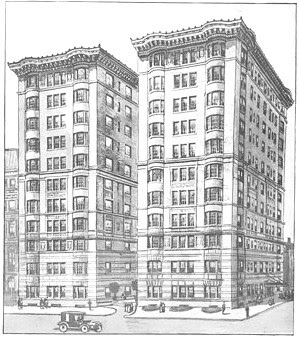
A 1913 rendering shows the original Madison Avenue entrance.  The World's New York Apartment House Album (copyright expired)

The apartments ranged from seven to 13 rooms "and a few are arranged on the duplex plan," said The World's New York Apartment House Album.  An advertisement in November 1913 touted, "very large rooms, ample closet space and exceptional servants' quarters," adding that the suites were, "especially designed for discriminating tenants."  Rents began at $2,000 per year, or about $5,450 a month today.

There were typically four apartments per floor.   The World's New York Apartment House Album (copyright expired)

In its July 1914 issue, The Real Estate Magazine noted, "in such an apartment house at No. 11 East sixty-eighth street, one can entertain on the same scale as they could in a country house with half the number of servants required in the latter."  That was because the building's staff was on hand for large entertainments.  In a recent event, for instance, the superintendent "acted as major domo" and six other employees "were his assistants," greeting the guests "to give them the same service that would have been afforded had the dance been held in the ballroom of a hotel."

The article said that the floor space within the larger apartments equaled that of a four-story private house, and the six-room apartments were "equivalent to that of the average three-storied residence."  The living rooms of the large apartments measured 31.6 feet in length and the dining rooms measured 22-by-14 feet.

Among the initial residents were W. Albert Pease, Jr. and his wife, the former Martha C. Rodgers.  Born in 1872, Pease had been the partner of Lawrence B. Elliman in the real estate company of Pease & Elliman.  (He would retire from that firm in 1917 to operate as an independent broker.)

On April 19, 1914, The New York Times reported that Martha had, "sent out invitations for two fancy dress dances" in the apartment--one for that evening and the other to be held three days later.  The article said, "While the invitations read 'Bal Poudre,' fancy dress is not obligatory."  A bal poudré had been a popular theme for balls in the last part of the 19th century.  

After Martha Pease's second affair, The New York Times said, "there were about a hundred guests, and the majority of them appeared in fancy costume with powdered hair and colored wigs.  As the entertainment was in the nature of a bal poudre, the men came in satin knickerbockers, with stocks [i.e., stiffened neckwear], frilled shirt fronts, and powdered hair."

Living here at the time were Morris Roderick Volck and his wife, the former Lillian Marian Holmes.  The couple had two children, four-year-old son, Morris Jr., and a two-year-old girl, Elsie.  Volck was born in 1886, the son of wealthy dry goods merchant George Andreas Volck, and graduated from Yale in 1910.  Following his father's death, his mother married Domicio da Gama, the Brazilian Ambassador to the United States.  

The other residents of the Marquand were assuredly unaware that Lillian Volck was being imprisoned in their apartment.  Suspecting that she was considering divorce, at around 3:00 on June 9, 1915, the 29-year-old Volck (whom Lillian thought had sailed for Germany) appeared at the apartment and announced that she was a "prisoner."  He forbade her to communicate with her family, her lawyer "or anyone else," according to The New York Times.  He then instructed the superintendent "not to allow anybody to come to or go from the apartment without his permission."

The minute he left the apartment, Lillian, who was 24, telephoned her lawyer, Edmund L. Mooney of Blandy, Mooney & Shipman.  The following afternoon, Mooney called the apartment and asked Volck what right he had to imprison her wife.  Mooney later testified, "He replied that his house was his castle and that he guessed he knew his business."  Mooney continued:

I got a little hot under the collar and replied: "You thick-headed mutt, don't you know that kind of business doesn't go in this country.  You needn't think this war has thrown us back to mediaeval times.  What you are trying to do may be all right in Germany, but it does not go in America.  I'll have you down to court before night on a writ of habeas corpus.

Leaving Lillian locked in the apartment, Volck went to the "villa" of his mother, Madame Da Gama, in Long Branch, New Jersey ("famous for its sunken gardens," according to The New York Times).  The newspaper tracked him down there.  In a telephone interview, Volck said, "Now it is all over and it is all right.  I believe that my wife and I will be living together in a day or two."

The couple was not living together in a day or two.  On June 15, 1915, The New York Times reported that Lillian had filed for divorce, charging her husband "with cruelty, desertion, and non-support."

Shields emblazoned with the Marquand's initial decorate the facade.

Other initial residents were William Hurlbut Force and his wife, the former Katherine Arvilla Talmage.  They had two daughters: Kathryn, born in 1891, and Madeleine, born two years later.  Force was the head of William H. Force & Co., commission merchants.  Still unmarried, Kathryn lived with her parents.  

Madeleine Force had married John Jacob Astor IV on September 9, 1911, against her parents' wishes.  Not only was Madeleine 18 years old and Jack Astor 47, but Astor was divorced.  The Episcopal church refused to marry the couple because of Astor's divorce.  (They finally were married by a Congregationalist minister.)  After an extended honeymoon, the couple booked passage back to New York on the new luxury liner RMS Titanic.  Astor was lost in the sinking, but Madeleine and her unborn baby, John Jacob Astor VI, were saved.

William H. Force died in the apartment on May 19, 1917.  He left his entire estate, about $12.2 million in today's money, to Katherine Arvilla.  In reporting his death, The New York Times remarked, "Miss Katherine E. Force...is engaged to Henri C. Harnickell, a broker."  That marriage would not come to pass.  

Five years later, on December 5, 1922, The New York Times reported, "Although the engagement of Miss Katherine E. Force...to Major Lorillard Spencer has never been formally announced, it has been rumored for some time, and their wedding will take place tomorrow at the home of Mrs. William K. Dick.  (Madeleine Force Astor had married William Karl Dick in June 1916.)

James Walter Thompson and his wife, the former Margaret Riggs Bogle, lived here by the early 1920s.  Margaret was the daughter of portrait painter James Bogle.  James Thompson was born in 1847 to Alonzo D. Thompson and Cornelia Roosevelt.  He came to New York City from Ohio in 1864 and found a job in an advertising agency.  He purchased the business in 1878, renaming it J. Walter Thompson Company.  Called the father of modern magazine advertising, Thompson was, according to The New York Times, "the first man to recognize the importance of the back pages and covers of magazines for advertising purposes."  He retired in 1916 and sold his firm.

Katherine Arvilla Talmage Force was at the Newport home of Katherine and Lorillard Spencer, Chastellux, in the summer of 1939.  She died there on August 14 at the age of 76.  In reporting her death, The New York Times commented, "Among her grandsons is John Jacob Astor."

An interesting resident at the time was Vladimir N. Smolianinoff, who lived here with his wife Olga.  The son of "wealthy Russian landlords," as described by The New York Times, he was was born in 1861.  Following his graduation from the University of Moscow in 1882, he oversaw the educational system in the Grandy Duchy of Finland and later the educational facilities in the south of Russia.  Czar Nicholas II appointed him Grand Master of the Imperial Court of St. Petersburg.  He fled Russia during the Revolution and came to the United States in 1938 to join his family.  He died in the apartment on August 8, 1942.

Another fascinating immigrant resident was Ernest Brummer, who lived here as early as the 1950s.  A native of Hungary, he studied at the Louvre School of Archeology in Pars and at the Sorbonne.  Prior to World War I, he went on expeditions to the Middle East and Egypt, where he uncovered "a collection of art works, including jewelry, sculpture and vases in marble, bronze and other metals," according to The New York Times.

Brummer immigrated to New York in the mid-1920s and opened the Brummer Gallery with his brother Joseph.  It handled classical art objects and among its clients were the Cloisters, the Metropolitan Museum of Art and the Louvre.

In 2012, the HFZ Capital Group and Vornado Realty Trust initiated a conversion to condominiums.  Three years later, The New York Times reported that the Marquand's 41 apartments were being remodeled into 25 condominiums.


That year, in May 2015, HFA Capital Group sold a five-bedroom apartment for $21 million, and on August 2, 2019, The New York Times reported that a triplex apartment sold for $34.2 million.

photographs by the author

Thursday, December 19, 2024

The J. William Clark Mansion (Automation House) - 49 East 68th Street


image by Jim Henderson

Millionaire banker Frederick Dobbs Tappen died in his brownstone-fronted mansion at 49 East 68th Street on February 28, 1902.  Just over a decade later, on January 4, 1913, the Record & Guide reported that the house had been sold, noting it, "adjoins the residence of Percy R. Pyne, at the northwest corner of Park av."  (The Pyne mansion had been designed by McKim, Mead & White two years earlier.)

The buyers were John William Clark and his wife, Margaretta Brua Cameron.  Born in 1867, Clark was president of the Clark Thread Company and the Spool Cotton Company, founded by his grandfather in Paisley Scotland.  (Its O. N. T. brand, short for Our New Thread, was a staple in stores and homes throughout the nation.)  Margaretta was the daughter of former Senator J. Donald Cameron.  The couple had three sons, William, Jr., John Balfour, and James Cameron.  The family's summer estate, Peachcroft, was in Bernardsville, New Jersey.

Peachcroft, from the collection of the Bernardsville Public Library

The Clarks hired the architectural firm of Trowbridge & Livingston to design a replacement home on the site of the Tappen mansion.  On April 23, 1913, The New York Times reported, "Plans have been filed for a new five-story private residence for J. William Clark...The facade will be of brick and marble in the Colonial style of architecture."  The neo-Federal style was, almost assuredly, meant to blend harmoniously with the Pyne mansion next door.  The architects placed the cost of construction at $60,000 (about $1.9 million in 2024).

John William Clark, United States Passport Application, 1923

On October 4, 1913, the Record & Guide reported that excavation was underway for the Clark house.  Its completion would be too late for the Clarks' eldest son, William, to occupy it.  He was married to Marjory Bruce Blair at Blairsden, the country estate of the bride, a month before the article.

The family moved into 49 East 68th Street the following year.  The main and service entrances were recessed within a double-arched loggia.  The upper floors were faced in Flemish bond red brick.  French windows at the second floor opened onto a full-width iron balcony.  The metal-clad attic level was fronted by two elegant, Federal style dormers.

James Cameron was 22 at the time and John Balfour was 17.  The boys prepared at St. Mark's School and James was currently a junior at Harvard.  When America entered World War I in 1917, both young men entered the United States Army Air Service.  While John would serve in France, earning the rank of lieutenant, James was stationed in Texas for the war's duration.

The Clark house enjoyed an unexpected second wall of light and ventilation.  photo by Wurts Bros. from the collection of the Museum of the City of New York

The global conflict was unable to hinder James's romance.  On December 6, 1917, the Air Service Journal reported on his engagement to Teresa Fabbri, the daughter of multimillionaire Ernesto Fabbri and the great-granddaughter of William Henry Vanderbilt.  He obtained a ten-day pass and the pair was married at Bar Harbor, Maine, on December 11.  Two days later, The New York Times reported, "Lieutenant James C. Clark and his bride, formerly Miss Teresa Fabbri...are on their way to San Antonio, Texas, where Lieutenant Clark is in the Signal Corps of the ground school for the Aviation Corps."

At the war's end, James was discharged on December 20, 1918 with the rank of first lieutenant.  He and John went into the family's business.  (John would eventually become its president, by then renamed Coats & Clark, Inc.)  William, in the meantime, had pursued law and eventually became a Federal judge. 

On January 16, 1924, The New York Times reported on John's engagement to Rhoda Cameron.  The couple was married later that spring.

John and Margaretta were at the Bernardsville estate on July 15, 1928 when John suffered a fatal heart attack at the age of 60.  He left an estate of $12,957,775, according to The New York Times.  The figure would translate to $236 million today.

In May 1937, Margaretta leased 49 East 68th Street.  It was occupied by Walter Mack and his family when she died in March 1941 at the age of 71.  Two years later, her estate sold the mansion to Leroy Alton Lincoln.

Lincoln was chairman of the Metropolitan Life Insurance Company.  Born in 1880, his earliest American ancestor had arrived in Hingham, Massachusetts in 1635.  His wife, the former Hilda F. Deyoe, was his third, his two previous wives having died.

The Lincolns resided here for a decade, selling the house in November 1953 to the Soviet Government for $150,000 ($1.7 million today).   The New York Times explained it would be used "as a residence for Andrei Y. Vishinsky, the Soviet Union's permanent delegate to the United Nations," adding, "The property has twenty rooms, an elevator, and three floors below ground."

In 1967, the mansion was purchased by Theodore Kheel for his American Federation on Automation and Employment.  Now called Automation House, its lavish 1914 interiors were gutted.  The renovations resulted in a "private museum" on the first and second floors, and office and exhibition space on the upper floors.

On March 2, 1970, New York Magazine announced, "Automation House...opens this week.  It is a kind of electrical service station for artists to plug in to.  Its first show will be The Magic theatre, an exhibition of electrical environments by eight artists."

Automation House was more than that.  Theodore W. Kheel was described by the Staten Island Advance in November 1970 as "the famous lawyer-mediator."  The venue for years was the scene of tense labor negotiations and was the headquarters of the Board of Mediation for Community Disputes, founded here in January 1969.

Automation House was outfitted with "telephones and electrowriters, as well as telex, Xerox and Magnavox facsimile machines," according to Catherine Spencer in her Beyond the Happening, Performance Art and the Politics of Communication.  Here, she writes, "Groups of children were invited to inhabit them simultaneously and use the technology to send each other text and picture messages."

The house served as meeting space, as well.  On January 27, 1970, for instance, British Prime Minister Wilson addressed a gathering of management and labor leaders here.  And later that year, on July 1, Samuel R. Pierce was sworn in here as general counsel to the Treasury Department by Secretary David M. Kennedy.  (Pierce was the first black to receive an appointment to a sub-Cabinet post in the Treasury Department, according to the Associated Press.)

A riotous situation occurred on July 13, 1976 when Rolling Stone Magazine, "long a fount of anti-establishment culture," as described by The New York Times, hosted a "big party for the new Jimmy Carter establishment."  The organizers miscalculated the response and at 11:00 p.m. the Automation House executives ordered the doors barred.  The New York Times reported, 

Left out on the sidewalk were the likes of: Warren Beatty, the actor, and Representative Bella S. Abzug, who later sauntered off as a twosome; Jane Fonda, the actress; Katharine Graham, publisher; and Benjamin Bradlee, editor of The Washington Post; William vanden Heuvel, Carter campaign manager here; Theodore H. White, the chronicler of presidential campaigns, and for a while, Lauren Bacall.

A few of the celebrities who had made it inside before the doors were locked were Paul Newman, Shirley MacLaine, and Walter Cronkite.  Apparently Bella Abzug was not overly-bruised by not gaining admittance and the following year, on December 19, 1977, she used Automation House to announce her candidacy for Congress.

Richard Feigen purchased 49 East 68th Street in 1991.  He told James McElhinney in an interview for the Archives of American Art of the Smithsonian Institution in 2009, "All the detail was gone from the inside...And it appealed to me because you had brick walls; you could hang early paintings and contemporary art and everything in there.  And I've always enjoyed mixing these things up."

On September 23, 1991, New York Magazine reported, "Richard L. Feigen settles into his new location with paintings and drawings by the Italianate Dutch landscape painter Bartholomeus Breenbergh."  It was the first of a long string of  important exhibitions that would last through 1999 when  composer Mitch Leigh and his artist wife Abby Leigh purchased the property for $1.1 million.

photo by Jim Henderson

The couple hired Wendy Evans Joseph to reconvert the building into a single family home.  Mitch Leigh, who won a Tony Award for composing the music to Man of La Mancha, died in 2014.  Two years later, Abbie Leigh, whose works hang in the Metropolitan Museum of Art, the Guggenheim and the Whitney, sold the house for $20.4 million.

Friday, July 2, 2021

The Marshall J. Dodge House - 37 East 68th Street


On November 29, 1912 Mrs. Joseph B. Hoyt hosted a reception in her townhouse at 37 East 68th Street for her debutante daughter, Gertrude.  It would be, perhaps, her last significant entertainment in the house.  Less than three months later, on February 8, 1913, the Record & Guide noted, "Another sale of interest was the purchase, by Marshall J. Dodge, of the house at 37 East 68th street, a 4-story structure, which the new owner will occupy.

Indeed, Dodge his family would occupy the 25-foot wide residence, but only after a major facelift.  The brownstone-faced dwelling had been completed around 1871, one of a row of seven identical high-stooped houses.  By now it was architecturally out of fashion.  One-by-one the vintage brownstones around it were being replaced or drastically remodeled into modern, Edwardian homes.

In May 1913 the architectural firm of Delano & Aldrich filed plans for renovations at a projected cost of about $400,000 in today's money.  The stoop was removed, the façade pulled off, and the front moved forward to the property line.  The architects gave the house a rather severe neo-Federal façade.  The upper sections of the tripartite design sat upon a stone base, its only ornamentation being the blind cartouche and swags over the entrance.  


A full-width iron balcony introduced the three-story undecorated mid-section where Flemish bond brick carried on the Federal motif.  The single-story top section sat back from an iron-railed balcony atop a marble cornice.  A shallow, tiled mansard completed the design

American Architect, March 10, 1915 (copyright expired)


Dodge was the grandson of millionaire William Earl Dodge, co-founded of Phelps, Dodge & Co., a and United States congressman.  A graduate of Yale University, Marshall was a partner in the stock brokerage firm of Palmer & Co.  He and his wife, the former Priscilla D. Barnes, had two daughters, Priscilla B. and and Josephine J.

The family maintained a country estate in Lawrence, Long Island.  They were headed there on February 22, 1917 with a houseguest, attorney Lawrence Greer.  Oddly enough, Marshall Dodge was at the wheel rather than a chauffeur.  The New-York Tribune reported, " Mr. Dodge attempted to pass a car in front of him, when the car slid and struck the auto truck with enough force to wreck the dodge car."  Dodge was not injured, but the others were.  The article said, "Mr. Dodge assisted Mrs. Dodge and Mr. Greer into another car and accompanied them to the Presbyterian Hospital.  Mrs. Dodge was found to have a possible fracture of the skull."

The no-nonsense staircase railing reflects the simplicity of the exterior design.  
American Architect, March 10, 1915 (copyright expired)

Rather surprisingly, the Dodges remained in their remodeled home less than four years.   Four months after the accident Marshall Dodge sold it to Herbert Scoville and his wife, the former Orlena Zabriskie.  The Sun noted on June 17, "he is reported to have paid close to $175,000."  The equivalent price today would be about $3.5 million.  In reporting the sale, the Record & Guide pointed out that the house was "one of an entire block of modern houses of the highest grade."

The 38-year-old was a partner in the law firm of Dwight & Scoville.  He and Orlena had been married in October 1909 at the summer home of her parents, Nirvana, in Stamford, Connecticut.  The New York Times commented at the time, "It was the richest wedding Stamford has seen in years...The bride received gifts valued at about half a million dollars."

The couple had two children, Elvia and Herbert, Jr.  Their country estate, Hill House, was near Salisbury, Connecticut and they owned a villa, as well, in Cintra, Portugal.

The Scoville family retained possession of Hill House until 2016.  photo via ctpost.com

The Scovilles were exceptionally caring of their domestic staff.  Decades later Richard Paddock, the grandson of chauffeur Charles Paddock told Alexander Wilburn, "All of the children [of the staff] on the estate got scholarships to school from the Scovilles...If something happened to one of the kids, a health emergency, the Scovilles were right there."  In addition to his salary, the chauffeur's position included a rent-free cottage on the property, and free meals and utilities.

Many of Orlena's entertainments in the 68th Street house went beyond mere teas and gossip.  In May 1930, for instance, The New York Times reported, "Dr. Thomas N. Salmon, Dr. John W. Brannan, Miss Ruth Morgan and others will speak on 'occupational therapy' at the home of Mrs. Herbert Scoville at 37 East Sixty-eighth street, beginning at 4 p.m."  And on February 16, 1932, The Evening Post announced.  "Mrs. Herbert Scoville of 37 East Sixty-eighth street will open her home to the public on Friday, March 4, at 8 o'clock for an evening of music for the benefit of Turtle Bay Music School.  The Brahms quartet will be the entertainers."

Orlena's father, Jersey City banker Cornelius Zabriski, had died in 1905.  Her mother, also named Orlena, moved into a suite at the Hotel Pierre on Fifth Avenue.  She died there at the age of 77 on May 14, 1934.  The funeral was held in the Scoville house  three days later.

Herbert Jr. was a senior at Yale University in January 1937 when his engagement to Ann Curtiss was announced.   The New York Times said, "The wedding is planned for the Summer."

At the time of the announcement Herbert's parents and sister were abroad.  Shockingly, two months later Herbert Sr. was dead at the age of 58.  On March 13, 1937 The New York Times reported, "The death of Herbert Scoville, an attorney, of 37 East Sixty-eighth Street, on Thursday at his villa in Cintra, Portugal, was made known here yesterday."

Society may have been somewhat surprised that Herbert Jr.'s wedding plans went on--most likely because he was headed to England to continue his studies at Cambridge University.  The marriage took place in Norfolk, Connecticut where the bride's parents had a country estate.

Orlena soon sold the 68th Street mansion to the prominent Frederick Ambrose Clark and his wife, Florence.  The couple did not move in, but gently renovated it as "a temporary home and club for servicemen on leave," according to the Otsego Farmer & Republican.  

A group of soldiers stand below the American and British flags.  photo by Wurts Bros. from the collection of the Museum of the City of New York.

The facility was a bit more focused than the newspaper suggested.  Called the British Service Club, it catered to British military men who were, no doubt, otherwise lost in the American metropolis.

British soldiers and airmen enjoy the amenities of the former Scoville mansion.  photos by Wurts Bros. from the collection of the Museum of the City of New York

Following the war 37 East 68th Street became home to Cancer Care of the National Cancer Foundation.  In 1963 the Brooklyn newspaper Canarsie Courier, described it as "a voluntary organization whose efforts are directed toward the care of terminal cancer patients and their families with financial and counseling aid."

A renovation completed in 1966 returned the mansion to a single family home for attorney Ivan Allen Ezrine and Sarah Erzine.   The ground floor included Ezrine's legal office.  It was apparently legal problems that prompted the Ezrines to leave the house within about five years.  Papers were first served at the house in 1966--shortly after the couple moved in--and later Ezrine was one of six men indicted by a Federal grand jury on 30 counts of stock fraud.


A subsequent renovation completed in 2006 removed the office space, returning the house once again to a true private resident.

photographs by the author
no permission to reuse the content of this blog has been granted to LaptrinhX.com

Wednesday, January 22, 2020

The Edward W. Sparrow House - 41 East 68th Street


By any estimation Edward Wheeler Sparrow had already led a remarkable life by the turn of the last century.  Born to well-to-do parents in Ireland, he came to America in 1858 at the age of 12.  Traveling West he landed several jobs, including being a page in the Michigan State Legislature and a clerk in a dry goods operation.  As he saved his money, he invested in real estate, eventually owning valuable Lansing, Michigan property, including 16 blocks in downtown Lansing.

In the 1870's the young man partnered with William Knoll, establishing saw mills and extensive lumber operations in the Northwest.  He lived, according to the National Cyclopedia of American Biography, "the life of a frontiersman."  Before moving to New York City, in addition to his lumber and real estate interests he had helped organize the City National Bank in Lansing (which he headed for 20 years), developed iron resources in Brazil, and was president of the Lansing Wheelbarrow Co.

Sparrow married Helen Therese Grant in 1896, and the couple had a son, Edward Grant Sparrow.  Just three years after their marriage Theresa died.  On June 30, 1903 Edward married Margaret B. Beattie, daughter of cleryman Charles Beattie.  Margaret was well-educated, having attended Vassar College.  They would have one daughter, Margaret Alicia.

In 1910 Sparrow purchased the older house at No. 41 East 68th Street, formerly home to John Terry Gardiner and his wife.  On May 25 the New-York Tribune reported that the architectural firm of Parish & Schroeder had filed plans for a six-story mansion on the site.  "The facade will be of brick, with trimmings of limestone," said the article.  The plans placed the cost of construction at $60,000--about $1.65 million today.


photo by Wurts Bros. from the collection of the Museum of the City of New York
The architects created a neo-French Renaissance residence that left no doubt about the wealth of its owner.  Above the rusticated stone base a full-width balustrade gave the impression of a balcony.  The corniced windows of the restrained second and third floors made no attempt at ostentation--that was left to the top levels.  Intricately carved panels flanked the fourth floor openings.  An ample fascia decorated with carved shields ran below the stone cornice which doubled as a balcony to the steep two-story mansard.

Edward Sparrow would not enjoy his new mansion for long.  The 67-year-old fell ill in the winter of 1913, and died in the house on February 21.   A funeral was held in the mansion on February 24, and another in Lansing, Michigan, where he was buried, the following day.


Edward Wheeling Sparrow (original source unknown)
Sparrow had apparently anticipated his impending death and signed his will just five days before.  He managed to control his $3 million estate (more in the neighborhood of $78.5 million today) even after death, putting it in trust with specific directions as to how it was annually distributed to his heirs.  Margaret, for instance, was to receive "a sum not to exceed $50,000 a year" (about $1.3 million today), and Edward's allotments increased as he reached certain birthdays.  Sparrow guarded five-year old Margaret's coming inheritance from any fortune hunters.  Her money, said the will, was "separate and apart from the control or influence of any husband."  Should she die, the money was to go to her children.  If she were childless, it reverted to Margaret and Edward.

The will included life warnings for the children:

I charge upon my son, Edward Grant Sparrow, the practice of economy and that he refrain from ostentation or display, as such practices are not in keeping with the pursuit of learning and are always offensive to good manners and gentlemanly demeanor, and I wish here to impress upon both of my children and especially upon my son the desirability of acquiring a thorough knowledge of business as is practicable.

Unexpectedly, given that she was still in mourning, Margaret and the children arrived at the fashionable Hotel Wentworth in New Castle, New Hampshire six months later.  On August 23 The Sun noted that several members of society had arrived by automobile, including "Mrs. E. W. Sparrow, Edward Sparrow and party, in an Alco."

Margaret was a summer resident of Lenox, Massachusetts where she regularly leased Home Farm, the estate of the deceased William A. Slater of Washington.  And as the "camping" fervor swept society in the years just before the outbreak of world war, she once again hired hired Parish & Schroeder to design "a wooden camp" at Old Forge, New York in 1917.   (Other than pine trees, lakes and occasional passing ducks, the term "camp" for high society had little to do with the term as used today.)

As Margaret's camp was under construction, she and Margaret Alicia, who was now old enough to be listed in society columns, went to Lenox.  Edward joined the Marine Corps. in 1917 and fought overseas.  When he came home in August 1919, The Sun reported that he was "visiting his mother...at Home Farm."  Two months later on October 19 The Sun reported that Margaret had given a "farewell luncheon at the Lenox Club for twenty-six guests before closing Home Farm and returning to New York this week."

It was the last time Margaret would close Home Farm.  Two weeks earlier the New-York Tribune had reported that she "is likely to purchase Sunnycroft, the country place of the late Mrs. George Griswold Haven."


By the terms of her father's will, Margaret Alicia could not touch her fortune until her thirtieth birthday.  In the meantime her mother had to make do with the $2,000 per month the girl was allowed.  At the equivalent of $28,000 today, Margaret feared it was not a large enough amount with which to clothe and adorn a girl approaching her debutante years.  In January 1923 she went to court to plead for more money for the 15-year-old.  Given Margaret's own income, the judge was unmoved.  The New-York Tribune reported somewhat sarcastically, "Miss Margaret Alicia Sparrow must makeshift on $2,000 a month for the next 15 years."

Margaret Alicia's debut was unexpectedly understated.  She was introduced to society at a tea in the 68th Street house on December 21, 1926.

Margaret established another summer estate near Locust Valley, Long Island around this time.  She and Margaret Alicia traveled as a pair, appearing in society columns for years as they entertained and moved between their residences.

Like her mother, Margaret Alicia attended Vassar.  She became especially interested in supporting the Girls Scouts of America (a favorite cause of her mother), and was an avid sportswoman.  The New York Post described her as being "interested in riding and hunting and is a familiar figure at the smart sports events held during the year on Long Island."

On April 14, 1936 her mother announced Margaret Alicia's engagement to George Hale Pulsifer.  The wedding was held on the grounds of the Locust Valley mansion on June 12 that year.  The New York Post described "a natural setting of green, with trees and shrubs in the background, but with no special floral decorations and no altar."

In 1950 Margaret moved permanently to Locust Valley.  She died there on July 22, 1958 at the age of 88.


When she left the 68th Street mansion it was converted to apartments, two each on every floor but the top, which held one.  The service entrance was altered to a window and it may have been at this time that the handsome areaway fencing was removed.  The top floor apartment was divided into two in 1968.

photographs by the author

Friday, January 17, 2020

The Michael Friedsam House - 44 East 68th Street


On January 26, 1915 the executors of the Benjamin Altman estate met in the offices of B. Altman & Co. to announce the bequests of the millionaire's will.  Among the executors was Alman's close friend and successor as president of B. Altman & Co., Michael Friedsam.  Afterward an oil portrait of Friedsam was unveiled in the executive offices, painted by Ellen E. Rand.  The New York Times commented, "The same artist painted a portrait of Benjamin Altman, which now forms part of the Altman collection in the Metropolitan Museum of Art."

The portraits were by no means the only things the two intimate friends had in common.  Neither married and each had astounding art collections which focused on Dutch Old Masters.  

In 1921 Friedsam set out to erect a new home--one that would be as much a residence for himself as a venue for his artworks.  On June 23 The New York Herald announced that he had purchased the houses at Nos. 44 and 46 East 68th Street for $175,000--about $2.45 million today.  "The houses thereon are of the old fashioned four story and basement type, but if Mr. Friedsam carries through his plans they will be replaced by one big dwelling ranking as one of the finest of its kind in the city."


Friedsam's house would replace the two brownstones seen at the far left of this photo.  In the center of the frame is the opulent John D. Crimmins mansion.  photo by Byron Company from the collection of the Museum of the City of New York

Three months later, on September 25, the newspaper reported "Col. Michael Friedsam, president of B. Altman & Co., has filed plans through Frederick G. Frost, architect, for a handsome residence and art gallery at 44 and 46 East Sixty-eighth street...It will cost more than $100,000."  That figure brought the total outlay to more than $3.8 million in today's dollars.

The appellation of colonel used by the newspaper, incidentally, was the rank Friedman held with the Quartermaster's Department of the National Guard.  He had been promoted in August 1918.

The New York Times explained that the proposed house would have "adequate provision for his art collection, considered one of the best in private ownership in the city."  The article noted "the new Friedsam residence will be in one of the most exclusive sections of the city, and where many homes of prominent New Yorkers have been erected in the last decade."


The newly completed house looks no difference today.  original source unknown
Completed in 1922, the five-story Friedsam house was clad in limestone.  Frost's restrained neo-Classical design featured a rusticated base with a centered entrance flanked by Doric columns.  Stone balustrades sat below the second floor openings which sat within round arches.   The upper floor were sparsely decorated other than a prim stone band between the third and fourth floors.  The cornice wore a tall, balustraded parapet.

Just before the house was completed Friedsam made two significant additions to his collection.  On December 3, 1921 the New-York Tribune reported he had purchased Albrecht Durer's 1502 work The Saviour, and Quentin Matsys' The Rest on the Flight into Egypt.  The article noted "These, together with other works acquired by Colonel Friedsam, soon will be housed in the latter's new home in East Sixty-eighth Street, it is said, which is being designed especially for his art collection."


The velvet-lined walls of the upper stair hall (above) and the art gallery were hung with masterpieces.  original source unknown
The two acquisitions would be in fine company.  In 1917 alone Friedsam had purchased Franz Hals' Portrait of a Man, Pieter de Hooch's The Maid Servant, and Nicholaes Maes' The Lace Worker.  During World War I he spent $1,900 for an autographed copy of Childe Hassam's The Avenue of the Allies.


The Lacemaker, painted by Nicolaes Maes in 1656 hung with other masterpieces in the 68th Street house.  from the collection of the Metropolitan Museum of Art
Friedsam's involvements and interests went far beyond art collecting and B. Altman & Co.  He was for years the president of the Fifth Avenue Association, a director in several banks, and was connected with the Architectural League of New York, the Museum of French Art, the Metropolitan Museum of Art, the Real Estate Board of New York, the French Institute, and many other groups and societies.  He was, as well, a commander of the French Legion of Honor and a member of ten exclusive clubs.


Michael Friedsam, from the collection of the Library of Congress
Friedsam's love of art, history and architecture was reflected in his philanthropy.  He was a contributor to the construction of the Cathedral of St. John the Divine and supported the College of the City of New York and the Museum of the City of New York.  When Thomas Jefferson's Monticello was threatened in 1925, he joined New York businessmen who rallied to save it.  His check over over $7,000 in today's money was the first received by the fund.


The entrance hall (above) led to the impressive marble staircase.  original source unknown
On February 19, 1931 The Sun reported that Friedsam had been elected to his seventh term as president of the Fifth Avenue Association.  The article noted that he "has been confined to his home at 44 East Sixty-eighth street with a slight illness," but assured he was improving and "is expected to return to his duties soon."


The French-style study featured a portrait of Benjamin Franklin.  original source unknown.
But he did not recover and on April 8 the newspaper reported "From all sections of this country and from abroad today tributes continued to pour in for Col. Michael Friedsam, philanthropist, connoisseur of art, civic leader and merchant, who died suddenly yesterday at his home, 44 East Sixty-eighth street."  The mayor ordered that all flags on Fifth Avenue be lowered to half staff.

Among the accolades was that of Governor Franklin D. Roosevelt who called Friedsam "one of the most unselfish and useful citizens of this city and State."  Former Governor Alfred E. Smith said "The city and State of New York have lost one of their most valuable citizens."

No report of Friedsam's death overlooked his vast art collection, estimated at the time at between $10 million and $29 million.  Included in the more than 200 paintings were four Rembrandts, several Vermeers, fifty French primitives including one of Louis XI by Frouquet, and works by Goya, Velsaquez and Murillo.

The wide-spread esteem in which he was held was reflected in Cardinal Patrick Joseph Hayes's appearance at the house to offer condolences.  He was named an honorary pall bearer, as well, despite Freidsamn's Jewish religion.  According to The Times, more than 3,500 persons filed into Temple Emanu-El for the funeral.  

Friedsam's estate was roughly appraised at over $21 million.  But that figure fell far short of the actual worth.  The New York Sun explained on April 19, 1933 "the figures filed today are not an entirely accurate reflection of what he was worth.  The most obvious example of this is that a value of $2,500,000 was set upon his art collection...The collection has been roughly valued by art authorities at around $10,000,000."


The Metropolitan Museum of Art and the Brooklyn Museum shared in the entire Friedsam collection, including "paintings, porcelains, tapestries, rugs, enamels, crystals, marbles, bronzes, antique furniture and objects of art," as worded in the will.   Friedman's niece, Alice A. Schwartz, was bequeathed "my household furniture, beds, beddings, household china, glass and housekeeping articles and utensils of every description belonging to me and all my silver plate and plated ware and all my jewelry and personal effects wherever the same may be located or stored."   Alice also received $250,000 (more than $4.1 million today); but not the house itself.  It was included in the real estate to be liquidated by the executors.

In 1936 the Dominican Academy purchased No. 44 for one dollar with the stipulation that it be used only for educational purposes.  Founded by the Dominican Sisters in 1897 as an elementary school, it grew into a private Catholic high school for girls.


Among the students in 1965 was 17-year old Patricia Genovese, described by one nun as "a fine student."  Some parents and neighbors were concerned, however, since Patricia's uncle was crime boss Vito Genovese, and her father, Mike Genovese, had been called to appear before a State Investigation Commission hearing on loan sharking a year earlier.   (He took the Fifth Amendment twenty-six times during that session.)

In the winter of 1965 the school received at least two letters and two phone calls "demanding Miss Genovese's expulsion because of her family's notoriety," according to the Long Island Star-Journal.   Then, on the first week of December, someone took matters in their own hands.

As Patricia left the school, she was abducted by two men "in their fifties," according to the FBI.  The Long Island Star-Journal reported on December 20, "Miss Genovese told police that they held her captive for several hours, but that she escaped by ramming a pencil into one man's ear."


The Dominican Academy remains in the Friesdam mansion.  Interior renovations were completed in 2018 which included updating the technology and security infrastructure.  From the street there is essentially no change to the residence since Michael Friedsam first moved in his priceless collection in 1922.

photographs by the author