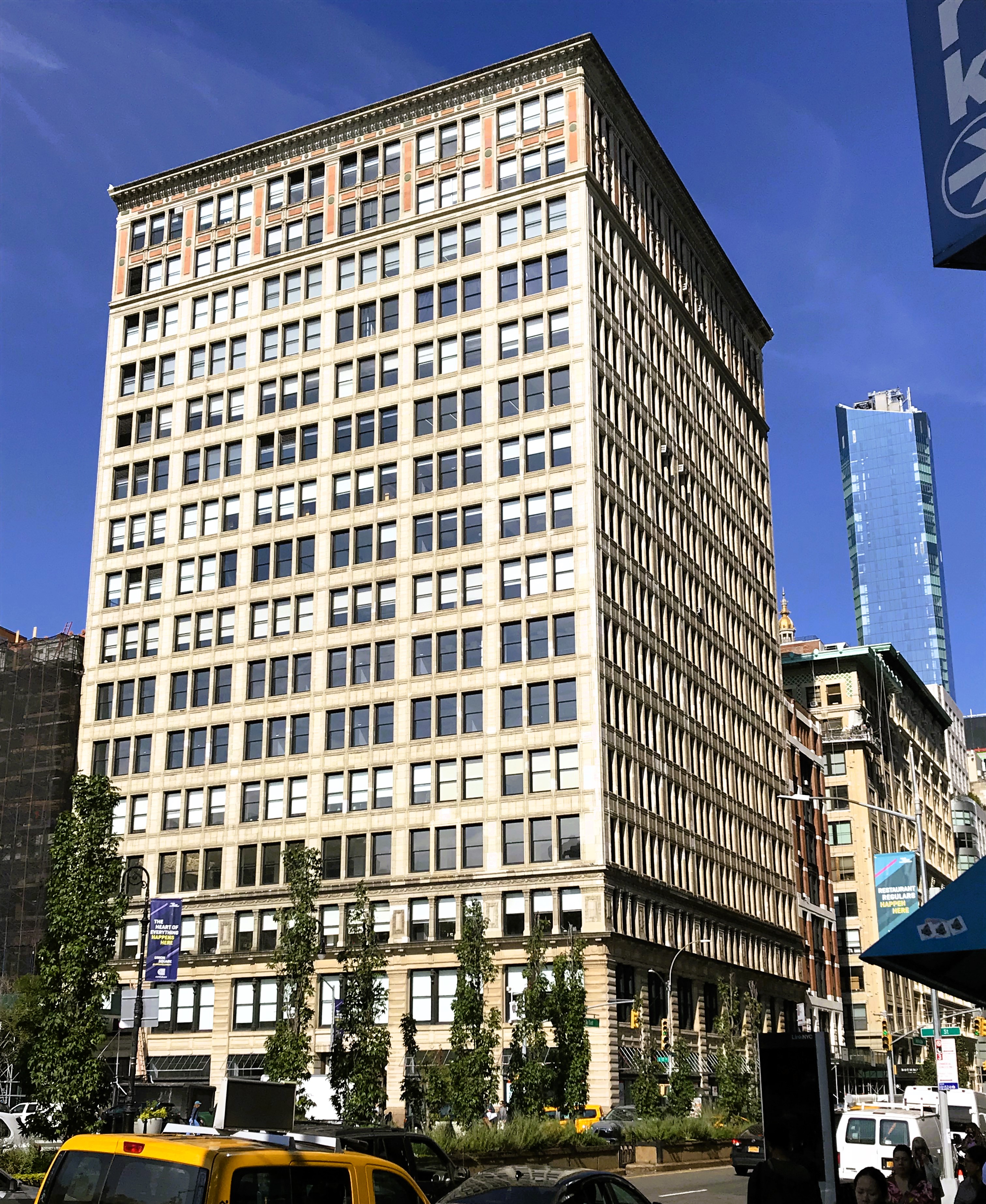
Apartments in The Rutherford ranged from three to five rooms with a bath. An advertisement stressed that it sat within a "refined residential section" and boasted an elevator. A five-room apartment cost $42, an affordable $1,500 per month by today's conversion.
Showing posts with label east 17th street. Show all posts
Saturday, May 31, 2025
The 1902 The Rutherford - 206-208 East 17th Street
At the turn of the last century, residents in the Stuyvesant Park neighborhood saw the beginnings of a transformation, as private homes were being replaced with upscale apartment buildings. On March 8, 1902, the Real Estate Record & Guide reported that two more residences, 206 and 208 East 17th Street, had been purchased by Isidor Mishkind and "a six-story flat will be erected."
Mishkind and his partner William Feinberg hired the architectural firm of Sass & Smallheiser to design the 44-foot-wide building. The plans, filed in September, projected the cost of construction at $65,000, or about $2.37 million in 2025. Completed the following year, The Rutherford was faced in beige brick above a rusticated limestone base. The entrance was sheltered by a handsome portico supported by Ionic columns and pilasters. The architects gave the building dimension by gently rounding the end bays. They splashed the Renaissance Revival design with touches of Beaux Arts, like the richly carved oval windows on either side of the entrance.
Apartments in The Rutherford ranged from three to five rooms with a bath. An advertisement stressed that it sat within a "refined residential section" and boasted an elevator. A five-room apartment cost $42, an affordable $1,500 per month by today's conversion.
Among the early residents was Benjamin Thackara and his wife. He was the "outside superintendent" of the Tiffany Studios Building and was in charge of its physical maintenance.
The Thackaras were already here when Jean N. McIlwraith and Imogen Harding moved into the building in 1904. According to Eva-Marie Kröller's Writing the Empire, The McIlwraiths, 1853-1948, McIlwraith had to share the apartment because she "had to count her pennies."
Imogene was a music student and the women's apartment had a piano. According to Kröller, both joined the choir at nearby St. George's Church on Stuyvesant Square. McIlwraith worked for publishing companies, eventually becoming head reader at Doubleday, Page and Co. She would write children's books, an opera, and historical romance novels.
Edward B. Schmalholz, was presumably living here alone when McIlwraith and Harding moved in. He was described by The New York Times as "a well-to-do butcher" whose shop was at 73 Third Avenue. The previous year, his wife, Margaret, left with their two children, ten-year-0ld Theodore and eight-year-old Edith. She and the children moved into the home of her sister and brother-in-law on West 83rd Street.
Schmalholz devised a dastardly scheme to end the monthly support he gave his wife. In the winter of 1904, Margaret attended an affair at the Waldorf-Astoria. She met a dashing young man, "who said he was Capt. Phillip K. Stone" of the U.S. Army, reported The New York Times. In fact, the soldier was Philip K. Sweet, a private detective.
Schmalholz visited the children every Wednesday, and during a visit the following summer, he said that Theodore looked sickly and offered Margaret $100 to take the children to Lake Placid. She was surprised to run into Captain Stone there. At one point Margaret sprained her ankle and Stone offered to help. The New York Times reported, "He was in the act of applying the ice, the children being in another room, when the door was broken in and Mrs. Schmalholz's husband and several other men rushed in."
Edward Schmalholz filed divorce papers, naming Stone as her lover. Margaret charged him for conspiracy, exposing Stone and Sweet as the same person and alleging, "her husband wants to get out of paying further alimony and desires to be free to marry a woman who is now living at 206 West Seventeenth Street." (The woman who answered a reporter's call to Schmalholz's apartment identified herself as the housekeeper.)
Joseph J. Evans and his wife had a remarkable houseguest in 1906--Evans's mother-in-law Hepsa Daggett Cottle. Born in 1809, Cottle lived on Nob Hill in San Francisco. When the earthquake and subsequent fires destroyed her house "almost around my ears," as she described the disaster, she found herself homeless. And so, the 97-year-old (who had never been in an automobile) drove cross-country to visit the Evanses. The Sun said, "After trying a short ride about town she motored to Boston and back and enjoyed the trip hugely."
Abraham Levi was the partner of Isaac Picker in their importing business at 12 Union Square. The two men were arrested early in 1912 for receiving stolen goods after a bizarre investigation. Fifteen reels of silent films had been stolen during a break-in at the General Film Company on Sixth Avenue. Detectives suspected 20-year-old Victor Weiss and trailed him as he repeatedly visited Levi and Picker. But he never carried anything into the shop.
Finally, detectives detained Weiss at 14th Street and Sixth Avenue as he neared Levi and Picker's office. In its March 1912 issue, Moving Picture News reported, "After a cursory search, they found no stolen property on him and were about to release him when one of the detectives opened the youth's vest." Weiss had spirited the movies one-by-one by winding the film around his body. The article said, "An end of the film dropped down. After removing Weiss' overcoat and coat the detectives spun him around like a top until the film was unrolled."
The occupants of The Rutherford continued to be professional. Living here in the years before World War I were pharmacist Eugene C. Osborn, whose drugstore was at 131 Third Avenue; pathologist Dr. James G. Callison; and artist William Grimm. Dr. Callison would still be here in the mid-1920s when Dr. Sandor Roth occupied an apartment.
Living here six months a year in the early 1930s was Amandus Hochman, who had served in the Prussian Army during the War of 1870. He came to America in 1873 and had worked as a bank guard. Now he divided his time between his daughter's family here in The Rutherford and his other daughter's farm in Hopewell, New Jersey.
On January 7, 1935, the superintendent of the building told The New York Post that Amandus Hochman, was "taken back to New Jersey yesterday by State troopers, who came here for him in a car." The 87-year-old Hochman was not in trouble. He was being escorted to testify in the trial of the Charles Lindbergh baby kidnapping. The New York Post said Hochman, who was "quite feeble," was "prepared to take the witness stand and identify Bruno Richard Hauptmann as a man he talked with on the night of the Lindbergh kidnapping."
Hochman testified that on the afternoon of the kidnapping, he witnessed Hauptmann stall his sedan by the road to his family's farm in Hopewell. He claimed he noticed a ladder in the car, presumably the one used to climb into the Lindbergh baby's window.
Grace Avery and her daughter, Elizabeth Harrison Avery, were residents in the early 1940s. Grace's husband, Commander Harrison Avery of the U.S. Navy, had died of a heart attack on board his patrol vessel in 1934. Grace's son, Harrison, Jr. was a cadet in the Army Air Force in Greensboro, North Carolina. As a child of a military family, Elizabeth had not only attended the Brooklyn Friends School and the Katharine Gibbs School, but the Shanghai American School in China. The military tradition continued within the family when Elizabeth married Ensign Adam A. Smyser in St. George's Church on Christmas Day 1943.
A renovation completed in 1974 resulted in four apartments per floor. Happily, the exterior of Sass & Smallheiser's "delightful, rather playful design," as worded by the Landmark Preservation Commission the following year, is almost totally intact.
photographs by the author
Thursday, April 17, 2025
The 1851 Henry P. Marshall Residence - 214 East 17th Street
Developer James Foster erected five upscale, high-stooped residences in 1850-51 on the southern blockfront of East 17th Street between Rutherford Place and Third Avenue. The Greek Revival-style homes were three stories tall above English basements. Faced in red brick and trimmed in brownstone, they originally exhibited the distinctive entrances of the style, with sturdy pilasters upholding a heavy entablature.
Foster originally leased 115 East 17th Street (renumbered 214 in 1867). The De Marcarty (sometimes spelled Demacarty) family were the first occupants. Gustave de Marcarty was a teller with the Bank of New York. The family of Ebenezer R. Duplignac, Jr., who operated a varnish business on Peck Slip, lived here in 1855 and 1856.
Henry Perry Marshall next leased the house, finally buying it from Foster in 1859. Born in Woodbury, Connecticut in 1814, he married Cornelia E. Conrad on November 28, 1840. The couple had five small children--Julia Perry, Blandina Tappan, Frederic Panet, Henry Rutgers and Cornelia Ellsworth. They ranged from 3 to 14 years old in 1859. (The couple's first child, John Henry, had died in 1850 at the age of nine.) The family's country homes were in Hastings-on-Hudson, New York and Woodbury, Vermont.
Henry P. Marshall started out in the importing business. In 1840, he was appointed American Consul in Muscat, remaining there until 1843 when he joined the Seamen's Bank for Savings. As the cashier of the bank, his highly responsible position tasked him with tracking its transactions and balancing its books.
The two Marshall boys attended Columbia College. By 1879, Frederic was an attorney and Henry was an architect and author. Henry married Julia Robbins Gillman in 1881. Among his designs would be Rudyard Kipling's home, Naulakha, in Vermont, and the original Brearley School in New York City.
Frederic Panet Marshall was in Thomasville, Georgia in the winter of 1886. He died there from Bright's Disease on December 30. Marshall's body was brought back to New York for his funeral in the nearby St. George's Church on January 2, 1887. (Henry P. Marshall, incidentally, had been treasurer of the St. George Episcopal Church Society for years.)
There would be two more Marshall funerals within a short period. The family was at Hastings-on-Hudson on September 7, 1887, when Cornelia died at the age of 72 "after a lingering illness," according to The New York Times.
The following summer, Henry Marshall "suffered an attack of malaria," as reported by The New York Times on November 17, adding that he "had not been the same man since." On November 16, Marshall was busy at his office until 2:00, when he and William C. Sturges, the bank's president, went to the dining room adjacent to the two men's offices for lunch. Their food was served and, according to The New York Times, Marshall said to Sturges, "Mr. Blank called this morning," and then "his head fell forward on his breast and he was apparently dead."
In reporting his death, The New York Times said,
Perhaps no bank Cashier in this city was known to more people than Mr. Marshall...Not only did he know most of the New-York financiers of to-day, but through his long banking career had a fund of personal reminiscences of great speculators whose doings on the street are now only a memory.
Just weeks after Marshall's funeral, his sterling reputation was tarnished. On January 19, 1889, The Sun ran the headline, "Mission Moneys Missing / $20,000 That The Late Henry P. Marshall Held Vanished." In addition to the St. George's Episcopal Church Society, Marshall had been treasurer of the Protestant Episcopal Church Missionary Society for Seamen. The Sun explained, "Other church societies came to him with their money, until he cared for the funds of half a dozen of the largest and richest of Bishop Potter's societies."
After Marshall's death, the books of the Missionary Society were audited. Although they showed a balance of $20,000, there was no money in the society's account. The following day, The New York Times reported that the deficit had risen to $60,000 (about $1.9 million in 2025 terms). The article was titled, "A Great Trust Betrayed."
The two unmarried daughters, Julia and Cornelia, continued to live in the East 17th Street house at least through 1891. That year Julia was a trustee of the New York Infirmary.
At the turn of the century, Dr. David D. Jennings and his wife, who was a nurse, rented 214 East 17th Street. They remained until April 1903, when Julie Faversham and her mother, Mary Opp, purchased the house.
Julie and William Faversham were well-known to theater audiences. Born in New York City in 1873, Julie Opp began writing in 1893, focusing on theater journalism. She traveled to Paris to interview the world famous opera singer Emma Calvé and actress Sarah Bernhardt. According to Who's Who on The Stage in 1908, "Both urged her to adopt the stage as a profession, offering their advice, influence and support."
Julie Opp made her debut in 1896. At the turn of the century, she first played opposite English born William Faversham. The couple was married in 1902. Julie continued to use her maiden name on the stage.
William Faversham's matinee idol looks made him a favorite leading man. At the turn of the century, he was one of the highest paid actors in the country, reportedly earning as much as $5 million a year.
What today would be called a power couple, the Favershams maintained a Long Island residence and a sprawling estate, The Old Manor, in Chiddingfold, England. The Jacobean-style mansion was built in 1503 and held 14 bedrooms and was surrounded by "25 acres of park land," according to The New York Times.
On May 6, 1908, The Evening Post reported that plans had been filed for adding a fourth story to the East 17th Street house "to be made for Mary Opp as owner." Designed by Hunt & Hunt, the new floor took the form of a steep mansard punctured by three dormers. The architects added sheet metal lintels to the lower floor windows, those of the parlor floor including dentils and egg-and-dart moldings.
Entertainments in the Faversham house included a blend of theater, musical and society figures. On February 13, 1911, for instance, The New York Times reported on a dinner party the previous evening "in honor of Mr. Faversham's birthday." Among the guests were conductor and violinist David Mannes and his wife, novelist Princess Troubetzkoy, and socialite Mrs. John Alexander.
Julie and William pose in the Rosemary Open-Air Theatre in Huntington, Long Island in 1917 with sons William and Philip. from the collection of the Library of Congress.
At some point, Julie took full ownership of the East 17th Street house. Perhaps revealing the strained relationship between William and his mother-in-law, the couple charged Mary Opp rent--$800 per year.
In 1915, Faversham first appeared in motion pictures. He continued to accept Broadway roles, and in 1921 was appearing at the Selwyn Theatre in The Prince and the Pauper.
When he and Julie arrived home on February 13 that year, after being guests of a dinner party for his birthday, "they thought burglars were in the house," according to the New York Herald. Instead, the parlors were filled with friends throwing a surprise birthday party for William.
It would be the last large entertainment in the house for the Favershams. In 1915, Julie had appeared with William in The Hawk. But illness ended her career after that. Shortly after the party, William traveled to Columbus, Ohio with The Prince and the Pauper. On April 8, 1921, he received a telegram that Julie had died that day at the Post-Graduate Hospital following an operation. The New-York Tribune called her, "one of America's stage favorites."
The following month, William advertised Julie's 1918 Cadillac landaulet for sale, saying, "the car is now as good as new; property of the late Mrs. William Faversham."
The acrimony between Faversham and Mary Opp soon became public. In August 1922, Faversham sued Opp for $100,000 "for her support [during] twenty years at the East 17th Street home," reported The Evening World. Mrs. Opp told the court "that she is in dire circumstances as a result of transactions in which the actor was concerned," said the article, explaining that she had loaned the couple $11,000 over the years. Faversham insisted that the loans, "were actually advanced to his wife, Julie Opp Faversham, and that he made no promises to repay them."
In 1924, the once sumptuous residence was converted to a rooming house by the new owner, B. Leavin. The Department of Buildings cautioned, "not more than 15 sleeping rooms" in the building. In the renovation, the stoop was removed, the entrance lowered to the English basement level, and a fire escape attached to the facade.
Leavin advertised in The New York Medical Week in September 26, 1925, "Ground floor in newly altered house. Will alter floor to suit responsible physician."
That ground floor space would remain a physician's office for decades, first occupied by Dr. Joseph S. Stovin. In the mid-1930s Dr. Max K. Silverman's office was here.
In 1959, the building was converted to apartments, two per floor except the top floor, which held one. Living here in the 1960s was well-known artist and designer Douglass Semonin. His paintings were shown at the Graham Galleries in New York and the De Young Museum in San Francisco. In 1964, the American Institute of Decorators awarded him the International Design Award for his "Town and Country" design. He died in his apartment on October 26, 1971 at the age of 45.
A renovation completed in 1999 resulted in a total of four apartments in the house. Even without its stoop, the building looks much as it did when two stars of the theater remodeled it in 1908.
photographs by the author
Saturday, March 29, 2025
The Henry J. Scudder House - 116 East 17th Street
In 1850, Henry Joel Scudder purchased the 25-foot-wide plot at 69 East 17th Street (renumbered 116 in 1867) from Courtlandt Palmer. Half a block to the west was Union Square where brick and brownstone mansions had begun appearing five years earlier; and two blocks to the east was the equally exclusive Stuyvesant Square.
Three years later Scudder married Louisa Henrietta Davies and the following year, in 1854, the couple began construction of their new home on the site. Their four-story-and-basement Italianate-style residence, completed within that year, was faced in brownstone.
The highly-ornamented arched entrance, inspired by Renaissance designs, would set the house apart. Its paneled columns were carved with a chain motif, the spandrels were filled with intricate foliate designs, and the keystone was carved with a stylized lyre. A full relief shell sat within the triangular, bracketed pediment. The chain motif was echoed in a frieze running below the fourth-floor windows.
The windows sat within molded architrave frames. A cast iron balcony most likely fronted the floor-to-ceiling parlor windows.
Born in 1825, Henry Joel Scudder had deep American roots, descending from Thomas Scudder who arrived in Salem, Massachusetts in 1630. Henry Scudder graduated from Trinity College in Hartford, Connecticut in 1846 and opened his law office in New York City in 1848. He co-founded the law firm of Scudder & Carter in 1854.
When the couple moved into their new home, they had a newborn baby, Henry Townsend Scudder. Also living with them were Henry's brothers, Hewlett and Townsend, a merchant and lawyer, respectively. (Townsend was a partner with his brother in Scudder & Carter.)
Henry and Louisa would have four more children--Charles Davies, Edward Mansfield, Mary English, and Elizabeth. The family's country home was along the upper Hudson River.
On April 12, 1861, the year Elizabeth was born, the Civil War broke out. Henry Scudder, a member of the Thirty-Seventh Regiment, left his family to fight in 1862. In his absence, Louisa died on December 28, 1864 at the age of 30. Shortly after Scudder's return to his East 17th Street home, Elizabeth died at the age of four.
Formerly the responsibility of Louisa, Henry Scudder was now tasked with staffing the houses. He placed an ad in The Sun on May 3, 1865:
Wanted--A Cook and Chambermaid in a gentleman's family, 60 miles up the North River. The cook to assist in washing and ironing; the chambermaid to be seamstress also; good references required. Call at 69 East 17th st, between the hours of 8 and 3 to-day.
At the time of the ad, Hewlett still lived with the family. Townsend had moved to East 30th Street by then.
In 1866, Henry Scudder married Emma Willard. The population of the East 17th Street house would continue to grow as the couple had five children--Willard, Louisa H, Heyward, Emma Willard, and Hewlett.
In 1872, Scudder was elected to the Forty-third Congress and held the office through March 3, 1875. Afterward, he returned to his law practice and became the principal counsel for the Standard Oil Company.
Scudder moved his family to East 22nd Street in 1882 where he died on February 10, 1886. In reporting his death, The New York Times said he, "for nearly a third of a century occupied a leading position at the Bar of this city." In the meantime, the East 17th Street house was being rented, its tenant operating it as a boarding house.
Boarding here by 1887 was George R. Phillips, who apparently consisted of the one-person faculty of The New York School of Oratory. Phillips taught his students from his rooms. His advertisement in the New York Herald on December 18, 1887 read: "The New York School of Oratory and Voice Culture for the care of stammering and vocal impediments, 116 East 17th st, George R. Phillips, Principal." He would remain here at least through 1879.
Another tenant gave instructions from his rooms. In the same issue of the New York Herald an advertisement read, "$5 for six lessons--day or evening; drawing, flowers &c.; painting, photo color, photo crayon. 116 East 17th." (The cost of each lesson would translate to $27.50 in 2025.)
The upscale tenor of the boarding house was reflected in one resident's ad looking for new accommodations on December 2, 1888. "A lady with maid would like sitting room and bedroom in quiet, comfortable house; private family preferred, where there are no other boarders. Address, giving particulars, K. E. 116 East 17th st."
The Scudder family advertised the house for sale on January 22, 1895, noting, "rented to May 1, 1896." Just four days later, The New York Times reported "the Scudder estate [sold] to W. S. Patten the four-story and basement brownstone dwelling 116 East Seventeenth Street."
William S. and Mary E. Patten inherited at least two boarders, Major Charles Mann and Rev. John R. Davies. Rev. Davies was the pastor of the Fourth Avenue Presbyterian Church.
Charles Mann was born in 1833 and educated in Germany. At the outbreak of the Civil War, he joined the First Missouri Light Artillery. He was Assistant Chief of Artillery at the Battle of Vicksburg. The New York Press noted, "After the war he interested himself in oil wells." Charles Mann was still involved in that business when he died here at the age of 62 on June 21, 1895. His funeral was held in the parlor three days later.
The Pattens continued to take in male boarders. An advertisement in the New York Journal and Advertiser on April 4, 1899 read, "17th St., 116 East, near Irving place--Large and single rooms; first class table; moderate price; gentlemen."
In December 1909, the Pattens sold the house to Ekko and Elise Sollmann. They resold it in 1917 to George Borgfeldt & Co., which leased furnished rooms in the house.
The chain-carved frieze, molded window frames and denticulated cornices of the parlor windows survived in 1941. via the NYC Dept of Records & Information Services.
Living here in the spring of 1928 was 22-year-old Winifred Mullarky, who came to New York from Youngstown, Ohio to become an artist's model. The impressionable young woman read James Branch Cabell's Beyond Life while living here.
On March 13, a tenant smelled gas and traced it to Mullarky's door. The Evening Telegram reported, "Failing to gain entrance, the tenant called Policeman Frolich of the East Twenty-second street station, who forced the door." Inside he found Winifred Mullarky unconscious in a chair. She had placed a rubber tube leading from an open gas jet into her mouth. Inhaling illuminating gas was so common that a device was available from some utility companies. In addition to calling an ambulance from Bellevue Hospital, Frolich summoned "a lung motor from the Consolidated Gas Company." The Evening Telegram reported, "it was said Miss Mullarky would recover."
The model had left a suicide note for her mother in Ohio, that said in part,
I am disappointed in life, in love, and in happiness. Much that I have wanted to try to do has not been done. I recently read the book by James Branch Cabell, "Beyond Life," and I found it very interesting.
She told her mother that the book shed light on the "life beyond the horizon."
Rooms continued to be leased in the house throughout the following decades. It was purchased in 2012 for $23.5 million, initiating a still-ongoing renovation that will result in a two-family residence.
photographs by the author
Monday, January 20, 2025
The Lost W. H. Jackson Building - 31 East 17th Street
The narrow W. h. Jackson Building towered above his neighbors. from the collection of the Library of Congress (cropped)
In the first years after the Civil War, commerce began invading the refined residential Union Square neighborhood. The mansions that ringed the park--with its iron fencing and ornamental fountain--were converted one-by-one to high end shops as their former residents fled northward. In as early as 1872, William H. Jackson owned the high-stoop brownstone at 31 East 17th Street, home to the headquarters of W. H. Jackson & Co.
Seen here in 1880, 31 East 17th Street (to the left of the tall Century Company Building) retained much of its domestic appearance. Only the parlor floor had been altered. from the collection of the New York Public Library
In 1890, architect William Harvey Birkmire, the staff architect for W. H. Jackson & Co., filed plans to replace the vintage mansion and the property behind it on 18th Street with an 11-story, $100,000 office building. Birkmire was a pioneer in "curtain wall" construction and in his 1893 Skeleton Construction In Buildings described the W. H. Jackson Building in detail.
Completed in June 1892, the W. H. Jackson Building was what would be called a "sliver building" today. Birkmire's design was a blending of Romanesque Revival and German Renaissance styles. Birkmire congratulated his design saying it had, "a commanding character in spite of its narrowness." The lower three floors, dominated by a three-story arch, were clad in cast iron molded to imitate stone. Inside, said Birkmire, "The stairs are finished with cast-iron ornamental strings and wrought-iron railings with marble treads, the passenger elevators with wrought-iron scroll grilles and cast-iron transoms."
The abundance of ornamental ironwork was not surprising. Founded in 1827, by Nathan H. Jackson, W. H. Jackson & Co. (known over the years as several names, including Wm. H. Jackson & Co. and Jackson Architectural Iron Works) designed and manufactured iron fireplace grates, architectural railings and other items. The firm's success eventually brought commissions to design and produce the doors of the Waldorf Astoria Hotel and the Bowery Savings Bank.
An 1891 complementary Wm. H. Jackson & Co. calendar pictured a decorative fireplace fender. (copyright expired)
Even as the upper floors were still under construction, the ground floor space was advertised for rent. On December 2, 1891, an ad touted the "handsome large store, 28 x 184, just finished." For potential occupants of the upper floors, the ad described "swift-running passenger and freight elevators. Steam heat and power. Complete system of electricity."
The store was taken by a long-term Union Square fixture, Brentano's bookstore. The firm had occupied a converted mansion on the west side of the park for years.
Other tenants included at least two architectural firms. Cady, Berg & See occupied offices by 1895. The firm had designed important structures like the Museum of Natural History and the Metropolitan Opera House. Esteemed architect George B. Post worked from the W. H. Jackson Building by 1897.
Several tenants were involved in the publishing industry. Cassell Publishing Company issued Cassell's Family Magazine here by 1895. At the turn of the century, the Ridgway Company published Everybody's Magazine here, and on March 17, 1906, The New York Times reported,
The group of publishers around Union Square--The Century Company, Baker, Taylor & Co., Brentano's, Doubleday, Page & Co., and Everybody's Magazine--will shortly be joined by Moffatt, Yard & Co., whose new offices will be at 31 East Seventeenth Street, the Jackson Building, where they will have more room for the growing business.
That year Moffatt, Yard & Co. published Behind the Scenes With Animals, the author of which was another W. H. Jackson Building tenant. Ellen Velvin's office would remain in the building at least through 1914. Born in 1862 in Plymouth, England, she was a prolific author, often writing about wildlife.
The W. H. Jackson Building is seen in this 1910 postcard. from the collection of the New York Public Library
Another publishing house, Robert M. McBride & Co., would occupy space by 1913.
In the meantime, William Henry Jackson died in November 1908 at the age of 79. The firm ceased operation the following year.
William Henry Jackson, from Biographical Directory of the State of New York, 1900 (copyright expired)
Another tenant in the first years of the 20th century was The Regina Co., which produced and sold "pneumatic cleaners," known today as vacuum cleaners. An advertisement in 1911 promised that Regina cleaners "have solved the 'Spring Housecleaning' problem in thousands of homes."
In 1913, Kyoto Manufacturing Co., a Japanese-based importer, moved in. Also occupying space in the building at the time were the Travel Club of America and Tilton & Keeler, dealers of "color cards."
Three new tenants moved into the W. H. Jackson Building in 1917. Owens-Kreiser Co., a toy manufacturer, leased the sixth floor; Winsor & Newton, Inc., "dealers of artists' colors," moved in; and the tenth floor was leased to the Camp Fire Girls.
Founded in 1910 by husband and wife team, Dr. Luther Halsey Gulick and Charlotte Vetter Gulick, the Camp Fire Girls was the first non-sectarian organization for girls in the country. In addition to camaraderie and fun, the girls learned domestic skills. On December 21, 1924, The New York Times remarked, "The next generation is assured of [being] able to cook a well-balanced meal, wash dishes and do a turn at the washboard." The article explained that to earn their homecraft honors during the past year, "They have cooked and served at least two Sunday dinners while their mothers have rested; they have cared for a baby at least an average of one hour a day for a month and they have made four kinds of biscuits."
By 1921, the Camp Fire Girls had expanded into the 11th floor, as well. On December 20 that year, The Evening World reported, "The Camp Fire Girls who are mending broken toys to give to poor children, want more toys to mend and give." The girls' toy drive had already resulted in the Italian-Chilean baritone Renato Zanelli of the Metropolitan Opera Company donating 25 new dolls.
In 1893, William Harvey Birkire had boasted that his W. H. Jackson Building, "is entirely fireproof." But on March 11, 1928, The New York Times reported, "Three women and more than twenty men were rescued yesterday afternoon by elevator operators in a fire in the eleven-story Jackson loft building, at Union Square North and East Seventeenth Street." The fire had started in the fifth floor in the toy and doll factory of Nadel & Shimmel. Owens-Kreiseler Company still occupied the sixth floor and the flammable celluloid used by both firms in making dolls fueled the blaze. The ensuing three-alarm inferno gutted the fifth through eleventh floors, including the Camp Fire Girls headquarters on the top two.
At one point, said the article, "two flights of steel stairs, from the ninth to the eleventh floor, collapsed. At first it was feared that a squad of firemen had been trapped, but all were found to be safe."
Almost two years to the day, on March 9, 1930, The New York Times reported on a second fire in the Jackson Building. In a tragic case of déjà vu, the fire once again started in the Nadel & Shimmel factory. "Firemen who responded to the first alarm turned in additional alarms when they found celluloid dolls and other celluloid toys," said The New York Times.
This time, the owners did not repair the upper floors. The Work Progress Administration's New York City Guide explained in 1939, "The decreased demand for industrial floor area and the increased number of vacancies, in the years following the financial crisis of 1929, led to the popularity of a new type of structure--the taxpayer...Such an example is at 31 East Seventeenth Street, a two-story structure of cream brick and panels."
The stump of the W. H. Jackson Building had been remodeled as a low-rise Art Moderne structure, including glass block and vast windows, made possible by William H. Birkmire's skeleton construction.
In 2005, the little building was given a gut renovation and a new glass and steel facade. No hint is left to suggest for the passerby that this is the remnant of one of the earliest skyscrapers in Manhattan.
Saturday, November 11, 2023
The 1908 Everett Building - 200 Park Avenue South
In 1853, the elegant Everett House hotel opened on the northwest corner of 17th Street and Fourth Avenue (renamed Park Avenue South in 1959). Over the coming decades it would see illustrious guests like the Prince of Wales come and go. Then, on February 9, 1907, the Real Estate Record & Guide reported that it had been sold to the Century Realty Co., noting, "The Everett House...is one of the old landmarks of the city of New York." A year later, the new owners announced that the venerable hotel would be replaced with a 16-story office building. "Messrs. Goldwin, Starrett & Van Vleck...are the architects," reported the Record & Guide.
Ground was broken in September 1908, and the steel-frame structure rose with blinding speed. Just four months later, on December 24, the New-York Tribune reported that the new Everett Building was "almost entirely occupied." A few weeks earlier, the Record & Guide had exclaimed, "Seventeen tiers in a trifle more than four weeks, or about four stories a week!"
Overall Renaissance Revival in style, the Everett Building's tripartite design was highly influenced by the Chicago School of architecture. And that is not surprising, given that Goldwin Starrett spend many years working in the Chicago office of architect Daniel Burnham.
Drawing from principals of the Chicago School, the Everett Building emphasized its structural grid. The starkly modern, terra cotta-clad mid-section was undecorated other than molded frames that further stressed the geometric motif. As much glass as steel and masonry, the 11-story midsection flooded the interior factory and office spaces with natural light. Renaissance style decorations adorned the third floor spandrels, while the two-story top section erupted in brilliant orange and green terra cotta tiles.
Demand for space in the new structure was such that in October 1910 its superintendent, William E. Chapman, told a reporter from the Record & Guide, "In one year there have been only two changes in tenants." In both cases, he said, the vacancies were filled within four hours.
The entrance was originally on East 17th Street. Real Estate Record & Guide, October 17, 1908 (copyright expired)
And while the New-York Tribune remarked that the building was "almost entirely occupied by large woollen [sic] companies," tenants from other industries took space as well. Among them was the office of the Everett Building's architects, Goldwin Starrett & Van Vleck. Surprisingly, it was William Aiken Starrett, a partner and brother of Goldwin Starrett, who brought unwanted publicity to the address.
On the night of July 23, 1913, actress Rose Meyer, whose stage name was Edna Adams, was walking home. At the corner of Broadway and 50th Street, according to The Pittsburgh Press, she passed Starrett and two of his friends. The architect said, "Don't you want to go out with me?," and when she ignored him, he asked, "Is money any object?" Rose found a policeman and complained. When he questioned Starrett, the architect produced a business card, and then accused Rose Meyer of stealing his gold watch and chain and $20 in cash. She was arrested, but at the station house Starrett dropped his complaint.
Just over a week later, on August 6, The New York Times reported that Rose Meyer had filed a $25,000 suit against Starrett. "She charged that Starrett subjected her to the humiliation of being brought to the West Forty-seventh Street Police Station," said the article.
Other early tenants were A. E. Kazan & Co., rug importers, which leased the fourth floor in 1909; the Pocasset Woolen Company, which occupied the 14th floor; and William Skinner & Sons, described by Silk magazine in August 1910 as one of the largest silk establishments in the county.
The Bauer Chemical Company operated from the Everett Building in 1910 when it marketed Sanatogen, "a food-tonic." The firm promised, "To the worker who cannot leave his office for any prolonged period, Sanatogen makes good the lack of rest and air that help his luckier brother."
Another tenant not involved in the apparel industry was W. G. Cornell Co., "specialists in plumbing, heating, ventilating and electric work." Its success was such that in March 1913 it took additional space. The firm's offices now engulfed the entire 17th Street side of the fifth floor.
Stursberg W. Schell & Co., fur dealers, operated from the Everett building at the time. In the spring of 1913 it shipped a crate to George N. Tower, who nearly did not receive his order. On May 28, The New York Times reported that a policeman noticed "two men take a large box from a truck and place it against the wall of a building near Seventh Avenue and West Twenty-sixth Street. The patrolman ran toward the men, who promptly fled." At the station house, the crate was opened and George N. Tower's $7,000 order of furs was found inside. (The amount would translate to about $213,000 in 2023.) The newspaper added, "The police believe that there is a “fence” who conducts operations in the neighborhood of West Twenty-sixth Street and Seventh Avenue and that the box was left for it."
Around 1914, the building began to see the influx of organizational headquarters, like the Employment Agencies' Protective League. On December 22 that year, the New York Evening Telegram reported, "An emphatic protest against the unrestrained operation of a free city employment bureau with branches in the different boroughs was contained in a letter received by the Board of Aldermen to-day from William T. McGovern, representing the Employment Agencies' Protective League." The article added, "The league also voices its opposition to the appropriation of any money for unlimited use by the new bureau."
Also in the building were the offices of the American Association of Woolen and Worsted Manufacturers, and the Textile Alliance, Inc. On April 10, 1915, The New York Times explained that the latter "is engaged in the work of arranging for wool importations from Great Britain."
A major tenant in the textile industry was Metcalf Brothers & Co., which occupied the 12th floor. Then, on September 20, 1919, the Record & Guide announced that the firm had purchased the building. In reporting on the transaction, the article credited the Everett Building with beginning "the development of Fourth avenue, which resulted in the transformation of this thoroughfare from an avenue of dwellings, old hotels and small stores into a high-class mercantile center."
During World War I, apparel makers were, of course, unable to acquire German dyes. But on June 23, 1920, Drug & Chemical Markets reported, "The Textile Alliance, Inc., authorized by the Government to undertake the purchase and sale of German dyes...has issued a list of the dyes available." It was a sign of a return to normalcy within the garment industry.
Insurance agent David M. Shapiro's offices were in the building in 1920, when he was lured into a shady operation. Leon Stutzin of the Bronx slightly damaged his car on February 12. He took it to Irving Eisenstadt's De Lux Auto Painting and Trimming Company to be repaired. The problem was, however, that Stutzin did not have insurance to cover the cost.
The two men met with David Shapiro on February 17, took out a policy with the Automobile Insurance Company of Hartford, and later filed a claim, saying that the accident occurred on February 20. Their ploy failed. On July 3, the New-York Tribune reported, "Investigation by private detectives uncovered the plot." It did not end well for any of the conspirators. For his part, Shapiro was sentenced to State prison "for from one year and three months to two years and six months," according to The Sun.
On November 5, 1921 the New-York Tribune reported, "Seven robberies in a week, six of them in stores occupied by furriers...remained unsolved last night. So bold have burglars become, it was reported, that they have committed robberies during the daylight hours of the Saturday half holiday." (The "Saturday half holiday" referred to the fact that garment factory employees worked only half a day on Saturday.) Among the locations that had been targeted was the French American Importing Company in the Everett Building.
Another tenant not associated with the apparel industry was the General Baking Company headquarters. On October 21, 1921, the New-York Tribune called it "one of the largest baking companies in the world, having twenty-five factories throughout the United States. Its general manager was Raoul H. Fleischmann of the yeast-making family.
The Cleanliness Institute was in the building in the mid-1920s. It published the Cleanliness Journal, which announced "A campaign to educate the people of the United States in school and out of school to understand the advantages of physical cleanliness to health and morals," in November 1927.
After nearly three decades, William Skinner & Sons still operated from the Everett Building in 1935.
Political activities in Europe were reflected in the Everett Building's tenant list beginning in the mid 1930s. Among the tenants in 1937 was the American League Against War and Fascism. And by 1934 the Jewish National Workers' Alliance had its headquarters here.
In the second half of the 20th century, the garment businesses were essentially gone from the Everett Building. Instead, relief and charitable organizations were the most visible tenants. In 1964, the women's organization Hapoel Hamizrachi was there, described by The New York Times as "the social welfare branch of the National Religious party in Israel." It would remain into the 1970s. Also in the building in 1964 was the New York chapter of the Association for the Help of Retarded Children.
The Kibbutz Aliya Desk operated from the address in the 1970s. On April 27, 1970, The New York Times explained the agency, which represented "over 200 kibbutzes throughout Israel," arranged summer jobs overseas for college students.
The 1970s also saw the offices of the New York Police Department's Civilian Complain Review Board in the building. It would remain until 1987. On January 1, 1973, The New York Times said, "Over the years, most complaints have alleged 'unnecessary force.' Other complains charge abuse of authority, discourtesy and ethnic slurs."
Throughout the next decades, other reform and charitable agencies called 200 Park Avenue South home. Among them were the Tolstoy Foundation, the American Council of Voluntary Agencies, and HIAS, Inc. By the mid 1980s, Interaction was here. It focused on working for the relief of Ethiopian famine victims in 1985.
At the time, a Chase Bank branch occupied part of the ground floor. It was the scene of a terrifying incident on November 13, 1981. At 2:45 that afternoon two men passed a note to 40-year-old teller Gladys Walla demanding money. The New York Times reported, "when she hesitated one of them opened fire, striking her in the chest and an arm." The two men fled without any money, and Walla was taken to Cabrini Hospital in serious condition.
The Association for the Help of Retarded Children, now more sensitively called Resources for Children with Special Needs, was still in the Everett Building as late as 1993. Three years later the New York City headquarters of the Skowhegan art school was here, as well. On August 11, 1996 The New York Times noted it "keeps in close touch with the New York art scene with advisers like Philippe de Montebello, director of the Metropolitan Museum of Art, and with a length list of well-heeled patrons like Bill Cosby."
The Everett Building was designed an individual New York City landmark on September 6, 1988. In its designation report, the Landmarks Preservation Commissioned deemed the structure "a uniquely American architectural expression."
photographs by the author
no permission to reuse the content of this blog has been granted to LaptrinhX.com
Subscribe to:
Posts (Atom)
.jpg)


.png)