Showing posts with label chambers street. Show all posts

Saturday, March 6, 2021

The 1858 Cast Iron 120 Chambers Street (aka 50 Warren Street)


The ultra-wealthy Jones families were a significant presence on the Chambers Street block between West Broadway and Church Street in the first decades of the 19th century.  In 1818, the year they were married, Isaac Jones, Jr. and his wife, the former Mary Mason, erected fine home at No. 122 Chambers Street, and in 1828 Isaac's brother, William Henry Jones, built a 23-foot wide residence next door at No. 120.  

By the 1850's their exclusive neighborhood was being increasingly invaded by commerce.  In 1857 the Jones families demolished their houses and replaced them with modern loft buildings, while retaining ownership of the properties.  The names of the architects have been lost, but they were almost assuredly not the same person.

No. 122 was faced in sandstone, while No. 120 received a cast iron facade--the latest in construction technology--from the foundries of Daniel D. Badger's The Architectural Iron Works.   That new building, completed in 1858, ran through the block to No. 50 Warren Street where an identical façade was installed.

The graceful Italianate-style design was divided into three parts by intermediate cornices.  Two identical two-story sections flanked by double-height Corinthian pilasters sat atop a cast iron storefront.  The spandrel panels of the arched openings were filled with frothy decorations.  An especially handsome bracketed cornice with rosettes completed the design.

A slightly wider version of the facade was pictured in the Architectural Iron Works catalog of 1865.  (copyright expired)


Interestingly, on May 6, 1856--even before demolition of the old Jones house had begun--space in the proposed building was being offered for lease.  The advertisement promised that the site "is to be immediately improved by the erection thereon of a five story first class store in all respects, with two basements and with all the modern improvements, either of marble or iron."  A lease was available to "an undoubted tenant" for ten or fifteen years "and the building will be arranged to suit his convenience."

Among the initial tenants was A. R. Van Nest & Co., which took the three lower floors.  Established in 1835 by Abram R. Van Nest, it was the foremost saddlery hardware firm in the city.  The first floor sales room offered, according to the 1859 The New-York Sketch Book and Merchants' Guide, "every variety of Heavy and Japanned Saddlery Ware, and Patent Leathers and Cloths of their own manufacture; also, all qualities and descriptions of Spurs, Stirrups, and Bitts, for riding and driving."  There were also harness mountings, carriage cloths and fringes, carriage lamps and whips.

The second floor salesroom was devoted to the sale of textiles and accessories--carriage blankets, curry combs, reins, shafts, springs and axles, "in fact, Buggy and Carriage Trimmings of every kind," according to The New-York Sketch Book.

The upper floors housed the "hats and caps" factory of  Geo. W. and Jehial Read.  Its brisk business was reflected in a continuous string of help wanted ads.  On February 21, 1859, for instance, an advertisement sought "two first class straw and silk bonnet trimmers.  None but experienced and capital hands need apply."  The same month the firm was seeking "a porter; one accustomed to the hat, cap and straw goods business."

Geo. W. and Jehial Read seems to have left the building by 1861, replaced by two apparel firms, George W. Nelson and T. S. Young & Co.  

In 1860 T. S. Young & Co. had hired a 17-year old boy, Edwards Tomlins.  The New York Times noted "he came highly recommended to his employers, and he soon exhibited such a marked talent for business, and was withal so apparently conscientious and honest, that his employers were induced to repose the most implicit confidence in him."  By the time the firm moved into No. 120 Chambers Street, Tomlins had been promoted to cashier--a highly responsible position--and was in charge of handling the company's books.

Tomlins earned only $300 a year--less than $8,000 in today's money.  And yet, according to The New York Times on December 24, 1862, "During the last four months, his employers and others noticed, with some surprise, that the young man was very extravagant in dress, and also in some other respects, but, strange as it may appear, they did not for a moment suspect that he was robbing their money-drawer."  The article said that, instead, they believed their "fast clerk" was living beyond his means, or that he had perhaps come into an inheritance.

Rather than arriving at work on a streetcar, Tomlins took a carriage to and from his boarding house every day.  "And yet such was the confidence with which this firm trusted young Tomlins that it never occurred to them to examine the cash-book or drawer, to see whether or not their confidence was misplaced."  As the year drew to a close, however, Tomlins knew that an audit of the books would be performed in January.  And the result would thrust him into "hopeless ruin."

On Morning morning, December 22, 1862 Tomlins--now 19-years-old--did not appear at breakfast at his boarding house.  When he had still not come down at 10:00, his landlady, Mrs. Archer, went up to check on him.  The New York Times reported, "The sight which then presented itself to her view caused her to start back and scream with fright.  On the floor of the room lay the apparently lifeless form of Tomlins, and beside him was a revolver."

When word of his death reached T. S. Young & Co. a cursory examination of the books was performed.  It was immediately apparent that more than $26,000 in today's money was missing "and it is believed that a more thorough investigation will reveal larger defalcations," said The New York Times.  Tomlins had taken care to use some of the stolen money to pay off his debts before ending his life.  His $462 tailor bill and $251 carriage bills had been paid--a total of $17,800 by today's standards.

A. R. Van Nest & Co. had been renamed J. Newton Van Ness & Co. when this photo was taken in 1885.  from the collection of the New York Public Library

Like many other apparel firms, George W. Nelson sometimes gave work to contractors to be made off-site.  Unfinished garments would be passed off to a tailor to do the finish work.  It was an arrangement that profited Polish-born tailor John Harris and a garment retailer, Louis Johnson--at least for a while.  During the summer of 1865 Harris took work from various firms then sold them to Johnson, "telling that person, at the time of the sale, that they had been stolen," according to The New York Times on August 12.  Their scheme was doomed to failure, obviously, when the finished garments never showed up at the original factory.  When the pair was arrested George W. Nelson was out more than $3,000 in garments by today's standards.

While other firms came and went over the decades, A. R. Van Nest & Co., remained.  The Van Nest family was among the early settlers of New York City and the Van Nest mansion in Greenwich Village where Alexander had been born, was a landmark.  Interestingly the family name had been interchangeably spelled Van Nest and Van Ness for decades.

By the early 1880's the firm was renamed J. Newton Van Ness Co.  Despite the name, the principal of the firm was still Alexander T. Van Nest, who had taken over the firm from his father. 


Brooklyn Life, December 3, 1892 (copyright expired)

Ill health forced Alexander T. Van Nest to retired relatively young in the early 1890's.  This condition was complicated in the spring of 1896 by an attack of appendicitis.   On July 14, 1896 he and his wife sailed for Europe for a several-month stay.  The 52-year-old died in the small Prussian town of Langenschwalbach on August 10.

At the time the New-York Bottlers' Supply Company was on the third floor of No. 120, the Regal Lamp Shade Company occupied the fourth, and the top floor was shared by the Herbert Brush Co. and the Brenack Paper Company.  

Both small operations, the Herbert Brush Co. and the Brenack Paper Company employed just a handful of workers.  The brush firm's staff of four men worked 59 hours per week plus nine hours on Saturdays.  The Brenack Paper Company consisted of foreman Francis O'Brien and four young girls.

On the afternoon of March 3, 1896 O'Brien "turned around and saw tongues of fire licking the ceiling," as reported by The New York Times.  "He at once shouted 'Fire!' and to add to the general confusion, Bertha Reed of 37 Gwinnett Street, Brooklyn, fainted."  The three other girls carried her down the the stairs to the street.  "Further than this, there was no excitement," said the article.

A second alarm was called in and, according to The New York Times, "to this can be attributed the fact that the fire was so quickly put out."  Nevertheless, the building was flooded "from top to bottom."  

J. Newton Van Ness & Co. suffered $10,000 in water damage, nearly $315,000 today.  The other tenants' losses were less significant, the largest of which was about $2,000.

In 1906 J. Newton Van Ness received a satisfying contract to supply "horse equipments, harness and stable supplies" for the New York City Police Department.  The total amount would equal more than $100,000 today. 

That same year a recent rival firm, Bartley Bros. & Hall Co. moved into the building.  The National Harness Review explained that "owing to enormously increased business" the young firm was "compelled to seek larger quarters."  The journal described the company's offerings as "one of the most attractive stocks of imported saddlery to be found in this country."

The two competing firms co-existed for 12 years.  Then, in its April 1918 issue, Harness magazine reported "The old established harness business of the J. Newton Van Ness Co., at 120 Chambers Street, New York City, has gone out of business, the stock, good will, etc., having been purchased by Bartley Bros. & Hall."

By 1920 Topping Brothers, manufacturers and dealers in "heavy and marine hardware, shipbuilders', railroad and contractors' supplies," operated from the building.  In the meantime, Bartley Bros. & Hall
continued to gobble up well-established firms.  On January 22, 1923 Greater New York noted that the firm were the successors to "Veil Brothers, C. C. Bartley, C. M. Moseman and Brother and J. Newton Van Ness Company."  The firm had opened a London branch by now.

After having been a saddlery showroom since 1858, the ground floor was converted to the Chamberlain Restaurant around 1924.  It was the scene of a moving testimonial dinner on April 1, 1925.  John Paul Kottcamp was retiring as course supervisor of the Pratt Institute School of Mechanical Engineering.  The Brooklyn Daily Eagle reported, "Two hundred of his former and present pupils attended."  He was presented with a silver gavel and a black leather traveling bag in appreciation for his years of service.

In 1927 architect Murray Klein was hired to design a replacement storefront.  The building continued to house small manufacturers until 1990 when it was converted to offices.

The Corinthian capitals of the pilasters have been sadly lost.  

That all changed in 1996 when a renovation resulted in sprawling apartments on the upper floors.  Murray Klein's 1927 storefront was markedly redesigned, however the Badger pilasters somehow survived along the sides.  

photographs by the author

Saturday, February 13, 2021

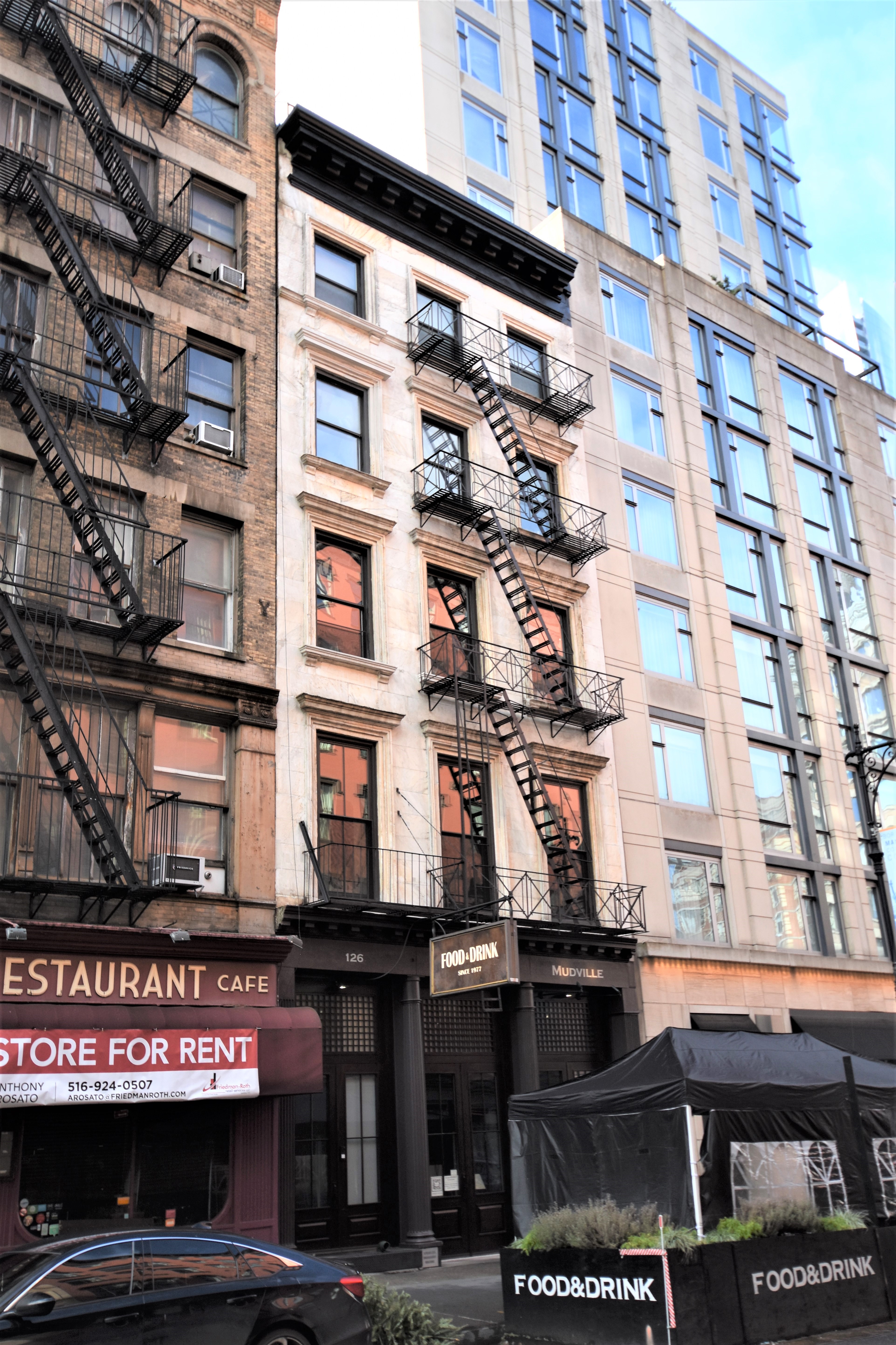
The 1856 126 Chambers Street


In the first decades of the 19th century John Atkinson was a member of the shipping firm John & Francis Atkinson, a member of the Western Inland Lock Navigation Company, and a director in the Bank of New York.  He leased the house at No. 126 Chambers Street from Trinity Church.  Following his death his widow continued living in the fashionable home until around 1830.  She was followed by dry goods merchant Samuel Holmes.  

In 1851 Holmes purchased the property from Trinity Church and in 1856 replaced the house with a commercial structure.  (There is a possibility that Holmes enlarged and renovated the old house, rather than demolishing it completely.)  Five stories tall, the Italianate style building predicted the loft buildings that would take over the neighborhood following the Civil War.  A cast iron storefront supported the stone-faced upper floors where the architrave openings wore molded sills and lintels.  

The structure was still under construction when tragedy occurred.  Tall commercial buildings utilized hatchways to haul heavy goods up and down.  The open, unguarded shaftway in the unfinished structure posed a significant danger.

German immigrant Christian Meyer was a framer--or window installer--who, according to the Morning Courier and New-York Enquirer on October 17, 1856, was "recently engaged on the new building No. 126 Chambers street [and] was found dead yesterday morning in the basement of those premises."  At about 6:00 on the previous evening the 32-year old Meyer was seen "partially intoxicated."  It was supposed that he had fallen through the hatchway to the basement.

The completed building filled with dry goods and apparel related firms.  Loder & Lockwood, dry goods jobbers, was among the initial tenants and would remain through 1867.  They shared the building with C. B. Churchill & Co., merchants in "cloths, cassimeres & vestings."

The early 1870's saw a number of auction houses move onto Chambers Street.  Among them was Osgood & Co. which leased space in No. 126 by 1872.  Run by Clinton B. Osgood, his ample salesrooms were the scene of auctions of household and commercial furnishings.  On April 12, 1872, for instance, not only was upscale domestic furniture like black walnut bedroom and parlor suites sold, but "500 stools suitable for dining saloons."

In late spring 1876 space was leased to two men named Cohen and Grossfeld for their start-up cloaks and suits manufacturing company.  The New York Herald reported "They obtained considerable credit about the city, probably $30,000 or $40,000."  (That would be equal to as much as $984,000 today.)  But when the partners failed to make payments on their debts, a deputy sheriff arrived to take possession of the property.  He was shocked to find not a garment factory, but an empty loft.  On August 4 the New York Herald reported, "It is now said that Messrs. Cohen & Grossfeld have absconded."

More upstanding tenants in the 1870's were H. Kohnstamm, makers of "colors and dye stuffs for flower and feather manufacturers;" Walsh & Brown, makers of ladies', misses' and children's fine shoes; and boot and shoe manufacturer Henry O. Van Gelder.

In the fall of 1878 a fair was held to help raise funds for the completion of the new St. Patrick's Cathedral.  The women of  St. Joseph's Church on Sixth Avenue supported the cause by manning a booth.  On November 16, 1878 the Journal of the Fair reported that "Mr. Brown, of the firm of Walsh & Brown...yesterday sent an elegant pair of ladies' gaiters, valued at $15, to the ladies representing St. Joseph's Church."  The value of the expensive shoes would be around $400 today.

Henry O. Van Gelder's name was also in the newspapers that fall, but for more concerning reasons.  The Evening Post reported that at 7:30 on the morning of September 3, 1878 he "left home for his business as usual, but did not reach his store."  Two days later the 60-year old was still missing.  The police released a description, saying he was "five feet eight inches in height, with gray hair and beard, but no moustache.  He was dressed in a dark suit of clothes, and carried a silver watch and chain."

The crisis worsened on September 5 when Van Gelder's son received "an incoherent letter from him saying that his mind was affected, and that he intended to commit suicide as soon as he could arrange for the transfer of a trust fund that he held for his niece," according to The Evening Post.   Van Gelder was eventually found and his plans of suicide thwarted.

Dry goods and shoe merchants gave way to more industrial tenants in the 1880's and '90's.  In the mid-1880's two importers of hardware and cutlery, William Burkenshaw and Harrison Bros. & Howlard were in the building.  Another hardware and cutlery firm, Henry A. Tilly joined them around 1890.

Wenck, a perfumery, leased space by 1882, and H. Kohnstamm & Co., manufacturers of "paints, oils and colors" was here the following year.  

Music & Drama, May 20, 1884 (copyright expired)

M. J. Stoddart & Co. ran a suspicious marketing scheme in December 1884.  It published an announcement in the Buffalo Evening News that read:

A Big Offer--To introduce them in Buffalo and vicinity, we are going to give away 1000 self-operating washing machines; if you want one, send us your name.  Address on a postal card at once M. J. Stoddard & Co., 126 Chambers street, New York.

David H. McConnell leased space on the third floor in 1890 for his seemingly unconnected Union Publishing House and California Perfume Company.  He had started his career as a Bible salesman and had come up with an innovative marketing tool.  He offered a free vial of perfume with every Bible purchased.  When he soon realized that perfume was more popular the scriptures, he added that business as a sideline.  

The publishing was done from the Chambers Street location and the perfume was manufactured in Rockland County, New York and marketed here.  

David McConnell narrowly escaped catastrophe on March 28, 1895.  The Evening World reported that the fact that he "was not burned to death or blinded and horribly disfigured for life this morning is wholly due to the promptness and bravery of his young woman clerk, Miss Josie Sawyer, and L. J. Miles, who is also employed in the office."

Just after 10:00 that morning McConnell was using cleaning alcohol in his office and Josie was assisting him.  He dropped the bottle which smashed on the floor, splashing his clothing with the flammable liquid.  The fumes were almost instantly ignited by the gas jet over his head and within a moment McConnell was engulfed in flames from the waist up.

The newspaper said "Miss Sawyer screamed for assistance.  Mr. McConnell threw off his coat, but his hair was blazing and so was his shirt about the shoulders."  Josie Sawyer tore off her apron and threw it over McConnell's head to smother the flames.  Hearing the commotion, L. J. Miles rushed in, took the apron and smothered the rest of the flames.

In the meantime, the alcohol had seeped through the floorboards and the timbers in the ceiling between the second and third floors were on fire.  Another employee ran to the street and turned in an alarm.  After firefighters pulled up 20 square feet of flooring, the fire was extinguished.

David McConnell posed with his bandaged hand after being treated for burns.  The Evening World, March 28, 1895 (copyright expired)

The New-York Tribune lapsed into 19th century sexism in saying, "Then Miss Sawyer showed that while she was equal to the emergency she was a woman after all, and she fainted and was carried to a place of safety, where her hands, which almost miraculously had not been badly burned, were attended to."

David McConnell was taken to the Hudson Street House of Relief, "his hair and mustache badly singed, his hands fearfully blistered and his face scorched," said The Evening World.

McConnell was still in the building as late as 1906.  By then his perfume company had been renamed Goetting & Co.  It would become a household name decades later as Avon Products, Inc.

The turn of the century saw horse-related firms taking space in the building.  C. M. Moseman & Brother, dealers in saddles and harnesses, was here by 1898, and William Knox, maker of "horse clothing" had space by 1901.

C. M. Moseman & Brother received a large military contract at the outbreak of the Spanish American War.  On April 30, 1898 Brooklyn Life reported "Some three weeks ago the Messrs. C. M. Moseman & Brother, 126 Chambers street, New York, received from Major General Roe an order for sixty saddles, bridles and other trappings which make up the equipment of field and staff officers' horses."  The article detailed the high-end equipment for the officers:

The order included one russet-colored pigskin Whitman saddle and saddlecloth, bridle, martingales, and breast-place for Gen. Roe and each officer of his staff, and for every brigade commander and every brigade staff officer in the National Guard of the State.

The firm remained in the building at least through 1924.  In 1908 it was marketing "The Kinnell Self-fitting Emergency Overshoe" for horses, guaranteed to prevent slipping on ice and asphalt.

The first centuries of the 20th century saw hardware related tenants like Wells Brothers; A. Z. Boyd Company, hardware manufacturers' agents; Wright Mfg. Co., makers of "high-speed hoists, screw hoists, differential hoists;" and the White Star Battery Company.  Somewhat surprisingly, another saddlery goods firm, M. Hancher, moved into the building in 1929 and would remain through 1940.

By 1943 the store space was home to the Colonial Café.  It was the scene of a ruckus on the night of February 1 that year when two plain clothes officers tried to serve a summons to manager Samuel Siegel for serving liquor to drunken patrons.  But those drunken patrons had other ideas.

Officers Thomas Rooney and his partner were set upon by five men.  Eventually the "fracas," as described by the Daily Argus, was quelled and the men arrested on charges of assault.  The Colonial Café remained in the space through 1955. 

The last quarter of the 20th century saw tremendous change the Tribeca neighborhood.  In 1981 the Aloha Restaurant was in the ground floor, replaced by Mudville9, which called itself a "saloon/restaurant," in 1994.


Better known simply as Mudville, the popular bar-restaurant remains in the space.  In 2009 the upper floors were converted to residential space, one loft apartment per floor.  

photographs by the author

Wednesday, February 3, 2021

The 1856 Richards Kingsland & Co. Building - 158 Chambers Street


Although the fluted columns have lost their Corinthian capitals, the cast iron storefront is relatively intact.

In April 1854 the "three story and attic" house at No. 158 Chambers Street was offered for sale.  The $23,000 price of the 26-foot wide property reflected the rising commercial value within the former residential neighborhood.  It would translate to about $722,000 today.

Exactly two years later, in April 1856, an advertisement in the Morning Courier and New-York Enquirer offered "To Lease--The new five-story store, No. 158 Chambers street."  It was a dignified Italianate style structure, the cast iron storefront of which supported four stone-faced floors.  The elliptically arched openings were graced with molded sills and lintels, and a bracketed cornice capped the design.

Within a month of the ad an announcement appeared in newspapers that read:

Removal--Richards Kingsland & Co. have removed to 158 Chambers street, where they will continued to manufacture Looking Glasses of all kinds, at prices for below any offered elsewhere.

Founded in 1790, the company was well known for its high-end, ornamental mirrors and had exhibited in the 1853 New York Exhibition of the Industry of All Nations, better known as the New York Crystal Palace Exhibition.  By the time it moved into its new location it had branched out into other products.  An advertisement in the New York Herald on November 30, 1857 listed "richly ornamented pier, mantel, side wall and oval mirrors," and "engravings, paintings in oil and pastile, in handsome gilt, rosewood, black walnut and oak frames."

This advertisement was published shortly after Richards Kingsland moved into 158 Chambers Street.

Unfortunately, the firm seems to have spread itself too thinly.  Less than a year after signing its lease, an auction was held of the vast stock.  The announcement explained simply, "as they are going out of business."

Angell & Co., wholesale dealers in foreign and domestic dry goods, soon moved in.  In February 1859 the firm was looking for short-term extra help, its advertisement reading "Three of four tailors, accustomed to cutting, may find employment for a few weeks by applying to Angell & Co., 158 Chambers street."

The firm was apparently on the cutting edge of technology.  In 1859 the Ericsson's Caloric Engine was introduced.  An announcement said "Ericsson's Caloric Engine is no long a subject of experiment, but exists as a perfect, practical machine, daily at work in numerous and diversified uses, with undeviating success."  On January 19, 1860 The New York Times reported that Angell & Co. had installed "a 24-inch Engine, to drive their hydraulic pumps."

The store as well as the fifth floor were occupied by the Knickerbocker Coffee & Spice Mills, run by William J. Stitt & Co., in 1869.  At around 11:00 on the night of March 25 a fire broke out in the store.  It was extinguished before it could spread to the upper floors, but resulted in about $96,800 in damages by today's standards.  It was the first of a series of fires that would plague the building over the next few decades.

The upper floors contained a wide variety of tenants around the time.  In 1871 L. Chapman's "plastic ivory umbrella handle" factory was here, and in 1876 P. I. Ronk & Son Co., butter merchants; Public Accountant John H. Allen; and builder Cyrus F. Loutrel were in the building.

Knickerbocker Spice Mills dealt with fire again in 1878.  This time it broke out on the fifth floor at around 9:00 on the night of December 19.  The New York Times reported "The flames spread with great rapidity, and when the firemen arrived they were bursting out of the upper windows of the building.  Firefighting techniques had not caught up with the increasing height of commercial structures and the five-story building presented problems.  "Owing to the great height of the structure the firemen experienced great difficulty in reaching the seat of the fire," said the article.

Next door, at No. 160 the Chambers-Street Hospital operated from a converted police station.  The New York Times reported "The fire caused great excitement in the lower part of the City, owing to the proximity of the burned building to the Chambers-Street Hospital, and it was at one time feared that the mansard roof of the hospital would take fire.  Fortunately, the wind was blowing in the opposite direction."  It was a valid fear.  When the blaze was finally extinguished the top two floors of No. 158 were gutted and a portion of the roof was burned off.

Richard Fisher moved his harness operation into the building the following month.  His advertisement in the New York Daily Herald on January 8 read:

Harness--The proprietor of the cheapest Harness Store in New York has removed to 158 Chambers st., where he is selling Buggy Harness for $7.50, Stable Blankets 80c, Buffalo Robes $3.50.

The advertisement price of a horse blanket would equal about $21.00 today.

A tenant whose business was far different from any others was Thorburn & Titus, here by 1883.  The firm dealt in garden seeds and gardening tools.  In February 1883 The Tri-States Union reported on the firm's 1884 Annual Catalogue of Seeds.  "It is a neat pamphlet of about 70 pages and contains a complete list of farm, garden and flower seeds, garden and yard implements and much other information that is useful to farmers," touted the article.

A frightening case of déjà vu occurred on April 24, 1887.  The Brooklyn Times reported "A fire on the top floor of 158 Chambers street, New York, next door to the hospital, illuminated the neighborhood for ten minutes last night, and many people supposed the hospital was ablaze.  The seventeen patients in the hospital kept to their beds.  Most of them could not help themselves.  A nurse fell down stairs."

The tenant list continued to be widely varied throughout the decades.  In 1891 A. G. Butler, Inc., manufacturers of bronze and brass letters and figures was in the building; and in 1895 Harry L. Cohn, a dealer in cordials operated here.

In 1914 building contractor W. J. Lachner took the store space. and in the first years after World War I Fred Vogler's pneumatic truck tire business was in the building.  The trend of more industrial tenants continued at mid-century when Alco Hardware was here through the 1950's.

By the late 1970's the Tribeca renaissance was catching up to No. 158 Chambers Street.  Potter JoAnn Meehan was looking for both a place to live and a studio space.  Several years later, on March 8, 1984, the Daily News reported "she bought her own retail and residential space in an abandoned Tribeca building that was about to become a co-op.  After extensive renovations, she moved in and opened Chambers Street Pottery with the idea what whoever worked out of it would also have a retail outlet."

The red-painted building next door once held a police station, a hospital, and a fire house.

The renovations, completed in 1981, resulted in one apartment per floor above the store space.  Meehan was perhaps its first resident.  The renovations did not go far enough to eliminate the need for the rather unsightly 20th century fire escape which partly obscures the façade, although it can be seen as a reminder of the string of fires that plagued the tenants over the building's 165-year history.

photographs by the author

Thursday, January 28, 2021

The Marble-Faced 153 Chambers Street


No. 153 Chambers Street, described in The New York Morning Courier as a "two story and basement brick dwelling," was offered for sale in 1847.  It had been home to Edwin Clark a decade earlier, whose hardware business was located at No. 193 Pearl Street.  During the 1850's it was operated as a "genteel" boarding house by landlady Ann Stewart.

Around 1866 the house and its next-door neighbor at No. 155 were replaced by two identical marble-faced loft and store buildings.  Five stories tall, the ground floor storefronts were cast iron.  The elliptically arched openings of the upper floors were trimmed with molded sills and lintels.  

Among the initial tenants of No. 153 was John J. Staff & Sons, importers, bottlers and sellers of wines and liquors like "brandies, wine &c.," port and "brown stout."  Also in the building was Trager & Garfunkel, hoop skirt manufacturers and dealers in hoop skirt materials.  It was run by Abraham Trager and Moses Garfunkel.

In May 1867 the second and third floors were still vacant in the "marble front Store 153 Chambers street."  The rental advertisement promised "in fine order; rent moderate."

The spaces were taken by U. H. Dudley & Co., "commission merchants and merchandise brokers," and Acker, Merrall & Co., retail grocers.  Uriah H. Dudley and Hiram H. Taylor had formed U. H. Dudley & Co. that year.  It specialized in canned goods and dried fruits.  


The neighborhood was becoming part of the "butter and egg" district at the time.  In December 1869 Gustavus Baylies advertised No. 153 Chambers Street for sale, noting that it was "admirably located for the butter business."

Despite the suggestion, the building continued to house a variety of tenants--none of them in the butter and egg business.  Along with U. H. Dudley & Co. in the mid-1870's were M. Simon & Brother, "gents' furnishings," run by Sinai and Mamklok Simon; John W. Louderback's basket business; and Joseph S. Brockway, who dealt in soaps.   

L. P. Worrall was in the building in 1873, marketing The American Fruit-Preserving Powder.  His advertisements promised that it "will effectually prevent fermentation and preserve all kinds of Fruits, Tomatoes, Cider, &c. during the year round or longer, in large Jars or whatever kind, and in wooden Kegs and Barrels."  The power was purported to preserve fruits "without the need of forming a vacuum or making the vessels air-tight."  The fact that he soon was gone from the building suggests that his product was not all it was promised to be.

The success of U. H. Dudley & Co. was rapid and astronomical.  By 1875 they operated branches in Chicago, St. Louis, San Francisco and Baltimore with sales of $2,500,000 per year, according to The New York Times.  That staggering figure would equal about $60 million today.  In 1879 the firm made negotiated a deal with the Central Pacific Railroad by which U. H. Dudley & Co. promised to ship 100 cars of canned goods from California each year and receive a 25 percent rebate on the freight fees in return.

In 1880 the rebate due for the previous year was $9,900--just over a quarter of a million in today's dollars.  U. H. Dudley & Co.'s problems now began.  The New York Times reported "The Central Pacific refused to pay the bill, and suit was brought in the United States Circuit Court."  Then, reported the newspaper, "In the Fall of 1881 their agents in Chicago and St. Louis are reported to have purchased more goods than the market would warrant, and in December of 1881 they had $75,000 worth of goods on hand in St. Louis."  News that the firm failed in December 1882 "caused much surprise in trade circles."

M. Simon & Brother and John W. Loudenback were still renting space in the 1880's.  C. C. Sullivan, "produce and commission merchant," and D. E. Manton, another produce merchant, were also tenants. The ground floor store held P. Pohalski & Co.'s cigar and tobacco store.  

On the night of December 28, 1887 fire broke out in the building.  It caused a fracas on the street when Thomas B. Fay tried to break through the fire line.  Fay worked in the willow ware company of William H. Barron at No. 141 Chambers and was trying to get to the address.  A policeman named McDermott stopped him, ordering, "Get out of here.  You can't get through here."

Fay responded, "But my employer's place may be on fire and I may be able to render service there."

The New York Eagle reported "'I don't care for that,' said McDermott, moving his club threateningly.  'Get out of here.'"

Fay was not intimidated.  "If you hit me with that club, I'll strike you with my umbrella."  The remark landed Fay in jail until his employer bailed him out.

The fire was extinguished, but not before it severely damaged P. Pohalski & Co's. store.  The company relocated to No. 58 Warren Street, a block away.  But bad luck followed.  Just two weeks later, on January 15, 1888, fire spread along that block to No. 58.  The Sun reported that P. Pohalski & Co. "claim a loss of 150,000 cigars by yesterday's fire."

The 1890's saw Robert Rennie, a merchant of "acids;" the National Railway Supply Co. and James E. Morris & Co. wholesale grocers operating from No. 153.  

In January 1894 James E. Morris received a tip that a huckster had targeted his firm.  For several weeks G. H. Henry had appeared at the offices of various wholesale firms, representing himself to be the buying agent of steamship lines, railroads and other major organizations.  He would order an amount of goods to be delivered at a railroad station where he would then claim them.  Morris told detectives of the information he had received, and a trap was set.

Late on the afternoon of January 25 an "immaculately attired man of refined appearance walked into the wholesale grocery store of James E. Morris & Co.," as reported by the New York Herald.  He identified himself as the purchasing agent of the American line of transatlantic steamers.

"You are just the man I want to see," said Morris.  "Step into the office."

Henry detailed his mission to buy goods and an order was made out.  He signed the order and rose to leave.  "His hand was on the knob of the office door when a policeman emerged from the shadow, a heavy hand fell upon Mr. Henry's shoulder and soon he found himself in Ludlow Street Jail," reported the New York Herald.  There he faced a list of charges.

A. M. Morris was associated with James Morris & Co. by the second decade of the 20th century, as well as being a director in the North River Steamboat Company.  He lived in fashionable Greenwich Connecticut.  He offered his services to that city in February 1917 when its mayor organized the Citizens Security League "for riot and other emergency duties."  He was among the 50 citizens chosen and sworn in on February 25 and "provided with nightsticks and revolvers," according to The Sun.

After having been in the building for more than three decades, James E. Morris & Co. purchased the property in February 1920.  Two years later on July 1, 1922 the Real Estate Record & Builders' Guide reported that the firm  "have added a parcel to their present holding at 153 Chambers st." by purchasing the six-story building directly across the street.  (It may have foreshadowed the impending sale of No. 153 in 1926 to Samuel Lipschitz.)

The tenant list under the new owner was a drastic change.  Among them were the salesroom of the Moto-Mower Co., makers of "a real motor driven grass cutter;" and the Empire Hardware Company which was on the ground floor.

The hardware store was replaced by the Silver Fox Tavern around 1929.  The problem was that Prohibition was still in effect and at 2:00 on the afternoon of May 17, 1930 "Volstead sleuths dashed into the Silver Fox tavern at 153 Chambers st. and confiscated 40 quarters of liquors," as reported in the Daily News.  "Several patrons in the place were not molested, but three employe[e]s were arrested."

Following the incident, John Mory sold his lease to the Chambers Street Restaurant in February 1931, and following the repeal of Prohibition the space became the Mullins Bar and Grill.  The bartender had just opened on the morning of October 29, 1949 when an armed robber entered at 9:00 and held him up.  He made off with $500 from the register--more than 10 times that amount in today's dollars.

Before 1941 the cornice was replaced with a brick parapet.  via the NYC Dept of Records & Information Services.

The tavern expanded into the second floor in 1951.  The first floor now held a "bar, grill and cabaret" and the second a "restaurant and cabaret."  Small factories continued to occupy the upper floors.

As the Tribeca neighborhood grew trendier in the last quarter of the 20th century, the ground floor became home to Cheese of All Nations on the ground floor and Cheese 'n' Wine on the second.  In its Going Out Guide on May 2, 1972 The New York Times called Cheeses of All Nations a "store-of-a-thousand cheeses."  It was not so impressed with Cheese 'n' Wine.  "Although the idea of the restaurant evokes commendation, reality invites hope for improvement."

The late 20th century was not kind to the Victorian, cast iron storefront.

The cheese store remained at least through 1984.  A renovation completed in 2008 resulted in loft residences on the upper floors, including a duplex on the fifth floor and new penthouse, unseen from street level.  A reproduction cornice, lost prior to mid-century, was installed at the time.

photographs by the author

Friday, April 28, 2017

John C. White's 1854 No. 145 Chambers Street


John White arrived in Baltimore from Ireland soon after the Revolutionary War.  He established John White & Co. in New York in 1804.  Among the merchant's 10 children were Robert and Campbell, both highly successful and wealthy.

By 1832 Campbell had moved his family to No. 145 Chambers Street.  The upscale block between West Broadway and Greenwich Street attracted well-to-do homeowners, like merchant Ellis Potter who lived next door at No. 143.  Despite Campbell's large family (he had 10 sons), Robert, who was still unmarried, moved in.

Both men were well respected.  Not only did they continue their father's business, Campbell was elected to Congress in 1829 and was re-elected for four successive sessions,  And both were directors in the Manhattan Bank.  That position would bring about the end of their respectability.

On March 21, 1840 the Manhattan Bank was on the brink of collapse and two men were held responsible for the failure.  The day before Robert White had been arrested.  The Morning Herald was not sympathetic.  It reported "The Recorder, no doubt, means to act with the firmness of the Roman, Lucius Junius Brutus; and when Bob is found guilty, the Recorder means to tell him...that 'this breaking of heads with bludgeons from behind, and assaulting respectable people, is a serious offence"...and that he must 'suffer some'."

He and his brother had been, in effect, embezzling bank funds through a complex series of loans to one another.  The Morning Herald opined "The slovenly manner in which the whole of the affairs of this bank has been managed reflects lasting disgrace on the whole of the direction, all of whom should immediately resign."

Within a decade commercial interests would begin pushing the wealthy homeowners away from Chambers Street.  Robert and Campbell's brother, John C. White, demolished the house in 1854 and erected a store and loft building.  In doing so he damaged the party wall with the Ellis Potter house; resulting in a lawsuit that dragged on until April 1861.

The upper floors of the five-story building were nearly residential in character.  The picture frame-like architrave surrounds of the openings sat on carved sills upheld by scrolled brackets and were topped by handsome cornices.

The cast iron store front, with its fluted Corinthian columns and pilasters, was among the first in a trend that was rapidly taking hold.  The concept of precast iron architectural elements in New York was only about six years old at the time.  Within the next decades the Tribeca and Soho neighborhoods would see the rise of scores of cast iron fronted structures. 

Among White's first tenants were E. W, Parker, and brothers M. M. and C. C. Keeler.  It is unclear what businesses they were involved in.   By at least 1874 Louis E. Howard occupied the retail space where he sold knives and cutlery.

Well-heeled passengers of public transportation were well advised to guard their possessions, as ruffians and gangs took advantage of the crowded streetcars.  On Mach 18, 1874 Louis E. Howard was on his way home, riding on the rear platform of a Broadway streetcar.  As he was getting off at Fourth Street, he "was jostled against by a gang of thieves," reported The New York Times, "and in the crush his watch and chain, valued at $160, were stolen."

The gold watch would be worth nearly $3,500 today; but while Howard knew he had been robbed, he remained cool.  Instead of alerting the crooks that he was aware of the theft, he silently followed one until he found a police officer.  William Stanton was arrested and held on $1,000 bail.  Howard's watch was found in his pocket.

Howard would be back in a courtroom two years later,  Chicagoan George H. Martin had dropped into the store on August 14, 1876.  The 31-year old browsed among the goods, then attempted to leave.  But he had been watched by a suspicious salesman, who barred his escape.  When he searched Martin's coat, he found $46 worth of pocket knives.

The handsome window treatment would have been equally appropriate in a high-end home as in the loft building.

By the last quarter of the century the produce district was centered around the Chambers Street block.  John Early was in the building by 1886 when his most lucrative contract was with the City of New York.

In September alone that year J. Early & Co. supplied the Department of Public Charities and Correction with "2,800 pounds Rio coffee, 3,000 pounds oatmeal, 3,500 pounds rice, 12,000 pounds brown sugar, 2,000 pounds coffee sugar, and 3,000 pounds starch."  Early remained in the building for several years, providing the Department with enormous amounts of food staples.

By the mid-1890's J. S. Barron & Co., "jobbers of Wooden Ware, Cordage, House Furnishing Goods, &c."  was here.  Like John Early, it enjoyed civic contracts, like the 1890 order for $362.50 in "naval supplies" for the New York Navy-Yard (that contract was doubled the following year).

But in 1895 the firm jumped on the rabid new fad that swept America--the bicycle.  The Iron Age reported on November 21 that J. S. Barron & Co. would be representing Davidson & Sons of Chicago; including the popular "bicycle built for two."  The journal wrote that the Davidson Bicycle "is made in four models--men's road wheel in three heights of frame, ladies' wheel, diamond frame tandem and combination tandem."

The C. C. Stutts Glass Company operated in an upper floor at the time, run by brothers Arthur C. and Conrad C. Stutts.   The firm represented the Pennsylvania flint glass manufacturers Agnew & Co., among others, in 1898.  It would stay on at No. 145 Chambers Street through the turn of the century.

In 1902 J. S. Barron & Co. erected its own building at Franklin Street and West Broadway.  At that time the tenant list at No. 145 Chambers Street was changing.  Robbins & Meyers dealers in electric motors had been here at least a year.  It advertised its "Standard Motors" as "made especially for linotype machines, presses, cutters, binders, staplers and other printers' machinery."

The Inland Printer, September 1911 (copyright expired)

The firm was soon joined by the Virginia-based Richmond Electric Co.  It too sold printers' motors.  Both companies would be in the building through, at least, 1914.  Despite the implication of its name, the Standard Scale and Supply Co., which moved in by 1916, sold "sand mixing machines."

Machinery manufacturers filled the building until 1931 when B. Schnee and the Northam Trading Company, candy wholesalers, leased the entire building.   Within the decade it was taken over by another confectioner, S. F. Hollander, Inc.

The president of S. F. Hollander in 1940 was 38-year old David Sanders who lived in Brooklyn with his wife.  He arrived at the office at 9:00 on November 19 that year, a day that seemed to be no different that any other.  At around 11:00 Sanders took the elevator up to the fifth floor, which was used as the stockroom.   His prolonged absence was apparently not given much thought until an employee discovered his body a few hours later.

Sanders had devised a noose from twine and tied it around a rafter.  The material was not strong enough to hold his weight, and snapped when he attempted to hang himself.  He was found on the floor with the noose around his neck.  Although the cord had not held, the action had snapped his neck.

The last quarter of the century saw remarked change in Tribeca.  In 1990 No. 145 Chambers Street was home to the Contemporary Russian Art Center of America.  The Center originated as an exhibition space for contemporary Soviet art; but was now a repository of Soviet art, books, magazines, photographs and documents.

Like so many Tribeca loft buildings, the upper floors were converted to residential space in 2010--just one apartment per floor.   While the storefront has been heavily altered, the early columns and pilasters--including their ornate capitals--survive after more than 160 years.

photographs by the author

Saturday, March 25, 2017

No. 143 Chambers Street


As early as 1835, Ellis Potter and his wife lived in a brick house at 143 Chambers Street.  Mrs. Potter was active in charitable work, serving as a manager of the New-York Female Assistance Society (organized for "the relief and instruction of the sick poor) in the 1830s and '40s.  Ellis was a well-to-do businessman who, as pioneers headed West, would become secretary of the Susquehanna and Wyoming Valley Railroad and Coal Company.

It was most likely the intrusion of commerce onto Chambers Street that prompted the Potters to leave by 1853.  That year Ellis placed an advertisement in The New York Herald offering, "To Let--For one or three years, the house and lot 143 Chambers street."

The lessee operated it as a boarding house, advertising, "One room, suitable for a gentleman and lady or two single gentlemen, also one single room, to let, with or without board," on May 29, 1855.  The upscale tenor of the boarders was evidenced when one purchased a custom-built piano; then had to sell it.  On the same page of The New York Herald with the ad for the rooms, another appeared that read:

A splendid $325 seven octave rosewood piano for sale for $235, made to order two months since by celebrated city markers, and fully warranted, of superior tone and finish; perfect every way.  The owner is going to Paris.

The original cost of the pricey instrument would be more than $9,000 today.

Ellis Potter was understandably outraged when months earlier, in May 1854, his next door neighbor at No. 145 demolished his house to erect a new commercial building.  In doing so, according to Potter's complaint, he "removed the party-wall between the premises."  Potter took him to court on April 2, 1861.  The defendant, named White, scoffed at the idea he had damaged No. 143, saying it was already "in ruinous condition."

Potter fired back, saying his house had been fine, "and was then renting for about $1,200 to $1,400 per annum. (about $3,000 per month in 2017 dollars).  He won his case, receiving a judgment of nearly $3,500.

But the damage was done and before long Potter began construction of a replacement structure himself.  Completed in the spring of 1864, it outshone White's building architecturally.  Above an elegant cast iron storefront were four floors of light-colored sandstone.  The graceful arched openings of the second floor were unified by shared pilasters, and dramatic scrolled keystones curled like breaking waves.  The windows of the floors above were ornamented with stone voussoirs which mimicked the quoins which ran up the sides of the building.  Above it all was a handsome Italianate cornice on ornate brackets.


J. Goldstein & Bro. not only managed the building, but moved into the ground floor space.  On April 23, 1864, it advertised, "To let--Three lofts, in the new building 143 Chambers street, opposite Hudson River Railroad depot, suitable for jobbing or manufacturing business."

One floor had already been leased.  William Lehman manufactured the hoops which were so necessary for the latest fashion craze, the hoop skirt.  In June 1865, two thieves attempted to make off with "twelve coils of skirt wire, valued at $130," as reported by The New York Times.  The crooks, William Gaynor and Daniel Gill, were apprehended and convicted.  Gaynor was sent to the State Prison for two and a half years, Gill for one.

Ellis Potter's building was elegant, but it was apparently difficult to fill.  In May 1868 all four upper floors were vacant, offered at "a moderate rent."  And nearly a year and a half later, in September 1869, only one loft was occupied.  That tenant was most likely Richardson & Co., dealers in "straw goods," which was here in 1871.

Surprisingly, despite the devastating Financial Panic of 1873, 143 Chambers Street suddenly was tenanted.  In 1874 Samuel Hirsch moved his furniture store into the first floor; Brush & Clark, real estate agents had its offices here, and Henry Lyon occupied the second floor.

Among Lyon's employees was 19-year-old James Carr, who was married and lived on Chrystie Street.  Businesses in No. 143 used a "hatchway" to hoist goods up from the basement--a shaft equipped with pulleys and ropes (think of an elevator shaft without an elevator).  On May 2, 1874, Carr was helping in just such a project when his teenaged bravado caused disaster.

A few days later his coworkers would testify, "He had been warned not to attempt to slide down the fall-rope, but disregarding it had attempted to do so."  He lost his grip and fell from the second floor to the basement.  The New York Herald said he was "seriously injured" and taken to the Park Hospital.  Carr died the following day.  An inquest was held and the jury rendered a verdict of accidental death.

Business went on and a few weeks later an advertisement appeared in The New York Herald.  "Wanted--An errand boy from 13 to 18 years old."  The macabre circumstances surrounding the opening may have been responsible for tepid response.  The following week, on June 14, a second advertisement was placed.  "Wanted--An errand boy, about 15 years of age with good reference. Apply to H. Lyon."

G. W. Teed was operating his rubber stamp manufacturing company on the floor above Henry Lyon by 1876.  He advertised his "rubber name stamps" for 30 cents "an outfit."  Business was apparently good, for in May 1877 he was looking for "agents to sell my rubber stamps--splendid terms."

The successful wholesale liquor dealer Samuel A. Besson would operate from No. 143 Chambers for years.  He lived with his wife in Yonkers, where her brother, Charles V. Martine also lived.  The family was understandably concerned when the 47-year-old left home on June 27, 1879 saying he had an appointment in New York City with his lawyer, William H. Pemberton.

But instead, they received a puzzling telegram from Albany saying he had arrived there safely.  On July 13, with no further word from Martine, Besson placed an ad asking for information on his whereabouts.  When that failed, he set off on a search.  The New York Herald reported on July 22 that he "returned to the city on Saturday night after a week devoted to a search for the missing man.  He visited all the summer resorts on the Hudson River, Saratoga, Lake George and some favorite retreats in Massachusetts, without obtaining any clew as to the whereabouts of Mr. Martine."

The newspaper explained the family's worry, saying Martine "took but little money with him to defray his expenses and an insufficient supply of linen and wearing apparel for a protracted absence."  It is unclear whether he was ever found.

Equally disturbing was the incident involving one of Besson's employees, O. P. Coleman.  At 5:30 on the morning of September 28, 1884 Police Officer McDermott noticed a man apparently sleeping in the doorway of No. 209 Washington Street.  The following day The New York Times ran the somewhat callous headline "Trying To Wake A Dead Man."

McDermott discovered upon attempting to arouse what he assumed was a drunk, that the middle-aged man was deceased.  A search of his pockets found three letters addressed to O. P. Coleman in care of S. A. Besson on Chambers Street.  With no one else to identify the body, Samuel Beeson was sent for; but he could not be found either in his office nor his Yonkers residence, so Coleman was taken to the Morgue until his employer could be located.

At some point before this time Ellis Potter had transferred title to the building to the St. James Episcopal Church.  When the congregation laid plans for a new structure on Madison Avenue and 71st Street in 1884, it took out a $200,000 building loan, using 143 Chambers Street as partial collateral.

Among the church's tenants in the building was Ryan & Co., makers of baseballs and "base ball goods."  Having moved here from 149 Fulton Street, it boasted "The Ryan Republican Dead Ball has been adopted for all professional and junior clubs throughout the country."

On March 17, 1882 it ran a sporty advertisement for workers.  "Base Ball Sewers--Come one, come all, to sew the Ryan dead ball; highest price paid; steady work."  The firm paid according to the model of ball the workers were constructing.  "Price list for sewing dead balls, 85c; stars, 50c; sheepskin, 30c; large 2, 25c; large O K, 20c; small O K, 16c."

The Evening World, February 10, 1894 (copyright expired)

Other tenants were James H. Flagg, cutlery, here in 1886; the printers and publishers, Irving Press; and Hardware Publishing Company, publishers of the bi-weekly Hardware; Good Value brand cigars; and Francis B. Thurber, head of the wholesale grocery firm Thurber-Whyland Company.

Irving Press Company received bad publicity in February 1895 when it was sued by William S. Stillman.   A year earlier, on January 4, William W. Thomas had hired Stillman as the firm's manager with a $20 per week salary.  The new employee should, perhaps, have been suspicious when, at the same time, Thomas asked him for a $430 loan, "to be repaid on Jan. 4, 1895."

When January 4 came and went, and Stillman pressed Thomas for his money, he was fired.  He sued for the loan plus the week and a half's salary he never got.


Remarkably, the 1820s house on the corner still stood in 1896.  No. 143 can be glimpsed to the side, revealing a permanent awning that had been erected over the ground floor.  from the collection of the New-York Historical Society

Francis Thurber was long established well respected in the wholesale grocery business.  He was elected to the Chamber of Commerce, had organized and was president of the Anti-Monopoly League, and organized the Merchants and Manufacturers' Board of Trade.

Following the Financial Panic of 1893, his firm H. K. & F. B. Thurber failed.  He reorganized as the Thurber-Whyland Company and, for all appearances, was doing well.  On March 12, 1899 The Sun ran a surprising article that announced "Francis B. Thurber has been admitted to the bar at 57."  The oldest lawyer admitted to the bar in New York at the time, he explained "My objects in being admitted to the bar were mental discipline, the putting of an example before the boy [his teen-aged son], and what seemed to me the opportunity of combining my business experience with my knowledge of law."

In fact, there was more to the story than that.  On July 12 1901 a headline in the New-York Tribune read, "F. B. Thurber Gives Up Fight."  The article reported that he his firm had declared bankruptcy.

In a statement he told how 30 years of hard work and a fortune "was swept away in the panic of 1893."  Seeing the inevitable, he procured his law degree and "am now trying, with good prospects, to establish a law practice" that he hoped "might enable me, with time, to do something for my creditors."  It was a humiliating and devastating end to Thurber's respected career.


Several publishers called No. 143 Chambers home, including the publishers of Hardware magazine.  (copyright expired)

Earlier that year, on January 12, a fire had swept through the building, causing $5,000 in damages.  It started on the second floor in the offices of the United States Export Association.  The publishers of The American Grocer was on the third floor, and the ground floor was home to Eugene W. Dunstan, dealers in bakery and confectioners equipment.

E. W. Dunstan suffered $500 in water damage; but would remain in the space at least through 1907.  The building, now nearly half a century old, was becoming antiquated.  In 1909 it was cited twice for health violations: "failure to provide sanitary water closets" and "failure to provide sufficient water to flush water closets."  The violations were repeated every year through 1912.

In April 1911 St. James Church foreclosed on the leaseholder, Elizabeth Bennett.  A new list of tenants soon filled the building, including Banner Utilities Company, which took the second floor, and hardware merchant William R. Keene who moved into the ground floor where he would remain until about 1918.

Keene got himself into trouble after his business associate and friend, Charles C. Carhart, introduced him to his wife, Eva.  The meeting not only ended Keene's and Carhart's friendship, but the Carhart marriage.  On April 15, 1913, Carhart sued his partner for $30,000 damages.  He said in court that "Mrs. Carhart's affections for him began to wane after he introduced her to Keene."

The building continued to lure a variety of tenants over the years.  In 1914, the same year that R. Heinlach's Sons Company and the Toplin Manufacturing Company leased space, the New York Iron and Steel Products Company moved in.  The firm would stay on into the 1920s.  The C. R. Andrews company distributed Hyde propellers here in the 1920s and '30s; and for years the Universal Butter and Egg Corporation operated here, finally going out of business in 1963.

The Tribeca neighborhood would soon change from gritty industrial to trendy residential and retail.  In 1985 the If Every Fool Studios was located at No. 143 Chambers Street.  That year it presented workshops "for an in-depth study of clowning" presented by master clowns from England, Canada and France.


Although space in the building was unofficially being used as living spaces as early as the late 1970s, in 2001 the upper floors were converted to residential spaces--one per floor.  The facade survives remarkably intact, including the storefront, with its Victorian double doors and handsome cast iron elements.

photographs by the author