Showing posts with label ango-italianate architecture. Show all posts

Friday, January 2, 2026

The Charles Lewis Tiffany House - 125 East 10th Street


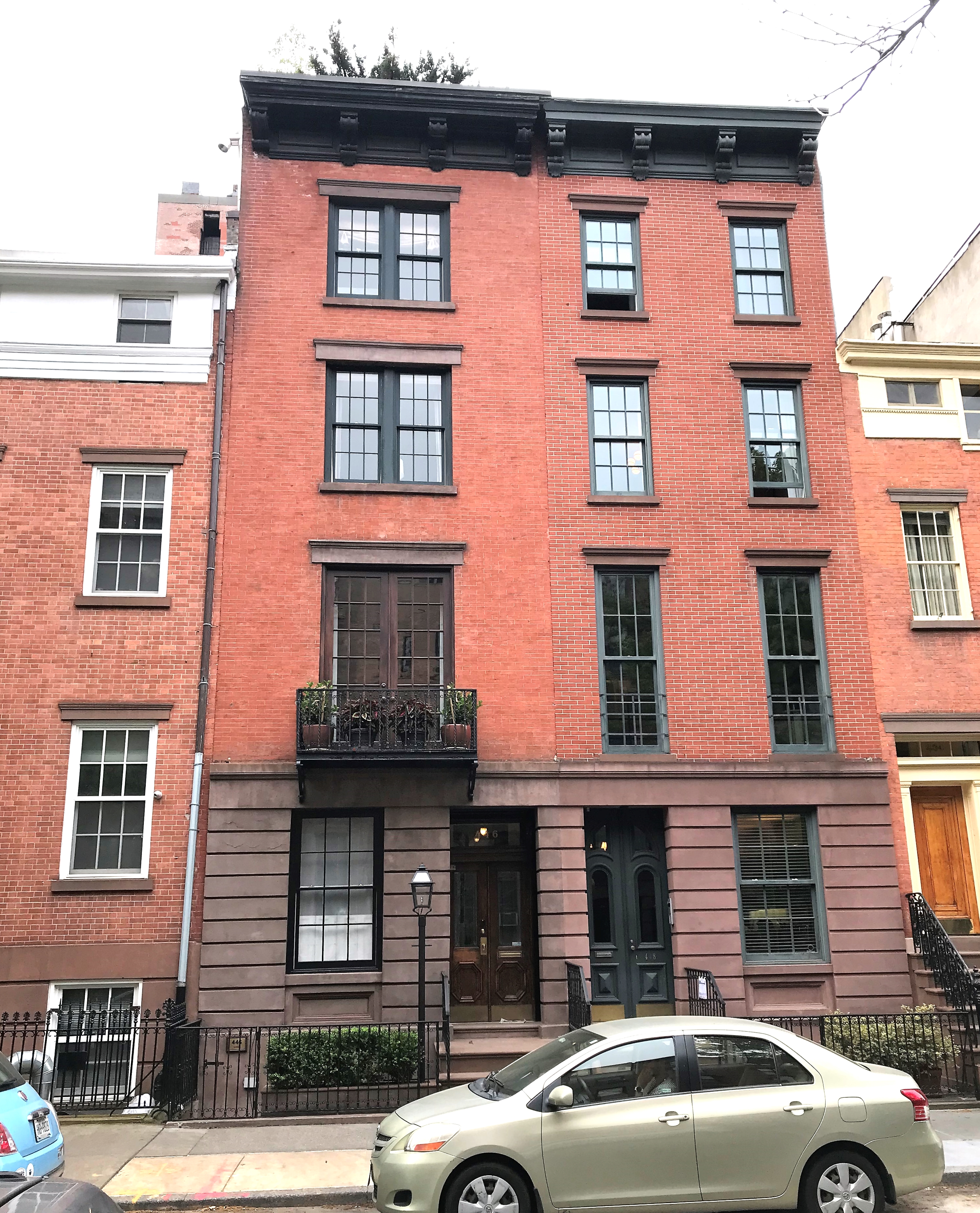
Identical to its next door neighbor, 125 East 10th Street is on the right.

Robert Carnley, who lived at 191 Tenth Street, erected two houses next door at 193 and 195 Tenth Street in 1854.  (The twin homes, just steps from St. Mark's churchyard, would be renumbered 123 and 125 East 10th Street in 1865.)  The homes were four stories tall and two bays wide above a low basement.  Sitting upon rusticated stone bases with arched openings, the upper floors were faced in red brick and trimmed in sandstone.  Full-width cast iron balconies fronted the second floor windows.  Molded stone lintels sat upon the elliptically arched upper windows and a single corbeled cornice unified the structures.

No. 195 Tenth Street became home to Charles L. Tiffany, the principal in the newly renamed jewelry firm Tiffany and Company.  He and John B. Young had started out in business in 1837.  In 1841, Tiffany married his partner's sister, Harriet Olivia Avery Young.  When the couple moved into the East 10th Street house, they had two children (their first, Charles Jr., died in 1847).  Annie Olivia, was ten years old, and Louis Comfort was six.  Three more children, Louise Harriet, Henry Charles, and Burnett Young, would arrive in 1856, 1858 and 1860 respectively.

Charles Lewis Tiffany as he appeared nearly half a century after moving into the East 10th Street house. from Tiffany & Co.

Tiffany was born in Connecticut in 1812.  At the age of 25, he  and John B. Young opened a small "stationery and fancy goods store" at 259 Park Row.  They established a reputation of selling only first-class items, like imported Bohemian glass and porcelain.  Starting around 1843, Tiffany began creating his own jewelry and in 1845 introduced the Blue Book, generally considered the first direct-mail catalog of fine jewelry in America.  

In 1853, Tiffany and Young separated and Charles Tiffany struck out on his own, creating Tiffany & Company.  The same year that the East 10th Street house was erected, the firm's new building at 550 Broadway, was built.

The Tiffany & Co. building (the clock of which would follow the firm in its subsequent moves) testified to Charles L. Tiffany's success.  Here it is seen in the Union Square store.  photograph via RIBA Collections.

Born in 1825, George McClure was the husband of Harriet Tiffany's sister, Maria Young.  He became a partner in the newly formed Tiffany & Co., heading the firm's diamond department.  When Charles and Harriet Tiffany left 195 Tenth Street in 1859, the McClures moved in.  The couple had two daughters, Nellie Louise, born in 1853; and Anna Cushman, born in 1856.

Living with the McClures was Frederick M. Peck, a clerk at Tiffany & Co.  He would remain with the family through 1862.  (By then, he listed his profession as "jeweler.")

Tragically, four-year-old Anna Cushman McClure contracted scarlet fever in 1860.  She died on June 5 and her funeral was held in the parlor the following afternoon.

When Civil War broke out, George McClure joined the 22nd Regiment.  He became Quartermaster and would serve on the staffs of Generals Aspinwall and Shaler.  McClure rose to the rank of colonel before the war's end.

At home, New York socialites turned their attention to helping the Union effort.  In February 1864, plans were laid for the "great Metropolitan Fair" to raise funds.  The New York Times reported that among the committee members of the "Jewelry and Fancy Goods" department were Harriet Tiffany and Maria McClure.

In 1870, the McClures moved into Everett House, conveniently across Union Square from Tiffany & Co.  George McClure would die of Bright's Disease there on September 30, 1885 at the age of 60.

In the meantime, 125 East 10th Street became home to the Henry H. Holly family.  Henry was a partner with Gilman Collamore in G. Collamore & Co., "importers of china, glass, gas fixtures, silver plated ware, &c.," according to an advertisement.  Son John I. Holly was in the oil business and was also a director in the Brunswick Land Reclamation Co.

Like many families at the time, the Hollys rented an unused portion of their house.  An advertisement in the New York Herald on May 22, 1874, read, "Neatly furnished apartments [i.e., rooms] in a private house with modern improvements, to one or two single gentlemen, at 125 East Tenth street, near Second avenue.  Terms moderate to suitable parties."

Next to occupy the house starting around 1876 was Harriet King and her unmarried children.  Harriet's husband, Josiah King, had been in the hardware business at 373 Bowery.  He died on August 5, 1873.  The couple had five children, Josiah Nicholson, Karlene Eugenia, Ida Estelle, Charles Fletcher and Frank A.   Josiah, who was the eldest, was 41 years old when his mother moved into the house, and the youngest, Frank, was 16.

Ida Estelle was married to Captain John Waydell of the 22nd Regiment in St. Paul's Methodist Episcopal Church on the evening of December 6, 1876.  The New York Times reported at length on the ceremony, mentioning, "The gentlemen were in full dress."  The article added, "A reception was subsequently held at the residence of the bride's mother."

Harriet had left 125 East 10th Street by 1878.  It was home to a series of occupants before becoming a rooming house at the turn of the century.  

In 1905, Max Silverman (also known as Max Studnick) and his bride, the former Celia Spielberger, took rooms here.  Celia worked as a servant girl and had carefully saved her money.  In July that year, according to The Sun, "she decided that she ought to be married.  She went to Max Tuner, a marriage broker."  Tuner promised her that every match he arranged "is full of happiness."

Soon after meeting with Tuner, Celia was introduced to Max Silverman.  He told her that he had an income of from $8,000 to $10,000 a year.  (The high-end figure would translate to about $368,000 in 2026.)  Celia asked for proof.  A few days later he showed her a check for $1,000 payable to him.  "Celia said that she had no proof that the check was genuine," said The Sun.  And so the next time they met, Silverman produced a bankbook that showed a $1,000 deposit.

Then, on an afternoon stroll with Celia, Silverman paused in front of a saloon at Pike and Madison Streets.

"That is my saloon," he said.

"Fine," replied Celia.  "Let's go in and look at it."

"Oh, no!  I couldn't think of it.  It is against the law for a woman to enter a saloon, and you, my future wife, must not be arrested."

Silverman pointed to the traffic coming in and out of the saloon.  "See all those customers.  Every one of them spends from 15 to 25 cents each," he said.

The Sun reported on August 27, "That was enough for Celia, and she married Silverman, who lived with her for four days at 125 East Tenth Street."  On the fourth day Silverman told his bride that "he had a sudden demand for money."  Celia had saved up $400 and, coincidentally, that was exactly the amount her husband needed.  The Sun reported, "Could he have it? With pleasure, she said.  He never came back."

As it turned out, Max Tuner operated a scam involving "a gang of men" who "will marry any number of women, get whatever money they have and then desert them," explained The Sun.  Celia's attorney told reporters that he had "evidence that Silverman married other women."  

In 1941, both houses were painted.  via the NYC Dept of Records & Information Services.

Twenty-five-year-old inventor Fred Miller rented a room here in 1911 when he, like Celia Spielberger, decided it was time to be married.  In September, he wrote to the mayor of Denver, Colorado asking him "to find a good Denver girl for him to marry."  His letter said that "New York girls do not appeal" to him.  According to The Sun, the letter explained that "he has heard so much about Denver girls that he wants to try one of them for a voyage on the sea of matrimony."  He guaranteed that the royalties from his inventions would support a married couple.  Whether or not the mayor fulfilled his request is unknown.

Detectives stormed into a room here on December 10, 1918 and arrested four men.  Among them were Peter Vazzaro and Alfred Faroco.  The New York Herald said, "They are charged with homicide, the police alleging they had a hand in the street fight in which Ettore Ochinoeri...was killed on November 29."

By 1919, St. Mark's Church was leasing this house and the one next door at 123 East 10th Street.  The tenant list became much more respectable.  Living here that year was Lucy Constance Rulison, for instance.  The highly-educated musician had graduated from Bryn Mawr College in 1902 and continued her studies in Europe through 1913.  She became a member of the faculty of the Music School Settlement in 1916, and became teacher of piano at the David Mannes Music School in 1917.

Artist Sarah Eakin Cowan lived here in 1923.  Born in Hendersonville, North Carolina in 1875, she studied in Paris at the Académie Julian.  Known for full-size and miniature portraits, she had co-organized the 1915 exhibition of painting and sculpture by women artists.  She was a co-founder of the American Society of Miniature Painters.

Kathryn Cerick purchased 125 East 10th Street in 2006 for $4.25 million.  She later sold it to French-born banker Olivier Sarkozy, who already owned 123 East 10th Street.  In 2015 he married actress and fashion designer Mary-Kate Olsen.  They soon sold both houses.


Former architecture critic for The New York Times, Nicolai Ouroussoff and his wife, artist Cecily Brown, purchased 125 East 10th Street in October 2019 for $7.75 million.  Real estate brokers continually told prospective buyers that the house was designed by James Renwick, Jr., despite there being no evidence of the assertion.  What is certain, however, is that both houses survive externally in a remarkable state of preservation.

photographs by the author

Friday, May 12, 2023

The Edward C. Chapin House - 220 East 13th Street


In 1851 the family of Edward Colton Chapin was living in the recently completed home at 128 East 13th Street (renumbered 220 in 1868).  Four stories tall, the brownstone-fronted house was one of a row of identical Ango-Italianate style residences, their entrances sitting above short, five-step stoops.

Born in 1814, Chapin was a silk goods merchant at 76 Chambers Street.  He married Nancy Ann Reed on April 23, 1839, and the couple had two children when they moved into the 13th Street house: Anna Maria, born in 1840; and Edward Lucius, born two years later.  (Ella Jane, who was born in 1845, had died at the age of two).  Another daughter, Helen R., arrived on November 17, 1856.

In 1856 the family left for an extended trip, most likely to Europe.  An advertisement in the New York Herald on August 1 offered: "Handsome brown stone house to let--No. 128 East Thirteenth street, between Second and Third avenue; contains all modern improvements, and is in a fine neighborhood; rent $900."  The rent was affordable by today's standards, equal to about $2,475 per month in 2023.

Cuban-born Don Dominigo De Goicuria signed the lease.  He was at the time embroiled in a heated conflict with William Walker, the American who had taken the presidency of Nicaragua by force and reinstituted slavery there.   De Goicuria had initially hoped that Walker would assist him in freeing Cuba from Spanish control.  But, realizing that Walker was interested in conquering Central America and had no interest in Cuba, De Goicuria turned on him.  In a letter written to The New York Daily Times from the East 13th Street house on November 22, 1856, De Coicuria said in part:

I therefore denounce Mr. Walker as a man wanting in the first element of every kind of ability, viz. of Good faith; I denounce him as wanting in ordinary sagacity and discretion; I denounce him as false to the interests as well of Cuba as of the United States.

In 1864 Edward Chapin changed professions from silk to starch.  He became an agent for the Oswego Starch company on Fulton Street.  Nancy Reed Chapin died on November 17, 1867 at the age of 53.  Five years later Chapin married Caroline W. Booth on April 14, 1872.

The family moved to 228 East 12th Street and rented 220 East 13th Street to Rev. Thomas Gallaudet.  He had been chosen by the Society of the Church Mission to Deaf Mutes of St. Ann's Church to organize a home "for elderly and ill deaf-mutes."  The choice of the house assuredly was influenced by Jane Middleton, who moved in with her widowed mother Ann.  Jane had worked for William Chapin, Edward's brother, at the Ohio State School for the Blind from 1845 to 1846.

Jane Middleton, who worked for free, became the superintendent of the Home for Aged and Infirm Deaf Mutes, working closely with Gallaudet.  In June 1873 the Phrenological Journal reported that the home "is now ready to receive all deaf mutes who have become unable by disease or old age to support themselves.  By thus bringing them together they can much better receive that religious instruction and pastoral care which they so much need."

The Church Mission to Deaf-Mutes, 1893 (copyright expired)

During its first year the home housed nine residents, four men and five women.  The mission paid Chapin $1,350 per year in rent in 1876 (about $36,000 today), and relied totally on donations for its operation.  By then it had accumulated a meager building fund of $5,000 for a permanent home.

A reporter from the New York Herald visited on November 13, 1878.  He explained, "Every year the inmates of this modest mansion  hold a reception and fair, and an interesting occasion it is."  He was greeted by Rev. Gallaudet, who walked him through the rooms and explained the home's operation.

As you can imagine, there are few people more helpless than aged and infirm deaf mutes.  They can do nothing for their own support and they require a great deal of care...But when we provided them with a home they are a remarkably cheerful set of people.  Two of the women we have here are nearly blind as well as deaf and dumb.

Upstairs, the journalist was shown through the "old men's quarters."  He wrote, "Some were reading, some were talking, and one old man was coloring pictures that he had copied from the illustrated papers.  His art was not high art, but it pleased him as well as though it was done with the dexterity of a Gerome."  In the parlor, the old women "were grouped around one of their number who was telling off an interesting tale from the ends of her fingers."   The article ended with the journalist speaking of himself in third person:

With singular sensations the reporter glanced around him upon the gay silence that pervaded the place, and the opening paragraph in one of the essays of Elia came to his mind:--"Wouldst thou find a refuge from the noises and clamors of the multitude?  Wouldst thou enjoy at once solitude and society?'...Go then to a reception of deaf mutes."

On March 26, 1889, The Evening Telegram reported, "The Church Mission to Deaf Mutes is doing a good work...The Mission House, at No. 220 East Thirteenth street, has been discontinued."  The mission had opened the Gallaudet House for Aged and Infirm Deaf Mutes on a 156-acre farm near Poughkeepsie.
 
The neighborhood around 220 East 13th Street, touted in 1856 as "fine," was in noticeable decline by now.  The house was operated as a boarding house, home to residents like Henri Dagerbert, here in 1902.  He was a Commissioner of Deeds for the city.

Not all of the boarders were as respectable as Dagerbert, however.  Living here that spring was 21-year-old Frederick Henratty who was hiding out from police.  On April 16 he went to his mother's home in Brooklyn and stole jewelry belonging to her and his two sisters valued at $480 (a considerable $15,600 in today's money).  Included in the loot were a pair of diamond earrings and two diamond rings.  The earrings alone were valued at $180.

On May 26, 1902, The Brooklyn Daily Eagle reported, "He disappeared on that day, and ever since detectives have been after him."  Then, the day before the article, Henratty's brother-in-law William Tighe "saw him having a good time in the Bowery, Coney Island."  He had him arrested.  The earrings were traced to a Manhattan pawnshop, but the rest of the jewelry was gone.

By 1912 220 East 13th Street had declined from a boarding house to a furnished rooming house.  Resident Nunzio Spataforo was arrested for an even more egregious crime than Henratty's on November 13, 1912.  In the first decades of the 20th century, New Yorkers were terrorized by anarchist groups like the Black Hand, which used violence to push their ideologies.  The New-York Tribune reported that Spataforo had been arraigned in the Essex Market Court that morning for "throwing a bomb in the moving picture theatre at No. 178 First avenue."

William Kary rented a room here in 1932.  On January 14 The New York Sun reported, "five hoodlums got away, though not far, with a truck loaded with $25,000 worth of silk last night.  They stopped it, hauled the driver from his seat, beat him and made off with the truck on the outskirts of Paterson [New Jersey]."  By the following morning, four of the men had been arrested, including the 21-year-old William Kary.  After being identified in a line-up, the gang confessed to a series of robberies and hold-ups in Long Island.

In 1953 there was a total of 16 furnished rooms in the once-proud house.  The deterioration of the neighborhood was reflected in an incident on October 11, 1964.  The New York Times reported on fatal stabbings of men who attempted "to sell diluted narcotics."  The article continued, "The latest victim, who was unidentified, was found dead at 6:20 A.M. in the outer lobby of a tenement at 220 East 13th Street."

An hour later 37-year-old Filipe Rivera was arrested when he was found near the crime scene with bloodstained clothing.  He admitted to the murder saying, "the victim had tried to sell him diluted narcotics," according to The New York Times.


By the last decades of the 20th century the neighborhood was on the upswing.  In 1980 220 East 13th Street was converted to apartments, one per floor.  The exterior of the Chapin house shows the abuse of the last century.  And yet, only a little imagination is required to envision it as it was when the well-to-do Chapin family moved in around 1850.

photographs by the author
no permission to reuse the content of this blog has been granted to LaptrinhX.com 

Thursday, October 6, 2022

The George H. Brodhead House - 53 West 9th Street


In 1854 George Hamilton Brodhead purchased the newly-built home at 41 Ninth Street (renumbered 53 West 9th Street in 1868).  One of a row of five, its Anglo-Italianate design was the latest in domestic fashion.  Just two bays wide, the house sat back on its plot (the same distance that would have been consumed by a stoop, were there one).  The Italianate areaway railing was copied in a rounded balcony at the second floor.  The double-doored entrance under a bracketed cornice sat within a rusticated base, while the upper floors were clad in dressed brownstone.

Brodhead purchased the house as an investment, initially leasing it house to Roderick Sedgwick and his family.  Born in Cornwall, Connecticut in 1785, Sedgwick was the son of General John Sedgwick and Abigail Andrews.  His wife, the former Margaret Stuart Dean, had died on March 13, 1850.  The couple had eight adult children. 

Roderick Sedgwick was a broker at 60 Wall Street.  Two sons and at least two daughters lived with their father in 1855.  John was an attorney, and Roderick Jr. was in the drygoods business on Broadway.  The daughters ran a private school in the house, listed as The Misses Sedgewick's School.  (Another daughter, Katharine Whetton Sedgwyck, was married to the well-known artist William Heine.)

The Sedgwick family remained in the house until the spring of 1859.  In April that year, Brodhead advertised "The elegant first class four story" house for rent.  He would have a series of tenants over the succeeding years.  William McCauley, a "money broker," leased the house in 1860 and '61, followed by Edward Vonderheydt, a partner in J. W. Schmidt & Co., and then by merchant William Woodward, Jr. 

Levi Chapman, who was in the strops (the leather strap for sharpening razors) business at 72 Duane Street, rented the house in 1873.  Only months (or weeks) after he moved in, on July 1 the parlor was the scene of his funeral.  He had died "suddenly," according to the New York Herald, at the age of 66 on June 27.  The term often suggested a heart attack.

The family of John C. Mabin leased the house in the mid-1870's.  They were nearly the victims of a burglar on March 4, 1876.  While the family slept, Police Officer Garney was making his rounds and heard the breaking of glass.  He discovered Thomas Wilson in basement area, where he had broken out a pane of glass in the door.  The New York Herald reported that Wilson "stated that he had neither home nor occupation," and was held in $2,000 bail.  (It was a significant amount, equal to $52,000 today, which Judge Kilbreath knew the homeless man could not obtain.)

Following his retirement from the brokerage business and after having leased the house for decades, George Hamilton Brodhead moved into 53 West 9th Street in the 1880's.  Born in 1815, Brodhead was the son of Rev. John Brodhead and Mary Dodge.  His wife, the former Julia Ann Phelps, had died in 1857 and of their four children, only two were still alive--Mary Frances Gardner, and Dewitt Williams Brodhead.  Dewitt and his wife, Ariadne Liebenau, moved into the West 9th Street house with George.

George Brodhead had been an important presence on Wall Street.  In 1855 he became secretary of the New York Stock Exchange, a position he held until 1870.  In 1874 he was elected president of the Exchange.  Dewitt Brodhead was a director in the Sixth Avenue Railroad Co.

On February 25, 1903 The Daily Saratogian ran the indiscreet headline, "Veteran Broker Dying," and reported, "George H. Brodhead, who was a well known figure in Wall Street fifty years ago, is dying at his home, No. 53 West Ninth street."  Because of Brodhead's long-standing influence in the brokerage business, his condition was followed by newspapers nationwide.  The 88-year-old died on March 2. The Colorado Springs newspaper The Weekly Gazette reported, "He had been ill three weeks and his death was due to heart disease."  His funeral was held in Newfields, New Hampshire where he was born.

Dewitt Williams Brodhead died in 1908, and the following year, on May 9, the New-York Tribune reported that the George H. Brodhead estate had sold the house to Arthur Brisbane, adding "This is the first transfer of this property in about fifty years."

Brisbane was a colorful and well-known figure.  Born in 1864, he had entered the journalism field in 1882.  He became a close friend of publisher William Randolph Hearst, and in 1897 became the editor of Hearst's Evening Journal.  Brisbane's summer home was in Hempstead, Long Island.

Brisbane was interested in experimental and scientific agriculture, and two years before buying the West 9th Street house, he had purchased the 600-acre deserted village of Allaire, New Jersey.  According to The New York Times on March 2, 1907, "he intends to make Allaire one of the finest model farms in the East."

Arthur Brisbane, from the collection of the Library of Congress

On July 31, 1912, The Sun reported that Brisbane had married Phoebe Cary in Calvary Protestant Episcopal Church.  The bride was the daughter of Seward Cary.  The newspaper noted, "Mr. Brisbane and Seward Cary are cousins and grew up together in Buffalo."

The Brisbanes soon acquired another country home, in Point Pleasant, New Jersey.  It was the scene of a horrific incident on May 27, 1914.  The New York Times began its article saying, "Stretched at full length upon the floor of a blood-spattered bedroom in the unoccupied Riverside home of Arthur Brisbane, editor of the New York Evening Journal, the body of a murdered man was found this afternoon."  The house, which sat among a dense grove of trees, had been entered that afternoon by three men.  A local boy heard the voices of men quarreling coming from a second floor window.  "He thought at first they were workmen sent there by Mr. Brisbane," said the article.

When he mentioned it to his mother, she notified the caretaker who took two men with him to investigate.  The body of the dead man was found, surrounded by empty champagne and wine bottles from the Brisbane cellars.  Searching the grounds, the men discovered one man attempting to "induce two little boys to row him across the river," according to The New York Times.  He had two knives on him, one of which was covered in blood.  The third man was not found.  The article noted, "Both men were either tramps or burglars.  They had gained entrance to the house by removing a pane of glass from one of the windows."

In 1916 Brisbane began renting the West 9th Street house.  He leased it to W. A. Upham that year, and to artist Guy Pene Du Boise around 1920.   Du Boise had studied under William Merritt Chase and Robert Henri, and counted among his closest friends the artist Edward Hopper (who was best man at Hopper's wedding).

Du Boise had married Florence Sherman Duncan in 1911.  The couple had a daughter, Virginia Avis.  On June 5, 1921, the New-York Tribune reported that Virginia had been married to Edwin Earle Lucas "in the country home of the bride's parents, at Saugatuck, Connecticut."  The article noted, "The bride's father is a well known art critic.  He is editor of Arts and Decoration."

Guy Pene du Bois painted An American Oriental in 1921, while living at 53 West 9th Street.  from the collection of the Los Angeles County Museum of Art

In 1924 Du Bois and his wife moved to Paris.  Brisbane, who now owned more than 80 properties in New York City, continued to lease the house until his death on December 25, 1936.  His estate sold the property in 1938.

Living here in the late 1950's was psychiatrist Dr. Alice E. Fabian, the widow of Dr. Abraham A. Fabian.  On October 28, 1962, The New York Times reported that she had married David Lind.  "The ceremony was performed at the bride's home at 53 West Ninth Street by Rabbi Charles J. Davidson."   Tragically, David Lind died the following year and the twice-widowed Dr. Fabian slipped into metal illness.


While she continued seeing patients in her second floor consultation room, she began hoarding elsewhere throughout the house.  Her detailed diaries revealed she "was convinced that she was not only being watched, but zapped by laser rays," according to the London newspaper Evening Standard years later.  Upon her death, Swedish artist Ann-Sofi Siden somehow obtained Fabian's journals, Polaroid photographs, and other belongings upon which she based her half-hour film, It's By Confining One's Neighbour That One is Convinced of One's Own Sanity.

Much of the original interior elements survive.  images via streeteasy.com

The 16-foot-wide home with its absorbing history remains a single-family home.  Much of the interior detailing is pristinely preserved, looking much as it did when George Hamilton Brodhead purchased the home in 1854.

photographs by the author
no permission to reuse the content of this blog has been granted to LaptrinhX.com

Wednesday, September 28, 2022

The 1848 Sherman-Dodge House - 52 West 9th Street


Wealthy physician Austin Sherman completed construction of his Greenwich Village home at 13 Ninth Street (renumbered 52 West 9th Street in 1868) in 1848.  The double-doored entrance of the Anglo-Italianate style residence was entered at street level within a rusticated brownstone base.  The two upper stories were faced in red brick and trimmed in brownstone.  In the rear yard, as was common, was a small, tw0-story house.

Austin was well-known for his patented medicine, "All Healing Balsam."  In addition to his medical practice, Austin dabbled in real estate.  In May 1851, for instance, he advertised: "To Let--A first class three-story and attic House with all the modern improvements and conveniences, pleasantly situated, 43 Ninth street.  Apply to A. Sherman, 13 Ninth street."

Dr. Austin was stricken with paralysis, according to the Weekly Drug News, in 1871, most likely the result  of a stroke.  He died 13 years later, on November 22, 1884.

The house would be home to three families by the turn of the century.  John A. Stevens was here by 1887, followed by the Charles E. Griswold family.  On March 27, 1891 The Epoch reported, "Mrs. Charles E. Griswold and Miss Gertrude Griswold gave an exceptionally pleasant musicale on the night of Wednesday, March 25th, at their residence, 52 West 9th street.  They will receive informally on the second, third and fourth Mondays of April."

Finally, William Cornelius Hall moved his family in.  He and his wife, Marie Suzette de Mirigny Thomas, had married in 1880.  Their first son, William Claiborne, was born in 1881, followed by John Mandelville the following year, and by twins Agnes Stuart and Marie Suzette de Marigny in 1886.

A graduate of Yale University, Hall was a vice-president of the Perth Amboy Terra Cotta company, perhaps best known for making the Tiffany bricks, designed by architect Stanford White.  Marie Suzette was related to the Marquis de Marigny, the Duc de Villinbrosa, and to Baron Louis von Hoffmann of Germany.  Her grandfather was the first governor of New Orleans.

Upon his graduation from Yale in 1904, William Claiborne Hall took a ground-level job in his father's firm, earning $5 per week (about $160 today).  A year later he was promoted to the sales department.

Marie Suzette's wedding to Charles Schuveldt Dewey on December 20, 1905 was a socially important affair.  Three days earlier The Sun had reported that pre-wedding entertainments had been going on for two weeks.  It added, "To-morrow night Chauncey Dewey of Chicago, a cousin of the bridegroom and a nephew of Admiral Dewey, will give a dinner dance for the bridal party at the Waldof-Astoria.  The final ante-nuptial affair will be a dance given on Tuesday night by the bride's aunt, Mrs. Gilbert Colgate."  

According to the New York Herald, Marie wore the wedding gown of her great-grandmother, "who was a lady in waiting to the then Queen of Spain."  The Church of the Ascension filled with some of Manhattan's most elite families, with names like Havemeyer, Schuyler, Roosevelt, Colgate and Hall.  Following the ceremony, a reception was held in the West 9th Street house, which the New York Herald said, "is one of the old fashioned houses that has undergone few changes."


Despite a privileged upbringing identical to his brother William, John Mandeville Hall (who went by his middle name) became the black sheep of the family.  He was seemingly unable to keep his name out of the newspapers for the worst of reasons.   It started on June 12, 1906 when the Perth Amboy Evening News began an article saying, "Mystery surrounds the sending out of a card bearing the Hall coat-of-arms and reading as follows":

                                                                    52 West Ninth St.

The engagement of Lily F. Wilson, of New Rochelle, daughter of Mrs. George Grant Wilson, and Mr. Mandeville de Marigny Hall, of New York, has been broken by mutual consent.

The Hall family had sailed for Europe soon after Marie's wedding, and had just returned.  Mandeville insisted he was dumbfounded at the announcement.  The newspaper said, "The envelope is from Tiffany's and Mr. Hall said it is unquestionably from their own supply of stationery...he asserted that he did not know who the mysterious sender was."

Not surprisingly, the engagement was called off.  Instead of marrying Lily Wilson, one month later, on July 9, Mandeville married Florence Teall.  The wedding was kept secret from society--even initially from Florence's parents.  The couple moved into the West 9th Street house, but Florence left Mandeville the following January, "owing, she says, to his dissipated habits," said The Evening World.  The marriage was no longer secret.

On Sunday January 10, Mandeville sent for Florence, "and urged her to return, but she refused," according to The Evening World.  He went up to his room and shot himself.  The following day The Perth Amboy Evening News wrote, "Mrs. William C. Hall, of 52 West Ninth street, a summer resident of Perth Amboy, was kept busy yesterday telling sympathetic callers that her twenty-four-year-old son, Mandeville, who was removed to the Roosevelt hospital on Sunday suffering from a pistol wound, had not attempted suicide."

Suicide, or attempted suicide, within a high society family would be scandalous, and the family (including Florence) joined in a well-constructed explanation.  Mandeville (who survived) told police and reporters that he noticed a jar of vaseline on a table in his room and decided to clean his revolver.  "There were three cartridges in it, and I omitted to remove them.  One of them exploded accidentally."

Following the incident, Mandeville sailed for Europe.  But it was not entirely to escape the ugly publicity.  On June 31, 1908 The Evening World reported, "Mrs. Florence Teall Hall, who learned through The World that her husband Mandeville de Marigny Hall, was traveling in Europe with Vida Whitmore, a former Weber & Field's beauty, today sought her lawyer, John L. Linehan."  Florence ordered an investigation "and if the fact were as reported," she would direct her attorney to bring suit for divorce.

She did not have to wait long for proof.  On August 4, chorus girl Vida Whitmore arrived in New York on the Lusitania "with a meagre wardrobe," according to the Perth Amboy Evening News.  "Although she travelled first class she was penniless, and her cab hire to her apartments uptown was paid by friends."

Although still married to Florence, Mandeville had told Whitmore he was divorced, and they had been married in New Jersey on May 21.  According to her, he convinced her to give him between $18,000 and $20,000 in "precious stones," then gave her the key to a strong box in the Colonial Trust Company.  When she opened the box upon her return to New York, "there was nothing in it but air," she told a reporter.  She continued, "It would take a book to tell all the low, mean things that man did.  His deception as to his former marriage and divorce was deliberate."

He had also told Whitmore that his father had died and left him a fortune.  "The poor old man is a victim of paralysis, and lives in a helpless condition in his lonely old-fashioned home No. 52 West Ninth street," she said.

Both Florence and Vida would have to wait to get justice.  The Perth Amboy Evening News noted, "Hall is now under arrest in London accused of having passed a worthless check."  He was extradited to France and sentenced to 13 months in prison.

But on September 28, 1909, The Perth Amboy Evening News said, "Through mysterious influence he obtained his release and turned up last May at Watch Hill, Rhode Island, in company with a married woman of New York...Hall is only twenty-five years old, but for four years he has led the life of a spendthrift, chiefly on money he got from women."

That lifestyle came to an abrupt end at the fashionable Narragansett Pier on July 12, 1909, where he was using the pseudonyms Charles W. Stevens and Douglas Turner Johnstone.  According to The New York Press, "A technical charge of forgery was entered against Hall, who is alleged to have drawn many checks on the [Fifth Avenue Bank] which were valueless."  According to the arresting detective, "Hall was enjoying himself hugely, having run up an automobile bill of $175...and was popular with summer girls there when arrested."  He was sentenced to two years in the Rhode Island state prison.

Despite the never-ending bad publicity, the family continued to maintain appearances.  Invitations went out in December 1909 for Agnes's marriage to Walter Bateman Allen on January 26, 1910 in the Church of the Ascension.  Most likely because of her brother's notoriety, her wedding did not get the ample press coverage that Marie's had.

William Cornelius Hall's paralysis that Vida Whitmore had earlier mentioned was the result of a stroke he suffered while he and Marie Suzette were touring Egypt in 1906. On June 6, 1911 he suffered another stroke.  This one proved fatal.  His funeral was held in the West 9th Street house at 5:00 on the following afternoon.  It may have been Mandeville's past that prompted Hall to simply leave the entire estate to his wife rather than deal with the untidy issue of disinheritance.

The house was purchased in October 1915 by Edith Livingston Hall Morgan.  In reporting the sale, The New York Times described it as "a three-story dwelling, with a two-story dwelling at the rear of the lot," and added, "Mrs. Morgan plans extensive alterations to the houses."

Edith Livingston Hall (unrelated to the previous Hall family) had married William Forbes Morgan, Jr. in 1904.  At the time of the wedding, according to the New-York Tribune, she was "one of the most prominent young women in New York society."  Morgan was a member of the brokerage firm of Morgan, Livermore & Co.  The couple had three children, Barbara L., born in 1905, and twins Ellen and William Forbes Morgan II born in 1907.   Edith's sister Anna Rebecca was married to Elliott Roosevelt and Eleanor Roosevelt was Edith's niece.

Things were not going well for the couple, and William remained at 176 East 70th Street, while Edith and the children moved into the West 9th Street house.

In 1920 William, Jr. was away at boarding school.  Shortly before 4:00 on the morning of February 4, Edith was awakened to the smell of smoke.  The New-York Tribune wrote, "Prompted by mother-love and disregarding her own safety, she rushed up to the fourth floor her home."  That was where 10-year-old Ellen and 14-year-old Barbara were sleeping.  "Before she could reach her children...she was overcome by smoke and collapsed."

Fire fighters had to break into the entrance doors.  On the fourth floor landing they found the body of Barbara.  "A quick search revealed the bodies of Mrs. Morgan and her other daughter, Ellen," said the New-York Tribune.

Edith's will demanded that the West 9th Street house "shall not be sold until Mrs. Morgan's youngest child shall have reached its majority, when the proceeds from the sale shall be distributed equally among her children," explained the New-York Tribune on April 21, 1920.  Despite her expressed wishes, the house was sold the following year.  On July 28, 1921 the New-York Tribune reported that William de Leftwich Dodge had purchased the "three and one-half story building and two-story studio building in the rear."  The article noted, "The new owner is a mural painter, and will improve the premises for his own occupancy."

Indeed, William de Leftwich Dodge was a mural painter.  Born in 1879, he grew up in Europe and studied at the Ã‰cole des Beaux-Arts.  His mural Glorification of the Arts and Sciences adorned the dome of the Administration Building of the 1893 Columbian Exhibition in Chicago, and in 1895 he completed a series of murals for the Library of Congress.  He had decorated the Cafe de l'Opera and the Follies Bergeres Theater in Paris.  

Dodge poses in front of The Purchase, one of six murals for the Tower of Jewels at the 1915 Panama-Pacific Exposition in San Francisco.  Original source unknown.

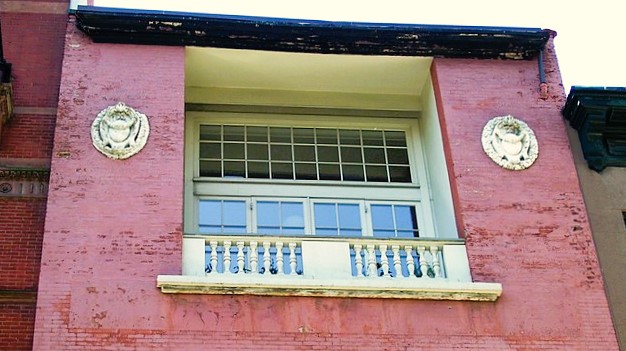
The "improvements" Dodge made to the West 9th Street house were transformative.  Essentially, only the ground and third floors gave hint of the home's 1848 appearance.  A five-paneled set of leaded casements was the feature of the second floor, and a double-height studio was installed at the former attic level.  Unlike most studio windows in converted vintage homes at the time, this one was recessed, providing an ample balustraded balcony.  On either side were complex terra cotta medallions, possibly designed by Dodge.

The balcony and medallions in 2011, prior to a restoration of the facade.  photo by Beyond My Ken.

By the time the Dodges moved into their remodeled house, William was a professor at the Arts Students League of New York.  He and his wife, the former Francesca (known as Fanny) Theodora Bland Pryor, had a daughter, Sara, and a son, Roger.  The family's summer home was in Setauket, Long Island.

On March 26, 1935, The New York Sun reported, "William De Leftwich Dodge, one of America's leading mural painters, whose panels form part of the decoration of many public buildings in this country and abroad, died yesterday after an illness of some months.  He was 68 years old."  Despite his international prominence, Dodge's funeral was private, held in the West 9th Street house the following afternoon.


The New York Sun revealed what was perhaps a little known detail in the artist's resume.  "The helicopter which Mr. Dodge made and flew for ten feet before the Wright brothers' flight in 1903 is now on exhibition in the Smithsonian Institution in Washington."

Dodge's renovations to 52 West 9th Street were perfect for artist Hans Hoffmann, and the following year the Hans Hoffman School of Fine Arts moved in.  Born in Weissenberg, Germany, Hoffmann grew up in Munich where he studied architecture before turning to painting.   In 1934 he had opened a summer school in the artist colony of Provincetown, Massachusetts, then a year-round school at 137 East 57th Street before moving to the former Dodge house.  The school remained here through 1938.

A renovation completed in 1948 resulted in a duplex on the ground and second floor, and one apartment each on the upper floors.  In May 2016 the duplex was purchased by Craig Newmark (founder of Craig's List) and his wife Eileen as their Manhattan pied-à-terre.  They paid $5.9 million for the three-bedroom, 3-1/2 bath home.


With the facade sensitively restored, the house looks remarkably as it did when William de Leftwich Dodge made his overwhelming 1921 "improvements."

photograph by the author
no permission to reuse the content of this blog has been granted to LaptrinhX.com

Thursday, May 19, 2022

The 1854 Former Twins at 446 and 448 West 22nd Street


In 1854 developer William Berrian's vacant, 32-foot-wide parcel on the south side of West 22nd Street between Ninth and Tenth Avenues provided him with an option.  He could erect one mansion or two skinny houses, each just over 15 feet wide.  He chose the latter.

Completed within the year, the mirror-image homes were designed in the Anglo-Italianate style.  Short stoops, three steps high, led to the double-doored entrances within a rusticated brownstone base.  The three upper floors were clad in warm red brick and trimmed in brownstone.  The full-height windows at the second floor may have been fronted by cast iron balconies.

The Swift family moved into 306 West 22nd Street (renumbered 446 in 1868).  Charles Swift was a carriage maker whose business was at 44 Mercer Street.  There is little doubt that his son, Charles, Jr., learned his trade from him, but for some reason the two did not initially work together.  Charles Swift, Jr. was listed in directories in 1860 as "coachmaker" with a business address of 372 Broome Street.  They would join forces by 1867, however, operating as Charles Swift & Son at the Mercer Street location.

By then the Swifts had been gone from West 22nd Street for three years.  The house was now home to Eliza Milne Chandler, whose husband, Adoniram Chandler, had died in 1854.  Widows often took in boarders for extra income, but that was not the case with Eliza, who lived here alone with her small staff of servants.  Her husband had apparently left her a sufficient estate upon which to live.

Eliza's husband, Adoniram Chandler, died ten years before she moved into the West 22nd Street house.  from the collection of the Museum of the City of New York

Adoniram had been highly involved in politics and was a Whig candidate for State Assembly at least once.  He was a Legal Collector of Arrears of Taxes for the city, with an office in the Old Alms House.

In the meantime, the house next door was initially home to Hamilton R. Searles, who listed his occupation as "mirrors" at 57 White Street in 1859.  By the following year he had opened a second store at 62 West 13th Street, and had expanded into "frames."

John C. Brampton and his wife moved into that house in 1864.  He was a real estate agent and it appears his wife helped out in the business, as well.  An advertisement in the New York Herald on April 28, 1866, for instance, read:

Country board can be obtained at the house on Greenwich Point, Long Island Sound, near the water; fine salt water bathing; healthy location; adults preferred; steamboat and cars; stable for horses...for further information call on Mrs. Brampton, at 308 West Twenty-second street.

Martin Fox purchased the Brampton house (now renumbered 448 West 22nd Street) in 1871.  He ran a store at the corner of 37th Street and Ninth Avenue until 1877, when it appears he retired.  He remained in the house until June 1885, when he sold it to Ernestena C. Unger for $12,500, just under $350,000 today.

Around 1895 Dr. C. Kierstedt and his family moved into 446 West 22nd Street.  He came from a long tradition of physicians, the first Dr. Kierstedt arriving in New Amsterdam in the 17th century.  The Kiersteds' daughter was a member of the Children of the Holland Dames of the New Netherlands and the house was several times the scene of the group's meetings.

The grade school aged members had serious business to attend to.  At a meeting here on April 4, 1898, for instance, the children addressed the on-going Spanish-American War.  Nine-year-old Sarah Bancker Trafton entrusted a letter to a reporter from The World to be sent abroad.  The succinct and straight-forward message read:

To Alfonso XIII, King of Spain:

Please have this war stopped at once.  I don't like it.

    Sarah Bancker Trafton
    Regent of children of Holland Dames of the New Netherlands.

And after the agenda points had been taken care of at the meeting a month later, Sarah asked, "Any new business?"  Mai Moore stood up and said, "I move that we look after the war correspondents.  They're just as much heroes as soldiers are."

Asked what they could possibly do, Mai answered, "Why, if they get sick and need things in hospitals, or clothes, they could just let us know.  And if they were in prison, maybe we could help them out.  I prayed for the two that were shut up in Havana, and now they're out."  The group voted to adopt the "looking out for poor war correspondents" as a priority.

The Kierstedt family remained in the house at least through the first months of 1902, after which it appears to have been operated as a boarding house.  Among the initial tenants was Orrin J. Ford, whose business was on West 29th Street.  Drinking during business hours was not a problem for Ford, but it nearly cost him his life on August 23, 1902.

The 64-year-old placed his whisky bottle on a window sill, and shortly afterward, someone placed a bottle of muriatic acid next to it.  The Brooklyn Daily Eagle said, "The two bottles looked alike and Ford took up the wrong one."  He drank a mouthful of the acid, spilling part of the bottle over his chin and beard, and collapsed on the floor.  The newspaper said "his cries of agony attracted the attention of his son, William Ford, who ran to his assistance."  A policeman ran to a nearby grocery store and returned with two quarts of milk, which he "poured down the man's throat."  Ford was taken to the New York Hospital where it was deemed the prompt administration of the milk saved his life.

Among the boarders in 446 West 22nd in 1908 was Helen V. McCourt.  That year she passed the civil service test for the position of telephone operator.

Living next door at 448 was the family of Charles Bryant Overton, who had moved in around 1892.   Overton and his wife, the former Carolina Augusta Unger, had five grown daughters, Caroline, Katherine Louise, Carrie H., Elizabeth, and Edith May.  

Caroline, Katherine Louise, and Edith May were unmarried and lived their their parents.  Both Katherine Louise and Edith May were teachers.  Caroline seems to have been a bit more progressive.  In 1905 she was the corresponding secretary of the Daughters of the Lafayette Post.  He father, who was now 67 years old, was a veteran of the Civil War.  The purpose of Caroline's group was "to perpetuate the memory of their fathers who fought in the Civil War."

Caroline's modern bent was much more apparent when The American Stationer reported on December 19, 1914 that the "stationary and bookstore of Caroline H. Overton, at 450 Bedford avenue, Brooklyn...will be opened on January 1."

On April 4, 1920 an advertisement appeared in the New York Herald offering 446 West 22nd Street for sale at $12,500 (about $161,000 in today's money).   It was sold within the month and on May 16 the New-York Tribune reported, "The purchaser will make extensive improvements."

Those improvements included removing the upper floor openings and replacing them with centered, paired windows.  The architect gingerly attempted to match the original brownstone lintels and sills seen next door.  A cast iron balcony fronted the French doors of the second floor.

Author and journalist Marguerite L. Glentworth purchased 446 West 22nd Street in 1926.  It was the setting of meetings and social events for women writers, such as the reception for the League of American Pen Women on April 22, 1926.  Marguerite Glentworth was a member of the New York Woman's Press Club, as well.

Equally interesting was Marguerite's spiritual side.  She claimed to have a "sixth sense" and could foretell coming events or the contents of sealed letters.  She told a journalist from The Forum that she had had "several manifestations of persons who have been out of the world many years--and seen them so clearly that I described peculiarities of their expression and articles of jewelry I had never seen or heard about."  Among those spirts were her great-grandmother and the deceased father of a close friend.


In 1945 446 West 22nd Street was converted to a two-family home with duplexes on the first and second, and the third and fourth floors.  An identical conversion happened next door in 1948.  A subsequent renovation to 446, completed in 2006, resulted in an apartment on the first floor and a single family residence on the floors above.

photographs by the author
LaptrinhX.com has no authorization to reuse the content of this blog