Showing posts with label Irwin S. Chanin. Show all posts

Tuesday, November 16, 2021

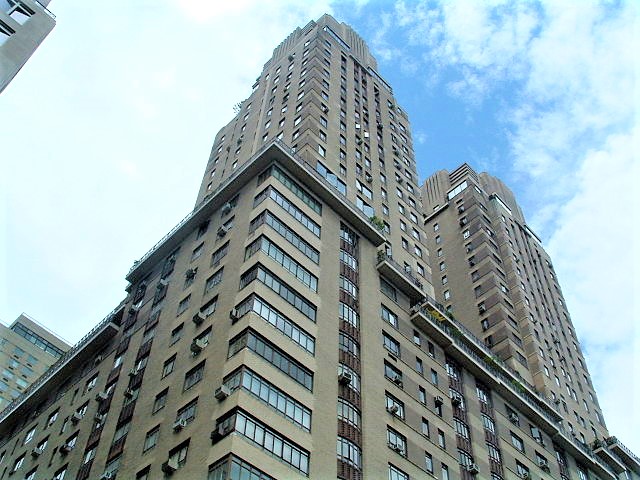
Irwin S. Chanin's 1931 The Century Apartments - 25 Central Park West


photo by Fbv65edel

The massive 1909 Century  Theatre (originally the New Theatre) was sold by the Shubert Brothers in 1929 to the 
Chanin Construction Co., headed by architect/developer Irwin Salmon Chanin.  In fact, on May 28 the Chanin firm announced its intentions to purchase the entire block from 62nd to 63rd, and from Central Park West to Broadway.

Originally, Irwin Chanin announced that his Palais de France would occupy the site--a multi-use building that would include exhibition space, French-based stores, offices of the French consulate, a hotel, and additional office space for French firms.  Chanin traveled to France to negotiate the sale of the site to the Government, but things fizzled.  Instead of the ambitious Palaise de France, Chanin's focus turned to a modern high-rise apartment building.

At the time, Chanin's Art Deco style Hotel Majestic was rising ten blocks north on Central Park West.  Like that building, the Century Apartments (named in honor of the theater), would mark the Central Park West skyline with twin towers.  The 30-story structure brought welcomed jobs to the Depression-crippled construction industry.  On June 21, 1931 The New York Times reported, "At one stage in the steel construction thirty trades were employed simultaneously.  The number of men at work has been 1,050, and at one time there were 1,400 workers."

Chanin stressed vertical and horizonal planes in his Art Deco, or "modern American," design.  The completed building held 417 apartments, many with Hollywood-set-ready sunken living rooms and fireplaces.  Residents had views of Central Park or the landscaped private garden within the U-shaped building.

Irwin S. Chanin was undoubtedly pleased with his latest project, since he and his family were among the initial residents.
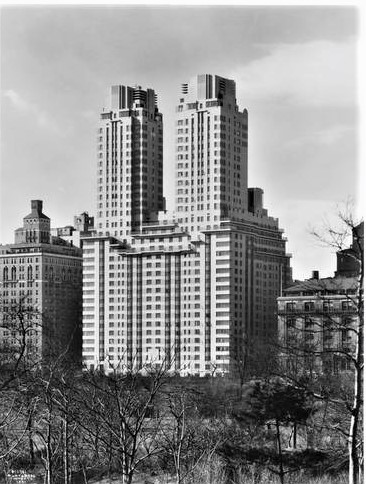
photo by Wurts Bros., from the collection of the Museum of the City of New York

An advertisement in The Princeton Alumni Weekly was entitled, "The Century Has Everything and Central Park."  It touted that the apartments included "such 'Century Specialties' as 3-room duplexes, 2-room and 4-room tower units with 3 exposures, 6-room tower suites with 4 exposures and 7-room corner solarium units facing the Park."  (Those "solarium units" featured imported glass from England that permitted ultra-violet rays to penetrate the interiors.)

Along with the expected bankers and businessmen, the Century Apartments quickly attracted residents from the entertainment industry.  On March 9, 1934 The Sun reported that actress Sally O'Neill had leased a duplex suite.  Largely forgotten today, she was a film headliner, appearing in more than 40 films with co-stars like Constance Bennett and Joan Crawford.

Another entertainer in the building was Ethel Merman, whose career was skyrocketing.  When she opened in Girl Crazy at the Alvin Theatre in 1930, The New Yorker deemed her "imitative of no one."  Sharing her apartment were her parents, Edward  and Agnes Zimmerman.  (Ethel explained to The New York Sun, "Some people think I'm Jewish.  I'm not.  I'm Scotch-German.  Mother is Scotch; father is German.  And Merman was better for the stage than Zimmerman.  So I dropped the Zim.")
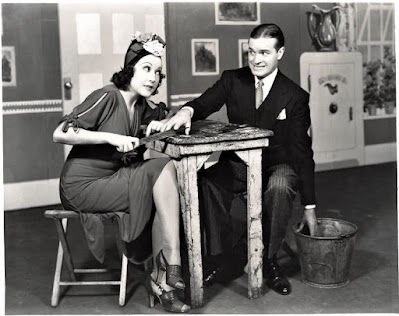
Ethel Merman and Bob Hope on the set of Red, Hot and Blue.  from the collection of the New York Public Library.

Ward Morehouse, The New York Sun's drama critic interviewed Ethel in her apartment shortly after midnight on November 6, 1936, following the opening of performance in Red, Hot and Blue.  Agnes stayed up while he was there, possibly for propriety's sake.  He wrote, "The living room was a flower shop; it had taken three cabs to haul her first-night tributes homeward."

The 28-year-old singer and actress had come a long way in a few years.  Morehouse said, "It's my impression that when Mr. [Vinton] Freedley hired you for your first show, he paid you $350 weekly, but that you now get $3,500 a week."

In typical Merman fashion, she responded, "Something around that.  It's a percentage arrangement.  So far it's worked out all right.  When Vinton told me he wanted me for Red, Hot and Blue I said sure, I'd like to work for him, but he'd have to pay me.  Well, he did...We're giving a swell show right now."  (Merman's Depression Era pay for Red, Hot and Blue would equal nearly $64,500 per week today.)

In 1937 Rose Gershwin, mother of George and Ira Gershwin, moved in.  George had purchased a house on West 103rd Street for the family, but following his death that year the house was sold.  Rose was the sold beneficiary of his estate.  (She died at the age of 71 in her apartment on December 16, 1948.)  

Other entertainment figures followed.  On August 30, 1938 The New York Times announced, "Among those reported as having taken space in the thirty-story Century Apartments, 25 Central Park West, were Graham McNamee, radio announcer, and Al Goodman, orchestra leader.  The former leased a terrace suite on the twelfth floor; the latter a seven-room solarium, facing Central Park."  Al Goodman was one of the most sought-after conductors on Broadway, eventually directing over 150 first-night performances.

Film star Carmen Miranda took a duplex apartment in June 1939.  And on the same day producer and stage manager Bernard Hart signed a lease for a duplex.  Although Hart was overshadowed by his famous playwright brother, Moss Hart, he more than made a name for himself.  Among the hit plays he would manage were My Fair Lady and Camelot.

Film sensation Carmen Miranda leased an apartment in 1939 after the filming of Banana da Terra.  from the collection of the New York Public Library 

Not everyone in the Century Apartments, of course, came from the entertainment field.  In 1940 residents included F. Tirade, president of the Gulf Shipping Company of Mexico; Chester Gash, president of the A. Gash Olive Oil Company; and at least eight physicians.

That year author William March moved in.  The former highly-decorated U.S. Marine was well-known for his parties.  According to biographer Roy S. Simmonds in his 1984 The Two Worlds of William March:

It was here, in Apartment 30-K...that March gave the more flamboyant of his legendary cocktail parties.  Findley McRae, one one occasion arriving early for a party, found in the refrigerator jugs of cocktails which had been mixed the previous day for the large influx of guests...Clay Shaw has also recalled those parties in the "tremendous living room" with its "marvelous view over the Park," and the seemingly inexhaustible jugs of prepared cocktails.

Motion picture actress Elaine Ellis did some entertaining of her own.  On May 13, 1941 Ward Morehouse reported that she "entertained at the Century Apartments for [film director] Jus Addiss and Hayden Rorke.  Guests included Ruth Chatterton, Constance Collier, Shirley Booth, Whitford Kane, Ann Corio, Anthony Brown, John Colton, Alexander Kirkland, Tonio Selwart, Thelma Schnee and Barry Thomson."

Surrounded by high profile residents, the Irwin Chanins led comparatively subdued lives.  Their names appeared in the society columns, however, on June 3, 1951, following the wedding of daughter Doris Joy to Alan Joseph Freeman.  The ceremony took place in the garden of the Chanin country home in New Rochelle, New York.

Abraham "Abe" Bennett Minsky and his brothers were famous for their risque burlesque shows.  The city outlawed burlesque in 1939, essentially putting an end to their careers.  Following Abe's death in 1949, his widow Mollie Minsky moved into the Century Apartments.  Active in Jewish charities and the treasurer of the Burley Amusement Corp., she was unapologetic about her husband's shows.  "Burlesque never hurt anybody," she told a reporter, "Anyone who objects to burlesque, authorities or no authorities, doesn't know what he's talking about."

Irwin S. Chanin was not the only architect in the Century Apartments.  In 1966 architect Robert A. M. Stern and his wife, Lynn, moved in.  In his Between Memory and Invention, My Journey in Architecture, he noted:

In a rental unit I could not make changes to structural walls, but I daringly did as much as possible to express my point of view, commissioning stage carpenters to build a platform over much of the "sunken" living room without damaging the underlying floor.  The platform had the effect of transforming our Central Park-facing casement windows into "French windows" (without any safety rails!) and forming a conversation pit a la Paul Rudolph, focused on the fake fireplace that was building standard.

The renovated Stern apartment.  photo by Hans Namuth via Between Memory and Invention.

Stern's alterations earned a two-page spread by Barbara Plumb in The New York Times on January 29, 1967.

Theater architect Herbert Knapp lived here at the time.  The chief architect for the Shuberts, he was responsible for the Hammerstein Theatre (now the Ed Sullivan) in 1925, and the 1928 Ethel Barrymore Theatre.  He suffered a fatal heart attack in his apartment here on February 16, 1973 at the age of 86.

photo by David Shankbone

In 1976, Sylvia Schofler Chanin died.  Twelve years later, on February 25, 1988, after having lived in his Century Apartments for more than half a century, Irwin Chanin died in his apartment at the age of 96.  Astoundingly, he had gone to his office in the Chanin Building every day until suffering an injury a month earlier.  Chanin had lived to see several of his buildings, including the Century, the Beacon Theater and the Chanin Building designated as individual New York City landmarks.

At the time of Chanin's death, the residents and owners of the Century Apartments had been locked in a heated conflict for about five years regarding conversion to cooperatives.  Then, on February 19, 1989 The New York Times headlined an article "At Last, The Battle of the Century Ends."  Journalist Richard D. Lyons began the article saying, "One of the longest, bitterest conversion fights in Manhattan apartment house history has ended with the imposing Century Apartments...becoming a condominium."  Of the now 410 apartments, 229 had been sold to their occupants at from one-half to one-third the market rate.

The landmarked building continued to attract celebrity residents.  Over the years professional boxer Jack Dempsey, theater mogul Lee Shubert, actors Nanette Fabray, Joey Heatherton, Carol Lawrence and Robert Goulet, and television personage Bill Cullin lived here. 

Classical clarinetist David Glazer and his wife, Mia, were residents in the 1990's and early 2000's, as were actor Kevin Conway and television soap opera star Eileen Fulton.  And in 2010 Dorothy Lichtenstein, widow of the Pop artist Roy Lichtenstein purchased a two-bedroom apartment here.  The sale prompted a headline in The New York Times on February 11, "No Need to Buy Artwork."

photo via realtor.com

Irwin S. Chanin's sleek and imperious Art Deco structure is an integral part of Central Park West's skyline--the backdrop for so many tourist photographs and motion picture scenes throughout the decades.

LaptrihX.com has no authorization to reuse the content of this blog

Tuesday, May 18, 2021

The 1931 Majestic Apartments - 115 Central Park West


Jacob Rothschild's Hotel Majestic, which opened in 1894, spanned the blockfront from 71st to 72nd Street along Central Park West.  For years it catered to well-known residents and transients, like Gustav Mahler, Sarah Bernhardt and Enrico Caruso.  But on December 21, 1928 The New York Times reported that it had been sold and "the buyers will demolish the structure...and erect a tall apartment house."

The massive Hotel Majestic sat across 72nd Street from the Dakota.  from the collection of the Library of Congress

The new owners did not go ahead with their plans, but sold the venerable hotel to the Chanin Construction Company on April 25, 1929.  The firm immediately announced plans to replace it with "a 45-story hotel, to cost $16,000,000," as reported by The New York Times.  Irwin S. Chanin said, "The Hotel Majestic is soon to make way for a structure that will represent a new departure in hotel construction on the upper west side."

He explained, "About one-half of the new structure will be devoted to studio, maisonette and duplex apartments of six to fifteen rooms.  The balance will consist of kitchenette apartments of one to five rooms."  As with all grand residential buildings of the period, it had semi-public spaces--"large dining rooms, a grand ball room and smaller quarters for social activities," according to The New York Times.

Irwin S. Chanin would personally design the building.  He had been greatly influenced by his visit to the 1925 International Exhibition of Modern Decorative and Industrial Arts in Paris.  Now a devotee of "modernistic" architecture, the Majestic would be his first "experiment," as he told architectural historian Andrew Dolkart decades later on June 6, 1985.

The old Hotel Majestic was demolished and construction was underway when the Stock Market crashed.  It resulted in the height being scaled back to 31 floors.  Chanin's streamlined Art Deco building was designed around a central courtyard.  It rose 19 floors at which point it gave way to two soaring towers.  As the building rose, on September 20, 1931 The New York Times commented, "The exterior is of buff brick and stone and red marble.  Suites are from three to fourteen rooms."  The article quoted Irwin S. Chanin as estimating "the building has a life expectancy of at least fifty years."

At the time of the article, residents had been signing leases for months.  On April 26, 1931, for instance, The Times-Union of Albany, New York reported that playwright Harry Herschfield and impresario S. L. Rothafel "will live in the new Majestic apartments on West 72d st."

Samuel Lionel "Roxy" Rothafel was famous in theatrical circles for his sumptuous presentation of silent films and his magnificent theaters--most notably the Roxy Theatre on Times Square and Radio City Music Hall (still under construction at the time).  The New York Times described his new 16th-floor apartment as having 10 rooms, a 60-foot terrace, "and sixteen windows facing the park."

Early in 1932, as the building prepared to open, Bruno Richard Hauptmann was hired as the building's carpenter with a salary of $100 per month (about $1,870 today).  Surprising his employers, on April 2 he suddenly quit his job.   

As it turned out, April 2, 1932 was also the date that Dr. John F. Condon paid a kidnapper $50,000 ransom for the return of aviator Charles A. Lindbergh's baby.  The Majestic's management and its residents were no doubt shocked to read of Hauptmann's arrest in 1934 for the kidnapping and murder of the 20-month-old.

Bruno Richard Hauptmann's mugshot -- Fleming Police Department records

During the "trial of the century," Dr. Conlon positively identified Hauptmann as the man to whom he had handed over the ransom money.  Hauptman swore that he was at work at the Majestic Apartments on the day of and after the kidnapping, and that he and his wife had friends over on the night of the ransom transfer.

But on April 5, 1936 The Times-Union reported, "With swift, sure, swinging strokes, the Attorney General brought Hauptmann's elaborate, ornate alibi crashing to earth.  The carpenter asserted he was working in the Majestic apartments on the day before and after the baby was stolen and slain.  Records of the building proved him a liar."

Although Hauptmann professed his innocence to the end, he was convicted and on April 3, 1936 was executed in the electric chair.

In the meantime, the Majestic Apartments continued to attract both wealthy and well-known residents.  Comedian and actor Jimmy Durante signed a lease in 1933--the same year that a terrifying fire broke out in the 10-floor apartment of Dr. Edward Sanders.  Eleven fire fighters became trapped in the blazing apartment "when their escape was cut off," according to the New York Sun on March 6.  They were, thankfully, rescued by two other firemen.  The fire extended to an adjoining apartment and one on the 11th floor before being extinguished.

Residents routinely appeared in society columns for weddings, dinner parties and other entertainments.  Such was the case on October 31, 1935 when The New York Times reported, "Mr. and Mrs. Edward H. Davis gave a farewell dinner last night at their home, 115 Central Park West, for Mme. Alfredo Zayas, widow of the former President of Cuba."


In December 1938 architect Sylvan Bien was commissioned to make $30,000 in renovations to the Majestic.  The New York Sun explained "the number of apartments are to be increased from twenty-two to thirty-three on the nineteenth to twenty-ninth floors" and "eight apartments also are to be created on the thirtieth and thirty-first floors."

Screen and stage actor Victor Frederick Moore moved into the Majestic  in November 1938.  Another well-known resident at the time was Florentine Scholle Sutro, the widow of banker and philanthropist Lionel Sutro who had died in 1931.  Described by The New York Times, as "A leader, in many cases a pioneer, in a large number of important civic and culture movements," Sutro had been a member of the peace delegation in Buenos Aires, was the chairperson of the Women's International League for Peace and Freedom, and the New York chairperson of the League for a Woman for President.

A less illustrious resident was Frank Costello.  Born Francesco Castiglia in Italy in 1891, he was an Italian-American crime boss and the head of the Luciano crime family.  

In 1944 he was subpoenaed to testify in the city's proceedings to revoke the cabaret license of the Copacabana Club.   On September 15 The New York Sun reported, "The service of the subpoena on Costello was not accomplished without a good deal of effort.  Detectives hovered around his home at 115 Central Park West throughout the night and also visited his favorite haunts, but without avail."  Finally, at 8:40 that morning detectives caught him as he was leaving the Majestic.

Costello spent extended periods away from his apartment here.  During the 1950-51 Senate Kefauver Hearings on organized crime, he was convicted of contempt and sentenced to 18 months in prison.  In 1952 the Government began proceedings to strip him of his U.S. citizenship and he was indicted for tax evasion, sentenced to five years in prison and fined $20,000.  Between 1952 and 1961 he was imprisoned numerous times, always managing to be released on bail on appeal.

Frank Costello testifying before the Kefauver Committee.  photograph by Al Aumuller from the collection of the Library of Congress

On the evening of May 2, 1957 Costello and his wife, Lauretta, had dinner at an Upper East Side restaurant with theatrical agent William Kennedy and Generoso Pope, owner of an Italian-language newspaper.  Lauretta and Generoso remained  behind while Costello and Kennedy left.  Kennedy dropped Costello off in front of the Majestic around 11:00 and he was just entering the lobby when, according to The Times Record, "a black sedan stopped at the curb."  According to the doorman, Pete Keith, "a heavy-set man about 6 feet tall rushed by him and into the lobby."  The article continued, "The gunman fired while about 15 feet from Costello, the doorman said, then dashed past him to the black sedan, which raced from the scene."

The 65-year-old gangster was shot in the head, but miraculously was not killed.  The bullet "furrowed under the scalp partway around the back of the head and emerged close to the right ear," said detectives.  Costello cried out, "Somebody tried to get me!" and later told reporters, "I don't know why I was shot.  I must have been mistaken for somebody else."

The hit had been ordered by mobster Vito Genovese and the gunman was Vincent Gigante.  Costello's close call convinced him to relinquish control to Genovese, although he remained influential in the New York City Mafia.  He and Lauretta continued to live on in their Majestic apartment. 

On February 8, 1973 Costello suffered a heart attack in the apartment and was taken to Doctors Hospital.  Eleven days later The New York Times reported, "Frank Costello, the racketeer who survived gang bullets and safely maneuvered himself through complex trials and deportation hearings, died yesterday morning of a heart attack.  He was 82 years old."

In November 1997 Ian Schrager, hotelier and former owner of Studio 54, purchased two apartments in the Majestic for a total of $9 million (more in the neighborhood of $14.3 million today).  The combined apartment engulfed 6,000-square-feet and had three terraces, one of which extended 75-feet along the living room.  According to The New York Times on November 27, "the 14-room combination has five bedrooms, six and a half bathrooms, a living room, a drawing room, two galleries, two dining rooms, two kitchens, two fireplaces and several servant's rooms."  Schrager hired French industrial architect and designer Philippe Starck to handle the interior design.  

After being married for two decades, billionaire financier George Soros and Susan Weber Soros divorced.  The founder and director of the Bard College Graduate Center for Studies in the Decorative Arts, Design and Culture, Susan Soros purchased the former Schrager apartment a year later, in June 2006.  The New York Times reported, "Ms. Soros said the apartment retained the interior design carried out for Mr. Schrager by Phlippe Starck.  She said she was not sure if she would leave it as is or do a renovation."

Another recognizable resident was television host and comedian Conan O'Brien.  His duplex contained seven bedrooms, eight-and-a-half bathrooms and three terraces.  In 2010 his position as host of "The Tonight Show" came to an end, The New York Times reporting, "Mr. O'Brien walked away with a $45 million settlement, some $33 million for himself and the rest for his staff."  A few months later O'Brien sold his duplex to David M. Zaslav, CEO of Discovery Communications.  The price tag was $25 million.

Susan Weber Soros "is downsizing and making a clean break," said The New York Times on October 25, 2012.  She had sold her sprawling "elegantly appointed" apartment for $50 million.  As far as the Philippe Starck interiors, Soros "has made significant renovations and updates to the décor," said the article.


Irwin S. Chanin's striking, streamlined Art Deco Majestic Apartments--which he predicted would last 50 years--is as illustrious an address today as it was in 1932.  Its presence is an integral part of the cityscape of the western hem of Central Park.

photographs by the author
LaptrihX.com has no authorization to reuse the content of this blog