Friday, November 24, 2023

The 1927 Park Avenue Synagogue - 50 East 87th Street


On June 5, 1926, The Reform Advocate began an article saying, "'There are considerably fewer Synagogues in New York today than there were forty years ago, although the number of Jews here has increased greatly,' Dr. Stephen S. Wise, rabbi of the Free Synagogue, said last Sunday at the laying of the cornerstone of the new Park Avenue Synagogue, 50 East Eighty-seventh Street."  Ground for the structure had been broken a year earlier and construction would be completed in 1927.

The congregation had its roots in the immediate neighborhood, having been founded in 1882 as Temple Gates of Hope, known familiarly as the Eighty-Sixth Street Temple.  In 1896 the congregation merged with Congregation Agudat Yesharim, and in 1920 joined with the Seventy-Second Street Temple.  The congregation's name became the Park Avenue Synagogue in 1923.

The architectural firm of Deutsch & Schneider received the commission, with Walter S. Schneider taking the lead.  Although the Gothic style had been avoided in Jewish ecclesiastical architecture for decades because it was so favored in Christian churches, Schneider gave subtle Gothic touches to his Moorish design--like the noticeably pointed main arch.

Faced in cast stone, the facade was dominated by that triple-height arch, within which three entrances stood above a broad stone staircase.  The upper hem of the arch was emblazoned with the inscription that translates to "I Love Your Temple Abode, The Dwelling-Place of Your Glory."  A handsome, blind arcade of engaged columns ran below the gabled roofline.  

photo by Wurts Bros. from the collection of the Museum of the City of New York

The magnificent new shul had not come cheaply.  The New York Times reported on September 18, 1926, "The building is being erected at a cost of $280,000, while the land is worth $240,000."  The combined costs would equal about $8.6 million in 2023.   It opened in 1927 with an auditorium capable of accommodating 1,200 worshipers.

photo by Wurts Bros. from the collection of the Museum of the City of New York

The seating capacity was insufficient for those wishing to attend the funeral of attorney Maurice Bloch on December 8, 1929.  One of the shul's most prominent members, he had been the Democratic minority leader in the State Assembly.  The Jewish Telegraphic Agency reported, "Before and during the services in the temple, a crowd of several thousand persons stood in the street outside, completely filling Eighty-seventh Street from Madison to Park Avenue.  A detail of 120 patrolmen, besides the regular motorcycle escort, was necessary to marshall [sic] the throng."

The Troy Times said, "Two thousand persons crowded into the Park Avenue Synagogue and thousands more, unable to gain entrance, stood reverently in the streets outside."  The New York Evening Post added, "Governor Roosevelt, former Governor Alfred E. Smith, Mayor Walker, Senator Robert F. Wagner and Acting Governor Herbert H. Lehman were among the honorary pallbearers at the funeral."  The eulogy was delivered by Rabbi Stephen Wise, who had also been a close friend of Bloch.

It was most likely after much discussion that the congregation changed from Reform Judaism to Conservative in the early Depression years.  It was a response to the shul's merger with other congregations composed of many Eastern European Jews.

photo by Wurts Bros. from the collection of the Museum of the City of New York

On May 27, 1934, Senator Royal S. Copeland addressed Jewish war veterans here.  The New York Sun said he, "appealed to them to enlist in the battle that the police are making to exterminate the 'traitors of the government which has given them the protection of its laws.'"  At the time, another threat was brewing across the ocean.

That threat had become exceedingly clear by November 19, 1937 when The New York Sun reported, "Dr. Joachim Prinz, former Berlin rabbi, who fled Germany last year, will be the guest speaker at the 8:15 o'clock service tonight at the Park Avenue Synagogue...The subject of his talk will be 'Why Hitler Is Not Overthrown.'"

The horrors of the Nazis left little trace of what had been thriving Jewish communities.  Following World War II, British Jews discovered sacred relics in the ruins of synagogues--Torah scrolls, ceremonial objects, and prayer books, for example.  Edward F. Bergman, in his 2001 The Spiritual Traveler, writes:

At the front of the sanctuary of Park Avenue Synagogue, a case holds Torah scroll Number 375, written by a scribe at the end of the eighteenth century and treasured at the synagogue in Horazodvice, Czechoslovakia, until the synagogue was destroyed and its members killed in 1942.  A tablet beneath the scroll quotes Deuteronomy 25:17, "Remember what Amalek did unto thee..."  Amalek harried the Jews as they left Egypt under Moses, and he represents all evil men.

With the war's end, the congregation turned to happier things.  In 1942 Cantor David J. Putterman established an annual tradition of highlighting works by contemporary composers.  
On March 3, 1946, for instance, The New York Sun reported, "Cantor David J. Putterman will present a Service of Liturgical Music by Contemporary Composers at the Park Avenue Synagogue next Friday." 

The following year, on April 28, 1945, The New York Sun announced, "Cantor David J. Putterman will present new compositions by thirteen contemporary composers" on May 11; and on April 29, 1947, The New York Times reported, "Nine composers have written works especially for the fifth annual Sabbath eve service of liturgical music by contemporary composers that will be presented on Friday night by the Park Avenue Synagogue."  The article noted, "Cantor David J. Putterman will be in charge of the program, which will be performed by the synagogue choir and the Hebrew Art Singers."  Over the years composers like Leonard Bernstein, Morton Gould, Darius Milhaud and Lukas Foss wrote music for services here.

Dr. Milton Steinberg had been rabbi of the Park Avenue Synagogue since 1933.  The scholar was the author of A Partisan Guide to the Jewish Problem, As a Driven Leaf (a philosophical novel), The Making of a Modern Jew, and Basic Judaism.  He was, as well, a member of the editorial board of The Reconstructionist, and contributed articles on Jewish problems and issues to various periodicals.  He died on March 20, 1950 at the age of 46.

An addition to the synagogue was erected in Rabbi Steinberg's memory, known as the Milton Steinberg House.  Designed by Kelly & Gruzen, it featured an extraordinary stained glass wall designed by Adolph Gottlieb.  On August 30, 1954, syndicated columnist Meyer Berger wrote, "The report last week that artisans were putting up an all-stained-glass facade at the Steinberg house, 50 East Eighty-seventh Street, led some people to wonder where stained-glass workers were to be found in mid-twentieth-century New York."  The article said Otto W. Heinigke had been working with stained glass since 1890.  The building was opened on September 19, 1954, its completed facade consisting of 91 Gottlieb-designed panels.

Steinberg House.  from the collection of the Gottlieb Foundation

The 75th anniversary of the congregation was celebrated on March 31, 1957 in an striking display of religious unity.  The New York Times reported, "Protestants, Roman Catholics and Jews paid tribute yesterday to the Park Avenue synagogue, 50 East Eighty-seventh Street."  The article continued, "Delegations from neighboring Presbyterian, Baptist, Unitarian and Catholic churches were scattered through the congregation, as well as representatives from several New York synagogues."

On May 28, 1965, former President Dwight D. Eisenhower worshiped with the congregation on the 20th anniversary of the liberation of concentration camps by troops under his command.  

A moving address was made here on December 5, 1994 when the Rev. Jesse Jackson condemned what he termed the "repressive" California anti-immigrant initiative.  The state's Proposition 187 denied education to children of undocumented immigrants.  Newsday reported, "He told the crowd that if it was wrong for America to turn its back on a boatload of Jewish refugees in 1939, and to round up 120,000 Japanese-Americans during World War II, and to turn back Haitian boat people in 1991, 'then it is racist and wrong to deprive Latino children of an education and health service in 1994.'"

Regrettably, in 1980 the unique Milton Steinberg House was dismantled.  Some of the panels were preserved and reused as clerestory windows in the replacement structure.


According to Edward F. Bergman, the Park Avenue Synagogue "is New York's largest and one of its leading Conservative synagogues."  

photographs by the author
no permission to reuse the content of this blog has been granted to LaptrinhX.com

Thursday, November 23, 2023

John G. Rohr's 1826 506 Canal Street


The proposal of the Board of Trinity Episcopal Church to develop an area along Hudson Street north of the city in 1802 was met with skepticism and derision.  What would become St. John's Park was at the time a reed-filled bog, overrun with mosquitoes and snakes.  But the Church forged on and the problem of the "sluggish stream" that fed the swampy, marshy Lispenard Meadows was soon dealt with.  

In 1809 excavation for an eight-foot-wide drainage canal was begun.  It was completed in 1811 and covered over in 1819, creating an especially broad, 100-foot-wide roadway.  With the marsh gone, development along Canal Street followed.  Among those taking advantage of the new opportunity was the German-born merchant tailor John G. Rohr, who erected several properties on both sides of the thoroughfare.

In 1826 he completed five similar brick-faced homes on the south side of Canal Street, just west of Greenwich Street.  The eastern-most was 239 Canal Street (renumbered 506 in 1860).  It exhibited expected elements of the Federal style--Flemish bond brickwork and paneled brownstone lintels, for instance.  But what made its design stand out was the ground floor store front.  Considered by architectural historians to be (almost assuredly) original, its series of brownstone arches frame two shop windows and two entrances--one to the store and the other to the residential space upstairs.  The multi-paned windows and elegant paneled pilasters gave the storefront a Dickensonian feel.

While his family lived at 243 Canal Street (later 510), Rohr opened his tailoring establishment in the ground floor here.  An advertisement in the New York Morning Courier in 1828 read:

Clothing Emporium, 239 Canal-street  —The subscriber has a Clothing Store at the above place where clothing of every description is made to order, at the shortest notice, and where he offers for sale fine and superfine blue, black, mixed, drab and olive Broadcloths and Cassimeres. Also, a great variety of the richest patterns of Valencia, and black figured Silk Vest Patterns, well worthy the attention of merchant tailors. N. B. Also, just received, a variety of first quality of English Mole Skins, or Fustians, for sale as above at very low prices.  - John G. Rohr

For some reason, Rohr removed his tailoring business in 1829, and leased the building to John Y. Smith, a starch and hair powder manufacturer, who had built and occupied the structure steps away at 235 Greenwich Street.  He transferred title of that property to Alonzo Alwyn Alvord and moved his family and business to the Rohr building.  In October 1829, he exhibited his wares at the American Institute's fair in Masonic Hall.  He was awarded a Discretionary Premium for the "best Starch and Hair Powder."

Smith's leasing of 239 Canal Street was most likely always intended to be temporary.  In 1830 John G. Rohr not only re-opened his tailoring business on the ground floor, but moved his family into the upper portion of the building.  Conditions within the house must have been snug.  Rohr and his wife Rebecca had four adult children, Rebecca, George (who worked in his father's tailoring business), John B., and Hannah.  They all lived here along with their own families.  (Rebecca and her husband Baltus Segee, who was a saddler, had two children; and there were five other grandchildren ranging from 6 to 15 years of age).  Additionally, a 35-year-old Irish servant, Catherine Brickham lived in the house.

By 1849, the Rohr population upstairs had thinned to the point that Elizabeth Mountford and her two adult sons Daniel and Peter took rooms.  The brothers opened what was originally called P. & D. Mountford, a stationary and book store, in the former Rohr tailor shop.

Among the Rohrs still living here were Rebecca and Boltis Segee and their children, and John B. Rohr and his family.  On September 6, 1850, John left the house and walked to Chambers Street.  When he got there he realized he had lost his firearm.  His ad in the New-York Daily Tribune four days later offered:

$10 Reward--Or $5 that will lead to the recovery of a double barrel gun lost on Friday morning Sept. 6, in going from 239 Canal-st. through  Washington to Chambers-st. inclosed [sic] in a leather covering with the owner's name partly erased on the guard.  The finder will receive the above reward by leaving it with the subscriber, at 239 Canal-st.     John B. Rohr

It was a valued weapon, and Rohr's reward would equal about $385 in 2023.

In 1840 the first mass produced Valentine cards were introduced in America and the public soon embraced the tradition.  They were embellished with real lace and satin ribbons.  The Mountfort brothers took advantage of the fad.  On February 9, 1851 they advertised:

                                                    VALENTINES AT 239 CANAL ST.

 The Proprietors beg leave to state to their numerous friends and patrons, that they have the best selected stock of Valentines ever offered to the American public, got up, not by travelling in the old countries, but by the best connoisseurs in that line of business in this or any other country.  They will also deliver them promptly, when requested so to do.  Remember the place.        MOUNTFORD & BROTHER, 239 Canal St., near Clinton Market.


In 1853 Rohr sold 239 Canal Street to Carsten Sierck.  He continued leasing part of the upper portion to Boltis and Rebecca Rohr Segee.  His other upstairs tenant was Richard H. Daily, who listed his profession as "agent."  The former bookstore became a ticket office for the Hudson River Railroad.

The last of the Rohr family had left 239 Canal Street in 1857 when Charles Schnibbe ran the upper floors as a boarding house.  Among his residents that year was shoemaker John Mebs.  By 1859 James Scott had taken over the shop for his "iron furniture" store.  (Cast iron settees, tables and chairs were popular not only for gardens and lawns, but for conservatories.)

The upper portion of the house continued to be operated as a boarding house for decades and, expectedly, it saw a variety of boarders come and go.  Living here in 1867 were Ellen and Patrick Gray, who worked at the nearby Clinton Market--she as a "huckster" (a seller of small goods) and he as a provisions merchant.  Also in the house that year were Henry J. Hollmann who was in the liquor business on Centre Street; and Joseph Schoenberger, who ran a saloon.  (The two may have worked together.)

Tragedy visited 506 Canal Street in 1873.  Living here at the time was Anna Creemer, the widow of John Creemer, who worked as a baker; and Henry and Margaret E. A. C. Wellbrook.  The Wellbrooks welcomed a daughter, Adelaide M. on December 5, 1872.  The infant died six months later, on May 24, 1873.  Her funeral was held here two days later.

After having owned the property for half a century, the Sierck family sold 506 Canal Street in 1907 to Samuel Weil, who already owned 504.  (In 1909 he would buy the former John Y. Smith building on the corner.)

The occupants of 506 Canal Street were working class in the first half of the 20th century, like Joseph Souza who worked as a water tender aboard the steamship Auditor.  On September 11, 1920, he got into a confrontation in a restaurant in the Red Hook district of Brooklyn, near the waterfront.  The Brooklyn Standard Union reported, "Frank White...alleges Souza threw two cups at him, one of which inflicted a deep cut in his head."  

image via the NYC Dept of Records & Information Services.

Souza was arrested for felonious assault and released on bail.  But, nearly a year later, on August 26, the newspaper reported that Joseph Souza, "who skipped $500 bail," had been rearrested.  Not only had he been arrested again, but it was by the same detective, Thomas Croak, who had arrested him the previous year.  This time he was held without bail.

Through some miraculous happenstance, the unique storefront of 506 Canal Street was not disfigured or replaced.  In 1990 the Ponte family of Ponte Equities owned 502, 504 and 506 Canal Street.  In almost every case when real estate firms accumulate abutting properties, a redevelopment is in the near future.  But each of the venerable structures was preserved.


Today there are two apartments per floor above the storefront at 506 Canal Street.  It survives as a wondrous anachronism within the bustling Holland Tunnel district.

many thanks to historian Anthony Bellov for suggesting this post
photographs by the author
LaptrinhX.com has no authorization to reuse the content of this blog

Wednesday, November 22, 2023

Emery Roth's 1925 Buckingham Hotel - 101 West 57th Street

 
image via estellepascoe.com


In 1922, the doors of the upscale Buckingham Hotel on Fifth Avenue were closed forever.  The building was demolished to make way for the Saks Department Store.  A year later, developers Uris Brothers commissioned Emery Roth to design a new Buckingham Hotel at Sixth Avenue and 57th Street.  The 57-year-old architect was quickly becoming one of the most influential apartment house designers of the period.

Roth's Renaissance Revival design included double-height arcades at the 12th- and 13th-floors decorated with engaged terra cotta columns and elaborate Renaissance style spandrels and tympana.  A bracketed cornice originally crowned the 15th floor.  Opened in 1925, the Buckingham Hotel accommodated both transient guests and permanent residents.  For families who needed additional space for servants, maids rooms were available on the second floor.  A lavish penthouse and a "sunparlor" occupied the 16th floor.

Among the initial residents were Andre David and his wife, who lived on the sixth floor.  An importer, he sailed to Europe on business late in 1925.  On December 10, Mrs. David took in a Broadway show.  In her absence, thieves climbed the scaffolding of buildings being demolished next door and reached her windows.  The New York Sun reported they "rifled her bureau and closets and stole $5,000 worth of jewelry and furs."  The loss would equal about $83,500 in 2023.

Alphonse G. Kaufmann and his wife were also original residents.  He was the manager of the Great Northern Hotel on West 56th Street.  Among their neighbors was Bruce Edwards and his Airedale Terrier.  Disregarding their lease, the Kaufmanns moved out on February 1, 1926, leaving unpaid rent of $805.  The hotel sued and the case landed in court on May 17.

Kaufmann's defense was that he had been technically evicted.  He had complained repeatedly, he said, that Edwards's dog barked "day and night"  He was unable to sleep, and "it was so bad that it drove his wife almost into hysterics."  Management's failure to correct the situation "constitutes a technical eviction," alleged Kaufmann's attorney, Sheridan Abels.

Bruce Edwards and his dog were brought into the courtroom "to prove its good manners," reported The New York Times, "and while the lawyers argued, it wagged its tail in evident enjoyment.  It did not bark."  Sheridan Abels was quick to point out to the court that the dog was muzzled.  In the end, the jury sided with the defense, ruling that the Kaufmanns had been evicted.  They did, however, award the hotel $55 "which Mr. Kaufmann owed for meals and incidentals."

Buchanan Schley, Jr. was a respected member of the New York Cotton Exchange.  Living in the 15th-floor apartment with him and his wife, the former Nathalie Selbie, was their son, Buchanan Schley, 3rd.  The senior Schley died "suddenly" in the apartment on November 14, 1926.  (The term often suggested a heart attack.)  His funeral was held in St. Thomas's Church on Fifth Avenue two days later.

Four months later, on March 6, Buchanan Schley emerged from his bedroom around 7:00.  The New York Sun reported, "He looked for his mother and found her room unoccupied, as were other rooms in the suite. Then he discovered that a window in his mother's room was open. Looking down he saw her body on the roof extension." 

Suicide in the 1920s still carried the stain of disgrace for well-to-do families.  In almost every case, attempts at damage control were immediate.  Buchanan said his mother had been in good spirits the evening before, and the hotel manager "pointed out that the low sill of the window of her room made it possible that she had fallen."  One of Buchanan's former classmates, John P. East, told The New York Sun he believed "that she had perhaps found the room too warm, had opened the window and leaned out for air and had lost her balance."

In April 1928, John Gellatly moved into the Buckingham Hotel.  His wife, the former Edith Rogers, had died on July 17, 1913, leaving a collection of more than 200 paintings, including works by Frederick S. Church, Augustus Saint-Gaudens, Albert P. Ryder and Abbott H. Thayer.  

Gellatly had continued to collect and, according to the Catalog of American and European Paintings in the Gellatly Collection of the Smithsonian Institution, "In the 1920's the importance of the collection was greatly increased by the addition of many outstanding items."  On May 12, 1929, just before the onslaught of the Great Depression, Gellatly donated his entire collection, valued at the time at $5 million (closer to $85.5 million today) to the National Gallery of the Smithsonian Institution.

In September that year, the 77-year-old Gellatly married Charlyne Whitley in Maryland.  His bride was 34.  He did not mention to her that he had given away his massively valuable art collection.  Two years later, on November 9, 1931, The New York Times reported, "John Gellatly, who spent his life and his fortune collecting rare objects of art...died of pneumonia yesterday in the Medical Arts Hospital."

The art collector's body was barely cold when his widow Gellatly took action.  In the same issue that told of Gellatly's death, The New York Times reported that Charlyne Gellatly intended to "appeal to Congress to reject the collection which it accepted in 1929...If her appeal fails, she said she would retain lawyers to protect her interests."  She alleged that her elderly husband had donated the collection "to pose as a philanthropist."

On September 5, 1930, The New York Sun reported, "Mme. Schumann-Heink has taken an apartment in the Hotel Buckingham, 101 West Fifty-seventh Street."  Born Ernestine Amalie Pauline Rossler in 1861 in Lieben, Bohemia (today's Prague), Madame Schumann-Heink was best known for her performances of Wagnerian roles.  Her first appearance at the Metropolitan Opera House was in 1899 and she still regularly appeared there.  Her singing of Stille Nacht ("Silent Night") on the radio every Christmas Eve had been a tradition since 1926.

Madame Schumann-Heink at a war rally in 1917.  from the collection of the New York Public Library

The repeal of Prohibition was highly celebrated by hotel managers throughout the country, including Edward Farrel of the Buckingham.  On February 27, 1933, The New York Evening Post reported, "A tap room has been opened in the Hotel Buckingham, 101 west Fifty-seventh Street. From old-fashioned bar to accordion music the rathskeller was complete."  The article quoted Farrel as predicting, "the tap room--a hotel tap room--would grease the skids that would put the speakeasy out of business, restore beer-drinking to respectability and bring prosperity back to the hotels."

In 1938, another venue was opened, the Crown Room.  An advertisement said it provided "wired music for dancing."  Supper "with favors" cost $2.50 (about $52 today).

The hotel often hosted well-known transient guests.  On October 16, 1940, for instance, the Herald-Tribune reported, "Artur Rubinstein, Polish pianist, and his wife were released from Ellis Island yesterday and have gone to the Hotel Buckingham, 101 West Fifty-seventh St."  The article explained that when they arrived a few days earlier, their seven-year-old daughter, Anna, was diagnosed with chicken pox.  She and her brother, Paul, who was five, were kept in the Ellis Island Hospital for observation.

Pianist and composer Ignazy Paderewski made the Buckingham Hotel his home during his 1941 tour.  It was here that he fell ill on June 27 that year, and died at the age of 80 two days later.

Journalist and short story writer Damon Runyon moved into the Buckingham Hotel in 1943.  His second wife, Patrice Amati del Grande, was in London at the time.  In April the following year, Runyon was stricken with a sharp pain in his throat.  He later wrote that in that instant he remembered his first cigarette.  Jimmy Breslin, writing in Newsday years later, said, "He figured he was 9 or 10, certainly not much older."

On April 10, surgeons removed a large tumor and a lymph node from his throat, leaving him no longer able to speak.  When he returned to the Buckingham Hotel after his recuperation, he received a letter from Patrice that revealed her romance in London with a 26-year-old named Bill Coffin.  It said in part, "He's wonderful.  And I hope to marry him.  Do take care of yourself."  Runyon replied, pleading for her to reconsider, but she went forward with the divorce.  

Alfred Damon Runyon (original source unknown)

On December 6, 1946, Runyon, weighing just 100 pounds, left the Buckingham Hotel for the last time.  Taken to Memorial Hospital in great pain, he fell into a coma and died there on December 10.  Jimmy Breslin wrote, "Two days later, Eddie Rickenbacker flew a plane over New York, with Mike Todd, a producer, and Damon Runyon Jr. in it.  When the plane was directly over Times Square, the son shook Runyon's ashes over the Big Street."

Pianist Van Cliburn added to the list of celebrated residents when, according to Nigel Cliff's Moscow Nights, he moved in by the spring of 1955. 

A single line from Adrian Mourby's Rooms of One's Own, 50 Places that Made Literary History, mentions that nearby the Buckingham was where "Georgia O'Keeffe and Marc Chagall had at various times been Runyon's neighbours."  That citation has led to the apparently erroneous retelling on the internet that those illustrious figures lived in the Buckingham.  

As the 21st century dawned, Manhattan saw a flush of hotels being converted to condominium residences.  In reporting on the trend, Newsday reported on July 22, 2005 that the Buckingham Hotel "is actually benefiting from the conversions."  The demand for rooms prompted the hotel to add to its staff.  The article noted, "The neighborhood around the Buckingham has lost four hotels in the last 18 months...The hotel's 30 employees soon won't be enough."  

Three months earlier, on April 17, The New York Times reported, "At the Buckingham Hotel, on 57th Street...the operator has recaptured its rooftop Martinelli Penthouse--named for the renowned tenor Giovanni Martinelli, who lived there for many years--from a long-term lease.  The space has been refurbished, and it is being offered for meetings and conferences."

Change came in 2023 when a two-year renovation by Perkins Eastman resulted in the Buckingham Hotel's becoming The Quin, an upscale hotel.  Other than redesigning the entrance and removal of the terminal cornice, Emery Roth's facade was left mostly intact.  The hotel includes the Quin Arts Program, which provides contemporary artists residencies while they work with curator DK Johnston.


Enigmatic brick letters A C C are emblazoned on the northern edge of the building.  photos by Claudia Keenan

The great enigma of the structure are the initials A-C-C executed in brick along the northern edge of the upper facade.  The monogram has no connection to Uris Brothers, the architect, nor seemingly any subsequent renovations.  

photo by Jim Henderson

many thanks to reader Claudia Keenan for prompting this post
no permission to reuse the content of this blog has been granted to LaptrinhX.com 

Tuesday, November 21, 2023

The James Morris Leopold House - 347 West 84th Street


In 1888, Nathan Murray began construction of the first house on the West 84th Street block between Riverside Dive and West End Avenue.  Designed by Joseph M. Dunn, 347 West 84th Street was completed the following year, its three-story, brownstone clad facade reflecting the currently fashionable Queen Anne style, splashed with neo-Grec touches.

The high stone stoop led to an impressive portico with banded Corinthian columns and pilasters.  The two parlor windows were united by a single frame and separated by fluted Corinthian pilasters.  Their single, triangular pediment was filled with a carved sunburst--a common Queen Anne element.  The upper story windows sat within architrave frames, with those of the second floor wearing pediments that echoed those of the doorway and parlor window.  An ornate pressed metal cornice topped the design.

The 18-foot-wide house was purchased by real estate operator Frank N. Gill, perhaps best known for erecting the Gill Building at 9-13 Maiden Lane.  He leased the house for several years before selling it to James Morris Leopold and his wife, the former Florence Rosetta Kohn, on November 29, 1897.

Born in Cincinnati, Ohio in 1860, Leopold was the head of the banking and brokerage firm James M. Leopold & Company.  He and Florence had four children, James Jr., Florence Henriette, Leopold, and Jane Rose.

(original source unknown)


Leopold's brother, Alfred, was a partner in James Leopold & Co.  He went to police headquarters in 1901 to file a complaint against a new client.  On May 6 Theodore Barron's check for $11,190 was returned by his bank marked "N.G." (no good).  The 38-year-old was arrested on May 14.  The Leopold brothers were not eager to speak about the incident.  The New York Times reported, "At the home of James M. Leopold all information was refused, reporters being told to go to the house of Alfred M. Leopold."  There the journalist was told that Alfred "would not return during the night, as he would stay at a hotel for the night."

Leopold sold 347 West 84th Street to George W. Thedford around 1908, who quickly resold it to Otho Sprigg Cockey and his wife in March 1909.  Cockey, whose family had deep American roots, was the general agent of the Grand Trunk Railway System.  

A year before moving into the West 84th Street house, Cockey was called as a potential juror in the most sensational murder case of the day--the trial of Harry Kendall Thaw, who had fatally shot architect Stanford White.  But, according to The Evening World, “The fact that Otho S. Cockey...had been associated with Thaw’s father in business barred him.”

The Cockeys beloved pet, a French bull terrier, ran off in the spring of 1913.  They wasted no time in offering a reward for her return.  On April 26 a notice in The New York Times read: 

STRAYED from 347 West 84th St., at 8 o'clock this morning, small toy, dark brindle French bull bitch; answers to the name of 'Wiggles'; liberal reward.  O. S. Cockey. 347 West 84th St.

It is unclear if Wiggles ever came home.

The Cockeys were at White Sulphur Springs, West Virginia on May 9, 1915 when Otho died.  His body was brought back to 347 West 84th Street where his funeral was held three days later.

Cockey's widow remained in the house for several years, then leased it.  On September 2, 1920, the Musical Courier reported that Adelaide Gescheidt had "added more space for her teaching facilities by taking the house at 347 Wet Eighty-fourth street, New York, retaining her main studios at 817 Carnegie Hall."

Born in Mount Vernon, New York in 1877, Gescheidt had been an operatic soprano.  Her stage career ended when, as she recalled in her 1930 book Make Singing a Joy, she "met with a serious accident to my neck by falling from an awkward height across a steel bar."  Now, she turned to coaching opera and concert singers whose voices had been damaged by "injury, illness, or other defects."

Adelaide Gescheidt, Musical Courier, November 23, 1922 (copyright expired)

On June 26, 1920, three months before Gescheidt leased 347 West 84th Street, Nina Teresa Melville was married to Gould Thorp Miner in Massachusetts.   Now, after their honeymoon, they subleased rooms from Adelaide Gescheidt.

The young groom had served in the navy during World War I.  He was now associated with the Bankers Trust Company.  They, like their landlady, rubbed shoulders with polite society.

On May 27, 1921, the New-York Tribune reported that the Miners had welcomed their first child, Olive Emelie.  The article noticed, "Mr. and Mrs. Miner will pass the summer with Mrs. Edward Gleason Spaulding, at Princeton, N. J., and Woods Hole."

This would be the last season that Adelaide Gescheidt received students in the West 84th Street house.  Musical Courier, July 6, 1922 (copyright expired)

In July 1923, The Sun reported that Mrs. Cockey had leased the house for a period of ten years.  It was operated as a respectable rooming house, with residents like Herbert H. Wentworth, a sales engineer with the Westinghouse Electric & Manufacturing Co., coming and going for a decade.

At the end of the lease, on September 6, 1933, The New York Sun reported that an agent "leased for Mrs. M. Cockey of East Orange, N. J., her dwelling at 347 West Eighty-fourth street to a client who will alter and occupy the house."  Around 1940, the Cockey estate sold the property to Harry W. Thedford, who was, ironically, the brother of George W. Thedford, from whom the Cockeys had purchased it.


In 1964 the house was converted to apartments, one per floor.  Then, a substantial renovation completed in 2019 resulted in an apartment in the basement and a triplex residence above.  While O'Neill Rose Architects removed almost any trace of Joseph M. Dunn's 1888 interior details, its sweeping redesign earned it Architect Magazine's 2019 Residential Architect Design Award.

photographs by the author
LaptrinhX.com has no authorization to reuse the content of this blog

Monday, November 20, 2023

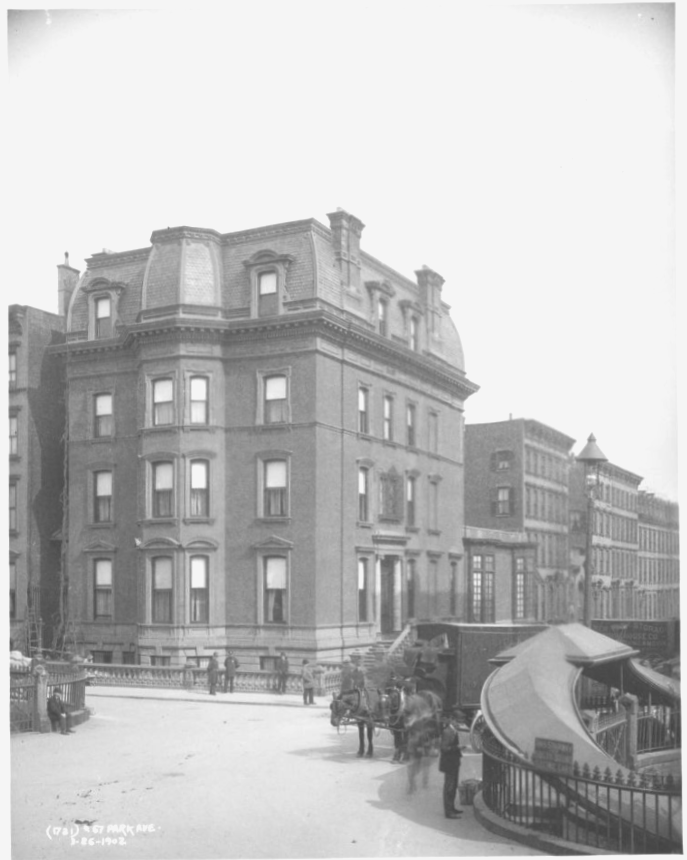
The Lost Charles T. Barney Mansion - 101-103 East 38th Street (67 Park Av)


from the collection of the New-York Historical Society.

In 1872, Caroline G. Reed's Boarding & Day School for Young Ladies operated from the stylish double-wide mansion at the northeast corner of Park Avenue and 38th Street.  Designed in the Second Empire style, its entrance above a brownstone stoop faced the side street.  A full-height faceted bay caught breezes on the avenue.  The fourth floor took the form of a smart mansard that sprouted dormers and chimneys.  

At the time, Ashbel Holmes Barney and his family lived a block to the west, at 38 East 38th Street.  Born in Adams, New York in 1816, he and his brother Danford had relocated to Cleveland, Ohio in 1842 to establish Danford N. Barney & Company, a forwarding and commission merchant business.

Danford Barney quickly moved to Buffalo, New York, having been elected president of Wells Fargo & Company in 1849.  Ashbel remained in Ohio until 1857, when he brought his family to New York City.  He was elected a director of Wells Fargo & Company in 1859, and became a director in several railroads, as well.

In 1873 Ashbel Barney purchased 101-103 East 38th Street (the family and newspapers would use either street number interchangeably).  He and his wife, the former Susan H. Tracy, had two children, Charles Tracy and Helen Tracy.  (A third child, Gardiner Tracy, died in childhood in 1856.)  Charles was married to Laurinda Collins Whitney, daughter of James Scollay Whitney and Laurinda Collins.  Helen, who would never marry, moved into the 38th Street mansion with her parents.  

The family had not lived here long before the house was the scene of somber occasion.  Danford N. Barney lived in the  fashionable Windsor Hotel on Fifth Avenue.   He died there on March 8, 1874 at the age of 66.  Danford's body was brought to 103 East 38th Street where his funeral was held on March 11.

It is unclear how extensive the Barneys' renovations of the mansion were; however in 1882 they commissioned a three-part stained glass window from Associated Artists (the partners of which were Louis Comfort Tiffany, Candace Wheeler and Lockwood de Forest).  Called The Sea of Mystery, it was installed in the second floor hallway directly above the entrance.  The theme was based on the tale of the fisherman and the mermaid.

from the collection of the Cooper-Hewitt National Design Museum

Sadly, Susan Hester Tracy Barney died that year, on July 3, 1882, at the age of 64.  Ashbel had retired from business the previous year, and would live on in the Murray Hill mansion until his death on December 27, 1886.  (He had fallen ill on Christmas day.)

In reporting on his demise, Harper's Weekly said, "The death of Ashbel H. Barney removes another of that long list of Americans whose names are associated with the great enterprises of the last half-century."  The article noted, "His enterprises made him a millionaire."

Barney's funeral was held on December 30.  The New York Times reported, "The remains reposed in the large hall between the parlors on the first floor...The four large parlors were crowded with the personal and business friends of Mr. Barney."

With his sister now alone in the East 38th Street mansion, Charles and Laurinda (who was known as Lily) sold their house at 10 East 55th Street to editor Joseph Pulitzer and moved in.  Helen would have to become accustomed to much more activity within the household--Charles and Lily brought along six children, Ashbel Hinman, James Whitney, Gardiner Tracy, Helen Tracy, Katherine Lansing, and Marie.  The eldest, Ashbel, was just ten at the time.

Born in 1851, Charles had graduated from Williams College in 1870 and entered banking.  His wife's familial ties assured his success.  He joined the Knickerbocker Trust Company in 1884, and was involved in real estate operations, as well.  In 1890 he, William C. Whitney, W. E. D. Stokes and others would form the New York Loan and Improvement Company.

The residence that had been only tepidly involved in high society now became a social center.  On December 23, 1891, it was the scene of the debutante reception of Azuba Latham Barney, the daughter of Charles's cousin Arthur L. Barney.  The Sun reported:

The rooms and hallways of the double house were trimmed with American Beauty, Mme. Cusine, and dark red roses and Christmas greens.  Lander's orchestra, screened behind trailing vines of smilax and evergreen, festooned with ropes of roses, played in the hallway throughout the afternoon and evening.  Miss Barney, a tall brunette, received in the white and gold drawing room.

The close relationship between the families was evidenced five years later, on April 18, 1896, when The New York Times reported, "Mr. and Mrs. Charles Tracy Barney of 101 East Thirty-eighth Street will give a dinner party to-night in honor of Miss Azuba L. Barney and her fiancé, Reginald H. Jaffray."

The dinner party took place in a totally redecorated house.  Among Charles's and Lily's closest friends were the Stanford Whites.  The couples shared a box at the opera, and White had designed the Barneys' East 55th Street house.  In 1895 Barney commissioned White to re-do the interiors of 103 East 38th Street.  

One of the double parlors following the Stanford White redecoration.  A portiere is slightly opened to reveal a glimpse of a similar room.  Note the stenciled and painted ceiling.  from the collection of the Columbia University Library.

The Barneys' summer home was Windy Barn in Southampton, erected by William Sprague Hoyt and his wife Nettie in 1877.  The Barney's purchased the estate in 1886, paying $20,000 (about $645,000 in 2023).  The couple almost immediately doubled the size of the main house, adding a ballroom and other improvements.  Its Dutch-inspired architecture featured cedar shake cladding and a gambrel roof that harkened to Long Island's colonial past.  Historian William Pelletreau said bluntly, "some call [it] quaintly artistic, and others a monstrosity, but it is an object of interest."  The New York Times, nevertheless, called it "one of the finest residences on the Long Island Coast."

The Barney addition, as see above, doubled the size of Windy Barn, (original source unknown)

Charles Barney again turned to Stanford White in 1900 when he commissioned him to decorate the interior of his yacht, the Invincible.  The following year he was brought back to the East 38th Street house to once again remodel the interiors.  It was a substantial project, costing $100,000, or about $3.5 million by 2023 terms.

The Barneys anticipated the massive upheaval and the army of workmen who would be invading their home.  That fall The New York Times reported, "For this reason, Mr. Barney had recently transferred many valuable belongings from that house to the country home."  Included, said the article, were "rare bric-a-brac and paintings of great value, by European artists."

The family was at Windy Barn on the night of November 16, 1901, when Katherine Barney, who was now 16 years old, "was awakened by the sound of crackling wood and in a few moments knew that the house was on fire," reported The Evening World.  The teen rushed through the darkened halls and stairways, first to her mother's room and then to every bedroom in the house to awaken the household.  "Before she reached the servants' dormitory, which was just above her room, the whole top of the house was shooting flames, visible for miles around," said the article.  Nevertheless, Katherine pushed on, saving the three sleeping servant girls.

The family and staff escaped to the lawn "in scant attire," said The New York Times.  Before firefighters could arrive, the wooden structure was engulfed.  The following morning The New York Times reported, "nothing remains but three tall chimneys, rising like monumental shafts."  The fire had started in the billiard room, supposedly from a defective flue.

Not only were the Barneys' rare tapestries, antique furnishings and valuable paintings destroyed, but Lily reported that she had $125,000 in jewelry in her bedroom.  The Evening World later reported, "for weeks after the family had given up the search for the gems hordes of diamond seekers swarmed to Southampton and spent many fruitless hours sorting debris and ashes in a vain quest for them."

Anders Zorn painted this portrait of Charles Tracy Barney in 1904.  from the collection of the New-York Historical Society.

Katherine's debut in 1903 began with a ball in the mansion of her uncle, William C. Whitney at 871 Fifth AvenueThe Evening World reported on December 17, "Everything that money and taste can do to make the occasion memorable among the balls of exclusive and extravagant New York society has been done."  

Debutante entertainments stretched throughout the winter season, and on January 19, 1904 The New York Times reported, "Mrs. Charles T. Barney gave a small dinner dance at the Barney residence, 67 Park Avenue."  (With the renovations done to the townhouse, the Barneys began using the Park Avenue address, although the entrance was still clearly on 38th Street.)  The article note, "The cotillion was preceded by a dinner of eighty covers, the guests being seated at large tables placed in the green and stone rooms."

The merger of two massively wealthy and socially important families occurred when Charles and Lily announced Helen's engagement to Archibald Stevens Alexander in the spring of 1905.  Following the ceremony in St. Bartholomew's Church on April 8, a wedding breakfast was held in the Barney mansion.

One of the Barneys' most celebrated entertainments was their masquerade party in February 1906.  The New York Herald reported, "Their guests were seated at a long and narrow table placed on three sides of their Renaissance tapestry room, and while it had the appearance of a continuous table, it was really divided into sections so that the costumes of each country represented were grouped together."  The article continued:

Even all the house servants were in costume, and the men, from Sherry's establishment who served the dinner, wore regular "beef eaters" costumes.  It was a most picturesque night when all the guests were seated, the architecture of the room, the brilliant light and the general artistic surroundings quite suggesting a painting of some old master.

Lily's costume was "a faithful reproduction of that worn by Catherine de Medici," said the New York Herald.  (copyright expired)


Katherine's engagement to Courtlandt Dixon Barnes was announced in November 1906.  Three months later, on February 24, 1907, The Sun reported that she would have an "Easter wedding," adding, "Mr. and Mrs. Charles T. Barney have a fine ballroom at their home, 67 Park avenue, which will be the scene of the reception."

Real Estate Record & Builders' Guide, November 30, 1907 (copyright expired)

Katherine's wedding came just before a most difficult time for her father.  By now he had been president of the Knickerbocker Trust Company for ten years.  In 1907 the firm became part of a shady deal organized by F. Augustus Heinze and Charles W. Morse to corner the market of the United Copper Company.  The scheme disastrously failed on October 15 when the share price of United Copper crashed.  Morse and Heinze were ruined and depositors began a run on the Knickerbocker Trust Company. 

Six days after the collapse, Charles T. Barney was asked by the board to resign.  The next day the Knickerbocker was forced to suspend operations.  Unlike his co-conspirators, Barney was not ruined financially.  His personal fortune was estimated at the time to be $2.5 million--or about $80.3 million in 2023.  But he was disgraced and humiliated.

At the time, the Barneys had a houseguest, Mrs. Susan Abbott Mead, who had arrived from Europe two weeks earlier.  Five days after Barney's resignation, at around 10:00 on the morning of November 14, 1907, Lily and Susan Mead were in Lily's bedroom, next door to that of Charles, when they heard a gunshot.  Lily told police:

I heard a shot in my husband's room.  I ran in there, and I saw him standing upright.  He fell to the floor, as I was approaching him.  I took his head in my lap.  I heard him say nothing that would indicate that he had committed suicide.  Indeed, I didn't know then he had been shot.

But Charles was shot.  He had placed a revolver to his stomach and pulled the trigger.  Ashbel, who was 31 years old at the time, ran upstairs.  His father directed him, "Don't move me."  Physicians rushed to the mansion and even as they worked to remove the bullet, Barney drew up his will.  He died around 2:00 that afternoon. 

The will was probated five days later.  The New-York Tribune reported on November 20, "The will itself is necessarily brief, made, as it was, when Mr. Barney was suffering from a mortal wound."  He left his entire estate to Lily.

Lily Whitney Barney lived on in the mansion with at least one of her children, Ashbel, who was unmarried.  He had graduated from Yale University in 1898.  

Named for his grandfather, Ashbel Hinman Barney was born in July 1876.  (original source unknown)

Stanford White's renovations to the house in 1901 included electric lighting.  The technology was still unreliable, and it caused a major scare in the Barney mansion on March 15, 1908.  The Evening World reported, "Mrs. Barney was awakened by the sudden turning on of the electric lights in the dining room.  Without waiting to arouse other members of the household she called up the police." 

The mansion was besieged by officers who "searched from top to bottom."  In the dining room were "large quantities of silverware," said the article, "but if the burglars had been there they did not have time to carry any of it away."  Although the house was put on "close watch," detectives told the press "the trouble is believed to have been caused by crossed electric wires."

Lily returned to entertaining following her mourning period.  On May 9, 1916, for instance, the New-York Tribune reported, "Mrs. Charles T. Barney gave a dinner, followed by bridge, last night, at her house, 67 Park Avenue."  But her residency was drawing to a close.  On November 29, 1920, the New York Herald advised, "Mrs. Charles T. Barney will remain at 101 East Thirty-eighth street until December 15, when she will move into her new apartment at Sixty-sixth street and Fifth avenue."

67 Park Avenue replaced the venerable mansion.  It survives.  photo by Wurts Bros. from the collection of the Museum of the City of New York

Lily had sold the mansion to developers who replaced it with a Schwarts & Gross designed, 14-floor apartment building completed in 1922.

LaptrinhX.com has no authorization to reuse the content of this blog