Saturday, January 22, 2022

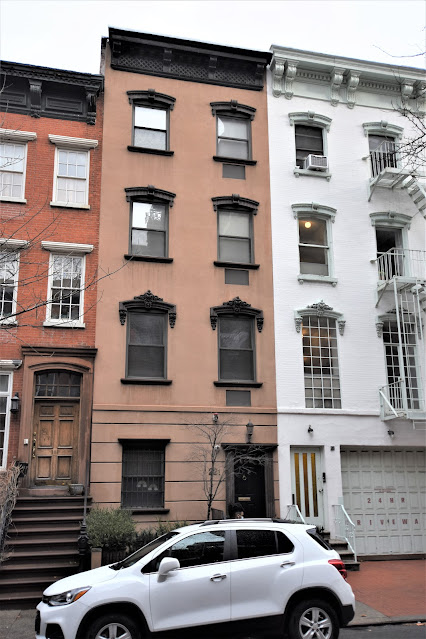
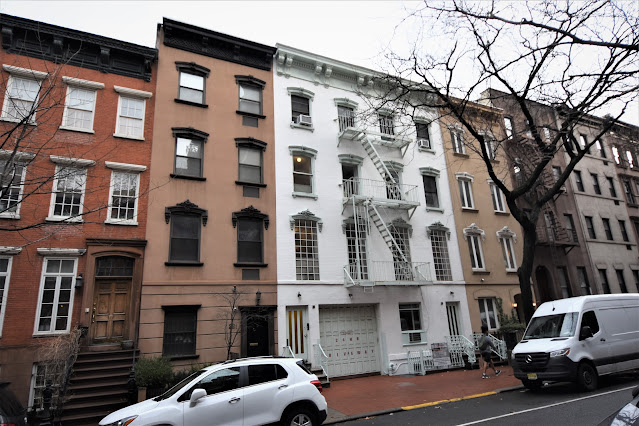
The 1845 Jacob R. Pentz House - 14 West 11th Street


In 1844 Henry Brevoort, Jr. began construction on five identical brick-faced homes on West 11th Street, each a gift for one of his five daughters.  The handsome Greek Revival style residences were completed the following year.  Three bays wide and three stories tall, they had full-length parlor windows and delicately dentiled cornices.  The doorways included elegant sidelights and transoms.

It seems that Breevort (who died three years after their completion) intended the houses to be investment properties for his daughters, not their homes.  The unmarried girls, Elizabeth, Margaret and Constance, continued to live in the Brevoort mansion on Fifth Avenue, and Laura Breevort Bristed and her husband, Charles Astor Bristen, lived on the Hell Gate estate on today's Upper East Side. 

The family of Jacob R. Pentz moved into 110 West 11th Street (renumbered 14 in 1853).   A well-to-do Platt Street merchant, he was president of the Empire City Bank and secretary of the Atlantic Insurance Company.  

The servant in charge of watching over the Pentz's young son, most likely a nurse, was in deep trouble in 1850.  A notice in the New York Herald on September 9 read:

Strayed from his home, on the 8th instant, George W. Pentz, aged three and a half years; light complexion.  Any person giving information to his anxious parents, at No. 110 West Eleventh street, will greatly relieve them.

Little George was found, but the servant was no doubt soon looking for a new position.

In 1853 George F. Peniston leased the house for just one year.  The senior partner of the shipping firm Peniston & Co., he had an interesting background.  Peniston was born "on one of the Bermuda Islands," as worded by The New York Times, in 1826.  He came to America at the age of 14 and found a job as a clerk with a flour merchant.  He went on to become one of the original members of the Produce Exchange and the Maritime Exchange.  Peniston never became an American citizen.  

Dentist Charles C. Allen and his family were the next occupants.  He and his wife, Mary, had a son, William H., who was also a dentist and was a partner in his father's practice.  Allen was a close friend of the socially prominent engineer and philosophy professor James Renwick, father of the esteemed architect.  

Following the death of Charles Allen in March 1858, Mary sold the house to Mary A. Bissell Dodge, another fascinating figure.  In 1832, shortly after her marriage to William M. Dodge, her father, Peter Bissell, and husband formed a partnership, W. M. Dodge & Co. "for the manufacturing of brass nails."  

It was a short-lived partnership.   The firm was in financial trouble that first year when William Dodge died.  The economic problems and the loss of his partner may have been too much for Bissell to handle.  On June 23 the New-York Evening Post reported that he had checked into the Fort Orange Hotel three weeks earlier, "and had drank excessively during the day yesterday."  He swallowed an ounce of laudanum, a tincture of opium used at the time by doctors as a pain killer.

The newspaper explained, "Mr. Bissell was under pecuniary embarrassment."  He left a note near the bed that read, "'Not of the Cholera. P. B."  The Greenfield Gazette & Franklin Herald snidely added, "Very considerate for a suicide."

Mary Dodge, who lost her husband and father within months of each other, was a resilient woman.  Now, moving into the West 11th Street house with her was her mother, Mary, and her sister, Sarah Bissell.  The women set up the dressmaking concern S. Bissell & M. A. Dodge in the house.  

Dressmakers with patrons from the carriage trade made significant incomes.  And the West 11th Street house, just off fashionable Fifth Avenue, was a perfect location for the business.  Around 1868 another relative, Anna M. Bissell, moved in.  She was a teacher in the Girls' Department of School No. 45 on West 24th Street between Seventh and Eighth Avenues.

In 1872 the women left West 11th Street and Mary leased the house for two years.  Then, in June 1874, an auction of "the entire rich furniture throughout the house" was held.

The residence was operated as an upscale boarding house for several years.  In 1876 the three boarders were Charles Piegne, a feather merchant; milliner Jane Vainy; and Martial G. Jouffret, whose profession was listed as "hair."

Around 1891, 14 West 11th Street once again became a private residence, home to importer Edward R. Biddle and his family.  The Fifth Avenue wedding of Edward R. Biddle and Harriet Whitney Wilmerding on November 21, 1871 had been a social event.  The couple had three daughters, Harriett (known at Hattie), Christine and Edna.  

The 1890's saw a surge of interest in things Colonial across America.  Houses were being designed in neo-Federal, neo-Georgian, and Colonial Revival styles.  No. 14 West 11th Street was given a Federal update.  The Greek Revival entrance was replaced with a simpler, double-doored version, and swagged stone panels and an oval plaque were installed on the facade below the second floor.


The Biddle house was the scene of entertainments throughout the years, but none more important that the debuts of the girls.  The first to be introduced to society was Hattie, in October 1894.

Christine was next.  On December 5, 1897 The Argus reported, "A New York social event of interest to Albany society folk was the formal introduction to society of Miss Christine Biddle...which took place Monday afternoon from 4 to 7 o'clock."

It would be a full decade before Edna was of age to make her debut.  On December 7, 1907 The New York Times reported, "To introduce her daughter, Miss Edna Biddle, Mrs. Edward R. Biddle gave a reception yesterday afternoon at her home, 14 West Eleventh Street."

With their daughters grown, the Biddles moved on, leasing the house by 1916.  Ten years later the Biddle estate sold the house to Lawrence Langner and his second wife, Armina Marshall.  The couple maintained a country home near Westport, Connecticut.

The Langlers (left) chat with Celeste Holm and Richard Rodgers backstage at the 2,000 performance of Oklahoma! in 1947.  from the collection of the New York Public Library

Langler was a patent attorney and he and Armina had one child, Philip.  The couple was highly involved in the theater.   Lawrence was one of the founders of the Washington Square Players in 1914, and in 1919 he founded the Theatre Guild.  Additionally, he founded and was chairman of the American Shakespeare Festival.  He and Armina established and ran the Westport Country Playhouse, where Armina sometimes acted. 

On New Years Eve 1939, Lawrence Langler's daughter by his first marriage, Phyllis, was  married to John Cornell in the Church of the Transfiguration--the "actors' church."  Cornell was involved in the management of the Westport Country Playhouse.  The reception was held at 14 West 11th Street and among the guests were American theater legends Lillian and Dorothy Gish.

In the early 1950's playwright, screenwriter and producer Robert W. Anderson and his wife, theatrical agent Phillis Stohl Anderson lived here.  Anderson recalled in a letter to the editor of The New York Times in 2000, "I wrote part of 'Tea and Sympathy' at this address, and some of the 'Theater Guild of the Air' scripts I wrote before 'Tea and Sympathy' was produced in 1953."

Robert Anderson - image via Playbill

Phyllis died in 1956.  Anderson would receive two Academy Award nominations--for the 1959 film The Nun's Story, and the 1970 I Never Sang for My Father.

Renovations completed in 1979 resulted in a duplex apartment in the basement and parlor floor, one apartment on the second, and another duplex in the third floor and new penthouse level, unseen from the street.

photographs by the author
no permission to reuse the content of this blog has been granted to LaptrinhX.com

Friday, January 21, 2022

The Cuthbert Adamson House - 221 East 31st Street


Constantine Adamson was 21 years old in 1805 when he became an apprentice in a London apothecary shop.  After first immigrating to Canada, he arrived in New York in 1817.  The following year Richard Seaman took him in as a partner in the Walters & Seaman pharmacy.  His son, Cuthbert, entered the business in 1821.

The American Journal of Pharmacy said, "His store became the resort of physicians of his vicinity, who, with great reason, placed entire reliance on the quality of his materials, and the skill, ability, and exactness of their preparation."  Constantine was a founder of the College of Pharmacy in 1829 and was elected its president in 1835.  The Journal reported, "On Saturday at 15th of August [1846], he was taken with a severe inflammation of the bowels, in consequence of a hernia which he had long been trouble."  He did not survive the infection.

Cuthbert (who was named for his paternal grandfather, a captain in the English navy), and his mother, Christina, lived at 699 Broadway at the corner of 4th Street at the time.  In 1858 they moved into the newly built house at 133 East 31st Street (renumbered 221 in 1868).  One of four identical homes, it was designed in the emerging Ango-Italianate style.  Short stone stoops led to the single-doored entrances.  The eye-catching cast iron lintels of the second floor windows set the design apart.  Their frothy French-inspired brackets and keystones reflected the domestic tastes of the 1850's.


The Adamsons' residency was short.  They seem to have moved permanently to their summer home in Fordham, New York in 1860, where Cuthbert A. Adamson died on June 21, 1863.

The East 31st Street house became home to the James H. Stevens family.  Stevens and his wife, Mary, had three daughters, Isabella, Mary V. and Charlotte (known as Lottie); and a son, James, Jr.  Stevens ran a large apparel factory at Bowery and Division Street.  While James, Jr. joined his father's business, his sisters were teachers.  Isabella taught in the girls' department of School No. 7 on Christie Street, and Mary was a teacher in the boys' department Primary School No. 1.

The size of Stevens' business was evidenced in a help-wanted ad in 1862:

Operators wanted to work on Wheeler & Wilson's sewing machines.  Also 50 women to make mosquito nets and stable blouses.

It was most likely James, Jr. who placed the advertisement.  His father had been ill for some time, and on November 7, 1862 The New York Times reported he had died the previous day "after a long and painful illness."  He was 57 years old.

Shockingly, exactly two weeks later to the day, Isabella was married to William F. Geisse.  What must have been viewed by some as an appalling breach of social protocol and mourning, may have been prompted by the ongoing Civil War.  The groom was a lieutenant in the Union Army and the couple may have hurried to marry before he was sent South to fight.

Mary V. Stevens was married to John Higgins on August 2, 1865.   Two years later, on December 12, 1867, Lottie married Thomas Colvin Smillie.  Her life was destined to be tragic.  When Thomas died on April 30, 1870 at the age of 35, Lottie had just become pregnant with their only child.  She named the baby, which was born in 1871, Thomas Colvin, after his father.  The infant died two days after birth.

In the meantime, James M. and Rosanna McCaffil Chichester had moved into 223 East 31st Street in 1867.  The couple had a teenaged son, William Rockwell, born in 1850.  Chichester was a tobacco merchant whose business was located at 51 Bowery.

The family took in two boarders.  Elizabeth Berrian, a widow, and Dr. Joseph D. Bryant, were rather long-term renters, listed with the Chichesters from 1871 through 1874.  It may have been the physician's influence on young William that prompted him to pursue a career in medicine.  Following Bryant, another physician, Dr. Joyce, took a room.  He lived with the family at least from 1875 through 1877.

In 1879 William Rockwell Chichester graduated from the New York University College of Medicine.  During a deadly heat wave two years later, The New York Times reported on July 1, 1881 that he was one of 50 physicians appointed "for service among the tenement-house population during the heated term."  His compensation for the five-week period would equal about $2,600 today.

The Chichesters sold the house on September 30 that year to Ephraim S. Widdemer for $8,300 ($217,000 in today's money).  Widdemer leased it to James Conolly Christie and his wife, the former Sophia Emma Brown.  The couple welcomed a daughter on January 2, 1883.

A household auction was held in the house on March 27, 1889.  The items sold reflected the still upscale tenor of the residence, among them a rosewood piano and "black walnut chamber suites."

No. 221 was now operated as a boarding house, operated by Maria Flynn.   Her boarders were almost all Irish immigrants.  One of them was looking for employment in October 1891.  Signing his advertisement with his initials, D. H., he wrote:

Waiter or Second Man -- By a young man in a private family; just disengaged; best city reference; last employer can be seen.

A waiter, in this sense, was a domestic servant who served in the dining room or drawing room; while a second man assisted the butler in serving breakfast, helped with trays and tended to silverware.  The fact that his former employer was available for in-person references attested to his performance and the genial parting of ways.

In the summer of 1892 Europe was suffering a crippling cholera epidemic and many Americans feared it was only a matter of time before it arrived here.  As a precaution, Governor Roswell P. Flower authorized the purchase of the Surf Hotel on Fire Island to be used as a quarantine station for infected passengers of incoming ships.

But not even that drastic move could keep the disease out of the city.  In the fall a ship from Hamburg arrived with infected passengers who slipped through.  On September 17, 1892 The Press reported, "Mary Connerty, 19 years old, a domestic employed at No. 221 East Thirty-first street, was taken ill at her place of employment Wednesday evening...Dr. C. J. Kane of No. 673 Second avenue pronounced her case cholera, and she was removed Thursday afternoon to the Floating Hospital at the foot of East Sixteenth street."

Maria Flynn had hired Mary seven weeks earlier.  The Rome [New York] Semi-Weekly Citizen said, "Miss Conity [sic] came to this city from Ireland six months ago...She was taken ill at 9 o'clock and by midnight the entire household was excited at the girl's condition."  Immediately after Mary was taken away, the house was fumigated and disinfected.  The article said, "everything with which she had come in contact [was] destroyed."  Furthermore,  five days later, The Press reported that Maria Flynn's boarding house had been placed in quarantine.

The house was sold in an executor's sale on February 27, 1895.  It continued to be operated as a boarding house, now run by a Swedish immigrant, Ida Bjorn.  Not all her tenants were upstanding.

On November 6, 1899 John H. Bjorlin went to the notorious saloon of Jack McManus on 30th Street and Sixth Avenue.  McManus, known as "Eat 'Em Up," was an infamous gangster, once second in command of the Five Points Gang.   Bjorlin went to police and said that five men had stolen his watch and $35 at the saloon.  In court two days later, the men were discharged by the judge, The World explaining, "Bjorlin was told he deserved what had happened to him."


Another Scandinavian immigrant boarding here was Andrew Gustavenson, a Swedish cabinetmaker.  Although he was married, his wife was estranged and living in Brooklyn.  His troubles continued when the 47-year-old lost his job early in 1899.  He fell behind on his rent, and pawned his woodworking tools.  When he found work in a piano factory in March, Ida Bjorn loaned him $4 to get them back.

Then, two weeks later, on April 12, he came home drunk at around 4:00 in the morning.  The Evening Telegram said, "As he was abusive while in that condition the landlady said nothing to him, and he went to his room."  The following morning Ida Bjorn smelled gas outside his door and used her passkey.  "She found Gustaveson undressed and in bed, with a gas tube in his mouth.  He had pulled the pillows and bedclothing around his head so that none of the gas might escape."

Another of Ida's boarders appeared in court that year.  Edward Warren was a self-declared advertising agent.  In fact, he was a slick con artist.  He printed tickets inscribed, "Twelfth Annual Ball of the Dry Goods Clerks of New York, at the Grand Opera House, on Feb. 28."  Then, posing as an employee of B. Altman & Co., went to ladies' tailoring and dressing making shops and sold them.  He was eventually arrested, according to The Morning Telegram on February 6, 1899, "for selling bogus tickets for an alleged ball and thereby fleecing hard working dry goods clerks and cash girls."

Throughout the next decades 221 East 31st Street continued as a boarding or rooming house.  Then a renovation completed in 1959 resulted in a triplex in the basement through second floors, and a duplex on the top two.  That configuration lasted until it was returned to a single-family home in 2003.


Outwardly, the Adamson house is the best preserved of the row.  And those striking cast iron lintels make a detour down East 31st Street worthwhile.

photographs by the author
many thanks to reader Ted Leather for prompting this post
no permission to reuse the content of this blog has been granted to LaptrinhX.com

Thursday, January 20, 2022

The Washington Irving Smith House - 361 West 19th Street


In 1845, Washington Irving Smith's pottery factory was located at 261 West 18th Street.  The firm manufactured industrial items, like clay drain pipes.  Smith and his family lived in a handsome, two-and-a-half story house at 241 West 19th Street (renumbered 361 in 1868), between Eighth and Ninth Avenues.  One of a row of identical homes, it featured understated brownstone lintels, a double-doored entrance above the high stone stoop, and a short attic level typical of the Greek Revival style.

Smith died around 1866.  His widow Margaret remained here until 1871 when the house was purchased by John M. and Mary A. Moffitt.  The couple paid the equivalent of $350,000 in today's money.

A sculptor, Moffitt was born in London in 1837 and came to New York after serving his apprenticeship there.  Appleton's Cyclopedia of American Biography noted, "One of the first orders he received after his arrival was for the execution of the figures that adorn the eastern entrance to Greenwood cemetery, and represent the four ages of man."

Two of Moffitt's bas relief panels are visible in this stereopticon slide of Richard Upjohn's magnificent Greenwood Cemetery gates.


Three years before moving into the West 19th Street house, Moffitts had executed the sculptures of Pike's Opera House on 23rd Street and Eighth Avenue.  On June 26, 1869 the Real Estate Record & Builders' Guide noted, "We also highly approve of all the sculpture work on Pike's Opera House...representing Mozart and Shakespeare, as well as Tragedy and Music, standing on the attached Corinthian columns in the centre of the main front on Eighth  avenue."

Calling Moffitt "an English sculptor of great celebrity in this city," the article added that he "also produced the 'Artic Monument' at Greenwood, the 'Soldiers' Monument,' in Connecticut, and the massive altar for the new church in New Haven, &c."  He was also responsible for the colossal Eagle and Her Young on the façade of the New York Life Insurance Company building at Leonard Street and Broadway.

An inventory of the household goods hints at the Moffitts' luxurious interiors.  Included were "costly oil paintings, by foreign artists," rosewood parlor furniture, a pianoforte, and Brussels carpets.  Notable was the "Herring's Iron Safe," which would have held cash, documents and, possibly, Mary's jewelry.

The Moffitts sold 361 West 19th Street to Thomas J. and Julia C. Coleman in 1877.  The couple paid $13,000, or about $330,000 today.  They took in a boarder in 1883, offering rooms on the top floor with "hot and cold water" for $17 per month (a pricey $455 today).  The advertisement sternly insisted, "no children."

In March 1884, following Thomas Coleman's death, Julia sold the house to Edward R. Merrill, president of the E. R. Merrill Spring Co.  He hired architect James Stroud to significantly update the dwelling.  The attic level was raised to a full third floor and a prominent cast metal cornice crowned with serrated decorations was installed.  Sheet metal sills and cornices were placed over the brownstone originals.

James Stroud's renovations included modern, paneled entrance doors.

The Merrill family remained in their remodeled house for two decades, selling it to Mary O'Neil in 1905, who operated it as a boarding house.

Among her newest tenants early in January 1907 was John Bailer, a bookmaker.  A month earlier he had married Hattie Moser and the couple had moved into Hattie's apartment on West 109th Street near Central Park West.  When he came home on New Year's Day, just three weeks into their marriage, Hattie was gone.  The Duluth Evening Herald reported, "He learned, he says, that she went away with young [James R.] Roosevelt in an automobile."

The married millionaire James R. Roosevelt, Jr., it turned out, had been paying the rent on Hattie's apartment and had also furnished it.  When Hattie did not return, Bailer put the furniture into storage and moved into the West 19th Street boarding house.  He then threatened to sue Roosevelt for the equivalent of $1.4 million in today's money, for the alienation of his wife's affections.

The scandalous story spread across the nation.  On January 12, 1907 the Roanoke Times said, "Unless the bride returns within a few days, which seems unlikely, the suit, Bailer says, will be filed."  Among those reading the shocking articles was Roosevelt's wife, Sadie.  The World commented that the millionaire's wife "knew much of young Roosevelt's escapades, but never suspected what was coming."

A flurry of suits followed the press coverage.  James Roosevelt swore out a writ "for the furniture, claiming it was his," according to The World.  Bailer pressed ahead with his alienation of affections suit, and on February 27 The Duluth Evening Herald reported, "The escapade[s] of James R. Roosevelt, Jr., are once more coming into the limelight, this time because his wife has begun proceedings against him for a separation."

Mary O'Neill sold 361 West 19th Street later that year.  It became the home of Dr. Henry J. Fischer, who had graduated from Cornell University in 1900.  Later it was occupied by Thomas A. Rosbotham, an executive of the American Distilling Company.  He died in the house on March 23, 1919.

The changing Chelsea demographics was evidenced in 1951 when the 602-4 East 138th St. Corp. purchased the house, from a doctor.  Court documents later said, "The parlor floor had been used as the physician's office, and the other three floors by his family as their residence."  Without notifying the Department of Buildings or filing plans, the new owner "promptly converted the building into an eight-family rooming house," according to The New York Times.  "It was rented to Puerto Rican families, generally consisting of seven or more persons, each occupying what was originally one room, under the most appalling slum conditions, at rents of over $110 per month."  (Astonishingly, that figure would translate to over $1,000 per month today.)

In July 1952, after tenants lodged complaints, an investigation was launched.  The State Rent Commission found that the owner had illegally "created squalid slums, not livable housing."  The house was subsequently officially converted to apartments, one per floor.  The alterations were completed in 1956.

A second renovation, completed in 1967, resulted in a duplex apartment in the basement and parlor levels.  Although holes for air conditioning units have been punched into the brick facade, the outward appearance of the house is little changed since its substantial make-over in 1884.

photographs by the author
no permission to reuse the content of this blog has been granted to LaptrinhX.com
Wednesday, January 19, 2022

The 1867 Dreyfus, Kohn & Co. Building - 35 Mercer Street


Born in 1810, Amos R. Eno started out in the dry goods business on Pearl Street.  The New York Times said decades later, "While making a fortune in the dry goods business, Mr. Eno began to invest judiciously in New York real estate.  He picked out desirable corners, and occasionally he would buy an entire block of land."  


In the 1850's, the neighborhood of Mercer and Green Streets--once lined with respectable private homes--had  gained the reputation of Manhattan's most notorious red light district.  But that began to change at the end of the Civil War.  As commerce inched northward, modern commercial buildings replaced the Federal style houses of the 1820's.

Amos R. Eno was among those transforming the district.  In 1867 he erected two large loft and store buildings at the southwest corner of Mercer and Grand Streets.  The same architect was doubtlessly responsible for both 31-33 Mercer Street and the corner building, 35 Mercer; their facades being nearly identical.

The identical elements of the two facades create the illusion of a single building.

Like its fraternal twin, 35 Mercer Street was five stories tall and faced in sandstone above a cast iron base.  Its prim Italianate design featured quoins that separated it and 31-33 Mercer, and created two-bay-wide vertical sections on either end of the Grand Street elevation.  

The ground floor store became home to the auction rooms of Richard Walters.  His sales liquidated a wide variety of merchandise.  On Friday, July 31, 1868, for instance, he sold "a large and general assortment of Parlor, Reception Room, Dining and Chamber Furniture, Bar Furniture, and Glassware."  Included were items like a "superior seven octave rosewood Piano," French plate glass mirrors, oil paintings, and carpets.

The upper floors were leased to the wholesale drygoods firm Treadwell, Taylor & Co.  They were nearly the victims of slick conmen on February 14, 1870, saved only by the sharp instincts of two policemen.  Charles Wilson and Edward Hale strode into the store carrying a "new and large valise securely strapped," as described by The Evening Post.  They identified themselves as "Western merchants, desirous of purchasing silks and dress goods."

The clerk brought various samples of materials, repeatedly turning his back on the well-dressed buyers as he did.  When he was not looking, one of the men pushed a button on the valise, which popped a spring catch and opened the side of the case.  Pricey fabrics were then stashed inside.  When pushed closed, the valise appeared to be securely strapped.  The Evening Post said, "The theft was  accomplished so adroitly that it did not attract the attention of the persons in the store."  But what the crooks did not know was that two policemen were waiting for them on Mercer Street.

The New-York Daily Tribune explained, "Detectives Casey and Quinn of the Broadway squad yesterday saw Charles Wilson and Edward Hale, well-known shoplifters, in Mercer-st.  One of them carried a large leather valise, and the officers, believing that the thieves were on a professional tour, they followed."

The pair had chosen 24 pieces of various goods, told the clerk they would return later to pay for the items and advise where to have them sent.  They then walked out of the building to encounter Casey and Quinn.  At the station house the valise "was found to be of novel construction," said the New-York Daily Tribune, which detailed the secret latch.  Inside were two pieces of brown silk, valued at $150 (more than $3,000 today).  The Evening Post added, "The police think this the most dangerous appliance yet introduced to aid shoplifters, and storekeepers are warned against persons who carry large securely-strapped valises."

Treadwell, Taylor & Co. was replaced in 1871 by Dreyfus, Kohn & Co., importers of apparel and millinery trims.  The location, quickly becoming the center of Manhattan's garment district, was well-suited for the firm.

The Evening Post, January 25, 1871 (copyright expired)

Dreyfus, Kohn & Co. was established in 1858 by Isaac E. Dreyfus, Aaron Kohn and G. Rosenblatt.  The year 1885 was a tragic one for the company, with both Dreyfus and Rosenblatt dying.  Kohn brought Rosenblatt's son, Moses G. Rosenblatt, into the firm.

The Financial Panic of 1893 hit Dreyfus, Kohn & Co. hard.  The company's troubles were increased when Aaron Kohn became ill in March 1896 "and was obliged to give up his work and take a trip to Jamaica," according to The New York Press.  Upon his return, the decision was made to close the company, described by the newspaper as "one of the oldest and most prominent in the trade."

The stress of closing the firm his father had helped found may have contributed to the death of Moses G. Rosenblatt.  The 48-year-old died on August 14, two weeks after business was suspended.  The New York Times said, "Mr. Rosenblatt worried greatly over the business embarrassments of the firm, and he was, in addition, prostrated by the heat on Saturday."

Amos R. Eno died on February 21, 1898.  At the time of his death his real estate holdings were valued at around $20 million--nearly $645 million in today's dollars.  A massive auction was held in February 1899 during which Leon Tanenbaum paid the equivalent today of $3.72 million for 35 Mercer Street.

from New York--The Metropolis, 1902 (copyright expired)

The building became home to William Openhym & Sons, another wholesale drygoods firm, founded in 1853.  The firm was reorganized in 1892 following the death of William Openhym and was now conducted by brothers, William, Adolphe, Joseph and Emile.

Adolphe was the senior member of the firm and a member of the Chamber of Commerce.  The New York Press described him as being "prominent in business and club life...He was a member of the Reform Club, City Club, National Arts Club and the Nineteenth Century Club."  He and his wife and two children lived in a handsome mansion at 352 Riverside Drive between 107th and 108th Streets.  

Each morning Adolphe rode in Riverside Park before heading downtown.   On Monday morning, March 30, 1903, according to The New York Press, "He returned in good spirits and passed a joke with his groom as he threw him the reins of his saddle horse.  After staying in the house a few minutes, Mr. Openhym walked briskly toward the north."  He was not seen again.

Openhym never made it to work that day.  An hour after he left the house, Frank McConville, the keeper of the High Bridge, saw a man stop in the middle of the bridge and take his hat off.  McConville shouted for him to move on, but instead the  man climbed to the railing and threw himself over.  McConville ran to the spot where the man's hat and umbrella lay.  They were identified by Emile Openhym as belonging to his brother.

Adolph Openhym, from New York--The Metropolis, 1902 (copyright expired)

Suicide was scandalous and shameful (and illegal) and neither the family nor the firm would admit to the possibility.  A member of the company said, "If he absolutely was seen to jump from the High Bridge into the Harlem River, I can only believe he had gone to the bridge for an extra breath of fresh air, and suddenly attacked by vertigo, toppled over into the river."  (Why he would have gone north after leaving home, rather than south, was not addressed.)

Openhym's body was not discovered until April 26.  His funeral was held in the Riverside Drive house three days later.  The 49-year-old millionaire received his final humiliation on May 2, when The New York Press entitled an article, "Declares Openhym Was Insane," and reported that Coroner Scholer ruled he had taken his life "while suffering from temporary mental aberration."

William Openhym & Sons continued on at 35 Mercer Street until 1912 when it moved north to the newly-completed Emmet Building at the southeast corner of Madison Avenue and 29th Street.  The Soho building continued to house apparel-related firms for decades, like the Manhattan Silk Company and the Rossie Velvet Company.

Unlike today, traffic at the intersection of Mercer and Grand Streets was essentially non-existent in 1941.  image via the NYC Dept of Records & Information Services

Major change to the Soho district came in the third quarter of the 20th century, as artists discovered the gritty area.  Storefronts became galleries or trendy cafes and shops, and vast lofts, formerly home to garment manufacturers, were converted to studios.  Among the pioneers in the movement was 35 Mercer Street.  A renovation completed in 1978 resulted in "joint living-working quarters for artists" above the store level--two on the second floor and one each on the upper floors.  Among the initial residents was architect Walter David  Brown.  The Department of Buildings stressed, "At least one occupant of each apartment shall be an Artist certified by the New York City Department of Cultural Affairs."


A subsequent renovation resulted in two artist lofts each on all the floors.

photographs by the author
many thanks to Marian Scheuer for requesting this post
LaptrinhX.com has no authorization to reuse the content of this blog

Tuesday, January 18, 2022

The 1910 Brentmore -- 88 Central Park West


photo by Wurts Bros. from The World's New York Apartment House Album, 1910 (copyright expired)

In 1910 The World's New York Apartment House Album lauded the newly-completed Brentmore as "one of the most magnificent dwellings in the city."  Construction at the southwest corner of Central Park West and 69th Street had begun the previous year by the Akron Building Co.  The architectural firm of Schwartz & Gross had deftly melded the neo-Renaissance and waning Beaux Arts styles to create the 12-story, brick, stone and terra cotta structure.

A light court gave The Brentmore the appearance of two identical buildings.  The tripartite design sat upon a three-story, rusticated limestone base.  The architects clearly defined the mid- and top sections with stone-and-iron balconies that girded the fourth and tenth floors.  The apartments and residential hotels of Central Park West catered to the upper class, and The Brentmore was no exception.  Apartments ranged from seven to nine rooms, with three apartments per floor.

The World's New York Apartment House Album wrote, "The apartments of the Brentmore are arranged duplex, all of the sleeping rooms being on the floor above the parlors, drawing rooms, library and dining rooms."  The passenger elevators opened directly into the apartments.   "A feature of the apartments in the Brentmore are the baths," said the article, "in each one of which are windows quite as large as in any other room of the apartment."

The interior appointments spoke to the well-heeled families who would live here.  The walls of parlors and drawing rooms were lined with silk, custom designed chandeliers hung in each room, and the marble lobby was decorated with antique furniture.

This floorplan shows one duplex apartment (lower right, with staircase) and two simplex apartments.  The World's New York Apartment House Album, 1910, (copyright expired)

The Brentmore filled with well-to-do families, like the Jacob H. Schoonmaker family.  A member of Butler Brothers, he and his wife, the former Emma Wilson, would have two daughters, Muriel and Beatrice.  On July 6, 1913 the New-York Tribune announced that the couple "sailed for Europe on Tuesday on board the Rotterdam for an automobile tour through Holland, France, Germany and Switzerland.  They will return to New York in the fall."

Other early residents were the wealthy Edwin E. Bernheimer, his wife, Etta, and their daughter, Isabel.  A native of Mobile, Alabama, Bernheimer had moved his family to New York City in 1908.  He was a partner in the stock brokerage firm Jerome J. Danzig & Co.  The family's summer home was in Deal, New Jersey.

Edwin and Etta Bernheimer went on a drive to Long Island with a friend, D. F. Long, on October 19, 1913.  Their tonneau--an automobile open to the air--was driven by their chauffeur, Carl Steadman.

The Bernheimers' automobile would have been similar to this tonneau (which cost the equivalent of $41,000 today in 1909).

The outing ended disastrously on the way home.  Steadman was headed to the Queensboro Bridge when he swerved onto a set of trolley tracks to avoid a farm wagon that drove directly into his path.  The New-York Tribune reported, "He did not see an eastbound trolley...coming toward him."

Both the trolley and the automobile were badly wrecked.  Steadman was "catapulted from his seat on to the front platform of the trolley car."  The Bernheimers and their guest were slammed against the front seat, and were "bruised, cut and shocked."  Their injuries were not serious enough to warrant treatment and they rented another automobile and motored home on their own.  Their chauffeur was taken to the Flushing Hospital.

Rents in the Brentmore in 1915 were $3,750 per year for a nine-room simplex and $4,000 for a nine-room duplex.  Both apartments had three bathrooms.  The rent for the duplex would be just under $9,000 per month today.

The Bernheimers appeared in the newspapers twice in March 1915.  The first incident occurred when Edwin attempted to cross Broadway on his way to the office on March 14.  At Broadway and Wall Street, he stepped quickly in front of a southbound streetcar.  He did not notice that a northbound car was just yards away.  He was trapped on the strip between the tracks and "the northbound car caught him and wedged him in the narrow space."  Bernheimer appears to have been more emotionally affected by his close call than physically injured.  "An ambulance from Volunteer Hospital carried him to his office, where it was found he was not dangerously hurt," said the article.

Two weeks later a more shocking story appeared in the newspapers.  Among the doormen of the Brentmore was Jimmy Murray, described by the Irish-American newspaper The Advocate as "a handsome and popular young Irish boy hailing from Lanesboro, County Roscommon."  On March 27 the newspaper began an article saying, "The sensation of the week in Irish circles was the marriage of Miss Isabel Bernheimer, the society girl, and heiress, of the Brentmore Apartments, No. 88 Central Park West, to Jimmy Murray."

The article pointed out the stark contrast in the backgrounds of the Irish immigrant and his wife, saying Isabel "is the granddaughter of the late Jacob Rothschild, proprietor of the Hotel Majestic.  Her great-uncle, Joseph Rothschild, is secretary and treasurer of the Rothschild Realty Company."

The path to the altar for the love-struck couple had been rocky.  Etta Bernheimer had hired a lawyer to derail the romance, but was told that there was nothing he could do.  According to Isabel, "Then she consulted me, and arrived at the verdict that I was crazy."  Joseph Rothschild had offered Murray a "$100 to $1" bet that the couple would not last four months together (the boy did not take the bet).  And it was no doubt the Bernheimers' influence that got Murray fired.

The two were married in a civil ceremony with another Brentmore employee, Rosa Clarke, and a friend of the groom as witnesses.  They moved in with Jimmy's aunt in Brooklyn.  When a reporter arrived there on March 26, Isabel told him, "My family disapproves of my choice of a husband to such an extent that they are going to cut me off.  I don't care."  She added, "As for Jimmy, he is going to get a job.  He's going to get a job right away.  He can get one, don't worry about that."

At the time of the upheaval in the Bernheimer household, Max C. Anderson was living in the Brentmore.  He had been in show business for around four decades.  The New York Times reported on March 9, 1915 that he was "interested in or controlled between 150 and 200 theatres, principally in the middle West."  The newspaper place his fortune at the time  at around $10 million--more than 26 times that much today.

When war broke out in Europe, the family of Mayer Swaab, Jr. responded.  Mayer, according to The Pennsylvania Gazette, "Has been doing important war work in this country," and sons Jacques Michael and Frank L. both enlisted.  

Jacques entered the army in June 1917.  (Frank, who was just 18, would have to wait a year before enlisting in the New York State Guard in 1918).  The Evening World reported that Jacques received "his training in the aviation camps at Columbus, O., and Dayton, O. before sailing for France."  Once there, he finished his flight training in France and Italy.

He saw action on September 10, 1918.  On his first flight over enemy lines "he engaged and shot down a Fokker machine," said The Evening World.  "Continuing his return flight he was attacked by a group of German plans, but shot one down in flames and forced another down out of control."  The article noted, "the air battle in which he downed the three Germans may have been his first."

Lieutenant Jacques Michael Swaab.  The Pennsylvania Gazette, April 11, 1919 (copyright expired)

It was not his last.  On April 11, 1919 The Pennsylvania Gazette said, "Of living American Aces, he stands third, while of unassisted victories he stands second in the list of living American Aces."  His experience in war led to his serving as technical advisor to the 1938 film The Dawn Patrol, starring Errol Flynn and David Niven.

The Bernheimers' bad luck with the Brentmore staff continued in June 1920.   The couple was at their summer home when three of the four elevator operators--Peter Martin, William Brenner and Edward Blenstein--orchestrated a complex burglary of two apartments, the Bernheimers' and that of retired merchant Henry Schwabacker.  By sending the other elevator operator to the basement on an errand, they managed to sneak their accomplices, brothers Mont and Benjamin Ayarviaz, into the building unnoticed.

Hours later Brenner reported a break in.  When detectives arrived at the Brentmore, they found Martin and Blenstein  with "scratched faces bearing evidences of a struggle," according to The New York Times on June 8.  Both apartments had been ransacked and the 400-pound safe from the Bernheimers' bedroom had been pried from the wall and taken away.

Detectives suspected this was an inside job, especially considering the fact that the burglars had taken their time.  The New York Times reported, "The detectives found the apartments littered with broken furniture, empty liquor glasses, scores of cigarette and cigar stubs, an empty jam pot and sardine cans."  Under intense interrogation, Blenstein confessed, explained the elaborate heist, and his confederates were arrested.

The Bernheimers' safe was located in a back room of the Dempsey Social Club on West 49th Street, still unopened.  Inside were jewelry and Liberty Bonds that were returned to the couple.  In Mont Ayarviaz's furnished room, police found six suitcases "filled with furs, clothing and jewelry, which they estimated as worth $50,000," said The New York Times.  That amount would be closer to $645,000 today.

The Brentmore continued to house wealthy families, despite the difficulties of the Great Depression and World War II.  Frank Cohen and his family, for instance, lived here in 1945 when his two-masted schooner Voyager II was lost during a storm off Cape Fear, North Carolina.  The Cohens were not aboard, but the four man crew and retired Army officer Gifford Nitz, Jr. and his three children were.  Happily, it was found on December 28 with all persons on board.

Stage and screen star Celeste Holm was, perhaps, the first  entertainment celebrity to move into The Brentmore.  She took an apartment in 1953.  

The building was converted to a co-operative apartment in 1959.  

On May 2, 1970 attorney Jerome H. Adler and his wife, Barbara, left New York on a Dutch Antillean Airlines plane for San Martin.  Adler was a trustee of the Music Performance Trust Funds of the Recording Industry.   There were 63 passengers on board the airplane, which ran into trouble over the Caribbean.  The pilots ditched the craft into the ocean.  Barbara was among the 40 passengers rescued, but tragically, Jerome Adler perished.

Record producer and Columbia/CBS executive Clive Davis and his wife, the former Janet Adelberg, moved into a five-bedroom apartment around 1970.  They paid, according to his 2012 autobiography The Soundtrack of My Life, $55,000.  In it, he described, "It was spacious, and offered a number of terrific features.  The elevator opened directly into the apartment, which had a large vestibule and dining room, and a huge living room overlooking the park, which became the site of many wonderful parties."  Davis estimated spending "an additional $10,000 to fix the place up."

Like so many Central Park West buildings, the Brentmore continued to attract celebrities.  In his 2005 book, Passion and Property in Manhattan, Steven Gaines writes, "When 'broker to the stars' Linda Stein was working with the pop star Sting on a $4.8 million apartment at 88 Central Park West, she gave him orders to shop for a conservative suit at Brooks Brothers for his board meeting and made him promise to 'think Central Casting businessman and father,' which he dutifully did."


The dining room of the Sting residence (above) and the staircase.  photos by Halstead Property

The 7,000-square-foot, 18-room duplex Sting would buy had been home to newlyweds Billy Joel and Christie Brinkley, until their pending divorce put it on the market.  Sting (whose given name is Gordon Sumner) listed the five-bedroom, four-bath apartment in 2009 for $26 million.

On June 7, 2012 fire in a lint-clogged drier sparked a fire in the fourth-floor apartment of Academy Award-winning actor Robert DeNiro and his wife, Grace Hightower, who had purchased the unit six years earlier.  FDNY Battalion Chief Mike Meyers said the damages were confined to "three or four rooms" in the apartment, as well as "a few" apartments on the floor above.

After half a century in her apartment, Celeste Holm died in there in 2012 at the age of 95.  Her apartment was put on the market for $13.95 million.  In reporting on the listing, The New York Times said, "Like its longtime owner, the right-room duplex possesses charisma--as well as enduring bone structure."

image via nynesting.com

Unlike early 20th century apartment buildings in other parts of the city, those on Central Park West never declined.  No exception, the Brentmore continues to attract the rich (and in some cases, the famous) more than a century after its doors opened.

no permission to reuse the content of this blog has been granted to LaptrinhX.com