Showing posts with label mercer street. Show all posts

Monday, August 29, 2022

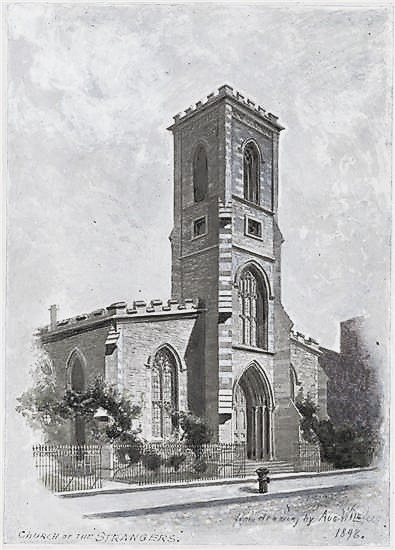
The Lost Church of the Strangers - Mercer St. near Waverly Place


image by John m. August Will, 1898 from the collection of the Museum of the City of New York

On October 8, 1835 a group of affluent men petitioned the Third Presbytery of New York to organize a church to be called The Mercer-Street Presbyterian Church.  Things moved swiftly.  That same month the 45-year-old Rev. Thomas Harvey Skinner arrived in New York from Newburyport, Massachusetts, and on November 8 was installed as the pastor.

The small congregation was composed of prominent New Yorkers like James Boorman and his wife Mary, and Gordon and Marcia Burnham.  A church building was quickly raised on the west side of Mercer Street just north of Waverly Place.  The neighborhood, just two blocks east of Washington Square, was filling with opulent residences.

The Gothic Revival building featured a central tower and tall pointed arch windows.  The architect is unknown, however several of the elements, like the crenellation and layered buttresses, smack of Richard Upjohn's Church of the Holy Communion, completed a decade later.

from Illustrated New York City and Surroundings, 1889 (copyright expired)

Rev. George L. Prentiss would recall in 1895, "No sooner was the new sanctuary completed than large numbers crowded into it from all parts of the city, and were at once received into its fellowship."  Other prominent families in the congregation were those of James Roosevelt, William E. Dodge, Anson Greene Phelps, and Alfred De Forest.

Among Rev. Skinner's first notable works was to help found the Union Theological Seminary in 1836.  For decades, the commencement exercises were held in the Mercer-Street Presbyterian Church.

Thomas Skinner resigned in 1848, triggering a series of rather short-lasting ministers.  The fourth, Rev. Robert R. Booth, was installed on March 6, 1861.  It was during his pastorate that significant change would come.  On September 16, 1870 the New York Presbytery merged the Mercer-Street Presbyterian Church with the First Presbyterian Church on University Place.  The combined congregations (now known as the Presbyterian Church on University Place) worshiped in the University Place church.  The Mercer Street structure was placed on the market for $65,000--about $1.4 million today.

Five years earlier Rev. Charles Force Deems had relocated to New York City from North Carolina.  Deems recalled in his 1897 Autobiography of Charles Force Deems, "Before the organization of any church and while I was simply preaching to strangers, a lady of high character living in Mobile, when on a visit to New York; always attended our service with her daughter.  With them I became acquainted."

The "lady of high character" was Mary Eliza Crawford and her daughter was Frank Armstrong Crawford.  Frank was highly taken with Deem's preaching and theology, and as her marriage to Cornelius Vanderbilt I approached, according to Deems, "it had been intended that I should celebrate the marriage, and that it would have been done but for my absence."

Rev. Dr. Charles Force Deems, from the collection of the New York Public Library

By the time the property became available, Deems's Church of the Strangers had been organized and was worshiping in a chapel at New York University.  The unusual name reflected Deems's non-denominational congregation, insisting that anyone who accepted the Apostles' Creed would be accepted.  He offered $50,000 for the property (money he did not have, but hoped to accumulate through fund-raising).

The Vanderbilts lived at 10 Washington Place, one block away from the Mercer-Street Presbyterian Church.  Cornelius Vanderbilt invited Deems to his mansion and offered to buy the church as a gift.  In Deems's words, "The commodore had never been a member of any church, had been a very worldly and even profane man; but he had from his earliest childhood the most unshaken faith in the Bible."  (The fact that his wife was an ardent admirer of Deems, no doubt, had much to do with the decision, as well.)

original source unknown

Vanderbilt's tepid feelings about organized religion became evident when Deems replied, "Commodore, if you give me that church for the Lord Jesus Christ, I'll most thankfully accept it."  Vanderbilt said, "No, doctor, I would not give it to you that way, because that would be professing to you a religious sentiment I do not feel.  I want to give you a church, that's all there is.  It is one friend doing something for another friend.  Now, if you take it that way I'll give it to you."

On October 3, 1870, The New York Times reported, "Since it has stood empty the edifice has been repainted, recarpeted, and renovated generally, and now presents quite a neat and tasteful appearance."  It had officially opened as the Church of the Strangers the day before.  Those attending represented some of the wealthiest and most influential in the city.  "Among the gentlemen present were Commodore Vanderbilt, Thurlow Weed, Horace Greeley, Peter Cooper, Daniel Drew, William M. Evarts, William F. Havemeyer, Algernon S. Sullivan, Stewart L. Woodford, William E. Dodge, Morris K. Jesup, James Lorimer Graham and E. I. Jeffray," said The New York Times.

from New-York Tribune, January 23, 1898

Rev. Deems had instructed the ushers to escort all clergymen to seats provided at the front of the church.  "One enthusiastic usher in obedience to these instructions searched for a victim and was finally rewarded by seeing an elderly gentleman, wearing a white neck-tie, alight from a carriage.  He approached him, and taking his arm, led him up the the main side towards the pulpit."  Rev. Deems interceded, introducing the usher to Cornelius Vanderbilt.  When the embarrassed usher apologized, the millionaire exhibited an unexpected spark of humor.  As he took his seat, he said, "That's not the first time I have been taken for a clergyman.  No apology is necessary."

Despite Vanderbilt's disinterest in organized religion, his faith was strong and his friendship with Rev. Deems grew extremely close.  On Thanksgiving Day 1875 Vanderbilt took a ride in Central Park and caught a cold.  By the spring he could no longer go to his office, and on April 26, 1876 was confined to his bed.  Rev. Deems visited Vanderbilt nearly every day for eight months.  Using the third person, Deems wrote, "The commodore would not let him leave his side, often keeping him for hours...Through all those months the attachment between the two men increased."

Cornelius Vanderbilt died on January 4, 1877.  Two days later  
The New York Times reported, "To-morrow morning the remains will be placed in the main hall of the house, where they will lie until 10 o'clock, at which hour they will be taken to the Church of the Strangers...where the funeral services will be performed."  The newspaper noted, "Some time before his death the Commodore requested Dr. Deems to avoid all pomp and abstain from all eulogy at his funeral."  Nevertheless, in his autobiography Deems wrote, "In his funeral sermon...Dr. Deems has set forth his estimate of the character of Commodore Vanderbilt."

Almost immediately a fund among the congregants was formed to memorialize Cornelius Vanderbilt.  In order that every member could contribute, the donations were limited to between 10 cents and $1.00.  Designed by William Gibson & Sons and approved by Frank Armstrong Vanderbilt and William Henry Vanderbilt, the bronze and black marble tablet was installed in the church in December 1879.

A depiction of the tablet appeared in several periodicals.  from the collection of the New York Public Library.

A surprising (at least to 21st century readers) ceremony took place in the church on Good Friday, 1881.  The New York Times reported, "Palestine Commandery, No. 18, Knights Templar, celebrated Good Friday by visiting the Church of the Strangers last evening and listening to a sermon by its Chaplain, the Rev. Dr. Charles F. Deems."  Accompanied by the fife and drum corps of the Ninth Regiment, the Knights Templar had marched "through Twenty-third-street, Fifth-avenue, Fourteenth-street, Broadway, Clinton-place, and Mercer-street, to the church."

A large floral arrangement with a Maltese cross presented by the commandery decorated the front of the church.  The Knights were seated in the front pews.  Congregants were given programs "printed in purple ink on lavender-colored paper [which] bore the insignia of the order on one leaf and a representation of the banner of the commandery on the other."  At the conclusion of the service, "The Knights arose in a body and, drawing their swords, saluted Dr. Deems and after passing out formed in line and returned to head-quarters."

There would be two other Vanderbilt funerals in the Church of the Strangers.  Cornelius Jeremiah Vanderbilt, described by The New York Times as "the discarded son of the late Commodore Vanderbilt," committed suicide on April 2, 1882.  Known within the family as C. J., he had never gained his father's approval, partly because of his epilepsy, which the commodore viewed as a weakness, but also because of his long-term relationship with his "particular friend," as worded by The New York Times, George Terry.  C. J. had been given a humiliatingly small portion of his father's estate.  On April 5, 1882, The New York Times reported on his funeral in the Church of the Strangers, saying, "The church was nearly filled, but aside from the members of the Vanderbilt family few persons of note were present."

Such was not the case on May 7, 1885.  The New York Times reported, "Many distinguished and well-known New-Yorkers attended the funeral of Mrs. Frank A. Vanderbilt in the Church of the Strangers."  The newspaper commented, "She married Commodore Vanderbilt when he was an unbeliever, and she made him a Christian."

Rev. Charles Alexander Force Deems died on November 18, 1893.  The Church of the Strangers was "crowded to the doors" during his funeral on November 22 at noon.  Among the pallbearers was Cornelius Vanderbilt III, the grandson of Commodore Vanderbilt.

from New-York Tribune, January 23, 1898

Just over four years later, on January 22, 1898, the last service was held in the church.  The Sun reported, "Nearly 1,200 persons crowded into the Church of the Strangers on Mercer street...to take part in the final service in the old edifice.  Next Sunday the congregation will move into its new home, on Fifty-seventh street, near Eighth avenue."

The New-York Tribune commented on the much-changed neighborhood.  "The quaint old building of rough stone is not small, even for a church of to-day, and when it was new, back in the thirties, it was doubtless regarded as an exceptionally large and imposing structure.  In those days it was at least allowed to show for what it was worth."  But, said the article, as "the neighborhood in which it is situated gradually changed from a quiet residence district to a noisy, active business centre, there came a corresponding change in the surrounding architecture."  The vintage church was now engulfed by loft buildings.

The structure sat empty until 1901 when a demolition permit was issued.  The loft building which replaced it was completed in 1903 and survives.

no permission to reuse the content of this blog has been granted to LaptrinhX.com

Saturday, March 26, 2022

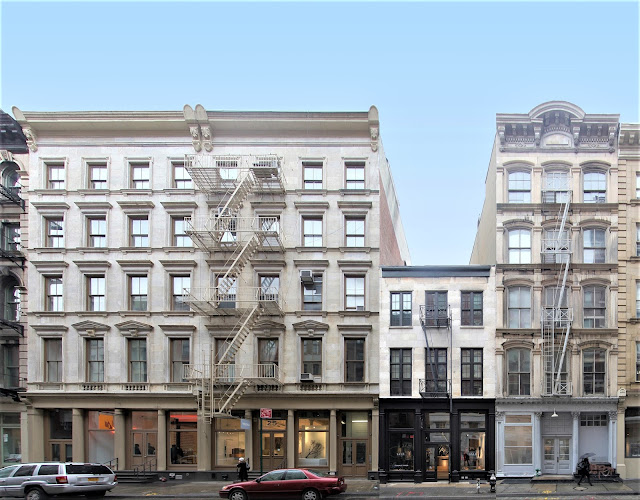
The 1861 Mason Brothers Building - 5-7 Mercer Street


image via centurionre.com

The fashionable tenor of the Mercer Street block between Canal and Grand Streets in the early 19th century was evidenced in a description of the building at 7 Mercer Street in December 1830.  The rental ad called it "the elegant three-story brick dwelling house and lot No. 7 Mercer street...finished in the best manner."

The upscale, residential neighborhood would be completely transformed in the first years following the Civil War, as low brick houses were replaced with modern loft buildings.  One of the pioneers in the movement was J. J. Phelps, who did not wait for the construction flurry of the late 1860's and early '70's.  In 1859 he purchased and demolished the 25-foot-wide houses at 5 and 7 Mercer Street, and hired architect John B. Snook to design a replacement structure.

His five-story, Italianate style structure sat upon a cast iron storefront, manufactured by Daniel D. Badger's Architectural Iron Works.  Its fluted columns were originally capped by ornate Corinthian capitals.   The openings of the upper floors sat within prim architrave surrounds, those of the second floor being fronted with handsome balustrades.  

It is probable that Phelps already had a tenant before construction began.  Although the building was not officially completed until 1861, the publishing firm of Mason Brothers moved in before then.  Headed by brothers David G. and Lowell Mason, Jr., in addition to academic books, the firm published sheet music and the biweekly New-York Musical Review and Gazette.  

An advertisement in May 1860 listed the latest releases, including the three-volume Life of Andrew Jackson (which cost the pricey equivalent of $240 today), The Life and Times of Philip Schuyler, and Italy: From the Earliest Period to the Present Day.

A separate, but related, firm, Mason & Hamlin, shared space in the building.  Organized in 1854 by Henry Mason (David and Lowell Mason's brother) and Emmons Hamlin, the company produced and sold cabinet organs, sometimes called parlor organs.  An advertisement in The New York Times on May 11, 1863 announced:

Clergymen and Others interested are invited to call at our warerooms, Nos. 5 and 7 Mercer-street, New-York, and examine the new Cabinet Organs, with from one to twelve stops each, recently introduced by Mason & Hamlin.  They surpass all other instruments of the class, for smaller churches, chapels, Sabbath school-rooms, and private houses, while the prices are very moderate, viz, $70, $85, $95, $120, and upwards, each.  Dr. Lowell Mason, Dr. Thomas Hastings, and more than fifty of the most distinguished organists and musicians of New-York, Boston &c., bear witness in written testimony to the great value of these new instruments, and their entire superiority to all others.
                                                        Mason Brothers


This model was among Mason & Hamlin's most scaled-down versions.  Others had elaborate cabinets and finishes.

In 1861 music publisher and agent Theodore Hagen leased space in the building.  He offered sheet music "of every description, foreign as well as American," and, like Mason Brothers, published a journal, the Musical Review and World.  

Hagen had a knack for marketing.  In a December 21, 1863 article outlining the recent programs at the Academy of Music, The New York Times mentioned, "The lady patrons of the matinees were presented with copies of the polka which is published by Mr. Theodore Hagen, No. 5 and 7 Mercer-street."

In 1865 space on the upper floors was leased to brothers Bernard, Jessie and John Travis for their millinery shop.  It was a hint of the future of the district, which would become the center of the millinery and apparel trade by the mid-1870's.

And, indeed, by 1879 both Mason Brothers and Mason & Hamlin had moved to Union Square.  The building's tenants were now The American Suspender Company, the Eureka Silk Mfg. Co., and Seavey, Foster and Bowman, agents of the Eureka Silk Mfg. Co.


In the 1880's the John P. Lynch Knit Goods Co. and G. & M. Bamberger leased space in the building.  John P. Lynch had immigrated from Ireland and was fervently behind the cause of Irish Home Rule.  On June 17, 1886 The Sun reported, "A big pile of money came into The Sun office yesterday to help the Home Rulers win their battle.  The largest contributor was John P. Lynch of 5 Mercer street.  He sent a check for $200.  It was his second contribution to The Sun fund."  His initial check had been for $100, bringing his total donation to date to the equivalent of $8,500 today.

Lynch flourished his dual patriotism in a long letter included with his second check, which said in part:

As an American and an Irishman, I feel deeply grateful for what The Sun has done for human liberty in general, and for Irish liberty in particular, and I have no doubt I voice the feeling of millions.  May it continue to shed its brilliant rays on the subject of home rule until Ireland is a free and prosperous nation.

At the turn of the century, the ground floor was home to E. Bissell & Co., wholesale auctioneers.  The firm liquidated overstocked goods and inventory of closed factories.  On December 9, 1908, for instance, The 14th Street Store, owned by Henry Siegel, advertised "Toys Bought at Auction," and touted its recent purchase "right in the heart of the Christmas Season." The ad urged, "Think of it!  An auction sale of bright, new perfect toys sold by E. Bissell & Co."

On an upper floor was the Base Sorting Plant, Inc., operated by Ira M. Kaplan, Nat Meyers and E. A. Stone.  The firm repurposed scrap materials from garment makers.  But World War I brought a new purpose to the company.  On December 29, 1917, Textile World Journal reported that the business, "is henceforth to be operated in the interest of the Government."

The Daily Mill Stock Reporter added that since September, the Base Sorting Plant was "handling all clippings resulting from the cutting up of khaki cloth for military uniforms.  It is also handling the old khaki rags from the cantonments."  The owners "have tendered their services gratuitously to the United States Government for the duration of the war."  All profits were turned over to the Government.

The building continued to house apparel-related firms until the Soho renaissance in the third quarter of the century.   In 2002 the Grant Gallery was here, as was Rooms and Gardens, a furniture and lighting store.

photograph by the author

A renovation completed in 2019 resulted in joint living-work quarters for artists above the ground floor retail space.  Although the cast iron capitals of the storefront have been lost, John B. Snook's handsome design is little changed after 160 years.

no permission to reuse the content of this blog has been granted to LaptrinhX.com

Friday, March 11, 2022

Louis Burger's 1868 29 Mercer Street


The building boom that followed the end of the Civil War transformed the block of Mercer Street between Canal and Grand Street from one of low brick houses to tall loft buildings.  In 1867 Henry Cardoza commissioned architect Louis Burger to design a five-story loft-and-store building at 29 Mercer Street.

Completed in 1868, the handsome structure would have been comfortable sitting among the upscale emporiums of Broadway.  Above the cast iron storefront with its ornate Corinthian columns were four floors of gleaming marble.  Burger's design drew inspiration from the recent French Second Empire style--each identical story defined by a projecting intermediate cornice on diminutive brackets, and prim pilasters separating the elliptically arched openings.  A robust metal cornice with arched pediment crowned the design.

Among the first tenants was J. Sheldon, who operated his men's hat business here in 1871.  He was a pioneer in the migration of the millinery and apparel business into the neighborhood.

Perhaps the first of a long string of thefts at 29 Mercer Street came on July 10, 1875.  Herbert C. Armitage hung his vest and jacket in his office, and later returned to find the vest missing.  In it were his gold watch and chain and $75 in cash--around $1,800 today.  Investigators spoke to James Brown, who worked down the block at 9 Mercer Street.  He said he had watched two men "loitering around Mr. Armitage's place of business" that day.  The New York Herald reported on July 18 that Brown "saw one of them, whose name is Frank Hudson, come out with a parcel in his hand which looked like a vest rolled up."  Hudson was arrested and held on $1,000 bail awaiting trial.

Also in the building at the time were importers Pratt & Farmer.  On December 18, 1876 the owners discovered they had been robbed of 3,000 gross of buttons, valued at nearly $100,000 in today's money.  There was no sign of forced entry, suggesting an inside job.

Once again, it was a vigilant worker on the block who solved the case.  George Lagenhoff was a porter at 35 Mercer Street.  The New York Herald reported that he told police that on that morning, "between seven and half-past seven o'clock, he saw [Frederick] Meyers open the door of Messrs. Pratt & Farm's premises and then call a truckman, who was near by."  Meyers was Pratt & Farmer's trusted porter.  The witness said that the truckman drove up, the boxes of buttons were loaded into the truck, and then he drove away.  Meyers locked up the store behind himself.  He was arrested on Lagenhoff's information.

Hertlein & Schlatter, makers of "fringes and dress trimmings" operated from an upper floor in 1880.  Their was a large concern, with a second factory at 210 Canal Street.

Another victim of inside crime was the English-based T. I. Birkin & Co.  The Mercer Street office imported and sold the lace curtains that the firm manufactured in Nottingham, England.  Early in 1895 John W. Smith, the cashier and financial manager of the New York office, filed charges of forgery against the firm's selling agent, Andrew B. Dick.  According to Smith, between April 3, 1893 and then, Dick had systematically cashed forged checks drawn on the company amounting to $15,000--nearly half a million in today's dollars.

The New York Times reported that Dick, who was hired in 1892 "was traveling through the United States for the firm, and was a trusted man."  On February 20, 1895 The World reported that Andrew B. Dick had been arrested.  But there was a problem.  The police arrested the wrong man.  The following day The New York Times explained, "Through an unfortunate blunder John W. Smith was placed in the position of A. B. Dick, and vice versa."  The article noted, "Naturally, Mr. Smith is very much annoyed by the confusion of identity, and his annoyance is shared by a large circle of friends."

Apparel firms continued to occupy the building at the turn of the century.  Among them was William J. Boesen, makers of "pleatings."  Exactly one-half of his workers were teenaged boys, who worked 54 hours per week.  Sharing the building that year was Schlatter & Sacks, makers and importers of ladies' dress and cloak trimmings.  Charles W. Schlatter and Henry K. Sacks had formed the firm on January 1, 1899.

A factory inspection of Isaac Falkenberg and T. H. Ellson's women's neckwear shop in February 1903 resulted in a Health Department violation for "failure to provide sink and running water."  The firm would soon have other concerns to deal with.  Although it was doing a brisk business, according to The New York Times on July 6, 1905, "Falkenberg could not collect the debts owing to him."

Rose Scott, the manager, opened the premises on the morning of July 5 to a horrifying scene.  The New York Times reported, "Falkenberg had committed suicide by attaching a rubber tube to a gas fixture and turning on the gas.  He had taken the precaution to move a table to a place beneath the gas fixture to make sure that the tube would not be too short and slip from his mouth when he became unconscious."   In his pocket was a letter to his brother explaining that his failure to collect his debts had driven him to the drastic act.


Georgette D. Fahnestock purchased the building in 1915 and retained possession for more than two decades.  She sold it to Elisa Imperatrice in June 1938 for $4,000--about $73,500 by today's standards.  It continued to house small businesses until the turn of the 21st century when the Soho renaissance finally caught up with the address.  Today, each of the upper floors contains one apartment.

photographs by the author
LaptrinhX.com has no authorization to reuse the content of this blog

Friday, February 18, 2022

Ritch & Griffiths's 1861 27 Mercer Street


image via premierequities.com

In 1866 the trustees of the estate of Charlotte Gomez contracted the architectural firm of Ritch & Griffiths to design a commercial building at 27 Mercer Street, between Canal and Grand Streets.  The neighborhood, only a generation earlier, had been residential, but it was quickly transforming into one of factories and stores.

The architects, who were recently responsible for designing elaborate buildings like the Emigrant Hospital on Ward's Island, and the Labor Exchange at Castle Garden, would now produce a much humbler structure.  Completed in 1867, the  three-story building was faced in granite above the cast iron storefront.  Twenty-four feet wide, its simple Italianate design looked as much like a converted house as a new loft and store building.

Unlike the large, cast iron-fronted structures rising throughout the district, 27 Mercer Street could accommodate only a handful of tenants.  Among the early occupants was Martin V. B. Travis, who operated a "notion business."  
Notions merchants offered a variety of goods, many of which were related to sewing, like ribbons, buttons, and buttons.  But other small items, like collar stays, pocket knives and mirrors were also offered.  

By the mid-1870's silk fabrics dealer George B. Skinner & Co. had its salesroom  here.  The firm's mills were in Yonkers, New York where it made textiles, the names of which are alien to today's seamstresses: "tram, organzine, fringe silk, sewing silk, and machine twist."

The company shared the building with Patterson Dyeing & Finishing Co., run by Claude Greppo.  It dyed piece goods at its dyeworks in Patterson, New Jersey.

The first years of the 1890's saw Jackson Brothers, makers of furs and fur trimmings, here.  Julius and Moritz Jackson employed ten men, four women, and three teens--one boy and two girls--in 1892.  They worked 58 hours per week and eight hours on Saturdays.

In the summer of 1893, Joseph Stiner & Bros. pressured the brothers for an outstanding debt of $2,375.  The Evening World said, "The Jacksons begged for time," and explained that they had just shipped more than $4,000 of goods to various clients.  And an inventory showed the firm had more than a third of a million in today's dollars worth of furs in stock.

Suspicious, however, the creditors wrote to one of the supposed customers and "were informed the firm had not bought the amount of goods represented, and did not owe Jackson Brothers what appeared on the books," according to Fur Trade Review.  When Steiner & Bros. filed for an attachment of the Jackson Brothers inventory early in September, according to The Evening World, "the Jacksons represented that they would settle with Steiner & Bros. if given until after the celebration of the Hebrew New Year, which began the next day.  They represented that as orthodox Hebrews they could do no business during that sacred festival."

Steiner & Bros. should have been wary of the excuse, given that the brothers' factory operated on the sabbath every week.  When the sheriff visited the Mercer Street premises early in September, he found that the Jacksons had fled in the night, taking the furs and leaving an empty loft.  On September 15, The Evening World reported, "The Sheriff has closed up the place of business of Jackson Brothers, manufacturers of furs at 27 Mercer street...on allegations that they had disposed of their property."  A manhunt for the fugitives was launched across several states.

Four days later the brothers were under arrest in Boston.  They were charged with fraud and extradited to New York City.

Following the disgraced Jackson Brothers in the building was Frank & Co., cloak manufacturers.  The tiny firm of Louis Emanuel, which made curtains, was here at the turn of the century.  Emanuel's staff of just three men worked 59 hours per week.

A major change came in 1916 when the Nicholas Doddato Company leased the building.  The Waste Trade Journal announced that the firm, "now occupy a three-story building, thoroughly equipped for the handling of their business."  That business was the scrap business.  The Doddato family dealt in "rags, bagging, cotton and wool waste, paper stock, [and] strings."

That tradition continued after 1925 when the building was sold to Rose Tuzio and her daughter, Victoria Mastronardi.  Victoria's husband, Andrew, took over the first floor for his waste paper business, while their existing tenants used the top two floors for theirs.

A horrific accident occurred on January 31, 1939.  Two years earlier Morris Dell 'Olio and his son had moved their waste paper business into the rear half of the upper floors.  The front half was occupied by a tenant named Derico, who was in the same business.

That morning Dell 'Olio and his son were unloading materials from a truck and hoisting them to the third floor.  Court papers later explained, "The hoist was operated by pulling a rope and it was necessary for the person operating the hoist to continue pulling the rope until such time as he desired to stop the hoist."  Dell 'Olio was unloading about seven or eight bags of heavy waste material into a sling, which he would then send up to his son.

For about five or six months, Dell 'Olio had complained to Andrew Mastronardi that the rope was in bad condition.  His concerns were warranted.  As bags, weighing about 700 pounds, were nearly at the third floor, the rope broke, sending them crashing directly onto Dell 'Olio.

While Dell 'Olio was not killed, he was seriously injured and sued the landlords.  In court, Andrew Mastronardi said that since Dell 'Olio knew the rope was in bad condition, he could have stood away from the spot directly underneath the load.  The jury did not agree and awarded Dell 'Olio $1,000 (about $18,600 today).

The Mastronardis' bad luck continued.  Late on the night of June 9 that year, fire broke out.  It developed into a two-alarm blaze, and by the time it was extinguished, according to The New York Sun, "the place was wrecked" and one firefighter injured.

The discovery of what is now known as the Soho district by artists in the third quarter of the 20th century changed the personality of 27 Mercer Street.  In 2006 Fringe Central was in the building, where tickets to the New York International Fringe Festival could be purchased.   Started in 1996, it is the largest multi-arts festival in North America, attracting world-wide companies.

The store space became home to Surface to Air in 2011.  It was the first store for the sportswear line that had been available in stores like Barneys New York and Bloomingdale's for years.

image via dxastudio.com

The little building that had stood in the shadows of its neighbors for 160 years was converted to a residential triplex in 2016-17, designed by the architectural firm GDSNY.

The days of waste paper and rags were over in 2016.  image via gdsny.com

Curbed New York called 27 Mercer Street "very Soho-glamorous" and described the five-bedroom space as having "wide white oak hardwood floors, imported natural stone, and marble; fancy appliances; an excess of slightly; and 'dueling terraces."  The unfinished residence went on the market in 2016 for $16.5 million.

no permission to reuse the content of this blog has been granted to LaptrinhX.com

Wednesday, January 19, 2022

The 1867 Dreyfus, Kohn & Co. Building - 35 Mercer Street


Born in 1810, Amos R. Eno started out in the dry goods business on Pearl Street.  The New York Times said decades later, "While making a fortune in the dry goods business, Mr. Eno began to invest judiciously in New York real estate.  He picked out desirable corners, and occasionally he would buy an entire block of land."  


In the 1850's, the neighborhood of Mercer and Green Streets--once lined with respectable private homes--had  gained the reputation of Manhattan's most notorious red light district.  But that began to change at the end of the Civil War.  As commerce inched northward, modern commercial buildings replaced the Federal style houses of the 1820's.

Amos R. Eno was among those transforming the district.  In 1867 he erected two large loft and store buildings at the southwest corner of Mercer and Grand Streets.  The same architect was doubtlessly responsible for both 31-33 Mercer Street and the corner building, 35 Mercer; their facades being nearly identical.

The identical elements of the two facades create the illusion of a single building.

Like its fraternal twin, 35 Mercer Street was five stories tall and faced in sandstone above a cast iron base.  Its prim Italianate design featured quoins that separated it and 31-33 Mercer, and created two-bay-wide vertical sections on either end of the Grand Street elevation.  

The ground floor store became home to the auction rooms of Richard Walters.  His sales liquidated a wide variety of merchandise.  On Friday, July 31, 1868, for instance, he sold "a large and general assortment of Parlor, Reception Room, Dining and Chamber Furniture, Bar Furniture, and Glassware."  Included were items like a "superior seven octave rosewood Piano," French plate glass mirrors, oil paintings, and carpets.

The upper floors were leased to the wholesale drygoods firm Treadwell, Taylor & Co.  They were nearly the victims of slick conmen on February 14, 1870, saved only by the sharp instincts of two policemen.  Charles Wilson and Edward Hale strode into the store carrying a "new and large valise securely strapped," as described by The Evening Post.  They identified themselves as "Western merchants, desirous of purchasing silks and dress goods."

The clerk brought various samples of materials, repeatedly turning his back on the well-dressed buyers as he did.  When he was not looking, one of the men pushed a button on the valise, which popped a spring catch and opened the side of the case.  Pricey fabrics were then stashed inside.  When pushed closed, the valise appeared to be securely strapped.  The Evening Post said, "The theft was  accomplished so adroitly that it did not attract the attention of the persons in the store."  But what the crooks did not know was that two policemen were waiting for them on Mercer Street.

The New-York Daily Tribune explained, "Detectives Casey and Quinn of the Broadway squad yesterday saw Charles Wilson and Edward Hale, well-known shoplifters, in Mercer-st.  One of them carried a large leather valise, and the officers, believing that the thieves were on a professional tour, they followed."

The pair had chosen 24 pieces of various goods, told the clerk they would return later to pay for the items and advise where to have them sent.  They then walked out of the building to encounter Casey and Quinn.  At the station house the valise "was found to be of novel construction," said the New-York Daily Tribune, which detailed the secret latch.  Inside were two pieces of brown silk, valued at $150 (more than $3,000 today).  The Evening Post added, "The police think this the most dangerous appliance yet introduced to aid shoplifters, and storekeepers are warned against persons who carry large securely-strapped valises."

Treadwell, Taylor & Co. was replaced in 1871 by Dreyfus, Kohn & Co., importers of apparel and millinery trims.  The location, quickly becoming the center of Manhattan's garment district, was well-suited for the firm.

The Evening Post, January 25, 1871 (copyright expired)

Dreyfus, Kohn & Co. was established in 1858 by Isaac E. Dreyfus, Aaron Kohn and G. Rosenblatt.  The year 1885 was a tragic one for the company, with both Dreyfus and Rosenblatt dying.  Kohn brought Rosenblatt's son, Moses G. Rosenblatt, into the firm.

The Financial Panic of 1893 hit Dreyfus, Kohn & Co. hard.  The company's troubles were increased when Aaron Kohn became ill in March 1896 "and was obliged to give up his work and take a trip to Jamaica," according to The New York Press.  Upon his return, the decision was made to close the company, described by the newspaper as "one of the oldest and most prominent in the trade."

The stress of closing the firm his father had helped found may have contributed to the death of Moses G. Rosenblatt.  The 48-year-old died on August 14, two weeks after business was suspended.  The New York Times said, "Mr. Rosenblatt worried greatly over the business embarrassments of the firm, and he was, in addition, prostrated by the heat on Saturday."

Amos R. Eno died on February 21, 1898.  At the time of his death his real estate holdings were valued at around $20 million--nearly $645 million in today's dollars.  A massive auction was held in February 1899 during which Leon Tanenbaum paid the equivalent today of $3.72 million for 35 Mercer Street.

from New York--The Metropolis, 1902 (copyright expired)

The building became home to William Openhym & Sons, another wholesale drygoods firm, founded in 1853.  The firm was reorganized in 1892 following the death of William Openhym and was now conducted by brothers, William, Adolphe, Joseph and Emile.

Adolphe was the senior member of the firm and a member of the Chamber of Commerce.  The New York Press described him as being "prominent in business and club life...He was a member of the Reform Club, City Club, National Arts Club and the Nineteenth Century Club."  He and his wife and two children lived in a handsome mansion at 352 Riverside Drive between 107th and 108th Streets.  

Each morning Adolphe rode in Riverside Park before heading downtown.   On Monday morning, March 30, 1903, according to The New York Press, "He returned in good spirits and passed a joke with his groom as he threw him the reins of his saddle horse.  After staying in the house a few minutes, Mr. Openhym walked briskly toward the north."  He was not seen again.

Openhym never made it to work that day.  An hour after he left the house, Frank McConville, the keeper of the High Bridge, saw a man stop in the middle of the bridge and take his hat off.  McConville shouted for him to move on, but instead the  man climbed to the railing and threw himself over.  McConville ran to the spot where the man's hat and umbrella lay.  They were identified by Emile Openhym as belonging to his brother.

Adolph Openhym, from New York--The Metropolis, 1902 (copyright expired)

Suicide was scandalous and shameful (and illegal) and neither the family nor the firm would admit to the possibility.  A member of the company said, "If he absolutely was seen to jump from the High Bridge into the Harlem River, I can only believe he had gone to the bridge for an extra breath of fresh air, and suddenly attacked by vertigo, toppled over into the river."  (Why he would have gone north after leaving home, rather than south, was not addressed.)

Openhym's body was not discovered until April 26.  His funeral was held in the Riverside Drive house three days later.  The 49-year-old millionaire received his final humiliation on May 2, when The New York Press entitled an article, "Declares Openhym Was Insane," and reported that Coroner Scholer ruled he had taken his life "while suffering from temporary mental aberration."

William Openhym & Sons continued on at 35 Mercer Street until 1912 when it moved north to the newly-completed Emmet Building at the southeast corner of Madison Avenue and 29th Street.  The Soho building continued to house apparel-related firms for decades, like the Manhattan Silk Company and the Rossie Velvet Company.

Unlike today, traffic at the intersection of Mercer and Grand Streets was essentially non-existent in 1941.  image via the NYC Dept of Records & Information Services

Major change to the Soho district came in the third quarter of the 20th century, as artists discovered the gritty area.  Storefronts became galleries or trendy cafes and shops, and vast lofts, formerly home to garment manufacturers, were converted to studios.  Among the pioneers in the movement was 35 Mercer Street.  A renovation completed in 1978 resulted in "joint living-working quarters for artists" above the store level--two on the second floor and one each on the upper floors.  Among the initial residents was architect Walter David  Brown.  The Department of Buildings stressed, "At least one occupant of each apartment shall be an Artist certified by the New York City Department of Cultural Affairs."


A subsequent renovation resulted in two artist lofts each on all the floors.

photographs by the author
many thanks to Marian Scheuer for requesting this post
LaptrinhX.com has no authorization to reuse the content of this blog

Saturday, September 5, 2020

Robert Mook's 1869 Cast Iron 483-485 Broadway


In 1869 Manhattan's theater district had moved northward from the neighborhood which would later be called Soho.   That year the Broadway Theatre, originally built as Brougham's Lyceum, was demolished as developer Helen Langdon laid plans for a modern store and loft building on the site.


from Memories of Fifty Years, 1889 (copyright expired)
Architect Robert Mook received the commission to design Nos. 483-485 Broadway.  Clad in cast iron, the five-story building extended through the block to Mercer Street.  Mook divided it vertically with stacked pilasters, nearly matching those on the ends.  The floors between the rusticated storefront with its engaged Corinthian columns and the modillioned terminal cornice were given little ornamentation.   

The spartan treatment went as far as the columns between the windows.  Rather than capitals Mook gave them a ring of egg-and-dart molding.  Nevertheless, he added three classical urns atop each of the piers above the cornice.

Among Helen Langdon's initial tenants was William H. & Co.  William H. Lyon had an interesting past.  Born in Holland, Massachusetts in 1819, he was educated as a lawyer, but instead went into teaching.  He was principal of the Clyde High School in Wayne County, New York when Samuel Morse put his telegraph in operation.  Fascinated, Lyon experimented on his own and subsequently invented a "printing-telegraph."  On July 11, 1844 the Clyde Eagle announced "With this machine Mr. Lyon is able to write with pen and ink with the same facility that Professor Morse scratches characters upon paper with points of steel."


The impressive William H. Lyon as he appeared in 1884.  By the time of this photograph he had been nominated as a both a mayoral and congressional candidate.  The Civil, Political, Professional and Ecclesiastical History of the County of Kings (copyright expired)
The following year Lyon changed his professional course once again.  He moved to New York and opened his wholesale dry goods business, the Yankee Notion and Fancy Goods company.  Later renamed William H. Lyon & Co., the successful firm took the store level and the top two floors--50,000 square feet--in No. 483-485 Broadway in 1870.

In 1884 historian Henry R. Stiles said the firm "import goods from Europe, China, India, and Japan, and their sales extend not only to every State in the United States from Maine to California, but also to Mexico, West Indies, South America, and Canada."

Also in the building was the dry goods firm Hecht Brothers, on the second and third floors.


Wm. H. Lyon & Co.'s extensive offerings went beyond dry goods. The Christian Union, December 18, 1878 (copyright expired)  
Fire broke out in the building on the night of January 30, 1879.  In the course of battling the blaze, Fireman Edward McGaffney of Engine Co. 33 was permanently blinded.   Two days later William H. Lyon & Co. placed a notice in The New York Herald that read:

To The Trade:  The fire in the lofts of Nos. 483 and 485 Broadway will cause no delay whatever in transacting our business.

On March 7, 1877 attorneys had been attempting for a month to compile a jury to try Thomas Cleary on charges of attempting to bribe an alderman.   The following day the New-York Tribune reported on their frustration.  "As the people came and went, the ordinarily bad air of the court-room got worse and worse.  The Judge buried his nose in a bottle of smelling-salts.  The lawyers drew their handkerchiefs wearily across their brows and looked frequently at the clock."

But then, wrote the newspaper, "The dreary level of the mental shallows through which the lawyers have all day been wading was happily broken when Bernard Hecht came on the stand.  He is a fancy goods importer at No. 485 Broadway."  Although Hecht admitted to having an opinion in the case, he "felt himself entirely competent to adjudge the evidence impartially."   Cleary's attorney was not convinced.  "The defense, acting on their settled policy of excluding intelligent men, challenged him for bias."

Hecht had other problems to deal with before the month was up.  On Saturday night, March 26, 1887 fire again erupted within the building.  It caused $100,000 in damages to Hecht Brothers, who carried insurance of only $75,000.  The different would amount to about $683,000 today.  The New-York Tribune reported "William H. Lyon & Co., dealers in white goods and hosiery, who occupied the first, fourth and fifth floors of the same building, refused to make any statement as to their losses or insurance."

Whether the fire prompted the decision to close William H. Lyon & Co. is unclear.  But in December 1889 the firm closed out all its stock at half the wholesale prices.


The artist got the cornice-top urns slightly wrong, and omitted the middle one.  New-York Tribune, December 29, 1889 (copyright expired)

Taking William H. Lyon & Co.'s place in the building was Weil, Haskell & Co.  In its November 1889 issue The Clothier and Furnisher reported that the firm "will occupy the old stand of W. h. Lyon & Co., 483 and 485 Broadway, after the first of January where they will be glad to meet their old friends, or whoever may be in search of good goods from first hands."  

The "good goods" made by Weil, Haskell & Co. were men's and boys' clothing.  Their product line included "boys' waists," flannel shirts, night shirts, "underwear, hosiery, novelties, etc., etc." according to an advertisement that year.


The Clothiers' and Haberdashers' Weekly, February 7, 1896 (copyright expired)
Having been in the building for three decades, Hecht Brothers may have shocked the dry goods community when it failed in 1899.  Both Bernard and Meyer Hecht followed up by filing personal bankruptcies that August.

Replacing them at No. 483-485 was William Meyer & Co., makers of embroideries, handkerchiefs and lace.  The firm employed a relatively small work staff of 15 men and 12 women.

The estate of Helen Langdon still owned the property in 1904.  By now Weil-Haskell Company and William Meyer & Co. shared the building with Rich & Hochster, makers of tortoise shell goods.  The success of that firm was evidenced in the luxurious living conditions of William R. Hochster who lived with his wife in a seven-room apartment in the Ansonia Hotel.  The Evening World deemed him "a man of large means."

The Hochsters returned from dinner at around 10:00 on January 17, 1904 to a shocking scene.  Because it was Sunday, their two maids had the day off.  Burglars had ransacked the apartment.  "The thieves took away jewelry valued at about $2,500 and left a lot of silverware strewn over the floor," reported The Sun.  The haul would equal just under $75,000 today.

Hochster's firm used the sub-cellar as storage space.  It was a condition that had deadly consequences that summer.  On June 29, 1904 fire, discovered just before noon, broke in the sub-cellar.  The New York Times reported "About fifty girls employed by the Weil-Haskell Company and William Meyer & Co. behaved calmly and reached the street unharmed, but frightened."  

It took firefighters three hours to extinguish the blaze, which did the equivalent of $3.6 million in today's money.  But far worse was the toll the toxic fumes of the burning celluloid took on the responders.  As they attempted to enter the cellar, "The firemen and their officers did not flinch, but reeled and fell where they were at work, and were carried to Broadway or Mercer Street by gasping comrades."

The following day The Evening World ran the headline: "Firemen Dying From Fumes of Gas and Smoke / Victims Swept Down Like Soldiers On Battlefield."  Of the nearly 50 hospitalized firefighters, the article said "It is feared that four firemen will die."

The history of fires in the building seem to have weakened the internal structure.  In 1908 W. G. Langdon hired esteemed architects Clarence True and Warren Conover to make renovations.  Their plans called for "remodelling [sic] the five story loft building...and strengthening the fourth and fifth floors."

On December 21, 1910 the New-York Daily Tribune reported that William Meyer & Co., "one of the largest embroidery firms in the country," had leased the old W. & J. Sloane building on Broadway and 19th Street after having been in No. 493-495 for nearly two decades.

Smaller firms now took over the building.  In 1914 the Aluminum Sales and Manufacturing Company operated from the second floor, William Reichman & Co. was on the third, Benjamin Shrage was on the fourth and Aaron L. Small on the fifth.  The Small company manufactured muslin underwear, employing 58 women, 4 men and one teen under the age of 16.

In 1916 building became home to three businesses, all co-owned by Frank Levy and Frederick W. Ellis.  Wholesale sellers of "bedding manufacturers' supplies" Taylor & Ellis moved into the store and basement.  Their goods came from L. E. Ellis & Son upstairs.  Also in the building was the Frank Levy Paper Company, makers of envelopes and dealers in cardboard, tissue and blotting papers, and "book papers."


The names L. E. Ellis & Co. and Frank Levy are prominently displayed on the facade in 1920.  Geyer's Stationer, September 9, 1920 (copyright expired)
The Frank Levy Paper Company had been in operation since 1882.  On September 9, 1920 Guyer's Stationer noted that the firm's salesroom and warehouse "is in the heart of the paper trading district."


The cast iron urns were the building's most distinctive element.  photo via the NYC Dept of Records & Information Services
As the decades passed, little changed to the building's exterior appearance.  In the 1930's the Weiss Shirt Co. operated here; and by the early 1990's the warehouse of Donghia Furniture and Textiles was in the building and would remain into the 21st century.


A renovation completed in in 2020 resulted in office and retail space throughout the venerable building.  At some point the wonderful rooftop urns, which were still in place in as late as 1973, were removed.  They were a significant loss to Robert Mook's rather austere design which relied so much on their whimsical touch.

photographs by the author