Showing posts with label west 96th street. Show all posts

Monday, May 2, 2022

The Lost Relics at 70-72 West 96th Street


In 1932 the twin houses were decidedly out of place.  photo by Charles Von Urban, from the collection of the New York Public Library

The first signs of development in the rural Manhattan Valley district of Manhattan appeared in the early 1870's.  But it would not be until the 1890's that the newly opened blocks filled with homes, stores and apartments.  One of the pioneering structures in the district was the double house at 70 and 72 West 96th Street.   

The builder took inspiration from the emerging Second Empire movement in placing a mansard roof atop the otherwise nearly featureless structure.  His configuration of the mirror image residences was, nonetheless, intriguing.   To maintain symmetry, the side-by-side doorways shared a common stoop, the second floor hall windows successfully pretended to be one, and the middle dormer sat half-and-half within each attic level.

By the mid-1880's, 72 West 96th Street was home to photographer George W. Fredrickson.  He was followed in the house by William O. Reagan and his wife, Hannah.  Reagan, a veteran of the Civil War, was a partner with Harry Munson in the New York Bill Posting Company.  

The company rented spaces on fences and walls where their advertisements would be pasted.  A court document that year explained, "Some advertisements continued for months; others changed weekly.  Some were on paper; others painted on canvas."

Renting a room with the Reagans was a company employee, Alexander Clark.  He and William Reagan were personally sued on June 9, 1898 by Mary Ryan, who owned a building on Barclay Street and West Broadway.  According to Ryan, the New York Bill Posting Company had plastered a wall of her building "with signs, posters, bill boards, placards and other advertising mediums" without her permission.  This, she said, had been going on since 1895.  Reagan and Clark were charged $10 damages.

William O. Reagan died at the age of 62 on May 6, 1900.  Oddly enough, his funeral, which took place in the parlor, was not held until a week later, on May 13.  Hannah remained in the house, taking out another mortgage that year.  She took in boarders for income--a family named McGee, and two widowed sisters, Mary D. Sherman and Minnie T. Riker.

The McGees had barely settled in before tragedy struck.  On June 10, 1900, 11-year-old Florence McGee went to the house of her playmate, Annie Kahler on Columbus Avenue, and together they went to Central Park.  They played on the lawn there until early evening, then headed back home.

At the corner of Columbus Avenue and 81st Street, Annie, who was 9, started across the avenue just as a streetcar "came whirling toward her," as worded by The New York Press.   The article said, "Florence dragged her little friend from this track just in time, but in doing so she stepped on the north track just as a car northbound came along.  With a scream Florence went under the car and the wheels passed over her right side."

A policeman carried Florence into a drugstore, and a passing physician rushed to his house to get his bag.  When he returned, Florence was still conscious, "but was in such agony, and demanded so vehemently to be taken to her mother, that Dr. Knight administered ether."  The little girl died 25 minutes later, hailed by newspapers as a hero.

By the time of the horrific accident, the Manhattan Valley neighborhood was fully developed, and the little twin houses were a noticeable anachronism.   Next door to the Reagan house, 70 West 96th Street had been operated as a boarding house for years.

Among the boarders in 1899 was real estate broker Freeman Strait, who devised a clever, if devious, way to make extra money--he sold revenue stamps.   According to The Brooklyn Daily Eagle on October 8, "Strait is said to have told a special Treasury employe[e] that he had disposed of $2,000 worth of stamps every week, selling them for three-quarters of their real value."  He could afford the discounted price, because the stamps had already been used.  

The news of his massive con and subsequent arrest was reported as far away as the Midwest.  On October 10 The Chicago Tribune reported he had been charged "with defrauding the government out of $100,000 in the last six months."  (That amount would equal about $3.22 million today.)  "Strait's alleged offense is the cleaning and selling of canceled revenue stamps...When arrested on Saturday he had in a trunk in his room canceled revenue stamps representing $4,626.29, and in his pocket washed stamps to the value of $50."

The Rochester Democrat and Chronicle added, "In a room occupied by Strait at No. 70 West Ninety-sixth street there was found a complete set of eradicating fluids and other materials for removing the ink from canceled stamps."  The New York Chief of the Internal Revenue, Frank G. Thompson, called Strait "an accomplished chemist and the shrewdest swindler he has ever met."

Another boarder to get into trouble with the law was Edmund H. Martine, a furniture packer, who lived here in 1910.  He had also been a private in the 25th Company of the 8th Regiment of the New York National Guard.  In 1908 the quarter-master was taken ill, and Martine was temporarily made acting quartermaster-sergeant at the armory at 94th Street and Park Avenue.   Suddenly, members reported things missing, notably gold lace and brass buttons.  And when Martine resigned in June, "because, as he explained, he was too busy to be a guardsman, the thefts stopped," reported The Sun.  

Furious at the losses which they personally had to pay for, members of the regiment tried to track down Martine.   Finally, two years later on October 2, 1910, Esmond M. O'Brien spotted Martine on Riverside Drive.  He was careful not to tip his hand.  The New York Herald said O'Brien "greeted him in a friendly tone.  It was suggested that they take a walk together, and Martine agreed.  O'Brien did the entertaining until, after their long stroll, he finally found Policeman Sammons and demanded the arrest of his companion."  That "long stroll" had been miles, from 86th Street to 96th Street, then across Central Park all the way to Third Avenue.

Edmund H. Martine was charged with "the larceny of $300 worth of military equipment."  The Sun said, "Martine said he was no thief.  If he cared to steal, he said, he could do a good deal better in the residences where he went to pack things than in an armory."

Emily Barlow ran the boarding house at 70 West 96th Street by 1916.  Among her tenants that year was 60-year-old Christina Ness, a spinster, as described by the New York Tribune.  Her entire world was upset by the conflict in Europe, and in 1914 the income she received from her native Germany stopped.  On April 13, 1916, the newspaper said, "She managed to live for nearly two years upon her own feeble earning power."  She attempted to sell songs to music publishers, but was repeatedly rejected.  The New-York Tribune said, "The aged spinster had been pretty near death from hunger ever since the war started."

Even more stressful than her financial condition was her concern about her family in Europe.  Each of the letters that arrived "brought word of relatives killed or maimed in France, in Russia, in the Balkans," said the New-York Tribune on April 13, 1916.

They were more like obituary notices than letters.  Day and night the horror of those she had received, the dread of another like communications which might come, prayed upon her.  Last Sunday she turned on the gas and forgot the war.

Emily Barlow became worried when Christina did not appear for several days and called Policeman Westervelt to break in the door.  The New-York Tribune began its article saying, "Christina Neft [sic] was starving to death, but that was not what made her kill herself in her room, at 70 West Ninety-sixth Street."  Emily Barlow and the policeman found her on the bed.  On a table was a half finished letter to friends in Germany.  "'This terrible war is stripping away all the blossoming youth of the Fatherland,' one sentence read," said article.

Another starving boarder was 17-year-old Louis Wilson, who arrived from New Orleans around Thanksgiving 1924.  He was arrested in Central Park three weeks later for violating the Sullivan Law (which prohibited the ownership of guns).  The New York Evening Post reported, "A gun, cartridges and intent failed to make a hold-up man of Louis Wilson...Detectives say that he told them he had made up his mind more than fifty times to become a bandit, but his mind wouldn't stay made up."  Wilson also told the officers he "had lived for a week on crackers and water."

In 1930 the double building was sold, along with the five-story apartment and store building at 733-735 Columbus Avenue on the corner.  Commercial spaces were installed in the houses, the basement level of 72 West 96th Street becoming home to Harry Chiong's laundry.  

In 1931 a shop now occupied the first floor of 70 West 96th Street.  from the collection of the New York Public Library.

Trouble at the laundry came in mid-September 1936.  Harry Chiong fired Chang Wah Lum.  Lum was furious and vowed vengeance.  It came a week later when late on the night of September 24, Lum returned and shot his former employer dead.

The New York Post reported, "At 2 o'clock, after relatives and friends had flocked there to view the body, police were notified."  The family immediately pointed the finger at Lum.  Police rushed to Lum's apartment on West 94th Street.  "They knocked several times but go not answer," said the article.  "Hearing footsteps inside they decided to break down the door.  As they did so they heard a shot."   Lum had fired a bullet through his jugular vein, fatally wounding himself.

In the mid 1950's the shop at 70 West 96th Street was home to Andre's Pastry.  The Lithuanian bakery advertised items like "plum biscuits...chestnut and plum delicacies," and imported chocolates.

Relics of a much different time, the little houses survived until 1969 when they were razed to make way for the garage connected to the apartment building on the corner lot.


LaptrinhX.com has 
no authorization to reuse the content of this blog


Tuesday, February 27, 2018

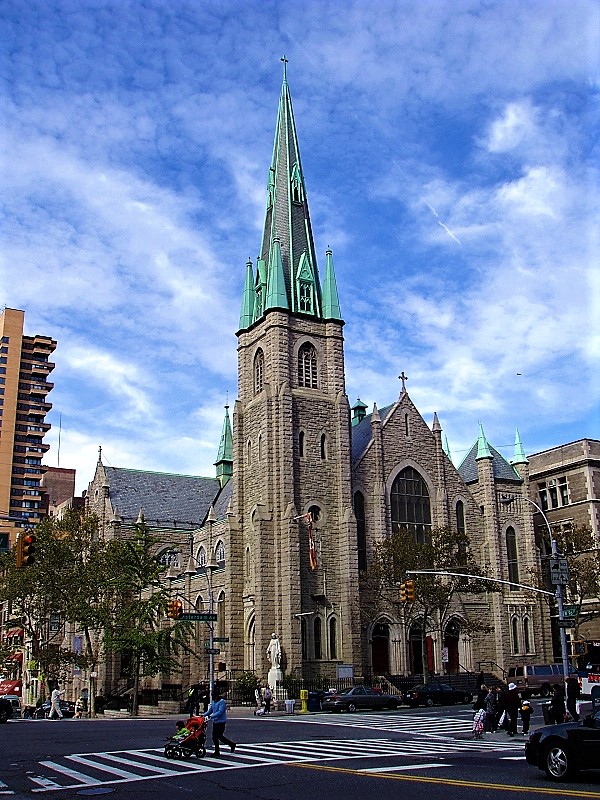
The Church of the Holy Name of Jesus - 207 West 96th Street


photograph by the author

According to the 1914 book The Catholic Church in the United States of America, "In 1867, the West Side above 75th Street was a region of vacant lots, with here and there a suburban cottage, while the majority of the inhabitants were squatters who supported themselves by tilling small pieces of ground around their huts."  Be that as it may, there were growing numbers of Roman Catholics living in the district around the Bloomingdale Road and what would become the West 90's; and that year Archbishop John McCloskey approved the formation of the parish of the Holy Name of Jesus and sent the Rev. Richard Brennen north as its pastor.

Within a few months land extending along the block from what would become Broadway to Amsterdam Avenue on the north side of 97th Street was purchased for $11,250.  Construction immediately began on a church.   On August 9, 1868 the Archbishop celebrated the first mass in of the wooden structure.  The parish had spent a little over $50,000 in today's dollars on the modest church.

When Rev. James M. Galligan took over as pastor on July 20, 1875, the nation was still reeling under the Financial Panic of 1873--the devastating economic collapse which would be known as the Great Depression until the Stock Market crash of 1929.  The Catholic Church in the United States of America recalled that "a large debt burdened the parish."

Nevertheless, as The New York Times explained years later, "Father Galligan when he took charge at once set to work to build up his parish.  He worked enthusiastically.  He made his flock enthusiastic, and the parish began to grow rapidly."

The Irish-born Rev. Galligan had come from the parish of the Church of the Holy Innocents, whose striking structure on West 37th Street had been completed just five years earlier.  The Times noted that his new church "was a little frame building that was too small for the congregation," and "coming as he did from a large and well equipped parish...to a small and poorly equipped charge, he at times felt discouraged, but never once did he falter."

If Rev. Galligan intended to replace the building with a new one, he first had to somehow pay off the parish's crushing debt.   Collections and bazaars were held to raise funds; but in the fall of 1886 a plague of burglaries threatened the progress.

On January 23, 1887 The New York Times reported that for the fourth time in six months thieves had broken into the church and "with a 'jimmy,' broke open the four poor boxes and the collection box."  But this time the church was one step ahead of them.  The boxes had already been emptied.  "The sacred  vessels had also been removed, so that when the thieves broke open the tabernacles on the three altars they had their trouble for their pains.  They forced open the baptismal font, which they doubtless supposed contained money or valuables, and tore a brass chain from a censor, which they probably supposed was gold."

Finally, on November 23, 1889, 14 years after arriving Rev. Galligan became pastor, the Real Estate Record & Builders' Guide reported on his ambitious project.  "Thos. H. Poole has been selected as the architect for the church, chapel and sisters' home to be built by the Church of the Holy Name of Jesus, on the west side of 10th avenue, 96th and 97th streets...The church is to be Gothic and will have two spires."

The 29-year old English-born architect had only been listed in city directories for a few years.  This would be one of his earliest commissions, and he would go on to design numerous Roman Catholic churches and schools throughout the New York City area.

But at a time when substantial structures in New York City were being completed within 12 months or so, construction of the church building would be a long haul.  On March 20, 1892 the "lower church" was dedicated.  The parish could now worship in a portion of the basement while construction went on around them.

Six years later, on January 29, 1898 The Record & Guide announced "The basement is completed, and has been used for the church purposes for some time.  Work on the superstructure will be commenced in the spring."  Archbishop Michael Corrigan laid the cornerstone on April 17, 1898 and almost exactly two years later, on April 1, 1900, the completed church was dedicated.


Following English Gothic tradition, the blunt corner tower was topped by four spires.  Construction on the school building next door was begun in 1904.   The Catholic Church in the United States of America 1914 (copyright expired)

Poole had created a strapping English Gothic structure faced in rough-cut pink Milford granite.   The bell tower which anchored the southern corner featured thin buttresses and four Gothic finials.  Crowning the traditional cruciform shape was a copper clad fleche. 

Archbishop Corrigan was back on April 1, 1900 to dedicate the new church which could seat 1,400 worshipers.  The New-York Tribune commented on the interior decorations, saying that the Gothic-style altars were "constructed of statuary marble and rare Mexican onyx.  The main altar has three spires, the centre of which, surmounted by a marble cross, rises to a lofty height, and is flanked by two wing spires."  The high altar featured Da Vinci's Last Supper carved in high relief.  The article described the richly carved tabernacle as being "shrouded by a heavily groined hanging canopy which also supports the statuary niche, which in turn is roofed by the main canopy."

At a time when electric power was not always dependable, the "combination chandelier of gas and electricity" provided a built-in contingency.   "The side altars are in keeping with the same style of architecture, with ornate mensa and reredos and statue niche, roofed over by a groined canopy and supporting a tower spire of delicate outline," said the article.

The pamphlet distributed among the parishioners that day reflected the tireless work the pastor had put into the project.  "The Church of the Holy Name is a grand and lasting monument to Father Gallagan's efforts, and in its general construction, in its design, and in its beautiful appointments it reflects rare good taste, fine discrimination, and sound judgment."

He would not enjoy the fruits of his perseverance for long.  A year later almost to the day, on April 3, 1901, Rev. James M. Galligan died.  In reporting on his death The New York Times noted "The principal work of Father Gilligan [sic] and one by which he will be longest remembered, is the new Church of the Holy Name, in the erection and equipping of which he was the dominant spirit."

The church would be, of course, the scene of many notable weddings and funerals.  But the funeral of Fire Commissioner Hugh Bonner on March 17, 1908 was remarkable.  The New-York Tribune reported "The church was so crowded that lines of police had to be formed around the street, where hundreds had gathered to take part in the services"


Hundreds lined Amsterdam Avenue in front of the church as the funeral procession passed.  The New-York Tribune, March 18, 1908 (copyright expired)

The cortege left the Bonner home on West End Avenue at 9:30, led by three battalions of fire fighters, mounted police and the police band.   Twelve fire companies followed, along with a battalion of Brooklyn fire fighters and two others led by three Deputy Fire Chiefs who had served under Bonner.

As the parish's golden jubilee approached, a change in Poole's design was made.  A steeple was added to the bell tower just in time for the celebration on May 30, 1918.  It was somewhat symbolic of the coming together of several events.  With the end of World War I, President Woodrow Wilson had set aside that day as a "day of public humiliation, prayer and fasting" (more popularly called the Day of Prayer).  And not only was the parish 50 years old, it was finally out of debt, which meant that the church building could be consecrated as part of the ceremonies.  The New York Times reported "The streets near the church were decorated in honor of the jubilee and bore a holiday air."


A sporty convertible waits for the light in front of the church with its now-soaring steeple in 1929.  from the collection of the New York Public Library

1918 was also a significant year for a former parishioner.  Among the members in 1894 was the Thomas Donahue family, who had just relocated to No. 791 Amsterdam Avenue.  Donahue was born in Ireland and his wife, Dorothy Rentz was German.  The couple would ten children, one of whom, Stephen Joseph, was one-year old when they moved into the into the parish.

Stephen would pursue a religious vocation and after studying in Rome for five years, was ordained by Cardinal Pompili, Vicar of Rome, on May 22, 1918.  His rise in the New York Church would be meteoric.  In 1920 he became assistant secretary to Cardinal Patrick Joseph Hayes, and was promoted to secretary a year later.  He traveled extensively with the Cardinal, including several trips to Rome.

He was created a monsignor in 1924.  In September 1932 he returned to the Church of the Holy Name of Jesus as pastor following the death of Monsignor James B. Curry.  Then, on March 2, 1934 Cardinal Hayes announced that Pope Pius XI had personally selected Donahue to be elevated to Bishop.

In a ceremony which The New York Times described as "marked by ancient splendor," Donahue, just barely 40 years old, was created a bishop on May 1.  The newspaper estimated the crowd in St. Patrick's Cathedral to be around 5,000.  The three-hour service was attended by four Archbishops and 48 Bishops along with several hundred priests.

Auxiliary Bishop Donahue remained pastor of the Church of the Holy Name of Jesus.  He officiated at its re-dedication on December 8, 1937, at which time it was noted that the "interior of the church has been completed redecorated."

Among Donahue's most passionate concerns was the motion picture industry.  He was a member of the Motion Picture Committee of the National Catholic Welfare Council, a member of the Motion Picture Committee of the American Council of Bishops, and was involved in the Legion of Decency.  The Legion of Decency, organized by the Catholic Church, was "devoted to the cause of morality in motion pictures."

Bishop Donahue resigned in May 1972.  He died in the Catholic-run Mary Manning Walsh Home on York Avenue at the age of 88 in August 1982.

In the meantime the parish of the Holy Name of Jesus had substantially changed.  Urban renewal projects had resulted in the demolition of entire blocks of rowhouses to make way for tenement projects.  As the the parish welcomed new immigrants from places like Haiti, the Dominican Republic and Puerto Rico, the liturgies adapted.  Masses are now celebrated in French, English and Spanish.


The Gothic crockets of the four finials are now sheathed.  photo by MoTabChoir01

Through it all the stately edifice is essentially unchanged since the steeple changed Thomas Poole's  English Gothic design in 1918.

photographs by the author

Tuesday, February 20, 2018

Pitiable Neglect - The West 96th Street Substation 11


Sadly some of the carved limestone ornamentation has been stripped off.

At a meeting of the West End Association on Tuesday, November 12, 1901 several representatives reported on the status of issues that concerned or affected Upper West Side residents.  On the list were the still-delayed paving of 72nd Street, the completion of the tiny Empire Park at Broadway and 63rd Street, and the "endeavor to improve the Circle at 8th av and 59th st, with a view to insuring the safety of the public using the same."

One of the most pressing problems was public transportation.  The Upper West Side's population had multiplied several times in recent decades and residents faced problems getting around.  The West End Association's Subway Special Committee reported on their meeting with the contractor for the Rapid Transit Subway Construction Co.  "He promised to complete portions now open before opening between 71st and 80th st, and satisfied the committee that he is doing all in his power to push work."

The Rapid Transit Subway Construction Co. was founded in 1900 by August Belmont, Jr. and Andrew Onderdonk.  It would later be renamed the Interborough Rapid Transit, or the IRT.   Creating tunnels, laying track, manufacturing the trains, and constructing stations was a massive undertaking.  In addition, the subterranean tracks would need electricity to power the trains along.

Powerhouses and substations with colossal generators had to be constructed.  The substations, which transformed the electric current generated at the main power plants, were generally located near passenger stations.   They were subsequently designed to meld into the residential or business blocks.  On October 23, 1904 The Sun noted "The substation buildings from which the electric current is served to the third rail are architecturally beautiful.  One of them might be taken almost for the home of a wealthy citizen whose fancy turned toward the heavy and impressive."

A year after the West Side Association meeting the subway was nearing 96th Street.  Even as the massive main power plant was still being constructed, plans were laid for the substation just west of Broadway on 96th Street.  On October 11, 1902 the Real Estate Record & Builders' Guide reported that plans had been filed for "a 3-sty electric power station for the West Side branch of the subway, to be built at Nos. 264 and 266 West 96th Street, at a cost of $55,000."  That price tag would amount to more than $1.5 million today.

The architectural firm of Van Vleck & Hunter had received the commission to design Substation 11.  They produced a handsome Beaux Arts structure faced in limestone.  The carved ornamentation, dormered mansard roof. and two-story metal-framed bays created a striking structure that could hold its own among handsome civic buildings like firehouses and libraries.

photo from The Street Railway Journal, October 8, 1904
Despite its Parisian-inspired facade, the interior of Substation 11 was a no-nonsense cavernous space of gigantic transformers, switchboards and "rotaries."

photo from The Street Railway Journal, October 8, 1904

The new IRT subway solved the problem of transportation on the Upper West Side.  At least temporarily.  As the district continued to grow, so did passenger complaints.  An article in the Record & Guide entitled "Subway Deficiencies" on February 3, 1906 sounds remarkably modern.  It said in part, "The delays are constant, and are sometimes prolonged almost beyond endurance.  Instead of traveling to the City Hall in less than twenty minutes, the residents of the upper West Side and Harlem find that it frequently takes them forty minutes, and many of them believe that they can average much better time on the Ninth avenue elevated expresses."

Passengers would be frustrated until the opening of the Eighth Avenue subway line on Central Park West alleviated much of the congestion.

The 1906 dilemma exemplified the never-ending challenges facing the subway.  Subsequently, constant improvements in technology and efficiency would eventually result in both the main power plant and Substation 11 becoming obsolete.

On June 12, 1940 the Interborough Rapid Transit was acquired by the city to be merged into the Metropolitan Transit Authority.  IRT properties, including the 96th Street substation, were transferred to the city.  No longer needed, it would eventually become abandoned.

In June 1991 the city's Division of Real Property attempted to sell the property.  In an unusual offering, it joined with the owners of two adjacent properties--No. 268 where the Salvation Army operated a thrift store, and No. 270 partially occupied by NAACP offices.  "The properties have more value as an assemblage than they do individually," explained planning director Margo Moehring to a New York Times reporter.  The minimum bid for the package was $6.2 million.

It was a valiant effort; or so it seemed.  But when there were no bids, Substation 11 was boarded up and essentially forgotten.  Weather and vandalism took their toll.  The first of the public complaints began around 2003 when multiple calls to the Department of Buildings reported a dangerous, unlit sidewalk shed which had been in place for years.


The concerns worsened as time passed.  In the summer of 2014 there were reports that the plywood over the windows was missing and pigeons were roosting inside; and in October 2015 journalist Emily Frost reported on the "growing homeless encampment" that had formed under the sidewalk shed.

In June 2017 a local resident complained "the entrance door is wide open" and voiced concerns that the building's proximity to elementary school P.S. 75 made it "unsafe for children who are curious and may try to go into the property."


Around that time rumors circulated that Substation 11 was to be converted to housing.  In the meantime Van Vleck & Hunter's once imposing Beaux Arts structure continues to decay.  Although its striking limestone carvings and mansard roof speak of its former industrial elegance, it has become a neighborhood eyesore.

photographs by the author