Showing posts with label west 25th street. Show all posts

Thursday, March 12, 2026

The 1911 Zinn Building - 210 Eleventh Avenue


photograph by Jim Henderson

Around 1847 when he was 16 years old, Simon Zinn left his native Bavaria.  Upon arriving in New York City, he found employment in a metal goods firm.  By the late 1880s, he was a partner in Zinn & Messer, which manufactured a vast variety of small metal goods like frames and clasps.  The firm's name had became Simon Zinn & Co. before Simon's death in May 1897.

Simon Zinn's widow, Mary, and her sons, Arthur and Martin, took over the firm.  The following year, they established an ancillary company, The Gem Cutlery Company to manufacture safety razors.  By 1907, the two businesses required a large facility.

On November 1 that year, The New York Times reported that the Zinns had purchased the two buildings at 210 to 216 Eleventh Avenue, on the southeast corner of 25th Street.  They were one- and three-stories tall, respectively.  The family did not move quickly to replace the structures, but a disaster three years later forced their hands.

On October 4, 1910, The New York Times reported on "One of the most spectacular fires New York has seen in years."  The blaze began in the lumberyards "on the North River water front" between 23rd and 26th Street.  The city's entire fleet of fireboats helped firefighters on the ground.   In the end, $1.5 million worth of property was destroyed and the riverfront from Tenth to Eleventh Avenue, from 24th Street to the north side of 26th Street was leveled.

Ten days later, the architectural firm of Shire & Kaufman filed plans for an 11-story "brick factory" for the Zinns.  The plans projected the construction cost at $300,000, or about $10.2 million in 2026.  Completed in 1911, the steel-frame Zinn Building was designed in an Arts & Crafts take on Gothic.  The three-story base included double-height segmental arches within banded piers.  The seven-story mid-section was faced in beige brick, its vast windows stacked within full-height arches.  The supports of the tenth floor piers took the form of medieval grotesques, and the building's corner sections rose above the roofline.  The northwestern corner sprouted a clock tower.

By 1940 only a stump of the clock tower survived.  image via the NYC Dept of Records & Information Services.

The Gem Cutlery Co. was as successful (if not more so) as Simon Zinn & Co.  An article in the October 1913 issue of Exporters' Review said, "The 'Gem' safety razors are among the best known safety razors in the United States, the Gem Cutlery Co. having been pioneers in the manufacture of these indispensable toilet requisites."

The Popular Magazine, November 1913 (copyright expired)

Emanuel Grammici was hired in April 1915 as a press operator for Simon Zinn & Co.  The 25-year-old earned $1.18 per day, or about $38 in 2026 terms.  In operating the power press, he created metal inlays.  Less than a month after starting his new job, on May 6, he suffered a horrific accident.  According to legal papers, "in placing the inlay in the die, he accidentally released the power, catching his fingers between the die and punch."  In an instant, all of Grammaci's fingers on his right hand were severed.

Mary Zinn died in May 1919.  She had been highly involved in the operation of the two companies since her husband's death.  Just four months later, in September, Arthur and Martin sold the Gem Cutlery Company for $4 million, a staggering $72.5 million today.

The void in the Zinn Building was filled by the newly-formed Automatic Straight Air Brake Co.  The Wall Street Journal announced on May 14, 1920, "The company has obtained a desirable location for manufacturing purpose, at 210 Eleventh avenue."  And on November 9, the periodical reported, "The Automatic Straight Air Brake Co. is already in production at its plant at 210 Eleventh Avenue."

Arthur and Martin Zinn now focused on the Simon Zinn Inc.'s metal novelty goods.  In 1920, they added their patented vanity cases to the line.

An advertisement for the Zinns' patented vanity case featured a photo of the Zinn Building with the clock tower atop the corner.  The American Perfumer and Essential Oil Review, May 1923 (copyright expired)

In 1924, the Zinns moved their operation to Bristol, Connecticut.  The building was sold to the newly-formed 210 Eleventh Avenue Corporation.  The syndicate was composed of Paul Baron and his sons, Louis J., Abner, Samuel T., Harry and Morton Harold.

Paul Baron was born in Russia and entered the paper manufacturing business in 1882.  He and his sons founded the Royal Card & Paper Corporation in 1913.  The firm produced a variety of papers and card stock and was the first producer of gift-wrapping paper in the United States.

Giftwares magazine, May, 1929

In an early example of environmental regulation, the Royal Paper Company was fined $100 by Magistrate Edward Thompson on September 24, 1951 for air pollution.  Murray Berger, an inspector of the Bureau of Smoke Control, "had witnessed on several inspections," according to The New York Times, of the firm's permitting "dense smoke from the smokestack."

When Morton Harold Baron died in 1986, all his brothers had predeceased him.  Shortly afterward, the Royal Paper Company closed.

At the time of Baron's death, the Chelsea neighborhood was seeing a transformation from industry to art as lofts were converted to gallery spaces.  In 1999, the Robert Mann and the Pardo-Sheehan galleries were in the Zinn Building, joined the following year by the Edward Thorp and the Urban Architecture galleries.  

photograph by the author

Today 210 Eleventh Avenue is known as The Chelsea Arts Centre, its realtor boasting it is "the home to cutting edge creative and high-fashion tenants."  Astoundingly, the lower floors have never been brutalized and Shire & Kaufman's 1911 design is greatly intact.

Wednesday, February 14, 2024

The William S. Moore House - 278 West 25th Street


In 1851 the family of William S. Moore lived in the brick-faced house at 184 West 25th Street (renumbered 278 in 1865).  The modest, middle-class home was three stories tall above an English basement.  Its builder borrowed elements from the established Greek Revival and emerging Italianate styles--the former in the plain, flat lintels and low third floor, the Italianate in the floor-to-ceiling parlor windows and the foliate-bracketed cornice.

Moore, who was an importer with offices on Maiden Lane, remained in the house until 1861, when he sold it to Enoch Stratton, a builder.  Moving in with Stratton and his wife were their daughter Mary Anna, her husband Edward Scantlebury, and their toddler grandson Joseph.

The family had barely settled in when tragedy occurred.  Joseph Scantlebury died two months before his third birthday on March 12, 1861.  His tiny casket sat in the parlor until his funeral there two days later.

It appears that Stratton's wife tried her hand at running a boarding house in 1864.  That year five other persons are listed at the address--merchant John Anderson; George Billings, who was a printer; Cornelius Meyers; and two educators, Henry K. White and Evelina Kellogg.  

Apparently the venture did not work out.  In 1865, only George Billings and Evelina Kellogg were boarding with the family, and George's stay was cut short when he was drafted into the Union Army on March 18.

Stratton and his family lived on at 278 West 25th Street through 1874.  The following year the house became the "office and residence" of the colorful Madame Clifton.  Her exhaustive advertisement in the New York Herald in October that year touted:

A business and medical clairvoyant, who has no equal in America.  $10,000 reward is offered to any one who can equal Mme. Clifton, the greatest Clairvoyant in America.  [She] can give us correct information on losses, law-suits, absent friends and business matters of all kinds.  She can allay the most serious trouble; located and prescribed for all diseases.  She manufactures a wash called Chinese Hyso, warranted to remove freckles, moth patches, and all eruptions of the skin, and render it perfectly smooth.  This is no humbug; nor does she wish to impose on the unwary.  She can refer to the most prominent citizens of New York, Boston, Philadelphia, and other cities.  All who are sick or in trouble will please call and verify the above statement.  Office and residence, 278 West Twenty-fifth street, third door east of Eighth avenue.

Another ad for Madame Clifton in February 1876 that year said she "locates all diseases, makes wonderful cures; on losses, law suits, absent friends or business matters she never fails.  All who are sick or in trouble should visit this wonderfully gifted lady."  The ad cautioned, "no likenesses or love powders."  

But then, as was often the case with clairvoyants and spiritualists, she quickly moved on.  George H. Barr, a clerk, was listed at the address later that year.

From 1879 until around 1893, detective John H. Conway owned 278 West 25th Street.  Born in 1843, he served on the Monitor during the Civil War when it engaged the Merrimac in battle on March 9, 1862.  An ardent Democrat, he became active in politics in the 1870s and was treasurer of Tammany Hall in the 1880s.  In 1893 he was made Deputy Tax Commissioner in Long Island City.

At the turn of the century, William Kroplins and his wife ran 278 West 25th Street as a boarding house.  On the night of August 27, 1904, they rented a room to a young dressmaker, Lucy Alexander, who had a 14-month-old child with her.  She explained that she had just arrived in New York from Philadelphia where had visited friends.

The following afternoon, at about 3:00, Mrs. Kroplins noticed the woman's door was open and "peeped in," as worded by The Sun.  "The room seemed deserted, so she walked inside and, on the bed, found the dead body of the child."  She called her husband who, after deciding that mother had fled, notified the police.

An hour later Lucy returned to the house with several other women.  She explained that earlier that morning, "her child was seized with convulsions...and died.  She hurried out to find friends to help her arrange for the burial, not supposing that any one would enter her room in her absence."  It appears that the authorities accepted her explanation, and she was not charged with any crime.

The house was unofficially converted to apartments during the Depression years.  The stoop was removed and the entrance lowered to the basement level.

image via the NYC Dept of Records & Information Services.

A subsequent renovation completed in 1971 resulted in furnished rooms and one apartment.  The building continued to be operated as a rooming house until 1991 when it was remodeled into an apartment in the basement and a triplex above.

The house as it appeared in 1991.  image via compass.com

In 2020 the stoop and entrance were reconstructed, so that today the house looks much more like it did when William S. Moore moved his family in more than 170 years ago.


photographs by the author
no permission to reuse the content of this blog has been granted to LaptrinhX.com

Saturday, October 7, 2023

The Twin Houses at 260 and 262 West 25th Street


Most likely part of a larger row of identical houses, 194 and 196 West 25th Street (renumbered 260 and 262 in 1867) were completed around 1850.  Their formal Anglo-Italianate design included short stoops that led to the rusticated, brownstone-clad first floor.  Just two bays wide, the upper three floors were clad in red brick and trimmed in brownstone.

No. 194 was home to the Isaac Watts Ayres family.  Born in Oyster Bay, Long Island in 1806, Ayres married Emeline Smith Underhill around 1829.  Despite what must have been crowded conditions (the couple had eight children), they took in a boarder, Charles P. Chamberlain.  A china and crockery merchant, he would live with the family for years.

Only months after moving into the house, Isaac Ayres died on December 20, 1852.  Four years later it was sold to John W. Clark, who listed his profession as "carver," but who also dealt in real estate, possibly as a contractor or developer.  The Clark family would remain until 1861.

Three families occupied 196 West 25th Street in 1851, and would continue to do so through 1859.  John Osborn was a physician, William A. Viets was a broker and merchant, and Amos Leeds ran a coal business with two locations, one on Wall Street and another on Troy Street (later West 12th).  The Gomien family next occupied the house.  Joseph H. Gomien was a teacher, and Justin M. Gomien was in the frames business on Broadway.  


When attorney Bailey Underhill purchased 262 West 25th Street in 1867, the house got its first really long-term occupants.  The Underhills were Quakers.  Bailey was born in Yorktown, New York in 1809 and was "married by Friend's Ceremony" to Mary K. Griffen on September 18, 1833.  The couple had three children, Eugene, Augustus, and Mariette.  Of them, at least Eugene and his wife, Susan, moved into the house with his family.  

Bailey Underhill died on February 15, 1873 at the age of 63.  In August the following year, Eugene and Susan had twin daughters, Mary Libbie and Florence S.  Tragically, the parlor would be the scene of both their funerals within months.  Mary Libbie died shortly after birth in August 1874, and Florence died on November 25.  Mary K. Underhill would remain in the house, taking in a few boarders at a time, until 1890.

In the meantime, George Rudd and his wife Mary had purchased 260 West 25th Street around 1867.  In 1872, they leased it to the Desvernine family, who were originally from Cuba.  Peter F. Desvernine was a grocer, Charles Maria was a physician, and Pablo Desvernine was among the world's preeminent pianists.  (Pablo would eventually anglicize his name to Paul).

Pablo (Paul) Desvernine (original source unknown)

Born in Havana on July 31, 1823, Pablo had first performed on stage at the age of 13.  He trained in Europe and was decorated by Queen Isabella II of Spain.  He and his extended family moved to New York City in 1869.  Among his students was Edward MacDowell.

Dr. Charles M. Desvernine had earned medical degrees from the University of Havana, the University of Paris, and the University of Madrid.  A neurologist, he was a member of the American Electro-Therapeutic Association, and the New York Neurological Association. 

Members of the extended Desvernine family remained at 260 West 25th Street at least through 1880, after which Mary Rudd continued to lease the house.  She was between tenants in 1893 and the house was temporarily vacant.  It was a situation that did not go unnoticed by Henry Ruland and William Franklyn.

On the night of April 21, 1893, police officer Garner Ruland walked into the Jefferson Market Police Court to testify against a prisoner, only to see his son among those being arraigned.  The New York Herald reported that Henry Ruland and William Franklyn "had rifled a house at No. 260 West Twenty-fifth street, which was untenanted, and, packing up a lot of lead pipe and two copper boilers, were about to drive away in an express wagon belonging to George Cornellisse."  Mary Rudd, who now lived on 124th Street, was there to press charges.

After the significant damage was repaired, 260 West 25th Street was operated as a boarding house by Mrs. George Bory.  On April 28, 1895, her ad appeared in The World offering a reward for her missing terrier, Frouette.  Three days later, the newspaper reported, "That evening the dog was brought home.  She was overjoyed, and gave the man who returned her pet $5."  (It was a generous reward, equal to about $180 in 2023.)

Unfortunately for Mrs. Bory, a boarder named Charles Broomhead saw her take the money from a roll in her bureau drawer.  The young man had until recently served with the Sixth Cavalry.  The World reported, "He left the house in a few minutes, and has not been seen since.  The roll of money--$30--also disappeared."

Boarder Charles Serkis was the victim of a thief, as well.  Describing himself as "an Egyptian pawnbroker from Colombia, South America," he came to New York to sell South American gold.  He and his partner, B. Felix Rodriquez, drew the suspicion of police, who arrested them for selling "gold bricks," or fake ingots.  The bars were tested and discovered to be "real gold," as disclosed by Magistrate Barlow in court, and the men were released.  Unfortunately, when Serkis returned to his rooms 260 West 25th Street, he discovered that while he had been detained, thieves had made off with $10,000 in gold bars and diamonds.

The large tree that obscures the houses today had not yet been planted in 1941.  image via the NYC Dept of Records & Information Services.

Both houses were being operated as boarding houses when they were sold by Loretta Kiple in 1925.  The new owner, who bought them "for investment," according to The New York Times, continued to rent rooms.  

Astonishingly, in 1946 at least one of the houses still had not been electrified.  The situation nearly ended fatally on October 4 that year.  The Sun reported that 28-year-old Glenda Sullivan "was overcome by illuminating gas in her third-floor furnished room at 260 West 25th street today."  She was given oxygen for half an hour before being transported to St. Vincent's hospital where her condition was reported as critical.


There are four apartments in 260 West 25th Street today.  A renovation to 262 West 25th completed in 1971 resulted in a duplex apartment in the basement and parlor floors, and a triplex apartment above.  Sitting back from the sidewalk and squeezed between two late 19th century apartment buildings, they present a charming reminder of the block in the 1850s.

photographs by the author
LaptrinhX.com has no authorization to reuse the content of this blog

Thursday, July 13, 2023

The Threatened 1910 John J. Stradar Stables - 276 West 25th Street


In the first years of the 20th century, the Utah Livery Stables operated at 276 West 25th Street, just east of Eighth Avenue.  A "chattel mortgage sale" liquidated its contents on May 14, 1909.  Included were 17 "fine driving and delivery horses," "one very elegant pony, [which] was used by a lady," 15 vehicles ranging from surreys, hansom cabs, and wagons to buggies and other models, as well as the hay, feed and trappings.

Charles A. Clark demolished the old structure and hired architects Chappell & Bosworth to replace it with a more substantial stable.  Their plans, filed in May 1910, projected the construction costs at $4,500, or about $132,000 in 2023.

Interestingly, the architects design drew from the Italianate style of a generation earlier.  The plot's narrow proportions (just 19 feet, 11 inches wide) precluded the expected stables configuration of a centered carriage bay flanked by a window and door.  Instead, the wide bay engulfed the eastern two-thirds of the ground floor with a single (exceptionally tall) doorway to the side.  The two windows and hayloft of the second floor were elliptically arched, their lintels and sills executed in brick.  The dentiled cornice was also made of brick, a considerable cost savings for Clark.

Taken during a snowfall, this 1941 photograph depicts the original appearance of the former stable.  image via the NYC Dept of Records & Information Services.

Clark had a proprietor lined up for the stables before the first brick was laid.  On April 30, 1910 he signed a 10-year lease with John J. Stradar.  

Both Charles A. Clark and John J. Stradar may have underestimated the change that motorcars would bring to the stables industry.  When the new stable was completed, automobiles were a luxury item, owned only by the wealthy, and trucking was still almost entirely by horse-drawn wagons.  But by the end of World War I, that was changing.

Around 1917 Stradar broke his lease and established a trucking company at 239 West 23rd Street.  The former stable was now home to the George F. Helds Company.  

In July 1930, the California-based West Side Lumber Company signed a five-year lease.  It started a decades-long tradition at the address.  It was most likely at this time that the hay loft opening was shortened.  West Side Lumber Company was supplanted by Midtown Lumber in 1962.

The Kopf brothers purchased the building and co-founded the firm.  Initially providing custom-cut wood for locals' projects, Midtown Lumber evolved to supplying contractors and other large customers.  In 2013, Michael Kopf, a son of one of the founders, established The Splinter Factory in Pennsylvania to build custom-built furniture.  Pieces have been purchased by galleries and the Museum of Modern Art.


After being in the space for six decades, at this writing Midtown Lumber is threatened.  The vintage building was purchased recently by developer John Catsimatidis who has started eviction proceedings.  According to Bloomberg, he "plans a high-end residential project" on the site.

photographs by the author
no permission to reuse the content of this blog has been granted to LaptrinhX.com 

Saturday, September 24, 2022

The 1860 John Russell House - 454 West 25th Street


photograph by the author

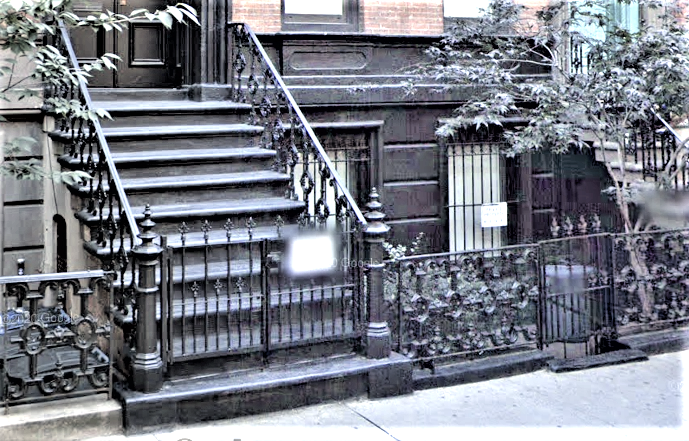
In 1860 a row of handsome Italianate style homes was erected on the south side of West 25th Street, between Ninth and Tenth Avenues.  The 20-foot wide brick-faced residences reflected the latest in domestic taste--with high stone stoops, substantial Italianate cast iron fencing, and paneled and bracketed cornices.  One house, 454 West 25th Street, stood out among the row with its oversized center window on the top floor.  It was apparently a specification of the purchaser during construction.

That buyer was 43-year-old John Russell, who owned a stonecutting business on West 30th Street near the Hudson River.  He and his wife Helen had nine children.  Despite what must have been somewhat tight conditions, they took in a boarder.  They would have to find a replacement in 1865 when C. P. Byron was drafted into the Union Army.

By 1865 the Russell's eldest daughter, Helen, was a teacher.  She divided her day between two relatively nearby schools--P.S. No. 55 on 20th Street between Sixth and Seventh Avenues, and P.S. No. 19 at 223 West 18th Street.

Around 1868 Russell moved his stone operation to the foot of West 51st Street and the Hudson River.  By now, the population of 454 West 20th Street had increased by one following Helen's marriage to Alexander Orr Hopkins, a boat pilot.

In 1876, Janet Russell, who was just five years old when the family moved into the West 25th Street house, became a teacher like her sister.  She taught in the primary department of Grammar School 546 on West 18th Street.  Her brothers, John Jr. and Robert, were both listed as masons, working in their father's business.

Sadly, that same year, on April 13, Helen died at the age of 31.  Her funeral was held in the parlor two days later.  Her husband moved out of the Russell house the following year.  The Russells once again took in a boarder.  Edwin Connor, who ran a coal business on West 29th Street, lived with the family in 1879 and 1880.

John Russell died in the house on March 20, 1881 at the age of 64.  His funeral was not held in the family residence, but rather far to the north, in the Church of Our Saviour on West 57th Street near Eighth Avenue.  His children inherited the West 25th Street house in equal portions.

The ornate Italianate style ironwork survives along the row.  photograph by the author

Alice R. Russell, who had married James P. Clark, sold her interest in the house to John Russell Jr. in 1887 for the equivalent of $22,o00 today.  By the mid-1890's 454 West 25th Street was occupied by what appears to be a different Clark family.  Patrick J. Clark operated a "three-story brick hotel" nearby on the northeast corner of Ninth Avenue and 25th Street.

He and his wife, Sarah Coleman, had a daughter, Mary, and five sons, Joseph, James, Philip, Eugene, and John Joseph.  Joseph attended P.S. No. 17 on West 20th Street in 1901.  On June 27, the day before his graduation, the 11-year-old was running home from school when, as reported by The New York Times, "he fell in front of a horse car at Twenty-fifth Street and Ninth Avenue and was instantly killed.  The front wheel of the car passed over the boy's abdomen."

Joseph's brothers were significantly older.  In 1909 James P. Clark was made a commissioner of deeds, a civic position similar to today's notary public, and John Joseph Clark was the proprietor of Clark's Café on Columbus Avenue and 62nd Street.    John Joseph died at the age of 30 on January 5, 1915.

Not long afterward, 454 West 25th Street was being operated as a rooming house.  War was intensifying in Europe at the time and the conflict would deeply affect three families living here.

John J. Flood held a job which today would qualify him as an "essential worker" and which qualified him as except from the draft.  But on August 10, 1917, the New York Herald listed him on "the honor roll of the national army" after he waived him exemption.

Two other residents joined the army, Edward P. Lynch and Joseph E. Nash.   Lynch enlisted with the 69th Regiment and was sent to Europe in October 1917.  Joining around the same time were his cousins, with whom he had grown up.  Nine months later, his widowed mother, Mary Lynch, received the news every mother feared.  On July 15, 1918 Edward was killed in action.  The New-York Tribune noted, "The corporal was Mrs. Lynch's only son, but she has two nephews, the sons of her sister, whom she has raised and who are at the front."

Mary E. Nash also received frightening news from Government.  Lt. Joseph E. Nash was "wounded severely" in April 1919, but happily he survived to return home to 454 West 25th Street.  Over the next few years his name would appear in newspapers for less heroic reasons.

In 1921 Irish-American newspaper The New York Age reported on the trials in Belfast, Ireland, of court-martialed Irish soldiers.  Virginia-born Ed Cahill had been stopped while bicycling and searched.  "Four envelopes were found in his possession.  One was addressed to "Jos. Nash 454 West 25th street, New York, containing seditious matter re affairs of Ireland," said the article."  In Cahill's room were found the floorplans of a police barracks, the plans for blowing up a bridge, and a notebook about the Irish Republican Army.  Cahill was sentenced to "five years' penal servitude."

Nash was still rooming at 454 West 25th Street on June 19, 1922 when he was pulled over by Patrolman D. J. Mullen for "failing to observe the eight-foot law."  (The law required motorists to stop no closer than eight feet from a stopped street cars and buses.)  Because this was Nash's second offense, he was fined $25--a hefty $400 by today's standards.

The house continued to be operated as a rooming house for years.  Mary Ellen Laritz and her adult son lived here in 1943 when she witnessed a horrifying accident from her window on August 24.  Directly across the street was the U.S. Coast Guard Chelsea Encampment.  She later testified before a Congressional hearing that at 7:00 that evening, "I was looking out of my front-room window, which faces the property now occupied by the Coast Guard."  She said that several children were running up and down the sidewalk playing, and a Coast Guard supply truck was on the sidewalk, fueling trucks parked along the curb.  The truck moved slowly up the block from one truck to another.

Mary Laritz recalled, "I suddenly heard screams from these several children, and saw several of them running back along the sidewalk, but I did not see the little light-haired boy.  I saw coast guardsmen and others running toward this oil truck which was at a standstill on the sidewalk."  The reason Mary Laritz could no longer see five-year-old William Mooney was because the supply truck had run over his leg.  The driver of the truck said the children had made a game of riding on the running board of the truck, and Mooney had slipped under.  Mary said, however, "The injured boy was not in the roadway at any time I saw him and was not hitching on any truck at the time I saw him."  

William Mooney suffered a fracture of his right femur, multiple abrasions and a laceration of the groin.  He spent two months in St. Vincent's Hospital.  Mary testified on January 22, 1944, "This oil truck and others were always running along the sidewalk, but since this accident, they do not run on the sidewalk anymore."

photograph by Beyond My Ken

A renovation completed in 1965 resulted in five apartments within the house.  A subsequent remodeling in 1992 combined the parlor and second floor into a duplex.

LaptrinhX.com has no authorization to reuse the content of this blog

Saturday, November 6, 2021

The Rich History of Small Businesses at 261 Seventh Avenue


For years the family of Joseph Fuchs lived in the old house at the southeast corner of Seventh Avenue and 25th Street.  Fuchs helped form Battery K Artillery of the First Division of the State National Guard during the Civil War.  

In 1874 merchant John N. Heubner diversified by trying his luck at real estate development.  In September he purchased 261 Seventh Avenue from Jacob Fuchs for $13,250, or just over $300,000 today.  Within days Daniel Kelly sold him the property directly behind at 168 and 170 West 25th Street.  

A month later, architect Louis E. Duenkel filed plans for two adjoining buildings: a four-story brick store and tenement at 261 Seventh Avenue, and a second behind it at 168 West 25th Street.   Duenkel designed the seamlessly-matching structures mainly in the Italianate style.  The red brick facades were trimmed in brownstone on the 25th Street side, while the windows of the more visible Seventh Avenue elevation were given decorative cast iron lentils.   An up-to-date neo-Grec style cast iron cornice capped the designs.

It appears that Heubner was over-optimistic about his new venture.  On November 5, 1875, just as the new buildings were being completed, the New York Herald reported on his bankruptcy.  "The principal cause of his failure was unlucky investments in real estate," said the article.

The corner building had a shop in the ground floor and another, smaller one, toward the rear.  That store shared the address of 170 West 25th Street with the residences upstairs.

In the mid-1880's the main store was home to George Kessler's barbershop.  In the dark of the night on January 6, 1886, John Foley broke in and made off with "razors, shears and articles to the value of $45," according to police.  The heist would be worth just over $1,250 today.   He sold the loot to two other barbers.  Unfortunately for Foley, he was identified and arrested.  His $1,000 bail awaiting trial far outweighed his profits.

At the time the rear store was a "depot," or retail shop, of the French-based Girondin Deodorizing & Disinfecting Company.  At a time when small-pox posed a significant and deadly threat, the formula was embraced by various cities, including the Baltimore Department of Health, whose head, Dr. Milton N. Taylor pushed his city to purchase it in bulk.  

An advertisement gave a not-so-scientific depiction of the disinfectant qualities of Girondin Disinfectant.

The apartments above the stores filled with low-income families, many of them immigrants.  A century before laws demanded window guards and other precautions, tragedy visited one Irish family.  On July 28, 1886 The Evening Post reported "Katie Cassidy, a babe less than two years old, was instantly killed this morning by falling from a window at No. 170 West Twenty-fifth Street."

The Girondin store was replaced by Samuel M. Jacobi's "printing and costume design shop" in 1893.  On July 29 The new York Dramatic Mirror reported "S. M. Jacobi, Parisian designer and printer, is prepared at 170 West Twenty-fifth Street to furnish show printing and lithographic of types novel here."

The New York Dramatic Mirror, July 29, 1893 (copyright expired)

Jacobi did work for theatrical manager, producer and director George W. Lederer in 1893.  The problem for Jacobi was that he never got paid.  And so, on October 9 he strode into Lederer's Broadway office and demanded payment.   It did not go well for Jacobi.

The Press reported that Lederer and Jacobi "quarreled yesterday...Mr. Jacobi said Mr. Lederer owed him money.  The theatrical manager had a policeman eject his visitor."  But it went further than merely being ordered off the premises.  "Mr. Jacobi was locked up until friends furnished bail."

Samuel Jacobi remained in 170 West 25th Street at least through 1896.  In the meantime, John C. Lankenan replaced the barbershop in the front store with his grocery.  He obtained a permit to keep a fruit stand on the sidewalk in front of it in November 1895.  

Nevertheless, a barbershop did continue at the address.  Lankenan leased the basement level to Laurent Pellegrin.  To the rear of his subterranean barbershop was a bedroom where he slept.  For several years the French-born barber had been the chief barber on the French liner La Touraine and in that capacity had shaved some of New York's wealthiest citizens, including George Gould.  John Lankenan commented that among Pellegrin's "most treasured possessions [were] testimonials from some of the most prominent men in New York."

In 1897, Pellegrin fitted up his elegant barbershop with new chandeliers with modern "patent jets."  By a pull of a chain, the gas could be turned on or off.  Not long after Pellegrin completed his renovations, his landlord saved his life.  While setting out vegetables in his sidewalk stand early on the morning of October 1, 1897, Lankenan smelled a strong odor of gas.  He traced it down the steps to the barbershop.

The Rochester Democrat and Chronicle reported "Going down the stone steps to the double glass doors at the bottom, Lankenan found that the odor of gas became stronger.  He shook the door and called to Pellegrin, but got no response."  Looking through the doors he could see that the barber's bedroom door was slightly open and feared he was unconscious or already dead.  "Applying his shoulders to the doors he burst them in, and going into the back room found Pellegrin lying in the bed unconscious.  The rooms were filled with gas."

The new-fangled patent gas jet had not worked properly.  When Pellegrin pulled the chain on one, the flame went out but the gas continued escaping.  Once taken outside, Pellegrin revived, but he was too weak to speak and was removed to the New York Hospital.  The article praised his landlord saying that Pellegrin "had a narrow escape from death by asphyxiation" and that the "timely discovery of his peril by John C. Lankenan, a grocer, saved him."

By 1899 Samuel Jacobi had left the rear store and it was home to fortune teller Madame Moore.  Her advertisement in The World on December 2 that year read "Parisian palmist, card reader; most accurate; 50¢, $1."  Madame Moore was pricier than most of today's storefront readers, her $1 services equal to more than $30 today.

John C. Lankenan's grocery store had been replaced by the drugstore of Paul O. Krause by 1915.   He and other store owners along the avenue were already dealing with the inconveniences caused by the construction of the Seventh Avenue subway that year when disaster struck.

Just before 8:00 on the morning of September 22 a massive explosion between 23rd and 24th Streets sent planks soaring into the air.  A huge crater swallowed a crowded trolley car and a brewery truck.  Seven passengers of the trolley were killed and 85 other people were injured.   The man in charge of dynamite blasting, August Midnight, fled the scene and still could not be found several days later.

Paul O. Krause's drugstore was shaken as if by an earthquake.  He told reporters "I ran out to the street and saw chaos in the hole where the street had been.  People were swarming over the splintered woodwork and the smashed street car seemed alive with crawling human beings."  Krause offered his pharmacy as a sort of triage space.  "A dozen of the injured were brought into the store here, most of them unconscious and with their legs and spines crushed, and the ambulance surgeons treated them and then rushed them away to the hospitals."  While doctors worked on the injured, civilians swarmed the drugstore to use Krause's several pay phones.   He said "people ran into the store and tried to telephone, but all of the telephones but one were put out of commission by the accident."

Following World War I the drugstore was replaced by Bernstein & Feldman's fur store.  On a January night in 1921 Patrolmen noticed two well-dressed young men, Morris Geroff and Abe Feldman, leaving the building with $15,000 worth of furs (more in the neighborhood of $214,000 today).  Following their arrest Magistrate Sweetser of the Jefferson Market Court gave the officers "high praise" for nabbing the pair, whom police said "are responsible for many of the fur loft robberies."

The sharply dressed crooks made unlikely suspects.  Daily News, January 13, 1921 (copyright expired)

Four months after the robbery, on May 27, the New-York Tribune reported that Bernstein & Feldman was bankrupt.  The firm reorganized as Jaffe & Bernstein, but that, too, failed.  The partners declared bankruptcy in April 1922.

The barbershop in the Seventh Avenue store around 1941 advertises Coca-Cola as well.  via the NYC Dept of Records & Information Services

At mid-century the store was once again a barber shop.  And then around 1975 Truemark Discount Fabrics moved in.  The Fashion Institute of Technology had erected its nine-story school building a block to the north in 1959.   The fabric store would be a go-to resource for students for decades.

Truemark Discount Fabrics was a staple in the F.I.T. neighborhood for four decades.  The beauty salon in the rear store lasted for many years, as well.

But in 2016, as was the case with so many small businesses in Manhattan, increasing rents forced the 40-year tenant to relocate.  An employee said that moving would involved "packing up the thousands of fabric bolts."  The store was replaced by Variety Coffee Roasters, a coffee shop with a neon sign that suggests it has been here for half a century.

photographs by the author
LaptrinhX.com has no authorization to reuse the content of this blog

Saturday, December 19, 2020

The James W. Gillies House - 456 West 25th Street


In 1860 a row of handsome Italianate style homes was erected on the south side of West 25th Street, between Ninth and Tenth Avenues.  The 20-foot wide brick-faced residences reflected the latest in domestic taste--with high stone stoops, substantial Italianate cast iron fencing, and paneled and bracketed cornices.


The heavy areaway fencing and stoop railings were the latest in fashion.

No. 456 first became home to James W. Gillies and his family.  As the first Independence Day neared in 1865--just three months after the end of the Civil War--the family festooned with house with patriotic decorations, called "illuminations" at the time.  They most likely included red-white-and-blue bunting and flags hanging from the doorway and windows.  The Gillies's display was elaborate enough to be included in the Metropolitan Police list of "notable illuminations."

A well-to-do builder, he was the principal in James Gillies & Sons, "contractors for cut stone work."  The firm was best known for fashioning stone monuments.  He was, as well, president of the New-York Oil Creek Petroleum Company.  When he erected his new "two-story brick stone cutters' shop" on Twelfth Avenue and 50th Street in 1874 he was listed not only as the owner and builder, but as the architect as well.

Gillies's was married to Kate Munn Lilburn, the daughter of Adam Lilburn who was described as "one of the leading brick manufacturers of Haverstraw, New York."  The two sometimes partnered in real estate dealings, co-owning a "tenement and store" on Ninth Avenue and 21st Street, for instance.

The well-heeled couple were members of the Broadway Tabernacle on Sixth Avenue and 34th Street.  Their affluence was evidenced in Gillies's expensive pastime, racing trotters.  Owning and stabling thoroughbred horses was a hobby of the wealthy and Gillies's animals repeatedly appeared in the newspapers.

On May 12, 1869, for instance, the New York Herald mentioned "Mr. James W. Gillie's [sic] brown Henry Clay horse Dick was trotting very fast on Monday afternoon on McComb's dam road, regardless of dust and danger.  It takes a 2:30 horse to stay with him when at speed, and a better one to be him."   And on September 5, 1874 the newspaper described "Mr. James W. Gillies' spanking pair of bay roadsters, who are speedy and of very attractive appearance."

James Gillies & Sons would continue to be well-known for creating monuments for decades.  But James W. Gillies was personally involved in real estate speculation as well.  In the summer of 1870 he purchased "a splendid tract of land situated four miles from the Hoboken Ferry" in New Jersey, as described by the Real Estate Record & Builders' Guide.  The journal said "Nearly as large as our Central Park, it is the largest plot of ground ever purchased so near New York by any one purchaser."  Gillies laid plans to develop it into an elaborate recreation area, with a race track, "hotel, grand stand, stables and outbuildings."  

On the whole the row is little changed.

In 1858 the city's magnificent Crystal Palace, originally erected for New York's World Exposition, burned to the ground.  A second Crystal Palace was proposed in 1872; this one to be "a perpetual World's Fair, Trade Mart, Garden of Plants and popular Art Museum" engulfing a site from 98th to 102nd Streets, from Third to Park Avenues.  When  subscriptions to the massive project were solicited, James W. Gillies gave $1,000--closer to $22,000 in today's money.

On May 5, 1878 (the same year James Gillies was elected a fellow of the National Geographic Society), an advertisement appeared in the New York Herald that read:

Top Floor to let--of three story high stoop house, No. 456 West 25th st., dumb waiter, water closet, four rooms and kitchen, rent $20.

It was not unusual for monied families to rent unused space in their homes.  James and Kate were asking about $530 per month in today's money for the entire floor.  Isabella Donnelly, the widow of Henry Donnelly, moved in with her 23-year old son, Terrence H.  Sadly, Terrence died the following year on October 25.  His funeral was held in the Gillies house three days later.

The tragedy was repeated five years later.  Like Isabella Donnelly, James Bell was widowed.  He moved into the Gillies's house with his daughter, Annie.  The 18-year old girl died on August 8, 1884 and once again a funeral was held in the parlor.

The Gillies sold No. 456 around 1890 and moved to a fine residence at No. 32 West 51st Street.  No. 456 became home to the Schlott family.  Joseph Schlott's wife was the former Helene Hundt.  Their daughter, Emma L. Schlott, was a teacher in the primary department of Grammar School No. 33 on West 28th Street.

In March 1892 Helene was looking for domestic help.  Her advertisement read "Wanted--A Strong Girl for general housework; wages $12."  Although her description sounded somewhat grueling, the weekly pay--equal to about $350 today--was enticing.

Like the Gillies had done, the Schlotts rented spare rooms.  And like the Gillies, they encountered tragedy in doing so.  In 1907 a young couple, Mary and Louis McClure, took rooms.  The lovebirds had eloped from Canada.  Louis got a job as a waiter in a Tenth Avenue restaurant, and in October Mary gave birth to a baby girl, named Rosalind.

It appears that Mary suffered from what today we would recognize as postpartum depression.  A newspaper said that since Rosalind's birth, "the mother has been very ill."  Things worsened for the young family when Louis took a day off work on Friday, January 10 to care for Rosalind.  He lost his job because of it.  "Since then he has made no money and was unable to get treatment for his wife," said the article.

On January 16, 1908 The Buffalo Courier reported that the baby's crying had wakened Louis and he realized Mary was not in the room.  "A light was burning in the bath room and after calling the door, he borrowed a hammer and smashed the lock."  The newspaper began its article saying "Filling a bathtub full of water, Mrs. Mary McClure, the young wife of Louis McClure of No. 456 West 25th Street, lay face downward in the fluid today and was drowned."  

Louis's attempts at resuscitating Mary were unsuccessful.  The Courier said "despite the fact that he has no money, [he] persists in keeping the baby with him."

Joseph Schlott died in his home of a quarter of a century on October 6, 1915.  He was 87-years old.  As had been the case over the decades, his funeral was held in the parlor.

After the house was sold in November 1923 it appears to have become a rooming house.  William Steck lived here in the mid-1936's when he appeared on the Government's list of Communist Party voters.  And David Rodriguez was renting a room in 1944.  On the afternoon of October 10 that year he was in a bar and grill on Ninth Avenue when Henry Golombusky, removed his watch and chain from his vest.  Golombusky was apparently not an adept pickpocket, however, and he was indicted on October 22 on a charge of grand larceny in the second degree.


A renovation completed in 1966 resulted in two duplex apartments.  The property was sold in 2007 for $3.55 million, a price that might have stunned even the wealthy James W. Gillies.

photographs by the author