Showing posts with label university place. Show all posts

Friday, July 31, 2026

The Hotel Albert - University Place and 11th Street


Midway between two elegant residential enclaves--Washington Square and Union Square--the block of East 11th Street between University Place and Broadway was lined with elegant Greek Revival and Italianate homes in the mid-1850s.  In 1875, businessman Albert S. Rosenbaum hired architect James Irving Howard to convert three of them--32 through 36 East 11th Street--into a hotel.  (The addresses would be renumbered 46 to 50 later.)  Containing 120 rooms, the Hotel St. Stephen was opened in 1876 under the proprietorship of hotelier William Ryder.

An advertisement on October 8, 1876 read:

11th St. West, Nos. 32, 34, 36--Elegant Rooms, newly furnished, stationary washstands, ample closets, all conveniences, with or without Board; terms very moderate; strictly first class.  Hotel St. Stephens [sic].

The History and Commerce of New York called the St. Stephen, "one of the best appointed hotels in a city noted for its superior hotel accommodations."  Rates "are $1.00 per day and upward," said the article.  The base figure would translate to about $35.50 in 2026.

Soon after opening, the hotel was nearly the victim of a sneak thief.  On November 28, 1876, Henry Bird checked in.  That evening, a clerk, De Witt Bogardus, walked through the halls "to see if everything was right," according to the New York Herald.  He saw Bird, "leave his room and stealthily secret something under the carpet of the main corridor."  Bogardus summoned Detective Slevin who discovered that Bird had hidden a pair of "nippers."  Slevin said they "are used by hotel thieves for opening room doors."  When Bird could not provide an explanation, he was arrested for carrying burglars' tools.

In 1882, Albert S. Rosenbaum increased his enterprise by erecting the Hotel Albert, an apartment hotel, abutting the St. Stephen at the corner.  Henry Janeway Hardenbergh (who was simultaneously working on the Western Union Telegraph Building and a long row of houses on West 73rd Street off Central Park West), was the architect.  As he had done in his Dakota Apartment two years earlier, he creatively blended styles--in this case French Renaissance and Queen Anne.  William D. Ryder now managed both properties for Rosenbaum.

An advertisement on November 5, 1883 called The Albert, "One of the finest furnished and safest apartment-houses in New-York City."  Almost as a post script, "Also, Hotel St. Stephen," was added at the bottom.

Stereopticon slide by Byron Company, from the collection of the Museum of the City of New York

The two venues coexisted--the St. Stephen as a transient hotel and The Albert as an apartment house.  Perhaps the first artistic figure to patronize either of them was writer Robert Lewis Stevenson, who occupied rooms in the St. Stephen in 1888.  In January 1919, The New York Times recalled his posing for Auguste Saint-Gaudens for his "medallion portrait."  The article said, "His method of 'sitting for his portrait,' however, was to lie, always smoking his inevitable cigarettes, in his bed in the old Hotel St. Stephen."

Living in The Hotel Albert in 1890 were Charles and Anne G. Rhind and their 47-year-old daughter Frances.  They were members of "one of the oldest Southern families in the city," according to The Evening World, and "belong to an ultra-fashionable set."  

At around 1:00 on the morning of December 14, T. P. Sorrenson, who was staying in the St. Stephen and whose rooms looked into the courtyard, "saw a white object pass his window," as reported by the New-York Tribune.  The object, it turned out, was Frances Rhind in a suicidal plunge. 

Living in The Albert in the 1890s was author Kate Douglas Wiggins, best known for her novel and stage play Rebecca of Sunnybrook Farm.  

An seventh floor was added to the Hotel Albert in 1891 and by 1895 the two operations were merged as the Hotel Albert-St. Stephen.

An 1896 ad touts the combined hotels. (copyright expired)

The operation continued to expand.  In 1903 the architectural firm of Buchman & Fox was hired to design a 12-story addition at 67 University Place.  The architects' design made no attempt to meld into the earlier structure.  An advertisement in the September 1906 issue of American Education listed the room rates at "$1 per day up.  100 rooms with private bath $2 per day up."


The addition was depicted in an advertisement in American Education in September 1906 (copyright expired)

In 1918, the Knott Hotels took over the management of the complex.  It wasted little time to disassociate the vintage St. Stephen buildings from the hotel operation.  On May 19, 1920, the New-York Tribune reported that the A. S. Rosenbaum estate had leased the Hotel St. Stephen building, "a landmark of the University place section," to the Bonar Phelphs Company, "manufacturer of straw hats."  The article said the firm intended to "convert the hotel into a mercantile structure."

 from the collection of the Museum of the City of New York.

With the loss of significant income-producing square footage, the operation, like a kudzu vine, again expanded southward.  In 1922 The Caterer reported, "The Knott Hotels will add 150 rooms to the Hotel Albert...The annex will be ready for the fall."  The six-story building, at the northeast corner of University Place and 10th Street opened in 1924.  Designed by William L. Bottomley with Sugarman, Hess & Berger, it, too, did not attempt to meld into the earlier structures.

An announcement in The New York Evening Post informed the public, "We have opened [a] new addition of 119 rooms in Hotel Albert.  This addition faces Southwest at corner of University Place and 10th Street."  The "permanent occupancy" rooms and baths rented for $75 to $100 a month.  (The most expensive rent equal to $1,840 in 2026.)

By the 1960s, rooms in the Hotel Albert were rented by the week.  An advertisement in July 1970 listed the rents for a room with private bath starting at $40 a week, and for rooms with shared baths starting at $23.

An article in The Villager on August 28, 1969, recounted the hotel's celebrated guests over the decades.  "It is believed that Jennie Lind, Edwin Booth and Thomas Edison were patrons of the hotel," said the article.  At the time of that article, embedded letters spelling out "Hotel St. Stephen" were still visible in the stone sidewalk on East 11th Street.

The article missed a few names.  Decades later The New York Times columnist Christopher Gray would recall,

Hart Crane wrote part of his 1930 poem "The Bridge" while there, and Thomas Wolfe used it as inspiration for the Hotel Leopold in his 1935 novel "Of Time and the River...It became the crash pad for rock musicians, checking in [were] the Electric Flag, Canned Heat, Cream, Paul Butterfield and the Blues Project.

In 1975, the Rockrose Development Corporation acquired the complex.  It evicted the residents and on December 30, 1976, The Villager reported that the developer "is trying to recapture, if not its most glamorous past, at least a touch of the elegance that was associated with the Hotel Albert a half-century ago."  The now-vacant buildings, said the article, "are being renovated into luxury apartments for what the developers call 'brownstone-type' living with the advantages of doormen and elevators."


The architecturally dissimilar buildings that made up the Hotel Albert retained the historic name following the renovation.  Originally rental apartments, the Albert became a co-op in 1984.

photographs by the author

Friday, September 2, 2022

The Jacob Story House - 32 East 12th Street (94 University Place)


In 1855 Dr. Oliver Hastings Wellington moved into the newly completed house at the southwest corner of East 12th Street and University Place.  At 27-feet-wide and three stories tall above the English basement, the Italianate style home reflected its enviable location just two blocks from fashionable Union Square.  Its corner location allowed for extra light and ventilation along the 40-foot long University Place elevation--a special amenity.

Born in Lexington, Massachusetts on August 19, 1813, Wellington had married Charlotte Augusta Kent in 1838.  The couple had three sons and two daughters, ranging in age from one year to 13 when they moved in.

Despite their large family and live-in servants, the Wellington's took in a boarder.  At advertisement on December 12, 1855 offered:

Board--At 32 East Twelfth Street, corner of University place, one block from Broadway.  A choice of rooms at different prices.  Fifth avenue stages pass the door.  Dinner at one o'clock.

Wellington converted a portion of the basement level for his Water Cure Establishment.  At the time, the "water cure" was sweeping the country.  a precursor to today's hydrotherapy, it was considered more spiritual and natural than contemporary medicine.  Practitioners believed that water (the major component of the body) would enter wounds and imperfections in the skin and flush out impurities.  This was done by various methods--"plunging baths," "sitting baths," and "head baths" among them.  Only cold water was used.

In the spring of 1855 Emma Augusta Cunningham visited the doctor, concerned about her daughter's health.  She brought her daughter in for treatments several times.  The doctor-patient relationship ended several months later when Wellington visited Mrs. Cunningham at 31 Bond Street, where she was housekeeper, in an unsuccessful attempt to procure his fees.   

Dr. Oliver Hastings Wellington (original source unknown)

Two years later Dr. Wellington found himself on the witness stand in one of the most publicized murder cases in New York history.  Emma Augusta Cunningham was accused of the brutal murder of her employer, Dr. Harvey Burdell.  Somewhat strangely, from the very start Wellington was a contentious witness.  On February 6, 1857, the New York Herald quoted the back-and-forth between Wellington and the coroner:

Coroner:  What is your name?  

Witness:  Oliver H. Wellington

Coroner:  Mr. Wellington, you solemnly swear--

Witness:  I do not swear; I affirm.

Coroner:  You what?

Witness: I do not swear.  I affirm.

Coroner: May I ask you what is the reason you don't swear?  Are you opposed to swearing?  It is against your creed to swear?

Witness:  We do not swear to any one on earth.

Dr. Wellington and his family moved to Massachusetts in 1858.  The house was purchased by Jacob S. Story, who ran a fish market nearby at 56 University Place.  He and his wife, Maria, had three children, Caroline, Mary Elizabeth Ester, and Jacob Jr.  Living with the family was Jacob's father, Benjamin, a veteran of the War of 1812.

Story owned considerable New York City real estate, as well.  But the family's wealth could not protect them from repeated tragedy and heartbreak while living in the East 12th Street house.   The family traveled to Charleston, South Carolina in the winter of 1858.  They were staying at the Mills' Hotel on March 6, when Caroline died.  Her body had to be transported back to New York for her funeral.

Two years later, on May 28, 1860, Mary Elizabeth Ester, the "only remaining daughter of Jacob and Maria Story," as worded by the New York Herald, died.  She would have been six years old in two months.  Her funeral was held in the parlor of 32 East 12th Street four days later.

Jacob Jr. was married to Louisa T. Knapp in the Washington Square Methodist Episcopal Church on November 10, 1863.  Jacob brought his bride back to his parents house to live.  The family's joy turned to sorrow 12 days later when yet another funeral had to be planned.  Benjamin Story died on November 22 at the age of 84.

Jacob S. Story died around 1869.  His son took over the business, continuing to run it at 56 University Place until 1874.  That year he converted the basement level of 32 East 12th Street to a store and moved the oyster and fish market into the space.  While he retained possession of the property, he moved his family to 73 Seventh Avenue.  As was common, an auction of the household goods and furnishings was held on October 16.  Listed among the items were "one elegant rosewood satin brocatel Parlor Suit, two marble top Tables," a rosewood etagere and black walnut bedroom suites.

Story rented the house to Maria Crosset, a dressmaker who took in one boarder at a time.  The best of society dressmakers 
often accrued significant personal fortunes, so Crosset's ability to afford the spacious home (albeit sitting above a fish store) was not surprising.  Her boarder in 1876 and 1877 was Henry Vellely, an engineer.  In 1879 and 1880 William H. Becker, who listed himself as "speculator," rented rooms.

Things had declined at the corner of University Place and East 12th Street in the 1890s.  The former fish store was now Isaac Boehm's saloon, and he operated the upper floors as a "hotel"(more accurately a rooming house).  Living there in 1896 was 25-year-old Charles Smith, who was arrested on May 19 "on the charge of highway robbery," according to The Sun.

In court that morning, Alice Murnane pointed at Smith and declared, "He is a highwayman, Your Honor."  She testified that her husband was away, and that at 1:00 a.m. she went out to a drugstore to get something to treat a toothache.  The Sun reported, "While walking through Twenty-fourth street, near Lexington avenue, she was accosted by Smith, who demanded what she was doing in the street at that hour."

According to Mrs. Murnane, he grabbed her arm.  "Let me go, sir.  How dare you," she demanded.  "With that he grabbed my pocketbook, containing $2, from my hand and ran.  I ran after him, crying 'Stop thief!'  He was about to jump on a cable car when a policeman caught him."  

Not surprisingly, Smith's story was much different.  He said he had met the woman on Lexington Avenue and she "asked him to go home with her."  The judge held him on $1,000 bail, a significant $33,000 in today's money.

In 1901 Isaac Boehm sold his saloon and hotel to Sabath & Brown.  As was often the case, they had a contract with Bernhaim & Schwartz to sell only that brewery's products.  The new owners did nothing to improve the reputation of the building.  On July 21, 1905 The Daily Argus reported that Seymour Sabath had been arrested not only for "having his bar-room open on Sunday," but for "conducting a disorderly house."  It was the polite turn-0f-the-century term for a brothel.

The following year the saloon was gone, replaced by the office of the Middleboro Realty Company.  The upper floors continued to be operated as a rooming house (a much more respectable one).   The store was home to the coat firm J. Bertstein & Co., run by Jesse Bernstein and Isidore Edelhertz at the end of the World War I.

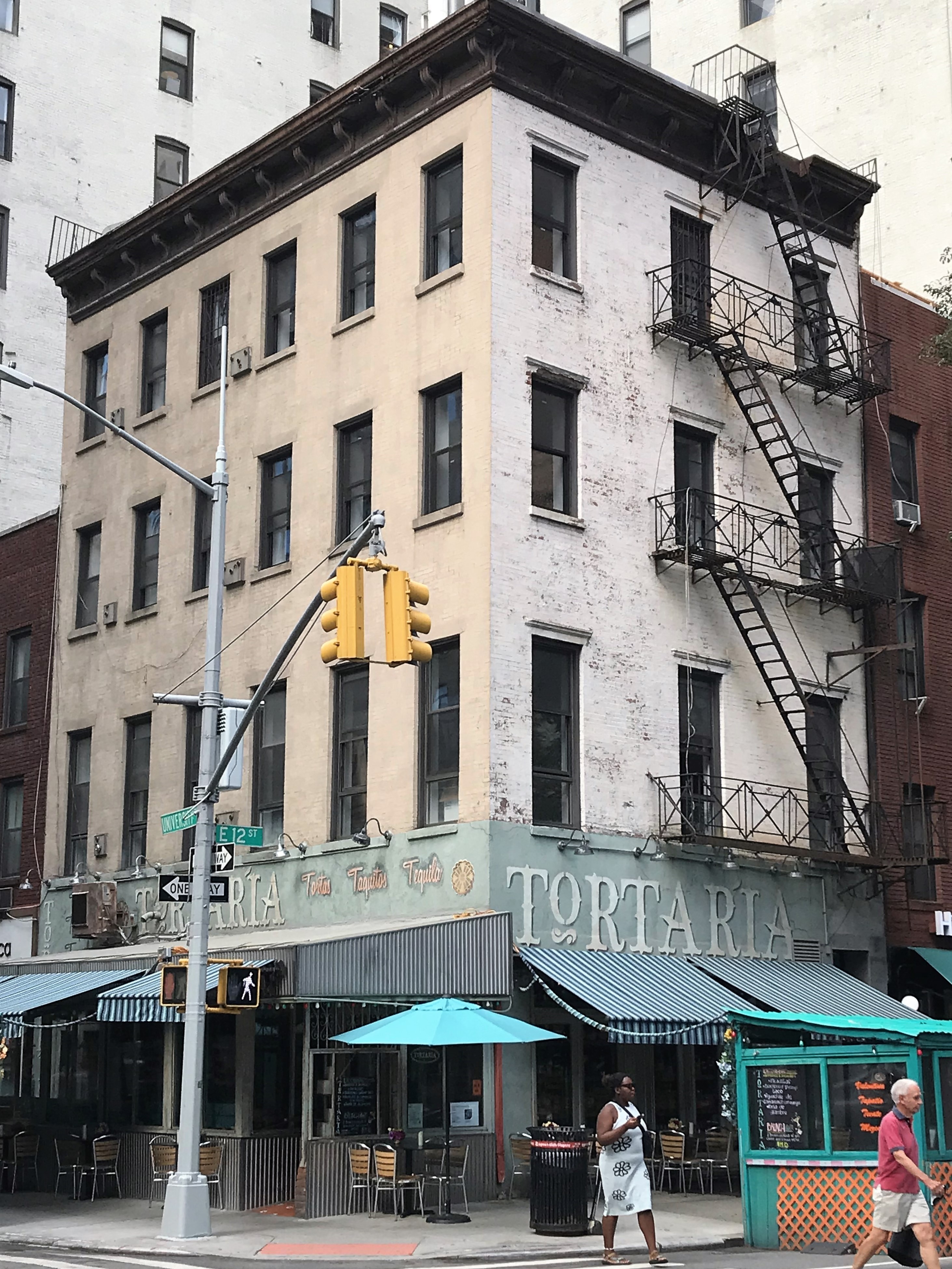
In 1941 the stoop had been removed and fire escapes ran up both elevations.  via the NYC Dept of Records & Information Services.

On June 22, 1949 the Madden Studios opened in the former residence, run by composer and dancer Charles Madden.   The New York Age reported, "Instructing classes in Primitive Dance are Lavinia Williams, formerly of the Katherine Dunham Dancers, and James Hunt, former member of the Dunham Experimental Group and 'Show Boat.'"  Teaching Primitive Percussion, said the article, would be Madden, "who has appeared in concert with Pearl Primus Dancers and the Dunham Group, as well as with the East Indian dancers Sujata and Osaka."

The changing neighborhood was reflected in the Kentshire Galleries occupying the ground floor space during the 1980's. In October 1985 it staged a showing of 19th century Indian antiques and artworks.  On October 27 The New York Times commented, "The show covers material dating mostly from 1800 to 1870."

1991 alterations included a remake of the ground floor facade for a restaurant.  via the NYC Dept of Records & Information Services.

A renovation completed in 1991 resulted in a restaurant on the first floor, its exterior veneered in artificial stone, and one apartment each on the upper stories.  The brick was given a coat of white paint.  Since January 2012, Howard Berke's Tortaria, a Mexican restaurant, has occupied the ground floor space.


photographs by the author
no permission to reuse the content of this blog has been granted to LaptrinhX.com

Monday, May 23, 2022

The Lost Society Library - 109 University Place


from the collection of the New-York Historical Society

In 1754 the New York Society Library was formed.  It occupied rooms in City Hall (later Federal Hall), nearly side-by-side with the earlier The Public Library, 
founded in 1700 under the administration of the Earl of Bellomont.  (That library was housed in Trinity Church.)

The New York Society Library's first permanent home was erected at 33 Nassau Street in 1795.  It remained there until 1836 when its magnificent Greek Revival building on Broadway at Leonard Street and Catherine Lane was completed.

The first and second New York Society Library buildings.  History of the New York Society Library, 1908 (copyright expired)

The constant northward movement of Manhattan's residential neighborhoods forced a third move.  Austin Baxter Keep, in his 1908 History of the New York Society Library, wrote, "By 1854 plans were well under way for a new location for the Library."  The previous year, three plots had been purchased from Adeline E. Schermerhorn, widow of Peter Augustus Schermerhorn, for $18,650 (about $593,000 in 2022).  

They were situated on the east side of University Avenue (later University Place), between 12th and 13th Streets.  The neighborhood was filling with refined homes, and the vacant parcel came with detailed restrictions.  Only a building of "brick or stone of at least two stories in height" could be built, and the purchaser could not "erect, permit or suffer upon the said premises or any part thereof any public school, theatre, or other place for public amusement, or any other place for any other trade, business or occupation dangerous, noxious or offense to the neighbouring inhabitants."

In March 1855 the trustees approved the firm of T. Thomas & Son as the architects of the new library.  The cornerstone was laid that summer, and on April 28, 1856 the trustees met in "the almost finished structure," as worded by Austin Baxter Keep.  The Italianate style brick-and-stone structure was 52-feet-wide at the property line, allowing for extra light and ventilation inside.  Towards the back, it spread out to engulf the entire width of the parcel.

Architects Thomas Thomas and his son, Griffith Thomas, arranged the facade in three vertical and two horizonal sections.  The entrance was centered within the rusticated stone base.  At the second floor, arched openings crowned with Renaissance inspired pediments flanked a Palladian-style group of windows.  They were surmounted by a carved entablature announcing "Founded A. D. 1754."  A second carved plaque, directly above, read "Society Library."  A hefty cast iron cornice was crowned with a handsome Italianate balustrade.

Valentine's Manual of the City of New York in 1856 wrote:

On entering the front door, the visitor finds himself in a hall forty-seven feet long and twelve wide, handsomely paved with tessalated [i.e., colorful, geometric tiled] pavement.  On the left hand is a comfortable room for a ladies' reading room, sixteen feet by thirty.  A similar room on the right is used as a conversation room.  At the end of the hall are folding doors opening into the large reading room, thirty-one feet by seventy-three, well lights and well furnished with papers and periodicals.

It was the second floor that was the most impressive.  A flight of stairs led to the library proper, described by Valentine's Manual as "a noble apartment."  The great room engulfed the entire second floor, its ceiling rising 35-feet to an oblong glass dome.  The space was girded by two galleries which, like the main floor, contained "quiet alcoves."  The library was designed to hold 100,000 volumes.

The cost of construction had added another $55,560, bringing the total expenditure to about $2.36 million by today's standards.

from the collection of the New York Public Library

Sixteen years after the opening of the new building, it was the scene of the library's centennial.  On November 10, 1872, The New York Times reported that the anniversary "was celebrated last evening in the hall of the New-York Historical Society building...At 7-1/2 o'clock a brilliant assemblage of ladies and gentlemen--many of them literary lights--occupied the seats in the main hall."  The current president of the board of trustees, Dr. Frederic De Peyster, gave the main address, which focused on the history of the institution.

Surprisingly, the trustees of the New York Society Library were duped in 1880 when they rented a room to Albert Welles's American College of Heraldry.  On February 6, 1881, the New-York Tribune reported, "A large gilt sign over a window of the building No. 67 University-place, displays the words 'American College of Heraldry.'  Near the top of the building cut in stone are the words 'Society Library.'  This latter sign, however, is not conspicuous, and strangers unfamiliar with the building suppose it to be devoted to the purposes of the College of Heraldry."

The newspaper had done an investigation and concluded the college "which is using the names of many prominent citizens as regents and life members, is a pretentious sham."  Welles, said the article, was not only the president, but the entire faculty, and he had "succeeded by ingenious devices in getting $50 each from these regents and life members, who have no duties and no privileges of any value."  Understandably, the college was soon gone from the Society Library building.

On the evening of August 31, 1883 the janitor, C. William Ormsby, was going through the rooms, closing the shutters for the night when he "surprised a man in one of the rooms on the second floor endeavoring to pry open a drawer in one of the desks which contained some money and rare coins," according to The New York Times.  Ormsby detained the intruder and summoned a policeman.  At his hearing, 26-year-old Paul H. Rieve explained that he was a machinist out of work and was simply in the building looking for employment.  The judge was not convinced and Rieve was held on $1,000 bail awaiting trial.

Around 1896 University Place was renumbered, giving the New York Society Library the new address of 109.

When this photograph was taken in 1906, commercial buildings had begun to populate the area.  from the collection of the New York Public Library

The year 1914 was remarkable for the New York Society Library for two very different reasons.  At some point between 1840 and 1854, the original parchment charter, granted by George III in 1772, had disappeared.  At the annual shareholders' meeting on April 28, 1914, it was announced that the venerable document "was restored to the library by a resident of Brooklyn."

An equally surprising story affected the janitor's family that year.  John McCarthy, his wife, and their children lived in a small apartment in the rear of the building.  In January, Anita Faithful McCarthy read in the newspapers that William Smith, a "recluse on the Bowery," had died, leaving a $200,000 estate (roughly $5.34 million today).  Smith was the assumed name of Dudley Jardine, son of a millionaire organ builder.  Anita knew immediately that Jardine, alias Smith, was her father.

Jardine had married Anita Blackwell following the Civil War, "but lived away from her most of the time, explaining that he was doing private detective work," said The Evening World on October 23, 1914.  "While he was living this dual life the child Anita Faithful Smith was born, and shortly afterward Jardine left the little family and took up his abode in a lodging house."

Anita told a reporter from The Sun, "My father deserted my mother.  I supported her from the time I was 16 years old except one year, when my father let my brother and me stay in the Juvenile Asylum."  Anita's mother had died in 1911, and now she went to court to claim her share of her father's fortune.

On October 23 The Evening World reported, "There are five children romping with joy to-day around a smiling woman of middle age in a rear apartment at No. 109 University place, and their lives hereafter will be blessed with the good things of life, while yesterday they were the children of a poor janitor."  Anita's long fought battle resulted in a decision that "she and her children are to share largely" in the estate.

By the Depression years, once again the northward movement of society caused the New York Society Library to rethink its location.  On May 3, 1936, the Chicago Tribune reported, "The New York Society Library, one of New York's hoariest social institutes, is moving.  For years it has stood on University place, grimly ignoring the onslaught of lofty buildings and second-hand shops.  Now the library can no longer take it, and its officials have purchased the residence of Mrs. John S. Rogers on East 79th street."

The T. Thomas & Son structure was demolished in 1939, replaced by an six-story apartment building designed by H. L. Feldman, which survives.

image via compass.com

LaptrinhX.com has no authorization to reuse the content of this blog