Showing posts with label state street. Show all posts

Monday, March 4, 2024

The Lost Lutheran Emigrant House - 12 State Street


from the collection of the New-York Historical Society

In the first decades following the American Revolution, State Street was lined with elegant mansions, the owners of which enjoyed harbor views across the Battery and cooling breezes.  One such residence, at 12 State Street, was described in 1820 merely as a "four-story house fronting the Battery."  It was offered for rent four years later at $300, or about $7,700 per month by today's conversion.

State Street in 1859.  No. 12 would have been further up the block, behind the trees.  from the collection of the New York Public Library.

No. 12 State Street was leased to a succession of well-heeled merchants.  Living here in 1848 was the family of S. H. Russ, whose 15-year-old son William H. Russ went missing that year.  He left for school on November 16 and did not return.  His parents' detailed description in the New York Herald on December 1 said:

He is a smart, active, intelligent boy; has a good education--is a good penman.  He is fifteen years of age, five feet two inches in height, brown hair, a cowlick on right side, dark blue eyes, a little near sighted, (but so little that it is hardly perceptible), light complexion, square face, dimples in his cheeks when he talks or laughs, wore away a black cloth cap, black alpaca roundabout, clouded blue and white vest, striped with one thread of black, black woollen pants, black silk neck handkerchief; but had sufficient means of his own to purchase other clothes as well as to pay his expense to any neighboring city or port.

The family's fears were evident toward the end of the notice.  "If this should meet the eye of said William, his father entreats him to return home, or if he is in business and does not wish to return, to write and let him know where he is, so that he can communicate with him and there shall be no obstacle put in his way to prevent his staying."

The teen was eventually found, and 12 years later, on December 23, 1865, the now 27-year-old shot the woman he loved in a jealous fit then jumped in the East River to drown himself.  The New York Dispatch reported, "Owing to the low tide, he could not accomplish his purpose, and, extricating himself from the mud, made his way to shore."  There he shot himself.  The murder-suicide did not succeed and both parties survived.

In the years between William Russ's disappearance and the murder-suicide attempt, the State Street neighborhood had changed.  In 1851, No. 12 was the home of Henry Lubs, who ran a porterhouse on Coenties Slip.  Living with his family was Oliver D. Vandenburg, a barkeeper.  Two years later the Lubs family had three blue collar boarders.  According to the Evening Post, in 1855 Lubs and his wife occupied the first and second floors, a family named Vandenburg lived on the third, and the Brown family on the fourth.  Another tenant, a 35-year-old dressmaker from Germany named Harmonia Baker lived in a room, as well.

At 2:00 on the morning of October 19, 1855, the occupants were awakened by smoke filling their rooms.  Fire had broken out in the basement and had "completely enveloped the stairways to the third story," according to the Evening Post.  The article said, "The firemen were quickly on the spot, but before the fire was subdued, so that assistance could be rendered to those in the upper stories, five persons lost their lives."

Henry Lubs and his wife made it out safely, although Mrs. Lubs broke her arm in a fall.  Tragically, the 50-year-old mother of Mrs. Vandenburg, Mary Ann Peacock, was burned to death as was the Vanderburgs' 5-year-old daughter Amanda.  Mrs. Catharine Brown, who was 26 years old, and her 9-year-old nephew died of smoke inhalation.  The Lubses' German servant girl named Frederica was also burned to death.  Harmonia Baker, according to the Evening Post, "was so severely burned that no hopes were entertained of her recovery."  Three days later, the New-York Tribune reported on her death.

The house, now owned by Thomas Cotton, was repaired and leased to Henry Mulholland, who operated it as a boardinghouse.  The basement level was then renovated to accommodate the porterhouse of Michael Quigley, who lived in the upper portion.  Just after midnight on August 12, 1861, fire broke out again.  The New York Times reported, "it was extinguished by firemen before it had extended to any other building."  There was little damage other than Quigley's loss of furniture worth about $3,000 in today's money.

Michael Quigley lost more furniture through a much different incident four years later.  On July 23, 1865, the New York Dispatch reported, "At about 11 o'clock A. M. yesterday a party of soldiers belonging to the Ninth Maine Regiment, stationed on the Battery, entered the saloon No. 12 State Street, became involved in a difficulty, and commenced breaking the furniture in the place."  When Officer Romer arrived to to quell the disturbance, "one of the number broke a musket over his head."  The mini-riot was soon suppressed by a "section of men" from the nearby station house.

Further up the block at the corner of Bowling Green, a group of similar formerly aristocratic homes were slated for demolition in 1899, to make way for the U.S. Customs House.  One of them had been home to the American Lutheran Emigrant House for years.  On October 7, The Evening Post reported that the organization had obtained quarters at 12 State Street.  A month later, The New York Times reported that plans had been filed for renovations to the vintage building.

The remodeling left no trace of the Federal style mansion.  Now five stories tall, a centered, single-doored entrance sat above a high stoop.  A parapet above the neo-Grec cornice announced The German Emigrant House in German.  (Newspapers would alternatively call it the Lutheran Immigrant Mission or the Lutheran Emigrant Mission.)

In 1920 the building (behind the cart) looked little different than when renovated in 1899.  from the collection of the Museum of the City of New York.  

The facility had not been open especially long when it had a most interesting visitor.  On June 18, 1900, The Sun began an article saying, "A queer-looking little German woman, broad-hipped and short, in a black dress, walked into Battery Park yesterday afternoon from the Lutheran Immigrant Mission...at 12 State street.  She wore the headdress of a Hanoverian peasant, and under the loose sleeves of her waist, just below the elbow, wore big bunches of silver bangles.  Her headdress resembled a silk skullcap, with a sort of veil dangling at either side."

As it turned out, the woman in the traditional dress of a peasant was Katherina Ibens who, according to The Sun, "owns one of the largest cherry orchards in Hanover, consisting of 500 trees."  Following her husband's death in December 1899, her health inexplicitly failed.  Finally, her doctor suggested a change in scenery and a trip to New York.  The frugal woman rode in steerage "that she might live afloat thus nearly as cheaply as it would cost her, with doctor's bills, to live in Hanover," said the article.

The 55-year-old Mrs. Ibens told a reporter she intended to see Coney Island and the places of interest in New York, but wanted to be home within two weeks for the cherry harvest.  The Sun noted, "she is not going to spend any money buying new-fangled American dresses."  She further saved money by staying in the Lutheran Emigrant Mission.

The mission was hit with scandal in the fall of 1902.  On November 10, the Commissioner of Immigration, William Williams, issued an order that barred Rev. H. J. Berkemeier, the head of the Lutheran Immigrant Home, and his assistant Daniel Dagen from entering Ellis Island.  Williams accused Berkemeier of, instead of assisting arriving immigrants, "you are in the habit of actually preventing recently arrived girls from meeting their friends and of compelling them to accept employment against their will with people who have previously directed you to look up servants for them at Ellis Island."  Williams ended his letter with a slap to Berkemeier's ministerial face.  "Your action is more reprehensible because you have prefixed to your name the word 'pastor.'"

Berkemeier was replaced by the Rev. Mr. Doering.  On June  15, 1904, his wife Ida, took some of the immigrant children on a boat excursion sponsored by the German language St. Mark's Evangelical Lutheran Church.  The outing turned into a nightmare when the pleasure boat, the S.S. General Slocum, caught fire in the East River and burned to the water line within 15 minutes.  It resulted in the greatest loss of life in New York City history prior to the attack on the World Trade Center.

That afternoon, The Evening World reported that six-year-old Edna Dahrens, from the Immigrant House, had survived and was in Lincoln Hospital.  Ida D. Doering, too, was rescued, but died, according to The New York Times, "from pneumonia brought on by shock."  Her funeral was held on June 25.

On June 14, 1919, the Real Estate Record & Builders' Guide titled an article, "Downtown Landmarks Sold," and reported that 9 through 12 State Street, "originally erected as private houses...all well-known landmarks, have been placed under a contract of sale."  The article noted that the purchasers "are acquiring the site for commercial purposes."  A 44-story tower was erected on the site in 1991.

image via WikiArquitectura

no permission to reuse the content of this blog has been granted to LaptrinhX.com

Monday, October 30, 2023

The Lost 1817 Nos. 16 to 19 State Street


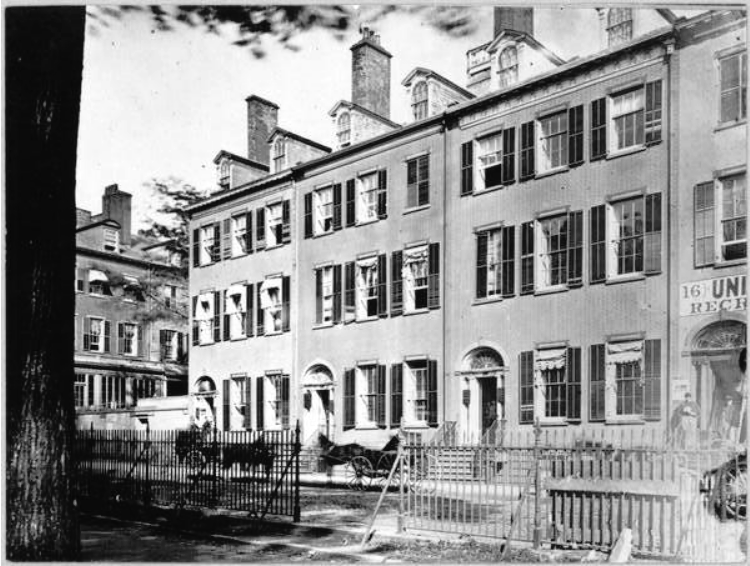
Just a sliver of 16 State Street appears at the right.  To the far left can be seen the rear of 7 Bowling Green, at the southeast corner of State Street.  from the collection of the New York Public Library

In the first decades of the new republic, lower Broadway, Bowling Green, and State Street were the most refined residential streets in Manhattan.  The mansions of State Street faced Battery Park, which afforded vistas of the harbor and cooling breezes.  Mornings and afternoons saw well-dressed society members promenading in Battery Park.

On March 23, 1816, an advertisement appeared in The Evening Post that read:

House and Lot at the Battery.  That elegant House and Lot No. 19 State-street is offered for sale.  The House and appurtenances thereunto belonging will be completed by the first of May next.  There are many conveniences belonging to the House and for beauty and variety of prospect the situation is perhaps unsurpassed by any other in the United States.

The nearly completed brick-faced mansion was 28-feet-wide and three-and-a-half stories tall above an English basement.  It was one of four identical, Federal style residences going up.  Atop the stoops, their elegant marble framed entrances reflected the financial and social status of the families who would occupy them.  Their leaded glass sidelights and dramatic fanlights were hallmarks of the Federal style.  The windows wore paneled lintels and two dormers distinguished the peaked roofs.

An advertisement for 18 State Street next door boasted its being built "of the best materials...and in the most elegant and workmanlike manner."  It noted, "On the rear of the lot is a convenient brick stable and coach house, opening onto a commodious street or alley."

A watercolor executed around 1848 shows the walled garden between 19 State Street and 7 Bowling Green.  from the collection of the New York Public Library

No. 16 State Street became home to the Nathaniel Gardiner family.  They were looking to replace a servant in May 1826, their ad reading, "Waiter--A colored man as waiter is wanted at No. 16 State street."  (Waiters were polished, dignified servants who served in the dining and drawing rooms.)

In November that year the Gardiners welcomed a son, Abraham S.  Sadly, the little boy died a month before his first birthday, on October 2, 1827.

Living next door was William Irving and his wife, the former Julia Paulding.  Born on August 15, 1766, he was elected to Congress in 1814 and served until March 3, 1819.  William's younger brother and business partner was author Washington Irving.  William and Julia had five children, the youngest of whom, Henry Ogden, was ten years old when the family moved into their new home.

William Irving (original source unknown)

Irving would not enjoy his handsome home for long.  He died on November 9, 1821.  Two months later, Irving's estate sold the house, noting it "is replete with every convenience, faithfully built, and fashionable and well finished in every part."  The announcement noted, "the Stable is fire proof, and has ample room for carriages and horses."

Thomas Bloodgood sold 18 State Street to J. Phillips Phoenix in 1821.  Like Irving, he had served in Congress.  In July 1883 the New England Historical and Genealogical Register would recall, "Mr. J. Phillips Phoenix was for several terms the efficient representative in congress of a district in this city, comprising a cultivated and intelligent constituency."  He and his wife Mary Whitney, had seven children.  In reflecting on Stephen Whitney Phoenix's birth in the house on May 25, 1839, the New England Historical and Genealogical Register mentioned that the residence sat within the "aristocratic and fashionable quarter of Bowling Green and the Battery."

The Phillips's next door neighbors at 19 State Street were the Robert Maitlands.  Robert's wife, Elizabeth Sproat Lenox, was the daughter of James and Elizabeth Sproat Lenox.  

Robert Maitland, from the collection of the New-York Historical Society

Mary Sproat Lenox Maitland, from the collection of the New York Public Library

Born in 1768, Maitland was the head of the Robert Maitland Company, a highly successful mercantile business.  In his 1864 The Old Merchants of New York, historian Joseph Alfred Scoville recalled the "famous society" which "called themselves the 'House of Lords.'"  He noted, "The society held their meetings at [Joseph] Baker's city tavern No. 4 Wall street, corner of New."  The group included Robert Maitland, Gulian Verplanck, Robert Lenox (Mary's brother), Preserved Fish, and John Wesley Jarvis.

Robert and Mary had two children, Jennet Lenox, born in 1817, and Robert Lenox, born the following year.  (Two others, Agnes and Harriet, had died in infancy.)  Robert L. Maitland would eventually join his father's firm as a junior partner and go on to establish a reputation equal to his father's.

Robert Maitland died at the family's country home in Westchester County on October 29, 1846.  The State Street house became home to Mary Townsend Nicoll, the widow of Edward H. Nicoll.  She died here on April 5, 1849 at the age of 60.

At the time of Mary Nicoll's death, the millionaires of Lower Manhattan were migrating north to exclusive enclaves like St. John's Park, the Bond Street neighborhood, and Washington Square.  By 1851, 16 State Street was being operated as a high end boarding house, run by Elizabeth B. Atkins, the widow of Benjamin Atkins.  She accepted only a few select boarders.  That year they were flour and grain merchant Thomas E. Burns; Antoine Cokino, another merchant; and attorney John J. Tyler.

The invasion of commerce into the once-refined block was perhaps best exemplified in 1857, when the Stafford Olive Tar Co. took over the lower floors of 16 State Street.

The Stafford Olive Tar Co. slathered the facade of 16 State Street with its advertising.  Appletons' Hand-Book Advertiser, 1857 (copyright expired)

An advertisement in the New-York Dispatch in 1857 read:

To Disinfect A Sick Room, place a table spoonful of J. R. Stafford's Olive Tar in a saucer over a bowl of hot water [and] the room will be soon filled with the delightful blended Aroma of the Olive and Pine, revitalizing the sick and preventing the spread of Disease.  Remember this when Small Pox, Scarlet, or other infection Fevers or Diseases prevail.  Olive Tar 50 cents a Bottle by the Stafford Olive Tar Co., 16 State street, east side of Battery, and by all Druggists.

Then, with the outbreak of Civil War in 1861, all four houses were taken over by the Union.  No. 16 became the New York City headquarters of certain U.S. Navy departments, and 17 through 19 were occupied by the U.S. Army's Quartermasters Department.  Various military figures occupied the upper floors of all four houses.

from the collection of the New York Public Library

On July 25, 1864, 17 State Street was the scene of the court-martial of General Francis B. Spinola.  According to The New York Times, he was charged with various offenses, including "mustering into the service of the United States sailors owing allegiance to, and in the service of, a foreign power."  More pointedly, he was accused of kidnapping troops and sailors.  Five months earlier the newspaper had noted, "During Gen. Spinola's administration, when 'runners' and the kidnapping of negroes were rife, over four hundred colored men were mustered into the service of the United States; since his removal there has only been one."

Following the war, the houses returned to private ownership, each being operated as a boarding house.  In 1873, New York City saw a resurgence of yellow fever.  On June 22, the New York Herald reported, "Considerable excitement has been occasioned among the residents of the lower part of State street by the death of a young man from that terrible contagion, the yellow fever, and the illness of three others with symptoms of the disease."

Sixteen-year-old John Ennis, who lived at 16 State Street, contracted the disease on Tuesday June 13 and died on Friday.  The day before his death, his brother exhibited severe symptoms.  The New York Herald said the Health Department authorities went so far "as to seize upon every article of furniture in the place, carting it away and burning it outside the city limits."  The house was quarantined, and on June 22 John's brother was "in a very low condition."

The article added, "Two of the neighbors were also attacked with the symptoms of this terrible malady.  One of the parties resides at 18 State street, and the other in the house adjoining the one in which young Ennis died."  In 17 State Street a Mrs. Lydon, who was 25 years old, and her sister had both contracted the disease.  The New York Herald reported on June 22, "Mrs. Lydon was confined last night and died shortly after.  The other patient was very low and her recovery was considered doubtful."

Four months later, 16 State Street became the German Emigrants' House.  The New York Herald reported on October 29, 1873 that it would be formally opened and dedicated two days later.  The ceremonies were to include "Addresses in English and German by distinguished speakers."

Surprisingly, 17 State Street was returned to a single family house in 1875 when it was purchased by Dr. William L. Shine.  In addition to his private practice, he was the official surgeon and claims adjuster of the Metropolitan Elevated Railway.  During the Civil War he had served as surgeon of the 69th Regiment.  The Evening Post later described him as a "skillful surgeon," but added, "He had an uncontrollable temper, which frequently involved him in affrays, and his habits were irregular."

Indeed, on September 11, 1878, The New York Times titled an article, "Dr. Shine Again In Court," and reported on his being charged with assault and battery on John Noonan.  The latter worked aboard the steamship City of Washington and boarded at 19 State Street.  Noonan had come to Dr. Shine for treatment and owed him $5 (about $151 in 2023).  The seaman was not as quick to pay his bill as his physician would like.

On the night of September 10, as the City of Washington pulled into port, Shine was waiting on the dock.  Noonan told authorities:

He says, "I'm looking for you for some time.  You owe me $5, and I want it."  I said, "I ain't got any money at present," when Shine said, "You lie, you got paid today, you ___ ___ little snoozer; you've been sending me off long enough."

Noonan claimed that Shine then jabbed him "right in the neck" with his umbrella.  "I said to him, 'Shine, I'll fix you for this.  I'll get the law.'  He then took a revolver out of his pocket, and holding on to the butt-end smashed me on the head."  Several witnesses appeared in court to support Noonan's account.

As often as Shine's name appeared in newsprint for his expert treatment of patients, it appeared in reports of his unprofessional and violent encounters, often in saloons.  On November 12, 1881, for instance, The New York Times reported, "Dr. William L. Shine, of No. 17 State-street, who was recently charged with cutting William H. Crummie...in a fight in a First Ward Bar-room, was again before Justice Kilbreth, in the Tombs Court, yesterday."

Both Shine's residency at 17 State Street and his medical career came to an end in October 1883 when he was declared insane.  He was sent to the Bloomingdale Insane Asylum and then moved to Ward's Island in August 1884.  He died there at the age of 47 on February 16, 1885.

The former mansions were demolished in 1899.  In the background can be seen the Produce Exchangefrom the collection of the New York Public Library

Against all odds, the beleaguered relics of an elegant period along State Street survived until 1899, when they were demolished to make way for the United States Customs House, designed by Cass Gilbert.

no permission to reuse the content of this blog has been granted to LaptrinhX.com

Monday, December 31, 2018

The Lost Ludlow Mansion - 9 State Street


from "Iconography of Manhattan Island," by I. N. Phelps Stokes, 1915 (copyright expired)
Historian John Flavel Mines described the Ludlow family in his 1918 Walks in Our Churchyards, saying "Descended from ancient and noble ancestry in England, they naturally became connected here by marriage with their social peers in the English colony--the Livingstons, Harrisons, Verplancks, Waddingtons, Ogdens and Mortons."

In 1768 Carey Ludlow purchased the 52-foot wide property at No. 9 State Street from the heirs of Abraham Lymsen.  It ran through the block to Pearl Street and, according to Appletons' Journal more than a century later, held "a fine Dutch house, with gardens, stabling, and out-houses."  Ludlow, who was described as "a very wealthy merchant," envisioned a grand new residence on the property.

But times were troubling.  Three years prior to Ludlow's purchasing the property the Stamp Act had been passed and it sparked determined resistance in the colonies.  Appletons' Journal explained "Carey Ludlow was so rank a Tory that from the first he declared for the legality of the proposed tax, and made himself so obnoxious to his fellow-citizens that he determined not to provoke remark by any ostentation in private life."

He now only postponed his building project, but began secreting his private fortune in case things got worse.  And they did.  When full-scale revolution broke out, he took his family to England, not returning until 1784 when "the bitter feelings of the strife had been replaced by the bonmonie of commercial intercourse."  (In other words, the fledgling republic felt his fortune was more important than his political past.)

Ludlow helped smooth over hard feelings by improving the residential waterfront.  He planted more than 300 trees in the neighborhood around No. 9 State Street, where he now began construction of his impressive Georgian mansion.

At the time his family was living on Front Street where, in 1791, his daughter Catherine, "a great beauty," was married to attorney Jacob Morton.  The match proved that the families had let political bygones become bygones.  While Carey Ludlow had been a staunch royalist, the groom's father, John Morton, had been called "the rebel banker" by British officers for the large amounts of money he loaned to the Continental Congress.

Although the State Street mansion does not appear in city directories until 1797, it appears to have been nearing completion at the time of the wedding.  Appleton's mentioned "Mr. Ludlow, shortly after the marriage, removed to the house on State Street."

Appleton's Journal, December 21, 1872 (copyright expired)
Three stories tall, not including the attic and basement levels, it was a regal presence among the other State Street homes.  A split staircase let to the porticoed entrance, above which was a charming half-round balcony.  (Historian Martha Lamb remarked in her 1877 History of the City of New York, "The view of the bay was superb from the little balcony over the front door.")  Three tall, arched dormers punched through the slightly peaked roof.

Inside were 26 large rooms, plus the servants' quarters.  John Flavel Mines wrote "Its oak chimney-pieces, wainscoting imported from England...made it a noteworthy edifice."

State Street was a tranquil, upscale street.  The Ludlow house is third from the corner.  Magazine of American History, June 1889 (copyright expired)
Carey Ludlow was not one for grand display, and the furnishings were described as "somewhat plain."  Although he and his wife do not seem to have often entertained grandly, the wedding of Eliza Susan Morton, the sister of their son-in-law, was an exception.

Martha Lamb described the occasion in an 1889 article in the Magazine of American History.  "One of the romantic social events of June, 1797, was the marriage of the celebrated Josiah Quincy to Miss Eliza Susan Morton," in the State Street house.  The president of Princeton College, Rev. Dr. Samuel Stanhope Smith made the journey to New York to perform the ceremony.

Carey Ludlow died in 1807, passing title to the house to his widow.  Catherine and Jacob Morton moved in with the elderly woman and, according to Appletons' Journal, "the palmy days of the old house began."  The couple, who not only had a considerable fortune but were "endowed with great taste," made the interiors even more magnificent.  "They lavished marble decorations, and ormolu, and superb girandoles, over the principal rooms."  The writer recalled that "from the windows of the banqueting-room, and from the rich drawing-rooms also, could be seen the Battery Park garden, where all the trees Mr. Ludlow had planted had by this time grown to a fair height.

Morton's career by now had gone far beyond his legal practice.  He was also a merchant and a major-general in the National Guard.  He and Catherine were among the most celebrated of New York City hosts, prompting historian Emmons Clark in 1890 to recall "Fond of society, and distinguished for his hospitality, [Jacob Morton's] house was for many years a social and fashionable center of great celebrity...All the distinguished men who visited New York were welcome guests at the superb mansion."

Appletons' Journal added "No. 9 State Street was emphatically the centre of intellect, refinement, and feminine loveliness.  Mrs. Morton had been a great beauty, and she delighted to assemble around her all the belles of the city, while her husband's wealth as a merchant, and distinction as a gentleman, brought to his house all the distinguished men of the time."

Entertainments were put on hold when Morton, now a brigadier-general, rendered service in the War of 1812.  In 1815 he succeeded General Stevens as commandant of the First Division of the National Guard.

Morton counted among his friends George Washington, Alexander Hamilton, and Lafayette.  A Standard History of Freemasonry in the State of New York, 1899 (copyright expired)
The single event for which the Morton house would be most remembered was the glittering ball held for Marquis de Lafayette in 1824.  Emmons Clark described it as "unsurpassed in the country at that period."   Peter Ross, in his 1899 A Standard History of Freemasonry in the State of New York, commented that the "grand ball [was] the last time, probably, on which its twenty-six apartments were all thrown open to guests."

Following Jacob Morton's death in 1837 Catherine was offered $90,000 for the mansion--in the neighborhood of $2.38 million today.  The offer was refused; however the once-elegant street was becoming increasingly commercial and the family left, leasing their mansion initially as an upscale boarding house.

But by the end of the Civil War it was home mostly to Irish immigrant families.  Appletons' Journal wrote "Lower and lower it went in the social scale.  A thieving tenant would steal some marble; another would lay his hands on some rare carving, until, little by little, wainscoting, marbles, mantel-pieces--all were gone and the mansion was completely despoiled."

Around 1868 the Morton family sold the beleaguered house for $28,000.   It was operated by "Mrs. Perry."  Among her Irish-born boarders at the time were the Glover family, Patrick Collins, Edward McEntee, and Michael Quigley.   McEntee was injured when he fell out a window that summer.  The New York Herald reported on July 21, 1868 "Edward McEntee, living at No. 9 State street, fell to the sidewalk on Sunday evening and broke one of his arms."

A year later on July 28, 1869 Henry C. Glover and his son, Samuel, went to Michael Quigley's room and asked to borrow his gun.   When he refused, according to his complaint to police, "they assaulted him with the gun, striking him several blows over the head."  The Glovers were arrested.

Both Quigley and Patrick Collins owned small rowboats which they moored at the foot of the park and rented.  Three months before Quigley's encounter with the Glovers, Collins had had his own problems.

from "History of the City of New York" by Martha J. Lamb, 1877 (copyright expired)
On April 15 he rented his rowboat to two teens, William Shea and John Grove.  The boys said they needed it for five hours and, according to Collins later, "left the Battery landing in high glee."  He waited well past the appointed time, but they never returned.  Nearly a month later, on May 8, they were arrested, charged with stealing the boat valued at $80 (nearly $1,500 today); and yet "neither of the prisoners would tell what they had done with the complainant's property," according to The New York Times.

A mysterious advertisement appeared in The New York Herald on February 13, 1870:  "Information Wanted--Of Mrs. Isabella Elliot, late from Derry, by steamship Caledonia.  By leaving her address at Mrs. Perry's, No. 9 State street, she will hear of good news."

Meanwhile Michael Quigley's problems continued.  On July 14, 1871 he placed an advertisement in The New York Herald:  "17 Foot Boat Stolen--From the Battery, Monday, 9th inst. painted white, red gunwale, blue streak, named Tommy Dodd; branded M. Quigley, Battery."  He offered a reward "for the conviction of the thief" equal to $1,000 today.

Two weeks later a horrific disaster occurred on Sunday, July 30.  The ferry boat Westfield was transporting more than 200 passengers to Staten Island when its boiler exploded.   The New York Times reported "the whole end of the boat on which the people were gathered was torn to tatters; fragments went upward and outward. But that mass of humanity! Who can picture! Who dare to even think of it! Lifted into the air, hurled into the water, buried in the debris of the wreck, bruised mangled, scalded, roasted, men, women, children, babes, were mingled in a mass of indescribable horror.”  


The wreck of the Westfield, Harper's Weekly 1871 (copyright expired)
Michael Quigley jumped into action, launching his rowboat into the harbor.  Although approximately 125 people perished that day, he was credited with saving several.

But heroism did not translate into great reward.  On September 5, 1871, The New York Times reported "Michael Quigley, of No. 9 State-street, who did such good service in he work of rescuing the victims of the Westfield, was a complainant yesterday before Justice Dowling, against John Williams of No. 46 Vandam-street, whom he charged with stealing his gold watch."

According to Quigley's testimony, he was standing at the Battery on that previous Sunday afternoon, "having in his vest pocket a gold watch worth $60."  (A significant $1,240 in today's dollars, considering Quigley's blue-collar status.)  The New York Herald said that Williams "had a predilection for the watch [and] quietly withdrew it from Quigley's pocket."  He had not gotten far before Quigley realize his pocket had been picked.

The ill-fated Quigley would have to find other accommodations before long.  In April 1874 architect John Correja filed plans for a five-story tenement building on the site for developer Patrick Dollard.  The Ludlow-Morton house, once one of the most celebrated residences in the city, was demolished with no comment in the press.

Today the site is part of the plaza of the 42-story 17 State Street.

The large red curbside bow unintentionally marks the approximate site of the Ludlow mansion.