Showing posts with label robert maynicke. Show all posts

Friday, July 11, 2025

Robert Maynicke's 1903 130-132 Fifth Avenue


image via loopnet.com

In 1874, piano maker Chickering & Sons invaded Manhattan's mansion district by erecting a piano showroom and concert hall on the northwest corner of Fifth Avenue and 18th Street.  For nearly three decades Chickering Hall would be one of the city's foremost music venues.  But at the turn of the century, the entertainment district and its wealthy patrons had moved northward.  The last concert in Chickering Hall took place in 1901.

Soon afterward, on December 8, The New York Times reported, "A new mercantile structure will soon rise on the site of Chickering Hall."  The venerable concert hall was razed and in 1902 excavation for the foundations of an 11-story business building began.  Developer Henry Corn was busily transforming the district from private homes to loft and office buildings.  He hired Robert Maynicke, of the architectural firm of Maynicke & Franke, to design the structure.  The two men had a close relationship and Maynicke, in fact, was simultaneously designing a similar 11-story building four blocks to the south at 84-90 Fifth Avenue.

Maynicke filed the plans on April 4, 1902, placing the construction cost at $600,000--about $22.6 million in 2025.  A month later, the excavation became the site of tragedy.  On May 27, 1902, an excited crowd of viewers crammed the area to view a parade welcoming the Rochambeau Delegation to the city.  (The group of distinguished French Governmental representatives and military figures were in the U.S. to dedicate a memorial to Jean-Baptiste-Donatien de Vimeur, Comte de Rochambeau, in Washington.)  The New York Times reported, "About 100 persons...were precipitated to the bottom of the deep excavation on the site of Chickering Hall...shortly after 6 o'clock last evening by the collapse of a large section of a temporary bridge or sidewalk thrown across the front of the pit."  One man died instantly and “at least fifty were so seriously injured that they either had to receive medical attention on the spot or else were driven away in carriages,” said the police report.

The structure was completed in 1903.  Maynicke disguised its steel frame skeleton by placing heavy, rusticated piers along the three-story base--mimicking load-bearing masonry construction.  There were two entrances on Fifth Avenue.  One accessed the upper floors and the other the ground floor store.  The northern entrance sat within a striking portico of polished granite columns upholding a Renaissance inspired hood.

The upper floors were clad in tan brick and trimmed with stone, their corners distinguished with stone quoins.  Typical of Maynicke's style, the windows of the eighth and ninth floors were arranged in stacked groups.  They sat within Gibbs-style elliptically arched frames.

image via the NYC Dept of Records & Information Services.

The building filled, mostly, with apparel-related firms.  Among the first was Stein-Bloch Co., a wholesale tailor which had operated for years at 718-720 Broadway.  In its March 1903 issue, The Clothier & Furnisher reported that the firm's loft, "is being fitted up in the most artistic manner, and when completed will be models of convenience and attractiveness."

The Clothier & Furnisher, March 1903 (copyright expired)

Other initial tenants included Marks Rosenberg & Bros., lace and millinery importers; Burr & Hardwick, dealers in trimmings; and the dry goods firm of P. K. Wilson & Son.  Decidedly not part of the apparel industry was S. Sanford & Sons, which sold floor coverings.

Burr & Hardwick included a rendering of the new building in its moving announcement.  Dry Goods Reporter, January 3, 1903 (copyright expired)

Marks Rosenberg & Bros., which was based in Paris, was described by The Evening World as "one of the largest millinery importing houses in America."  It consisted of Jules, Hugo, and Max Rosenberg.  (Max managed the Paris concern.)  

Jules and Hugo Rosenberg were drawn into an uncomfortable position in the spring of 1905 when Parisian-born traveling  salesman Hugo Jacobson committed suicide by shooting himself in the head at the Hotel Breslin.  Before doing so, he mailed a letter to a friend, saying where his body could be found.  He also left a note on the dresser that read, "Mr. Jules and Hugo Rosenberg of 130 Fifth avenue will take care of me and settle everything."

McClure's, October 1908 (copyright expired)

On January 10, 1908, the 12-story Parker Building on Fourth Avenue (later Park Avenue South) and East 19th Street was gutted by fire.  It was one of the first fires in a high-rise building in the city.  The O. B. Potter Trust, which now owned 130-132 Fifth Avenue, quickly reacted.  On January 22, The Sun reported, "Plans have been filed for equipping the eleven story Mercantile Building at Nos. 130 and 132 Fifth avenue with an auxiliary fire extinguishing plant, supplied by a 15,000 gallon storage tank and two 5,000 gallon pressure tanks."  Architect Francis H. Kimball was hired to make the modifications.

In the summer of 1910, the employees of P. K. Wilson & Co. were moved by newspaper reports of 12-year-old Ethel Worbert, who was knocked down by an Eighth Avenue streetcar and hospitalized.  On June 26, the New-York Tribune reported, "The case excited much sympathy, as the girl had been accustomed to lead her blind father to and from the Christopher street station of the Hudson tunnel, where he stands all day and sells newspapers."  The P. K. Wilson & Co. workers, who had little money to spare, pooled their resources for the little girl.  The New-York Tribune reported, "Ethel Worbert received $10 through The Tribune some days ago from employe[e]s of the firm of P. K. Wilson & Co., silk merchants."

Marks Rosenberg & Bros. got less favorable press that same month.  The New-York Tribune reported that Jules and Hugo Rosenberg, "along with their brother, Max, who is the Paris manager of the concern, were indicted...on a charge of undervaluing imports entered at the New York Custom House."  Along with the charge of undervaluing $234 worth of goods, said the newspaper, "there are other indictments standing against them."  Jules and Hugo posted $10,000 bail  each awaiting their trial.  (The bail was significant--amounting to about $341,000 each today.)

When the men did not appear in court in October 1910, Marshal Henkel went to 130-132 Fifth Avenue to arrest them.  But they were not there.  Henkel was told they were out of the city.  The New-York Tribune explained, "The offence charged is one for which extradition does not apply, so that if they get out of the country they will be safe from punishment."

Three months later, on January 23, 1911, The Evening World reported that Judge Hand had declared their bail forfeited.  Having closely examined the firm's books, the Government now placed the amount the men had cheated Customs at $250,000 (more than $8.5 million today).  The article said that Jules and Hugo Rosenberg had joined Max in France, adding, "it has been impossible to coax them across from Paris for trial."  In the meantime, their firm had been placed "in other hands, though there has been no change in the sign."

Finally, a compromise between the Government and the brothers was made and Jules and Hugo returned to America in June 1911 and paid $182,436 on the outstanding duty, and $25,000 each in fines.  

In 1915, original tenants in the building like Burr & Hardwick and S. Sanford & Sons were joined with G. C. Batcheller & Co., a corset maker.  The quality of the carpeting sold by S. Sanford & Sons was reflected in a two-day auction held in the building beginning on April 19 that year.  The Sun reported, "Carpets and rugs valued at $4,500,000 will be disposed of."  The article estimated that nearly 2,000 buyers from throughout the country would be in attendance.

image via the NYC Dept of Records & Information Services.

At the time of the auction, Charles Cheever Hardwick, of Burr & Hardwick, was preparing for his semi-annual buying trip to Europe.  Normally his wife accompanied him on these trips, but this time she was nervous about the ongoing war in Europe.  On May 1, Hardwick boarded the RMS Lusitania headed to Liverpool, England.   Six days later, a German U-boat torpedoed the ship off the coast of Ireland.  Among the 1,198 lives that were lost was Charles Hardwick.

On June 21, 1920, Ralph Cherry, a 17-year-old clerk working for P. K. Wilson & Son, purchased $100 in stamps for the shipping room.  Just as he returned, three men stopped him on the sidewalk and asked about possible work.  Suddenly one of them grabbed the parcel.  Cherry fought back and was stabbed in the back, but refused to release the stamps.  The Evening World reported, "The three men, grabbing clubs that looked like baseball bats, went out into the crowds on Fifth Avenue."

Two policemen came to Cherry's aid.  One stayed with the injured clerk and the other chased the would-be robbers.  One of them was captured at Broadway and 17th Street, and another policeman who had joined the chase overcame a second on 18th Street and Fourth Avenue.  Joseph Gardella and Frank Flanio were both 19 years old.  The knife used to stab Cherry was found on Gardella.  Ralph Cherry recovered from his wounds at New York Hospital.

The building continued to house apparel firms into the 1920s.  In 1921 Sanford Narrow Fabric Co. leased a floor, and in 1924 Belcraft Shirt Company moved in.  That year the Chatham and Phenix National Bank converted the ground floor for a branch office.

photograph by the author

That space became home to a Manufacturer Hanover Trust branch in 1970.  It was followed in the early 21st century by an Express retail shop, and a Duane Reade store in 2022.  Robert Maynicke's handsome 1903 design is little changed, including the ground floor and its impressive Renaissance-style entrances.

many thanks to reader Doug Wheeler for prompting this post

Thursday, June 26, 2025

The 1903 Pinaud Building - 84-90 Fifth Avenue


image via markplace.vts.com

In its "Building Intelligence" column on May 3, 1902, Architect and Architecture reported that developer Henry Corn would be erecting an 11-story office building on the northwest corner of Fifth Avenue and 14th Street.  Half a century earlier, the site sat on one of the most socially important intersections within the then-exclusive residential district.  The mansions on each corner--like the opulent Greek Revival-style mansion of William H. Halstead here--looked onto two of Manhattan's most fashionable thoroughfares.  Now, those wealthy homeowners had all fled northward as commercial buildings overtook lower Fifth Avenue.

Architect and Architecture noted that Robert Maynicke of Maynicke & Franke would design the structure.  The identical two facades gave his Renaissance Revival-style structure  perfect symmetry.  Stores lined the rusticated, two-story base.  The six-story mid-section, sandwiched between intermediate cornices, was essentially unadorned.  In stark contrast, Maynicke lavished the top section with double-height, elliptical arches that engulfed stacked trios of windows and gave Renaissance pediments to those in the center.  A dentiled and bracketed cornice crowned the design.

The Brickbuilder, August 1914 (copyright expired)

Construction of the building progressed with lightning speed.  Only three months after Architect and Architecture revealed Corn's plans, Blum & Koch announced in the August 1902 issue of The American Hatter, "Do not fail to note the coming change of address which will give our hats a Fifth Avenue label.  By the middle of December we hope to welcome customers to our new and more spacious quarters at 84-90 Fifth Avenue."

Blum & Koch was not the only firm who had already signed leases.  Ed. Pinaud would be the building's major tenant and had negotiated space with Corn even before the plans were completed.  Founded in France by Ă‰douard Pinaud in 1830, the fragrance and cosmetics company was a favorite among the carriage trade (Ed. Pinaurd had supplied Queen Victoria with her toiletries).  On March 6, 1903, The Brooklyn Daily Eagle reported on the "New Ed. Pinaud Building," saying in part, 

Ed. Pinaud perfumery has erected a skyscraper that contains all the latest devices in construction and equipment.  To celebrate the opening yesterday Victor Klotz, the proprietor, tendered a reception during the afternoon to his friends and customers.

Victor Klotz had traveled from Paris to attend the ceremony.  The Brooklyn Daily Eagle noted, "The offices, all newly fitted up and finely decorated, were adorned with French and American colors and floral pieces.  A collation was served, during which corks popped merrily."

This advertisement gives the firm's address as simply "Ed. Pinaud Building."  The Argosy, October 1904 (copyright expired)

Other early tenants included apparel makers like Fein Brothers & Sturmann, a cloak manufacturer that leased 10,000 square feet of space in July 1904; clothing maker S. N. Wood & Co.; and J. C. Stratton & Co., makers of women's cloaks and suits.

The sale price of the advertised suit would translate to about $350 in 2025.  The Evening World, April 17, 1908 (copyright expired)

As the Pinaud Building rose, so did the 12-story Parker Building at Fourth Avenue (later Park Avenue South) and 19th Street.  On January 10, 1908 a fire broke out on its sixth floor.  Firefighters were faced with a modern problem--fighting fires in high-rise buildings.  Their efforts were fruitless and the Parker Building was gutted.

Exactly one week later, on January 17, The Sun reported, "The Fire Department last night attended to the first high building fire since the Parker Building burned and Chief Croker turned out to see that it didn't get away."  The fire had started in the seventh-floor loft of J. C. Stratton & Co.

The Pinaud Building was built with firefighting apparatus--standpipes on each floor that precluded the necessity of hauling firehoses up staircases.  "The fire was at such a height that the firemen decided to use the standpipes in the building," said the article.  Frustratingly, when they arrived on the seventh floor, they discovered that "some one had cut off the nozzles of the hoses, probably for the metal in them."  With the standpipes useless without functioning hoses, the firefighters had to use the pump engines on the street.  The blaze was extinguished, despite the problems.  The Sun reported, "About $4,000 damage was done."  (The figure would translate to about $140,000 today.)

By the following year, Frank & Beeman occupied space here.  The firm manufactured the popular shirtwaists--a ubiquitous women's blouse similar to a man's shirt.  The company's female workforce walked out during a strike in December that year.

Socialite Ines Milholland was an activist in women's rights (she was affiliated with Emmeline Parkhurst in the suffragist movement) and workplace conditions.  A graduate of Vassar, she allied with the young working women who struck Frank & Beeman.  On December 16, 1909, The Sun reported, "Since the shirtwaist makers have been on strike Miss Milholland has become much interested in their cause and frequently establishes herself as a volunteer picket outside factories to make sure that the police make no arrests that are not justified."

Ines Milholland was on the picket line outside 84-90 Fifth Avenue on December 15.  The policemen, who were well aware of her political power, stood by to ensure things remained calm.  The Sun reported, "While she was there the policemen made no arrests."  But when she stepped around the corner for a few minutes, things changed.  She returned to discover that sisters Tillie and Lotta Gold, and Sarah Rabinowitz "were in the grasp of two policemen."  Ines followed them to the station house where Policeman O'Connor at the door said, "You might as well come in too.  You're under arrest as much as these girls."

Ines Milholland was soon released, but the factory girls were sent to night court.  The Sun reported that Ines, "had intended to go to the opera last night, she said, but she spent the entire evening at the night court waiting for the cases of the three strikers to be called."  In telling the magistrate of the officers' actions, she said, "It was downright cowardly, that's what it was."  The magistrate was sympathetic and discharged two of the women and fined Lotta Gold $5.

Viola White worked for Frank & Beeman as a "shirtwaist model" in 1913.  On the afternoon of August 30 that year, she left work and entered the elevator.  Apparently forgetting something, she tried to step out.  The New York Times reported that she "was crushed to death...between the elevator and the floor on which she worked."  John Gubo, the elevator operator, was arrested for homicide.

Millionaire Joseph C. Brownstone was head of J. C. Brownstone & Co., a chain of clothing stores which operated here as early as 1919, and a director in the Bank of the United States.  On the afternoon of July 3 that year, IRS agents entered his office and arrested him.  The following day, The New York Times ran the headline, "Rich Man Arrested In Tax Fraud Case."

A friend of Brownstone, Jay A. Weber, secretary of the Pictorial Review Company, was being held "in a plan to defraud the Government out of approximately $500,000 in taxes due from the Pictorial Review Company," according to The New York Times, and for attempting to bribe an IRS agent by offering him $25,000.  Now Brownstone tried to get his friend out of trouble by offering the same agent the same amount.  Assistant United States District Attorney Benjamin De Witt said he was, "greatly puzzled that [Brownstone] should approach the same man in the same case with an offer of the same amount."

Weber had attempted his bribe inside the Hotel McAlpin in view of several witnesses.  Brownstone thought he could avoid such a trap by catching up to the agent on the street.  It did not work.

image via the NYC Dept of Records & Information Services

Ed. Pinaud, Inc. remained in the building at least through 1926.  The other tenants continued to be mostly garment manufacturers, like G. Solomon, makers of cloaks and suits, and the Dependable Clothing Company.  In 1929, S. Golde & Sons leased three floors in the building.  They made coats for the U.S. Army.

Joseph Brownstone was in trouble again in 1931.  Like many banks in the early years of the Depression, the Bank of the United States failed.  Just before its closing, Brownstone issued a $275,000 loan to J. C. Brownstone & Co.  Because it would not be due until after the bank was insolvent, his firm would not be obligated to pay back the funds.  On January 1, 1931, The New York Times reported, "He said that he had a perfect legal right to borrow money from the bank of which he was a director."

A tragedy occurred in the offices of the I. Buss Uniform Company here on December 30, 1947.  When employees arrived that morning, they found 40-year-old Harold Busch dead on a cot in his office.  The New York Times reported that there was "a newspaper over his face and gas escaping from a tube near his mouth."  Busch had left three notes on his desk, "one giving burial instructions."

After mid-century, the first non-manufacturing tenants began moving into the building.  In May 1960, The Rabbinical Council of America, the offices of which were already here, opened Beth Din (court of religious law) in the building.  The Council described its purpose in The New York Times as "giving guidance in the field of marriage and family status to all Jews who require it."

The transition from manufacturing to office space continued when consulting engineer James Ruderman leased 5,000 square feet in September 1961.  At the same time, BenGor Industries, Inc., an investment firm, occupied space here.

A renovation completed in 1970 resulted in a bank and store on the ground floor, a union health center on the second, and offices and showrooms throughout the upper floors.  Among the new tenants were the offices of the American Civil Liberties Union, the computerized testing center of the Health Insurance Plan of Greater New York (HIP), and the offices of The Irish World, the oldest Irish-American weekly newspaper in America.

Other tenants starting in the 1970s included the Council on Municipal Performance, the Citizens for Abortion Rights, and NOW/NY (the New York chapter of the National Organization for Women).  They were joined in the building in the 1980s by the Teachers' and Writers' Collaborative and the Research Institute of America.   After the devastation of downtown Manhattan on September 11, 2001, the Housing Authority, which had occupied 90 Church Street, moved into 100,000 square feet of 84-90 Fifth Avenue.

Twelve years later, however, the former Pinaud Building was vacant.  Its owner, RFR Holding, described it in The New York Times on March 25, 2014 as "largely a blank canvas."

image via squarefoot.com

Robert Maynicke's design is intact, even at the ground floor, always the first level to be obliterated by modernization.

many thanks to reader Doug Wheeler for suggesting this post

Friday, December 13, 2024

Robert Maynicke's 1906 Yorkville Bank -- 1511 Third Avenue


image via realestate.union-investment.com


Reinhold Van Der Emde was born in Germany on March 17, 1842.  After studying the pharmaceutical trade in Switzerland, he arrived in New York City in 1869.  The New York Times later said he, "got a position in Dietel's drug store.  He was thrifty, and soon started a business of his own on the Bowery."

Van Der Emde's drugstore thrived.  In 1893, he and Richard H. Adams founded the Yorkville Bank, erecting a building on the northeast corner of Third Avenue and 85th Street within the neighborhood that was greatly populated by German and Hungarian immigrants.  Reinhold Van Der Emde became the bank's president.  The New York Times recalled in 1909, "The institution was successful from the first."

So successful was the Yorkville Bank, in fact, that on July 30, 1904, the Record & Guide reported, "Robert Maynicke...is preparing plans for the new building to be erected by the Yorkville Bank."  (Van Der Emde's choice of the architect may have been slightly influenced by the fact that Maynicke was also German-born.)  He filed plans on January 7, 1905 for the $125,000 structure (about $4.47 million in 2024).  

The project moved fast.  On the same day of the Record & Guide's article, The Evening Post reported, "On Monday next the bank will be moved temporarily to Eighty-third Street and Third Avenue," and a month later, on February 4, the Record & Guide announced, "The old buildings are now being demolished and excavating will begin next week."

The new Yorkville Bank building was completed within ten months and its doors were opened on December 18, 1905.  Maynicke had produced a handsome Italian Renaissance banking palazzo of four floors.  A graceful arcade ran along the sidewalk, its tall arched openings separated by full-height pilasters.  A prominent intermediate cornice introduced the upper floors.  Maynicke carried on the Renaissance motif by treating the openings with terra cotta pediments, classical metopes between the third- and fourth-floor windows, and dentils below the stone cornice.

It appears that Van Der Emde gave Maynicke input.  On June 10, 1909, The Pharmaceutical Era wrote, "The bank's new building at Third avenue and 85th street, which is generally looked upon as a model for banking houses, was designed under the direction of Mr. van der Ende."

The upper floor offices were leased, mostly, to real estate and legal firms.  Among the first were realtors Nathan H. Weil, Arthur G. Muhlker, here in 1906, and the F. Dornberger Realty Co., which moved in in August 1909.

The F. Dornberger Realty Co. was headed by Frederick Dornberger.  Between 1:30 and 2:00 on the morning of October 11, 1910, he exited the subway at Eighth Avenue and 110th Street.  Dornberger witnessed a woman going through the pockets of an elderly, intoxicated man within the hansom cab sitting at the curb.  He demanded she stop.  Dornberger told a judge a few hours later, "She told me to 'beat it while my shoes were good and mind my own business.'"  

When the realtor continued to interfere with her larceny, she stabbed him with her hatpin, which pierced his cheek and tongue.  She then told the cabbie to drive as fast as he could.  Undeterred, Dornberger jumped into another cab, told the driver to follow her, all the while yelling, "Stop, thief!"

The commotion caught the attention of Patrolman Boylan who stopped the vehicles and took everyone in.  The next morning Lillian Harrison, described by The Sun as, "a handsomely gowned, golden-haired woman," and Dornberger faced off in the Harlem Court.  (The Sun noted, "the old man had promised to appear, but he failed to do so.)  Although Lillian denied the charges and the would-be victim was not in court, The Sun reported, "Magistrate Breen, however, was impressed so by Dornberger's story that he held her in $1,600 bail."

Reinhold Van Der Emde died in 1909.  August Zinsser, Jr. replaced him as president and continued the bank's policy of serving the mostly German neighborhood.  On February 27, 1910, for instance, The New York Times reported that the bank had partnered with Public School 77 in an innovative program.  The school formed a bank run by schoolboys.  Pupils made deposits and withdrawals "and even promissory notes are dealt with," said the article.  Zinsser was "a prime factor in establishing the right principles," said the article.  And when a student's bank account reached $5, it was transferred to the Yorkville Bank where it began receiving interest.

On September 22, 1922, The New York Times reported that the bank had purchased the 25-foot-wide, three-story building at 1515 Third Avenue.  Architect P. Gregory Stadler was hired to extend the bank building to the north and east.  His alterations, completed in 1924, honored Maynicke's design, resulting in nearly seamless additions.

An announcement of the merger of the Manufacturers Trust Company with three other banks, including the Yorkville Bank was published in the New York Evening Post on June 2, 1925.  It described the Yorkville Bank, "For many years the financial center of the great Yorkville District of Upper Manhattan."

At the time of the merger, Ernest Wolkwitz had been an employee of the Yorkville Bank since 1892, when he was hired as a clerk.  By now he had risen to vice-president.  He retained his title and was given charge of the branch here.  The new responsibilities may have been too much for him, and on July 1, 1927, he retired "on account of ill health," according to The New York Times.  At the time, he was being treated "for a nervous affliction."

Wolkwitz and his wife, Minna, lived in a ninth-floor apartment at 115 East 90th Street.  On the afternoon of November 21, 1927, Minna went shopping.  When she returned, she found Wolkwitz's body hanging "from a pipe in the bathroom of his apartment," according to The Times.

image from the NYC Dept of Records & Information Services.

Twenty-two year old Patricia Ann Ryan was a teller in the Manufacturers Trust Co. branch in 1956 when she faced a terrifying incident.  On August 15, a man walked up to her counter and handed her a note that said in part that he had "nitro enough on me to blow all us up."  It seems, however, that this was the skittish bank robber's first heist.  The Citizen Register of Ossining, New York reported, "Before Miss Ryan had time to hand him any money, the man panicked, turned and ran."

Among the upstairs tenants in the late 1950s were the offices of the New York National Enquirer.  In 1974, a medical laboratory took over the entire third floor.  The bank left the ground floor in 1991.  A renovation in 2018 resulted in a retail store on the first floor and a health club on the upper floors.  Happily, Maynicke's striking 1906 design remains almost totally intact, including the graceful arcade of the first floor.

image via NYC.gov

Thursday, May 14, 2020

Robert Maynicke's 1903 476 Broadway


In 1871 the two converted Federal style houses at Nos. 474 and 476 Broadway were demolished as the Soho neighborhood rapidly transformed to one of loft and store buildings.


Among the jumble of businesses in 474 and 476 Broadway was Clirehugh's Illusive Wig shop. from the collection of the Metropolitan Museum of Art  
In their place architect Richard Morris Hunt designed an elaborate Moorish fantasy faced in cast iron.  It was not only a frenzy of details, but of colors.  American Architect & Building News described it on June 10, 1876 saying, "The panels are filled with porcelain decorated with arabesques, the shafts of the columns are incased in brass and nickel-plated drums; and the mouldings, etc., are painted with various colors."


Hunt's rendering included colored sections to suggest the completed effect.  from the collection of the Library of Congress

In November 1901 prolific developer Henry Corn purchased No. 476 Broadway, which ran through the block to No. 38 Crosby Street.  The Record & Guide reported that he "will erect thereon a 12-sty store and loft building from plans by R. Maynicke."  A few days later the journal gave its approval to replacing Hunt's 30-year old building, saying that rentals in the area were "doing very much better than [they were] a few years ago; and consequently improvements, such as the one Mr. Corn contemplates, are in order."

Construction began on April 16, 1902 and was completed ten months later, on February 28, 1903.  Robert Maynicke had created an 11-story commercial structure faced in beige brick above a three-story limestone base.  Monumental two-story Scamozzi columns upheld a dentiled entablature.  Beaux arts ribboned wreaths flanked the third floor, while the five-story mid-section was relatively unadorned other than splayed stone lentils.  The top three floors returned to Beaux Arts with terra cotta window frames, scrolled brackets and cartouches.


Colossal columns flank a three-sided metal storefront.
Typical of the neighborhood, the building filled with dry goods firms, like that of Henry I. Kleinberger, a silk merchant, who was uncomfortably called for jury duty on one of America's most famous court cases in 1907.

Multi-millionaire Harry Kendall Thaw had an intense hatred of architect Stanford White, who had not only, at least in Thaw's mind, boycotted him from Manhattan high society, but had carried on an intimate relationship with Thaw's wife, showgirl and model Evelyn Nesbit.  On June 25, 1906 he walked into the roof garden of Madison Square Garden and shot White three times in front of hundreds of witnesses.

Kleinberger was the only immigrant on the jury.  Born in Austria, he had come to America while still very young.  On January 30, 1907 Henry Kleinberger was sworn in.  The New-York Tribune described him as "about fifty years of age, has a small mustache, is partly bald and wears glasses."  He may have been a bit unnerved by Thaw who "stood erect as a soldier" and then, as Kleinberger was sworn in, "smiled at his counsel afterward as if he was much pleased."

Henry I. Kleinberger managed to get out of jury service, however.  The following day the judge excused him "because of ill health."  The Jamestown, New York newspaper the Evening Journal reported "This was a complete surprise" and explained "Mr. Kleinberger's physician had informed the district attorney's office of danger to his patient's health, should he serve."

Of the eight firms in the building in 1909, only one, A. L. Silberstein (which manufactured cutlery), was not in the dry goods or apparel business.   The other tenants were M. D. Harris & Co., shirt makers; Jacobs & Janowitch, makers of "white, negligee and work shirts and pajamas;" Samuel Salzman, underwear makers; Garland Mfg. Co., manufacturers of children's blouses; Townsend & Longmire, "webs, braids and metal trimmings;" and Blumenthal, Erdman & Co., lace merchants.


Several of the tenants would remain for years, like Samuel Salzman who was still in the building in 1919 when the neighborhood was plagued with a rash of burglaries and hold-ups.  On October 1 the New York Tribune ran the headline "Robbers Get $865,113 in Two Months."  Among the victims was Samuel Salzman who was robbed of $3,000 worth of silk underwear on September 1.  The haul would amount to about $44,300 today.

In the first years following World War I the tenant list began to change.  Some were, of course, still involved in dry goods and apparel.  In 1920 I. Oliver & Co. made gloves; A. J. Hague & Co., Inc. was an importer of "notions;" and International Belt Co., made belts.  But already electric and mechanical firms were moving in.

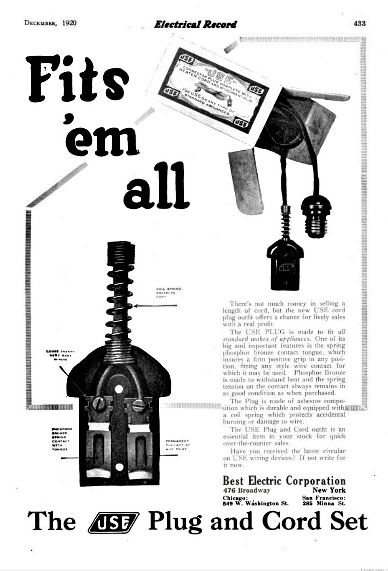
By 1918 Beck Duplicator Co., makers of mimeograph machines and the "Beck Speedograph," had space in the building.  In 1920 Henry Hyman & Co., which sold "gas burners, electrical goods, metal goods and stamping" moved onto two floors.  Other tenants were Best Electric Corporation, and the United States Electric Manufacturing Corporation.  

In its August 1920 issue Electrical Record noted that the United States Electric Mfg. Co. was "making a new type of multiple dry battery, which is sold in small individual cells, instead of being made up in a carton as a complete battery.  Elsewhere in the issue it described the firm's 'Usalite' flashlight "with luminous button and safety shut-off, which prevents the battery from being accidentally exhausted."


Electrical Record magazine, December, 1920 (copyright expired)

The building continued to be home to similar firms.  Beck Duplicator remained for years, joined in 1939 by the United States Bronze Sign Co., Inc. and in the first years of the 1940's by the Amagamated Radio Television Corp. and the American Radio Hardware Corp.

The last quarter of the 20th century saw the first hint of the changing personality of Soho as an emerging arts district.  In 1975 artist and musician John Fischer founded Environ on the top floor--a sprawling 5,000 square foot space.  He moved into the rear of the loft with roommates Dan and Chris Brubeck.  The musicians were sons of legendary jazz musician Dave Brubeck and would form the Brubeck Brothers Quartet.

Environ was the scene of jazz and concert performances, the first being staged in July 1975.  Events here were covered by the mainstream newspapers, like The New York Times which announced that Michael Sell, jazz saxophonist would perform on September 13, 1977.

By 1981 the art gallery Thread Waxing Space was in the building and would remain until about 2001.  

The building still saw commercial tenants, of course.  One of them was experiencing problems with its postal machine in September 2001.  The building was on the list of stops for equipment repairer Harriet Cordero, scheduled for later in the morning on September 11.  Cordero's schedule put her at the World Trade Center at 9:00, but the office at No. 476 Broadway lured her there first.  The New York Times explained "she made the detour because the company on Broadway was a new customer, without a contract, and she would get credit toward her bonus for doing that work.  The job at the trade center carried no bonus."

As she worked on the company's postal machine, the first of the terrorist-hijacked planes hit the World Trade Center.  "My life was spared because I made a decision because I live in a capitalist country," she told Times journalist Joseph B. Treaster.  "I decided to get paid first."


In 2008 the building was converted to a mix of offices and apartments.  

photographs by the author
many thanks to reader Gregory P. Gaddis for requesting this post

Friday, August 30, 2019

The 1901 Panhard & Levassor Bldg - 230-232 West 13th Street


On December 8, 1901 The New York Herald reported that Jams S. Herman had bought the "two old buildings" at Nos. 230 and 232 West 13th Street from Mrs. Mahalt Miller.  The announcement mentioned that he "will improve the property."  Neighbors on the quiet residential side street may have taken exception to the term "improve" when Herman began construction of his industrial-use building.

Herman commissioned Robert Maynicke to design his low-scale structure.  His choice of architect was perhaps as surprising as his choice of sites.  The well-established Maynicke was better known for impressive commercial buildings.  His design for Herman's project would be far different from the elaborate multi-story structures he was designing on lower Fifth Avenue around the same time.

It would appear that Herman was not entirely sure what he had in mind for the structure.  The plans called for a three-story "office, factory, shop and stable" building.  The ground floor of the beige brick structure featured two wide vehicle bays on either side of two windows.  The brickwork of the lower two floors was laid to create rustication; and the voissoirs of the ground floor and splayed lintels of the upper floors were executed in brick.  The molded cornice that separated the second and third floors was one of the few uses of stone.  A pressed copper cornice finished the design.

It took Herman some time to find a tenant for his new building.  But on October 6, 1903 The Evening Post reported that the Panhard & Levassor Company had rented it for a period of five years.  The Paris-based firm was branching into the American market.

On November 19, 1903 a large announcement in the New York Herald announced:


 Messrs. Panhard & Levassor, 
Manufacturers Of 
Automobiles and Motor Boats,
Of Paris, France,
Announce The
Opening of their American Branch
December 1, at 230-232 West 13th St.,
New York City

The advertisement went on to say that along with the sale of cars and motor boats, the firm "will be prepared to make all repairs, to supply spare places for their various products and to furnish information concerning their cars."

The Automobile Magazine was pleased that Panhard & Levassor now had a "fine new building" in America.  In its  January 1904 issue it accused American dealers who sold parts for or repaired the French vehicles as making "dear Americans...pay through the nose."  The article said "It is, therefore, satisfactory to know that in the future, at least, those who buy a Panhard automobile will be sure to get decent treatment, since the West Thirteenth street establishment will carry a full line of Panhard parts, and will have factory mechanics on hand to attend to any repairs necessary."
"Gasoline carriages" like this model would have been on display in the building.  The chassis (which was sold separately from the body) sold for as much as $8,850 in 1904--more than a quarter of a million in today's dollars.  Frank Leslie's Popular Monthly, April 1904 (copyright expired)

Panhard & Levassor scored a marketing coup less than a year after moving into the 13th Street facility.  In 1904 William K. Vanderbilt II financed the first of the Vanderbilt Cup races.  It was an attempt to bring American manufacturers into racing, already a popular European sport.  The race took place on October 8 and, just as they did for the horse races, society turned out in their finest.  Most expected to see American machines outrace the European cars.

But it was George Heath, driving a Panhard, who crossed the finish line first.  Panhard & Levassor proudly announced that they would "exhibit at their stand at [the] Madison Square Garden Show" in January 1905 "The Vanderbilt Cup won by Mr. George Heath."

The 1904 Panhard race car was admittedly less elegant that its passenger vehicles. from the collection of the Library of Congress  
For some reason Panhard & Levassor did not remain for the entire five-year lease period.  In March 1906 the "brick factory building," as described by the Real Estate Record & Guide, was leased to the Marine Engine & Machine Co.   The new tenant signed a five-year lease as well.

Electrical Review explained in April that year that the firm "will occupy it as the headquarters of its elevator construction department," saying its increasing elevator business had outgrown the old facility on West 24th Street.  "The company will now have the benefit of up-to-date accommodations and facilities in the new building, which will be very advantageous in every way."

Four years into that lease, on February 9, 1910, the building was rented to the U. S. Chemical Co.  The Record & Guide reported it would use the property "for office purposes, and will make considerable improvements."  And although the firm signed a seven-year lease, it too moved on before its expiration.  By 1914 the building was home to the Barnes School of Embalming.

The American Journal of Nursing, March 1914 (copyright expired)

The relatively quick turnover in tenants continued.  On July 31, 1916 The Sun reported that space in the building had been "temporarily" leased to the drug manufacturing firm, Liggett, Riker & Hegeman Company.  The arrangement was temporary, indeed.  Less than two months later, in September, The Iron Trade Review reported that the Johnson-McCabe Ore Testing & Refining Co. had signed a five-year lease on the building.

The firm, a refiner of graphite, would continue the history of short-term residencies.   Johnson-McCabe had not been in the building half a year when it declared bankruptcy in February 1917.

In 1924 the Moisant Ozonized Water Company took over the building.  The Boston-based firm marketed "The Perfect Drinking Water" for office water coolers.  It, of course, provided the coolers, as well.  The firm touted its process of "purification of drinking water by means of ozone."

The wide-flung tenant list at Nos 230-242 West 13th Street continued when, in 1982, a renovation resulted in a day care center on the first floor with offices above; a configuration which survives today.


Other than replacement windows and the reconfigured bay doors, Robert Maynicke's 1901 design survives remarkably intact; a handsome Greenwich Village structure with an amazingly varied past.

photographs by the author

Saturday, December 30, 2017

The Estey Piano Building - 97 Fifth Avenue


Around May 1, 1893 Otto L. Braumuller, president of the Braumuller Piano Company, left the four-story house at the northeast corner of Fifth Avenue and 17th Street for good.  His wife, Luetta E. Braumuller, whom he had married in August 1876, remained behind.

Perhaps even more well known than her husband, The Evening World called her "an artist of considerable reputation."  The editor of China Decorator, she had been awarded several medals at the Chicago World's Exposition where she also gave an address.  The newspaper described her as "about thirty-five years old, dresses stylishly and wears glasses.  She has sharp, clearly cut features."

Luetta held art classes in the Fifth Avenue house.  Trouble ensued after an 18-year old friend of her son, W. Earle Holcombe, signed up.  It would seem that art was not the only lessons the boy received.

Braumuller sued her for divorced, claiming she had become "too friendly" with the teen.  Proper Victorian women were no doubt shocked when they read account of the hearing in The Evening World on January 22, 1894.  Two of the witnesses were Braumiller servants, who testified "to having found Holcombe's nightclothes in Mrs. Braumuller's room."

At the time of the divorce proceedings the neighborhood around No. 97 Fifth Avenue had almost completely changed from one of private mansions to commercial buildings.  The Braumuller residence would soon become another victim.

Real estate operator Henry Corn was highly responsible for the transformation of lower Fifth Avenue.  Working most often with architect Robert Maynicke, he replaced one mansion after another with modern loft buildings.  They teamed up again for No. 97 Fifth Avenue.

Construction on the building began in 1897 and was completed the following year.   The eight-story neo-Renaissance structure was a typical Corn-Maynicke collaboration.   Clad in brick with terra cotta trim, it was stately and handsome, but not exceptional.  Decorative elements like the striking palm-backed cartouches that adorned the spandrels between each floor, were signature Maynicke touches.

The realistic palm frond decorations are typical of Robert Maynicke designs.
The neighborhood was home by now to several piano and organ firms--the Fischer Piano Company, Chickering Piano, and Decker Piano among them.  Sohmer Piano Company would soon occupy another Corn-Maynicke building at No. 170 Fifth Avenue which had risen simultaneously with No. 97.  Following the trend, the Estey & Saxe company, Vermont-based makers of pianos and organs, moved into the ground floor of No. 97 Fifth Avenue.

In May 1898, there were just two tenants.  Both Estey & Saxe and B. L. Solomon's Sons had signed 10-year leases.  B. L. Solomon's Sons dealt in "artistic furniture" and "antique coverings" (upholstery fabrics).   It offered, for instance, a "full line of railroad plushes" in its new "spacious and elegant salesrooms."

A vice-president of Estey was Levi Knight Fuller, a former governor of Vermont.  When he died not long after the firm moved into No. 97 Fifth Avenue, he left a unique collection to the firm.  On March 25, 1899 The New York Times reported "Collectors have all sorts of fads, but one of the queerest to the average man was that of the late Gov. Fuller of Vermont.  His hobby was tuning forks."

The 307-piece collection was put on exhibition in the Estey showrooms.  Included was an 18th century example by John Shore, who had invented the tuning fork in 1711; and one which had been owned by George Frideric Handel and reportedly used "when he conducted his oratorio, 'The Messiah,' in 1751."   There was also a "delicate little fork" used by opera star Adelina Patti during her 1882 American concert tour.  A standout was the two-foot long fork used to tuning the lowest notes of the keyboard.

Customers to the Estey showrooms browsed among pianos and reed organs--sometimes called "parlor organs."  About the size of an upright piano, the reed organs produced music when the operator pumped foot pedals which filled an internal bellows.   They were highly popular not only for domestic use, but for small churches.

This Estey reed organ was typical of the models displayed in the Fifth Avenue building.  copyright expired
At the turn of the century, however, the parlor organ's popularity began to wane.  So the firm turned to manufacturing pipe organs as well.  Well-known organ builder William E. Haskell was recruited from Philadelphia to head that operation.

An advertisement in The New Music Review in March 1905 touted the new instruments.  It promised that the "Estey Pipe Organ insures against cheap construction--inside and out, annoying breakdowns, continual repairs...old-fashioned ideas, slot, stiff or noisy action [and] untried experiments."

The New Music Review and Church Music Review, May 1905 (copyright expired)
By now another upholstery firm had moved into the Building.  Thomas F. Gurray was here by 1901.  When Estey moved its showrooms to No. 7 West 29th Street in 1907, the store became home to Flatau, Olesheimeer & Co., "dealers in laces and veilings."   Ramer & Lissauer, makers of "neckwear, silks, satins, linings, etc.," moved into the sixth floor around the same time.

The two firms would remain in the building for many years.  They were emblematic of the fabrics and apparel tenants that would continue to occupy it.   The other tenant in 1919, for instance, were Benedick & Bodner, makers of "reefers" (men's jackets); Liondale Shirt Company (which would be a major producer of U.S. Army uniforms shirts during World War II); and R. Goldstein & H. Israel.  One non-apparel firm at the time was Wolfson Brothers Umbrella Company, on the fourth floor.

A new tenant in 1922 was Brandon Magnus Company, makers of men's handkerchiefs.  Both Liondale Shirt Company and Ramer & Lissauer were still here.  In June 1922 Ramer & Lissauer touted its new ties, still termed "cravats" at the time.  The OxWear Cravats were "guaranteed to wear 3 months!" 

The following year the firm experienced a disturbing incident.  Public accountant Harry A. Cohen was hired to audit Ramer & Lissauer's books.  Rather astoundingly, on September 8, 1923 The New York Times reported he was "charged with the theft of $500 from Ramer & Lissauer, neckwear concern at 97 Fifth Avenue."  The amount, about $7,000 today, seems hardly worth the accountant's professional ruin.

Liondale introduced an innovation in men's shirts with its attached, matching collars.  The Washington D.C. Evening Star, March 25, 1927

In October 1943 real estate operator David W. Frankel purchased the building, assessed at the time at $95,000 (just over $1.3 million today).  In reporting on the sale The New York Times forgot about Henry Corn's 1897 purchase of the site, saying that the "Crosby and Delafield families...have owned the property for about 100 years."

Although the garment and textile districts had moved north of 34th Street by now, No. 97 continued to house related firms for years.  In 1961 two of them, Alscap, Inc. and Lopa of Italy, Ltd. were slapped with violations by the Federal Trade Commission.  Both firms represented their Italian-imported fabrics as "wool."  They were not.


The end of the line for commercial tenants came in 1977 when a conversion resulted in eight apartments on each of the upper floors.   Other than an inexplicable coat of paint that obliterates the contrast of materials, even at street level there are few noticeable alterations to Robert Maynicke's 1898 design.

photographs by the author