Showing posts with label pine street. Show all posts

Monday, November 15, 2021

The Lost Hanover National Bank - 5-11 Nassau Street


from the collection of the Library of Congress

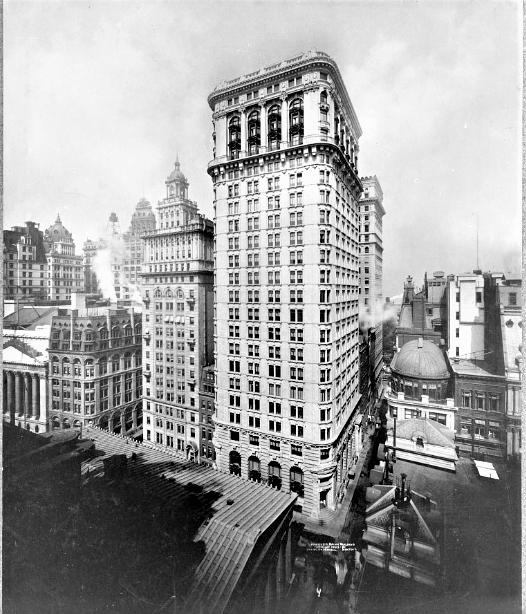
Established in 1851 as the Hanover Bank, the institution became the Hanover National Bank in 1865.  Its success continued until on July 13, 1901 the Real Estate Record & Guide reported that it intended to build a 22-story office building on the southwest corner of Nassau and Pine Streets "from plans by James B. Baker."  The Duncan Sherman & Co. building on the site, erected in 1857, would be a casualty of the coming construction.

Completed in June 1903, the soaring structure had cost $1 million to erect--more than 30 times that much by today's terms.  Baker's neo-classical office building stood head and shoulders above its neighbors.  His tripartite design included a rusticated three-story base, a 15-story midsection, and a four-story upper segment embellished with engaged columns, pedimented metal window framing, and stone balconies.  A handsome stone balustrade crowned the elaborate terminal cornice.
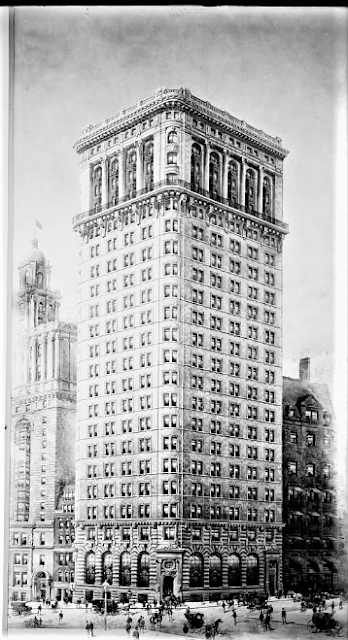
James B. Baker's 1901 rendering included foot and carriage traffic on the busy intersection.  from the collection of the Library of Congress.

Three months before the building opened the Record & Guide noted, "The Hanover National Bank Building is not filling up as rapidly as some of the others, because the high rental, which is naturally demanded for space in a building so well situated."  The rental agents, however, told the reporter they were "fully satisfied with the demand for offices."

And indeed, the upper floors filled with tenants--mostly banking and brokerage firms.  Among the early occupants were the large stock exchange brokers Moffat & White, the American Finance & Securities Co., and Spitzer & Co., bankers.
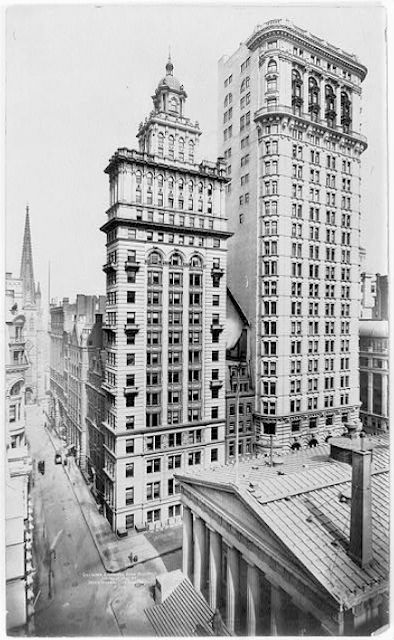
To the left of the Hanover National Bank is the 1897 Gillender Building, and at lower right is the 1842 Federal Hallfrom the collection of the Library of Congress.

Two tenants unrelated to the finance industry were the New York and New Jersey Rapid Transit Company, which took space in May 1906; and the offices of the Lunacy Commissioners, which judged the sanity of certain individuals.  

The New York and New Jersey Rapid Transit Company was formed to operate commuter railroads between Manhattan and New Jersey.  Its general manager, Malcolm R. McAdoo, explained in a letter to The Paterson Morning Call on May 29, 1908, that the large railroads had told him that "the short-haul suburban business was so much less profitable" and that they "would gladly abandon it."

In the 19th century, having a wealthy or cumbersome relative declared insane was a convenient way to get one's hands on their money, or simply to put them out of the way.  The problem was such that in 1891 the Lunacy Law Reform League was established to prevent sane victims from being committed to asylums.

A peculiar case came before the Lunacy Commissioners here in November 1906.  Valeria F. Sands had been held for 15 years "as a lunatic in the Sanford Hill Asylum at Flushing, Long Island," according to The New York Times on November 17.  The newspaper said, "Miss Sands's delusion is that she has a right to the titles of Countess of Balmoral, Duchess of Kent, Duchess of Argyll, Duchess of Orleans, Countess de Rochefouchauld, Barone von Blanc, and Infanta of Spain."

Valeria's father had made a fortune in the East India trade and she had grown up in "one of the greatest mansions ever erected in Hong-kong," according to The New York Times.   Valeria's personal fortune was estimated at about $500,000--nearly $15 million today.

An only child, she had been committed by her cousins, Mattie Robinson and Margaret Clayton.  Now the two sisters wanted Valeria released for entirely different reasons.

Mattie Robinson declared that her sister wanted Valeria in her own custody to control her fortune, which was being administered by a court-appointed guardian.  The New York Times noted, "it has been increasing in value every year."  The accusations between the warring sisters erupted during the first session when they "fought with their fists."

After cooling off, the sisters reappeared on November 16.  Mattie Robinson told the commission, "She has been kept locked up all these years for no other than mercenary reasons."  Now, half of Valeria's fortune, which was held in Scotland, was in jeopardy.  Mattie testified that the $250,000 there would revert to the Crown in three years if Valeria did not appear to claim it.  "I am going to Scotland next Spring to look after some property of my own there, and Miss Sands wants to go with me and claim her property."

A third session was held on November 23.  Mattie Robinson declined to testify this time, telling a reporter, "I would have taken the stand but Mrs. Clayton was present, and I feared she would start a fight.  She would hit me with a chair at the slightest provocation."

The case dragged on until December 3 when neither sister got the result she had hoped for.  Valeria was deemed, "incapable of taking part in any other amusement than visits to the ladies' parlor" in the asylum, as reported in The New York Times.  Dr. Charles L. Dana, saying she was "unlikely to be cured," announced "she was better in the asylum."  Dr. Jared G. Baldwin, who had been the Sands' family physician, was given custody of her fortune, with no authority over "the spending of her money beyond approving the accounts submitted by the asylum."

from the collection of the New-York Historical Society

Broker George Wheeler Meacham was another early tenant.  He nearly lost his life in the summer of 1907 when he was carried unconscious from the burning Long Beach Hotel on July 29.  He recuperated in a private hospital near Central Park.  That paled, however, to the threat he encountered in his office two months later. 

Meacham was sitting at his desk on September 20 when James Macdonald stormed in, drew a revolver, and accused Meacham of being "attentive" to his wife.  The broker insisted he did not even know Macdonald's wife.  His earlier near-tragedy turned helpful when Macdonald mentioned dates that Meacham had supposedly carried on the indiscretion with his wife.

The New York Times reported, "To prove that Macdonald was wrong in his suspicions, Meacham brought forth his diary and asked him to compare it with the dates he said Mrs. Macdonald and Meacham had been together."  He had been hospitalized throughout the entire period.  Later Meacham testified, "He then forced me, at the point of his revolver, to sign a paper to the effect that I did not know his wife, and left, saying that if he ever returned it would be with the intention of blowing my brains out."

But the signed paper did not end the frightening affair.  On November 25, a Saturday, Macdonald showed up again.  Meacham explained to a judge a few days later, "Then I decided to put a stop to the business, as it was a little out of the usual routine in a New York office to have a man coming in with a loaded gun to interview one at unexpected moments."  He had Macdonald arrested at his home on December 3.  Macdonald professed that he had returned to Meacham's office merely to apologize for his first visit.  He was locked up.

Charles Edwin Ellis was the secretary, treasurer and director of the American Finance and Securities Company until the summer of 1912.  After going on a "prospecting trip" through the South, the Far West and Canada, he "became impressed with the insincerity of mankind," wrote The New York Times on August 19.  "He would have each man sincere with himself, and sincere with others."  

And so, to devote his entire time to the cause of sincerity, he resigned his position with the American Finance and Securities Company and two other concerns.  On August 18 he sent a 3,000-word platform for the Society of Sincerists to New York newspapers.  Although his plans for attacking the problem were, admittedly, still vague, Ellis could pinpoint the source of the country's problems.  "Then let us write across the sky in letters that the whole Nation may read, and spell out as the exact cause of this individual's culpability, the one word--insincerity!"  (Ellis's Society of Sincerists was not especially long lived.)

Banking and brokerage firms were often deceived by trusted employees.  Such was the case with Kean, Taylor & Co. in 1920.  Antonio di Gregario had been hired as a messenger boy five years earlier.  By now, the 19-year-old was the head messenger and, as such, was informed ahead of time when deliveries of bonds were expected.   

On November 30, 1920, messengers Irving Cohen and Austin Young were on their way to the office of Igoe Brothers with $466,666 worth of Liberty Bonds.  They were attacked by three men.  Young said later, "One of them pressed a gun to my side and demanded the bag."  When he did not release it, he was shot.  "I put up a fight and was struck over the head...I tried to hold to the bag, but they got it away from me."

Luckily, Young was not fatally injured.  Cohen told investigators, "It looks to me as though some one had tipped them off and they lay in wait for us."  It did not take police long to focus on Antonio di Gregario.  Pressured, he confessed and identified his brother, Joseph, who had a criminal record, and Antonio Vanilla, as the hold-up men.

Another tenant to fall victim to its own employee was the brokerage firm of Potter & Company.  Charles W. Reid was an auditor for the firm.  He got himself into serious trouble when he started an extramarital affair in 1923.  "Although I am married and have a daughter four years old, I fell in love with another woman," he explained to police two years later.

The other woman wanted more than to be a mistress.  She sued for $25,000 in damages for breach of promise.  Reid later said, "Fearing that my wife would hear of my misconduct, I did not contest the suit.  That was my mistake."

Things only worsened for Reid when friends of the woman threatened to tell his wife and his employer.  (Marital infidelity at the time was grounds for dismissal.)  In order to pay his blackmailers, Reid began to embezzle funds.  "I was trusted by my employers and it was easy for me to pad the payrolls and steal from $500 to $800 a month," he confessed.  He had skimmed $4,000 before being caught in 1927--nearly $60,000 in today's money.  He insisted "Every cent of this was spend on the young woman or given to the blackmailers."  As was so often the case with embezzlers, said The Times-Union, he "blamed his downfall on a woman."
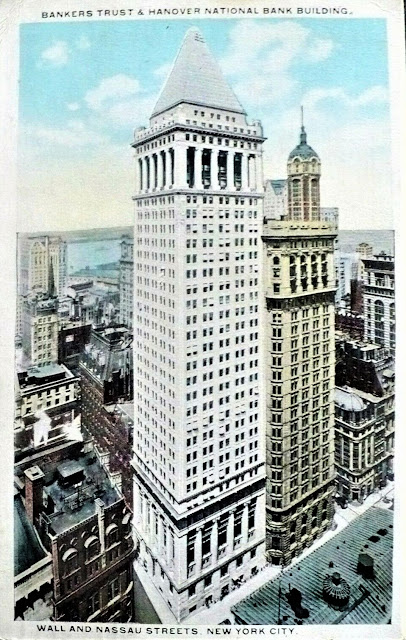
The Hanover National Bank building would fall victim to its taller next door neighbor, the Bankers Trust building.

By now the Hanover National Bank had been renamed the Central Hanover Bank.  On September 11, 1929 The New York Times reported that it had sold its Nassau Street building to the Bankers Trust Company.  "The purchase gives the Bankers Trust Company control of more than half the block," said the article.  Less than two years later, on June 19, 1931, the newspaper reported that the demolition of the 28-year-old Hanover National Bank building had begun "to make room for the new building of the Bankers Trust Company."

image via cbre.us.com

many thanks to reader Doug Wheeler for suggesting this post
LaptrinhX.com has no authorization to reuse the content of this blog

Thursday, January 25, 2018

The 1902 Caledonian Insurance Bldg - 50-52 Pine Street


In 1894 the Caledonian Insurance Company, based in Edinburgh, Scotland, established its United States Branch at Nos. 27-30 Pine Street.  According to the firm's History of a Hundred Years, 1805-1905, "Such had been the growth of the business, that arrangements were made which resulted eventually in the purchase of a valuable property at 50-52 Pine Street."

Sitting on the site was the old Mercantile Exchange Building, which had been used as the home of the Down Town Club since around 1877.   On October 24, 1899 The New York Times announced that the insurance firm "will erect immediately a twelve or fifteen story office building.   The structure will embody all modern improvements with extra high ceilings, and much space devoted to courts for light and air."  The article projected that the new building would be ready for occupancy on January 1, 1901.

When the Caledonian Insurance Company purchased the property, this building was on the site.  sketch by Pettit & Field, from the collection of the Museum of the City of New York

Something happened, however, and the deal fell through.  But the Caledonian Insurance Company kept its eye on the property and when it came up at auction in March 1901, three of the firm's trustees were in the crowd of bidders.  This time they were more successful, paying $175,000 for the old building.  The Real Estate Record & Builders' Guide reported less than a month later, on April 13, that the firm had wasted no time in hiring an architect and planning a new building.  "Plans have been drawn by James B. Baker...for a 15-sty office building to be erected on the site."

Construction took less than a year and on May 3, 1902 the Record & Guide reported that "The Caledonian Building, at 52 Pine st., containing some one hundred and thirty offices, has been fully rented with the exception of seven small rooms.  Insurance companies, brokers and lawyers are the tenants."

sketch from
History of a Hundred Years, 1805-1905 (copyright expired)

Baker's handsome stone and brick building featured a two story Beaux-Arts style base with frothy carved decorations, including two exuberantly-framed oculi over the side entrance doors.  Stately Corinithian columns upheld the entablature which proudly announced the firm's name.

The midsection was faced in buff colored brick, each story separated by a crisp cornice.  Splayed lintels with paneled keystones distinguished the openings.  Fussy decoration reappeared at the top two floors which nestled below a deeply overhanging cornice.

One major tenant which did not fall into the categories of "insurance companies, brokers and lawyers" was Tams, Lemoine & Crane, yacht brokers, and naval architects and engineers.   The firm was well-known among the nation's yachting community, selling sleek vessels to millionaires.   It had scored a coup several years earlier at the outbreak of the Spanish-American War.  The Sun reported "Tams & Lemoine supplied most of the yachts that were bought up by the Government."

Yacht architect Henry Barbey was a partner in Tams, Lemoine & Crane.  The well-to-do designer was an early automobile owner and was arrested for speeding along the west drive in Central Park in the fall of 1905.  He may have been momentarily relieved when he appeared in court on October 24 and saw that the judge was his long-time friend, Magistrate Barlow.  But there would be no partiality in this case.

"So you're here at last," said the judge.  "I thought the police would get you."  He fined his friend $5 (about $130 today).  The Evening World reported "Mr. Barbey paid the clerk and then joined the magistrate at the bench and laughed at the joke on himself."

Tams, Lemoine & Crane not only sold expensive vessels to wealthy sportsmen, it got rid of their old ones.  In 1906, for instance, the firm sold Edwin Gould's 154-foot steam-powered yacht the Aileen to the Cuban Government.

Tams, Lemoine & Crane designed and built a variety of crafts, like the houseboat shown above, and the streamlined yacht below Yachting magazine, October 1914 (copyright expired)

Ashton Lemoine never married and, despite his having made a million dollars in the stock market in one year alone, he shared rooms in a bachelor apartment on East 29th Street with two other wealthy businessmen.  On the cold evening of February 12, 1907 he dressed in evening clothes and told his roommates merely that he "was going to dine at Sherry's."  His plans were more extensive, however.

Later that night he entered the lobby of the Bijou Theatre with a woman.  He bought two orchestra seat tickets for All-of-a-Sudden Peggy.  Just as he turned away from the box office, he fell to the floor.  The Sun reported "His head struck the marble tiled floor and his opera hat bounded across the lobby."  Lemoine was dead.

When his female companion realized he was dead, she tried to bolt, but was stopped by a theater employee.  She refused to give her name and the mystery of her relationship with Lemoine and her identity seem to have never been solved.

On January 14, 1907 the Russo-Chinese Bank, headquartered in St. Petersburg, opened a branch office in New York on the second floor of the building.  The bank explained its purpose was "the furtherance of American trade with Russia and the Far East."  Three years later, its principals would be scrambling to do damage control.

The bank's agent, Gustav Gertz, left for Europe on vacation in July 1910.   Two weeks later headlines shocked newspaper readers across the country.  The Sun's headline on July 23 read "Strong Box Looted of $70,000 of Bonds / Agency of Russo-Chinese Bank in Pine Street Robbed Strangely / Manager is On a Vacation."

It was a major problem for the bank, the negotiable bonds equaling about $1.75 million today.   Spokespersons repeatedly assured the press that the bank was fully protected against loss; however The New York Times was skeptical.  'In spite of this statement," it said on July 26, "doubt was expressed that the Russo-Chinese Bank would be able to recover the stolen bonds, and Wall Street discussed this phase of the case all day."

The identify of the culprit was discovered just three days after the loss was reported.  Erwin Wider was a cashier who made $25 a week.  But while his name was now known, his whereabouts were not.  On July 27 The Times noted "At Police Headquarters it was said last night that no trace of Wider had yet been found.  Detectives have been watching his house in the Bronx."

As it turned out, Wider had been spiriting bonds for months.  The New-York Tribune reported "Wider's downfall came as a result of the allurements of Wall Street, and it was stated positively by one of his intimates last night that the missing bonds were put up as margins for speculations."

The article continued "For the last few months, it was said, he had been living high, spending freely, and riding in taxicabs instead of streetcars.  His wife, who has disappeared for the present, is said to be broken own physically from the shock of their troubles."

Surprisingly, the German-born Wider was spotted by Detectives Thomas Hughes and Louis Hyams "walking carelessly through the downtown business district," according to The Times on July 30, just a few blocks from No. 50-52 Pine Street.  He was accompanied by his lawyer, Leon B. Ginsburg and a law clerk, Alexander Henshall.  Wider had shaved his mustache and his altered appearance almost worked.

"If that fellow had a mustache he might be our man," Hughes was reported to say.  Hyams took a closer look and answered "He's Wider, all right."

Wider was arrested and held in The Tombs.  His doctor told reporters he had developed "acute suicidal mania," and his lawyer added he "was very ill, being unable to eat or retain any food."  His jail keepers disagreed.  On August 1, 1910 The New York Times reported "Keepers in the Tombs, where Wider is confined, laughed when asked about Wider's reported refusal to eat to starve himself to death.  'He eats like a longshoreman,' said Head Keeper John Hanley."

Wider had confessed to the crime, but it was not until February 1911 that he was sentenced.  The District of Columbia Alexandria Gazette reported on February 9 that he was sentenced to "14 years imprisonment."

The Caledonian Insurance Company was notified in the summer of 1914 that their handsome Corinthian columns "encroached" on public property.  The city demanded that it get is sidewalk space back.  In response, the architectural firm of Nast & Springsteen was commissioned to redesign the two lower floors.  They replaced the columns with flush piers that terminated in huge scrolled brackets.


By 1913 W. S. Barstow & Co. had its headquarters in the building.  It advertised at the time as "Consulting and Construction Engineers."  But as the years progressed, the firm would greatly diversify.   The company exhibited its patriotism in 1916 after Mexican revolutionary Pancho Villa attacked the border town of Columbus, New Mexico.  National Guard units were mobilized to find Villa and to guard the border.   On July 1, 1916 W. S. Barstow & Co. announced it would "continue the salaries of employes enlisted in the guard and hold their positions for the period of enlistment."

Tams, Lemoine & Crane were still in the building and would remain well into the 1920s.  Other tenants included attorneys Aron & Vanderveer, public accounts West & Flint, and insurance firm Alberti, Baird & Carleton, Inc.

In 1918 the National Surety Company leased the ground floor for its underwriting office.  The firm marketed itself as both "the World's Largest Surety Company" and "America's Largest Burglary Ins. Co."  That same year the investment firm of Case, Pomeroy & Co. took two floors, signing a lease totaling $75,000. 

Two years later real estate operators may have been surprised when, in March 1920, the Caledonian Insurance Company sold its building to its tenant, Alberti, Baird & Carleton, Inc.  The Caledonian Insurance now became a renter in the building it had erected as its headquarters.

In reporting on the sale, the Record & Guide called Alberti, Baird & Carleton, Inc, "one of the most prominent insurance brokerage firms in the district."  Saying that building was valued at about $1 million and had a rent roll of approximately $100,000 a year, the journal noted it "will be renamed the 'Alberti Building.'"

The new owners may have given No. 50-52 Pine Street a new name, but they allowed the Caledonian Insurance Company name to remain deeply carved into the entablature.

Among the major clients of Alberti, Baird & Carleton, Inc. was the White Star Line.  Both firms would be drawn into a world-wide controversy in 1925 when the White Star liner Homeric happened across the floundering Japanese freighter S. S. Raifuku Maru off Nova Scotia on April 21.

As that vessel slowly sank, its crew hoped for rescue by the luxury passenger ship.  Instead, all 38 members drowned.  When the Homeric steamed into New York harbor, its passengers were quick to express anger.  One, Amos R. E. Pinchot told The New York Times:

"We could see men climbing over the side of the Japanese ship.  Some were swept overboard, others tried to cling to the bottom of the overturned ship.  We could see them with our naked eyes.  People who had glasses could see them very plainly, as they were clinging to the rail.  Others--many others--drifted down to within 150 to 200 yards of the stern of our ship.  There were three or four in one group.  They gradually dropped out of sight.  We were standing still.  Almost immediately after the Japanese ship was capsized we continued on our way."

In the meantime, W. S. Barstow continued to increase his interests and his fortune.  That same year The New York Times announced "The Binghamton Light, Heat and Power Company, of which W. S. Barstow...is President, probably will be sold to the American Gas and Electric Company."

Three years later the newspaper announced that Barstow, under his Central Gas and Electric Corporation at No. 50 Pine Street would be erecting "the largest dam in cubic content in America and possibly in the World."  Located ten miles outside of Columbia, South Carolina, the project would create a lake "twice the size of Lake George, 30 miles long and fourteen wide."  Barstow told reporters the "first expenditure" would be $20 million and would provide electricity to nearly the entire state.

The building continued to house mostly brokerage, attorney and insurance firms.  In the early Depression years the brokerage company A. W. Porter & Co. was here.   Arlington W. Porter had been connected with Wilson & Co. until 1924 when that firm declared bankruptcy.

Porter was sitting at his desk on June 28, 1935 when 57-year old Joseph Sullivan barged into his office, walked over to him and said "I've been looking for you for eleven years and now I've got you."  He drew a pistol from his pocket and added, "Now, give me my money back or I'll kill you."

Porter started to stand up, but was ordered "Sit down and write out a check for $7,000.  Do it quick and I'll call everything even."  The executive apparently looked puzzled, because Sullivan continued, "You remember how you took $1,200 from me when you were with Wilson & Co. and knew all the time the house was bankrupt."

Despite having a gun pointed at his head, Porter negotiated and the two agreed on a lesser amount.  He wrote out a check for $1,500 and sent an assistant along with Sullivan to cash the check.  Immediately after they left, Porter called the police, directing them to the Continental Bank and Trust Company at No. 30 Broad Street.

Sullivan was standing in line at the teller's window when he was arrested by detectives.  At the station house his story changed.  He now said that Porter "had accepted $4,800 from him for a brokerage account when the first was in bankruptcy."  He pleaded not guilty to robbery and Sullivan Law (gun possession) charges.   Following his indictment by a grand jury, the judge ordered him taken to the psychiatric ward of Bellevue Hospital "for observation as to his sanity."

A colorful occupant of No. 50-52 at the time was mining engineer and promoter Charles V. Bob.   The millionaire had paid $108,000 towards Byrd's 1928 expedition to the Antarctic, resulting in a mountain range being named after him.   But his reputation became tarnished when he was tried in 1931 on charges that he defrauded the public in selling stock of Metal and Mining Shares, Inc., and Mineral Research Corporation, which failed after the Stock Market Crash with losses of $6 million.

That trial ended in a hung jury, as did the second in 1932 and the third in 1935.  After that trial, he demanded a Congressional investigation, saying he was being persecuted.   The U.S. Attorney's office dismissed the old indictment.  But he would not be out of hot water for long.

In May 1938 he was charged with new fraud charges.  On February 3, 1939 he was found guilty of five mail fraud counts and one of conspiracy and sentenced to five five-year sentences for the mail fraud and two years on the conspiracy count.

The indictment had said in part, "In furtherance of the fraud, the defendants operated 'boiler rooms' at 50 Pine Street."  The term "boiler room" referred to the sale of fake investments by telephone.

In the mid 1940s the building was purchased by the city.  Among the departments housed there was the office of the Investigation Commissioner.  John M. Murtagh was tasked with digging into a wide range of issues associated with possible government corruption.

In the summer of 1947, for instance, he delved into the possible collusion between Idelwild Airport officials and the Gulf Oil Corporation.  That same year he looked into gambling on Wall Street, parking bribes taken by policemen, questionable pier leases, police graft in Queens and the racketeering in the sale of fuel oil and kerosene during "storm distress."

A major investigation in 1948 involved the city's milk purchases.  The suspicion was that members of the La Guardia administration had conspired to fix prices with major dairies.  And in 1949 he took on a potentially dangerous adversary--the mafia and the longshoremen.  On May 4, 1949 he characterized dock workers as "mysterious."  He promised that his investigation was "the first step in eliminating irregularities and racketeering."

Murtagh's wide-spread investigations went so far as to include ticket scalping for the hit Broadway plays South Pacific and Kiss Me Kate in 1949.

The Red Scare of the 1950s and '60s showed up at city level in 1964 when the Department of Investigation, now under Commissioner Leon A. Fischel, subpoenaed members of the Mobilization for Youth to testify before its investigation of Communist infiltration.   Three of the seven refused to appear, sending letters instead that said the Mobilization for Youth was "beyond the jurisdiction of the Department of Investigation of the city" and added that the information sought was "irrelevant to the interests of the city."

Fischel fired back in asking the State Supreme Court to issue a show-cause order.  "This is no witch hunt.  I don't want to accuse people unfairly, but we'll keep subpoenaing until we get results."

After it sat vacant for six months, the city sold No. 50-52 Pine Street on November 10, 1966.  It was purchased by the Sylvan Lawrence Company for $500,000.    The firm announced it would "modernize the building, rent the office space, and hold the property as an investment."


Major change came in 1998 when a conversion of the upper floors to residential space was initiated.  Today there are two apartments per floor.   A franchise doughnut shop operates from the ground floor once home to insurance brokers.  Sadly the exquisite foliate carvings over one of the doors and surrounding its round window were for some reason stripped off at some point.

photographs by the author

Thursday, January 11, 2018

The 1890 Sun Fire Insurance Building - 54 Pine Street


Architect Arthur D. Pickering, whose offices were at No. 105 Fifth Avenue, enjoyed a varied practice in the 1880s and '90s.  His commissions ranged from luxurious country homes, to hotels and commercial buildings.  In 1889 he was hired by the London-based Sun Fire Insurance Company to design its new New York City offices.

Established in 1710 the firm was the second oldest fire insurance corporation in the world.  (A representative dismissed the second-place designation, noting in 1890 "As a corporation doing a purely fire insurance business it is, however, the oldest, as well as one of the richest.")  The firm had branched into New York City in 1882 and by now had 1,500 agents across the United States.  Now it looked to replace its old building at No. 54 Pine Street with a modern headquarters.

On June 7, 1889 Pickering filed the plans.  Three weeks later the Record & Guide noted the 27-foot wide building would be "constructed of Jonesborough granite and light-colored Baltimore brick."  The interiors, said the article would be of "marble and hardwoods" and there would be one elevator.

At a time when large buildings were thrown up within months, the Record & Guide seems to have been a bit impatient with the progress three months later.  "The five-story building now being erected at No. 54 Pine street, for the Sun Fire Office, of London, is not far advanced as yet.  The first floor iron beams are laid, and the side and rear walls are up to about the third story."

Construction was completed in May 1890 and the trade journal apparently felt it was worth the wait.  On May 10 the trade journal said "Indeed, it is safe to say that this building is one of the handsomest of its kind in the city."   Despite having just five floors, it was a pricey project, costing $160,000 with the land--just over $4 million today.

Pickering produced an eye-catching Queen Anne-style structure with no lack of visually interesting details.  Bands of stone contrasted with the Roman brick at the second floor, creating a striped effect.  The openings on this level were given egg-and-dart ornamented terra cotta frames.

A projecting cornice introduced the third and fourth floors where the openings were unified by a pair of complex Greek key terra cotta enframements.    Spandrel panels depicted sunbursts with faces, a nod to the name of the insurance company.  The top floor openings were grouped together within elaborate terra cotta frames.

The ground floor had little (or nothing) in common with the upper portion.  Real Estate Record & Builders' Guide, May 24, 1890 (copyright expired)
Given the up-to-the-minute design of the upper stories, the ground floor was surprising.  The granite piers and entablature echoed the Greek Revival storefronts that had peppered the neighborhood decades earlier  The arched openings, as well, were holdovers from a generation earlier.

The Record & Guide said that much of the high cost of construction was "due to the quality of granite, marble, hardwoods and other embellishments used in the interior.  It pointed out "The flooring and wainscoting are of marble, and this is carried through the entire building.  Each floor is in hardwood trim, oak and quartered oak being used.  There are mantels, mirrors and fireplaces in the private offices of each suite, and all the necessary accommodations for an office building of a fire-class character have been provided, including an elevator, steam heat, electric gas lighting, sanitary plumbing, etc."

Nearly cartoonish sun faces symbolized the firm's name.

By the time the doors opened, the building was fully rented.  The basement through second floor were the Sun Fire Insurance offices; the third floor was taken up by the Transatlantic Insurance Company of Germany; the fourth was leased to insurance broker Frederick H. Parson; and the top floor to Joseph S. Spinney, a merchant who did significant business shipping goods to California.

Sun Fire Insurance would not be in the building long before it was one agent short.  In 1886 the 21-year old Charles Ackerman was hired for $5 a week.  The job, a company spokesperson later divulged, "was procured for him through the influence of H. M. Flagler."  Henry M. Flagler was, of course, a multi-millionaire partner in the Standard Oil Company.

Ackerman was more interested in enjoying a genteel lifestyle than in working.  The Sun later noted "He lived well and dressed well.  His commissioners were very small."  Describing him as "a tall, good looking young fellow," the newspaper said that he began courting "a young lady of good family" in Brooklyn, whom he married in 1890.

Ackerman's Sun Insurance manager, named Renshaw, told the reporter "during his courtship Ackerman gave his fiancee expensive presents, and his friends wondered where the money came from."  Everyone involved would find out when the firm's secretary, John J. Purcell, sent a letter to a policy holder in New Jersey asking why he was behind in his premiums.

The man appeared at No. 54 Pine Street with a receipt for $50 signed by Ackerman.  He then headed off for Ackerman's house in Brooklyn.  He waited there eight hours until the agent showed up.  Ackerman explained that it was all a huge mistake and that the man's money would be refunded the following day.

The Sun Fire Insurance Company would soon be looking for a replacement agent.  The Sun reported on October 21, 1891 that, indeed, he did pay back the $50; "but things were becoming very warm for him, and he departed to Chicago, leaving his young wife behind him.  This was six months ago."

Despite the size and wealth of the Sun Fire Insurance Company, its mangers showed their human side in 1894 when the firm was the victim of forgery.   After the perpetrator was caught, the circumstances surrounding the crime melted the hearts of the executives.

James E. Cowan had been working as a bookkeeper at the Norwich Fire Insurance Company nearby at No. 59 Wall Street.  But like so many other low-level workers, the Financial Panic of 1893 cost him his job in August that year and he could not find another.

He had just enough money to pay the $8 rent on the one-room apartment on West 133rd Street that he shared with his wife and 18-month old baby.  But he had nothing left for food or rent.

He forged a $40 check with the signature of  John C. Alten and went to the Sun Fire Insurance offices, saying he was the agent of Alten, who wished to insure two houses.  He received a $12 commission for the deal.  When Alten received the policy, the scam was uncovered.

Cowan was arrested and he confessed.  On October 13, 1894 The Sun reported, "Cowan, who is only 35 years old, but looks fully 50, wept as he stood at the bar."  The Evening World added "he told how he had committed the crime to get money to buy food for his wife and little girl, who were literally starving.  He had been out of work for a long time, and although brought up as a gentleman, he could not see his loved ones suffering for food."

In light of the several letters sent by officials of the Sun Fire Insurance Company "begging for clemency," Judge Cowing suspended sentence.

The firm was not so understanding when it came to George W. Holt, one of its fire insurance adjusters.   The city had been plagued with a rash of commercial fires in 1894 and early 1895.  In what seemed a remarkable coincidence, most of the cases were handled by Holt.

The disbelief on co-workers faces can only be imagined when police walked into the Sun Fire Insurance offices on June 22, 1895 and arrested Holt for arson and conspiracy to defraud.  Detective work had discovered that he was involved with a ring of "fire bugs" that included Policeman Charles H. Lenz.  The group would conspire with businessmen to burn their buildings, then divvy up the insurance settlements.


On October 16 The Sun noted that "There are seven persons charged with arson and said to be members of various firebug gangs awaiting trial now."  Among them was George W. Holt, who the newspaper said "is alleged to have made a fortune out of the business."

While Holt lost his job, he did not lose his freedom.  He was released when the jury was deadlocked for "lack of evidence."  Amazingly, he obtained a job in the New York office of the Fire Association Insurance Company of Philadelphia and immediately returned to his old ways.

On May 19, 1896, not a full year after his initial arrest, he was arrested along with Henry Vaughan and charged "with the presentation of false and fraudulent proof of loss with intent to defraud."  The New-York Tribune reported "The fire which they are alleged to have started was in the frame building owned by Max Gluckman, at No. 175 South Eighth-st.  The house was worth $1,200.  Hold was the representative of the fire insurance company."

Although the district attorney "strenuously contended that the defendants were guilty;" Judge Hurd dismissed the case in the County Court on January 6, 1897, saying it could not be proven.  The judge may have regretted his decision when three months later Holt was indicted "as an accessory after the fact to the crime of arson," according to The Sun on March 12.


Another tenant at No. 45 Pine to see the wrong side of jail bars was attorney Marshall R. Van Nostrand.  Following the death of one of his clients, Benjamin Pickman, on June 4, 1893, the administration of his $94,479 trust fund passed to Van Nostrand.  This gave him, according to The Evening Times of Washington D. C. years later, the "power to dispose of the principal by will."

Van Nostrand served as the legal adviser to the deceased man's widow, Sarah O. G. Pickman.  She became suspicious five years later and closely looked at the books.   She was displeased with what she found.

According to The Evening Times, "She asserts that he was to pay certain bequests in accordance with the will, and to invest the remainder for her benefit.  She acknowledges having received $82,494 from the lawyer, but says he has not accounted for $11,910."

The missing money would equal about a third of a million dollars today.  She filed suit for $18,070 and had Van Nostrand arrested.  The lawyer proclaimed his innocence and attributed the missing funds to "a claim against her for professional services, which, if settled, would clear the matter."

Another attorney in the building at the same time was Neville Castle, whose story outdid Van Nostrand's for drama.   Castle was doing a good business when he married San Francisco actress Mary Scott in 1899, whom The Hawaiian Star newspaper said "was regarded as the most beautiful woman on the Pacific Coast."

The bride moved to New York following the wedding and made her debut in The Princess and the Butterfly.  The New York Times mentioned, "in the role of Fay Zuliani, a debutante, Mary Scott, in private life Mrs. Neville Castle...seems to have made a note-worthy hit."

But while Mary's professional fortunes seemed bright, her husband's were not.   In 1900 his business failed.  Leaving his actress wife behind, he forged off to join the Alaskan gold rush.  On April 1, 1901 The Hawaiian Star reported "until a year ago [he] had offices at 45 Pine street.  He then lost his money, and hoping to regain his fortune, went to the Klondike."

Mary continued her stage career, while living at No. 220 West 45th Street.   In March 1901 a cousin, Mrs. Frank Goodwin, who lived at No. 467 Central Park West, gave a dinner in her honor.  Afterward Mary was supposed to attend rehearsals, but she complained of feeling ill and left for home.

She did not show up there and days later was still missing.  Newspapers nationwide reported on the search and suggested suicide.  Another cousin, Crocker Goodwin, who had been at the dinner, told reporters "In my opinion Mrs. Castle has made away with herself" and refereed a letter Mary had recently written to his wife that said "The game is not worth the candle, for the strain has absolutely worn me out."  Another cousin, Lawrence Griffith had spent two full days searching for her.  He added "She was too ambitious to be happy.  She simply wore herself out."

In fact, it may have all been a well thought out publicity scheme.  A few months later, on July 28, The Times reported "The feature at Keith's next week will be Miss Mary Scott, (Mrs. Neville Castle), who will make her first appearance in New York in vaudeville.  Miss Scott claims relationship with the late ex-President Benjamin Harrison."  No mention was made of the earlier incident.

In an interesting side note, eight years later Mary was arrested in the Waldorf-Astoria after she shot her lawyer William L. Craig in the main hallway there.  Rumors had already swirled that the two were carrying on an affair.  But she insisted that "she was not divorced nor legally separated from her husband, and that neither he nor she had any cause for divorce.  She said he was 'a Yale man and a gentleman,'" reported The Times.

Despite that, the couple was divorced within the year.

In the meantime, The Sun Fire Insurance Company had commissioned architect Richard K. Mosley in 1904 to "take out and rebuild [the] front wall" and to do interior renovations, including "re-arrange elevators."  While two of the hefty granite pilasters remained, the two openings were replaced by a yawning arch that engulfed a centered window flanked by two entrances, one to the upper floors and the other to the insurance offices.  Carved decorations in the spandrels of the arches depicted crossed burning torches--symbols of fire departments and related companies--under a heraldic shield.  An incised sunburst, symbolizing the Sun Fire Insurance company provided the background.

The corner carvings depict torches, symbols of the fire department, on a sunburst background.
One tenant in the pre-World War I years who was not involved in the legal or insurance industries was Harper Gallagher, a jewelry dealer.  He became the victim of a thug on his way home on the night of August 14, 1913 while riding on the Broadway streetcar.

Around 20th Street he felt a hand reaching for his wallet.  He grabbed the wrist of the middle-aged man sitting next to him, who pulled out what appeared to be a black-jack.  The New York Times reported "Whatever it was it landed on Gallagher's head with sufficient force to knock him from the car."

Gallagher's problems were not over by far.  As he began to get to his feet, he was struck by a north-bound street car and knocked to the gutter.  He was so battered that he was taken to the New York Hospital.  Detectives launched an investigation "to find out how the assault on the open trolley car had escaped notice."

After half a century at No 54 Pine Street and 30 years in the Pickering-designed building, in May 1920 the Sun Fire Insurance Company leased space at No. 56 John Street.   Three years later it transferred title to No. 54 Pine to real estate operator Frederick Brown.

Then, on May 1, 1926 The New York Times reported that A. G. Becker & Co. have moved their office to their own building at 54 Pine Street."   Prior to moving in, the firm had commissioned architect Lester Kintzing to remodel the interiors to "banking offices," as described in his plans.  The minor alteration to the facade was the inclusion of bronze lettering above the first floor entablature which announced the firm's name.

The Chicago-based brokerage firm filled all five floors and did business here until 1955 when it sold the property to Simon Mogeloff and the Interboro Realty Company.  A. G. Becker & Co. moved to No. 60 Broadway in December that year and the new owners renovated No. 54 to house a restaurant on the ground floor and mezzanine, with offices above.  For some reason, the bronze lettering over the new restaurant's window were preserved.


In 2000 a three-year renovation resulted in one apartment on each of the upper floors.  A restaurant is still housed at ground level.  Arthur D. Pickering's striking 1890 building is overshadowed by its soaring skyscraper neighbors.  It is nonetheless a delightful surprise on the narrow little street.

photographs by the author