Showing posts with label harry allan jacobs. Show all posts

Friday, October 1, 2021

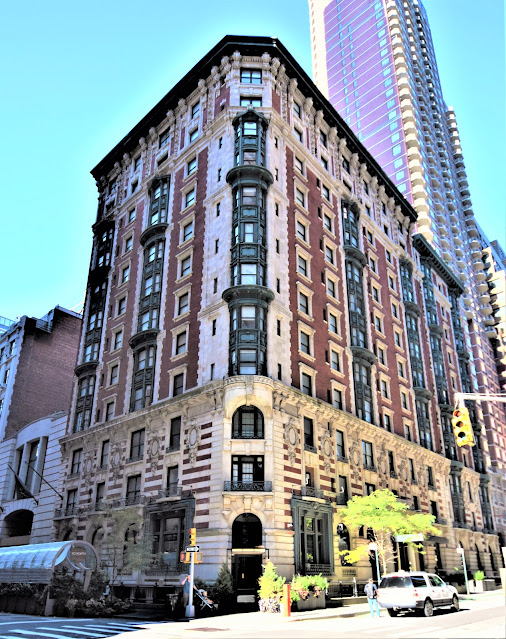
The 1904 Hotel Seville (The NoMad) - Madison Avenue and 29th Street


At the turn of the last century the neighborhood north of Madison Square saw the rise of several lavish Beaux Arts style residence hotels.  In 1901 ground was broken for the Hotel Seville, intended to equal or surpass its rivals.  Then, two years into the project, things ground to a halt when the developer ran out of cash.

The property was sold at foreclosure in the fall of 1903 for $489,000--a staggering $14.9 million today.  The Real Estate Record & Guide reported, "it was estimated at the time that it would cost about $150,000 to complete it."  That would add another $4.5 million in today's money to the total outlay.  Construction resumed, but infighting among the newly-formed syndicate, the Twenty-two East Twenty-ninth Street Company, became unworkable.

On January 9, 1904 the Record & Guide reported that two members of the firm, attorneys Louis C. Raegener and Harold Binney, had bought out their partners.  The men promised, "The hotel will be opened in the near future."

Designed by Harry Allan Jacobs, the 13-story brick-and-stone structure would be adorned with frothy French decoration.  Jacobs gave the red brick, seven-story mid-section added dimension and color with bowed metal bays.  The chamfered corner provided sweeping views from the upper rooms and from the first floor main dining room.  The entrance, centered on the 29th Street elevation, sat within a dignified, columned portico.

photo by Wurts Bros from the collection of the Museum of the City of New York

The Hotel Seville catered to both transient and permanent residents.  Its upscale accommodations and relative proximity to the 23rd Street theater district prompted the world-famous London actress Mrs. Patrick Campbell to check in shortly after the doors opened.  She was best known for her roles in plays by James Barrie, George Bernard Shaw and William Shakespeare.

Mrs. Patrick Campbell from the collection of the University of Washington, special collections

The "Marian's Chat" column of The Morning Telegraph on September 19, 1904 reported somewhat cattily: 

Mrs. Pat Campbell is here.  Yes, with her gowns, her maid, her accent, and her daughter.  They are all stopping at the Seville Hotel, a select hostelry, done in pale yellow, on Madison avenue.  Mrs. Pat is so fatigued by her trip, has so many trunks to unpack, is so busy unpacking them, is so anything else you can think of, that I suggest we all bury ourselves in tanbark, and be quiet.

Mrs. Campbell may have thought twice about stopping at the Seville had she been aware of an incident a week earlier.  On September 10 The Evening World had reported, "Another of the jewel robbers in the hotels of the 'Tenderloin' that have become so frequent of late was revealed to-day in the Jefferson Market Court."  George Potter had been arrested and charged with grand larceny.  Potter, who worked as a hallboy in the Hotel Seville, was accused of robbing a permanent resident, Mrs. Arthur Paton.

Glass panels installed across the portico prevent drafts inside during the cool months in this photo taken around 1917.  from the collection of the New-York Historical Society

The Evening World explained, "Mrs. Paton, who is an invalid, said that she lay down for a nap yesterday afternoon, and the last person she saw was Potter, who had carried a glass of lemonade to her room."  Mrs. Paton had secreted a sealskin bag with her jewelry under a pillow.  She drifted off to sleep and when she awoke discovered it was missing.  She notified the manager who was told that Potter had left the hotel.  He had made off with nearly $40,000 in gems in today's money.

The New-York Tribune pictures the marble-lined lobby (above) and the Tudor ceilinged dining room on May 18, 1905 (copyright expired)

In March 1905 Mary Gallaway took a three-room suite, "one of the finest in the hotel," according to the New-York Tribune.  She was accompanied by a full-time attendant, Margaret Withers.  Mary's decision to move into the Seville was a complicated one.

The 27-year-old was the only daughter of millionaire Robert M. Gallaway.  He was president of the Merchants' National Bank , president of the New-York Mutual Gas Light Company, and a director of several railroads.  The Evening World described Mary as "thin and delicate and suffer[ing] from a complication of complaints that had superinduced neurasthenia."  The condition resulted in extreme fatigue, anxiety, and depression.

Mary's mother, a "dominant, forceful woman," according to The Evening World, was suffering from heart problems.  "The daughter, so nervous that the least disturbance or untoward happening threw her into the boarders of hysteria, discovered that her condition was detrimental to the state of health of her mother," said the newspaper.

It was decided that by moving Mary out of the house the chances of recovery for both would be improved.  Mary spent most of her time here in bed, attended to by the family doctor.  When she did venture out, Margaret Gallagher accompanied her.

Two weeks after she move in, at 5:30 on the afternoon of April 9, 1905, Dr. Ellsworth Eliot, Jr., arrived for his usual visit.  Notified by the front desk that he was there, Margaret informed Mary.  Mary asked her to get a dress from the wardrobe, and as Margaret turned her back to retrieve it, she heard a pistol shot.  She swirled around to see Mary on the bed with blood streaming from her mouth.

Dr. Eliot later told reporters, "the only explanation I can give for her shooting herself is that she became tired of living the life of an invalid and decided to make way with herself."  Now there was the additional matter of her mother.  He called the Gallaway house, but Robert was not home.   After telling the butler what had happened, he "told him not to breathe a hint of it to Mrs. Gallway, not even to tell her that he had called up the house, but to go at once in search of Mr. Gallaway," said The Evening World.

The success of the Hotel Seville was such that only a year after it opened, Louis C. Raegner purchased the property next door on East 29th Street running through the block to East 28th Street as the site of an annex.  On December 9, 1905 the Record & Guide reported he had hired architect Charles P. Mott to design the 10-story addition.  "The new part in design will harmonize in exterior and interior with the old part," said the article.

Indeed it did.  Although noticeably shorter, the annex melded nearly seamlessly with the original structure.  The addition doubled the size of the hotel, with an additional 21 rooms and 19 bathrooms per floor.

The slightly shorter annex is seen in a vintage postcard.

The Hotel Seville was now among the largest hotels in the city with a total of 400 rooms and 300 baths.  Upon completion of the addition, the New-York Tribune reported on September 15, 1907, "The entire first floor, on which are the office, foyer, restaurant, ladies' parlor and palm garden, is wainscotted in Siena marble.  The ladies' parlor is finished in white and gold."

The 1907 addition extends through the block to East 28th Street.

The affluent residents of the Hotel Seville were not accustomed to the presence of police, of shouting in the hallways, or the beating on doors.  But on March 11, 1908 The Evening World reported that detectives and Post-Office inspectors "kept the usually quiet and exclusive Seville in an uproar last night."

Frances McLean and her husband, Thomas O'Connor, had been charged with using the United States mail "to further a swindling scheme manipulated from Wall Street," according to the newspaper.  That evening officials arrived at their seventh-floor suite to arrest them.  The couple would not go quietly.

From behind their locked door, according to The Evening World, "'Have you a warrant?' asked Miss McLean, in a shrill, angry voice."

"No, we have not.  But there are warrants out for both of you."

The newspaper reported O'Connor yelled back, "You go to hell and get that warrant.  I defy you to arrest either of us."

While a messenger rushed to obtain the warrants, police scaled the fire escapes to prevent escape.  The siege continued until 2 a.m. when, with warrants in hand, Marshall Henkel beat loudly on the door, yelling "Open! Or I shall break down the door."

The door opened.  The Evening World said, "the woman, fully dressed for the street, and smiling blandly, stood before the inspectors and detective.  She was followed by O'Connor."

The article concluded, "The halls of the hotel were crowded with guests who had been aroused by the disturbance.  The prisoners passed through the crowd, still smiling and apparently amused.  They were taken to the Tombs."

Rates for transient rooms ranged from $2 to $6 per day in 1910.  That would translate to around $170 a night for the most expensive accommodations today.

In the fall of 1911 John J. McCarthy came to New York on business and brought his wife, Frances along.  They checked into the Hotel Seville.  The New-York Tribune described McCarthy as "one of Holyoke's wealthiest residents" and said the couple "are socially prominent in Massachusetts."  

On September 27, while her husband conducted business downtown, Frances went shopping on Sixth Avenue.  In one emporium, she caught the attention of store detective John J. McCarthy.  To avoid her notice, he watched her in the reflection of a mirror with his back turned.  The New-York Tribune reported, "He trailed and watched her go about the store, up stairs and down.  Finally, he alleges, he saw her carefully roll up a waist and slip it into her blouse jacket and then go to the women's waiting room, and then out of the store."

He seized her on the sidewalk.  As it turned out, the blouse was not the only item she had taken.  She also had "corset covers, a waist, lingerie and the like--in all amounting in value to $21," said the newspaper.  Frances broke into tears, pleading to be let go and saying she did not know why she did it.

Instead, she was arrested.  The manager of the Hotel Seville, Edward Purchas, appeared in court, provided bail, and took Frances back to the hotel.  Reporters followed and were in the lobby when John McCarthy returned.  He had apparently been notified of the incident ahead of time.

"It is all a mistake, it is all a mistake," he said as he pushed through the reporters, "and it has been practically admitted.  I have nothing else to say."  

One can imagine he had much more to say to his wife when he reached their rooms.

Guests paid as much at $10 per night for a parlor, bedroom and bath in 1915.  New-York Tribune, May 23, 1915 (copyright expired)

Advocates lauded the enactment of Prohibition as the removal of the scourge of alcohol from society.  But officials soon found that it was being replaced by a far deadlier substitute--drugs.  A sedative called veronal become popular within months of the new law.

By October 10, 1920 the New York Herald reported that an investigation by the Department of Health, "already shows that the drug is being used extensively by persons who formerly found exhilaration in alcohol."  The article said, "This latest phase of the peril of drug addiction which threatens every community came to light only a few days ago through the death of a young woman at the Hotel Seville from an overdose of this sleep inducing agent."  

In the early 1960's the Seville Galleries occupied space in the ground floor on 29th Street.  On May 10, 1964 The New York Times reported on an auction held there of "Persian, Chinese and other oriental rugs, including some rare examples."


But things were declining in the aging hotel.  On September 20, 1971 narcotics detectives raided a room and arrested four men for possession of heroin and amphetamines.  And on October 6, 1975 the Herald Stateman reported that resident Thomas Keough had been arrested on charges of passing counterfeit travelers checks.  The article said that Keough, who had at least 12 different aliases, "had a prior record of convictions for forgery, robbery, burglary, narcotics violations and other crimes."

In 1980 police were dealing with a series of brutal murders of prostitutes whose bodies were subsequently mutilated--the heads and hands severed.  On May 15 firefighters responded to a fire in a room in the Hotel Seville.  Inside they found the body of Jean Reyner a "high-class prostitute" who normally operated from far classier hotels.  In addition to evidence of bondage and torture, her breasts had been removed and displayed on the bed's headboard.

Rather surprisingly, given the recent history, in 1985 New York University rented 350 rooms on the top floors as additional dormitory space for freshmen and transfer students.

Change came in 2000 when a $60 million restoration began that would result in the Hotel Carlton.  Five years later John Holusha, writing in The New York Times, reported that after an eight-month restoration, the stained glass dome in the bar (the former café) had been completed.  "The layers of tobacco tar and dirt were so thick that the dome appeared to have been painted black," he said.  "In fact, the glass held a cornucopia, its contents depicted in bright colors."

A three-story addition on Madison Avenue was part of the renovation.  The new entrance on Madison Avenue opened into a new lobby with a waterfall.  On November 11, 2007 The New York Times journalist Frank Bruni wrote, "The presence of Country, owned and run by the chef Geoffrey Zakarian, is a big point in the Carlton's favor."  The reputation the hotel enjoyed in the Edwardian era had been restored.  Bruni added, "the Carlton gives a much greater sense of luxury than a Sheraton, say at a similar price."


Today it is NoMad, operated by The James Hotels.  And while nearly nothing survives of the early 20th century interiors, outside the ebullient Beaux Arts design is wonderfully intact.

photographs by the author
LaptrinhX.com has no authorization to reuse the content of this blog

Thursday, August 5, 2021

The Frederick W. White House - 20 East 64th Street


On November 17, 1879 brothers David and John Jardine advertised one of their pair of newly build residences:

For Sale--The elegant four-story full-wide bay-front brown-stone house, No. 20 East 64th-st.; just completed, designed and built by the undersigned in the most careful and complete manner.  Can be seen any day.  D. & J. Jardine, Architects

The 25-foot-wide, high-stooped house was sold to Henry Belden, Jr. and his wife, Clara.  Oddly, the Beldens had a proclivity for moving.   In the two years since 1877 they had lived in Brooklyn, on East 47th Street, on  West 45th Street, and at 18 West 38th Street--sometimes staying only for a matter of months.  Their habits did not change with the purchase of 20 East 64th Street.

In 1880 the Beldens moved to Irvington, New York and sold the 64th Street house to Franciso Bianchi and his wife Elizabeth for $80,000--around $2 million today.  Bianchi was a millinery merchant as well as an officer in the Eighth Avenue Railroad.  

Tragically, the family were in their new home only a few months before the drawing room was the scene of a funeral.  The Bianchi's son, Theodore, was about 11 years old when he died on September 5, 1880.

There would be another funeral in the house three years later.  Living with the family was Joanna Willis, the elderly widow of William Willis and presumably Elizabeth's mother.  She died on July 19, 1883 at the age of 81.  Her funeral was held in the drawing room the following day.

The Bianchis sold the house in October 1898 "for about $80,000," according to The Sun (interestingly, that was exactly what Francisco had paid for it 18 years earlier).  The buyers were Henry P. Goldschmidt and his wife, the former Georgette Woodleaf.

Born at Frankfort-on-the-Main in 1843, Goldschmidt was a banker.  He had come to New York in 1866 to work with the German banking house of Ballin & Sander.  He was now the head of the banking firm of H. P. Goldschmidt & Co.

He and Georgette maintained a "handsome villa in South Elberon, New Jersey," as described by George von Skal in his 1910 History of German Immigration in the United States.

On February 18, 1920 Goldschmidt sold the outdated brownstone to Frederick M. White.  Before he and his wife, the former Pansy B . Belwin, moved in, they hired architect Harry Allan Jacobs to transform it to a modern mansion in keeping with the neighborhood.  (The New York Evening Post commented that Jacobs "has planned some of the finest residences in New York.)

Jacobs stripped off the brownstone façade and removed the stoop.  A new marble front was erected at the property line.  Completed in 1921, the chaste neo-French Renaissance residence featured little ornamentation.  The main and service entrances at street level were nearly undistinguishable, their concave frames delicately carved with Renaissance style decorations.

Similar carvings embellished the arched openings of the second story.  The fourth floor sat above a projecting band.  Here intricately carved panels flanked the openings.  The windows of the tiled mansard, interestingly, were recessed within the roof, rather than taking the form of more expected dormers.


White was president of Peters, White & Company, president of the Mapes Company, and vice-president of the Mutual Chemical Company of America.  He and Pansy had been married since 1909.  His many social clubs included the New York Athletic, the Bankers Club, the Oakland Golf Club and the New York Club.

Perhaps unexpectedly, after spending $40,000 in renovating their house--in the neighborhood of $738,000 today--the Whites sold it in May 1927 to J. Clark Dulany and his wife, Belle Bart.    

The Dulanys were a colorful couple.  They established the American Academy of Astrology in the house upon moving in.  They and their operation quickly raised eyebrows--both social and legal.

On May 9, 1928 the Daily News reported, "At Belle Bart's fashionable astrology parlor at 20 East 64th st., you may learn what the stars have to do with your most private affairs.  But Edmund E. Frisch, jeweler of 576 5th ave., who is trying to find out what has become of a diamond brooch he values at $12,500, is not so sure the revelations are authentic."

Frisch had met the Dulanys in August 1927 in Lucerne, Switzerland.  They asked him to drop by the 64th Street mansion in December with a selection of jewelry from which to choose.  The  couple picked out the brooch as well as a diamond-studded bracelet with a $350,000 price tag in today's money.  They asked Frisch to leave the pieces so they could have them independently appraised.

Five months later Frisch had received neither payment nor the jewelry.  In May 1928 the bracelet was discovered in a pawn shop.  It was being held by the sheriff when, within days, the Dulanys appeared before State Supreme Court Justice Thomas C. T. Crain "to explain...why they shouldn't produce the brooch and also have the sheriff return the bracelet to Frisch."

On May 25 The New York Times reported that on the stand Belle said she was wearing the brooch one day in April, "and later in the day discovered it was missing."  The article added, "A search of the house failed to reveal it, she said."

This was (so far) the third time the Dulanys had been in legal trouble that year.   In February they had defended themselves against a law suit filed by George A. Devoe for default in a $20,000 loan made to the Academy.  And in reporting on the Frisch case, The New York Times noted, "Mrs. Dulany was mentioned last week in the replevin suit by the Federal Insurance Company to recover an $18,000 diamond ring alleged to have been lost by Mrs. Frederick W. Trabold, in which it was said the ring came into Mrs. Dulany's possession."  The ring had been pawned for $8,000.

Then, on August 24 that same year The Yonkers Statesman reported that George A. Devoe had been arrested for embezzling $325,000 from the New Jersey Fidelity and Plate Glass Insurance Company.  The complaint alleged that he shared the proceeds "with Mrs. Barton Delaney [sic], known also as 'Belle Bart,' an astrologist and her husband J. Clark Delaney [sic], 20 East 64th Street."

The Delany's left 20 East 64th Street in 1931 (they filed for personal bankruptcy in 1932).  The new owner, Roy Wilson Howard, had architect F. Albert Hunt make interior alterations to the 22-room mansion.  

Howard was chairman of the board of the Scripps Howard newspapers.   Living with Howard and his wife, the former Margaret Rohe, were their son, Jack, and Margaret's unmarried sister, Alice.

Roy Wilson Howard from the collection of the Library of Congress

Howard was a self-made man, having been born in Gano, Ohio on New Year's Day 1883 to a railroad brakeman and his wife.  Following his father's death, he was forced to drop out of school and help with the family's finances.  He found a job with the Indianapolis News and went on to a career in journalism.

Alice Rohe was as fascinating as her brother-in-law.  In 1914 she had served as bureau chief in Rome for the United Press.  She was the first female to hold such a position with an international press organization.  She was, as well, the first women to interview Italian Fascist leader Benito Mussolini.  When World War I broke out, she served with the Red Cross in the Balkans.

Alice Rohe from the collection of the Library of Congress

Alice died on April 7, 1957 at the age of 81.  She bequeathed an impressive collection of Etruscan antiquities to the University of Kansas.

Roy Wilson Howard died on November 20, 1964.  After various owners it was purchased by Irish-born real estate investor Derek M. Quinlan in 2005 for $26.25 million.   He listed it in 2009 for $37 million after the real estate market had plummeted the previous year.  He finally sold it in August 2011  to Gregg Hymowitz for $3.25 million less than he had paid for it.


Hymowitz, a co-founder of EnTrust Capital Funds, immediately began renovations--some of which did not please the locals.  By June 2015 he faced two lawsuits from neighbors who claimed their residences were being damaged by his construction.  The owners of 22 East 64th Street alleged their foundations had been damaged by Hymowitz's "attempt to build a below-ground bowling alley," according to Curbed New York.  They sued for $5 million.

Despite any interior remodeling, the exterior remains precisely as it looked when Harry Allen Jacobs gave it a sensational make-over in 1921.

photographs by the author
no permission to reuse the content of this blog has been granted to LaptrinhX.com

Thursday, August 20, 2020

The 1921 Martin Beck House - 13 East 67th Street


Born in Liptovský Mikuláš in today's Slovakia in 1868, Martin Beck had a humble start.  At the age of 18 he came to America where he joined a group of actors.  Unsuccessful on the stage, he landed a job as a waiter in a Chicago biergarten.  The New York Times later wrote that the proprietor "let him put on a show on an improvised stage.  When this made a hit he transferred it to a large music hall, where he earned the stake that took him to San Francisco."

He opened his first theater, the Orpheum Concert Hall, in 1889.  He grew it into the Orpheum circuit of 60 or more theaters.  Returning to New York City in 1907 he made his mark by introducing audiences to future stars like Ed Wynn, Charlie Chaplin, Buster Keaton and Harry Houdini.  The New York Times later said "Other headliners included the Four Marx Brothers, Gallagher & Shean, Douglas Fairbanks, Nazimova, Beatrice Lillie, the sisters Ponselle, Fannie Brice, Sophie Tucker, Will Rogers and Elsie Janis."

By 1920 Beck was an extremely wealthy man.  That spring he purchased two Upper East Side properties.  On April 23 The Sun reported that he had purchased the old Abraham Strauss residence at No. 13 East 67th Street.  And two weeks later the Record & Guide entitled an article "House as Wedding Gift" and reported that he had purchased the four-story house at No. 18 East 54th Street "as a wedding gift for his daughter Helen, who was recently married to James Howard Hoffman."

The 67th Street property was for himself.  But Beck would not be moving into the outdated Strauss brownstone.  He demolished it and on October 8, 1920 architect Harry Allan Jacobs filed plans for a four-story dwelling to cost $150,000--or just under $2 million today.  The result was a striking 23-foot wide limestone-clad mansion in the English neo-Classical style which prompted the architecture critic Paul Goldberger in his 1979 The City Observed to call it "a grand homage to Palladio (or, to be more precise, to the Palladian foller Serlio)."


Goldberger referred, of course, to the dramatic windows of the second floor, or piano nobile.  Despite their grandeur, Jacobs did not allow them to overpower the overall design.  The third floor featured a stone balustraded balcony fronting a grouping of three openings.  The understated fourth floor sat back from the roofline, shyly peaking out from above the cornice.

Beck was highly involved in the interior design of the house.  Writing in The New York Times in 1998, Tracie Rozhon said he "asked the architect to design the first two floors of the town house to imitate a miniature Broadway theater, with a formal reception room on the first floor."  On the second, the ceiling of the 40-foot "studio living room" (so called because of the soaring windows) rose 21-feet.  Also on this level was the 21 by 30 foot dining room.  It was paneled in antique woodwork which cost $574,000 by today's dollars and included a platform, or stage, for performances.  The New York Evening Post noted "The pipe organ is one of the finest in the city."  On the roof was a 23 by 40 foot terrace and in the basement was a lap pool.


The organ maker, Welte-Mignon Corp., illustrated the Beck organ in its 1923 catalog, noting it was located "in provided pit behind stair landing."  (copyright expired)

A central light court provided ventilation and sunlight to the interior rooms of the upper floors.  There were two guest rooms on the fourth floor along with a wood-paneled squash court with an 18-foot ceiling and nickel-lined shower.  The third floor master bedroom was 17 by 22 feet.

Helen's marriage to James H. Hoffman did not last especially long.  She divorced him in December 1925 and shortly afterward, on January 13, 1926, Variety reported that her marriage to Paul Ladin would take place in the Beck mansion the following day. 

Only seven years after building his residence, Martin Beck sold it in May 1928 and moved into a new mansion at No. 166 East 64th Street.  The 67th Street house became home of Robert Muirhead Byrnes.  Byrnes was a member of the Camaguey Sugar Company.  He and his wife, the former Adelaide Bottsford, had four children, Robert, Jr., Barbara, Elizabeth and Malcolm.  

By 1938 the Byrnes family was gone.  Oddly enough, given the exclusive tenor of the block, by that fall the dining room which Martin Beck had outfitted with a stage was briefly known as the Renaissance Room where concerts were held.  On October 29, for instance, the New York Post reported that the Music Society of New York "will present Marguerita Salvi, soprano, and Frederico Longas, pianist, in an evening of Spanish music in the Renaissance Room, 13 East Sixty-seventh Street, next Tuesday, November 1."  And on December 6 The New York Times announced that soprano Goeta Ljungberg, pianist Walter Bricht and violinist Guido Brand would perform that evening.

The house was home to the American Institute of Graphic Arts in 1951 and '52, followed by the Arts Equity Gallery in 1953.  Somewhat surprisingly, none of the groups altered the interiors (other than the coat of orange paint which Arts Equity applied to the first floor walls).

While New York Society of Craftsmen was staging its Golden Jubilee Show at the Arts Equity Gallery in April 1955, Winthrop Rockefeller and his colorful second wife, Barbara Paul Sears Rockefeller, were going through well-publicized post-divorce negotiations.  Newspapers made much of Barbara's modest roots.  Known familiarly as Bobo, on August 4, 1954 the Buffalo Evening News called her "a coal miner's daughter."  She had won a $5.5 million settlement and custody of their five-year old son, Winthrop Paul (known as Winnie.)"

In 1955 Barbara purchased No. 13 East 67th Street, painted over the orange first floor walls and moved in with Winnie.  She spent about a year redecorating.  The New York Times described it as being "furnished grandly, with tapestries, murals, gilded mirrors and down-filled Louis XV sofas."  Her bedroom contained an 18th century Chippendale carved canopy bed which Bobo explained was "known as a state bed--in grand country houses, they were reserved for visiting royalty."

But her battle with her former husband had not yet ended.  On September 15, 1955 journalist Cynthia Lowry commented in the Buffalo Courier-Express that Bobo "for the past six or seven years has been making almost a full-time career of jousting with Rockefellers...Hundreds of headlines and thousands of words have related the martial marital adventures of this good-looking, 39-year-old former model and actress since her  surprise marriage in 1948 to Winthrop Rockefeller, fourth son of John D. Jr. and then just about the most elusive and attractive bachelor of the nation."


Construction paraphernalia congests the street as renovations go on inside the mansion in 2020.
Young Winthrop's financial future was further secured following the death of his grandfather, John D. Rockefeller, Jr. in 1964.  The 16-year old received a $120,000 trust fund (just under $1 million  today).  The Daily News commented on December 25 "The boy is also taken care of in another way.  The remainder of the principal of that $30 million trust fund his father got 30 years ago is to go equally to all the lawful children of the older Winthrop after his death."

In the meantime, Bobo entertained in the 67th Street house and her Paris apartment.  Perhaps her most memorable event in No. 13 was her Red-and-White Ball.  Years later she told a reporter "I invited everyone in Europe, and I carried out the trick of asking everyone to wear red and white.  I had the orchestra downstairs, and I had it catered, with 12 waiters.  It was labeled a success before it even took place; people heard about it and came in red and white, trying to crash."


Barbara arrives at the theater with the noticeably younger James Webster for the debut of Anastasia in 1956.  Photo by United Press

After four decades in the house, Bobo Rockefeller placed it on the market in 1998.  She explained to Tracie Rozhon of The New York Times, "I've got a Paris flat and I've stayed here too long.  I miss my friends.  The people here are not too interesting.  Most of my real friends here have died off.  I get a little bored.  My Paris flat is within walking distance of the President's palace and all my friends."  The 82-year old added "I'm going to whip around and have some fun!"

In 2009 artist Jeff Koons purchased the mansion along with the abutting No. 11 East 67th Street.  He applied for permission to join the two houses internally to "create a mansion with a pool, gym and maids quarters," according to the New York Post.  The newspaper added "that request was denied."  But in April 2014 a revised plan to combine the houses was approved.  The New York Post estimated the renovation cost at $4.85 million.


The two mansions are currently being merged.  photo via Friends of the Upper East Side Historic Districts
Work on the project is ongoing.

photographs by the author

Tuesday, March 21, 2017

The 1905 Hotel Marseilles - 2689-2693 Broadway


In 1899 millionaire William Earl Dodge Stokes had a vision.  He foresaw Broadway, at the time called The Boulevard on the Upper West Side, as New York's answer to the Champs-Elysses.  For his part he imported French architect Paul E. M. Duboy to design the massive Ansonia apartment building on Broadway at 73rd Street--a frothy French concoction 17 stories tall.

The Ansonia sparked the rise of similar French-style apartment buildings facing Broadway.  As it rose (construction would take five years) the Netherlands Construction Company purchased the large plot of land at the southwest corner of Broadway and 103rd Street and set architect Harry Allan Jones to work designing an upscale "apartment hotel."

Construction began in 1902 and was completed three years later.  While decidedly less exaggerated than the Ansonia; the 11-story structure carried on the French motif right down to its name: the Hotel Marseilles.  The three-story base of rusticated limestone included shops along Broadway and an elegant entrance on 103rd Street adorned by a portico of banded columns.  (The portico would be nearly duplicated in the strikingly similar apartment Kenilworth Apartments designed by Townsend, Steinel & Haskell, completed in 1908).


The four-story central section was clad in warm red brick that gave way to the contrasting white stone above the seventh floor cornice.  The high, sloping two-story mansard featured dormers, the most dramatic of which broke through the cornice and wore bold, arched pediments.

In October 1905, just as the finishing interior touches were being completed, the Netherlands Construction Company leased the building to hoteliers Louis Lukes, of Milwaukee, and New Yorker H. C. Griswold.  The men formed the Marseille Hotel Company (forgetting to use the "s" at the end of Marseilles) for the project.

The Real Estate Record & Builders' Guide described a few of hotel's amenities: "A rathskeller, grill-room, billiard-room, cafe, barber shop and one of the best-equipped kitchens in the city occupy what is called the cafe floor of the Marseilles."  The ceilings of the main floor were 18 feet in height.  On this level were "palm and reception-rooms, a spacious lobby, telegraph and telephone rooms."

Also on the main floor were a public dining room as well as several private dining rooms.  More private dining rooms were found on the mezzanine.  These were a necessity in residence hotels where few apartments contained kitchens.  The allure of upscale apartment living was the relief from maintaining a domestic staff.  Residents could forego help like cooks, laundresses, and cleaning maids.

The Hotel Marseilles was intended for upper-middle class residents.  While apartment buildings like the Kenilworth had just three house-sized apartments per floor, there were 17 suites to each floor of the Marseilles, ranging from just one to three rooms each.

Perhaps because of those small suites, the hotel seems to have been more popular with transient tenants than full-time residents.   One of the early guests would cause months of mystery and speculation in the newspapers.  Blanche Turner Dennis was the widow of Major Hugh C. Dennis, at one time one of the highest-salaried life insurance agents in America.  His was a peculiar death, The World saying that he "grieved himself to death" after an investment scheme failed.

Blanche, whom The World described as a "young woman of thirty, beautiful of face and figure," arrived at the Hotel Marseilles on February 17, 1906.  The newspaper hinted "she is supposed to have come here to conceal a secret."

That secret was her pregnancy.  Her husband had been dead two years, so there was no explaining away her condition.

Hotel employees remarked that Blanche arrived "gowned in the latest style.  She seemed to have an unlimited supply of money, and she looked the woman of refinement."  She was given a room on the seventh floor.  Once there, she had no callers and kept to herself.

Four days later a doctor was called to the hotel.  Newspapers carefully avoided words like "pregnant" or "abortion;" instead tiptoeing around the situation, while leaving no doubt in their readers' minds as to what had happened.

The World reported "The physician saw at once that Mrs. Dennis was suffering from drugs and an operation of a criminal nature, and she admitted that she had administered [it] to herself."  Although Dr. Kidder treated her for several days using "heroic methods," it was clear on March 28 that she was dying.

The coroner was called to the Marseilles, not to witness her death, but to get a dying statement.  In 1906 the man responsible for her condition would have been a guilty party in the crimes of suicide and abortion.  The coroner was, however, frustrated in his cause.  The Evening World reported on March 29 "If there had been a time when she could make such a statement she would not talk.  She seemed to want to die with her secret."

Blanche died that evening; but detectives had not given up.  A newspaper noted "In her trunks are believed to be letters which will tell of a St. Louis scandal."

Remarkably, the suicide resulted in a related tragedy and headlines.  Another young widow, May Kay was staying in the Hotel Alabama and she was a friend of Blanche Dennis.  On the morning following Blanche's death, a woman called Coroner Shrady and asked if she had suffered great pain.  Rather indiscreetly he told her yes, she had.  He told police later that the caller then "burst into tears, and was able to give her name with difficulty."  Her name was May Kay.

That night May put a pistol to her head in her room in the Hotel Alabama.

An investigation to find Blanche's lover rounded up local suspects, even though she was not from New York.  The New York Times reported on April 11 that "The Baron de Cartazzi will also appear as a witness this morning before Coroner Shrady in the inquest to be held over the late Mrs. Blanche Turner Dennis, a widow who died suddenly in the Hotel Marseilles last month."  The newspaper later reported that "A number of prominent bankers, insurance men and politicians were examined at the same time."

Another high-level person questioned was wealthy financier Joseph G. Robin.  The Evening World described him as having "no time to marry or to spend in the society of women," and said he "was very indignant when questioned by Coroner Shrady." 

Later that year, in September, the hotel received more unflattering publicity.  In 1879 Grace Sterling Bixby had become one of the first "penny princesses"-- the wealthy socialites who married foreign titles--when she was wed to Count Casimir Ignace Mankowski.  When Count and Countess Mankowski arrived in New York from England with their youngest son, Robert, they headed to the Hotel Marseilles.

The Countess's wealth came from the $3 million estate of her father, which gave her an income of $100,000 per year (more than $2.7 million today).  John M. Bixby's estate also bequeathed her valuable Manhattan properties like the Union League Club and the Casino; and extensive Murray Hill real estate.

In the early years of the 20th century, a convenient method of obtaining a relative's wealth was to have him or her declared insane.  Only a week after the family moved into the Hotel Marseilles, the Count petitioned the court to have his wife committed.  On September 15 Justice Dowling of the Supreme Court appointed a commission "to inquire into the sanity of the Countess Grace Sterling Mankowski."

While The New York Times described her as "an exceptionally bright woman;" the count said "She is unable to read or write or maintain a coherent conversation."  A sheriff's jury ruled her "incompetent."  However instead of turning over the administration of her affairs to her husband, it put her two adult sons in charge.

In 1908 Joseph Hamerschlag foreclosed on the Netherlands Construction Co.'s outstanding $638,716.12 mortgage.  He took back the property and briefly renamed the building the Hotel Langham.  Within the year he rethought that idea, and returned its name to the Hotel Marseilles.

Among the elegant entertainments held in the Hotel Marseilles, was the "orchid tea" in the Palm Room given by George Levy to celebrate the debut of his only daughter, Rena Geraldine, on February 6, 1909.  The Times society column reported "The room, with its cathedral glass dome, was lighted with hundreds of tiny electric bulbs, the wall lights were shaded with orchid-tinted silk shades, and pendent from them were bunches of purple orchids and maidenhair fern.  The tea table was banked with masses of the same blossoms."

But it was repeatedly unwanted publicity that landed the hotel in headlines.  In September 1911 a 38-year old Boston woman came to New York with hopes of becoming an actress.  She checked into the Hotel Marseilles then headed off to land a place on the vaudeville stage.

The Evening World explained on October 23, "For six weeks she travelled up and down the weary round of offices in the Rialto, a journey unfavorably known to many in the theatrical profession."  Mrs. A. E. Necker had spent $500 on costumes "to dress the act" and pitched her act to managers and booking agents.  Each told her that her act was "a novelty" and would probably be a success.  Yet none was willing to back her.

To survive, she sold off her jewelry piece by piece.  As her desperate financial circumstances worsened and the dream of success on the stage faded, the pressure became too much.  On Saturday morning, October 21, she was found in the third floor waiting room, "laughing hysterically and unable to speak."  A journalist who witnessed her answering every question with "wild laughter" opined "at last the realization of her alarming conditions, inevitable poverty, oncoming age and life spent in failure, became too great for her reason."

Mrs. Necker was taken away to Bellevue Hospital, well-known for its insanity wards.  The Evening World warned would-be actresses, blinded by the limelight.  "Beneath this apparently simple announcement lies a tragedy as pitiful as is typical of the quest for fame in New York.  It carries the three ever recurring themes--poverty, the lure of the stage and vanished youth."

The hotel continued as a popular venue for dinners and meetings, like dinner of the Men's League for Woman's Suffrage on March 21, 1912.  "A feature was the wearing by each of the diners of a yellow paper hat, indicative of the pledge to get the right of suffrage for women," noted the New-York Tribune.

A postcard pointed out the convenient proximity to the subway station.

The following spring Manager Charles A. Weir announced that a roof garden would be installed.  The Real Estate Record & Guide reported "The garden will be decorated in the usual manner, with latticework and foliage, but several new ideas will be incorporated in the lighting effects and the service."

At the time the Hungry Club held its monthly dinner meetings here.  The group received permission to hang a large oil portrait of General Robert E. Lee, painted by a member, in the large dining room.  It was the focus of an incident in June 1914 that gave The New York Times fodder to lampoon vacuous socialites.

The newspaper said "Recently a lady in the west side gave a bridge party at the hotel in aid of her pet charity."  Among the guests, said the article, was "a typical 'climber' with considerably less education than cash.  Consequently she was never backward with misinformation on most any subject that came up."

Between hands one player vocally admired the portrait and wondered aloud who the subject was.  The unnamed "climber" was quick to respond.  "That, my dear, is General Marseilles, a noted Frenchman, for whom the hotel is named."

The hotel was the scene of a tragic and avoidable event on October 30, 1917.  Berney B. Loveman was 25 years old and a corporal in the United States Army.  His father owned Alabama's largest department store.

When he was furloughed on Sunday October 28 he rushed to New York City and proposed to his sweetheart, Regina Glanckopf, and she happily accepted.  Corporal Loveman had been in the military for four years and was about to be deployed to France.  The Evening World noted "She and the young soldier were eager to have the ceremony performed."

They obtained a license and Loveman purchased two wedding rings, engraved "R. G. and B. B. L."  But then her parents, possibly concerned that Loveman would not return from the front, insisted they wait to marry until the war ended.  Thinking that his mother's support might sway the Glanckopfs, he telegraphed her.  To his extreme disappointment she wired back saying she also thought it best to wait.

On October 30, with his furlough running out, he telegraphed his mother again.  He waited all day for an answer, then had dinner with his future in-laws and fiance.   The telegraph from his mother never came.  Eight hours after leaving the Glanckopf house, at around 3:40 in the morning he went to the Hotel Marseilles.  Regina was to drive him to Camp Mills on Long Island, later that day.

Instead, Loveman went directly to his eighth floor room and jumped.  He was instantly killed when he landed on the 103rd Street sidewalk.


Around the time of World War I a large "Restaurant" entrance opened on the Broadway side.  photo by Irving Underhill from the collection of the Museum of the City of New York

The hotel was the scene of an unusual Christmas party the following year.  New Yorkers were accustomed to reading of wealthy women providing parties, dinners and gifts for needy children during the holidays.  But Mrs. William Hollis Weeks came up with a different idea that year.

The Sun reported on December 29, 1918 that she "has closed her mansion at Queens and is spending some time in a suite at the Hotel Marseilles, with her family."  While other socialites focused on the poor, the newspaper said "At least one social leader in New York did not forget 'the poor little rich girl.'"

She decided, according to the article, "to play hostess to the little children who were guests in the hotel."  Management provided a Christmas tree in the Green Room and Mrs. Weeks "twined it with all the glittering ornaments that children love and hung amid its rainbow hued electric lights such beautiful gifts as Santa Clause loves to bestow and children to receive."

Thanks to Mrs. Weeks the well-off children were "radiantly happy" in the "perfect Christmas fairyland."

In the early years following the end of World War I the hotel continued to attract the well-do-do.  In a somewhat elitist advertisement in 1918, the management stressed "The clientele of the Marseilles is selected with a desire to harmonize personal relationships.  Unusual care is taken in accepting those whose presence will be compatible with the highest standards."

Such careful vetting did not always pan out.  Ida Platou was the 21-year old daughter of ship supply dealer Carl Platou when she married Norwegian Fridtjof Bryde, described by The Evening World as a "millionaire ship owner," on December 27, 1918, just a month after the war ended.

Ida's two brothers were in the navy and her extended family had worked tirelessly in the war effort.  She consented to marry Bryde on the condition that he become an American citizen and that he sail his fleet under the American flag.   In the weeks just before the wedding he launched two new ships, one of which was christened by Ida and named in her honor.

Bryde had consented to his bride's conditions; but then she added more demands during the wedding dinner at the Biltmore Hotel:  "that he would live in New York--not Brooklyn or the Bronx, but Manhattan--nine months out of the year.  If business compelled it, she was willing he should take a three months' trip to England or Norway."  He agreed to the new demands as well.

The newlyweds moved into the Hotel Marseilles.  But Ida was almost immediately disillusioned.  Their unhappy marriage ended when Bryde left home in February and never returned.  Ida was in court in May 1919.  The Evening World wrote that she alleged that two weeks after moving into the Hotel Marseilles "her husband treated her cruelly because she insisted that he do something to Americanize himself."  She desperately wanted a divorce because "her husband would not keep his promise."

Ida had a problem, though.  Bryde was a citizen of Norway, she was a citizen of the United States.   Her separation suit could not be tried in America because, according to Bryde's attorneys, "the courts of this country cannot separate citizens of a foreign country."

In 1922 a single room with bath cost $3 and $4 per day.  Rooms "with water" (a sink) were an extra $2.50 and $3.00.  A double room cost either $5 or $6 a day, "with water $4 & $5."  The $6 double room would be equivalent to $85 a night today.

A 1919 advertisement touted the "superb dining rooms."  (copyright expired)

Not only had the neighborhood around Broadway and 103rd Street changed by the end of World War II, but once-fashionable turn of the century hotels had been surpassed by new structures with modern conveniences.   The Hotel Marseilles was taken over by the United Service of New Americans as a refuge for Jewish war survivors.

The stories brought by the hotel's new residents were often heart-wrenching.  An example was that of 24-year old Izak Lanchart and his 22-year old brother Leon.  They arrived at Pennsylvania Station on October 2, 1947 and were greeted by United Service representatives and their sister, Celia, and brother Morris.  The four had not seen one another in the ten years since they were separated in Germany and Poland. 

When they arrived at the Hotel Marseilles and deposited their "hand-stitched suitcases," The Times said "the brothers first asked haltingly about their parents.  Their sister described how their father, Israel David Lanchart, a Hamburg tailor, and his wife were deported to Poland.  Then the father died in a hospital.  'Mother and her three brothers were killed in Auschwitz concentration camp,' she said."

In his 1992 book Against All Odds: Holocaust Survivors and the Successful Lives They Made in America William B. Helmreich said of the Hotel Marseilles "Some remembered it as a 'dilapidated halfway house for war refugees' where they, nevertheless, felt at ease.  Others identified it as the place where they received their first key ever to a private room."

The facility offered "meeting rooms, recreation halls, medical facilities, offices and a kosher dining hall."  There was also an in-house synagogue.  Manufacturers donated new clothing for the new-comers.

Helmreich wrote "Walking around in the lobby and listening to the conversations of immigrants in a dozen tongues gave observers the feeling of being in another world, a world whose inhabitants were unwilling to shed the cultural baggage of the past even as they hesitantly groped their way toward a new life."

The month following Izak and Leon Lanchart's arrival many of the refugees in the Hotel Marseilles experienced an American tradition.  The Times reported on November 25, 1947 that "Several hundred men, women and children, recent arrivals from displaced persons centers in Europe will observe their first Thanksgiving in the United States."  That afternoon Secretary of Commerce W. Averell Harriman spoke in the dining room.


Of all the Upper West Side's exuberant turn of the century apartments and hotels along Broadway, perhaps none had a more colorful or often tragic history than the Hotel Marseilles.  In 1980 it was converted to apartments for the elderly.  Despite some alterations at street level on the Broadway side and a hideous blanket of asphalt shingles on the mansard, the Hotel Marseilles survives as a fine example of the era of William Stokes's Parisian dream.

photographs by the author
LaptrinhX.com has no authorization to reuse the content of this blog

Saturday, July 2, 2016

The Andrew J. Miller Mansion - No. 14 East 78th Street


In 1886 developers Charles Graham & Sons began construction on a row of six high-stooped houses on East 78th Street.  Steps away from Fifth Avenue and Central Park, their reserved, four-story stone facades would reflect the respectable, upscale families who occupy them.

The row was completed in 1887, but it was not until March 1888 that Charles Graham & Sons sold No. 14.   On March 17 the Real Estate Record & Guide reported that Albert G. Morganstern had purchased the 20-foot wide house for $45,000—in the neighborhood of $1.2 million in 2016. 

As was customary, the title to the property was placed in the name of Morganstern’s wife, Madlon.   A wealthy rubber merchant, Albert was active in charitable causes.  He was, for instance, a director of Primrose House, a branch of the Society to Befriend Working Girls.  

In a surprising transaction on October 5 1891, Madlon sold half of the house to Albert for $22,500.  Possibly, this Albert was the Morganstern’s adult son; although the absence of the designation of “Jr.” or “Sr.” in the paperwork makes it a mystery.

Madlon Morganstern died in 1908 at the age of 69.  Her funeral was held in the 78th Street house on Tuesday morning, February 4 at 9:30 a.m.  Albert stayed on for another nine years before selling it in July 1917 to banker Andrew J. Miller for $70,000.

In the 30 years Morganstern had lived in the house, the block had changed.  Vintage, high-stooped rowhouses were being demolished or transformed as even wealthier New Yorkers moved into the neighborhood.  Now, directly across the street from the Morganstern house was the magnificent, five-year old free-standing palace of James B. Duke.  In reporting on the sale of No. 14, the Record & Guide pointed out “The building may be demolished and a residence of the English basement type erected by the buyer for his own occupancy.”

As Albert Morganstern had done, Miller put the property in the name of his wife, Grace Saunders Miller.   Two months after the sale he commissioned architect Harry Allen Jacobs to design a “5-story brick and stone dwelling” with a projected price of $50,000.  The Real Estate Record & Guide predicted it would be a “handsome private residence.”   And the journal was right.

The completed mansion was a dignified—nearly austere—modern take on the Italian Renaissance.   Above the centered, arched entrance was the home’s most distinctive feature; a deeply recessed set of French doors fronted by two richly-veined Ionic columns.  An unembellished set of grouped, diamond-paned openings were at the third floor; while one story above three delicate bas-relief panels were separated by the two windows.  Above the limestone cornice was a sloping roof of deep red Italian tiles.


Born in Washington DC, Andrew J. Miller was graduated from Georgetown University in 1888 and arrived in New York in 1897.  He was a member of the banking firm Boissevain & Co. and a director, along with millionaires William Rockefeller and Henry Huddleston Rogers, of the Anaconda Copper Mining Company. 

The 50-year old banker and his wife had one daughter, Frances.   As was often the case with the wives and daughters of wealthy men, Grace and Frances sometimes left Andrew in New York conducting business while they traveled.  And so Andrew spent Christmas alone with his servants in 1920 while the female two-thirds of the family spent the holidays with Grace’s mother in Cleveland.

Nevertheless, more often than not, the family traveled together.  In March 1923 they went to the fashionable resort of Hot Spring, Virginia.  The New York Times noted that Frances “is attending the Farmington School and is on her Easter vacation.”  They were back that fall and on September 5 a local newspaper reported that “Mr. and Mrs. Andrew J. Miller of New York gave a riding party yesterday afternoon for their daughter.”  The article noted “Mr. and Mrs. Miller and their guests rode over Cole’s Mountain and through the jungles of the Jackson River, and on their return had dinner at Valley View.”

Frances’s education continued in France where she attended finishing school.  She returned for the winter season of 1924 in time for her coming out entertainments.   Andrew and Grace threw a “large dinner party” on the night of December 20 at Pierre’s.  The young men and women who dined and danced that evening included the cream of young society.  The guest list included names like Dodge, McAlpin, Bouvier, Gould, Cushing and Bostwick.

By 1930 the Millers had moved to No. 53 East 70th Street.  The 78th Street mansion became home to the John Nickerson family.  That spring Mrs. Nickerson hosted a series of lectures on municipal hospitals in the house.   Their residency would not be long-lasting, however.  In 1931 they sailed for Europe and in July 1932 leased the house to Hicks Arnold Weatherbee for three years.  The New York Times noted at the time that Nickerson “is abroad and upon his return will occupy the house.”

Weatherbee was the grandson of James M. Constable and the great grandson of Aaron Arnold, founder of the Arnold, Constable & Co. department store.  Born in 1885 he was educated at the exclusive Andover Academy, at Yale University, and the New York Law School.  Despite his legal education, he joined Arnold, Constable & Co. in 1912 and three years later became its president.  It was under Weatherbee that the firm moved to its Fifth Avenue and 40th Street location.  Following World War I the department store was sold and Weatherbee founded Weatherbee & Co., a dry goods business.

On January 5, 1934 Margaret Kip Weatherbee was in Philadelphia visiting relatives.  In her absence Hicks took the opportunity to have a pair of her diamond earrings repaired.  When he opened the safe where they were kept, he found them missing.  Hicks telephoned his wife who confirmed she had not taken the “ear pendants” with her.  He hung up the phone and called police.

Not only were the earrings missing, but so too were a pearl necklace and several rings—a haul of $10,000.   The following day The New York Times reported “Three servants were questioned, but detectives said they had not been able to determine how the jewelry was removed from the compartment.”

The Weatherbees’ lease expired in 1935; but the Nickersons by now had decided to remain in Europe.  In May that year they sold No. 14 East 78th Street to their tenants for $78,000.  The title was transferred to Margaret Kip Weatherbee, Inc.

On August 1, 1940 Hicks and Margaret traveled to California on vacation.   Less than two weeks later, on August 12, Weatherbee became ill.  When his condition worsened he was admitted to the Good Samaritan Hospital in Los Angeles on Tuesday the 20th.   He died there of acute pneumonia three days later at the age of 54.

Childless, the bulk of Weatherbee’s estate went to Margaret.  His will also directed that she distribute $25,000 at her discretion among the household servants and his employees.

Unlike so many of the splendid private homes in the neighborhood, No. 14 remained a single-family residence until 1983 when it was acquired by New York University for its Institute of Fine Arts, which already occupied the Duke Mansion across the street.  Called the Stephen Case House, the university described the function of the new facility as “teaching and research in art conservation.” 


Upon its opening The New York Times noted on October 2, 1893 “While more space, skylights and terraces were added, the 19th-century façade was preserved.”  The newspaper may have gotten the century wrong, but indeed the façade remained untouched.  A highly unusual example of the architectural style, the structure appears much as it did when the Miller family moved in in 1918.

photographs by the author