Showing posts with label grove street. Show all posts

Saturday, October 11, 2025

Bootleggers, Evicted Artists, and Nightclubs - 55 Grove Street


William A. Thompson, an attorney, tried his hand at speculative development in 1839 by erecting five brick-faced homes on the north side of Grove Street between Bleecker and West 4th Streets.  Two-and-a-half stories tall, their entrances would have sat above short stoops, and two dormers would have pierced their attics.

Thompson leased the houses, rather than selling them.  Something happened within the family of his original residents of 55 Grove Street.  On September 10, 1839, months (if not weeks) after their moving in, an auction of "the entire neat furniture of a family breaking up housekeeping," as described in the New York Morning Courier, was held.  The announcement said the furnishings were "in good order, and in use but a short time."

William Thompson continued to lease the houses to working class tenants over the coming decades.  Their professions included butchers, a carman, a shirt maker, a butter dealer, and various others.

Thompson died in 1873, and his daughters, Eunice and Frances, inherited the row.  It was about that time that the attics were raised to a full floor.  The women sold No. 55 in September 1889 to Francis A. Curry, initiating a rapid-fire turnover in owners.  By February 8, 1894, when Julius Klentzin purchased the house for $7,500 (about $282,000 in 2025 terms), it was being operated as a rooming house.

Among the tenants Klentzin inherited was Michael Kelly.  The 35-year-old drove a hansom and was in league with Louis Picus, the proprietor of the notorious Picus Hotel and a predator upon naïve travelers to the city, especially foreigners. 

On the morning of August 4, 1894, three Swedish brothers, Charles, John and Hendrick Zeimmerdahl, landed in New York and Michael Kelly and his cab was waiting at the dock.  The Evening World reported, "Kelly wanted to know where they were going.  They told him to the Hamburg dock."  Kelly posed as an agent of the Hamburg Line and said he would take them there for free.  Instead, he drove to the Picus Hotel where they had breakfast, "after which Kelly demanded $1.50 apiece to take them to the boat."  (The total would equal $170 today.)  The Evening World said, "They refused to give it, and Kelly started to whip them."  
A passing policeman stepped in.  Kelly was arrested and that afternoon was sentenced to six months at Blackwell's Island.

Renting a room here in 1922 was James Grasso, a gangster and bootlegger.  On the afternoon of February 23, he entered the Cafe Venezia at Kenmare and Elizabeth Streets with Jerry Ruberto (aka Jerry the Wolf), Joseph Pagano and Joseph Recardo.  The Cafe Venezia had recently been owned by rival bootleggers Ernesto and Silvio Melchiore.  Eight weeks earlier, Ernesto's body had been found in Coney Island, "nearly decapitated," according to The New York Times, and six weeks after that, Silvio was gunned down in the restaurant.

Grasso and his comrades took a table.  The New York Herald reported, "Friends gathered to wish the new proprietors success."  A cabaret singer was in the midst of her act when shooting began.  Jerry Ruberto, shot through the heart, died instantly.  The New York Times reported that Joseph Pagano was shot through the neck, and James Grasso "was dying from a bullet in the abdomen."  The fourth man was picked up staggering along Kenmare Street, injured.

More pleasant news about a tenant that year was the marriage of Kenneth R. Edwards to Leila Lewis in August.  Born in Toledo, Ohio, Edwards had arrived in New York in 1920 as a free-lance writer and cartoonist.  The New York Times said, "He produced one of the earliest animated cartoons, entitled 'Goldilocks and the Three Bears.'"  Edwards would join Eastman Kodak Company in 1928 and become an advisor on educational and other non-theatrical films.

Former actor Keith Smerage shared a room here with Philip Towne, a government clerk, in 1930.  Ten years earlier, Smerage was attending Harvard University when he was one of 32 students suspected of being homosexual.  The university established a "court" that interviewed the men and all 32 were expelled.  With his educational plans derailed, Smerage turned to acting, but in September 1930 had not found a role in a year and a half.  He took odd jobs, the last one being a bus boy in a Greenwich Village restaurant.  He lost that job in July.

On September 7, Philip Towne returned home to find Smerage dead "of gas asphyxiation," as reported by The New York Times.  He "found the cracks about the doors and windows stuffed with paper and four jets open in the kitchen stove."  (Incidentally, two other of the 32 expelled Harvard students committed suicide.)

In 1934, architect Sidney Daub was commissioned to renovate the house.  The stoop was removed and a restaurant called the Romany was installed in the basement and first floors.  The second and third floors became a duplex apartment.

An understated sign for The Romany hangs on the facade in 1941.  image via the NYC Dept of Records & Information Services.

Renting the apartment from Vincenzo Di Martini in 1949 were Evsa and Lisette Model.  When they married in 1937, Lisette was already a well-known photographer and Evsa a respected artist and member of the Cercle et Carré (Circle and Square) with Piet Mondrian.  They moved to New York City in 1938 and Lisette's photographs were soon regularly published in Harper's Bazaar.  Her work was exhibited in the Museum of Modern Art's 1948 "In and Out of Focus" and "Fifty Photographers" exhibitions.

In June 1949, the couple temporarily went West--Lisette to Reno, Nevada on an assignment for the Ladies Home Journal, and Evsa to teach at the California School of Arts in San Francisco.  Before they left, they paid their rent through September.

On the afternoon of September 26, 1949, Mrs. Michael Lewis, the owner of the Charles-Fourth Gallery, took a walk with her two children.  When she came to 55 Grove Street, she "saw Mr. Model's pictures littering the sidewalk in front of the Grove Street house, in a jumble of furniture, and other household articles and camera equipment," according to The New York Times.  Di Martini was there, too.  Mrs. Lewis reminded him that the couple was out of town.  "Listen, lady, I put notices up," he said.

Mrs. Lewis rushed to a telephone.  Within an hour, "a circle of the Models' friends had gathered."  John Morris from the photographic department of the Ladies Home Journal had hired a moving van and all the Models' things were transferred from the city marshal's van and put into storage.  Among those "in the rescue squad" were writer and art critic Elizabeth McCausland, photographer Berenice Abbott, Dorothy Wheelock of Harper's Bazaar, and Dee Knapp of the Museum of Modern Art.  The Times said that two of Evsa Model's paintings were destroyed and "six or seven damaged."

Two years later, a renovation created a two-story cabaret space in the basement and ground floor.  Called the Upstairs/Downstairs, its patrons could choose between the lower level for drinking, or the upper level for cabaret entertainment.

By the early 1960s, the name had been changed to the Duplex.  The entertainment columns regularly reported on the acts offered here.  On March 3, 1964, for instance, John Wilson of The New York Times wrote, "in a dark and tiny second-floor room in Greenwich Village--Upstairs at the Duplex, 55 Grove Street--a personable, tuxedo-clad singer, David London, gradually changes into the traditional circus clown as he goes through his program of songs.  He plays it for wonderment."

Cue magazine, on February 5, 1966, called Upstairs at the Duplex, "one of Greenwich Village's most intimate night clubs."  The Villager reminisced on December 11, 1978, "The Duplex is more laid-back than the other Grove St. establishments.  It has had its up and downs over the past 15 years.  Once a showcase for comedians such as Dick Cavett and Woody Allen, the Duplex today is a piano bar downstairs...and a nightclub upstairs."

In 1990, Quynhi Pham leased the building, renaming the club Rose's Turn after his mother, who was called Rose, and inspired by the song "Rose's Turn" from Gypsy.  But a change of proprietorship did not change the offering: a piano bar in the lower level and the cabaret upstairs.

Rose's Turn became a favorite haunt of gays, not only for the camaraderie of the regular patrons around the piano bar, but because of the unexpected celebrities who stopped into the upstairs venue.  Phan told Anthony Ramirez of The New York Times in the summer of 2007, "many famous artists had come to visit Rose's Turn then felt moved to jump on stage and perform, including Ms. [Liza] Minnelli and Ms. [Olivia] Newton-John."  He said, "There were so many people...I can't remember them all."

It ended in 2007.  On July 19 Ramirez wrote, "For 56 years, since it opened during the Truman administration, 55 Grove Street in the West Village has been a piano bar, cabaret and comedy club for the quick-witted and full-throated."  During that time, he wrote:

Woody Allen, Dick Cavett, Hal Holbrook, Barbra Streisand, Joan Rivers, Richard Pryor--and later Liza Minnelli and Olivia Newton-John--swung open the double doors, stepped down seven careful steps to the piano bar or climbed the dark stairs, narrow as a ship's ladder, to the second-floor cabaret.

The article said the new owner had paid $3.5 million "to take over the three-story brick building with the peeling white paint."  Ramirez said the future of 55 Grove Street "will not include a piano bar."

S. R. Gambrel, an interior design company, renovated the three lower floors to its showroom and offices.  The top floor was converted to a one-bedroom apartment.  The building was next purchased in 2014 for $9.1 million.  On January 28,  2015, The New York Times reported that 55 Grove Street "will be the location of a new restaurant, as yet unnamed, from Alessandro Borgognone and Daisuke Nakazawa of Sushi Nakazawa."  The proposed owners, reported the article, said "that it would not be Japanese."


The prospective restaurant did not materialize.  Instead it became Little Owl the Townhouse, an event space.  Unidentifiable as the Federal-style house of 1839, the building continues to change and add to its remarkable history.

photographs by the author

Saturday, December 7, 2019

Close Call -- The Amputated No. 70 Grove Street


In 1858 John T. Boyd advertised "To Let--The convenient three story house with large yard, No. 70 Grove street."  It was most likely being operated as a rooming house three decades later when Colden Robinson, his wife Sarah, and her sister, Elizabeth Whitehurst lived there.  Their lives would drastically change on March 30, 1888.

Colden and Sarah apparently became involved in a violent argument.  It ended with Colden slashing his wife's throat with his razor, and cutting Elizabeth (described by The Evening World as "a neat-looking colored woman) when she attempted to intervene.  Robinson's first-degree murder trial began on the morning of June 27.  The first witness called was Elizabeth Whitehurst, who "was dressed in deep mourning."  Three days later Robinson was found guilty and sentenced to hang.

The house where the murder occurred sat about midway on the long block of Grove Street, between Bleecker and West 4th Streets.  It was purchased by Maria Fossier in 1899.  She demolished the old structure and hired the firm of Small & Schumann to design a five story brick tenement with a ground floor store on the site.  The construction cost of the 22-foot wide building was $15,000; in the neighborhood of $468,000 today.

The shop was leased to M. Cowperthwait & Co., a furniture retailer with stores throughout the city.  The company would remain for several years.  Maria Fossier seems to have over-stretched her finances and in April 1901 the building was sold at auction.

At the time major change to the neighborhood was on the near horizon.  Around 1904 Real estate agent Charles C. Hickok began lobbying to have Seventh Avenue, which began at 11th Street, extended south to Varick Street.  Years of pressure paid off an in 1913 the extension began in concert with the construction of the 7th Avenue subway.  Scores of buildings, including the historic 1840 Bedford Street Methodist Church, were demolished.  Portions of other buildings, like No. 70 Grove Street, were simply sliced off, their interiors exposed like a child's doll house.

When the project was completed in 1917 fully half of the front facade of No. 70 was lost, leaving only 9.5 feet on Grove Street and an open wound along Seventh Avenue South where the corner had been.  Its owner, May C. Fay, had to decide whether to finish the demolition or reconstruct her oddly-shaped property.


On September 27 1919 the Record & Guide reported that architect George McCabe had prepared plans to alter the apartment building.  The cost of reparations, which included rebuilding the diagonal Seventh Avenue South wall and installing new beams, was a quarter of a million dollars in today's money.  The missing corner was patched with full-width grouped windows and pressed sheet metal spandrel panels with embossed diamond designs.  


A subsequent remodeling came only two years later, which resulted in a store on the first floor.  The stories above held "non-housekeeping apartments."  The term meant that there were no kitchens and no cooking was allowed.


The peculiar looking apartment building was home to middle class renters throughout the 20th century.  A renovation was completed in 1972 which resulted in an "eating and drinking establishment without restrictions" on the ground floor, three apartments each on the second and third, and two each on the fourth and fifth floors.  

In 1993 Down Beat open in the store space.  It was described by New York Magazine on January 3 that year as "an intimate new jazz club;" and on December 31 The New York Times said it was a favorite of "jazz's hard-bop mainstream."  A week later the newspaper's journalist Peter Watrous called it "a welcome addition to what is already the jazz capital of the world."


The pedimented entrance is original to the 1899 design.
No. 70 Grove Street's bizarre proportions testify to the close call it survived when a massive urban project destroyed so many Village structures and left others without their corners.

photographs by the author

Saturday, November 16, 2019

The James Polhemus House - 96-98 Grove St (170 Waverly Place)


The original house was 2-1/2 stories tall and not as deep along Grove Street.

James Polhemus was born in September 3, 1792 on Long Island.  He grew up, however, in New York City  Identified in city directories as a grocer, he married Catherine Hadley on December 31, 1816.  They had one child, Catherine Ann, born in July 1819.

The elder Catherine died two months before her 27th birthday on September 10, 1823.   Exactly one year later, almost to the day, James married Mary Smith, on September 11, 1824.

The following year James began construction of a new home on the corner of Burrows and Sixth Street in Greenwich Village.  Completed the following year, it was two-and-a-half stories tall and faced in Flemish bond brick.  It is possible that the Sixth Street (later renamed Waverley Place) front always had a store in the ground floor.  Next door on Burrows Street (later Grove Street) was a wooden building, two stories tall, which may have been a stable or small shop.

When the family moved in its population had increased by one.  William S. Polhemus was born on September 7, 1825.  Another addition, James, Jr., came in October 1827.  The family Bible noted he was born "corner of Burrows and Sixth Street."  By the time John was born on December 3, 1829 the street had been renamed.  The Bible entry read "corner of Grove & Sixth Streets."

The street renaming came about after uproar from the residents, like James Polhemus.  The similarity between Burrows Street and the nearby Barrow Street caused great confusion.  In the summer of 1829, for instance, Polhemus was assessed $4.75 for the public well and pump on Barrow Street (about $132 today).  He protested to the Committee of Assessments asserting "that he has no front on Barrow street."  On August 9 the committee reversed the assessment.

The Polhemus family moved from Grove Street in the early 1830's.  For certain a store was operating from the Waverly Place front by the 1850's.   

In March 1869 Ann Martin sold the property, including No. 96, to James Green for $32,500, a substantial $618,000 today.  Within the year he had replaced the wooden structure with a two-bay extension and raised the entire house to four floors.  A bracketed Italianate cornice brought the building up to date; but the Federal style doorway, with its sidelights and transom, and the cast iron porch newels were preserved.

Green's expansion project was possibly in anticipation of operating the building as a rooming house.  Among the residents in 1874 was Civil War veteran William McCoy and his mistress.  McCoy made his living as a "journeyman jeweler."  The Wilmington, Delaware Daily Gazette noted on July 15 that year that "he had become a drinking man while in the army during the war, and on returning to civil life married."  Before too many years had passed, McCoy's eye wandered.  The newspaper wrote that he "abandoned his wife and two children to live with some one else."

Now living with the other woman in the Grove Street house, McCoy had turned to drugs as well.  Laudanum was a popular over-the-counter pain remedy which, because it contained opium and morphine, was highly abused and addictive.  The powerful drug was used not only for its narcotic properties but for its deadly ones.

The Daily Gazette reported that McCoy "was recently found dead in his bed at No. 96 Grove Street, New York, having taken poison...He began recently to take laudanum, which was the drug finally used for his exit."  His deathbed remorse was recorded on a note he left in the room:  "Good-bye wife and children.  You will soon forget me.  I feel the fatal drug working now."  

Another resident, 65-year old Catharine Jones, nearly met her death in a terrifying incident on May 30, 1883.  She was in line to cross the Brooklyn Bridge pedestrian footway that afternoon, among an unusually large crowd.  The Paris, Kentucky Bourbon News reported that at around 4:00 the throng "thickened, swelled and stopped in its motion just at the stairs leading up from the concrete roadway to the bridge proper.  Strong men and feeble women, manhood and infancy, were wedged together in that jam by the fearful pressure of the crowd. which extended miles, one might say, on either end of the line."

Like the others, Catharine was trapped among the mass of humanity.  Unable to move forward or backward, scores of people fainted as the situation stretched on for an hour.  When bridge officials tried to alleviate the human jam by removing sections of the iron railing a stampede resulted.

Some, "weak and fainting as they were, immediately fell helter skelter, heels over head, down on the jagged, gravelly road beneath a mass of bruised, discolored human flesh.  Scores were trampled upon instantly, and to stumble was death.  Men were dragged out of that heap of helpless humanity with faced blue as indigo, and the life blood trickling out of their nostrils; children and women, pale, disheveled and dead."  Newspapers published long lists of the dead and injured.  Luckily for Catharine, she survived with head and chest injuries.

The rooming house was operated by what The New York Times described as a "pleasant-faced old lady" in April 1885.  At around 9:30 on the night of April 14 she answered a rap on her door to find John Henry McKenzie there.  He and his wife had rented a room looking onto Grove Street for two years.  The Times called McKenzie, who was 55-years old, "a tall, portly Scot, with a heavy gray mustache and partly bald head."   Originally from Prince Edward Island, both were considered "well educated and intelligent."

But two weeks earlier Mrs. McKenzie had thrown her husband out with all his belongings.  She had grown tired of his excessive drinking.  The New York Daily Graphic described her as "a sober, industrious seamstress," and added that on the night he knocked on the landlady's door he had been "drunk eleven weeks."

McKenzie had been there that afternoon, but his wife was out.  At that time, according to The New York Times, "The housekeeper saw that he was then decidedly under the influence of liquor.  When he called again in the evening he was still drunk."  When she told him she did not know if his wife was at home or not, he rushed up the stairs and banged on the door.  

Hearing him "storming and cursing," the landlady "threw her apron over her head and ran out through her area and thence down the street in search of a policeman," reported The Times.  In her absence McKenzie finally gave up, after getting no response from within the apartment.

But Mrs. McKenzie somewhat foolishly "softly raised the window and looked out to see if he were gone."  McKenzie, on the sidewalk below, raised his "seven-shooter Smith & Wesson revolver" and shot.  She threw her arms into the air, screamed, and disappeared back into the apartment.  McKenzie then fired another shot into his head behind the right ear.

Police rushed to the McKenzie apartment and "found Mrs. McKenzie in a faint condition sitting in a chair.  The right side of her dress was saturated with blood."  As she had thrown her arms into the air in horror, a bullet had entered her right armpit.  Within thirty minutes she was composed enough to walk to the ambulance outside.  John Henry McKenzie was not so fortunate.  He died on the sidewalk.

Among the tenants here in 1886 was vaudevillian Margaret Tennant, who was described as a "light and character comedienne."  

During the 1890's the storefront was home to a Chinese laundry.  It was the scene of a vicious act on May 4, 1898.  The New York Times reported "Some boys threw a beer bottle through the door of the Chinese laundry at 96 Grove Street last night, striking Chu Fon, the proprietor, on the head and fracturing  his skull."  He was taken to St. Vincent's Hospital.  

The rooming house continued to see working class tenants.  Michael Casey, who made his living as a street car conductor, lived here in February 1909 when he was involved in a fatal accident.  The mother of 4-year-old Helen Moytstack was watching from the window as the little girl crossed 23rd Street when Casey's street car ran her over.  "In her anguish at the sight Mrs. Moytasck made an effort to jump out of the five-story window, but was detained by her 16-year-old daughter, Mary, and some neighbors," reported The Times.

The newspaper dramatically noted that it "was one of the few times the little girl had been out alone.  She was on her way to buy some candy with a penny her mother had given her, and she also wore a new white dress and a red coat that had been bought on Saturday."  Her dead body was wedged under the wheels of the trolley.

Casey's street car was quickly surrounded by an angry mob who threatened both him and the motorman.  Police from the 22nd Street station house took the two men in, "followed by more than a thousand persons," said the article.  They were charged with homicide.

A most interesting tenant in the post World War I years was James Le Baron Johnson, the former assistant rector of Grace Church.  He had earlier been married to Mabel Van Rensselaer.  At the time he was also the fire chaplain, a position that required him to administer to the spiritual needs of fire fighters and their widows and children.  The massive June 1900 fire at the North German Lloyd piers in Hoboken put an enormous strain on him and he suffered a mental collapse.  Following his release from a sanatorium later that year, he informed Bishop Potter that he would leave the ministry.

As it turns out, it was not the strain of his job that prompted his resignation--it was love.  The New-York Tribune reported "Several weeks later it was discovered that he had eloped with Mary Hoffman, a nurse at Bellevue Hospital.  His wife obtained a divorce and he and Miss Hoffman were married."

The couple moved into the Grove Street building and Johnson was now in the insurance business.  His offices were on the 12th floor of No. 70 Fifth Avenue.  On March 3, 1921 the 51-year-old fell from his window to the courtyard below, dying instantly.

Unless undeniable--like a gunshot or slit wrists--suicides were routinely covered up.  An associate stressed to the press that Johnson "was in poor health...and probably had been stricken with weakness, and went to the window to get air, losing his balance and falling out."

The World War II years saw artist Saul Schary living here.  Born in Newark in 1904, the modernist painter produced a wide variety of works--portraits, still lifes and landscapes.  


Titled Untitled. this 1934 still life by Schary hands in the Smithsonian American Art Museum
A renovation completed in 1999 resulted in a restaurant in the shop space and two apartments each on the upper floors.


The triangular pediment over the door was part of the 1870 remodeling.
photographs by the author
Saturday, October 12, 2019

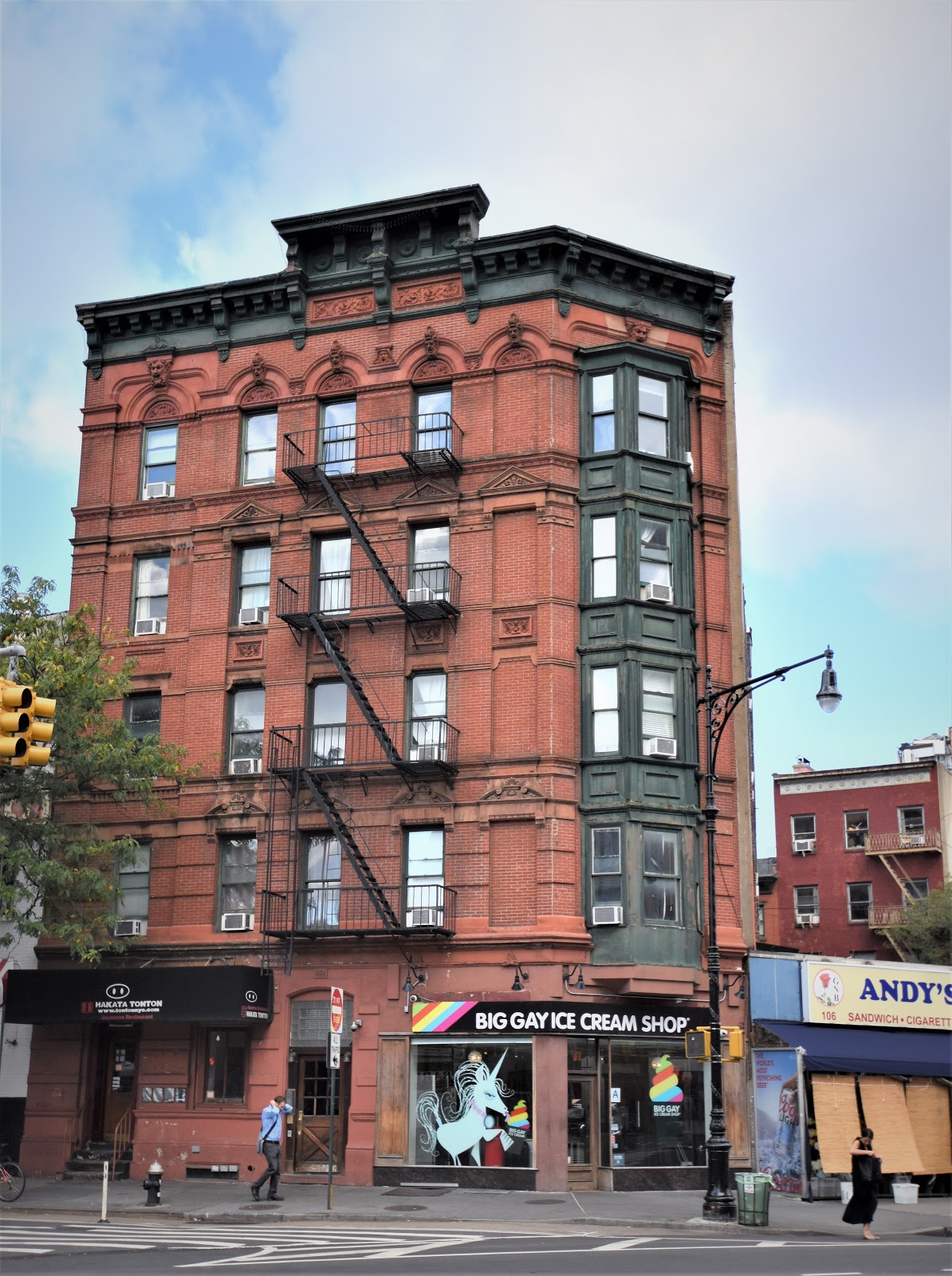
61 Grove Street and Its Remarkably Re-Built Corner


A seam running up the corner of the building testifies to the amazing plastic surgery performed in 1914.

In 1890 brothers John and Philip Goerlitz contracted architect Franklin Baylies to design a flat house on Grove Street in Greenwich Village between Bleecker and West 4th Streets.  The five story building would extend through the block, having entrances at both No. 61 Grove and No. 76 Christopher Street.  John Goerlitz was a contractor as well as a developer, so it is most likely that he was responsible for the construction.

Baylies's completed building was clad in red brick and trimmed in brownstone and terra cotta on the main, Grove Street elevation.  The openings of the top floor top floor were embellished with terra cotta tympana and fanciful carved portrait keystones.  Terra cotta panels were inserted within the ambitious tin cornice.  The Christopher Street side was similarly treated, although the brick here was beige--creating an even more striking color contrast between the materials.


The cost of construction was significant.  In April 1891 the brothers took out a $100,000 mortgage from The German Savings Bank--around $2.85 million today.

Tenants in the new building were a mixed bag--from blue collar workers like Edwin S. Payne, a seaman to professionals like Abraham Webb, an attorney. 

The fifteen families living at No. 61 were panicked on the evening of July 21, 1895 when a fire broke out in the basement.  The New York Herald explained "A match, thrown by some one into the front apartment of Janitor David Rinoler, had set some drapery ablaze and Rinoler, finding that he could not master the flames with buckets of water, caused an alarm to be turned in.  The tenants became frightened and rushed out on the fire escapes.  This caused some one in the vicinity to believe that the whole building was on fire and another alarm was sent in."  The fire was quickly extinguished and the damage was estimated at about $15,400 in today's dollars.


The Christopher Street elevation wears beige rather than red brick.
One resident at the turn of the century seems to have had a hard time retaining a job.  William T. Engesser placed a position wanted at in the New-York Tribune on December 30, 1900 for "Collector--Young man, 21, as collector with reliable firm; at present employed with jewelry house."  A month later he was looking for a position with a "reliable firm, with change for advancement; good penman, figurer, neat, quick, trustworthy."  No mention was made of his collector job.  And then on December 18, 1902 his advertisement read "Young Man, 22, at anything; neat, quick, trustworthy; business experience; references, bond; good education; no cavassing."  Possibly thinking his youth was working against him, his ad a month later added three years to his life and greatly broadened his background:  "Young Man, 25; neat appearance; good education and character...experienced selling and collection, shipping receiving and stock; trustworthy, a hustler."

An ugly feud between two families erupted around the time of Engesser's latest advertisement.  According to The Sun on March 1, 1905 "Social rivalry, it is alleged, had much to do with discord that prevailed."  It started when the Dugan family purchased a piano--an expensive item at the time--around 1903.  Their neighbors, the McCormicks responded by buying a piano too.

The Sun reported "The Dugans at first seemed to have rather the better of it.  Then the McCormicks added a fiddle to the family equipment and every one felt that they had gained a distinct lead."  But, said the article, "It was not for long."


"In May, 1904, the Dugans went to a concert in Tammany Hall.  They not only went to it; but Mrs. Dugan sang at it.  Further, there is the authority of Mrs. Dugan herself for saying that she frequently went to the theatre and that carriages drew up to take her there and in bringing her home.  But when the Dugans made a trip to Europe last summer—then it was, according to Mrs. Dugan, that the relations, already strained, snapped, and war in real earnest began."

In retaliation, according to the Dugans, the McCormicks "operated on their piano morning, noon and night" and "cooked fried liver and onions and boiled cabbage with their dumbwater shaft open."  The McCormicks retorted "that the Dugans caused small boys to ring their doorbell, and that an effort has been made to kidnap the family fiddle."

Edward Dugan was a special policeman and B. McCormick worked in a boiler factory.  Neither husband seemed much interested in their wives' feud until Dugan began receiving anonymous letters described as "very offensive in tone."  Mrs. Dugan had her neighbor arrested and the two women aired their grievances against one another in court.  The Sun noted "The husbands were there, too, but no one paid any attention to them."

Far more significant upheaval than piano music and fried liver was on the horizon.  At the time real estate agent Charles C. Hickok was lobbying to have Seventh Avenue, which began at 11th Street, extended south to Varick Street.  The project would necessitate the demolition of scores of buildings and portions of others.  Years of pressure paid off an in 1913 the extension began in concert with the construction of the 7th Avenue subway.  The project annihilated No. 63 Grove Street and shaved off a triangular corner section of No. 61.

When the dust had settled owner Jennie Messing hired architects Wortmann & Braun to fix the problem.   Their plans, filed in May 1914, were unexpectedly sensitive to the original designs.  In fact, during demolition the carved elements were salvaged to be incorporated into the rebuilding.  The result was seamless (other than the still-visible seam).   A three-sided bay included in the renovations projected over the new corner store.


In 1914 repairs were being made to the cut-off corner.  from the collection of the New-York Historical Society
Among the tenants in 1947 were Anthony Hintz, his wife Maisie, and their two-year-old son, Edward.  Hintz worked on the docks as a "boss stevedore."  The industry was controlled by the mob, making his job potentially dangerous if he stepped on the wrong toes.  And he did.

When Hintz answered his door on January 8, 1947 a barrage of shots rang out.  He fell to the hallway floor, struck by six bullets.  Neighbors, alerted by the gunshots, heard Maisie scream "Who shot you?" and Hintz answer "Johnny did it."

Despite the close-range wounds, Hintz lingered in the hospital for 25 days--more than long enough for him to make "death-bed declarations" against his attackers.  He identified John M. "Cockeye" Dunn as "the man who shot me," and Andrew Sheridan and Daniel Gentile as accomplices.

The individual trials went on for a year before all three were convicted of first degree murder and sentenced to the electric chair early in 1949.

Maisie remained in the Grove Street apartment, remarrying not too long afterward.  Around 3:00 on the afternoon of March 17, 1953 she went upstairs, leaving Edward, now eight years old, playing on the street.  In retrospect, it was a cavalier move, considering that she told investigators "she had received telephone calls threatening violence to her son."

The following day The New York Times reported that Edward "disappeared yesterday from the street in front of his home."  The article said Maisie "was near collapse when she reported his disappearance to detectives at 11:40 P. M."  A 13-state alarm was issued for the "chunky seventy-pound youngster" as described by The Times.

The terrifying situation had a happy ending--at least for Maisie.  The following morning just before 8:00 police found the boy sleeping in the cab of a truck around the corner.  "The boy said he had spent the night in the truck cab because he was afraid of being punished for staying out late," explained The New York Times.   It is more than possible that he was punished anyway.

For years during the second half of the century the corner store was Grove Drugs; and in 1974 the retail space on Christopher Street became home to Boots & Saddle, a gay bar.  


Around 1997 Taka, a "tiny sushi bar," opened at No. 61 Grove Street.  On November 21 that year The New York Times praised chef Taka Yoneyama's presentation.  "She will decorate tuna with leaves of edible gold, and stuff squid with spiced cod roe and cut it into pinwheels."

After decades on Christopher Street Boots and Saddle was replaced by Hakata Tonton, an Asian restaurant which stretched through to the Grove Street space formerly occupied by Taka.


Wortmann & Braun's 1914 rebuilding of the lost corner was so perfectly done that it fooled even the Landmarks Preservation Commission.  In its 1969 Greenwich Village Historic District Designation Report, the commission stated "The building was specifically designed for an oddly shaped corner lot."

photographs by the author

Friday, October 4, 2019

The 1842 House That was Jack Delaney's Restaurant - 72 Grove Street


William Newhouse erected his substantial 21-foot wide home at No. 72 Grove Street in 1842.  As with almost all such projects, there was a secondary building--in this case a three-story house--in the rear yard.  Newhouse's three-story Greek Revival house was unpretentious; its brownstone lintels and sills and its simple fascia board below the cornice making no attempt at display.

The rear house was leased to a working class family.  On April 19, 1853 an advertisement in The New York Herald read: "A respectable Protestant young woman wishes to get a situation as chambermaid; is a fine washer and ironer; would be willing to do general housework...Please call at 72 Grove street in the rear."  Similar advertisements appeared over the next decade.

The Collins family was living in the main house in 1862 when tragedy struck.  The New York Herald reported on October 1 "Edward Collins, a boy about five years old, residing with his parents, at No. 72 Grove street, fell off the pier at the foot of Christopher street, yesterday, and was drowned."

It appears that the main residence was being operated as a boarding house by the end of the Civil War; and several families lived in the rear house.  

Mrs. Rosaline Elliott had rooms in the main house when she became the victim of a burglar on March 9, 1869.  Thomas Smith was charged with "burglarously entering" her rooms and "stealing a quantity of clothing" after he was seen leaving the house by a pedestrian.   Smith seems to have gotten away with the crime, however.  The Evening Telegram reported on his trial of June 20, saying "One witness swore to the identity of the accused, but only saw him across the street.  The good character of the accused was established, and the jury rendered a verdict of not guilty without leaving their seats."


In the meantime an Irish immigrant family--the widowed Mary McKenna and her grown children, Owen and Bridget--were living in the rear house.  On May 8, 1868 Mary, who was just 58 years old, died there after what The New York Herald called "a lingering illness."  Her modest funeral was held in the little house two days later.

By the early 1870's the basement of the main house, now apparently owned by John Campbell, had been converted for business.  The stoop was moved to accommodate the traffic to the the saloon there.  Campbell's family occupied the upper floors.  On March 8, 1872 John's widowed mother, Jannett, died at the age of 70.  Her funeral was held in the house on March 11.

It is unclear whether John Michel and his wife rents rooms in the main or the back house at the time.  He was looking for employment that year and his advertisement suggests the agrarian-trained man had recently arrived from Europe.  "Gardener's and Farmer's Situation Wanted--by a practical married man (German); understands his business fully; greenhouses, graperies, vegetables and the management of stock and general farming."


Bridgett and Owen McKenna had remained in the rear house following their mother's death.  Now on February 24, 1873 Bridgett died "after a long illness."  She was just 28 years old.  (It is possible that both Mary and Bridgett had succumbed to the smallpox epidemic which first arrived in New York in 1868 and lasted through 1875.)  As the anniversary of Bridgett's death approached, it may have been too much for her brother.  His death notice reported that he died "suddenly" on "Sunday evening, February 1...aged 32 years and 13 days."   The New York Herald was more explicit.  "The body of Owen McKenna, native of Ireland, thirty-two years of age, was yesterday found floating in the dock foot of Leroy street, North River, and removed to his late residence in the rear of No. 72 Grove street, where Coroner Kessler will hold an inquest."

In August 1874 the saloon's owner, John Meyer, sought to sell his basement business.  "A first class wine and lager beer saloon for sale, doing a good business; satisfactory reasons for selling."

A tenant, 23-year-old Andrew Hamilton, got himself in trouble with the law for his rowdiness in June 1881.  He and a group of young men and women crossed the river every week to attend a Saturday night dance at a certain Hoboken pleasure garden.  On June 13 The New York Herald noted "the termination of the dancing is, as a rule, the signal for the outbreak of a series of fights."  As the "party of revelers" headed to the ferry, they were met by Officer Flaherty who ordered them to keep quiet and go home peaceably.  "But they turned upon him and he arrested one of the crowd," reported The Herald.  "With the assistance of Officer Crush two others were taken, and at the police station charges of disorderly conduct and resisting an officer were preferred against them.”  Among the arrested was Andrew Hamilton.

It did not go well for the young men.  Determined to end "these Sunday morning quarrels," the court imposed a fine of $20 each--just over $500 today.  Unable to pay the fine the men were sent to the Penitentiary for three months.

Following the turn of the century the former saloon became the shop of chair maker H. B. Foster.  His son, Edward, was good friends with a rookie police officer, Bruce Manson, appointed to the force on July 2, 1908.  That friendship would result in Foster's enduring a frightening incident in 1910.


H. B. Foster's "chair business" was in the basement by July 30, 1914 when this photograph was taken.  Tenants stare from the first floor windows.  from the collection of the New York Public Library.  
That spring the Secret Service offices in Washington and in New York received a series of peculiar, anonymous letters that warned that Manhattan's street posts, fire alarm boxes and mail boxes were painted in treacherous colors.  The New York Call later explained "The red meant danger and black was the color of death, the writer said.  He wished the boxes and posts be removed and the dangerous colors changed."

The letters were traced to Officer Manson.  He was retired in May on a doctor's certification and committed to an asylum in Central Islip.   Five months later, on October 19, The New York Call ran a headline that read "Crazy Ex-Policeman Escapes From Asylum" and reported that when H. B. Foster answered a knock on the door "Manson staggered to a seat.  His clothes were torn and he was covered with dust."  He had walked all the way from Islip after, according to him, he "just walked out."

Foster remained calm, put the escapee to bed, then called for a policeman.  He was taken to Bellevue Hospital with little commotion.


The brick was painted white around 1928 when this photograph was taken.  The Village Grove restaurant operated from the ground floor.  from the collection of the New York Public Library

No. 72 received an alteration in 1921 that converted the ground floor to a commercial space.  By the beginning of the Great Depression it housed The Village Grove Restaurant, operated by S & C Restaurant, Inc.  In 1932 it renewed the lease for 10 years, with a starting rent of $3,300 per year, gradually increasing to $3,900 (about $6,000 a month today).

In 1936 the building was leased by Jack Delaney.  After making renovations he opened Jack Delaney's Restaurant.  It became a popular destination specializing in steaks.  Delaney was a horse breeder and the main dining room was decorated with horse racing photographs and memorabilia.  The barstools were fashioned from English saddles and hanging from the ceiling was a sulky cart.  

Lunch cost 50 cents in 1939; around $9.00 in today's money.  Greenwich Village was ground zero for writers, poets and musicians, resulting in the restaurant appearing in literature throughout the coming decades.

Poet Frank O'Hara wrote:


I was reflecting the other night meaning
I was being reflected upon that Sheridan Square
is remarkably beautiful, sitting in Jack
Delaney's looking out the big race-track window
on the wet
drinking a cognac while Edwin
read my new poem...

And in his 1968 Vanity of Duluoz: An Adventurous Education, 1935-46 Jack Kerouac recalled his father taking him downtown in 1939: "So we go down to Jack Delaney's steak restaurant on Sheridan Square, myself little knowing how much time I was destined to spend around that square, in Greenwich Village, in darker years, but tenderer years to come."


A trotter and sulky decorate the rooftop of Jack Delaney's Restaurant in June 1940.  from the collection of the New York Public Library
Jack Teitelbaum, who went by the name of Jack Lane, played piano during the "cocktail" hours.  Lane, who lived just a block away at No. 95 Christopher Street, had been a vaudeville director in his early career.  He had also composed popular songs and musical scores for silent movies.  After three decades at Jack Delaney's, he died on January 20, 1964.

Two years later, on January 14, 1966, Jack Delaney died at the age of 65.  If New Yorkers were concerned that his death would signal the end of the restaurant, it was not to be--not yet at any rate.

On March 12, 1973 New York Magazine wrote "The favorite Village pianists are here.  Mon. and Tues. it's Charles DeForest, and the rest of the week it's Murray Grand.  There's no tune you can ask for that one of them won't know."  And a year later, on October 21, The New York Times remarked on a new pianist, Phil Della Penna, calling him "a genial man who looks like an English Lit. prof."  


By 1990, however, the venerable restaurant and nightclub was gone, replaced by the Sheridan Square Restaurant, a diner that lasted for many years.  Today the ground floor houses a Starbucks.  The unassuming little building reveals no hint of its rich history and the importance it played in 20th century Greenwich Village.

photographs by the author

Friday, August 24, 2018

The House Where Grove Press was Born - 18 Grove Street


The corner location provided windows on Bedford Street--allowing for additional light and ventilation inside.

In 1829 Samuel Winant and John Degraw, both carpenters, merged their businesses as Winant & Degraw and branched into the building trade.  In 1839 they purchased the plots on the eastern third of the block bounded by Hudson, Grove, Bedford and Barrow Streets.  Within the year they began construction of four identical houses at Nos. 12 through 18 Grove Street.

Finished the following year the 21-foot wide Greek Revival-style houses were three stories of orange brick upon brownstone English basements.  Handsome but unassuming, the homes were modestly trimmed with stone lintels and sills.  The entrances were framed by the expected heavy stone pilasters and entabulatures of the style.

The good friends took the middle houses for themselves; Winant moving into No. 14 and Degraw into No. 16.  It is unclear who the original purchaser of No. 18 Grove Street was; but its location at the corner of Bedford Street made it the most appealing of the four with its extra wall of windows and side access to the rear yard.

The lady of the house dropped her expensive shawl in the fall of 1854.  An advertisement in The New York Herald offered at reward of $150 in today's dollars "to any person who may take a square French shawl to No. 18 Grove street, lost on Sunday, about 3 P.M., either in a car in Bowery, or in Bleecker street, between Bowery and Carmine."

The family living here would not have been wealthy, but financially comfortable enough to have at least two servants, a cook and a maid.  In a middle-class household like this one, a servant would be expected to take on several tasks, as evidenced in the February 21, 1860 advertisement for "A good, neat and competent girl wanted as a nurse and plain sewer; also to make herself generally useful."

The arrival of a new baby in the house no doubt prompted the need for a nurse.  The ad cautioned "None but those of an obliging disposition and in quest of a good steady place need apply."  That girl with an "obliging disposition" would earn between $5 and $6, according to the ad, or about $180 a week on the high end.

The following year, in October, the family left Grove Street and offered the house was for lease.  The advertisement promised "rent low; lease may be had," suggesting that if the family intended to return, it would not be for a long while.

David O. Hogan and his wife, Mary E. were living here at least by 1866.  That year, on January 14, little Charles S. G. Hogan was born. 

The early years for Victorian children were especially tenuous and that year approximately one-third of all deaths reported in New York City were children.  On December 4, 1866 The Sun reported that 83 children in Brooklyn had died the previous week, ten of those from scarlet fever.

It was about the same time that Charles began showing symptoms.  The little boy died in the Grove Street house on January 3, 1867, just 11 days before his first birthday.   His funeral was held in the house the following Saturday afternoon.

In the first years of the 20th century real estate operators Pepe & Brother became well-known in the Greenwich Village area for remodeling run-down, antiquated houses into modern structures, frequently incorporating artist studios.  Their re-makes often involved a coat of stucco and Mediterranean inspired touches like faux balconies and tiled roofs.

Belle C. Bunn was a real estate operator in the neighborhood at the time and in 1910 owned No. 18.  She may have followed Pepe & Brother's lead when she initiated a "rebuild" of the house that year.  Although a few of the Greek Revival elements (like the doorway) survive, it was apparently Bunn who stripped off the exterior details and covered the brick with stucco.

A subsequent interior remodeling in 1921 resulted in two apartments in the upper floors and a doctor's office in the basement.

The house was purchased by Louise W. Bender, widow of Louis Bender, assistant treasurer of the New York Central Railroad, sometime after his death in February 1928.  Louise's estate sold the property in April 1945 to Aida Aliprando and Marion Booth.

Living in one of the apartments at the time was attorney and author Ambrose Doskow and his wife Naomi.  The two were a fascinating couple.  Shortly after graduating from Columbia University's Law School, Doskow had served as clerk to United States Supreme Court Justice Benjamin N. Cardozo.  Now a trademark litigation expert, he was the author of books like the 1940 Anti-Semitism and the Law in Pre-Nazi Germany and Historic Opinions of the U S. Supreme Court, published in 1936.

When Naomi Brodie Doskow died in February 1946 she was just 33-years-old.  But she had served as national secretary of the Junior Hadassah, the Young Women's Zionist Organization of America, and secretary of the American Zionist Youth Commission.

The following year Aliprando and Booth sold No. 18 to Cecil Associates, which resold it in November 1947.  The house became home to a newly-formed publishing firm, which took its name from the location: Grove Press.  The tiny company managed to publish only three books within the first three years, including the 1950 The Verse in English of Richard Crashaw.

The owners sold the business in 1951 to Barney Rosset for $3,000.  Under his direction Grove Press introduced avant-guard literature including several (at the time) controversial works deemed too racy by other publishers.  Samuel Beckett's play Waiting for Godot was among them.  The Beat Generation's Jack Kerouac, William Burroughs and Allen Ginsberg were authors and poets represented by Grove Press.

The firm's success necessitated larger quarters and in 1962 it was gone.  No. 18 was once again converted to two residences, an apartment in the basement and a single family home above. 


No. 18 Grove Street as it appeared prior to 2016.  photo by gallery 438 via 18 Grove Street, New York City proposal

It was the scene of a chilling attempted crime on December 1, 1964.  Police had been looking for an ex-convict, 38-year-old Shepard Campbell, for nearly a month after he had raped two Greenwich Village women.  Campbell had a record of 22 arrests.

That day two detectives spotted him in the Village and followed him in a car, but lost him when he climbed a fence.  The New York Times reported "Later, they heard a woman scream in a building at 18 Grove Street.  They captured the suspect as he ran from the building."

When the building appeared on the market in 2016 the 517 Group proposed to convert it to condominiums with  a cafe in the rear and a roof garden.  The firm's proposal said "The project has a more modern design to attract wealthy residents as well as wealthy investors."


The proposed condo project with its rear cafe.  rendering via 18 Grove Street, New York City proposal

Instead, it was reconverted to a single-family residence that included five bedrooms, a 12-seat screening room and a 5,000-bottle wine cellar.  Real estate listings boasted that Belgian designer and "antiquarian" Alex Vervoordt had "thoughtfully selected" all the interior details and that buyers would find the interiors "wabi-sabi"style; referring to the Japanese philosophy of simplicity and imperfection.


The renovated house also included a yoga a meditation room, a full-floor library with a wet bar and wood-burning fireplace, and a roof terrace with dining area and "lounge."  A Mediterranean-inspired tiled faux roof, in keeping with Pepe & Brothers early 20th century designs in the neighborhood, took the place of the long-lost cornice.  The sumptuous home was put back on the market in the spring of 2018 for $25 million.


photographs by the author
no permission to reuse the content of this blog has been granted to LaptrinhX.com