Showing posts with label greenwich street. Show all posts

Monday, March 17, 2025

The Lost William Maginnis House and Store -- 513 Greenwich Street


On June 13, 1913, when this photograph was taken, a restaurant occupied the ground floor.  Colonial Architecture in New York City, 1913 (copyright expired)

In 1815, homes and shops were appearing along Spring Street between Greenwich and Hudson Street.  It was around that year that the two-and-a-half story house-and-store was erected at the southeast corner of Greenwich and Spring Streets.  The Federal-style structure was faced in brick on the front, or Greenwich Street elevation, and in clapboards on the side.  The attic, under a high gambrel roof, featured two tall dormers at the front, and an arched window on the side flanked by quarter-round openings.

The residential entrance was at 318 Spring Street, while the commercial address was 513 Greenwich Street.  In 1816, the shop was occupied by the Henry A. & C. Heiser candle store.  By 1850, the ground floor was divided into two shops.  William Maginnis and his family lived upstairs, and he ran his "willowware" (i.e. baskets) shop here.  The enterprising businessman ran a fruit market next door, at 316 Spring Street, as well.  The other shop was home to Thomas Dean's tinsmith business.  Previously, he worked and lived a block away at 324 Spring Street.  (He and his family now lived at 76 Charlton Street.)

Thomas Dean would operate his tin shop here through 1858.  In 1851, Maginnis moved out, relocating his family to 573 Greenwich Street.  (He kept his fruit business next door, however.)  James Clinton took over the vacant store for his boots and shoe shop.

Ann Mulligan, the widow of Bernard Mulligan, seems to have operated the upper floors as a boarding house in the mid-1850s.  Listed at the address in 1853 were John McCool, a builder, and Levi Hyer, a clerk.  Both men volunteered as fire fighters at the National Hose Company, No. 24 nearby at 315 Spring Street.  (John McCool would become a significant developer in the years after the Civil War, erecting long rows of brownstone residences in the burgeoning Upper East Side.)

from the collection of the New York Public Library

Sharing the ground floor with Thomas Dean in 1858 was John Jones's carpet weaving shop.  On December 16 that year, a fire was sparked by a "candle in dust," according to the The United States Insurance Gazette and Magazine.  The building was owned by Dr. Samuel M. Valentine, who lived at 159 Madison Avenue.  In repairing the damages, Valentine further separated the ground floor, which now held three stores.  It was likely that the reduction of space prompted Thomas Dean to leave, moving his business to 533 Canal Street.

Valentine's ground floor tenants were now John Jones's carpet weaving business, Joseph Watson's tinsmith shop (it is possible he had worked for Thomas Dean), and David Orr's boot and shoe shop.  Just after midnight on November 27, 1861, another fire broke out "in the carpet weaving shop of John Jones," according to the New York Herald, which said, "The flames extended into the tinware store of Joseph Watson, adjoining, before the fire was extinguished."

This time, the Fire Marshal's Semi-annual Report deemed the cause, "carelessness."  The damage to the building was estimated at $100.  Jones suffered the same amount (equal to about $3,570 in 2025).  Watson's loss was half that amount, but he had no insurance coverage.  Although the fire did not spread into David Orr's shop, he suffered the worst.  The New York Herald noted that his "stock of boots and shoes...was damaged by water to the extent of about $150."

It appears that Valentine restored the ground floor to two spaces.  Not surprisingly, after two fires in his shop, John Jones was no longer a tenant.  Joseph Watson now shared the ground floor with John and Elizabeth Collins.  John shared his basket store with Elizabeth's "home furnishing" business.  The couple lived nearby at 311 Spring Street.

In the meantime, boarders came and went in the upper floors.  J. Flinger's residency was cut short in August 1863, when he was drafted into the Union Army.  An unmarried woman, E. Connell, lived here the following year.  She advertised for a job in The New York Times on November 18, 1864, "Wanted--By a young American woman, a situation to travel as a companion to an invalid or as lady's maid; can furnish the best reference."

from the collection of the New York Public Library

Elizabeth and John Collins remained in their store as late as 1874.  By then, John had added crockery to his basket offerings.  Around 1867, Thomas Gallagher had taken over the former Joseph Watson tin business.  John Gallagher, presumably his son, ran the business in 1879. That year Philip Scheurer ran a crockery store in the former Collins space.  Scheuer and his family shared the upper portion of the building with "pumpmaker" John Ivans.

In 1888, D. Parrata obtained a permit to operate a "fruit and soda water stand" on the sidewalk.  Living upstairs at the time was the Ferris family.  Charles Ferris listed his profession as "pedlar," and Joseph Ferris as a driver.

The frame building survived another fire that broke out at 10:25 on the morning of October 27, 1903 in the office of Ledyard Avery & Co., commission merchants.  The ground floor was returned to a single commercial space, home to a restaurant by 1913.  It was replaced in the post World War I years by Star Art Glass Co.

The Glaziers' Journal, August 1923 (copyright expired)

The Star Art Glass Co. was still in the unlikely surviving relic on June 29, 1938 when photographer Berenice Abbott photographed it.  In the shadow of the rumbling elevated train, a notice plastered on the building's facade offered "This Corner Plot" for sale, noting, "Will Alter or Erect New Building."

from the collection of the Museum of the City of New York

Within three years the venerable structure was gone.  In its place, a single-story building was erected, which survives.

image via Googlemaps

Wednesday, November 20, 2024

The United States Express Bldg - 2 Rector Street (101 Greenwich)


image via archinect.com

Born in Oswego, New York on July 15, 1833, Thomas Collier Platt was described by The New York Times as, "for nearly a quarter of a century the undisputed 'Easy Boss' of the Republican organization in this State."  Known popularly as Tom Platt, he served two terms in the U.S. House of Presentatives and three terms in the U.S. Senate.  He was highly involved in the consolidation of five counties into the City of Greater New York.  The Times noted that he knew "every President, personally, since Lincoln."

In 1879, Platt became secretary and a director in the United States Express Company and was elected its president the following year.  He still held that position nearly 30 years later when, on July 7, 1905, the architectural firm of Clinton & Russell filed plans for the firm's new headquarters on the northern side of Rector Street between Greenwich Street and Trinity Place.  The plans called for a 23-story "brick and stone office building" projected to cost $1.6 million to erect (about $57.2 million by 2024 conversion).

As the caissons for the foundation were being sunk into the bedrock three months later, Carpentry & Building explained, "The first five stories of the façade will be of granite, while the remaining stories will be of brick trimmed with terra cotta.  The style of architecture will harmonize with the Empire and Trinity buildings."  That style would be, for the most part, a commercial take on Renaissance Revival, with nods to Gothic Revival and touches of Beaux Arts.  As the building rose, Henry Alexander Horwood, writing in The Metropolitan Magazine, said, "Trinity churchyard is in front of it and from Broadway it will loom up like a giant in the background." 

The decoration of the original, terra cotta-clad top section included elaborate piers, and spandrels containing classical figures.  photograph by Wurts Bros from the collection of the Museum of the City of New York.

The United States Express Building was completed in the fall of 1906.  An interesting innovation was a second floor arcade that connected the stations of the Sixth Avenue and the Ninth Avenue elevated trains.  The United States Express Company occupied the lower floors and rented the upper portions to a variety of tenants.  On December 1, 1906, for instance, the Record & Guide reported that the 17th floor had been leased to the Safety Car Heating and Lighting Co. for ten years, and the Lackawanna Steel Co. had signed a lease on "almost all of the eighteen floor for a long term."

A significant tenant was the Carnegie Safe Deposit Company, which on January 24, 1908 installed what the Topeka State Journal described as, "the largest steel vault in the world."  The article said, "The huge plates used are of the same quality of steel as is used by the leading nations in the protection of their battleships, and are proof against even any modern high power gun cable of being brought to an attack on the vault."  Each of the steel plates, made by the Bethlehem Steel Company, weighed 756 tons.  The doors to the vault weighed 20 tons each, yet the article said, "These are hung with such delicate precision that a child can swing them."

This photo was captioned "One of the Plates in the World's Largest Deposit Vault" in The Topeka State Journal on January 24, 1908 (copyright expired)

Interest switched from the massive vault to a scandal involving Thomas C. Platt five months later.  A front page article in The Evening World on May 18, 1908 was headlined, "Platt's Letter to Mae Wood Signed 'Lovingly, Tom" and the article detailed Mae Catharine Wood's divorce suit against the former senator.  The interesting thing about the case was that Platt already had a wife, and he insisted he and Wood had never been married.

The article said, "Mae Catharine Wood-Platt asserts that she was married secretly to the Senator in the Fifth Avenue Hotel on the night of Nov. 9, 1901.  Two years later, she says, he married Lillian Janeway."  Although Platt did not attend the court session on May 17, 1908, Mae Catharine Wood was undeterred in exposing embarrassing details and reading torrid love letters during her testimony.

The scurrilous proceedings lasted until May 27 when the judge declared, "I cannot credit the plaintiff's evidence as to the alleged marriage and the testimony as it impresses the court is that this is a most wicked design to support a false and fictious clam by forgery and perjury."  Mae Catharine Wood was sent to the city prison on charges of perjury "unless she furnishes a bail in $5,000," reported the Daily News of Kearney, Nebraska.

The lobby boasted carved stone, a deeply coffered ceiling, and mosaic floors.  photograph by Wurts Bros from the collection of the Museum of the City of New York.

An advertisement for an office in the building on April 7, 1917 touted its up-to-the-minute amenities.  "Fire proof building, light, heat and service included, circulating ice water, excellent toilet facilities."  The "circulating ice water" was a somewhat common means of cooling large buildings in the decades before air conditioning.  A refrigeration plant in the basement sent frigid salt water through copper tubing within the walls, noticeably lowering the temperatures during the hot months.

Among the several attorneys with offices in the United States Express Building in 1920 was Frank I. Finkler, who acted as his own lawyer in a startling case against his son-in-law, John F. McNulty, in July that year.  Finkler accused him of bigamy, of trying to poison the entire Finkler family, and of setting fire to his house to conceal a theft of $5,600 worth of Liberty Bonds.

Finkler's daughter, Martha Ruth, had served in the Women's Motor Corps of America during World War I.  One morning she was assigned to drive Lieutenant McNulty to the New York Navy Yard.  A romance blossomed and "despite her father's objections," according to The Evening World, they were married in the Cathedral of St. John the Divine on April 2, 1919.  The newspaper said, "Later it was found that McNulty had previously married Mary Wasal Oct. 28, 1908, and Ruth Ennis, by whom he had three children, on Nov. 8, 1911.

One morning, Finkler's wife saw McNulty drop mercury tablets into the coffee pot that was boiling on the stove.  She poured the contents into the sink.  Later, McNulty witnessed Finkler place Liberty Bonds in his desk drawer in the library.  After a fire later gutted the room, Finkler applied to Washington for redemption of the bonds, only to be told they had been sold.

On July 18, 1920, Finkler's daughter took the stand.  "But she had scarcely started to give her testimony," reported The Sun, "when, overcome by sight of the prisoner, the father of her child, she toppled from the witness chair in a faint, which lasted nearly an hour."  She was unable to return to the courtroom.  Nonetheless, McNulty pleaded guilty to bigamy, while denying he had tried to kill the Finkler family or to having stolen the bonds and set fire to the house.  He was sentenced to two to five years in Sing Sing Prison.  Finkler told the reporters, "It has cost me $24,000, including the Liberty Bonds, to rid my daughter of this man."

The Brickbuilder, July 1907 (copyright expired)

On January 12, 1925, The New York Times reported that the Electric Bond and Share Company, "purchased for its future home the twenty-three-story office building at 2 Rector Street."  The article noted, "The building was erected by Thomas P. [sic] Platt as President of the United States Express Company and was considered the finest building of its kind."  The new owners enlarged the skyscraper by adding three floors, the architecture of which honored the Clinton & Russell design.

Joseph A. Eggers worked in the mail room of the Electronic Bond and Share Company.  On the evening of February 25, 1933, the 40-year-old was seen sorting mail, and then he disappeared.  Suddenly, Joseph Hawthorne, the manager of the Western Union branch office in the rear extension of the building, was startled by a loud thud.  Investigating, he found Eggers's body "wedged in a ventilator," according to The New York Times.  He had thrown himself from a window on the 21st floor.

John J. McMullen, the owner of the Houston Astros, purchased 2 Rector Street in March 1981 "for a price reported in trade circles as $23 million," reported The New York Times.  (The figure would translate to more than $77 million today.)

Cesar Martinez, who worked for the building's management firm as a security guard, helped his sister, Eridania Rodriquez, obtain a job here as a cleaner in 2008.  Almost a year later, on July 7, 2009, Eridania failed to meet her co-workers for their evening meal at 9:00.  When they looked for her, they found only a hair clip and a mop.  In the room where the employees changed into their uniforms, they found her clothing and purse.  Her cart was abandoned on the eight floor.

The building was carefully searched, but no trace of the woman was found.  Two days later, The New York Times reported that police suspected foul play.  Then, on July 11, the newspaper reported, "After days of fearing the worst, the police said they believed they found the body of Eridania Rodriguez, a 46-year-old woman missing since Tuesday night."  At 8:50 on Saturday morning, an officer found a body inside an air-conditioning duct near the 12th floor.

Joseph Pabon, who worked as an elevator operator in the building, was arrested and convicted in April 2012 for murder and kidnapping.  He was sentenced to 25 year to life in prison.

image via polycor.com

A renovation by architects Montroy Andersen DeMarco completed in 2018 resulted in "a significant repositioning," as worded by the firm's website.  The vintage building was modernized to accommodate 21st century tenants, including "the financial and hospitality sectors."  With the updates came a new address, 101 Greenwich Street.

many thanks to reader Laurie Gwen Shapiro for requesting this post

Friday, June 14, 2024

Lafayette A. Goldstone's 1930 19 Rector Street (88 Greenwich Street)


photo by ZeligJr

In 1929, months before the Stock Market crash that would usher in the Great Depression, the Gening Realty Corporation broke ground for what was intended to be a 40-story office building at the southwest corner of Rector and Greenwich Streets.  Gening Realty Corporation was described as a "syndicate representing the General Realty & Utilities Company and A. M. Bing & Son."  On March 11, 1930, the New York Sun reported that General Realty & Utilities had financed a $3.35 million building loan for the project--a significant $61 million in 2024.

The article noted, "The forty-story building under construction at 19 Rector street [is] from plans by Lafayette A. Goldstone."  Goldstone had dissolved his partnership with William L. Rouse in 1926.  The highly successful firm of Rouse & Goldstone had designed dozens of substantial Manhattan buildings, most of them apartment houses.

By the time construction was completed later that year, the plans had been scaled back to 35 floors of offices and a penthouse apartment.  (In 1936, the penthouse was converted to offices, as well.)  Goldstone's Art Deco skyscraper was clad in beige brick above a two-story limestone base.  Numerous asymmetrical setbacks at the upper levels provided several terraces.

The two-story base, see here in 1939, is only moderately changed today.  photo from the Gottscho-Schleisner Collection of the Library of Congress

Despite the ongoing Depression, the offices filled with tenants.  Louis W. Abrons, the president of General Realty & Utilities Corporation, told the New York Sun in May 1933, "It is interesting to note that the leading applicants for space comprise, in addition to members of the Stock Exchange and Curb Exchange, accountants and firms associated with railroads and steamship lines."  

Typical was the brokerage firm John L. Morgenthau & Co.  It was headed by millionaire John L. Morgenthau, the nephew of former U.S. Ambassador to Turkey, Henry Morgenthau.  The firm had its offices in the building as early as 1932.  Among the few tenants not involved with brokerage or shipping were the Reynolds Metals Company and Dobbins-Trinity Coal, Inc.  In 1938 the Waterman Steamship Agency, Ltd. leased the entire 19th floor.  


Engineers with The H. K. Ferguson Company work at drafting tables in 1947 (top), while clerical workers occupy the mid-century equivalent of work cubicles.  The firm, which had branch offices in Cleveland and Houston, was industrial engineers and builders.  photo from the Gottscho-Schleisner Collection of the Library of Congress

The tenant list became more diverse after mid-century.  The 1950s continued to see shipping related firms like the American Railway Institute and the Pearl Assurance Company here.  But the Phoenix Mutual Life Insurance Company occupied offices by 1951, and in 1959 Wood & Selick Coconut Co., Inc. and the Camp Fire Club of America were tenants.

By 1960, a major tenant was the New York Telephone Company.  Among its employees was chief telephone investigator Harold A. McElroy.  Among his responsibilities was performing court ordered wiretaps on suspected criminals.  

Late in 1961, McElroy was visited by Police Captain Anthony Obremski, who, according to McElroy, "identified himself as the new commander of the Third Division (Midtown)" and asked for his cooperation.  He told McElroy, "the third Division had a fund to compensate those who gave the police valuable information and that Mr. McElroy would get $100 a month," as reported by The New York Times.

Obremski telephoned McElroy "from time to time," who then supplied him with confidential information obtained through wiretaps.  Once a month a plainclothes officer would meet McElroy in the hallways of 19 Rector Street to slip him his $100.  He told investigators later, as reported by The New York Times, "he had not regarded the payoffs as bribes.  He said he had not reported them on his income tax forms because he looked upon them as gratuities, for helping the police cut corners."

In fact, Obremski was misusing the information being collected for legitimate NYPD investigations.  He was later arrested and charged with using "information about wiretaps to protect bookmakers who were paying graft and to shake down others," said The New York Times on August 11, 1964.  McElroy was suspended from his job but avoided prosecution by testifying.

In 1972 the West Side Highway Project moved into offices on the sixth floor here.  On April 23, The New York Times said, "An unusual amalgam of city, state and private talent is quietly at work here, drawing up plans for a new West Side Highway."  The planners were "quiet," said the article, "because opposition to some earlier proposals has been fierce."

Two years later, on March 26, 1974, The New York Times reported, "Despite protests from community planners, key state and city officials appeared ready yesterday to press for Federal designation of the entire Hudson shore corridor from the Battery to the George Washington Bridge as an interstate expressway route."  The project included replacing the "dilapidated elevated highway," and was the first step in the massive redevelopment of the Hudson riverfront.

In 1997, 19 Rector Street was purchased by Greystone Management.  On the evening of December 23, it "brought its own nonunion workers to the building," reported The New York Times.  "When the regular maintenance crew showed up a few hours later, they found that their jobs had been eliminated."  The 25 workers, some who had worked in the building for more than two decades, found themselves unemployed two days before Christmas.  The article continued, "The displaced workers said Greystone offered them applications for jobs with no sick time, virtually no benefits and lower wages--$8 an hour, compared with $15."

Importantly, the article mentioned, "The 37-story [sic] Art Deco building, built in the 1920's [sic], reportedly will be gutted and turned into condominiums."  Two years later, on November 21, 1999, the newspaper began an article saying, "Just when it seemed there couldn't be another conversion from office to residential in the Financial District, developers announced that a former office tower, an Art Deco skyscraper at 88 Greenwich Street, is being turned into rental apartments."  For some reason, the developers, The World-Wide Group, had decided to change the address.

The article said they, "are gutting the 38-story [sic] building at Rector Street, making 461 apartments."  Costing $100 million, the reconstruction actually resulted in 452 units.

A year after the building's opening, the World Trade Center was attacked on September 11, 2001.  Residents were faced with health hazards, difficulty in access to the building, and curtailed services.  On October 1, the tenants voted to go on a rent strike, "demanding break [sic] leases and to get reduced rents," reported The New York Times.  A class-action suit was proposed, based not only on the health and services concerns, but "on emotional issues."  A lawyer for tenant David Frazer told the reporter, "I want that mother who called with kids whose window looks out over the disaster site.  I want to put her before the judge."

In 2006 the building was converted to condominiums, called Greenwich Club.  Its residents would face another disaster in October 2012--Hurricane Sandy.  According to The New York Times, the storm's floodwaters, "dislodged an oil tank, which hit a ceiling beam and cracked open, necessitating a major cleanup."  In reporting on the downtown damages on December 5, MetroNews said the building "may not be habitable for months."

At least one resident, Jonathan Stark, went to court, filing a $35 million lawsuit in November.  The New York Times reported he accused "the board and managers of failing to safeguard the building against floods they knew were coming, then blocked residents' attempts to file insurance claims.  Managers have told residents they could not return for four months."  Repairs were eventually completed and the building reopened in January 2013.

In June 2016, the 9/11 Tribute Center moved into the ground floor of 88 Greenwich Street.  It had been located at 120 Liberty Street since 2006.

photograph by Tdorante10

Having survived a three devastating events--a depression, a terrorist attack, and a natural disaster--Lafayette A. Goldstone's Art Deco skyscraper survives nearly unchanged externally.

many thanks to author and reader Laurie Gwen Shapiro for requesting this post
LaptrinhX.com has no authorization to reuse the content of this blog

Friday, March 1, 2024

The New York Mills Building - 458 Greenwich Street


In the mid-1860s, the two-and-a-half-story Federal style house at 458 Greenwich Street was home to the Bailey family.  At the time, commerce had already been invading the neighborhood for years.  On April 1, 1873, Isaac Dixon purchased the 25-foot-wide property for $16,000 (just over $400,000 in 2024).  Two decades later, he testified, "There was an old dwelling-house on it when I bought it."

Dixon owned a coffee and spice business, the New York Mills.  Initially, he ran it from the former residence.  In February 1874, he hired builder Peter McManus to make "front and interior alterations" to the building; and in 1880 he added an extension to the rear.

The success of the New York Mills was such that in 1883 Dixon demolished the old structure and hired architect James S. Wightman to design what his plans described as a "five-story brick and Ohio stone trimmed warehouse" on the site.  Wightman clad his neo-Grec style structure in red brick above the cast iron storefront.  Each of the identical floors included recessed, vertical panels between the openings and horizonal panels between floors.  Stone bandcourses connected the sills and a single lintel with delicate, incised carved vines served all four windows on each floor.  


The neo-Grec style forewent the curvy Italianate decorations in favor of more geometric lines, and Wightman pulled out the stops with his cornice.  It rested upon brick, stair-stepped corbels atop a row of saw-tooth brick.  Between each bracket were recessed panels below brick dentils.  

Despite occupying the entire building, Dixon ran his operation with a bare-bones staff.  In 1895, he employed just six men who worked 59 hours per week.  The ground floor held the firm's office which was "visited from time to time for the purposes of placing or removing merchandise," according to the Board of Standards.  The fifth floor was used for coffee roasting, and the second through fourth were used for storage of coffee and spices.  In 1901, the New York Mills still operated successfully with the same number of employees.


Isaac Dixon died in 1897 and his widow Agnes transferred title to the building to Frederick J. Dixon (presumably a son), who took over the business.  While coffee and spices were the company's mainstay, a mention in The Spice Mill in April 1910 noted that the "New York Mills, 458 Greenwich street, New York, also roast wheat, etc., besides coffee."

An ad shows that the building originally had a triangular pediment on the roof.  The Brewers' Journal, October 1, 1915 (copyright expired).

The firm remained at 458 Greenwich Street until around 1931 when it moved a block to the south.  It was replaced by the Fred W. Lange Trucking Co., which altered the ground floor by adding a loading platform in the southern bay.  It was apparently at this time that the pediment was removed from the roof.

image via the NYC Dept of Records & Information Services.

The Tribeca district saw striking changes in the last decades of the 20th century, as industrial tenants were replaced by galleries, restaurants and residences.  The lofts at 458 Greenwich Street were among the earliest to be unofficially renovated for residential use.   Living here in the early 1970s was C. John Kingston and his wife, the former Emily Rutgers Fuller.  He was a vice president of the S. D. Fuller & Co. investment firm.

The ground floor where the Fred W. Lange Trucking Co. had loaded and unloaded freight, became a Closet King store in the 1980s.   An official renovation of the upper floors to apartments--one per floor--was completed in 2001.  The transformation of 458 Greenwich Street into a trendy Tribeca spot was complete in 2006 when the Mediterranean restaurant Turks & Frogs Tribeca opened.  It was described by The New York Times food critique Florence Fabricant as "an antiques shop and wine bar."  In 2009, Inside New York reported it was now "a full-fledged restaurant."

The eatery remained until 2013 when it was replaced by The Greek, which Florence Fabricant said was "a gastro-taverna offering dishes from northern Greece."  It remains in the space.

photographs by the author
no permission to reuse the content of this blog has been granted to LaptrinhX.com

Friday, December 15, 2023

The Charles C. Dyer House and Store - 510 Greenwich Street


The canal that drained the boggy Lispenard Meadows was completed in 1811.  Its covering over in 1819 created Canal Street, and now the northern expansion of the city could continue.  Greenwich Street developed as a shopping thoroughfare, and so many of its houses would include ground floor shops.  Such was the case with 510 Greenwich Street.

In 1831 the three-story brick front house was first advertised.  Its builder's design drew on the emerging Greek Revival style, no doubt taken from style books.  The peaked roof and dormers of the Federal style, still popular, were replaced with a flat roof.  But not everything Federal was brushed aside.  The arched entrance to the residential space upstairs was crowned with an elegant fanlight.

No. 510 Greenwich Street became home to Samuel Montgomery, who ran his pharmacy from the shop.  Unfortunately, he would not live here long.  He became seriously ill in June 1834 and died at the age of 64 a few days later.  His funeral was held in the house on June 21.

The following year an advertisement appeared in the New York Morning Courier:

TO LET—The store No. 510 Greenwich street, now occupied as a drug store—it is a first rate stand for any kind of retail business, being in a business part of Greenwich street, near to Spring street and in the immediate vicinity of Clinton market.

The store was leased to P. Burnet & Co., another drugstore.  Like all pharmacies of the day, it sold a variety of patent medicines.  Several ads on a single page of the New York Herald on January 7, 1836 offered products like "Genuine Polandria Oil," touted as "a sure East Indian cure for the Rheumatism;" and Dr. Stillman's Magnetic Odonitca, an "invaluable preparation for the Teeth."   

Two tenants lived upstairs that year, the families of William Fischer, a tobacconist; and William Johnston, a cooper.

The property was offered for sale in 1836.  It was purchased by Charles C. Dyer, who moved his family into the upper portion and ran his "tool store" below.  Dyer catered to the building trade, a fact make clear in his advertisement in the New-York Tribune in 1841:

Mechanics' Tools--Charles C. Dyer 510 Greenwich st. between Spring and Canal, has just received large additions to his former stock, and has on hand a general assortment of Carpenters', Cabinet Makers', Chair Makers' and almost every description of Wood Workers' Tools at the very lowest city prices. A general assortment of Wood Saws ready filed and set. Call at CHAS. C. DYER's Tool Store, 510 Greenwich.  Saws re-cut, re-toothed, framed, filed and set, as usual. 
 
Born in Vanceborough, Maine in 1807, Dyer came to New York City as a youth.  The New York Times later said, "he was for a long time one of the most active members of the old Spring Street Church and took a deep interest in religious matters."  His intensive studies of the Bible and Christian history prompted him to draw "with his own hands four topographical views of Jerusalem."  The newspaper said, "He took great pride in these views, and was very fond of showing them to his visitors and friends."  Dyer was active in local politics, as well, and in 1855 he was nominated for City Inspector on the Whig and Reform ticket.

Charles Dyer may have been widowed.  Living with him was his only child, a daughter, Eliza, who became a teacher around 1851.   She taught at Primary School No. 17 at 461 Greenwich Street, earning $250 per year (approximately $9,870 in 2023).  

Eliza continued teaching until 1858, when she married George H. Dunham, a clerk.  (Teachers were expected to be single, and marriage put an end to their careers.)  The newlyweds moved into 510 Greenwich Street and, while he continued briefly to run his store here, Charles moved to Newbridge, New Jersey.  George and Eliza took in a boarder that year, a "presser" (or ironer) in a tailoring establishment, Joshua Cakebread.

The Dunhams remained at 510 Greenwich Street through 1861, by which time George W. Whiteman operated the hardware shop.  (Like Charles Dyer, he lived in New Jersey.)  He shared space with the office of Ogden & Mount, builders.

In 1864 Michael Shonborn (sometimes spelled Schonborn) purchased 510 Greenwich Street.  Ogden & Mount moved a block north to 608 Greenwich Street, and Shonborn opened his hardware store here.  Living with him and his family that year was John Hines a "huckster" at the nearby Clinton Market.  (Hucksters sold a variety of small items, unlike the more pervasive provision merchants or butchers in the market.)

On Sunday, June 28, 1878, Michael Shornborn joined a group of friends in the shed behind 506 Greenwich Street.  Among them was Martin Sheedy.  The New York Times said they spent the day "playing euchre and other kindred games."  It appears there may also have been alcohol involved, and reckless male horseplay turned deadly.  On July 2, The New York Times reported:

One of the crowd had a single-barreled pistol, which through some means fell into the hands of Schonborn. The latter, in a jesting way, carelessly pointed the weapon at Sheedy, at the same time giving expression to the words. "I'll shoot you." Schonborn had hardly uttered these words when the pistol was discharged, the contents entering the mouth of Sheedy, who received a dangerous, if not fatal, wound.

Sheedy was taken to the New-York Hospital, "suffering intensely," while Michael Shonborn was arrested and held in jail "to await the result of Sheedy's injuries."  The facts that newspapers did not run follow-up stories and that Shonborn was soon operating his hardware store again strongly suggest that Sheedy survived.

In May 1889, Shonborn hired contractor L. Sibley to install a new storefront.  The updating cost him the equivalent of $6,500 in 2023.  It was possibly at this time that the fanlight over the residential entrance was removed and the arch bricked in.  (A vague scar can still be seen.)

A ghost of the Federal doorway survives.

Edward Shonborn was born upstairs in 1877.  By the time he was 17, he was working for his father making deliveries.  Edward was driving the delivery wagon up Fifth Avenue near 75th Street on April 15, 1894, when he smashed into the wagon of Joseph Efinger.  The Sun reported, "Efinger's wagon was smashed to pieces."  Police apparently placed the blame on Shonborn, who was arrested, "but was released upon promising to pay for the damage."

Although Michael Shonborn retained possession of the property, in 1897 he retired.  An auction was held on December 20 of the vast array of hardware and tools, and the "show cases, counters, shelving, wall cases."  Edward now had to find a job.  His ad in the New York Herald early in 1898 read, "Young man 21 years, requires position in wholesale hardware store: furnish best of references.  E. Schoborn, 510 Greenwich st. New York city."

The store was taken over by Glessner B. Childe, who ran G. B. Childe Co. here, an "oils and grease" store.  Four years after opening, Childe ran an advertisement in the New York World that read, "Boy--Wanted, bright, intelligent boy in oil business; good opportunity; references required."

G. B. Childe Co. remained at least through 1908 when Michael Schonborn sold the property to George Bartholomew.  He immediately signed a five-year lease with William Lord.  The store saw a variety of occupants over the years, and the upper floors seem to have been operated as rented rooms.  

Michael Shonborn's 1889 storefront survived in 1941.  image via the NYC Dept of Records & Information Services.

By 1941 a grocery occupied the ground floor.  It was not the store itself, but the activities in the basement that caught the attention of the Federal Government in 1943.  On November 16 Treasury Department agents raided the store, found a wine press and seized "approximately 619-1/2 gallons vinegar stock."  

The owners apparently did not learn their lesson.  Two years later, the District Supervisor of the Alcohol Tax Unit announced that "on Jan. 8, 1945, approximately 175 gallons of alleged wine was seized at 510 Greenwich St., N.Y.C."


The Soho neighborhood had greatly changed by the third quarter of the 20th century.  The store where Charles Dyer had sold and sharpened saws for years was home to the Sun Lin Chinese restaurant in 1988.  It made way for Pintxos in 1998, one of only two Basque restaurants in Manhattan.  It survived at least through 2005, after which 510 Greenwich Street was renovated to a single family home.

photographs by the author
LaptrinhX.com has no authorization to reuse the content of this blog

Wednesday, October 18, 2023

The 1845 William J. Cunningham House - 681 Greenwich Street


image via propertyshark.com
 

In 1845 Lewis Radford, a grocer, invested in real estate by erecting seven three-story, brick-faced houses on the east side of Greenwich Street stretching northward from the corner of Christopher Street.  Sitting above brownstone-clad English basements, they exhibited the molded lintels, full-height third floors, and stoop railings of the new Italianate style.  Yet, their architect clung to the Greek Revival style in the handsome doorways, with transoms, sidelights and pilasters, and in the simple cornices and fascia boards.

No. 681 Greenwich Street became home to the family of drygoods merchant William J. Cunningham.  He would take the long journey down Greenwich Street every day to his business at 23-25 Dey Street.  Along with his wife and son, living in the house with Cunningham was his teen-aged brother-in-law, N. W. Badeau, Jr.

William J. Cunningham, Jr. was born the same year 681 Greenwich Street was completed.  Like many parents at the time, the Cunninghams seemed to have valued practical, hands-on experience over formal education.  In 1863, when William Jr. was 18 years old, Board of Education documents showed he had spent just four years and three months in public schools.  He almost assuredly was working in his father's business at the time.

N. W. Badeau died on February 5, 1862 at the age of 29.  His funeral was held in the house two days later.  A second funeral would take place in the parlor nine years later following William J. Cunningham's death on January 27, 1871.

Within two years 681 Greenwich Street was being operated as a boarding house.  Despite its proximity to the riverfront, its tenants, like the Cunninghams, were white collar.  Among them in 1873 was 26-year-old Alexander Brinkerhoff.  He was a bookkeeper for John Green, who dealt in construction stone.  The stone yard was several blocks north, at the foot of Jane Street and the Hudson River.

On the evening of  October 24, 1873 a shipment of stone blocks arrived at the pier and Brinkerhoff left the office to supervise the hoisting of the heavy blocks onto a truck.  The New York Times reported, "a portion of a derrick fell on his head, killing him instantly."  The article noted, "The body was removed to No. 681 Greenwich street to await an inquest."

Another resident narrowly missed accidental death four years later.  On August 9, 1877, Daniel Onderdonk boarded the 7:45 a.m. train to Long Branch, New Jersey.  Almost two hours later, at 9:25, as it was crossing a wooden bridge half-way between Red Bank and Long Branch, the train derailed.  The New York Times reported, "the engine plunged over the side of the bridge...There was a rush of steam from broken pipes which was quickly lost in the crashing of timbers, for the baggage-car ran up over the wreck of the locomotive, turned completely upside-down on the land, and in the twinkling of an eye was converted into a mass of splinters.  All but one of the passenger cars followed, plunging "with a splash upon their sides in the river."  Amazingly, the fifth and last car somehow became disconnected and ground to a halt at the precipice of the wrecked bridge.

The passengers of that car scrambled down to the river, where men and women were trapped within the cars in about three feet of water.  "The men of the party descended to the side of the overturned cars, and passed up the wet and wounded men, women, and children, dragging them out at the doorways and through the windows as quickly as possible," said The New York Times.  Astoundingly, there were no deaths, and Daniel Onderdonk escaped with only minor injuries.

In 1879 Henry Corse purchased 681 Greenwich Street for $7,025, or about $213,000 in 2023 terms.  Corse owned several Greenwich Village properties, and continued leasing this one as a boarding house.  The residents remained professional, like Lucy D. Foster who lived here in 1888.  She taught in the Primary Department of Grammar School No. 3 on Hudson Street.

image via the NYC Dept of Records & Information Services.

Two boarders living here in 1892 were 36-year-old Mary Blake and Edmund Saarbach, who was about 24.  Saarbach worked in a cigar store downtown on Cortlandt Street.  The Brooklyn Daily Eagle explained on March 22, 1893, that when rumors swirled that Saarbach "was too intimate" with Mary Blake, he moved out of the boarding house.  The newspaper said, "she has since followed him up."

Mary had good reason to pursue the man who had abandoned her.  A woman in the 19th century who had been "deflowered" faced the loss of her respectability and almost certainly a bleak future.  The situation came to a head on the night of March 21, 1893 when Edmund left the cigar store with its clerk, a Miss Hart.  When they reached the corner of Cortlandt and Washington Streets, Mary stepped up and "said she wished to speak with him."

Edmund stepped away from Miss Hart, and Mary "spoke a few words to him in an excited tone," according to The Brooklyn Daily Eagle.  When he turned away and walked back towards Miss Hart, Mary threatened to shoot him if he did return.  He did not and, said the article, "She carried her threat into execution and the bullet cut the sleeve of the young man's coat."  Before she could fire again, Policeman Knapp rushed across the street and seized her.  She was held on a charge of attempted murder.

Change came to 681 Greenwich Street following Henry Corse's death in 1893 and the liquidation of his properties.  The house was now operated as a "sailor's boarding house," as described by The Sun, and its tenants were often less respectable than their predecessors.

It was being operated as a boarding house by Catherine Bellew in 1912 when 42-year-old Frederick Goulet came ashore that summer and he rented a room.  The French-born sailor was a chef on an American Line steamship.  On the morning of Sunday, August 25, Catherine Bellew attempted to enter his room to make the bed, but found the door locked.  When she still got no answer by 4:00 that afternoon, she called a policeman.

The officer broke the door in, and found the nude body of a woman on the bed.  The Sun said, "There was no jewelry, no hat, no pocketbook, nor any mark by which she could be identified."  A search was made for the missing sailor.

When Frederick Goulet was found, he told a bizarre story.  According to him, he had met the woman on Friday night.  He carefully avoided incriminating himself as having hired a prostitute.  The Sun recounted"She said she had no home, and no money and asked him for a night's lodging.  This he gave her."  His story was that he left the house early on Saturday morning, and when he returned at 8:00 he found her dead.  "He said he became frightened and had walked the streets all Saturday night and Sunday, trying to get up nerve enough to tell the police."  Although The New York Times said "She appeared to have died from natural causes, " Goulet was arrested pending the results of an autopsy.

image via apartments.com

By the Depression years, 681 Greenwich was the last survivor of Lewis Radford's 1845 row.  The stoop was removed for the widening of Greenwich Street around 1942 and the entrance moved to the rear, accessed by a courtyard on Christopher Street.  In 1962, the Port Authority-Trans Hudson acquired the property for use as a workshop.

The city offered the beleaguered house at auction in 1979.  It was purchased by architect and attorney Philip Teller who sympathetically converted it to a ten-family structure.  Teller later explained to me that the Landmarks Preservation Commission insisted that the floating door be kept intact, as a important element of the historic building.

many thanks to reader and blogger Jason Kessler for suggesting his post

Saturday, January 1, 2022

The 1854 David R. Doremus House - 741 Greenwich Street


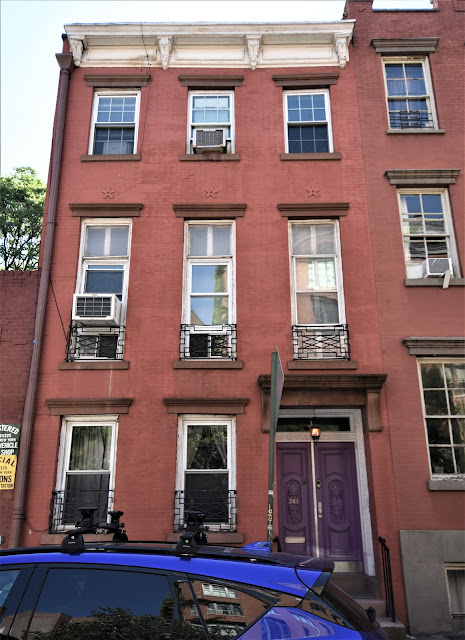
David Roelef Doremus was listed as a "surveyor and builder" with an office at 7 Wall Street in 1854.  That year he erected a 19-foot-wide, brick-faced house for his family at 741 Greenwich Street, between Perry and West 11th Streets.  A short stoop led to the double-doored entrance.  Tall French windows graced the second floor, and ornate foliate brackets upheld the cornice.

Doremus had married Ann Van Riper in 1822.  By the time they moved into their new home, most of their nine children were grown, although at least two--14-year-old Cornelius David, and 8-year-old Helen Matilda--lived with them.  

Doremus was upper-middle class.  In 1860 he co-founded the Franklin Savings Bank, Inc., and he was a manager of the North-Western Dispensary on Eighth Avenue.  By then he had moved his family far north to 241 West 82nd Street, having sold 741 Greenwich in 1856 for $6,500--around $205,000 today.

Catherine A. Putnam occupied the house in 1862.  Calling herself Madame Parselle, she ran a "lying-in asylum," where women stayed during their pregnancies and recovered after birth.  Almost all of her clients were unmarried and, in truth, Catherine Putnam was in the baby business.

On June 15, 1862 two advertisements appeared in the New York Herald.  One read, "Any person wishing to adopt a beautiful baby from its birth, either male or female, can do so by calling at 741 Greenwich street."  The other said, "Children taken for adoption and adopted out at the Infant Nursery; also ladies taken to board by Madame Parselle."

Women who simply dropped off newborns to be adopted rather than board here during their pregnancies were charged $30--around $500 in today's money.

Catherine Putnam styled herself as a doctor, as well.  An ad in the New York Herald on June 4, 1864 read:  "Madame Parselle--Female Physician and midwife, is now ready to receive all lady invalids; comfortable rooms expressly for ladies during confinement.  Call at 741 Greenwich street."  

On one hand, her services were invaluable.  Unwed women who found themselves pregnant were in serious trouble.  The ramifications of being considered a "fallen woman" included public censure and the inability to find work, even as a domestic.  At Madame Parselle's lying-in asylum they could essentially hide out until the birth, after which the adoption of the baby was quietly taken care of.

The other side of that coin, however, was dark.  In January 1868 a coroner's inquiry delved into the activities of the house following the death of a month-old baby boy.  Testimonies of servants painted a grim scene.

Catharine Connolly was a washer woman who worked here two days a week.  It was Catharine who had taken the infant's body to the Board of Health for a burial permit.  She said in part:

I think I have taken four or five dead children from this house; they were all wrapped up in the same way as deceased was; Mrs. Parselle gave me the children to take; her right name is Putnam...I think there was an average of about one death in two months in Greenwich street; the children generally got placed out.

A clue to the deaths came from Catharine Smith, who helped take care of the newborns.  She said, "I give them aerated bread, with milk and sugar, to eat; we boil the bread in water, then put in the milk and sugar."  Dr. James W. Ranney testified, "Taking children from their mother's breast and feeding them on spoon victuals tends to shorten their lives."  He added, "treating children in this way might be regarded as disreputable."

The verdict of coroner's jury did not fare well for Catharine Putnam.  On January 25, 1868 the New York Herald reported, "They find that death was hastened by want of proper care on the part of Catherine A. Putnam, alias Mrs. Parselle, and believe that establishments of the kind kept by her are the means of causing great infantile mortality and tend to the increase of immorality and crime.  They recommend that proper steps be taken to break up this and all similar institutions."

The recent history of 741 Greenwich Street may have prompted the wording of an advertisement following Catharine's departure.  "Parlors in suites or single; also a Reception Room, with privilege of housekeeping, suitable for genteel parties of respectability; house contains the latest improvements."

The owner, however, seems to have encountered problems finding and keeping a tenant.  It was advertised for rent in April 1869 for the equivalent of $2,125 per month today, and again in April 1870, and yet again in March 1873.

That year it was leased by John Smith, who was the victim of a shocking crime five months later.  On the night of August 24, 1873, Smith got into a coach and told the hackman, James Byrnes, to take him to a hotel.  The next thing he knew it was the following morning.  The New York Herald reported, "he woke up in a livery stable yesterday and his money was gone."  Smith had had $150 in his pocket--a significant $3,35o today.

Smith had Byrnes arrested.  He professed his innocence to Judge Hogan.  "Byrnes denied all knowledge of the money and said if the complainant was robbed at all it must have been by some person he took in the coach with him."  The judge was not convinced and held Byrnes on the equivalent of more than $22,000 today awaiting trial.

Painted purple today, the entrance doors and the surround are exquisitely carved.

Henry Drugan lived at 741 Greenwich Street in 1889 when he became involved in what devolved into a horrifying incident.  On the evening of October 29 Drugan was "staggering along the sidewalk very drunk," according to the New York Herald.  He encountered a group of children, including eight-year-old Joseph Brennan, playing in the street.  Drugan's obvious inebriation was a source of amusement for the boys.

"The children began to hoot at him and he seized Joe [Brennan]," said the article, "and raising him up over his head he flung him to the sidewalk."   Two days later the newspaper entitled an article "Little Joe May Lose His Life," and said, "The child was picked up unconscious and has remained insensible most of the time since."  Drugan was arrested for drunkenness and was held in jail "to await the result of injuries inflicted on little Joseph Brennan."

Patrick McGrath, who lived here four years later, was apparently a very sound sleeper.  At 4:00 on the morning of January 22, 1893 Policeman McCluskey arrested longshoreman Charles Howard on Bethune Street.  The Press said Howard was "weighted down with several suits of clothes."  At the station house a letter was found in the pocket of a coat addressed to "Patrick McGrath, No. 741 Greenwich street."  Police went to the house to check with McGrath.

"He was asleep, and as Howard had taken away everything, even his hat, he was forced to fall back on the generosity of neighbors to supply him with enough apparel to go to court," said The Press.  Howard was charged with burglary and held for trial.

Daniel J. Quinn purchased 741 Greenwich Street around 1897.  His wife, Bridget, ran it as a boarding house.  Among the boarders that year was Thomas Hogan, who was employed in the New York Biscuit Company's cracker factory on West 15th Street.  He worked nights in the cutting room, where the flat rolls of dough were cut into crackers.

On the night of August 28 that year, Hogan and three other employees took a meal break.  Upon their return all but Peter Dogget resumed work in the cutting room.  He went into the mixing room.  Ten minutes later the others heard Dogget scream.  The Sun reported he had "fallen or been thrown into a dough mixing vat, where he was cut to pieces by the revolving knives."  The coroner's jury ruled his death accidental, but five months later the investigation was renewed.

Dogget's sister received a letter from her mother in Ireland with new information.  She said Dogget had been murdered and there was only one witness, an Irish immigrant named Jack.  The letter said "the murderer had given him money to get out of the country as soon as possible," according to The Sun.  The employees, including Thomas Hogan, were interviewed again.  But it seems to have been a mere formality.

"Capt. McClusky said that he knew of no law which would compel the witness of the alleged crime to come back to New York against his will.  Therefore, he did not see that he could do anything more about the case at present," said the newspaper.

Also living at 741 Greenwich Street that year was Charles Whitemore, Jr.  He seems to have made extra money by working for rookie Policeman Gustave A. Gayer.  The New York Herald said on April 20, 1897, "Whitemore is alleged to be a 'stool pigeon' for Gayer."  The problem was that the information Whitemore provided was contrived.

The scheme came to light during the trial of Robert McGee, a wagon driver, on April 19.   He had been arrested by Gayer for carrying "knockout drops" (the same substance used on John Smith two decades earlier).  According to the New York Herald, "McGee alleges that he is the victim of a conspiracy between Gayer, who has been a policeman less than a year, and Whitemore."  Gayer's scheme to distinguish himself by making multiple arrests fell apart when the judge in this case realized that Whitemore had been Gayer's witness in at least two earlier cases.

Resident William Reilly was even shadier--and more brazen--than Whitemore.  On November 9, 1898 the Morning Telegraph reported, "Daniel McGrady, who lives on the second floor of 3232 West Eighteenth street, was awakened early yesterday morning by feeling a human hand drawn slowly over his face."  McGrady realized that a burglar was in his room who, he surmised, might murder him.  "He therefore remained perfectly still when the burglar struck a match and held it in front of his face, and pretended not to awake."

The sneak thief was William Reilly who, satisfied that his victim was sound asleep, lit a candle and proceeded to search the room.  When his back was turned, McGrady "gave a yell that aroused the household."  He rushed to the door where Reilly attempted to block his escape.  Although he was knocked to the floor, McGrady managed to get to his feet and run down the stairs and out to the street, shouting for a policeman.

Policeman McDonald accompanied McGrady back to the house.  It appeared that Reilly had escaped but, according to the New York Herald, "just as the policeman was about to leave, McGrady heard something stirring under the bed, and Riley [sic] was found hiding there."

Among the Quinns' boarders in the first years of the 20th century was John Lynch.  When the United States entered World War I, he joined the army and was sent to fight in France.  He would not return home.  A private in Company H, 115th Infantry, he was killed in action on September 18, 1918.

The Quinns' son, James, operated a taxicab at the end of the war.  On February 8, 1923, he reported his cab stolen and it was spotted at 116th Street and Second Avenue by Patrolman James Walsh.   As the officer pursued the cab, he was shot in the stomach.  The Brooklyn Standard reported, "The shot is believed to have been fired either by the driver of the taxi or a man inside."  Quinn's cab was found abandoned ten minutes later, and Walsh, who was driven to the hospital by a passing physician, survived.

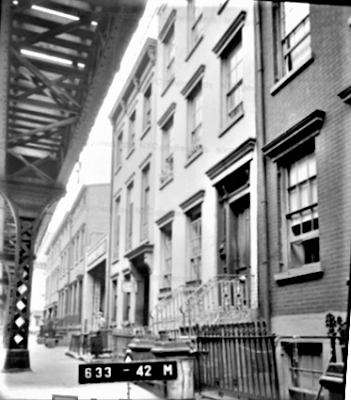
A sign advertising rooms for rent hangs in front of 741 Greenwich Street around 1941. The Ninth Avenue elevated train tracks still ran down the center of Greenwich Street.  via the NYC Dept of Records & Information Services.

The house remained a single family home until a renovation completed in 1957 resulted in an apartment in the basement.  Although the French windows of the second floor have been replaced, the striking carved Italianate entrance doors survive, as does the overall appearance of David Doremus's 1854 home.

photographs by the author
LaptrinhX.com has no authorization to reuse the content of this blog