Showing posts with label flemish revival architecture. Show all posts

Tuesday, January 31, 2023

The John P. Kirwan House - 118 West 88th Street


In 1886 developer William J. Taylor began construction of a row of eight narrow homes along the south of West 88th Street, between Columbus and Amsterdam Avenues.  Architect Samuel B. Reed  designed them in a delightful jumble of revival styles--Flemish, Romanesque, and Renaissance.  Completed the following year, while they shared enough elements to make the row pleasantly cohesive, each house was individual.  

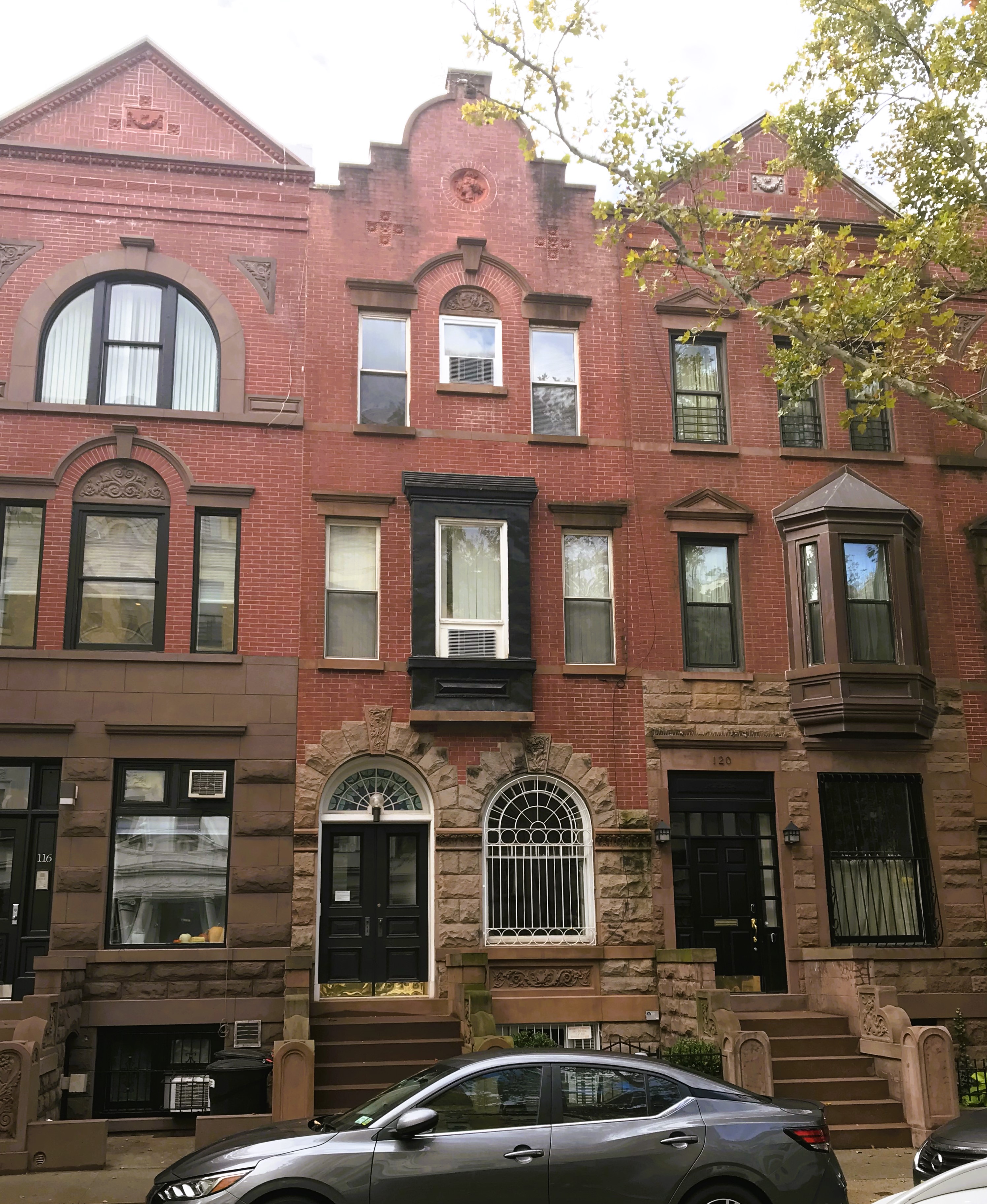
Like its neighbors, 118 West 88th Street was a mere 15.6 feet wide.  Its basement and parlor levels were clad in rough-cut stone.  Chunky stone voussoirs rose to foliate-carved keystones over the parlor openings.  A shallow, square edged oriel distinguished the second floor, while the third floor windows were arranged in a Palladian-inspired configuration.  A brownstone eyebrow connected the lintels of the end windows, and a terra cotta portrait of a man filled the tympanum of the center opening.  Above it all rose a dramatic Flemish gable, decorated with a terra cotta roundel with a striking female profile.

The execution of the female terra cotta bas relief was far superior to its carved stone male counterpart below.

In October 1887 Taylor sold the house to "a Mrs. Walsh," according to the Record & Guide, for $19,000 (about $558,000 in 2023).  It was common for real estate buyers to initially hide their identities, and Mrs. Walsh was, in fact, Harriet E. Barney, the wife of theatrical agent and manager Ariel N. Barney.

Barney managed several well-known stage performers, but none was more famous than Julia Marlowe.  Their professional relationship was nearly ended by a horrible accident in January 1889.  That night Julia was standing in the wings, just offstage, under a heavy piece of scenery.  The Evening World reported that she "received a portion of its woodwork upon her head.  This produced a compound fracture, and it is doubtful, even if she recovers, that her reason will remain."  The article noted, "Mr. Barney [has] watched her day and night."

Only a month later Marlowe had recovered sufficiently that The Evening World reported, "Mr. Barney is delighted because next season his little star will devote twenty weeks to four big cities--New York, Chicago, Philadelphia and Boston."  Harriet Barney and the West 88th Street house saw little of Ariel during that winter theater season, as he traveled with his troupe--notably Julia Marlowe--from city to city.

In July 1891 the Barneys sold 118 West 88th Street to another theatrical manager and producer, J. Wesley Rosenquest, and his wife Minnie Coote, for $18,000.  (It was a significant discount from what the Barneys had paid.)

Born in Brooklyn in 1859, Rosenquest entered the theatrical profession as a youth.  The manager of the Bijou Opera House and the Fourteenth Street Theatre, The Evening World called him "one of the best-known theatrical men in the country."

James Wesley Rosenquest, Notable New Yorkers of 1896-1899 (copyright expired)

Minnie was a member of the chorus of the Lydia Thompson Burlesque Company when the two met.  It seems that things were not always placid within the West 88th Street house.  Minnie would later testify that she lived "in fear of her bodily safety" and that her husband "stormed and raged and wound up by assaulting me and tearing my clothing and driving me out."

The Rosenquests' residency would be relatively short.  They lost the house in foreclosure in December 1896.  It was purchased at auction by real estate operator John P. and Julia M. Kirwan.  

The Finance and Commerce of New York and United States would call Kirwan in 1903, "One of the best known and oldest established real estate experts in the fashionable uptown district of New York City."  Kirwan's business focused on the Upper West Side "where palatial hotels, magnificent apartment houses, and residential palaces are springing up as if by magic on every side," said the writer.

John P. Kirwan, from The Finance and Commerce of New York and United States, 1903 (copyright expired)

John and Julia had three sons when they purchased the house.  John Stanislaus (he would later often use Stanley as his middle name) was five years old, Raymond was four, and baby Arthur was just eight months old.   Two years later, in October 1898, a fourth son, Robert L. was born, 

Also living in the house was Julia's sister and brother-in-law, Lucy A. and John J. Commins, and two Irish-born servants, Mary Fitzpatrick and Katie Hughes.

In 1905 a terrifying outbreak of typhoid fever swept New York City.  Robert fell ill and, according to the New York Herald, "Mr. and Mrs. Kirwan insisted upon caring for him themselves.  They said that his chances of improvement would be better if his mother and father were his nurses."  It was a decision they would most likely regret.

A second son came down with the fever and another suffered an accident.  The Kirwans' summer home was at Quogue, Long Island and John went there in July to ready the house "so that one son who was suffering from typhoid fever and another son whose arm had been broken might go there to recuperate."  While he was there alone, John contracted the dreaded disease.  The New York Herald reported, "It had become impossible for Mr. Kirwan to leave Quogue because of the gravity of his own illness."

On July 10, 1905, little Robert died in the 88th Street house.  By then John's condition was perilous.  Doctors told Julia that John could not be told, fearing "the shock of the disclosure would prove fatal to him."  The New York Herald said he was "intensely devoted" to his sons.

With intense bravery, following Robert's funeral Julia took the boys to Quogue so she could tend to her husband.  They were warned not to tell their father of their brother's death.  When he would ask about Robert, the New York Herald explained, "Each time he has been that the boy's condition is improving."  The article said, "So far Mrs. Kirwan has escaped illness, but last night she was almost worn out from anxiety.  Since her husband was stricken she has not been able to eat or sleep much and the physicians in attendance upon her husband fear that she may become ill."  Thankfully, all members of the Kirwan family recovered.
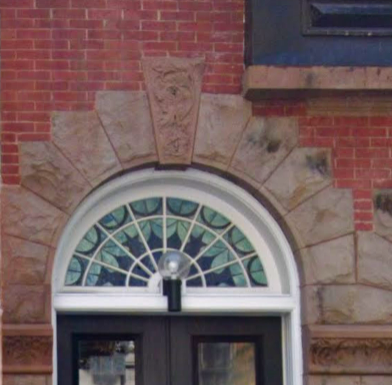
Colorful petals of stained glass form the fanlight above the entrance.

In 1910, 19-year-old John S. Kirwan met 17-year-old Jean Gazlay Donaldson, who was attending school at Dobbs Ferry.  A romance bloomed--one firmly objected to by Jean's mother.  To distance the two, Emma Donaldson laid plans to send her daughter to a European school.  Jean discovered the plot and the teens eloped to New Jersey.  It was a short-lived marriage, annulled in April 1913, after which John moved back into the West 88th Street house and joined his father's business.  (Jean, incidentally, would go on to have five more husbands and a life highlighted by wealth, charges of criminality, and celebrity.)

Raymond became engaged to Dorothy Lazarus in 1913.  The couple was motoring in Long Island that summer when Raymond was pulled over for speeding.  The Brooklyn Daily Eagle reported that he was driving "at a rate of thirty-eight miles an hour over the Hempstead Turnpike."  His heavy foot cost him a $15 dollar fine--a significant $450 today.

Arthur graduated from Harvard in 1916.  The previous year his brother John had left their father's business to to go Europe to volunteer with the Red Cross Ambulance Corps.  Upon America's entry into the war, John joined Squadron A of the New York Cavalry.  While in training at Camp Holabird in Baltimore in 1918, he suffered a serious accident from which he would never recover.

John Stanislaus Kirwan died at the age of 29 in the West 88th Street house on July 5, 1921.  The Evening Telegram attributed his death to the injuries received at camp.  

Julia Kirwan had died around the time that John left for the war.  On November 15, 1925, The New York Times reported that her estate had sold 118 West 88th Street, noting, "This marks the first sale of the house in twenty-eight years.  It was purchased for occupancy."

The house was lost in foreclosure during the Depression years, but remained a single family house.  Otto von Strotha leased it for his family home in 1933.  But when it was rented again in 1939, it became a rooming house.  

In April 1940, 27-year-old Peter Paul Waskiewicz rented a room here.  Unknown to the landlord, Waskiewicz, who had a home in Ridgewood, Queens, was a Teamster boss who was out on $1,500 bail.  He was a defendant in the FBI's case against 36 union officials charged with racketeering.  Waskiewicz was scheduled to appear in court on April 30, but he did not appear.

Later that day, a patrol car was called to 118 West 88th Street to answer a call of an attempted suicide.  They found a man unconscious, suffering from gas poisoning.  Upon being revived "after considerable effort by an ambulance physician," he was taken to Bellevue Hospital.  A union card identified him as Waskiewicz.  An additional charge of being a fugitive from justice was added to his alleged crimes.

118, at right, creates part of a charming ensemble. 

The house was converted to apartments in 1955.  A subsequent renovation, completed in 1991, resulted in a duplex apartment in the basement and parlor levels, two apartments on the second floor, and one on the third.

photographs by the author
LaptrinhX.com has no authorization to reuse the content of this blog

Tuesday, December 13, 2022

The John Schmieg House - 313 West 88th Street


Millionaire William E. D. Stokes turned to real estate development in the late 1880's, focusing on the Upper West Side.  For three years, from 1887 through 1890, his rows of homes were designed by architect Joseph H. Taft.  In 1889 Taft designed a row of four brown-fronted residences on the fashionable block of West 88th Street, between Riverside Drive and West End Avenue.  As he often did, the sometimes eccentric Stokes listed the owner of record not as himself, but as W. Gunn and A. Grant.


The sole survivor of the row, completed in 1890, is 313 West 88th Street (the others were demolished in 1927).  The 19-foot wide house rose four stories above an English basement, its stoop rising to an entrance tucked within a cantilevered portico upheld by a single corner column.  The three-sided bay of the second and third floors provided a balcony to the fourth.  Flemish stepped gables at the front and eastern side gave the house a Dutch feeling.  Inside were 14 rooms and three baths.

By the turn of the century 313 West 88th Street was owned by Lloyd Williams.  Boarding with the family in 1904 was 20-year-old Frank Bry, who described himself to police as a "professional bicycle rider."  He was arrested as a suspicious person on August 5 that year when, according to The Evening Telegram, he and two other men and a woman "were seen in Central Park spreading a quantity of silk handkerchiefs and watch fobs and guards on the grass."

Williams sold the house in March 1905 to John Schmieg and his wife, the former Minnie Lenora Hoffman.  The couple had a 17-year-old daughter, Florence Bell.

Born in 1863, Schmieg was a partner in the "gentlemen tailors" firm James W. Bell Son & Co.  (His close personal relationship with its principal may have accounted for his daughter's middle name.)  The shop catered to an upper-class clientele like Nikola Tesla, known for his sense of style, who reportedly had nearly all his suits made by James W. Bell & Co.

John Schmieg, The American Tailor & Cutter, January 1892, (copyright expired)

Like their well-to-do neighbors, the Schmiegs had a country home.  Theirs was at Larchmont Manor on Long Island.  The Schmiegs' social status resulted in their being invited to the inauguration of President William H. Taft in March 1909 by Almet Reed Latson, president of the exclusive Union League Club.  The Brooklyn Daily Eagle reported that the Schmiegs "brought their charming daughter, Florence Bell, along."

Latson had invited another couple, John William Tumbridge and his wife, as well.  Florence Bell and Mary Grace Tumbridge immediately formed a friendship, and Mrs. Tumbridge escorted her to the Inauguration Ball. 

The Tumbridges lived in the elegant Hotel St. George in Brooklyn Heights.  John William Tumbridge's father, William, was its proprietor and one of its managers was John's younger brother, Stanley Spartan Tumbridge.  When the families returned to New York, Mary invited Florence to her home.  

The Brooklyn Daily Eagle explained that Stanley "was duly presented to Miss Schmieg by his sister-in-law."  Young Tumbridge had graduated from Rensselaer Polytechnic Institute in 1900 with a degree in civil engineering and a year later earned his degree in mechanical engineering from Cornell University.  The Brooklyn Daily Eagle said the couple's introduction led to "a brief and ardent courtship."

Indeed, the chance meeting at the Presidential Inauguration had resulted in romance and only nine months later, invitations had been sent out for the Stanley's and Florence Bell's marriage.  On December 31, 1909, The Brooklyn Daily Eagle reported that the prospective groom "is also an enthusiastic autoist and it is said that he 'popped' the question to Miss Schmieg while she was autoing with him one day last summer to Garden City."  The article described Florence as "beautiful and accomplished," saying, "She is an expert musician and has achieved fame among her friends for her dexterity in ceramics."

The wedding took place in All Angels' Protestant Episcopal Church on January 18, 1910.  The New York Times reported that following the ceremony, a reception was held in the West 88th Street house.

The Schmiegs stayed in the West 88th Street house for another decade, selling it to S. L. Pakas, a real estate dealer, in June 1920.  Pakas paid $38,000 for the property, or about $514,000 in 2022 terms.  It is unclear whether Pakas lived in the house or leased it.  The affluent lifestyle of its occupants, nevertheless, was evidenced by an ad placed by a servant looking for new position in August 1922, "Japanese, experienced, wishes position; cook, useful butler, general housework, and can drive car.  S. Nako."  (In the 1920's it was quite fashionable to have a Japanese butler.)

The stoop was intact in 1941, and the parlor windows were still full-height.  via the NYC Dept of Records & Information Services.

It appears that the house was lost in foreclosure during the Great Depression.  Fannie Schreier purchased it from the Bowery Savings Bank in August 1931 for $25,000.  A widow, her husband John had died in 1920.  The motorcycle cop had been struck by a taxicab in 1916 and, after two operations, died of his injuries four years later.

Fannie Schreier most likely took in roomers, but, surprisingly, 313 West 88th Street remained a single-family home until 1972 when it was converted to two apartments per floor.   The stoop was then removed and the entrance lowered to the basement level.  The brownstone was given a coat of white paint, most likely in an effort to give it a more modern look.  At some point around the turn of the century, the paint was happily removed.


photographs by the author
LaptrinhX.com has no authorization to reuse the content of this blog

Tuesday, December 13, 2016

The Lew Fields House - No. 307 West 90th Street


In October 1898 Clarence F. True filed plans for seven upscale houses which wrapped around the northwest corner of 90th Street and West End Avenue.  He received the commission from developers John T. and James A. Farley, who did business as Terrance Farley's Sons.  As the rowhouses were being constructed the Record and Guide commented on the brothers, saying on December 22, 1900 that they "have always been engaged in the building of the best residence improvements and have always kept abreast of the continually increasing demands of the times."

Clarence True was prolific on the Upper West Side and routinely turned to historic styles for his inspiration.  And he often mixed and matched disparate styles with gleeful abandon, as was the case with No. 307 West 90th Street; part of the Terrance Farley's Sons project.

Completed in 1901 the 18-foot wide, five-story residence was designed in the American basement plan which did away with the tall stoop so popular for the past half century.  Two bays wide, True designed the first four floors in an exuberant Renaissance Revival style--its bowed red brick front decorated with conspicuous limestone quoins, two appealing balconettes at the second floor, and an arched Renaissance-style entrance almost identical to that around the corner at No. 627 West End Avenue.  At the top floor True changed gears.  He abruptly turned from Renaissance to Flemish Revival, designing the attic level as a flamboyant Dutch gable fronting a red tiled pitched roof.


William Cumming Story and his wife, the former Fannie Ella Daisy Allen, moved from Central Park West to the 90th Street house.  Story was vice president of the American Savings Bank and vice president of the Standard Statistics Bureau; but it was his wife who claimed the spotlight.

Fannie Story's American roots were deep.   Her English and Dutch ancestors included an uncle, Enos Throop, who served as Governor of New York, and Stephen Allen, the first elected Mayor of New York.  Fannie followed the family's political traditions, serving as President General of the Daughters of the American Revolution, President of the Republican Women's Club and President of the City Federation of Women's Clubs.

The style morphed from Renaissance Revival to Flemish Revival at the attic floor, where Oscar Hammerstein and Herbert Fields later wrote songs.

The Storys had three sons, Allen, Harold and Sterling, and the family maintained a summer "cottage" in on Long Island in Cedarhurst.  And while the Storys were visible in society, the majority of Fannie's entertainments were related to her various offices.  On Thursday, January 30, 1907, for instance, she held a bridge party for the Manhattan Chapter of the Daughters of the American Revolution.

William Cumming Story did not simply sit at home while his wife was at meetings, teas and conventions.  In October 1908 he was inducted as a member of the West End Association; a civic group formed to promote improvements on the Upper West Side.

Rather surprisingly, the fight for office within the Daughters of the American Revolution was sometimes cutthroat.  In April 1908 Mrs. Donald McLean, the incumbent President General, supported Mrs. Matthew Scott, who was running against Fannie Story.  The McLean camp sent out a letter to all delegates to the upcoming congress.  It praised Mrs. Scott for her interest in the proposed Continental Hall in Washington D.C.  The Sun reported on April 9 "As for Mrs. William Cumming Story, who is running against Mrs Scott, the letter says that she doesn't care a continental for the hall, in fact is almost opposed to it."
Fannie Ella Daisy Allen Story -- from the collection of the Library of Congress

The fight was on.  "As soon as Mrs. Story's adherents heard about the letter they decided to get out one of their own, and accordingly they hastened to headquarters to obtain a list of accredited delegates and alternatives."  But the D.A.R. officials refused to release the mailing list.  "Mrs. Story's supporters had forgotten that the McLeanites are at present in control of the organization machine and that nothing can go out from headquarters without their sanction."

A reporter called at No. 307 West 90th Street to ask Fannie about the letter.  She said "I have no personal feeling against Mrs. Matthew Scott, who is running against me."  Confident of her win, Fannie said "I shall do everything possible to encourage Mrs. Scott to use her splendid abilities for the advantage of the cause dear to us both."

Fannie was president of the City Federation of Club Women at the time.  The following year was an election year and the fight was no less ruthless than the D.A.R. campaign.  The New-York Tribune opined on January 10, 1909  "'If any Tammany politician wants pointers in the art of manipulating elections let him come to us.'  This is the substance of remarks that may be heard among almost any group of clubwomen in these degenerate days."

Outspoken and opinionated, Fannie Story made her views known.  Indifferent to the feathers she might ruffle, she rallied for women's right to vote and railed against the pacifists concerned about war in Europe (all three of the Story boys would fight in the coming World War I).  And when she was asked to speak at a July 4 celebration in 1910, she may have surprised some in the audience.

While other speakers recalled patriotic feats of George Washington or Thomas Jefferson, Fannie spoke only of women--like Dolly Madison, Margaret Corbin (who helped to defend Fort Tryon), and Catherine Schuyler.  The New-York Tribune reported "She said that they suffered for their country as much as the men did."

About the time of the Independence Day speech the Storys had left West 90th Street.  The 1910 census shows the Lew M. Fields family in the house.  Lewis Moses Shanfield used the stage name Lew Fields.  As half of the enormously successful comedy team Weber and Fields, he had amassed a personal fortune.  The team broke up in 1904 when Weber took over operations of a music hall.  But the multi-talented Fields forged on as an actor and comedian, producer and theater manager.

Lew Fields, photo from The Actors' Birthday Book, 1909 (copyright expired)

With Fields had married his wife when she was 17 and working as a toy buyer for the Namm department store in Brooklyn.  They now had four children, Joseph, Frances, Herbert and Dorothy.  Also living with the family was Bob Harris.  He was the uncle of the Fields children, but was only five years older than Joseph.

Joseph seemed to find himself always in trouble. On December 29, 1911 The New York Times reported that Patrolman Boshamer noticed posters on trees along Broadway between 88th and 92nd Streets.  He tore them down; but when he returned later new ones had been tacked up.  He saw two boys busily replacing the posters.

"One of them was young Fields and the other was Herbert [sic] Harris, who lives with the Fields family at 307 West Ninetieth Street," noted the newspaper.  The boys appeared before a judge on December 28, who, "after giving the lads a kindly lecture, fined them east $1, which they paid."

Joseph and his brother Herbert attended De Witt Clinton high school.  In his senior year Joseph had missed so many classes he was in serious trouble.  He brought his father to school to smooth things over.  School officials, however, were not duped.  The youthful Bob Harris made a poor surrogate for the mature (and well-known) Lew Fields.

It ended with Joseph and his brother, Herbert, being expelled from De Witt Clinton; but they dared not tell their father about it.  Decades later Joseph told their astonishing story to Karl Schriftgeisser of The New York Times.  The reporter explained "They sold themselves to a private school as what used to be called, in less honorable days, 'ringers' for the football team.  That meant free tuition, and somehow they managed to be graduated without Lew getting wise."

Lew Fields continued to have theatrical successes, including his 1911 Hen-Pecks co-starring Vernon Castle, and his 1920 Poor Little Ritz Girl, with songs by Rodgers and Hart.  And so it was no doubt a shock to most who read the New York Times headline on August 21, 1921 "LEW M. FIELDS BANKRUPT."  The actor's attorney, Jacob I. Berman downplayed the situation.  He told reporters that Fields "had been forced to take the step because he wished to take a position without having his means of livelihood attacked by creditors."  He said that Fields would continue making payments "until the slate was clean."

In the meantime, although their mother vocally opposed their entering show business, the Fields children showed extraordinary talent.  The family was still on West 90th Street when, in 1922 Lorenz Hart and Herb Fields came up with an idea for a musical, Winkle Town.  Hart's biographer, Gary Marmorstein, wrote in his A Ship Without a Sail: The Life of Lorenz Hart, "The premise was so intriguing to Oscar Hammerstein II...that he offered to work with Herb Fields on a book for the show.  Fourteen or fifteen Winkle Town songs were written on the top floor of the Lew Fields house at 307 West Ninetieth Street."

Dorthy became a lyricist, sometimes working with Herbert.  Among her memorable songs would be "I Can't Give You Anything But Love," "I'm in the Mood for Love," "On the Sunny Side of the Street," and "The Way You Look Tonight," which won her an Academy Award.

Bad boy Joseph eventually became a Hollywood scenarist.  He teamed up with Jerome Chodorv.  Their main success was the screen dramatization of My Sister Eileen.

But before any of that happened, the 90th Street house was sold in September 1922.  In reporting on the sale, the New-York Tribune noted "The property will be altered into apartments."  The resulting renovation resulted in what a later sales report called an "apartment house for nine families."


Then in 1991 came another renovation, resulting in just two multi-floor apartments.  Flat paned windows replace the more charming curved examples that originally conformed to the bowed facade.  But overall Clarence True's delightful blend of styles survives remarkably intact.

photographs by the author

Monday, October 12, 2015

The Lost 1888 44th Street Lodging House


photo from the collection of the New York Public Library
In mid-19th century New York teemed with waifs known as “street arabs” – the orphaned or abandoned children of prostitutes, drug addicts and alcoholics -- who fended for themselves.     The dirty, neglected children slept in stairways and parks.  Some earned pennies selling newspapers or shining shoes; others turned to pocket picking or other crimes to survive.

In response, The Children’s Aid Society was formed in 1853 by Charles Loring Brace to “ensure the physical and emotional well being of children and families.”  The Society’s purpose was to serve the “large multitude of children who cannot be placed in asylums and yet who are uncared for and ignorant and vagrant.”

The Children’s Aid Society depended heavily on the donations of the wealthy in order to fund lodging houses, industrial schools, and reading rooms.  In 1887 John Jacob Astor funded the 14th Ward Industrial School on Mott Street, while almost simultaneously banker and entrepreneur Morris K. Jesup provided the money for the lodging house and school at No. 247 44th Street, at the corner of Second Avenue.

Both structures--as indeed were all the Society's buildings--would be designed by the architectural firm of Vaux & Redford.  Calvert Vaux (who will be forever be most remembered for co-designing Central Park with Frederick Olmsted) and his partner G. K. Redford filed plans for the 44th Street structure in September 1887.  In reporting on the filing, the Real Estate Record and Guide noted “The building, which is of brick and stone, four stories high, will be somewhat Flemish in appearance.”

Indeed the building, completed in 1888, was, like its fraternal twin on Mott Street, a Victorian Gothic pile of brick, terra cotta and brownstone, liberally splashed with Flemish Revival elements like the prominent stepped gables.  The delightfully irregular roof with its many dormers, chimneys, and projections, was crowned with a four-sided clock tower.

The Second Avenue El runs in front of the beleaguered structure in the 1920s.  photograph from the collection of the New York Public Library

Initially, the $65,000 facility suffered an identity problem.  First called the Newsboys’ Lodging House, it was known briefly as the House for Homeless Boys.  But by 1889 the Children's’ Aid Society had decided on the "East Forty-Fourth Street Lodging House.A year after its completion, the Society reported “This beautiful building, provided by the generosity of Mr. Jesup, has realized all our hopes and is crowded from top to bottom with poor children—in the day Industrial School., the work-shop, the Crippled Boys’ Brush-shop, the night school, and the Lodging-House.”

The report air-brushed the conditions of the indigent boys, saying “No House in the city presents a scene of busier activity or more cheerful industry.  It will be a lasting source of pleasure to the kind-hearted giver to see how much happiness and good he has scattered in that quarter of the city.”

Industrial schools city-wide offered training to orphaned or neglected boys; providing them with a trade when they entered society.  But the Crippled Boys’ Brush-Shop was unique.

The seeds for the Brush Shop were planted years before, in 1882, when a boy named Peter was run over by a freight train which severed both his legs.  The Evening World, on February 24, 1891, explained that for some years he “hid, slept and starved in wagons and areas, and finally was advised by a kindly disposed and sympathetic officer to try the Children’s Aid Society.”

William H. Matthews, Superintend of the 44th Street Lodging House searched “far and wide and high and low for suitable employment for the boy, who was strong in his arms as a young lion and perfectly willing to work.  But nobody wanted him.  ‘Crippled, you see, and would only be in the way,’ they said.”

Matthews conceived of a classroom to teach otherwise unemployable crippled boys a trade that did not require extreme physicality.   Supplies were ordered from Philadelphia, a shop was constructed and a brush maker was brought in to teach Peter the craft.  The Evening World reported “Other boys, cruelly handicapped, entered the shop, and before the first month’s report was out there were thirty at the bench.”

Young Peter became the supervisor, refusing to use “his timbers;” instead moving around the shop using his arms and dragging the stumps of his legs.  He had a sizable crew under his guidance.  The Society’s 1889 report noted “The Crippled Boys’ Brush-shop has continued during the year with good results; an average of 14 cripples have been kept at work.  In addition to this, 264 boys were given temporary employment.”

Unfortunately, in Peter’s case his early success came to a crashing defeat.  Jacob Riis later explained that the homeless boys, despite the Society’s influences, were often still victims of the outside environment.  An article he wrote for The Century Magazine in 1912 included “There is evil enough abroad in the streets. Its touch, with all that is cheap and tawdry and vulgar, from the peren­nial cigarette to the vile bar-room and worse that open upon it, sharpens the lad's wits and too often tends to dull his mor­als.”
Regarding Peter, The Evening World said “Success of heredity, or both influences, turned his head.  He took to drink, became ungovernable and was suspended.  He retaliated by getting out in the street with a pocketful of stones and riddling the windows.

The other crippled boys continued on.  They began work at 7:00 in the morning and worked until 5:00.  They received one hour break as well as a free lunch.  The boys were compelled to attend one hour of night school following work from October through March.  If they went out at night, they were required to return by 10:30 during the weekdays and midnight on Saturday.

The brush makers paid five cents to live in the house and five cents for evening meals.  If they broke curfew, they were charged extra for their beds—between 7 and 11 cents.  Those trying to get back into the lodging house after midnight would find the doors locked.

The Crippled Boys’ Brush-Shop was a commendable endeavor; but it could go only so far.  The Evening World commented “These poor little fellows are not long-lived.  Many of them die of consumption, and pneumonia is both common and fatal among them.  The majority are Irish children, friendless, helpless and homeless.”

Between 1888 and 1889 the Lodging House furnished beds to 33,474 boys who came and went.  It supplied 53,107 meals, of which 45,524 boys were able to pay their nickel and 7,583 were supplied free.  During that 12-month period, 378 boys found homes and employment.

The Children’s’ Aid Society was a favorite cause of many of New York’s wealthiest citizens.  Thanksgiving and Christmas were, of course, times when benevolence shined brightest.  The boys at the 44th Street Lodging House who routinely ate meagerly were treated to a bountiful Thanksgiving dinner, for instance, in 1894 when millionaire William Earle Dodge’s family not only paid for the feast, but joined the boys for dinner here.

Thanksgiving dinners and Christmas trees did not make routine life for the boys much improved, however.  John Widmore was 18-years old and living here in 1900 when he took the trolley to Jamaica, Queens, to visit his mother.  The boy had enough money to pay his fare to Queens, but was penniless when he tried to return.  The New York Times described him as “much emaciated, and his face was sallow, and his eyes sunken.”

When the conductor, 22-year old Thomas Chivers, realized Widmore had sneaked onto the trolley, he fought with the boy.  The motorman, 47-year old Henry Smith, joined in and they physically threw Widmore off the moving trolley.  The boy landed on a stump, causing internal injuries.  He died in Flower Hospital of peritonitis.

When a journalist from The Times questioned authorities at the 44th Street Lodging House about Widmore, they “gave him a good reputation and said he was very steady.”

Tragedy touched the lives of other residents.  On August 11, 1907 19-year old John Kelly sought to escape the city heat by swimming in the Harlem River.  He did not know how to swim, and wore a pair of rubber water wings which were slightly too large for him.

He was swimming a few feet away from a moored barge loaded with bricks when someone dived from the vessel.  Startled by the splash, Kelly jerked and his water wings dislodged and floated away.

“The boy floundered about in the water and screamed for help,” reported The Times the following day.  “Men crowded to the edge of the bank and the rail of the barge and watched the boy, but they made no attempt to haul him from the water.”

Finally the panicked, flailing boy sank for the last time.

The taint of homelessness and poverty was more powerful than the glow of heroism in the case of James Coleman.  Frustrated in its failed attempts to nab the notorious burglar Eddie Fay, the City of New York offered a staggering $17,000 reward for his capture in 1910.

On Tuesday, March 29 Coleman, described by The New York Times as “a bright-faced newsboy of 19,” was selling his papers in front of Grand Central Station.   Police closed in on Eddie Fay on Vanderbilt Avenue and a commotion ensued.  James Coleman ran to towards the scene, only to see Fay “dashing away.”

James stuck out his foot and tripped the felon.  He then jumped on the crook and held him until police could apprehend him.  A witness, Frederick Keppel, offered to write a letter testifying that it was the newsboy who detained Fay.

On April 1 the boy walked into the Mayor’s office with Keppel’s letter.   Mayor Hugh J. Grant listened to Coleman’s story and read the detailed account provided by the well-respected Keppel, a picture frame dealer with the fashionable address of No. 4 East 39th Street.

And then he sent the boy away.  “The Mayor told Coleman that the distribution of the $17,000 reward offered for Fay is not in his hands, and that he did not see how he could help him in any way.”

Two weeks later a little joy arrived at the Industrial School (which now accepted girls) in the form of 13 postcards sent from Egypt by one of the facility’s fondest supporters, Theodore Roosevelt.  The Times said on April 16, “The Roosevelts have been interested in the activities of the Children’s Aid Society for three generations.  When he was Vice President the Colonel delighted the boys of one of the lodging houses by passing ice cream and cake at one of its entertainments.”

As Roosevelt laid plans for his international trip in the fall of 1909, the class had sent birthday wishes to him that included good wishes for a “pleasant journey” and one boy added that he hoped “that you will come back and be our next President.”

The Times said the boys had followed Roosevelt’s movements through “dispatches in the local Italian newspapers.”   Now, with the arrival of the picture postcards and a sheet of Cairo Hotel stationery with the message “With all good wishes for my friends, both teachers and pupils,” the children were elated.

“The proudest children in New York today are the Italian boys and girls of Class 3A,” said The Times.  The article added “The postcard will be famed and hung in one of the places of honor in the east side school’s gallery.”

Some of the indigent boys saw the United States’ entry into World War I as one way to improve their lot.  Military service, of course, did not always end well.  On August 13, 1918 Joseph E. Becker, who could only list the Lodging House as his address, was included on the War Department’s Casualty List as “severely wounded.”

The trend continued even after the war.  In 1922, by which time the name of the facility had been changed to the Brace Memorial Newsboys’ House, 105 boys had enlisted in military service.  The number of boys sheltered and fed that year was 1,341.  That year President Warren G. Harding sent an autographed photograph inscribed “To the Brace Memorial Newsboys’ House, with cordial greetings from one who knows the sterling stuff from which real boys are made.”

In 1925 the Childrens’ Aid Society discontinued the Lodging House; converting the structure to the Kips Bay Boys’ Club in an effort to provide safe recreation space for boys living in the surrounding tenements.  The renovated structure provided “facilities for 1,500 boys, with a gymnasium, game rooms, library, showers and clubrooms.”

It would be a short-lived endeavor here, however.  Four years later the Society sold the building as a modern Kips Bay Boys’ Clubhouse was planned.   The venerable Vaux & Redford structure was demolished, replaced with a playground which in turn made way for the 1964 Olympia House apartment building.

photo http://streeteasy.com/building/olympia-house

Tuesday, October 6, 2015

The Elizabeth Home for Girls -- No. 307 East 12th Street


The unmarried Elizabeth Davenport Wheeler had dedicated her relatively-short life to the betterment of the poor.  When she died on May 3, 1890, she was the manager of the Society for the Relief of Half-Orphan and Destitute Children.

In her memory, her widowed mother and two sisters purchased the former home of the recently deceased William Bigley, at No. 307 East 12th Street.  The women donated it to the Children’s Aid Society, with the stipulation that it be used as the site of a girl’s shelter—the Elizabeth Home for Girls—which they would also pay for.

The Children’s Aid Society had been founded by Charles Loring Brace along with a few other concerned men in 1853.  Brace had been, according to King’s Handbook of New York City, “engaged in teaching some of the little arabs of the streets.”  The Society was incorporated in 1856 “for the education of the poor by gathering children who attend no schools into its industrial schools, caring and providing for children in lodging houses, and procuring houses for them in the rural districts and in the West.”

The lofty goals of the Society were clearly laid out in an address in 1857 by the group’s secretary:

 “How many idle hands will be made useful, how many petty thieves become industrious laborers, how many vagabonds turned into steady householders; how many vagrants, how many robbers, how many housebreakers, how many despairing girls and vile women, how much laziness, how much vice, how much crime, how much poverty and hunger will be saved to society in this number!  What friends to temperance there will be among these; what haters of vice, what lovers of good order and virtue, what virtuous women and strong men, who will remember the ‘pit’ in our cities from which ‘they were dug!’"

 As the Society had done for its eleven earlier structures--lodging houses and industrial schools—it commissioned the architectural firm of Vaux & Radford to design the Elizabeth Home.  It seems that Calvert Vaux, best known for his co-designing of Central Park, was the leading hand in the designs.

Construction began in 1891 and was completed in December the following year.  Like Vaux’s other Children’s Aid Society buildings, it was a blend of Victorian Gothic and Flemish Revival.  Its asymmetrical red brick façade featured a multi-paned arched opening nestled deeply with the hefty stone balcony that sprouted over the entrance, a prominent stepped gable and two charming dormers with copper hoods.


Upon the formal opening of the home on December 13, 1892, The New York Times noted “The handsome structure was designed as a home and training school for destitute girls, and is well adapted to the needs of the inmates.”  In the basement were two dining rooms, the kitchen, the girl’s laundry and drying room, “together with a large ironing, washing, and drying room for custom work, two bathrooms and closets.”

The goals of the home were evidenced not only in the laundry rooms downstairs, but in the “typewriting and sewing-machine” classrooms on the first floor.  On this level were also the office, a reading room, a waiting room for applicants and “fitting room for the dressmaking department.”

Even on the upper floors where the dormitories and bedrooms were located, the girls were not far from instructional areas.  On the third floor was the dressmaking workroom.   The roof space was not overlooked, either.   The Times said it was “so arranged as to be available for gardening purposes or as a lounging place on Summer evenings.”
                                                                     
The girls who would take up residence in the Elizabeth Home for Girls were under the close scrutiny of the matrons and Superintendent Elizabeth S. Hurley.  Mrs. Hurley, whose physician husband was killed in the Civil War, had worked for the Society since 1855 on East 40th Street in the “shanty district” then known as Dutch Hill.  The Times noted that she was given the supervision of the Elizabeth Home because of “her skill in training unruly girls and her sympathy with and affection for her charges.”

The often street-wise and difficult girls received no free rides.  In the year prior to the Home’s opening 22 girls had been training in dressmaking, 99 learned to use sewing machines, two dozen were trained in the laundry and 35 “in housework.  The New York Times reported that “108 had been sent to situations, 28 to employment, 44 returned to friends, and 4 to various institutions.”   The distinction between “situations” and “employment” was not explained, nor was the meaning of “various institutions.”

During the dedication ceremonies two society women spoke on the areas they felt were most important in molding the girls.  Mrs. Bainbridge “made a plea for spiritual training;” while Grace Dodge argued that the “geometry and physiology of dressmaking” and the “methods and management of the housewife” were prime essentials.

Residency in the Elizabeth Home for Girls was not intended to be anything but temporary.  A few years later, in 1902, Children’s Aid Society agent R. L. Neill commented that the Home was “used only until a child is fitted to become a member of a private family and until a suitable home for it presents itself.”  Becoming a “member of a private family,” of course, meant finding a job as a servant.

Wealthy New Yorkers paid for Thanksgivings and Christmases at the Society homes.  In most cases a single family chose its favorite location and annually donated the funds.  In the case of the Elizabeth Home, it was millionaire W. Bayard Cutting who year after year provided Thanksgiving feasts.

For girls who rarely received small gifts or tasted gravy, Christmas was a special day.   The day after Christmas in 1897 The Times described the holiday in the Home.   The girls, it said, “assembled early in the evening, and until supper was served they spent the time in singing Christmas carols, and when they marched into the dining hall and saw the long rows of tables covered with snow white cloths, and smelled the aroma from the well-prepared dishes, giggles and exclamations of ‘Oh, isn’t this just too lovely for anything,’ were heard all along the line.  Then after grace had been said, the clatter of knives and forks and merry conversation began.  After supper there was more singing.”

In 1901 the success of the Elizabeth Home was praised by the New-York Tribune.  “The present commodious building on Twelfth-st. has accommodations for fifty inmates, and is usually well filled.  It is well equipped with rooms for sewing and cooking lessons, a flourishing laundry, where girls may receive thorough and practical training, and pleasant rooms for evening classes in the rudimentary English subjects.”  The newspaper added “Intended from the first for the purpose of affording shelter to girls under eighteen years whose means of livelihood are precarious, it is always open to respectable girls.”

On August 14, 1901, the Tribune reported that the building next door had been purchased as an annex.  The newspaper explained that more space was needed to house “a larger number of homeless and orphan children.”

The girls in the laundry did their work in the Home; while as the other girls became proficient they were sent out into the city to work in, for instance, dressmaker shops where “meager wages are paid.”

Girls still under training lived in the Home at no charge.  Once they earned wages, they paid $1.50 per week for their “comfortable bed in the dormitory,” as described by the New-York Tribune.  The annex allowed the Elizabeth Home to accept temporary residents who were not rescued off the streets.   Young women looking for work in the city could rent a bed at 10 cents a night and receive meals for six cents.   A few lucky working girls were housed here as well.  The newspaper noted “Six small rooms, daintily furnished, are rented to those obtaining fairly good wages for $1.50 a week.”

By 1906 even the girls receiving training were asked to pay for their board.   The Department of Social Welfare’s annual report that year noted “Homeless girls are received and are expected to pay five cents each for meals and lodgings; but no one is refused shelter or food because of inability to pay.”  There had been 324 girls cared for that year, and the Home was just breaking even.  The report said the receipts were $10,942.05 and the expenses were, to the penny, the same.

After serving the Children’s Aid Society for 55 years, the 84-year old Elizabeth S. Hurley died of a heart attack in the Elizabeth Home in November 1909.  She had cared for as many as 20,000 girls and it was estimated that every year she had sent about 300 of them to various positions.  Officers of the Society announced that her influence and training were responsible “for the fact that 12,000 women have led useful lives who might otherwise have gone to evil ways.”

Elizabeth’s funeral was held in the Home on the night of November 17, 1909.  Coincidentally, above her obituary in the New-York Tribune was that of Charles N. Crittenton, “widely known as the millionaire founder of the Florence Crittenton Rescue Home for Girls.”  The two institutions would cross paths on East 12th Street within a few decades.


One of the working girls who found lodging in the Elizabeth Home for Girls in 1911 was Gertrude Williams.  She had come from Birmingham, Alabama and found work in New York as a cashier in an uptown restaurant.  She was keen to the evils of the city facing a single working girl and had no intentions of being accosted by a wolf.

She was on her way to work on the evening of April 25.  When she exited the subway at Times Square and headed down Broadway, she was aware that a man had followed her.  As she reached 39th Street she was uncomfortable enough to turn back.

Charles Stewart, described by The Times as “a dapper-looking Englishman,” said “hello!”  That was the last straw for Gertrude Williams and she slapped his face, causing his hat to fall off.  As he bent over to pick it up, a policeman nearby arrested him.

Stewart explained to the court that he had mistaken Gertrude for someone else.  “You know, Judge, it is very easy to be mistaken for some one else in this country.  Why, a woman stopped me in Fifth Avenue the other day and said she thought I was a friend.  I didn’t have her arrested.”

The judge replied “I should think not.”  Nevertheless, he did not accept Stewart’s excuse for assaulting Gertrude with a too-familiar “hello.”  “I’ll fine you $10.”

The ordeal was all too much for Gertrude.  “As Miss Williams left the court room she fainted,” reported The Times.  “She was taken to an ante room and revived.”

The Children’s Aid Society operated the Elizabeth Home for Girls until 1930.  The building was sold to Benedict (who also went by Benjamin and Benard) Lust who opened his American School of Naturopathy and Chiropractic here. Lust had purchased the word “naturopathy” from Dr. John Scheel to promote his approach to healing by the power of nature. 

His sometimes quackish medical practices included his “water cures,” one of which included standing under a running shower for eight hours without eating.  Ardently against the use of drugs, he had written the Universal Naturopathic Encyclopedia and published Nature’s Path magazine.  He also espoused the Indian concepts of Ayurveda and Yoga.

Lust’s practices did not always sit well with the law.  In 1935 he and the school’s dean, Sinai Gershanek, and its secretary, Mark B. Thompson, were led out of No. 307 East 12th Street by police.  They were charged with “unlawful granting of degrees in chiropractic.”

On November 1, 1946 the building once again became a home for homeless or troubled girls.  Two hundred persons attended the opening of the Florence Crittenton League’s Barrett House.  The shelter would house girls between 16 and 21 years old, “some of them runaways, some under the jurisdiction of the Juvenile Aid Bureau of the courts, others detained as witnesses” while trained workers “arrange for their future,” said The Times.   The newspaper described it as “designed and equipped essentially as a home, with colorful, comfortably furnished rooms.”

The Florence Crittenton League’s Barrett House remained here for decades; but the troubled girls proved more unruly those supervised by Elizabeth Hurley at the turn of the century.  On July 12, 1980 The Times reported that neighbors “say they have lost patience with the noise, violent behavior and sexual activity inside and outside.”   Even the residents and “house parents” had to admit there was a problem with some uncontrollable girls.  The newspaper said “the house parents and girls said many of the residents were lesbians” and “there were many complaints among the girls of cursing, stealing by their housemates” and even “hitting staff members.”

House parent Mary Bradley assured “But there is something good here, and there are plenty opportunities for the girls.  They just have to want it.”  Nevertheless, she admitted “A girl comes in here confused and leaves worse off in terms of respect for herself.”

Frustrated neighbors would not have to contend with the problem much longer.  In 1983 the building was converted to co-operative apartments.  While the original interiors were essentially gutted; the exterior of Vaux & Radford’s Elizabeth Home for Girls is largely untouched.

photographs by the author