Showing posts with label east 82nd street. Show all posts

Tuesday, August 22, 2023

The 1893 Emmet K. Little House - 126 West 82nd Street


Like its neighbor to the right, the fourth floor was originally a slate-shingled mansard.

Emanuel Gandolfo started his architectural practice around 1882, but it appears it was a short lived venture.  In 1885 he was commissioned by real estate operator Virgilio Del Genovese to design five four-story rowhouses on the south side of West 82nd Street between Columbus and Amsterdam Avenues.  Were it not for the survival of two of them, apparently nothing would exist of his work and there is no record of him after that project.  

Based on the pair of survivors, Gandolfo's obscurity cannot be blamed on his lack of talent.   The Queen Anne style houses, arranged in an A-B-A-B-A configuration, were splashed with touches of Jacobean Revival.  Completed in 1883, the 20-foot-wide homes were faced in red brick above the parlor level and trimmed in brownstone.

No. 126 West 82nd Street was one of the two B models.  Delicate foliate carving decorated the lower third of the Corinthian pilasters that flanked the double-doored entrance, and a grouping of three parlor windows with stained glass transoms afford extra natural light.  The second and third floor openings were framed in stone quoins, and the fourth floor took the form of a slate-shingled mansard punctured by two dormers with carved brownstone pediments.

Captured in 1941, the grouped parlor windows, the mansard roof, and the Jacobean style pediment carvings were intact.  image via the NYC Dept of Records & Information Services.

Virgilio Del Genovese rented 126 West 82nd Street until October 25, 1888, when he sold it to Emmet K. Little and his wife Emily for $41,000 (about $1.3 million in 2023).  It appears that the Littles overstretched their finances in buying the expensive property.  Little was a salesman for the National Elevator and Machine Company of Scranton, Pennsylvania, and only two years after the purchase, Del Genovese foreclosed.  In reporting on the foreclosure auction held on February 14, 1890, the Record & Guide noted, "This dwelling contains all the modern improvements."

(Things did not improve for the Littles.  Emily had left Emmet and was living in Newburg, New York in 1902 when he declared bankruptcy.  Among his listed creditors were "Virgilio Del Genovese, $7,000 due on a mortgage on 126 West Eighty-second Street, which was wiped out under foreclosure."  The debt to Del Genovese alone was nearly a quarter of a million in 2023 dollars.)

No. 126 West 82nd Street was sold twice in relatively quick succession.  John J. and Mary C. Brown purchased it at the 1890 auction, then sold it on September 30, 1892.  After being resold in July 1898, it became a high-end boarding house.  Among those living here were Alfred W. Mack, an importer and 1885 graduate of the City University of New York; and Henry A. Bostwick, a cotton yarn merchant who graduated from Columbia University in 1885.

Henry Bostwick nearly lost his life in the house on December 8, 1901.  The New York Herald reported, "When fire was discovered under a staircase in the cellar, all the tenants escaped, but Mr. Bostwick went back for money and jewels."  Bostwick's rooms were on the second floor, and after grabbing cash and jewelry, he rushed back into the hall to find himself trapped.  The New York Herald explained, "but by that time the flames had spread through the building and escape was cut off."

Bostwick ran back into his rooms and threw open the window.  "The rooms were filled with smoke and he was almost suffocated," said the article.  He made his way onto the sill course that ran the width of the building, where he sat until firefighters rescued him.  Investigators surmised that a dropped match had started the blaze, which resulted in about $142,000 in damages by today's conversion.

Repairs were made and by 1905 126 West 82nd Street was again a private residence, home to the William Henry Lippincott, Jr. family.  Born in 1844, Lippincott was a member of the Produce Exchange.  He and his wife, the former Mary Elizabeth Yates, had three children, Florence, Lansing Yates, and Alice Catherine.

In 1905 Lansing was 22 years old and a student at the New York University College of Medicine.  The ambitious young man got a summer job as a gymnastics teacher in the City Vacation Schools that year.

It was not unusual for even well-to-do families to rent rooms.  The Lippincotts placed an advertisement for top floor rooms in May 1905 that expressly excluded immigrants: "Large and small rooms on the fourth floor; table board; Americans; references."  The term "table board" meant that if the tenants wanted meals, they would be charged extra.

Having a boarder did not preclude the Lippincott women from entertaining.  On February 18, 1906, for instance, the New York Herald reported, "Mrs. William Henry Lippincott and Miss Alice Catherine Lippincott, of No. 126 West Eighty-second street, will give an at home on Tuesday next."

Lansing Yates Lippincott received his medical degree in 1908.  The following year on September 22 he married Louise Woodville Cragin.  Louise was one of four Cragin siblings who played tennis.  Only a few months before her wedding day, she participated in the 1909 U.S. Women's Nationals in Philadelphia.  The couple moved to Metuchen, New Jersey.

The entire Lippincott family had left 126 West 82nd Street in 1908, a year before Lansing's wedding.  It was once again a boarding house, now run by Samuel Hector Pelletier.  He had been in the boarding house business since 1891 and currently ran four houses on the block--120 through 126.

Among Pelletier's first boarders was Swiss-born Almeo Bouet, who turned out to be a cad.  Two years earlier, at a ball in Geneva, Switzerland, Bouet had met a 20-year-old woman named Ida Ruffy.  She later explained, "His parents are very well to do, his father being a rich architect and contractor there.  We fell in love at once.  I was a milliner, and his parents did not think I had money enough for him.  My mother, however, has some money, but she is married again, and I have to support myself."

To separate the couple, Bouet's parents sent him to America.  He promised to send for Ida as soon as he could, and wrote ardent letters that included passages like:

Write to me, I beg of you.  One single word from you will prove you have thought of me one moment, will dry one of my tears.  I see only you.  You cannot believe that enough.  My heart is torn, I cannot write any more.  I want you to be mine.  I adore you.  I would kill some one to bring you here.

Assuming that when she arrived in America she and her lover would be married, Ida sold her millinery business and boarded the steamship President Lincoln with $85 in her bag.  She landed on April 15, and six days later, The Evening World reported, "Having notified the ardent Mr. Bouet of her coming she naturally expected to step from the steamship into the manly arms so much written about.  Instead, she stepped into the detention pen at Ellis Island, where she has remained ever since, and young Bouet who lived till the day of her arrival at No. 126 West Eighty-second street...has faded apparently from the face of the earth."

To make matters worse for Ida, telegrams from Bouet's parents had arrived at the immigration office before she landed.  The Evening World reported, "Wires had been pulled by the influential papa of Amy Bouet and anonymous letters had been received making all manner of unbelievable charges against the young girl."  On the day of her arrival, the newspaper said, "The girl was handsomely gowned and had every appearance of refinement.  She also had many times the required amount of money.  Nevertheless, she was treated with the same consideration that is usually accorded a bandit."

Deemed "an undesirable alien," Ida Ruffy was scheduled to be deported back to Switzerland on the Kaiser Wilhelm.  But people who read her heart-wrenching story flooded Acting Commissioner of Immigration Joseph Murray's office with letters appealing her deportation.  Ida told a reporter a few days before the ship was scheduled to depart, "Amy has treated me very badly, yet I am sure he loves me.  But I will forget him and work."  Tragically, Almeo Bouet, who had left 126 West 82nd Street to go into hiding, never appeared on her behalf.  On April 24, the New-York Daily Tribune reported that officials had sent Ida back to Switzerland.

Among the other boarders were B. L. Amerman and his wife.  Mrs. Amerman was a vice-president in the New York City Indian Association.  Living here by 1910 was artist Olive Parker Black.  A landscape painter, Black was born in 1868 and had studied under H. Bolton Jones and William Merritt Chase.  

Early Spring is typical of Oliver Parker Black's landscapes.

No. 126 West 82nd Street was sold in August 1926 for $35,000.  The price, equal to about $584,000 today, reflected the changing tenor of the block.  Now a rooming house, it was home to Joseph Berber in 1927.  He was arrested in April that year, suspected of having stolen jewelry valued at $5,000 from an apartment in Long Island City.

Curtis Bennett rented a room here in 1933.  The 26-year-old got into a confrontation with two men at 82nd Street and Riverside Drive early in the morning of August 17 that year.  It did not end well for Bennett.  He was taken to Polyclinic Hospital with a stab wound in the abdomen.

Living here from 1944 through (at least) 1956 was Frank A. Wiseman.  The veteran sailor had served about the USS Leviathan during World War II.

126 and 128 West 82nd Street are the last remaining examples of Gandolfo's work in Manhattan.

Although the house was never officially converted to apartments according to the Department of Buildings, there are nonetheless ten units in the building.  In the third quarter of the 20th century the mansard was eliminated and the roofline squared off, providing additional headroom inside while disfiguring Emanuel Gandolfo's outward design.  The renovation resulted in the brownstone carvings in the dormer pediments being lost.  It was most likely at the same time that the parlor level was given uninspired replacement windows.

photographs by the author
LaptrinhX.com has no authorization to reuse the content of this blog

Thursday, October 21, 2021

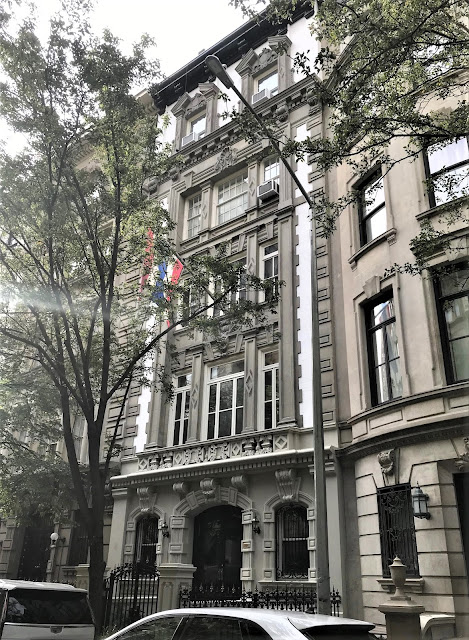
The Frederick M. Davies House - 20 East 82nd Street


In the 1870's Richard W. Buckley was deemed by the Real Estate Record & Builders' Guide to be a "rising young architect."  In 1880 he formed a partnership with developer Robert McCafferty.  Initially McCafferty & Buckley designed and erected rows of middle-class brownstone homes.  But in the 1890's they aimed at a more moneyed customer base.

In 1900 they began construction on a row of sumptuous mansions at 18 through 26 East 82nd Street.  Completed the following year, the Beaux Arts style houses were harmoniously, yet individually, designed.  Like the others, 20 East 82nd Street was intended for a wealthy buyer.  Five stories tall and 26-feet wide, it sat behind elegant areaway fencing with paneled stone gateposts.  Heavy Gibbs surrounds framed the entrance and first floor windows.  A carved stone balcony introduced the three-story midsection.  The fifth floor openings, which sat atop the bracketed intermediate cornice, wore impressive broken pediments.

Robert McCafferty's health began to fail around the time the houses were completed in 1901.  The sale of these and many other properties was held up.  After what was termed “a lingering illness,” he died in his Park Avenue home on February 11, 1905.  Two years later the McCafferty holdings finally began being liquidated.  The New York Times remarked “The sale of the real estate owned by the late Robert McCafferty is an event of unusual interest to the older generation of real estate men in New York, among whom he was for many years a leader.”
On April 16, 1907 Richard W. Buckley "as surviving partner" sold 20 East 82nd Street to Eugene Murrough O'Neill.  Born in Clonroche, Ireland in 1850, he had emigrated to Pittsburgh, Pennsylvania as a youth, "following his brother Daniel," according to The Recorder, Bulletin of the American Irish Historical Society later.  He became the editor and publisher of The Pittsburgh Dispatch and then increased his significant fortune in Pittsburgh real estate.
Eugene's brother had married Emily Martha Seely in 1867.  They had three children.  Daniel died in 1877 and two years later Eugene and Emily were married.
Eugene M. O'Neill had retired in 1902.  The purchase of 20 East 82nd Street was, presumably, a gift to Emily O'Neill, his step-daughter, who had married Frederick Martin Davies in 1901.  Nevertheless, he listed his New York address here with the Davies family.
Born in 1877, Frederick Martin Davies had graduated from Yale University in 1899.  He went into the railroad business for two years and then turned to banking.  When he and Emily moved into their new home, he was a partner in Alexander, Thomas & Davies.  The couple had a four-year-old daughter, Emily O'Neill and a one year old son, Frederick Martin, at the time.  A second daughter, Audrey, would arrive in 1912.
In 1914 Frederick "was stricken with a cold, which did not improve," according to the New York Herald.  Hoping that a change of climate would help, he went to Santa Barbara, California.  There he developed pneumonia and his condition was so precarious that his closest friend since childhood, Alfred Gwynne Vanderbilt, "obtained a special train in order to get quickly to his bedside."  
Frederick rallied and the New York Herald said, "Later Mr. Davies went to Palm Beach, Fla., and then took a yachting trip, but neither of these served to improve his health."  On May 2, 1915, Frederick Davies died in the 82nd Street mansion at just 38 years old.  Calling him a "prominent horseman and clubman," The New York Times listed his many memberships in exclusive clubs:  the Metropolitan, Union, Knickerbocker, New York Yacht, Piping Rock, University, Colony, Down Town and The Brook Clubs.
The bulk of Frederick's extensive estate went to Emily.  The will directed her to set aside $50,000, "the income to be paid to Frederick Martin Davies, Jr., until he is 25 years old, or until he shall be graduated from the Naval Academy at Annapolis.  Then he is to receive the principal."  Frederick Jr.'s father was obviously intent that his son would attend the Academy.  "Should the boy not choose to enter the academy or fail to finish his course there, the fund is to revert to the residuary estate."  His $50,000 (about $1.3 million today) inheritance would then be divided among him and his sisters.
The will also directed Emily to choose "some articles of jewelry" for Alfred Gwynne Vanderbilt as a "personal remembrance."  Tragically, on the day before Frederick's death, Vanderbilt had boarded the RMS Lusitania headed for England.  He was among the victims when the ship was torpedoed by a German U-boat on May 7.
Among other bequests was $5,000 to Burton Leopold Powley, "man servant of my father-in-law, Eugene M. O'Neill."  An Englishman, Powley was O'Neill's valet.  The position, like that of a lady's maid, resulted in close, personal relations--despite its being an employer-employee situation.
The family had always summered in Newport.  Now, in November (despite still being in mourning), Emily hired the architectural firm of Mann & MacNeille to design a summer home in Southampton, Long Island.  Upon its completion the Daily News called it "one of the show places in fashionable Southampton."
During World War I, New York socialites threw their support behind the various causes.  Emily showed her support for the troops abroad in what might seem a surprising way.  On January 15, 1918, The Sun reported, "Mrs. F. M. Davies, 20 East Eighty-second street, has generously provided some 67,000 smokes for our soldiers in France."  
Eugene O'Neill's valued manservant, Burton Powley, registered for the draft in September that year.  It may have been his age--he was 41 years old at the time--that kept him from service.  His registration form listed his address at 20 East 82nd Street.
But, ironically, being drafted might have saved his life.  Ten months later, on July 14, 1919, Powley was headed from Manhattan to the Davies country home in Southampton on a motorcycle.  Riding with him was Dora Harding.  They were about two miles from the Davies estate when the motorcycle was hit by an automobile.  Miss Harding was killed instantly and Powley died at the Southampton Hospital a few hours later.
On February 8, 1923, Emily gave a dinner party in honor of William Henry Vanderbilt III, the son of Alfred Gwynne Vanderbilt.  There was more to her tribute to the 22-year-old than the close relationship between his father and Emily's deceased husband.  Later that year, on November 1, her daughter Emily O'Neill Davies and William Henry were married in Grace Church.
The New York Times reported, "A Vanderbilt wedding naturally attracted a large crowd, but the police kept the curious well in hand, although there was a crush of women around the entrance awning."  Eugene O'Neill walked his granddaughter to the altar.  Audrey, who was now 11 years old, was the bride's maid of altar.  
Following the ceremony, the millionaire guests filed into 20 East 82nd Street for the reception.  The New York Times said the house "was simply decorated with large jars of russet oak leaves, dark chrysanthemums and small palms with white and palm hued autumnal flowers in the drawing room, where the bride and bridegroom received congratulations."
In September 1926 Eugene M. O'Neill contracted pneumonia.  He died at St. Luke's Hospital on November 26 at the age of 72.
The marriage of Emily and William H. Vanderbilt was not going well at the time.  That year rumors of trouble circulated when Emily went to Paris while William vacationed in California.  Although William told reporters upon his return to New York that "there was nothing to the reports," Emily returned to Paris that fall.  Friends said she told them "she was through with married life."
In May 1928 Emily sued for divorce.  Gossip said she was having an affair with theater producer Sigourney Thayer.  The rumors proved true when the couple was married in the East 82nd Street mansion on December 7 that year.  The New York Times reported, "The marriage comes as a complete surprise to the friends of the couple, as no preview announcement of the engagement had been made."  Not surprisingly, only immediate family members were present at the ceremony.
Arthur Mefford, writing in the Daily News, was less sympathetic in its reporting of the wedding.  He wrote, "Mrs. Emily Davies Vanderbilt, harum-scarum daughter of Mrs. Frederick Martin Davies, 20 East 82d st., and divorced wife of William H. Vanderbilt 3d, eloped yesterday with Sigourney Thayer, jack of all trades and a rival of the famed Joe Cook as a 'one man show.'"
This marriage did not work out, either.  A year later the couple divorced.  Emily Vanderbilt Thayer spent much of her time in Paris, surrounding herself with literary figures like Gertrude Stein and Alice B. Toklas.  She reputedly had a two-month affair with poet E. E. Cummings.  
The colorful and tragic Emily Davies Vanderbilt Thayer Whitfield.  from the collection of the Library of Congress.

When in America, of course, she was either at the Southampton estate or 20 East 82nd Street.  On April 20, 1930 Cholly Knickerbocker, the pseudonym of a group of society columnists, reported in the Times-Union, "Recently Mrs. Thayer has been making her headquarters with her mother, Mrs. Frederick Martin Davies, at 20 East Eighty-second street."  The writer had caught sight of her at the Madison Square Garden circus, proving "that Emily is decidedly more human than most of the ladies who have been in a position to sign themselves' Mrs. Vanderbilt.'"
Emily's place in the spotlight was briefly taken by her mother that year.  On July 19, 1930 The New York Times reported, "Cables were received by relatives here announcing the marriage in Paris yesterday of Mrs. Emily O'Neill Davies, widow of Frederick Martin Davies, to Horace Chase Stebbins...It took place very quietly in the Hotel Crillon."
There would be no time for an extensive honeymoon.  One month later, on August 21, 600 guests were invited to a ball at the Alexander Hamilton Rice mansion, Miramar, in Newport to celebrate the betrothal of the Rice's granddaughter, Diana Dodge, to Frederick M. Davies, Jr.
The wedding on December 6, 1930 in St. Thomas' Church on Fifth Avenue took up nearly a full page of the Daily News.  The article said, "It was a Social Occasion (capitals, please), with every one conscious of the fact that the Dodge-Davies nuptials were bound to be an Event.  Because of the prominence of the two families...Philadelphia, Pittsburgh and Newport were as interested in the wedding as Manhattan and sent their highest hats to attend."
Emily Davies Vanderbilt Thayer married again in 1933.  Her husband this time was mystery writer Raoul Whitfield.  This marriage would end in what could have been a chapter from one of his books.  Following her long-established trend, Emily started divorce proceedings in 1935.   The couple had purchased a ranch in Las Vegas, New Mexico called Dead Horse.  At around 7:30 on the morning of May 24 an employee entered Emily's bedroom there to light a fire.  He found her shot dead through the heart.
The Daily News wrote, "Society knew Emily Davies Vanderbilt Thayer Whitfield as either a Scott Fitzgerald flapper born too late or a member of the Lost Generation.  Born to the purple, she inclined toward the mauve."  A coroner's jury deemed the death a suicide, despite the fact that the wound was on her left side and she was right-handed, making it nearly impossible to have been self-inflicted.  Years later Lillian Hellman flatly said, "she was murdered...and neither the mystery story expert nor the police ever found the murderer."
Things had not gone well with Frederick's marriage, either.  In June 1936, Diana Dodge Davies obtained a Nevada divorce and on the day after Christmas she married George Ryan.  The Daily News described the newlyweds as "two of fortune's as well as Society's darlings."  In reporting the marriage, the newspaper recalled, "Her Park Avenue wedding to Frederick Davies, the son of Mrs. Horace Chase Stebbins...was one of the grandest at which the Best People of New York, Newport and Philadelphia have hobnobbed."
In the meantime, Horace Stebbins had adopted Audrey.  He died in Roosevelt Hospital at the age of 73 on June 2, 1947.  Eleven years later, after suffering what The New York Times called "a long illness," Emily died at the age of 82 on October 3, 1958.

The following year 20 East 82nd Street was made Thailand's Permanent Mission to the United Nations.
photographs by the author
LaptrinhX.com has no authorization to reuse the content of this blog

Thursday, October 7, 2021

The John Prentice Kellogg House - 9 East 82nd Street

 
photo via streeteasy.com


In 1894 architect Henry Anderson designed a row of four dignified rowhouses on East 82nd Street, between Fifth and Madison Avenues, for developer Daniel Hennessy.  Completed the following year, their entrances sat within a rusticated limestone base above a two-step porch.  The Greek motif of rosettes and triglyphs in the entrance entablature reappeared in the second floor frieze, as well as the frieze below the copper cornice.  The three uppermost floors were faced in yellow brick and trimmed in elaborate terra cotta.

According to the New York Herald on November 24, 1897, Ellen Prentice Kellogg purchased 9 East 82nd Street "for about $74,000."  (The purchase price would equal about $2.4 million today.)  Ellen was the widow of stockbroker Charles Kellogg, who had died in 1892.  She lived in the house next door, at 11 East 82nd Street, which she bought in 1895.  

Ellen Kellogg leased 9 East 82nd Street to Albert Gould Jennings and his wife, the former Suzanne Beatrix Crimmins.  The young couple had been married in 1894.  The location of their rental home was perfectly situated for watching the on-going construction of their mansion across the street at 2 East 82nd Street.

The couple moved into the new residence in the first weeks of 1900.  On February 3, The New York Times reported, "Mrs. Albert G. Jennings will give a large reception in the afternoon at her residence, 2 East Eighty-second Street."  

Ellen Kellogg next leased 9 East 82nd Street to the family of Henry Francis and Lena Marianna Cook.  Then, in 1906, she sold it to her only son, John Prentice Kellogg and his wife, the former Ethel Thornell.  At the same time, Ellen sold her son the Kellogg family house in Newington, Connecticut.  The Georgian-Federal style structure had been built around 1808 for General Martin Kellogg.

John Prentice Kellogg purchased the ancestral Kellogg house from his mother in 1906.  photograph by Sage Ross

Born on January 27, 1878, John Prentice Kellogg had graduated from Princeton University in 1900.  The Princeton Alumni Weekly later said, "After traveling around the world he became associated in the banking business with the firm of Strong, Sturgis & Co., of New York City, and in 1902 became a member of the firm of Schmidt & Gallatin, bankers."  Kellogg rose to the top of his profession, becoming a governor of the New York Stock Exchange.  He and Ethel would have three children, Barbara, John, Jr., and Claire.

With America's entrance into World War I, Kellogg became focused on domestic security.  He organized a fleet of patrol boats to police New York Harbor, and became head of the Marine Section of Home Defense in New York City.  He then enlisted in the New York State National Guard, serving as captain of the Motor Transport Corps until the end of the war.

During the winter season of 1918-19, the Kelloggs leased their home furnished to newlyweds John Sloane and Elsie Nicoll Sloane, who had been married June 23, 1917. 

It may have been John Kellogg's health that prompted the couple's leaving New York City's cold.  He was suffering from pleurisy, an inflammation of the lungs resulting in severe chest pain.  He and Ethel Kellogg had barely settle back into their 82nd Street home when, on April 10, 1918, the 41-year-old suffered a fatal heart attack.

Ethel sold the mansion in April the following year to stockbroker John Hone Auerbach and his wife, the former Dorothy Pennington Toler.  Their residency was short-lived.  The sold the house in August 1921 to William Fitz Hugh Whitehouse for a reported $160,000, the equivalent of $2.3 million today.

Born in 1877, Whitehouse was married to Sybil Douglas.  The couple had two children, Adelaide Frances and William, Jr.   Whitehouse had been the roommate of Alfred Gwynne Vanderbilt at Yale University.  He was perhaps best known as an explorer of Africa.  According to the 1902 book, Through the Country of the King of Kings, he was the first white man in an unknown region "south of the chain lakes."

Whitehouse (left) and Alfred G. Vanderbilt relax in their comfortable dorm room in 1899.  from the collection of Historic New England.

Like their predecessors in 9 East 82nd Street, William and Sybil Whitehouse were prominent in high society.  There were listed as numbers 357 and 358 of "The 400" in the 1904 The Ultra-Fashionable Peerage of America.

William's mother had lived in Paris for a number of years.  Nearly every year the family traveled to France to visit.  On March 11, 1924, for instance, the New York Evening Post reported, "Mr. and Mrs. William Fitz Hugh Whitehouse, of 9 East Eighty-second street, will sail for Europe on April 2.  Their daughter, Miss Adelaide F. Whitehouse, and their son, Mr. William F. Whitehouse, jr., will accompany them.  They will go to Paris to visit Mrs. Whitehouse."  The article assured its readers, "Mr. and Mrs. Whitehouse and their family will spend the summer as usual in Newport."

It may have been William's election to the State Senate in 1926 that prompted the sale of 9 East 82nd Street in March 1928 to Dr. Allan S. Blumgarten and his wife, Stella.

An endocrinologist, Blumgarten had served in the Medical Corps during World War I and was the author of several medical books.  Stella was a young widow when the couple met while she was doing Red Cross work in the war.   Their son, James H., was three years old when they moved into the 82nd Street house.

Blumgarten's talents went beyond medicine and writing.  An amateur stained glass artist, he designed and installed a window in the rear of the house executed in pastel colors.  Along with medical and musical symbols, it contains the quotation, "The vintage of wisdom is to know that rest is rust and that real life is in love, laughter, and work."

The 1940 census shows four live-in servants in the Blumgarten household, all of them in their 50's other than 31-year-old Catherine O'Donnell.  Following the Blumgartens in the house was Bridget McGovern, who died in 1953.  

photograph by the author

The residence was converted to apartments in 1959 and by 1980 the ground floor became La Boetie Gallery, which remained until about 2014.  In 2015 the gallery Oliver Forge & Brendan Lynch was here.  A recent gut renovation returned 9 East 82nd Street to a single-family residence.

no permission to reuse the content of this blog has been granted to LaptrinhX.com
Friday, September 24, 2021

The Edward J. King, Jr. Mansion - 7 East 82nd Street


In 1895 real estate developer Daniel Hennessy completed an elegant row of four 25-foot-wide homes at 7 through 15 East 82nd Street, between Fifth and Madison Avenues.  Designed by Henry Andersen, the easternmost mansion, No. 7, like its siblings, rises five stories, with three floors of yellow brick sitting atop a two-story limestone base.  An imposing five-foot-high iron fence and gate surrounds the areaway.  The entrance, above a three-step stoop, sits within fluted Greek Doric columns that support an entablature decorated with rosettes and triglyphs.

Those elements reappear at the second floor, where Doric pilasters flank the openings and uphold a frieze embellished, again, with rosettes and triglyphs.  Elaborate terra cotta frames surround the third floor openings.  Between the brackets of their prominent cornices flank the rosette motif is continued.  The triglyphs and rosettes would make yet one more appearance in the frieze of the copper cornice.

On November 5, 1897 The Jewish Messenger reported that Edward J. King, Jr. had married Jessie Rosette Ickelheimer two days earlier.  The groom was 43 years old and the bride was 26.

The following year, on August 11, 1898, The New York Times reported that Daniel Hennessy had sold 7 East 82nd Street to King.  The New York Herald placed the price "at about $85,000" (around $2.74 million today).

Edward was a partner with his brothers David and Bennett in the furrier firm of Edward J. King & Sons.  Jessie, whose parents had both died prior to the wedding, had grown up in affluence.  Her father, Isaac Ickelheimer, had been a member of the stock brokerage firm Heidelbach, Ickelheimer & Co. and a director in several banks.

The four neo-Classical style residences form an elegant, dignified row.  7 East 82nd east at the far left.

It appears that Edward's busy work schedule did not always suppress Jessie's travel plans.  On January 27, 1901, for instance, the New York Herald reported, "Mrs. Edward J. King, of No. 7 East Eighty-second street, will leave for California during February.  She will give her last at home for the season on Friday afternoon."  ("At homes" were the published days when other socialites were welcome to call.)

More often, of course, the couple traveled together.  On July 30, 1905 the New-York Tribune reported that among those "returning to the Mount Washington [Hotel]" in Bretton Woods, New Hampshire in the White Mountains were the Kings.  Two summers later they used millionaire Levi P. Morton's Pine Brook Camp on Upper Saranac Lake for the season.

After being in the 82nd Street mansion over a decade, in 1911 King commissioned the well-known architect John H. Duncan to update the interiors.  The "general alterations" cost the equivalent of around $141,000 today.

The Kings leased the house for the winter season of 1914-15 to Elihu Root, Jr. and his wife, the former Alida Stryker.    They had barely settled in when the couple became a trio.  The Utica Sunday Tribune reported, "Tuesday, October 13, a son was born to Mr. and Mrs. Elihu Root, jr., of 7 East Eighty-second street, New York City.  This is their first son and has been named Elihu Root, 3d, being a grandson of United States Senator Elihu Root."

Incursion of commerce into exclusive residential neighborhoods had been the bane of millionaires for decades.  Although the property along the 82nd Street block was protected by restrictive covenants that prevented the homes being used for commercial purposes, that was not the case on Madison Avenue.  Early in 1928 Edward J. King alerted his neighbors that undertaker Frank E. Campbell had laid plans for an upscale funeral parlor at the corner of Madison Avenue and 82nd Street.

On January 14 The Evening Post reported that the "silk stocking residents" opposed the plan.  The article explained that "fear that scenes like those that accompanied the funeral of Rudolph Valentino may occur in the midst of their exclusive neighborhood have led prominent property owners of the section to protest."  A letter to the neighbors signed by Edward King warned that their property values would drop by 25 to 33 -1/3 percent.  It said, as well:

In addition, conveyances bearing corpses of the deceased would presumably drive up with their burdens at all hours of the day and night, since the business of the mortician is known as one where the telephone never sleeps.

Frank Campbell had already purchased the property, however, and the efforts of King and his well-to-do neighbors were fruitless.

Jennie Rosette King died on May 20, 1933 at the age of 62.  Edward survived her by two years, dying in the mansion on October 11, 1935 at the age of 81.

The following year The New York Times detailed the distribution of his estate, reported at $3,110,201--more than $58 million in today's money.  Because the Kings were childless, much of the fortune went to charities, including Lenox Hill Hospital, the Trudeau Sanitarium, the Henry Street Settlement and the New York Association for the Blind.  King was generous to his loyal servants, as well.  Two maids received the equivalent of $280,000 today; and three other live-in servants received the equivalent of $187,000.

In July 1939 the King estate leased the 82nd Street mansion to Dr. Harry Gold, with the option to buy.   The New York Sun noted a surprisingly early amenity, saying the house "contained an electric elevator and is air-conditioned."  The article said, "After alterations are completed, the house will be occupied as an office and home."

Gold was a 1919 graduate of Columbia University.  Born in Russia on December 25, 1899, he was brought to the United States as an infant.  He was now a heart specialist connected with the Cornell University Medical College.  His wife, Bertha, was a professor of physiology at Hunter College.  Of their four children, three--Stanley, Muriel and Naomi--would all pursue medical careers.

Dr. Gold took advantage of his option to buy in 1942.  Five years later he became a professor of clinical pharmacology at Cornell University Medical College and would become the consulting cardiologist at Beth Israel Hospital and at the Hospital for Joint Diseases.

By 1967 he had established the Harry Gold Research Fund for Human Pharmacology, Inc., with offices in the house.  A pioneer in developing modern potent forms of digitalis for heart disease, he was given the Award of Distinction of the Cornell Medical College Alumni Association in 1971, which cited him "as founder of clinical pharmacology, which concerns the effect of drugs on man rather than on other species, and provides basic principles for evaluating the efficacy, potency and toxicity of drugs."

On April 21, 1972 Dr. Gold suffered a fatal stroke in the 82nd Street house.  He was 72 years old.  Bertha Gold died on December 25, 1987 at the age of 91.


The mansion remains a single family home today.  Interior renovations were completed in 1992, but the exterior is essentially unchanged since Edward and Jessie King moved in nearly 125 years ago.

photographs by the author
LaptrinhX.com has no authorization to reuse the content of this blog

Friday, September 17, 2021

The Edward A. Kerbs Mansion - 19 East 82nd Street


In 1894 architect Henry Andersen designed a pair of opulent homes on the northern side of East 82nd Street, just west of Madison Avenue, for developer Daniel Hennessy.  Construction took two years to complete.  

The mirror-image, 25-foot-wide mansions were an especially dignified take on neo-Italian Renaissance architecture.  Short stoops introduced the recessed entrances, flanked by Ionic columns.  The service entrances sat below oculi framed in carved, spilling cornucopia. Like the first floor, the second was clad in rusticated limestone.  Its windows were fronted by stone balustrades and flanked by Ionic pilasters.  Delicately carved shells sat atop each opening.


The upper three floors, which were gracefully bowed, were faced in light orange brick and trimmed in terra cotta.  Andersen embellished the top floors with ornate, Renaissance inspired panels and entablatures.  An elaborate terra cotta frieze introduced the bracketed cornice.

Edward A. Kerbs and his wife, Alice, purchased 19 East 82nd Street late in 1899.  Kerbs was a partner in the cigar manufacturing firm of Kerbs, Wertheim & Schiffer.  The couple had a four year old daughter, Jeanne Edith.

The Kerbs wasted little time in opening the doors of their new home to guests.  On February 22, 1900 the New York Herald announced, "Mr. and Mrs. Edward Kerbs, of No. 19 East Eight-second street, will give a large reception to-day, which will be in a measure a house warming."

During the 1915-16 winter season entertainments in the house focused on Jeanne as she was introduced to society.  It began on December 24 when her parents hosted a dance at the Ritz-Carlton for her.

The 82nd Street house was the scene of Jeanne's marriage to William Kallman on February 25, 1919.  It would be the last large event for the family within the residence.

Less than three months later, on May 12, 1919, Edward A. Kerbs died in the house.   His philanthropic lifestyle extended past death.  His will left $15,000 (a quarter of a million in today's dollars) to the Hebrew Orphan Asylum, of which he was a trustee, and $50,000 to the Trudeau Sanitarium in the Adirondacks.   He stipulated that the latter amount was intended "to erect pavilions for men and women tubercular patients."

The bulk of the estate went to Alice, with the direction that after her death it passed to Jeanne.  But should Jeanne die first, without children, "the estate is to be used to establish the Kerbs Hospital for Tubercular Diseases."

As a side note, in 1953 Jeanne honored her parents by funding the Kerbs Memorial Boathouse, designed by Aymar Embury II, in Central Park.

The Kerbs Memorial Boathouse in Central Park.  photo via the Central Park Conservancy

Almost immediately after her husband's death, Alice sold the mansion to millionaire Isaac N. Phelps.  If he intended to move in, he quickly changed his mind.  In October 1920 he sold it to John Sergeant Cram and his wife, the former Edith Claire Bryce.

Cram was president of the Dock Board and head of the New York Public Service Commission.  He was, as well, the treasurer of the Dayfield Realty Company of which Edith was a director.

Born in 1851, both the Sergeant and Webb families were socially prominent.  John's first cousin William Seward Webb was married to Eliza Vanderbilt, the daughter of William H. Vanderbilt. 

Edith was his second wife.  He had married the widow Georgiana Beatrice Budd in 1898 when he was 47 years old.  She died in 1903.  He and Edith were married in 1906 and would have three children, Henry Sergeant, Edith Bryce, and John Sergeant.  The family had a summer home in Newport and a winter house in Palm Springs, Florida.  

John Sergeant Cram, New York State's Prominent and Progressive Men, 1902 (copyright expired)

Despite her husband's highly visible government positions, it was Edith whose name appeared in newspapers more often.  She was both an ardent pacifist and an activist for human rights.

On December 1, 1921, for instance, the New York Herald reported that she chaired a meeting of the World Peace Fellowship in Town Hall the evening before.  The article said it was "attended by more than 1,000 persons, at which most of the audience signed pledges they would never engage in a war, offensive or defensive, whether it be by bearing arms, making or handling munitions, voluntarily subscribing to war loans or laboring to set others free for war service."

During World War I, men were imprisoned for "political offenses."  In 1922 the wives and children of 37 of them set off on a protest from the West Coast to Washington D.C. seeking their release.  On April 26 they arrived in New York City and paraded up Madison Avenue carrying banners with mottos like "I Have Never Seen My Daddy" and "Is Opinion a Crime in the U.S.A.?"  The New York Herald reported, "In the afternoon they went to the circus as the guests of Mrs. J. Sergeant Cram."

Edith's agenda was not all political, of course.  She routinely entertained in the 82nd Street house.  On February 21, 1924 The Sun reported, "Mrs. J. Sergeant Cram gave one of a series of dinners last evening, at her home, 19 East Eighty-second street," and on February 1, the following year--presumably just before heading to Palm Beach--she gave another.

The family received a major scare in April 1926 when the 72 year old Cram fell down the staircase at 19 East 82nd Street.  Two months later, on June 24, the Oswego Palladium-Times reported he had "failed to rally," and "is seriously ill as the result of severe injuries to his head."

Nevertheless, Edith and her daughter went to Newport that season.  On September 10, The New York Sun announced that "Mrs. J. Sergeant Cram and Miss Edith B. Cram have returned from Newport."

Edith continued with her pacifist activities, which did not go unnoticed by right-wing Ralph Montgomery Easley, head of the National Civic Federation.  In a series of articles in the New Republic in 1924, Captain Sidney Howard placed Easley at the top of his list of "self-appointed, business-backed, hell-roaring flag wavers." On May 5, 1927 Robert Dunn, writing in The Daily Worker, listed "some of the persons this man Easley has gone out of his way to slander and malign."  Among them were H. G. Wells, Cardinal William O'Connell, and "Mrs. J. Sergeant Cram, noted peace advocate."

In 1931 J. Sergeant Cram was 80 years old.  It may have been his advancing age that prompted the Crams to lease their home to a William Randolph Hearst concern in August that year.  The firm may have eyed the property for development, since it already owned the entire Madison Avenue blockfront between 82nd and 83rd Streets, along with the twin house next door at 17 East 82nd.

Instead, the mansion was subleased.  It was home to the widowed Mrs. Carl Newkirk in 1939.  Her husband had been an attorney in Frankfort, Germany.  On February 4 that year her son,  Rudolph H. Newkirk, was married in St. Thomas Church on Fifth Avenue to Hope Emerson Lyons.

John Sergeant Cram died in 1936.  In July 1941 the 82nd Street house was sold to Louis Potter.  He converted it to apartments and furnished rooms.

The elegant mansion saw a variety of commercial tenants in the ground floor "apartment" over the next decades.  In the early 1970's it was home to the Coe Kerr art gallery, and in 1976 became the World of Leslie Blanchard, the society hairdressing salon of "world-famous authority on hair coloring, styling and conditioning," Leslie Blanchard as described by The Journal News on September 16, 1976.  By 2008 the property was owned by Warren Adelson and was home to the Adelson Galleries.


Then, in 2012 the mansion was purchased by the foundation organized in 2005 by impressionist artist Cy Twombly.  (He had died in Rome on July 5, 2011.)  It announced the house would be converted to an education center and Cy Twombly museum.  The Cy Twombly Foundation continues to stage exhibitions and display Twombly's works here.

photographs by the author
LaptrinhX.com has no authorization to reuse the content of this blog

Friday, August 13, 2021

The William J. Ryan Mansion - 12 East 82nd Street


Edward Kilpatrick designed and constructed a row of high-stoop brownstone houses along East 82nd Street, between Fifth and Madison Avenues, in 1888-89.   He advertised the 21-foot-wide dwellings as "elegant."  On June 22, 1889 the Real Estate Record & Guide reported that he sold one of them, No. 12, "to Mary K., wife of David Palmer."  (Putting real property in the wife's name was common at the time, assuring security in case of the husband's demise.)

Born in Westchester County in 1814, Palmer had been president of the Dry Dock Bank, was for many years vice-president of the Cumberland Coal and Iron Company, and had co-founded the Philadelphia and Reading Coal and Iron Company.  He was now vice-president of the National City Bank.  

David and Mary had two daughters, Caroline H. and Louise S., and a son, Stephen Squire.  Stephen was 36 years old when his parents purchased the house.  He was married to the former Susan Flanders Price.  The couple, along with their son, Edgar, moved in with David and Mary.

David Palmer's health began to fail in 1894.  He died in his bedroom on August 5 that year, and his funeral was held in the drawing room on the 7th.   There would be another funeral in the house only two months later.  Susan died on October 30 at the age of 40. 

Stephen was more well known than his father had been.  He was a director in the National City Bank and an officer and director in more than 30 other corporations.  A graduate of Princeton University, he was appointed president of the New Jersey Zinc Company in 1897.  

Stephen S. Palmer - original source unknown

Palmer was intensely concerned about the welfare of his workers.  He created the mutual Relief Association which gave financial relief to employees and their families for medical reasons or in case of accidental death.  He build schools and encouraged the continued education of his workers.  In 1906 he built the St. John's Episcopal Church in Palmerton, Pennsylvania (named in his honor) in memory of his Susan.

Mary Katharine Squires Palmer died at the age of 68 on May 12, 1901.  Stephen and his son lived on at 12 East 82nd Street and in Redlands, California until Stephen's death on January 29, 1913.  His funeral was held in All Angels' Church on West End Avenue.

Edgar, who was now 32 years old, inherited the 82nd Street house.  By 1919 he was leasing it to George Lewis Chapman.  He and his wife, the former Augusta Bradley, had one daughter, also named Augusta.  The family maintained a summer home, Cedarbrook, in Nyack, New York.  Augusta married Francis William Randebrock in the Church of the Heavenly Rest in 1919.

Edgar Palmer sold his grandparents' home on April 16, 1920.  William Joseph Ryan was the wealthy owner and publisher of the Literary Digest.  He and his wife, Helen B. Cuddihy, had three children, Bennett Yarrow, Jane Yarrow and Ruth Yarrow Ryan.  Their country home, Yarrow, was at St. James, Long Island.

The Ryan's country estate, Yarrow, as it appears today.  photo via patch.com

The Ryans commissioned architect Bradley Delehanty to completely remodel the outdated brownstone.  The front was pulled forward to the property line.   The new neo-Federal façade was distinguished by a marble base, three floors of red Flemish bond brick, and a steep copper-clad mansard with three dormers.

American Architect & Building News, August 20, 1926 (copyright expired)

The Ryans were highly visible among society.  On September 29, 1933, for instance, the Smithtown newspaper, the Messenger, reported on the reception and tea dance held at Yarrow for Jane's debut.  "There were more than 300 guests, most of them older friends of the debutante's family."

Many of Helen's entertainments revolved around philanthropic causes.  On January 29, 1935, she hosted a "bundle tea," to which all the invited socialites were asked to bring wearing apparel for the Lots for Little Thrift Shop on Third Avenue.  And on April 1 that year she hosted a bridge and tea "to aid the work of the Catholic Big Sisters," as reported by The New York Sun.

American Architect & Building News, August 20, 1926 (copyright expired)

But the Ryans' focus would turn from teas and luncheons to something far graver later than year.  Bennett was a sophomore at Harvard University.  Following the Harvard-Dartmouth football game on Saturday October 26, a raucous party broke out in Bennett's residential hall, Dunster House.   The janitor, 67-year-old Frank Foster attempted to quiet the noise.  He was described by The New York Times as "a small man of frail physique."

Bennett Ryan flew into a rage and beat Foster mercilessly.  He was witnessed in the act by a campus watchman, William A. Lawrence, who rushed to the 100-pound janitor's aid.  The New York Sun reported, "Foster was dangerously injured" and "suffered a fracture of the skull and other injuries."  

Over the next few days, investigators questioned five students, but could not find Ryan.  A warrant for his arrest was issued on November 1.  The Sun reported, "Ryan has been absent from his room since Monday...and has not attended classes.  He was reported in seclusion with his father at a Boston hotel."

Bennett turned himself in, offering a dubious excuse.  On November 24, 1935 The New York Times reported, "Ryan testified that he was intoxicated at the time and had no recollection of what happened."  Bennett was found guilty of assault and battery, but received what many must have felt was a mere slap on the hand.  The Ryans paid Foster $7,000 (around $140,000 in today's money) "as amends for the injuries suffered in the assault."  It may have been the incentive for the janitor's plea for leniency.  According to the Meriden, Connecticut newspaper The Journal, he told the judge he did not wish to see Ryan go to jail.  Bennett was fined $100, given a suspended sentence, and expelled from Harvard.  

The Ryans' library.  American Architect & Building News, August 20, 1926 (copyright expired)

Three years later, on January 15, 1938, The New York Sun reported that Bennett was engaged to Valerie Lathrop.  While the article went on at length about her bride-to-be's lineage, it mentioned only, "Mr. Ryan is a grandson of Mr. and Mrs. Robert J. Cuddihy of 300 Park Avenue."

Ruth Yarrow Ryan was married to Henry Sanford, Jr. in the 82nd Street house the following year on September 1.  The New York Sun reported, "The bride attended the Sacred Heart Convent and the Ethel Walker and Oldfields Schools."

American Architect & Building News, August 20, 1926 (copyright expired)

On January 12, 1940 The New York Times reported that William J. Ryan had sold "the five-story dwelling containing fourteen rooms and an elevator."  In 1945 it was converted to a two-family home, and it was probably at this time that the copper of the mansard was replaced with glass panels.

Among the residents over the next decades were Herbert N. and Hortense Busse Goodman.  Herbert was the chairman of Danskin, Inc., makers of women's and children's apparel.  The couple had a second home in Palm Beach, Florida.  Herbert died there in November 1975 and Hortense died at the age of 81 on April 25, 1977.

At the turn of the 21st century the property was owned by Jocelyne Wildenstein, former wife of billionaire art dealer Alec Wildenstein.  Accused of extensive plastic surgery because of her cat-like appearance, she denied it, telling an interviewer in 2018 that her features were simply a result of her Swiss heritage.

Wildenstein sold the mansion for $14 million in 2006 to Russian-born Janna Bullock.  Penelope Green of The New York Times wrote in July 2007 that the nanny-turned developer "has taken as her hobby, as she put it, the buying, renovating and flipping of choice single-family Upper East Side town houses."  Her designs were not always welcomed by neighbors and preservationists.  

Bullock gutted the former Ryan mansion.  In April 2012 The New York Times wrote, "The back of No. 12 is five stories of jagged bricks, exposed beams and a sad blue tarp, shredded as if by desperate animals, hanging in halfheartedly across a few years of the open building."  Rain poured in during the summer and snow piled up in the window.  Bullock placed it on the market in 2012 for $19 million with the caveat "To be built out and is being sold in 'as is' condition."   The "hollow shell," as described by the Observer on January 1, 2013 was sold and is currently undergoing renovations.

photograph by the author
LaptrinhX.com has no authorization to reuse the content of this blog