Showing posts with label broome street. Show all posts

Saturday, January 28, 2023

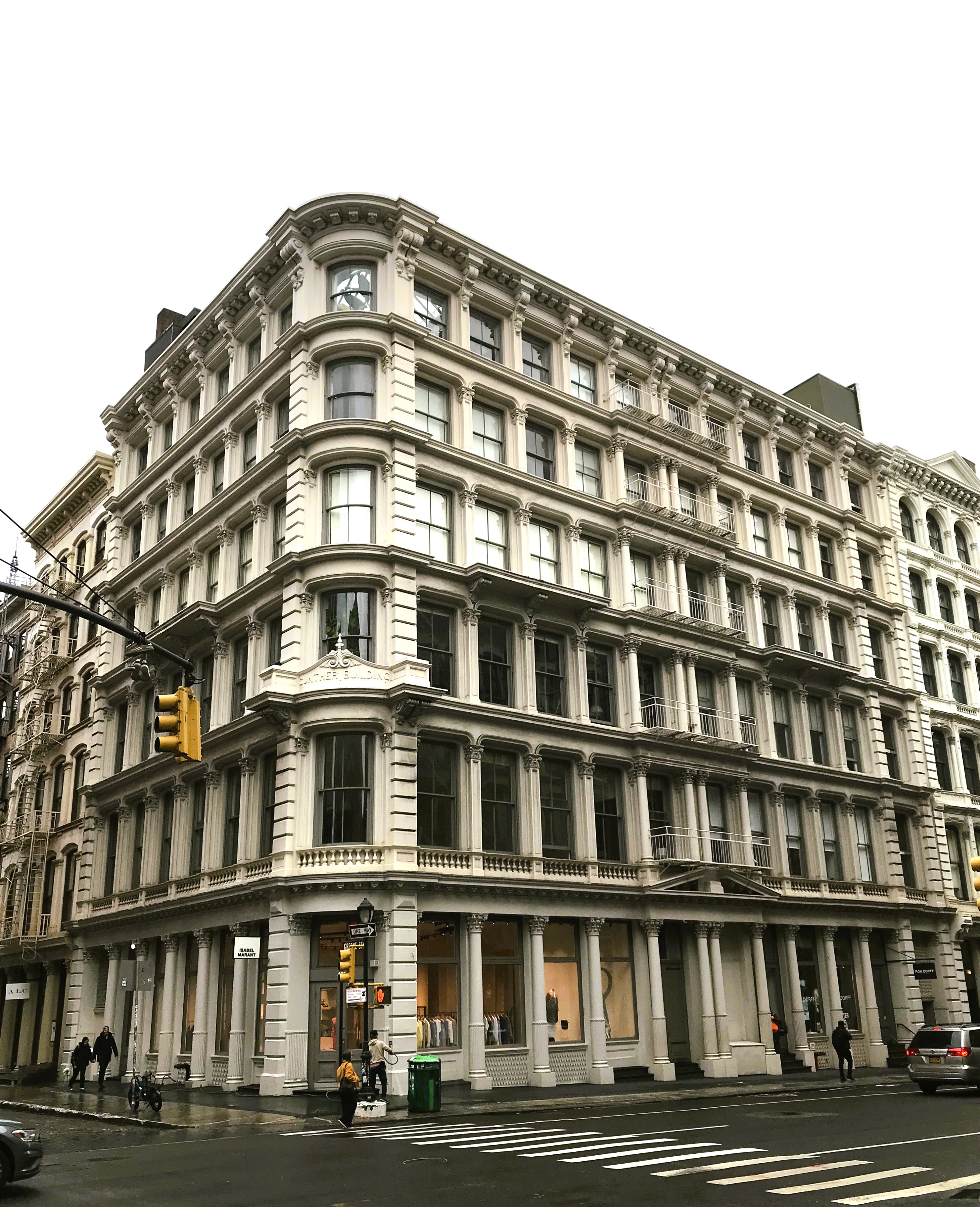
The Gunther Building - 469-475 Broome Street


In a succinct, one-sentence announcement on November 11, 1871, the Real Estate Record & Builders' Guide reported that William H. Gunther had commissioned architect Griffith Thomas to design a six-story "iron store" at the southwest corner of Broome and Greene Streets.  (
Griffith Thomas would be kept busy on the block between Greene and Wooster Streets, designing four of the seven buildings there between 1867 and 1873.)

Gunther was a partner in the upscale furrier C. G. Gunther's Sons.  He was also the secretary of the Peru Iron & Steel Co. on Reade Street; and so, it is possible he partially influenced his architect's choice of cast iron for the building's facade.   The structure, completed in 1872, was a highly sophisticated version of the commercial Second Empire style.  The Aetna Iron Works had cast the iron sections.  Like a wedding cake, the building's upper tiers diminished in height, visually grounding the structure.  Each floor was defined by a cornice, while Corinthian columns and paneled pilasters, balconies (which originally held iron railings), and blind balustrades along the second floor gave the architecture a noble air.

Most striking, however, was Thomas's treatment of the corner.  The building gently rounded the edge, with the window panes of rolled glass following the curve.  Above the second floor window a scrolled pediment flanked by pedestals (that most likely once held decorative urns or finials) announced Gunther Building.


It does not appear that C. G. Gunther's Sons ever occupied the building.  It quickly filled with silk importers, including Fleitmann & Co.  The firm was operated by brothers Ewald and Hermann Fleitmann, with Ewald running the New York business and Hermann living and working in Germany.  Also here in 1880 were silk importers Feldman & Decker, and Napoleon Godone. 

Today Victorian cast iron structures like the Gunther Building are routinely painted white.  But in the 19th century they were handsomely polychromed.  On June 17, 1882 the Record & Guide reported that "Artmann & Fechteler, the well-known fresco painters and designers," had repainted the facade.  "The prevailing colors of the Gunther Building are a deep drab and a subdued olive, relieved by the gold on the caps, cornices, brackets and columns."

By the early 1890s Hoeninghaus & Curtiss, drygoods merchants and importers of silk and ribbons, operated from 469 Broome Street.  Headed by Fritz Hoeninghaus and Henry W. Curtiss, the firm (like all similar businesses) was a target for scam artists.

Early in 1894, Moses Levy purchased "a large amount of goods on from sixty to ninety day's credit," according to The Evening Post.  He represented himself as the manager of his wife Julia's millinery establishment at 594 Broadway.  The ribbons and other items were presumably intended as components in Julia Levy's millinery creations.  Instead, said the article, as soon as the goods arrived the Levys sold them "at any price they could obtain for cash."  When a representative from Hoeninghaus & Curtiss went to the Broadway shop to collect the bill on May 26, he found the Levys had cleaned it out and fled.

It did not take police long to track down the thieving couple.  On May 31, The Evening Post reported, "They were arrested in Troy, and brought here from that place."  The Levys had already opened two millinery shops there.

On the morning of March 28, 1899, 18-year-old Joseph Moore walked into Hoeninghaus & Curtiss with an order for $250 worth of silk from Iglick & Springer of 28 Waverley Place.  Although the order was not overly large, about $8,500 in 2023 terms, a call was made to Iglick & Spring to confirm it.  The decision to do so was a wise one.  The Morning Telegraph reported that the call, "resulted in the arrest of Moore on the spot.  It is believed that he is one of a gang which has operated successfully lately."

The Gunther Building continued to house silk firms into the  first years of the 20th century.  Among them were the Liberty Silk Works; Schefer, Schramm & Vogel; Ferris & White; and William Schroeder & Co.  The latter had been founded by German-born William Schroeder.  It was run in 1906 by his 26-year-old grandson, William Schroeder, Jr.

American Silk-Journal, September 1912 (copyright expired)

The post-World War I years saw drygoods and textile merchants joining the silk merchants in the Gunther Building.  Among them were Berteaux & Radon; and Muser Bros., which imported lace goods and embroideries.

No matter how handsome the building's facade, the conditions inside the shops were harsh, with employees working long hours in lofts that were often insufferably hot.  On July 18, 1922 the New York Herald reported, "The heat and humidity, working in partnership, caused considerable suffering in New York and vicinity yesterday, and as many as could went to the beaches for relief.  Five drownings and five heat prostrations were reported to police."  Among the latter was Jacob Balva, who "was overcome at work at 469 Broome street."

As mid-century neared, the garment district migrated northward past 34th Street.  The Gunther Building filled with a far different type of tenant.  Leasing space here in 1940 was the Strand Paper Box Company, founded in 1929 by Isidor Engelsberg.  His sons Sidney and Moe were partners in the firm.

On August 26, 1940 The Herald Statesman reported, "Jack Feinman, thirty...who is accused of stealing more than $1,000 worth of cloth from his employers, will appear in Manhattan Felony Court on Friday."  Feinman worked for the fabric firm Cohn-Hall-Marx Company.  When the company discovered a large amount of stock missing, undercover detectives were put on the case.  The Herald Statesman reported, "they saw Feinman place 1,000 yards of rayon and other material in a hand truck last Thursday and deliver the lot to Sidney Engelsberg" who was waiting at the service entrance.

The article continued, "At the Engelsberg box factory...detectives said they found more than 4,000 yards of rayon alleged to have been taken previously from the Cohn-Hall-Marx offices.  Police say the Engelsbergs had been using the cloth to line the boxes they manufactured."  Isidor Engelsberg and his sons were arrested and charged with receiving stolen property.

The 1970s saw a metamorphosis of the Soho district as factory lofts were transformed to artist studios and stores to galleries and restaurants.  In 1972 the Landmark Art Gallery opened in the building and would remain well into the 21st century.  

The upper floors of the Gunther Building were converted to joint living-working quarters for artists in 1976.  

The lofts where silk and textile workers toiled in sometimes oppressive conditions for a century, are now luxury residences.  image via streeteasy.com

In 1988, Soho 20 Gallery joined Landmark Art Gallery in the building.  And around 1998 Waterworks, founded in Connecticut in 1978, opened here.  It offered high-end bathroom and kitchen materials.  On May 16, 2002 David Colman wrote in The New York Times that Waterworks "has put glittering, nickel-plated bath fittings on a status with Vuitton luggage."  Today clothing boutiques occupy the ground floor.


A century after its completion, the 1872 Gunther Building was deemed by the Landmarks Preservation Commission "one of Griffith Thomas' finest designs."  His ingenious, rounded treatment of the corner continues to draw attention today.

photographs by the author
no permission to reuse the content of this blog has been granted to LaptrinhX.com

Saturday, October 24, 2020

The Lost Wm. Valleau Building - 506 Broome Street


Once a handsome home, 506 Broome Street (left) was sorely abused by the Depression years. from the collection of the New York Public Library  

An advertisement in the New York Morning Courier in 1831 offered a two-story brick house for sale at No. 506 Broome Street.  It and its identical neighbor at No. 504 were, in fact, two-and-a-half stories tall.  The Federal style residences would have been marketed to merchant class families.

In the early 1850's (until 1856) William Filmer and his family lived in No. 506.  He ran an electrotyping business on Fulton Street.  In 1856 it became home to two widows, Mary J. Pennoyer and Elizabeth Robinson and a boarder, Augustus Steinmetz.  Steinmetz made his living as a pianist.  For the next three years residents would come and go nearly yearly.

The house was offered for sale early in 1859.  An advertisement in the Morning Courier and New-York Enquirer on February 25 described the "two story, attic and basement house and lot."  Another widow, Caroline Barlett, moved in and it was almost assuredly at this time that the house received a significant make-over.

The changes followed the recently popular Second Empire style which was sweeping Europe.  The parlor windows were extended to the floor and the peaked roof was remodeled to a slate-shingled mansard with elaborate, lacy iron cresting.

The first years following the end of the Civil War, however, saw a transformation taking shape in the Soho neighborhood.  Private residences like Caroline Barlett's were being demolished or converted for business purposes.  By 1871 William W. Valleau, Jr. had purchased the house and installed his gold foil business in it.  

Valleau had established his business in 1849.  His gold foils were marketed for the most part to the dental industry for use in fillings.  An ad some years later promised "We claim for our foil that it is made of absolutely pure gold, and beaten with the greatest care to produce uniformity and toughness, never losing sight of quality for the sake of cheapness."

He shared the former house with George J. Pack & Co., which was also in the gold foil business.  That Valleau chose a competitor as his tenant is surprising, although the two apparently had a very amicable relationship.  They shared a full page advertisement in the March 1873 issue of the American Journal of Dental Science.  
The American Journal of Dental Science, March 1873 (copyright expired)

Valleau's business had apparently grown enough by 1877 that he now used the entire building.  The previous year he had been honored at the Centennial International Exposition in Philadelphia (the first official World's Fair in the United States).  The Reports And Awards noted that William Valleau, Jr.'s Dental Gold-Foil was "Commended for purity brilliancy of color, and variety and convenience of forms, for the use of the operator."

In fact, his increasing business required him to hire carpenter N. J. Rigney to erect a one-story rear extension to the building in March, 1880.  The plans described No. 506 as a "workshop and dwelling," suggesting that Valleau's family lived in the upper floors.  He and his wife, the former Sarah Agnes Aitkew, had three children, Clinton Monteith, who was nine-years old in 1880; William Smith Valleau, who was 13; and Charlotte Amelia, who was 17-years old.

Valleau touted his World's Fair award in this 1880 advertisement.  The Odontographic Journal (copyright expired)


Valleau's extremely valuable stock prompted him to subscribe to the Holmes Electric Protective Company on February 1, 1883.  It was an early embrace of modern technology, a forerunner of today's burglar alarm.

William Valleau, Jr. died around 1887, but the firm continued under Sarah and the children.  In January 1889 it was reorganized as The Valleau Manufacturing Co.  Sarah, who had remarried and whose surname was now Griffin, took the position of president, with William Smith Valleau as secretary.  A price list that year explains his father's eagerness to upgrade security.  "Soft and Cohesive Foils," for instance, were priced at $30 per ounce, or about $870 per ounce in today's money.

The firm was nevertheless deceived by a clever scam artist in March 1897.  Edward Merrinan first stopped into the store of Van Houten & Sheldon, respected dealers in paints and painters' supplies, and said "I want to get some gold leaf and as I know that your work is of a high grade, I want to buy my stock from the same people you do."  The Evening Telegram explained that as the representative listed his gold leaf suppliers, Merrinan took one of Van Houten & Sheldon's business cards.

On March 14 he walked into the Valleau Manufacturing Co. and placed an order for four packages of gold for Van Houten & Sheldon, offering the business card as identification.  The firm was a long-time customer and the clerk was not suspicious.  "There was only one package in stock and this he was given," reported The Evening Telegram.  It was not until the balance of the order was delivered to Van Houten & Sheldon that the ruse was discovered.

If the Valleau family had, indeed, originally lived on the upper floors of No. 506, they by no means did by now.  Clinton lived in a handsome home at No. 106 West 71st Street and was a member of the exclusive Manhattan Club.  (William had relinquished his interest in the firm by now.)  The rooms on the upper floor were now home to some of the firm's workers.

A union delegate testified before a hearing of the American Federation of Labor on December 15, 1897.  His words exposed the stark differences between the lifestyles of the Valleau family and their workers.

After four years of suffering and fighting starvation wages, we finally succeeded through organization in raising our wages to the living point.  All employers in the United States acceded to our demands with the exception of three firms [including] The Valleau Co...In the case of the Valleau Co. the majority of the men actually live in the workshop, working day and night for the past two years, and yet their wages do not average $10 per week.

(The $10 salary would equal just under $320 per week today.)

In 1902 the Valleau Manufacturing Co. listed its principals as Sarah, Clinton and Charlotte, whose surname was now Jenks.  
The firm was reaching out to a new market at the time.  An advertisement in The International Book-Binder in January 1903 marketed its gold leaf for use in the gold edging for books, as well as providing the labor in applying it.  The advertisement suggests the firm had improved the working conditions, saying in part "We employ none but Union Hands (no boys or girls), and every one a skilled mechanic."

The pressures of business seem to have overwhelmed Clinton in 1905.  He was committed to Dr. McFarland's Sanatorium in Greens Farms, Connecticut for "treatment for a nervous ailment."  Six months later, on May 22, 1906, the New-York Tribune entitled an article "Escapes From Sanatorium" and reported that Clinton was on a trolley car when his conduct attracted attention.  He was arrested by a plain clothes officer.

The article said "He had 25 cents in money and wore expensive clothing.  He seemed anxious to get to New Rochelle and said his trouble would be over if he could only get there."  Clinton's freedom was short-lived.  The article ended "The police turned him over to the sanatorium people."

Sarah Valleau Griffin died on February 22, 1908.  In 1911 only Clinton and his sister Charlotte were listed as owners of the property.  They were leasing the second floor and attic that year to to the Lion Knitting Works, while continuing to operate their firm from the lower section.

A fire broke out in the Lion Knitting Work's stockroom at around 9:00 p.m. on September 23, 1911.  Firefighters were blinded by the dense smoke, so 42 year old Battalion Chief William Devlin led a team to the roof to chop a hole.  The Sun reported "The roof, which tops an old fashioned  building, is peaked at the front but flattens out half way back toward the rear end of the structure.  Firemen were walking on this flat portion."

Firefighters "heard a yell and some of them turned in time to see the chief fall over the edge," said the article.   He first hit the extension that William Valleau had added in 1880, then rolled off, landing on the flagstone-paved rear yard.  Chief Devlin was unconscious when he was taken away.  The Sun said "He suffered serious internal injuries and physicians fear also that his spine was fractured."  He died four days later.  Tragically, Devlin was a widower and left behind five orphaned children.

The blaze was confined only to the Lion Knitting Works, so damage to the Valleau Manufacturing Company's space was limited to water damage.

A printing firm occupies the ground floor in this July 23, 1939 photograph.  One of the Victorian dormers has been replaced.  from the collection of the New York Public Library

Following World War I the Broome Street neighborhood declined.   By the early 1930's the former house that had been headquarters of the Valleau family's gold foil business for decades was a printing shop.

When this photo was taken around 1941 the end of the line for the aged building was on the horizon.  NYC Dept of Records & Information Services.

The venerable, if sorely treated, building survived until 1947 when it was replaced by a gasoline station.  In 1996 the current three-story building was completed on the site of 504 and 506 Broome.


Saturday, July 11, 2020

The 1874 Martin Bates, Jr. & Co. Bldg - 489-493 Broome Street


photo by Beyond My Ken
Architect Jarvis Morgan Slade's father, Jarvis Slade, was among the first major developers to change the face of the neighborhoods later known as Tribeca and Soho from residential to commercial.  The Real Estate Record & Builders' Guide would call him a "pioneer in this district" and say "it was mainly due to his influence that it was so rapidly covered with first-class buildings."

As a teenager J. Morgan Slade learned architecture in the offices of Edward H. Kendall.  He the opened his own practice at No. 346 Broadway and at just 20-years old received a significant commission--a five-story, 62-foot wide commercial building for silk merchant Martin Bates.

Located at Nos. 489-493 Broome Street between Wooster Street and West Broadway, the structure went up with lighting speed.  Construction began on August 1, 1873 and was completed four months later, on January 31.  Partially responsible for the rapid completion was Slade's choice of cast iron for the facade.  The ability to bolt large pre-cast sections onto the masonry frame was widely touted for its time-saving (as well as fire-proof) qualities.

Costing $75,000 to construct (about $1.65 million today), Slade had produced a highly restrained, sparsely ornamented building.  Each of the upper floors was essentially identical (the second floor received preferential treatment with its engaged columns sitting on paneled pedestals).  Even the capitals of the columns were understated.  While other architects were embellishing their cast iron columns with elaborate, leafy Corinthian capitals, Slade chose a simple ring of egg-and-dart molding that resembled a string pearls.


Slade's subdued capitals are quietly dignified.
Within the triangular pediment above the bracketed cornice was the date construction date 1873.

Bates moved his business, Martin Bates, Jr. & Co., into the new structure.  The American Hatter would later call the firm "one of the pioneer establishments in the fur business, dating back to the year 1834."  At the time of its founding in Boston it was Martin Bates & Sons.  Martin Bates, Jr. opened the New York office in 1845 and in 1853 the firm was renamed Martin Bates, Jr. & Co.

Furs not only provided Victorian consumers warmth but status, as well.  Martin Bates Jr. & Co. did a large sealskin business, requiring several vessels that steamed to Alaska for skins.  The American Hatter added that it also dealt in "buffalo robes, deer, elk beaver and all kinds of furs."


Directory of the Hat, Cap and Fur Trades, 1880 (copyright expired)

Bates leased space in the building to A. De Grieff & Co., a trimming goods importer.  The respected organization suffered humiliating press coverage in 1875.  On December 22 The New York Herald reported "No little stir occurred in the Custom House yesterday with reference to the customs seizure of the establishment of A. De Grieef [sic] & Co., of Nos. 489 to 493 Broome street."


photo by Beyond My Ken (cropped)
The firm had received 95 cases of dress trimming from Paris, the value of which it declared at $14,000.  Suspecting fraud, the Customs office sent inspectors Benjamin and Cosgrove sent to the Broome Street factory with orders "that no goods are allowed to leave the establishment without their knowledge and consent."  

The senior partner in A. De Grieff & Co. admitted that the goods were worth about $70,000; but deflected blame onto a fired clerk.  "We believe that these accusations against us of defrauding the revenue emanate from a discharged clerk named Bell."

After only six years in the building Martin Bates, Jr. & Co. moved to Greene Street in 1880.  Among Bates's Broome Street tenants at the time were Clinton H. Smith & Co., lace goods manufacturer; Wightman & Co., ladies apparel makers; and Fleitmann & Co., silk importers and commission merchants.

Established by Ewald and Hermann Fleitman who had arrived in New York from Germany in 1864, Fleitmann & Co. was by now among the largest commercial merchants in the city.  

Despite the intricate work required to produce high-quality lace goods, female workers of Clinton H. Smith & Co. made what today would be considered sweat shop wages.  An advertisement in 1881 read "Experienced operators on lace goods can get from $7 to $12 per week, steady work."   The higher end of that range would equal $300 today.

Dry goods merchant George Forbes occupied space in the building in 1887.  And that year he learned a lesson about drinking too much.  On May 20 he stumbled out of "a drinking resort" on 6th Avenue and hailed a hansom cab.  The driver, Benjamin Frankford, owned the cab as well as the livery stable where it was housed.  When they got to Forbes's home on East 87th Street, Frankford helped the inebriated man get to the door.

Later Forbes realized his gold watch and chain, valued at nearly $7,000 in today's money, were missing.  Hoping that Forbes had been too drunk to recognize him, Frankford boldly reappeared at his door the next day.  He said he was a private detective and was certain he could track down the thief.  Forbes handed him $10 as a retainer.

Frankford repeatedly returned, but never with the watch; only to get additional fees.  Finally, after having spent over $1,800 in today's dollars, Forbes realized he was being swindled.  Frankford was arrested and Forbes had learned a very expensive lesson about over-imbibing.

By 1892 I. Modry & Co., makers of "caps, laces and rufflings," and The Empire Manufacturing Co., children's dresses manufacturers, were the two major tenants.  I. Modry & Co., headed by Ignatius Modry (known as Ignaz), was a massive operation, employing 390 workers in 1892, only 15 of whom were men.  More than half of the operators were minors, with 50 of them under 16 years old.  The firm would remain in the building into the first years of the 20th century.


The building as photographed on April 13, 1916 looks little different today.  from the collection of the New-York Historical Society
Following World War I the tenant list changed.  After the building was purchased in November 1917 by the Levett Sales Co., apparel related firms disappeared.  They were replaced by more industrial companies like General Platers' Supply Co. and the Parker Sheet Metal Works.  


New York Herald, January 26, 1919 (copyright expired)
The were joined in the 1920's by North & Herbert Co., Inc., dealers in machinery, automobile accessories and hardware; and Aerovox Wireless Corp, founded in 1922 as the Radiola Wireless Corporation, makers of radios and components.


Radio World, April 1926

The post-Prohibition years saw another type of tenant, the wine warehouse of De Boer & Miller, Inc. 

The Soho district would see dramatic change beginning in the 1970's as artists took over the old factory buildings.  The streets that had rumbled with delivery trucks increasingly saw the influx of art galleries, artist lofts and shops.  By 1971 the Fischbach art gallery was in the former Bates building and the following year the upper floors were converted to "studio and offices"--one per floor.

Fischbach remained in the building through the mid-1970's, joined by the Alessandro Gallery by 1976.  The Frank Marino Gallery was here in 1981.  Other commercial tenants over the next two decades would include The Handbag Workshop and the health food store Healthy Pleasures.

Another renovation completed in 2001 resulted in one sprawling apartment each on the second and fourth floors, and two each on the third and fifth.


photo by Beyond My Ken
Today the Martin Bates, Jr. & Co. building--designed by a young man barely out of his teens--is remarkably intact after more than a century and a half.

Friday, June 19, 2020

Charles Mettam's 1874 500 Broome Street


The retail spaces on West Broadway did not exist until 1992.  photo by Tdorante10 (cropped)

In the first half of the 19th century comfortable brick-faced houses lined Broome Street and South Fifth Avenue (later West Broadway).  But in 1874 they were rapidly making way for modern commercial buildings, such as the one George Marchand began at the northeast corner of the intersection on August 6.  

Marchand hired Irish-born Charles Mettam to create the five-story structure at No. 500 Broome Street.  The well-respected architect had been chosen to design the canopied catafalque that bore the coffin of President Abraham Lincoln through the streets of New York in 1865.

His eccentric design blended the neo-Grec style with a touch of Second Empire that demands pause.   The West Broadway elevation, faced in brick and trimmed in stone, was mundane, little different from scores of commercial buildings being erected at the time.  But the Broome Street facade, clad in cast iron from the Aetna Iron Works, was singular.

The French Second Empire style upper openings, three on Broome and two on West Broadway, were separated by sedate engaged Doric columns.  They were flanked at the corner and sides by neo-Grec paneled piers, the capitals of which upheld intermittent cornices.  Each overblown capital suppored what was essentially a robust platform for the pier above.  The motif was carried on even at the terminal cornice even though there was nothing for the platforms to support.  The piers of the storefront included a charming touch in the form of single, delicate tassels that hung from fluted bands at midsection and from below the capitals.


Marchant's building went up with remarkable speed, completed in just over four months on December 21, 1874.  An advertisement in The New York Herald the following April offered "Elegant first loft to let--at 500 Broome street, corner of south Fifth avenue; well lighted' fine entrance; hatch in the rear; suitable for any first class business."

The "first loft" meant the second floor and the "hatch" referred to the shaftway through which crates and other items were hauled up and down by a system of pulleys in the days before freight elevators were common.  Hatchways were by nature dangerous and this one caused a tragic accident in the summer of 1876.

The New York Evening Telegraph reported on August 12, "An inquest was held this morning by Coroner Eickhoff in the case of William Mulligan, the boy who was killed by falling through an open hatchway, at No. 500 Broome street, last week.  The jury returned a verdict of accidental death and recommended that in future the proprietors of the store keep the hatchway closed except when in use."

Young Mulligan most likely worked for Seth G. Babcock & Co., woolen merchants.  Run by Paul Babcock, Jr. and Seth G. Babcock, it was the only tenant listed in city directories that year.  The following year it was joined by Paul Gumbinner, lace merchant, and the Keep Manufacturing Co., makers of Keep Custom Shirts.

Founded in 1866 Keep Manufacturing Co. sold its products in its own retail stores.  In 1877 Alexander M. De Leuw worked as the firm's clerk--a highly responsible and trusted position that required the handling of large amounts of cash and keeping the books in order.  But the 21-year old, according to the New-York Daily Tribune, "was led into dissipation."  To fund his expensive lifestyle, he began falsifying the payroll records and skimming money.  His shaky scheme fell apart in December 1877 when it was time for the books to be audited.

Having embezzled $10,000--more than a quarter of a million in today's dollars--De Leuw destroyed the books and disappeared.  Detectives played a hunch and notified New Orleans officials to be on the lookout for him, since the De Leuw family was "well-connected" there, according to the Tribune.  It paid off and on January 28, 1878 the New-York Daily Tribune reported that De Leuw had been arrested there.

Employees in garment factories worked grueling schedules, normally between 50 and 60 hours during the week and 9 hours on Saturdays.  During the summer months the conditions in the shops were inhumane.  On July 3, 1885 The New York Times reported on a novel idea being launched in Syracuse, New York.  "An energetic movement is in progress here to inaugurate the popular half holiday scheme.  It is the intention to secure Saturday afternoons during July and August."  The Saturday "half-holiday" would mean that workers would work half days "during the heated term."

The following year Keep Manufacturing got on board with the idea.  The New York Evening Telegram reported on May 6, 1886 that the management gave its employees "the Saturday half-holiday, commencing May 8."

The following summer George Marchand sold No. 500 Broome Street to Thomas Barrett for $40,000 (just over $1.1 million today).  It became headquarters for the Thomas Barrett & Son firm, dealers in "rags and paper stock" and "general paper."  Long time tenants Keep Manufacturing  and Seth G. Babcock & Co. soon moved out; but Barrett continued to lease part of the building to R. Smith & Co., a cloak manufacturer. 

In the winter of 1890-91 a general strike crippled the apparel industry.  In reporting that several of the firms "have granted the demands of their striking cloakmakers" on January 21, 1891, The Evening World revealed where its sympathies lie by using a term most often reserved for corrupt Tammany Hall leaders.  "The same was the case at Boss Smith's shop, 500 Broome street."

As had happened with Keep Manufacturing Co. nearly two decades earlier, in 1896 R. Smith & Co. discovered that $175.50 was short in the accounts of one of their salesmen, Maurice Lapp.   It seemed to Smith that it was most likely a mistake, since Lapp, who had worked for the firm for more than two years, made $1,800 a year plus about $250 in commissions--around $65,000 today.

Nevertheless Smith went to the police station and asked that Lapp be surreptitiously watched "until they could go further into the books," according to The New York Times on March 8.  Smith said that if there was significantly more money missing, the firm would press charges.

There was.  Lapp realized that the noose was tightening and confessed to his employers that he had skimmed money, offering $2,000 if they would drop the case.  The New York Times reported "The firm refused to do this, and at once put experts upon the books."  The auditors discovered "that the defalcation would probably amount to $15,000 or $20,000." (As much as $628,000 in today's money).  

Audaciously, after being arrested on March 6, Lapp "confessed his guilt, and said that if the firm would only take the $2,000 he offered them, they would not lose much, if anything."  Instead he was held on a charge of grand larceny.

Thomas Barrett died on February 23, 1913 leaving at estate of just over $4 million.  The Sun reported that he "gave his interest in the firm of Thomas Barrett & Son to his son, Nicholas J. Barrett.

Before long Nicholas would have to address a problem that threatened both his business and his building.  On July 19, 1919 the New-York Tribune noted "West Broadway has long been suffering from a depression."  The article was not about financial troubles, but structural ones.  "The cellars of most of the buildings along the street between Canal and Springs Streets have been lower than the sewer level."  

A spokesperson for Thomas Barrett & Son told the newspaper "the poor sewer system has caused tremendous damage.  We are looking forward to the construction of some new sewers.  Perhaps we shall then be able to eliminate this needless loss."  (Work on a new system of sewers had already begun, thankfully.)

Thomas Barrett & Son remained in the building for decades.  It was still run by Nicholas J. Barrett in 1939 when The History of Paper Merchandising in New York City wrote, "Although originally a wrapping paper house entirely, Thomas Barrett & Son has expanded its activities to include almost every line of paper made, especially fine and special papers."


The original appearance of the West Broadway side can be seen in this photo from around 1941.  via the NYC Dept of Records & Information Services.
The paper firm was followed in No. 500 by the Food Trading Corporation, listed as dealing in "spices, seasonings, seasoning sauces, processed herbs and meat extracts for food."  In 1977 the factory filled 100,000 cans of seasoning each day.  

By now the Soho neighborhood was becoming increasingly residential and not all of the loft dwellers appreciated the smells.  On September 11, 1977 Carl Glassman reported in The New York Times "outside the plant, the aroma is sharp enough to make some residents sneeze.  Inside, it's almost thick enough to grind."

The firm's vice president, Max Scherer waved off the complaints.  He insisted the neighbors were healthier by inhaling the herb-infused air.  "It's good for you.  They all like it.  They never get colds this way."


In 1990 a gut renovation and conversion to residential space for certified artists was begun by United American Land Company.  The facade work was executed by Fifield, Piaker and Associates under the guidance of the Landmarks Preservation Commission.  Completed in 1992, it included four new shops cut into the West Broadway side.

Monday, May 18, 2020

The Lost Ingraham House - 504 Broome Street


The Federal style of No. 504 (right) predated its fancier Second Empire neighbor by decades.  The architectural integrity of No. 504 was relatively intact in 1935.  photo by Berenice Abbott, from the collection of the New York Public Library

After New Yorkers had been deprived of their tea supply throughout the Revolution, merchant John Broome (the first alderman appointed after the departure of the British) purchased two million pounds of tea from China.  The deal not only replenished New Yorkers' tea caddies, but sparked a robust trade with China.  Broome was honored with the naming of a street in the neighborhood known as New Delaney's Square.

Among the handsome Federal style homes that were erected in the 1820's and '30s was No. 504 Broome Street, on the northwest corner of South Fifth Avenue (later West Broadway).  Two-and-a-half stories tall, its red brick facade was trimmed in simple stone lintels and sills.  Above the wooden cornice two tall, hooded dormers punched through the peaked roof.  The staircase inside hugged the southern wall, necessitating the slightly offset appearance of the second floor openings.

By the early 1840's the house was home to Mrs. S. R. Ingraham.  She was apparently a window, since a Mr. Ingraham never appears in directories.  She was an ardent reformer, acting as corresponding secretary of the American Female Moral Reform Society in 1840.  

Like so many other widows, Mrs. Ingraham rented rooms to supplement her income.  In 1842 a Dr. Banning boarded in the house.  He published the Medical Gazette (using the Broome Street address) and gave lectures.  On April 25, 1844, for example, he spoke on "Dyspepsis and its Attendants, Local and General Debility, and Affections of the Heart and Lungs."

Living in the attic level were one or two servants--most likely Irish girls.  Given Mrs. Ingraham's strict moral character, one can only imagine her horror when one of them narrowly escaped the attack of a rapist on June 4, 1844.  An announcement from the office of Mayor James Harper recounted that "a young woman residing with a respectable family at 504 Broome street, having been sent on an errand, lost her way, and wandered about the city till between 8 and 9 o'clock P. M. when she applied for direction to a well dressed man."

He offered to show her the way, but instead "enticed her into a house of ill fame in a narrow, dark street, and there endeavored to accomplish her ruin, and threatened her life, and drew a knife upon her."  The feisty girl was more than he could handle.  She wrested the knife from him, broke open the locked door, and fled.  When word of the attack reached the newly-elected mayor he offered a $100 reward for the capture of the attacker.  It was a significant enticement--equal to more than $3,500 today.

Mrs. Ingraham continued to involve herself in worthy causes.  On June 19, 1845 the New-York Daily Tribune reported on the attempts of a group of women to establish an Asylum for Discharged Female Convicts.  "They have met, thus far, with little success; but touched by the position of several women, who, on receiving their discharge, were anxiously waiting in hope there would be means provided to save them from return to their former suffering and polluted life, they have taken a house and begun their good work in faith that Heaven must take heed that such an enterprise may not fail, and touch the hearts of men to aid it."  

Mrs. S. R. Ingraham was on the executive committee of that group.  She was, as well, the corresponding secretary of the House of Industry and Home for the Friendless on East 30th Street.  

Two advertisements placed in 1848 provide evidence that the neighborhood was still respectable.  One read "A gentleman and lady, or two or three single gentlemen, can be accommodated in a small family, where few boarders are taken."   The number of boarders in a location was an indication of its exclusivity.  The other ad noted "the house is pleasant and the neighborhood genteel."

In 1852 the house and lot were sold at auction.  It was purchased by John Crothers and his wife, Jane.  A clothier and tailor, his shop was on Chatham Street.  Like Mrs. Ingraham, he was an upright citizen, highly involved with the Reformed Presbyterian Church.  In 1853 he sat on the Committee on Seminary Debt, &c., tasked with devising a plan to pay off the debt of the Presbyterian Seminary.

The couple had three children, John C., Nicholas L., and Mary A Crothers.  Mary taught in the Girls' Department of Public School No. 50 on 20th Street between Second and Third Avenues.  In 1854 she was earning $100 a year--or about $3,150 in today's money.

The Crothers took in a single boarder in 1855 and '56.  Edward N. Shields was a produce merchant in the Washington Market.

The Crothers family continued to occupy No. 504 through the Civil War years.  John's store was still listed at No. 90 Chatham Street as late as 1861.  By then Mary's salary had tripled to $300--almost $9,000 a year today.  She was still teaching at P.S. 50 in 1865.  

In 1869 the neighborhood around the house was seeing drastic change as private homes increasingly gave way to commerce.  The Crothers family was no longer listed at the Broome Street address that year, although they retained possession and leased the property for decades.

It was about this time that the ground floor of No. 504 was converted for business and the upper section was operated as a rooming house.  It now drew attention not for the charitable works of its owner, but for far more disquieting reasons.

On August 14, 1869 The New York Times reported on a gruesome discovery.  "John Brown, a native of England, was found dead yesterday morning in the water-closet of the premises No. 504 Broome-street."

The rooms upstairs may have been used for more nefarious purposes than merely sleeping.  A common ploy for prostitutes in the 19th century was to work with a cohort who would sneak into the dark room while her client was distracted and remove cash and valuables from his clothing.  That may have been what took place on November 3, 1870 when Abraham P. Hopper, who lived in Newfoundland, New Jersey, was robbed of $300 (a significant $6,000 in today's money).  John Collins was arrested and convicted for the theft.

In the meantime Charles Nagel ran his "eating-house" on the ground floor.  He was granted permission by the Board of Aldermen on September 30, 1872 "to place a watering-trough in front of his premises, 504 Broome Street."  Nagel was responsible for all costs and the resolution came with the caveat that it would "remain only during the pleasure of the Common Council."

Although Nagel listed the business year after year as a restaurant, it was in fact more accurately described as a saloon.  On Sunday, May 21, 1876, bartender Frederick C. Hensell sold a beer to the wrong patron.  The entire police force had been give orders "for the strict enforcement of the Excise law" which prohibited the sale of alcohol on Sundays.  The New York Herald reported "the result was the wholesale arrest of liquor store proprietors and their barkeepers."  Among those hauled in was Frederick Hensell.

Charles Nagel was living above the saloon by at least 1879.  That year he listed his business as "beer."  He paid a fee equal to about $2,000 today for his liquor license every year through 1887.

In January 1888 Jane C. Crothers hired the architectural firm of Thayer & Robinson to erect a three-story brick extension to the rear.  The following month she leased the property to Lewis C. Allen for ten years.

Five years into his lease Allen seems to have decided to give up the saloon business.  An advertisement appeared in The Evening World on September 16, 1893 offering: "Saloon, 504 Broome st., corner South 5th ave; long lease, low rent; full license."

Jane Crothers died around 1895.  On January 1, 1896 John and Nicholas leased the property to Michael J. Moran.  He ran the saloon at least through 1905.  Following Moran there would be a relatively quick succession of proprietors.  In 1908 the excise license was held by Felix Bellando, who referred to the rented rooms upstairs as a "hotel" on his application.  In 1913 the bar was operated by Henry Bullwinkel, and in 1917 by Henry Schubkegel.


In 1939 a automobile repair shop operated from the former saloon space. from the collection of the New York Public Library
Around two years later billboards covered the now-vacant upper floors.  photo via the NYC Dept. of Records & Information Services
Prohibition put an end to the four decade old tradition of a saloon in the venerable building.  A large opening was gouged into the West Broadway facade to accommodate an auto repair shop.  And then, in 1947, the relic of a more refined period on Broome Street was demolished to make way for a parking lot "of more than 5 motor vehicles."


In 1996 the current three-story building was completed on the site.

Thursday, May 7, 2020

The Eliza Payne House - 499 Broome Street


photo by Beyond My Ken

Sometime after 1767 an east-west road was laid out in the district which two centuries later would be known as Soho.  It underwent a string of names--Bayard's Lane, Bullock Street, Hevins Street and "Orchard Street West of Broadway"--until finally, in 1806 it was permanently christened Broome Street in honor of the current Lieutenant Governor John Broome.

Around 1825 Alfred S. Pell began construction on similar, upscale houses at Nos. 497 and 499 Broome Street.   Because No. 499 sat on the corner of Laurens Street (renamed West Broadway in 1897) it was the more desirable, with extra light and ventilation.

The three-and-a-half story dwelling was faced in brick and featured incised brownstone lintels and a single centered dormer at the high peaked attic level.  The doorway would, most likely, have been flanked by twin Ionic columns, narrow sidelights and a leaded overlight. 

It is doubtful that Pell ever lived in either house.  An advertisement in the New York Morning Courier in 1829 offered No. 499 for sale.  It became home to the family of Hannah C. Payne.  Known to her friends as Eliza, she was the widow of William Payne.  She had three children, Walter, Cecelia and Hannah.

Tragedy struck in January 1834.  Walter joined a group of "sixty or seventy boys skating," according to the New York Journal, on a nearby pond.  The newspaper estimated the thickness of the ice at about 1-1/2 inches.  A boy on the bank noticed Walter and five other boys standing together about 30 feet from shore.  "While thus engaged, a coloured boy came so swiftly towards them as not to be able to stop himself, but ran against them, and they were all precipitated into fifteen feet of water."

The ice was too thin for onlookers to attempt rushing out to rescue them, so a board was pried from a fence.  One boy was saved by that method.  By the time a boat was pulled from dry dock, all the others were dead.  "Five were taken out of the water soon afterwards, and another next morning two of them brothers, being clasped in each other's arms."  Among the dead was Walter Payne.

Sometime after 1837 Eliza married Jacob Haughwout.  By the early 1840's she had opened the Broome Street Saloon in the ground floor.  It was listed as a "porter house"--a tavern where malt liquor such as porter and food were served.  For several years she had leased the cellar to Andrew W. Twist and his wife, who made their home there.  

Twist, who testified in court in 1845 that he rented the basement from "Hannah E. Paine [sic]," described the house by saying that "the upper part was occupied as a porter house, called the Broome Street Saloon, and kept by Mrs. Haughwout and her two daughters."

At around 3:00 on the morning of June 25, 1845 Twist and his wife were awakened by a banging on the basement door.  The saloon watchman told him the house was on fire.  "I saw the flames and smoke through the roof and third story windows," said Twist.  After the fire was extinguished Twist went to the second floor where it had begun.  On the way up he noticed a suspicious detail.  "I saw shavings on the stair case, spread on the steps," he told investigators later.  He added another possibly disturbing item, "I saw things taken out of the house about 3 or 4 weeks before the fire."

Investigators quickly suspected that the Haughwout family had set the fire.  On July 3 the New York Herald ran the headline "Important Arrest--Arson" and reported "Jacob Haughwout, Eliza Haughwout, alias Hannah C. Payne, Hannah F. Payne and Cecelia Payne" had been "charged with setting fire to the dwelling house."  The newspaper called the alleged crime "this atrocious outrage."  The New-York Tribune paused to describe Hannah and Cecelia as "smart, black-eyed looking girls about 15 and 17 years of age."

The family members were tried separately.  The outcome of the proceedings could not have been more dire.  As the New-York Tribune pointed out, arson was a crime "the penalty of which, on conviction, is death."

Eliza's trial was first, beginning on October 15.  Things did not look good when a fire investigator testified that when fire fighters arrived, "the Haughwouts were all there, the house was fired in six or eight places, the beds were untumbled [i.e., not slept in]" and a claim for the insurance had been immediately filed.  Cornelius V. Anderson of the fire department testified that one of the fires had been set in "shavings in the bed quilt" and insisted "the fire could not have originated in any way except by design."

The hope for the family's attorney was that the all-male jury would not be able to sentence three females, two of them teenagers, to death.  Indeed, the Tribune reported "There was an almost general sentiment expressed by persons examined as Jurors against the taking of life as a punishment."

Despite the overwhelming evidence against them, the Haughwouts walked free.  

In 1848 Cecelia Payne was listed as the proprietor of the saloon.  The family was renting upstairs rooms by the early 1850's, with E. J. Perry, a "colorist," living here in 1852.  That year Eliza rented the entire house.  Her ad in The New York Herald on March 23 offered "A three story house, consisting of twelve rooms, with croton water on each floor."  It was leased by Timothy Kendall and Jesse M. Carter, both of whom moved in and listed the building as a hotel.  The Broome Street Saloon was renamed Carter & Kendall Porter House.

Eliza Haughwout, once again widowed, was back by 1856 when she reappeared in the city directories here.   In 1864, despite having a saloon in her home, she threw herself into the work of the Educational Institute for the Benefit of Colored Adults.  On Christmas Eve 1867 the first Sunday school service for non-white adults was held in the house.  On January 4, 1868 The New York Times praised Eliza, saying "The institution of this school is the praiseworthy result of the labors of a widow lady during the past four years."  The article noted that the neighborhood now had a "population of 2,000 colored people."

Among Eliza's tenants in 1870 were the family of Joseph Melfi, a musician, and Peter Muske, "segarmaker."  The saloon was run by Cornelius Murphy.  One of Melfi's young students went missing in 1870.  He placed an advertisement in The New York Herald on June 8 that read:

$50 reward--Lost, an Italian boy answering to the name Francesco de Rago; he is thirteen years old and plays on the harp.  Any person that can give any information that will lead to his apprehension will receive the above reward by applying at Melfli Bros.

The reward would be equal to $1,000 today.

The following year Murphy was, apparently, eager to get out of the saloon business.  His ad on November 21, 1871 announced "For Sale--The First Class corner liquor store...If not sold by Tuesday will be sold on that day, at 10 1/2 o'clock by William Abbott, Auctioneer."

It was purchased by Andrew Hopke.  But he would not remain for long.  In an article entitled "Foul Food" on April 18, 1872 the New York Daily Tribune reported he was guilty of serving ""unhealthy puddings; and very young veal, too small to be eaten."  The following year the saloon was on the market again.  "For Sale Cheap--The lease, stock and fixtures of a first class corner liquor store."

By now Cecelia had inherited the property.  In 1874 she protested the assessment she was charged for the paving of Broome Street.  Surprisingly, she won that petition.

James J. Rafferty took over the saloon and around the same time the upper floors were converted for business purposes and a three-story extension was added behind.  


Arps combined the house with the three story building at the rear, dating from 1874, in 1921.  A row of windows was punched into the second floor facade at the time.  from the collection of the New York Public Library

Morris Mehesy ran his fur business here in 1875.  To increase the visibility of his operation, he placed a showcase on the sidewalk.  But displaying furs outdoors was a risky proposition.  On December 2, 1875 The New York Herald reported "the showcase in front of the store of Morris Mehes[y], at No. 499 Broome street, was robbed yesterday of a sealskin sacque and muff valued at $35."  It was a significant loss, equal to about $840 today.

Mehesy and Rafferty both remained through 1877.  But the following year both were gone, replaced by L. Schwartz & Co., printers upstairs, and Edward Gross who listed himself as "beer."

Having been owned by the Payne family for nearly half a century, the house and its three story rear extension was sold in March 1879 for $8,460--or about $225,000 today.

Louis Schwartz & Co. continued to operate here for several more years, and in 1883 John Carmody took over the saloon, paying his $75 excise license fee each year through 1897.  The following year John J. Dougan took over its operation.  In the meantime, in 1895 Samuel Cashman's hat and cap factory opened upstairs.  That year he employed four men and one woman.  He remained at least through 1899.

In 1906 Otto L. Arps took over the saloon.  Ten years later he purchased the building, described by the Department of Buildings at the time as a "cafe" on the first floor and "lofts (factory) existing" upstairs.  Arps leased the upper floors to various businesses over the years, including J. Spaulding & Sons, Co., the Square Leather Goods Co., and the U. S. Steel Stamping Company.

The Volstead Act went into effect on January 17, 1920, kicking off Prohibition.  Otto L. Arps ignored the law until he was finally discovered by Prohibition Agents in 1925.  The New York Times reported that the bar had been padlocked and that Arps was forced to close the business for two months as penalty.

In the meantime, in 1921 Otto Arps connected 499 Broome Street internally with the building behind, at 361 West Broadway.  The third floor of that building became the offices of the St. George Society, described by The Evening World as "one of the biggest British charitable organizations in the country."  Leonard D. Langley, its almoner, was at his desk at 2:15 on the afternoon of December 19, 1921 when three young men entered the office, shut the door, and pointed a gun at his head.  The crooks took Langley's watch, stickpin, and money, then stole $185 from the safe.  "I told them that they were dirty, damned scoundrels to rob a charitable institution that helps the hungry and down-and-outs," Langley told a reporter.  In an unexpected twist, a few days later, on Christmas Eve, one of the bandits returned and asked Langley for his forgiveness.  He was locked up.

Three months later Langley's office was visited by four gunmen again.  The New York Herald reported on March 15, 1922 that they "became angry when they found that he had nothing more valuable than a $2 watch.  One fired at him, the bullet grazing Langley's abdomen on the left side and inflicting a slight flesh wound."  The four men fled with the watch.  That was enough for Langley.  On November 18 that year the New York Herald reported that he was relocating his office downtown.

Following the repeal of Prohibition, the long standing tradition of a bar on the ground floor of No. 499 was renewed.  On October 29, 1938 The Advocate reported that the Rocco J. Angelo and Michael R. Libonati had received their liquor license for the Gotham Bar & Grill.


In 1946 Joseph and Lillian Lata purchased the property.  They leased the tavern to proprietors, while operating Lil's Cafe on Hudson Street.  Their upstairs tenant in the 1970s and '80s was filmmaker, producer and artist Hart Perry.

Following Joseph Lata's death in 1965, Lillian continued managing the property.  A disturbing incident occurred in 1970 when, according to local reports, a man, convinced that the bartender was having an affair with his wife, strode in and fatally shot him.  According to a relative of Lillian Lata, police forced her to close the bar.  It remained shuttered until February 1972, when brothers Kenn and Bob Reisdorff leased the ground floor and opened Kenn's Broome Street Bar.

Kenn soon bought out his partner. and ran the bar--now in a neighborhood filled with art galleries and shops--until his death in 2014.  Two patrons signed a new lease and continue running Kenn's Broome Street Bar today.  The property is still owned by descendants of the Latas after more than three-quarters of a century.

no permission to reuse the content of this blog has been granted to LaptrinhX.com