Showing posts with label bond street. Show all posts

Thursday, April 15, 2021

The 1889 Hornthal & Co. Building - 31 Bond Street


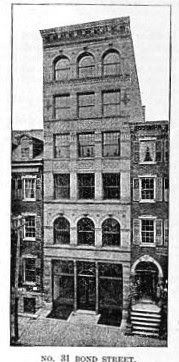
The brick-faced former mansion at No. 31 Bond Street was nationally infamous in 1887.  It had been the scene of the brutal murder of Dr. Harvey Burdell in 1857 and 30 years later no one had forgotten.  It was perhaps its gruesome reputation that resulted in a rapid turnover of owners.

On January 15, 1887 the Mutual Life Insurance Co. sold the property to Siegmund T. Meyer for $22,500.  Within four months he reaped a tidy profit by reselling it to John N. Hayward for $35,000.  The game of realty hot potato came to an end the following year, on  September 5, 1887, when Abraham Wolff purchased it for $36,000--just over $1 million in today's money.  Wolff was a founder of the investment banking firm Kuhn, Loeb & Co. and he recognized the changing personality--and opportunity--of the Bond Street neighborhood.

He hired the recently-organized firm of De Lemos & Cordes to design a replacement building.  The partnership of Theodore de Lemos and A. W. Cordes would go on to produce massive commercial buildings, like the Siegel-Cooper department store building on Sixth Avenue and the Macy's department store on Herald Square.  But their commission to replace the Bond Street house for Abraham Wolff would be significantly less grand.

Completed in 1889 the six-story loft and store building was faced in beige brick above a granite-and-iron base.  The upper floors were trimmed in brownstone and color-matching terra cotta.  The arched openings at the second and sixth floors and delicate decoration prompted the Real Estate Record & Builders' Guide to deem the structure "a fine business building."

Federal style former mansions, with marble stoops and trim, survived on either side of the new building.  Real Estate Record & Guide, May 10, 1890 (copyright expired)

The initial tenant was Hornthal & Co., manufacturers of "coffins and caskets."  The firm was run by Joseph Hornthal, his brother-in-law Moses Hatch, and William J. Noble.  It held a patent on the innovative "ice casket."  Decades before air conditioning, when bodies lay for two days in the parlors of their former homes, conditions could become unpleasant in hot months.  The casket held a compartment to hold ice, helping to cool the body and slow decomposition.

This model also came with the amenity of a fold-up viewing window over the corpse's face.  (copyright expired)

Interestingly, before many years Hornthal & Co. would change from manufacturing coffins to building hearses.

Following the departure of Hornthal & Co., there were several tenants in the building at the century, all of them involved in the millinery or apparel trade.  In the first decade of the 20th century it was home to firms like Dauziger Bros., skirt manufacturers; A. Smith, hat "ornaments';" women's hat maker H. Seller; W. Tompkins & Co., makers of flowers and feathers for women's headgear; and the Paris Millinery Supply Manufacturer.

A. Smith manufactured accessories for apparel makers here.  The Illustrated Milliner, July 1910 (copyright expired)

Nothing changed until the Depression years when around 1935 Max Goldberg, a "dealer in rags," and Goldseal Textiles took over the building.   The two firms remained for four decades, until 1975 when Yasuko Harada purchased the building for the newly-organized Kampo Cultural Center, a branch of the Japan Calligraphy Education Federation.

The organization initiated a renovation, completed in 1987.  It resulted in a multipurpose gallery and recording space on the first floor, a recording studio on the second, a video room and classrooms on the third and four floors, and artists' joint living-working quarters on the two upper floors.

The first floor venue was the scene of presentations, like the concert in October 1987 by Japanese koto (Japanese zithers) player and composer Tsutomu Sakamoto.

A subsequent renovation, completed in 2019, resulted in offices throughout.  De Lemos & Cordes's handsome commercial building, which erased the memory of a grisly murder, survives with little change.

photograph by the author

Saturday, April 3, 2021

A Lung Institute, A Wig Factory and Abandoned Women - 6 Bond Street


As fashionable society moved ever northward in the first decades of the 19th century, Nathaniel Weed purchased property in the developing Bond Street neighborhood.  In 1828 he began construction on an opulent Federal style house at No. 6 Bond Street.  Completed the following year, the 25-foot wide residence was three-and-a-half stories tall.  Its peaked roof would have held dormers.

Weed was head of Nathaniel Weed & Co. dry goods at 191 Pearl Street, and a director in the North River Bank and the Howard Insurance Company,  In 1837 he was appointed vice-president of the New York and Erie Rail Road.

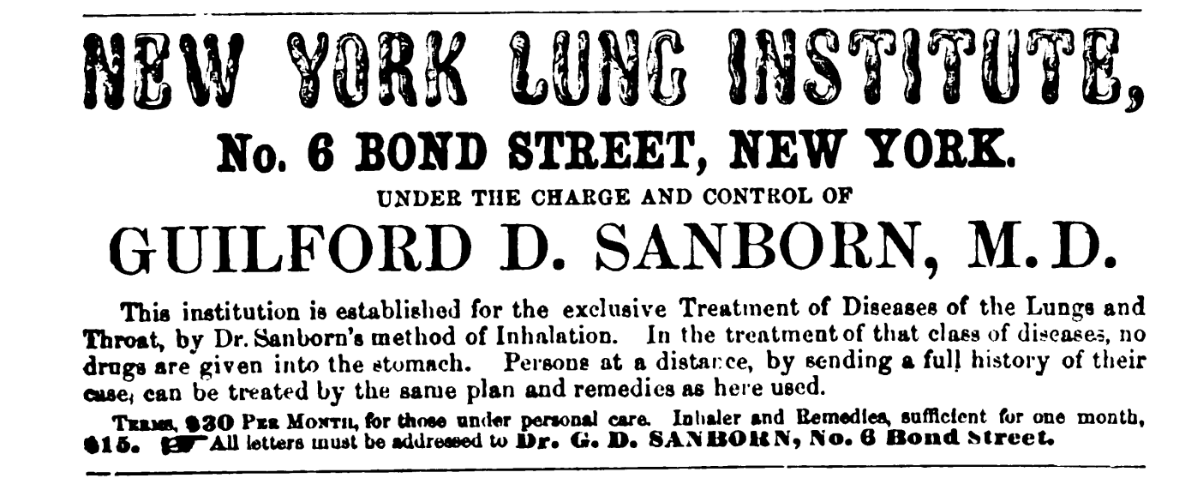
Around 1843 attorney Francis Griffin and his wife Mary moved into the house.  They lived here for a decade.  Then in 1854 Mary was listed in city directories as "widow."  She sold No. 6 Bond Street to Guilford D. Sanborn that year.  A doctor, he lived in the house and opened his New York Lung Institute here. 

On June 4, 1854 an announcement appeared in the New York Daily Herald that read in part:

This institute is established for the exclusive treatment of all diseases of the lungs and throat by the inhalation of medicated vapor, as the only medicated treatment; for no drug of any kind is given into the stomach.  The unparalleled success that has attended this system of practice is far great and more satisfactory than the old antiquated method of making a drug shop of the stomach.

Trow's New York City Directory, 1855-56 (copyright expired)

The New-York Daily Times published a long letter from Sanborn in December 1855 which outlined the importance of good nutrition.  It detailed proper foods, and in the paragraphs-long letter mentioned "all oils and fatty substances, including butter, and also sugar, starch and alcohol, are purely respiratory or carbonaceous food."  The Victorian editors seized on the single mention of alcohol to entitle the article "Alcoholic Drinks, In and of Themselves, Do Not Prevent Consumption."

Also living in the house were George Vandeuser, who worked in the Institute and also ran a perfumerie on Chambers Street, and a boarder, Charles W. Price, who worked as a clerk.

Suddenly at the end of 1855 the well-known Dr. Sanborn dropped out of the picture.  An announcement in the New York Herald dated January 26, 1856 declared:

New York Lung Institute, No. 6 Bond Street.  From and after this date this institution will be under the medical charge of D. D. T. Nestell, A.M.M.D., and assistants.  New and complete arrangements have been perfected for the convenience and comfort of our numerous patrons.  Noah S. Day Proprietor.

Dr. Daniel D. T. Nestell now lived above the institute along with George Vandeusen.  Charles W. Price was still boarding here in 1860 when The New York Lung Institute left.

No. 6 Bond Street was being operated as a respectable boarding house in 1861 by Christian Dietzsch and his wife.  Their white collar tenants included three importers, Max Bayer, Henry Flegenheim, and Isaac Ickelheimer; along with broker Louis T. Lehmeyer; optician Marcus Wise; and Charles Rubens, the head of the watch importing firm of Charles Rubens & Co.

The Civil War years saw the once exclusive Bond Street becoming increasingly commercial.  In 1863 the owner of No. 6, A. S. Hope, initiated a major modernization of the property by raising the attic to a full fourth floor adorned by a handsome Italianate cornice.

Christian Dietzsch and his wife continued to operate the boarding house, and their residents continued to be professionals.  Charles Rubens, who remained through the construction, was joined in the house in 1865 by drygoods merchant Samuel M. Cohen; importers, Jacob Goodmann, David Neumann, and Jacob Picardt; physician Bernard Segnitz; and "segar" merchant Leopold Wachenhelm.

In 1868 the basement level was converted for business.  It became home to Batchelor's Wig Factory, which also manufactured Bathelor's Hair Dye.  An advertisement in the Buffalo Morning Express on May 2, 1868 did not hold back on over-the-top self promotion:

Batchelor's Hair Dye--This splendid Hair Dye is the best in the world.  The only true and perfect dye--harmless, reliable, instantaneous.  No disappointment.  No ridiculous tints.  Remedies the ill effects of bad dyes.  Invigorates and leaves the hair soft and beautiful black or brown.  Sold by all druggists and perfumers; and properly applied at Batchelor's Wig Factory, No. 6 Bond street, New York

At the time James G. Aitken was operating the boarding house.  He would continued to do so until 1876 when he moved his operation to West 23rd Street.  

In 1879 Eugene Regan converted the wig factory space as his restaurant.  It was a short-lived venture and the 1880 he transferred his lease to A. Lemoine who opened a saloon in the space.  In turn, Lemoine sold the lease to Arthur Reisendorf the following year.  With each transfer, the reputation of the business declined.

On September 24, 1881, The New York Times reported "Four months ago Arthur Reisendorf opened a concert saloon at No. 6 Bond-street, which became a nuisance to the neighborhood within less than a week.  Abandoned women of the vilest instincts congregated there, and their obscene language, coarse songs, and boisterous laughter were continued far into the night and often until daylight."  The article noted that nearby at No. 7 Great Jones Street George R. Bevans's invalid wife was kept awake "in consequence of the drunken orgies in progress in Reisendorf's saloon."

Bevans walked to the saloon to complain.  The New York Times said that the "injuries" he had already suffered were added to by "being abused by the saloon people for protesting against the noise."  He therefore took his complaint to the police who arrested Reisendorf.

The saloon appears to have been cleaned up and the upper floors converted to offices and a meeting space by 1883.  The ungainly named Committee on Public Exercises of the Memorial Committee of the Grand Army of the Republic met in the building on March 12, 1883 to lay plans for Decoration Day (now known as Memorial Day).  Among the results was the formation of a committee to go to Washington to invite President Arthur to attend the ceremonies.

Factories associated with the millinery industry operated from the upper floors.  I. A. Goldberg, maker of artificial flowers, employed 29 women and three men in 1896, as well as two boys under 18 years old and 36 teenage girls.  They worked a grueling 57-hour workweek.  Dennis Cunahan's millinery factory produced "pattern hats."

The address received bad press again in October 1905 when one office was raided for running a poolroom--the term for an illegal horse betting operation.  Despite the arrests made, the gambling joint continued, almost assuredly by bribing local police.  It was too much for one Brooklyn Police Commissioner, General Bingham.

Bingham had made it his mission to eradicate poolrooms and, despite its being far outside of his jurisdiction, he sent Second Deputy Police Commissioner Arthur J. O'Keefe to No. 6 Bond Street on October 7, 1905.   The Sun reported "He says he was treated most discourteously there."

George Monroe refused to allow O'Keefe to enter.  "But I'm a police official," said O'Keefe, "and it is my right to enter this place."  Monroe reportedly responded, "nothing doing."  Despite calling for back-up of an officer from the Brooklyn traffic squad, Monroe prevented their gaining entrance.  He was arrested, however.

General Bingham had provoked the ire of powerful Manhattan criminals.  On April 5, 1906 a reporter from The Sun asked him if he intended to resign.  "There is a well founded rumor that you are going to do so.  It is said that the big gambling interests of his city are behind a movement to oust you."  Bingham insisted he had no intention of stepping down.

The converted residence continued to house small factories throughout most of the 20th century.  The first signs of the Noho renaissance appeared in the late 1970's when Gallery Soho 7 opened in the former saloon space.


A renovation of the property completed in 1991 resulted in a restaurant on the lower three floors.  In 2002 the restaurant space was reduced to the first and second floors (home to the Bond Street Restaurant today), with living-working quarters for artists on the upper two.  

photographs by the author

Friday, March 26, 2021

The 1831 Benjamin Lee House - 33 Bond Street


In 1831, shortly after builder Timothy Woodruff completed construction on the 25-foot wide brick house at No. 33 Bond Street,  it was purchased by Benjamin F. Lee and his wife, the former Jane Lawrence.  Sitting in one of the most exclusive residential districts of the city, their new Federal style home was three-and-a-half stories tall.  A short stoop led to the parlor floor and one or two dormers originally poked through the peaked roof.

Lee was described by Valentine's Manual of the City of New York as "one of New York's famous old merchants."  He had been a pioneer in the development of vulcanized rubber "under the Goodyear patents," according to Valentine's Manual, "and made a fortune in that business."  Lee had recently been a partner with Thomas Lord in the firm of Lord & Lees, but was now engaged with Paul Babcock in Lee & Babcock.  (The location of Lee's new house may have been a bit awkward, since Thomas Lord lived directly across the street at No. 32 Bond Street.)

Jane Lawrence Lee was known as "a celebrated beauty," according to the manual.  Her portrait by Charles Cromwell Ingham, entitled The White Plume, became famous within her lifetime.

Charles Cromwell Ingham was a founder of the National Academy of Design.  His portrait of Jane Lee created a sensation.  from The Moss Rose, 1854 (copyright expired)

The Lees did not remain on Bond Street for especially long.  It was advertised for sale in The Evening Post on January 16, 1834.  It was purchased by attorney Jonathan J. Coddington, who resold it in 1836 to Amelia Staples.

Amelia was the widow of John Staples.  Living with her in the Bond Street house were her son, William J. Staples, and his wife Hanna.  William was a well-to-do attorney and developer.  When the family moved into No. 33 he was actively involved in developing a section of Staten Island in partnership with politician Minthorne Tompkins.

In 1832 they had acquired a large parcel of land from the Vanderbilt family--part of the family farm where Cornelius Vanderbilt I was born.  They laid out streets for a new village named Stapleton.  Four years later they began marketing the new community and initiated a ferry service from Manhattan. 

In 1847 William was appointed Consul to Le Havre, France.  With her son and daughter-in-law gone, Amelia took in a boarder that year, broker William M. Clarke whose office was at No. 62 Wall Street.   She died in 1852 and the following year William Staples listed "the first-class dwelling."  His ad offered "with furniture, if desired."  

Amelia's mother's personal wealth was reflected in the other properties being sold to settle the estate.  Included was a house on Cherry Street, and three lots on Ninth Avenue and 16th Street.  William Staples apparently changed his mind about selling No. 33 Bond Street and in 1854 the title was transferred to Hannah.

Catharine Taylor purchased No. 33 in May 1885 for $16,000--about $435,000 in today's money.  She was the wife of Washington H. Taylor who operated a hotel on Park Row.  Catharine purchased the property as an investment, and in September 1888 transferred the title to her sister, Margaret Barnes.  The problem was that Washington Taylor was not aware of the transactions nor that the women were using his money.

In February 1889 he discovered that his wife, who had access to his safe, had absconded with more than $1.15 million by today's standards.  He left her and then filed suit against the two women to "recover property which he claims his wife purchased with money misappropriated from his safe."  Included, of course, was No. 33 Bond Street.

Catharine Taylor's purchase of the house as an investment was a wise move.  At the time the Bond Street neighborhood had changed from residential to commercial and small businesses filled the once-elegant homes which had not yet been demolished and replaced.  By 1896 Joseph Lowenstein's feather business operated from the building.  That year he employed six men, six women and two teen-aged girls who worked 55 hours each week.

Lowenstein's premises were protected by an early example of an electric burglar alarm which proved its worth on August 11, 1897.   The Sun reported "A burglar alarm saved the feather factory of Joseph Lowenthal [sic] early yesterday morning, not from looting by robbers, but from destruction by fire."  A fire had started in the room where dyed feathers were laid out to dry at around 1:00 in the morning.  It spread up the woodwork to the office on the floor above.  

"The flames snapped the tiny wire of the alarm and the bell rang furiously in the offices of the burglar alarm company," said The Sun.  Private detectives rushed to the scene to surprise the burglars.  "Instead they found the fire, and by giving the alarm had the firemen there soon."  Lowenstein's losses were about $64,000 in today's money.  But his burglar alarm had prevented the possible complete destruction of his business.

The anachronistic Lee house was surrounded by modern loft buildings at the time.  In 1901 real estate agent J. Jamison Raphael appeared in court regarding a property dispute in the neighborhood and was asked to assess other buildings.  In testifying he said in part, "I know the premises 33 Bond Street.  The building upon that property is of no particular value."

It was owned by Bernard H. Smith in 1908, who leased it to David Birnbaum for his fur factory.  Smith owned several buildings along the block and was apparently more interested in the rental income than the working conditions.  A factory inspector that year slapped Smith with three violations for Nos. 33, 27 and 23 Bond Street for the unsanitary conditions of the restrooms.

In November 1908 Harry Gorrfine and an accomplice were foiled in their attempt to rob Birnbaum's fur factory.  They were both sentenced to a year in prison, but Gorrfine quickly escaped.  Astoundingly, two weeks after his first attempt, a detective spotted him slipping back into No. 33 Bond Street on the afternoon of Saturday November 28.  What Detective Wilbur did not realize that Gorrfine had two cohorts already inside the building.

Wilbur rushed to a telephone and called headquarters for help.  As he ran back to No. 33 Gorrfine was just coming out with a large bundle.  Wilbur "nabbed him and took him back into the hallway," according to The Sun.  When two other officers arrived, they took their captive back upstairs.  "The minute they opened the door the other two thieves made a rush to get by, but were collared."  Police reported that inside Birnbaum's factory were bundles of furs worth $10,000 that the thieves had prepared to be remove--more than a quarter of a million in today's dollars. 

In April 1911 the architectural firm of Cleverdon & Putzel was hired to renovated the old house to an efficient loft building.  They raised the attic to a full fourth floor and added a pressed metal cornice that harkened to the Italianate style of a decade earlier.

In 1941 B. Rosen's remnant store occupied the parlor level.  via the NYC Dept of Records & Information Services.

Throughout most of the century the building would house small businesses like the Forlin Hat Company, here in the 1920's.  Then in 1996 a renovation resulted in an art studio in the basement and first floor, home to 33 Bond Street Architecture Design, and living-working quarters on above.


The commercial space became home to Vitsoe in September 2009.  The gallery-type store offered shelving systems and chairs designed by Dieter Rams.  Vitsoe remained until around 2017.  Today the basement level is home to Dashwood Books, which arrived approximately in 2010, and the physical therapy studio Body Evolved occupies the first floor that was once filled with the elegant furnishings and paintings of Benjamin and Jane Lee.

photographs by the author

Monday, March 15, 2021

The Lost William B. Burgoyne Residence - 712 Broadway


Leopold Tilman and his wife lived in the upper floors in 1862.  To the left a sliver of the marble "Colonnade Houses" can be seen, and to the right a portion of the once-sumptuous Chesterman house is visible.  photo by Maurice Stadtfield, from the collection of the New-York Historical Society.


What would be known as the Bond Street District vied with St. John's Park as the most exclusive residential district in New York City in the early 1830's.  In 1833 Elisha Bloomer began construction of two lavish marble mansions at Nos. 714 and 716 Broadway.  They would be mini-versions of LaGrange Terrace a few blocks away on Lafayette Place.  At the time William Bickford Burgoyne and his family had lived at No. 712 Broadway for at least a year.

The brick-faced Burgoyne house was typical of the upscale Federal style residences in the Bond Street neighborhood.  Three-and-a-half stories tall and 25-feet wide, its entrance featured fluted columns and an exquisite leaded fanlight.  Gibbs surrounds framed the basement openings and marble lintels and sills graced the windows of the upper floors.  The peaked roof was pierced by two prominent dormers.

Burgoyne was a trustee of The Croton Insurance Co.  He and his wife, the former Eliza Moser, had nine children.  Three of them were still toddlers when the family moved in.  

In 1832 Eliza looked for help, placing two advertisements in The Evening Post.  On February 8 she sought "a Chambermaid, and a young woman to do housework.  Americans or coloured would be preferred."  And eight months later she advertised for: "A nurse to take charge of three children.  A middle aged woman, either American, English or Scotch would be preferred.  Good reference required."

Slavery had been abolished in New York City in 1827.  The same, of course, was not the case in the South--a situation that would cause problems within the Burgoyne household in 1842.

That spring the family had houseguests from New Orleans, Mrs. Terenea Burke and her brother, Mathew Morgan.  Wealthy ladies routinely traveled with their personal maids and Terenea Burke brought along Julia Green.  It was not long before abolitionists got word that a slave was being held in the Burgoyne house.  On May 28 a writ of habeas corpus was served on Mrs. Burke to produce the young woman in court.

Mathew Morgan took Julia to the Chambers Street courthouse where a partial hearing was heard, according to The Evening Post.  The case was temporarily adjourned and Morgan and Julia headed back to No. 712 Broadway.  "When nearly opposite the City Hall he was attacked by a gang of black and white men," reported the newspaper, "and the slave taken from him by force and conveyed, contrary to her wishes, to a house in Church street."

Morgan sought the help of police and officers went to that house to retrieve Julia.  "They were assaulted very violently, but finally gained admittance into the house.  The slave, however, had been spirited away."  Whether it was "contrary to her wishes" or not, Julia Green had been liberated.

Two sons, Benjamin and William M. Burgoyne, took advantage of the California Gold Rush by relocating to San Francisco in 1849 and opening a banking business which provided loans to prospectors.  It was about this time that their parents left No. 712 Broadway.

What had been a block of luxurious mansions was increasingly becoming commercial.  In 1852 Jules Delcroix moved his upscale shop into the former Burgoyne residence.  On May 3 he announced:

Rich Laces Only--the depot of the manufacturers of Chantilly and Brussels Laces is transferred from No. 16 Park place to 712 Broadway, opposite Washington place.  Shawls, Scarfs, Caps, Berthas, Flounces, Sleeves, Mantillas, Veils, Handkerchiefs, &c., &c.

The following year Madame Augusta relocated her studio into an upper floor.  The ability of the daughters and sons of well-heeled families to dance was crucial before they were introduced to society.  An announcement appeared in the New York Daily Herald on January 21, 1853 that read:  "Madame Augusta has re-opened her dancing classes in her commodious house, No. 712 Broadway.  A reduction will be made to parties having a number of children to be instructed."

It was most likely Leonard Tilman, here by 1862, who fancifully decorated the façade.   Although he may have been responsible for the removal of the intricate wrought iron basket stoop newels, little else of the original detailing was destroyed.  Nevertheless, a first-rate artisan was commissioned to plaster and paint the façade to resemble veined marble blocks.  A wooden partition was erected in front of the peaked roof to mimic a mansard.  It deftly incorporated the original dormers into its design.  Tasteful painted window shades served as additional advertisement, as did the oversized replicas of the awards Tilman had received at the London Exposition of 1851 and the Paris Exposition of 1859.

Leopold Tilman's trade card illustrated his decorated building.  The complex fan light was carefully detailed.  from the collection of the Museum of the City of New York

Tilman and his wife moved into the upper floors and ran their extensive millinery and artificial flower business downstairs.  The business catered to the carriage trade, as evidenced in this advertisement from December 7, 1862:

At Tilman's, 712 Broadway.  Great Sale of bonnets and headdresses.  For fifteen days to commence on the 8th of December, Mr. Tilman will sell a splendid stock of rich Bonnets and headdresses, the best articles at the very lowest price.  Bonnets, in French black silk velvet, from $12.  Headdresses with bouquet de corsage, from $8

 The sale price of $12 would be equal to about $315 today.

By 1868 Tilman shared the building with Dietrich & Co., dealers in silver plated items, which occupied the basement and parlor floor.  The Tilmans were not at home at around 11:00 on the night of April 16, 1868 when a fire broke out on the second floor.  The New York Herald reported, "The firemen, as usual, were very prompt, and put out the fire before it spread much beyond its place of origin."  Nevertheless, Tilman suffered about $5,000 in damages--just under $93,000 today.  Dietrich & Co. suffered smoke and water damage of about $500.  The Evening Post mentioned, "The building is owned by Theodore Burgoyne."

Tilman left No. 712 Broadway around 1870.  The former house was briefly used as a sensational exhibition space.  On May 25, 1870 an advertisement in the New York Daily Herald touted:

See the Japanese Mermaid
The long Lost Link of the
Simian Tribe Discovered
Thousands have already visited 712 Broadway to see this rare and remarkable prodigy.
THE MERMAID
THE JAPANESE MERMAID
HALF WOMAN AND HALF FISH
Now on exhibition at 712 Broadway from 10 A.M. to 10 P.M.
Admission 25 cents; children 15 cents

That venture was short-lived and by 1872 the building was home to F. Leypoldt's publishing business, founded in 1847.  He was editor and publisher of the trade journal, The Weekly Trade Circular, which served the publishing and stationery industry, as well as the annual The American Book-Trade and The Shippers' Monthly Circular.

When Leypoldt's long time partner retired in 1872 he sought a replacement.  On October 10 he advertised for a partner, "either special or active, with a capital of twenty-five to thirty thousand dollars."  He promised the potential associate that "The investment is a strictly first-class one."  

Leypoldt's publishing business reflected the change along this section of Broadway from fashionable stores to more industrial tenants.  The same year that he was looking for a partner, William H. Nicols signed a lease for space for his sewing machine store.  The following year the American Buttonhole, Overseaming & Sewing Machine Co. moved in.

By the dawn of the 1890's the Burgoyne house was possibly the last relic of the 1830's along the block.  The Folding Trunk Company and the Pickens & Co. real estate office occupied spaces in the building that year.  But they would soon have to relocate.  

On February 22, 1890 the Real Estate Record and Builders’ Guide reported that the “three-story brick store” had been sold “Mssrs. Scholle Bros.” for the equivalent of $2.55 million today.  Within two weeks the Record & Guide reported that architect Alfred Zucker "has prepared plans for a handsome store building" on the site.

That building, completed in 1893, survives.

photograph by the author

many thanks to historian Anthony Bellov for prompting this post

Friday, February 26, 2021

Ralph S. Townsend's 1895 35-39 Bond Street


The block of Bond Street between Broadway and Bowery was lined with elegant homes in the 1830's.  Wealthy merchants George Sharp and James Hagarty lived in Nos. 35 and 37 Bond Street, respectively, while Judge William Kent occupied No. 39.  That high-tone residential tenor would be long gone by the last quarter of the 20th century.

In 1892 Havens & Winters purchased the three properties.  The real estate developers were well known for erecting modern factory buildings.  For the Bond Street project they turned to architect Ralph S. Townsend who designed several Havens & Winters buildings.

Townsend produced two identical structures that successfully pretended to be one.  His tripartite Renaissance Revival style structures were faced in brick and stone and lavishly decorated with terra cotta.  Each two-story rusticated limestone base held a storefront.  The brick-faced midsection featured three-story arches.  The panels between the floors were decorated with elaborate terra cotta swags.  Egg-and-dart terra cotta eyebrows above the grand arches sprung from Renaissance faces.  The top floor featured triple arcades below a pressed metal cornice and frieze.

Havens & Winters were developers, not landlords.  On March 11, 1893 The Real Estate Record & Guide noted "Last week builders Havens & Winters sold their recently-completed stores on Bond street."  The journal noted, 'The district is one of the most active in the city now; every new building rents quickly, often in advance of completion, and the demand is unsupplied."

The upper floors filled with apparel firms.  Among them was neckwear manufacturer Berliner, Strauss & Denzer whose massive factory on Elizabeth Street had burned on January 9.  Within a month the firm had relocated to No. 35 Bond Street and on February 4 the management showed its appreciation to brave employees.  The Sun reported that the staff "assembled at 35 Bond street yesterday afternoon to witness a presentation of medals by the firm to employees whose coolness and courage had helped in saving the lives of over 600 persons."

The three young men had, indeed, showed bravery.  The elevator boy, Samuel Bernstein, refused to retreat from the burning building until he had successfully brought all the female employees down.  Another, Solomon Altschuler, rushed back into the offices to close the fireproof safe which contained $40,000 in cash; and Nathan Ullman had directed some of the young females to the roof where they were rescued.

Berline, Strauss & Denzer was undoubtedly the largest tenant in the building.  In 1895 it employed 35 men, five boys under 18 years old, 400 women, and 26 females under 21 (five of them under 16 years old).  They worked a grueling 54-hour work week. 

Other early tenants included the start-up firm, the Bloomingdale Company.  In its February 1894 issue The Clothier & Furnisher reported "There is a new concern in the manufacture of specialties in clothing line to be found at 39 Bond street.  Its founder, Larry Bloomingdale, "is ready now for business in garments for the Spring and Summer trade," said the article.  The size of Bloomingdale's operation paled when compared with Berliner, Strauss & Denzer.  In 1896 he was employing just three men.

The other tenants in the 1890's were clothing makers Cohen Mfg. Co., A. Robinowitz, J. Lamkay & Co., and Joseph Carmel & Co.  Unrelated to the garment trade was the Pacific Press Publishing Co., which operated from No. 39 by 1896.

Pacific Press Publishing was edited by Alonzo T. Jones.  It published books and pamphlets, most with a decided religious theme.  Among the books offered in 1899 were Sunbeams of Health and Temperance, Heralds of the Morning, and Almost A Man.  An advertisement for Almost A Man promised, "every boy will read it, and be better for it as was the boy in the story.  It is intended to help mothers and teachers in the delicate task of teaching the lad concerning himself, purely, yet with scientific accuracy."

The firm also published the weekly American Sentinel, "published in the interests of [issues] Religious, Liberty-Christian and Constitutional."  The articles shared a similar theme.  In the September 14, 1899 issue, for example, were articles entitled "Rome Aims to Rule the State," "Papal Titles for Sale," and "Political Religion."

The American Sentinel, July 13, 1899 (copyright expired)

The turn of the century saw a diversification of the tenant list.  In 1901 the ungainly named Standard Cloth Examining, Sponging and Refinishing Works was here, employing 11 men who worked 59 hours per week.  Restoff & Bettman, manufacturers of "leather dressings" occupied space in 35 by 1905, and advertising agent Martin J. Ott's office was here in 1907. 

Ott found himself in hot water on April 1 that year.  He was at a an office in No. 28 Ann Street where an illegal horse betting operation, known as a pool room, was conducted.  Suddenly Police Captain E. J. Toole and six detectives rushed in.  Ott was among those arrested, charged with aiding and abetting a poolroom.  It was no doubt a humiliating incident for him, and one which could be damaging to his professional reputation.  The New-York Tribune said "A large crowd watched the men being put into the patrol wagon."

Clothing manufacturer Jacob Cohn had operated from No. 39 as early as 1896.  His was a modest business with a staff of only about ten.   For several months in 1910 orders of cloth to be made into clothing mysteriously disappeared before making it to Bond Street.  On December 12 the New-York Tribune reported "Cohn has been missing bills of lading for goods shipped over the New York Central and other railroads.  Detectives discovered that the original bills of lading for shipments of goods to Cohn had been presented and the goods delivered."

When the freight depot turned over the signed bills of lading to detectives, they showed Jacob Cohn's signature--except "Cohn said the signatures on the bills were forgeries."  Investigation soon focused on the 19-year old office boy, Abe Silverberg.

As it turned out, the teen had been "impelled by one man to open letters and purloin bills of lading," explained the New York Press.  He would deliver them to Moses Trosky, who then signed the documents and claimed the freight.  The incentive was hard to resist.  Following Silverberg's arrest on December 18, Detective David Brown told reporters that "Not long ago...Trosky handed him $70 as his share of the loot.  Silverberg had $30 when arrested."  The $70 would equal nearly $2,000 in today's money.

The first decades of the 20th century continued to see a mix of tenants.  In 1917 the Columbia Dye Works, Inc. was in No. 39.  When a client failed to pay its invoice in August 1917, the firm sold the finished goods at auction--"2,000 opposum skins, dyed black."

The appearance of the buildings in 1932 is essentially unchanged today.  Photo by Wurts Bros. from the collection of the Museum of the City of New York

In 1922 the start-up firm of Israel Brothers, manufacturers of "fabric and imitation leather belts," opened in No. 39.  Other tenants of the buildings in the 1920's included the Boston Ladies' Hat Company, the Exclusive Hat Frame Company, and the American Mirror Works.  

Mid-century saw a more industrial type tenant.  Greenwich Village Plumbers Supply, Inc. moved in in the mid-1950's and remained through 1997.  But the last quarter of the 20th century were dark days for the neighborhood.  Most of the building sat vacant throughout the 1970's.

But little-by-little the block revived as artists discovered the Noho neighborhood.  In 1973 photographer Harold Feinstein rang a ten-week creative photography workshop in his studio in No. 39.  The course, open to beginners and advanced students, cost $100 (a little more than five times that much in today's dollars).

In 1977 the Carat Conway Dance Studio opened.  It staged works like the 70-minute work "Zero As A Value" presented on December 19, 1980.  The Villager described it as "a trilogy comprised of a monologue, a film and a dance that become interwoven."

In 1994 the buildings were joined internally and the upper floors converted to joint living-work quarters for artists, just two or three sprawling spaces per floor.  In 2000 the Soho shop Peter Roberts Antiques relocated to No. 39, and shortly after Modernlink furniture store moved into No. 35.   Lobel Modern Gallery replaced Peter Roberts Antiques in 39 around 2007.


After its more than 125 years, Ralph S. Townsend's handsome commercial structure continues to be a handsome architectural presence.

photographs by the author

Saturday, January 30, 2021

The 1829 David S. Jones House - 2 Bond Street


Attorney David S. Jones was the sixth son of Samuel Jones (known as the Father of the New York Bar) and Cornelia Herring (often spelled Haring).  He was born at the family's country home, Tryon Hall, in South Oyster Bay, Long Island on November 3, 1777.  Soon after graduating from Columbia College he was appointed private secretary to Governor John Jay and upon his return to New York joined his father's law practice. 

Jones inherited a large share of the sprawling Herring Farm.  By the mid 1820's streets had been laid out on the property and the eastern section, later known as the Bond Street District, was seeing the rise of opulent residences.  In 1828 Jones began construction of a large brick-faced home at No. 2 Bond Street, just east of Broadway.  (That section of Broadway was known as Great George at the time.)

An 1869 map shows the original Herring farm as surveyed in 1784 with the contemporary streets overlaid.  from the collection of the Princeton University Library

Completed in 1829, the 26-foot wide Jones house was three-and-a-half stories high above a short English basement.  A service road, known as Jones Alley, to the side afforded windows on three sides.

Jones had been married three times--each time to a woman of sterling pedigree.  His first wife, Margaret Jones (of a non-related family) was the granddaughter of Declaration of Independence signer Philip Livingston.  Susan Le Roy, his second wife, was the daughter of Herman Le Roy, one of the wealthiest citizens of New York; and his third wife, Mary Clinton, was the eldest daughter of Governor DeWitt Clinton.

The ample size of the new house was necessary.  The three marriages had produced 18 children.  In addition to his legal practice, Jones was trustee and legal advisor of Columbia College, the General Theological Seminary and the Society Library, and a director in the Phenix Bank.

In 1835 Jones moved his family to the Long Island estate, although he continued to work in the city.  (He gave up the arduous commute in 1840, but never returned to Bond Street.)

The 1917-1918 Valentine's Manual of the City of New York noted, "After Judge Jones' departure from Bond street, his old residence became the 'fashionable boarding house' of Mrs. Lois Street...She had ample experience in the business, for as early as 1809 she and her husband kept a boarding house at 67 Pearl street."

Lois's deceased husband, Caleb Street, had been a prosperous merchant.  Her well-to-do boarders in 1838 included Gabriel Wisner, a Front Street merchant.  She placed an advertisement in the Morning Courier and New-York Enquirer in September 1842 offering:

Board In Bond Street--At no. 2 Bond street, board with very pleasant rooms can be obtained.  A gentleman and his wife or a few single gentlemen will find his a desirable location for the winter.

Lois Street moved her boarding house business to No. 47 Lafayette Place, the northernmost house on LaGrange Terrace, in 1844.  The Bond Street house next became home to John William Schulten, described by The New York Times as "a well-known merchant of this City."  His commission business was located on Broad Street.  

Boarding with the Schultens was Dr. James Stewart, the medical examiner of the Mutual Benefit Life Insurance Company.  He remained with the family until they left in 1847.  

An auction of the household items held on April 16 that year hints at the elegant interiors.  Included were imported carpets, "mahogany sofas and chairs covered with crimson plus, ottomans...mahogany card and dining tables, bronze Astral and mantel lamps...dressing bureaus and with stands with Egyptian marble tops" and "glass decanters and tumblers, wines and liqueurs, white China Ware" and other upscale items.

For the next few years No. 2 Bond Street was home to a private school.  Most such schools were segregated by sex--instructing either the sons or the daughters of wealthy families.  But the Giraud School was surprisingly co-educational.  An advertisement in 1848 read:

The Misses Giraud's French and English school for young children, will re-open on Monday, September 11, at No. 2 Bond street.

In 1853 the widowed Margaret Howell was operating No. 2 again as an boarding house.  While her tenants were still professional, the increased number reflected the gradual decline of Bond Street.  (The more boarders in an establishment, the less exclusive it was considered.)   Among her boarders in 1855 were Charles F. Bartholomew, who dealt in mourning goods; salesman George D. Humprys; Phineas W. Sprague whose forwarding business was on Front Street; accountant William F. Reed; and, Dr. James Warner.

No. 2 Bond Street was sold at auction on December 7, 1858.  It was purchased by Dr. Joshua F. Bridge.  The house became home to his family and to his Graefenberg Institute which treated women's medical issues.  

Bridge developed his own medicines.  An advertisement in The New York Times on November 123, 1860 touted:

The Graefenberg Company's Uterine Catholicon is a certain cure for all female irregularities, weakness, tumors, ulceration, inflammation, whites, failing and other local derangements of the uterine organs, as well as the constitutional troubles arising from them.

The price was $1.50 per bottle (about $48 today).  But for $6 "five bottles will be sent by Express, and charges prepaid to the end of the Express line from New-York," said the ad.  "Dr. Bridge pledges his word for the truth of the above," it promised.

Bridge described his services in The New York Times on February 23, 1861, saying:

The Graefenberg Institute Buildings are in the finest and most central portion of New-York City (No. 2 Bond-street, near Broadway).  They are four stories high, open, airy, elegantly furnished and arranged, and are admirably adapted for the comfort of those who wish to place themselves under the immediate care of the resident physician, who resides in the buildings, and who has been long and favorably known to the community for his skill and experience.  The diseases treated at the Institute comprise chronic uterine and other difficulties of women...and the Institute enjoys, as it deserves, the entire confidence of those who require its advantages.

Dr. Bridge moved his facility to Brooklyn in 1863.  The new owner of No. 2 Bond Street, Anthony S. Hope, was a wholesale grocer.  He initiated major changes to the building by raising the attic to a full fourth floor and giving it a modern Italianate cornice and cast metal lintels over the windows.

It was operated as a boarding house for almost decade.  After David Tetzlaff purchased the property around 1872 he converted it for business purposes, including a two-story cast iron storefront.  The former basement level became Tetzlaff's "eatinghouse," while upstairs were the "gentlemen's furnishings" store of Blackmar, Hart & Boyd; Loskamp, Schaible & Lerch, jewelers; and Stecheri & Wolff, "German booksellers and importers of European literature."

In 1878 George Murphy, "manufacturer, importer and dealer of photographic goods," opened his store in the building.  He sold plates, lenses, cameras and other supplies.  The goods were not inexpensive.  A dozen 11 x 14-inch negative films (or plates) cost $7.50 in 1889, or about $215 in today's money.

Anthony's Photographic Bulletin, February 1889 (copyright expired)

In 1892 the St. Louis and Canadian Photographer reported "Mr. Geo. Murphy, the enterprising dealer of number 2 Bond St., N.Y., has been compelled, on account of his phenomenal increase of business, to seek more room and better facilities."  David Tetlaff's restaurant was still in the basement level but the personality of Bond Street was increasingly becoming more industrial.

Within three years all the tenants of the upper floors were clothing manufacturers.  In 1895 S. M. Bondy & Co.'s business was described as "cutting clothing."  The other tenants were Rothblatt & Abrahams and Joseph S. Blatt & Co., both of which made knee pants.

At the turn of the century the basement space was now Miller's Restaurant.  Its cashier, Gustave Mensenge, got himself in trouble on the evening of December 2, 1902.  Described by The Evening World as "neatly dressed and is a fine-looking young fellow," had been arrested on charges of having attempted to hug a young woman on Lexington Avenue.

In court the next morning Mensenge denied the accusation, saying his mistook Emma Morgan ("a pretty young girl who lives in Long Island City," according to The World) for a friend.  According to him, he greeted her, "How are you, Mamie?" and she replied, "Oh, very well," with a smile.  He testified that when she agreed it was a delightful evening, he asked "Would you like to go to the theatre with me?"

"How rude you are sir; I don't even know you!" she blurted.

Mensenge told the judge, "The next thing I knew I was placed under arrest."  He did not explain how the conversation had continued so long without his realizing the she was not his friend.  Because Emma had not appeared in court, the judge held Mensege on $500 bail until she could be brought in.

photo via the NYC Dept of Records & Information Services

Throughout the first three quarters of the 20th century the former Jones house held small factories.  But that all would change as the Bond Street neighborhood saw the arrival of artists, musicians and trendy shops.  By the mid-1970's the popular nightspot The Ladies' Fort was at No. 2 Bond, and in the former Tetzlaff restaurant space was the First Amendment, an improvisational theater.

On October 28, 1977 The New York Times reported "Jazz will return to the Ladies Fort at 2 Bond Street, near Broadway and Bleecker Street, with the Battle of the Big Bands."  In October 1985 the First Amendment celebrated its 10th anniversary.


In 1993 the upper three floors were converted to "living-working quarters for artists," one per floor.  After nearly 200 years the structure bears only hints of the handsome mansion erected by David S. Jones.

photographs by the author

Saturday, January 16, 2021

The James Iddings House - 52 Bond Street


Even while horribly disfigured, the ca 1836 house manages to hint at its former elegance.

Around 1807 Bond Street was laid out, but it would not be until around 1812 that the first house appeared.  Before mid-century it would boast 60 high-end houses which rivaled and surpassed the grandest homes on Broadway, St. John's Park and Lafayette Place.  Sturges S. Dunham, writing in Valentine’s Manual of Old New-York in 1907, noted “Bond Street was one of the best known streets in the city and none stood higher in favor as a place of residence.”

In 1834 builder Ephraim H. Wentworth purchased the plot at No. 52 Bond Street.  He sold the property to Jonathan J. Coddington four years later.  Coddington was highly involved in politics and in 1844 would be the Democratic nominee for mayor.  It is unclear which of the men erected the 25-foot wide house on the site, but appears that neither of them lived in it.

The brick-faced house was an early example of the Greek Revival style on the street lined mostly with Federal style residences.  The railings of the stone stoop were highly unusual--their serpentine design engulfing two palmettes, a popular motif of a generation earlier.  The stone surround of the entrance was expected in the architectural style, its pilasters upholding a heavy stone entablature.  A squat attic floor replaced the peaked roof and dormers seen in the neighboring Federal houses.

Somewhat battered today, the stoop railings may be unique.  Under its coat of paint the paneled stoop may be marble, as was the case with other mansions on the block.

According to Valentine's Manual of the City of New York in 1917, "The first occupant of No. 52 Bond street seems to have been James Iddings, assistant cashier of the United States Bank, then at 34 Wall street, opposite the old Merchant's Exchange."  Iddings was appointed to that position on August 30, 1838, the same year Coddington purchased No. 52 Bond Street.  It came with an annual salary of $4,000--about $115,000 today.

In 1841 Iddings moved to Brooklyn.  An advertisement appeared in The Evening Post on April 5 that year offering the "three-story house, No. 52 Bond street" for rent.  It became home to teacher Esther Ann Devereux for a year (she moved across the street to No. 55 in 1843) and the house next became home to Dr. John Davis.

Dr. Davis's home, like all the others along the block, would have been furnished in high style, with oil paintings, marble and bronze statuary, and custom-made furnishings.  He almost assuredly ran his practice from the house as well. 

By the first years of the 1850's the wealthy residents of Bond Street were moving further north as commerce threatened their refined neighborhood.  Dr. Davis apparently gave notice to Coddington of his intentions to move in 1851.  An advertisement in the New-York Daily Tribune that February offered the house for sale.

Davis moved to No. 37 Bleecker Street in 1852.  No. 52 became a high-end boarding house, with residents like William Gardiner, a cabinetmaker at No. 69 Gold Street who lived here in 1853 and '54.  An advertisement in the New York Herald in May 1855 read:

Board at 52 Bond Street--Two suits of rooms on first and second floors, furnished or unfurnished, for gentlemen or gentlemen and their wives; also, two rooms on third floor, furnished or unfurnished, for single gentlemen, with all the modern improvements.  Private breakfast extra if desired.  References will be required.

That the ad mentioned single gentlemen, but not single ladies, was significant.  Respectable boardinghouses did not accept unmarried women for fear of housing a disreputable woman and the taint she might bring to the establishment.  An apparent exception was Eleanor Williamson, a widow, who lived here in 1855 and '56.  Another boarder at the time was David Ritter who ran a drug store on the Bowery; and James H. Holden moved in and operated his dental office (presumably in the basement level) in 1857.

Unmarried women who found themselves pregnant not only faced ruin, but in many cases they could barely afford to feed themselves let alone an infant.  The problem resulted in newborns being abandoned on doorsteps.  On December 28, 1855 a new mother sneaked down the stairs to the basement of No. 55 and left her baby outside the door.

The following day the Evening Post entitled an article "Another Discarded Infant" and reported "Last night, though the weather was intensely cold, some inhuman mother or father left a little boy, about two weeks old, in the area of house No. 52 Bond street.  The parentless child was kindly cared for until he could be sent to the Governors of the Alms-House."

It appears that Dr. Payton Spence and his wife, Amanda, were operating the boardinghouse by 1862.  Dr. James Holden was still here and would operate his dentist office through 1865.  Edward W. Bartholomew, a maker of "medicines" on John Street, was renting a room by 1864.

The change in the neighborhood was reflected in the Spences' questionable side business.  An advertisement in The Herald of Progress on May 24, 1862 read:

Dr. and Mrs. Spence may be consulted at No. 52 Bond Street, New York  Mrs. Spence, in her capacity as a Medium, will prescribe and manipulate for physical, mental, and moral diseases, acute or chronic.

A few patients can also be accommodated with rooms and board.  L
etters of inquiry may be addressed to either Dr. Payton Spence or Mrs. Amanda M. Spence, No. 52 Bond Street, New York city.

No. 52 briefly became a private house again when banker Henry Bischoff purchased it in 1865.  He shared office space at No. 58 Bowery with his son, Henry Jr., who was an attorney.  Although the Bond Street neighborhood was in decline--most of the once-elegant homes now being used as dental offices, boarding houses or small businesses--the Bischoffs were well-to-do and well respected.  

But when Bischoff sold the house in 1868 to Frederick Bornhagen and his wife Dorothea, it again became a boarding house.  Born in Prussia, Bornhagen was a tailor, as was his son, Francis.  He leased the basement level as a commercial space to L. Levy, a boot and shoe maker.  The Bornhagens' boarders were respectable working-class citizens like Peter Bohl, a barber, and Patrick Keirns, a private detective in 1873.

Then in 1875 Bornhagen leased the basement level to brewer Jacob Ruppert for $1,000 (about $24,000 today).  It was common for breweries to operate their own saloons in the 19th century, a practice that gave them the opportunity to sell only their own goods.  Possibly as a part of the deal, Frederick Bornhagen changed his profession from tailor to "beer."  He would run the saloon until about 1887.

By then the Bond Street block had become somewhat seedy.  In 1880 the Bornhagens' 11 boarders included an actor and several actresses (who worked most likely in the Bowery theaters nearby), a horse dealer, a barkeeper, two cigar dealers, a painter, and three children.

Although they retained possession of the property, the Bornhagens are no longer listed at the address after the mid-1880's.  In 1887 the saloon was being operated by Max Lasker who ran an illegal "card room" in the back.  Working on a tip, an undercover detective Eugene D. Collins joined in a poker game on November 19 that year.  The New York Times reported that he lost $11 (more than $300 in today's money).  On November 23 the newspaper reported "Yesterday a raid was made upon the place and Lasker, who claimed that it was a private club, was held for trial.  Three men who were arrested with him because they were in the card room were discharged."

Illegal gambling paled to the charges brought eight years later.  In 1894 both the saloon and the rooming house above were being operated by John H. Meyer.  On May 28, 1895 Frank Moss, the attorney for the Parkhurst Society, charged that "from January 1 to May 17 last a large number of disorderly houses flourished in [police Captain Joseph B.] Eakins's precinct, openly and flagrantly, without his interference."

A "disorderly house" was a polite term for a brothel.  The Sun reported "A list is given of six saloons declared to be the resorts of prostitutes and of twenty-one alleged houses of ill fame."  Among them was No. 52 Bond Street, which was labeled a "house of assignation."

It was most likely that scurrilous press that prompted the Bornhagens to convert the entire house to commercial space.  In 1897 furs and fur cap manufacturer M. Cohen and furrier Alex A. Bernstein were among the first to lease space.

Fur merchants continued to fill the building.  The three tenants in 1901 were S. Kanrich, makers of fur hats and caps; and furriers S. Bierman and A. Gottfried. 

Bond Street was fast becoming part of the millinery district at the time.  In 1904 Wm. B. Goldbaum factory produced hat and bonnet frames in No. 52, Kanrich Bros. produced ladies' hats, and the Jacobson-Brilliant Trimmed Hat Co. opened here in 1907.

The Millinery Trade Review, January 1904 (copyright expired)

After having owned the property for nearly four decades, the Bornhagens sold it to Michael J. Adrian in 1905.  It continued to house millinery firms for most of the first half of the 20th century.  But as the garment district moved north past 34th Street, the Bond Street block became decidedly more industrial.  No. 52 was home to electricians, ironwork firms, and at least one leather goods company through 1950.

In 1941 the Greek Revival entrance surround survived and a show window has been carved into the parlor floor.  via the NYC Dept of Records & Information Services.

A holdover from that period in 1987 was automobile parts dealer American Brake Products, run by brothers Harry and Archie Freibaum.  But businesses like theirs were already becoming scarcer as the Noho renaissance changed the face of Bond Street.  

By the 1960's space on the upper floors was being used, unofficially, as residential.  In 1966 designers Thelma Toma Holly (known as Toma) and her husband Jan Gero, founded the fashion company 52BOND, in the basement space.  Their factory was located directly across the street at No. 42.  The couple ran their business, 52 Bond Street, Ltd., from the space until 1970.

A renovation completed in 2008 resulted in one residential space per floor.  Sadly, sometime after 1974 the Greek Revival entrance surround was removed.  Despite the industrial metal doors, and the parlor floor alterations, the overall domestic appearance of the Iddings house survives.

photographs by the author