Showing posts with label avenue C. Show all posts

Wednesday, May 11, 2022

The Varied History of 40 Avenue C


In the 1840's, the house and store at 40 Avenue C was home to a number of blue collar residents.  Little had changed in 1863, when the ground floor cigar store was used by the city as an election polling place.  And it appears that the residents were living in less than comfortable conditions.  On July 10 and 11, 1867, the Sanitary Company of Police set its "subdivision of unskilled labor" to work "whitewashing walls and cleaning cellar" of the building.

Then, in 1869, builder Charles Boehm purchased this and other Avenue C properties from Bernard J. Fry.  It seems to have been Boehm who updated (or replaced) the old building.  A marble bandcourse now ran through the second floor brickwork and the upper floor openings boasted paneled lintels.  

Charles and Katharina Boehm had four children, Charles, Annie, John, and Rosa.  The family continued to house boarders, both in the main house and in the small building in the rear yard.  Most of their tenants were German immigrants.

That was not surprising.  The neighborhood had seen the influx of Germans since the 1840's, and by 1855 only Berlin and Vienna had a higher population of Germans than New York City.  It was likely that Charles Boehm, himself, was one of those early German immigrants.

Following Charles Boehm's death around 1885, Barbara Boehm (the widow of John Boehm) ran the boarding house.  The accommodations must have been crowded.  In the three-story rear building were the families of four tenants, a shoemaker, a cabinet maker, a baker and a hatter.   Above the ground floor real estate office of Goodman & Adler, Barbara had seven boarders: two bakers, a carpenter, a printer, a shoemaker, a coal merchant, and Mary Jaekle, a widow who dealt in umbrellas.  Each of them had a German surname.

On April 21, 1886, Katharina Boehm leased the building to Wolf Morris.  By the time she leased it again in 1890, she had remarried, the paperwork listing her as "Katherina Muller, formerly Boehm."

While the Boehm's boarders had traditionally been hard-working and respectable, by the turn of the century at least one was not.   Living in a front room on the top floor was a woman, described by investigators as of "fair complexion, round face, weight 160 lbs., 30 years, high [sic] 5 ft. 5", Jewish."  She had a reputation both with her neighbors and the police.

On November 5, 1901 Vice Inspector H. S. Conklin filled out a "Disorderly Tenement House" complaint, saying he had visited the woman four days early with Jacob (known as John) Kreiswurth.  The complaint said, "John paid her in presence of me.  She then took him in a small room, remained there for short time, then we left."  (The payment was $1, or about $30 in today's money.)

Why three more visits to the woman's rooms over the next few days were necessary is unclear.  Kreiswurth wrote about their visit on November 7, saying:
 
She took me to a bed room and exposed her self for Prostitution purposes which I declined.  A partie [sic] who lives on the same floor, back, told us that it is a shame to live with such a woman on the same floor.

There were four tenants living in the rear building on January 9, 1902 when a chimney fire broke out.  Happily, it was extinguished by fire fighters before any significant damage could be done.

Annie Sadlak ran the boarding house in 1906.  Typical of her tenants was Frank Woodinski, a brick layer.  He was working on construction site at 122nd Street and Second Avenue on September 24 that year when disaster occurred.  The New-York Tribune reported, "Edward Brandt...who was working on the scaffold, missed his footing and fell heavily against the new wall which the men were building.  In a moment it collapsed and about ten men fell two stories to the ground."  Among the most seriously hurt was Woodinski, taken to Harlem Hospital "with injuries to legs, arms, body and head and a probable fracture of the skull."

Three months earlier, in June 1906, Annie Sadlak had taken in a new boarder, Michael Sabak.  One afternoon while she was out visiting friends, he sneaked into her rooms and stole a gold watch and chain and $200 from a bureau drawer and disappeared.  (The cash alone would be more than $6,000 today.)

Romance put an end to Sabak's freedom.  Annie Sadlak read the news of his upcoming wedding in January 1907.  She went to police, who arrested him at the wedding reception on January 27.  The New-York Tribune reported, "When the bridegroom's arrest became known, the bride collapsed."  A search of Sabak at the station house revealed "a pair of brass knuckles and a pawn ticket, it is alleged, for the watch which he is charged with stealing from Mrs. Sadlak."

On September 27, 1906 the Tenement House Department cited 40 Avenue C for "unsanitary conditions."  The situation was corrected by Sigmund Kraus, who signed a lease on the building on January 17, 1907.  He initiated alterations, designed by architect Max Muller that included new store fronts, stairs, windows and interior walls.  It was most likely at this time that the distinctive second floor copper bay and the new copper cornice were installed.

The renovations seem to have attracted more upscale tenants.  In 1909, Frederick Hemley lived here when he was appointed a commissioner of deeds.  In 1914 Jack Branower passed his medical licensing examination; and by 1917 Deputy Attorney  General William Blau lived here.  That year Mayor John Mitchel appointed him a city magistrate.   He remained in his apartment at least through 1918.  The store space at the time was either a tavern or liquor store, the excise license being held by S. Kraus & Bro.

The building as it appeared in 1983.  via the NYC Dept of Records & Information Services

In the 1980's, the commercial space held the Camano Restaurant.  It reflected the changing demographics of the neighborhood, as an increasing Hispanic presence joined the Ukrainian and Russian population.

Then, in 2010, what The New York Times called the "pansexual" nightspot, Bedlam opened in the ground floor.  On September 29, the newspaper's journalist Tim Murphy said, "It's a modern-day love triangle:  Williamsburg-y gay men bring their gal pals, who attract straight guys, who in turn bring out more gay men."  The space had come a long way since its days as a German-language real estate office.  Murphy noted, "A recent soft opening drew a hodgepodge of luminaries, including Anderson Cooper, Sarah Jessica Parker, Matthew Broderick and Alan Cumming."  
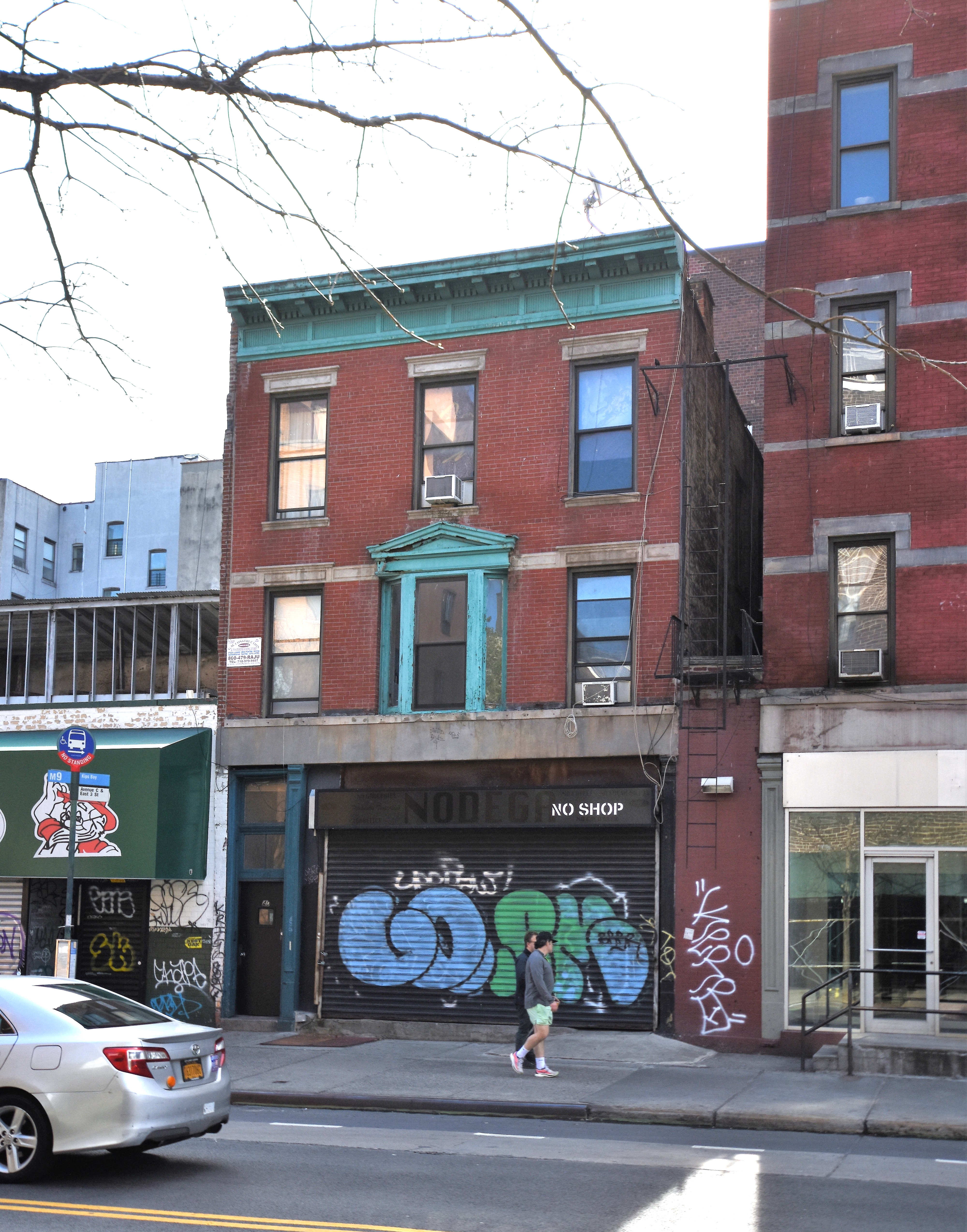

Recently the ground floor space sprouted the purposely puzzling sign "Nodega," noting "No Shop," "no coffee," "no cold beer," "no groceries, and "no cigarettes."  

photographs by the author
LaptrinhX.com has no authorization to reuse the content of this blog

Wednesday, May 4, 2022

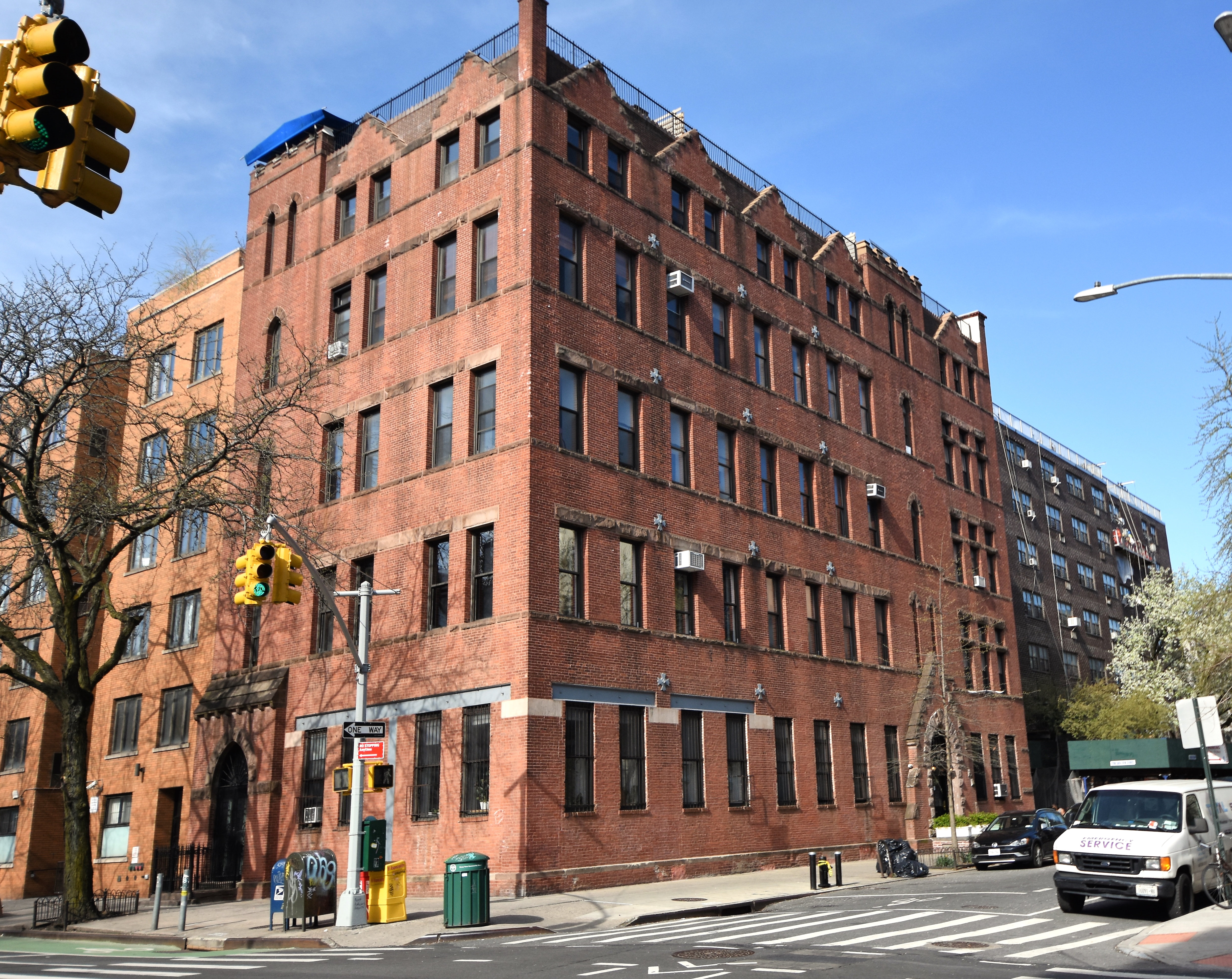
The 1887 Holy Cross School and Clergy House--300 East 4th Street


At street level, the corner originally held a store that provided income for running the school.  

On September 15, 1885, The New York Times commented, "The consecration of the Mission Church of the Holy Cross, in Avenue C. near Fourth-street, marked an important stage in the work of the Sisters of St. John the Baptist."  Sister Helen Margaret had begun work in the neighborhood, described by The New York Times as "one of the most densely populated in the city," a decade earlier.  The Sisters of St. John the Baptist worked among the teeming German population, operating a mission, a sewing school, and other assistance.

Eventually, a church building was necessary.  "A piece of ground was bought for it, and there has been erected a structure of brick, plain and substantial in its outside appearance and with a roomy and handsome interior," said the article.

The rector of the Mission Church of the Holy Cross was the Rev. James Otis Sargeant Huntington.  The Sun described him as "the Episcopal monk, of the United Labor party and head of the mission."  Months after the church building was completed, he embarked on a second project--the construction of a school and clergy house abutting the church.  

On May 4, 1888, The New York Times explained that Sister Helen Margaret, "was an heiress, and when she died [in 1885], she made provision in her will for the new school and clergy house.  Her bequest was increased by 1,000 small subscriptions collected by her co-laborers, including Father Huntington."

The four city lots on the corner of Avenue C and West 4th Street, abutting the church, were purchased.  The New York Times explained that the school and clergy house "will be five stories high, of brick with brown-stone facings."  The Sun added that it "will contain the clergy house with parish rooms, guild rooms, etc.; the Sisters of St. John the Baptist will have in the building a parish school for the accommodation of about two hundred boys and girls, in which an effort will be made to rival the best teaching of the public schools."

The laying of the cornerstone on September 19, 1887 was an impressive ceremony.  The Sun reported:

Avenue C was blocked with spectators at 3-1/2 o'clock when the procession of acolytes and Episcopal priests issued from the vestry doors of the mission church and wound around the foundation walls of the new school edifice to the spot where the corner stone hung from a rope.  Behind walked acolytes and choristers in robes of black and white.

Next came the clergy and their assistants.  "Behind them marched in couples, singing and bearing embroidered banners, the little children of the mission, several hundred in number.  Last of all came the black-robed Protestant sisters of St. John the Baptist."

The building was completed in December 1887.  Although his design is less sophisticated than theirs, the architect (whose name was inexplicitly never mentioned) was obviously influenced by the several industrial schools being designed by Vaux & Radford at the time.  Without the projections and angles found on the Vaux & Radford examples, the boxy bulk of the building comes off as a bit clumsy.  But the architect, who may have been a congregant, used the trademark Vaux & Radford stepped gables and similar, picturesque entrance treatments.


A corner store, which provided rent to help defray the costs of the school, was entirely separate from the main building.  On the first floor were the "choir room, guild room, reception room, sacristy, office and two broad halls," according to The New York Times.  The church could be accessed by either hall.

On the second floor were two guild rooms, and a large library.  Two classrooms for girls, "which can be divided by sliding doors," shared the third floor with the clergy apartments and a kitchen.  The third and fourth floors held the boys' classrooms, and the fifth was the convent for the nuns in charge of the school and guild.

Another impressive ceremony took place on May 3, 1888--the blessing of the building, known as the Feast of the Invention of the Cross, by Bishop Henry C. Potter.  The bishop, 20 clergymen, the Sisters of St. John the Baptist, and a "large choir of mail voices, men and boys," processed through each room of the building.  In each room a blessing was performed.  The ceremony concluded in the church, during which Bishop Potter said, "The perils of the poor in the metropolis remind me of Victor Hugo's vivid and picturesque description in 'The Toilers of the Sea.'  The planting of this mission in a part of the city where so many persons were exposed daily to manifold temptations will prove an anchor and a shield."

Each year since 1870, the Fresh-Air Fund of the New-York Tribune had collected money "for sending tenement-house children to country homes for a fortnight in the summer."   On November 25, 1888 the newspaper said that to date, nearly 11,000 had been given the vacation from the city, to enjoy two weeks of sunshine and fresh air.

November was not too early to start planning for the next summer season, and in 1888 the newspaper assembled "a large number of city pastors, physicians, nurses, missionaries and Bible-readers" to discuss the fund.  Perhaps to the surprise of many, Father Huntington was not keen on the concept of hosting tenement children in homes in the country.  On November 25, the New-York Tribune said he "spoke in favor of 'colonization,' showing how much better it was to have the city children apart from country children.   It was better for both classes, he urged, to have city children and country children kept separate."

In 1911 the building was converted for use as Holy Cross House, "a boarding house for working girls," as described by The Sun on April 10, and operated by the Sisters of St. John the Baptist.  Single women in the city could find jobs as shop girls and factory workers.  But few boarding houses accepted unmarried females, and hotels were costly.

The Sun said, "A novel and attractive feature of the home is that the regulations governing it will be entrusted as far as possible to the girls themselves.  Only industrious young women of good character will be admitted and the sisters in charge are going to try the experiment of permitting their guests to prescribe many of the conditions under which they will live together."

The interior changes included "nicely furnished sitting rooms," a gymnasium, a roof garden and dormitory.  "Girls who feel the need of a maximum of fresh air will find sleeping quarters on the roof," said The Sun.  Working girls who boarded at Holy Cross House paid $2.50 per week for meals and a bed, about $70 in today's money.

Subsequent remodeling filled the spaces between the Flemish stepped gables with brick.

By the Depression years, little had changed, although the rate had doubled.  On June 13, 1933, The Daily Argus noted that it was still run by the Sisters of St. John the Baptist "and is a residence for Christian girls and women under 40, some students.  There are dormitories."  The charge was "$7 a week with meals," equivalent to $140 today.

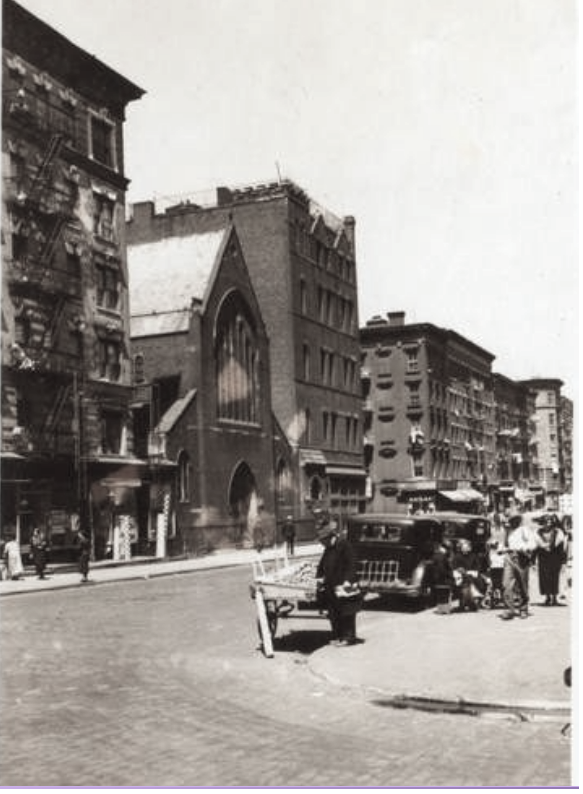
The church building still stood on April 26, 1935.  It was demolished around 1941.  from the collection of the New York Public Library

In March 1941 the St. John the Baptist Foundation sold the church and the corner property to the Ukrainian Orthodox Church of America.  In petitioning the Supreme Court for permission to sell the property, the foundation said in part, "It is no longer practical for the Sisterhood of St. John the Baptist to conduct services in the Holy Cross Church...or to use the mission house because the population of the vicinity...has so changed that it is impossible to obtain an adequate congregation."

The change in the population that the petition mentioned was the replacement of German with Ukrainian, Russian and Polish immigrants.  "The Ukrainian Orthodox Church of America has need of a church and mission house in the neighborhood," said the petition.

By 1948 the congregation had altered the former Holy Cross House to accommodate the Ukrainian church, as well.  Because it was essentially unidentifiable as a church from the exterior, it temporarily confused former G.I. Joseph J. Hall that year.

On November 20, Hall met Ronald E. Fisher in a restaurant on Third Avenue and and East Fourth Street.  Friends warned Hall that Fisher was "a church robber."  According to The New York Sun, "When [Fisher] suggested he help in picking up a typewriter, Hall accompanied Fisher only to see whether the story told by the friends was true."  In court on December 2, Hall told the judge, "If there is anything in this world I hate, it's a church robber."

Hall admitted that the two entered "the Ukrainian Orthodox Church of America at 300 East Fourth street, but only after they had entered did he discover that it was a church."  When Fisher started rifling desks in the church office, Hall attacked.  The Sun reported, "he punched him, threw him to the floor, and then called the police."  Both men were arrested for burglary.

In court to defend Hall was the Right Rev. Bohdan T. Shpilka, who had been asleep in the rectory until the police arrived.  He supported Hall's attorney who pleaded, "I'm not asking Your Honor to pin a medal on him, but I am asking that you dismiss the charge."  The judge agreed.

The building was renovated again in 1969 to Horizon House, a Federally-run drug-treatment center.  Here, according to The New York Times in 1971, "ex-addicts handle much of the treatment of the addicts."  By 1975 the facility was Rehabilitation Phase Halfway, Inc., "a center for addicts and ex-offenders," as described by its director, Mrs. Beverly Brooks that year.

image via compass.com

Then, finally, a remodeling of the building completed in 1989 resulted in three apartments on the ground floor and four each on each of the upper stories.  Inside, no trace of the rooms where German immigrant children attended school, working girls found accommodations, and addicts were given treatment survive. 

photographs by the author
no permission to reuse the content of this blog has been granted to LaptrinhX.com