Showing posts with label Eleanor Roosevelt. Show all posts

Saturday, July 9, 2022

The Benno Neuberger House - 55 East 74th Street


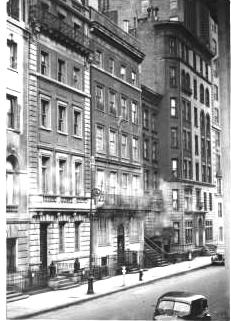
In 1898 the prolific real estate developer Jeremiah C. Lyons began construction on a row of eight five-story dwellings on East 74th Street between Park and Madison Avenues.  His architects, Buchman & Deisler, design them in two balanced groupings of four--A-B-B-A and C-B-B-C.  Among the C models was 55 East 74th, a dignified neo-Renaissance style residence faced in limestone.

Above a short stoop, the entrance sat within a handsome portico upheld by Scamozzi columns.  The pierced balcony railing at the second floor flowed into the continuous balustrade along the row.  An arched, cartouche-filled pediment sat above the center door at this level.  The bowed facade ended at the third floor, providing a stone railed balcony to the fourth.

Construction would be completed in spring of 1899, but Benno Neuberger did not wait that long.  On February 9, 1899 The Sun reported that he had purchased 55 East 74th Street "in course of construction."


Neuberger was born in Bremen, Germany in 1866 and came to New York in 1881.  He was the senior member of the tobacco firm of E. Rosenwald & Brother.  Highly involved with Jewish charities, he was the president of the Hebrew Orphan Asylum, as well.  He and his wife, the former Stella Mayer, had two children, Florence Edna and Harry Hobson.  Moving in with the family was Stella's widowed mother, Fredricka Mayer.

Like their neighbors, the Neubergers filled the house with costly furnishings and decorations.  An inventory listed "an Aubusson tapestry suite of five pieces," an Aubusson tapestry fire screen, and Eduardo Leon Garrido's modern painting The Masque Ball, appraised at $8,000 by today's conversion.  Neuberger's German roots may have prompted him to buy a Benz automobile rather than an American-made vehicle.  It cost him $2,000, the equivalent of $53,400 in today's money.


from Empire State Notables, 1914 (copyright expired)

On January 4, 1911 Fredericka Mayer died at the age of 70.  Her funeral was held in the drawing room the following day.  That summer the family sailed for Germany, where Florence first met Ehrich Hecht, a well-to-do young agent for a Berlin exporting firm.  A romance was sparked.

The family was back in Germany in 1914.  Benno Neuberger was ill and sought "the cure" in Konigstein.  Not surprisingly, it seems that Ehrich Hecht was a regular caller on Florence.  But the trip ended tragically, with Neuberger dying of pneumonia there on July 6, 1914 at the age of 48.  He left an estate valued at $1,357,982--or about $36.3 million today.

The funeral and burial was held in Germany.  The family narrowly escaped being trapped abroad when, less than two weeks later on July 28, World War I erupted.  

Once back home, Harry joined the Tenth Field Artillery to fight against the country his father had so dearly loved.  He was sent to the French front in 1918 where he would receive what the New York Herald called, "his baptism of fire at Chateau-Thierry."  Harry performed valiantly during the harrowing battle.  The New York Herald reported, "He continued to assist in the evacuation of the wounded even after being gassed," and noted grimly, "Of his regiment only three more men are left.  All the others were either killed, wounded or detached."

New York Herald, February 25, 1919 (copyright expired)

On February 24, 1919 Harry was awarded the Distinguished Service Cross for heroism overseas.

Just months after peace was declared, Florence resumed her romance with Ehrich.  Anti-German sentiments still ran high in America, a fact that, perhaps, resulted in their marriage being quietly held in the East 74th Street house on October 25, 1919.  The New York Times commented that the groom was "said to be the first German subject to arrive here since the war."  The article noted, "Mr. Hecht was employed in the German War Office during the hostilities, but it was said that he intends becoming an American citizen if permitted to do so."

In April 1920, Harry Neuberger sold the house to the Stevenson C. Scott family.  Born in Edinburgh, Scotland in 1864, Scott was the son of a portrait painter.  He came to the United States in 1893, and was now a respected art critic and the president of Scott & Fowles, art dealers.  He was an authority on 18th century English painting and, according to The Saratogian, "possessed a comprehensive knowledge of modern and classical art."

He and his wife, the former Marie Power, had one daughter, Marie.   The family was followed by the society columns as they sailed to Europe, or summered in Saratoga Springs, New York.  Understandably, the home of the man who sold paintings to wealthy collectors and institutions like the Metropolitan Museum of Art filled his home with valuable artwork.  In 1939 he traveled to London where he created "a mild sensation" in art circles, according to The Saratogian, "when he paid $30,000 at Christies for Whistler's famous painting, At the Piano."  It was the highest price ever paid for a Whistler at the time.

Scott paid the equivalent of $560,000 in today's money for At the Piano.  from the collection of The Taft Museum, Cincinnati.

In January 1945, Stevenson Scott injured his hip when he suffered a fall in the East 74th Street house.  The family went to the fashionable Gideon Putnam resort in Saratoga Springs for his convalescence.   He died there nine months later, on October 8 at the age of 81.

The East 74th Street house was soon purchased by Dr. Otto  Burchard and his wife Berta.  The couple remained here until selling it in December 1951.  The New York Times noted that the buyer intended to remodel it into "apartments of four rooms each."  That plan was never carried through.

At the time, former First Lady Eleanor Roosevelt was living at 211 East 62nd Street.  She had met Dr. David Gurewitsch in 1944 and the two became extremely close, platonic friends, often traveling together.  When Gurewitsch married Edna Perkel in 1958, the deep friendship increased by one.  According to Shannon Butler in her Roosevelt Homes of the Hudson Valley: Hyde Park and Beyond, Eleanor "soon treated Edna as an additional companion, and they traveled all over the world and formed a tight bond of friendship."

Dr. David Gurewitsch and Eleanor Roosevelt outside the Kremlin.  from the Everett Collection

Butler explains, "It was Edna who mentioned the possibility of the three sharing a townhouse together that would give Eleanor more room to work and David space to see patients."  In 1959 the three purchased 55 East 74th Street, with Eleanor taking the lower three floors and the Gurewitsches living on the top two.  While they lived separately, the Gurewitsches would often dine with Eleanor.

Living with a diplomat had its challenges.   According to The Wall Street Journal writer Katherine Clarke, "One day in 1960, Edna Gurewitsch got a call from former First Lady Eleanor Roosevelt suggesting she get to their shared townhome early: Soviet statesman Nikita Khruschev, in town to address the U.N. General Assembly, was swinging by."

Less than three years after moving in, Eleanor Roosevelt went to Columbia Presbyterian Medical Center on September 26, 1962 for what the public was told was "a routine checkup."  But, the Utica Press later noted, "Actually she had suffered a lung infection and anemia.  When her illness failed to yield [to] hospital treatment, she was discharged to her Manhattan apartment at 55 East 74th Street on October 18."

The modestly furnished room in which Eleanor Roosevelt died.  from the collection of the Franklin D. Roosevelt Library and Museum

The First Lady "gradually faded," according to the article, until she died at 6:15 on the evening of November 6, 1962.

In 1964 an auction of Eleanor Roosevelt's personal items was held at Hammer Galleries.  The New York Times reported, "The collection comes from Mrs. Roosevelt's residences at 55 East 74th Street and the Val-Kill Cottage on the Roosevelt estate at Hyde Park, N.Y."  While many of the items were valuable antiques, like the 1750 George III melon-shaped silver pitcher, and the American Sheraton-style mahogany breakfront, a surprising number of the First Lady's furnishings were modest.  The New York Times diplomatically said, "In every case, though the furniture in the collection may have what is known as age, the articles are not period pieces."

David Gurewitsch died in 1974 and by 1976 Edna was operating the Gurewitsch Gallery from the house.  In April that year she staged an exhibition of sculptures by George Rickey here. 

She remained at 55 East 74th Street until 1999, when she sold it to Credit Suisse executive Vikram Gandhi and his wife, Meera, the founder of the Giving Back Foundation.   The nonprofit raises funds for education and to fight global poverty.  Through her works, Meera Gandhi, like Eleanor Roosevelt, would host prominent guests like Hillary Clinton in the house.  In 2000, the Gandhis made major renovations to the interior, eliminating Buchman & Deisler's 1899 architectural elements.


In the fall of 2021, with her children grown, Meera Gandhi sold 55 East 74th Street for $13.5 million.  In reporting the sale,
The New York Times noted, "It has around 8,500 square feet of interior space and features terraces on the roof and fifth floor and a rear garden.  There are also six bedrooms, five full bathrooms and two half baths."

photograph by the author
no permission to reuse the content of this blog has been granted to LaptrinhX.com

Friday, March 8, 2013

The Ludlow-Parish Houses -- Nos. 6 and 8 E. 76th St.

The Ludlows lived at No. 6 (right) and the Parishes at No. 8 -- photo by Alice Lum
Margaret Tonnele Hall Ludlow had an impressive New York pedigree. She was closely related to the Roosevelt family and in 1863 she married Edward Philip Livingston Ludlow--a direct descendant of Philip Livingston, a signer of the Declaration of Independence, and of Gabriel Ludlow who was named by King William III as a Vestryman of Trinity Church in 1697.

By the time Ludlow’s daughter, Susan, married the wealthy banker Henry Parish, Jr. in 1884 New York’s wealthy citizens were building imposing mansions along the east side of Central Park. The Ludlows and Parishes would join the trend in 1895 when Edward and Margaret Ludlow laid plans for a double mansion on East 76th Street, just off the Fifth Avenue.

The Ludlows commissioned architects Parish & Schroeder to design two side-by-side homes—one for themselves and the other for their daughter and son-in-law.  By designing the houses as mirror images, the firm created what appeared to be a single Italian Renaissance palazzo—two mansions pretending to be one.  Sitting squarely at sidewalk level above two shallow steps, the separate entrances were disguised by a single portico supported by paired columns.

The limestone base gave way to four stories of beige-grey Roman brick trimmed in limestone.  Parish & Schroeder resisted the gushing ornament popular on other mansions of the period; instead relying on restrained decoration—brick quoins, simple iron railings and just two Renaissance-inspired triangular window pediments.

The houses were completed in 1896, the title of both being recorded in Margaret’s name.  The Ludlows moved into No. 6 East 76th Street, with the Parishes next door at No. 8.  The houses were connected internally by “wide sliding doors” between the drawing rooms, according to The New York Times.  While Margaret Ludlow gave the expected entertainments here and in her Newport cottage, Mount Airie, it would be Susan Parish who attracted the social spotlight.

On December 4, 1897 the Parish home was ready to receive guests.  The following day the New-York Tribune noted that “Mrs. Henry Parish, Jr., of No. 8 East Seventy-sixth-st., gave a housewarming yesterday afternoon, in her new home, which was one of the largest and most brilliant receptions of the day.”

For her afternoon housewarming Susan wore “a gown of mauve velvet,” and assisting her in receiving the throng of guests were five wealthy socialites:  Mrs.Goodhue Livingston, Mrs. Douglas Robinson, Mrs. Benjamin Welles, Mrs. William S. Cowles, and, of course, her mother who, the Tribune mentioned, “lives in the communicating house.”

Susan and Henry had just one child, Julia, a fact that did not stop them from hosting several debutante affairs, weddings and receptions in the house.  Henry’s sister, Edith married her “kinsman,” Daniel Parish Kingsford, in a wedding in July 1898 that the Vermont Phoenix deemed “notable because it involved some of the best blood of old New York.”  The ensuing wedding breakfast was held at No. 8 East 76th.  The following year, on December 14, Susan gave a dinner for her relative Kitty Hall.  “The guests were all debutantes,” mentioned The New York Times.
Henry Parish, Jr. -- "Genealogical and Family History of Southern New York" 1914 (copyright expired)
But none of the events held in the house at No. 8 East 76th Street would outdo the wedding that took place here on St. Patrick’s Day, 1905.


At the turn of the century, both parents of Susan’s cousin, Anna Eleanor Roosevelt, had died.  Anna, who went by her middle name, moved in with the Parishes.  Eleanor’s uncle was President Theodore Roosevelt and following a reception and dinner at the White House in 1903, she was introduced to her distant cousin, Franklin Roosevelt.

Much to the disgruntlement of his domineering mother, Sara Delano Roosevelt, Franklin announced his plans to marry Eleanor in 1904.  Despite Sara’s efforts to stop it, the wedding took place in the Parish mansion.  The house was transformed for the ceremony.  The Los Angeles Herald said “A huge floral cluster of 1,000 pink roses, entwined with smilax and asparagus, was suspended in the center of the drawing room and formed a canopy.”  


The New York Times wrote “The two large drawing rooms on the second floor, done alike in pale amber-yellow satin brocade, were thrown into one large salon running the width of the two houses.”  With no father to give her away, Eleanor relied on her uncle, the President of the United States.

Getting to the Parish house for the President meant disrupting the St. Patrick’s Day Parade.  The Los Angeles Herald said “On the way he met a big St. Patrick’s day parade, which was stopped, the participants and the thousands who crowded the sidewalks wildly cheering Mr. Roosevelt as he went through and passed up Park avenue.”

At 3:00 in the afternoon he arrived.  “The president, with his niece leaning on his arm, preceded by the bridesmaids, passed into the drawing room through an aisle of white ribbons held by the ushers,” said the newspaper.

In 1915 Henry Parish retired from the Bank of New York and Trust Company where he had been vice-president and trustee.  Unbendingly old-fashioned, The New York Times remarked that “he had never allowed a telephone in the institution and permitted typewriters only out of his own earshot.”

The Parish house continued to be the scene of numerous entertainments, including the wedding of cousin Elizabeth Livingston Hall to Norwood Rathbone on February 8, 1922.  The New York Times could not resist mentioning that “Mrs. Rathbone is a cousin of Mrs. Franklin D. Roosevelt, whose wedding was also celebrated some years ago in the same house, long occupied by Mr. and Mrs. Parish.”

The Roosevelts and the Parishes had a close relationship and even after Franklin attained the presidency he and Eleanor were frequent guests on East 76th Street and in the Parish homes in Newport and Llewellyn Park, New Jersey.  Henry and Susan were guests, as well, at the White House.

On June 26, 1942 the 82-year old Henry Parish died of a heart attacked in the Llewellyn Park summer home.  Susan continued to live on in the house on East 76th Street and to maintain the New Jersey and Newport estates.

Four years after her husband’s death, Susan Parish was at home in New York while workman prepared the New Jersey house for her return in May 1946.  A lit cigarette was tossed onto the porch roof and before long the upper floors were on fire.  A gardener, William Kennedy, rushed into the burning house to rescue personal and historic items.  Among them were photographs “of the late President after his graduation from Harvard University and one of the Roosevelts at their wedding, which took place in the home of Mrs. Parish,” reported The Times.

The fire destroyed the second and third floors of the home, “one of the oldest residences in Llewellyn Park,” according to The Times; causing about $30,000 in damages.

Susan had the home restored.  By now the aging woman who had once been so socially prominent was a semi-invalid and spent her time in seclusion.  In 1950 she traveled to the Llewellyn Park estate for the summer and there, on July 9, she died at the age of 84.

The following year her estate sold the house on East 76th Street where she had lived for over half a century in a cash deal.  It was the end of the line for the Parish house as a private home.

Both homes were converted to multi-family residences; their historic significance largely lost -- photo by Alice Lum
After her mother’s death, the house next door had been purchased by Colonel Thomas H. Birch.  He died here in 1929 and Mrs. Birch remained on until the early 1930s.  In 1946 it had been converted to apartments and doctors’ offices.

The same fate would befall the Parish home.  Following the sale in 1951 it was converted to apartments with doctors’ offices on the ground floor.
 
The two once-grand homes give little hint of their former lives.  No one remembers that here a President of the United States gave away a future First Lady in marriage, under a canopy of 1,000 pink roses.

Wednesday, June 8, 2011

The Eleanor Roosevelt Statue -- Riverside Park at 72nd Street

The ivy-covered site for the Eleanor Roosevelt monument was created from a demolished highway entrance ramp -- photo wn.com
Although Anna Eleanor Roosevelt was born to a socially prestigious family in 1884, her interests were far removed from the endless teas, dances and dinner parties expected of a turn-of-the-century debutante. Instead, upon returning from finishing school in England, she volunteered as a social worker in the slums of the Lower East Side. After she and her fifth cousin, Franklin Delano Roosevelt, began seeing one another, she walked him through the deplorable tenement district of Five Points so he could see for himself the living conditions of the poor.

Years later during the Great Depression she would repeat the walking tour with her young son, Franklin Jr., taking him among the shanties erected in Central Park so he could appreciate the intense needs of the underprivileged.

Eleanor’s humanitarian concerns broadened and she used the influence she gained through her husband’s political successes as a means to forward her causes. Unafraid of the term “activist” she walked picket lines, lobbied for civil rights, and spearheaded women’s rights causes. Her focus on basic human rights was such that she once lashed out at the planners of city housing projects who wanted to save money by eliminating seats from the toilets. Roosevelt decried the insult to the human dignity of the residents.

Eleanor Roosevelt died on November 7, 1962. Her rich life history included fights against sweatshops, appointment as delegate to the United Nations, and ceaseless battles for women’s and racial equality.

In March 1986, Roosevelt admirer Herbert Zohn, who lived near Riverside Park, noticed the disheveled condition of the Park around 72nd Street and envisioned a revamped section of park that would include a memorial to the intrepid former First Lady.

A decade of organization, planning, lobbying and cajoling later, Zohn’s vision began taking shape. The State of New York agreed to remove an unused Henry Hudson Parkway entrance ramp, the city paid for landscaping improvements by Bruce Kelly/David Varnell Landscape Architects, and over 2,000 private donors contributed to a statue.

A national competition was held with the commission going to Penelope Jencks. The artist envisioned Roosevelt not in a traditional, stately pose; but natural and contemplative. Mrs. Roosevelt would be depicted deep in thought, leaning against a boulder in the park’s open air, ankles crossed beneath her long skirt and coat, and her chin resting on her hand.

Jencks used Phoebe Roosevelt, Eleanor’s great-granddaughter as the model for the torso. The young model later said she was picked because she has the Roosevelt slouch. The artist discovered after months of looking that there was no perfect boulder and that rather than rely on Mother Nature she would have to shape one herself. Giuliano Checchinelli carved the black granite rock to Jencks’ specifications.

On October 5, 1996 the 8-foot bronze statue was unveiled with remarks by then First Lady Hillary Rodham Clinton. Mrs. Clinton had often spoken of her sense of connection with Eleanor Roosevelt; leading her to sometimes “speak” to the former first lady in times of stress. Thirty-five Roosevelt family members were in attendance, including Franklin D. Roosevelt III.

photo riversideparkfund.org
The art magazine Sculpture Review called the Jenck’s statue the “finest achievement of her career making public sculpture.”

Part of the $1.3 million project was a new walkway inscribed with quotations by Mrs. Roosevelt and Adlai Stevenson. Stevenson’s tribute reads “She would rather light a candle than curse the darkness and her glow has warmed the world.”

The quotation from Eleanor’s March 27, 1958 speech to the United Nations Commission on Human Rights is “Where, after all, do universal human rights begin? In small places, close to home. Such are the places where every man, woman and child seeks equal justice, equal opportunity, equal dignity.”

The Eleanor Roosevelt memorial was the first statue in New York City of an American-born woman and is maintained by the Eleanor Roosevelt Monument Fund.

Wednesday, April 6, 2011

The 1908 Roosevelt Houses -- Nos. 47-49 East 65th Street

The Sara Delano Roosevelt-Franklin Delano Roosevelt House -- photo Cromwell International
Sara Ann Delano, who could trace her ancestors to the Mayflower, married the wealthy widower James Roosevelt in 1880. They had one son, Franklin.   When James Roosevelt died in 1900 the domineering Sara doted even more on her already-spoiled son.

Sara poses with Franklin in a highlands outfit in 1887 -- photo Franklin D. Roosevelt Library
Two years later the Harvard student, Franklin, met his distant cousin, Anna Eleanor Roosevelt. In 1903, after a reception and dinner at the White House (President Theodore Roosevelt was Eleanor’s uncle), the two began seeing one another. A year later, in November, Franklin proposed.

Sara Delano Roosevelt was not pleased.

On her insistence, the engagement was not announced for a month while she argued against the marriage. Then, in 1904, Sara swept her son away on a cruise in the hopes that separation would bring him to his senses. It didn’t.

“I know what pain I must have caused you,” Franklin wrote to his mother, referring to the engagement, “I know my own mind, and known it for a long time, and know that I could never think otherwise.”

Much to Sara’s disappointment, the couple was married on St. Patrick’s Day 1905 with President Roosevelt giving way the bride.

The newlyweds took an apartment and then left for a three-month honeymoon. They returned to find that Sara Roosevelt had started plans for a double townhouse for the three of them – Franklin and his new wife on one side, she on the other.

Designed by architect Charles A. Platt the house was completed in 1908. Situated on East 65th Street near 5th Avenue, it was a stately red brick Neo-Georgian structure with a limestone first-story. The arched doorway with double wrought-iron doors framed a handsome fanlight. The foyer beyond contained the doors leading to the separate residences.

The house during the FDR Presidency - photo NYPL Collection
 At the second floor, with its four tall-multi-paned windows, a wrought-iron balcony extended the width of the structure. A striking carved cartouche between the third and fourth stories added visual interest.

Sara, known by society as Mrs. James Roosevelt, took up residence in No. 47, while Franklin and Eleanor moved in next door at No. 49. Totally dominating the couple’s lives, she chose their furniture and décor and hired their household staff.

Sara with her young daughter-in-law in 1908 -- photo Franklin D. Roosevelt Library
The couple stayed in the house when they were in New York, which as the years passed, became less and less.

In 1918 the Spanish Flu pandemic swept the globe. More than a quarter of the world’s population was infected and between 50 and 100 million died. On September 17 of that year, Franklin Roosevelt, now Assistant Secretary of the Navy, arrived in New York after two months abroad. Roosevelt had contracted the dreaded disease aboard ship which now had worsened with a slight case of pneumonia. Rather than being taken to his own home where Eleanor was waiting, he was taken to his mother’s side of the residence.

Only three years later, in August of 1921, Franklin was abruptly stricken with polio. After two months of hospitalization, he insisted on going to East 65th Street, rather than the more private Hyde Park estate upstate. Here, in the fourth floor bedroom, he spent months in a resolute struggle to recover and resume his political and social life.

Gradually Franklin and Eleanor spent less time at No. 49 until, by 1928, the family was there only sporadically. After her husband’s election to the White House, Eleanor preferred to spend her time in New York at an apartment at 20 East 11th Street in Greenwich Village. Finally, in October, 1934, The New York Times reported that “President Roosevelt's town house at 47-49 East Sixty-fifth Street is for rent. A rectangular sign saying so, freshly coated with cream-colored paint and lettered in bright ultramarine, was hung to the right of the arched doorway yesterday morning.”

Mrs. James Roosevelt, however, remained firmly entrenched. Sara gave regular teas in support of her many charities and the door to her side of the residence welcomed a steady stream of New York socialites until 1941.

Perhaps the first hint that things were not well was when, on September 5th of that year, Eleanor gave up her 11th Street apartment and moved back into the home on 65th Street (which The New York Times noted “has stood unoccupied for most of the period since her husband went to the White House in 1933). Eleanor told the press her move was in part economical but that she “will be next door to the President’s mother, who has not been in good health.”

Two days later Sara Delano Roosevelt was dead.

A week later Eleanor Roosevelt instructed the real estate firm of Pease Ellian, Inc. to put the house on the market. In October, the President and Eleanor went through the house for the last time to select “furniture and bric-a-brac that he wants to transfer to his home at Hyde Park on the Hudson,” reported The Times.

The house was acquired in 1942 by a group who presented it to Hunter College as a social and interfaith center. Franklin Roosevelt expressed his happiness the home’s new use, which was to foster “mutual understanding among Protestant, Jewish and Catholic students.” The joined houses, he said, brought “memories of joy and sorrow.”

Eleanor Roosevelt spoke at the dedication ceremonies.

photo by Alice Lum
The President personally furnished the library and presented a large number of books. The two dining rooms were combined as were the two parlors; but otherwise the interiors were kept essentially intact.

Today the dignified double home that Sara Delano Roosevelt built looks just as it did in 1908. It is a fine example of early 20th Century townhouse architecture and an important piece of American history.