Showing posts with label ninth avenue. Show all posts

Wednesday, June 26, 2024

The 1884 "French Flat" at 693 Ninth Avenue


On February 7, 1872, William C. Morgan purchased three properties on the Ninth Avenue block between 47th and 48th Streets from the estate of Henry Ulrick.  The Hell's Kitchen neighborhood in which the old buildings sat was, overall, sketchy at best.  Morgan may have had buyer's regret.  He attempted to sell the property to Michael Lorentz on March 21, 1874, but the transaction was never completed.  In 1880, he transferred the title to Charles W. Morgan (presumably a son), but on November 22, 1884, the Record & Guide recorded that Charles had transferred the title back to William.  In recording the change, the journal noted, "new buildings projected."

Morgan erected two French flat buildings with stores on the sites.  No. 693 Ninth Avenue, in the middle of the block, was five stories tall and faced in red brick above the storefronts.  Its prim neo-Grec design featured stone bandcourses that connected the window sills and lintels.  Diminutive rosettes decorated the lintels, one on each corner.  The building's metal elements, no doubt chosen from a catalogue, stepped away from neo-Grec: the highly decorative fire escapes harkened to the Italianate style of a generation earlier, while the cornice included neo-Classical swags and a triangular pediment.

With his property improved with a modern building, Morgan sold 693 Ninth Avenue in February 1887 to Zachariah Jaques for $38,000--about $1.26 million today.  The building became home to respectable families--one realtor telling the courts that it had a "better class" of tenants than did buildings a block to the west on Tenth Avenue.

Two stores flanked the entrance at ground level.  One was initially home to a D. Auerbach & Sons candy store.  The firm's large factory was at 334-336 West 39th Street.  For some reason, in 1887 D. Auerbach & Sons moved their shop next door to 691 Ninth Avenue, and their former space became home to the P. C. Eckhardt real estate office.

Record & Guide, June, 30, 1888 (copyright expired)

Peter C. Eckhardt had founded the business in 1858.  When he moved into 638 Ninth Avenue his two sons worked with him.  P. C. Eckhardt specialized in Hell's Kitchen properties.  Peter C. Eckhardt, Jr. (who started out in the office at the age of 12 in 1873), testified in 1892 that in addition to the "general course of real estate, "We do a great deal of collecting of rents and for a great number of parties on Ninth Avenue and on Eighth Avenue...also on Tenth Avenue and on the intervening streets between Thirty-fourth and, say, Twenty-third Streets."

In 1898, A History of Real Estate, Building and Architecture in New York City said, "There is a class of real estate men who are as much a necessity to a community as is the medical practitioner...No one would question the right of placing the firm of P. C. Eckhardt in this category."  The Eckhardt concern would operate from 693 Ninth Avenue into the first decade of the 20th century.  It was still here in January 1910 when Peter Jr. became a director in the newly formed Penn Amusement Company, organized "to own and manage theatres and to present plays, operas and moving picture exhibitions."

The other store was originally home to the Farmer's Butter & Egg Co., then to an S. Cushman & Sons bakery.  There were three other Cushman bakeries in the city.

In the meantime, the residents of 693 Ninth Avenue drew little undue attention.  An exception was 13-year-old Marcella Hunter who got into trouble with her classmate, Maude Vliet on February 6, 1893.  Something about their behavior when they walked into the Bloomingdale Brothers' store caused the store detective to suspect "the girls of misconduct," reported the New York Press.  He watched them and, sure enough, they pocketed merchandise.  The "two pretty young girls" were "committed to the care of the Gerry society to await trial."  (The Gerry Society was the common name for the New York Society for the Prevention of Cruelty to Children.)  The fact that the residents of 693 Ninth Avenue were of "a better class" was evidenced in the newspaper's saying that the girls "are well connected."

Living in the building at the time was the family of Peter J. Ferrier, a veterinarian whose office was at 521 Seventh Avenue.  He was foreman of the jury that heard the case against Joseph F. Blaut, former President of the Madison Square Bank in February 1894.  Blaut was charged with perjury and fraud, having accepted deposits while knowing that the bank was insolvent.  After three days of heated deliberation, the jury gave up without reaching a verdict.  The World remarked that the "feeling in the jury-room grew so bitter that the Jurors went out and talked about each other."

Godfrey Gort lived here by 1907.  He was a member of the New York Railroad Club and would remain at least through 1911.  Another resident, Frank Morris, was affluent enough to afford a motorcar.  He apparently missed the newspaper articles about the crackdown of Westchester county police on Sunday speeders in the spring of 1906.  On April 30, the New-York Tribune reported, "A score of men were on guard on the leading highways with motor cycles, stop watches and flags," but they did not get "the usual Sunday harvest."  Only one speeder was arrested--Frank Morris.  He deposited $100 (a hefty $3,500 today) for his appeared in court.

Nellie Hayes, who lived here by 1922, was a school teacher.  On July 16 that year, The New York Times reported on The Sight Saving Class, "The first training class ever given under the auspices of an American university began at Columbia University last week with a class of twenty-one."  Among the educators in the class was Nellie Hayes. 

Nellie had a close call two years later.  On August 21, 1924, she went to Long Island City with a friend, Harriet Friedman.  That afternoon, they were "found unconscious at Court Square," according to the Queens, New York Daily Star.  The women were taken to St. John's Hospital in Long Island City where physicians "worked for hours before reviving the women."  An analysis of the seafood in their stomachs was "declared to be poisonous" by the doctors, who said "the sea food was not as fresh as it should have been."  The women were held overnight at the hospital.

In 1935, a year after the repeal of Prohibition, one of the stores became home to Dan Sheehy's restaurant and bar.  On July 27, the Irish American Advocate reported that Dan Sheehy's "goes with the Patrick Henry beer tide."  (Patrick Henry was a brand of draft beer.)
 
The other shop was Sam's Ninth Avenue Meat market.  During the World War II, President Franklin Roosevelt established the Office of Price Administration to control prices and limit consumption of certain commodities, like meat.  On July 25, 1946, the New York Sun reported on "treble damage actions seeking to recover more than $1,000,000" that were filed against eight Manhattan meat dealers.  The article said the "largest sum sought in the actions filed by [Callman] Gottesman in Federal court here, was $294,337.68 from Sam's Ninth Avenue Meat Market, Inc."

The R & T Meat Market occupied the space in the third quarter of the century.  The store's participation in the Ninth Avenue International Food Festival on May 15, 1977 reflected the change in the neighborhood's demographics.  Molly Ivins reported in The New York Times, "The R & T Meat Market at 693 Ninth Avenue had a loudspeaker broadcasting salsa music which attracted some very fine dancers and a two-man rhythm section.  One fellow played a bongo drum while the second got a nice beat by playing a Ballantine Ale can with an Afro comb."

As the Hell's Kitchen neighborhood continues to change (there is a Dunkin' Donuts and a smoke shop in the store spaces today), William Morgan's 1884 building has not.

photograph by the author
no permission to reuse the content of this blog has been granted to LaptrinhX.com

Friday, September 8, 2023

The 1933 Morgan General Mail Facility - 341 Ninth Avenue


In 1913 the United States General Post Office designed by McKim, Mead & White was opened on Eighth Avenue, directly opposite their recently completed Pennsylvania Station.  The facility was the largest post office in the country and, according to The New York Times, “possibly in the world.”  But by the Great Depression even this massive structure was overtaxed.
 
Twenty years after the General Post Office opened, the 2.2-million-square-foot Morgan General Mail Facility was completed.  Designed by James A. Wetmore, the acting supervising architect of the Public Works Branch of the United States Treasury Department, it engulfed an entire block from Ninth to Tenth Avenues, and from 29th to 30th Streets.  Named for Edward M. Morgan, New York postmaster from 1907 to 1917, the facility was built with funds and labor provided by the New Deal’s Works Progress Administration program.  It was connected to the High Line, providing direct access to thousands of mail trains from across the country. 
 
Designed as two sections, Wetmore’s behemoth structure rose ten-stories on Ninth Avenue and six on Tenth Avenue.  Above the two-story limestone base, the seven-story midsection was clad in beige brick.  Above the bronze entrance doors on Ninth Avenue was a full-height bronze grill.  On either side were carved plaques of bald eagles in bas relief.  Carved into the entablature between the second and third floors was “United States Parcel Post Building.”  The tenth floor sat above and behind a substantial stone cornice decorated with Roman antefixes.

 
photograph by Patrick Nouhailler's

The post office operated from the lower floors--with trains entering and leaving, a five-mile system of conveyor belts, and elevators and chutes transporting packages throughout the cavernous spaces--while the upper floors became home to Government offices.  On March 4, 1934, for instance, The New York Times advised that those needing advice in completing their income tax returns could be assisted here.  Other offices included the Veterans’ Administration Bureau; the Railroad Retirement Board; the Office of Veterans’ Unemployment Rights, and the U.S. Department of Labor, Wage and Hour Division.

Mail trains entered from the High Line into the facility on Tenth Avenue.  Photograph by Jim Henderson

An often-conspicuous office here was the United States Conciliation Offices, where management and labor groups, unable to find contract compromises, hammered out negotiations.  From August through October 1946, for instance, talks were held here during the strike of the American Communications Association, C. I. O. against firms like the Western Union Telegraph Company and Press Wireless, Inc.  The Government intervened partly because the union had initiated a news “blackout,” refusing to telegraph news stories to the press from abroad.  “The tactic has been acknowledged by the union as a means of bringing pressure against newspapers to force a favorable settlement of the controversy,” reported The New York Sun on August 14.
 
Two years later, the Teamsters Union and the Pelham Coal and Oil Company were deadlocked in the dead of winter, when consumers desperately needed heating.  On January 12, 1948, representatives came together at the U. S. Conciliation Service Office to work out the details.

The Morgan Annex became the target of terrorists in 1967.  
On December 8, a postal worker on the fourth floor tossed a packaged addressed to Cuba and labeled “medical supplies” toward a chute.  An explosion followed.  The package bomb caused injuries to eight employees.  Eight nights later a fire broke out in the conveyor belt area of the basement around 9:30.  The Daily News reported it, “roared through Christmas packages and mail last night in the Morgan branch of the post office.  For a time the blaze trapped scores of employes [sic] in upper stories of the 10-story building.”
 
The inferno grew to seven alarms, bringing firefighters from six Manhattan fire stations and one from Brooklyn.  The article noted, “There was one report, not immediately confirmed, that an explosion had signaled the start of the blaze.”  The New York Times reported, “Some 1,800 to 2,000 postal employes [sic] were safely evacuated.”  Despite around 350 firefighters and 50 pieces of equipment, at 3:00 the next morning the blaze was still out of control.  Twelve firefighters and several postal workers were overcome by smoke.
 
The New York Times announced, "The fire ruined most of the interior of the Morgan Annex."  The everyday operations were moved to the Brooklyn Army Terminal while fire investigators sorted through the rubble.  They found one especially interesting survivor of the blaze.

On December 17, 1967, The New York Times reported, “Among the charred debris, the water-soaked packages and the sludge of fallen plaster mixed with water, firemen found a partly opened package in the Morgan Annex of the post office yesterday.”  The contents, partially showing through the damaged package, sparked their interest.  “They found $44,000 in cash,” said the article.  “The money was in a box that had originally contained carbon paper.  This was in a cardboard box and was wrapped in burlap.”
 
The cash, all in small denominations, was turned over to postal authorities.  There fire had destroyed any markings on the box that could have provided identification of the sender or intended recipient.  Not surprisingly, on January 5, 1968, The New York Times reported, "News that the package of bills had been discovered spread rapidly, and the claims followed in quick succession."  Postal inspector Robert J. Hickey told reporters that the claimants, so far, were "completely out of touch with reality."  Although there were no markings on the package, there was an item inside along with the cash.  Hickey was "just sitting back" waiting for the owner, who would be able to describe that item, to appear.

Whoever the group or person intent on destroying the Morgan Annex was, they tried one last time.  Two days after that The New York Times article, J. H. Matson, chief of the Ninth Fire Battalion, discovered five separate fires burning in the "heaps of charred and water-damaged mail and packages in a fourth-floor room," as described by The New York Times.  Luckily he found the purposely-set fires early on and they were extinguished within 20 minutes.

On June 26, 1968 Postmaster General W. Marvin Watson announced that the General Post Office on Eighth Avenue and the Morgan Annex would be combined into "the world's largest postal facility."  The Morgan was to be demolished and the proposed $100-million complex would engulf the area from 28th to 30th Streets and Ninth to Tenth Avenues.  The main post office, called "architecturally distinctive but functionally antiquated" was to be turned over to the General Services Administration."  The project was slated for completion in early 1974.

The ambitious undertaking never took shape, however.  A rehabilitation to the Morgan Annex included air conditioning and modern equipment.  Little by little, as work was completed, certain areas resumed operation.  

photograph by Jim Henderson

The Morgan was still mostly empty on the night of February 9, 1971 when postal inspector Edward Lyons confronted and arrested six employees whom he accused of pilfering mail.  One of them, 60-year-old George Leo, however, refused to go quietly.  In the scuffle that followed, Lyons's gun "accidently fired," according to The New York Times.  Leo was shot dead.

On March 31, 1979, The New York Times reported, "The Morgan Post Office Station...unused since a fire in 1967, will remain closed indefinitely despite a $70 million renovation.  It was announced yesterday that the building would require about $30 million more for the correction of design and safety deficiencies."

In 1992 a massive new facility was completed on the block to the south, between Ninth and Tenth Avenues and 28th to 29th Streets.  The two structures were connected by a skybridge on 29th Street.  With the Morgan Annex now only partially utilized, in 2019 the Postal Service leased the top six floors to the Tishman Speyer real estate development firm.  The Postal Service continues to utilize the basement and first four floors.

Renderings of the roof garden in 2022.   image via Tishman Speyer

Tishman Speyer, in compliance with the Department of the Interior's Standards for the Treatment of Historic Properties, renovated the upper floors to high-tech offices spaces with a 2.5 acre roof garden, a terrace on the eighth-floor, and 5,100 square feet of retail space on Ninth Avenue.

non-credited photographs by the author
no permission to reuse the content of this blog has been granted to LaptrinhX.com

Saturday, December 10, 2022

The Jules Wile Sons & Co. Bldg - 62-64 Ninth Avenue


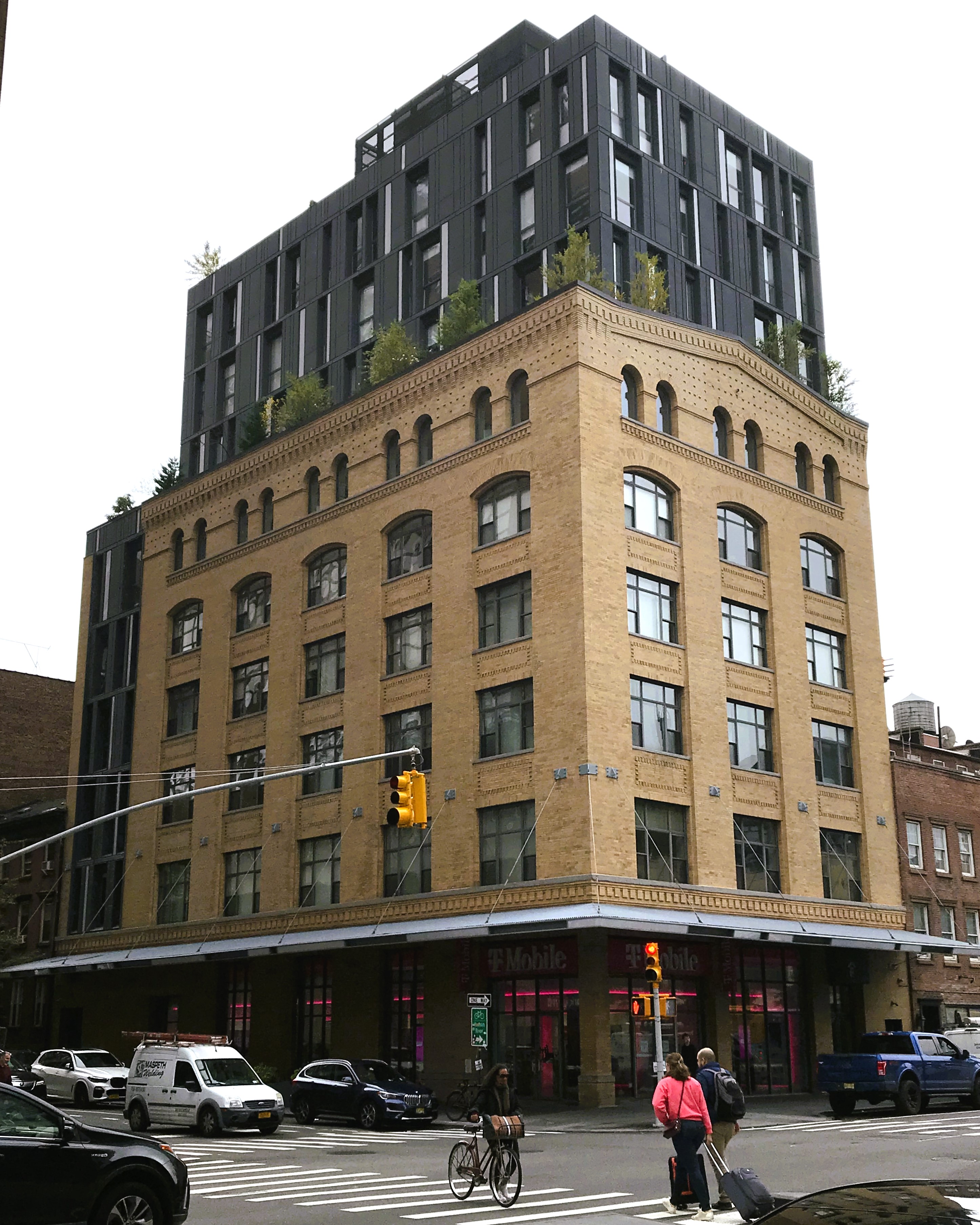
In November 1905, architect William A. Boring filed plans for a six-story brick and stone warehouse to be erected on the southeast corner of Ninth Avenue and 15th Street.  He had been hired by developer Mary A. Tuttle, who saw the potential in the site's location at the northern hem of the bustling Gansevoort Market area.  Completed in 1906, the structure was faced in yellow brick above the ground floor loading area.  A modern take on Romanesque Revival, the openings on the second through fifth floors were slightly recessed, creating the impression of four-story arches.  The decorations--paneled spandrels, a corbel table below the sixth floor, and complex dentiled cornice--were all executed in brick, a significant cost savings for Tuttle.  The paired windows of the sixth floor were arranged as an arcade, and the Ninth Avenue roofline rose in a gentle gable.

Mary A. Tuttle leased the building in May 1906 to German-born Julius Wile for a term of 20 years.  He was the principal in Julius Wile Sons & Co., importers of liquors and wines, which he founded in 1877.  Working with him were sons Alfons and Irwin.  

While the firm occupied most of the building, it sublet two floors in October that year to the Austrian Bent Wood Furniture Company.  In 1914, upon the expiration of that lease, the Eureka Pneumatic Spray Co. rented the third floor.   The firm manufactured what The Metal Industry described in July 1915 as "a complete spraying outfit consisting of compressor, air tanks, gauge,, safety valve, tank draincock, air filter, one sprayer and a length of hose."  The gadget retailed for $33, or just under $1,000 in 2022.

The Ninth Avenue elevated tracks ran in front of the building, which loomed above the 19th century structures around it.  The sign stretching the building's width above the first floor reads "Julius Wile Sons & Co."  photograph from the collection of the New-York Historical Society.

As America emerged from World War I, the Government turned its focus to an issue that would have enormous effect on Julius Wile Sons--Prohibition.  The 18th Amendment was ratified on January 16, 1919 and Prohibition was enacted on January 17 the following year.

The firm was permitted to carry on business on a limited basis.  A loophole in the National Prohibition Act allowed clergymen to use wine for sacramental services, food processors to use alcohol in preserved fruits, and doctors to prescribe liquor for medical reasons.  (For instance, when the future British Prime Minister, Winston Churchill, was in New York in 1932, Dr. Otto C. Pickhardt wrote a prescription, "This is to certify that the post-accident convalescence of the Hon. Winston S. Churchill necessitates the use of alcoholic spirits especially at meal times.  The quantity is naturally indefinite, but the minimum requirements would be 250 cubic centimeters.")

Liquor and wine firms like Julius Wile Sons & Co. were closely scrutinized, so when Daniel Murphy and Joseph Levine showed up in September 1920 with a permit to purchase 200 cases of whisky, the management was suspicious.  The New-York Tribune reported, "Weil's [sic] employees kept the men in the place and communicated with the authorities, who declared the permit a forgery."  The value of the liquor they attempted to buy would top $200,000 today.

The restricted amount of business in liquor and wine that Julius Wile Sons & Co. was permitted to conduct was not enough to sustain the business.  And so the firm adapted, forming a sideline, The Wile Corporation.  In 1921 The Index of Export Merchants listed it as dealing in "hosiery, underwear, hardware, iron, steel, textiles, groceries, cigars, cigarettes, general merchandise."

Unfortunately for Julius Wile Sons & Co., gangsters were as harmful to its business as was Prohibition.  On February 2, 1924, the New York Evening Post reported, "Four thousand cases of well aged Scotch were stowed in the Cunard-Anchor liner Cameronia when she sailed at noon to-day from Pier 56 and Chief Office A. H. Kesson submitted that carrying Scotch to Glasgow outdid the adage of carrying coals to Newcastle."  

The liquor was part of a 9,000 case order earlier imported by Julius Wile Sons & Co.  The remaining 5,000 cases were scheduled to ship on the next ship to Glasgow.  The article said, "They are sending it back because they cannot meet the competition in supplying druggists and hospitals, of bootleggers, who undersell them $21.75 a case."  Kesson told the reporter that the shipment was guarded by "a whole regiment" of security men on the way to the docks.

Julius Wile Sons & Co. now focused even more on alternative products.  The following year, on April 12, The New York Times reported that the California Crushed Fruit Corporation, "manufacturers of orange, grapefruit and lemon juices," had opened a New York office at 62 Ninth Avenue in cooperation with Julius Wile Sons & Co., "who will act as their New York representatives for ten years."

Just over a year later, on May 13, 1926, The New York Times announced, "Julius Wile Sons & Co., for many years in the liquor business at 62 Ninth Avenue, have taken a long term lease...on the building at 10 Hubert Street, northwest corner of Collister Street.  After improvements are made the new tenant will use the building for the sale and handling of fancy groceries."  

As an important side note, following the repeal of Prohibition, the resilient firm returned to importing wine and liquor and once again became a leader in the field.  For years, Julius Wile's grandson, also named Julius, would write the wine section of the Encyclopedia Britannica's Book of the Year, and in the 1970's would rewrite the 1941 book Encyclopedia of Wine.

Following Julius Wile Sons & Co.'s departure, the architectural firm of Maher & Ward made renovations to the building.  There was now an office and market on the ground floor, and warehouse and factory space above.

In the 1960's the Ruger Chemical Co., Inc. occupied the building.  By the mid-1970's a Chase Manhattan Branch occupied part of the ground floor.  It was the scene of a terrifying armed robbery on August 12, 1978.  That day Michael McClanahan, Wayne McClanahan and Rickard Mickens walked in with guns drawn.  They made off with $8,000.  The McClanahan brothers were captured before long, but Mickens remained on the lam until April 12.

Historian Jay Shockley, in writing the 2003 landmark designation report of the Gansevoort Market Historic District, said, "At the time of designation, this property was under construction, which entailed the alteration of and addition by architects Sharples Holden Pasquarelli to a 1905 wine warehouse.  Above the fourth story of the building, the new addition is cantilevered over No. 60 Ninth avenue."  


One wonders if Sharples Holden Pasquarelli's design would have been approved had the addition not been begun prior to the district's designation.  The sleek, black form that rises above Boring's warm brick warehouse makes no attempt at architectural continuity.

photographs by the author
no permission to reuse the content of this blog has been granted to LaptrinhX.com

Wednesday, October 20, 2021

James S. Maher's 1923 Arts & Crafts Style 401 West 14th Street


Despite having permanently stormed off to England with his family in 1891, William Waldorf Astor continued to control his vast real estate holdings in New York City.  He had inherited a significant amount of property in the west side area, including the long northern blockfront from Ninth to Tenth Avenue.

Astor died on October 18, 1919.  His estate soon began liquidating the Manhattan holdings and on November 25, 1922 the Real Estate Record & Guide reported, "Estate of William Waldorf Astor sold twenty parcels in West Forty-fifth Street and also a Ninth Avenue and Fourteenth Street corner to operators."  The buyers of the Chelsea corner were James S. Maher and John J. Gillen.  

Maher had started out as a builder in the construction firm founded by his father, John Maher.  But around 1899 he added architect to his resume, opening his own practice and designing several industrial buildings in the West Side market district.  He frequently partnered with developer John J. Gillen on projects.

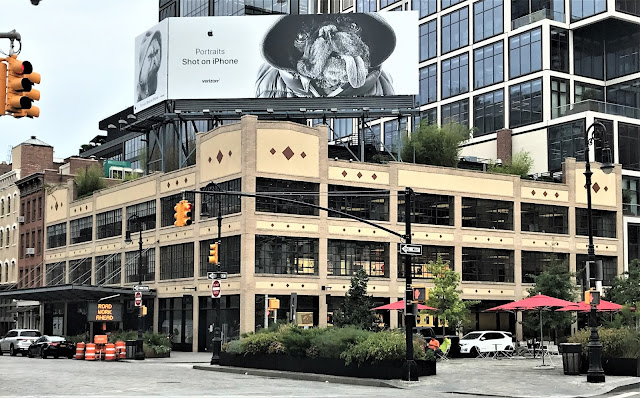
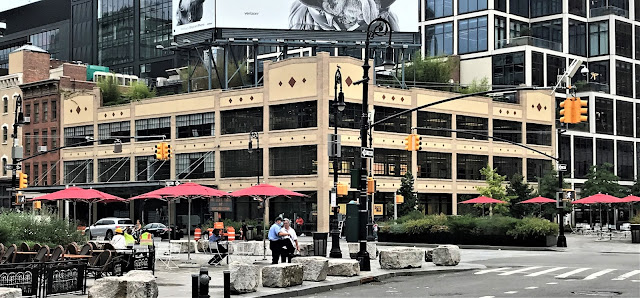
The old buildings on this parcel--401 and 403 West 14th Street and 47 through 59 Ninth Avenue--were demolished.  In their place Maher designed what the Department of Buildings described as a "three-story storage building."  Seemingly as much glass as masonry, Maher's Arts & Crafts style structure must have seemed ultra-modern among its red brick Victorian neighbors.

The use of steel framing allowed for vast expanses of glass that flooded the interior with daylight.  Maher gave interest to what might have been an unexciting rectangular box by placing tall parapets at the corners.  The minimal decoration took the form of brick-framed stucco panels and terra cotta diamonds.

The new building sat within the Gansevoort Market district, established by the city in 1884.  Like all the buildings, 401 West 14th Street would be home to wholesale food merchants.  Upon its completion, George Cook Poultry Corp., dealers in "dressed poultry," moved in. 

Sharing the building by the early 1930's was the butcher operation of Charles Wissmann Company.  The firm had been founded in 1906 by brothers Charles and Louis Wissman.

The large scope of the George Cook Poultry Corp. was evidenced upon George Cook, Sr.'s death in 1943.  His estate was valued at around $4.5 million in today's dollars and George, Jr., who had been in business with his father for decades, received the equivalent of nearly $2 million in company stock.

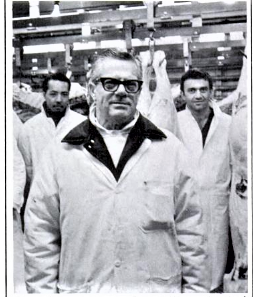
The 1960's saw the New York Loin Corp. and Joseph Kenney meat purveyors in the building.  On May 20, 1968 New York Magazine wrote, "Behind some of those 19th-century facades in the Gansevoort Meat Market (in the West 14th Street area) you'll find a relatively new kind of veal, called plume de veau."  The article said that until 1960 "New York's finest restaurants ordered their mild-fed veal from Europe, but today Joseph Kenney, 401 West 14th Street, supplies almost all of New York's notable restaurants with plume de veau."

Joseph Kenney posed with his staff (and a lamb carcass) in 401 West 14th Street in 1968.  New York Magazine, May 20, 1968.

After decades of housing only wholesale dealers, around 1975 Frankie's Meat & Food Warehouse opened in 401 West 14th Street.  Consumers willing to travel to the gritty area and to buy in bulk were rewarded with bargain meat prices.  In December 1978, for instance, a 15-pound bag of chicken legs sold for 59 cents per pound.  

Frankie's Meat & Food Warehouse was a destination spot for years.  It was replaced around 1991 by Western Beef, which advertised itself as "The Meat Supermarket."  And like Frankie's Meat & Food Warehouse, consumers traded the inconvenience of the location and the bulk-buying requirements for low prices.

By 1999 the Chelsea neighborhood was seeing change as beef and poultry firms were gradually being nudged out.  Markt opened in 401 West 14th Street in the last week of December 1998.  A week later The New York Times's food critic, Florence Fabricant, said it was located "in what is becoming a Belgian enclave, across the street from a Petite Abeille café and near Waterloo Brasserie."

The former meat market had received a drastic make-over.  Fabricant said, "Markt's look is all-brasserie, with dark wood, etched glass and vintage beer posters.  Mussels and other seafood, with frites, of course, are among the Belgian specialties on the menu, created by the French-trained Edward Pryor."  The dizzying wine menu listed 250 labels.

The first years of the 21st century saw the transformation of the former meat packing district nearly complete.  The first stage of the High Line park began in 2006.  That same year Apple, Inc. purchased the building.


The architectural firm of Cookfox was hired to renovate the abused structure.  Energy-efficient replacement windows were installed, terra cotta tiles and the stucco panels were repaired and cleaned.  According to the firm's website, "Several thousand damaged Hebron bricks were replaced with originals discovered in a Midwestern brickyard."  A new canopy of corrugated glass echoed the original corrugated metal roof over the old loading dock.

photographs by the author
no permission to reuse the content of this blog has been granted to LaptrinhX.com

Wednesday, July 28, 2021

The 1831 James N. Wells House - 183 Ninth Avenue


James N. Wells was a carpenter-builder in Greenwich Village, responsible for the construction of St. Luke's Church on Hudson Street.  But when Clement Clarke Moore decided to parcel off his family's summer estate, Chelsea, in the late 1820's, Wells became his property manager.

In 1831 construction began on a house and store at the northwest corner of Ninth Avenue and West 21st Street for a "Mr. Royer."  Completed the following year, it was two-and-a-half stories tall and faced in red Flemish bond brick.  In the rear was an ample yard with a small wooden house.

Wells purchased the property soon afterward and is listed as living here with his family in 1833.  It was a temporary arrangement while he constructed a grand brick residence nearby at 414 West 22nd Street.   When he moved out in 1835, he leased the street level shop to Theodore Martine's feed and grocery store.   Wells did not totally leave the building.  City directories indicate that Wells moved his real estate office into the upper portion, above the store.

Theodore Martine had entered the grocery, flour and feed business in 1826.  In the mid-1840's the Board of Aldermen relied on his expertise to examine the goods provided to the Alms House and other institutions.  On the afternoon of New Year's Eve, 1845, for example, he looked over 20 chests of tea (finding that "one fell short two pounds"), "several hogsheads" of molasses, a delivery of muslins, and 20 boxes of soap.  He found soap missing from some of the boxes, tampering of the molasses barrels, and a portion of the tea "worthless."


Martine operated his store from 159 Ninth Avenue (renumbered 183 in 1868) until 1850.  His son Randolph B. Martine would go on to become the new District Attorney in 1885.  In reporting on his new position Frank Leslie's Illustrated Newspaper would comment, "His father, Theodore Martine, will be remembered by old citizens of the West Side as an extensive grocer and real estate dealer."

The store next became home to the Vanvalkenburgh & Martin grocery store.  John A. Vanvalkenburgh and his family lived above the store while his partner Joseph T. Martin lived nearby at No. 147 West 21st Street.

In 1856 John A. Vanvalkenburgh and moved his produce business to Washington Market and his son, John J. Vanvalkenburgh partnered with Benjamin Haviland to continue the store here.  They operated it as Vanvalkenburgh & Haviland grocers.  That partnership lasted until 1860 when Haviland opened his own store on Fourth Avenue.  John Pierson ran the grocery here until at least 1862.

The grocery store continued to change hands.  In 1864 and '65 it was run by George A. and Joseph T. McDowell, and beginning in 1867 it was called the Browning & Berry grocery, run by Lewis F. Browning and James E. Berry.  Interestingly, the partners lived next door to one another at 160 and 162 Ninth Avenue.

Households in the middle of the 19th century depended heavily on lighting oils like kerosene for lamps.  These were generally a staple found in neighborhood grocery stores like Browning & Berry.  In the winter of 1869 proprietors were surprised by agents of the Metropolitan Board of Health who took samples of the kerosene-oil as well as lamps they were selling for testing.  Unfortunately for Browning & Berry, their kerosene was deemed "below Legal Standard."

James N. Wells died in 1860 and in 1865 his family sold the property.  It was purchased by Levi L. Livingston.  He was a decorative painter, responsible for murals and painted interior decorations of public and private buildings, including the Masonic Temple on 23rd Street and Sixth Avenue. Instrumental in organizing the Association of Master Painters of which he was president several times, Livingston had “heavy contracts for painting the North River steamers and the elevated railroads,” according to The New York Times.

After his death in 1882, his estate continued to maintain the property until finally selling it in 1910; advertising the house as a “three story tenement and store.”

In the meantime, as had been the case with Vanvalkenburgh & Haviland, Browning & Berry dissolved in 1871 when James Berry opened a store on Fourth Avenue.  Lewis F. Browning took in a new partner, Albert H. Siemers, who lived next door at No. 185.  They would operate the grocery here until at least through 1880.

By 1889 the store was run by Clamor L. Magna.  He lived upstairs, taking in three grocery clerks as boarders at the turn of the century.    He would remain in the space into the early years of the 20th century.


Most of the 20th century was unkind to this section of Ninth Avenue, with the clattering elevated train running down its center.  At one point 183 Ninth Avenue was divided into apartments, but in 1993 as Chelsea was rediscovered, it was purchased by attorney Steven Shore.  He hired architect Stephen B. Jacobs who restored the storefront and created a single residence on the upper floors.  The Wells house is the second oldest house in Chelsea.

photographs by the author
LaptrinhX.com has no authorization to reuse the content of this blog

Thursday, October 29, 2020

The James A. Cowie House - 140 Ninth Avenue


By 1853 Henry Jarvis ran his fancy goods store at No. 120 Ninth Avenue (renumbered 140 in 1868).  He and his family lived in the three story building, as well, with two boarders, Abraham Coady, a carpenter, and Sophia Heney.  Jarvis's operation apparently went beyond simply selling ribbons and cloth, he advertised in The New York Herald on May 2, 1855: "Wanted--Two apprentices to the dressmaking and millinery [trade].  Apply in the store 120 9th avenue.  None but good sewers need apply."

Jarvis moved his store out in 1856 when the entire building was offered for rent.  An ad on April 14 noted it "would be let for $450."  (It was an affordable amount, equal to about $14,000 today.)

The fancy goods store became a confectionery shop, run by a quick succession of proprietors.  It was operated by Charles Clausen in 1857 and '58, George Lamb in 1859, William Toden in 1861 and '62, and in 1864 and '65 by Henry F. Balk.  

By the time Balk ran the candy store the house was owned by George W. Hyer and his wife, the former Catharine L. Gaffit,  who took in one boarder at a time.  Their tenant in the winter of 1865 was Charles F. Church who worked in the shoe factory of Henry McClellan downtown.  He went to work on Saturday, January 21, but would not return that night.

In the era before elevators freight was hoisted up through commercial buildings through hatchways--open shafts outfitted with a system of pulleys.  It was a dangerous system which resulted in repeated accidents and tragedies.  On January 23, 1865 The New York Times reported that Church "was killed on Saturday evening by falling through a hatchway on the fourth floor of No. 9 Ferry-street."  He died instantly.

George and Catharine Hyer had married in 1837.  The groom was 19-years old and the bride 17.  They had six children.   An active Mason, George earned his living as a "tooldresser."  He died on January 22, 1866 (coincidentally exactly one year and one day after his tenant had died).  He was just 49-years old.  The funeral was held in the house two days later.

Catherine lived on in the house, continuing to take in a boarder.  In 1867 it was Joseph R. Quick, a carpenter.  Around that time Cornelius B. Crist, who lived nearby on West 16th Street, was operating his butcher shop in the store.

James A. Cowie purchased the property from Catherine in 1870.  Cowie ran a fish and butcher shop on Eighth Avenue.  Born in 1844 he had "served in the Rebellion," as noted by the New York Herald, and had been a member of the Volunteer Fire Department.  As the Hyers had done, he and his wife, Margaret (known as Maggie), took in boarders.  In 1872 fireman John Vannorten lived with the couple and would remain for several years.


Cornelius Crist's butcher shop had become Margaret Lindsey's fancygoods store by 1872.  Margaret was a widow and unfortunately her enterprise did not succeed.  On September 25, 1873 an advertisement offered: "For Sale--Stock and Fixtures of a fancy store; three rooms; cheap rent; No. 140 Ninth avenue; will be sold cheap."

The Cowies welcomed a son, James, Jr., in the summer of 1875.  Tragically, eight months later, on December 12, his funeral was held in the house.  The following year the couple had another baby boy, this one, too, named James A. Cowie, Jr.  It may have been the presence of an infant in the house that prompted the Cowies to suddenly take in widows as their boarders.  Catharine Fyfe was here in 1876 and Margaret Corsa in 1878 and '79.  They possibly provided extra hands for the young mother.

Around 1878 Cowie moved his fish store to the shop next door, at No. 142 Ninth Avenue, while, oddly enough, leasing the store in his own building to Frank Schrader's grocery.  The ambitious Cowie had branched out by now.  He ran for political office and was elected to the assembly in 1884.

The family had a serious scare in 1891.  On July 30 The Evening World reported "The friends of ex-Alderman James A Cowie, of the Thirteenth Assembly District, were shocked this morning to learn that his life is despaired of.  They knew that Mr. Cowie was a sufferer from rheumatism, but they did not know until to-day that his malady had attacked the region of the heart, and that his attending physician holds out little hope of his recovery."  (The newspaper did not hide its partisan support of Cowie, saying he "has been the leader of the Republican opposition to wicked Fred Gibbs.")

Cowie recovered, but worse troubles for the family were on the near horizon.  In 1892 James, Jr., who was now 18, developed consumption, a condition recognized most often today as tuberculosis.  The New York Herald had an unexpected explanation for the disease, saying he was "taller than his father, who measures six feet, and the son's rapid growth had undermined his constitution."

The teen was sent to the Catskills for his health during the summer of 1893.  In the meantime Maggie fell "critically ill" as reported in the New York Herald.  James was brought home in September and confined to his bed.  His father ran again for assemblyman, but his campaign was conducted almost entirely without him as he cared for his wife and son.

The election was held on November 7.  "On election day, however, Mr. Cowie did not leave the bedside of his dying son, his brother-in-law Mr. Hyer, attending to the last details of the canvass," said a newspaper.  James A. Cowie, Jr. died that afternoon.  

The well-respected James A. Cowie, Sr. lived on in the house until his death on May 2, 1897.  The New York Herald called him "one of the most conspicuous figures in the old Ninth ward and said "his bitter struggles with [Frederick S.] Gibbs are still fresh in the memories of politicians."

The quaint little house and store continued its tradition of several residents upstairs and a small business at street level.  In the 1920's it held a grocery store and in the 1940's a delicatessen.  

A sign hawks the salads and sandwiches available in the deli around 1941.  Overhead a section of the 9th Avenue Elevated can be seen.  via the NYC Dept of Records & Information Services

The little building was lost to foreclosure during the Great Depression, and bought from the bank in June 1939 by Fred Cordes who paid $8,500--or about $156,000 today.


A renovation completed in 1972 resulted in a duplex apartment above the storefront.  

photographs by the author

Tuesday, October 6, 2020

The Original "Chelsea Market" - 130 Ninth Avenue


In 1852 Amos Brand and his family lived above the George Cranna's lamp wick store at No. 110 Ninth Avenue (renumbered 130 in 1868).  A butcher, his own store was only a block away at No. 78 Ninth Avenue.  Within the year Cranna, who operated a second store on Eighth Avenue, moved into the upper portion of the house.  His wife, Isabella, had died seven years earlier at just 35-years old and he rented an unneeded room to Joseph Street, a staircase maker.

George Cranna expanded his kerosene and lamp wicks business by adding china by 1855, and now called his shop "George Cranna Crockery."  The venture may have been overly optimistic, however.  In the spring of 1857 he had what today would be called a going out of business sale, and on April 16 an auction of the remainder of stock was held.  The announcement of the sale of "crockery, glass and china" noted that "the balance of the stock contained in the store, consisting of fluid and oil, cans, measures, &c, &c, must positively be sold this day."

Cranna moved his business to West 25th Street where he returned to selling what he knew best--"lampwicks."  The upper floors of No. 110 were now operated as a boarding house.  Cranna's former store became the Chelsea Market, a butcher store run by Henry Ford.  As Thanksgiving neared in 1861, an advertisement appeared in the New York Herald which read:

Thanksgiving Poultry--Live or dressed, from 8 to 10 cents per pound; premium Beef, corn fed, Pork, fresh and salt, from 6 to 9 cents; Mutton from 5 to 7 cents, at the Chelsea Market.

The tenants--including Henry Ford--would have to find new accommodations after March 12, 1863 when the building was sold and the contents auctioned.  The boarders had enjoyed a piano and two sewing machines.  Included in the sale were "the contents of the Butcher's Store, fixtures, marble slabs, desks, racks, blocks, &c., worthy the attention of the trade and others."

The building was purchased by Albert and Emma Hyland who ran a provisions store on West 18th Street.  (A provisions store sold household items like buckets, detergents, cups, and food as opposed to a grocery store which sold only flour, sugar, produce and such.)  They leased the ground floor to Landeline Stortz who opened his beer saloon in the space.

The Hylands took in blue collar boarders.  In 1864 and '65 two Irish stonecutters, William Murphy and Dennis Sullivan lived in the house.

Landeline Stortz was required to appear before the Board of Excise on July 11, 1867 after a "Mrs. Clancy" complained that he sold her husband liquor after she had instructed him not to.  The New York Herald reported that Board dismissed the case.

Stortz personally ran the saloon at least through 1873.  He subleased it briefly afterward to Daniel Orth and in 1878 to Jacob Hoehn.  The upper floors continued to accept boarders.  Most were still Irish immigrants, like roofer James C. Morison and Thomas Clark, a policeman, here for several years in the late 1870's.


The saloon was outfitted with a kitchen so patrons could also have food with their beer.  Jacob Hoehn continued to run it until 1892 when the J. C. G. Hupfel Co. signed a lease on the space.   

The Hupfel Co.'s saloonkeeper was Peter J. Grieshaber.  On September 30, 1893 16-year old Frederick Diedrich arrived in New York from Germany and was given a job in the saloon that same day.   Ten days later Grieshaber was horrified when he saw blotches on the boy's face and hands.

The Sun reported that the saloonkeeper "kicked up a row last night by dragging a sixteen-year-old boy through the streets whom he said had small-pox.  A crowd gathered about him in  Ninth avenue and some one asked him what the boy had done."

"Get away!" he warned, "this boy has the small pox."

The article recounted "Then there was a small stampede, but a new crowd soon gathered, who saw the saloon keeper take the boy into the West Twentieth street police station."  The sergeant there was irate with Grishaber, asking why he brought a person with a contagious disease into the station house instead of calling a doctor.  Frederick was locked in a cell and a doctor summoned.

Dr. Benedict examined the boy and "pronounced it an aggravated case of dirt, and prescribed a liberal application of soap and water."  Grieshaber admitted "the boy persistently refused to wash."  Both were sent back to the Ninth Avenue saloon, but not before the sergeant gave Grieshaber one more "sharp reprimand."

When the three-year lease expired Robert B. and Maria Roubaud took over the business.  The couple lived in rooms in the rear of the saloon.  At the time Robert had been battling an ongoing medical condition.  He had had an unsuccessful operation and in January 1896 was told he needed another.  The Standard Union reported "The result, he was told, would be doubtful."

The despondent man placed a 32-calibre revolver to his temple in the back room just before midnight on February 10.  He was still clinging to life when he was taken to New York Hospital.

Brewer Peter Doelger took over the operation of the saloon in 1898, while Peter Kilmurry signed a lease for the upper portion of the house that year.  It was still home to Irish-born residents like John Conway.

The Building Maintenance Supply Co. was in the store when this photo was taken around 1941.  To the left the Ninth Avenue Elevated train can be seen.  via the NYC Dept of Records & Information Services

Prohibition put an end to the saloon in No. 130 Ninth Avenue.  The store became home to the Building Maintenance Supply Co.  Contractors and apartment building owners purchased varnish, paints and accessories here for years.


In 1991 a renovation was done to accommodate a delicatessen in the former saloon space.  There were now four apartments upstairs.  Other than the remodeled ground floor, the Italianate style appearance of the building is little changed after over a century and a half.

photographs by the author

Wednesday, September 30, 2020

Common Buildings With Uncommon Fire Escapes - 233-235 Ninth Avenue


Around 1850 two mirror image Italianate buildings were erected on the west side of Ninth Avenue, between 24th and 25th Streets.  Faced in red brick and trimmed in brownstone, each had a store at street level and "flats," or apartments above.  Identical cast metal cornices completed the design.  At some point, most likely in the first decade following the Civil War, ornate cast iron fire escapes were installed.  They spanned the two center windows, so should fire break out in one building its residents could clamber over to the other.  The firewall between the two structures would at least slow the fire's progress until the tenants could escape to the street.

The fire escapes constitute industrial Victorian artwork.

Despite the buildings' proximity to the upscale homes of West 23rd Street (including the 1845 row of mansions called London Terrace), Nos. 215 and 217 Ninth Avenue filled with working class families.  (The buildings received new addresses in 1868--233 and 235.)

By 1855 August Kallendorf lived above his grocery store in No. 215.  Another grocer, John C. Middendorf, also lived in the building and may have been employed by Kallendorf.  Next door lived Thomas Crudden and his family.  A bootmaker, it appears he also operated his store in the ground floor space.

Although he still lived at No. 215 in 1857 August Klattendorf had moved his grocery to Spring Street.  The store was now operated by Richard Fulle.  And the boot store in No. 217 was now home to Joseph McElroy's shoe business.  (McElroy lived nearby on West 25th Street.)

In the early 1860's Joseph McElroy moved his shoe store to No. 198 Ninth Avenue.  His former shop became home to May Keziah's fancygoods store.  The grocery next door at No. 215 was now operated by Henry Baumann under the name Baumann & Co.

In the meantime, the upper floors housed a variety of blue collar tenants.  In 1861 saloon owner Joseph T. Martin, shoemaker Henry Miller, and James Weir, a clerk, lived in No. 215; while next door were another clerk, Henry Hull, policeman William Jenkins, and Levi S. I. Roome, a smith.   The following year, on January 9, 1862, Jenkins's funeral was held in his family's rooms.  He was just 38-years old.

The houses were lost in foreclosure in February 1864.  The auction sale described them as "the valuable four story Buildings, 215 and 217 Ninth avenue."  While Henry Baumann continued running his grocery store at No. 215, with the change in landlords the store space at No. 217 became home to John Roche's saddlery shop.  Like Baumann, he would here, selling leather goods like harnesses, into the next decade.

Both buildings were owned by Anne F. Blanchet until her death around 1882.  On March 2, 1883 her estate sold the properties to Ahrend F. Meyer and his wife, Sophie.  The couple paid $32,000, or about $843,000 today.  The store at No. 233 became T. Brown's bakery in 1885.  By 1893 it was home to Frederick Meyer's grocery store.  (He was quite possibly a relative of his landlords.)  In 1897 Solomon Cohen leased the space next door for his pawn shop.

photo by Beyond My Ken

For the most part the upstairs tenants continued to be hardworking and respectable.  But occasionally a rogue moved in--like Harris Palmer.  Late on Saturday night, January 12, 1889 the assistant foreman of the Street Cleaning Department, Robert Burke, was standing at the corner of 39th Street and Ninth Avenue in the shadows.  The Press reported "he saw a young man teach a hunchback to pick pockets."  The instructor was 22-year old Harris Palmer.  Both he and the 18-year old hunchback were arrested.

Another tenant made the news nine months later.  On November 4 The Evening World reported "Leo Haunel, of 233 Ninth Avenue, bookkeeper for Banker George Weber...was held for trial at the Tombs to-day on his employer's charge that he stole 4,800 two-cent postage stamps, given him to use on the mail."  (The embezzlement would be equal to about $2,750 today).

Ahrend and Sophie Meyer sold No. 233 to David Lubelsky on February 1, 1897, while retaining ownership of No. 235.  David and Sarah Lubeksly lived in an apartment in the building.    Two years later the innovative fire escapes proved their worth when fire broke out at 6:31 a.m. on September 22, 1899.  The Lubelskys hired architect Charles H. McAfee to make renovations, including some new walls.

The newly-formed paint business of Freidlander & Silverstein opened in the store at No. 233 in December 1902.  Next door Solomon Cohen was still operating his pawn shop.  It had become the center of a well-publicized news story a month earlier.

On the night of November 21, 1902 a cheaply-dressed woman entered the shop.  Unfortunately for Catherine McCluskey, the two men chatting with Cohen were Detectives Butler and Foley.  She laid a glittering diamond and sapphire ring on the counter and asked $150 for it.  Cohen asked her if she knew its value to which she replied, "About $200."  He countered "That ring is worth $1,000.  Where did you get it?"  (That assessment would equal about $30,700 today.)  The Evening Telegram said "He said this loud enough for the detectives to hear, and they at once began to question the woman."

She explained that the ring had been given to her husband by his sister about four years ago.  "She said their money had run low and she wanted to pawn it," said the New York Press.  The detectives were doubtful and Mrs. McCluskey was arrested.

At the station house she admitted that she was employed as a scrubwoman at Madison Square Garden.  One evening following the Horse Show she found the ring in the Vanderbilt box while cleaning up.  She watched the newspapers for notices and a possible reward, but when none appeared she decided to pawn it.  

The temptation was understandable.  The New York Press said "She is married and has six children, the eldest 11 years old, and her husband, Michael, is a longshoreman."  Michael was out of work at the time and there was "little money in the house."  Neighbors told a reporter that "she has always worked hard and has practically supported her six children, her husband having had little success in obtaining work."

The Evening Telegram reported "when told she would have to be locked up, Mrs. McCluskey cried bitterly and then fainted.  She begged the police to send for her youngest child."  What the poor woman had initially seen as a stroke of good luck became even more disastrous.  She was not only held in jail for trial, but was fired from her job.

The following spring Arhend and Sarah Meyer sold No. 235 to Solomon Cohen.  He would continue operating his pawn shop here into the 1920's.  The store next door was home to Sylvain Metzger's butcher shop by 1915.  He lived upstairs and remained in the space until declaring bankruptcy in March 1921.

Maggie Tweed lived in an apartment in No. 233 in 1906.  She was estranged from her husband, Frank Tweed, a nephew of the infamous Tammany leader William M. "Boss" Tweed.   Frank worked nearby at the Reed Construction Company on West 24th Street between Sixth and Seventh Avenues.  He was summoned to appear in court on July 31 that year for failing to support his wife.  Despite his uncle's vast wealth, he pleaded poverty, saying he earned only $10.50 a week.  He was ordered to pay Maggie $3 of that amount.

Solomon Cohen's pawn shop was taken over by Benjamin Jeffe by 1934.  It was the scene of a terrifying robbery on March 25 that year.  The Rochester Times-Union reported "Four robbers, each carrying an automatic pistol, walked into the pawnshop of Benjamin Jeffe, 235 Ninth Avenue, today, bound four men in the shop and departed with several thousand dollars worth of jewelry."  While the two clerks and two customers helplessly watched, the bandits "leisurely selected jewelry valued at several thousand dollars and other articles, and escaped," reported the North Shore Daily Journal.


photo via the NYC Dept of Records & Information Services

The two buildings continued to house middle-income families throughout the 20th century.  In the 1980's and '90's the store at No. 233 was home to seafood store, Starfish Enterprises.  In its December 18, 1989 issue New York Magazine recommended its "many varieties of smoke salmon, sliced or whole" and cautioned "Starfish delivers only in the Chelsea area, so stop in and make your selection."

Two years later The New York Times journalist Susan Hermann Loomis reported on a less likely fare--alligator meat.  On January 17, 1990 she wrote "alligator meat has been transformed from an obscure Southern specialty to a dish with cachet, and the market for the meat is booming."  She noted "In the New York region, sources for alligator meat include Starfish Enterprises, 233 Ninth Avenue."


Although the storefronts have been brutally altered and the lintels of No. 233 shaved flat, the upper floors of both buildings retain much of their early 19th century appearance--including those remarkable fire escapes.

photographs by the author