Showing posts with label east 69th street. Show all posts

Thursday, November 5, 2026

The 1924 J. Henry Lancashire Mansion - 11 East 69th Street

 
image via friends-ues.org


Banker Jefferson Seligman and his wife, the former Julia Wormser, occupied a townhouse at 11 East 69th Street and a country home in Deal, New Jersey in the first years of the 20th century.  The couple shocked society in 1915 when Julia filed for divorce, her attorneys asserting, "her husband left her on May 31, 1913, and has never returned."  Julia retained possession of the homes in the divorce.  She died in the New Jersey residence on March 28, 1921, leaving an estate equal to more than $18 million in 2026.

When the East 69th Street property became available in December 1922, Edwin C. Jameson, who lived next door at 9 East 69th Street, purchased it "to protect his own home," according to The New York Times.  He resold it in February 1923 to James Henry Lancashire and his wife, the former Sarah Hale Wright.  The New York Times reported that they "will remove the present structure entirely and build a new fire-proof house for [their] own occupation from designs by Delano & Aldrich."  The article added, "This promises to be one of the most attractive modern residences on Lenox Hill."

Construction of the 32-foot-wide mansion was completed in 1924 at a cost of $200,000 (about $3.8 million today).  Faced in limestone, its sedate neo-French Classic design included a rusticated base where the double-doored entrance sat within an understated, molded frame.  At the second floor, or piano nobile, were floor-to-ceiling windows, the central of which was fronted by an iron balcony and capped with a triangular pediment.  The sixth floor sat discretely behind a stone parapet topped with Classical stone urns.  The New York Times remarked, "It is provided with two elevators and there is an attractive rear garden."

The Seligmans' house was a near match to No. 13, at the right.  photograph b y Wurts Bros. from the collection of the Museum of the City of New York.

Dr. James Henry Lancashire (who went by his first initial professionally), was born in Ontario, Canada on August 22, 1858.  Sarah Wright was born in Vermont on February 8, 1861 and the couple were married on October 4, 1883 in Saratoga Springs, New York.  They had three daughters: Harriet Wright, Helen and Lila.  (The others had died in childhood.)

Only Lila would live in the mansion.  Harriet had married Edward Lawrence White in 1911, and Helen, who married Vincent Umberto Coletti-Perucca in 1916, lived in Italy.  

The Lancashires filled the mansion with costly antiques and artwork.  The New York Times would later comment that Sarah's "collection of seventeenth and eighteen century English furniture" included "twelve William and Mary carved walnut tall-back side chairs."  They were executed by Daniel Marot in 1695.  Other items within the residence were a Chinese Chippendale mahogany card table and a Sheraton mahogany dining table.

This portrait of Sarah Lancashire was painted by Ignaz Marcel Gaugengigl in 1910.  from the collection of the Museum of Fine Arts Boston

The family's country home, Graftonwood, was in Manchester, Massachusetts.  On June 12, 1925, The New York Times reported that Lancashire "and his daughter, Miss Lila Lancashire, have closed their home at 11 East Sixty-ninth Street and have gone to their Summer home at Manchester-by-the Sea."  The article explained, "Mrs. Lancashire, who is visiting her daughter, Mme. Colette-Perucca, in Florence Italy, is expected to return early in July."  In fact, Sarah was accompanied by Helen upon her return.  On July 2, The Saratogian reported, "Mrs. J. Henry Lancashire...and her daughter, Mme. Umberto Coletti-Perucca, arrived from Europe on the Giulio Cesare and are at the Ritz-Carlton.  They are leaving on Friday for Graftonwood."

On January 11, 1927, The New York Times reported that the Lancashires had announced Lila's engagement to Chicago banker Richard Southgate, noting, "Miss Lancashire attended the Spence School, and is a member of the Junior League and a director of the Navy Club."

Lila's marriage took place in the Church of the Resurrection on June 1, 1927.  The New York Times explained, "Relatives and a few close friends only have been asked to the ceremony owing to the limited capacity of the church, but the invitations to the reception at the home of the bride's parents, 11 East Sixty-ninth Street, are more general."  The next evening, the Lancashirers hosted a dinner and dance at the Park Lane for the wedding party.

Now empty nesters, Lancashires continued to appear in the society columns.  On January 31, 1928, for instance, The New York Times announced, "Dr. and Mrs. J. Henry Lancashire of 11 East Sixty-ninth Street, with a party of friends, will leave to day for Nassau, later going to Palm Beach for the remainder of the Winter."

On April 21, 1931, the newspaper reported that the Lancashires had sold 11 East 69th Street to Mrs. Barend van Gerbig for "very close" to the asking price of $400,000 (about $8.5 million today).  

Mrs. Barend van Gerbig was the former Edith Olcott.  Her husband was born in the Netherlands in 1868 and arrived in American in 1890.  Educated at the University of Leyden, Barend van Gerbig was an investment broker and musician.  He was 32 years old when he and Edith were married on May 25, 1900.  The couple had a son, Howell.  (Their first son, Dudley, died in 1915.)  The family's country home was in New Canaan, Connecticut.

image via the NYC Dept of Records & Information Services.

Edith Olcott van Gerbig began collecting Early American glass at the age of 13.  Displayed in the East 69th Street mansion was her collection of nearly 3,000 pieces.  She was recognized nationally as "an assiduous collector as well as a knowledgeable scholar of American glass," according to the Worcester Telegram.

Edith Olcott van Gerbig died at the age of 83 in the New Canaan residence on July 15, 1953.  Barend died there on December 3, 1957.  Three months earlier, he had donated Edith's entire glass collection to the Wadsworth Atheneum Museum of Art in Hartford, Connecticut.  He, additionally, donated a $250,000 endowment "for the construction of an 'Edith Olcott van Gerbig Memorial Gallery of Glass' within the contemplated alterations of the Wadsworth Atheneum buildings," reported The Morning Union on September 1, 1957.

No. 11 East 69th Street became headquarters for the American Friends of the Hebrew University.  It was the scene of an exciting announcement on October 31, 1961.  Here Yigael Yadin, Professor of Archaeology at the Hebrew University of Jerusalem, announced the discovery of "First-century documents found in remote caves along the western shore of the Dead Sea."  He described their finding "as the most important discovery of the period next to the Dead Sea Scrolls."

Two years later, the American Friends of the Hebrew University presented its Woman of the Year Award to Golda Meir, Foreign Minister of Israel.  The large attendance at the luncheon made holding it in the former mansion impossible.  The award was presented to Mrs. Meir at the New York Hilton.

A poignant event took place here on March 11, 1976.  The New York Times reported, "The memory of the 11 Israelis murdered during the 1972 Olympics at Munich was revived...with the establishment of the first memorial to the athletes."  The memorial took the form of scholarships to the Hebrew University in Jerusalem. 

In 2004, real-estate operator David Levinson purchased 11 East 69th Street from the American Friends of the Hebrew University for $9.5 million.  According to The Real Deal, he spent $20 million in renovations to return it to a private mansion, with "six bedrooms, ten bathrooms, and a rooftop solarium."

image via streeteasy.com

Levinson sold the residence in June 2021 for $53.5 million.  The exterior is sheathed with scaffolding and netting at the time of this writing.

photographs by the author

Saturday, October 24, 2026

The Charles F. and Maude Watson Mansion - 34 East 69th Street


Prolific real estate developer Anthony Mowbray erected two brownstone-faced homes at 32 and 34 East 69th Street between Park and Madison Avenues in 1880.  Designed by Lamb & Wheeler in a marriage of neo-Grec and Queen Anne styles, they were 20-feet wide and four stories tall above high English basements.

34 East 69th Street would originally have been very similar to its next-door-neighbor at 32 E. 69th Street.  from the collection of the New York Public Library

Politician John Kelly and his wife, Ann Theresa Mullen, purchased 34 East 69th Street.  Born in 1822, Kelly entered politics in 1840 and served as a New York Representative in Congress from 1855 to 1858.  He was elected Sheriff of New York County in 1859 and in 1871 turned his focus to fighting the corruption of the notorious Tweed Ring.  By 1874, Kelly controlled Tammany Hall and earned his nickname, "Honest John."

John Kelly, from the collection of the Library of Congress

Ann was Kelly's second wife.  His first, Mary Ann McIllhargy, died on July 17, 1866, and within five years their three children had perished.  He and Ann (who was the niece of New York Cardinal John McCloskey) had a son, John Jerome, and a daughter, Josephine.

Kelly, the most powerful force in New York City politics, suffered a blow in 1884.  In his 1917 The History of Tammany Hall, Gustuvus Myers writes:

Kelly broke down with nervous and physical prostration after the Presidential campaign of 1884.  Grover Cleveland's election, which falsified his predictions, deeply disappointed him.  He kept to his house, No. 34 East Sixty-ninth street, but still issued his orders to the Tammany organization.

His condition was well publicized.  On February 14, 1885, The New York Times reported that Kelly had spent a few days as a guest of Nathaniel Jarvis, Jr. in Far Rockaway.  Now back home, the article said "it was announced that he was greatly improved in health, and had not been in better spirits for several weeks."

New Yorkers no doubt realized things were more serious that November.  The day after the elections, the New-York Tribune reported, "John Kelly remained all day yesterday at his home, No. 34 East Sixty-ninth-st.  It was stated that he was too ill to go out of the house."

By the following year, according to Gustuvus Meyers, "he could not sleep except by the use of opiates."  Around 1:30 on the morning of May 30, 1886, Mary Ann sent for a priest.  Two more came at around 10:00 to administer last rites.  On June 2, The Sun reported, "John Kelly, the Tammany chieftain, whose name is as familiar to the country as the President's, died yesterday afternoon at a little about 3 o'clock."  John Kelly's funeral was held in St. Patrick's Cathedral on June 5.

Kelly had left the East 69th Street house in equal shares to Mary Ann and Josephine, who was still unmarried.  Following their period of bereavement, the women again entertained.  Those gatherings often reflected the Kellys' deep Catholic faith.  On December 16, 1894, for instance, the New-York Tribune wrote, "One of the pleasant dinners of the week was given by Mrs. John Kelly for Monsignor Satolli, at her home, No. 34 East Sixty-ninth-st., on Monday.  The decorations were in white and purple, the Papal and the Delegate's colors."  (Monsignor Francesco Satolli was the first Apostolic Delegate to the United States.)

Mary Ann and Josephine remained here until August 1928 when 34 East 69th Street was sold to stockbroker Charles Frederic Watson Jr.  Somewhat ironically, seven months later, on March 25, 1929, Mary Ann Kelly died.

In reporting the sale on August 3, 1928 The New York Times had remarked that during the decades that the Kelly family occupied the house, "the block was improved with fine residences."  Charles and Maude Watson followed suite by hiring architect A. Wallace McCrea to remodel the outdated brownstone.  

He stripped off the outer wall and pulled the facade to the property line.  McCrea gave the mansion a tripartite, neo-French Classic marble facade.  Above the rusticated base, the windows of the piano nobile were fully arched, while the upper openings were segmentally arched.  McCrea even executed the terminal cornice in marble.

The renovation caused a stark contrast to its once fraternal twin next door.  via the NYC Dept of Records & Information Services.

As work on the house progressed, the Watsons lived in a sumptuous apartment in Mayfair House at 610 Park Avenue.  Then, on November 2, 1929, The New York Times reported, "Mr. and Mrs. Charles F. Watson Jr. have left Mayfair House for 34 East Sixty-ninth Street."

Both Charles Frederic Watson Jr. and his wife, the former Maude V. Burnside, came from privileged backgrounds.  They were married in St. Thomas's Church on January 26, 1924.  The New York Times said that Charles was "descended from the Campbell and Argyle families of Scotland."  On her maternal side, Maude was a descendant of Roger Sherman, signer of the Declaration of Independence.

Charles was born in Orange, New Jersey and educated in private schools.  He became a member of the New York Stock Exchange in 1906, but was, perhaps, better known for his athletic skills at the time.  He was a championship amateur tennis player.  Now, he and Maude maintained a home in London where they spent several months every year.

As early as 1938, the Watsons's butler was John Evert Andren.  The butler was the most trusted member of a family's domestic staff and were entrusted with all the keys and combinations for silver safes.  On January 17, 1939, Andren was arrested "as a suspect" in the theft of some of the Watsons' silver.  Although he claimed innocence, he was carrying "monogrammed silverware worth more than $500" at the time of his arrest.  (The value would translate to more than $11,000 in 2026.)

Charles Frederic Watson Jr. died at the age of 71 on April 19, 1954.   Maude sold 34 East 69th Street on November 1, 1956 to Harold G. and Irene R. Lacks.  The couple's marriage dissolved and the house was auctioned as part of the divorce proceedings in February 1969.  It was purchased for the equivalent of $3 million today by the Government of Iran.  On February 28, The New York Times reported, "The house will be the residence of Iran's consul general, Parviz Sepahbodi."

photograph by Gottscho-Schleisner, Inc. from the collection of the Museum of the City of New York.

On February 11, 1979, revolutionary, armed forces overthrew the Iranian Government.  The U.S. State Department took over Iranian properties, including 34 East 69th Street in April 1980.  Six months later, on October 14, The New York Times reported that the State Department had leased the building to the French Designer Showhouse.  The Decorator Showcase continued to be held here through 2000.

In 2001, the Richard L. Feigen & Co. gallery opened in three floors of 34 East 69th Street.  Founded in Chicago in 1957, the gallery "handles work by such important artsists as German Expressionist Max Beckmann and Surrealist master Henri Rousseau," according to the 2016 ART + NYC.

David Zwirner's gallery took over the space in 2017.  Art dealer Adler Beatty occupied the fourth floor.  When Zwirner closed his East 69th Street location in July 2026, artnet recalled, "The Zwirner on East 69th Street hosted about three-dozen exhibitions for canonical figures like Yayoi Kusama, Bill Traylor, and Dan Flavin."


With the gallery gone, the future of the landmarked marble mansion is unclear.

photographs by the author

Wednesday, May 20, 2026

Emile L. Capel's 1915 129 East 69th Street


image via cityrealty.com

On December 6, 1913, the Real Estate Record & Builders' Guide reported on the death of one of America's foremost architects, George B. Post.  The lengthy obituary mentioned, "His town house was at 129 East 69th street."  Developers Brixton Building Corporation wasted little time in acquiring the mansion from the Post estate, along with five other residences that faced Lexington Avenue.  In November 1915, architect Emile L. Capel filed plans for an 11-story apartment building on the site.  They estimated the construction costs at $450,000--about $14.5 million in 2026 terms.

The building's design is the first on record (at least in New York City) of the recondite architect.  Capel filed plans for only one more building and two renovations before 1920, when he sat on the board of directors of the newly formed New York Architectural Club, Inc.  He falls into obscurity after that.

Emile L. Capel produced a neo-Georgian-style structure faced in red Flemish bond brick and trimmed with creamy terra cotta.  The dignified arched entrance sat between double-height, paired and fluted pilasters with palm leaf capitals.  The large terra cotta spandrels of the two-story base on the 69th Street side were decorated classical urns.

An intermediate cornice introduced the midsection, its frieze ornamented with alternating urns and anthemions.  The urn motif reappeared in the stepped lintels of the third floor and in the spandrels between the 10th- and 11th-floor openings.

In 1917, Lexington Avenue was paved in brick and a streetcar track ran down its center. image via urbanarchive.org.

Among the initial residents was Major Frank C. Grugan.  Born in 1842, he was educated in France and upon returning home in 1861 enlisted in the Union Army.  The New York Herald reported, "He fought in twelve important battles, including Gettysburg."  A life-long military man, he would see combat "against the Indians in the West," as worded by the New York Herald, and in Cuba during the Spanish-American War.  When he moved into 129 East 69th Street, he was a widower.

In July 1918, Harold Garrison Villard and his wife, the former Mariquita Serrano, took a duplex apartment here.  The son of millionaire journalist and financier Henry Villard, he and Mariquita were married in 1897.  They had three children, Henry Serrano, Vincent Serrano and Mariquita Serrano.  The children were 18, 17, and 13 years old respectively when the family moved in.

Henry Villard was overseas at the time.  He had left Harvard to volunteer as a driver in the Italian Ambulance Service.  At the war's end, he returned and graduated in 1921.  

Harold Garrison Villard in 1915.  Twenty-fifth Anniversary Report, Harvard University Class of 1890 (copyright expired)

Harold Villard's mother, Fanny Garrison Villard, died on July 5, 1928.  The bulk of her estate, "estimated to be worth more than $10,000,000," according to The New York Times, was divided between Harold and his brother, Oswald.  (The figure would translate to about $183 million today.)  Additionally, she left $50,000 to Mariquita and $10,000 each to her grandchildren.  Mariquita's inheritance would equal about $185,000 today.

Vincent Serrano Villard was married to Katharine A. Tomkins on August 2, 1928.  The New York Times remarked, "Owing to the recent death of Mrs. Henry Villard, only members of the families and a few intimate friends were present at the  ceremony."

In the meantime, a 10th-floor corner apartment of "8 large rooms and foyer" with three baths was advertised in January 1920 at $5,600 per year, about $7,300 per month in today's terms.

A current view of a duplex apartment hints of the scope of the spaces.  via cityrealty.com

Among the tenants at the time were Impressionist artist Francis Sterling Dixon and his wife, Rosalie Turner Hooker.  The couple was married on August 10, 1915 "a short time after she had obtained a divorce in Idaho from Professor William Welling of Trinity College," according to The New York Times.  

Francis and Rosalie Dixon on their wedding day in 1915.  from the collection of the Bibliotheque Nationale de France

Dixon was born in September 1879 and studied at the Art Students League.  With deep American roots, he was a member of the Society of Colonial Wars and the Sons of the Revolution.  His artistic proclivity earned him memberships to the Allied Artists of America, the Connecticut Academy of Fine Arts, the Salmagundi Club, and the Players.

A typical Francis S. Dixon landscape.

The Dixons had a son, Francis Jr.  Unfortunately for the marriage, as had happened in 1915, Rosalie had a wandering eye.  She traveled to Paris in 1925, obtained a divorce, and announced her engagement to British Captain Rowland W. Cash.  Then, on January 26, 1926, The New York Times reported that the engagement had been broken.  Instead, in April she married Prince Levan Melikov de Somhetie, described by the New York Evening Post, as the "claimant to the non-existent throne of Georgia."

Domestic problems were plaguing another socially prominent couple in the building at the time.  Born in 1894 to millionaire Oliver Harriman Jr., Oliver Carley Harriman was described by the Syracuse, New York Journal in 1926 as "the son of Mrs. Oliver Harriman, one of the most admired and popular women in New York society," adding, "His father, Oliver Harriman, and his grandfather, also named Oliver Harriman, were powers in Wall Street." 

Harriman married socialite Loise Roberts Bisbee on June 7, 1915 and they had two daughters.  According to the Journal, "at the time of his marriage, he was the youngest member of the New York Stock Exchange, and said to be earning a large income from various sources."  The young broker was also a "prominent figure at the horse shows and polo matches at Westchester, Long Island and Newport," said the newspaper.

Like Rosalie Dixon, the handsome Oliver Carley Harriman had a wandering eye.  U.S. Passport photograph

Oliver Carley Harriman was career driven and according to the Journal, his "intense ambition" caused him to "frequent rather mixed company in the evening."  In fact, the "company" that kept him away from the couple's apartment on many of those nights was not always a business associate.  On July 28, 1923, Loise read a news article about a trolley car accident.  Among the witnesses was "Mrs. Harriman."  A puzzled Loise dug into her husband's nocturnal nightlife.

Fashion model Harriet Hewitt lived in an apartment at 206 East 61st Street, the rent of which was paid by Harriman.  The residents of the building knew Helen as "Mrs. Harriman."  An indignant and angry Loise left 129 East 69th Street and filed for divorce in December 1923.  Even before the divorce was granted, rumors within high society said that Oliver Carley Harriman intended to marry Helen Hewitt.  And he did.

A disturbing and bizarre incident happened here in the fall of 1928.  Antiques dealer William F. Cooper and his wife, Martha, had previously lived in an apartment on East 66th Street.  In 1923, Martha suffered a stroke but recovered.  Then in 1927 William was hospitalized for three months after an operation, during which Martha "fretted herself into a nervous breakdown," according to The New York Times.  Both she and her husband recovered.

In September 1928, they moved into a seventh-story apartment in 129 East 69th Street.  Unlike the quiet block of 66th Street, "all day long the clang of the surface cars floated in through the apartment windows," said The New York Times.  

On September 22--the Coopers' first Saturday night in the apartment--they had friends over.  After their guests left, William went to bed.  Martha wrote a note to her husband, sealed it and left it on the dining room table.  She then took a photograph of William from its frame and "carefully cut out the likeness of his face."  Clutching it, she then leaped to her death from the apartment window.  Her note explained, "she could not stand the eternal sound of the street cars."

The Robert Ackermans' apartment had been given an Art Deco make-over before this photograph was taken in 1935.  photo by Samuel H. Gottscho from the collection of the Museum of the City of New York.

Lloyd Paul Stryker, his wife, the former Katherine Traux, and their daughter occupied an apartment here as early as 1929.  Born in Chicago in 1885, Stryker graduated from New York Law School in 1909.  The Yale Biographical Dictionary of American Law said he "became famous as a flamboyant criminal lawyer."  In March 1929, he was nominated by President Calvin Coolidge as a Federal judge for the Southern District of New York.  

Stryker came into the national spotlight in 1948 when he was the lead defense counsel in the two criminal cases against Alger Hiss.  Life magazine published an article on Stryker in 1947 titled: "Trial Lawyer: Lloyd Paul Stryker is Archetype of Vanishing Courtroom Virtuoso."

image by Wurts Bros from the collection of the Museum of the City of New York

Another prominent attorney in the building at midcentury was Frank Lyon Polk.  He and his wife, the former Katherine Hoppin Salvage, whom he married in 1934, had three sons: Frank Jr., Samuel S. and William M.  Polk's father was Under-Secretary of State under Woodrow Wilson and he headed the American delegation to the Paris Peace Conference after World War I.  Frank was also the great-nephew of President James Knox Polk.  The family's summer home was at Fishers Island, New York.

Polk became ill in 1952 and was hospitalized in Doctors Hospital.  Calling him "a member of a socially prominent family," on September 20 The New York Times reported that he had died there at the age of 40.

Katherine Polk and her sons remained in the apartment.  In December 1959, she announced Frank Jr.'s engagement to Nancy Holliday Wear.  In reporting on the event, The New York Times commented on Frank's maternal pedigree.  "He is a grandson of Lady Salvage of Glen Head, L. I., [and] the late Sir Samuel Agar Salvage.

Three years later, it was Katherine Polk's turn to wed.  Her marriage to John Currie Wilmerding, the former husband of Lila Vanderbilt Webb, was celebrated in Old Westbury on April 28, 1962.

Photographed in 1943, this top floor duplex enjoyed a lush roof garden.  photo by Wurts Bros. from the collection of the Museum of the City of New York

Never married, Florence Wardell also lived here at midcentury.  Born in Brooklyn and having graduated from Bryn Mawr College in 1898, she had been active in Republican women's activities for decades.  She was vice chairman of the Republican Women's State Executive Committee in 1922, was a delegate to the National Republican Convention in 1928, and worked on Herbert Hoover's Presidential campaign.

Following World War I, Hoover requested her to go to Washington to help him provide relief for the Belgians.  She was later decorated by the Belgium Government for her service.  She fell ill in 1959 and died in her apartment at the age of 82 on February 12.

Investment broker Francis F. Randolph and his wife, Mary Hill Hadley, who lived here by the 1960s, filled their apartment with a remarkable art collection.  Although he sat on the boards of several corporations and was a trustee of institutions, he and Mary were best known for their involvement in the arts.  Francis was chairman of the finance committee of the Metropolitan Opera Guild, a patron of the Metropolitan Museum of Art, and the Pierpont Morgan Library.  The New York Times mentioned that they "gave a number of works of art and incunabula to Vassar College."

image via 6sqft.com

The building, designed by a nearly unknown architect, survives almost entirely intact.

Friday, April 26, 2024

The Russell C. Leffingwell Mansion - 38-40 East 69th Street


By the time Russell Cornell Leffingwell purchased 38 East 69th Street in 1927, the 49-year-old attorney had made a name for himself in both the financial and legal communities.  In 1917, he was appointed Assistant Secretary of the Treasury.  In reporting on the appointment, The New York Times said, "Mr. Leffingwell is well known as a finance lawyer, and has for several years been a member of the firm of Cravath & Henderson."  Leffingwell presided over the sale of Liberty Bonds, and The New York Times said, "He has given his services without compensation, and has lived almost night and day in the Treasury Building since he took up the work on the loans."

Russell Cornell Leffingwell, from the collection of the Library of Congress

Leffingwell married Luchen (known as Lucy) Hewitt in 1906.  The following year their daughter Lucy was born.  After World War I, he brought his family back to New York City and in 1923 was made a partner in the banking firm J. P. Morgan & Co.

The high-stooped brownstone on East 69th Street that Leffingwell purchased in April 1927 was one of seven identical rowhouses built around 1875.  Noting that the vintage house "is in the vicinity of many fine residences," The New York Times said he bought it "as a site for improvement with his new home...Construction of Mr. Leffingwell's new residence will be started immediately."

Those plans soon changed.  Leffingwell purchased the house next door at 40 East 69th Street and, rather than demolish the four-story residences as originally reported, he hired architect Edward Shepard Hewitt to combine and remodel them.  The entry to No. 38 was closed and an elegant, split staircase replaced the stoop of No. 40 and a handsome neo-Georgian entrance installed.  Interestingly, Hewitt made few other changes to the facade.  The lintels of the first through third floor windows were shaved flat, replaced by prim keystones.  Round-arched openings replaced the originals on the fourth floor, and an impassive parapet took the place of a cornice.

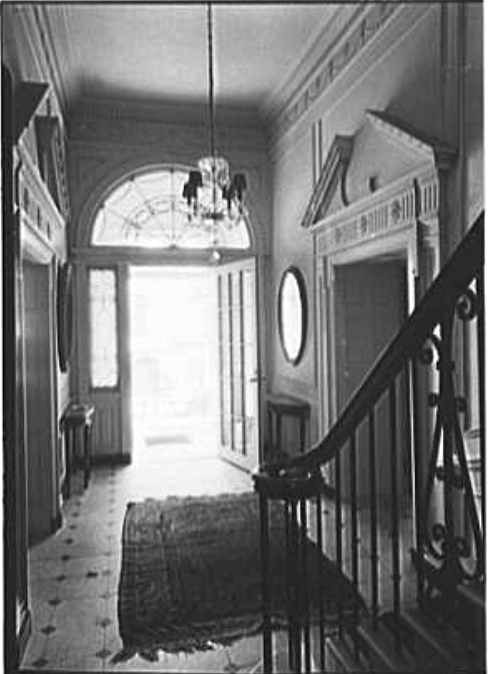
The neo-Georgian doorway was a mere hint of the interiors.  Hewitt lavished the rooms with details inspired by 18th century English architecture, including delicate plaster Adam-style ceilings.

Georgian doorways flanked the marble-tiled entrance hall.  from the collection of the Library of Congress.

Lucy had been introduced to society while an undergraduate at Vassar College in 1926.  The family had just moved into the East 69th Street mansion when her parents announced her engagement to Thomas John Edward Pulling on January 15, 1928.  

The Library.  from the collection of the Library of Congress.

The Leffingwell's 116-acre country estate was Redcote at Oyster Bay, Long Island.  Its picturesque main house was originally a 19th-century farmhouse.

Lucy's wedding took place at St. John's Episcopal Church in Cold Spring Harbor, Long Island on June 23, 1928.  The New York Times reported, "Following the ceremony at the church there was a reception at the home of the bride's parents on Yellow Cote Road."


Two views of the dining room, with its exquisite Adam style ceiling.  from the collection of the Library of Congress.

At the time of Lucy's wedding, in addition to his partnership in J. P. Morgan & Co., Russell Leffingwell was a director of seven corporations and a trustee of Vassar College.  Now empty-nesters, Russell and Lucy remained socially visible.  On June 3, 1930, for instance, the New York Evening Post noted, "Mr. and Mrs. Russell C. Leffingwell are at the Westbury before going to Oyster Bay," and four months later on October 22, the newspaper reported the Leffingwells "who had an apartment at the Claridge during their stay in London, are returning today on the Olympic and will go to...38 East Sixty-ninth Street.  They will be among those entertaining at the opera Monday night."

On December 14, 1931, the New York Evening Post ran a long article about the many entertainments surrounding the debut of Helen Batcheller.  It said in part, "Miss Batcheller was a guest of honor at a large dinner her uncle and aunt, Mr. and Mrs. Russell C. Leffingwell. gave at their home, 38 East Sixty-ninth Street, before the first Junior Assembly." 

Two years later, on September 24, 1933, The New York Times began an article saying, "A plot to kidnap a niece of Russell C. Leffingwell, a partner of J. P. Morgan and former Assistant Secretary of the Treasury, was frustrated yesterday by Department of Justice agents and the police of Yonkers, N. Y."  As Helen Batcheller's wedding to John K. Dougherty neared, her parents received letters that threatened "to abduct her and blow up the Batcheller home unless they received $190,000 to insure her safety."

The terror threat derailed the recent debutante's plans for a society wedding.  "On Sept. 13, however, Miss Batcheller and Mr. Doughtery were married quietly at her home, with agents of the Department of Justice as the only witnesses except members of the immediate family."  About a week later, the blackmailers arranged a drop-off point for the money.  Helen's father deposited the package behind a billboard in Yonkers.  Not surprisingly, when a woman retrieved it later, she was arrested, leading to the capture of the other conspirators.


Two views of the living room.  from the collection of the Library of Congress

During the Great Depression and World War II, Leffington was consulted about the economy and was supportive of President Franklin D. Roosevelt's taking the country off the gold standard.  He told a meeting of the Academy of Political Science in 1934, "When the horrible cycle of deflation began to revolve toward the abyss, the only hope for humanity was to stop gold payments, to go off gold...Cheap money opens the door to recover."

Lucy did her part on the social side.  On February 2, 1942, The New York Sun reported, "Mrs. Russell Leffingwell will give a luncheon tomorrow at her home, 38 East 69th street, for members of the executive committee of the Women's Council of the Community Service Society.  Mrs. Leffingwell's husband is an honorary vice-president of the society."

In 1948, Russell Leffingwell was made chairman of the board of J. P. Morgan & Co.  Although he retired in 1955, he remained on the board as a director.

The Blue Room contained colonial furniture.  from the collection of the Library of Congress

In February 1959, Lucy suffered a heart attack.  It was followed by pleurisy and pneumonia, and she died at the age of 78 in the East 69th Street mansion on February 8.  In reporting her death, The New York Times recalled that she "had been active in the Charity Organization and Community Service Societies and, during World War II, in the work of the Lenox Hill Hospital."

The following year, on October 2, 1960, Russell Cornell Leffingwell died at the age of 82.  His decades of accomplishments filled columns in newspapers like The New York Times that reported his death.


In 1966 the Leffingwell mansion was converted to doctors' offices in the basement and two duplex residences on the upper floors.  A subsequent renovation, completed in 1970, resulted in a duplex apartment in the basement and parlor levels, and a triplex on the top floors.

photographs by the author
LaptrinhX.com has no authorization to reuse the content of this blog

Thursday, April 18, 2024

The 1918 Harvey D. Gibson House - 52 East 69th Street


In 1881 developer William a. Hawkinson completed a row of five high-stooped houses at 50 to 58 East 69th Street.  Each 18-feet wide, they were designed by Lamb & Wheeler.  The first resident of 52 East 69th Street was Anne White Schermerhorn Suydam, whose husband Charles Suydam died on December 31, 1882.

In the first years of the 20th century, the outdated brownstones in the neighborhood were being replaced by sumptuous, modern mansions.  Banker Henry P. Davison purchased the southwest corner of Park Avenue and 69th Street in 1916 as the site of his new home.  Included in the parcel were 50 and 52 East 69th Street--50 as part of his site and 52 to guarantee that no apartment building was erected next to his mansion.

Davison was well acquainted with another banker, Harvey Dow Gibson.  As his own residence was under construction, on December 27, 1916, The American Architect reported that Davison had sold "to Harvey Gibson, vice-president of the Liberty National Bank, the lot at 52 East Sixty-ninth Street.  Mr. Gibson will erect a dwelling for his own occupancy."

The close relationship between the two financiers was reflected in Gibson's choosing the same architectural firm that had designed the Davison mansion--Walker & Gillette.  Completed the following year, the architects' neo-Georgian design complimented the Davison house.  Both sat on a limestone base and were faced in the same Flemish bond red brick.  

The fluted columns that flanked the entrance of 52 East 69th Street supported an entablature decorated with rosettes and bellflowers.  Full-relief rams' heads upheld its cornice.  The paneled lintels of the second floor openings were carved with neo-classical urns and swags.  The fifth floor, behind a brick parapet, took the form of a steep, slate shingled mansard with two pronounced dormers.


Born in 1882 in New Hampshire, Harvey Dow Gibson graduated from Bowdoin College in Brunswick, Maine in 1902.  He started with American Express before moving to the Liberty National Bank where he quickly rose to vice-president.  He married Carrie Hastings Curtis on June 10, 1903.  

The couple's 32-acre summer estate, Land's End, was in Locust Valley, Long Island (where the Davisons' country home, Peacock Point, was also located).  The mansion there, built in the 1850s, was given a Georgian remodeling by Walker & Gillette.  The Gibsons also owned a home at 5 Rue Mesnil in Paris.

Henry Dow Gibson in 1917, the year he moved into 52 East 69th Street.  from the collection of the Library of Congress

America entered World War I in April 1917, just as the Gibsons were preparing to move into their town home.  Henry Davison was appointed chairman of the War Council of the American Red Cross and The New York Times reported that Davison "called upon" Gibson to become the Red Cross Commissioner in France.  Both he and Davison traveled to the war front throughout the remainder of the war.

The year 1917 was additionally eventful for Gibson when, in addition to his new house and Red Cross position, he was promoted to president of the Liberty National Bank, as reported in The American Elite and Sociologist Blue Book.  (Upon Liberty National Bank's merger with the New York Trust Company, Gibson became president of the latter organization.)

Gibson was, according to The New York Times, "a close friend of Helen Keller."  He would eventually be treasurer of the Helen Keller Foundation and a trustee of the American Foundation for the Blind.

Untypical of millionaires, Gibson was driving himself on the night of June 20, 1921.  As he entered the intersection of Fifth Avenue and 56th Street, former tennis champion Beals Wright, who was drunk, smashed into Gibson's automobile.  According to the policeman who witnessed the collision, "As soon as he became disentangled from the Gibson car...Wright continued up the avenue."  The New-York Tribune reported "at Fifty-sixth Street, it is alleged, [Wright] struck and upset a horse-drawn carriage, driven by Denis Ryan."  The tennis star was arrested for intoxication and reckless driving.  Gibson was apparently unharmed.

Domestic clouds were forming over the East 69th Street house before long.  On July 1, 1925, The New York Times reported, "Mrs. Harvey Dow Gibson of New York, wife of the President of the New York Trust Company, has filed a petition for divorce in the Paris courts." 

The following year, on March 13, 1926, The New York Times reported that Gibson had married Helen Whitney Bourne in Berne, Switzerland.  The article said the marriage "is of wide interest in New York.  Mrs. Bourne obtained a divorce from George Galt Bourne in Reno in October, 1924, and Mr. Gibson and his first wife, the former Miss Carrie H. Curtis, were divorced in Paris last Summer."

On May 15, 1933, The New York Times reported that the 51-year-old banker "broke his collar-bone yesterday when he was thrown from his horse while hurdling a fence near his estate, Land's End, Locust Valley."  The millionaire spent the night in the North Country Community Hospital.

About two months later, the Land's End house was burglarized.  Then, on August 13, Gibson reported $200 in cash was missing from the residence.  The Gibsons may have had a light-fingered servant in their employ.  The New York Times recalled, "The theft follows another and larger loss in the same manner several weeks ago."

image via the NYC Dept of Records & Information Services

Interestingly, although Harvey and Helen Whitney Gibson continued to live in the East 69th Street house, Carrie Gibson had received it in the 1925 divorce.  It was not until February 2, 1935 that The Sun reported that Gibson "acquired the town house he occupies at 52 East Sixty-ninth street, at an indicated consideration of $90,000" from Carrie (who was now married to Griffith E. Thomas of the U.S. Navy).  The price would equal about $1.9 million in 2024.

Harvey Dow Gibson died "of a heart ailment," according to The New York Times on September 12, 1950.  In reporting his death, the newspaper called him a "banker of world-wide fame," and noted that he had served as a "Red Cross leader in both World Wars."

Helen Whitney Bourne Gibson's daughter, actress Whitney Bourne, who married Roy Atwood in 1956, inherited the East 69th Street house.  On December 24, 1964, The New York Times headlined an article, "Actress Buys East Side House" and reported that Whitney Bourne Atwood had sold 52 East 69th Street to Jayne Mansfield.  The article noted, "Miss Mansfield plans alterations to the residence."

Jayne Mansfield and husband Matt Cimber with their newborn son and her four other children.  Los Angeles Times, October 22, 1965.

Mansfield had married her third husband, Italian-born director Matt Cimber exactly three months earlier, on September 24, 1964.  The couple separated on July 11, 1965.

Two months before that, on May 10, 1965, the Long Island City newspaper Star Journal reported, "Actress Jayne Mansfield's East Side town house at 52 East 69th street, Manhattan, was burglarized yesterday of $51,000 in jewelry."  The amount of the heist would translate to about $473,000 today.

Mansfield was in Biloxi, Mississippi appearing at the Gus Stevens Supper Club in the early summer of 1967.  After midnight on June 28, a driver for the club chauffeured the actress and three of her children, her attorney, and her romantic partner Sam Brody on a trip to New Orleans where Mansfield was to appear on an afternoon television show.  The automobile slammed into the rear of a tractor-trailer, killing Mansfield and the two other front seat passengers.


The former Gibson house later became home to Peter M. Robbins.  It was sold in 2022 to historian, author, and collector of Old Master paintings Davide Stefanacci for $9.1 million.

photographs by the author
no permission to reuse the content of this blog has been granted to LaptrinhX.com