Monday, May 26, 2025

The Lost Walter B. James Mansion - 7 East 70th Street


photo by Wurts Bros. from the collection of the Museum of the City of New York.

In 1818 Robert Lenox paid the Corporation of the City of New York $6,920 (about $176,000 in 2025) for 30 acres of land far north of the city.  He named his summer estate Lenox Farm.  In his will dated May 23, 1829, he admonished that his son should keep "the property from being sold."  James Lenox did (mostly) keep the property intact throughout his lifetime.  But in January 1870, he donated the Fifth Avenue blockfront between 70th and 71st Street for the site of a library--the Lenox Library.

In March 1895, the Lenox, Tilden, and Astor Libraries were consolidated, creating the New York Public Library.  Even before after its palatial building on Fifth Avenue was completed in 1911, plots within what the Record & Guide called "the Lenox Library block" were being sold.  The Sun mentioned, "The instructions of the trustees were that sales could only be made to parties who would improve for their own resident purposes."  (In other words, buyers could build only homes for their own occupancy on the plots.)

Industrialist Henry C. Frick was early to the party, purchasing the entire Fifth Avenue blockfront in 1907 in anticipation of his sprawling mansion.  In 1910, Cornelius Luyster Jr. completed a sumptuous residence on 70th Street, directly behind the Frick site.  On March 10 that year, The New York Times said a "half dozen" others were under construction on the block.

In 1913, a glimpse of the Frick mansion can be seen.  Between the Luyster and Walter Jennings mansions sits the last vacant lot.  from the collection of the New York Public Library.

On February 26, 1914, the Engineering News reported that Trowbridge & Livingston had completed plans for "a six-story brick and limestone residence at 9 East 70th St., for Mrs. Helen I. James."  (The confusing numbering on the block--including the skipping of numbers--was soon corrected giving the James plot the address of 7.)  The Record & Guide said it would contain "21 bed rooms, 2 elevators, to cost $100,000."  (The construction cost would translate to about $32.4 million today.)

Helen Goodsell James was the wife of Dr. Walter Belknap James.  (It was common among affluent couples to place the titles of their domestic real estate in the names of the wives.  The owner of record, therefore, was Helen.)  

Born in Baltimore, Maryland in 1858, James graduated from Yale in 1879 and from the Columbia College of Physicians and Surgeons in 1883.  He immediately became a clinical lecturer at Columbia.  Walter and Helen had three children, Eunice Coe, Helen G., and Oliver Burr. 

As construction neared completion on May 8, 1915, the Record & Guide called the James mansion, "one of the largest private houses in the city," and said, 

This house is seven stories in height, with basement and attic, and in height is second only to John D. Rockefeller's house in West 54th street...The building itself occupies a plot 41 by 90 feet.  Its facade is of granite and limestone, elaborately carved.

Trowbridge & Livingston produced a dignified Renaissance Revival-style mansion.  Above the trio of fully arched ground floor openings, the windows of the second floor (or piano nobile) were fronted with stone balustrades and capped with Renaissance-inspired triangular pediments.  The two top floors, behind a stone balustrade, formed a steep mansard.  The windows of the fifth floor were capped with arched pediments.

The James family maintained a sprawling country estate in Cold Spring Harbor on Long Island.  

This aerial view of the James estate and mansion in Cold Springs Harbor was taken on March 16, 1947.  from the collection of the New York State Archives.

The winter social season of 1916-17 saw daughter Helen's introduction to society.  Debutante entertainments often continued for weeks and on February 17, 1917 The New York Times reported, "Mrs. Walter B. James gave a small dance at her residence, 7 East Seventieth Street, for her debutante daughter, Miss Helen James, guests being chiefly debutantes of the season and the young dancing men."

Focus turned to Oliver later that year.  On November 22, The Evening Post reported that invitations had been issued to the wedding of Oliver B. James to Angeline J. Krech.  The article mentioned, "Mr. James is training with the aviation section of the Signal Corps."  The ceremony took place in St. Bartholomew's Church on November 28 and the couple moved into the East 70th Street mansion.

from left to right are the Frick, Luyster and James mansions.  Real Estate Record & Guide, May 8, 1915 (copyright expired)

By then, Helen James had been highly involved in war relief efforts for months.  On January 1, 1917, The New York Times reported, "Many prominent people filled the ballroom in the house of Mrs. Walter B. James, at 7 East Seventieth Street, yesterday, in the interest of the Comité Franco-Americain pour la Protection des Enfants de la Frontière, with headquarters in Paris."  The article said, "Appeals for little children of France made orphans and homeless by the war induced a small group of women to offer to support fifty children for one year."

Five months later, on May 16, The Times reported, "Sixty-one orphans of the battle of the Marne found foster-parents at the home of Mrs. Walter B. James...when each member of the New York Committee of the Fatherless Children of France pledged herself to 'adopt' one more fatherless children."  (The adoptions were financial, rather than actual.)

Eunice was introduced to society during the winter season of 1919-20.  On November 26, 1919, her parents hosted a dance for her in the house.  The Sun reported, "There was general dancing during the evening, and at midnight supper was served.  The guests, about 500 in number, included young married couples, debutantes, and young men in society."  The article listed among the guests some of New York's most socially illustrious names, including Grace and Cornelia Vanderbilt, Emily Sloane Hammond, Katharine Mackay, M. Millicent Rogers, Katherine Bliss, and A. Routh Ogden.

Even with the war over, Helen continued her relief efforts.  She could, however, begin hosting solely social gatherings.  On January 7, 1920, for instance, the New-York Tribune announced, "Mrs. Walter B. James will give an afternoon musicale to-day at her home, 7 East Seventieth Street."

On November 16, 1922, Walter and Helen announced Eunice's engagement to Henry E. Coe, Jr. and Katherine's engagement to Herman D. Boker.  (Katherine's wedding to Boker would not come to pass.  She later married Henry Burrill Anderson.)

Eunice and Henry Coe, Jr. were married in the mansion on April 19, 1923.  An at-home wedding did not imply a small affair.  The New York Times reported that Eunice had "eighteen young people" as her attendants.  The article noted, "Mr. and Mrs. Coe are sailing shortly and will travel in Europe for several months."

Years after the end of World War I, Helen James was still working for the benefit of French victims.  On January 12, 1923, for instance, The New York Times reported that she had sponsored the exhibition and sale of articles "made by French people who have been deprived of their means of support through the war." 

Dr. Walter Belnap James.  from the collection of the Cold Spring Harbor Laboratory.

Walter James occasionally had private time.  On January 11, 1924, The New York Evening Post reported, "Dr. Walter B. James will leave this week for Jekyl [sic] Island, Ga."  Jekyll Island was purchased in 1886 by the male-only Jekyll Island Club, which Munsey's Magazine deemed, "the richest, the most exclusive, the most inaccessible club in the world."  At the time of the Evening Post article, James was president of the club.

In March 1927, James suffered a heart attack while at Jekyll Island.  The New York Times reported, "His relatives were summoned to the club but he improved sufficiently to be removed to his home here."  He died in the mansion on April 6.  

The estate of Dr. Walter B. James was reported as being "about $2,000,000," according to The New York Times (around 18 times that much in today's money).  On April 19, The Times said his will, "makes substantial bequests to three colleges, a sanitarium and a biological association."  Helen received all the real estate, personal effects like furniture, jewelry, etc., and one half of the remaining estate.  The three children shared equally in the other half.

Oliver and his family were still in residence with his mother at the time.  He and Angeline would have five children, Angeline Pool, Helen, Walter Belnap, Oliver Jr., and R. Campbell (known familiarly as Zup). 

In 1930, Helen purchased a second lavish summer home, Aspen Hall, on Bellevue Avenue in Newport, Rhode Island from John Aspegrens and his wife.  Helen renamed it Rockhurst.

Rockhurst.  from the collection of the DeGolyer Library of the Southern Methodist University.

Helen Jennings James died in the 70th Street mansion on August 15, 1946 at the age of 86.  In reporting her death, The New York Times recalled that she was the niece of William Rockefeller and a descendant of Isaac Jennings, a settler of Hartford, Connecticut.  

At the time of Helen's death, the Frick mansion had been operating as a museum--the Frick Collection--for eleven years.  In 1940 the museum purchased 9 East 70th Street "and converted it to a wartime storage area," according to The New York Times, and following Helen James's death, it purchased 7 East 70th Street.  The museum leased it to The Asia Institute.

Founded in 1928 as the Iranian Institute, the organization was formed with the goal of "furthering the knowledge of Oriental culture and civilization."  On September 21, 1947, The New York Times reported that the institute "will move to larger quarters at 7 East Seventieth Street in time for registration for the fall semester."  The Asia Institute could now boast "the largest faculty on Chinese studies in the United States and one of the largest in the world."

In 1941, East 70th Street was lined with sumptuous mansions.  The Frick mansion is the short structure at the left, and the James residence is two doors away, behind the automobile.  via the NYC Dept of Records & Information Services.

The institute opened in December 1947.  Asian art was displayed on the ground floor, including "Gandhara and Khmer sculpture, Chinese and Indian rugs, Persian carpets, miniatures and ceramics," according to The Times on December 9.  The second floor housed the library and a gallery of Persian art.  The New York Times reported, "The third floor houses the art of India, Indonesia and the Zimmer Memorial Library."  The upper floors held classrooms, "each decorated in the style of the region to be studied," and the administrative offices.

On November 23, 1949, Mohammed Reza Pahlevi, the Shah of Iran, opened "an impressive exhibit of Persian art treasure" here, as described by The New York Times.  The Shah was accompanied by "an entourage of fifteen persons."

At the time of the exhibition, The Asia Institute was in serious financial trouble.  On February 23, 1950, The Times reported, "Unless $50,000 is raised by Wednesday, the Asia Institute at 7 East Seventieth Street...will go out of existence."  While the institute managed to survive, it was forced to leave the former James mansion.

In 1952, the Frick Collection demolished the structure "for an expanded service area," according to The New York Times.  Just over a decade later, in 1973, the site of the James mansion became part of the museum's plan to create a 100-foot-square garden and terrace.

photo by Navid Baraty, from the collection of The Cultural Landscape Foundation.

Saturday, May 24, 2025

The 1893 American Female Guardian Society Industrial School 7 - 225 E 80th


By the last decade of the 19th century, the concept of industrial schools--in which underprivileged youths were trained in manual skills for boys and domestic skills for girls--was well established.  In March 1892, architects Fowler & Hough filed plans for a three-story "brick and stone building" to replace the two houses at 225 and 227 East 80th Street.  The cost was projected at $20,000 (or about $711,000 in 2025 terms).

Fowler & Hough was tasked with designing a multi-functional structure.  It would be shared by the Phillips Chapel of the Phillips Presbyterian Church and the American Female Guardian Society.  The society would operate its Industrial School 7 in the lower portion, training children as young as kindergarten age; and its Home for the Friendless in the upper section.  

Completed in 1893, the Romanesque Revival-style structure was faced in beige brick.  Striation of the first floor was created by bands of salmon colored brick that matched the pinkish terra cotta frames of the windows and the striking hood over the double-doored entrance.  Sitting upon sturdy brackets, the inside of the hood was decorated with deep coffers.  They were echoed in the deep frames of the windows on this level.


The second floor was sandwiched between terra cotta bands.  A single arched window sat above the entrance, and paired openings appeared over the first floor windows.  These were separated by fluted, terra cotta Corinthian columns and capped by denticulated eyebrows with stylized palmettes.  A bracketed cornice capped the understated third floor.

The children who were housed by the American Female Guardian Society and Home for the Friendless were often desperate.  On July 2, 1895, for instance, The Evening Post reported on the arraignment of Herman Reich, "the man accused of murdering the woman he lived with."  The article said Riech's "little six-year-old daughter, now without natural protection," was "committed to the care of the American Female Guardian Society" by the magistrate.

The entrance hood is a masterful example of terra cotta work.

Among the financial supporters of the society was Helen Miller Gould, daughter of multimillionaire Jay Gould.  On May 4, 1895, in celebration of the marriage of her sister, Anna, Helen funded parties in several of the society's locations (there were twelve by the turn of the century).  The following day, The New York Times reported, "Children of the Home Industrial School, No. 7, at 225 East Eightieth Street, about 350 in number, enjoyed a beautiful dinner at noon yesterday, through the bounty of Miss Gould."

In reporting on the kindergarten graduation of Industrial School 7 on June 29, 1900, the New-York Tribune called the facility "almost the 'banner' school of the series of twelve, and the exercises showed a remarkable brightness on the part of the pupils."  The five-year-old graduates "showed good training, even if some of the youthful elocutionists did forget a line or two."  In March and April that year, lectures for women were presented: "Care and Repair of Clothing," and "Food and Cooking for Health and Economy."  The mission also conducted a Girls' Club.

By now, the Phillips Mission was called the East 80th St. Mission, a branch of the Madison Avenue Presbyterian Church.  In addition to children, it offered courses for mothers.  In 1903 it conducted "The Mother as Housekeeper," "The Mother as Trained Nurse," and "Common Diseases and How to Avoid them."

On February 6, 1918, The Sun reported that the American Female Guardian Society and House for the Friendless had sold the property to the New York City Baptist Mission Society.  The article explained the group "will use it for a church and other settlement work for the Hungarian Baptist congregation."

The Regional Conference of Baptist Ministers was held here in September 1919.  Among the issues the clergymen debated was the proposal of a strike.  The Rev. George Chalmers Richmond was markedly opposed to the notion.  He told his colleagues, according to the New-York Tribune on September 23, "A strike of clergymen would be 'all tomfoolery.'"  The article said, "He suggested a minimum salary of $1,500 for unmarried clergymen and a minimum of $2,500, with quarters, for married pastors."  (His proposed salary for married ministers would translate to $45,300 today.)

In 1920, the Rev. Dr. Nickolas Dulitz, pastor of the Hungarian Baptist Church, initiated a "servant girl club" where female domestics could "spend their leisure hours," as reported by The New York Times on March 22.  The Hungarian Girls' Club, which was on the third floor, was "equipped by women in Baptist churches of the city."  Dulitz told the newspaper, "he thought this was a well-directed step toward solving the servant problem."  By 1926, the Hungarian Girls' Club had morphed into the First Hungarian Baptist Church Home for Hungarian Working Girls, where domestics and shop girls could live inexpensively.


Hungary was experiencing political and military upheaval in 1920.  A counterrevolution, sometimes called the "white terror," led to imprisonment, executions--as many as 5,000-- and torture of Jews, leftist intellectuals, socialists and communists.  On May 2, The New York Times reported, "The American Red Cross is co-operating with the American Relief Committee for Hungarian Sufferers in the shipment of clothing to Budapest."  The article mentioned, "If a donor cannot supply a whole case of gifts, he should send his contributions to the Rev. Michael Dudley of the Hungarian Baptist Church, 225 East Eightieth Street."

In many ways, the services offered by the Hungarian Baptist Church echoed those of the American Female Guardian Society.  The 1922 Directory of Social Agencies said it, "Conducts preaching services, a sewing school, clubs and classes for boys and girls, women's meetings.  English classes and a Home for Hungarian working girls."

In response to the strife in their homeland, the church hosted Hungary Night on February 27, 1922.  The Baptist reported, 

To the scores of Baptists who assembled in the church, there was given for the first time a vivid and definite picture of Hungary, the land of the Magyars; the land of a troubled history that had striven so long for freedom; the land of women whose clever fingers know their way through intricate mazes of fine needlework; the land of art and music; and the land today of struggle and hunger and sorrow.

image via the NYC Dept of Records & Information Services

In 1928, John Chaky was hired as the building's janitor and his wife, Rose, as housekeeper.  Rose oversaw the maintenance of the Home for Hungarian Working Girls.  According to Elizabeth Matuskovits, the wife of pastor Rev. Joseph Matuskovits, "Mrs. Chaky took care of and cleaned 18 rooms daily in our girls' home."  The couple and their three children lived in the building.

On February 18, 1932, Rose Chaky underwent what The New York Times described as "a serious operation" at Lenox Hill Hospital.  Two days later, she plunged from window of her 11th floor room of the hospital, dying instantly.

In March 1957, title to the 80th Street property was transferred from the New York Baptist City Society to the Hungarian Baptist Church.  In 1969, it shared its meeting hall with the recently founded India Christian Assembly.  The group would remain about two years.


The Hungarian Baptist Church still occupies the building after more than a century.  Its arresting Romanesque architecture is a captivating presence on the block.

many thanks to historian Anthony Bellov for suggesting this post
photographs by the author

Friday, May 23, 2025

The Jacob and Mina Shire House - 109 East 61st Street

 
photograph by the author

Bentley Squier was a major player in the development of the Upper East Side in the years following the Civil War.  In 1870 he broke ground for a brownstone-faced residence at 109 East 61st Street.  It was most likely designed by D. & J. Jardine, with which he worked repeatedly. 

Squier sold the completed, 19-foot-wide house to Henry Grossmayer on February 25, 1871 for $28,000 (about $742,000 in 2025 terms).  Four stories tall above a high English basement, its Italianate design included an arched, double-doored entrance with a foliate keystone and brackets that upheld a triangular pediment.  The architrave frames of the openings wore prominent molded cornices.  A complex pressed metal cornice with foliate brackets crowned the design.

Henry Grossmayer was a cotton merchant.  The recent war had greatly disrupted his business.  To keep the Confederate government from seizing his bales of cotton, he had warehoused it in Savannah under the name of a Southerner, Abraham Einstein.  A later court order explained, "It remained in store in this manner until the capture of Savannah, in December, 1864, when it was reported to our military forces as Grossmayer's cotton, and taken by them and sent to New York and sold."

On December 1, 1879, Grossmayer sold 109 East 61st Street to Jacob Shire and his wife, the former Mina Milius, for $20,000.  A partner in the shirt manufacturing firm Miller, Shire & Co., Jacob Shire was born in Germany in 1834 and his wife was born in Ohio in 1844.  The couple were the parents of eight children: Leo, Albert, Tillie, Simeon (known as Sidney), Helen, Lawrence Crawford, Harold and Edward Isaac.  The children ranged from 5 to 14 years old when the family moved in.

Twelve years later, tragedy rocked the Shire family.  As Sidney got older, he became, "rather wild, and as he had plenty of money to spend, he...associated with undesirable companions," according to Annie E. Griffin.  She was the mother of 20-year-old Minnie Griffin, who moved into Annie's apartment on West 59th Street from Chicago in 1890.  Shortly afterward, Minnie and Sidney Shire met and, according to Annie, "I think the girl had a good influence over him."

Within months, 22-year-old Sidney became engaged to Minnie Griffin.  His family, however, was opposed to the relationship.  Jacob Shire later said, "We all talked to him in turn--that is, the different members of the family, but it seemed to have no effect upon him.  He was probably infatuated with her."

The last of those talks came on the afternoon of July 7, 1891 when Sidney, "had a stormy interview with his father," as worded by The Evening World.  Jacob demanded that he give up Minnie.  If not, "he must leave his house."  Jacob threatened that he would "have nothing more to do with him unless he obeyed his wishes."  The Evening World said, "The young man...was very much cut up over his father's treatment of him, and said he would never desert the girl he loved."

That evening Sidney visited the Griffin apartment.  He told Minnie of the conversation and vowed to leave his family.  Minnie, however, told him "he ought to regard his father's wishes, and that at least he ought not to give up his home."  

At around midnight, Sidney got up and put his hat on.  He kissed Minnie good night, then asked if he could step into the bedroom to check himself in the mirror.  As Minnie waited by the door, she suddenly heard a gunshot and "a heavy fall."

The Evening World, July 8, 1891 (copyright expired)

The Brooklyn Daily Eagle indiscreetly reported that Sidney, "blew his brains out."  The New York Press said, "Just before 1 a.m. a fierce ringing of the bell at No. 109 East Sixty-first street led to the announcement to Jacob Shire and his wife and to Simeon's brothers and sister the news that the boy had killed himself in his distraction between love and duty to his parents and his infatuation for Miss Minnie."

Jacob Shire, accompanied with two sons, including Albert (who was in the jewelry business), drove to the Griffin apartment.  "The father was so prostrated by the news of his son's shocking death that he would not go inside to look at his body but remained in the carriage while the brothers entered the house and learned the details of the shooting," recounted The Evening World.  Simon's body was brought to the East 61st Street house around 6 a.m.

At the time of the tragedy, the youngest child, Edward Isaac, was 17 years old.  Two years later he was enrolled in both Columbia College's School of Arts and in The School of Mines.  He graduated from the latter in 1896 with a Ph.B. degree.

After living here for nearly a quarter of a century, Jacob and Mina Shire sold 109 East 61st Street on June 2, 1902 to Josephine Van Boskerck for $35,000 (about $1.3 million today).  The widow of John W. Van Boskerck, Josephine's residency would be relatively short.  She died here on February 5, 1908.  Her funeral was held in the parlor three days later.

The house was leased by Josephine's daughter, Lizzie, to Charles Cashman.  The unmarried 77-year-old died in the house on March 12, 1909.  As had been the case with Josephine Van Boskerck, his funeral was held in the house.  Later that year, on November 23, 1909, The New York Times reported that "Miss L. Boskirck" [sic] had leased the house.  Her new tenants were the De Witt Davidson family.

De Witt Davidson was a jeweler.  In 1913, his wife hired a polished maid named Marie despite the 24-year-old's having no references.  On October 13, Mrs. Davidson told a reporter from the New York Herald that she "was somewhat uneasy at having taken her into the household without proper recommendations, [but] she had never had so fine a servant before."

The newspaper described Marie as Viennese, saying, "In appearance, Marie is more than the ordinary maid.  She is prepossessing and neat, short of stature, with pleasing but not striking features, and has a wealth of beautiful hair."  Mrs. Davidson noticed that "her hands were soft and white."  Marie's hands, her refined manners, and her wardrobe strongly suggested that she was no run of the mill servant girl.  The New York Herald reported,

With her neat trunk, which bore labels from every country, installed in her room, Marie began unpacking her belongings, only to find that she had nothing suitable to work in.  She took out a handsome skating costume, but laid that aside as being inappropriate.  Then a tennis costume was tried on with white buckskin tennis shoes, and as that was the nearest approach to the uniform of a well groomed servant she decided to wear the tennis outfit until she could have made some plain gingham and calico dresses, with white aprons.

There were other hints to Marie's identity in her trunk.  She removed "family jewels valued at several hundred dollars, which she asked her employers to place in safe keeping for her until she could rent a box in a safety deposit vault," said the article.  The other clues in the trunk were: "a dainty bridal gown with orange blossoms, a lace veil, satin slippers and all the accessories of a trousseau."  Residents along East 61st Street quickly concocted rumors.  "Neighbors who have heard about Marie are wondering if she is not some person of position and wealth disguising herself as an upstairs girl," said the article.  

Pressed by the family, their "upstairs girl" obliquely explained how she came to work in their home.  Without betraying her true name, Marie said she "fled from her home in Europe to escape being wedded to a man she did not love."  The intended groom, she said, "is a man of high status," and hinted, said the New York Herald, that she "herself is far above the ordinary class to which she has assigned herself."  The mysterious Marie remained with the Davidsons for some time.

On April 30, 1914, the New York Press reported that Lizzie Van Boskerck had sold 109 East 61st Street to Dr. Louis Faugeres Bishop.  Born on March 14, 1864 in Brunswick, New Jersey, Bishop was a graduate of Rutgers College and the College of Physicians and Surgeons.  In 1899 he married Charlotte D. Gruner.  The couple had one son, Dr. Henry Bishop.

Louis was president of The Good Samaritan Dispensary and consultant in heart and blood vessel diseases at the Lincoln Hospital.  The family occupied the upper floors of the house and Bishop opened his Cardiac Institute in the lower portion.

The Medical Times, March 1918 (copyright expired)

The Bishops rarely appeared in the society columns, but on November 17, 1923, The Sun reported, "Dr. and Mrs. Louis Faugeres Bishop are giving a reception this afternoon at their home, 109 East Sixty-first street, to celebrate the silver anniversary of their wedding."

In 1927, the Bishops advertised the house for rent.  The ad in the Medical Journal and Record read:

Physicians House, arrangement suitable for a group, 15 rooms, 4 baths, large basement extending the length of the lot with skylight studio in the rear.

It was rented by Marion B. Herrschaft, the head of the Parkside Special School.  Termed by Hershaft as a "foundation training school," her listing in Private Schools that year described it as "A day school for children who find progress difficult in regular schools.  Montessori principles followed."  The school accepted pupils of both genders, from 7 to 15 years old.

Child Study, October 1927 (copyright expired)

The venture within the East 61st Street house was fleeting.  On June 4, 1928, the New York Evening Post reported that Bishop sold the house to The 535 Park Avenue, Inc.  With Prohibition in effect, the house was converted to a nightclub called Malborough House, run by Jim Moriarty.  In her 2021 Madam, The Biography of Polly Adler, Debby Applegate writes, "The Marlborough House catered to the collegians with the approval of their parents, who knew [the] establishment was strictly upper class."

It was most likely during the conversion to the Malborough House that the parlor windows were replaced a vast window with leaded and stained-glass panes.  via the NYC Dept of Records & Information Services.

In June 1931, Leonard Leaman signed a 15-year lease on the house and converted it to the Opera Club.  The first problem with law enforcement came on January 19, 1932.  The Norwich Sun reported, "The Opera Club, a resort at 109 East Sixty-First street, with a thirty-foot bar in the basement, was raided by agents yesterday afternoon," who seized 108 bottles of liquor.  Surprisingly, the 30 customers in the space at the time were not arrested.  The article said they "were ordered to depart after paying their checks."  The staff, on the other hand, were not so lucky.  Seven employees--the manager, bartender and waiters--were arrested.

Prohibition Director McCampbell intended that the Opera Club could not reopen.  The New York Sun reported that he ordered the club to be "dismantled," while warning that the "property must not be destroyed."  The Evening Star of Washington, D.C. reported that on January 21, "a half dozen laborers were stripping the Opera Club at 109 East Sixty-first street, and were trucking the furnishings away to the Federal warehouse."

The Opera Club did reopen, however, and was still in operation as late as 1935, two years after the end of Prohibition.  In 1937 the house was converted to apartments.   As early as 1983, the stone stoop was removed and a staircase to the side installed.  Around 1986 the upper floors were returned to a single-family home and the basement converted to a commercial space. 

Thursday, May 22, 2025

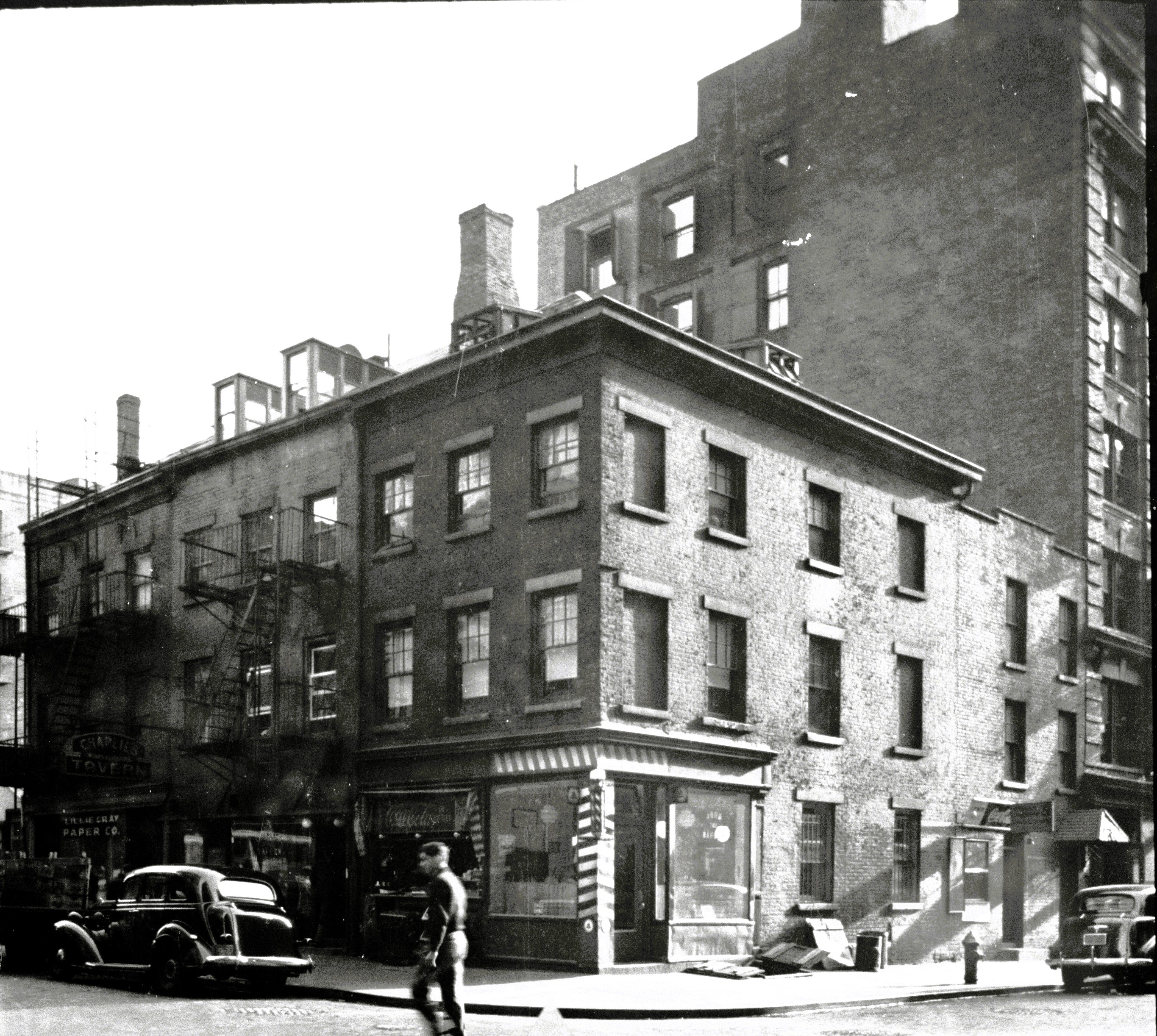
The Power & Kern Saloon Building - 70 Prince Street


The neighborhood around St. Patrick's Cathedral on Mulberry Street, completed in 1815, was filled with a mixture of residents in 1827.  It was about that time that Patrick Sherryd erected four similar brick houses on the southern blockfront of Prince Street between Lafayette Street and Crosby Streets.  Unlike the refined mansions that would soon rise on nearby Bond Street and Astor Place, Sherryd’s three-story homes were middle-class.  No. 70, on the corner of Crosby, was faced in Flemish-bond red brick above a ground floor store.  It rose to a simple wooden cornice below a shallow hip roof with tiny dormers.
 
The first occupant of the ground floor was Lewis T. Stansbery, who ran a grocery store.  By 1836, he had changed courses and ran a clothing store at 477 Greenwich Street.  The grocery was operated by Christian Febrock as early as 1840.  Around 1856, grocer William Lohmann extended the building to the rear and installed the residential entrance at 105 Crosby Street.  Lohmann and his family lived in the upper floors.  His Lohmann & Ording grocery was one of two, the other being at 117 Bleecker Street. 
 
The Lohmanns took in roomers.  Among them in 1856 was John Boyle, who taught in the Boys’ Department of Ward School No. 4 on Marion Street near Prince.  But the shadier character of some of the residents was reflected in the arrest of Alfred Howard on July 26, 1867 during a raid on “policy” dealers.  Policy rackets were a version of a numbers game or illegal lottery that preyed on the desperate poor.  Police Officer Lacy of the 14th Precinct charged Howard with running a policy game, “he having purchased a ‘policy’ ticket from Howard for the sum of four cents,” reported The New York Times.
 
In the meantime, the Lohmanns moved to Wooster Street in 1860.  Dederick and Richard Gerken now ran the grocery store and lived upstairs.  A significant change came in 1867 when John Shewell converted the store into a saloon.  He was charged on December 29, 1868 for violating the excise laws, most likely for having the saloon open on Sunday.
 
Well-to-do New Yorkers left the oppressive city heat by spending the summer months at country homes or resorts.  The less affluent had to suffer and, in many cases, died.  Such was the case of 49-year-old Henry Blesses on June 29, 1869.  Described as “a German,” by The New York Times, he died suddenly in his room, “supposed to be the result of the heat.”
 
In 1871, Abraham W. Burnett, whose family lived upstairs, took over the saloon.  And around 1876 it became the Powers & Kerns saloon, operated by Frank Kerns and Edward Power, whose families--like Burnett's had done--lived above the business.  Their less visible partner was Alderman Patrick Napoleon Oakley. 
 
Saloons in the 19th century, at a time when almost every male carried a weapon, were often dangerous places.  In 1879, Jim Poole shot Pat McGowan here, landing him in Sing Sing Prison for ten years.
 
The outspoken and colorful Patrick Oakley was a member of the Marion Club, a political group with ties to Tammany Hall.  It used a room on the second floor for meetings.  In 1880, the room was also being used as the meeting place of the Metropolitan Hancock and English Campaign Club.  (Winfield Hancock and William English were the Democratic Presidential and Vice Presidential candidates in 1880.)
 
By then, John Edward Power, Edward’s son, had been a partner in Power & Kerns for at least a year.  He, like Oakley, was an assemblyman.  Born on May 15, 1850, he attended public schools and Cooper Union before working in a machine shop as a pattern maker.  He was married in 1873 in the Mott Street cathedral to Mary Louise Donohue and the couple had two children.
 
In 1886, the City Reform Club wrote of him, “He now keeps a liquor-saloon at 70 Prince St.  This saloon has many thieves and prostitutes among its customers.”  The organization's scathing assessment of him said in part:
 
As a legislator, Mr. Power was not as useful or as harmful as he might have been.  If he can be commended in the least, it is because some of his colleagues were apparently much more corrupt.  He was as unfit for the place which he held as any keeper of a low saloon must be…He was controlled by the bosses in New York City.
 
The New York Times accused him of hiding his partnership in the saloon.  On October 24, 1886, it reported that he, “sells ales, wines, beers, and spirituous liquors in Prince-street.  He conceals the fact from his friends in the country by telling them in his biography, printed in the Albany Political Almanac, that he ‘is now interested in the hotel business.’  He tells them also in the same article that ‘he is descended from one of the best families of Ireland.’”
 
The year following the blistering remarks, Oakley and Power replaced the saloon front.  The new street level façade included cast iron columns and a large window.  But later that year, John Power would have other things to think about.
 
On October 19, 1887, The New York Times wrote, “Assemblyman James E. Power has got himself in trouble.”  For years Power had been a friend of Richard W. Conroy, who ran a Sixth Avenue saloon.  The newspaper said Conroy, “lived with his wife at 116 Waverley-place happily enough until May 30 last, when, coming home later than usual from his club, he found Power in the bedroom with his wife, Mary Louise Conroy.”  Saying, “Power keeps a saloon at Prince and Crosby streets,” The Times reported that Conroy had filed suit for $20,000 in damages against the assemblyman.
 
During the campaign of 1890, Oakley openly served liquor on Sundays as part of his campaign.  On Monday November 3 that year The New York Times reported:
 
There was a strong smell of fresh varnish yesterday in the demure white saloon of Alderman Patrick Napoleon Oakley at 70 Prince Street, and the floor was shiny in spots, as though in course of preparation for a ball.  The blinds were discretely drawn, but the two back doors swung noiselessly on their hinges and the beer pump beat the record of the old oaken bucket long before the day was over.  A policeman hovered near, but he devoted his attention to a gang of wicked small boys.  Two bartenders were on duty all day, and the saloon was at least half full of people nearly all the time.
 
Alderman Oakley was on hand, and he held frequent consultations with his visitors on the subject of the election.  Some campaigning was also in progress, and there was a noticeable proportion of young men, some of them mere lads, among the patrons of the bar.  Up stairs, the ‘Marion Club’ was in session.
 
The New York Press had a decidedly different opinion of the Assemblyman.  Following the election that year, it said he, “came to the rescue of his constituents like the refreshing shadow of a rock in the great desert where cooling waters are to be found…He is a native of Ireland, 43 years old, and a thorough American.”
 
The danger of burglarizing the business of two politically connected men did not deter two thieves on March 23, 1891.  The Evening World reported, “Thomas Kilimet and Thomas Sheridan were caught breaking into Alderman Oakley’s saloon, on Prince street, at 2:30 this morning, and were held at the Tombs Court.”
 
Patrick Napoleon Oakley was home at the time, suffering from a severe cold he had caught two days earlier.  It quickly developed into pneumonia, and he died just after midnight on March 26, 1891.  The World was glowing in its recap of his political accomplishments and focused on his prominence in the Ancient Order of Foresters, his memberships in the Knights of St. Patrick, the Marion Club, and the Catholic Benevolent Legion.  The newspaper only briefly mentioned, “He was the owner of two saloons, one at Canal and Mott streets and the other at Prince and Crosby streets.”
 
The saloon business was taken over by H. D. Dircksen and, apparently, his son, A. E. Dircksen.   They operated the saloon here at least until 1905.
 
The heavily Irish neighborhood saw the influx of Italian immigrants in the last decade of the century and in 1899 Antonio Sciarra received approval from the city to run his fruit stand on the Crosby Street side of the building.  Two years later, Giuseppe Porfillio replaced him with his own fruit stand there.
 
The enactment of Prohibition necessarily changed the personality of the ground floor, which became a barbershop.  T
he upstairs portion remained residential.  In 1922, A. Solomon, who was in the silk business, lived here with his family.  They were still here in 1935 when son Lester passed the New York State bar exam.

image via the NYC Dept of Records & Information Services

As early as 1982, the former saloon space held The Crosby Luncheonette.  The restaurant would have an ongoing and unhappy relationship with the Department of Health.  In March 1982, it reopened after having been closed for health violations.  It was shut down again in September that year, reopened in October, and was closed again in June 1983. 
 
It became the Rodriguez Restaurant which, like its predecessor, was closed by the Department of Health in June 1984, cited again in 1985, and again in April 1986.
 
But in 1990, the Soho neighborhood was seeing a rebirth as galleries opened in its vast cast iron structures.  Trendy shops and restaurants opened, including Savoy at 70 Prince.  The American-Mediterranean bistro was a popular destination for over two decades.  The second floor was converted to a dining room, while the uppermost floor was listed in Department of Buildings records as a “one family home.”
 
Then, in June 2011, owner Peter Hoffman served the last dinner here with an $85 five-course menu.  Less than a year later, on February 29, 2012, Peter Hoffman announced he would open a version of his East Village restaurant, Back Forty, here.  Called Back Forty West, its glass and metal store front cleverly exposes the cast iron column that survives from Oakley’s and Power’s 1887 renovation.
 
Renovations to the top floor apartment were underway in 2025.

Surrounded by 19th century factory lofts, the 200-year-old 70 Prince Street and its contemporary next door are unexpected survivors.  The second floor continues to house part of the ground floor restaurant, and there is one apartment on the top floor.  

Wednesday, May 21, 2025

The Michael H. Norton House - 42 Charlton Street


Thomas B. Ridder was a successful tobacco merchant and a councilman.  In 1851 he was leasing the newly-built, three-story house at 42 Charlton Street, erected by E. Young.  Above the brownstone basement, the house was faced in warm red brick.  The paneled piers flanking the entrance were a handsome and unusual detail.  The building's simple wooden cornice was typical of the style.

Sharing the house was the Samuel Cohen family.  Samuel and Dinah Cohen had a daughter, Mary.  Samuel was a fur merchant on Water Street.  Sadly, Mary died after a short illness on September 29, 1852 at the age of 13.

On February 8, 1853, 42 Charlton Street was sold at auction.  The announcement described the 23-foot-wide home as "built with the modern improvements.  Gas introduced into the house."  It added, "Chandeliers go with the house."

The purchaser paid $8,400 (about $342,000 in 2025 terms) for the house, which he continued to lease.  The Riddles and Cohens remained through 1855, after which Moses Souza, an importer, and Rev. Morgan Dix moved in.

Born on November 1, 1827, Dix was the son of Major General John Adams Dix, a U.S. Senator from 1845 to 1849, Secretary of the Treasury in 1861, Governor of New York from 1873 to 1874, and a notable figure during the Civil War.  Rev. Morgan was assistant minister of Trinity Church.

Rev. Dix and the Souza family remained until the spring of 1863.  In April the house was offered "for sale or to let."  By now, according to the ad, running water had been introduced.

It was purchased by Dr. Edward Fields.  Living with him and his wife, Iodema, were their daughter Jennie and her husband John D. Slayback.  In April 1865, the population of the house increased by one with the birth of the Slaybacks' daughter, also named Jennie.  Four months later, on August 17, the infant died.  Her funeral was held in the parlor.

It was most likely the Fields who modernized the house.  Italianate stoop railings and hefty newels were installed and the parlor windows were extended nearly to the floor.

Dr. Fields was drawn into a scandalous case in 1865.  On the night of September 25, Dr. Grindle, who ran a lying-in hospital brought a patient, Lucy Sagendorf, to the boarding house of Mary Julia Rolf.  According to Mary, he had told her that Lucy "had inflammation of the bowels."  The doctor's wife stayed with Lucy overnight.  The next evening, Mrs. Grindle brought a young man, James J. Hicks, and after about ten minutes, according to Mary Rolf, Mrs. Grindle came down in great haste and inquired of me whether she could find a minister."  Before long, Rev. Dr. J. K. Wardle arrived and performed a marriage at the bedside.

Mary Rolf became concerned around midnight, and sent for Dr. Fields.  He later told investigators, "she was very pale and...she complained of intense pain in the intestines."  He noted, "she had been leeched."  When he asked Mary if Lucy had been treated by another physician, she said no, apparently protecting Dr. Grindle.  Fields visited Lucy that afternoon, and she died later that night.  He issued a death certificate citing the cause of death as peritonitis.

Dr. Grindle's lying-in hospital (a facility for pregnant women) doubled as an illegal abortion clinic, as it turned out.  And Mary Julia Rolf's boarding house was often used for the recuperating women.  Rolf testified on September 27, "I have recently had two cases of confinement and about twenty cases of miscarriage in my house."  In the trial that followed, Fields had to defend himself against suspicion of collaborating in the fatal abortion by having falsely listed the cause of death.

Dr. Edward Fields died in 1866.  Iodema sold the house to Michael H. and Marietta L. Norton in June 1870 for $30,000 (about $723,000 today).  Born in Ireland in 1838, Michael H. Norton was brought to New York as a child.  He "developed into an athlete and acquired considerable science as a sparrer," said The Sun.  He gave up boxing for politics and was elected an alderman in 1864 and to the State Senate in 1868.  Also elected to the Senate that year was William M. Tweed, later known as "Boss" Tweed, and the two became close friends.

Living with Michael and Marietta were Michael's brothers Peter and Edward.  (Another brother, John, and his family lived nearby at 50 King Street.)  

The Charlton Street house was again the scene of a funeral on May 21, 1871.  Edward H. Norton died at the age of 25.  The Sun reported that the parlor was filled members of several political groups, who followed the procession to the Church of St. Anthony of Padua afterward for a solemn requiem mass.

Michael Norton's generosity kept him from amassing wealth.  His financial condition was hinted at in an article on December 4, 1872 in The Evening Telegram, which said,

Yesterday Senator Michael Norton left his house, 42 Charlton street, with a large diamond stud fastening his shirt collar.  He got into a Bleecker street car and rode down to the Court of Special Sessions.  Soon afterward he discovered that while the gold setting remained attached to his collar the diamond was missing.  The Senator is a poor man, and can illy afford to lose so large a diamond.  He will pay a liberal reward for its return.

Peter Norton and his wife had a son, John M., in 1866.  The little boy died at the age of 7 on June 7, 1873.  The New York Herald reported on June 9, "The funeral will take place from the residence of his uncle, Michael Norton, No. 42 Charlton street, at twelve o'clock to-day."

Michael H. Norton, The Sun, April 24, 1889 (copyright expired)

In 1885 Michael H. Norton was appointed a justice in the District Court with a salary of $6,000 (about $196,000 today).

On April 23, 1889, The New York Sun reported, "Civil Justice Michael Norton is lying dangerously ill at his residence, 42 Charlton street."  The 55-year-old judge had slipped and fallen a week earlier resulting, according to the newspaper, "as he is a heavy man, in serious internal injuries."   The New York Evening World remarked, "Justice Norton is one of the most widely known and popular public men in New York.  He has earned a good deal of money in his lifetime, but has been so generous and charitable that he has remained poor."

Norton died just before midnight in the Charlton Street house on April 23, 1889.  Two days later, The Evening World reported, "The modest, old-fashioned house No. 42 Charlton street, in which Civil Justice Michael Norton passed the latter years of his life, was this morning visited by throngs of friends and admirers of the dead leader, who came to take a last look at his face and to condole with his family."

Amazingly, the day after Norton's death, his brother John died.  The Evening World remarked, "When he died he did not know that Michael had passed away twenty-three hours previously."

On April 26, The Evening World reported on Michael Norton's funeral.

A sweet, languorous perfume from a room full of flowers drifted through the open doors of the old-fashioned mansion at 42 Charlton street this morning.

In the centre of the room, in the midst of the perfume-giving flowers, stood a crape-covered casket containing the earthly remains of Civil Justice Michael Norton, who in life was called "The Thunderbolt."

Among the mourners were prominent politicians like Mayor Hugh J. Grant, Tammany bigwig Richard Croker, aldermen and a senator.  The Evening World remarked, "In the street in front of the house there were hundreds of people who had known and loved Mike Norton."

Marietta L. Norton sold the house to John C. and Catherine McGinn in July 1891 for $20,000 (about $691,000 in 2025).  Living with the couple were their adult children: Edward F., who was in the bottle business; Mary T. Sinnott and her husband; and Julia L. Bishop, her husband, and their young son, James.  Another son, Jonathan J. Bishop, lived elsewhere.

Despite what must have been snug conditions, they took in a boarder.  In 1892, Norman J. Osborne, a clerk, lived here; and in 1894 and 1895 Elizabeth Schaefer, a widow, lived with the family.

On August 21, 1904, James Bishop, now a teenager, placed an advertisement in the New York Herald looking for a job.  He obviously had not yet settled on a career path.  "Young man (17) wishes a position at anything.  James Bishop, 42 Charlton st."  Seven years later, however, he seems to have charted a course for himself, and applied to the city for a job as a police patrolman.

By March 20, 1915, the McGinn siblings had inherited the house in equal shares.  It was sold in November 1920 to their tenants, Lucy and Joseph Tomasullo.  Like Michael Norton, Tomasullo was a former boxer, known in the ring as Kid Thomas.  He now was a part owner of the White Poodle cabaret at 216 Bleecker Street.

While the Tomasullos were still renting 42 Charlton Street, the White Poodle was the scene of violence.  The New York Morning Telegraph reported that when members of the Hudson Dusters Gang attempted to rob the restaurant, it became "the scene of a battle" with police.  One patrolman, Michael Batto, was stabbed in the face.

On the morning of December 26, 1923, Joseph Tomasullo left an apartment at 216 Hancock Street where The New York Times said, "several men had been playing cards."  An assailant who was lying in wait in the hall shot him twice.  The New York Morning Telegraph said one of the bullets, "entered the chest and ploughed its way to the heart, and the other lodged in the left side."  

Tomasullo's brother Anthony heard the shots "and found his brother on the floor of the hallway," reported The New York Times.  He took him in a taxi to St. Vincent's Hospital where he was pronounced dead.  Police surmised that Tomasullo was "the victim of a Greenwich Village gamblers' feud."

It is unclear how long Lucy Tomasullo remained at 42 Charlton Street.  By the last decades of the century, the house received a coat of blue paint.

The house in 1983 retained the stone stoop railings and flat lintels, and was painted blue.  image via the NYC Dept of Records & Information Services.

In 2009, The Little Red School House, which owned the former Elisabeth Irwin High School next door, purchased the house and hired the architectural firm ABA Studio to connect the structures internally.  Included in the extensive renovations was the removal of the blue paint, and the addition of molded window cornices.  Writing in Curbed on February 22, 2010, Peter Davies reported, "From the street it all looks perfectly historical...But behind the landmarked facade there's all sorts of new stuff."

photographs by the author