Thursday, June 23, 2022

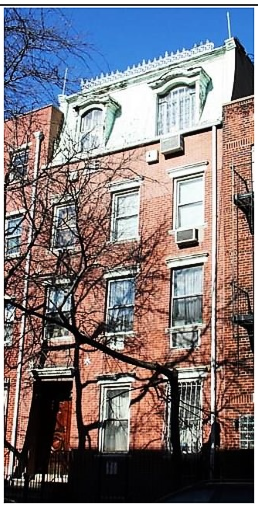
The 1848 Chauncey L. Norton House - 9 Charles Street


In the early 19th century, Greenwich Village expanded into what had been the 300-acre summer estate of Admiral Sir Peter Warren.   Charles Christopher Amos inherited a part of the Warren estate, and in 1819 Abraham Van Nest, president of the Greenwich Savings Bank, purchased the manor house.  The three ownerships would result in a confusing tangle of street names on the properties.  

Charles Amos named the road running through his property along the stretch of thoroughfare running from the Hudson River to Greenwich Avenue Charles Street, after himself.  But he named a single block, between Waverly Place and Greenwich Avenue, Warren Place in homage to Sr. Peter Warren.  And Amos further added to the confusion by giving a nod to Abraham Van Nest by christening the north side of one block of Charles Street--between Bleecker and West 4th Street--Van Nest Place.

Until 1819 the Eagle Mills occupied the north side of the Warren Street block.  That year it was purchased at auction by Najah Taylor and Nathaniel Richards, whose Eagle Distillery sat on part of the site.  In 1847, as Greenwich Village expanded into the area, the pair sold seven plots to men engaged in the building trades.

They erected four houses, 1 through 7 Warren Place, as a group.  Completed in 1848, their Greek Revival design were most likely drawn from style books.  And yet, their entranceways and stoop railings reflected the emerging Gothic Revival style.  The Gothic-paneled doors were enclosed by diamond-paned sidelights and transoms below square headed drip moldings.  The elements placed the houses on the cutting edge of domestic design.


On September 22, 1847, about the time construction began, Abraham Riker Lawrence purchased 5 Warren Place as the home of his daughter, Margaret Parslow Norton, and her family.  She was the wife of Chauncey L. Norton family.  The couple had three children, Abraham Riker Lawrence, Cecilia Augusta, and Margaret L.  Norton was connected with the Bank of the Union, on the corner of Broadway and Howard Streets.  Following the resignation of James R. Del Vecchio in 1854, Norton was elected its president.

Interestingly, the Nortons used the addresses 5 Warren Place and 5 Charles Street interchangeably until 1879.  That year the block officially became Charles Street and the house received the new address of 9 Charles Street.

On May 9, 1851, three years after the family moved into the house, Margaret Norton died after what the Mourning Courier and New-York Enquirer called "a short and severe illness."  She was just 30 years old.  Her funeral was held in the parlor the next afternoon.

The following year, on March 29, 6 year old Margaret died.  She was buried in Trinity Cemetery next to her mother.

Abraham Riker Lawrence died on August 3, 1863.  His nephew, Andrew Lawrence, produced a hand-written will dated December 1839, which left the entire estate to Lawrence's brothers and sisters, and to his nephew.  By now all of the heirs had died except Andrew Lawrence.  Noticeably omitted from the list of heirs were the Norton children, Abraham Lawrence's grandchildren.  And so, Chauncey Norton went to court, suggesting the will was a forgery.

Norton had a stake in the proceedings, as well.  The Charles Street house was still owned by Lawrence at the time of his death.  By the terms of the contested will, Lawrence's nephew would now be the legitimate owner.

The trial dragged on for months.  The New York Herald said, "In the course of the long and exhaustive trail before the Surrogate very great acrimony was exhibited between the contesting parties, and a number of exciting scenes occurred among the counsel, there being four or five lawyers on each side."  Acrimony was understandable, given the fact that defense claimed that Abraham Riker Lawrence had never married and that Margaret Norton was an illegitimate daughter, therefore, not entitled to a bequest.

Finally, a decision was announced on April 29, 1865.  Despite the absence of evidence to support "the existence of the marital relation between the decedent and the grandmother of the infant contestants," the court deemed the Norton children "the heirs at law and next of kin of decedent."  As a result, Abraham and Cecilia inherited equal shares of the Lawrence estate and the Norton family now owned their home.

Chauncey L. Norton died at the age of 66 on February 16, 1880.  Abraham, now a broker, remained in his childhood home until March 1894 when he sold it to Henry Schlobohm "for about $18,000" according to The New York Times.  The sale amount would be equivalent to around $560,000 today.

A milk merchant who also dabbled in real estate, Henry would have to leave his Charles Street house in 1898 when he was called to fight in the Spanish American War.  (It would not be until 1916 that the Government granted him a $24 per month pension for his action.)

Henry consistently received mail and packages intended for 9 Van Nest Place.  In 1900, he and a group of neighbors finally  had had enough of the Van Nest Place confusion.  On October 2 they signed a petition to the Board of Aldermen that said in part:

Van Nest place is practically unknown except to persons living in the immediate vicinity of the block bearing that name, and for that reason expressmen and all others having packages, letters or messages for delivery, upon inquiry for Van Nest place are invariably directed to Charles street, and told that Van Nest place and Charles street are the same, and therefore from the fact that there are two sets of numbers from No. 1 to No. 18 in that street, the delivery at the wrong house is frequently made.

The petitioners asked that the name Van Nest Place be discontinued and that portion of Charles Street be renumbered.  Unfortunately for them, it would not be until 1936 that the change was effected.


The former Norton house remained a single-family home until a renovation completed in 1971 converted it to apartments, two per floor.  At the same time, all of the surviving 1848 interior details, except for one or two Greek Revival mantels, were obliterated.

photographs by the author
LaptrinhX.com has no authorization to reuse the content of this blog

Wednesday, June 22, 2022

The John A. Squires House - 271 East 7th Street


image by the Greenwich Village Society for Historic Preservation

No. 271 East 7th Street was one of a row of fine, brick-faced homes completed in 1843.  Like its identical neighbors, it was 22-feet-wide and three stories tall.  The full-height third floor, normally much shorter in Greek Revival houses, showed the influence of the emerging Italianate style.  The upscale tenor of the residence was reflected in costly extras, like the marble stoop.

Although situated in what was known as the Dry Dock District, just about a block from the East River shipbuilding area, the residents of 271 East 7th Street were not involved in that industry.  The rapid turnover of occupants suggests the house was initially rented.  Grocer Joseph Cobb and his family lived here from 1851 to 1852, followed by William Wells, a butcher, and his widowed mother Eliza in 1853 and '54.

In 1856 Edwin L. Tallmadge and his family moved in.  Listed as a carman, he was most likely the owner of a delivery firm, rather than merely being a driver.  He and his wife, Ann E. Tallmadge, had five children, Edwin Jr., Herbert H., Harry E. Willard P. and Ella A.  The family also took in a boarder, Elizabeth Elting, who taught in the Girls' Department of Public School No. 15 on Fifth Street.  The family would remain in the house until 1861, when Tallmadge sold it to a neighbor, John A. Squires.

The Squires family had lived half a block away at 298 Seventh Street (the East would be added decades later).  John and his wife, the former Mary R. Nevins, had two sons, John H. and Joseph H.  A third, Robert A. Squires would be born in 1864.

At some point Squires updated the Greek Revival house with Second Empire elements--a slate-shingled mansard with two dormers and lacy iron cresting, and arch-paneled doors within a modernized entrance now bereft of the Greek Revival framing.


The family had barely settled in before trouble arose.  Among their domestic staff was Julia Madden.  On February 25, 1861, she bundled up "wearing apparel, furs, jewelry and money to the amount of $75," according to the New York Express, "and decamped with the plunder."  When police went to her home at 15 Baxter Street, they found the stolen goods.  On March 12, the New-York Daily Tribune reported, ""Julia Madden, a young girl of 17, in the employ as servant-maid of Mary R. Squires...pleaded guilty."  She was sent to the State Penitentiary for two years.

John A. Squires was a partner in the painting firm of Hogg & Squires.  The partnership was dissolved on September 11, 1865, with a notice in the New York Herald announcing "The business will be continued by John A. Squires."

Just over a week after taking over the establishment, John and his wife experienced heartbreak.  On September 21 their nine year old son, Joseph, died.  His funeral was held in the parlor three days later.

Following John H. Squire's marriage to Hannah Tyrie, the newlyweds moved into the East 7th Street house.  Interestingly, the bride brought along her two brothers, John and James, as well.  Her father-in-law took at least one of them, James, into the painting business.

At some point a studio window replaced the arched dormer window on the eastern half of the mansard.

The joy of a marriage soon dissolved into a string of tragedies.  On October 5, 1868 John J. Tyrie died at the age of 29.  His funeral was held in the house two days later.   A year and a half later, on May 4, 1870, John H. Squires died at the age of 22.

At the time of his brother's death, Robert A. Squires had just turned eight years old.  His father had changed his profession to the veneer business.  Robert was visiting his father's shop at 205 Lewis Street on July 13, 1871 when the unthinkable happened.  The New York Herald reported that he "was run over by one of the cars of the Belt Line Railroad at the corner of Lewis and Eighth streets and killed."  The funeral of the last of the Squires' sons was held in the house on July 16.

At some point Hannah Squires's sister, Cecelia, and her husband William A. Collyer moved into the East 7th Street house.  The string of sorrowful ceremonies continued when Cecelia's funeral was held on May 20, 1874.  She was 30 years old.  Only seven months later, another funeral was held in the parlor continued.  Mary R. Squires died on December 15, 1874 at the age of 48.  

John A. Squires sold his veneer factory two months later and presumably retired.  All three occupants of the East 7th Street house--John Squires, Hannah Squires, and William A. Collyer--were now all widowed.  John took in two boarders that year, Moses Sulzberger, a drygoods merchant, and his widowed mother, Babbette.  Almost unbelievably, Babbette died in her room on September 2, 1875 at the age of 69.  Yet again, a funeral was held in the parlor.

Moses Sulzberger remained with the family through 1880.  In 1881 John A. Squires moved to Piermont, New York and transferred title of 271 East 7th Street to William A. Collyer "during life of John A. Squires."  In 1886 he leased it to attorney Joseph Emanuel Newburger.  

Born in 1853, Newburger was a bachelor.  Moving in with him was his unmarried sister, Hannah (who ironically taught in the Boys' Department of Grammar School No. 15 where Elizabeth Elting had worked decades earlier), and his widowed mother, Lottie.  Aside from his legal practice, he was highly active in Jewish affairs.  He was a founder of the Jewish Theological Seminary of America, president of the Independent Order of B'nai B'rith District No. 1 and president of the Hebrew Orphan Asylum among other activities.

Newburger was elected a City Court judge in 1890, and would become a Justice of the New York State Supreme Court in 1905.   His occupancy would start a tradition of judges in the East 7th Street house.

Joseph E. Newburger on commencement day at Columbia University in 1914.  from the collection of the Library of Congress (cropped)

John A. Squires died in April 1891 and the following year his estate sold the house to Charles Seligman for $16,000 (about $469,000 today). 

The Seligmans would remain in the house only until March 1901 when it was purchased by Justice Benjamin Hoffman "for his own occupancy," according to The Sun.  The judge and his wife, Rebecca, had four children, Belle, Eva, Ruth and Joseph Benjamin.  Before moving in, Hoffman hired the architectural firm of Rogers & Stander to do interior renovations, including "new windows, partitions and floors," according to their plans.  The updating cost Hoffman the equivalent of $37,700 in 2022 dollars.

The Hoffman girls were the center of social attention within the family.  On December 11, 1904, for instance, the New York Herald reported, "Mrs. Benjamin Hoffman will give a debutante tea for her daughter, Miss Belle Hoffman, at her residence, No. 271 Seventh street, to-day."

As they grew to be young women, debutante entertainments turned to weddings.  Eva's engagement to Nathan Ries was announced in November 1912, and Ruth's to Newton M. Shack came in September 1917.

By the time of Ruth's engagement, the Hoffmans had shared 271 East 7th Street with the David Lazarus and his wife, the former Molly Lemlein, for at least seven years.  The couple had two grown children, Bella and Lester.  Lazarus and Hoffman had a close professional connection.  While Judge Hoffman was the Sixth Assembly District leader of Tammany Hall (appointed in 1891), Lazarus served as his deputy.  In December 1910 Lazarus was elected to take Hoffman's seat.

A massive meeting was held in the Hoffman home in September 1918.  The Evening Telegram reported on a bronze tablet to be placed in Hamilton Fish Park honoring the East Side "soldier boys who have fallen on French battlefields."  The article noted, "This was decided at a representative meeting of 100 residents of the east side, including the mothers of the heroes, held at the home of Judge Benjamin Hoffman."


Somewhat ironically, when Joseph E. Newburger's first term as Supreme Court justice was ending, Benjamin Hoffman established the Newburger Club to promote his candidacy for reelection.  The Sun reported on August 11, 1919, "It was started at a meeting of East Side citizens at 271 East Seventh street, where the headquarters will be."

When women obtained the right to vote in 1920, Rebecca Hoffman stepped up.  She was appointed co-leader of the Sixth Assembly District with her husband, who had regained the seat.  Always active in politics, she had helped found the Progress Relief Society in 1895, and still served as an officer.

Benjamin Hoffman suffered a fatal stroke on May 20, 1922 at the age of 58.  The New York Herald mentioned, "Recently he had been working on rent cases and had disregarded the warnings of his physician that he lessen his labors on the bench."  His funeral was held in the house on May 22.  Among the several judges to serve as pallbearers was David Lazarus.

Hoffman's death left the position as Tammany leader of the Sixth Assembly District unfilled.  Lester Lazarus, who was still living with his parents in the East 7th Street house, was a Deputy Assistant District Attorney.  He was appointed to replace Benjamin Hoffman as Assembly leader on July 28, 1922.  The New York Herald mentioned, "The salary is $9,000 a year.  He formerly received $4,000 a year as Deputy Assistant District Attorney."  His new salary would equal about $139,000 today.  

Rebecca Hoffman was still the district's co-leader, and following her husband's death, she became even more active in politics.  That year she served as a delegate to the Democratic National Convention, and would do so again in 1924 and 1928.  When she ran for reelection as Register of New York County in 1928, Mayor James Walker deemed her, "the queen of the ticket."   The Elmira Star-Gazette said, "When she came to office, at a salary of $12,000 a year, she was the highest paid woman public official in the state, and one of the highest in the country."

Rebecca Hoffman, Elmira Star-Gazette, June 18, 1931

She held that position until her death on June 16, 1931.  In reporting her death, The New York Sun commented, "For thirty-five years she had made her home at 271 Seventh street, known as Political Row."

The entire Lazarus family continued on at 271 East 7th Street and at their summer home in Rockaway Park.  On August 7, 1933 The New York Sun reported on David's 75th birthday, noting that he spent "fifty of them in the Tammany organization."  He was now a Commissioner of Records in the Surrogate's Court.  

The mansard was undergoing work in June 2022. 

It is unclear when the Lazaruses left the East 7th Street house.  It was seemingly being operated as a rooming house by 1937.  Although it has never been officially converted to a multi-family building, today it holds five apartments.

photographs by the author
many thanks to reader Joe Ciolino for prompting this post
no permission to reuse the content of this blog has been granted to LaptrinhX.com

Tuesday, June 21, 2022

George H. Griebel's 1891 34 and 36 West 73rd Street


High stoops originally led to the entrances, which are now the wider windows or the second floor.

In 1891 developer F. G. Pourne completed a row of nine impressive stone-faced homes at 28 through 44 West 73rd Street.  Architect George H. Griebel had designed them in the Romanesque Revival style with elements of Renaissance Revival.  They were configured in an A-A-B-A-A-B-A-A-C pattern, the second story oriels of the A models and the three-story bowed bays of the B's creating an undulation of rounded forms.


Among the matching A models were 34 and 36 West 73rd Street.  They were faced in limestone from the basement through second floors, and beige Roman brick above.  The second floor oriels, with their blind balustrades and bearded portrait brackets, stole attention from the parlor level.  Equally eye-catching were the openings of the top floor, arranged in an arcade separated by ornate, engaged columns.


Pourne sold 34 West 73rd Street to Henry Bramble Wilson, a partner in the banking firm of Emerson McMillin & Co., and his wife, the former Mary Elizabeth Willard.  Both had been born in Ironton, Ohio and lived there until 1890, when they relocated to New York City.

The couple filled the house with fine artwork.  The New York Times later commented that Wilson was "known as an art connoisseur, and owned many valuable paintings."  He was, as well, a member of the National Arts Club and the chairman of the Art Committee of the Union League Club.

The Wilsons had three daughters, the eldest of whom made her debut five years after the family moved into the 73rd Street house.  On December 12, 1896, the New York Herald announced, "Mr. and Mrs. Henry Bramble Wilson, of No. 34 West Seventy-third street, gave a reception, followed by an informal dance, last night at Sherry's to introduce their daughter, Miss Ella Willard Wilson."  Ella was married to Captain Paul Comstock in the drawing room on April 29, 1903.

In the meantime, Evaristo Vicente Montalvo y Rodriguez-Prieto and his wife, the former Maria Louisa Leblanc y Hernandez, had purchased the house next door.   The wealthy owners of a Cuban sugar plantation, the couple had a son, Evaristo Vincente, who was 16 years old at the time.  

In 1895, young Evaristo entered Princeton University.  He was the only Cuban and one of just two Roman Catholics among his classmates.  His studies were interrupted when the United States intervened on behalf of Cuba against Spain in its fight against colonial rule.  After the USS Maine was sunk in Havana Harbor, the Spanish-American War broke out and Evaristo enlisted to fight.

He later wrote in the Record of the Class of 1897 of Princeton University, "It was Cuba's fight--my fight.  Duty stared me in the face."   Evaristo did not see combat, however.  He was sent to the Philippines to serve as a translator.

Evaristo did not finish his studies at Princeton University and in 1900 Triennial Record light-heartedly updated the 1897 class:

Cuba freed, the Count has returned to his ancestral estates, and is now basking in the sunshine of the tropics, surrounded by a score of obsequious attendants, who fan his fevered brow and press to his parched lips costly goblets wherein is the clink of ice and the sparkle of nectar.  The enervating influences of such a life have destroyed all his epistolary energy...His mission in life accomplished, his sword has been beaten into a plow-share and his spear into a sugar-hook.  The raising of cane (sic) once more engrosses his entire attention.

Indeed, at the war's end, the entire family had returned to Cuba.  On October 31, 1900, the New York Post reported that the De Montalvos had sold 36 West 73rd Street to the Edward C. Clark estate.  At the same time the Montalvos left West 73rd Street, so did the Wilsons.  Like their next door neighbors, they sold 34 to the Clark estate, which rented the houses.  The former Wilson residence became home to Dyer Pearl and his wife, Euphemia Caroline, known familiarly as Carrie.  The couple had three children, William, Dyer, Jr., and Elsie. 

Pearl was the senior member of the brokerage firm Pearl & Co and a member of the New York Stock Exchange.  Following his graduation from City College in 1874, he had joined Dyer, Pearl & Co., which his grandfather had founded in 1830.  He and his brother, William renamed the firm following their father's death in 1881.


Like their predecessors in the house, the Pearls were staunch Roman Catholics, and on October 6, 1905, the New-York Tribune reported, "The Pope to-day received in private audience Dyer Pearl...and Mrs. Pearl."

While the couple was in Italy, drama played out at home.  Pearl & Co. securities worth $359,330 had disappeared from the National City Bank on September 27.  It was a massive theft, worth about $10.7 million today.  Then, three days later, a messenger dropped of a bulky envelope with a servant at the Pearl home.  The New-York Tribune reported, "Dyer Pearl, jr., a student at Princeton, went to the house Sunday, saw the envelope and telephoned to E. F. Slayback, a member of the firm...saying he suspected the envelope contained some of the stolen securities."  And it did.  There was $269,000 worth of the missing securities in the envelope, which had been dropped off by a regretful National City Bank Clerk.  The remainder was later recovered.

Dyer, Jr. was the last of the children to leave the house.  He was married to Bessie M. Pond Phipps on May 28, 1912.

Dyer and Carrie Pearl attended the Metropolitan Opera on February 10, 1913, and when they arrived home, Carrie realized that silver and diamond pin was gone.  She went back to the Met, only to find it had been claimed that night.   Much annoyed, she placed two announcements in the newspapers:

Will the lady who on Monday evening, February 10, claimed a silver Bar Pin from the doorman at the Metropolitan Opera House please send her name and address to box office and oblige the doorman?

and

Will person who claimed Pin at Opera House Monday night return to owner?  Reward and no questions.  34 West 73d.

As it turned out, there were two lost bar pins that night.  Carrie's chagrin was unfounded.  The New York Herald reported, "A few hours after the advertisements appeared Mrs. Pearl's bar pin was returned to her by a man who resides in Newark, and who found it on the night it was lost."  The article said the "I-would-worry" lines on the face of the Metropolitan Opera doorman were replaced by an "I-told-you-so" smile.

The Pearls suffered another troubling incident later that year.  Their close friends, William Henry Maule and his wife, who were from Philadelphia, were returning home on September 3 from "an automobile trip through the White Mountain region," as reported by The Brooklyn Daily Eagle.  They stopped at the Pearl house for a few days.  Just two hours after arriving, William went to the New York Club where, while talking to a friend, he collapsed and died.

After leasing the house for two decades, the Pearls purchased 34 from the Clark estate in March 1920.  That year the estate sold 36 West 73rd Street to conductor and voice coach Percy Rector Stephens.  Born in Chicago in 1876, Stephens had graduated from the University of Notre Dame and began his teaching career in New York City in 1897.


The year after he purchased the house, on September 14, 1921, Stephens married Jeannette Vreeland.  In 1925 the couple outfitted a floor as a rental apartment.  An advertisement that year described a four-room and kitchen space with "3 closets, parquet floors, paneled walls, 2 colonial fireplaces."

Carrie Pearl died suddenly on February 11, 1922.  Her funeral was held in the house three days later.  Dyer sold the residence in July 1924 to John Enos Quinn and his wife, Ethel C. Quinn.  Ethel continued the tradition of entertaining in the house.  On January 16, 1925, for instance, The New York Times announced, "Mrs. John Enos Quinn, President of the Women's Democratic Club of the City of New York, will entertain on the remaining Sundays in January at her home." 

The end of the line for both houses came in 1944 when developer Frederick A. Jambes purchased these and four others along the row.  On December 1, The Sun reported, "The buyer now controls a combined frontage of 120 feet on which he plans to build a twelve story apartment house after the war."  And, indeed, two years later plans were filed by architect H. I. Feldman for a $450,000 apartment house at 28-36 West 73rd Street.

Those plans, however, were never carried out.  Instead, both 34 and 36 West 73rd Street were converted to apartments.  Their stoops were removed and the entrances lowered to the former English basement level.

John Harms, the head of the John Harms Chorus, operated his vocal studio from an apartment in 36 West 73rd Street.  His chorus's presentation of Elijah in Town Hall on May 31, 1944 "evoked great praise from the critics in New York papers," said The Diapason.   The journal added that his studio "at 36 West Seventy-third Street in New York, is one of the most spacious private studios in the city."

Another artistic tenant were dancers Daniel Nagrin and his wife, Helen Tamiris.  Helen's career began in 1926.  Born  Helen Becker of Russian immigrant parents on the Lower East Side, she studied dance at the Metropolitan Opera's ballet school.  The New York Times recalled on August 5, 1966, "In 1929 she introduced Negro spirituals to the Salzburg Festival in Austria in a recital there, and the follow year she joined Martha Graham, Doris Humphrey and Charles Weidman in founding the Dance Repertory Theater.

Turning to Broadway after the war, she arranged the choreography for Annie Get Your Gun, Showboat, Plain and Fancy, and Inside U.S.A.  In 1960, Nagrin and Tamiris founded a new concert company.


Other than their lost stoops, the two handsome houses are little changed since their first owners moved in their furniture and artwork in 1891.

photographs by the author
no permission to reuse the content of this blog has been granted to LaptrinhX.com

Monday, June 20, 2022

The Lost North-Western Dispensary - 9th Avenue at 36th Street


from Nineteenth Annual Report of the North-Western Dispensary, January 11, 1872 (copyright expired)

In the first decades after the Revolution contagious disease was a threat as some New York City neighborhoods grew crowded and unsanitary.  In 1791, the first of the public dispensaries opened—more or less the precursors of today’s urgent care walk-in clinics.  As the city expanded northward, additional dispensaries were established in poor neighborhoods.

The North-Western Dispensary was founded in 1852 under the supervision of the New York Association for Improving the Condition of the Poor.  It operated from rented rooms above a store on the corner of Eight Avenue and 36th Street within the notorious Hell's Kitchen neighborhood, infamous for crime and devastating poverty.  But the area it covered was even larger--from 23rd Street north to 86th Street, and from Fifth Avenue to the Hudson River.

While the engraver did show a ramshackle awning over the storefront, he put a happy face on the blighted district with gentile appearing pedestrians.  Valentine's Manual of the Corporation of the City of New York, 1868 (copyright expired)

Robert Ray, president of the dispensary, traveled to Albany in 1858.  His petition for incorporation explained the purpose of the facility, saying in part it was founded...

for the purpose of providing and furnishing medicines, and medical and surgical aid gratuitously to the sick poor...General and gratuitous vaccination, and the collection of pure vaccine matter are made a prominent feature...which is distributed free of charge.

Ray pointed out that while the dispensary was "a public work," it was operated almost entirely by private donations.

Seven years after the dispensary's founding, Robert M. Hartley, secretary of the Association for Improving the Condition of the Poor, pleaded with New Yorkers in a letter to the editor of The New York Times for funds for "an appropriate edifice."  In it, published on August 25, 1859, he noted that the North-Western Dispensary had become "one of the most useful charities in the City."  But he pointed out "the constant burden of rent and the risk of being dislodged," and warned the institution's "very existence is insecure until it has a building in fee under a charter, which will render the property legally inalienable to any other purpose."

Harley appealed to the emotions of his readers.  "The two words, the 'Sick poor,' imply the whole design, and express its charitable character.  Whoever may be neglected, the indigent sick should not be."  Towards the end of his rather lengthy entreaty, he named the figure needed for the land and building: $20,000--or just under $650,000 today.

It would be nearly a decade before the money was raised.  On December 13, 1868, the New York Herald reported, "It is gratifying to state...that they have accomplished the raising of a sufficient fund for putting up a new building.  The ground has already been broken for this new structure, which is to be erected near the corner of Thirty-sixth street and Ninth avenue, and which will be modelled after the latest most approved styles."  

The site was one block to the west of the existing facility.  The esteemed architectural firm of Renwick & Sands had been commissioned for the project.  The resultant Victorian Gothic style building would be trademark Renwick & Sands.  The plans, filed in May 1869, succinctly called for a "brick dispensary" of four stories.  Work proceeded at a rapid pace and by December, although construction was not completed, the facility was unofficially operating from the new building.  

On December 12, 1869 the New York Dispatch commented on scope of the dispensary's work.  "Last year, 10,824 patients were treated, and 17,908 prescriptions were dispensed from the apothecary's department...The medical staff of this dispensary consists of five visiting physicians, twelve attending physicians, four consulting physicians, one house physician, and one apothecary."  During the year 1,862 patients were treated at home, while 8,962 came into the facility.

On January 20, 1870, The New York Times reported on the official opening.  The cost of the project, originally expected to be $20,000, had risen to $83,000--around $1.7 million in today's money.  "The new building is of brick, faced with stone, four stories in height, and admirably designed for its purpose," said the article.  

Renwick & Sands's tripartite design included two stores on the ground floor, which provided extra funds for operating the dispensary.  The windows of the midsection sat upon a wide stone band, their Gothic-arched lintels connected by a continuous stone bandcourse.  Narrower bands of stone  contrasted with the red brick, creating a striped effect between the openings.  The windows of the top section sat within double-height arches, their lintels (as was the case at the second floor) composed of alternating dark and light stone.

The dispensary operated from the second and third floors.  The top floor was designed as a vast meeting hall, which also provided rental income.  The New York Times said it "is already leased to the Broadway Tabernacle Church for a Sunday School and other purposes, and the rents received from this hall and the stores beneath will aid considerably in the support of the institution."

The article noted, "The Dispensary proper is divided into reception rooms for patients, operating and consultation rooms for the various classes of diseases, apothecary shop, office and room for the house physician and a room for the Board of Managers.  Everything has been done which skill could suggest to add to the convenience of the institution and to make it a model of its kind for the use for which it was erected."  

Doctors at the North-Western Dispensary dealt, of course, not only with diseases and afflictions that arose from poverty and unsanitary living conditions, but from the lifestyles of many of the Hell's Kitchen residents.  Two months after the new building opened, on March 9, 1870, 50-year-old James Creighton was brought in.  The New-York Daily Tribune said, "He was apparently suffering from general debility, and was in a very low state."  The attending physician "pronounced it a case of delirium tremens," or what today is known as alcohol withdraw.  The article said, "The usual remedies in such cases were given, and the patient died on the following day."  An autopsy showed death was caused "by corrosive poison."

The Dispensary's annual report that year gave a somewhat startling picture of its work.  It said in part:

The wasting diseases of children, usually so common and fatal during the hot months, were much less so during last summer.  Scarlet fever and measles, only, of a mild and manageable form prevailed.  The gastric diseases of adults, with cholera-morbus and dysentery, heading the list, corresponded in character and frequency with those of children above alluded to...Small pox has prevailed considerably during the year, though I think not to such an extent in this district as to justify the excitement about it, that exists.

A particularly tragic patient was Christine Albertson, a Swedish immigrant who arrived on the ship Sunshine in 1876.  On the voyage, she met another Swede, named Johansen.  The New York Dispatch said, "The friendship soon ripened into love, and especially was this love sincere on the part of the girl.  She loved Johansen with 'a love that the angels in Heaven might envy.'"  Johansen took advantage of Christine's infatuation to seduce her, a situation that did not go unnoticed by the ship's captain.

Captain Simmons called the two into his cabin and asked Johansen if he intended to marry Christine, "for if you do not, you must cease to keep her company."  Johansen said he certainly intended to marry her when they reached New York.  Simmons then asked Christine if she would be willing to marry Johansen.  She "burst into tears," according to the New York Dispatch, and said, "she loved him, and had no other alternative.  'For,' said she, 'I have been a wife to him in all but name nearly ever since the bark left Bremen.'"

When the ship arrived in New York, Simmons refused to let the couple disembark.  He sent for a minister and they were married on board.  It was not the beginning of a happy life for Christine.  Only a few days later, Johansen "began to show his true character, he drank, and abused her, and her life was miserable."  The article said, "He then made her go to a concert saloon in Broadway, and work to make money for him to recklessly spend for rum."  And then, when Christine became pregnant and had to quit her job, Johansen deserted her.

Now penniless and alone, Christine came to the North-Western dispensary for medicine.  When she went into labor in January 1877, a doctor went to the tenement where she was staying to deliver the little girl.  The New York Dispatch reported that "some kind-hearted people" had taken an interest in Christine's case and had paid her rent.  Her medical care, of course, was free.  The newspaper added, "and if Johansen can be found, he will be held responsible for the future welfare of the wife he so cruelly betrayed and deserted."

Because the North-Western Dispensary relied almost entirely on donations, benefits were often held to raise funds.  On November 23, 1902, for instance, the New-York Tribune announced, "The next of the series of dances given in the interest of the Northwestern Dispensary...will be held at the Manhattan, Nos. 113 and 115 West Seventy-ninth-st., on the evening of December 9," and two months later, on January 25, 1903, the newspaper reported, "The musical donation tea given at the home of Mrs. Loton Horton, of No. 117 West Seventy-second-st., last week for the benefit of the North-western Dispensary was a social and financial success."

The store fronts were significantly altered when this photo was taken on October 6, 1927.  from the collection of the New York Public Library

The venerable institution continued in the Ninth Avenue building until 1954.  When the North-Western Dispensary was formally merged with the Judson Health Center in March 1957, The New York Times recalled, "The North-western Dispensary, formerly at 403 West Thirty-sixth Street, was closed to make room for the Port of New York Authority administration building."

That structure was later demolished to make way for the approach to the Lincoln Tunnel.  The Hudson Crossing Apartments, erected in 2002, now occupies part of the site.

image via transparentcity.com

LaptrinhX.com has no authorization to reuse the content of this blog

Saturday, June 18, 2022

Frederick T. Camp's 1884 347 West 46th Street


On January 12, 1884 developer John Livingston announced his plans to erect a row "stone front private dwellings" along the north side of West 46th Street, between Eighth and Ninth Avenues.   A month later his architect Frederick T. Camp filed plans for nine "three-story and basement brown stone dwellings," each to cost $11,500 to erect, or about $315,000 in today's money.

Camp designed the identical brownstone-fronted homes in the neo-Grec style.  The architrave stone frames of the windows were miniature versions of the entrance.  Geometric brackets with etched decorations upheld pronounced molded cornices.  The corbels of the cornices, with their paneled frieze, carried on the motif of the openings below.

The houses were completed in December 1884.  Livingston offered 347 West 46th Street for lease at $1,400 rent, an affordable $3,000 per month today.  His listing noted that the 20-foot-wide house was "3-rooms deep."  He rented the house for two years before selling it to Samuel T. Reed on March 15, 1886 for the equivalent of $558,000 today.

It appears that Reed and his family never lived in the house.  Instead it was operated as a high-end boarding house.  Among the high-profile residents here by 1889 was G. Waldo Smith, a wholesale grocer and member of the Chamber of Commerce.  He would remain in the house at least through 1894.

The outspoken Smith was unafraid to make his opinions known.  In 1894, Congress considered a Tariff bill that included an income tax proposition.  On June 2, the New-York Tribune entitled an article "The Metropolis Protests / Away with The Income Tax," and went on to report on a mass meeting of businessmen.  G. Waldo Smith spoke on behalf of the wholesale grocers, and the journalist deemed his remarks, "particularly acceptable."

New Yorkers were concerned with other trouble issues at the time.  The Lexow Investigating Committee, formed by the New York State Senate, was looking closely into corruption among the New York Police Department.  Smith reacted dramatically.  At a special meeting of the Chamber of Commerce on October 34, 1894, he addressed the group, calling for martial law.  He stressed that the force "should be stripped of all civil appearance, and instead, should be changed into a military body, with its members subject to court-martial and the sternest of discipline."

Also living in the house at the time were John F. Suydam and his wife.  Suydam, who came from an old New York family, was a wholesale grocer.  He had fought in the Civil War with the Seventh Regiment, known as the Silk Stocking Regiment, or the Blue Bloods, because a disproportionate number of its members came from the socially elite.  He was a member of the prestigious Holland Society, restricted those who could trace their roots to New Amsterdam.

In 1898 the North American Journal of Homoeopathy reported that Dr. Hugh Kidder had moved his office from the West Side Clinic and Hospital to 347 West 46th Street.  There was already a physician operating from the address at the time, Dr. Santia Crova, who conducted a bizarre set of experiments in "cutaneous metamorphosis."  They resulted in Crova being sued for $10,000 damages by a patient in April 1898.

In his complaint, John Barnes (described by The Brooklyn Daily Eagle as "a stalwart young negro") said that in July 1897, "Dr. Crova told him he would pay him $5 per week if he would submit to certain baths for the purpose of turning his skin white."  The Brooklyn Daily Eagle explained, "At the expiration of six weeks, [Barnes] was informed, he would be a white man."  Crova "represented himself as a scientist in that particular line," and the two signed a contract.  

In court, Barnes detailed the treatments.  "The recital reads much like a chapter of medieval art," said the newspaper.

Barnes would enter the tub and remain there a half hour, sometimes two hours.  He would suffer a burning sensation, whereupon the physician would rub the parts with vaseline and cold cream.  Sometimes he could not renew the bath, so greatly did he suffer from the pain caused by the chemicals in the water, he says.  So powerful were these chemicals that they even penetrated the zinc of the tubs, he alleges, practically ruining the metal.

Barnes testified that his fingernails had turned deep black, parts of his body remained "extremely sore," and his general health had been "weakened and impaired."  He told the court, "Yet my skin is as black as ever."

In the first years of the 20th century single women were boarding in the house, still owned by Samuel T. Reed.  Elsie R. Hirst was here as early as 1906, when she was on the "eligible list" for the position of stenographer and typewriter for the Board of Water Supply.  She got the job, earning $900 a year in 1910.

Actress Marie Burker boarded here in 1916.  The location was convenient, since by now the entertainment district had moved northward to nearby Times Square.  She had a handyman who was doing work in the house arrested on May 7, 1916, accusing him of stealing a ring valued at $600 (a significant $14,600 today).  William Brower, who lived in the Mills Hotel No. 3 (a residence for down-on-their-luck working men), confessed he had stolen the ring.  Unfortunately for Marie Burker, the ring was gone.  "He asserted, however, that some one had since stolen it from him," reported The New York Press.

Another actor who lived here was Edwin "Poodles" Hanneford.  Born in England, he grew up in a circus family.   He and his family were brought to America by John Ringling in 1915.  By then, Hanneford was among the greatest trick horse riders in the world.  He fell in love with well-known actress Grace White, but she refused to marry him until after World War I had ended, fearing he would be killed.

Then, on August 20, 1919 The Brooklyn Standard Union reported, "Edwin Hanneford, an actor, of 347 West Forty-sixth street, Manhattan, was married to-day to Miss Grace White, a well-known actress."  The groom was 28 years old and his bride was 23.  Hanneford would go on to play in motion pictures, including the 1935 Our Little Girl with Shirley Temple; The Red Pony, with Myrna Loy and Robert Mitchum, released in 1949; and the 1952 The Springfield Rifle with Gary Cooper.

Albert E. Smith, who was "in the steel construction business," according to the New York Herald, lived here with his widowed mother, Elizabeth, around the time Edwin Hanneford and Grace White were married.  Elizabeth died on March 11, 1921, and her funeral was held in the house.  

A few months later, Albert Smith's deep sense of patriotism prompted him to have an Englishman arrested.  Smith was at the Strand motion picture theater on August 18.  In the audience was 38-year-old Herbert Blache.  According to Smith, "when a 'close-up' of the [American] flag flying from the battleship Michigan was thrown on the screen, Blache hissed audibly."  Smith had Blache arrested, and two other patrons, Mrs. M. E. Johnstone and Louise P. Sanger, backed up his complaint.

At the station house Blache protested, insisting that he had applied for citizenship.  "I deny hissing the American flag.  I am an Englishman, though I have been in this country fourteen years.  I have nothing against the American flag.  In fact, I prefer it to any other," he told the police lieutenant.  He was held on $500 bail awaiting his appearance in court.

The following year Leonora M. Reed sold the house to Dr. J. Kessler, "for occupancy," according to the New York Herald.  The once-upscale block was undergoing significant change at the time.  The bustle of Times Square spilled into the neighborhood and one-by-one the former private homes were being converted to apartments with businesses in the basements.


In 1971 the basement of 347 West 46th Street was Chez Cardinale.  It was not until 1978, however, that the upper floors were converted to apartments, two per floor.  In 1982 the restaurant space became home to La Vielle Auberge.  On December 3, The New York Times food critic Mimi Sheraton wrote, "Considering the demand for good, pleasant, moderate-price restaurants in the theater district, La Vieille Auberge should develop a loyal following."  And it did.  The restaurant was a fixture on Restaurant Row for more than a decade.


Some interior details, like the staircase wainscot and railings, and a marble neo-Grec mantel, survive.  images via streeteasy.com

In 1997 Les San Culottes, another French restaurant was in the space, replaced by Sushi of Gari, which opened in 2006.   Although the brownstone has been painted, Frederick T. Camp's neo-Grec facade is otherwise greatly intact--even the 1884 entrance doors survive.  Inside, a few of the original details, like neo-Grec marble mantels, remain.

photograph by the author
no permission to reuse the content of this blog has been granted to LaptrinhX.com