Showing posts with label warren street. Show all posts

Thursday, December 11, 2025

The 1854 55 Warren Street (aka 55 Murray)


photograph by Anthony Bellov

A French family resided in the vintage house at 55 Murray Street between West Broadway and Church Street in 1853.  On October 20 that year, an advertisement written in French sought, "We ask for a good Frenchwoman who knows how to sew well.  Contact 55 Murray Street between 12 and 2, after noon."

The family would soon have to move.  That year former district attorney James R. Whiting purchased the property and that directly behind it at 55 Warren Street.  He erected a five-story store and loft building on the site, completed in 1854.  Although Whiting (who would be elected to the bench of the New York Supreme Court the next year) was listed as both the builder and owner, he indubitably commissioned an adept architect to design his structure.

Faced in marble above cast iron storefronts, the Warren and Murray Street facades were identical.  Their striking Italianate elements were drawn from Renaissance palazzi--alternating triangular and arched pediments over the center openings, prominent molded cornices over the others, and delicately carved cresting over those of the second floor.  The marble cornice was supported by scrolled, foliate brackets.

The details were drawn from the Italian Renaissance.  photograph by Anthony Bellov

The initial tenants were importers Bradford, Heath & Clark, operated by George P. Bradford, Charles Heath and John Q. Clark; and boot manufacturer Howes, Hyatt & Co., owned by Rueben W. Howes and Stephan Hyatt.

Around 1859, some of the floors were divided, giving certain tenants the 55 Warren Street address only.  Among those was a shirt manufacturer, and one of his employees seems to have been embarking on a more artistic career: the formation of a band.  An advertisement on June 8, 1859 read:

Wanted--A violinist, a good player.  One willing to travel, and capable of leading at a performance; must be satisfied with a moderate salary.  Apply at 55 Murray street, up stairs, in the shirt store.
  
Alexander Platt worked in the building in 1865 when he found himself in a highly embarrassing situation on November 29.  Platt went to Greene Street, notorious for having no fewer that two dozen houses of prostitution.  The New York Times reported that he accompanied "Cecilia Austin, otherwise Flora Reed, a syren [sic] from Greene-street" to her house.  The next day he realized his valuable gold watch was gone.  Prostitutes most often got away with thievery since their clients avoided the humiliation and scandal that would accompany the reporting of the crime.  Such was not the case with Platt and Cecilia was arrested later that day.

By the last quarter of the century, the tenant list was predominately glass and hardware dealers.  In 1879 they included Williams, White & Churchill, hardware, and S. N. Wolff & Co., glass (listed at 55 Warren Street); and Vogel & Reynolds, "dealers in glassware" at the Murray Street address.

At the turn of the century, the hardware firm of Surpless, Dunne & Co. was on the first floor and the New York Bag Company occupied the entire second floor.  A. L. Tuska, Son & Co., importers of Japanese ware, also leased space in the building.

On the night of July 20, 1901, a passerby saw smoke pouring out of the windows of the Warren Street side.  A fire had started under the stairway on the second floor.  The New York Times reported, "the flames quickly spread to the thousands of tightly packed bags, causing thick volumes of smoke to fill the whole building."  The fire was contained to the New York Bag Company space, although the upper floors were slightly damaged by smoke and Surpless, Dunne & Co. suffered water damage.

Elegant carved marble cresting crowns two of the second floor windows.  photograph by Anthony Bellov

A much more serious fire broke out eight months later.  On Saturday night, March 15, 1902, the engineer of a Sixth Avenue elevated train noticed smoke coming from a fourth floor window.  He stopped his train midblock between Church Street and West Broadway directly in front of Fire Patrol No. 1 and blew his whistle several times.  He shouted that there was a fire at 55 Murray Street.

The blaze soon grew to a three-alarm fire.  The New York Times reported, "An exciting incident occurred soon after the second alarm had been sent in.  Four firemen of Engine Company No. 7 had climbed to the fourth story by the fire escape, and as they reached the cage a sheet of flame burst forth, completely enveloping them."  The water tower truck had just gotten into position.  The stream of water "struck the men with great force," but saved their lives.

The Annual Report of the Committee on Fire Patrol reported, "Fire originated on fourth floor of No. 55 Warren Street and extended to fifth floor, then through roof and fifth floor and roof of No. 55 Murray Street."  The blaze also damaged the abutting buildings at 53 Murray, 53 Warren and 57 Warren Street.

The Murray Street elevation is identical to that on Warren Street.  photograph by Anthony Bellov

The Motor Car Equipment Company leased three floors in the repaired building in 1905.  Established in 1902 by Emil Grossman, it handled automobile supplies like batteries and tires.  Automobile Topics said their new space contained "approximately 10,000 square feet."

A. L. Tuska, Son & Co. was still here.  On November 25, 1907, the American Druggist and Pharmaceutical Record suggested, "In casting about for striking holiday goods the druggist could not do better than include the line of beautiful Japanese novelties which are imported into this country direct by A. L. Tuska, Son & Co. 55 Murray Street, New York."  

Also in the building that year was Plume & Atwood Mfg. Co., makers of "electric portables," such as "lamps, unmounted gongs for electric bells, etc."

In 1917, Columbia Graphophone Co., makers of the Dictaphone, leased the entire building.  An announcement in The New York Times on July 9, 1917 explained, "And here are the reasons for the move: The steadily increasing adoption of The Dictaphone System by business men generally in and around New York has made more room and better facilities a necessity."

The New York Times, July 9, 1917 (copyright expired)

Another advertisement stressed that the country's entry into World War I would make the Dictaphone crucial to the workings of an office.  "You are going to lose some of your workers through conscription--possibly many--and you must be prepared for the loss."

The Columbia Graphophone Company's residency would be short.  In 1920 it completed construction of its own building at Fifth Avenue and 34th Street.  In March that year, the I. Blyn Shoe Company purchased the property.  Founded in 1874 and incorporated in 1923, it operated Red Cross Shoe and Rambler Shoe stores.  The firm moved its main office into the building and continued to rent unneeded space.

The company was the victim of audacious thieves in 1924.  On April 27, The New York Times reported, "Burglars broke open two safes and stole $5,000 in the offices of the I. Blyn Shoe Company, 55 Warren Street, yesterday morning or Friday night.  The police think the burglars hid in the building before it was closed Friday night.  They entered the offices by boring a hole through a wall."

I. Blyn Shoe Company operated numerous stores across the country.  But the Great Depression dealt a fatal blow to the firm and it declared bankruptcy in July 1931.  Jacob Blyn, a widower, moved into his sister's apartment on Riverside Drive.  On July 27, 1936, The New York Times reported, "Jacob Blyn, 67 years old, ended his life early yesterday by opening four jets on a gas range in the kitchen of the apartment of his sister, Mrs. Hannah Stoff."

photograph by Anthony Bellov

A renaissance in the Tribeca neighborhood began in the last quarter of the century as industrial lofts were converted to artists' working and living spaces.  In 2013, 55 Warren Street was converted to residential use above the ground floor.  The renovation resulted in one apartment per floor.

many thanks to historian Anthony Bellov for suggesting this post

Thursday, March 23, 2023

The Thomas N. Dale & Co. Building - 18 Warren Street


image via hirschmark.com

In 1794 Robert Harpur was Deputy Secretary of the State of New York.  He lived at 18 Warren Street, half a block from the City Commons (today's City Hall Park), where five years earlier George Washington had been named President of the United States of America.  By the 1850s the formerly residential neighborhood was rapidly being overtaken by commerce.  The last resident of the former Harpur house was tailor Benjamin M. Noe, here until 1854.

That year the vintage homes at 18 through 22 Warren Street were replaced by modern loft buildings.  The identical, Italianate style structures were five stories tall, their ground floor store spaces capped by a prominent cornice.  The elliptically-arched second and third floor openings were distinguished by robust cornices that sat upon scrolled brackets.  Matching scrolled keystones made the second floor windows slightly more ornate.  The openings of the topmost floors sat within architrave frames and wore slightly less pronounced lintels.  Handsome Italianate cornices upheld by paired, scrolled brackets completed the design.

On June 1, 1855 a notice appeared in the New York Herald that announced the dissolution of Thomas N. Dale & Co.  Having severed his business relations with his former partners, the notice said, "Thos. N. Dale has this day formed a copartnership with George Richmond, under the firm of Thos. N. Dale & Co., and will continued the business of the late firm at No. 18 Warren street."

Thomas N. Dale was born in Massachusetts and began his career as a clerk in a country store.  In his 1860 A History of American Manufacturers J. Leander Bishop said, "Mr. Dale, we believe, was the first to make the sale of Clothiers' and Tailors' Trimmings a specialty."  The company sold braiding, buttons, fabrics and such to garment makers.  By the time of the article, Thos. N. Dale & Co. was among largest such firms in the country, with branch offices in Philadelphia, Cincinnati and Paris.

The reorganization of Dale's firm in 1855 may have had to do with a disagreement about domestic production.  It had previously imported silk ribbons and fabrics from Europe, but now operated a silk mill in Paterson, New Jersey and "a large and splendid factory," as described by Bishop.

A year after moving into the new building, the company was the victim of a bold forger.  On October 22, 1856 the New York Herald reported that in June a 9-month note for $2,313.41 had been presented to Sackett, Belcher & Co.  The fraud was discovered when that firm tried to liquidate the note.  It was a significant amount, more than $76,000 in 2023.

Thomas Dale's regard within the business community was evidenced when he was elected a member of the Chamber of Commerce in 1861.  That same year, the Civil War broke out.  Passionately patriotic, just days after the first shot was fired in April, Dale donated $300 to The Union Defence Fund.  Later that year he added another $500 to his contribution, the total amount equal to about $25,500 today.

Working for Thos. N. Dale & Co. at the time was David Kilmer, a clerk.  When what today would be called "inventory shortages" were discovered that year, the employees were closely watched.  On December 23, 1861, The New York Times reported, "David Kilmer, recently a clerk in the employ of Dale & Co., No. 18 Warren-street, was taken before Justice Connolly yesterday, charged with purloining from his employers, at various times, large quantities of sewing silk, buttons, braid, buckles, machine twist, &c. of the value of $500."  Also arrested was the Third Avenue retailer who purchased the stolen goods.

In 1863 Thos. N. Dale & Co. moved directly across the street to 17 Warren Street.  In its place, 18 Warren Street filled with apparel and drygoods firms.  Rosenheim Brothers, dealers in fancygoods was composed of Leopold, Meyer and Seligman Rosenheim.  Similar to Dale's items, "fancygoods" were trims and fabrics used by apparel makers.  Also in the building were the drygoods operation of Herman Bernheimer, who was also a banker on Broad Street; and Griessman Brothers & Hoffman, a clothing firm run by Charles and Joseph Griessman and Isaac Hoffman.

In 1867 a far different type of tenant arrived.  Onion, Haigh & Cornwall dealt in "all kinds of fire arms, gun materials, ammunition, fishing tackle and sporting goods."  It was operated by William M. Cornwall, John H. Bliss, William Haigh and William H. Onion.  As had been the case with Thomas N. Dale and his original partners, the firm was soon reorganized as Onion & Cornwall.   But troubles continued.

On October 10, 1877, the New York Herald reported, "The firm of Onion & Cornwall, dealers in guns, at No. 18 Warren street, have failed and have placed their property at the disposal of their creditors."  William M. Cornwall was resilient.  He managed to keep control of the business, now named William M. Cornwall, as the sole proprietor.

New York State Association for the Protection of Fish and Game, 1881 (copyright expired)


By the 1880s, drygoods firms at 18 Warren Street had been replaced by G. & D. Silver, boots and shoes; and Butler & Constant, hardware merchants.  In a now familiar scenario, John R Butler and John C. Constant found themselves in financial trouble in March 1886.   The firm was reorganized as Butler Hardware, with only John Butler now involved in its operation.

P. H. Bohner & Son manufactured "leather goods" (specifically harnesses and "harness specialties) here by 1894.  That year the firm employed 13 men and 12 girls under 16 years old who worked 59 hours per week.  The firm would remain through 1901.

In 1899 the store, basement and cellar levels of 18 Warren Street were rented by hardware dealers Neal & Brinker.  It had been established at 168 Church Street two years earlier where it employed "one salesman, stenographer, porter and boy," according to Hardware Dealers' Magazine later.  "Owing to the growth, they were compelled to seek larger quarters," said the article.  Neal & Brinker acted as agents for out-of-town hardware makers, like the Buffalo Manufacturing Co., which made items ranging from tea kettles to bathroom fixtures.

The Buffalo Manufacturing Co. was one of the firms represented by Neal & Brinker.  Hardware Dealers' Magazine, June 1907 (copyright expired)

The success of Neal & Brinker was such that on May 1, 1905, "they found it necessary to occupy the entire building," as reported by Hardware Dealers' Magazine.

The offices of the firm were located on the ground floor.  On May 3, 1908 The New York Times reported that at 7:00 on the previous evening, "Mr. [Edward B.] Brinker was at work in the office and was surprised to hear three engine companies come up to the front of the building.  He went to the window, looked out, and then ran to the street."

Several employees of the building next door had seen flames and smoke coming through the sidewalk and summoned firefighters.  By the time Brinker escaped to the street, the basement and cellar "were blazing like furnaces," according to The Sun.  The men battled the fire for an hour before it was subdued enough that they could go in.   The Sun reported, "The smoke was so stifling that the men had to work in relays, some coming to the surface for air while the others held the hose."

Then a near disaster occurred.  The New York Times said, "The fire had been so hot that the gas connections were melted."  When the gas pipes burst, the firefighters of Engine 7 had already reached the subcellar.  Miraculously, the release of gas did not result in a massive explosion, however the firefighters were put in imminent danger.  Deputy Chief Gooderson called out, "Back! Back out, men!"  The Sun reported that Lieutenant Charles McConnell replied, "I'm all in, Chief!" and "he dropped unconscious into the water that flooded the place."

Firefighters Robert Burnett and Frank Conroy bent down to pick him up, and "both fell over his body unconscious."  By now Gooderson and Battalion Chief Galvin were nearly overcome, and escaped only when fresh men carried them to the street.  Eventually, all the men were rescued, six of them brought unconscious to the street.  The Sun reported, "The fire was extinguished after two hours work with a loss of about $2,000."

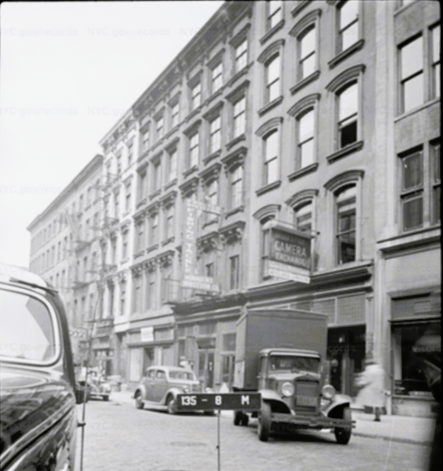
A blade sign advertising Horrock-Ibbotson Company projected from the building when this photo was taken in 1941.  The storefront cornice and the window details were still intact.  via the NYC Dept of Records & Information Services

As had been the case so often at 18 Warren Street, in May 1912 Neal & Brinker first reported financial problems.  Three years later, on May 4, 1915, The Sun reported, "The five story loft building at 18 Warren street, the home for the last twenty years of the Neal & Brinker Company, hardware dealers, was sold yesterday for that firm to the M. Weiss Company."  The deal allowed Neal & Brinker to lease the store and basement for two years, while M. Weiss Company, importer of chemicals and hardware goods, would occupy the upper floors.

As it turned out, Neal & Brinker Company did not survive through its two-year lease.  In 1916 the store became home to the Baily Electrical Supply Co.  

In its November 1916 issue, Electrical Review illustrated the Baily Electrical Supply Co. store.  (copyright expired)

M. Weiss remained in the building through around 1922, after which the Horrock-Ibbotson Company moved in.  Like William M. Cornwall, it was a sporting goods firm.  Claiming to be "The Largest Manufacturer of Fishing Tackle in the World," it operated factories in Utica and Rome, New York.

This advertisement marketing fishing rods was published in 1953.

The Horrock-Ibbotson Company went out of business around mid-century.  In 1953 Rudge Cycles operated from 18 Warren Street.  The firm marketed "Britain's Best Bicycle."  For years, starting around 1969 through the 1980s, Leonard Radio occupied the ground floor.

Then, in 1989, the Tribeca renaissance caught up with the venerable building.  That year the upper portion was converted to apartments, one per floor.  Sadly, the striking 1855 architectural details have been shaved off, stripping the building of most of its personality.

photographs by the author
many thanks to reader Evan Rieder for requesting this post
LaptrinhX.com has no authorization to reuse the content of this blog

Saturday, March 6, 2021

The 1858 Cast Iron 120 Chambers Street (aka 50 Warren Street)


The ultra-wealthy Jones families were a significant presence on the Chambers Street block between West Broadway and Church Street in the first decades of the 19th century.  In 1818, the year they were married, Isaac Jones, Jr. and his wife, the former Mary Mason, erected fine home at No. 122 Chambers Street, and in 1828 Isaac's brother, William Henry Jones, built a 23-foot wide residence next door at No. 120.  

By the 1850's their exclusive neighborhood was being increasingly invaded by commerce.  In 1857 the Jones families demolished their houses and replaced them with modern loft buildings, while retaining ownership of the properties.  The names of the architects have been lost, but they were almost assuredly not the same person.

No. 122 was faced in sandstone, while No. 120 received a cast iron facade--the latest in construction technology--from the foundries of Daniel D. Badger's The Architectural Iron Works.   That new building, completed in 1858, ran through the block to No. 50 Warren Street where an identical façade was installed.

The graceful Italianate-style design was divided into three parts by intermediate cornices.  Two identical two-story sections flanked by double-height Corinthian pilasters sat atop a cast iron storefront.  The spandrel panels of the arched openings were filled with frothy decorations.  An especially handsome bracketed cornice with rosettes completed the design.

A slightly wider version of the facade was pictured in the Architectural Iron Works catalog of 1865.  (copyright expired)


Interestingly, on May 6, 1856--even before demolition of the old Jones house had begun--space in the proposed building was being offered for lease.  The advertisement promised that the site "is to be immediately improved by the erection thereon of a five story first class store in all respects, with two basements and with all the modern improvements, either of marble or iron."  A lease was available to "an undoubted tenant" for ten or fifteen years "and the building will be arranged to suit his convenience."

Among the initial tenants was A. R. Van Nest & Co., which took the three lower floors.  Established in 1835 by Abram R. Van Nest, it was the foremost saddlery hardware firm in the city.  The first floor sales room offered, according to the 1859 The New-York Sketch Book and Merchants' Guide, "every variety of Heavy and Japanned Saddlery Ware, and Patent Leathers and Cloths of their own manufacture; also, all qualities and descriptions of Spurs, Stirrups, and Bitts, for riding and driving."  There were also harness mountings, carriage cloths and fringes, carriage lamps and whips.

The second floor salesroom was devoted to the sale of textiles and accessories--carriage blankets, curry combs, reins, shafts, springs and axles, "in fact, Buggy and Carriage Trimmings of every kind," according to The New-York Sketch Book.

The upper floors housed the "hats and caps" factory of  Geo. W. and Jehial Read.  Its brisk business was reflected in a continuous string of help wanted ads.  On February 21, 1859, for instance, an advertisement sought "two first class straw and silk bonnet trimmers.  None but experienced and capital hands need apply."  The same month the firm was seeking "a porter; one accustomed to the hat, cap and straw goods business."

Geo. W. and Jehial Read seems to have left the building by 1861, replaced by two apparel firms, George W. Nelson and T. S. Young & Co.  

In 1860 T. S. Young & Co. had hired a 17-year old boy, Edwards Tomlins.  The New York Times noted "he came highly recommended to his employers, and he soon exhibited such a marked talent for business, and was withal so apparently conscientious and honest, that his employers were induced to repose the most implicit confidence in him."  By the time the firm moved into No. 120 Chambers Street, Tomlins had been promoted to cashier--a highly responsible position--and was in charge of handling the company's books.

Tomlins earned only $300 a year--less than $8,000 in today's money.  And yet, according to The New York Times on December 24, 1862, "During the last four months, his employers and others noticed, with some surprise, that the young man was very extravagant in dress, and also in some other respects, but, strange as it may appear, they did not for a moment suspect that he was robbing their money-drawer."  The article said that, instead, they believed their "fast clerk" was living beyond his means, or that he had perhaps come into an inheritance.

Rather than arriving at work on a streetcar, Tomlins took a carriage to and from his boarding house every day.  "And yet such was the confidence with which this firm trusted young Tomlins that it never occurred to them to examine the cash-book or drawer, to see whether or not their confidence was misplaced."  As the year drew to a close, however, Tomlins knew that an audit of the books would be performed in January.  And the result would thrust him into "hopeless ruin."

On Morning morning, December 22, 1862 Tomlins--now 19-years-old--did not appear at breakfast at his boarding house.  When he had still not come down at 10:00, his landlady, Mrs. Archer, went up to check on him.  The New York Times reported, "The sight which then presented itself to her view caused her to start back and scream with fright.  On the floor of the room lay the apparently lifeless form of Tomlins, and beside him was a revolver."

When word of his death reached T. S. Young & Co. a cursory examination of the books was performed.  It was immediately apparent that more than $26,000 in today's money was missing "and it is believed that a more thorough investigation will reveal larger defalcations," said The New York Times.  Tomlins had taken care to use some of the stolen money to pay off his debts before ending his life.  His $462 tailor bill and $251 carriage bills had been paid--a total of $17,800 by today's standards.

A. R. Van Nest & Co. had been renamed J. Newton Van Ness & Co. when this photo was taken in 1885.  from the collection of the New York Public Library

Like many other apparel firms, George W. Nelson sometimes gave work to contractors to be made off-site.  Unfinished garments would be passed off to a tailor to do the finish work.  It was an arrangement that profited Polish-born tailor John Harris and a garment retailer, Louis Johnson--at least for a while.  During the summer of 1865 Harris took work from various firms then sold them to Johnson, "telling that person, at the time of the sale, that they had been stolen," according to The New York Times on August 12.  Their scheme was doomed to failure, obviously, when the finished garments never showed up at the original factory.  When the pair was arrested George W. Nelson was out more than $3,000 in garments by today's standards.

While other firms came and went over the decades, A. R. Van Nest & Co., remained.  The Van Nest family was among the early settlers of New York City and the Van Nest mansion in Greenwich Village where Alexander had been born, was a landmark.  Interestingly the family name had been interchangeably spelled Van Nest and Van Ness for decades.

By the early 1880's the firm was renamed J. Newton Van Ness Co.  Despite the name, the principal of the firm was still Alexander T. Van Nest, who had taken over the firm from his father. 


Brooklyn Life, December 3, 1892 (copyright expired)

Ill health forced Alexander T. Van Nest to retired relatively young in the early 1890's.  This condition was complicated in the spring of 1896 by an attack of appendicitis.   On July 14, 1896 he and his wife sailed for Europe for a several-month stay.  The 52-year-old died in the small Prussian town of Langenschwalbach on August 10.

At the time the New-York Bottlers' Supply Company was on the third floor of No. 120, the Regal Lamp Shade Company occupied the fourth, and the top floor was shared by the Herbert Brush Co. and the Brenack Paper Company.  

Both small operations, the Herbert Brush Co. and the Brenack Paper Company employed just a handful of workers.  The brush firm's staff of four men worked 59 hours per week plus nine hours on Saturdays.  The Brenack Paper Company consisted of foreman Francis O'Brien and four young girls.

On the afternoon of March 3, 1896 O'Brien "turned around and saw tongues of fire licking the ceiling," as reported by The New York Times.  "He at once shouted 'Fire!' and to add to the general confusion, Bertha Reed of 37 Gwinnett Street, Brooklyn, fainted."  The three other girls carried her down the the stairs to the street.  "Further than this, there was no excitement," said the article.

A second alarm was called in and, according to The New York Times, "to this can be attributed the fact that the fire was so quickly put out."  Nevertheless, the building was flooded "from top to bottom."  

J. Newton Van Ness & Co. suffered $10,000 in water damage, nearly $315,000 today.  The other tenants' losses were less significant, the largest of which was about $2,000.

In 1906 J. Newton Van Ness received a satisfying contract to supply "horse equipments, harness and stable supplies" for the New York City Police Department.  The total amount would equal more than $100,000 today. 

That same year a recent rival firm, Bartley Bros. & Hall Co. moved into the building.  The National Harness Review explained that "owing to enormously increased business" the young firm was "compelled to seek larger quarters."  The journal described the company's offerings as "one of the most attractive stocks of imported saddlery to be found in this country."

The two competing firms co-existed for 12 years.  Then, in its April 1918 issue, Harness magazine reported "The old established harness business of the J. Newton Van Ness Co., at 120 Chambers Street, New York City, has gone out of business, the stock, good will, etc., having been purchased by Bartley Bros. & Hall."

By 1920 Topping Brothers, manufacturers and dealers in "heavy and marine hardware, shipbuilders', railroad and contractors' supplies," operated from the building.  In the meantime, Bartley Bros. & Hall
continued to gobble up well-established firms.  On January 22, 1923 Greater New York noted that the firm were the successors to "Veil Brothers, C. C. Bartley, C. M. Moseman and Brother and J. Newton Van Ness Company."  The firm had opened a London branch by now.

After having been a saddlery showroom since 1858, the ground floor was converted to the Chamberlain Restaurant around 1924.  It was the scene of a moving testimonial dinner on April 1, 1925.  John Paul Kottcamp was retiring as course supervisor of the Pratt Institute School of Mechanical Engineering.  The Brooklyn Daily Eagle reported, "Two hundred of his former and present pupils attended."  He was presented with a silver gavel and a black leather traveling bag in appreciation for his years of service.

In 1927 architect Murray Klein was hired to design a replacement storefront.  The building continued to house small manufacturers until 1990 when it was converted to offices.

The Corinthian capitals of the pilasters have been sadly lost.  

That all changed in 1996 when a renovation resulted in sprawling apartments on the upper floors.  Murray Klein's 1927 storefront was markedly redesigned, however the Badger pilasters somehow survived along the sides.  

photographs by the author

Friday, January 18, 2019

The 1895 Holmes-Bromley Candy Factory - 83 Warren Street


J. M. Atwater leased the property at No. 83 Warren Street from Grace Church.  The building he erected on the site housed his extensive business of jellies, sauces, catsups, canned goods, and other grocery items "wherewith the epicurean palate is so deliciously tickled," according to Illustrated New York, in 1888.   The writer mentioned that "The store, No. 83 Warren Street, is in one of the most desirable locations down town."

In March 1894, 34 years after opening his business, Atwater sold the leasehold to the property to Hampton O. Marsh for $5,000.  Marsh, who lived in Morristown, New Jersey, immediately initiated plans to replace the old Atwater building.  His architect, W. G. Beatty, filed plans in May, calling for a five-story brick and limestone loft building to cost $13,000--about $382,000 today.   Beatty included a hand-powered sidewalk freight elevator and electric lighting in the plans.

Hampton O. Marsh would never see his building completed.  He died of a heart attack in his home on September 22 that year at the age of 63.  His estate forged ahead with the plans.

The building was completed by the end of the year.  An industrial blend of Romanesque Revival and Renaissance Revival styles, it was faced in variegated Roman brick and trimmed in limestone.  The no-nonsense cast iron storefront had none of the grandiose Corinthian capitals and other decorations of a generation earlier.   Brawny splayed lintels with prominent keystones adorned the openings of the second through fourth floors.  A row of five arched openings sat upon a delicately-carved stone cornice at the fifth.

The new building was leased to candy manufacturer Holmes-Brumley & Company.  The factory's boilers required a smoke stack, so W. G. Beatty was called back in January 1895 to make the alterations, which cost the Marsh estate a little over $7,500 by today's standards.

In February 1897 the estate sold the leasehold to Benjamin Sire for $5,400.   He would soon have to find a new occupant of his building.   On March 26 The Sun reported that Holmes-Brumley & Company was in financial trouble and Robert W. Bullock had been appointed its receiver.

The candy company had debts amounting to nearly half a million in today's dollars.  Bullock, who was just 28 years old and "bears a good reputation," according to The New York Times, had been a bookkeeper in the company.  He now took on the responsibility of settling the affairs of the firm; a psychological burden which may have been more than he could handle.

The first week of July Bullock complained to friends of a headaches and said he thought he would go away for a few weeks to rest.  That was the last anyone heard from him.  On July 16 The Times reported "Some alarm is felt by creditors of Holmes, Brumley & Co...Mr. Bullock has been missing for more than two weeks, and as a result the settlement of the affairs of the company is blocked."  The article was quick to assure "no one suspects that the young man has absconded...They fear, however, that he has either met with foul play or is seriously ill and unable to communicate with his friends."

Bullock had already sold off the perishable stock of the firm, and had arranged for an auction of the company's equipment and furnishings.  The auction went on without him; but the buyer of the company's safe encountered a problem when it was revealed that only Bullock had the combination.  A representative of the safe factory was called to open it.  Everything inside was in order--checks made payable to Bullock as receiver, and some cash.  The mystery of Bullock's whereabouts only deepened.

On July 17 the New-York Tribune proposed "It may be possible that Bullock, while laboring under some mental stress, has wandered away, and does not know what he is about or what he is doing.  He was an extremely nervous man, and was under the care of several nerve specialists."  Oddly enough, the newspapers lost interest in the case after the company's finances were settled.  None seems to have followed up on the story of the missing man and his fate.

The former candy factory became home to a drastically different tenant.  Robert A. Keasbey was a manufacturer and dealer in industrial supplies, including railroad and ship parts.  The firm was, for instance, among the top bidders in 1898 for supplies for the New York Navy Yard.  And it was the Robert A. Keasbey company which supplied the asbestos coverings for pipes in the two torpedo boats being built for the U.S. Navy in Elizabethport, New Jersey in 1903.

In September that year Marcus Stowe Hill took a job earning $15 a week as a clerk.  His had been an ambitious but sadly disappointing career to date and the new job was a distinct step down.  He had met his wife, Alberta, in Sidney, Australia and they were married on December 1, 1888.  By now they had two children.

At one point Hill had moved his family to San Francisco, where he was a commission merchant.  But he devised a scheme to make a fortune making Egyptian and Turkish cigarettes.  He convinced three friends to invest $7,500 and relocated the family to Japan where the cost of living was lower.  In 1901 he returned to America and hired an engineer to make a special cigarette-making machine.  But it never worked.

And so to make ends meet he accepted the job of clerk.  After having worked at Robert A. Kesbey just three weeks, Hill was no doubt humiliated when police entered the building and arrested him for non-support.  Alberta, willing to wait no longer for her husband, had arrived in New York with the children and gone directly to the police.

Hill pleaded with the judge "I asked her not to come here, as it costs much more to live here than in Japan.  She has $500 worth of diamonds and I hardly have a collar button."  Alberta produced her husband's landlady as a witness, but, according to The Sun on October 3, 1903, "her evidence was all in favor of the defendant."

Irene Kenney testified "He boarded for $6 a week because he wanted to save money to get back to his family, of whom he appeared very fond."  Alberta's suit fell flat.  "The Magistrate dismissed the complaint when Hill said that he would do the best he could by his wife," explained The Sun.

Not long after the messy affair, the Robert A. Keasbey company moved to North Moore Street.  Three butter and egg firms took its place at No. 83 Warren Street.  The first was the Consumers' Butter and Egg Co., which had been organized at Greenwich and Reade Streets in 1902.  Two years later, according to The Sun, "a fire drove it to 83 Warren Street."

The blaze came at an especially bad time.  Consumers' Butter and Egg Co. was already burdened with debts that amounted to $15,000 (about $426,000 today), according to the New York Produce Review on March 9, 1904.  Unable to survive, the journal reported that the firm would close its doors.

On May 4, 1904 the New York Produce Review and American Creamery reported that after 27 years at No. 81 Warren Street, J. D. Stout & Co. had moved next door to No. 83.  "The object of moving was to get a more modern building and a better equipment for the handing of butter, cheese, and eggs, which have been the specialties of the firm every since its organization," the journal explained.

The American Produce Review, May 1904 (copyright expired)

A separate article on the same day noted that De Wolff & Christiansen "have moved from 15 Harrison street down to 83 Warren street."  Both butter, cheese and egg firms remained here only until about 1913, when a far different tenant moved in.

The James Goldmark Co. was the New York agent for Holtzer-Cabot Electric Co., based in Boston.  Its extensive list of products included buffers and polishers, time clocks, motors and dynamos, fire extinguishers, and soldering compound.

Following World War I No. 83 became home to the New York branch of Chicago-based John F. Jelke Co., makers of oleomargarine.  The firm was looking for an ambitious young employee in the summer of 1920.  "Boy Wanted--Strong, willing, for stock room and shipping department; steady employment, $14 a week."  It would be a lucrative job for someone, the weekly pay equal to about $185 today.

John F. Jelke Co.'s oleomargarine was marked under the Good Luck label.
The following year a salesman was needed.  The firm's advertisement in The New York Herald on April 24, 1921 sought someone with "good record and high class references" to sell "popular food in Bronx and Brooklyn."  The candidate would have to "driving experience."  The ad concluded "If you are a business producer with ability and character, call early Monday morning, John F. Jelke Co., 83 Warren St."

The Warren Street block saw a wave of employment agencies take over buildings beginning in the early 1940's.   The Employment Agency Center Building opened at No. 80 in 1942, housing more than 40 agencies; and the same year the Edwards Employment Agencies, Inc, purchased No. 73 Warren Street.  That deal prompted The New York Times on May 19 to call it part of "the recent movement of many similar enterprises from Sixth Avenue."

On November 17, 1947 The Times reported that the trend had reached No. 83.  "Roberts Employment Service, 83 Warren Street, a new organization specializing in male and female positions in the mechanical, technical and building trades, has been formed by Edward Greenberg."

Employment services would give way to residential space by the mid-1970's (although not legally converted).  Unlike so many Tribeca lofts which were taken over by artists, No. 83 became noted for its musical residents.  According to Mike Katz and Crispin Kott in their 2018 Rock and Roll Explorer Guide to New York City, "Dubbed the 'Home for Teenage Dirt,' 83 Warren St. around 1977 was a residence for musicians Lydia Lunch, Bradly Field, and Miriam Linna; members of the group Mars; and writer and former WFMU DJ James Marshall."


Official residential conversion came in 1990 when the building was transformed for one apartment per floor.  But more than 113 years of change in the neighborhood has not greatly affected the appearance of W. G. Beatty's handsome brick factory building.

photographs by the author

Thursday, November 15, 2018

The 1891 Hicks Building - 73 Warren Street


In 1890 the parish of St. George's Episcopal Church had owned the 25-foot wide property at No. 73 Warren Street for decades.  That year, on November 26, the trustees sold it to Lewis Coon and his wife, Amalie, for $32,500.  It was a significant amount, more than $900,000 today.

The title was put in Amalie's name; and the couple wasted no time.  Just three days later The Engineering and Building Record announced that architect G. A. Schellinger had filed plans for a "brick store" to replace the old three-story building on the site.  The projected cost was set at $1.1 million in today's dollars.

Completed within the year, Schellinger's six-story structure was a confusing, if delightful, mixture of styles and materials.  An elegant cast iron storefront of three arched openings graced the ground floor.  The rough-cut granite blocks at this level suggested Romanesque Revival; but the shallow capitals of the side piers included delicate neo-Classical swags.


The Romanesque Revival motif was carried on through a four-story arch and hefty undressed granite lintels.  Then Schellinger added intricate terra cotta panels in the Renaissance Revival style above the second and third floors, and Corinthian terra cotta capitals to the long piers.  The ruddy red Roman brick gave way to a quilt of Queen Anne style tiles at the fifth floor, perfectly matching in color.  Five stone pilasters at the top floor upheld what must have been an impressive cornice.

The Coons sold No. 73 Warren Street to Ratcliffe Hicks on March 23, 1892.  Hicks, who lived in Connecticut, had already lived a fascinating life.  Born in 1843, he began practicing law in 1864.  When only 23-years old he was elected to the State Legislature and served several terms.  He was largely responsible for the abolishment of the death penalty in Connecticut.  He purchased the Warren Street building, in part, to house the New York office of the Canfield Rubber Company of which he was part owner with Jared H. Canfield.

A consummate marketer, Hicks devised an innovative exhibition at the 1893 Chicago World's Fair to promote the Canfield Seamless Dress Shield.  Victorian women's garments were unforgiving in hot, humid weather, causing perspiration in the most refined of wearers.  Underarm sweat was not only embarrassing, but damaged expensive fabrics.  The rubber Canfield Seamless Dress Shield promised to solve the problem.

Sadly, according to this advertising postcard, the woman at right failed to use an underarm shield.
The Canfield Rubber Company's exhibition included two full-sized wax figures--one of Jared Canfield, the other a working girl.  They were depicted seated at a table, with Canfield explaining how the dress shields were made.  In conjunction, Hicks kicked off a startling marketing campaign.

On August 6 The New York Times reported "A very interesting feature of the exhibit is that the Canfield Rubber Company, whose factory is at Bridgeport, Conn., while its principal offices are at 73 Warren Street, New-York, offers three free Cook excursion tourist tickets to Europe and return for the best three guesses by ladies as to the number of its shields sold in the world during the year 1893, the number sold in the United Stats during 1893, and the number sold in Europe during 1893."

If the winners preferred cash rather than the trips, they would received $500, $300, and $200 in gold.  The Times added "It requires all guesses to be mailed to 73 Warren Street, New-York, prior to April 1, 1894."

The Canfield Rubber Company did not occupy the entire building,  In 1893 a floor was leased to the newly-formed printing firm of Redfield Brothers.  Founded by brothers Judd H. and Tyler L. Redfield, it would become one of the leading printing firms in the city.  The fledgling firm remained here only a year, moving to No. 25 Park Place, in the printing district, in 1894.

While Ratcliffe Hicks had his office in New York, he continued to make his mark in Connecticut.  In 1894, for example, he established the Ratcliffe Hicks prizes for students of the Agricultural College in Storrs.  The prizes were awarded annually to essay writers.  That same year, in May, he donated $5,000 to the city of Hartford for the erection of a monument to Frederick S. Brown.  He would go on to establish the Ratcliffe Hicks Industrial and Educational School at Tolland.

The well-traveled millionaire published Observations in 1900.  The book "deals in a fascinating manner with European Countries and Customs," according to a advertisement, and "has received the highest testimonials from the reading public."

In the meantime the store space was home to Dr. P. Harvey Flynn's veterinary supply store.  Unlike the rawhide bones and doggie sweaters carried by such retailers today, the products sold had more to do with the thousands of horses that populated Manhattan.  He, like his landlord had done, came up with a solution to a ubiquitous problem in 1899.

Runaway horses were dangerous, killing or injuring numerous people per year.  Flynn invented the My Little Giant Controller, a type of bit which he guaranteed to stop and control any skittish horse.  While he marketed the gadget as "completely humane," his description in The New York Times on March 25, 1899 said the horse "will not run; he cannot run; the pain caused by a steady pull is too intense to permit him to fight against it."

The Horse Review, October 31, 1905 (copyright expired)
Flynn insisted "I know that I have been saved from accident, possibly from death, while driving spirited horses, by the use of this simple contrivance."  And he urged "It is an appliance that should be on every harness, used by a woman particularly."

Around the same time Thomas Leeming & Company moved into an upper floor.  Leeming had come to New York in 1883 and formed the commission house.  The firm remained in the Warren Street building until Leeming's death in 1902.

Of Ratcliffe Hicks' several homes was an estate near Pasadena, California.  He had built the house there in 1898; but decided to sell two years later.  His advertisement for the property in April 1900 noted "For fuller description of location and advantages of La Crescenta, send for circular.  Plans can be seen at office of owner, Ratcliffe Hicks, Hicks Building, 73 Warren St., N. Y."

Before Hicks died in 1906 he had sold the building to John H. Browning and Canfield Rubber Company had moved out.  In 1907 the marine supply firm of F. S. Banks & Co. operated from the building and submitted proposals to the United States Navy's Isthmus Canal Commission.  Among the items for which the firm hoped to land contracts were hoisting chains, 16,500 pounds of "black iron chains," "yawls or row boats," skiffs and oars.

The Motor Appliance Co. of America was in the building by 1911.  Like F. S. Banks & Co., it dealt in marine supplies, like boat motors, carburetors and the like.

Motor Boating, May 1911 (copyright expired)
Through the World War I years the building saw tenants come and go, including the Page Belting Company and the Neal & Scott Co., Inc. who took floors in 1913, and the Bissell Carpet Sweeper Company which moved in in 1916.

In 1920 the property was purchased by the Carbondale Sponge Company.  The firm dealt in sponges and chamois.  It leased the store that year to the National Twist Drill and Tool Company.  Other tenants sharing space with Carbondale in the 1920's were the Supreme Printing Company on the fourth floor and F. H. Hobbs on the second.

Major change came in 1942 when Edwards Employment Agencies, Inc. bought the building.   Directly across the street at No. 80 Warren Street the large Employment Agency Center Building had recently opened.  Edwards Employment Agencies joined what The New York Times on May 19 called "the recent movement of many similar enterprises from Sixth Avenue."

The president of Edwards Employment, Stanley Knapp, announced the building would "be extensively altered to fit it especially for the concern's own needs."   The company hired the well-known architectural team of Boak & Paris to do $35,000 in interior "modernization work," as described by The Times on June 15. (The comprehensive make-over would equal more than half a million dollars today.)  Sadly, the cornice had been lost sometime before the firm's purchase of the building, replaced by a gruesome parapet.


Now called the Edwards Building, the renovated structure was formally opened on June 13, 1942.  It was one of two locations for what The Times called "one of the largest industrial employment services in the country."  The Warren Street location catered to job hunters in the "mechanical, industrial, building and real estate fields."

The employment agency would remain in the building through the 1950's.  In 1966 the Newspaper Guild of New York went on strike.  Composed of unions of typographers, or "pressmen," the strike crippled several of Manhattan's newspapers.   On June 21 the Guild's strike bulletin announced "that The Journal-American and The World-Telegram strike headquarters had been consolidated at 73 Warren Street."

No. 73 Warren Street was one of the earliest of the Tribeca loft buildings to be converted to residential space.  In 1977 a vending machine business occupied the ground floor; while upstairs were one "living-work" quarters per floor for artists.  In 1985 the description was changed to one "loft dwelling" per floor, removing the restriction of artist use.

U. S. Telecom, a computer network design firm, was in the shop space at the turn of the century.  The attacks on the World Trade Center were devastating for the company.  According to its president in June 2002, the resulting drop in business, "and damage to equipment and furnishings stemming from the trade center's destruction, had resulted in nearly $500,000 in losses."

In 2012 Mulberry & Vine signed a lease on the ground floor space.  It was described by The New York Times' Florence Fabricant as offering "self-service cafe fare for breakfast, lunch and dinner," in 2013; and Alexis Lipsitz Flippin gushed about its "tasty, healthy prepared foods" in her 2014 book Food Lovers' Guide to Manhattan.


Mulberry & Vine remains in the space. while upstairs there is still one apartment per floor.  Schellinger's striking brick and terra cotta design is a show-stopper on the street.  Its lost cornice is as lamentable as the rest is joyous.

photographs by the author

Friday, May 29, 2015

The 1857 Swift, Seaman & Co. Bldg -- No. 122 Chambers St.


In 1818 Isaac Jones Jr. married Mary Mason, the daughter of fabulously wealthy banker John Mason.  Jones erected a house for his bride on land owned by his father, at No. 122 Chambers Street.  Directly behind their new residence was that of New York City Alderman William Hoghland, at No. 52 Warren Street.

Within the next two decades the inevitable taint of commerce would encroach on the high-end neighborhood and in 1839 the Joneses moved uptown to No. 734 Broadway.  The family retained possession of the Chambers Street property, however.  In her new home Mary Mason Jones, already established as the queen of New York society, would reign until being nudged out by the likes of Caroline Schermerhorn Astor.

In 1856 the property at No. 122 Chambers Street was inherited by Emily Jones.  The area around the old building now bustled with activity and she wasted no time in taking advantage of its income-producing potential.  Within the year she razed the old house, along with the former Hoghland property, in order to erect a handsome commercial building.  Completed a year later, the sandstone-faced building—with identical facades on Chambers and Warren Streets—was the last word in Victorian architecture.

The architect, whose name has been lost, created a remarkably attractive five-story Italianate-style store-and-loft building.  Above the storefront base each successive row of openings decreased slightly in height—an architectural slight-of-hand that made the structure visually taller.  Setting the building apart—and a step above--its otherwise similar neighbors were the exquisite carvings that sat diadem-like above the windows of the second through fourth floors.


Directories listed Swift & Seaman, “hardware,” at both Nos. 122 Chambers and 52 Warren Street in 1858.  The firm, which would later become Swift, Seaman & Co., took up much of the building.  It specialized in harness brasses and saddlery hardware.  A related firm, Seaman Brother & Sniffin which also dealt in saddler hardware, operated in the building by 1865. 

Harness maker and hardware dealer Abraham R. Van Nest Company was in the building by 1863, the year that it hired 16-year old Alpheus Lawrence as a mailroom boy.   The firm would remain in the building for nearly eight decades.

While Swift, Seaman & Co. remained here until 1879; other businesses moved in, including two dry goods merchants.  L. Minster dealt in “cloths, cassimeres & vestings;” as did Stern Bros.

L. Minster’s significant operation was run by Lazarus Minster, Samuel Minster, Caroline Minster and Morris Kohn.  In the spring of 1865 the principals embarked on a rather nefarious scheme.   

According to court papers later, they hired James Sherlock to purchase $10,876 worth of mittens and gloves from Isaac V. Place, a Gloversville, New York manufacturer.  In June that year the transaction was made and Sherlock promised to pay the invoice “within thirty or sixty days from their delivery.”

Sherlock signed the purchase agreement, never mentioning that the goods were actually being bought by L. Minster.   Investigation revealed “It was also a part of the design that Minster and Kohn should pay to Sherlock a liberal compensation for his services, and assist him to abscond from the State and country so that the plaintiff could not prosecute him for the goods.”

Once Sherlock had skipped town, the proprietors of L. Minster claimed “they had never ordered the goods, or authorized Sherlock to purchase them.”   Isaac Place sued, claiming that L. Minster had “procured goods…to the amount of about $11,000, fraudulently, and with the intent to cheat him out of them and not pay for them.”  The enormous stock of gloves and mittens would amount to about $160,000 wholesale value today.

In 1876 the building was filled with a variety of businesses.  Swift, Seaman & Co. was still here, sharing the address with Moses Falk, “sugars;” Joseph Hirsch, “segars;” Adolph Meyersbergh, who listed himself as “agent;” and McCafferty & Connelley, dealers in fancy goods.   Shoemaker James Griffin was on the second floor of the Warren Street side; and “leather and findings” dealers (makers of shoe parts) John P. Benjamin, and, later, Brown & Folk were also here.

Around 5:00 on the afternoon of Wednesday January 4, 1877 John P. Benjamin came across two men trying to force their way into the closed shop of James Griffin.  The feisty Benjamin attacked the two would-be thieves.  The New York Times reported that “One of the men turned on Mr. Benjamin and endeavored to strike him with a jimmy, but the merchant warded off the blow and knocked the burglar down.

All the commotion drew the attention of J. H. Steenberg whose office was on the top floor.  He rushed to Benjamin’s aid, attacking the other crook.   The four men fought “desperately” in the hallway until two policemen, Roundsman McArthur and Patrolman Garland came on the scene.  The Times reported that they “instantly brought the burglars to terms.”

Unlike many loft buildings which housed firms of the same industry--like dry goods or produce dealers--No. 122 Chambers Street continued to see a wide variety of businesses:  the shoe trade, printing, hardware and imported wines among them.

A long-term tenant by 1910 was Topping Brothers, run by Frederick, Joseph P. and Herbert W. Topping.  The firm dealt in wholesale heavy-duty hardware such as spikes, ship locks and latches, and tackle blocks.  It would remain in the building into the 1920s.

In November 1910 the firm sent out to architects “an attractively prepared book describing in detail the operations of the ‘Mechanigraph,’ which is a machine for making reproductions of blueprints from original drawings without tracing by a mechano-chemic process,” reported the Real Estate Record & Builders’ Guide.

In 1918 Abraham R. Van Nest Company was succeeded by Bartley Brothers & Hall, a saddler importer which was founded in London in 1791.  The combined concerns stayed on the building following the merger.  Remarkably, Alpheus Lawrence the mailroom boy who was hired in 1863, was still with the company and was kept on in the shipping department.   

Firms in the silk industry were leasing space by now.  In 1919 tenants included the Fulton Silk Co., General Piece Dye Works, the Metropolitan Silk Co., and the Eagle Silk Co.  But a far different type of tenant moved onto the fourth floor of No. 122 Chambers Street in the early 1920s.  R. H. McMann, Inc. was a radio supply store.   The firm found itself the unlucky target of thieves eager to get their hands on the expensive radio tubes.  In March 1923 robbers made off with $2,000 worth of radio supplies; then on Wednesday, November 5 the following year “thieves drove off with a truck loaded with tubes valued at more than $3,500,” as reported by The New York Times.

But that was not the end of it.  Only three days later, on Saturday November 8, 1924, another burglary was discovered when the store was opened for business.  This time radio tubes valued at $15,000 had been taken.

In 1921 Bartley Brothers & Hall updated the street-level storefronts.  They commissioned architects DeSuarea & Hatton to removed the mid-Victorian fronts and replace them with matching, modern facades.   A stone frame with scalloped corners embraced wide show windows, topped by a many-paned frosted transom.


On February 28, 1928 Bartley Brothers & Hall lost their oldest employee.    Alpheus Lawrence died in his Brooklyn home at the age of 81.  He was the same mailroom boy who had started working in the building 65 years earlier for Abraham R. Van  Nest Company.  “From the time he obtained his first position until his death,” said The New York Times, “Mr. Lawrence went to work at the same address every day.”

By 1930 Cornelius Bertschinger ran his Hudson Sporting Goods store on the third floor of the Warren Street side of the building.  It was a time when the cities like Chicago and New York struggled in the grip of gangsters who ran speakeasies, gambling dens and houses of prostitution.   On September 17, 1930 The New York Times reported that Bertschinger had been arrested in his store at No. 52 Warren Street for selling firearms to Charles De Denetto and Joseph Bonventre, agents of Al Capone.

The following day the newspaper added “Dertschiner [sic], the police charged, was a source of supply for machine guns and ammunition, and Benedetto and Bonaventura had purchased weapons there.”  They guns were then shipped to Chicago where Scarface Capone was battling George (Bugs) Moran.

On December 5, 1938, when Alexander F. Bartley died in his home in Montclair, New Jersey, Bartley Brothers & Hall was still doing business from No. 52 Warren Street.   And so was, perhaps surprisingly, the Hudson Sporting Goods store, which was still operated by Cornelius Berchinger.  

Berchinger was back in court on April 29, 1940 testifying in the trial of members of the Christian Front, a secret organization advocating the overthrow of the United States Government.  When arrested the alleged conspirators were in possession of firearms and “partly finished bombs.”  An invoice found in the home of one of the defendants recorded “the sale of ninety-four boxes of rifle ammunition for $67.01,” purchased at the Hudson Sporting Goods store.

The Warren Street elevation, down to the 1921 storefront, is identical to Chambers Street.

Somewhat ironically, the store would appear in newspapers again two decades later—this time the victim of crime.   Three teenage gang members of the Phantons broke into the store on Friday evening, March 18, 1960.  They used crowbars to pry open a wooden shutter, then made off with an entire arsenal—20 revolvers and automatics, a rifle, two bayonets, and 3,000 rounds of ammunition.

The delinquents talked too much, however, and were overheard by a policeman discussing the heist in Colonial Park in Harlem.   When they saw Patrolman Paul Tekleis approaching, they fled, leaving five weapons behind.  The three boys were later apprehended and the firearms and ammunition recovered.  The oldest was 16 years old.

In July 1968 police killed a gunman who killed a young woman and injured two policemen and an elderly man in a Central Park shooting spree.    The .45-caliber revolved used in the crime was owned Bulgarian immigrant living in New Jersey on whose apartment walls were taped photos of Nazi leaders. 

Investigation traced the gun to the Hudson Sporting Goods Company of No. 52 Warren Street.


The days of harness brasses, radio tubes, and gangsters came to an end in 1981 when the building was converted to a block-through store at street level and apartments on the upper floors.   Both elevations appear much as they did when Bartley Brothers updated the storefronts in 1921.  And the superb carved ornaments over the upper openings survive—excellent examples of Victorian decorative taste in the years just before the Civil War.

photographs by the author