Showing posts with label east 64th street. Show all posts

Saturday, March 25, 2023

Fitting In - 9 East 64th Street


In 1884 Ulysses Simpson Grant and his wife, Fannie Josephine Chaffee, purchased the double-wide brownstone at 7 and 9 East 64th Street from Alvin J. Johnson, paying the extravagant amount of $150,000.(more than $4.25 million in 2023).  The son of the former President, he was a successful attorney with the firm of Davies, Work & McNamee.

Property values had risen by the turn of the century, when vintage brownstones were being razed or transformed into modern American basement mansions.  In 1906 railroad mogul James J. Hill purchased the sumptuous mansion at 8 East 65th Street, directly behind the former Grant house.   Two years later The New York Press announced he had paid $500,000 for "Nos. 7 and 9 East Sixty-fourth street, a four-story high-stoop brownstone house."  The National Real Estate Journal explained that Hill purchased the house simply "to  secure light and privacy" for his 65th Street residence, and he promptly demolished it.

Hill died in 1916 and his estate sold the vacant lot the following year.  It was purchased by John Sergeant Cram and his wife, the former Edith Claire Bryce in 1928.  The couple hired the architectural firm of Strass & Barnes to design a house at 9 East 64th Street, leaving the plot at 7 undeveloped, apparently as a garden.  The resulting two-story, vaguely Art Moderne structure was rather peculiar.  A cantilevered slab-like marquee hovered above the entrance and a single, large window punctured the unadorned second floor.  The New York Sun called the house "handsome," and made a note of its "40-foot living and dining rooms."

The Cram house, with its large second-story window, sits just in front of the parked delivery vehicle.  The one-story house to the left was built by Edith Cram on the site of the garden in 1939.  image via the NYC Dept of Records & Information Services.

Born in 1851, Cram graduated from Harvard College in 1872 and Harvard Law School in 1875.  Closely affiliated with Tammany Hall, he was an intimate friend of Charles Francis Murphy, known as "Silent Charlie" and "Boss Murphy."

Edith was, perhaps, even more interesting.  She was well-known nationally for her anti-war speeches and peace initiatives.  She was the founder of Peace House and during World War I tirelessly expressed pacifist ideals in newspapers.  She was, as well, a staunch proponent of women's rights, advocating for birth control and sitting on the Advisory Council for women's educational fields at Cooper Union.

J. Sergeant Cram died on January 18, 1936. Three years later, on January 17, 1939, The New York Sun reported she had sold 9 East 64th Street to Adolph Levitt, chairman of the Doughnut Corporation of America.   The article noted that she had already hired architect Louis Kurtz to design a single-story house on the garden plot next door, saying "A one-story residence in this aristocratic section of Manhattan will be unique."

In 1958 9 East 64th Street became home to newlyweds Anthony Brady Farrell and Kathryne Barbara Mylroie.  Farrell was a Broadway producer and owner of the Mark Hellinger Theater.  Kathryne was an actress, known to audiences as Kate Manx.  Their residency (and marriage) was relatively short-lived.  They divorced on July 30, 1964 and Kate died of an overdose of sleeping pills on November 15 that year.

The former Cram house became home to the Samuel Rubin Foundation, Inc., which remained well into the 1970s.  Then, on June 19, 1994 The New York Times reported that record magnate David Geffen had bought the "two nondescript one-story [sic] houses" at 7 and 9 East 64th Street, noting he "has hired the architect Richard Meier to design a town house for the double lot."

Two years later the newspaper reported that Geffen "changed his mind and put the building back on the market."  Calling them "the pair of dilapidated two-story brick buildings," the article said they had been purchased by Theodore W. Kheel as the site of a "headquarters for three foundations, with rental apartments above."  Kheel's group, the TASK Foundation, had paid $4 million for the properties.

On April 28, 1996 The New York Times explained that architect Henry George Greene's design would meld into the mansion block.  "The proposed $6 million seven-story Renaissance-style limestone building...will echo its grand neighbors on the outside.  While the foundations take the bottom floors, the top five stories would be devoted to three full-floor two-bedroom apartments and one penthouse duplex."  Kheel predicted "Rents on the apartments will be expensive."

Demolition began in January 1997.  To assuage the neighbors like Ivanna Trump, Gianni Versace and Edgar Bronfman Jr., Kheel hosted "the quintessential block party," as described by Nadine Brozan of The New York Times on January 22, 1997.  He explained that the erection of what would be called Foundation House would "be discommoding people there for about 14 months, so this is a kind of apology for the unavoidable inconvenience."

But Kheel changed his mind mid-stream.  As the building rose, on August 13, 1999 The New York Times reported that it would now be a "high-end town house condominium."  Kheel had hired the Greenwich-based architectural firm of ERG Architect to tweak Henry George Greene's plans.  Journalist Rachelle Garbarine explained the five-story structure, "designed to blend with its neighbors, will have three condominium apartments, ranging in size from 3,300 to 6,800 square feet, and in price from $3.9 million to $7.5 million."  ERG Architect principal E. Ronald Gushue said, "I reorganized the facade to include more classically inspired details and proportions.  I made it more harmonious with neighboring residences done at the turn of the century."

The building was especially remarkable in one respect.  Theodore W. Kheel was what Andrew C. Revkin of The New York Times called "an environmental showman."  Kheel explained the building "is also meant to illustrate how energy-saving technology and environmentally sensitive construction methods can pay for themselves."

To that end, the two deepest holds in New York City--"each deeper than the World Trade Center is tall"--were drilled into the bedrock.  The 1,500-feet-deep holes would "tap stored energy in the rock."  Kheel added, "We're not going to change the world with one little building.  But we can set an example.  Geothermal will be our best expression of what can be accomplished."


In September 1999, before construction was completed, all three of the condominiums had been sold.  The largest, a quadruplex with a 1,045-square-foot garden on the below-grade level cost $11.1 million.  Today's casual passersby might easily mistake the new kid on the block with its remarkable backstory for a century-old townhouse.

photographs by the author
no permission to reuse the content of this blog has been granted to LaptrinhX.com 

Thursday, March 16, 2023

The 1918 Warren and Helen Thorpe Mansion - 15 East 64th Street


On June 24, 1916, the Real Estate Record & Builders' Guide reported that Helen C. Thorpe had purchased the double-wide house at 13 and 15 East 64th Street from Edith Shepard Fabbri.  Their husbands' names--Warren Parsons Thorpe and Ernesto Fabbri--were not mentioned simply because the titles to real property were most often held in the name of the women within society families.  The Fabbris apparently had owned the 64th Street house merely as an investment.  They were currently erecting an opulent mansion for their use at 7 East 95th Street.

Only a week later, The New York Press reported that the Thorpes had demolished the old house and "commissioned John G. Greenleaf to prepare plans for a five-story American basement brick and stone residence on the site."  The cost of the new mansion was placed at $100,000--more than $2.5 million in 2023.

Warren Thorpe was a stockbroker, and had recently moved his family to New York from Philadelphia.  Helen Prentiss Converse Thorpe, a graduate of Bryn Mawr College, was the daughter of Philadelphia millionaire John H. Converse.  He was in ill health and a widower when the couple became engaged in 1905.  While they initially planned to live in New York, Converse bribed them with a high-paying job for Thorpe and a sumptuous mansion to stay in Philadelphia.  Now, following Converse's death in 1910, they had revived their original plans and brought their two children, Theodora and Warren Jr. to live in New York City.

The Thorpes' mansion was not completed until 1918.  Greenleaf produced a dignified limestone-faced house in the neo-French Classic style.  His design drew the eye to the second floor where a shallow balcony was crowned with a deep, arched pediment.  The sedate facade rose to a steep mansard above a stone cornice where copper-pedimented dormers sat behind iron railings.

Born in 1878, Thorpe had graduated from Yale in 1900.  He was a partner in the Wall Street brokerage house of Henderson & Co.  Like all moneyed families, the Thorpes spent the warm months away from the city.  Somewhat surprisingly, however, they chose to lease estates (almost always in Lawrenceville, Long Island) rather than purchase a summer home.

In March 1917, for instance, The Sun reported that the Thorpes had leased the "furnished dwelling" of Marshall C. Lefferts in Lawrenceville, and in 1920 the New-York Tribune announced they had taken Windward, the estate of Mrs. Frederick Tilden Brown for the 1921 summer season.  The article noted it contained "about fifteen acres, with a large modern dwelling and a number of outbuildings overlooking the Atlantic Ocean."  (The family's attachment to Lawrenceville was so strong that Thorpe would later become mayor of the town.)

Theodora was born in 1906, the year her parents married.  Normally young society daughters were not mentioned in print before their debuts.  But on New Year's Eve, 1920, the 14-year-old appeared in the society columns of the New-York Tribune as the hostess of a dinner for debutante Edyth C. Elliman.  (There was no doubt a great deal of discussion about that for weeks ahead of the event.)

Finally it was Theodora's turn in the spotlight.  The first of her debutante entertainments took place on November 1, 1924.  It was a tea given by her aunt, Mary E. Converse at The Lindens, her home in the upscale Rosemont neighborhood of Bryn Mawr, Pennsylvania.  Once introduced, young society women often turned their attention to marriage, and Theodora was not an exception.

The following year, on December 17, 1925, The New York Times reported that a telegram from London announced Theodora's engagement to W. Palmer Dixon, "elder son of the Hon. Mrs. Cecil Campbell."  The groom-to-be had attended Eaton before entering Harvard, graduating in 1924.  The article noted, "The wedding will take place in New York in the Spring."  The ceremony was held in St. James Church on Madison Avenue on April 9, 1926.  It was a society affair, followed by a reception in the 64th Street mansion.

It would take Warren Jr., who was six years younger than his sister, longer to find love.  He graduated from Yale University in 1934, and while the Thorpe name repeatedly appeared in society columns for his mother's entertainments and charity involvements, it would not be until June 24, 1941 that The New York Sun reported the 29-year-old's engagement to Elisabeth Searles Greene.  The wedding took place in St. John's Episcopal church in Far Rockaway on September 13 that year.

With their children gone, Warren and Helen Thorpe moved into a suite at 800 Park Avenue and hired architect Louis Weeks to remodel their mansion into apartments and to install an elevator.  An advertisement in 1941 described the "exceptionally fine block," noting the "just completed" apartments featured "huge living rooms," maid and valet service, and optional meals.

Among the initial residents were Monroe Douglas Robinson, a nephew of President Theodore Roosevelt, who had served as an official of the War Finance division of the Treasury Department; and Frances Milne Carleton.  During World War I she had helped organize Red Cross canteens and was in charge of the Red Cross base hospital at Camp Mills, Long Island.  When America entered World War II, she once again helped organize the canteen service.

The affluence of the residents was reflected in a burglary here on November 1, 1954.  Mrs. Ruth Wertheim Lyons Smith returned home that night to find that crooks had stolen $125,000 in jewelry--more than one and a quarter million in today's dollars.  The Long Island Star-Journal noted, "the thieves overlooked another $25,000 worth of gems cached in a valise in a closet."

Living here in the 1970s was George Oppenheimer.  He was drama critic for Newsday, a screenwriter for Metro-Goldwyn-Mayer, a playwright, an author, and an editor.  His first play, Here Today, opened at the Ethel Barrymore Theatre in 1932, starring Ruth Gordon.  His last play, A Mighty Man Is He, was performed at the Cort Theater in 1960.  Also a publisher, in 1925 he and Harold Guinzburg had founded the Viking Press.


The 31-foot-wide Thorpe mansion was purchased by Edgar Bronfman Jr., the president of Seagram's, on June 9, 1994 for $4.375 million.  He reconverted it to a single-family home.  Bronfman remained here until October 2007, when he sold the mansion to financier and chairman of the Warner Music Group, Leonard Blavatnik, for $52 million.

photographs by the author
no permission to reuse the content of this blog has been granted to LaptrinhX.com

Thursday, August 5, 2021

The Frederick W. White House - 20 East 64th Street


On November 17, 1879 brothers David and John Jardine advertised one of their pair of newly build residences:

For Sale--The elegant four-story full-wide bay-front brown-stone house, No. 20 East 64th-st.; just completed, designed and built by the undersigned in the most careful and complete manner.  Can be seen any day.  D. & J. Jardine, Architects

The 25-foot-wide, high-stooped house was sold to Henry Belden, Jr. and his wife, Clara.  Oddly, the Beldens had a proclivity for moving.   In the two years since 1877 they had lived in Brooklyn, on East 47th Street, on  West 45th Street, and at 18 West 38th Street--sometimes staying only for a matter of months.  Their habits did not change with the purchase of 20 East 64th Street.

In 1880 the Beldens moved to Irvington, New York and sold the 64th Street house to Franciso Bianchi and his wife Elizabeth for $80,000--around $2 million today.  Bianchi was a millinery merchant as well as an officer in the Eighth Avenue Railroad.  

Tragically, the family were in their new home only a few months before the drawing room was the scene of a funeral.  The Bianchi's son, Theodore, was about 11 years old when he died on September 5, 1880.

There would be another funeral in the house three years later.  Living with the family was Joanna Willis, the elderly widow of William Willis and presumably Elizabeth's mother.  She died on July 19, 1883 at the age of 81.  Her funeral was held in the drawing room the following day.

The Bianchis sold the house in October 1898 "for about $80,000," according to The Sun (interestingly, that was exactly what Francisco had paid for it 18 years earlier).  The buyers were Henry P. Goldschmidt and his wife, the former Georgette Woodleaf.

Born at Frankfort-on-the-Main in 1843, Goldschmidt was a banker.  He had come to New York in 1866 to work with the German banking house of Ballin & Sander.  He was now the head of the banking firm of H. P. Goldschmidt & Co.

He and Georgette maintained a "handsome villa in South Elberon, New Jersey," as described by George von Skal in his 1910 History of German Immigration in the United States.

On February 18, 1920 Goldschmidt sold the outdated brownstone to Frederick M. White.  Before he and his wife, the former Pansy B . Belwin, moved in, they hired architect Harry Allan Jacobs to transform it to a modern mansion in keeping with the neighborhood.  (The New York Evening Post commented that Jacobs "has planned some of the finest residences in New York.)

Jacobs stripped off the brownstone façade and removed the stoop.  A new marble front was erected at the property line.  Completed in 1921, the chaste neo-French Renaissance residence featured little ornamentation.  The main and service entrances at street level were nearly undistinguishable, their concave frames delicately carved with Renaissance style decorations.

Similar carvings embellished the arched openings of the second story.  The fourth floor sat above a projecting band.  Here intricately carved panels flanked the openings.  The windows of the tiled mansard, interestingly, were recessed within the roof, rather than taking the form of more expected dormers.


White was president of Peters, White & Company, president of the Mapes Company, and vice-president of the Mutual Chemical Company of America.  He and Pansy had been married since 1909.  His many social clubs included the New York Athletic, the Bankers Club, the Oakland Golf Club and the New York Club.

Perhaps unexpectedly, after spending $40,000 in renovating their house--in the neighborhood of $738,000 today--the Whites sold it in May 1927 to J. Clark Dulany and his wife, Belle Bart.    

The Dulanys were a colorful couple.  They established the American Academy of Astrology in the house upon moving in.  They and their operation quickly raised eyebrows--both social and legal.

On May 9, 1928 the Daily News reported, "At Belle Bart's fashionable astrology parlor at 20 East 64th st., you may learn what the stars have to do with your most private affairs.  But Edmund E. Frisch, jeweler of 576 5th ave., who is trying to find out what has become of a diamond brooch he values at $12,500, is not so sure the revelations are authentic."

Frisch had met the Dulanys in August 1927 in Lucerne, Switzerland.  They asked him to drop by the 64th Street mansion in December with a selection of jewelry from which to choose.  The  couple picked out the brooch as well as a diamond-studded bracelet with a $350,000 price tag in today's money.  They asked Frisch to leave the pieces so they could have them independently appraised.

Five months later Frisch had received neither payment nor the jewelry.  In May 1928 the bracelet was discovered in a pawn shop.  It was being held by the sheriff when, within days, the Dulanys appeared before State Supreme Court Justice Thomas C. T. Crain "to explain...why they shouldn't produce the brooch and also have the sheriff return the bracelet to Frisch."

On May 25 The New York Times reported that on the stand Belle said she was wearing the brooch one day in April, "and later in the day discovered it was missing."  The article added, "A search of the house failed to reveal it, she said."

This was (so far) the third time the Dulanys had been in legal trouble that year.   In February they had defended themselves against a law suit filed by George A. Devoe for default in a $20,000 loan made to the Academy.  And in reporting on the Frisch case, The New York Times noted, "Mrs. Dulany was mentioned last week in the replevin suit by the Federal Insurance Company to recover an $18,000 diamond ring alleged to have been lost by Mrs. Frederick W. Trabold, in which it was said the ring came into Mrs. Dulany's possession."  The ring had been pawned for $8,000.

Then, on August 24 that same year The Yonkers Statesman reported that George A. Devoe had been arrested for embezzling $325,000 from the New Jersey Fidelity and Plate Glass Insurance Company.  The complaint alleged that he shared the proceeds "with Mrs. Barton Delaney [sic], known also as 'Belle Bart,' an astrologist and her husband J. Clark Delaney [sic], 20 East 64th Street."

The Delany's left 20 East 64th Street in 1931 (they filed for personal bankruptcy in 1932).  The new owner, Roy Wilson Howard, had architect F. Albert Hunt make interior alterations to the 22-room mansion.  

Howard was chairman of the board of the Scripps Howard newspapers.   Living with Howard and his wife, the former Margaret Rohe, were their son, Jack, and Margaret's unmarried sister, Alice.

Roy Wilson Howard from the collection of the Library of Congress

Howard was a self-made man, having been born in Gano, Ohio on New Year's Day 1883 to a railroad brakeman and his wife.  Following his father's death, he was forced to drop out of school and help with the family's finances.  He found a job with the Indianapolis News and went on to a career in journalism.

Alice Rohe was as fascinating as her brother-in-law.  In 1914 she had served as bureau chief in Rome for the United Press.  She was the first female to hold such a position with an international press organization.  She was, as well, the first women to interview Italian Fascist leader Benito Mussolini.  When World War I broke out, she served with the Red Cross in the Balkans.

Alice Rohe from the collection of the Library of Congress

Alice died on April 7, 1957 at the age of 81.  She bequeathed an impressive collection of Etruscan antiquities to the University of Kansas.

Roy Wilson Howard died on November 20, 1964.  After various owners it was purchased by Irish-born real estate investor Derek M. Quinlan in 2005 for $26.25 million.   He listed it in 2009 for $37 million after the real estate market had plummeted the previous year.  He finally sold it in August 2011  to Gregg Hymowitz for $3.25 million less than he had paid for it.


Hymowitz, a co-founder of EnTrust Capital Funds, immediately began renovations--some of which did not please the locals.  By June 2015 he faced two lawsuits from neighbors who claimed their residences were being damaged by his construction.  The owners of 22 East 64th Street alleged their foundations had been damaged by Hymowitz's "attempt to build a below-ground bowling alley," according to Curbed New York.  They sued for $5 million.

Despite any interior remodeling, the exterior remains precisely as it looked when Harry Allen Jacobs gave it a sensational make-over in 1921.

photographs by the author
no permission to reuse the content of this blog has been granted to LaptrinhX.com

Thursday, April 29, 2021

The Elisabeth and Anna Meyer house - 17 East 64th Street


In 1879 the prolific architect John G. Prague designed four high-stooped brownstone houses on the north side of East 64th Street, just steps from Central Park, for developer William F. Croft.  Completed the following year, No. 17 became home to the family of financier Charles L. Rathborne.

The head of the brokerage firm C. L. Rathborne & Company, he put the title to the new house in the name of his wife, Elizabeth (known as Bessie).  Living with the family was Elizabeth's father, Joseph Hagan.

Elizabeth's entertainments were detailed by the society columnist.  Such was the case on January 26, 1882 when The New York Times reported, "Mrs. Charles L. Rathborne gave a brilliant reception last evening at her residence, No. 17 East Sixty-fourth-street."  After providing the impressive guest list, the article noted, "The supper was served by Clark."  (Clark was one of the three top society caterers at the time.)

In 1885 Elizabeth hired a Swedish butler named Theodore Hahr, who left after only a few days.  Nothing more was thought about it for several months--not until Mrs. Duncan Cryder took a pair of diamond earrings and a diamond ring to Tiffany's to have them reset.  The pieces had originally cost her husband $3,000.  She was "astounded and mortified to learn that they were not diamonds, but glass," reported the Illustrated Police News.

Mrs. Cryder directed suspicion on her former butler, Theodore Hahr, who--just as he had done with the Rathbornes--disappeared after working only a few days.  Knowing that the Rathbornes had also employed Hahr, Mrs. Cryder suggested to police that they should check Elizabeth's jewelry.  The Illustrated Police News said, "an examination showed that Mrs. Rathborne's earrings also, which had cost nearly $1,000, has been successfully tampered with and glass substituted for the expensive jewels."   Hahr was traced to New Jersey and arrested on May 25, 1886.  Happily for Elizabeth, The Evening Post reported, "Inspector Byrnes said that the diamonds stolen from C. L. Rathbone [sic]...had been found pawned in Jersey City and would be recovered during the day."

On May 14, 1887 Joseph Hagan died in the house at the age of 89.  Hagan was a Quaker and his funeral was not held in the Rathborne residence, as some might have expected, but in the Chappaqua Meeting House.

Despite technically being in mourning, Elizabeth turned her attention to her daughter's coming-out.  On December 2, 1887 The Evening Telegram reported, "Mrs. C. L. Rathburn [sic], No. 17 East Sixty-fourth street, gave a large reception to introduce her daughter, Miss Rathburn [sic], yesterday afternoon."  The article added, "An elaborate collation was served by Clark."  One can imagine Elizabeth's annoyance with the newspaper's misspelling of their names.

Elizabeth died on New Year's Eve, 1890.  Her funeral was held in St. Thomas's Church and, like her father, she was buried in Chappequa, New York.  

Charles sold No. 17 East 64th Street to sisters Elisabeth M. and Anna Catherine Meyer in 1895.  The women were the daughters of millionaire sugar refiner Cord Meyer and his wife Catharina.  Never married, they lived quietly and on the few occasions that their names appeared in society columns, it was always as a pair.  They had three brothers, John N., Cord, Jr., and Christian Moller Meyer.  Their father had died on June 10, 1891, leaving each of the children approximately $7 million.

The sisters immediately hired architect Gilbert A. Schellenger to remodel the house.  He and the new owners may have initially wanted to do a complete makeover, removing the stoop and pulling the front forward, but there was a problem.  A restrictive clause in the deed expressly prohibited the "building or extension thereof on said premises beyond a front line established."  And so Schellenger's changes were less drastic.  He gave the house a full-width, three story bowed bay above the parlor floor and added Renaissance Revival decorations.  The cost of the improvements was $8,000--or about $251,000 today.

Complex leafy carvings decorate the underside of the bay.


Elisabeth and Anna shared a summer home with their brother Christian in Maspeth, Long Island.  The Meyer estate held two "costly mansions in the centre of a handsomely-laid-out park," according to The New York Times.  The families of brothers Cord and John shared the other residence.

While most New York socialites traveled to Europe routinely--some going to Paris and London every year to shop for new fashions--the Meyer sisters' trip in the summer of 1897 was only their second.  The Times Union reported on November 18 that they "returned from Europe in the early fall and express themselves as highly pleased with their sojourn abroad....While in Germany they visited the homes of their ancestors.  They were intensely interested in the novelties presented in Switzerland and Holland."

Elisabeth died on April 2o, 1900 at the age of 43.  Her funeral was held in the 64th Street house two days later.  Anna Catharine lived on in the house for another two decades, now alone with her servants.  She died at the age of 63 on September 6, 1922.  Her funeral, too, was held in the drawing room.

By 1927 the house was home to Henry Huttleston Rogers, Jr. and his wife, the former Mary Benjamin.  Huttleston was the son of Standard Oil mogul, Henry Huttleston Rogers.  The house was the scene of the funeral of Mary's father, Dr. George Hillard Benjamin, on November 12, 1927.

The following year the house was converted to apartments.  The renovations included the removal of the  stoop, lowering the entrance to the former basement level, and remodeling the original doorway to a window.

The Renaissance Revival panels to the left do not extend to the base of the pilasters--evidence of the stoop railings that once terminated there.


Among the original well-heeled residents was attorney William H. Harkness, Jr., another Standard Oil heir.  Shortly after moving in, on June 18, 1928, his engagement to Jane G. Penfold was announced.

Another renovation, completed in 1953, resulted in a commercial space on the ground floor.  It became the office of Magnum Photos, founded in 1947 by photographers Robert Capa, David "Chim" Seymour, Henri Cartier-Bresson, George Rodger and William Vandivert.  

In July 1957  The Blackamoore Showroom opened here.  The owners, Charles Meyer and Randall Kenney, designed the furniture exhibited and sold in the shop.  Only five months later the Andre Emmerich Gallery opened in the space.  Its premier exhibition, according to The New York Times on December 20, included "recent paintings by five American artists, a selection of Northwest Indian and pre-Columbian sculpture and several classics, among them a Degas pastel and two Miro oils."

Beginning in 1959 the Edward R. Lubin Gallery, which dealt in Gothic and Renaissance antiques, shared the space.  Both galleries remained for years.  Today the space holds the offices of the design architecture firm Ingrao, Inc.


Surrounded by opulent mansions of the early 20th century, the Meyer house looks a bit out of place, a remnant of the previous chapter along the block.

photographs by the author
no permission to reuse the content of this blog has been granted to LaptrinhX.com

Thursday, April 22, 2021

The Florence A. Alker House - 22 East 64th Street


In January 1881 William Erastus Tefft purchased the newly-built rowhouse at No. 22 East 64th Street from developer John Davidson.  Designed by architect James E. Ware, the high-stooped brownstone was 25-feet wide and three stories tall above an English basement.  Tefft paid $83,000 for the residence, or around $2.1 million today.

Tefft was born in Syracuse, New York on January 15, 1841.  He was a partner in the dry goods firm Tefft, Weller & Co., co-founded by his father.   He and his wife, the former Emma A. Apgar, had eight children, William Jr., Charles Griswold, Frank, Gladys, Edna, Ella Gretchen (who went by her middle name), Jessie Augusta and Alma.  The family's summer estate, Hamilton Grange, was in Great Barrington, Massachusetts.  It was described by The New York Times as "one of the finest residences in the town."

Emma's entertainments straddled the roles of socialite and well-to-do mother.  On March 27, 1885, for instance, The Evening Telegram announced, "A very pretty birthday party will be given this evening at the residence of Mrs. W. E. Tefft, No. 22 East Sixty-fourth street, in honor of the birthday of her young daughter.  Eighty invitations have been issued, and there will be dancing, with music by Bernstein and supper by Sherry.  The supper table will be very handsomely decorated, and there will be in the centre a great Easter egg, en surprise, in which will be disclosed unique favors for the children."

And a month later, on April 23, the newspaper reported on a grown-up affair.  "Mrs. W. E. Tefft will give an informal card party at her residence...this evening.  There will be six round tables, handsomely decorated with flowers.  Sherry will serve the supper."

In 1888 William succeeded his father as the senior member of the Tefft, Weller & Co.  His memberships reflected his broad range of interests:  The Merchants' Club, the Players', the Liederkranz, the Riding and Driving Club, the American Museum of Natural History and the Metropolitan Museum of Art, among them.  

The 64th Street house held his rather unusual collection.  Fabrics, Fancy Goods and Notions explained, "His collection of theatrical curiosities is said to be surpassed only by that owned by the Players' Club."  The journal said that among his intimate friends were actors Edwin Booth, Laura Keene, and Lawrence Barrett, noting that "his collection is filled with many reminiscences of them and their connection with the stage."

A joyous entertainment was held in the house for the Tefft's 25th wedding anniversary on January 14, 1887.  The New York Times said the house "blazed with light" and added, "The rooms were very tastefully decorated with flowers and palms, and after the reception a supper was served by Sherry."

The residence was the scene Jessie's wedding to Henry Bloodgood Slayback on October 31, 1894.  Her sister Edna served as her maid of honor and Gretchen as one of the bridesmaids.  The Sun noted "A large reception followed the ceremony."

Edna's wedding ceremony was performed in St. Thomas's Church on November 17, 1897.  She married William Abbott Slayback, the brother of Jessie's husband.  The Sun reported, "After the church ceremony there was a large reception given by the bride's parents at their residence."

Around this time William Tefft was diagnosed with Bright's disease, a kidney condition known today as acute nephritis.  It prompted a series of visits to doctors across the country and in Europe for consultation.

There were two weddings within the family in 1901.  Gretchen was married to John Leveritt Pell in the house on April 23.  Later the New York Herald reported that the Teffts had gone to Hamilton Grange and "will have as their guests part of the season Mr. and Mrs. John Pell."

Charles Tefft's wedding two months later was less fashionable.  Initially, little was known of his bride, but The Argus discovered details.  On June 24, it began an article describing the ceremony which took place in city court the previous week as "the romantic marriage of Charles G. Tefft and Miss Grace A. Gates."  It disclosed that the mysterious bride was "well known at No. 54 East Forty-ninth street, which is a home for trained nurses."  Grace had tended to Charles during a serious illness.  

Ten days before the article she had packed her things and left the nurses' home, saying "Good-bye.  Hereafter I'll take care of myself and one other only."  The article said "Then she left without any further explanation."

That year William's worsening medical condition forced him to retire.  He sold No. 22 East 64th Street to William Baylis and moved into Hamilton Grange permanently.  The New York Times commented that the many doctors he had seen "were unable to help him materially."  He died on February 19, 1903.

The 64th house saw a rapid turnover of owners.  Baylis sold it to Solomon A. Cohn in 1902 who sold it the same year to Louis Korn.  Korn sold it in March 1903 to H. P. Goldschmidt, who remained for 13 years, selling it to Charles L. Bernheimer in 1917.  He transferred title to Franklin Pettit the following year and Pettit sold it in November 1919 to Florence Augusta Alker.

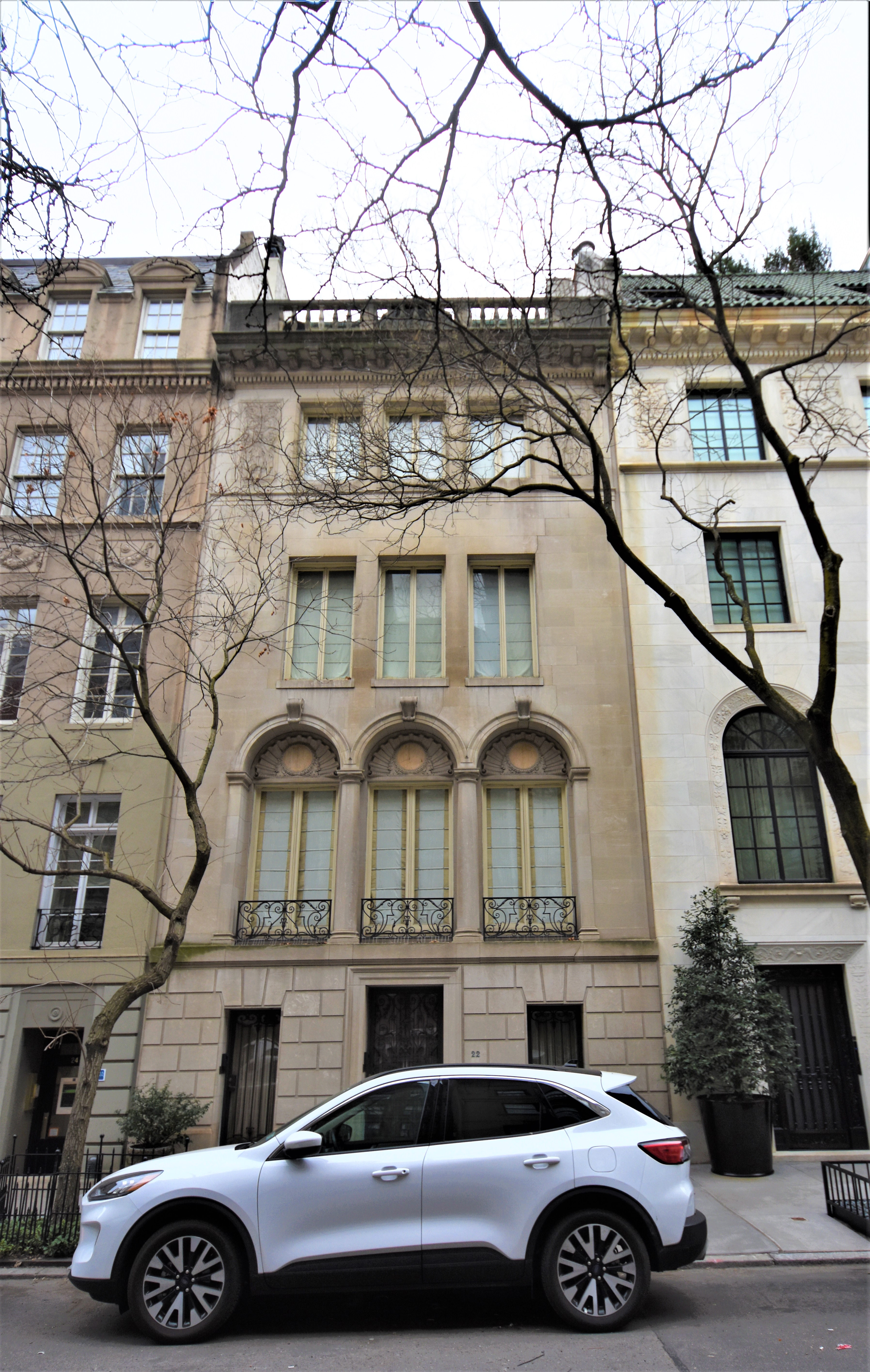
Florence had no intentions of reselling.  She hired architect Harry Allen Jacobs to completely remodel the outdated brownstone at a cost of about $450,000 in today's money.  He stripped off the façade, pulled it forward to the property line, and created a limestone-clad, neo-Italianate Renaissance showplace.  The second floor, or piano nobile, grabbed the attention.  Here three round-arched openings fronted by swirling iron grills created a loggia.  Their tympanums held marble roundels flanked by masks in profile and backed by deeply carved shells.


Florence Alker was the widow of Alphonse H. Alker.  Her father was James E. Ward, the founder of the Ward Line of steamships.  The Alker summer estate, Idlewilde, was in Great Neck, Long Island.

A postcard depicted Florence's country estate, Idlewilde.

Sadly, Florence would not enjoy her remodeled home for long.  Only a year after its completion, on May 13, 1921, she died.  Her estate was appraised at $25.5 million by today's standards.
 
Florence's heirs sold the house to Sarah Emile Woodbury.  The daughter of Effington Townsend, she was twice widowed.  Her first husband, Samuel Irvin, died in 1884.  Her second was John McGaw Woodbury, who died in 1914.  

Sarah brought Harry Allen Jacobs back in 1923 to add a small penthouse, hidden behind the balustrade above the cornice.  The renovations were completed in the summer of 1923 and on August 24 The Sun reported "Mrs. John McG. Woodbury will return from Southampton October 1 and, with her son, E. Townsend Irvin, will occupy her new house at 22 East Sixty-fourth street.

A broker with J. P. Morgan & Co., Effington Townsend Irvin was best known for his yachting.  He was a vice-commodore of the New York Yacht Club and was a member of the America's Cup Committee which handled the arrangements for the annual American-British races.

Sarah Woodbury died in the house on May 19, 1938 at the age of 89.  E. Townsend Irvin and his wife, the former May Novy, continued to live in the residence.  Irvin died at the age of 82 on November 19, 1957.  

May later sold the house to Dr. Jacob Easton Holzman and his wife, Minnette.   Dr. Holzman was a specialist in diagnosis and internal medicine.  He died in the home on March 23, 1970.  


No. 22 East 64th Street remains a private residence.  It was placed on the market in 2014 for $42 million, the listing boasting "exquisite gilded detailing, parquet de Versailles wood floors, oak paneling," a marble staircase, stained glass skylight and 10 marble fireplaces.

photographs by the author

Friday, April 2, 2021

The Charles L. Bernheimer Residence - 18 East 64th Street


In 1878 architects David and John Jardine designed a row of brownstone-faced residences for developer Edward Kilpatrick on the southern side of East 64th Street between Fifth and Madison Avenues.  The neo-Grec style homes rose four stories above English basements.  No. 18 was purchased by W. W. Johnson, possibly before ground was even broken.

The 25-foot wide house was completed in 1879.  Johnson retained possession only five years, selling it in January 1884 to Charles Minzesheimer for $61,500--around $1.65 million today.

A provisions merchant, he and his wife, the former Clara Hertz, had three sons, Charles, Jr., David and Clarence.  David died three years after the family moved into the 64th Street house.

In 1892 the Minzesheimers started interior renovations to their home.  Things ground to a halt, however, in June when the city's unionized cabinet-makers became embroiled in labor disputes.   The Board of Walking Delegates ordered strikes at three locations throughout the city, including the Minzesheimer house.

King's Views of the New York Stock Exchange, 1898 (copyright expired)

In January 1897 Minzesheimer partnered with his son Clarence and two others to form Charles Minzesheimer & Company, a commission firm dealing in cotton, coffee, grain and provisions.  Charles, Jr., went on a different career path, going into banking.

The family remained in the house until early 1911.  In March Clarke's Art Rooms advertised for sale the "valuable modern paintings, the collection of Charles Minzesheimer, Esq."

The purchaser of the now architecturally outdated house was Charles Leopold Bernheimer and his wife, Clara L.  The Bernheimers hired the architectural firm of Buchman & Fox to completely renovate the residence.  The stoop was removed and the front pulled slightly forward.  As construction got underway, a frightening accident occurred on June 25, 1911.   

Explaining that "the house is being remodeled during the absence of the family," The Brooklyn Daily Eagle reported that the scaffolding in the rear of the house had collapsed, injuring two men, one seriously.  A worker, known only as John, was on the top of the scaffolding when it gave way "with a crash that could be heard for several blocks." 

A worker on the ground was hit with several pieces of iron, but not seriously injured.  John, however, "was buried and crushed beneath the mass of metal."  Workmen extricated the unconscious man from the twisted iron and he was transferred to the Presbyterian Hospital with a fractured skull and internal injuries.

Completed in 1912, the remodeled house now wore a chaste limestone neo-French Classic facade.  Oddly enough, the lower floor configuration was not changed, resulting in a step-down to the entrance (at what was formerly the English basement level).

The rusticated second floor, or piano nobile, featured French windows fronted by stone balustrades.  Carved roses spilled from the scrolled keystones above the three sets of arched French windows, fronted by cast iron balconettes, on the floor above.  Smaller versions of the keystones graced the lintels of the upper floors.

Bernheimer was born in 1864 in Germany and arrived in the United States in 1881.  The couple had two daughters, Helen Amalie and Alice Martha.  Living with the family were six live-in maids.  

Charles Leopold Bernheimer (original source unknown)

Although he made his fortune in the textile business, Bernheimer had two passions which could not have been more different.  A pioneer in the movement to develop a single procedure to arbitrate industrial disputes, he spent much of his time promoting its advantages.  He was equally--or more--interested in archeology and geology and spent every summer in the Far West.

Bernheimer styled himself the "tenderfoot cliff dweller from Manhattan."  While his wife and daughters summered in comfortable resorts, he annually traveled to the deserts of New Mexico, Utah and Arizona to explore cliff ruins and hunt for dinosaur bones.  The relics he collected are housed in the American Museum of Natural History, the Smithsonian Institution, and the Carnegie Institute.

Clara Bernheimer in her younger years.  A natural stone arch in Arizona is named for her.  from the collection of the Library of Congress

On the afternoon of June 11, 1922 Clara ventured out into what the Yonkers Statesman's headline called the "Worst Storm In Years."  She would have been well to stay home, for she narrowly escaped serious injury.  The newspaper reported that the Bernheimer's Packard touring car was on North Broadway at around 5:15 when the roof of the First Presbyterian Church was blown off.  It "closed down upon the occupants of the car, Mrs. Bernheimer and the chauffeur, Frank Akison, and police assistance was necessary in freeing them."  Although the chauffeur suffered cuts on his hands, Clara escaped uninjured.


The Bernheimers left the East 64th Street by the early 1930's.  It was briefly operated as uncertified apartments until officially being converted to furnished rooms in 1938.  Another renovation completed in 1943 resulted in a combination of five apartments and fifteen furnished rooms.  That configuration lasted until 1963 when the house was converted to all apartments.   Asian art gallery Dai Ichi Arts operates from the ground floor today.

photographs by the author

Saturday, March 20, 2021

The Charles G. Cornell, Jr. House - 24 East 64th Street


Real estate developer Theodore Weston acted as his own architect when he erected four Queen Anne style homes on the south side of East 64th Street, just west of Madison Avenue, in 1881.  Four stories tall above high English basements, they were completed the following year.

Weston sold the western-most of the row, No. 24, to William Cullen Brewster.  Born on July 29, 1831, he was married to the former Georgiana Williams in 1857.  The couple had a two daughters, Annie Seabury and Mary Roget (who went by her middle name) Brewster.

The family had a sterling American pedigree.  Brewster was directly descended from Elder Brewster and John Alden.  Georgiana's ancestors included Roger Williams.

William was a founder of the Plaza Bank and its first president.  He was also president of the Fifth Avenue Safe Deposit Company and a director in the Second National Bank and other financial institutions.

Mary was the first to marry.  Her wedding to Navy Lieutenant Lazarus L. Reamey took place on November 10, 1886 in the Church of the Holy Spirit.  The Argus mentioned, "his bride has very sensibly persuaded him to transpose his two Christian names, and on the wedding invitations he stands as Lieutenant Lowry L. Reamey."  

The writer had visited the Brewsters' home previous to the ceremony and wrote, "I saw, confidentially, a guest chamber crowded with sumptuous bridal gifts, many of them from Tiffany's."  A reception was held in the house following the wedding.

Mary's parents had been uneasy at the both the pace of the couple's romance (they had known each other just ten days before Reamey proposed) and what The Argus called "the genteel poverty of our naval service."  But William Brewster found the suitor his other daughter eight years later even more troubling.

The problem was that the Brewster family was Episcopalian and Count Henri de Frankenstein was Roman Catholic.  The Polish count traveled from Rome to New York in January 1894 and waited nervously for two months as William and Georgiana talked it out.  (One imagines that Georgiana may have pressed for the match, which would result in her daughter's becoming a countess.)

Finally, on March 13, according to the Indianapolis News, "Mr. Brewster looked relieved this morning.  'I have given my consent to his marrying my daughter,' he said.  'They are engaged.  The wedding will take place, I presume, on March 28.'"  The article noted that the prospective groom's family "are closely allied to the family of the Pope" and "Miss Brewster may be obliged to renounce Protestantism and become a Roman Catholic."

On March 28 The Evening World reported "The marriage of County Henri de Frankenstein to Miss Annie Seabury Brewster...who is worth $1,00,000 in her own right, took place at 11:30 o'clock this morning in St. Patrick's Cathedral."  A wedding breakfast was held in the East 64th Street house, the guest list of which groaned with high-level society names like Rockefeller, Mills, Post, Thebaud and Gibson.  

Annie Brewster on her wedding day.  The Evening World, March 28, 1894 (copyright expired)

Brewster, however, seemed not quite reconciled.  At the breakfast, according to The Evening World, "He went from one room to another with his hands in his trousers' pockets, his head bent, his nerves unstrung, and a cigar in his mouth, puffing smoke into the rose and lily scented atmosphere."

William Cullen Brewster suffered a fatal heart attack in the house on May 30, 1900.  His estate sold No. 24 East 64th Street the following February to Judge H. W. Bookstaver for $70,000--about $2.2 million in today's dollars.

The house saw a turnover in owners over the next two decades.  Major change came in 1919 when it was purchased by Charles G. Cornell, Jr.  (Interestingly, he paid $70,000 for the property, exactly the price paid almost two decades earlier.)  He hired society architect Mott B. Schmidt to remodel the outdated Victorian into a modern, American basement residence.

Schmidt removed the stoop and pulled the front forward to the property line.  He replaced the brownstone facade with white stone.  What had been an eccentric Queen Anne house now wore a prim Adamesque facade

The original appearance of the house is suggested by the No. 26 partially seen to the left.  photo by Wurts Bros. from the collection of the Museum of the City of New York.

Sculptress Consuelo Vanderbilt was the daughter of Virginia Fair and William Kissam Vanderbilt, Jr.  She was named after her aunt (the daughter of William K. Vanderbilt, Sr. and his wife Alva), who had become the Duchess of Marlborough.  On January 26, 1926 she married stock broker Earl E. T. Smith in her father's mansion at No. 666 Fifth Avenue.  

The newlyweds would make No. 24 East 64th Street their home.   The New York Sun remarked, "The house, completely furnished, was a wedding gift from her father, William K. Vanderbilt."  Although Mott Schmidt's interiors were only five years old, Consuelo hired John Russell Pope to make alterations before the newlyweds moved in.

Daily News, March 9, 1927

On March 9, 1927 the Daily News reported that the couple had welcomed their first child, Iris.  "Two of three middle names will be given the seven-and-one-half pound morsel of aristocracy now lying under silk coverlets in the Smith home at 24 East 64th st.," said the article.

The couple's second daughter arrived three years later.  On May 20, 1930 the Daily News reported "Another heir to the vast fortunes of the clan Vanderbilt was born on Sunday...The child...is a great granddaughter of Mrs. Oliver H. P. Belmont and the late William K. Vanderbilt on the maternal side and the late Edward N. Tailer, social lion of the mauve decade, on her father's side."  The baby was named Virginia.

But the end of domestic bliss was on the horizon.  In 1934 the Smiths separated.  The New York Times said, "Relatives and close friends, it is learned, have been endeavoring to effect a reconciliation.  Few, however, knew of the marital difficulties."  On January 9, 1935 the newspaper reported that Consuelo had arrived in Reno to institute divorce proceedings.

The eight-minute private trial was held on February 21.  The New York Times reported, "Mrs. Smith, who is reported to have a personal income of $1,000,000 a year, went directly to District Judge Thomas F. Moran's court room.  A moment later the doors were locked behind her and the trial began."  Consuelo's claims of "extreme cruelty" were supported by the testimony of a servant, Mrs. A. A. Blackmer.

Consuelo sold No. 24 East 64th Street to Colonel Grayson M. P. Murphy, and in turn bought his former house at No. 11 East 70th Street.  Grayson was a senior vice president of the Guaranty Trust Company and founder and principal in the brokerage firm of G. M. P. Murphy & Co.  During World War I he had served as the first European Commissioner of the American Red Cross, and more recently was implicated in the failed 1933 conspiracy, known as the Business Plot, to overthrow President Franklin Roosevelt in a military coup.

Grayson would not enjoy the house for long.  He died in October 1937, about a year after moving in.  The residence was sold by his estate in December.

Owner William H. Hawkins hired architect Morris Whinston to alter the house to accommodate the Lawrence O'Toole Gallery at sidewalk level and apartments on the upper floors.  On December 21, 1940 The New York Sun deemed James St. L. O'Toole's new galleries "exceedingly agreeable and lend themselves well to the furtherance of exhibitions."

The Lawrence O'Toole Art Gallery remained in the space until 1958 when the ground floor was converted to one apartment and a retail space.  Another renovation completed in 1976 resulted in offices throughout the building.


The ground floor space became home to Bradley Mischka's first Manhattan boutique in 2013.  Despite the interior alterations in the second half of the 20th century, the sophisticated mansion retains much of its 1920 appearance.

photographs by the author