Thursday, November 24, 2022

The Alpha Phi Alpha House - 203 West 138th Street


Vertner Woodson Tandy entered Tuskegee Institute to study architecture in 1904.  A year later he transferred to Cornell University.  There he and seven other students established Alpha Phi Alpha fraternity on December 4, 1906, to promote a bond and fellowship among Black collegians.  It was the first intercollegiate Greek-letter fraternity especially established for Black men.

Upon graduation, Tandy became the first African American registered architect in the State of New York, and the first Black architect to gain membership into the American Institute of Architects.  In 1919 he and his wife, Sadie, moved onto West 139th Street, in a section of homes built in 1891 as the King's Model Houses

At the time, Louis C. Jacob lived a block away, at 203 West 138th Street.  This block, like the one onto which the Tandys moved, was developed by David H. King, Jr.  An extension of King's ambitious project, these homes were designed by architects Bruce Price and Clarence S. Luce in a creative take on the neo-Georgian style.  

203 West 138th Street is at the far right.  photograph by Beyond My Ken

Like its neighbors, the Jacob house was face in beige brick and richly trimmed in white terra cotta.  Three stories tall above an English basement, its single-doored arched entrance sprouted a dramatic, elongated keystone.  The splayed lintel of the parlor window was composed of alternating, foliate terra cotta sections, matched by smaller versions above all but one of the second story openings.  The exception, at the second floor, was crowned by a lintel in the form of a fasces, and an arched panel with a wreath and garlands.  Above it all was a brick parapet with balustraded openings.


In 1923 the Eta Chapter of Alpha Phi Alpha acquired the Louis C. Jacob house.  The branch of the fraternity founded in part by its now-neighbor, Vertner Woodson Tandy, had been established on June 5, 1909 on the campus of Columbia University.  The chapter was known as "The Jewel."

On December 29, 1923, The New York Age reported:

Eta Chapter of this city holds a very important position in the organization, having been awarded the 'McGhee Cup' for efficiency and progress at the last convention in St. Louis, Mo.  This year it has also made single progress as evinced in the securing of the beautiful home at 203 West 138th street, as the Chapter House.

In 1926 the chapter initiated a series of meetings in the house to "present prominent people to residents of the community," as explained by The New York Age on April 24.  The first to speak here was W. P. Beazell, managing editor of The New York World, on April 23.  The newspaper noted, "Well-known men and women of the race were in attendance."  Perhaps as interesting as Beazell's speech about current-day wages, was Ralph E. Mizelle's short talk.  The president of the Eta Chapter, he told the audience about the "go to high school and college" movement fostered by Alpha Phi Alpha.

As was the case with almost every fraternity chapter house, to help with finances, rooms were rented on the upper floors to members, very often alumni.  Living here at the time of Beazell's speech was Claude Thurston Ferebee.  (He had been elected the chapter's secretary in January that year.)  Ferebee had entered Columbia's dental school in 1924.  An all-around athlete, he was also a member of the French Club, the Dramatics Club and the NAACP.

While living here, Ferebee met Dorothy Boulding, a 1924 graduate of the Tufts University School of Medicine.  The couple was married in 1928, a few months before Ferebee graduated as a doctor of dental surgery on June 4, 1929.  Ferebee joined the staff of Howard University's dental program, and his wife became a professor in the school's medical school.  Dorothy Boulding Ferebee would go on be a member of the executive board of UNICEF, of President John F. Kennedy's Council for Food for Peace, and the President's Children and Youth Council.

photograph by James Van Der Zee

Alumnus Dr. I. A. McGowan broke racial barriers in 1926 while living here.  On May 1 that year The New York Age began an article saying, "The fight to have colored internes [sic] named for duty at Harlem Hospital has at last been won."  The hospital had barred Black interns until the arrival of a new superintendent, Dr. Rudolph Rapp, in March.  Neither Rapp nor McGowan was naïve about the challenges the intern would face.  Rapp told reporters that McGowan "would be given every opportunity to make good, and that he would be protected in every way possible from any attempt to subject him to unfair or prejudicial conditions because of his color."

The nation and, perhaps, Blacks in particular, were divided on the issue of Marcus Garvey's incarceration on mail fraud charges in connection with his Black Star Line of ships.  In March 1927 a reporter from The Daily Worker interviewed an Alpha Phi Alpha member, A. M. Smith, in the West 138th Street house.  Smith was unsympathetic, saying "The government was justified in imprisoning Mr. Garvey for fraud."  A fraternity brother who quite possibly did not agree was Clarence Benjamin Curley.  He had been the general accountant and secretary for Garvey's Black Star Line.

Within a year of Smith's interview, Curley and his wife, Alma Zola Duncan, purchased 203 West 138th Street.  Born in Memphis, Tennessee, Curley had helped lead the movement to establish the Black officers' training camp at Des Moines, Iowa during the war.  He received his masters degree from New York University in 1922.  The year that he and Alma moved into the 138th Street house, he founded the National Negro Fraternal Association, a life insurance firm.  On August 18, 1928, The New York Age noted, "There are some strong organizations of his kind among the other races, but this is the first among Negroes in the State."  The article said that "since this is a New York institution, [it] makes Mr. Curley's effort a valuable contribution to the business awakening in Harlem."  Curley ran the operation from the 138th Street house.

C. Benjamin Curley, The Crisis 1939

Within a few months Curley established the People's Credit Union here, as well.  It was the only Black-owned financial institution in New York City chartered by the State, according to Negro World in 1932.

While his family (he and Alma had four children) remained in the upper floors, in 1935 Curley leased the basement and parlor levels of the house to Lorenzo "Lonnie" Debman.  On February 9, The New York Age reported that the "progressive young businessman" had established "an up-to-date funeral home at 203 West 138th street."


The New York Age, May 4, 1935

The Curley family remained in the house at least through 1942.  By now Clarence Benjamin Curley had made an enormous impact on Harlem and the Black community at large.  He had been greatly involved in the Colored Merchants' Association and in 1930 he and Alma established Rainbow's End, the first summer camp for Blacks in New Jersey.

Another influential figure in the Black community was Charles Seifert.  Born in Barbados in 1871, his father was a plantation overseer.  As a child Seifert read his father's books on African history, most of them written before slavery.  In 1910 he dedicated his life's work to preserving African American history.  Working as a contractor, he bought books, manuscripts and other documents, eventually compiling what he named the Ethiopian School of Research History.  By the time of his death in 1949, his library included thousands of volumes.  (Reportedly Marcus Garvey had accessed Seifert's library so intensely that for a time he moved into the Seiferts' home.)

Soon after his death, Seifert's widow, Goldie, moved the Charles C. Seifert Research Library into 203 West 138th Street.  On June 10, 1950, The New York Age reported "the Charles C. Seifert Historical Research Association, Inc., held open house at the Charles C. Seifert Library, 203 West 138th Street, New York City, recently."  The article said, "An overflow crowd of former students, friends and persons interested in research gathered to pay homage to the life work and character of the late Charles C. Seifert, research historian and founder of the library."

The library was the scene of lectures and other educational functions.  On October 7, 1950, for instance, The New York Age reported it hosted Dr. William Leo Hansberry, "eminent Howard University archaeologist and anthropologist, in a series of seven lectures of Africa beginning Saturday, October 7th, and continuing every other Saturday until February, 1951."  The article added, "The Seifert Research Library is as extensive in the books, pamphlets and materials it contains as the original Schomburg Collection, now part of the New York Public Library."

By 1973 the Negro Book Club, Inc. was headquartered at 203 West 138th Street.  The Black periodical News Illustrated was published from the address as the time.


A renovation completed in 2021 returned the house--so important to Black history in New York City--to a single family home.  At the time the facade and its terra cotta decorations were restored.

photograph by the author
many thanks to Mark Satlof for his valuable input
LaptrinhX.com has no authorization to reuse the content of this blog

Wednesday, November 23, 2022

The 1937 Madison Square Station - 149-153 East 23rd Street


In the first decades of the 20th century, the Madison Square Station post office sat at 122 East 23rd Street, a block and a half east of the park that gave it its name.  The branch's name would become slightly more confusing when plans were laid in 1936 to move it a block further away from the park.

The Government acquired the old, five-story building at 149-153 East 23rd Street as the site of the new post office.  The Supervising Architect of the Treasury, Louis A. Simon, commissioned architect Lorimer Rich to design the structure. 

The five-story, Victorian building in the center of this photograph was demolished for the new post office.  from the collection of the New York Public Library.

The total appropriation for the 27,000 square-foot building was $935,000, of which $438,000 would be spent on construction (about $8.5 million in 2022).  The cornerstone laying ceremony took place on October 15, 1936, with Postmaster General James Farley, Postmaster Albert Goldman and United States Representative John J. O'Connor in attendance.  

Almost a year later, on September 20, 1937, the Madison Square Station was officially opened.  Rich's Art Moderne take on neo-Classicism echoed governmental architecture appearing in the Washington D.C. and in Germany.  Although the 1939 New York City Guide by the Works Progress Administration called the design "a new classicism free of dependence on the works of antiquity," at least two modern architectural historians disagree.  Norval White and Elliot Willensky in their 2010 AIA Guide to New York City suggest that the building "revives the memory of the mortuary temple of Queen Hatshepsut at Deir el Bahari, Egypt."  

The general architecture of the post office building could possibly be traced back to this building, from Egypt's 18th Dynasty, according to the AIA Guide to New York City.  photo by Dennis Jarvis.

Faced in polished, mahogany-colored granite, the three-story structure is dominated by four double-height pilasters and two matching piers.  The cast iron spandrel panels between the second and third floors were decorated with allegorical gilded bronze reliefs of communication.  The central three were sculpted by Edmond Amateis and the others by Louis Slobodkin.  They depict the messenger god Mercury, signal drums, a letter carrier, a carrier pigeon, and Native American smoke signals.


The modern letter carrier (bottom) is honored with the central position among the reliefs.

Pencil Points wrote, "The dark, polished surfaces and strong, simple forms of the Madison Square Post Office are a new note in the city picture of New York, with a large simplicity and a general beauty of proportions which are admirable."  The critic said that the spandrel figures "give life and humanity to the whole," adding, "The use of the figures is important; they are not 'ornament' from a drawing board via a modeler, but the work of a sculptor."  The architect lamented, in retrospect, that he had not given the reliefs more importance.  "And Mr. Rich says that, if he were doing the building today, all the banding and ornament on the spandrels would go, and the sculptured figures be made larger, more important.  The building would thus have gained in power and human appeal," explained the article.

When the building opened, eight interior murals by Kindred McLeary were still in process, and would not be completed until 1939.  The New York Times noted that Rich had called for "the use in the public space of furniture of the type used in banks."  Part of an upper floor was set aside for employees' recreation use.


Three of Kindred McLeary's murals.  After 85 years of accumulated grime, the artworks are in need of conservation.

Throughout the coming decades, the post office branch garnered little attention.  That changed in September 1969 when a "regular substitute" employee, 22-year-old Ronald Walker, was caught taking $3.25 from an envelope.  Previously, postal workers found guilty of stealing mail were simply suspended without pay.  The New York Times wrote, "the theory was that the defendant had suffered enough by the loss of his job."

But Ronald Walker's case would set a new precedent.  Federal Judge Edward C. McLean initiated what was called a new "get tough" policy for thieving postal workers.  On January 5, 1970, he sent Walker to prison for six months.

Later that year, postal workers went on strike.  The effects on businesses and regular civilians was reflected by the American Kennel Club, whose mail came from the Madison Square Station.  The organization normally received about 10,000 pieces of incoming mail in the morning, and sent out about the same number in the afternoon.  Now, not only was the staff steeling themselves for the eventual avalanche of mail when the strike was over, but they were running out of space for the back-up outgoing mail.

Another irritation to customers came in January 1976, when postal rates for a first-class letter rose from 10 to 13 cents.  The Madison Square Station was besieged on January 6 with patrons who had left over 10-cent stamps and needed to buy 3-cent stamps.  A reporter from The New York Times noted the "large crowd" at the Madison Square Station, where "a man seeking 3-cent stamps turned away in disgust.  'It's ridiculous, he said, 'And I'll be damned if I'm going to pay them 20 cents.'"


Lorimer Rich's dignified 1937 building stands unchanged on East 23rd Street, a striking example of Governmental architecture of the Depression Era.


photographs by the author
LaptrinhX.com has no authorization to reuse the content of this blog

Tuesday, November 22, 2022

Schwartz & Gross's 1911 155 Riverside Drive


The sweeping Hudson River views and handsomely landscaped Riverside Park made Riverside Drive one of the most desirable residential thoroughfares in the city.  By the first decade of the 20th century, upscale apartment buildings were rising among the the drive's opulent mansions.  In 1910 the Charter Construction Co. began construction of one such building, at the southeast corner of Riverside Drive and West 88th Street.

Designed by the firm of Schwartz & Gross, the 12-story,  Renaissance Revival style structure was completed in 1911 at a cost of $275,000 (about $8 million in 2022).  Faced in deep red Flemish bond brick, the building's eight-story midsection was essentially unadorned.  The two-story top section made up for that with ornate terra cotta panels and swags.  A bracketed cornice crowned the design.

The elaborate two-story entrance is executed in terra cotta.

Although the entrance opened onto West 88th Street, the building took the more impressive address of 155 Riverside Drive.  There were just two apartments per floor--one with "nine rooms, three baths and thirteen closets," according to an advertisement, and the other containing ten rooms, three baths and sixteen closets.  Schartz & Gross ensured light and ventilation to all rooms by reserving a 25-foot wide yard between this and the building on 87th Street, and inserting a courtyard at the rear.

The World's New York Apartment House Album, 1911 (copyright expired)

Among the initial residents were the Oppenheimer family, who lived on the 11th floor.  Julius Oppenheimer was born on May 12, 1871 in Hanau, Germany, and arrived in New York in 1888.  He was employed in the warehouse of Rothfeld, Stern & Company, a textile importing company run by relatives.  Although the young immigrant spoke no English and had no money upon his arrival, by the turn of the century he was a partner in the firm.

A large banner advertises apartments in 1911.  The Edison Monthly, July 1911 (copyright expired)

Julius had taught himself to speak English and eagerly read about American and European history.  He spent his free time browsing the city's art galleries and it was possibly in one of them that he met artist Ella Friedman.  Ella had studied art at Barnard College and in Paris, where she focused on Impressionism.  The couple married on March 23, 1903.  When they moved into 155 Riverside Drive they had a seven-year-old son, J. Robert Oppenheimer.  A second son, Frank Friedman, would be born on August 14, 1912.

The boys would grow up among privileged surroundings.  Their parents owned a chauffeur-driven Packard, and the Oppenheimer apartment was hung with magnificent modern artworks.  According to Kai Bird and Martin J. Sherwin in their 2005 American Prometheus:

...the collection included a 1901 'blue period" painting by Pablo Picasso entitled Mother and Child, a Rembrandt etching, and paintings by Edouard Vuillard, Andre Derain and Pierre-Auguste Renoir.  Three Vincent Van Gogh paintings--Enclosed Field with Rising Sun (Saint-Remy 1889), First Steps (After Millet), Stain-Remy, 1889), and Portrait of Adeline Ravous (Auvers-sur-Oise, 1890)--dominated a living room wallpapered in gold gilt.  Sometime later they acquired a drawing by Paul Cézanne and a painting b y Maurice de Vlaminck.  A head by the French sculptor Charles Despiau rounded out this exquisite collection.

Van Gogh's Exposed Field with Rising Sun hung in the Oppenheimer's living room. from the collection of  Sammlung R. Oppenheimer

Like the other residents of 155 Riverside Drive, the Oppenheimers maintained a summer estate.  Theirs was at Bay Shore, Long Island, where Julius moored his 40-foot yacht, the Lorelei.

Among the Oppenheimers' neighbors was George S. Ward, the president of the Ward Baking Company.  On the night of October 5, 1917, his chauffeur, 30-year-old Samuel R. Douglas, took out the Wards' automobile.  He picked up three friends and went on a spree that would end tragically.  

At 2:00 in the morning, Douglas smashed the touring car into an elevated railway pillar at Jerome Avenue and 206th Street in the Bronx.  Julius Becker, who was 23, and John Hardy, 21-years-old, were killed.  Douglas suffered a compound fracture of the left leg, and his other passenger, Emil Mosbacher, was taken to the hospital to be treated for shock.  The New York Times reported, "Mr. Ward told the police that the chauffeur had taken the machine without permission."

Jennie C. H. Denton, who lived here by the mid-1920's, was the widow of Waldo E. Denton.  She maintained a country home in Greenwich, Connecticut.  In September 1927 she became enraged with her broker and lawyer, Herman W. Booth.  Jennie had entrusted him with $150,000 in bonds (more than $2.3 million today), and when she requested that he return them, he disappeared.

If Booth had anticipated that he was dealing with a feckless widow, he was mistaken.  Jennie Booth filed a missing person complaint and actively joined in the search.  In the meantime, in Booth's absence he was expelled from the Stock Exchange.  Rumors swirled that he had committed suicide.  Then, on September 30, Jennie burst into his downtown office and found him.  The New York Evening Post reported, "Mrs. Denton herself made the arrest yesterday and, accompanied by a detective of the Missing Persons Bureau, escorted Booth to Police Headquarters.  He was locked up charged with grand larceny."

By the 1930's, J. Robert Oppenheimer had become a professional physicist.  His brother Frank, upon Robert's nudging, followed his lead.  During World War II Robert became the director of the Los Alamos Laboratory in New Mexico, where the Manhattan Project was initiated.  Its mission was to design and build the first atomic weapons.  Frank worked on uranium isotope separation at the University of California Radiation Laboratory.  In 1943 he joined the staff at Los Alamos.

Two years earlier, the sprawling apartments of 155 Riverside Drive had been divided.  There were now five apartments per floor.  

Living here in the second half of the century were Isidor Palca and his wife, the former Eva Lipka.  The couple had a son, Alfred, and daughter Rosalind.  Isidor was born in Poland and came to America in 1906, serving in World War I.  A former diamond merchant and founder of the Diamond Dealers Association, he retired in 1962.

Born on March 23, 1920, Alfred Palca graduated from New York University in 1940.  While studying there, he began writing for NBC radio.  After serving in World War II, he became a publicity agent for 20th Century Fox.  But his passion was writing.  In 1950, Columbia Pictures agreed to finance his screenplay, Go, Man, Go! about the Harlem Globetrotters.  He hired an aspiring actor, Sidney Poitier (who was running a barbecue ribs shop in Harlem at the time), to star in the film.

The bottom fell out when the F.B.I. accused Palca of being a Communist.  His project was developing during the McCarthy Era, known as the Second Red Scare.  Palca insisted he was never a Communist, but, according to Dinitia Smith of The New York Times in 1998, "In fact, Mr. Palca said, part of the proof that he was a Communist, the F. B. I. told him, was that he had hired Mr. Poitier, a black man."

After the accusations, Palca told Smith, "My career was phhhtt."  The film was released in 1954 with Palca's name removed.  (His credit would be restored in 1997 at a ceremony honoring blacklisted Hollywood writers and directors.)


A renovation to 155 Riverside Drive completed in 1993 combined several spaces into duplex apartments.   From 1998 to 2006, the building served as the exterior of the apartment of Will Truman and Grace Adler in the popular television series, "Will and Grace"

photographs by the author
no permission to reuse the content of this blog has been granted to LaptrinhX.com

Monday, November 21, 2022

The Lost Altar to Liberty - Madison Square


On the face of the central part of the monument was a map of the Western Front.  Architecture magazine, November 1918 (copyright expired)

American patriotism exploded following the country's entry into World War I on April 6. 1917.   Within three months, the stretch of Fifth Avenue from Madison Square to 59th Street was branded "The Avenue of the Allies," and three temporary monuments--The Altar of Liberty in Madison Square, the Arch of Victory at 24th Street, and the Arch of Jewels at the northern end--were being planned.

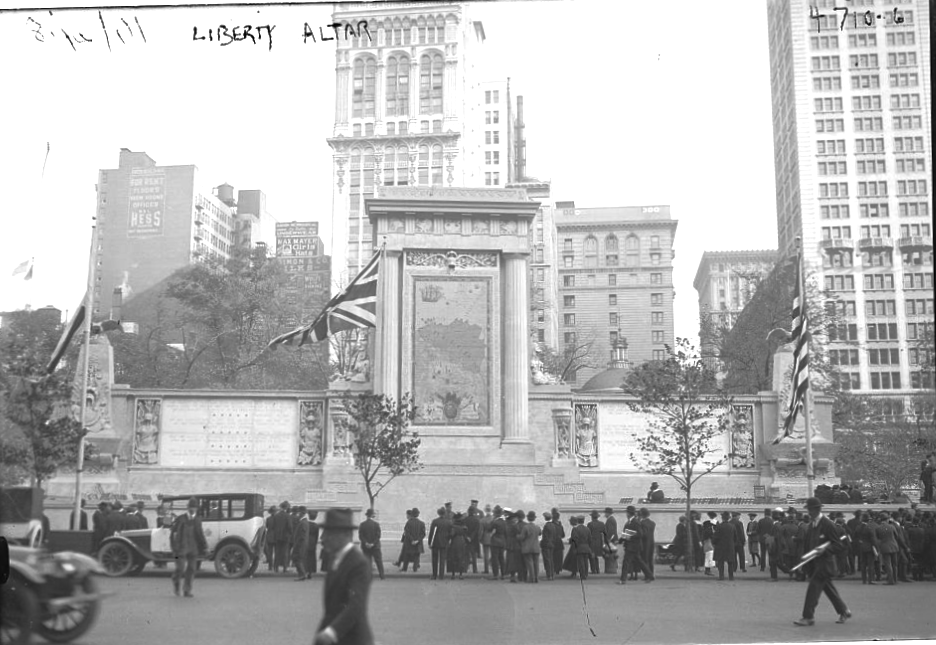
The Altar of Liberty, which would edge up to the sidewalk facing Fifth Avenue, was designed by Thomas Hastings, of Carrere & Hastings.  He incorporated quotations from statemen like Lloyd George, Woodrow Wilson, and Georges Clemenceau into the design.  Hastings explained the neo-Classical structure in Greater New York magazine one year later.  Interestingly, he stressed that his focus was not merely on World War I, but on civilization's fight for freedom in general, including slavery.  He said in part:

On either side of the Altar the chain armor, the shields, helmets and chains symbolize the early spirit of asceticism, mediaeval feudalism and finally slavery in our own time and country overcome by the continuous progress of civilization.  The Altar in its ensemble and in the selected quotations from men who think and men in authority, shown in the large panels at either side, is intended to signify and uphold the real moral issue that this is a war upon the very institution of war itself, to conquer and overthrow militarism in order to establish, with limited armament, reason and justice in all intercourse between nations.

The altar was dedicated by Vice-President Thomas R. Marshall on September 28, 1918.  Several thousand people crammed Fifth Avenue, and the New-York Tribune reported, "the great mass of citizens reacted to the stimulus of great events and lofty utterances by signing their names to orders for bonds--in quietly mobilizing their savings for service in the war."  It was the first instance of a series of Liberty Bond drives to take place at the Altar of Liberty.

The flags of the Allied nations fly during the dedication ceremonies on September 28, 1918.  image via the Granger Collection

There would also be specific days dedicated to each of the Allied nations along The Avenue of Allies and at the Altar of Liberty.  On October 10, 1918, The Christian Advocate explained, "Each avenue block is decorated with the flags of one of the Allied countries, and each day at noon a representative of a different nation is escorted to the altar, where he lays upon it a floral offering and makes an address, which ends with an exhortation to buy bonds."

General Gvosdenovitch speaking at the Altar of Liberty on Montenegrin Day on October 11, 1918.  from the archives of the Department of War, Washington D. C.

In 1920, Valentine's Manual of Old New York described the Avenue of the Allies and the Altar of Liberty:

The Altar of Liberty at Madison Square--an extraordinarily beautiful work of art--was the center of attraction for the crowds who came out to boost the Liberty Loan.  Fifth Avenue was decorated gorgeously.  Such richness and beauty of color was never seen before.  Each block was decorated with the colors of one particular nation of the Allies, and the avenue for the time became known as the Avenue of the Allies.

The Commonwealth, November 26, 1918 (copyright expired)

The flag-lined thoroughfare was memorialized in Childe Hassam's famous series of paintings, known as the Flag Series, in 1918.

World War I came to an end on Armistice Day, November 11, 1918.  That same day the National Sculpture Society met "to discuss ways and means to embody the Altar of Liberty into a permanent 'Victory Arch' that will remain, for all time, as a monument to America's part in the war," reported The Evening World.  The proposed rendering featured an arch of victory, atop which was a grouping of soldiers and a bi-plane, a colonnade, and a fountain and large reflecting pond complete with a submarine. 

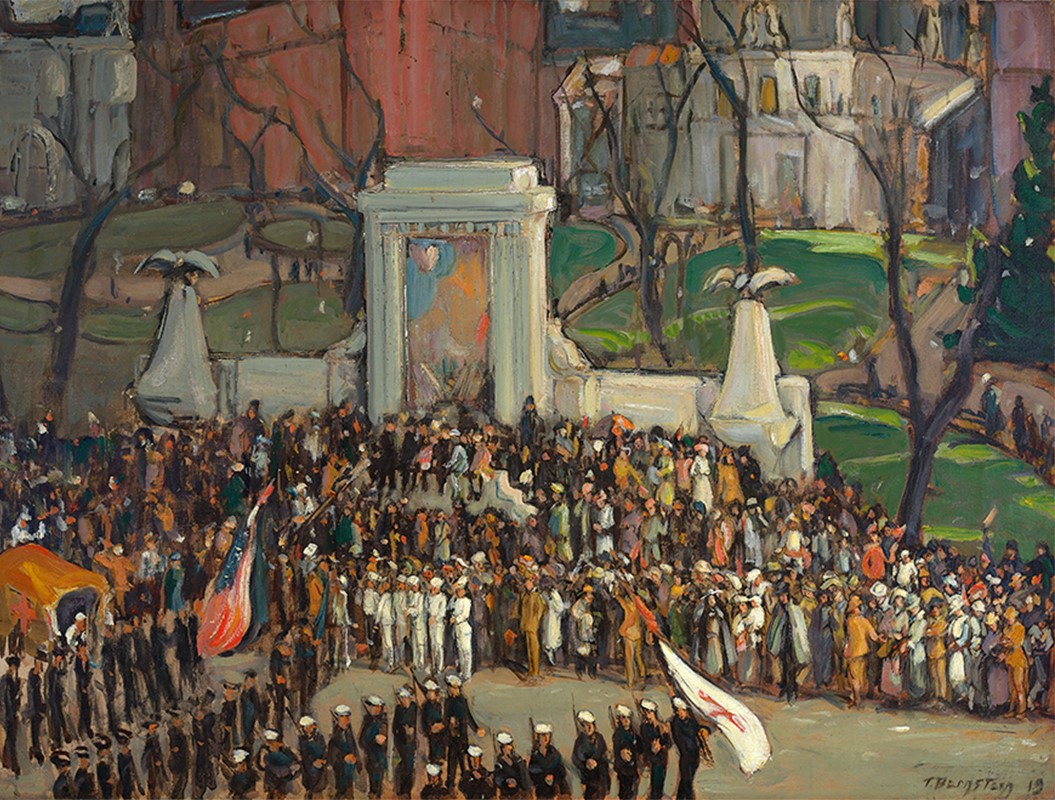
Theresa Ferber Bernstein painted Armistice Day Parade: The Altar of Liberty in 1919.  from the collection of Smith College

Plans for demolishing the Altar of Liberty proceeded quickly.  Robert Davis, a colonel with the Field Artillery in Germany, sent a plea to delay the razing through a letter to The New York Times on December 12, 1918:

I speak for a large number of us to whom has fallen the lot of garrisoning captured areas in Germany during the coming dreary Winter when I ask that you use your influence to prevent the removal of the much-read-of 'Altar of Liberty' from New York until such time as the army shall have been returned to the States.

We feel that we are as anxious to see what you have done in the States as you are to inspect the work accomplished by us here.

Davis got his wish.  As the returning American troops marched up Fifth Avenue, they paused at the Altar of Liberty.  One officer, Colonel William Hayward, echoed Thomas Hastings's thoughts on freedom to the crowd on May 2, 1919.  Hayward was the commander of the "colored" New York 15th Regiment."  Segregated from white troops, the Black regiments were always commanded by white officers.  Standing at the Altar of Liberty at noon that day, he announced, "If there is any one here who does not approve of the principles for which my men fought let them clear out of the country and don't let them buy any Victory notes.  Let those who approve those principles have the privilege of buying."

from the collection of the Library of Congress

Four months later, two million spectators lined five miles of Fifth Avenue to welcome General John J. Pershing and the famous First Division.  The Chattanooga Daily Times wrote, "It was the last great review of the war for New York and it was a fitting climax to a long series of military spectacles."  The article noted, "Perhaps the most impressive moment of the parade was when the soldiers reached the altar of liberty at Twenty-third street, where drums were muffled, colors 'dipped' and officers saluted in memory of the nation's heroic dead."

Shortly afterward, the Altar of Liberty was scrapped.  Proposals to replace it with a permanent structure were discussed for two more years.  After that, the memory of Thomas Hastings "extraordinarily beautiful work of art" faded from memory.

Many thanks to reader Doug Wheeler for prompting this post
LaptrinhX.com has no authorization to reuse the content of this blog

Saturday, November 19, 2022

From Saloon Stabbings to Modern Art -- 132 Tenth Avenue

 
The ghost of the replacement auto glass signage from the 1980's can still be seen between the second and third floors.

In the early 19th century, the neighborhood around Tenth Avenue and West 18th Street was gritty at best.  The New York Police Department described the area near the riverfront at night as "the resort of outcasts, drunkards, dissolute people, and a dangerous class of depredators and petty highwaymen."  With that in mind, Ellen Sheehan, the widow of John Sheehan, must have been a tough, self-reliant woman.  Starting around 1851, she ran a rooming house at 132 Tenth Avenue, a three-story, brick-faced house-and-store.  Its vernacular style exhibited Italianate elements, like the full-height third floor windows, as well as Greek Revival details, as in the understated wooden cornice.

Because Ellen's roomers were transitory, many of them likely sailors, they rarely appeared in city directories.  Those that did were working class.  Living here in 1851 was carpenter William Roberts; in 1858 Patrick Hart, a house painter was here; and in 1861 roomer Henry McLaughlin listed his profession simply as "laborer."

At ground level was a grocery store run by Patrick Hart until around 1865, and by Adam Meinhard afterward.  Then, in 1869, the personality of the space changed drastically when Francis J. McKeogh converted it to a saloon.

Police now had one more rowdy "resort" to deal with.  On May 4 that year, the New York Herald reported, "During a fight which took place last evening in Francis Koegh's liquor store, No. 132 Tenth avenue, Edward Dempsey, of No. 449 West Nineteenth street, was stabbed with a knife in the hand and cheek by a man named John Mann.  Dempsey's wounds are not considered dangerous.  Mann was arrested."

The incident resulted in a complaint against McKeogh and a hearing was held at the Metropolitan Board of Excise on May 10 to decide whether his excise (or liquor) license would be revoked.  The panel judged in his favor--a happy result for McKeogh and a less satisfactory one for the concerned neighbor.

It is impossible to know exactly how many people crowded into the upper floors at any given time.  In 1870 Jacob Martz, a cabinetmaker, was the only resident listed at the address.  There were far more living here, however.  That year small pox broke out in New York City and spread rapidly.  On April 1, 1871, the First Annual Report of the Board of Health reported six cases of small pox at 132 Tenth Avenue.

By 1876 another widow, Catherine A. Hofaner, ran the upper portion of the house.  The former saloon was now the butcher shop of Henry Hobbs.  As might be expected, many of Catherine's roomers were shady.  One was Francis Bethel, alias Francis Rooney, a butcher who possibly worked downstairs.  Bethel had another source of income as well--forgery.  On August 10, 1877 he pleaded guilty to forging a $25 check "purported to be signed by James Goodheart," reported the New York Herald.  "The prisoner was sentenced to four years' imprisonment."

A third widow, Jane Peel, ran the rooming house in 1879.  With McKeogh's saloon gone, her roomers had to go elsewhere to imbibe.  On the night of August 2, 1880, Michael Blassins and John Williams went to the saloon in the nearby boarding house at 284 Tenth Avenue.  Three days earlier, Adolph Wangler had arrived in New York from Germany and taken a room there.   That night he, too, was in the saloon.  Blassins spoke to him, but Wangler, not speaking English, did not respond.  The perceived slight did not sit well with Bassins, who "jumped up and struck him in the face," according to the New York Evening Express.  As if that were not enough, "then Williams picked up a chair and struck him over the head and in the face, which broke the bridge of his nose."  The proprietor called Officer Covert from the street, "who arrested the ruffians."

The unmarried Eliza Rottelersberger found herself pregnant in the spring of 1882.  On March 18, Elizabeth Klink performed an abortion on the girl in her room here.  She died on April 23.  Klink was charged with malpractice.  In court on September 27, her attorney alleged, "Eliza Rottelersberger "suffered from a painful abscess and died from the effects of lead poisoning."

When John J. Duffy purchased the building for $3,775 on February 10, 1898, it was described as a "three-story brick tenement."  The price would translate to about $127,000 in 2022.  Irish-born Mary Moran was likely already living here at the time.  She suffered a horrific accident the following year.  On September 11, 1899, the 31-year-old was crossing Eighth Avenue when she was struck by a trolley.  The New York Times wrote, "her right ear was so badly torn that it will have to be removed."

Duffy's purchase of the building sparked a rapid turnover in owners.  It was sold three times before 1903, and the store changed hands that many times, as well.

The Ryder family rented rooms here in 1903.  Their son, 10-year-old Frank, and a group of boys stripped down to go swimming at the end of a gas company's pier at 17th Street on the Hudson River.  The Sun reported, "the men on the sand schooner Racer, which lay alongside, warned them off."  It was good advice, for, as the newspaper explained, "West Seventeenth street touches a point on the shore line which, with Stevens Point in Hoboken, opposite, forms the narrowest spot in the North [i.e., Hudson] River.  It gets the full sweep of the tide as it swings around from the Weekawken flats."

Ryder, however, was hard-headed.  "He started from the head of the slip and swam toward the schooner to show the men that he wasn't afraid of the tide," said the article.  "Swimming back wasn't such easy work, and after a few minutes' hard struggle with the current, he shouted for help."  Michael Gleason, the gas company's engineer, threw off his jacket and shoes and plunged off the pier.  He, too, was immediately in trouble.

Two more men, David Reilly, the mate from the schooner,  and dock laborer Daniel Moriarty, jumped into the swirling waters.  Reilly reached the boy "just as he had about given up.  Young Ryder was wild with fright and grabbed his rescuer around the neck in a grip that made him helpless," said The Sun.  A watchman on the pier had jumped into a rowboat and reached the two "just as both were about done for." 

In the meantime, Moriarty who "could scarcely swim a stroke," was also in trouble.  Dockworkers threw him a rope and hauled him in.  But Michael Gleason had been swept away.  The Sun reported, "By the time [the rowboat] got them aboard, Gleason had gone under fifty feet away.  The engineer did not come to the surface again."  

Frank Ryder and David Reilly were taken unconscious to New York Hospital where they later recovered.  But the boy's impetuous bravado had cost one man his life and endangered two others.  Michael Gleason left a wife and two children.

By 1917 the ground floor had been converted to Charles Glassman's blacksmith and wheelwright shop.  A large carriage bay was installed and the interior gutted.  Three years later, with horses giving way to automobiles, he adapted the business.  It was now the Glassman-Bartha Welding Corporation.

On July 27, 1939 The New York Sun reported that J. & S. Bear Safety Service, Inc. had leased the building for five years, "for an automobile service station."  (It would more accurately be  called an auto repair shop, today.)


Garage doors served the automobile repair shop in 1941.  via the NYC Dept of Records & Information Services.

A renovation completed in 1956 resulted in a tire shop on the ground floor, an office on the second and storage above.  The building was still used as an automobile shop in the 1980's, home to Mr. Glass, Inc. which installed replacement auto glass.  

And then, the discovery of this section of Chelsea by artists sparked its refashioning.  Former meat packing plants became trendy boutiques, shops and galleries.  On September 5, 1997, Carol Vogel, writing in The New York Times, said, "The migration from SoHo to Chelsea continues faster than ever, with some blue-chip uptown galleries now joining the crowd."  Among the established SoHo galleries to defect was Alexander & Bonin, which left 59 Wooster Street to move into 132 Tenth Avenue.


The space, where once drunken sailors and dockworkers got into knife fights, now displayed modern art, like the 1997 exhibition of works by Willie Cole, and the October 2003 showing of paintings by Stefan Kurtin.  The gallery remains in the space, revealing no hint of the little structure's colorful past.

photograph by the author
LaptrinhX.com has no authorization to reuse the content of this blog

Friday, November 18, 2022

The Thomas Francis House - 349 West 17th Street


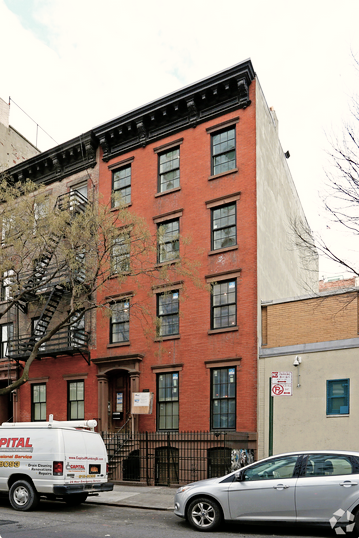
image via apartments.com

The majority of the residents along the block of West 17th Street between Eighth and Ninth Avenues in 1850 were involved in the building trades.  That was not the case, however, at 247 West 17th Street (renumbered 349 in 1868).  Thomas Francis and his son, John, operated a laundry operation.  Also living here was Francis's daughter Helen and her husband James E. Connor.  Connor was the sexton of Chelsea Presbyterian Church on West 22nd Street.

The recently-erected house was one of a row of identical residences.  The Italianate style structure retained hints of the waning Greek Revival style.  Its four stories of red brick sat upon a rusticated brownstone English basement.  The entrance, with its gently arched entablature, was an interesting melding of the two architectural styles.  Molded lintels capped the openings and a bracketed Italianate cornice crowned the design.

The year 1852 was a somber one within the household.  Scarlet fever broke out early that year and by March was spreading among the city's children.  On March 12 an article in The New York Times began, "Among all diseases among children, scarlet fever gives the most terror and has been the most dreaded."  Eight days later the newspaper would report that ten children had died of the disease during the past week.

James E. and Helen Connor's four-year-old daughter, Catharine Maria, was among the earliest victims.  She died on January 28 and her funeral rapidly took place the following afternoon.

The parlor would be the scene of a second funeral that year.  John Francis died at the age of 50 "of paralysis" in September.  The diagnosis normally referred to a stroke, despite his relatively young age.  His funeral was held on October 1.

Two years later, in March 1854, James and Helen Connor had another baby.  They named the infant Thomas Francis Connor in honor of Helen's father.  In a cruel case of deja vu, the little boy died of scarlet fever in February 1856, two months before his second birthday.  In what must have become far too familiar for the family, his funeral was held in the parlor on February 27.

Around 1860, the families left West 17th Street.  It became home to London-born Thomas W. Pyke, his wife Alice and their daughter Harriett.  Pyke, who was a real estate operator, worked from the house.  He advertised, for instance, on November 8, 1863, "To Rent--Three story and basement house 304 West Fourteenth street, East of Tenth avenue; has gas and water fixtures, &c.; immediate possession.  Thos. Pyke, 247 West Seventeenth street."

The melancholy tradition of deaths within the house continued.  One week after his 64th birthday, Thomas Pyke died on April 4, 1864.  Once again, on the afternoon of April 6, a funeral was held in the parlor.

Alice stayed on, now taking in boarders.  In 1864 they were a widow, Margaret Callaghan; John Dax, a printer; and mason James Hamilton.   Soon afterward G. Oelstel moved in, but his residency would be short-lived.  On March 17, 1865 his name was pulled in the Draft Lottery and he left to fight for the Union Army.

There would be another funeral in the house that fall.  On November 19, Harriett W. Pyke died "of dropsy on the heart," according to the New York Herald.  She was just 23 years old.

Around 1866 building contractor William Mulry purchased 349 West 17th Street.  He augmented his income with investment properties throughout the city.  Like Alice Pyke had done, he and his wife took in boarders.  Theirs were quite likely employees of Mulry.  Living with the couple in 1870 were Olin A. Apgar, a carpenter; James P. Voorhes, "carpenter and builder," and John K. Hardy, a painter.

The Mulrys remained at 349 West 17th Street until April 1, 1882 when they sold the house to Maria E. McQuaide for $14,000 (about $385,000 today).  She resold it two yeas later, and it became a boarding house for working-class tenants.  

Charles W. Newman lived here in 1885.  Listed as a "carter," he ran a delivery business and owned "three trucks and a cart," according to his own testimony that year.  Also boarding here were John and Thomas Parks, both laborers.  The two sought to better their circumstances, however.  In July 1885 John Parks was accepted into the Police Department, and Thomas was appointed to the department the following year in May.

Living on the top floor in 1893 were Frank Gau, and his unmarried adult children.  A cabinetmaker, Gau as born in Germany and had come to America in 1855.  The New York Times described him as "industrious and thrifty and succeeded in bringing up a family of three daughters and four sons."

Gau's wife had died in 1888 and, said The New York Times, he "never fairly recovered from the grief occasioned by her death."  To make matters worse, while he had "prospered in business," according to The Evening Telegram, the Financial Panic of 1873 had severely impacted his cabinetry shop and it finally failed in 1878.

Gau had found work with the Hammond Typewriter Company, but because illness, he was forced to retire in 1889.  The Evening Telegram said he was being treated for "heart disease as well as well as for a chronic throat trouble, from which he was at times in danger of being choked to death."  Gau sunk into a deep depression--what at the time was termed "despondency."  During the week of June 19, 1893, he said to his daughter, "Death is slow coming.  I'm a burden to you.  I wish death would come soon."

A week later, on the evening of Sunday, June 25, the 68-year-old attended services at the Eighth Avenue Mission, returning home at 10:00.  The next day The Evening Telegram wrote, "His daughter, on entering his room at five A.M. to-day, saw his body hanging directly over the bed.  He had fastened a rope to a nail and had kicked a chair from under him."  His son, Theodore, cut him down.  The family told a reporter they surmised he "walked around the front room in pain, as as his wont every night, and that the agony become so great as to drive him insane and to a suicide's death."

The residence continued to house respectable, working class tenants through the World War I years.  Like the Parker brothers, Cornelius Mitchell had been appointed to the Police Department in 1894.  Rose Fitzpatrick lived here in the early 1900's, receiving her late husband's police pension of $300 per year (about $8,900 in 2022).

By the 1920's, the tenants of what was now a rooming house were no longer all upstanding.  On May 19, 1922 34-year-old taxi driver Edward Schultz found himself in jail.  That night his cab was involved in an accident at 23rd Street and Ninth Avenue.  His two passengers ran away, leaving behind "three five gallon demijohns containing alcohol," said the New York Herald.  Schultz was "locked up on charges of transporting liquor, and assault."

Three months later, on August 28, 22-year-old William McNamara was one of three men who broke into a the express office of Peter Connelly at 203 West 20th Street.  Pursued by police, he and an accomplice, Thomas Duff, surrendered when shots rang out.  They were charged with burglary.

And on December 9, 1923, another tenant, 33-year-old James McKeaver, was arrested for burglary.  He and John Donnelly had chosen the wrong apartment to rob.  While Donnelly stood outside as lookout, McKeaver slipped into the window of the apartment of former Police Inspector John J. Farrell.   He was rummaging through drawers in the bedroom when Farrell woke up, and grabbed the revolver on the bedside table.  

McKeaver ran out of the apartment and down the stairs toward the basement.  The former cop was right behind him and, when he fired a shot that missed McKeaver's head by inches, McKeaver gave up.  The shot got the attention of a policeman, who saw Donnelly fleeing.  Unlike McKeaver, he ignored the sounds of warning shots and was stopped only when a bullet tore into his leg.

In 1923 the house was sold to Joseph de Allessandro.  The Evening Post remarked, "This is the first sale of the property since 1884."  The next sale would be much quicker.  By 1929 it was owned by Bernard Donohoe, who converted it two a "two family dwelling with furnished rooms," as documented by the Department of Buildings that year.

Living in one of the furnished rooms in 1939 was Jacob Comiskey.  He nearly fell victim to a scam against the elderly that January.  Fifty-two-year-old Samuel Cohen concocted a scheme to steal pension money from old men.  The New York Post explained that he "posed as a Welfare Department physician and asked his victims to strip for medical examination.  Then, he is alleged to have asked them to go into another room for a minute while he robbed them of the small amounts they had in their pockets."

Cohen tried his scam on Comiskey on January 11, 1939.  He knocked on Comiskey's door, identified himself and explained he needed to do an examination.  But Comiskey became suspicious when he was told to go to another room to undress.  The New York Post reported that he "came back into the room in time to see Cohen taking $13.  Cohen dropped the money and ran."  The feisty 70-year-old was not about to let the would-be thief escape and, despite the January cold, pursued him onto the street dressed only in a bathrobe and slippers.  The scene caught the attention of a police officer who arrested Cohen

The following day Cohen appeared in court and so did his accusers.  The New York Post reported, "Shaking their fists in anger, a score of aged and tottering men appeared in Jefferson Market Court today to accuse Samuel Cohen."


A renovation completed in 1978 resulted in a duplex apartment in the basement and parlor floors, and one apartment each on the upper floors.  Then, in 2018, the upper floors were reconverted to a single-family home, with one apartment in the basement level.

uncredited photograph by the author
LaptrinhX.com has no authorization to reuse the content of this blog