Monday, December 24, 2012

The Lost Seymour Hotel -- 44 West 45th Street


The brick and limestone Seymour Hotel (left) was frosted with Beaux Arts decoration -- photo from the collection of the Museum of the City of New York
At the turn of the last century the blocks between Fifth and Sixth Avenues in midtown saw the advent of high-end residential hotels and exclusive clubs as once-fashionable residences one-by-one were demolished or converted for business purposes.  One of the first, the Royalton Hotel for well-heeled bachelors, was erected in 1898 spanning the block from 44th to 45th Streets

Three years later A. G. Hyde would sell four lots on 45th Street, Nos. 44 through 50, and a single lot on 44th Street next to the New York Yacht Club.  On July 24, 1901 The New York Times reported that “The site will be improved with a twelve-story apartment hotel.”

By August of the following year the Seymour Hotel was nearly ready for occupancy.  Built by developers Irons & Todd, it was touted as “fireproof” and “positively exclusive.”  Unlike the Royalton or the Hotel Mansfield which would open on West 44th Street a year later in 1903 the new Seymour was not intended just for bachelors; but was marketed to well-to-do families.  

M. F. Miller was the President of the Iroquois Hotel at No. 49 West 44th Street and his brother, J.  C. Miller, was its Secretary and Treasurer.  On August 16, 1902 they added the Seymour to their responsibilities, leasing the new hotel from Irons & Todd for 21 years at a gross rental of $1,395,900.

The hotel (left) interrupted a row of once-fashionable brownstones on West 45th Street.  By 1910 "Rooms for Let" signs hang on the old houses and at least one has sprouted a commercial addition to the front.  photo from the collection of the Museum of the City of New York
On October 1 the Seymour Apartment Hotel opened its doors to its new residents.    The Beaux Arts building was constructed of red brick with limestone trim, sitting on a two-story rusticated limestone base.  The main 45th Street entrance was framed in a dramatic limestone portico above a set of three stone steps.  The white stone quoins and bandcourses contrasted with the red brick and a sumptuous balcony stretched the wide of the structure at the 10th floor.

On the narrow 44th Street side, the skinny building did its best to keep up.  It mimicked the rusticated base and even the balcony; yet the strange proportions resulted in a gawky, cartoonish structure.

The architects squeezed a compatible entrance on the skinny, West 44th Street, side.  photo from the collection of the Museum of the City of New York
Residents were offered apartments from two to “five or more” rooms with yearly leases.  The magnificent dining room offered both “Restaurant a la Carte” or “Table d’Hote.”   Guests were promised that the hotel was planned “for the comfort of its guests, luxurious and artistic in its appointments.”

Among the first of the wealthy residents to move in were J. H. Taylor and his wife.   Around 6:00 on a Wednesday evening in July 1903 the couple left their apartment, locking the door behind them, and went to the hotel dining room.  Upon their return the door was locked as they had left it; but upon entering the apartment they noticed things were out of place.  Mrs. Taylor discovered $8,000 worth of jewelry missing, including a diamond sunburst, a diamond brooch, several rings and other jewelry that had been left in a chamois bag in the dresser.  Within days three hotel employees were arrested, albeit with no evidence.

J. H. Taylor and his wife returned from dinner in the above dining room in 1903 to find their apartment ransacked.  photo from the collection of the Museum of the City of New York
Howard Montgomery, a bellboy, was fired and arrested on suspicion.  The New-York Tribune said of him “One of the prisoners was a clerk of the hotel, who was discharged because the only reason to suspect him of complicity in the robberyt was the fact that he had passkeys to rooms in the hotel.”

Norman Powell, a 21-year old porter, and Alice Howard, a 22-year old check attendant in the restaurant, also lost their jobs and were arrested.   Adding to the question of their character, Detective Walsh discovered that “the Howard woman and Powell” lived together unmarried.  A search of their rooms found a few items of silverware with the hotel restaurant’s monogram; but none of the jewelry.

Detective Walsh admitted to Magistrate Barlow that “he had no evidence that any of the prisoners were concerned in the theft of the jewelry.”  Nonetheless he requested that they continue to be held on $1,500 bail.

Another of the early residents was General Louis P. di Cesnola, the director of the Metroplitan Museum of Art, along with his daughter, Louise.   Upon the death of his wife, he took an apartment in the Seymour.   A veteran of two Italian wars, di Cesnola had come to New York in 1860 and opened a school of languages.  But the signs of the coming Civil War prompted him to convert his language school into a military academy where he taught militia officers in swordsmanship and tactics.  In 1861 he had 300 pupils and after the firing on Fort Sumter, the Italian offered his services to the Union.

A Colonel of the Fourth New York Cavalry, he was wounded at the battle of Nedia, Virginia and lay for four hours under his dead horse.  Discovered by Confederate soldiers, he was confined to a military prison for the rest of the war.  In 1865 President Lincoln appointed him United States Consul to Cyprus.

There General di Cesnola began his collection of  archaeological artifacts which grew to the point that in 1877 it was regarded as the “most wonderful” collection in the world, according to The Sun.  He sold it to the Metropolitan Museum of Art for about $90,000 that year.  He was made a trustee and director of the museum and worked tirelessly to make it the foremost museum in the world.

The general filled the apartment at the Seymour Hotel with priceless artwork and antiquities and a substantial library of first editions signed by the authors.   

In November 1904 he telephoned the Metropolitan Museum saying he was “a little under the weather,” and asked that his mail be sent to him.  He worked from home that day, dictating letters to his secretary, Mr. Parry,.  The following day he was still not feeling well and summoned Dr. Carlo Savini who diagnosed a severe attack of asthma and a slight kidney complication.  The physician instructed di Cesnola to remain in bed.  “The General didn't like these orders, so he compromised by lounging around most of the day,” said The Sun on November 22.    He went to bed at 9:00 that evening and died an hour later.

A year later the General’s now-married daughter, Mrs. Guy E. Baker, returned from a short trip and noticed that items were missing from the apartment.  “They included paintings, bric-a-brac, clay modelings, ancient antiques and valuable books,” reported the New-York Tribune.    Once again it was an inside job.

The 21-year old elevator boy, Frank McCarthy, was arrested by detectives on May 20, 1905.  In his room at No. 777 Eighth Avenue they had found “costly paintings, antiques and editions de luxe.”  Among the recovered artwork was a painting by Murillo.

Not only did prominent citizens like former United States Senator John P. Jones and socialite Mrs. Jackson Gouraud live here in 1908; but successful entertainers were drawn by the hotel’s proximity to the theater district.   Signor G. Perguini, a singer, was among these, and another was English actor Charles Warner who had become internationally prominent several years earlier in a play titled “Drink.” 

Warner, in 1908, did a one-man vaudeville sketch “At the Telephone,” in which he was on stage for nearly twenty minutes holding an imaginary telephone and captivating audiences.  A member of the Lambs, he was well known in Broadway and theatrical circles.  But by the early months of 1909 he had grown “morose and melancholy,” according to friends.

Around 11:00 in the morning on February 11 he telephoned the front desk asking for a heavy ball of twine to be sent to his rooms.   He then carefully wrote a note in black ink which he pinned to the outside of his sitting room door, along with two checks.  The note read “Hounded to my death by thieves, liars and blackmailers….the criminal lawyer, principal rogue, who preferred to save me from ruin.  They fooled me out of thousands and thousands.  Now he is in prison.  God bless you all!  God bless you all at Lent.  Oh, my dear ones!  Oh, my beloved!”

Warner then closed the doors between the sitting room and his bedroom and made a noose from a valise strap which he fastened to the top of the door.   He stood on a chair and after fitting his neck into the noose, kicked the chair from under him.  Unfortunately for Warner, his neck was not broken and he slowly strangled to death.

The two checks were for $27, to cover his funeral expenses, and $150 to pay for his outstanding bill at the Seymour.

In the meantime Mrs. Gouraud had problems of her own.  She lived in the Seymour only during the winter months, spending the rest of the year at her Larchmont estate or traveling.   In October 1908 she was preparing for a trip to India for two reasons.  “First and foremost, because the East is so mystic, so romantic, so full of adventure,” she told a reporter from The Evening World.  “I adore romance, mysticism, adventure.  Here there is none of it.  Everybody is too busy.  Why, the average New York woman does not know what an adventure is!  A real adventure, I mean.”

But there was another reason she was returning to India.  She had stolen a Buddha from a shrine and needed to return it.  “The last time I was in the East I saw this little ugly god and wanted him.  A man stole him for me—really it was quite dangerous.  But ever since I have had him I have had the most dreadful luck.”

Mrs. Gouraud related that recently a Buddhist woman visited her and was “quite horrified” when she discovered how the socialite came to possess the Buddha.  The visitor informed her that she would never have any luck as long as she kept it.   To neutralize the curse, Mrs. Gouraud hung jewels on the statue and burned incense in front of it.  “But it was no good, so I am taking him back.”

The wealthy woman admitted to the journalist that she just might not return to the Seymour Hotel after her trip.  “Of course I will not remain in India long.  I am considering a permanent residence in Paris.  The people know how to live there—how to get more out of life.  The Orient is glorious, but next to it I think I love France.”

Whether the Buddha-stealing Mrs. Gouraud returned on not, the Seymour continued to fill with wealthy and interesting residents.  In 1912 State Senator John Godfrey Saxe lived here and in 1916 dancer Maud Allen was here.  That year The Evening World remarked that “Few dancers have met with Miss Allen’s success.  Seven monarchs have been her friends—King Edward VII, the Czar, the King of Portugal, the Kaiser, the King of Spain, the Emperor of Austria and King Albert of Belgium.”

At the same time the Russian Baroness de Beckendorf, wife of a Russian army officer, had an apartment here.   As the United States edged closer to involvement in the world war, she held a press conference in her rooms on July 30, 1916 declaring that German chemist C. L. Wettig had attempted to kill her husband, the Baron Beckendorf, before he returned to the Russia army and that he had stolen $1,000 of jewels from her.

“Why that man has even said that I was a German spy,” she exclaimed.  “And to think that only a few months ago I nursed him in my own apartment while he was ill.”

The handsome and popular silent picture actor Robert Harron lived in the Seymour Hotel in 1920.
In 1920 young motion picture actor Robert Harron had come a long way from his childhood home in Greenwich Village.   Called by the New-York Tribune “one of the best-known moving picture stars,” he had appeared in leading roles in D. W. Griffith’s “The Birth of a Nation,” “Intolerance, “Hearts of the World” and other productions.  The handsome leading man was unpacking a trunk in his apartment in the Seymour Hotel on September 1 when a revolver fell from the pocket of a coat.  The weapon fired as it hit the floor, sending a bullet into the actor’s chest.

Five days later, at the height of his career, the dashing actor died of his wound.

The once-magnificent midtown hotels suffered in the latter part of the 20th century as new, modern hotels and apartment buildings left them dowdy and somewhat seedy.  On January 19, 1981 New York Magazine remarked about the Seymour Hotel.  “An AAA sign hangs out front, and, inside, the dim lobby and corridors—with the obligatory red carpet—give off a sense of better days gone by…Not as Spartan or desperate as some, it’s just…cheerless; call it a 4 on the Depression Scale.”

On 45th Street, the brick and limestone facade has been replaced with glass and steel -- photo by Alice Lum
While some of the old hotels—like the Royalton—were reclaimed with multi-million dollar makeovers; it was not to be for the Seymour Hotel.  In 2000 it was demolished, replaced with the soaring 30-story Sofitel which, almost ironically, has its main entrance at the skinny little plot on West 44th Street.
The thin 44th Street side is now the main entrance to the new hotel.  Next door the last 19th century carriage house on the block still holds on -- photo by Alice Lum

Saturday, December 22, 2012

The B. Altman Store -- No. 615-629 6th Avenue


photo by Alice Lum

Philip Altman ran a moderately-sized dry goods store on the Lower East Side in the first half of the 19th century.  A later account would remember him as “for many years well and favorably known in the district devoted to that trade.”  Customers would often find Altman’s two sons, Morris and Benjamin, working tirelessly behind the counter.

Benjamin left public school at the age of 12 to enter his father’s business in 1855.  The young salesman learned the business, paying particular attention to his brother’s ideas of handling a retail operation.  When their father died in 1863, the boys continued running the store and Morris reorganized it as Altman Brothers.

Morris Altman’s ground-breaking business sense was a major force behind the Early Closing Association, which pushed for the shortened work day of dry good clerks.  America’s Successful Men of Affairs called him, “A man of fine presence, splendid address and talent as a speaker on economic, social and business subjects.”  The business flourished and a new, larger store was acquired on Third Avenue at 10th Street.  Quickly Altman Brothers outgrew that space and the operation was moved to an even larger store on Sixth Avenue at 21st Street around 1869.  It was a propitious move—the brothers would be among the first dry goods merchants along the stretch of Sixth Avenue that would become known as The Ladies’ Mile.

In 1876, at the young age of 39, Morris died.  Only a few months later, his wife died, leaving their four children orphaned.  The unmarried Benjamin took in the children to rear.  That year he began plans for an even larger, more impressive store.  He leased the land two blocks south at the southwest corner of 19th Street and Sixth Avenue from Jacob Dodge for $20,000 per year for 21 years, with the right to renew for another 21 years at the same rent.

Architects D. & J. Jardine were given the commission to design an imposing new emporium—the first of the grand retail houses along the avenue.  The brothers, David and John Jardine, had gone into partnership in 1865 and were among the most respected architects in the city.  Eight years after the Altman commission, New York’s Great Industries would say they had “erected the most important buildings, both public and private, of any firm in the city.”  For Benjamin Altman’s new store they produced a four-story, neo-Grec structure that predicted the other grand emporiums that would follow.

The cast iron façade allowed expansive windows and, therefore, additional daylight into the sales floors.  The incised decorations on the pilasters reflected the Eastlake movement which was all the rage in furniture, home décor and architecture at the time.

photo by Alice Lum

The new store opened in 1877 and only three years later the architects were called back to extend the building back 50 feet along 19th Street.  Yet even that could not contain Benjamin Altman’s successful business.  As stores lined the avenue from 14th Street to 23rd Street, Altman’s was one of the most prominent.  Within a few years, the elevated train ran down the center of 6th Avenue, making travel to the Ladies’ Mile convenient for all classes of shoppers.  Benjamin Altman needed more retail space.

In 1887, a new addition extended the store in an L-shape around the building still standing at the corner of 18th Street.  Designed by William Hume, the extended Sixth Avenue facade closely mimicked the original by the Jardine Brothers.  The New York Times remarked on September 25, 1887, “The wisdom of increasing the capacity of the establishment to twice its former size has already been demonstrated.  The patronage has more than kept pace with it, but there is far less difficulty in passing from one point to another than formerly, and most of the old bustle has been pleasantly dispensed with.”

By nearly matching the original design (right) the additions were nearly seamless -- photo by Alice Lum

The main entrance was, of course, on Sixth Avenue.  Near the entrance on 18th Street, a convenient flight of steps led to the elevated train.  For the more affluent shopper, a carriage entrance was located on 19th Street, removed from the more pedestrian consumers.

The store now had all the modern conveniences.  “Pneumatic tubes have taken the place of the cash boy or girl, and gas has been given the cold shoulder for electric light,” reported The New York Times.  There were now four passenger elevators and three freight elevators.  As his brother had done, Benjamin Altman remembered the conditions of his workers.  He installed a “comfortable lunch room” for employees and seats behind the counters—an unheard of luxury for salespeople. 

The millinery department was located in the new section, with a large portion of the stock made expressly for Altman’s in Paris.   The New York Times remarked on the dress goods department’s “magnificent stock of silks and velvets just imported, and an unusually large stock of brocaded velvets, in which special bargains are offered.”

The incised line decorations were typical of the Eastlake movement -- photo by Alice Lum

Although Altman’s welcomed the middle-class shopper, the carriage trade was not forgotten.  Gowns from Worth and Pingat of Paris were offered, as were bonnets from Madame Eugenie’s and Virot’s.  On April 12, 1888, The Evening World commented on the store’s newest imports from Paris.

Calling the bonnets and dresses “marvels of beauty and elegance,” the article said “There are dresses for seashore, country and city, for spring and summer wear.”  One dress, appropriate for the seashore, caught the writer’s attention.  “It is called the ‘handkerchief dress,’ being composed of eighteen handkerchiefs.  It is both novel and pretty and is sure to charm the mind of any lady who views it.  A lady could stand all day admiring the numerous other dresses that fill the store, for they are so enchanting.”

The article also made note of another novelty.  “There is a bonnet, which this firm is the only importer of, that will surely gain popular favor.  It is called the flower bonnet.  It represents a full-grown geranium.  There are also other flowers represented.”

By now Benjamin Altman was a wealthy man.  He was amassing one of the great art collections in the city and enjoying world travels.  He left for a world tour in May 1888, traveling overland to California then taking a steamer to Japan.  In February 1889, The New York Times updated readers on his whereabouts.  “He has during his nine months’ absence visited Japan, China, India, Ceylon, and is now in the land of the sphinx.”  The merchant was on his way to Paris to visit the Exposition, expecting to reach home in August or September.

In his absence, trouble was brewing back home.  James L. Dodge owned the land on which the Altman dry goods store stood.   It was his father who had negotiated the lease and “Young Dodge became convinced some time ago that his father did not know what he was about and that the ground rent was worth much more,” said The New York Times on August 4, 1889.

Although Benjamin Altman was current in the rent, Dodge wanted more for the land, despite the lease.  “Imagining that on this account he had a grievance against Mr. Altman,” said the newspaper, “he has since made himself variously offensive.”

It all came to a head when he stormed into the store demanding to see Altman.  When he was informed that the owner was away, “he made a disturbance which startled the customers on the street floor and drove some of them out.”  When a policeman arrived, Dodge “wilted” and at the station house broke down crying.  After he tearfully apologized to Justice Ford, saying his “feelings got the better of him,” he was fined $10 and let go.

Benjamin Altman’s business continued to grow and on March 7, 1900 The New York Times reported that “B. Atlman & Co. of Sixth Avenue propose to materially enlarge their commodious stores in the near future.  The firm has just purchased sixty-five feet of additional ground on West Nineteenth Street from Edward Jansen and others.”   But changes were coming to The Ladies’ Mile.

Roland Macy’s department store had anchored the southern point of shopping district at 6th Avenue and 14th Street.  But in 1902 he made a startling move.  Leap-frogging the slow northern expansion of the shopping district, he relocated to Herald Square, far north of the other emporiums.  It was the first domino to fall in what would be the end of an era.

Benjamin Altman was the next to follow.  On December 11, 1904, The Sun reported that the merchant intended to build “an enormous store” on Fifth Avenue, diagonally across from the exclusive Waldorf-Astoria Hotel.

Two years later, as his new white marble palazzo was being completed, Altman sold the Sixth Avenue building to Henry Morgenthau and Joseph B. Greenhut for $2.5 million.   Greenhut was a Gettysburg hero who retained the title of Captain.  He and his son, Benedict, had joined the Siegel-Cooper store operation, across Sixth Avenue, in 1896.  In 1902, the father and son team had bought out Henry Siegel.

The Altman building is framed by one of the grand arches of the Siegel-Cooper store --- photo by Alice Lum

In buying Altman’s 88,000-square-foot structure, the men were stressing their faith in the continuance of The Ladies’ Mile.  With the Sixth Avenue subway project in the planning stage, they told The New York Times, “this section will become even more firmly intrenched as the great shopping centre.”

On September 17, 1907, the old Altman store reopened as Greenhut & Co. drygoods.  The new store marketed itself as upscale and borrowed Tiffany’s idea of a trademark color.   The New-York Tribune noted that even the announcements that were sent out had a “note of distinction.”  They were:

a delicate green, technically known as mignonette color, and the wrapping paper is going to be of the same tint.  So also will be the string and the boxes.  The stock boxes, too, will be of this charming color, which looks very pretty against the wood.  The uniforms will be of an unobtrusive green whipcord and the wagons will be painted dark green.

The firm intends to make this distinctive color the keynote of the store, the outward expression of a certain uniqueness.

The management handed each employee a rule book that laid out the expectations of treating the customer courteously.  The store had its own blacksmith shop to take care of the dray horses, “and there will be four autos for the transportation of heavy merchandise,” said the New-York Tribune.   Customers with automobiles could use the department store’s garage.

In 1909, the Greenhuts hired the well-respected architectural firm of Buchman & Fox to enlarge the building yet again.  The three brick buildings at the corner of 18th Street were demolished, and the store now filled the entire block.  The architects skillfully copied the original 1876 cast iron front, creating a single unified structure of what was, actually, a patchwork of successive additions.

The 1924 fifth story addition paid little heed to the original design, seen here in 1948 -- photo collection of the Museum of the City of New York

As stores continued to move away from Sixth Avenue, Captain Greenhut remained steadfast.  In February 1911, he merged his two gargantuan stores under the name Greenhut-Siegel Cooper Company.  In doing so he announced, “Sixth Avenue from Fourteenth to Thirty-fourth Street is the centre of the retail business not only of New York City, but of all the surrounding territory, and we won’t see much change in our lifetime.”

When a reporter brought up the poor retail performance of the past holiday season, Greenhut reasoned, “The dullness this Winter has been due to several causes, all of which, in my opinion, are temporary.”  He blamed politics, the high cost of living, and the automobile.  “The automobile craze has been another factor.  Cars have been bought by people who have to spend a large part of their incomes in keeping them up.”

In fact, Greenhut was fighting a lost battle.  In 1914, the Siegel store failed and the following year the Greenhut company collapsed.  Although the Greenhuts fought valiantly, reorganizing as the Greenhut Company, the firm was liquidated in 1918.  Captain Greenhut finally had to admit that days of the once-fashionable Ladies’ Mile were over.

“As one after another big concerns quit and moved away we were left high and dry to fight the fight alone,” he said.  “We found the neighborhood pretty well destroyed as a shopping centre, and we suffered much for the misfortunes of others”

The store was leased in May 1921 to The Manufacturers’ Exhibition Company, Inc.  The company had recently been  organized “for the purpose of pushing export sales of machinery.”  The president, L. R. Duffield, explained that “New York sells more machinery than all Europe, and New York needs a permanent exhibition centre…The exhibition in the Greenhut Building will be the most complete machinery exhibition in the world.”

In 1924, architects G. & H. Boehm were commissioned to remove the cornice of the southern 1909 section and erect a fifth floor.  Unlike the previous alterations and additions which had faithfully copied the 1876 architecture, this was a nearly-industrial design that offered no apologies to integrity of the original design.

photo by Alice Lum

The grand emporium where ladies once shopped for “French lingerie, tea gowns, matinees and toilet robes,” became loft space for  manufacturers.  Men’s clothing makers and other small factories occupied space in the 1930s.

By the 1970s, the former Ladies’ Mile was nearly abandoned and its once impressive buildings were in serious disrepair and neglect.  A renewed appreciation for the structures sparked a renaissance and in 1982 the first renovation of the rusting hulk of the Altman building resulted in six “class A” apartments on the fifth floor.

Today the cast iron façade is painted gray and the entire first floor contains a Container Store.  The Ladies' Mile is once again a vibrant shopping and residential district and the old B. Altman store survives, even at street level, nearly unaltered.

Friday, December 21, 2012

The Virginia O'Hanlon House -- 115 W. 95th Street


photo by Alice Lum

By the late 1880s the block along West 95th Street, between Columbus and Amsterdam Avenues bore little resemblance to the Charles Ward Apthorp estate of a century earlier.   Now speculative rowhouses lined the streets, most designed by architects Charles T. Mott and William J. Merritt.

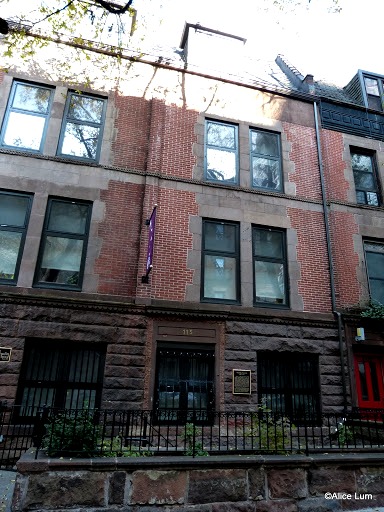
Among the Merritt-designed structures was 115 West 95th Street—one of a string of six somewhat boxy brick-and-brownstone homes that stretched from 111 to 121 West 95th Street built by developer Charles Bouton.   A rusticated, rough-cut brownstone first floor served as a base for two stories of red brick.   Brownstone quoins framed the paired, centered windows and each peaked, tiled roof was interrupted by a single dormer.

115 West 95th Street was near towards the center of the row, marked by the purple banner above -- photo by Alice Lum

The six harmonious homes were intended for middle class families, like that of Dennis Moloney, a meat merchant, who moved into 115. 

At the time, Dr. Philip F. O’Hanlon was making a name for himself in the medical community.  O’Hanlon’s family had a medical tradition—both his father and grandfather had practiced medicine on East 18th Street.  Philip earned his medical degree from New York University in 1886 and immediately became House Surgeon at Gouverneur Hospital until 1887.  In 1891 he was appointed Medical Examiner in the Insurance Department of the State of New York.  But after 1895, when he became the City’s Coroner’s Physician, Philip F. O’Hanlon’s name became a household word.

The doctor and his wife, the former Laura Lincoln Plumb, had one daughter, Laura Virginia, who was born in 1889.  The year after receiving his position in the Coroner’s Office, he leased 115 West 95th Street.

photo by Alice Lum

The year 1896 was a busy one for Dr. O’Hanlon.  He performed the autopsy on Eveline M. Bliss, the victim in a notorious murder case, and testified at the trial of her daughter, Mary Alice A. Fleming.   Mary Fleming was charged with having put arsenic into the clam chowder she served her mother.

A headline in the New-York Tribune on May 29, 1896 read “DR. O’HANLON TESTIFIES,” and the article informed a shocked public that “Dr. Philip F. O’Hanlon, who conducted the autopsy on Mrs. Bliss’s body, was the most important witness yesterday, and his testimony was that in his opinion death was caused by arsenical poisoning.”

The following year he broke the sensational Geldensuppe murder case by detecting an obscure clue that resulted in the unraveling of the murder mystery, leading to the conviction of the murderer.  The case had all the scintillating and gruesome trappings of a crime novel—a dismembered corpse, a menage-a-trois, and shocking extra-marital affairs.  The New York Journal called it “a murder, most foul, deliberate, mysterious and terrible.”  The case firmly established Dr. Philip F. O’Hanlon’s reputation and renown.

The same year that O’Hanlon was instrumental in solving the Geldensuppe case, he was forced to tackle another difficult question.  Little 8-year-old Laura Virginia O’Hanlon—known as Virginia to the family—faced a problem that summer.  Her school friends chided her for still believing in Santa Claus.

When she asked her father if, indeed, Santa existed, he deftly passed the onus of an answer to The New York Sun.   So, relying on her father’s professed unswerving faith in the veracity of the newspaper, little Virginia penned a letter to the editor:

Dear Editor:
I am 8 years old.  Some of my little friends say there is no Santa Claus.  Papa says, “If you see it in The Sun it’s so.” Please tell me the truth; is there a Santa Claus?
        Virginia O’Hanlon 115 West Ninety-Fifth Street

On September 21, 1897 a reply was printed to Virginia’s touching query.  In what was doubtlessly a carefully thought out response, the author—assumed today to be 58-year-old Francis P. Church—dexterously answered the question while avoiding the obvious pitfalls in his path.

Laura Virginia O'Hanlon in 1897 -- thebluegrassspecial.com

The editorial began “We take pleasure in answering at once and thus prominently the communication below, expressing at the same time our great gratification that its faithful author is numbered among the friends of THE SUN.”   In what would become the most famous and celebrated editorial in the history of newspaper journalism, Church wrote:

Virginia, your little friends are wrong.  They have been affected by the skepticism of a skeptical age.  They do not believe except they see.

You might get your papa to hire men to watch in all the chimneys on Christmas Eve to catch Santa Claus, but even if they did not see Santa Claus coming down, what would that prove?  Nobody sees Santa Claus, but that is no sign that there is no Santa Claus.  The most real things in the world are those that neither children nor men can see…Nobody can conceive or imagine all the wonders there are unseen and unseeable in the world.

Church’s long and moving column ended “No Santa Claus!  Thank God!  He lives and he lives forever.  A thousand years from now, Virginia, nay, ten times ten thousand years from now, he will continue to make glad the heart of childhood.”

Although Dr. Philip F. O’Hanlon was a celebrated and well-known physician and nerve specialist; his little 8-year-old daughter’s heart-felt appeal to The New York Sun would eventually make her the famous member of the family.

A year later the country became embroiled in the bloody Spanish-American War.   Philip F. O’Hanlon, along with Hamilton Williams and Edward J. Donlin—also Deputy Coroners—applied to the War Department to go to war either as soldiers or physicians.    O’Hanlon became a lieutenant in the Medical Reserves Corps.

photo by Alice Lum

After four years of renting 115, Dr. O’Hanlon purchased the house across the street at 121 West 95th Street.   Later that year, on December 27, he nearly lost his life when a horse drawing a coach in which he was riding “took fright” and ran wildly down 42nd Street from Broadway.  The coach swayed from side to side, banging into other vehicles, until it struck an electric automobile at Tenth Avenue.  The collision caused the horses to pause just long enough for the doctor to jump from the coach.

By 1920 the O’Hanlon’s former residence at 115 had become a boarding house, owned by Elizabeth Brogan.   Among the 11 residents was the 35-year-old motion picture actress Maude Wecherley.   In the winter of 1920, Patrolman John Delaney came across Wecherley “entertaining a crowd on the sidewalk at Eighty-ninth Street and Columbus Avenue by singing in the small hours” of December 21.  The singing actress was wearing glittering jewelry which concerned the policeman.  And so he arrested her.

Delaney testified in the West Side Court “On account of the crime wave I thought it would be best to take her in before somebody got her diamonds.”  Apparently the movie actress, who went by the screen name of Maude Vancott, was unperturbed by the temporary loss of her freedom.  According to the New-York Tribune the following day, she “thanked the patrolman for his thoughtfulness and Magistrate Mancuso suspended sentence.”

The house on West 95th Street went through a quick succession of female owners.  In 1920 Elizabeth Brogan sold it to Helen Egler.    Florence Hull purchased the property next while 35-year old Simon Sunarian, a Russian-born “lecturer” was living here.  Hull leased it in October 1927 to Helen Wandrie for five years.  In 1957 the property was converted to apartments—two per floor including the basement.

As the century progressed, the neighborhood noticeably declined.  In 1965, 115 West 95th Street was taken over by the City of New York as part of an urban renewal scheme intended to clean up the now-derelict homes along the block.

No. 115 and its reportedly "rat-infested" neighbors are boarded up in 1969 -- photo NYPL Collection

In the meantime, little Laura Virginia O’Hanlon was all grown up.  A retired teacher, now Mrs. Douglas, she granted repeated interviews regarding her now-famous letter and the responding editorial, and received hundreds of letters.   She never took credit for the iconic Santa Claus prose.  “All I did was ask the question,” she later told her nephew, James Temple.  “Mr. Church’s editorial was so beautiful…It was Mr. Church who did something wonderful.”  Virginia O’Hanlon Douglas died on May 13, 1971 at the age of 81.

In 1974 a well-intentioned resident of the block, Jeanne Beaty, purchased five of the houses from the City for about $35,000 each.   Among the homes she intended to renovate as investment properties was 115.  Unfortunately Beaty’s ambitious plans never came to fruition and two decades later the structures had decayed to decrepit, vacant hulls.  Legal battles dragged on until, finally, the city repossessed the buildings in 1992.  The following year Moshe Shrem purchased three of the empty shells, including 115.  Shrem paid about $175,000 for the former O’Hanlon house.  The deal with the city required the buyer to reconstruct the property within six years.

In 2001, according to Department of Buildings records, 115  West 95th Street had been renovated to a single family residence with an apartment in the basement.  The house was put on the market that year for $2.7 million.

No. 115 lost its front door when it was combined with its neighbor to the left -- photo by Alice Lum

Then, in 2009, it and the matching house next door were purchased by The Studio School—a private institution for gifted students from kindergarten to adolescent ages.  The two houses were internally combined and converted to classrooms.  Although the original interiors are gone, the quirky Late Victorian façade of 115 survives—a vestige of a time when a childless newspaper editor assured little girls and boys worldwide that, indeed, Santa Claus “exists as certainly as love and generosity and devotion exist.”

Thursday, December 20, 2012

The 1836 St. James Church -- 32 James Street


photo by Alice Lum

America may have been founded on religious tolerance, but that tolerance was mainly intended for Protestants.  During British rule, Roman Catholic worship was outlawed in New York City, and as the 19th century dawned, two religious groups still suffered brutal discrimination: the Jews and Catholics.

Both persevered, however, and the stalwart Catholics collected funds to erect churches for its growing population.  In 1833, St. Mary’s Church on Grand Street, founded by Irish immigrants, was dedicated after its original building had been burned in a savage display of anti-Catholic and anti-immigrant sentiment.  The same year, the cornerstone of St. Joseph’s Church uptown, in Greenwich Village, was laid.  As that building began rising, parishioners were forced to stand guard against attacks, according to church historian John Talbot Smith.

Two years later, construction began on St. James Church at 32 James Street.  The Gothic Revival style that would become nearly synonymous with church architecture was still years off and American churches tended to be of the “temple order.”   The Greek Revival style was additionally attractive to Catholics because it suggested permanence and strength—a message to anti-Catholic bigots that the religious group was here to stay.    Predictably, this was the style chosen for the new structure.

Completed in 1836, St. James Church was one of three Roman Catholic churches dedicated that year—the others being Transfiguration on Chambers Street and St. Paul’s Church far to the north in Harlem. 

The architect, whose name has been lost, outdid himself.  The sophisticated design and detailing was similar to that of the influential architect Minard Lafever.  The handsome proportions and the refined decorative elements resulted in a nearly unparalleled monumentality.  

Sophisticated detailing is evident in a side entranceway, photographed around 1915 -- collection of the Museum of the City of New York

Constructed of fieldstone and clad in dressed brownstone, the church sat above a broad set of stairs.  Two massive fluted columns upheld the recessed porch, flanked by two separate entrances with handsome Greek Revival ornamentation.  Breaking away from what contemporaries called, “pure Greek,” the architect added a Georgian domed cupola to the classic pediment.  Across the brownstone face was carved “D.O.M.S. JACOBO DEO OPTIMO MAXIMO”–To God, the Best and Greatest.

Not long after this photograph was taken, the splendid cupola would be removed -- collection of the Museum of the City of New York

To protect themselves from anti-Irish violence and partly in response to the burning of St. Mary’s Church, immigrants met in the new church in 1836 to form the Ancient Order of Hibernians.  It would be the beginning of a deep and long-lived bond between the Irish community and St. James Church.

The congregation was led by a succession of Irish-born priests.  In 1842, the Rev. Dr. John N. Smith took the pulpit.  It was a time when New York was seeing an increasing (and, for some, alarming) number of Irish immigrants as they fled the Great Irish Famine.

On St. Patrick’s Day in 1844, The Young Friends of Ireland celebrated in the Apollo Saloon.  After several speeches, a series of toasts were made, the eleventh of which was “The Hierarchy of Ireland.”  Raising his glass the toaster proclaimed, “Honor to them, for all the wealth of the richest nation of the earth could not induce them to sanction the union of church and state.”

Among the boisterous crowd was the Reverend Smith.  The New-York Daily Tribune noted that he, “responded to ‘The Hierarchy of Ireland,’ in a happy and appropriate manner; he pronounced a high eulogy on the Catholic Clergy, their well-tried fidelity to their sacred trust, and to the cause of the liberties of mankind.”

photo by Alice Lum

As the immigrants continued to arrive on the overcrowded and unsanitary sailing ships, they were exposed to typhus, what was at the time termed “ship fever.”  In 1847, Father Mark Murphy was in charge of tending to the patients of the quarantine station of Station Island.  As he lay dying of the disease, Father Smith rushed to his bedside.  He, too, contracted ship fever and in February 1848 the Rev. Dr. Smith died “a martyr to charity,” as later described by historian Alphonso T. Clearwater.

Despite the obstacles it faced through its early years, St. James grew and prospered.  In 1865, Father Thomas Farrell was called to New York “to take charge of an immense congregation attached to St. James’ Church,” as recorded by Clearwater half a century later.

photo by Alice Lum

On December 30, 1873, a son was born to Thomas and Catherine Mulvihill Smith.  Little baby's grandparents were all immigrants, Irish on his mother’s side and Irish-German on his father's.  Before becoming Governor of New York and the first Roman Catholic candidate for the U.S. Presidency, Smith served as an altar boy in St. James Church.  While still a teenager, he boasted that his church held its own with the great St. Patrick’s Cathedral, saying it was the “leading Catholic parish in New York, not excepting the cathedral itself.”

The Lower East Side neighborhood of James Street changed in the 20th century as the Italian and Irish population was replaced by a new group of immigrants: the Chinese. 

Although at some point, possibly in 1929, the attractive cupola was removed, the structure retained its fine proportions.  When the Landmarks Preservation Commission designated the building a landmark in 1966, it deemed it, “one of the monuments of the Greek Revival in New York City.”

The venerable structure was threatened in 1983 when the roof was found to be in danger of collapse.  After nearly a century and a half of service, the city closed the structurally unsafe St. James Church.

The Ancient Order of Hibernians, which was founded in the building 147 years earlier, took up the cause.  It spearheaded a group of concerned citizens that provided the funds for a complete restoration.

A firefighter scales a ladder towards the burning roof -- photo DNAinfo/Ben Fractenberg

Then in January 2011, a two-alarm fire, apparently electrical in nature, broke out inside the historic church.  An hour-and-a-half after the first firefighters arrived, the blaze which was located between the ceiling and the roof, was finally brought under control.  There was significant damage, mostly the result of water.

The sedate and noble façade of St. James Church, a true architectural treasure, gives little indication of the ordeals overcome by its founders and early parishioners.

photo by Alice Lum