Showing posts sorted by relevance for query 18 east 76th. Sort by date Show all posts

Thursday, July 3, 2014

The Henry Block House -- No. 18 East 76th Street


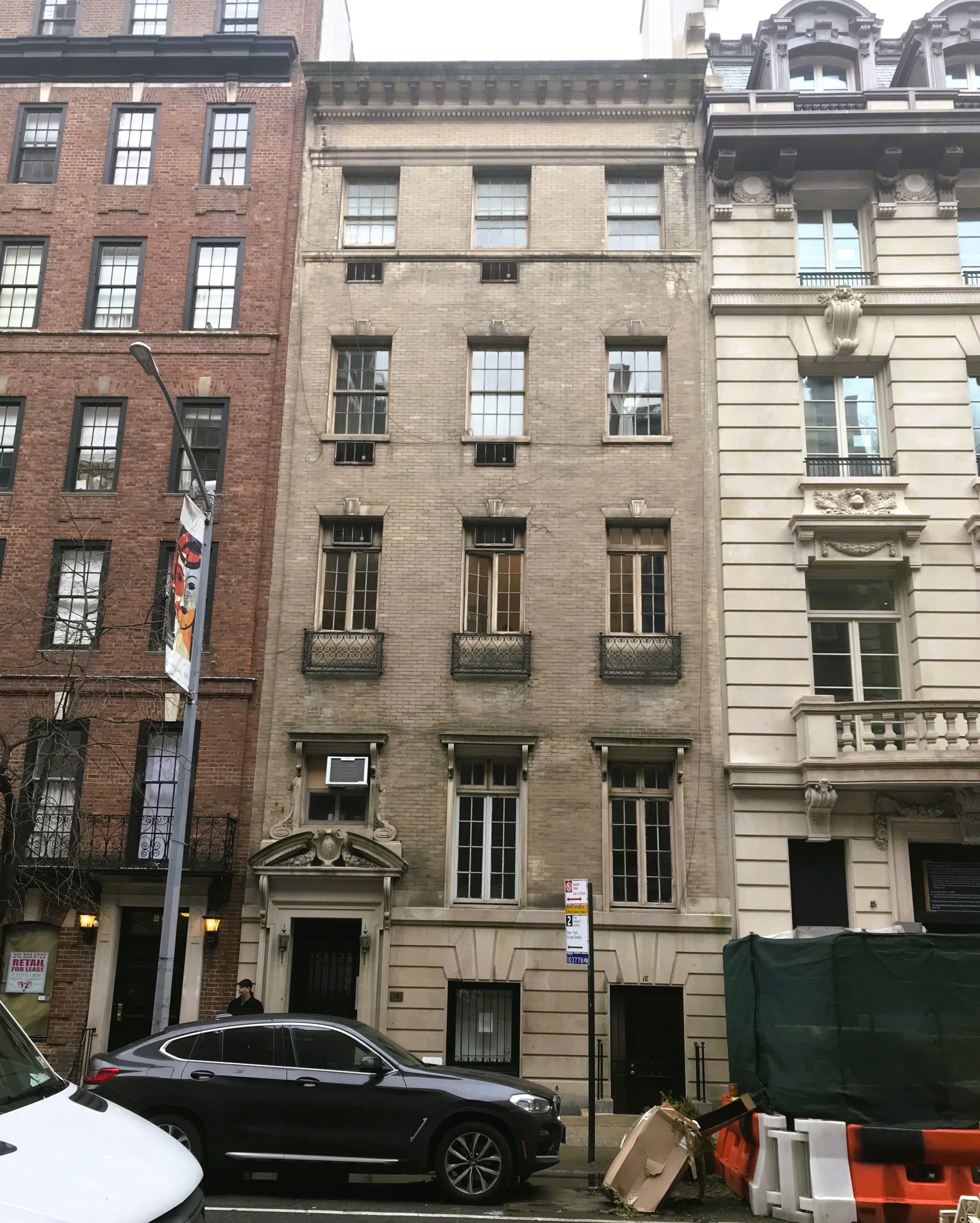
In 1906 when Henry Block and his wife, Alice, laid plans to update their Victorian brownstone at No. 18 East 76th Street, they were climbing on a renovation bandwagon that stretched from Murray Hill to the Upper East Side.  The streets of these upscale neighborhoods were lined with comfortable rowhouses mostly constructed during a building flurry following the Civil War.  Now wealthy homeowners hired the best architects to upgrade their homes into fashionable and modern Edwardian mansions.

The Blocks’ house had been designed by John G. Prague for speculative developer William Noble.  It was one of ten identical residences that stretched from No. 10 to 28.  Construction began in 1881 and was completed a year later.  No. 18 would sit unoccupied for a year and a half.  Then, on May 31, 1884 The Real Estate Record & Builders’ Guide reported that William Noble had sold “the four-story and basement brown stone house, No. 18 East Seventy-sixth street…with a three-story extension, to George C. Clausen, the brewer, for $65,000 cash.”

George Caspar Clausen’s cash outlay would amount to about $1.5 million today.  As The Guide intimated, Clausen was indeed a brewer; a member of Henry Clausen & Sons.  George’s father, Henry, had arrived in New York from Bremen, Germany and, after trying his hand at the mercantile business, turned his focus to brewing beer.

New York State’s Prominent and Progressive Men said, in 1902, that “seeing the vast opportunities in the rapidly increasing popularity of beer as a beverage, he founded in New York city the great brewing establishment of Henry Clausen & Sons.”  When young George graduated from a military college in Maryland and then returned home from studying in Germany, he was taken into his father’s brewery as a partner.

George was more than a brewer, however.  He was head of the insurance firm Clausen, Bayley, & Kearney, and on January 4, 1893 was appointed by Mayor Gilroy a Commissioner of the Department of Taxes and Assessments.  By the turn of the century he would be President of the Park Board, and a Park Commissioner.

The family would grow within the house to include a son and daughter.  George’s wife went about the routine expected of the wife of a wealthy businessman (The New York Herald mentioned that “An afternoon tea will be given by Mrs. G. C. Clausen at No. 18 East Seventy-sixth street on February 1” 1887); while her husband busied himself with his clubs.  Clausen was not only President of the New York Riding Club; he held memberships in the Democratic, New York Athletic, the Larchmont Yacht clubs, as well as the Liederkranz and Arion societies.  New York State’s Prominent and Progressive Men added, “He is also a member of the New York Driving Club, and is one of the best-known horsemen on the pleasure drives of New York.”

By 1901 the Clausen’s daughter was reaching her coming-out age, and their son was off at Princeton.  That year they sold the 76th Street house to the Henry and Alice Block.  It would appear, though, that the new owners had second thoughts.  On April 18, 1902 the New-York Tribune reported “Alice A. Bloch [sic] is reported to have sold No. 18 East Seventy-sixth-st., a four story and basement dwelling house.”

If they intended to sell, the deal fell through and instead the house was leased to Mrs. Douglas’s School.  The exclusive girls school had been instructing the daughters of Manhattan’s wealthiest citizens for half a century.  Mrs. Douglas’s School accepted only 25 pupils at a time, charging their parents $1500.00 per year in 1905—just under $40,000 today.

But that same year the school moved to a new mansion at No. 42 Riverside Drive; leaving the Blocks with a decision to make.  They commissioned Herts Bros. to do over the outdated brownstone.  Renovations began in 1906 and would not be completed for a year. 

Somewhat surprisingly, and perhaps as a cost-saving move, the firm did not eliminate the stoop and move the entrance to street level.  At the time the “American basement” plan was all the rage and as one-by-one the rest of the brownstones on the block were revamped; only No. 18 would retain its stoop.  The result was that despite the limestone façade with its marriage of neo-Classic and Beaux Arts elements; the Block house still looked like a made-over Victorian.

Herts Bros. opted to retain the raised parlor, replacing the old brownstone stoop with a lavish one of limestone.

On April 22, 1908, a few months after the renovations were complete, The New York Times reported that Alice leased “for a long term to H. Carroll Brown, 18 East Seventy-sixth Street, a new five-story dwelling.”  At the time the Record & Guide called it “a new 5-sty low entrance modern residence.”

H. Carroll Brown was a member of the banking firm H. C. Brown & Co. at No. 49 Wall Street.  He had married Mary Daly, the daughter of Marcus Daly (called by The New York Times “the multi-millionaire Western copper king”) in 1901.  The couple had two children, Margaret and Frances.

The Browns’ country estate, Brookland Wood, in Maryland had been in the family for generations.  It had once been the home of Richard Caton, son-in-law of Charles Carroll, signor of the Declaration of Independence.  The Times would later remark “Both Mr. Brown, Sr., and H. Carroll Brown were hosts at many notable social events held there, one of the most important annual occurrences being the steeplechase known as the Brooklandtown handicap.”

Mary's millionaire father, who died in 1900, had established his copper mines in Montana.  In early April 1911 Mary boarded a train to Anaconda, Montana with her mother and brother.  Once there, the high altitude affected Mary’s weak heart.  When her condition worsened, she was put on a special train to speed her back to New York and medical specialists.  On the train with her were her relatives, two physicians and several nurses.  “And the long race for sea level began,” reported The Sun on April 30.

H. Carroll Brown rushed in the opposite direction to intercept the special train, which he met and boarded in Chicago.  When the train arrived in New York, Mary was transported to her mother's mansion at No. 725 Fifth Avenue.  “On her arrival in town…the sick woman was taken in an automobile to her mother’s house,” said The Sun.  “Her heart was weak and toward midnight she had a relapse that resulted in her death.”

H. Carroll Brown would not stay on in the East 76th Street house.  In 1912 he leased it to John D. Ryan, and on November 13 the following year newspapers reported that Emmet Queens had leased the house.  In reporting on the lease, The Record & Guide deemed it “a very handsome interior 5-sty stoop house.”

The Queen family had not been in the house long before they purchased a French Bulldog puppy for son Morley.  The new pet was named Grisette III.

The family was still in the house in 1915 when daughter Philippa’s engagement to Robert Clement was announced; however the following year Henry Block leased it to George W. Peters.  It would become home to at least one other family, William E. Chambers and his wife Hazelle and their child, before wealthy shipbuilder James E. Shewan purchased it in 1924.

The  head of James E. Shewan & Sons, Inc., Shewan died in 1925, just months after moving in.  His 75-year old widow, Ellen, now lived in the East 76th Street house alone with only her servants.  The grown Shewan children--son, Edward, and three daughters –all lived elsewhere.

On the evening of April 16, 1925, the elderly woman sat in the library of the house when suddenly a man appeared in the doorway.  His face was partially hidden behind a handkerchief.  The burglar demanded the two rings she was wearing; but when he attempted to snatch her diamond bar pin, Ellen screamed.

Before servants could respond, the man had fled.

A little over four weeks later 25-year old William Homan was behind bars.  The convicted robber had been released from Sing Sing prison just 15 days before terrifying and robbing Ellen Shewan.  The New York Times, on June 23, reported “Homan was arrested in a furnished rooming house yesterday morning and the police say they found a loaded revolver and several pieces of jewelry in the room.”

Ellen Shewan continued to maintain her summer home in Cold Spring on the Hudson, New York, and to travel to Europe.  On April 16, 1935 she died in Mentone, France; leaving an estate of more than $1.3 million.

Ellen’s three daughters retained possession of the property until January 1952, when they sold it to Mrs. Susanna Mathieu “for occupancy” according to The New York Times.  If Mrs. Charles Mathieu indeed intended to occupy to mansion, she soon changed her mind.  Within a year the house was converted to doctor’s offices in the basement and first floor, a duplex apartment on the second and third, and a single apartment on the fourth.

In 1964 the house was being used as the Missionary Society of St. Paul the Apostle and Paulist Fathers Instruction Center; and for several years in the late 1960s and early ‘70s housed Spencer A. Samuels and Co. Antiques.  In 1980 it was converted one more; this time to a single apartment per floor.

Despite its many owners and several uses over more than a century, Herts Bros. sweeping makeover of the Victorian brownstone is remarkably intact.

photographs by the author

Saturday, January 21, 2023

The Julius A. Stursberg House - 18 East 67th Street


The architectural firm of Lamb & Wheeler designed a row of high-stooped brownstone homes for real estate developer Anthony Mowbray in 1879.  Their Queen Anne design was on the cutting edge of domestic fashion.  Completed in 1880, at least one of the homes, 18 East 67th Street, was purchased by its designer, Hugh Lamb.  Lamb often dealt in real estate, so the transaction was not surprising.  

He sold the 25-foot-wide house in March 1883 to John J. Brown for $65,000--about $1.8 million in 2023.  The sale triggered a rapid turnover of owners.  Brown sold the house the same year to Rudolph Lichtenstein, who lost it in foreclosure in 1884.  It was purchased by Julius Katzenberg who quickly resold it to George H. Lichtenhein and his wife.

Lichtenhein was a partner in the cloak importing firm of Pach & Lichtenhein.  The Lichtenheins had two young adult children, a daughter and son.  The family received horrific news on the evening of July 6, 1885.  On the weekend of July 4th, Henry G. Lichtenhein was invited with several others as the guests of Mrs. P. F. Gardiner.  On July 7, The New York Times wrote, "A merry party of young people went from this city last Friday evening to spend the Fourth and Sunday on Gardiner's Island, in the Sound."  There were seven young men and three of them took their sisters along.  "Everyone had a jolly time," said the article.

The stage they ordered to take them to the 7:00 train back to the city was delayed on Sunday evening, so the men arranged a carriage to take the ladies, and then they walked.  Henry slowed the two friends walking with him as he gathered field daisies for his sister at home.  As they neared the station, they could hear a train approaching, which they assumed was theirs.  It was, instead, an express train which did not stop at the station and, because it was late, was traveling at "a terrific speed," according to The New York Times.

Henry attempted to cross the tracks ahead of the train.  He did not make it.  As his companions watched, he was flung by the cowcatcher 20 feet in front of the locomotive, which then ran over his body.  The New York Times's headline read, "Young Henry G. Lichtenhein Cut To Pieces By A Flying Train."  When his body was removed from the tracks, he still clutched the bouquet of daisies in his hand.

One of the party, Jacob Latrus, went to 18 East 67th Street to inform his parents.  The Port Chester Journal reported that "Mrs. Lichtenhein...as she saw his agitated countenance, exclaimed: 'Jake, Harry is drowned; I know it.  Harry is dead.'"  Latrus told the Lichtenheins as gently as possible what had happened.  "The young man's father took the news much harder, and it is feared that the blow to him will be a serious one," said The Port Chester Journal.  "His grief is uncontrollable."

That block off Fifth Avenue was becoming increasingly exclusive was reflected in the rising property values.  On  December 21, 1887 The Evening Post said the Lichtenheins' house "is valued at about $75,000."

In 1890 Julius A. Stursberg and his wife, the former Hedwig Hoffbauer, purchased 18 East 67th Street.  Both were born in Germany, and at some point after arriving in America Julius had anglicized and simplified his name.  He was born Georg Albert Julius Stusberg.  (Why he added an "r" to his surname is puzzling.)

The 38-year-old had already garnered a fortune.  He was a founder of the South Porto Rico Sugar Company, and a trustee of the Sugar Trust along with millionaires like Theodore A. and Hector G. Havemeyer.  The Stursbergs had four children, Wihelmina J., Alice Clara, Albert Herman, and Julia Hedwig.  The year after they moved in, Herbert Julius was born.

In 1893 Julius commissioned the firm of William Schickel & Co. to design the family's summer home, Stonehyrst, in Somerset County, New Jersey.  The choice of architects quite possibly had to do with J. William Schickel's having been born in Germany.  (Two years later the firm name would be changed to Schickel & Ditmars.)

Wm. Schickel & Co. designed Stonehyrst in the Tudor Revival style.  from the collection of the Bernardsville Public Library

Ever mindful of his native roots, Julius was a member of the Liederkrantz Society, a men's German singing group, and in 1906 would be appointed chairman of the building committee for the new Anna Ottendorfer Dispensary on Park Avenue at 76th Street.  It is not surprising that Hedwig staffed the house with German-born domestics.  In September 1904 she placed an advertisement in an attempt to find a new job for one of them:  "Lady wants position for fraulein whom she has had three years."

Wilhelmina was 26 years old when she was married to Eugene Watterman Mason, Jr. in St. Bartholomew's Church on January 5, 1916.  A reception was held in the 67th Street house after the ceremony.

On the day after Christmas that year, the engagement of Herbert to Marie Louise Vietor was announced.  The groom-to-be had graduated from Yale Sheffield in 1912.  The New York Times said, "He is a member of Squadron A, and has just returned from duty at the Mexican border."  But America's entry into World War I four months later would upset the couple's plans for an impressive ceremony.  On April 13, 1917, The New York Times reported, "Another hurried war wedding, originally planned for June 2, was that yesterday of Herbert J. Stursberg, a member of Squadron A...and Miss Marie Louise Vietor."  Upon his return from the war, the couple settled into the house at 17 East 94th Street.

Hedwig Stursberg died at 18 East 67th Street of a heart attack on May 14, 1923 at the age of 66.  Remaining in the house with her father was Alice, who was still unmarried.

Two years after his wife's death, Julius A. Stursberg hired Henry C. Pelton to drastically remodel the out-of-date house.  The architect removed the stoop and brownstone front, pulled the façade to the property line, and transformed it into a modern American basement style mansion.  His subdued neo-Classical design sat quietly among its more exuberant neighbors. 

Faced in light brown brick above a rusticated limestone base.  Pelton's restrained ornamentation included a broken pediment with cartouche over the entrance, splayed lintels and a bracketed stone cornice.

Two weeks after falling ill, Julius Stursberg died on December 23, at the age of 77.  His funeral was held in St. Bartholomew's Church.

Alice remained with her staff of servants in the house in which she had grown up.  Like other society women, she busied herself with charitable causes.  On December 11, 1936, for instance, the New York Evening Post reported that prior to the December Ball for the benefit of the Grosvenor Neighborhood Home, "a debutante of the season, Miss Dorothy Pagenstecher, will be the guest of honor at a dinner to be given by Miss Alice Stursberg of 18 East Sixty-seventh Street."

After having lived at the address for seven decades, Alice (who was now 81 years old) sold it in 1960 to Jun Tsei Tai, a dealer of Chinese antique.  On April 2, The New York Times reported, "The house...will be altered into five apartments."

While he did not alter the façade with show windows, a marquee, or other hints that the mansion had been commercialized, Tai installed his shop, J. T. Tai & Company in the ground floor.  It sold Chinese ceramics, porcelains, bronzes and other antiques here until his death in 1992.

Other spaces within the building, while technically apartments, became home to galleries, like the Terry Dintenfess Gallery, one of Tai's initial tenants.  Terry Dintenfess exhibited "contemporary American painting and sculpture" from the space until 1975, when she moved to a larger space at 50 West 57th Street.

By 1978 the Helios Gallery, which held photography exhibitions, was in the building, and in 1996 the Victoria Anstead Fine Art had space.  Kinsey Marable & Company, rare book dealers, moved into the building in 1998.


Outwardly, there little to suggest that the former Stursberg mansion is anything but a dignified private residence.

photographs by the author
no permission to reuse the content of this blog has been granted to LaptrinhX.com

Friday, June 20, 2014

The 1898 Clarence Whitman Mansion -- No. 7 East 76th Street

When constructed No. 7 bore the address of No.  5 East 76th St.  To the left is the mansion's fraternal twin, originally No. 3.
On October 24, 1897 The New York Times reported that the wealthy socialite Mrs. E. Schiefflin had purchased the lot at No. 3 East 76th Street from Dr. E. Seybel.  By the following year Catherine Schiefflin would own the adjoining plot at No. 5 and set the architectural firm of Parish & Schroeder to work designing two grand limestone mansions.

Completed in 1898 Nos. 3 and 5 were harmoniously designed in the neo-Renaissance style.  The proportions and compositions of the sister homes left no doubt that they were built as a pair or that they were intended for wealthy owners.  The slightly lower stoop of No. 5 allowed for higher ceilings on the parlor level and therefore grander spaces.  The reserved Italian-inspired façade, highlighted by a delicate iron balcony at the second floor, rose to a rather unexpected clay-tiled mansard.

The house was purchased by Clarence Whitman who wasted little time in adapting the mansion to his personal tastes.  On June 10, 1899 architect Charles Alonzo Rich filed plans for alterations amounting to $10,000—over $275,000 today. 

Whitman was a wealthy importer of laces and embroidery.  He and his wife had three sons, Harold, Gerald and Clarence, and the family summered in their elaborate country estate in Katonah, New York.

The Whitman boys were nearly grown when the family moved in.  Clarence Morton Whitman graduated from Harvard in 1900 and, like his father, was a yachtsman and clubman.  He left the mansion following his November 19, 1903 wedding in St. Thomas’s Church to Eleanor Motley.

A society event, The New York Times remarked that “It was a white wedding, the decorations of church and house being white flowers and greens.”  The modern couple spent their honeymoon in Southern California rather than making the traditional European bridal tour.

On November 23 the following year Clarence Whitman sold the house to Harold Farquhar Hadden.  Like Whitman, Hadden was an importer.  He was the head of Hadden & Co., which had been founded by his grandfather.  By now it was one of the oldest silk importing firms in the country. 

Hadden was educated at Cambridge University and, as expected of moneyed merchants, was a member of several clubs.  The spacious home was necessary for Hadden and his wife, the former Valerie Burkhardt--they had three daughters and three sons.  Their summer home was in Seabright, New Jersey.

In 1904, the same year that the family moved into the East 76th, son William Aspinwall Hadden was admitted to the family firm.  A graduate of Harvard, he had spent two years learning the business and now stepped into the position of President.

Young, handsome and wealthy, William Hadden died in the mansion at the age of 27 -- The American Carpet and Upholstery Journal June 10, 1908 (copyright expired)

But in 1908 the 27-year old contracted typhoid fever.  According to The American Carpet and Upholstery Journal on June 10, “Mr. Hadden was stricken at just about the opening of the carpet season, after a hard Winter’s work, and for a time convalesced so rapidly that his friends were encouraged to believe he would soon be at his desk; but last week his condition took a turn for the worse.”  Tragically, on Saturday morning, June 6 the promising young businessman died in the mansion.

With the construction of the J. J. Wysong mansion at the corner of Fifth Avenue in 1910, the house numbers along the 76th Street block shifted.  Rather than take the prestigious Fifth Avenue address, the new mansion took No. 1 East 76th Street—an address already being used by Charles Hudson.   Now the Hudson house became No. 3, No 3 became No. 5 and so forth down the block.

That same year brought a flurry of social excitement to the Hadden household.  On March 30, 1910 Harold Farquhar Hadden, Jr. was married to Laura Emmet in what The New York Times called “the largest of the Easter week events.”  The newspaper said “St. James’s Church, at Seventy-fourth Street and Madison Avenue, was filled with a fashionable throng.”

Five months later, on August 18, the Haddens announced the engagement of daughter Valerie to Francis Behn Riggs of Seattle.  Valerie’s debut had been celebrated in the house just a few years earlier.

It would be a short engagement.  On October 6 the wedding took place in the same church where her brother had been married; with a reception following at the 76th Street mansion.

Social events in the Hadden house were not all about weddings, debuts and engagements.  On February 4, 1913 Valerie Hadden hosted a musical for some of Manhattan’s most socially-elite.  The Times reported that “Those invited included Mrs. Vanderbilt, Mrs. H. Fairfield Osborn, Mrs. Hamilton Fish, Miss Beatrix Jones, Mr. and Mrs. Walter Damrosch, Miss Constance Wilkinson, Magistrate Barlow, Miss Olive Fremstad and M. Hellen.”

St. James’s Church had not seen the end of the Hadden children weddings.  In January 1914 son Gavin’s engagement to Rebecca Lloyd was announced and on February 16, a year later E. Kenneth Hadden married Frances Hawthorne Wyeth.  In reporting that ceremony, The Times said “The wedding…filled the edifice with a large and fashionable assemblage.”  The newspaper noted that following their honeymoon the newlyweds “will live at 7 East Seventy-sixth Street.”

Six months later on August 11, 1915 Harold Farquhar Hadden died in the Seabright home at the age of 60.  Valerie did not stay on in the mansion and within months the Yale Alumni Weekly announced that Herbert Parsons had changed his residence to 7 East 76th Street.  It was possibly Parsons who installed a handball court on the roof in 1917.

While many of the Upper East Side mansions were either razed or converted to apartments in the 1920s and subsequent decades, No. 7 survived as a private residence.  By 1926 it was home to Colonel Thomas H. Birch.  The annual horse show was a major event for Manhattan society and on November 25 that year The New York Times noted that “The third night at the horse show was marked with an unusually brilliant showing of fashion.”  This was partially due to the attendance of the Spanish Ambassador, his wife, and a large entourage. 

On the afternoon before The Times article Colonel Birch hosted a luncheon in the house “for the Spanish team of officers who are participating in the international events at the show.”

Throughout the 1930s Mr. and Mrs. Albert J. Erdmann lived at No. 7.  Mrs. Erdmann was highly involved in charitable causes.  In 1932 she was a member of the committee arranging the Vassar Club’s benefit opera “Lucia di Lammermoor” and to benefit the college’s scholarship fund.  She would be a force behind the formation of the Junior Consultation Service that helped drop-outs find jobs with the help of psychologists and vocational counselors.

By the 1960s the mansion was home to Sam Salz, one of the world’s leading art dealers.  Salz dealt mainly in impressionist and post-impressionist paintings; but he was a collector as well.  On February 15, 1964 The Times remarked “On walls in hallways, living rooms, and bedrooms are works of Renoir, Dufy, Utrillo, Brque, Pissarro, Degas, Monet, Cezanne, Rouault, Manet, Sisley and Toulouse-Lautrec.  There are also many pieces of sculpture.”

The Austrian-born dealer lived in the mansion with his wife, Marina, and their two sons.  “On the walls of the bedrooms hang small Vuilllards, Bonnards, Renoirs and Pissaros,” reported The Times’ Milton Esterow.
.

The mansion survives essentially unchanged today; a remarkably handsome private home.

 photographs by the author

Tuesday, March 10, 2020

The Chas. A. Wimpfheimer House - 18 West 76th Street


In February 1898 developer James Carlew commissioned the architectural firm of Cleverdon & Putzel to design four upscale residences at Nos. 18 through 24 West 76th Street.  Construction costs for each 25-feet wide, five story homes was around $1.25 million by today's standards.  Their regal Beaux Arts facades would have been equally at home on the more formal Upper East Side.  The following year Carlew put the architects to work extending the row with the three more homes, Nos. 12 through 16.  

The newer homes slipped seamlessly into the row. While the individuals residences were perfectly symmetrical in design, the row was a purposely unbalanced mix--an A-B-B-A-B-A-C configuration.


The aristocratic row bespoke wealth and social position.  No. 18 is to the right of center.
On October 24, 1899 The Sun reported that Carew had sold No. 18.  The name of the buyer was not disclosed until February 2, 1900 when the Record & Guide identified her as "a Mrs. Wempfheimer [sic]."  In fact it was Charles A. Wimpfheimer who paid for the house; but as was common practice at the time, the title had been put in his wife's name.

Wimpfheimer was a partner with his brother Max in the importing firm of A. Wimpfheimer & Bros.  He and his wife, the former Annie Nordinger, had four children, Mildred Rosalie, Clarence E., Harold D. and Jacques D.  Their summer home was in Long Branch, New Jersey where Charles and Annie were visible in society.

On August 20, 1910, for instance, they were guests at a theme dinner at the home of Judge and Mrs. Wilbur A. Heisley.  Spurred by advances through the work of inventors like the Wright Brothers, the world was fascinated with the concept of human flight.  The New-York Tribune reported "Aviation dinners have been popular the last few days" and reported on the Heisley's dinner party.  The article noted "Dirigible balloons were the souvenirs."

Wimpfheimer donated generously to charities.  One newspaper said of him, "He is known by his friends as an exceedingly modest man and a generous giver."  His favorite cause was Mount Sinai Hospital, of which he was a director.  On May 17, 1916 The New York Times mentioned "His contributions to the hospital within the last few years total $230,000.  He recently gave $50,000 toward the new building fund and $50,000 toward the endowment fund."  

On the day before The Times article he had added another $150,000 (more than $3.5 million today) to his gifts by endowing the new department of surgery of the stomach.

With the outbreak of World War I Jacques (known popularly as "Sunny Jack") joined the U. S. Army, becoming a private in the 165th Ambulance Company.  Tragically, many soldiers died not from enemy fire, but from influenza and other diseases.  Jacques never made it overseas, but instead died of pneumonia "after a brief illness" in January 1918 at a military hospital in Hoboken.  He was 19-years-old.  His funeral was held in the 76th Street house on January 25.

Charles Wimpfheimer was a vice-president and board member of the Monmouth Memorial Hospital near the Long Branch summer home.  Two months after Jacque's death ground was broken for an addition to hospital, a $150,000 gift from the Wimpfheimers in memory of their son.  The dedication was held on July 19 the following year; the New-York Tribune noting "The entire cottage colony of Monmouth County attended the ceremonies."

After Mildred graduated from Vassar College, her father donated the Mildred Rosalie Wimpfheimer Nursery School to the school.  It opened on November 1, 1927.

But long before that Charles and Annie had left West 76th Street.  In  May 1919 they purchased the former Samuel Reading Bertron mansion at No. 935 Fifth Avenue and sold No. 18 West 76th Street "to a New York publisher for occupancy," as reported in The Sun.

That publisher was John R. Gregg, president and founder of the John R. Gregg Company at No. 77 Madison Avenue.  Born in Ireland in 1867, his father John Gregg had insisted that he and his four siblings should learn the Pitman system of shorthand.  As John R. Gregg entered the business world he continually honed his shorthand skills and developed his own method, the Gregg Shorthand System.

He introduced his system in a school in Chicago in 1895 and within a year dozens of public schools across America were teaching it.  He and his wife, the former Maida Wasson, moved to New York in 1907.  By the time the couple purchased No. 18 his publishing company was cranking out his own textbooks and the works of Gregg shorthand experts.

It is unclear whether John and Maida Gregg ever moved into the mansion.  If so, they soon leased it to Madame Augusta Öhrström-Renard, the Swedish mezzo-soprano opera singer formerly with the Metropolitan Opera.


Augusta Öhrström-Renard, from the collection of the Swedish Performing Arts Agency
With her singing career over, Augusta turned to teaching future operatic stars like Anna Case.  The 65-year-old underwent an operation at the Post Graduate Hospital on November 6, 1921 and died there that night.

The Greggs retained possession of No. 18 for several more years, leasing it to Mary Sotherham in March 1928 with an option to buy.  

In the years following the devastating stock market crash of 1929 the houses along the row were one-by-one converted to apartments.  In 1939 No. 18 was altered into a rooming house.  Each floor contained furnished rooms and a rooftop addition, unseen from the street, was added.  It contained two furnished rooms.

The owner was looking for a married couple to oversee the property in the summer of 1943.  The ad suggests that other than the free accommodations, the salary was not sufficient for two people to live on.   It sought a couple with "rooming house experience" and stressed that the husband must be employed.

In 1954 a renovation changed No. 18 from a rooming house to an apartment house by squeezing four apartments onto each floor--although the "penthouse" still contained three furnished rooms.

Furnished rooms in general sometimes drew less-than-respectable tenants.  Bernice Quintero lived in one of them in 1958.   In March that year Eastchester police were stymied by a rash of burglaries of upscale residences.  The thieves targeted jewelry and furs--with a noticeable preference to mink--which could be easily fenced.


The ring of six was finally rounded on in April.  Two of them were women.  Vivian Kaminsky was the mother of 21-year old Ira Kaminsky, one of the burglars, and 34-year old Bernice Quintero was the other.  Their jobs were to receive and sell the stolen goods.

Other than replacement windows and entrance doors, from the street little has changed to the house since Charles and Annie Wimpfheimer doled hundreds of thousands of dollars to worthy causes in the first decades of the 20th century.

photographs by the author

Saturday, April 2, 2022

The Charles Downer Hazen House - 42 East 75th Street


The original window treatment can be seen in the upper floors of the house to the right.

In 1881 the architectural firm of Thom & Wilson designed a row of four 19-foot wide, high-stooped brownstone houses at 38 through 44 East 75th Street for developer Terence Farley.  Completed the following year, the four-story dwellings were designed in the neo-Grec style, with prominent cornices above the openings and bracketed, cast metal terminal cornices.

The Seligman family moved into 42 East 75th Street.  Philip Seligman was a partner in Seligman Brothers & Co., makers of men's suits; and Joseph C. Seligman made his living as a clerk.  Their residency would be relatively short lived, and in 1886 Nathaniel Harsh moved in.

On the morning of September 11 that year Harsh was walking along East 76th Street with "a valuable little terrier in his arms," as reported by The New York Times.  He caught the attention of three corrupt dog catchers--John Kennedy, Joseph Walker, and John Hughes.  They were, it seems, paid according to the number of strays they rounded up.  And so, they set their sights on Harsh's dog.

When the dog catchers attempted to snatch the dog away, "He clung to the animal and was roughly handled," said the newspaper.  "The tussle attracted a large crowd."  Harsh steadfastly held on to his pet until a police officer arrived and arrested the dog catchers.  Harsh told a reporter he had had "a similar adventure with dog catchers" a year earlier.

The Harsh family's tenancy was even shorter than the Seligmans'.  By 1888 it was home to wealthy bachelor Jackson Goldman.  A grain dealer, he was a member of the New York Produce Exchange.  

Among Goldman's domestic staff in 1891 was Hannah Hynes.  She was a waitress, the 19th century term for a higher-level maid who served in the dining room and parlor.  She came to the rescue of another servant girl in August that year.

Kate Williamson, who worked in the Presbyterian Hospital, was walking along Madison Avenue near 75th Street when she was accosted by Thomas Lawson.  The Press said, "She repulsed him, when he attempted to grasp her by the throat, and she ran away."  But Lawson followed and, in a panic, she ran into the basement of 42 East 75th Street.

Recognizing Kate's peril, Hannah, whom The Press said, "is stalwart and bold," quickly armed herself with an umbrella and rushed to Kate's defense.  "Hannah laid the umbrella over Lawson's head and jabbed him with the point of it until he ran off, the two women following him and uttering the cries for help that attracted the policeman," said the article.  Lawson turned out to be a serial assaulter.  As Kate and Hannah told their story in the station house, fully a dozen other women appeared to file complaints.

On the evening of April 19, 1893, Jackson Goldman was married to Marion Mayer in the drawing room of her father's home on East 56th Street.  Soon afterward Goldman sold the East 75th Street house to Joseph C. Hatie and his wife, the former Amanda Hobson Heyl.  Hatie was president of the Mutual Fire Insurance Co.

Long-term owners finally came in 1896 when Leopold and Leonora B. Rossbach purchased 42 East 75th Street.  Rossbach was the principal in J. H. Rossbach & Brothers, dealers in "hides, leather and goatskins."  The couple had four children, H. Harry, Walter S., Lawrence B. and Helen R. Rossbach.

In 1900 the Rossbachs hired architect E. Lowenbein to make renovations to the house.  They were apparently minor, interior updates, costing about $16,000 in today's money.  The architect was called back three years later to do additional updates, also minor.

Wealthy Jewish families, not welcomed in resorts like Bar Harbor or Newport, created their own summer destination in the area around Long Branch and Elberon, New Jersey.  On April 1, 1909 the New-York Tribune reported, "Leopold Rossbach has bought the summer home of Colonel R. C. Clowry, president of the Western Union Telegraph Company, situated at Elberon, N. J., at the corner of Lincoln and Elberon avenues."

In 1916 the Rossbachs moved to 9 East 88th Street.  They leased the 75th Street house to Charles Downer Hazen and his wife, Sarah Duryea.  Born in Barnet, Vermont on March 17, 1868, Hazen came from an old New England family.  His first ancestors arrived in Massachusetts in the 17th century.  After graduating from Dartmouth College, he studied at Johns Hopkins University, and in Europe.  He was teaching history at Smith College in June 1901 when he married Susan, a 1896 graduate of the school.

The Hazens had moved to New York City in 1915, a year before leasing the Rossbach house.  He had been offered a position at Columbia University.  While living here he would write prodigiously.  Among the 15 academic works published after 1917 were Fifty Years of Europe, 1870-1919; French Revolution and Napoleon; Modern European History; Contemporary American Opinion of The French Revolution; and The Letters of William Roscoe Thayer.

Leopold Rossbach died at the age of 65 on March 5, 1918.  He left an estate valued at around $49 million in today's money.  The following year, in February, Leonora Rossbach sold 42 East 75th Street to the Hazens.

Somewhat surprisingly, Charles and Sarah soon leased the house to Edward Robbins Wharton.  Living with him was his unmarried sister, Nancy.  Wharton was the divorced husband of socialite and author Edith Wharton.  Edward and Nancy summered at Pine Acre, the estate purchased by their mother, Nancy C. Wharton, in 1892.

Interestingly, society journalists followed the movements of the Whartons separately.  On September 23, 1920, for instance, The Evening Telegram noted, "Miss Nancy C. Wharton, who spent the summer in Lenox, Mass., will be at No. 42 East Seventy-fifth street for the winter."  

Edward Robbins Wharton (original source unknown)

It was, perhaps, at the instigation of the Whartons that in 1923 the Hazens hired architect James E. Casale to modernize the 75th Street house.  The neo-Grec elements of the upper floors were shaved off, the stoop removed, and the entrance lowered to the former basement level.  Casale transformed the two lower floors with romantic neo-Gothic details and leaded glass French windows at the second floor.


On February 8, 1928 Edward Robbins Wharton died at 42 East 75th Street at the age of 78.  On February 11 The New York Times reported, "The will of Edward Robbins Wharton of 42 East Seventy-fifth Street, New York City, divorced husband of Edith Wharton, the novelist, was filed here this afternoon."  Among his bequests were two months' pay for his domestic staff, and "expenses from New York to Lenox for the burial."

Charles and Sarah Hazen moved back to 42 East 75th Street.  Charles died on September 18, 1941 at the age of 73.  Sarah sold the house now long afterward and in 1945 it was converted to apartments.  There were now a duplex in the basement and first floors, one apartment and a furnished room each on the second and third, and one apartment on the fourth floor.


The configuration lasted until 1988 when a doctor's office was installed in the ground floor, and the upper section was converted to two duplex residences.

photographs by the author
LaptrinhX.com has no authorization to reuse the content of this blog

Wednesday, March 27, 2019

Snowden and Elizabeth Fahnestock House - 14 East 76th Street


On June 1, 1910 Elizabeth Bertron was married to Snowden Andrews Fahnestock in her parent's home at No. 46 West 54th Street.  It was a particularly notable wedding and the long guest list included some of the most elevated names in Manhattan society--Roosevelt, Delano, Hewitt, Rives, Iselin, Minturn, Vanderbilt, and Whitney among them.  The New York Times remarked that the newlyweds left "on a short wedding trip and will eventually make their home in New York."

The "wedding trip" was necessarily short because in just two weeks Elizabeth was scheduled to be the maid-of-honor at the wedding of Eleanor Alexander and Theodore Roosevelt, Jr.  But the couple would have a proper honeymoon afterward.


Elizabeth arrives at the Roosevelt wedding.  Mostly hidden behind her is, most likely, her recent husband.  from the collection of the Library of Congress 

On July 2, 1910 the New-York Tribune reported that Elizabeth's mother, Caroline Harding Bertron, had sailed for Europe.  Three weeks later on July 24, the newspaper announced that the newlyweds "sailed for Europe yesterday to spend the remainder of the summer abroad.  They will join Mrs. Fahnestock's mother, Mrs. Samuel Reading Bertron...in Paris."

Elizabeth, her parents' only child, was born in August 1889, a year after their marriage.  Her father was a vice-president in the Equitable Mortgage Company and a partner in the banking form of Bertron, Griscom & Jenks.  Snowden Fahnestock, who graduated from Harvard in 1908, not coincidentally, also worked at Bertron, Griscom & Jenks.

Two months before the her wedding Elizabeth's father, Samuel Reading Bertron, had commissioned the firm of Warren & Wetmore to design a six-story mansion at No. 935 Fifth Avenue, at the northeast corner of 75th Street.  It was possibly intended as his daughter's wedding present but, if so, the plans changed.

On March 25, 1911 the Real Estate Record & Guide ran an short article entitled "S. Reading Bertron to Build Again" and reported that he "has had plans prepared for a residence at 14 East 76th st, Manhattan."  Bertron had commissioned York & Sawyer to design the 30-foot wide home on the site of an old brownstone.  Their plans called for "exterior walls of limestone, marble and brick," the total cost of construction estimated at $100,000--about $2.6 million today.

As the house neared completion, the close ties of the Bertron, Roosevelt and Fahnestock families was again evidenced.   On February 18, 1912 the New-York Tribune reported "Theodore Roosevelt, jr., after spending nearly four years in the carpet business, is now planning to become a bond salesman for the New York Stock Exchange house of Bertron, Griscom & Jenks." 

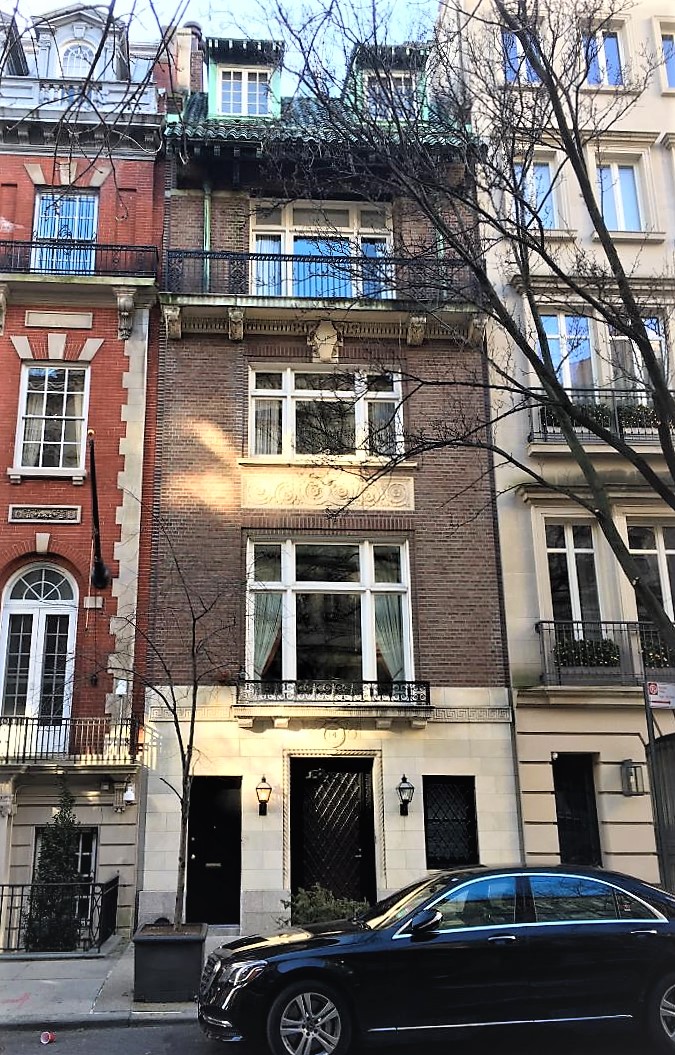
The Fahnestocks moved into the completed house later that year.  York & Sawyer had designed an unconventional townhouse; a blend of Spanish and Italian Renaissance elements.  

The only decoration on the marble base was a carved wreath encircling bronze address numbers above the entrance and a Greek key course, broken by a marble faux balcony with an iron railing.  Three stories of brown-red "tapestry brick" were embellished with a carved Italian Renaissance panel between the second and third floor openings, and a full-width balcony at the fourth.  The attic floor took the form of a deeply-overhanging Mediterranean roof, sheathed in green clay tiles and punctured by two copper-clad dormers with picturesque casement windows.

In 1913 S. Reading Bertron transferred title to Elizabeth.  He and Caroline continued living in their West 54th Street house.

Elizabeth and Snowdon hob-nobbed with Manhattan's elite.  They were, for instance, members of the exclusive Friday Evening Club.  Elizabeth was among "the usual brilliant assembly" at the last of the group's supper dances on March 13, 1914.  Held in the Della Robbia room of the Vanderbilt Hotel, entertainment included music by the Russian Imperial Balalaika Orchestra, members of the Imperial Opera ballet troupe, and dancing to Conrad's and Fejer's orchestras.  With Elizabeth in the room that night were the Duke and Duchess de Richeliue, August Belmont Jr. and his wife, the Oliver Harrimans, the Jay Goulds and the Frederick T. Havemeyers.

The Fahnestock summer home, Old Brick Farm, was in Roslyn, New York.  But Elizabeth spent the summer of 1914 in Europe.  On May 31 The Sun reported her among the impressive passenger list of the France departing that day along with her mother.  She was about three months pregnant at the time and upon her return to New York a son, Reading Berntron Fahnestock, was born on November 10.

Snowden would sail to Europe within a few years, but for far more serious reasons.  In 1917 he was the secretary and treasurer of the United Equities Corporation, but that year he resigned to enter the Army after the United States was drawn into World War I.

Snowden was among the first training class at the Plattsburg Camp in 1917.  By the time he was deployed to Europe with the 77th Division he had achieved the rank of captain.  

In his absence Elizabeth did her own part in the war effort.  She became involved in the Red Cross Institute for Crippled and Disabled Men and was instrumental in the formation of classes in April 1918 to teach women to "teach trades to crippled soldiers" and "awaken public interest in this branch of war services."

Later that year Elizabeth received terrifying news.  On November 1 her husband's name appeared on the list of soldiers reported wounded in action.   Despite his serious injuries, Snowden recovered and when he returned home following the war he held the rank of colonel and had been awarded the Croix de Guerre by the French Government.

In 1920 the American Investigation Corporation was formed to investigate the potential of trans-Atlantic transportation by means of helium-filled dirigibles.  Snowden A. Fahnestock was appointed the association's president, Franklin D. Roosevelt its vice-president, and S. Reading Bertron was chairman of the board.   

On July 28 that year the New York Herald announced that "Congratulations are being extended to Mr. and Mrs. Snowden A. Fahnestock upon the birth yesterday of a daughter at Old Bright Farm, their country place."

But storm clouds would soon form in the Fahnestock home.  More and more Elizabeth traveled alone, spending much time in Paris, Newport and Washington DC.  Finally, on December 17, 1924 a cable arrived at The New York Times offices from Paris which said simply "Mrs. Snowden A. Fahnestock of New York made formal application for divorce to the Seine Tribunal today."

Interestingly, in reporting on the development, The Times merely mentioned that Elizabeth was the daughter of Samuel R. Bertron.  It went on for paragraphs, instead, about the accomplishments of her husband.

Fahnestock wasted no time in remarrying.  Six months after Elizabeth filed divorce papers he wed Helen Morgan Moran.  Theirs, too, would end in a well-publicized split and eventually in tragedy.

Accusing his wife of "being infatuated with another man," Fahnestock sued for divorce in 1934, and then for complete custody of their two children.  At one point Helen swore out a writ charging that Fahnestock had illegally removed Clara and Mary Lee from a train heading to New York from Aiken, South Carolina.  During the ugly court battle Fahnestock's mother was given temporary custody. 

On October 7, 1935 Fahnestock was awarded a divorce "on a charge of desertion."  It had all played havoc with Helen's nerves.  She was confined to a Connecticut sanitarium and then moved to a New York hospital "for treatment of a nervous disorder," according to one newspaper.  She was released on November 29 to spend Thanksgiving Day with her family.  Following Thanksgiving dinner at the home of her aunt and uncle she excused herself and went upstairs.  A few moments later she plunged from a third story window to her death.

In the meantime, the 76th Street house had became home to Herman Alfred Prosser and his wife, the former Winifred Sprague.  Born in 1876, Prosser was the vice president of the American Smelting and Refining Company.   Their children included a son, Robert Woodward, daughter Elizabeth, and Winifred, from her mother's former marriage to the late Albert E. Walker.  

The family's country home, Idlewild, was in Greenwich, Connecticut.  Living with them in their city home were two servants.

Like Elizabeth Fahnestock, Winifred had turned her attention to war efforts.  In 1917 she had been chairman of the Emergency Committee of the Women's Auxiliary of the American Institute of Mining Engineers.  Calling it a "fine patriotic society" in July that year, Mining and Metallurgy noted that she "is in close touch with Major Arthur S. Dwight, ready to act when necessity arises." 

The first of the children to leave the 76th Street house was Winifred.  Her engagement to Donald M. Lovejoy on May 4, 1930 was covered by newspapers as far away as Utah's The Ogden Standard-Examiner.  Robert was next, his engagement to Mary King Smith announced on October 12 1933.

Elizabeth was not so quick to marry.  It was not until twelve years later, on December 27, 1945, that the Bronxville Review-Press commented "One of the loveliest of the pre-Christmas brides was Miss Elizabeth Woodward Prosser, daughter of Mr and Mrs. Herman Alfred Prosser, of East Seventy-Sixth Street, New York City, who on Friday, became the  bride of Captain Francis Falconer Sanford, Army Air Forces."

Now empty-nesters, the Prossers soon left the 76th Street house, moving to No. 1001 Park Avenue.  The 76th Street house has remained a single-family home, its unusual Spanish-meets-Italian facade unchanged after more than a century.


photographs by the author
Thursday, June 5, 2014

The Moncure Robinson Mansion -- No. 16 East 76th Street


With the completion of Central Park the blocks off Fifth Avenue saw rapid development.  In 1881 William Noble began construction on 10 speculative rowhouses stretching from No. 10 through 28 East 76th Street.  Completed a year later they were designed by John G. Prague and were described by The New York Times as “four-story brownstone-front” dwellings.

When M. L. Sire purchased No. 16 with “the similar dwelling 28 East Seventy-sixth Street" in 1897, the three wealthy Robinson siblings were living in their family mansion at No. 23 North Washington Square.  Their father, Edmund Randolph Robinson had died the year before and their mother had died earlier.  The young adults were wealthy, prominent, and on their own. 

After the expected period of mourning, they Robinsons resumed their upscale social lives.  Eleanor hosted a reception for the introduction of her sister, Augusta, into society on December 10, 1898 in the home.  And their attorney brother, Moncure Robinson, would be well-known in the highest social circles.

The Robinson children had not only large personal fortunes, but an outstanding pedigree.  Their mother was the daughter of John Jay and was related to the Chapmans and McVickars.  The Times would later note “The Robinson family is one of the old families of Virginia.”

Their social standing was glaringly obvious on April 4, 1900 when Augusta was married in the parlor of the Washington Square house, given away by her brother.  Among those assembled were Mrs. Stuyvesant Fish, Mr. and Mrs. Cornelius Vanderbilt, Jr., the Schieffelin family, the Abraham Hewitts, Mrs. William Morgan and her daughter, the W. Bayard Cuttings and other high-ranking society figures.

A month later Moncure would earn attention at the “artists’ revel” in Boston when he “personated a Doge of Venice.”  Later he and Eleanor took a cottage in fashionable Bar Harbor. 

By the time they returned for the winter season, things had drastically changed in the East 76th Street neighborhood.  The neighborhood had increasingly lured Manhattan’s wealthiest citizens and the addresses of the brownstone residences of a generation earlier were suddenly highly valued.  On September 29, 1901 The New York Times remarked that “The good demand for dwellings of moderate value has continued to be the mainstay of the market…This demand has been principally for houses near Fifth Avenue, north of Fiftieth Street.”  Among the houses sold that week was No. 16 East 76th Street.

The rapidly increasing value of the property was noted by the Real Estate Record & Builders’ Guide on March 15, 1902.  The house was purchased by the City Real Property Investing Co.  “The house changed hands twice last year; the first time at $60,000, the present sellers paying $67,000.”

Within a few weeks it would be sold again—this time to Moncure Robinson.  The purchase was made public on May 3 and was possibly sparked by Augusta’s impending engagement to Commander Louis Wentworth Packington Chetwynd of the Royal Navy.  As preparations for the wedding in Fifth Avenue’s St. Thomas’s Church were laid out; Moncure set architects Hoppin & Koen to work remodeling the old brownstone uptown into a fashionable, modern mansion.

Augusta’s January 17, 1903 wedding was a star-studded event in terms of society names.  The church was filled with names like Fish, Vanderbilt, Belmont, Harrison, Beekman and Townsend.  But The New York Times was careful to print at the top of the list “Mrs. Astor.”

The following week Moncure was a guest of Mr. and Mrs. Robert J. Collier in the mansion on Gramercy Park.  It was in honor of Mrs. Collier’s grandmother, Caroline Schermerhorn Astor and his inclusion on the guest list of only 16 was a social coup.  But Robinson was eager to begin entertaining on his own in his new house.

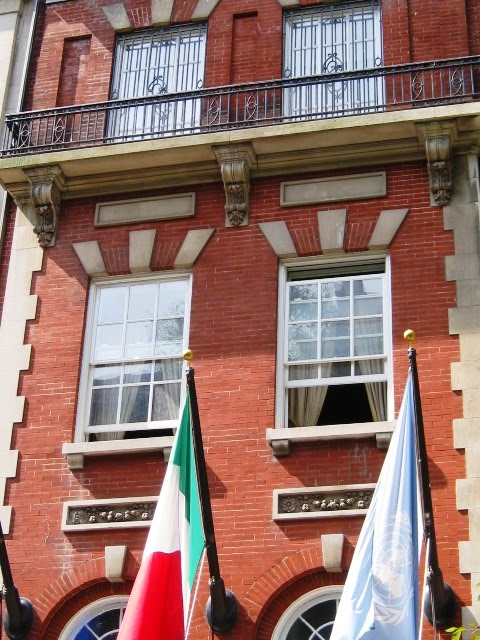
The East 76th Street project was finished by now.  Hoppin & Koen had produced a striking five-story neo-Georgian home of red brick with limestone trim.  The entrance in the rusticated stone base was a few steps below the sidewalk; and the architects drew on a variety of 18th century elements to produce the refined and elegant home—fanlights above the second story French doors; radiating stone lintels over the upper openings, and finely detailed dormers behind a stone balustrade.

On February 23, 1903 Moncure Robinson formally opened his new house with a “Colonial dinner.”  It would be the first of many elaborate entertainments in the house.  A week later, on March 1, The New York Times society page gossiped about the young attorney.  Calling him “a member of several of the fashionable clubs,” the newspaper said “He is simply a young man who has a good fortune and who is fond of entertaining.  He has, like so many of the young bachelors of to-day, moved into a house of his own, and he is an excellent host.  In appearance he is quite youthful, and is about thirty years of age.  He is a member of the Knickerbocker, and was graduated from Harvard in 1896.”


The Times called Robinson’s new home “a bijou of a house, which is charmingly furnished, where he will entertain a great deal next Winter.”  The newspaper may have predicted extensive entertainment because it was about time for the wealthy 30-year old to marry.  On May 10 the newspaper hinted at romance.

“Moncure Robinson, who will sail shortly for Europe, has put the finishing touches to his new home in East Seventy-sixth Street.  He has taken such pains in furnishing this house that rumors are again started as to his matrimonial intentions.  Both he and Mrs. Moses Taylor Campbell have denied these reports several times.”  The denials were undeniably true.

By now Robinson had given up Bar Harbor for Tuxedo Park and Newport.  It was in Newport on September 2, 1906 that he was the unwilling party in an episode that enraged Mrs. Stuyvesant Fish.  Mamie Fish invited Moncure along for an automobile ride with her and her daughter, Marion.  As the car cruised along the country road about four miles outside of Newport, chauffeur George Effyeara was pulled over for exceeding the speed limit of 18 miles per hour.

Effyeara insisted he was traveling at 14 miles per hour; but the constable climbed into the limousine and ordered it driven back to Newport.  After a heated exchanged between Mrs. Fish and Judge Franklin, the socialite begrudgingly paid the $23.60 fine.  “Mrs. Fish paid it,” reported The Times, “but she was not in a very pleasant mood, remarking as she paid the money, ‘This is highway robbery.’”

Another well-to-do bachelor who often appeared on the same guest lists with Moncure Robinson was Francis Otis.  Although both men had ample fortunes, The New York Times noted in 1908 that the two would be sharing an apartment in Paris for the summer season.

Back in New York, Moncure’s lavish entertainments were sometimes too large for his 76th Street house to handle.  On these occasions he turned to the St. Regis Hotel.  On December 13, 1911 he hosted a dinner here in honor of Princess di San Faustino and Comtesse De Gontaut-Biron.  “The guests, numbering sixty, were asked for dinner at 8 o’clock, following which specialties and tableaux vivants were given on a miniature stage erected at one end of the marble ballroom,” recounted The Times.  An evening of entertainments included performances by some of the socially-elite guests.

The newspapers routinely reported on Moncure’s entertainments at home and at the St. Regis.  On February 3, 1914 his dinner required the entire second floor of the hotel, “including the marble ballroom,” said The Times the following day.

The following year, in August 1915, Robinson leased the 76th Street house "to a client for occupancy," according to The New York Times.  It became home to Edward N. Breitung and his socially prominent wife.  Breitung was a banker, mining engineer and ship owner.  During the war she had donated an x-ray ambulance to General Pershing and their daughter, Juliet, had been active in war work as well.

Delicate carved panels are set into the brick facade.
In July 1918 Mrs. Breitung arranged “a big athletic carnival” for the Sailors and Marines Club which she founded.  The details of the event were finalized in a meeting in the 76th Street house on July 12 and they included 50-men teams for tug-of-war, running events, tennis, baseball, swmming races and other events.  Professional athletes signed up to appear.

But the Breitungs tended to attract negative attention despite their philanthropic deeds and good intentions.  Juliet eloped with Max F. Kleist, the gardener of the mansion adjoining the Breitung’s country estate in Marquette, Michigan.  “Owing to the prominence of the Breitung family, the marriage and its subsequent developments attracted considerable attention,” said The New York Times later.

The “subsequent developments” were that Juliet soon realized the Kleist had married here only for the money and after she left him, he sued her father for $250,000 “for alienation of affections.”  The suit was eventually dismissed and in December 1918 Juliet became engaged again.  The Times ran the headline “Juliet Breitung to Marry Again” and rehashed the ugly affair, including the Reno divorce.

A year later the household was terrified by a series of letters that arrived threatening to blow up Breitung’s office at No. 11 Pine Street.  Then, on September 6, a letter arrived “containing a threat to blow up his home at 16 East Seventy-sixth street.”  Investigators were able to track down the extortionist, John N. Redmond.  The 38-year old was committed to the psychopathic ward of Bellevue Hospital for observation.  He explained that he believed to have been “defrauded of millions” by the banker.

Mrs. Breitung continued on with her social calendar of dinners and charitable events.  On March 25, 1921 she entertained her guests at dinner in the house, then took them to the opera.  A similar affair two weeks earlier had ended most uncomfortably for the socialite.  Society had been rocked by a series of burglaries during supper and card parties.  In each case it was the expensive belongings of guests that were stolen.

On March 25, 1921 The New York Times reported that Mrs. Charles M. MacNeill, “after attending the opera about two weeks ago…drove in her car to the home of Mrs. Breitung, where there was a supper party.  The next day she missed her [opera] glasses, which were worth $3,000, and telephoned to Mrs. Breitung.  Search was made, but the glasses could not be found, and Mrs. Breitung believed that Mrs. MacNeill had lost them before or after leaving the party.”

But the awkward theft of a guest’s valuable opera glasses was nothing compared to the embarrassing press the Breitung’s got later that year.  On September 7, 1921 the New-York Tribune reported that Edward had been arrested in a raid on a brothel.

Mrs. Nellie Kift, of No. 640 Madison Avenue, was charged “with having let two rooms to women for questionable purposes” and Breitung was arrested for vagrancy.  As the trial neared, Breitung proclaimed his innocence and told reporters “My wife knows all about this case and has absolute confidence in me.  She and my family are sticking by me.”

Testimony by detectives was lurid.  The New-York Tribune reported that Detectives Raihl and Massie said they found “the banker in one of the rooms of her apartment with Edna Clark and Jean Whitney.”  Edward Breitung had an excuse to be at the brothel, however.  He said he “had called at the apartment to discuss a mining project.”

In 1923 Moncure Robinson sold the house.  It was owned by Maurice Goodman on September 29, 1927 when John Packwood Tilden died in his house near by.  Tilden was President of John P. Tilden, Inc., a liability insurance firm, and a proud member of the Society of Mayfower Descendents.  He  had lived with his wife, Mabel Simmons Tilden, at No. 58 East 73rd Street.

Mabel quickly sold the 73rd Street house and purchased the mansion at No. 16 East 76th Street in July 1928.  Like the previous residents of the house, she would lavishly entertain.  Summers were spent at the Briarcliff Lodge and winters were given over to musicales, dinners and receptions.  Society pages routinely reported on her entertainments, as was the case on February 12, 1937 when The Times reported “Mrs. John Packwood Tilden will give another in a series of luncheons today at her home, 16 East Seventy-sixth Street, for Mrs. Robert A. C. Smith.”

The following month, just before Mabel left for the Briarwood, she received a most unexpected delivery.  “A healthy seven-pound baby girl only six hours old was found abandoned at 10 o’clock last night wrapped in a brown blanket and sheltered in an opened black suitcase on the doorstep of the townhouse of Mrs. John P. Tilden,” reported The New York Times on March 28.  The little girl was discovered by a private patrolman, Horace Victor, and was in good health despite her exposure to the March air.

If the infant’s mother thought that, perhaps, Mrs. Tilden would take the baby in, she was mistaken.  “Later she was taken to the New York Foundling Hospital.”

Mabel Simmons Tilden’s routine of Summers at Briarcliff Lodge and winters on East 76th Street would continue into the 1950s.  The house became home to Calvin Klein in 1988.  Having paid $6.8 million for it; the fashion designer sold the 10,000 square foot mansion to the Italian Government for just $4.8 million in1991 during a depressed real estate market.  The house was purchased as the home to the Italian Consul General.

The handsome residence has survived as a private home for over 130 years.  Little has changed since its remarkable makeover in 1903 when the it became the renovated bachelor pad of the socially-visible Moncure Robinson.

photographs by the author