Showing posts with label east 76th street. Show all posts

Saturday, May 3, 2025

H. I. Feldman's 65 East 76th Street


photograph by Lowell Cochrane

Among the properties sold off in the liquidation of Standard Oil Company executive Lannon V. Harkness's estate in 1916 was the upscale rowhouse at 65 East 76th Street.  The Bridgeport, Connecticut Evening Farmer reported its value at $275,000, or just over $8 million in 2025 terms.

In 1943, architect H. I. Feldman filed plans for an apartment building on the site of 59 through 63 East 76th Street for Kenkim Realty Corporation.  The project stalled, however, for two years later.  Then, on October 11, 1945, The New York Sun reported that the developer had, "enlarged its holdings by the purchase of 65 East 76th Street to be included in the site." 

Hyman Isaac Feldman, who went professionally by his initials, had opened his architectural practice in 1921 and by now was well-known for his Art Deco and Art Moderne-style apartments.  His 11-story design included a stepped stone base and, in trademark Feldman form, a full-height recessed bay above the entrance.  Windows wrapped around the chamfered corners of the central bay.  The upper floors were faced in beige brick and the terraces were given streamlined railings.

photograph by Lowell Cochrane

Feldman was brought back in 1949 to add a penthouse level.  It included two apartments and "two maid's rooms under the water tank," according to Department of Buildings documentation.

Among the initial residents were Sanford E. Gerard and his wife, the former Mildred Telfer.  Their country home was in Beach Hampton, Amagansett, Long Island.  Born on June 12, 1902, Gerard was a commercial artist.  He was at one point the art director of Macy's department store, and in 1931 became art director of the advertising agency Lennen & Mitchell, Inc.  Gerard pursued fine art as well and his watercolors and drawings were exhibited in the Philadelphia Watercolor Show and the National Academy of Art.  He wrote the book, How Good is Your Taste?

The comfortable lifestyles of the residents were reflected in the Frank J. Hickey family, who announced the engagement of their daughter Joan Ware to Arne Rostad, Jr. in November 1951.  The family had country homes in Palm Beach and Winsted, Connecticut.  Joan was educated at St. Margaret's School in Waterbury, Connecticut; the College of William and Mary; and the Art Students League.  The couple's wedding in St. Thomas's Church on Fifth Avenue was followed by a reception at the Carlyle.

Dr. Otto C. Kestler was living here as early as 1953.  An orthopedic surgeon, he was graduated from the Royal University in Budapest, Hungary in 1930 and came to America in 1939.  While living here he was attending orthopedic surgeon at the Hospital for Joint Diseases.

Among Kestler's neighbors at the time was Bernard H. Sumergrade.  He was a partner in N. Sumergrade & Sons, a bedding manufacturer founded by his father, Nathan.

Another respected physician to live here was Dr. Milton Goodfriend, along with his wife, the former Rose Soman.  The couple were here by the early 1970s.  An obstetrician and gynecologist, Goodfriend received his medical degree in 1919 from Columbia University and studied further at the University of Vienna.  He had been head of the medical boards at Bronx-Lebanon and Jewish Memorial Hospitals.  Before his retirement, Goodfriend was president and chairman of the Bronx County Medical Society.

photograph by Lowell Cochrane.

No. 65 East 76th Street survives as a sterling example of H. I. Feldman's trademark Art Moderne apartment building style.

many thanks to reader Lowell Cochrane for requesting this post

Friday, February 12, 2021

The Fleming Smith House - 11 East 76th Street


In the last decade of the 19th century developer brothers William W. and Thomas R. Hall erected high-end speculative homes, most within the fashionable Upper East Side.  Although they most often erected just one mansion at a time, in 1895 they commenced work out a row of six, Nos. 9 through 19 East 76th Street, between Fifth and Madison Avenues.  Their architect, Alexander M. Welch, designed the row as three pairs--an A-A-B-B-A-A pattern.  They were completed in 1896.

No. 11 was a near match to its next door neighbor at No. 9.  The gray brick above the limestone base was gently contrasted with white stone.  Its neo-Renaissance design featured a faceted oriel at the second floor which created a stone-railed balcony at the third.  Panels below the windows were decorated with cornucopia and stylized ferns.   Carved lion heads adorned the unusual carved enframement which continued from the second through third floors.  As expected, they stared straight forward from the upper edge, but turned sideways along the sides.  The fourth floor was made especially handsome with an arcade of five openings separated by bulbous, twisted Corinthian columns.  The cornice was supported by an ornate row of cusped arches, above a frieze containing superbly carved scallop shells.

On January 14, 1897 The New York Times reported that the Halls had sold No. 11 "to a Mr. Blum" and added "This leaves but one remaining out of a row of six."  For some reason or another, the buyers of upscale homes often attempted to remain anonymous--at least initially.  The buyer was not Mr. Blum, but Fleming Smith.

The son of Isha and Lydia Ann Smith, Smith was born in New York in 1835.  He was married to the former Helen McGaw.  A prominent broker and real estate dealer, he name is best remembered today for the distinctive Fleming Smith Warehouse on Watts Street.  

Helen inherited an impressive family pedigree.  The daughter of John A. McGaw, a wealthy shipping merchant in the pre-Civil War decades, her great-grandfather, Matthew Thornton, was a signer of the Declaration of Independence.  

The well-do-to Smiths attended the fashionable Grace Church, far downtown.  Like other upper crust New Yorkers, they filled the 76th Street house with notable artworks.  Their summer estate was in New London, Connecticut.  The year after moving into No. 11 Fleming hired Providence, Rhode Island architect Hoppin Ely to make renovations on that residence.  The significant alterations cost him the equivalent of about $187,000 today.

The childless Smiths lived quietly, never appearing in society columns and apparently interacting little within fashionable circles.  The couple was at the New London residence when Fleming died at the age of 78 on August 19, 1913.  A telegraph arriving at the New-York Tribune said cryptically, "Death was due to paralysis."

Helen McGaw Smith survived her husband by only a year.  She died in the 76th Street house on October 4, 1914 at the age of 77.  Her funeral was private, mirroring the Smiths' quiet lives.

Helen's estate was estimated at $1 million--closer to $27 million in today's dollars.  She gave "use" of the summer estate to her nephew, Thornton Woodbury, during his lifetime, after which it became property of the city of New London "for a park."  The New-York Tribune noted "The Metropolitan Museum of Art in New York receives paintings and works of art."

The East 76th Street house was sold to Estelle Scholle, but if she ever lived here at all, she was leasing it by the 1920's when the family of Arthur Marvin Anderson occupied the house.  The family's summer home was in Llewellyn Park, New Jersey.   Alice Mary Anderson was introduced to society in November 1929 and one of the entertainments--given by a summer-season neighbor--stood out.

On November 11 the New York Evening Post reported "Mrs. Thomas A. Edison of Glenmont, Llewellyn Park, West Orange, N. J., will entertain at dinner Tuesday evening, November 28, at the Cosmopolitan Club in honor of Miss Alice Anderson, debutante daughter of Mr. and Mrs. Arthur Marvin Anderson...Mrs. Edison will take her guests to the concert of the Philadelphia Symphony Orchestra."

Even servants deserved notice in newspapers for special events in their lives.  On June 15, 1935 the Irish-American newspaper, The Advocate, reported on the upcoming marriage of one of the Andersons' live-in maids.  Margaret Gallagher, "native of Glasgow," was scheduled to wed John Heaney, "native of Derry," at All Saints' Church on 129th Street four days later.

Estelle sold No. 11 in 1943, after which it was altered to a multiple family dwelling.  The renovations resulted in a duplex in the basement and first floor, one apartment each on the second and third, and a duplex on the fourth that extended into the new penthouse, unseen from street level. 

The family of Edward S. McCann were among the first tenants.  They most likely leased one of the duplexes.  He was the principal in the Edward S. McCann Realty and Construction Company.  The McCanns, who announced the engagement of daughter Mary Jane to Frederic C. Reichey on May 26, 1946, remained here at least through the late 1950's.

Despite the changes inside, the exterior of No. 11--and as a matter of fact, the entire 1896 row--is almost perfectly preserved.

photograph by the author

Monday, September 23, 2019

The Lost Anthony Post House - 76th Street at the East River


photographer unknown, from the collection of the Museum of the City of New York

In the first half of the 19th century Anthony Post was a director of the Phoenix Bank, one of the city's principal financial institutions.  His enchanting Italianate-style summer house sat on extensive grounds and was surrounded by landscaped gardens girded by a prim white fence.  The estate sat at the edge of the East River and stretched approximately from what, still on paper, was East 76th and 84th Streets.

The New York and Harlem Railroad had been extended along what would be named Park Avenue in 1837, making travel to the rural district more convenient.  Post's wooden villa was constructed a few years later, around 1840.  

The simple residence stressed charm over grandeur.   Two stories tall and three bays wide, its wide veranda sat above a high porch--no doubt a defense against spring flooding.  A deeply overhanging cornice supported the shallow hip roof.   At the western elevation was a glass conservatory.  The architect added the romantic touch of diamond-paned windows throughout.


The three sets of French doors provided cooling breezes to the interiors.  photographer unknown, from the collection of the Museum of the City of New York

As most wealthy families did, Anthony and Mary Post brought servants from their city house each season.  As the summer drew to a close in 1858 Mary Post discovered some of her jewelry--worth nearly $63,000 by today's standards--was missing.  On November 1 The New York Herald wrote "Suspicion rested upon the servant girls, Isabella Kenny and Letitia White, and after being watched some time they were arrested."  

Under the pressure of early 19th century interrogation techniques, it did not take long for Isabella to confess.  She "stated that she had tied up the stolen jewelry and sent it by a strange boy to her sister's house in Eleventh street, near avenue C."  Investigators went to the Lower East Side address and recovered $1,200 of the loot--a little more than half.  "The rest could not be found, and the girl says she thinks the boy stole it," explained the newspaper.  Even though Letitia "is supposed to be innocent of the theft," she was held along with Isabella in jail for further examination.

At the time of the theft the district around the Post estate was changing.  The Yorkville neighborhood just to the north filled with German and Irish immigrants hired to construct the Croton Aqueduct; and in 1858 streetcar lines were extended along Second and Third Avenues.

The Posts may have already been anticipating liquidating their estate in the spring of 1863 when an advertisement appeared in The New York Herald.  "For Sale--An altered goat, sulky and harness; drives by bit, well trained and gentle; price $30.  Can be seen at the foot of Seventy-sixth street, East river.  The man will show him."  The price of the two-wheeled cart and goat would be equal to about $620 today.


A fieldstone retaining wall ran along the riverfront.  photographer unknown, from the collection of the Museum of the City of New York

In the summer of 1865 East 76th Street was "regulated and graded."  It symbolized the end of the era of summer estates in upper Manhattan.  On October 17, 1869 the Post estate was advertised "for sale cheap in single lots or plots, on very easy term."    The buyer was Hamlin Babcock.

Babcock moved into the house, but quickly began partitioning the land into lots.  He advertised in The New York Herald on November 19, 1870: 

UP TOWN LOTS FOR SALE--At reasonable prices and on very easy terms.  Owner, Hamlin Babcock, Seventy-sixth street and East river.

Babcock continued selling off the property and by the fall of 1871 had reduced the estate to the point that the plots now included former Post outbuildings.   He marketed the river-front location of four lots, saying they were "suitable for stone, coal or lumber yard, with Stable Sheds, Smith's Shop, &c."


The carriage gates were far to the rear of the gardens.  photographer unknown, from the collection of the Museum of the City of New York
Despite the appearances, Hamlin Babcock was more interested in politics than real estate.  On October 27, 1876, for instance, The New York Times reported that the Republican Convention of the Tenth Congressional District had "amid much enthusiasm, nominated Mr. Hamlin Babcock to represent the district in the House of Representatives."

The decline of the neighborhood was clearly evidenced in 1881.  Babcock was leasing the house that summer when it became central to a murder investigation.  On August 4 The New York Times began an article saying "At the foot of East Seventy-sixth-street is situated the residence of Mr. Hamlin Babcock, and the grounds surrounding the residence slope down to the river and form a favorite bathing place for the people living in the neighborhood."  (The term "bathing" did not mean swimming, but quite literally, taking a bath.)

At 8:00 on the previous morning a number of boys were bathing in the river when they noticed the body of a man floating in the water.  One of the boys, James Donohue, "horrified at the discovery," ran to the Babcock house, which was "temporarily occupied by Detective Samuel Campbell."  Campbell went down to the riverfront and with the help of the boys, pulled the corpse to the shore.

Born in Germany, Samuel Alt was a 62-year old "peddling butcher," who lived with his family at No. 202 East 76th Street.  Alt had left home the day before to buy calves and therefore had $50 in cash in his pocket.  It was missing from the body as was his double-cased silver watch.  There was a wound on the side of his head.

The Times said "The place where he was found is very lonely and unfrequented.  The street ends in a bluff, which on the other side slopes down to the river.  On the south side of Seventy-sixth-street is the boundary wall of Mr. Babcock's premises, which extends out into the water."  Despite the missing money and jewelry, police theorized that Alt had come down to the spot to bathe and before he could undress was "either seized with a fit or stumbled and fell into the water."

Investigators changed their minds when the autopsy was completed.  The following day The Times reported "The post-mortem examination of the remains of Samuel Alt, the aged Hebrew who was found in the water at the foot of East Seventy-sixth-street...showed that death was the result of violence."  Alt's skull had been nearly fractured by a blunt blow and he died from a concussion of the brain.

The newspaper noted "It is known that a gang of young outlaws infest Avenue A [now York Avenue] and First Avenue, and they have been a source of great annoyance and trouble to Mr. Hamlin Babcock, the owner of the grounds and residence at the foot of East Seventy-sixth-street.  His grounds have been frequently invaded, and his orchard and flowerbeds devastated out of sheer malice, and the Police have been, in the past practically powerless to afford him protection."

Babcock's flowerbeds, orchards and his well-kept house were an exception in the neighborhood.  The New-York Tribune said the area was "regarded as a very bad one, several of the blocks being occupied only by hovels on the rocks."  Ironically, many of those ramshackle houses were built on land originally sold by Babcock.   The grim environment was most likely responsible for Babcock's closing the house shortly after the murder.  With no renters, the building sat vacant for years.

The Settlement Movement took roots in America around 1890.  It stressed education over charity so that impoverished children and women could independently make their way in the world.  In 1891 Babcock sold the house to a newly formed organization, East Side House Settlement, which opened on June 5.  The organization's first Annual Report described it as "an old country residence" without "a pound of plumbing in it."  

A substantial renovation went beyond what the Report called "a thorough cleansing from top to bottom."  A cast iron range was installed, as well as indoor plumbing.  When the East Side House Settlement opened it had an acceptable library and what passed for a gymnasium.


Alterations included bricking up the former conservatory (left).  A somewhat scary-looking swing set was erected in the yard.  East Side House Annual Report, 1892 (copyright expired)
The need for the settlement house was obvious.  On December 19, 1893 The Evening World wrote "The territory bounded by Third avenue, Sixty-eighth street, Seventy-sixth street and the East River, has a dense population.  It contains a score of factories, in which at least 2,000 persons are employed."  

Maintaining the settlement house required generous donations.  On April 23, 1897 a reception and ball was held in the Central Opera House on East 77th Street near Third Avenue for the benefit of the East Side House.  "The affair was largely attended by friends of the association and the dancing was kept up until a late hour," said the New-York Tribune.

The wooden house could not serve the needs of the exploding population for many more years.  On April 22, 1900 the New-York Tribune reported "Drawings have been made for the proposed enlarged building of the East Side House Settlement...on the river bluff at East Seventy-sixth-st."  The newspaper printed renderings by architects Howells & Stokes.


New-York Tribune, April 22, 1900 (copyright expired)
Within the year the old Anthony Post house was gone.  The replacement structure was demolished during the Depression years for construction of the FDR Drive.

Thursday, July 4, 2019

The Joel W. Thorne House - 9 East 76th Street


In the last decade of the 19th century developer brothers William W. and Thomas R. Hall erected high-end speculative homes, most within the fashionable Upper East Side.  Although they most often erected just one mansion at a time, in 1895 they commenced work out a row of six, Nos. 9 through 19 East 76th Street, between Fifth and Madison Avenues.  Their architect, Alexander M. Welch, designed the row as three pairs--an A-A-B-B-A-A pattern.  They were completed in 1896.

The western-most house, No. 9, was a mirror image of No. 19 at the far end, and a near match to No. 11 next door.   Its neo-Renaissance design featured a rounded bay at the second floor which created a balcony at the third.  Carved lion heads adorned the unusual carved enframement which continued from the second through third floors.  As expected, they stared straight forward from the upper edge, but turned sideways along the sides.  The fourth floor was made especially handsome with an arcade of five openings separated by bulbous, twisted Corninthian columns.  The cornice was supported by an ornate row of cusped arches, above a frieze containing superbly carved scallop shells.


With only slight variations, Nos. 9 and 11 are nearly identical.

The Halls sold the house on March 24, 1896 to George Quintard Palmer.  The timing of his purchase no doubt had much to do with his upcoming marriage to Edna Earl Johnson less than a month later, on April 22.  Palmer would become President of the Alberger Pump Co.; President of the Newburgh Ice Machine & Engine Co.; and Vice President and Director of the Alberger Condenser Company.  

The Palmers remained in the 76th Street house for only four years.  George purchased the house at No. 1 East 76th Street, directly behind the Fifth Avenue mansion in which he grew up and on March 31, 1900 The Real Estate Record & Builders' Guide reported that he had sold the 22-foot wide No. 9 to "a Mrs. Smith."  The New York Times placed the selling price at $80,000, or around $2.47 million in today's money.  That "Mrs. Smith" was the wife of Ormond Gerald Smith.  

Smith was president of the publishing firm of Street & Smith, co-founded by his father Francis Smith and Francis Scott Street.   He had joined the firm in 1883 after graduating from Harvard University.  He and his wife, the former Grace Hewitt Pellett, had one child, Gerald.

Like Palmer, Smith did not stay especially long in the house.  On January 13, 1907 the New-York Tribune reported that he had purchased the former Abernathy house at No. 39 West 56th Street, and as Palmer had done, "will tear down the building and put up a five story American basement house."

Smith sold No. 9 to Emily T. Lesher, the wife of banker Stephen R. Lesher.  The couple, who lived at No. 611 Fifth Avenue, purchased the mansion as an investment only.  In 1910 Emily leased it to wealthy bachelor Joel Wolf Thorne.   The signing of the lease knocked over the first domino in what would result in years of drama and publicity.

The New York Times described Thorne as "a well-known figure in society and club life in this city" and a "member of one of New York's oldest families."  The son of millionaire banker Samuel Thorne and a cousin of banker Oakleigh Thorne, Joel was heavily involved in western mining.

On November 2, 1911 The New York Times reported on a bizarrely-secret wedding in "one of the handsomest suites" in the Plaza Hotel.   Joel W. Thorne had married Mary Casey with only 14 persons present.  "So closely were the details of the wedding kept, by direction of Mr. Thorne himself, that even after the ceremony few about the hotel knew the identity of the couple.  It was especially desired that all news of the wedding should be withheld from the newspapers."

The Times was noticeably frustrated that no information on the bride could be obtained.  The article added "As far as could be learned last night, few members of Mr. Thorne's family were aware of the wedding and fewer attended it."  That was because Thorne's socially prominent family had vigorously protested his marriage.

The reason was Mary's background.  She was born on the very unfashionable Third Avenue.  Despite her humble childhood, she had struggled to improve her lot.  Saying "She is tall, has very dark hair and an Irish rose complexion," The Sun later explained "She worked her way through Barnard, where she specialized in psychology, was graduated in 1908, and received the degree of A. M. at Columbia."  When Joel Thorne fell in love with her she was teaching at Public School 49.  

In 1914 the couple's only child, Joel, Jr. was born.  Although the Thorne family still refused to accept the socially-inferior Mary, Joel's mother, Phoebe Thorne, did come to the 76th Street house to see her new grandson.  Mary later recalled that on that occasion she treated her "condescendingly."  She explained "She spoke unkindly about my religion, too, saying that the only persons she knew of that faith were in her kitchen."

Despite it all, Mary attempted to slip into polite society.  She studied singing under contralto Mariani Brandt, and worked with other socialites for the benefit of charities like the New York Home for Homeless Boys.
Mary Thorne poses with son Joel.  The Sun, April 26, 1918 (copyright expired)

The Thornes celebrated Joel's third birthday on October 16, 1917.  Nothing seemed out of the ordinary to Mary as she went to bed that night.  She later recalled that Joel "came in and kissed me.  I'm a good healthy sleeper.  I went right off to sleep.  In the morning he was gone.  His bed had not been slept in.  He had gone away without any clothes except those he was wearing.  He didn't even take an extra collar."

Although Mary was frantic about her husband's mysterious disappearance, the Thorne family was not.  Six months later Joel's brother, Samuel, a banker, responded to a reporter from The Sun saying "I do not know where Joel Thorne is just now.  Do you know where President Wilson is just now?  I don't recall when I saw him last, but am sure he's all right.  He has not disappeared."  The Thorne family's lawyer simply said he was "all right" and was "out West in business."

Mary had gone to the newspapers as her only hope.  The New-York Tribune reported she "summoned newspaper men to her luxurious home, 9 East Seventy-sixth Street," where she declared "that her husband's family did not like her and would not tolerate her socially, and she insisted that they knew where Mr. Thorne was."

She told the New-York Tribune on April 25, "I'm certain the Thorne family is hiding him from me.  They never liked me, and they would do anything to get my child from me, for he is one of the heirs to the Thorne millions."  She insisted "For the boy's sake, I regret this notoriety; but there was nothing left for me to do."

Getting her husband back would also mean she would again have financial support.  "He took away the three cars--one of which he had given me for my own--and stopped all my accounts.  I haven't had a cent of allowance since October," she told a reporter.  She was paying bills with the $40,000 in stock dividends she had managed to cash out.

Mary Thorne thought up another way to force her husband out of hiding.  The following week, on April 30, she went to the District Attorney's office and said "that she believed her husband...who has been missing since last October, was dead."  It was a clever ploy, since a declaration of death would mean that she and her son would inherit most of his fortune, leaving a still-living Joel W. Thorne penniless.

But the Thorne family was no less resourceful.  Because the months of stress were showing their effects on Mary's nerves, she contacted Dr. Seth Milliken, whom she had met around the time of Joel's disappearance.  He told her she did not need a tonic, but, as she later described, "a place where I could have regular hours, a diet and perfect quiet; in other words, a rest cure."

Milliken drove her to a facility on Central Park West where Mary overheard the man at the desk say "Why, this lady is in full possession of her mental faculties.  I don't want any damage suit.  I must decline to accept her as a patient."  Dr. Milliken then drove her to Bellevue Hospital where he told Mary she would "receive the best of treatment."

She was taken to the psychopathic ward, her clothing was taken from her, and she was put in a straitjacket.  Dr. Theron J. Vosburg diagnosed her with "maniacal depressive insanity."  The following day the long-missing Joel W. Thorne appeared at the hospital to consult with Dr. Vosburg.  He did not visit his wife. 

Mary was not permitted to communicate with anyone in the outside world.  Dr. Vosburg later admitted he had given orders "not to permit her to see any one."  But Mary somehow did manage to contact her lawyer.  A hearing was held in New York Supreme Court on June 12, 1918.  The following day The Sun ran the headline, "'Third Ave. Bride' Of Thorne Is Free."  Justice Geigerich's decision was diplomatic, not stepping on any high-powered toes.  "I do not think that this young woman should be detained.  But let me say in this connection that the city authorities acted in her case in the utmost good faith.  She is discharged."

Joel W. Thorne soon disappeared again, but this time he was not alone.  On August 24, 1918, Joel Jr.'s nurse took him out but they never returned.

Mary had no doubt that the boy's kidnapper was his father.  Seven months later, when no progress was made in the investigation, she again turned to the press.  On March 28, 1919 the New-York Tribune reported "Having failed to obtain the custody of her four-year-old son, Joel W. Thorne, jr., through habeas corpus proceedings, Mrs. Mary Casey Thorne, of 9 East Seventy-sixth Street, yesterday...offered $1,000 reward to any person giving her definite information about the whereabouts of the boy or actually placing him in her custody."

Mary was certain where he was being held.  The article noted "Mrs. Thorne was positive she saw her offspring on Tuesday watching the parade of the 27th Division from a window in the Fifth Avenue residence of his paternal grandmother, Mrs. Phoebe Thorne."  The family denied he was there.

In addition, she filed for legal separation from her husband, alleging "cruelty and abandonment."  Since no one seems to know where he was, the papers were served at the Thorne mansion on Fifth Avenue.  His response was lighting fast. 

The New-York Tribune reported "Joel Wolf Thorne, son and heir to the millions left by Samuel Thorne, banker, heretofore always the defendant in court proceedings between himself and Mrs. Mary Casey Thorne...assumed the offensive in the Supreme Court yesterday by suing his wife for a divorce."  His filing reflected a deeply-held enmity against Mary.

He named Raymond B. Wilson in the suit, saying he and Mary had engaged in "misconduct" in the 76th Street house.  (Ironically, Wilson, who was a professional bodyguard, had been hired by Mary's lawyer to guard the house to prevent accusations by the Thornes of illicit behavior.)   Thorne went on to demand full legal custody of their son, and further accused Mary of being a drunk.  He produced a bill from a Third Avenue liquor dealer for "Scotch whisky, gin, vermouth, brandy and stout," and claimed another Third Avenue dealer, Charles Daly, had delivered "180 bottles and seventy-two nips of stout" to No. 9 East 76th Street between March 14 and May 1, 1919.

Unfortunately for Mary, her servants testified on Thorne's behalf.  Although Mary's attorney, former judge John G. Dyer, reminded the jury that "back stairs gossip is completely and consistently denied," (perhaps hoping to introduce the possibility that the powerful Thornes had paid off the staff), the testimony of "loose and lascivious acts" prevailed.  Mary lost the case and any hope of getting her son back.

Mary, understandably, left No. 9 East 76th Street.  In May 1921 Emily Lesher sold it to William Adams Kissam for $90,000, just over $1.25 million today.  The New-York Herald announced on May 8 "The new owner will occupy after making extensive alterations."  Those alterations would all be internal.  Designed by architect F. P. Kelly, they included the installation of an elevator.

A nephew of Mrs. William H. Vanderbilt and the chairman of the board of the South American Development Co., Kissam had married the former Edith May Gale five years earlier.  He was 54-years old and she was 52 when they moved in.  Edith's first husband, Sewell Tappan Tyng, had died in 1913.  Her son by that marriage was now an adult, born in 1895.

The Kissams were prominent both in Manhattan society and in Southampton, where the maintained their summer estate.   Newspapers routinely reported on their entertainments in both locations.

Edith died in the 76th Street house on December 16, 1949.  A month later, on January 29, 1950, William died there at the age of 82.

Within the year the mansion was converted to a doctor's apartment and apartments.  Around 1954 it was purchased by the Lebanese Government as its permanent mission to the United Nations.  That, at times, resulted in disruption to the normally quiet residential block.

On September 7, 1972, for instance, The New York Times reported that "Last night more than 100 members of the Jewish Defense League demonstrated near the Lebanese mission to the United Nations at 9 East 76th Street.  Two men who forced their way through the crowd at a police barrier were taken into custody."

A similar protest occurred on May 17, 1974.  But by far the most frightening incident happened at around 9:30 on the night of July 5, 1982 when a pipe bomb exploded outside.  The explosive had been placed on the steps leading to the entrance.  A nearby doorman said "There was a big explosion and a huge cloud of smoke blew 10 to 15 feet in the air."

The blast occurred almost simultaneously with another at the French Mission on Fifth Avenue.  Police Officer David T. Hibert estimated that about two minutes separated the explosions.  He described the one on 76th Street saying "Glass shot across the street, and shattered the front glass of No. 10."


Only the Lebanese flag hints that the mansion is home to the Consul General.
The Lebanese Permanent Mission relocated to No. 866 United Nations Plaza before the end of the century and No. 9 East 76th Street became the private home of the Lebanese Consulate General.

photographs by the author

Wednesday, March 27, 2019

Snowden and Elizabeth Fahnestock House - 14 East 76th Street


On June 1, 1910 Elizabeth Bertron was married to Snowden Andrews Fahnestock in her parent's home at No. 46 West 54th Street.  It was a particularly notable wedding and the long guest list included some of the most elevated names in Manhattan society--Roosevelt, Delano, Hewitt, Rives, Iselin, Minturn, Vanderbilt, and Whitney among them.  The New York Times remarked that the newlyweds left "on a short wedding trip and will eventually make their home in New York."

The "wedding trip" was necessarily short because in just two weeks Elizabeth was scheduled to be the maid-of-honor at the wedding of Eleanor Alexander and Theodore Roosevelt, Jr.  But the couple would have a proper honeymoon afterward.


Elizabeth arrives at the Roosevelt wedding.  Mostly hidden behind her is, most likely, her recent husband.  from the collection of the Library of Congress 

On July 2, 1910 the New-York Tribune reported that Elizabeth's mother, Caroline Harding Bertron, had sailed for Europe.  Three weeks later on July 24, the newspaper announced that the newlyweds "sailed for Europe yesterday to spend the remainder of the summer abroad.  They will join Mrs. Fahnestock's mother, Mrs. Samuel Reading Bertron...in Paris."

Elizabeth, her parents' only child, was born in August 1889, a year after their marriage.  Her father was a vice-president in the Equitable Mortgage Company and a partner in the banking form of Bertron, Griscom & Jenks.  Snowden Fahnestock, who graduated from Harvard in 1908, not coincidentally, also worked at Bertron, Griscom & Jenks.

Two months before the her wedding Elizabeth's father, Samuel Reading Bertron, had commissioned the firm of Warren & Wetmore to design a six-story mansion at No. 935 Fifth Avenue, at the northeast corner of 75th Street.  It was possibly intended as his daughter's wedding present but, if so, the plans changed.

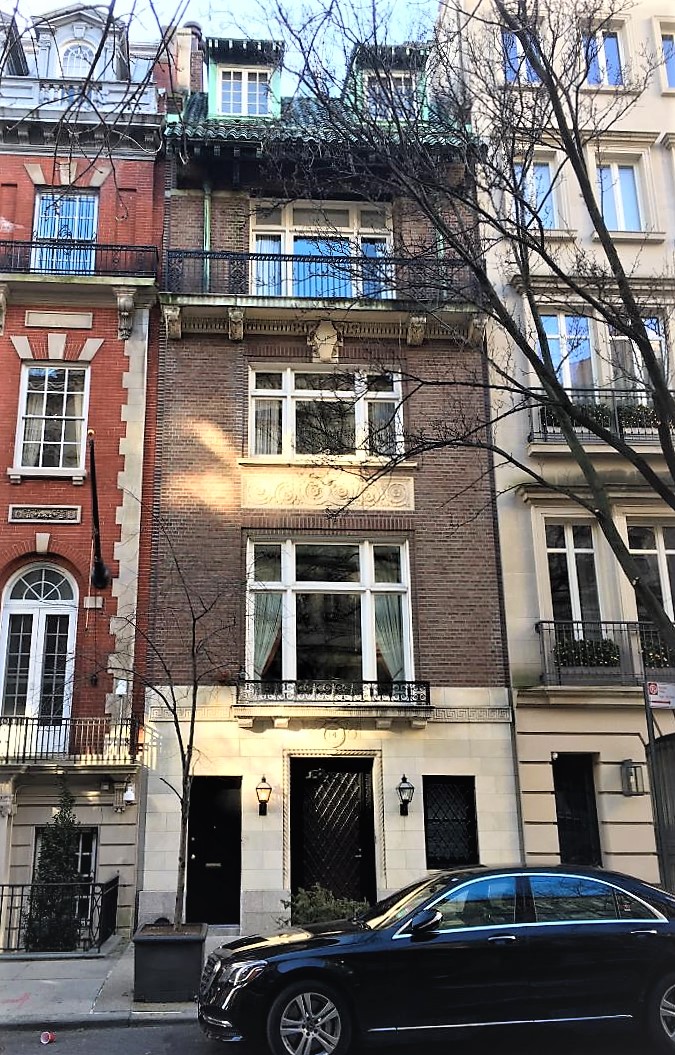
On March 25, 1911 the Real Estate Record & Guide ran an short article entitled "S. Reading Bertron to Build Again" and reported that he "has had plans prepared for a residence at 14 East 76th st, Manhattan."  Bertron had commissioned York & Sawyer to design the 30-foot wide home on the site of an old brownstone.  Their plans called for "exterior walls of limestone, marble and brick," the total cost of construction estimated at $100,000--about $2.6 million today.

As the house neared completion, the close ties of the Bertron, Roosevelt and Fahnestock families was again evidenced.   On February 18, 1912 the New-York Tribune reported "Theodore Roosevelt, jr., after spending nearly four years in the carpet business, is now planning to become a bond salesman for the New York Stock Exchange house of Bertron, Griscom & Jenks." 

The Fahnestocks moved into the completed house later that year.  York & Sawyer had designed an unconventional townhouse; a blend of Spanish and Italian Renaissance elements.  

The only decoration on the marble base was a carved wreath encircling bronze address numbers above the entrance and a Greek key course, broken by a marble faux balcony with an iron railing.  Three stories of brown-red "tapestry brick" were embellished with a carved Italian Renaissance panel between the second and third floor openings, and a full-width balcony at the fourth.  The attic floor took the form of a deeply-overhanging Mediterranean roof, sheathed in green clay tiles and punctured by two copper-clad dormers with picturesque casement windows.

In 1913 S. Reading Bertron transferred title to Elizabeth.  He and Caroline continued living in their West 54th Street house.

Elizabeth and Snowdon hob-nobbed with Manhattan's elite.  They were, for instance, members of the exclusive Friday Evening Club.  Elizabeth was among "the usual brilliant assembly" at the last of the group's supper dances on March 13, 1914.  Held in the Della Robbia room of the Vanderbilt Hotel, entertainment included music by the Russian Imperial Balalaika Orchestra, members of the Imperial Opera ballet troupe, and dancing to Conrad's and Fejer's orchestras.  With Elizabeth in the room that night were the Duke and Duchess de Richeliue, August Belmont Jr. and his wife, the Oliver Harrimans, the Jay Goulds and the Frederick T. Havemeyers.

The Fahnestock summer home, Old Brick Farm, was in Roslyn, New York.  But Elizabeth spent the summer of 1914 in Europe.  On May 31 The Sun reported her among the impressive passenger list of the France departing that day along with her mother.  She was about three months pregnant at the time and upon her return to New York a son, Reading Berntron Fahnestock, was born on November 10.

Snowden would sail to Europe within a few years, but for far more serious reasons.  In 1917 he was the secretary and treasurer of the United Equities Corporation, but that year he resigned to enter the Army after the United States was drawn into World War I.

Snowden was among the first training class at the Plattsburg Camp in 1917.  By the time he was deployed to Europe with the 77th Division he had achieved the rank of captain.  

In his absence Elizabeth did her own part in the war effort.  She became involved in the Red Cross Institute for Crippled and Disabled Men and was instrumental in the formation of classes in April 1918 to teach women to "teach trades to crippled soldiers" and "awaken public interest in this branch of war services."

Later that year Elizabeth received terrifying news.  On November 1 her husband's name appeared on the list of soldiers reported wounded in action.   Despite his serious injuries, Snowden recovered and when he returned home following the war he held the rank of colonel and had been awarded the Croix de Guerre by the French Government.

In 1920 the American Investigation Corporation was formed to investigate the potential of trans-Atlantic transportation by means of helium-filled dirigibles.  Snowden A. Fahnestock was appointed the association's president, Franklin D. Roosevelt its vice-president, and S. Reading Bertron was chairman of the board.   

On July 28 that year the New York Herald announced that "Congratulations are being extended to Mr. and Mrs. Snowden A. Fahnestock upon the birth yesterday of a daughter at Old Bright Farm, their country place."

But storm clouds would soon form in the Fahnestock home.  More and more Elizabeth traveled alone, spending much time in Paris, Newport and Washington DC.  Finally, on December 17, 1924 a cable arrived at The New York Times offices from Paris which said simply "Mrs. Snowden A. Fahnestock of New York made formal application for divorce to the Seine Tribunal today."

Interestingly, in reporting on the development, The Times merely mentioned that Elizabeth was the daughter of Samuel R. Bertron.  It went on for paragraphs, instead, about the accomplishments of her husband.

Fahnestock wasted no time in remarrying.  Six months after Elizabeth filed divorce papers he wed Helen Morgan Moran.  Theirs, too, would end in a well-publicized split and eventually in tragedy.

Accusing his wife of "being infatuated with another man," Fahnestock sued for divorce in 1934, and then for complete custody of their two children.  At one point Helen swore out a writ charging that Fahnestock had illegally removed Clara and Mary Lee from a train heading to New York from Aiken, South Carolina.  During the ugly court battle Fahnestock's mother was given temporary custody. 

On October 7, 1935 Fahnestock was awarded a divorce "on a charge of desertion."  It had all played havoc with Helen's nerves.  She was confined to a Connecticut sanitarium and then moved to a New York hospital "for treatment of a nervous disorder," according to one newspaper.  She was released on November 29 to spend Thanksgiving Day with her family.  Following Thanksgiving dinner at the home of her aunt and uncle she excused herself and went upstairs.  A few moments later she plunged from a third story window to her death.

In the meantime, the 76th Street house had became home to Herman Alfred Prosser and his wife, the former Winifred Sprague.  Born in 1876, Prosser was the vice president of the American Smelting and Refining Company.   Their children included a son, Robert Woodward, daughter Elizabeth, and Winifred, from her mother's former marriage to the late Albert E. Walker.  

The family's country home, Idlewild, was in Greenwich, Connecticut.  Living with them in their city home were two servants.

Like Elizabeth Fahnestock, Winifred had turned her attention to war efforts.  In 1917 she had been chairman of the Emergency Committee of the Women's Auxiliary of the American Institute of Mining Engineers.  Calling it a "fine patriotic society" in July that year, Mining and Metallurgy noted that she "is in close touch with Major Arthur S. Dwight, ready to act when necessity arises." 

The first of the children to leave the 76th Street house was Winifred.  Her engagement to Donald M. Lovejoy on May 4, 1930 was covered by newspapers as far away as Utah's The Ogden Standard-Examiner.  Robert was next, his engagement to Mary King Smith announced on October 12 1933.

Elizabeth was not so quick to marry.  It was not until twelve years later, on December 27, 1945, that the Bronxville Review-Press commented "One of the loveliest of the pre-Christmas brides was Miss Elizabeth Woodward Prosser, daughter of Mr and Mrs. Herman Alfred Prosser, of East Seventy-Sixth Street, New York City, who on Friday, became the  bride of Captain Francis Falconer Sanford, Army Air Forces."

Now empty-nesters, the Prossers soon left the 76th Street house, moving to No. 1001 Park Avenue.  The 76th Street house has remained a single-family home, its unusual Spanish-meets-Italian facade unchanged after more than a century.


photographs by the author

Saturday, April 2, 2016

The 1883 Imperial Flats -- Nos. 55-57 East 76th Street


On June 3, 1882 the Real Estate Record marveled at the number of apartment buildings being built in Manhattan.  The test period for apartment living was over and New Yorkers embraced the convenience of “flat-houses” with gusto.  “Unless all the indications are deceptive, before five years are over New York will have the largest and best appointed apartment houses in the world.  Every week some new plan is filed, and the last design has some attractive novelty not thought of when these great establishments were first erected.”

The journal pointed out amenities designed by developers to lure potential tenants: one Madison Avenue “Paris flats” would have a rooftop garden; “another proposes to have a Turkish or Russian bath for the use of its inmates.”  The article listed a page of buildings under construction, including the massive Navarro, the Dakota, and Frederick Aldhous’ “seven-story brown stone” building at Nos. 55-57 East 76th Street.

Only three months earlier Aldhous’ architect, Frederick T. Camp had filed the plans.  The Real Estate Record noted at the time “The feature of this house will be an interior court which will furnish light and ventilation to the centre of the house.”  Completed in 1883 at a cost of $90,000—about $2.2 million in 2016—The Imperial, as it was called, offered residents the latest in luxury. 


The 19 apartments featured “ventilating iceboxes” which opened to the outside, eliminating the need of ice in the coldest weather; tile-lined gas fireplaces with oak mantels and bathrooms with “porcelain flooring.”  An advertisement in the New-York Tribune offered “seven, ten, and fourteen room apartments.”

Just one block east of fashionable Fifth Avenue and Central Park, Camp had clad his neo-Grec structure in traditional brownstone; designing it to meld comfortably among the still-existing rowhouses on the block.  Two slightly-projecting bays provided dimension to the façade which was adorned with incised decorations, carved cornices above the openings, limestone trim and iron cresting.


The Imperial filled with moneyed residents whose lifestyles mirrored other socially-prominent New Yorkers.   Many of the apartments sat vacant during the summer as their occupants left for country estates and resorts.  Their wide-range of occupations is evidenced in a handful of the early renters.  Richard Schramm was appointed a Commissioner of Deeds in 1897, Michael Joseph Corcoran was a broker; the Rev. Thomas P. Hughes was rector of the Church of the Holy Sepulchre on 74th street near Park Avenue, and author of several books including The Dictionary of Islam; and William L. Sonntag was a well-known landscape artist.

Sonntag had been elected an academician of the National Academy of Design in 1861 and was active in the American Water Color Society.  At the age of 78 the artist developed lung problems and he died on the morning of January 22, 1900 in his apartment here.

Owners of the Imperial initially had problems.  The building was sold in foreclosure in September 1894, and resold in 1905.  The new owner, real estate operator William Buhler, set off on a marketing campaign that included renaming the building.  Despite its undeniably brown color, he dubbed it La-Casa Blanca—The White House. 

After a few months of refurbishing, Buhler flooded the newspapers with advertisements, hawking “electric light, telephones in each apartment; all night elevator; handsome entrance with marquise; door boys.”  Tenants, who “can select decoration,” would expect to pay rents from $1,200 to $3,500 a year—a substantial monthly rent of about $7,900 for the most expensive apartment in 2016 dollars.

The wealthy Helen C. Mostyn was twice widowed.  Her second husband, Berkeley Mostyn (deemed by The Times “an Englishman of good family”) died around 1907.  By 1909 Helen lived here with her unmarried daughter, Alexandra Stevens.  Social pages followed the mother and daughter as they came and went, traveling abroad to often exotic locations like Algiers.

Socialites were updated on their movements by announcements like that in The New York Times on October 6, 1910.  “Mrs. Berkeley Mostyn and her daughter, Miss Alexandra Stevens, will open their apartment, 55 East Seventy-sixth Street, on Nov. 7.”

As Helen and Alexandra came and went, other tenants in the building included two judges, city magistrates Robert C. Cornell and Joseph E. Corrigan; Dr. Walter Lindsay Niles and his wife, Louise, and Christian Blancard described by The Times in 1912 as “for more than thirty years one of the leading manufacturers of jewelers’ findings.”  Also living here in 1912 were Loring Townsend Hildreth, Consul General from Siam and an Assistant Corporation Counsel to the City of New York, and his wife, the former Augusta Warner Miller.

When owner Harrison Aronson decided to sell the building in 1920, tenants formed The 55 and 57 East Seventy-sixth Street, Inc. and purchased it.  The cooperative was under the directorship of J. Barlow, W. H. Lownsberry, and J. Prescott Gage.  Wealthy apartment owners included Dr. Edward Jewitt Wheeler; William R. Barnes, of Barnes & Noble; and John M. Cornell.

Dr. Wheeler was editor of Current Opinion and literary advisor to Funk & Wagnalls Company.  The first president of the Poetry Society of America, had founded the Literary Digest, and was also a governor of the National Arts Club.  A widower, he shared his apartment with his bachelor son Curtis Wheeler, a World War I flying ace.

Curtis had graduated from Yale in 1912 and served with the field artillery on the Mexican border in 1915.  As the United States entered World War I he was transferred to the Air Corps in 1917.  While in France he shot down three German planes, winning the Distinguished Service Cross, the French Croix de Guerre, and the Belgian Order of Leopold.

In the spring of 1922 the senior Wheeler showed signs of a baffling ailment.  Doctors were unable to diagnose the problem and in the beginning of May he was moved from East 76th Street to Lake Placid “in the hope that the change might benefit his condition,” according to the New-York Tribune.  It did not.

Although his physicians did not believe his condition to be life-threatening, Dr. Wheeler died on July 15 at the age of 63.  The following day the New York Herald noted that “His body will be sent to-day to his home, 55 East Seventy-sixth street.”

Lt. Curtis Wheeler continued to live in the apartment.  He followed in his father’s footsteps and by 1927, now 36 years old, he was associate editor of the Sunday magazine section of The New York Daily Tribune.  But despite his journalistic profession, Wheeler continued to assist the Air Corps.

In July 1927 he traveled to Watertown, New York to help train recruits.  He and 26-year old Lt. Carl J. Sack, also from Manhattan, climbed into a 1915 Curtis J N-4 army biplane on the morning of July 6 during field artillery and infantry maneuvers.  At 11:05 their craft crashed, killing Wheeler instantly.  Sack died in the ambulance on the way to a hospital.

Among the more celebrated residents in the building by 1937 were Raymond Brown and his wife Gertrude.  Brown was a well-known illustrator, author and art editor.  He had been art director of Everybody’s Magazine, publisher of Ridgway’s Magazine, and art director and vice-president of the Hawley Advertising Company.  Among his best known books was his 1915 How It Feels to Be the Husband of a Suffragette.

Indeed, Gertrude Foster Brown was both a concert pianist and a women’s rights activist.  She had been incited into her suffragist work when she heard a judge comment that women would have the right to vote if they weren’t “such fools.”  She led state-wide barn-storming lectures, founded the Woman’s Suffrage Study Club, and organized “the series of colorful, persuasive suffrage parades and demonstrations that enlivened New York City before World War I,” according to The Times.

On January 9, 1937 Gertrude hosted a luncheon for the 78th birthday of suffragist Carrie Chapman Catt.  During the event, Carrie told a reporter that it would probably take another generation “or so” for women to “find their place in the world.”  She added that she was “neither disappointed nor discouraged about the participation of women in public affairs.  They are behaving just as I thought they would.”

Ray Brown died in the apartment on April 30, 1944 at the age of 78.  He had been ill for several months.  Gertrude soon unofficially retired from public life, focusing on music.  She organized a chamber music group that played in the 76th Street apartment.  She remained in the building until her death on March 2, 1956 at the age of 88.


Throughout the second half of the 20th century, Victorian apartment buildings were modernized and broken up into smaller units.  Somehow the original floor plans at Nos. 55-57 East 76th Street survived; which in many cases preserved the interior elements—mantels, parquet flooring, and window surrounds, for instance.

The intricate French-inspired mosaic survives in the vestibule.
In 2004 the co-op initiated a façade restoration with the architectural firm Walter B. Melvin.  The  brownstone survivor of the heyday of Victorian apartment construction is a delightful and charming relic.

photographs by the author