Showing posts with label west ninth street. Show all posts

Saturday, May 6, 2023

The 1855 John W. Quincy House - 11 West 9th Street


Banker James Franklin Doughty Lanier would erect a "terrace" of elegant homes along the south side of West 10th Street in 1856.  But before starting that project, in 1855 he leased the three plots on the opposite side side of the street to Henry Pierson, a wealthy iron merchant.  Pierson constructed three handsome Anglo-Italianate homes on the site.  The identical, four-story houses sat upon rusticated brownstone bases.  Their arched doorways, above a short stoop, were perfectly balanced by windows of the same proportions.  Full-width cast iron balconies fronted the second floor French windows and a single bracketed cornice unified the trio of homes.

The John Cameron Stone house at 15 (left) retains its second floor balcony.

The easternmost house, 59 Ninth Street (later renumbered 11 West 9th Street), became home to the family of John W. Quincy, a metals merchant.

New-York Daily Tribune, December 17, 1856.

In 1863 the Quincys moved directly across the street, and 11 West 9th Street became home to Thomas Gemmell and his family.  He was at the time a vice-president of the Baltimore-based Hampshire & Baltimore Coal. Co.  Their residency would be relatively short.  Upon Gemmell's promotion to president of the firm in 1867, he relocated to Baltimore.

The next family in 11 West 9th Street were the Van Burens.  John D. Van Buren had graduated from Columbia College in 1829.  During the Civil War he had been appointed Paymaster-General for the staff of Governor John D. Hoffman.  After the conflict, he served as the governor's private secretary.  Hoffman's term ended in 1868 and the Van Burens relocated to New York City and West 9th Street.  He now served as the state's Quarantine Commissioner.

John D. Van Buren, Jr. had served as a engineer at the Navy-yard throughout the war.  The New-York Tribune would later recall, "Through his father's influence he was appointed to a position in the Dock Department under General McClellan, and assisted him in perfecting his elaborate plan of dock improvements."

John Sr.'s political ties continued to be an asset to his son.  Samuel J. Tilden was elected governor in 1874.  The New-York Tribune called Van Buren Sr. "one of Governor Tilden's most intimate friends."  Tilden placed John Van Buren Jr. on "the commission for the investigation of the canal frauds."

In the meantime, John Jr.'s brother, Frank R. Van Buren, had graduated from Columbia College in 1863 and now practiced law at 52 Wall Street.  His father's political prominence was reflected in his being confirmed by the State Senate to a commission in November 1872 to revise the state's constitution.

Following the Van Buren family's departure in 1875, the house was operated as a high-end boarding house for a decade.  Among the short-term boarders in the spring of 1882 was Martin P. Dixon.  The Evening Telegram described him as "a North Carolina farmer, who came to this city to sell a patent car coupler."  Dixon was successful in selling his patented device, and on April 28 he was paid $$1,800 in cash--or about $50,000 in today's money.

But the Southern farmer was not wary of big city hustlers and, according to The Evening Telegram on April 29, shortly after receiving his bounty, he met John Schraeder and his wife, Rachel on Broadway.  "They invited him to the saloon at No. 116 Fourth avenue, where all partook of beer."  As they were leaving, Dixon realized that all but $600 of his money was gone.  He had Rachel Schraeder arrested.  "At the Jefferson Market Police Court this morning, the woman Schraeder stoutly denied that she took the money," said the article.  It is unclear whether Dixon received either justice or his money.  He was ordered to bring witnesses to court the next morning.  That would most likely prove to be a daunting task.

The house was once again a private home when the Dr. Charles Remsen family moved in in 1886.  The family was, according to the 1896 Portrait and Biographical Record of Suffolk County, "one of the oldest in New York."  Remsen's grandfather, Benjamin Remsen, was private secretary to Thomas Jefferson.  Born on February 7, 1856, Charles Remsen studied at Princeton College and the College of Physicians and Surgeons, graduating in 1880.

He and his wife, the former Lilian Livingston Jones, had married in 1886 and would have two sons, William and Charles, Jr.  In 1890 they acquired their summer home in Speonk, near Southampton, Long Island.  The Portrait and Biographical Record noted, "Here, with all the charm that beauty of location and scenery can add, he enjoys the delightful climate and the various sports for which the region is noted."  In 1895, after the Remsens built a church for Speonk, its citizens renamed the village Remsenburg.

Lilian Remsen entertained often.  On December 10, 1887, for instance, The Evening World announced, "Mr. Charles Remsen, of 11 West Ninth street, will give a dinner to fourteen guests on Thursday.  Pinard will serve."

The Remsens moved across Fifth Avenue to 12 East 9th Street in 1890.  Philip Bradford Niles and his bride, Sarah Brookman, moved in after their wedding trip.  Their wedding in Grace Church on November 21, 1894 had been described by the Brooklyn Citizen as being one of the most "notable weddings in fashionable society as have taken place...in a long while."  Indeed, the ushers and best man came from the best families in New York society: Suffern Tailer, Robert Livingston Beekman, Richard A. Peabody, Arthur Melvin Hatch and Arthur Lucian Niles.


Both Philip, who was a stockbroker, and his wife came from old New York families.  Sarah, like Lilian Remsen, made 11 West 9th Street the center of social activities.  On February 8, 1895, for instance, The Evening Telegraph reported, "The reception of Mr. and Mrs. Bradford Niles, of No. 11 East Ninth street, is the chief formal 'at home' on for this afternoon."

The couple summered in Tuxedo, and it was there in 1896 that Philip suffered a severe accident that resulted in "constitutional injuries" according to Brooklyn Life, from which he would never recover.

Nonetheless, he continued on with his business and social life.  On August 1, 1897 the New-York Tribune reported that Philip and Sara Niles were "among the well-known fashionable people who arrived from Europe last week."

But Philip's condition worsened.  The Brooklyn Daily Eagle remarked, "his gradual decline since [the accident] has been apparent to all his friends and business associates, although he consulted the best doctors of this country, who could not affect a cure, nor afford him any relief."  Finally, on April 12, 1898 he died in the West 9th Street house at the age of 32.  His funeral was held in the house three days later.  On April 16 Brooklyn Life remarked, "His youth and strikingly fine physique combined to make his early death seem especially sad."

Sarah went on with her summer plans, although almost assuredly stepping away from society.  A month after the funeral, on May 16, The Standard Union reported, "Mrs. Philip Bradford Niles...expects to spend the summer at the De Rham cottage, Tuxedo.  The cottage was taken by Mr. Niles shortly before his death."

The house was sold in 1902, and soon afterward became home to Edward Roscoe Mathews.  He and Louisa Shaw Albee had married on September 14, 1899 and had a daughter, Esther Cary, born in 1902.  They would have a second child, a baby boy, who tragically died at birth in 1909.

On March 28, 1906 The Evening World reported that a cunning burglar "has thrown the sleepy old aristocratic quarter which flanks Washington Square upon the north into a state of panic."  Within the past five nights, he had "visited six wealthy homes, drugged the inmates, cut the telephone wires, cleaned up all visible valuables and got safely away."  Among the houses burglarized was the Mathews residence.  In the early morning hours of March 26 he had made off with $1,000 worth of Louisa's jewelry--more than$31,000 in today's money.

As Esther Cary Mathews reached her teen years, her preparation for being introduced to society was paramount.  Among the highly important social skills for any son or daughter of prominent families was dancing.  And so, several socialites took charge of dancing classes for aristocratic teens.  On January 12, 1914 The Sun reported, "At the Vanderbilt [Hotel] the tango teas are under the direction of Mrs. Edward Roscoe Mathews, of 11 West Ninth street, and the chief instructor is Prof. Ain."

The following year, on January 11, The New York Press announced, "In the Vanderbilt this evening there will be a regular meeting of the dancing class organized by Mrs. E. Roscoe Mathews of No. 11 West Ninth street."

The Mathews family remained in the house until 1915.  During the World War I years it was home to the Winfield S. Putnam family.  Putnam had been an instructor in chemistry at Cooper Union for several years.  When the war broke out Winfield M. Putnam was a student at Worchester Polytechnic Institute.  He left school to enlist in the army in August 1917.

The younger Putnam attended officers' training camp, and then artillery school at Fort Sill, Oklahoma.  He sailed for France in May 1918 with the 16th Field Artillery.  There the 24-year-old was appointed a battalion gas officer and instructor in gas defense tactics.  The Putnams received word later that summer that Winfield had been "severely wounded" on August 15.  Sadly, on September 29, 1918 The Sun reported, "In a cablegram to his father he says his wounds necessitated the amputation of one foot, but that he was resting comfortably and expected soon to be invalided home."

When Harry Katz purchased the house in December 1926 it was described by The New York Sun as a "four story and basement remodeled residence." It now held nine apartments.  Among the tenants the following year was Nell Martin, author of The Constant Simp "and other humous works," according to The New York Sun.  Her 1928 novel Lord Byron of Broadway would be made into a motion picture of the same name by MGM in 1930.

But before all that, Martin suffered an accident.  On October 24, 1927, The New York Sun reported, "Miss Martin recently drove all the way from Hollywood, Cal., in ten days without a mishap other than three tire punctures."  Back in New York, her automotive luck ran out.  The New York Sun said, "On Friday, she halted for traffic at Eleventh street, when a taxicab struck her machine, ripped loose the driver's seat and threw her violently backward."

Despite the accident, Martin continued home and that evening kept a dinner engagement.  "At midnight, however, she collapsed," said the article.  As it turned out, she had suffered a concussion in the accident and three days later was still confined to her bed in the West 9th Street house.

In 1960 novelist Stuart Woods moved into an apartment, sharing it with illustrator and cartoonist Roland Michaud.  In his 2022 autobiography, Stuart Woods, An Extravagant Life, Woods described the apartment as "a place a friend of mine said had 'a certain seedy elegance.'"


A renovation completed in 2020 returned 11 West 9th Street to a single family home.  Although, sadly, the Victorian details of the upper floors were shaved flat (most likely during the 1920's remodeling), the Quincy house manages to hint of a time when its parlors glittered with high society affairs.

photograph by the author
no permission to reuse the content of this blog has been granted to LaptrinhX.com

Thursday, February 23, 2023

The Cornelia Jones Miller House - 58 West 9th Street


In 1853 builder Reuben R. Wood erected three exceptionally handsome homes at 10 through 14 Ninth Street (renumbered 54 to 58 West 9th Street in 1867).  Their three-step porches were protected by brownstone wingwalls, surmounted by beefy iron Italianate railings and newels.  The double-doored entrances and parlor windows sat within fully arched openings.  At the second floor, a common balcony stretched the width of the three homes, its railing matching that of the porches and areaways.  The upper floor windows sat below segmental arches and wore molded lintels.  Separate bracketed Italianate cornices crowned the homes.

Wood initially leased the westernmost house to Thomas Smith, a drygoods merchant, and his family.  They lived in 14 Ninth Street in 1853 and 1854.  The house was advertised for rent again the following year, after which James R. Swords, who ran a book business on Broadway, moved in.  The pattern repeated with families rarely staying for more than two years.

Among them was Emilie Crooks.  She was the widow of Ramsay Crooks, a Scottish-born fur trader.  A partner in the Pacific Fur Company, he had spent years in the wilderness, dealing with Native Americans, and had married Abanokue, the daughter of an Ojibwa Chieftan.  Following her death, he married Emilie Pratte.  Emilie leased the house in 1863, four years after her colorful husband had died.  Living with her were two of her nine children, Ramsay, a merchant at 57 Front Street, and Sylvester, a broker.

The Crooks family remained until about 1866, and the house again saw a succession of occupants.   Its first real long-term owner came in 1878 when it was purchased by Dr. Edmund Carleton, Jr.

A homeopathic doctor, Carleton was on the faculty of the New York Medical College and Hospital for Women.  That not all of the medical community supported homeopathic practices was clearly and publicly evidenced in 1884.  On January 17, Carleton visited a patient who lived in a boarding house on West 12th Street.  While he was there, the landlady, Mrs. Babbitt, asked him to examine her throat.  The New-York Daily Tribune reported, "He told her that she had a mild attack of diphtheria; he wrote a prescription and advised her to disinfect her rooms."  Following city policy, he sent a report to the Board of Heath, which in turn directed the 12th Street Grammar School not to admit pupils from Mrs. Babbitt's boarding house.

The following day Mrs. Babbitt's family physician arrived and "pooh-poohed the idea that she was suffering from a contagious disease."  The New-York Daily Tribune said, "learning that a homeopathic physician had sent a report to the Board of Health, he undertook to procure a correction.  He also expressed his opinion that the other physician did not understand his business."

Carleton struck back, telling a New-York Daily Tribune reporter, "If Dr. Spreng says Mrs. Babbitt did not have diphtheria, he is a fool."  He explained the symptoms, and said had she continued the medicine he had prescribed, her condition would have been much improved.  "Perhaps he does not know that a child, Mary Cook, was removed from the house last week suffering from diphtheria."

At the time of that incident, Dr. Carleton was dealing with another problem.  In November 1882, he had paid several visits to a patient, Helen Lillian Russell Solomon, better known by her stage name, Lillian Russell.  His bill totaled $39 (just over $1,000 in 2023).  Carleton wrote notes, and paid personal visits to the actress's home in attempts to collect his fees.  Finally, on June 5, 1888, The Evening World wrote, "It took five years and seven months to tire out the doctor's patience; but he went to Court determined to recover the money with costs."  The article said that initially, "the fair warbler...intended to give the doctor a legal fight."  But faced with a public trial, she agreed finally to pay the bill.

Dr. Edmund Carleton, Jr. remained at 58 West 9th Street through 1890, when he sold it to Cornelia Jones Miller.   She was the widow of John Bleecker Miller who had died in Toulon, France on April 22, 1861.  He had served under President James Buchanan as consul-general to Germany.  Cornelia's impressive pedigree equaled that of her husband's.  She was the daughter of Judge Samuel William Jones and Maria Bowers Duane.  Initially living with Cornelia were her unmarried daughter, Maria Duane Bleecker Miller, and her married daughter Cornelia and her husband, Admiral French Ensor Chadwick. 

In October 1891, when famine in Russia killed upwards of 400,000 and sparked a revolt against the Tsar, Admiral Chadwick sent a letter from the West 9th Street house to the editor of The Sun.  He reminded readers of the strong sense of gratitude Americans should have to Russia.  During America's own rebellion three decades earlier, the Russian Admiral was directed "in the event of the recognition of the Confederacy by France or England, to place his fleet at the disposition of the American Government."

Admiral French Ensor Chadwick.  from the archives of the West Virginia & Regional History Center

Chadwick, who was also a military historian and author, was well-known to have similar strong opinions.  He would later complain that American women were not keeping up with immigrant women in procreating and "soon the older American stock will be replaced completely."  He balked at the replacing of male teachers in public schools with women, charging that boys were being made effeminate.

Around 1892 the Chadwicks relocated to Washington D.C.   They would be back to attend Maria's wedding to Wilmot Townsend Cox in the house on December 26, 1896.  The New York Times remarked, "The ceremony was performed in the parlor, which was decorated with evergreens, palms, and potted plants," adding, "An informal reception followed the ceremony, which was attended by the numerous family connections and intimate friends."  The "numerous family connections" included some of the oldest names of New York society, including Beekman, Irving, Jones, Rutgers, and Townsend.

The bridegroom's first American ancestor, James Cock, had arrived in Setauket, Long Island prior to 1659.  Other of his ancestors included Henry Wisner, a signer of the Declaration of Independence; John Townsend, an early settler of Long Island; and Robert Coles who accompanied Roger Williams to Rhode Island.  Wilmot Townsend Cox had graduated from Harvard in 1879 and from the Columbia College Law School in 1881.  At the time of the wedding he was a member of the law firm Scudder, Tappan, Seaman & Cox.

Maria Duane Bleecker Miller Cox.  This may have been Maria's wedding dress, described by The New York Times, as "white moirĂ©...tastefully trimmed with rare old family lace."  original source unknown.

Maria had long been interested her family's genealogy and was one of the five incorporators of the Colonial Dames of New York.  The first meeting of the Colonial Dames had been held in the West 9th Street house.  Among her ancestors were Jan Jansen Bleecker, Mayor of Albany in 1700; Major Thomas Jones, who arrived in America in 1692; James Duane, a member of the Continental Congress; and Robert Livingston, the first Lord of Livingston Manor.

The Coxes remained with Cornelia Miller in the West 9th Street house, and mother and daughter entertained together.  On February 6, 1898, for instance, The New York Times announced, "Mrs. John Bleecker Miller and her daughter, Mrs. Wilmot Townsend Cox, of 58 West Ninth Street, will receive during February.  Mrs. Miller's daughter, Mrs. F. E. Chadwick, is with her for the Winter."

On December 7, 1901, Cornelia died at the age of 75.   Maria inherited the West 9th Street house.   She and Wilmot remained there until her death on December 16, 1915.  She left the house to her husband.  To ensure her work went on after her death, she left $3,000 each to Cornelia and French Ensor Chadwick, who now lived in Newport, and a trust of $1,000.  The New York Herald explained that the money was "to be used for the publication of manuscripts relating to the Dutch occupation and the English government of New York." 

In 1916 Wilmot Cox left 58 West 9th Street, never to return.  At some point he transferred title to Cornelia Chadwick.  It was leased in rapid fire succession to Charles J. Berdell, Jr. in 1916, G. P. Dubois in 1917, and George D. Yeomans in 1918.  After years of leasing the house, in 1920 Cornelia Chadwick sold it to Juliana R. Force.

photo via the New York Times

Force converted the venerable home into unofficial apartments.  Living on an upper floor in 1924 was Dorothy Harrington and her two-year-old son, Donald.  Dorothy's husband, Portus Harrington, was a Cleveland stock broker.  Why she and the boy were living separately in New York is unclear.  

On the afternoon of February 17 that year, Dorothy put Donald into his crib and (unthinkable today) left to visit her uncle, Justice Davis on East 94th Street.  Before she reached his home, at around 3:00 fire broke out on the second floor of the 9th Street house.   It started in the apartment of Dr. Ettore Perrone, whose eight year old daughter Rose was in bed with tonsilitis.   "The child saw the flames and screamed in fear," reported the New York Evening Post.  Her father, who was downstairs in his office, rushed up and carried her to the street.  The article said, "He was there in plenty of time to have returned for Donald, had he known the child was there alone.  But he believed the boy was with his mother."  Later, in the thick smoke firemen stumbled upon the crib in the Harrington suite.  The toddler was already dead.


A renovation completed in 1997 returned 58 West 9th Street to a single-family home.  It is the only one of the trio to retain all of the 1853 architectural elements.

photographs by the author
no permission to reuse the content of this blog has been granted to LaptrinhX.com

Wednesday, September 28, 2022

The 1848 Sherman-Dodge House - 52 West 9th Street


Wealthy physician Austin Sherman completed construction of his Greenwich Village home at 13 Ninth Street (renumbered 52 West 9th Street in 1868) in 1848.  The double-doored entrance of the Anglo-Italianate style residence was entered at street level within a rusticated brownstone base.  The two upper stories were faced in red brick and trimmed in brownstone.  In the rear yard, as was common, was a small, tw0-story house.

Austin was well-known for his patented medicine, "All Healing Balsam."  In addition to his medical practice, Austin dabbled in real estate.  In May 1851, for instance, he advertised: "To Let--A first class three-story and attic House with all the modern improvements and conveniences, pleasantly situated, 43 Ninth street.  Apply to A. Sherman, 13 Ninth street."

Dr. Austin was stricken with paralysis, according to the Weekly Drug News, in 1871, most likely the result  of a stroke.  He died 13 years later, on November 22, 1884.

The house would be home to three families by the turn of the century.  John A. Stevens was here by 1887, followed by the Charles E. Griswold family.  On March 27, 1891 The Epoch reported, "Mrs. Charles E. Griswold and Miss Gertrude Griswold gave an exceptionally pleasant musicale on the night of Wednesday, March 25th, at their residence, 52 West 9th street.  They will receive informally on the second, third and fourth Mondays of April."

Finally, William Cornelius Hall moved his family in.  He and his wife, Marie Suzette de Mirigny Thomas, had married in 1880.  Their first son, William Claiborne, was born in 1881, followed by John Mandelville the following year, and by twins Agnes Stuart and Marie Suzette de Marigny in 1886.

A graduate of Yale University, Hall was a vice-president of the Perth Amboy Terra Cotta company, perhaps best known for making the Tiffany bricks, designed by architect Stanford White.  Marie Suzette was related to the Marquis de Marigny, the Duc de Villinbrosa, and to Baron Louis von Hoffmann of Germany.  Her grandfather was the first governor of New Orleans.

Upon his graduation from Yale in 1904, William Claiborne Hall took a ground-level job in his father's firm, earning $5 per week (about $160 today).  A year later he was promoted to the sales department.

Marie Suzette's wedding to Charles Schuveldt Dewey on December 20, 1905 was a socially important affair.  Three days earlier The Sun had reported that pre-wedding entertainments had been going on for two weeks.  It added, "To-morrow night Chauncey Dewey of Chicago, a cousin of the bridegroom and a nephew of Admiral Dewey, will give a dinner dance for the bridal party at the Waldof-Astoria.  The final ante-nuptial affair will be a dance given on Tuesday night by the bride's aunt, Mrs. Gilbert Colgate."  

According to the New York Herald, Marie wore the wedding gown of her great-grandmother, "who was a lady in waiting to the then Queen of Spain."  The Church of the Ascension filled with some of Manhattan's most elite families, with names like Havemeyer, Schuyler, Roosevelt, Colgate and Hall.  Following the ceremony, a reception was held in the West 9th Street house, which the New York Herald said, "is one of the old fashioned houses that has undergone few changes."


Despite a privileged upbringing identical to his brother William, John Mandeville Hall (who went by his middle name) became the black sheep of the family.  He was seemingly unable to keep his name out of the newspapers for the worst of reasons.   It started on June 12, 1906 when the Perth Amboy Evening News began an article saying, "Mystery surrounds the sending out of a card bearing the Hall coat-of-arms and reading as follows":

                                                                    52 West Ninth St.

The engagement of Lily F. Wilson, of New Rochelle, daughter of Mrs. George Grant Wilson, and Mr. Mandeville de Marigny Hall, of New York, has been broken by mutual consent.

The Hall family had sailed for Europe soon after Marie's wedding, and had just returned.  Mandeville insisted he was dumbfounded at the announcement.  The newspaper said, "The envelope is from Tiffany's and Mr. Hall said it is unquestionably from their own supply of stationery...he asserted that he did not know who the mysterious sender was."

Not surprisingly, the engagement was called off.  Instead of marrying Lily Wilson, one month later, on July 9, Mandeville married Florence Teall.  The wedding was kept secret from society--even initially from Florence's parents.  The couple moved into the West 9th Street house, but Florence left Mandeville the following January, "owing, she says, to his dissipated habits," said The Evening World.  The marriage was no longer secret.

On Sunday January 10, Mandeville sent for Florence, "and urged her to return, but she refused," according to The Evening World.  He went up to his room and shot himself.  The following day The Perth Amboy Evening News wrote, "Mrs. William C. Hall, of 52 West Ninth street, a summer resident of Perth Amboy, was kept busy yesterday telling sympathetic callers that her twenty-four-year-old son, Mandeville, who was removed to the Roosevelt hospital on Sunday suffering from a pistol wound, had not attempted suicide."

Suicide, or attempted suicide, within a high society family would be scandalous, and the family (including Florence) joined in a well-constructed explanation.  Mandeville (who survived) told police and reporters that he noticed a jar of vaseline on a table in his room and decided to clean his revolver.  "There were three cartridges in it, and I omitted to remove them.  One of them exploded accidentally."

Following the incident, Mandeville sailed for Europe.  But it was not entirely to escape the ugly publicity.  On June 31, 1908 The Evening World reported, "Mrs. Florence Teall Hall, who learned through The World that her husband Mandeville de Marigny Hall, was traveling in Europe with Vida Whitmore, a former Weber & Field's beauty, today sought her lawyer, John L. Linehan."  Florence ordered an investigation "and if the fact were as reported," she would direct her attorney to bring suit for divorce.

She did not have to wait long for proof.  On August 4, chorus girl Vida Whitmore arrived in New York on the Lusitania "with a meagre wardrobe," according to the Perth Amboy Evening News.  "Although she travelled first class she was penniless, and her cab hire to her apartments uptown was paid by friends."

Although still married to Florence, Mandeville had told Whitmore he was divorced, and they had been married in New Jersey on May 21.  According to her, he convinced her to give him between $18,000 and $20,000 in "precious stones," then gave her the key to a strong box in the Colonial Trust Company.  When she opened the box upon her return to New York, "there was nothing in it but air," she told a reporter.  She continued, "It would take a book to tell all the low, mean things that man did.  His deception as to his former marriage and divorce was deliberate."

He had also told Whitmore that his father had died and left him a fortune.  "The poor old man is a victim of paralysis, and lives in a helpless condition in his lonely old-fashioned home No. 52 West Ninth street," she said.

Both Florence and Vida would have to wait to get justice.  The Perth Amboy Evening News noted, "Hall is now under arrest in London accused of having passed a worthless check."  He was extradited to France and sentenced to 13 months in prison.

But on September 28, 1909, The Perth Amboy Evening News said, "Through mysterious influence he obtained his release and turned up last May at Watch Hill, Rhode Island, in company with a married woman of New York...Hall is only twenty-five years old, but for four years he has led the life of a spendthrift, chiefly on money he got from women."

That lifestyle came to an abrupt end at the fashionable Narragansett Pier on July 12, 1909, where he was using the pseudonyms Charles W. Stevens and Douglas Turner Johnstone.  According to The New York Press, "A technical charge of forgery was entered against Hall, who is alleged to have drawn many checks on the [Fifth Avenue Bank] which were valueless."  According to the arresting detective, "Hall was enjoying himself hugely, having run up an automobile bill of $175...and was popular with summer girls there when arrested."  He was sentenced to two years in the Rhode Island state prison.

Despite the never-ending bad publicity, the family continued to maintain appearances.  Invitations went out in December 1909 for Agnes's marriage to Walter Bateman Allen on January 26, 1910 in the Church of the Ascension.  Most likely because of her brother's notoriety, her wedding did not get the ample press coverage that Marie's had.

William Cornelius Hall's paralysis that Vida Whitmore had earlier mentioned was the result of a stroke he suffered while he and Marie Suzette were touring Egypt in 1906. On June 6, 1911 he suffered another stroke.  This one proved fatal.  His funeral was held in the West 9th Street house at 5:00 on the following afternoon.  It may have been Mandeville's past that prompted Hall to simply leave the entire estate to his wife rather than deal with the untidy issue of disinheritance.

The house was purchased in October 1915 by Edith Livingston Hall Morgan.  In reporting the sale, The New York Times described it as "a three-story dwelling, with a two-story dwelling at the rear of the lot," and added, "Mrs. Morgan plans extensive alterations to the houses."

Edith Livingston Hall (unrelated to the previous Hall family) had married William Forbes Morgan, Jr. in 1904.  At the time of the wedding, according to the New-York Tribune, she was "one of the most prominent young women in New York society."  Morgan was a member of the brokerage firm of Morgan, Livermore & Co.  The couple had three children, Barbara L., born in 1905, and twins Ellen and William Forbes Morgan II born in 1907.   Edith's sister Anna Rebecca was married to Elliott Roosevelt and Eleanor Roosevelt was Edith's niece.

Things were not going well for the couple, and William remained at 176 East 70th Street, while Edith and the children moved into the West 9th Street house.

In 1920 William, Jr. was away at boarding school.  Shortly before 4:00 on the morning of February 4, Edith was awakened to the smell of smoke.  The New-York Tribune wrote, "Prompted by mother-love and disregarding her own safety, she rushed up to the fourth floor her home."  That was where 10-year-old Ellen and 14-year-old Barbara were sleeping.  "Before she could reach her children...she was overcome by smoke and collapsed."

Fire fighters had to break into the entrance doors.  On the fourth floor landing they found the body of Barbara.  "A quick search revealed the bodies of Mrs. Morgan and her other daughter, Ellen," said the New-York Tribune.

Edith's will demanded that the West 9th Street house "shall not be sold until Mrs. Morgan's youngest child shall have reached its majority, when the proceeds from the sale shall be distributed equally among her children," explained the New-York Tribune on April 21, 1920.  Despite her expressed wishes, the house was sold the following year.  On July 28, 1921 the New-York Tribune reported that William de Leftwich Dodge had purchased the "three and one-half story building and two-story studio building in the rear."  The article noted, "The new owner is a mural painter, and will improve the premises for his own occupancy."

Indeed, William de Leftwich Dodge was a mural painter.  Born in 1879, he grew up in Europe and studied at the Ă‰cole des Beaux-Arts.  His mural Glorification of the Arts and Sciences adorned the dome of the Administration Building of the 1893 Columbian Exhibition in Chicago, and in 1895 he completed a series of murals for the Library of Congress.  He had decorated the Cafe de l'Opera and the Follies Bergeres Theater in Paris.  

Dodge poses in front of The Purchase, one of six murals for the Tower of Jewels at the 1915 Panama-Pacific Exposition in San Francisco.  Original source unknown.

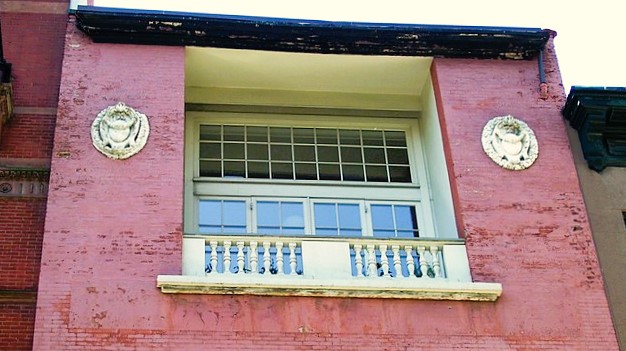
The "improvements" Dodge made to the West 9th Street house were transformative.  Essentially, only the ground and third floors gave hint of the home's 1848 appearance.  A five-paneled set of leaded casements was the feature of the second floor, and a double-height studio was installed at the former attic level.  Unlike most studio windows in converted vintage homes at the time, this one was recessed, providing an ample balustraded balcony.  On either side were complex terra cotta medallions, possibly designed by Dodge.

The balcony and medallions in 2011, prior to a restoration of the facade.  photo by Beyond My Ken.

By the time the Dodges moved into their remodeled house, William was a professor at the Arts Students League of New York.  He and his wife, the former Francesca (known as Fanny) Theodora Bland Pryor, had a daughter, Sara, and a son, Roger.  The family's summer home was in Setauket, Long Island.

On March 26, 1935, The New York Sun reported, "William De Leftwich Dodge, one of America's leading mural painters, whose panels form part of the decoration of many public buildings in this country and abroad, died yesterday after an illness of some months.  He was 68 years old."  Despite his international prominence, Dodge's funeral was private, held in the West 9th Street house the following afternoon.


The New York Sun revealed what was perhaps a little known detail in the artist's resume.  "The helicopter which Mr. Dodge made and flew for ten feet before the Wright brothers' flight in 1903 is now on exhibition in the Smithsonian Institution in Washington."

Dodge's renovations to 52 West 9th Street were perfect for artist Hans Hoffmann, and the following year the Hans Hoffman School of Fine Arts moved in.  Born in Weissenberg, Germany, Hoffmann grew up in Munich where he studied architecture before turning to painting.   In 1934 he had opened a summer school in the artist colony of Provincetown, Massachusetts, then a year-round school at 137 East 57th Street before moving to the former Dodge house.  The school remained here through 1938.

A renovation completed in 1948 resulted in a duplex on the ground and second floor, and one apartment each on the upper floors.  In May 2016 the duplex was purchased by Craig Newmark (founder of Craig's List) and his wife Eileen as their Manhattan pied-Ă -terre.  They paid $5.9 million for the three-bedroom, 3-1/2 bath home.


With the facade sensitively restored, the house looks remarkably as it did when William de Leftwich Dodge made his overwhelming 1921 "improvements."

photograph by the author
no permission to reuse the content of this blog has been granted to LaptrinhX.com