Showing posts with label john sexton. Show all posts

Tuesday, February 22, 2022

The Isabella Merritt Hawley House - 49 West 71st Street


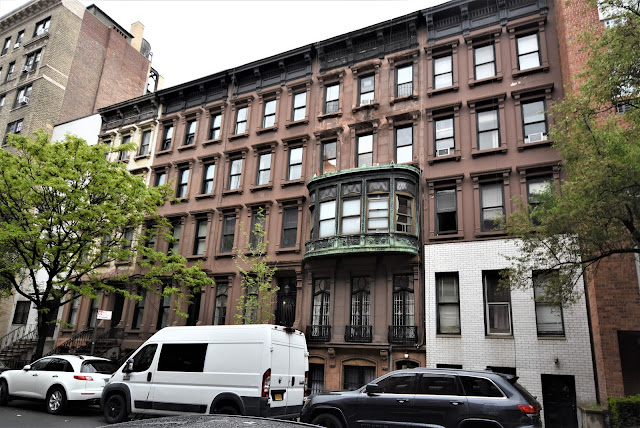
In January 1885, architect John Sexton filed plans for seven four-story brownstone houses on the north side of West 71st Street, between Columbus Avenue and Central Park West.  The 19-foot-wide homes would cost the developer, Owen Donahue, $12,000 each to construct (about $329,000 today).  Donahue may have run into financial problems, because before the project was completed his builders, George and Andrew Crawford, held title to the properties.

Although the row was completed in 1886, the Crawfords retained possession of 49 West 71st Street until October 23, 1890 when it was sold to Louis Stix for $34,500--just over $1 million today.  The Real Estate Record & Guide noted, "This is the last house of the row built by Mr. Crawford on 71st street."

The house was identical to the other six along the row.  Designed in the neo-Grec style, its openings sat within architrave frames, each having a molded cornice and bracketed sills.  Identical pressed metal cornices graced each house along the row.

49 West 71st Street is easily identified along the row of once-identical homes by its 1909 French makeover.

Louis Stix purchased the property as an investment.  (He and his family resided in another of George Crawford's houses on the block, 35 West 71st Street, just steps away.)  He leased it  to Isabella Meritt Hawley.

Isabella was born in St. John's, New Brunswick, where she received a private education before attending the Troy Female Seminary in Troy, New York, and then Mrs. Mears' Boarding and Day School in New York City.  She was the widow of Peter Radcliffe Hawley, an officer of the U. S. Coast Survey, a Government-run scientific organization.  They were married in 1856 and had five children.  

Isabella Merritt Hawley was no  hapless widow.   An accomplished dancer and musician, the 1898 Emma Willard and Her Pupils noted that she was, as well, a "contributor to the daily newspapers on current topics, and has translated from both French and German."  That same year, on December 9, The Argus reported that she had incorporated the stock brokerage firm, I. M. Hawley Company with her sons Alan and William.  The New-York Tribune commented that she spoke "fluently French, Italian and German and was especially interested in Oriental philanthropy and religion."

One of Isabella's two daughters was Wilhemina Douglas Hawley, born in 1860.  Like her mother, she showed early artistic talent and in 1879 enrolled in the Cooper Union Women's Art School, and the following year she entered the Art Students League--eventually becoming its first female vice president.

When her mother moved into 40 West 71st Street, Wilhemina was in Paris, studying at the Academie Julian.  She would never return, settling permanently in Europe where she pursued her career as an artist.

Equally noteworthy was Isabella's son, Alan Hawley.  His interest in stocks and bonds paled to his passion for flight.  Born in 1869, he attended the prestigious Trinity School in New York City.  He would become a balloonist and early aviator.  In 1910 he entered and won the Gordon Bennett International Balloon Race, and in 1916 was first passenger to fly in an airplane from New York City to Washington D.C.

In the meantime, Isabella carried on the expected routine of a wealthy socialite.  On June 28, 1898, The Evening Telegram announced she "has leased a cottage at Seabright, N.J. for the season."

The house was sold to George Potts in 1901, triggering a rapid succession of owners and occupants.  Potts resold it the following year to Irving I. Kempner.  In 1903 it was purchased by Lewis C. Marshall, who sold it to Elizabeth E. Mack in April 1909.

As Louis Stix had done, Elizabeth purchased the property as an investment.  A professional lecturer and speech instructor, she had studied under Sarah Bernhardt.  The unmarried speaker gave lectures and dramatic readings on subjects like "Current Events of the New York Theatres" and "Modern Poets."

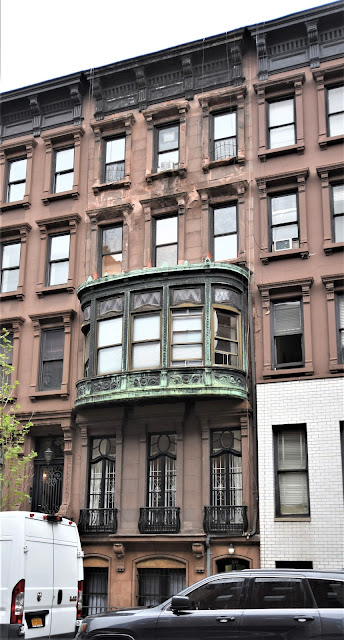
Before leasing the house, Mack hired the architectural firm of Herts & Tallant to modernize it.  A three-story addition was constructed in the rear, the stoop was removed and the entrance lowered to the basement level, and a striking copper oriel was added to the second floor.  The former parlor level was given French windows fronted by bulbous faux balconies.

The glass of the original oriel window panes would have been curved to follow the shape of the bay.

Mack's first long-term tenant came in 1917 when Nelson W. Greenhut and his wife, the former Cecile Erstein, moved in.  Greenhut was a partner in the private banking firm of Greenhut & Co., founded by his father, Joseph B. Greenhut.  (Joseph Greenhut had distinguished himself in the battle of Gettysburg, earning a special commendation from Secretary of War, Henry L. Stimson.)

Jacob H. Scheuer purchased the house in 1924.  After the Scheuer family sold it two years later, it was operated as an unofficial apartment house, home to professionals like attorney Joseph Ankus throughout the Depression years.

In 1947 a renovation resulted in two apartments per floor.  During the Cold War years of the 1960's it was owned by Lino Quirko, who installed a Federally registered fall-out shelter in the cellar level.

A resident in the summer of 1969, Karen Sue McKee, led police in several counties on a nearly year-long search for her.  The News-Review reported on March 5, 1970, "Police say she went on a shopping spree last July in Suffolk [county] stores, concentrating on Riverhead, Patchogue, and other Brookhaven communities, writing forged checks ranging from $180 to $220, and purchasing small articles."  The total value of her buying binge was more than $2,000--nearly seven times that much in today's dollars.

The 29-year-0ld was arrested in November 1969 in Rhode Island, "but jumped $2,000 bail on Nov. 13," said The News-Review.  It all ended without drama when McKee surrendered to County Police at Hauppage, New York on March 3, 1970.

The appearance of the original stoop can be seen next door at 51 West 71st Street.

Outwardly, 49 West 71st Street is little changed since Elizabeth E. Mack gave it an architectural split personality in 1909.

photographs by the author
no permission to reuse the content of this blog has been granted to LaptrinhX.com

Tuesday, June 1, 2021

The 1886 Max Weil House - 51 West 71st Street


In January 1885 architect John Sexton filed plans for seven four-story brownstone houses on the north side of West 71st Street, between Columbus Avenue and Central Park West.  The 19-foot-wide homes would cost the developer, Owen Donahue, $12,000 each to construct (about $329,000 today).  Donahue may have run into financial problems, because before the project was completed his builders, George and Andrew Crawford, had title to the properties.

Although the row was completed in 1886, the Crawfords retained possession of 51 West 71st Street until August 1890 when they sold it to George E. Stedman the equivalent of $1.1 million today.

The house was identical to the other six along the row.  Designed in the neo-Grec style, its openings sat within architrave frames, each having a molded cornice and bracketed sills.  Identical pressed metal cornices graced each house along the row.  If Stedman lived in the house at all, it was only for a short period.  By the mid-1890's it was home to the Maximillian Weil family.

Born in 1843, Max Weil and his wife, the former Gertrude (known as Gertie) Williams, had three children, Hilda, Minnie B., and Max Sanford.

The year 1897 began with the family making plans for Hilda's upcoming wedding.  The focus turned to Minnie, however, as she fell seriously ill.  The 25-year-old died in her bedroom on February 2 and her funeral was held in the drawing room three days later.

Rather shockingly, Hilda's wedding plans went on and she was married to John Taussig in that same room two months later, on April 7.  The New-York Daily Tribune remarked, "Because of a recent death in the bride's family, only relatives and personal friends were present to witness the ceremony."  Afterward a "wedding dinner" was served to those present.

Young Max graduated from New York University in 1903 where he had been on the varsity tennis team.  The family remained at 51 West 71st Street for just three more years, selling it to Thomas J. McLaughlin in May 1906.  

McLaughlin most likely gave them an offer they could not refuse.  He simultaneously purchased 49 and 47 West 71st Street and hired architect C. B. Brun to remodel the three adjoining homes.  The middle house of the trio was made the true centerpiece with a spectacular copper-clad oriel at the second floor


As with the other two, Brun replaced the parlor windows of 51 West 71st Street with full-length French windows that opened onto Juliette balconies.  The entrance was given an ornate French grilled door.  His renovations completed, McClaughlin advertised the house on February 23, 1907:

Ready for occupancy, four story Dwelling; thoroughly renovated; entire new plumbing system; three bathrooms, electric light; hardwood floors; chandeliers and attractively decorated.

Only five days later the New-York Tribune announced that McLaughlin had sold 51 West 71st Street.  "This completed the sale of the three adjoining houses bought and extensively remodelled by Mr. McLaughlin," it added.

The new owners were the Reverend John Henry Watson and his wife, the former Susan Matilda Hoffman.  Born in Boston, Watson was a Harvard graduate and received his divinity degree at the Berkeley Divinity School in Middleton, Connecticut.  Susan had significant religious ties, as well.  Her father was Rev. Eugene Augustus Hoffman, the dean of the General Theological Seminary.  (When Dean Hoffman died in 1902 he left an estate to about $460 million in today's money, the bulk of which was divided among his widow and four children.)

The Watsons had two sons and a daughter.  By the time they moved into the 71st Street house Watson had given up his parish work to devote all his time to missions in the city.

On September 30, 1913 Watson suffered a fatal heart attack in the house at the age of 68.  The following year, in November, the house was opened for inspection prior to the auction of the  house and its contents.  The two day auction was handled in part by Silo's Fifth Avenue Art Galleries who took charge of "the art collections and period furniture," according to the New York Herald on November 13.

By the early 1920's 51 West 71st Street was home to the Louis Krohnberg family.  A partner in the Eureka Dress Company, Krohnberg also made money in a less upstanding way--poker.  It resulted in a well-publicized law suit in January 1920 when the Commissioner of Charities, Bird S. Coler, charged Krohnberg with cheating.

Coler claimed he and others had lost a total of $350,000 during poker games--an astounding $4.47 million today--to Krohnberg.  Alleging that Krohnberg "used markers," he sued for $1.75 million, five times the amount lost, promising to turn it all over to charity.

Louis's wife appeared in newspapers for more respectable reasons.  On May 26, 1922, for instance, The New York Times reported, "Mrs. Louis Krohnberg entertained at a luncheon at her home, 51 West Seventy-first Street, yesterday for her niece, Miss Florence Krohnberg, who is to be married at the Astor Hotel on June 20.

In 1941 the house was renovated to apartments and furnished rooms.  A subsequent remodeling, completed seven years later, resulted in a total of nine apartments; and a final renovation in 2009 joined the basement and parlor floors into a duplex.


Of the three homes Thomas J. McLaughlin remodeled in 1906, 51 West 71st Street has fared the best, retaining its stoop and crisp neo-Grec details.

photographs by the author
no permission to reuse the content of this blog has been granted to LaptrinhX.com

Friday, December 21, 2018

The William M. Benjamin House - 127 East 69th Street


Among the most prolific of the developers who transformed the Upper East Side from open land to residential neighborhoods in the years following the Civil War was Christopher Keyes.  In 1872 he hired architect John Sexton to design a row of eleven 20-foot wide brownstone houses on the northern side of East 69th Street, stretching to the corner of Lexington Avenue.

Completed in 1873, No. 127 like its neighbors was four stories tall above a high English basement.  It became home to the family of Max Abenheim, principal of Max Abenheim & Co., "grain and provisions" firm at Nos. 2 and 4 Stone Street.

It appears that Abenheim had slightly altered his surname when he first arrived in New York.  In 1877 he took out a $20,000 mortgage on the house with Abenheimer Bros, of Baden, German.  The amount of the mortgage, equal to about $485,000 today, hints at the original purchase price. 

Among the Abenheim children was Sidney, whose teen-age hobby was coin collecting.  He placed an advertisement in Harper's Young People on November 2, 1880 that read "I would like to exchange rare stamps for foreign or United States coins with any readers of YOUNG PEOPLE."   He would not be the only occupant of No. 127 over the years to have a serious interest in coins.

Three years later Sidney enrolled in Columbia College and joined his father's business.  The ambitious young man would hold directorships in mining and railroad companies and even invented a shoe polishing machine in 1892.

By then Max Abenheim & Co. had branched out into tobacco exporting.  And following Abenheim's death Sidney and his brother, Max, Jr., who ran the firm as co-partners, focused only on tobacco.

In July 1894 Abenheim's heirs sold No. 127 to real estate operator Julia Friend, who leased it until 1903 when she sold the house to William Hartman Woodin, head of the American Car and Foundry Company.  A bizarre accident earlier in the year nearly prevented the transaction.

The Woodin country home was upstate.  On January 8, 1903 a local newspaper reported "William H. Woodin, a prominent resident of Oneonta, was struck by a train this noon on the Delaware and Hudson Railroad at Cooperstown Junction.  He is still alive and may recover."

Woodin, of course, did recover and moved his family into the 69th Street house.  He and his wife, the former Annie Jessup, had two daughters, Mary Louise and Anne Jessup.  Like Sidney Abenheim, Woodin was interested in rare coins--but his fortune took the hobby to a nearly unparalleled level.

In 1909 Woodin's purchase of two coins drew international attention.  On June 6 The Sun reported "Two unique United States gold coins of the denomination of $50, each of different design, which have long been regarded as the rarest coins in the world by American coin collectors, were purchased a few days ago by William H. Woodin of this city at a figure for each which by far exceeds all record high premiums paid for any coin ever sold."

Each of the coins was one-of-a-kind; the only examples struck.  The Sun explained "They never emerged from the experimental stage."  Minted in 1877, they were put away at the United States mint and had never been brought out since.  Although the exact price for each coin was not disclosed, it was announced that it exceeded the previous record of $6,200, making the lowest possible price for both in the neighborhood of $345,000 today.

Excitement was aroused within the numismatic community when Woodin decided to sell part of his collection in 1911 at an auction at the Collectors' Club.  On March 5 The New York Times remarked "The Woodin collection of three-dollar gold pieces is said to be the finest and the only complete one of this denomination ever offered at public sale."  The collection brought $16,862 (nearly $450,000 today).

Woodin's recognized expertise in coins and coin design came into play in 1914 when a movement to improve silver coinage took hold.  Proponents pointed out that the current designs were easily worn down with use.  When the Federal Government was urged to form a special committee to address the issue in December 1914, The New York Times reported "It is probable that William H. Woodin...an authority on United States pattern coins, will be the Chairman of this committee."

(Woodin, incidentally, would be appointed Secretary of the Treasury by President Franklin D. Roosevelt in 1933.)

William H. Woodin - from the collection of the Library of Congress
While her husband focused on building railroad cars and coin collecting, Annie Woodin had been busy grooming two future socialites.  In November 1911 she gave a tea to introduce Mary Louise to society.  The New York Times noted "The tea will be followed by a dinner and theatre party."

Anne's turn came in November 1914, the year that her sister graduated from Bryn Mawr College.  Anne's coming out began with an evening reception in the house on November 24, followed by "a dinner and informal dancing."

The Woodins began construction on a new summer home in Easthampton, Long Island in the spring of 1916.  The residence, designed by society architect Grosvenor Atterbury, cost the equivalent of $925,000 today.

The United States involvement in World War I and the prospect of deployment sparked a sense of urgency in many romances.  On April 14, 1918 The Sun reported that "News was received here last week of the marriage on April 6 of Miss Mary L. Woodin, daughter of Mr. and Mrs. William H. Woodin of 127 East Sixty-ninth street, to Lieut. Charles Miner, 109th Field Artillery, U.S.A."  The couple had been married near Camp Hancock, Georgia where the groom was stationed.  "Miss Woodin's engagement was not announced until a short time before the wedding," said the article.

The following year, in December, Anne would be married to Colonel Olin F. Harvey.  Nine months earlier her parents had sold No. 127 and moved to No. 752 Park Avenue.

The transaction was both convoluted and a bit sneaky.  In March 1919 the house was sold to Foot & Martin, Inc., which almost immediately resold it to "a client of Ruland, Whiting & Benjamin," one of the leading real estate firms in the city.  That client was the Etagloe Holding Company, of which William Massena Benjamin, was president (he was, as well, president of Ruland, Whiting & Benjamin).

Benjamin, using the name of Etagloe Holding Company, hired architect S. Edson Gage to completely remodel the outdated Victorian into a modern residence.  Gage removed the stoop and moved the facade forward to the property line.

The remodeled house was highly unusual among Manhattan rowhouses.  Gage produced a 20th century take on 18th century Adam style architecture  The variegated Flemish bond brick was trimmed in stone.  The design was dominated by the over-sized arch that rose from the elegant entrance.  The slightly-recessed double-doored entrance was fronted by classical columns and pilasters that upheld an entablature decorated with Adamesque swags and garlands.


Delightful Juliette balconies clung to the third floor openings.  The paneled lintels of the fourth floor windows were carved with leaves and flowers.  Behind a stone balustrade the mansard level featured brick dormers with similar paneled lintels.

Benjamin and his wife, the former Charlotte Hoffman Prime, had six children: Sarah Morris, Charlotte Prime, Elizabeth Fish, Julia Kean, Samuel Nicoll, and William Hoffman Benjamin.  Two years after moving in another son, Hamilton Fish, would be born.

William Benjamin came from a distinguished New York family, and was related to the socially and politically eminent Fish family.  His grandfather was Hamilton Fish, Secretary of State in the Ulysses S. Grant administration.  The family's summer estate was at Garrison-on-Hudson. 

While he was a member of some of the most exclusive men's social clubs--among them the St. Nicholas Society, the Union Club, the Downtown, and the St. Anthony--he seems to have been more passionate about his membership in sporting clubs.  The New York Times later said he was "a keen sportsman, particularly fond of hunting and fishing"  He was president of the Triton Club of Canada and a member of the Boone and Crockett Club, founded by Theodore Roosevelt in 1887.

Perhaps to prevent any problems with the title of the house later in life, on May 1, 1922 the Etagloe Holding Company sold No. 127 to Charlotte.  It was a move that would prove wise before very long.

In the winter of 1928 William Benjamin became ill.  In hopes that a warmer climate would improve his health, he left New York for a cruise along with Charlotte and two of their daughters.   When his condition worsened, they disembarked in San Juan where Benjamin was hospitalized.  The 54-year-old died there on February 15.

Somewhat surprisingly, the engagement of Elizabeth to William Lawrence McLane was announced by her mother just two months later.   Nevertheless, no doubt because the family was in mourning, The New York Times noted that "No date has been set for the wedding."

Julia's engagement to Lieutenant Joseph Farrell Haskell of the U.S. Army was announced in December the following year; but it was soon broken "by mutual consent."  So when Charlotte announced the couple would be married in the 69th Street house in January 1932, The Times said "News of the approaching marriage will come as a surprise to members of society."

Charlotte's life was consumed with engagements and debutante entertainments as the years passed.  The year after Julia's home wedding, Emily was introduced to society with a dinner in the house on January 6, 1933.  Charlotte then hosted her guests at a performance of the play 20th Century at the Broadhurst Theatre.

Emily's engagement to Charles Arthur Richards, Jr. was announced in January 1934; but like Julia's first engagement, it did not last.  On October 4, 1935 Charlotte announced that it had been "terminated by mutual consent."  And, like her sister, the rift was repaired.  On April 11, 1936 the date for the couple's wedding, June 5, was announced.

Sarah was next to enter the spotlight.  Her debut came in the form of a dinner and dance in the Persian Room of the Plaza Hotel on December 10, 1937.  Her engagement to Alan Anderson was announced on February 2, 1939.  Following closely behind was Mary, whose engagement to Eric Sinclaire Purdon was announced by Charlotte in August 1940.

Charlotte's maternal responsibilities were not over.  The following year the engagement of Samuel, who was now a Lieutenant in the Air Corps, to Joan Oakey was announced.  His wedding took plate the following year in Montebello, California.  The Times noted "At the reception the bride cut the wedding cake with a saber awarded to the bridegroom at Gunter Field for outstanding military achievement."

Although Charlotte Benjamin lived on to the age of 88, dying in September 1969 at Garrison, she sold the 69th Street house to Dr. Emanuel Joseph in 1944.  The physician converted the house to ten apartments, one of which, on the first floor, he retained for his own home and office.  His unmarried nurse, Frances Ormsby, occupied the topmost floor.

On the afternoon of March 11, 1946 Frances rushed into the office saying that burglars were in her apartment.  The doctor picked up a heavy iron bar and headed upstairs.   Frances had been right.  Five teen-agers were in the act of looting her apartment.

As Joseph rushed up the stairs, he encountered the boys carrying the booty in a blanket.  The New York Times reported "He told police...that he knocked two of the youths unconscious and held a third at bay with the bar."  The other two escaped.  The oldest of the trio was 15 years old.  They were declared delinquents in Children's Court and remanded to the Youth House for sentencing.

Joseph was drawn into a case of intrigue and civic spying in 1949.  Two men appeared at the house and identified themselves as telephone workers who needed to check wiring.  They were, in fact, former Treasury Department agent Edward M. Jones and former detective Kenneth Ryan, who were now working for private investigator John G. Broady.  Broady was in turn hired by Clendenin J. Ryan, an opponent of Mayor William O'Dwyer.  They installed a wiretap intended to pick up the telephone conversations from the home of Manhattan Borough President and Tammany Hall leader Hugo Rogers.

Soon afterward Detective Joseph Popp discovered a wire tap device in the Rogers house.  That led to the uncovering "of the Sixty-ninth Street listening post."  Popp cautioned Dr. Joseph to be on the lookout for any fake telephone company employees.

Only a couple hours later Ryan and Jones returned for their routine "check-up."  Despite Popp's warnings, Joseph acted naively, telling them that he had been told to watch for bogus telephone men.  Joseph later testified "They went off in a great lather."  Despite a stake-out of No. 127, the police were unable to catch the suspects in the act due to Joseph's unthinking blabbering.

No. 127 was sold in July 1954.  The former doctor's office soon became home to the Burden Littell Bureau, an organization active in promoting benefits for organizations like the Turtle Bay Music School.  It would remain in the space at least through 1962.  In the 1970's it was home to the art gallery Carlton.


A subsequent renovation in 1988 resulted in medical offices in the basement and first floor, one apartment on the second, a duplex on the third and fourth, and one apartment in the mansard level.  The altered residence has since been home to recognized names like Leigh Keno, American antiques dealer whose face became familiar to viewers of Antiques Roadshow.

photographs by the author
Friday, August 26, 2016

The Wm. S. Thorn House -- No. 136 East 70th Street


The end of the Civil War triggered a resurgence in building in Manhattan, partly due to the return of the workforce that had been fighting in the South.  In 1869 developers R. & J. Cunningham completed a row of five upscale brownstone homes on East 70th Street. 

The most desirable of architect John Sexton's Italianate row was No. 136, because of its location at the southwest corner of Lexington Avenue.  The corner site afforded windows on the eastern side, admitting light and breezes.


Four stories tall above a high English basement, the front of the house was clad in brownstone while the avenue elevation was warm red brick.  Sexton’s attention to architectural details was evidenced by the stone quoins that joined the brick and brownstone facades, the paneled lintels of the parlor level, and the handsome arched openings of the top floor.

No. 136 became home to another real estate developer, John Muller.  Unlike R. & J. Cunningham, Muller focused on the tenement districts of downtown.  In 1870, the year No. 136 was completed, he was constructing a five-story tenement building on Stanton Street, for instance.  And in 1874 he was working on three five-story brick combination store and tenement buildings on Elizabeth Street.

In December 1884 William S. Thorn and his wife, Carrie, purchased the residence.  They spent $18,500 on their new home, in the neighborhood of $450,000 today.   Thorn was president of the Second Avenue Railroad Company. 
 
Owners of fashionable dwellings required a household staff and Carrie A. Thorn was quite specific in her needs.  On August 14, 1890 she advertised for “a competent German or Swedish girl for general housework.”

On February 8, 1883, almost a year before the Thorns moved into their new home, 24-year old William S. Thorn, Jr. had married Josie Dingee of Brooklyn.  By 1894 the couple had two children.  He had risen to the position of President of the Red Star Manufacturing Company, and was a partner in the lubricating oil firm of Dingall & Co.

Trouble came in 1894 when both William Thorn, Sr. and Jr. suffered illnesses.   The elder man’s condition forced him to resign from the railroad that year, and by autumn it was considered “serious.”  The Evening World was blunt, saying “The senior Thorne [sic] it is said, is lying close to death’s door.”

According to that newspaper, William Junior’s ongoing health issues were “the result of worry over business complications.  The worriment, it is said, preyed so heavily upon Mr. Thorne [sic] that his health had been undermined.”  His despondency grew to the point that he left his Brooklyn house and family, and moved into his parents’ much quieter East 70th Street home on October 6.

The near morning, Sunday October 7, he appeared at breakfast and seemed “more cheerful than usual,” according to the family.  At around 10:00 he went upstairs to his room.  When he had not been heard from by 4:00 he was checked on.   William Thorn, Jr., was dead, having “sent a bullet crashing through his brain,” according to The World.

The New York Times mentioned William Thorn, Sr.’s condition.  “It is feared that when he learns of his son’s death the shock may end his life also.”

On April 7, 1896 No. 136 was sold at auction.  Henry Neckersheimer placed the winning bid of $25,100.  He quickly resold it to architect Gerard Fountain who took advantage of the advantageous Lexington Avenue location by extending the structure into the rear garden to accommodate ground floor stores and apartments above.

Living in the main portion of the structure at the turn of the century was the John H. Meyer family.  On May 21, 1900 daughter Gertrude Attracta Meyer was married to Ambrose Stolzenberger, Jr. in what the New-York Tribune deemed “a pretty wedding.”  The newspaper reported “The ceremony over, a wedding supper was served at the home of the bride’s parents…after which the happy couple started on an extended tour.”

Fountain sold the property in 1903 to Dr. Charles Ignatius Proben and his wife, the former Josephine Ulrich.   Proben was a specialist in diseases of children and in gynecology.

The basement sprouted a commercial storefront in the second half of the 20th century.

The Probens shared the house with renters, including publisher and playwright William Harlowe Briggs and his wife, Berta.   The Briggs had been married in 1913, six years after William had been appointed associate editor of Harper’s Bazaar.  He was later made book editor of Harper & Bros.  In 1915 his play Behold Thy Wife was produced in New York.

When war broke out in Europe, Briggs put his career on hold and left East 70th Street to join the army.  In 1916 he was a private at the Federal Military Training Camp of the Eighth Training Regiment.

Charles and Josephine Proben continued to rent the rear portion of their large home.  Concert oboist Albert Marsh lived in the house from about 1918 to 1922.  He taught in his studio here during that time.   And in January of 1925 Cornell graduate Thomas Louden and his wife, the former Elizabeth H. Valentine moved in.

Josephine B. Proben, now widowed, died in 1946 having owned the 70th Street house for more than four decades.


Over time the store space in the southern extension spread throughout the entire Lexington Avenue span, culminating in a storefront addition at the corner.  Yet, rather surprisingly, the post-Civil War residence remains little changed on the floors above.

photographs by the author

Thursday, September 3, 2015

John Sexton's Nos. 242-244 Lafayette Street


In the last quarter of the 19th century the rows of Federal style houses along Lafayette Street were quickly disappearing.  In their place modern commercial structures were changing the face of the once-elegant residential street.

In 1881 developer Thomas Wetherbed commissioned architect John Sexton to design a loft building at No. 244 Lafayette Street.  The prolific Sexton had been dividing his time in designing rows of townhouses on the developing Upper East Side and tenement buildings on the Lower East Side.  For Wetherbed he produced a five-story brick factory, completed in 1882, which drew no special attention.

But more than a decade later, in 1897, Wetherbed called Sexton back to double the size of his building.  The extension, at No. 242, perfectly matched the northern side.  But Sexton patched the two sides together with a two-bay section in the Queen Anne style.  Here the cornice formed a peak above the eye-catching center windows of the fifth floor.  Sexton gave them the appearance of arched openings by crowning them with ornate terra cotta tympani framed with vaulting brick eyebrows.  The Queen Anne motif was carried through to the entrance portico where hefty columns supported an entablature and sunburst-filled pediment.


Despite the architectural marriage, the two sections were treated as separate addresses.  Matching retail store fronts flanked the centered entrance.

The building was filled with a wide variety of tenants, from apparel manufacturers to lamp makers.  Nearby was the area which was by now referred to by New Yorkers as the “Italian quarter.”  On the morning of June 18, 1906 about a dozen of the immigrant neighborhood boys brought excitement and misfortune to the Lafayette Street building.

The boys had been playing a few blocks south on Centre Street when they came across a pile of blasting caps that had been left by construction workers.  The Sun reported “There was a good sized armload of the stuff.”

Not realizing the danger the explosives posed, the boys decided they could burn off the rubber insulation and retrieve the copper wires for resale.   On the sidewalk in front of No. 242-244 Lafayette Street they built a fire and, once it got going, dumped the quantity of blasting caps into the flames.  Quickly “there was an explosion that startled the neighborhood and thousands of people ran to the corner from the markets along Mulberry and Spring streets.”
When Policeman Moffatt arrived on the scene, he found five of the boys lying on the street suffering from cuts and burns.  The exploding caps had created copper shrapnel that flew into the faces and bodies of the youths.

The injured boys bore the names of Italian families who came to America for a better life: George Sulivati, Niccolo Garadi, Tommaso Gelesti, Alfonso Grecci, and Alfonso Capola.  Dr. Charles F. Nammack was able to patch up four of the boys.  But 10-year old Alfonso Capola was seriously injured.  The Sun reported that the boy “may die.  His right eye was nearly torn out and a piece of copper was buried deeply in it.  He was cut about the face and head also and burned.”

News quickly spread and frantic mothers, unsure of who the victims were, were hysterical.  “The accident occurred at 4 o’clock when the streets of the Italian quarter are most crowded,” said the newspaper, “and there were 5,000 people in front of the Mulberry street station.  Two of three Italian wives who thought their children were hurt tried to fight their way in and there was a small sized riot for a few minutes.”

The neckwear manufacturing firm owned by Meyer Berse was operating from No. 242 Lafayette Street at the time of the explosion.  A month later Berse would find himself in the midst of a frantic effort to clear his name of ungentlemanly behavior and a resulting strike as well as .

The neckwear union ordered a strike of all the manufacturers on the East Side following an incident in which Berse was accused of manhandling a female employee.  On July 12, 1906 The Sun explained “According to the union, Fanny Tepper’s employer, Meyer Berse of 242 Lafayette street, had an argument with her, in which she admits she answered back very sharply.  Finally, she says, her employer slapped her face and tore her blouse, and then refused to pay a fine of $25 levied by the union on the complaint of the girl.  This refusal to pay the fine led up to the strike.”

As could be expected, management’s version of the story was quite different: Fanny Tepper was a back-talking employee who not only had attitude, but performed poorly.  Berse’s brother explained the story saying, “The girl got fresh about her work and when my brother reprimanded her she got sassier and sassier.”   

Then Fanny went too far.  “She called him an insulting word, which means swine in English.  He got excited and told her to get out.  She refused and he caught her by the arm to put her out.  It was a very warm day and everybody was perspiring and his hand slipped and her [shirt]waist was torn a little at the  shoulder.  My brother did not slap her, as he is too much of a gentleman to slap a woman.”

Fanny’s complaint led to the $25 fine levied by the union.  Meyer Berse refused to pay it, telling the union “only the courts could inflict fines and that the union should go to the courts.”  Meyer’s brother said “Then the trouble began.”

The incident erupted into a violent strike and The Sun noted that “There were several arrests of neckwear makers, all men, yesterday.”


Around the same time the factory of Hampel-Lifmer was here.  In 1910 it was searching for experienced solderers to work on making metal bag frames.  The Union Art Glass and Mfg. Company was in the building until its bankruptcy in 1915.  And in June 1917 the newly-formed Desk Exchange Corp., sellers of “desks and office supplies,” moved in.

Over the next few decades the unusual mix of tenants continued: The Homestead Valve Mfg. headquartered in Homestead, Pennsylvania moved its New York office into the building in August 1920; the Caldwell Paper Co. was here at the same time; as was the Zalon Glove Co.  By 1933 the Manhattan Bookbinder Co. was here and a year later the Lafayette Motive Parts, Inc. moved in.  That firm provided “for ‘dead’ automobile storage.”

In the 1940s the building was home not only to respectable businesses like the Beacon Chemical Corp., which made household cleaning products, and the J. I. Shoe Machinery company; but to at least one not-so-upstanding operation.

Based in Pennsylvania, the Beacon Chemical Corp. marketed its Zero as a cleaner for nearly everything.
Prior to the outbreak of World War II gangster Charles (Lucky) Luciano controlled an illegal lottery ring.   Targeting the working community, the gang sold lottery tickets for drawings held in Italy every Friday.  Results were printed in New York on Saturdays, the “pay-off day.”  But the war interrupted the lottery.  According to police, “During the war, with results unobtainable from Italy, the lottery suspended.”

But in 1947 things were back to normal.  The difference, now, was that Lucky Luciano had been released from prison and deported to Italy.  A new syndicate took over the ring; printing lottery tickets and preying on those who could least afford the gamble.  “As usual it flourished on the earnings of workers in the thickly populated sections of the city,” said officials.  The estimated weekly take was $5 million.

But on April 19, 1947, after weeks of investigation, a massive raid was made by plainclothed officers who “swooped down on earmarked establishments,” as described by The New York Times.  Among those operations was Gri-O Press. 

“Plates, books and records were seized at the Grio-O Press, 242 Lafayette Street, which the police said is owned by Anthony Grio.”  The Times noted the irony of the Grio’s arrest.  “Not only was Grio’s printing established located in the shadow of Police Headquarters, but he is a neighbor of Commissioner Wallander as well.”

Commissioner Arthur W. Wallander did not comment on Grio specifically; but did call the sting “the outstanding series of lottery arrests in the history of the department.”

As the century drew to a close the Soho neighborhood underwent rebirth as artists rediscovered the old loft buildings.  Around 1982 Architectural Sculpture moved into one of the retail stores and in 1984 Bicycle Habitat took the other.  Rather astonishingly, the ground floor had not been modernized—the twin arcade store fronts survived as did the wonderful columned portico.

In 1993 the upper floors, once home to neckwear makers, bookbinders, and a gang-related printing operation, was converted to residential space.  On each floor were now two “joint living-working quarters."  To qualify for a loft here, the Department of Buildings noted the artists must be “certified by the Department of Cultural Affairs.”

Bicycle Habitat eventually took over both ground floor stores.  But the 21st century’s scourge of exorbitant rents may bring an end to the store’s decades-long history here.   In May 2015 the store faced what its owner deemed “sky high rents” and was considering the need to leave the building.


In the meantime, John Sexton’s handsome two-part building survives beautifully intact.

 photographs by the author