Showing posts with label east 11th street. Show all posts

Wednesday, June 4, 2025

The Heavily Remodeled Walcutt & Leeds Building - 53 East 11th Street


On November 11, 1896, The Electrical Engineer reported that Walcutt & Leeds had moved into the building at 53 East 11th Street.  There, said the article, they "manufacture phonograph and graphophone records and supplies.  They manufacture also the blank cylinders and sell also the latest types of the Edison phonographs."  The firm had been formed that same month by Edward F. Leeds, Loring L. Leeds and Cleveland Walcutt.  

Loring L. Leeds, according to the New-York Tribune, was "for many years identified with Thomas A. Edison."  Edison had invented the phonograph nearly two decades earlier and Walcutt & Leeds (along with others) worked to improve the phonograph cylinders.  

The Phonoscope, May 1897 (copyright expired)

The building at 53 East 11th Street had been erected about 15 years earlier by T. F. Sturges.  At the time it was two stories tall, but was remodeled and enlarged in 1894.  Now three stories tall, the stepped gable of the factory-and-shop structure reflected the currently popular Flemish Revival style.  Faced in brick, the upper floors were separated by undressed stone courses.  A large terra cotta rondel above the third floor and a half-round terra cotta sunburst atop the gable added interest.


image via the NYC Dept of Records & Information Services.

The firm produced recordings of popular singers and musicians, including Irish-born George J. Gaskin, known as the "silver-voiced Irish tenor."  The company's largest customer for master (or blank) cylinders was the National Phonograph Company, established by Edison.  Walcutt & Leeds, however, was consistently in court because it "flaunted phonograph-related patents," according to the Discography of American Historical Recordings.

Directly behind 53 East 11th Street was Ward School No. 47The Sun said that the Walcutt & Leeds building was "only a few feet from the rear windows of the school, and it is easy to see from one building to another."  The newspaper said on June 16, 1897, "For some time the firm has been conducting experiments in a room on the third floor of the factory."  The previous day, Cleveland Walcutt and Dr. J. W. Metcalf had been "experimenting to produce a more perfect phonograph record cylinder than the one now in general use."  According to the article, "They had a great nine-foot cauldron of boiling wax, and into this they poured various chemicals."

Suddenly there was an immense explosion that "literally ripped the room to pieces," said the article.  "Windows were broken, sashes torn out, and the walls and ceilings brought down with a crash."  Cleveland and Metcalf were splashed with boiling wax and seriously burned.  

The blast blew out windows of Ward School 47.  The janitor, who was helping girls decorate a classroom for that day's graduation ceremony, was thrown across the room.  The school was evacuated and, as reported by The Sun, "When the fire in the factory had been put out the children were marched back into the school and the school duties resumed as though nothing had happened."

In 1903 the firm was manufacturing disc recordings.  Lippincott's Magazine Advertiser, December 1903 (copyright expired)

In 1897, a judge found Cleveland Walcutt and Edward Leeds guilty of contempt for ignoring a patent infringement injunction.  Two years later, Walcutt left the company and in June 1899, Edward Leeds partnered with Reade Catlin to reorganize as the Leeds & Catlin Company.

The firm soon began experimenting with the emerging disc, rather than cylinder, market.  It produced its final brown-wax cylinder catalog in 1903 and turned solely to disc (or record) production.

In 1899, Leeds & Catlin leased space to R. Arnold, a manufacturing and retail furrier, who had been operating on University Place.  Working in the shop at the turn of the century was Helene Miller, "a tailoress," as described by The New York Times.  She responded to an advertisement by Charles Blumenthal looking for "people with small incomes desirous of building homes."  Helene sent him several $15 installments towards her building fund, and then Blumenthal disappeared.

Helene lived in North Bergen, New Jersey and took the ferry back and forth each day.  In the fall of 1900, she spotted Blumenthal on the ferryboat.  The feisty woman, it turned out, was not to be trifled with. "I took hold of his collar and gave him a good shaking, demanding my money back," she later told a reporter.  He begged her not to create a scene and promised to return her money "within a day or two."  When the money had not been returned by December 11, Helene began her own investigation to find his home address. 

On January 7, 1901, she told a reporter from The New York Times, "I found out to-night where he lived, and immediately notified the police.  I would have given him a good beating but the detective made me walk on ahead."  Blumenthal was arrested for swindling.

A horrific accident occurred here on the morning of February 27, 1901.  Santa Cancialosa and her husband entered the elevator on an upper floor.  The New York Times reported that when it reached the lobby, "the elevator man threw open the gate, stepped out and started to walk across the hall."  According to court documents later, "When he had gone about ten or twelve feet, he heard a scream behind him, and, turning, saw the elevator moving upwards."

The 26-year-old Santa Cancialosa had been the first to exit the elevator.  The New York Times reported, "before she was entirely out of the elevator the car suddenly darted upward, catching her body between it and the landing above."  The elevator operator attempted to stop the car, but "Mrs. Cancialosa was wedged in so tight that she was killed almost instantly."

On March 15, 1909, The Talking Machine World reported on the "new twin record catalog of Leeds & Catlin Co." and added, "The company are making arrangements to move into a new suite of offices in one of the prominent buildings of the city, but retaining their laboratory at 53 East Eleventh street."  That move would not happen.  Three months later, on June 22, The New York Times reported that Leeds & Catlin Company had filed for bankruptcy.  An auction of the firm's physical assets was held in the building on August 10.  Along with the expected office furniture to be sold, according to The Waste Trade Journal, were more unusual items like an organ, a piano and stool, microscopes and technical equipment like a "3-cylinder recording machine," vacuum pumps, Edison reproducers and such.

No. 53 East 11th Street now filled with a variety of tenants.  Waterman & Company, pen manufacturer, occupied space through 1915.  In 1916 Joseph Reichbach leased the ground floor space.  Around the same time Barshop & Klein, general contractors, operated from an upper floor office.  In January 1920, Morallissee & Fondrisi, apparently an apparel firm, took the front portion of the second floor.

In 1932, the ground floor was converted to a restaurant and the factory space above became apartments, one per floor.  

Ben's Luncheonette occupied the ground floor in 1941.  via the NYC Dept. of Records & Information Services. 

Thelma Burne lived in one of the apartments in 1936.  On August 8 that year, The New York Age reported that she "entertained an intimate group of friends at a weekend party ending after Sunday dinner."

In 1948, Robert Frank took an apartment here.  Born in Zürich in 1924, he had emigrated to the United States a year earlier and landed a job as a fashion photographer with Harper's Bazaar.  Frank would develop as a notable photographer and filmmaker.  His 1958 book The Americans was described by critic Sean O'Hagan as, "perhaps the most influential photograph book of the 20th century."  Robert Frank's residency would be short-lived.  He left to travel throughout South American and Europe in 1949.

On May 16, 1963, The New York Times reported that Oscar and Rachel Zurer had purchased "the three-story studio and store building" at 53 East 11th Street.  The article said, "Mr. Zurer, who is identified with several off-Broadway plays, plans to use most of the house for his residence and business."  The couple renovated the ground floor to the Renata Theatre.  Part of the second floor became the office and the other portion was now part of a duplex apartment for the Zurers.  The 157-seat Renata Theatre opened on October 8, 1964 with Shout From the Rooftop by Jess Gregg.  

In the meantime, Grove Press had been established at 18 Grove Street in 1951.  In 1962 the firm moved to University Place (where it was first charged with selling an obscene work).  Then, on August 31, 1967, The New York Times reported that the publishing firm's president, Barney Rosset, had announced that, "he had purchased the Renata Theater, 53 East 11th Street, from Oscar Zurer for $170,000 and leased it to the Grove press for 10 years."  The article said the theater portion "will be used for the presentation of plays and films and its name will be changed to Evergreen."  Evergreen was the title of Grove Press's bi-monthly review, its series of books, and the theater programs that it printed.

The residential space above the theater was converted to offices. Evergreen Theater opened on October 16, 1967 with The Beard, a two-character play by Michael McClure.  Less than three months later, on January 10, 1968, Barney Rosset announced that going forward the Evergreen Theater would present "both plays and films." 

Grove Press had been scrutinized by the Central Intelligence Agency for years.  In August 1975, Barney Rosset and an editor, Fred Jordan, filed a suit against the C.I.A. on behalf of Grove Press.  It charged the agency "with infiltrating, wiretapping and bombing the offices of Grove Press, Inc."  (The bombing had taken place at the University Place location.)  The 21-page complain sought $10 million in damages.  Among the specific accusations were:

The agency wiretapped the telephones of Grove Press and Mr. Rosset, collected the wiretapped information in an intelligence file and divulged the contents to others

Impersonation and disguise were used to "infiltrate" Grove Press, employees placed in the company adversely influenced its managerial, editorial and employment policies

A "mail watch" was conducted against the plaintiffs that included opening and copying their correspondence.

Around 1982, Bahá’í Center took over the building.  According to its website, it strives "to give expression to the oneness of humanity, a core principle of their faith, by seeking to eliminate racial prejudice, advance the equality of women and men, and build a vibrant spiritual community reflecting the human family in all its diversity." The theater portion is used for the Children's Theater Company, which stages children's plays.


In 1992, the lobby and the exterior were remodeled. The ground floor was given a veneer of pink granite, and the upper floors received white stone panels. Unfortunately, the renovations eradicated the little building's 1897 charm.

many thanks to reader Mark Satlof for suggesting this post
photographs by the author

Wednesday, February 15, 2023

The 1903 Alabama Hotel - 13-15 East 11th Street


When Leopold Wertheim purchased the "old buildings" at 13 and 15 East 11th Street in April 1902, he was already erecting an apartment building, The Van Rensselaer, on the site of two other vintage structures next door at 17 and 19 East 11th Street.  In reporting on the recent sale, the Record & Guide commented, "A 9-story apartment building will be erected on the plot."

As it rose, the Van Rensselaer had been leased to the Municipal Realty Company.  Now, according to the New-York Tribune, "arrangements are being perfected for the leasing to the corporation of Nos. 13 and 15 East Eleventh-st., and making the two hotels one."

Despite those negotiations, architect Louis Korn made no attempt to meld the designs of the two structures.  The 45-foot-wide Alabama Hotel would be clad in red brick above a two-story, rusticated limestone base.  Its Italian Renaissance Revival design featured a Palladio-inspired portico with free-standing Ionic columns, wreath framed openings and swirling carved ribbons and bellflowers.  The entrance sat within an intricately carved frame.


Korn visually divided the six-story midsection in two parts by lavishing the openings of the third through fifth floors with quoins, elaborate keystones and carvings.  Each of the more sedate sixth through eighth floors grew less ornamented, with molded lintels and scrolled keystones at the sixth, bracketed sills at the seventh, and prim stone frames at the eighth.  A full-wide stone balcony fronted the top floor.  The structure cost Wertheim the equivalent of $5.36 million to construct by 2023 terms.

The Hotel Alabama opened as an "apartment hotel" in 1903. "Elegantly furnished apartments with private bath" rented for $25 per week, if the guest took two meals per day, or $15 if they needed only one.  The rent would translate to about $800 per week for the more expensive today.

Henry Gregory Granger lived here in 1905.  Described by the New-York Tribune as "a United States consular agent in Colombia," on November 9 the newspaper said, "Granger is a Princeton graduate and was an athlete when in college...He has just returned from Colombia, where he has extensive mining and agricultural interests."

The previous year, Charles O. Brewster had been a poll watcher at 27 Chrystie Street.  Poll watchers were hired by candidates to ensure there was no tampering with the election process.  Brewster "was sandbagged while on duty there," said the New-York Tribune, noting "One of the worst districts in the city for watchers, who are not in sympathy with Tammany Hall is the 6th Assembly, of which 'Little Tim' Sullivan is the leader."  Brewster said he would return this year "if he could have two husky men to back him up."  

One of them was Henry Gregory Granger.  At six-foot, two-inches tall and 215 pounds, he and his brother N. N. Granger, who was also an athlete, accompanied Brewster to the Chrystie Street polling site.  It did not go well.

On November 9, 1905, the New-York Tribune wrote that Henry G. Granger, "is lying in his apartments at the Hotel Alabama, No. 15 East 11th-st., a sadly battered wreck."  The article said that while standing in front of the polling station, "he was knocked down with a blackjack and kicked in the face until he became insensible."  Granger told police "that the brutal attack was instigated by State Senator John G. Fitzgerald, who succeeded 'Big Tim' Sullivan."  


In March 1906, May Kay took a suite in the Hotel Alabama.  The Sun described her as "a very good looking young woman, who had plenty of fine clothes and jewelry and appeared to be well supplied with money."  May's husband had died three years earlier.  A broker in New Orleans, he left her substantial property in New York and Cincinnati.  She additionally received $150,000 in liquid assets (more than $4.5 million today).

The young widow entrusted a former schoolmate with the administration of her affairs, giving him complete power of attorney.  Another friend confidentially said he "had reason to suspect that there had been a love affair between Mrs. Kay and the young man."  She received a letter early in 1906 that read:

My Darling Dear.  Am leaving but against my wishes.  If you love me, please wait until my return.  I simply cannot give you up.  Yours sincerely, Bill.

May did not wait, but followed him to New York.  It is unclear if she ever found him.  Whether she did or not, she was "the source of a good deal of uneasiness to the hotel management," said The Sun on March 30.  "She was in a highly nervous state and had announced on several occasions that she was going to commit suicide."  Two nights before that article Dr. P. E. Bush, who had been treating her, remained in her apartment until 3:00 in the morning, "arguing with her about the foolishness of taking her life."  She promised him, finally, that she would not.

But early on the evening of March 29, May telephoned the desk, telling the Gregor Krischbaum, "Come quickly to my room.  I've shot myself."  The clerk made rapid-fire calls to Dr. Travell who lived down the block, then the police, and then an ambulance.  (Krischbaum later told investigators that May had had "a long telephone conversation over the telephone with a man," shortly before shooting herself.)

When Dr. Travell arrived, May told him, "I want to die, and I am sorry to bother you.  I don't wish you to go to any trouble.  Just leave me alone.  I will be glad when it is all over."  As Travell looked around for the weapon, she directed, "You'll find it over there in the corner.  I threw it behind a portiere."  The Sun reported, "A fancy little revolver was where she said it was."  May Kay had attempted to shoot herself in the heart, but missed.

Blanche Turner Dennis's story was strikingly similar to May Kay's.  Born in the South, she had been married to Confederate Major Hugh C. Dennis, who later became president of the Rialto Grain and Securities Company of St. Louis.  He died about six months after May's husband.  The Sun described Blanche almost exactly as it did May Kay.  "She had plenty of clothes and some jewelry and was apparently always in funds."  She had taken a suite at the Hotel Alabama a few months before May Kay arrived.

The Sun said, "Mrs. Dennis occupied a suite of three rooms, which were tastefully furnished and contained many pieces of bric-a-brac and paintings which she bought from time to time to decorate the rooms."  She had only one caller, a man of about 50 years of age.  Blanche Dennis's story was as tragic as May Kay's.  She had been hiding a pregnancy and died on March 29, the same day May shot herself, of "blood poisoning following a criminal operation presumably performed by herself," as reported by The Sun.

The negotiations to combine the Van Rensselaer and The Alabama had fallen through in 1902.  Now in 1906, J. C. Lawrence, the proprietor of the Van Rensselaer, acquired The Alabama.  While they continued to be operated as separate entities, they were now under the same management.  An advertisement on September 19, 1909 was titled, "In the Midst of Aristocracy are the Alabama - Van Rensselaer Hotels."  The "permanent rentals" ranged from $30 to $200 monthly, an extravagant $6,150 today for the most expensive.

On January 16, 1908, Detroit newspaper man James L. Long, checked into the Hotel Alabama.  The New-York Tribune said, "He seemed to have plenty 0f money and spent it freely."  The following morning a young woman, Carrie O'Neill, applied for a job as a maid and was hired.  A week later, on January 23, the she was seen coming from Long's room by a porter who notified the management.  The New-York Tribune reported, "When asked about the incident Long became indignant, and, handing his key to the clerk, moved out, bag and baggage.  Carrie O'Neil was summarily dismissed and also left the hotel."

At the time of the unpleasant confrontations, two residents Mrs. Harold B. Miller and Mrs. M. R. Gibbs were both at dinner.  When they returned to their rooms, they found them ransacked.  The burglars had overlooked $5,000 in jewels in Mrs. Miller's apartment.  Acting on a hunch, police went to the Hotel Breslin where Long had had his trunk forwarded.  They broke in his door and found him and Carrie O'Neil together.  The detectives also found the "valuable gowns" of Miller and Gibbs there.  Police believed they had solved the string of mysterious hotel robberies that had began weeks earlier.

A resident was the victim of a more bizarre robbery on January 17, 1909.  The Sun began its article saying, "A queer story was turned out at Headquarters last night of a robbery whose victim was a woman known to the police only as Miss Simmons of the Hotel Alabama."  That afternoon, she told investigators, she was out walking when she met an acquaintance she had not seen in some time.  The article said, "The two walked together until it began to storm...The man suggested that they go into a café and wait until he could summon a cab."

While seated at a table, he asked to see the diamond pin, valued at $400, she was wearing.  "The man suddenly excused himself and went out.  Miss Simmons says she asked for her pin, but he did not stop."  The story became stranger when Miss Simmons received a telephone call the following morning from the friend, who said he would be at the Alabama in a few moments.  She waited, but a different man showed up, said he was a secret service detective, and could help her recover her jewelry.  The astute Miss Simmons asked him to please come back later that afternoon.  Then, when a man approached the desk and asked for Miss Simmons, detectives were waiting to arrest him.

The Sun reported that Don P. Collins had a shield in his coat pocket presumably from the Secret Service Society of the United States.  He told the detectives he had called on Miss Simmons "to see if he could get the job of getting back her pine, as he had heard of the robbery."  Miss Simmons identified him as a man she had seen at the café when her "friend" had stolen her pin.  He was held as a suspicious person.

After James E. Knott, head of the Knott Corporation, purchased the two hotels around 1912, he listed them together as the Hotel Van Rensselaer.  An advertisement that year called it "The finest hotel below Fourteenth Street," and offered, "To rent by the week, month, season or year, at very attractive rentals."  The rents started at $15 including meals.  The advertisement noted "Cuisine of the highest standing at moderate rates.  Table d'hote breakfast."

Despite the changing neighborhood in the post World War I years, the hotel continued to house respectable residents.  Among them was Theodore L. Waugh, who was appointed Assistant District Attorney in September 1918.

Four decades after his father had purchased the buildings, in October 1950, David H. Knott sold the property to Nathan Wilson.  The New York Times reported, "A condition of the sale was that Mr. Knott and his family will continue to have their city home on the property."  The article noted, "Mr. Wilson plans to alter the apartment building into smaller suites."  Still, the renovations did not combine the two buildings internally.

Living in one of those smaller suites in 1970 was 18-year-old Cheryl Sharpton.  She was one of five arrested on October 9 that year for armed bank robbery.  Two days earlier two teenaged girls had attempted to hold up the main office of the Dry Dock Savings Bank at 59th Street and Lexington Avenue, but failed.  They implicated the other three including Sharpton, the oldest of them being 21 years old.  Police said they had netted about $32,500 in bank robberies since July 6.

A more respectable resident at the time was Ida Rauh Eastman.  Born in 1877, she was a founder of the historic Provincetown Players and an ardent feminist.  A sculptor, poet, painter and actress, she had been known as the "Duse of Macdougal Street" (where the Provincetown Theater was located), and directed the first production of Eugene O'Neill's Where the Cross is Made.  

Rauh (she preferred to be known by her maiden name), had been active within Margaret Sanger's birth-control campaigns and was arrested in 1916 for distributing birth-control pamphlets.  Her bust of close friend D. H. Lawrence is now housed in the Lawrence Memorial Library in New Mexico.  The 92-year-old died in her apartment here on February 28, 1970.

The Alabama and the Van Rensselaer were joined by a common lobby in 1984.

In 1984 the two structures were internally connected at the lobby level, the apartments renovated, and shortly thereafter converted to a cooperative.  Then, on February 6, 1998, The New York Times reported, "In a novel transaction, a majority of the 94 apartment owners in a two-building, 114-unit cooperative in Greenwich Village have individually sold their apartments to Yeshiva University, which will turn them into housing for students at its nearby Benjamin N. Cardozo School of Law."  The university had spent $11.6 million for 93 of the studio and one-bedroom units.  It now put another $2 million in to renovations and repairs.

The buildings were renovated again in 2016-17.  They now provided furnished, off-campus housing for New York University, the New School, and the Cardozo School of Law.   Just three years later the newly-organized Alabama Flats purchased the combined properties, while still offering the apartments to students.  

photo by Anthony Bellov

Now called The Alabama, the name was chiseled into the entablature of the portico and a tongue-in-cheek portrait keystone--certain to have caused shudders to Louis Korn--was placed in its arch.

photographs by the author
many thanks to historian Anthony Bellov for prompting this post.
no permission to reuse the content of this blog has been granted to LaptrinhX.com

Thursday, July 28, 2022

The 1852 Isaac Labagh House - 12 East 11th Street


In 1852 wealthy banker James Gallatin constructed two identical, speculative houses on East 11th Street, just steps from Fifth Avenue.  Gallatin had lived on the block for several years.  Faced in red brick, the 21-foot-wide Italianate style homes rose four stories above a brownstone clad basement level.  

The western house, 52 East 11th Street (renumbered 12 in 1868), became home to the Isaac Labagh family.  Labagh had married Maria Louise Wood in 1840, and the couple had two children, Isaac Mead and Maria Louise.

Labagh was born in 1811, the son of Revolutionary War soldier Isaac Labagh.  He was a partner in the wholesale grocery firm of Conover & Labagh.  The family remained in the East 11th Street house through 1866, when it was sold to Charles C. Peck and his wife, the former Angelina Stagg.

Peck was a partner in the drygoods firm Seaman, Peck & Co. at 37 Pine Street.  The company had a branch in New Orleans, as well.  

Thirteen years after the Pecks moved into 12 East 11th Street, Angelina fell ill.  She died on February 7, 1880, and her funeral was held in the parlor four days later.

Joshua Mersereau and his wife lived at 60 West 11th Street at the time.  By 1886 they had moved into the former Peck house.  Born on Staten Island in 1813, Mersereau came "from an old Huguenot family," according to The Evening Post.  Now retired, he had been the secretary of the Old Staten Island Dyeing Company, and a County Clerk of Richmond County for at least a decade.  He and his wife had a grown son.

On November 24, 1888 The Evening Post reported that Mersereau had died "suddenly" (often suggesting heart failure) the previous day at the age of 75.  The article said, "He was a most straightforward, honest business man and highly spoken of by his old business associates."  It added, "He was a man of large means."

Dr. Charles Remsen leased the house by 1890.  The Remsen family was, according to the 1896 Portrait and Biographical Record of Suffolk County, "one of the oldest in New York."  Remsen's grandfather, Benjamin Remsen, was private secretary to Thomas Jefferson.  Born on February 7, 1856, Charles Remsen studied at Princeton College and the College of Physicians and Surgeons, graduating in 1880.

He and his wife, the former Lilian Livingston Jones, had married in 1886 and would have two sons, William and Charles, Jr.  In 1890 they acquired their summer home in Speonk, near Southampton, Long Island.  The Portrait and Biographical Record noted, "Here, with all the charm that beauty of location and scenery can add, he enjoys the delightful climate and the various sports for which the region is noted."  In 1895, after the Remsens built a church for Speonk, the citizens renamed the village Remsenburg.

Mary L. Hall, who purchased the house in 1896, continued to lease it to the Remsens.

Tragedy came to the family on March 22, 1899 when eight-year-old Charles, Jr. died.  His parents broke the tradition of an in-home funeral, holding it instead at Grace Church Chantry.

The Remsens left in 1902, after Mary L. Hall sold the house that October to Adrian H. Joline.  The new owner rented it to attorney Archibald Gourlay Thatcher and his wife.  The couple redecorated the house, and on December 11, 1902 The Evening Telegram noted, "Mr. and Mrs. Archibald G. Thatcher, whose new home, at No. 12 East Eleventh street, will not be ready for occupancy for some time, have taken an apartment temporarily in the Van Rensselaer, No. 17 East Eleventh street."

Born in 1877, Thatcher had graduated from the Harvard Law School.  Like Remsen, he came from an old American family.  Hanging in the 11th Street house was an 18th century Gilbert Stuart portrait of an ancestor, Reverend Samuel Cooper Thatcher.

Once into their new home, it was again the scene of social gatherings.  On April 16, 1904, for instance, The Globe and Commercial Advertiser mentioned, "Mrs. Archibald Gourlay Thatcher, 12 East Eleventh street, entertained at 'bridge' on Friday afternoon."

Adrian H. Joline sold 12 East 11th Street in April 1906 to Cullen Van Rennselaer Cogwell.  It once again became home to an old New York family.  Cogwell had married Agnes Eugenie Nickerson on January 1, 1896.  

The couple maintained two country homes,  one in Southampton and the other, Riverdale, in Dedham, Massachusetts.  They had two daughters, Louisa Winslow and Mary Van Rensselaer, who were 8 and 4 years old, respectively, when the family moved in.

Cogswell was a secretary and treasurer of the United States Cobalt Company and a mining engineer.  The 1915 Genealogies of the State of New York mentioned, "He has traveled extensively, and is regarded as an expert in his profession."

Louisa was introduced to society in 1917.  Shortly afterward, on December 30, the New York Herald announced, "Miss Louisa Winslow Cogswell is the first of the debutantes to become engaged."  It may have been America's entry into World War I that hurried the announcement.  The groom-to-be was Ensign Thomas Robins, Jr. of the United States Navy Reserves.  The New York Herald mentioned, "At present he commands a submarine patrol boat."

Louisa's wedding took place in the Church of the Ascension ("where her great-grandmother was married," according to the New-York Tribune) on March 16, 1918.  She wore the white satin wedding gown of her grandmother and "an old Van Rensselaer veil of Brussels point applique lace."  The ceremony had a decided military atmosphere, with the best man and ushers all in uniform.  A reception was held in the Cogswell house afterward.

The Cogswells were in Connecticut in the summer of 1919.  The three servants in the East 11th Street house were asleep on the fourth floor on the night of June 14 when burglars clambered up the rear trellis and entered Agnes's bedroom.   Cogswell later explained, "Once in, they proceeded to ransack the second floor, first taking the precaution to lock the doors leading from the rooms in which they were working, so as not to be disturbed."

After gathering up loose pieces of jewelry in Agnes's bedroom, they turned their attention to her 100-pound jewelry safe.  Rather than risk detection by attempting to break into it, they tied a length of clothesline around it and began lowering it out the window.  The Evening World reported, "But the rope broke and down crashed the safe to the flagstones of the yard, where it made a noise that roused the whole neighborhood, even the police, and the burglars had to hurry away with no more loot than they had pocketed."  It was a fortunate turn of events for the Cogswells.  The New York Times reported, "instead of the $20,000 they might have obtained, the burglars got away with only about $900 worth of trinkets."

The following year, on December 17, Molly's first debutante entertainment was held.  It culminated in a Christmas Eve dance in the Ritz-Carlton Hotel.  She would be less quick to marry than her sister.  On July, 28, 1922 The Evening Telegram noted that she and her mother "will sail for Europe from Boston, Mass., tomorrow, and will travel abroad for two months."  And on August 6, 1924 The Sun reported, "Miss Mary Van Rensselaer Cogswell...of 12 East Eleventh street, accompanied Mr. and Mrs. J. Rich Steers and their daughter, Miss Mary Steers, on a trip to the Canadian Rockies."

The Cogswell family had left East 11th Street by 1927, when their former home was being operated as unofficial apartments.  Among the early tenants was historian, critic and author Constance Lindsay Skinner.  A regular theater critic for the New York Herald Tribune, she is best remembered for the "Rivers of America" series for publishers Farrar & Rinehart.

In 1964 attorney Joseph Siegel lived here when he married motion picture actress Kim Stanley.  According to Jon Krampner in his 2006 Female Brando, The Legend of Kim Stanley, they "split their marriage between her home in Congers [New York] and his ground-floor apartment at 12 East Eleventh Street in Greenwich Village."  

Actress Kim Stanley - from the collection of the Library of Congress

In 1966 Siegel joined the staff of Robert Kennedy's campaign for United States Senate.  It, ironically, ended the couple's marriage.  Kennedy had given Siegel his sister-in-law's telephone number to contact regarding a question.  Stanley found the piece of paper on the dresser.  According to Krampner, "she picked up one of Joe's shoes and started beating him on the head and saying, 'You son of a bitch, you're cheating on me with Jackie Kennedy!"  She stormed out of the East 11th Street apartment never to return.  They divorced shortly afterward.


A renovation completed in 2016 resulted in a triplex on the lower floors and a duplex apartment above.  Happily, much of the 1852 interior detailing survives.

photographs by the author
LaptrinhX.com has no authorization to reuse the content of this blog

Saturday, October 16, 2021

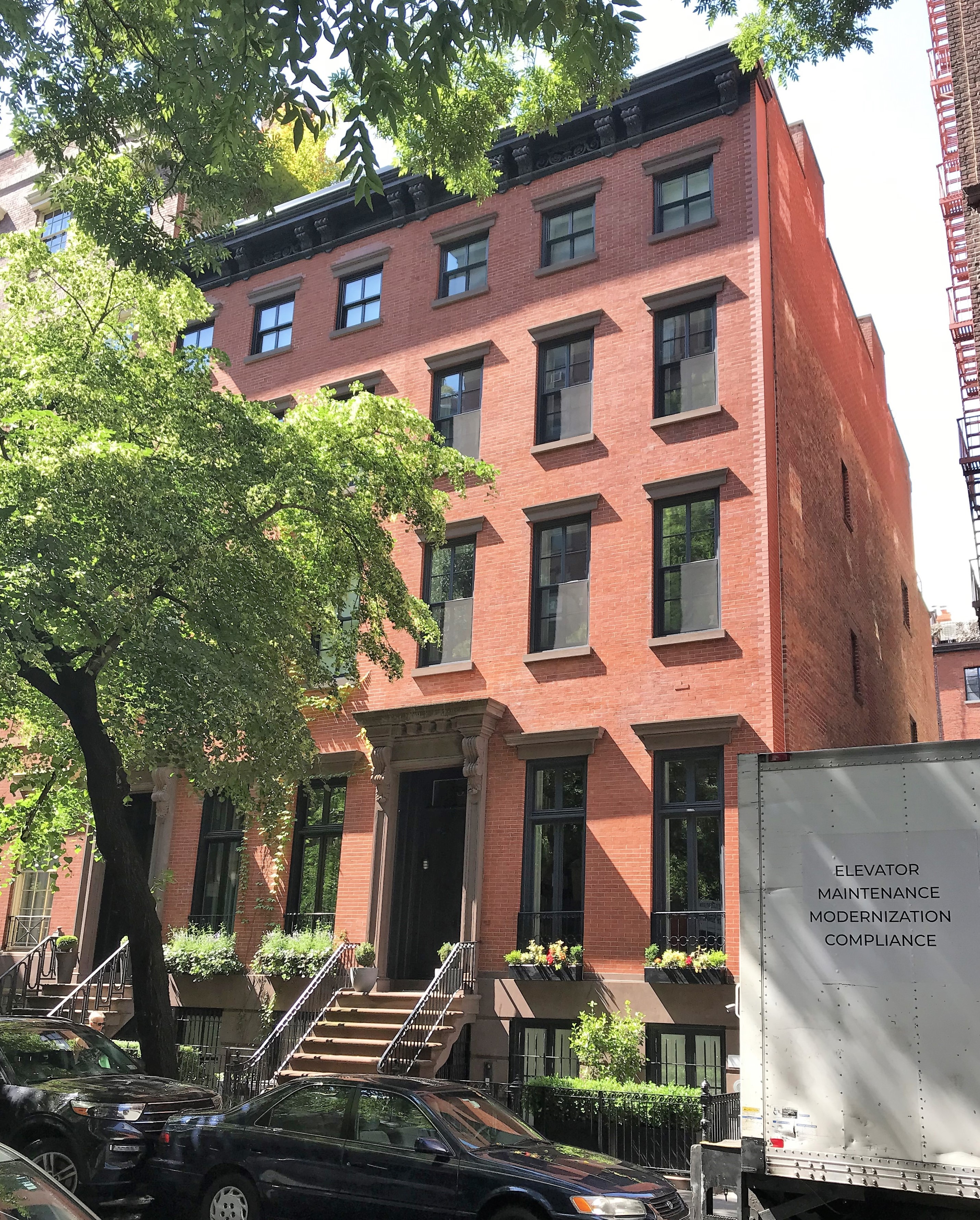
The 1845 Samuel Holmes House - 27 East 11th Street


In 1845 Samuel Holmes completed construction on a fine, 26-foot wide home  at 43 11th Street (renumbered 27 in 1868).  His elegant three-and-a-half story home sat above a brownstone basement level.  Its Greek Revival design included handsome ironwork fencing enclosing the  areaway, stoop railings, and a balcony at the parlor level.  Above the broad stoop, the doorway sat with a brownstone enframement, flanked by two pilasters with foliate capitals.  A wooden cornice with delicate dentils ran along the roofline.

Holmes was in the drygoods business at 22 John Street.  He and his family remained here until 1853 when they moved to Fifth Avenue.  The 11th Street house became home to the esteemed physician, Edward Griffin Bartlett.

Barlett was born in Portsmouth, New Hampshire in 1824.  After graduating from Yale College in 1846, he moved to New York City and joined the Union Theological Seminary.  But, according to the historian of his Yale class in 1871, "his health was not firm, and in 1849 he entered the New York University Medical School."  

On September 24, 1850, three years before buying the 11th Street house, he married Jane Ball.  They would go on to have eight children.

Dr. Edward Griffin Bartlett, Yale College Class of 1846 25th Anniversary, (copyright expired)

A homeopathic physician, Bartlett occasionally wrote for medical journals.  In his off-time he was an amateur artist, however the Yale anniversary book admitted, "His taste for painting he can gratify only to a limited degree."  He was, nevertheless, a member of the Academy of Design.

The Barletts' only son, William, went on to become an Episcopal priest.  While traveling in Chicago in 1869, he married a young couple, a Mr. Guiteau and a Miss Bund.  Years later he was "horrified," according to The New York Times when Charles Julius Guiteau assassinated President James A. Garfield.

By then the Barlett family had been gone from East 11th Street for some time.   In 1860 William P. Stewart had moved in and would remain for about a decade.  Directories listed no profession for Stewart, indicating he was either retired or simply financially comfortable enough not to need a job.


Around 1873 27 East 11th Street was being operated as a high-end boarding house.  Its most interesting resident that year was Señor Don Felipe Zapata, Colombia's "Envoy Extraordinary and Minister Plenipotentiary."

An advertisement in the New-York Tribune on June 1, 1897 encapsulated the amenities boarders could expect:  "Handsome rooms; sanitary plumbing; excellent table; table board; fine, central location; reasonable."

The house received some unexpected guests on January 10, 1899 following a horrific train crash on the New Jersey side of the Hudson River.  Two trains traveling in opposite directions on the same track collided head-on at 12:47 p.m.  Thirteen passengers were killed and 30 others were "maimed, bruised and otherwise injured," according to the Indianapolis Journal.

Some of the injured were taken to boarding houses, and The New York Times reported, "Miss Annie A. Johns, Miss S. Johns, Miss L. Johns, Mrs. A. Hughes, Mrs. Fulton, and Miss Fulton, all from Shamokin, are at 27 East Eleventh Street."

Mrs. Hughes told a reporter:

We had gone to the front end of the second car to get a drink of water, and the force of the collision threw me to the floor.  I was buried under several others, and for a while was unconscious.  I don't know how I was taken off the car or what happened after that.  The scenes were pitiable, and I was glad to get away as soon as possible.  What I saw will be impressed on my mind as long as I live.  The wounded, the dead, the wreck and escaping steam and fire made it too horrible to describe.  We escaped fairly well in our car, which was the second.  Those who were standing up were hurt more or less.  I think my aunt, Miss Johns, was the most seriously injured of those in the second car.

Indeed she was.  The New York Times noted, "After the accident, Miss Johns fainted.  When revived she was brought to this city and then taken to 27 East Eleventh Street in a cab."  Dr. J. Milton Mabbot, who lived just two blocks away at 19 Fifth Avenue, was called in.  "He found that Miss Johns was suffering from bruises on her sides, hips, and legs, and he feared that she might be internally injured."  She was taken to St. Vincent's Hospital.

Boarding in the house at the time of the accident was publisher Harry Willard Mathews who worked with Macmillan Company.  An 1896 graduate of Yale College, the bachelor used his rooms only during the week, going to his New Haven, Connecticut home on the weekends.  

Another boarder in 1899 was Harry Lydston Johnson, who had also attended Yale.  And also like Mathews, his permanent address was in New Haven.  Eight days after the train disaster, he married Monterey Louise Smith in New Haven. 

In 1906 Frederick W. Whitridge purchased 27 East 11th Street.  He leased it that year Dr. John Willard Travell.  Born in Troy, New York in 1869, he was married to the former Janet Eliza Davidson.  The couple had one child, Janet G., who was five years old when they moved in.

They had not been in the house long before Dr. Travell was called to the Hotel Alabama, just down the block.  On the night of March 29, 1906 Mrs. May Kay, described by The New York Times as, "a young Southern widow," called the front desk saying, "Come up quick."  The article said, "The clerk hurried up and found her lying on the bed.  ' I have shot myself,' she said."

Travell arrived soon after.  She repeated to him, "I shot myself.  I aimed at my heart, but was nervous and missed.  It won't do any good to do anything for me, because I want to die."  

May had come to New York to settle her late husband's estate--estimated to be about $4.5 million in today's money.  She knew a man in the city, a Broadway manufacturer.  The New York Times said, "When she came to this city it is said that she gave this man funds and securities, for which she received no receipt.  Her effort to get her property back is supposed to have weighed heavily upon her mind."

There was little Dr. Travell could do.  In her bungled attempt to shoot herself in the heart, she had instead shot herself in the abdomen.  What would have been a quick and relatively painless death was instead a slow and agonizing one.

Janet Travell was well-educated and a graduate of Wellesley.  On April 16, 1910 she hosted the annual meeting of the New York Wellesley Club in the house.

When electricity was first used in medicine, Travell was not timid about testing its effectiveness.  In 1917 he wrote, "I find physical therapeutics and particularly electro-therapeutics more and more interesting as an aid to other treatment in all localized disorders with inflammation, induration or pain.  Why limit our resources to drugs where drugs plus other powerful agencies can be used."

As had been the case in 1910, on December 16, 1918 disaster victims were brought to 27 East 11th Street.  That afternoon there was an explosion in at the dye plant of the American Analine Products Company on University Place.  The Evening Telegram reported, "Twenty persons were injured...scores of employe[es] in surrounding hotels and loft buildings were thrown into a panic, pedestrians were sent scurrying to escape showers of falling glass, and considerable damage was done."  Six of the victims were brought to Dr. Travell's office for treatment.

Janet Travell followed in her father's professional footsteps, becoming a physician.  She focused on the study of referred pain and pioneered the discovery of trigger points.  Years later she practiced nearby at 9 West 16th Street.  On May 26, 1955 a young senator, John F. Kennedy, sought out her help.  She later remembered, "He was thin, he was ill, his nutrition was poor, he was on crutches."

Unlike any of his previous doctors, Janet Travell was able to devise a protocol to manage Kennedy's pain.  He would forever trust her abilities and Travell went on to be the Presidential physician.

Janet's parents had left East 11th Street in 1919.  Frederick W. Whitridge next leased the house to the Clarence Blair Mitchell family.  Mitchell , a graduate of Princeton University, was an attorney and author.  The family's country home, Pennbrook, was in Far Hills, New Jersey.

He had published The A B C of Riding to Hounds in 1916 and would go on to write two other books.  He and his wife, the former Mildred Matthews, had one son and four daughters.  On December 4, 1919, soon after they had moved in, Mildred hosted "a small dance" in the house for their debutante daughter, Caroline.

A year earlier, in May 1918, the engagement of Janette Alexander to Captain Arnold Whitridge of the 5th Field Artillery had been announced by her parents.  Janette had grown up in the massive Alexander mansion at 4 West 58th Street, next door to the Cornelius Vanderbilt residence.

The wedding would have to wait until World War I had ended.  It took place in the Fifth Avenue Presbyterian Church in October 1920.  Frederick Whitridge had died, but Arnold's mother presented her son and new daughter-in-law with the East 11th Street house.

Following their honeymoon, the newlyweds spent the 1921 summer season at the Alexander estate in Tuxedo Park.  On August 20 the New-York Tribune noted they, "will take possession of their house at 27 East Eleventh Street next month."

They made it back just in time for Janette to give birth.  On September 9, 1921 the New York Herald announced, "Congratulations are being extended to Mr. and Mrs. Arnold Whitridge upon the birth of a daughter in their home, 27 East Eleventh street, on Thursday."   Another congratulatory article appeared on November 26 the following after a son was born in the house.

The Whitridges remained at 27 East 11th Street until around 1926 when it was being operated as unofficial apartments.  Among the tenants over the ensuing years was writer and film producer E. David Lukashok and his wife, Nancy, here in the early 1970's.  Lukashok became a partner in Joshua Tree Productions in 1967, and in 1972 became president of EDL Productions.  He suffered a fatal heart attack in the apartment at the age of just 34 on July 19, 1974.

Another notable resident died later that year.  Jerry Dodge had first made his mark on Broadway in Bye, Bye Birdie in 1960.  Four years later Gower Champion chose him to create the part of Barnaby Tucker in Hello, Dolly!  He went on to roles in musicals like George M! and The Desert Song.

Jerry Dodge (left) with Betty Ann Grove, Patti Mariano and Joel Grey in the stage production of George M! in 1968.  from the collection of the New York Public Library

He was appearing in the musical Mack & Mable when he died of "chemical poisoning," on November 4, 1974, according to The New York Times.  The article said, "He was 37 years old and had been undergoing medical treatment for a virus infection."


The dignified 1845 residence was never officially converted to apartments.  It remains a single-family home today.

photographs by the author
LaptrinhX.com has no authorization to reuse the content of this blog