Showing posts with label Samuel a. warner. Show all posts

Saturday, March 5, 2022

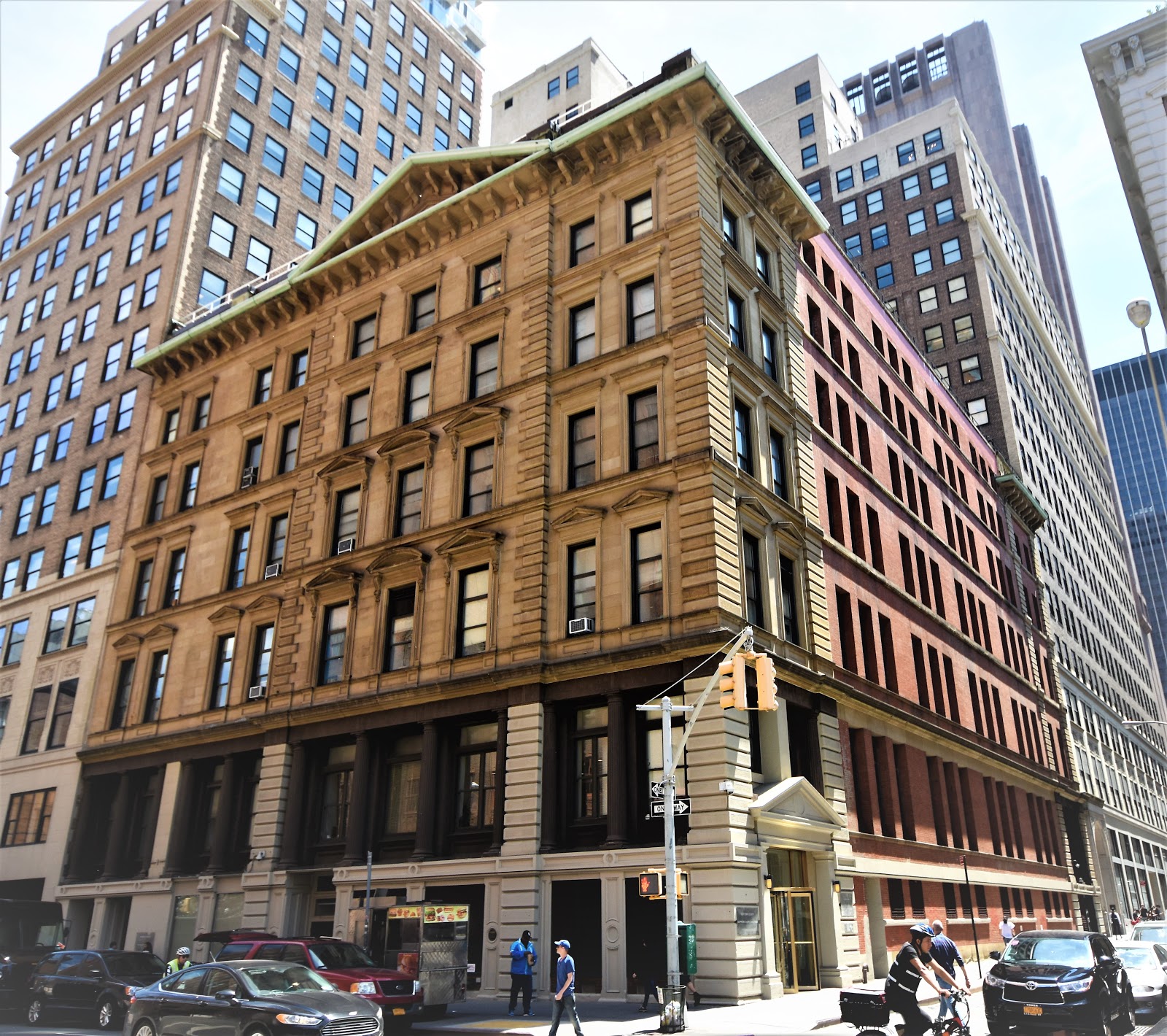
Samuel A. Warner's 1857 23 Park Place

 
image via loopnet.com

In 1855 the formerly elegant neighborhood around the homes of Edwin Brutton  Strange and Dr. Valentine Mott, at 23 and 25 Park Place respectively, was becoming increasingly commercialized.  That year Richard D. Lathrop and Charles H. Ludington signed a lease on the properties.  It stipulated that "a good and substantial building...of five stories high beside basement and sub-cellar with marble fronts and iron pillars" would be erected on or before November 1857.  The lease additionally specified that the building would be used "as a dry goods store."

The latter stipulation was not coincidental.  The renters were the principals in the drygoods firm Lathrop, Ludington & Co., then located at 16 Cortlandt Street.  They hired architect Samuel A. Warner, who specialized in mercantile buildings, to design two matching structures that would run through the block to Murray Street.

The nearly identical buildings were completed early in 1857.  As the lease stipulated, Warner had clad the upper stories in marble, above a cast-iron storefront manufactured by Daniel Badger's Architectural Iron Works.  At three-bays wide, 23 Park Place was slightly narrower than its counterpart, but continuous stone intermediate cornices above the third and four floors, and a bracketed terminal cornice unified the buildings, making the difference nearly undetectable.

At first glance, the buildings appear to be a single structure.  23 Park Place is to the right.

Warner's dignified Italianate style design took inspiration from Renaissance period antecedents, particularly at the second and third floors.  The openings of the second floor were clearly influenced by the 16th century Palazzo Farnese in Rome, with their alternating triangular and arched pediments.  The window treatment gradually became less elaborate with each successive floor.

Warner clearly took inspiration from Rome's Palazzo Farnese for his second floor window treatment.  from the collection of the University of Notre Dame

Lathrop, Ludington & Co. moved into 25 Park Place and part of 23--assuredly the lower section.  An advertisement in December 1857 said that a shipment of "new, fresh and desirable goods" had made "their magnificent Warerooms the most attractive resort in town for buyers who have the cash to spend."  The variety of drygoods offered included, "sheetings shirtings, tickings, flannels, De Laines, prints, blankets, black and fancy silks, merinos, alpacas, paramettas, cloths, cassimeres, &c. &c."

The upper floors of 23 Park Place were leased to another dry goods firm, Wm. Lottimer & Co.  Thanks to a sharp-eyed policeman, the company narrowly escaped being burglarized on January 21, 1860.

Evening Post, March 1, 1858 (copyright expired)

The New York Times reported, "Wm. Smith, a carman, and Martin Besby, an oysterman, were detected on Friday night as they were leaving the store of Lathrop, Ludington & Co., No. 23 Park-place, which, it is alleged, they had broken open with the intention of robbing."  Officer Wildey arrested the men, who had two pieces of serge fabric in their possession, the value of which would translate to about $2,250 today.  Smith and Besby were sent to prison.

The near loss paled to a forgery committed against the firm four years later.  According to The New York Times on November 17, 1864, police were searching for the gang that had carried out "one of the most extensive and successful series of forgeries which have ben perpetrated in this country for several years."  The name of Richard D. Lathrop, the firm's senior member, had been signed to a $27,127.50 check--more than $425,000 today.  The newspaper explained, "The fraud was not discovered until some time after the crime was perpetrated."  Authorities feared the extend of the forgeries would reach $300,000.

In the spring of 1867 Lathrop, Ludington & Co. leased 23 Park Place to seed distributor B. K. Bliss & Son.  The firm sold a vast variety of vegetable seeds through the mail, advertising in agricultural periodicals throughout the country.

American Agriculturist, February 1873 (copyright expired)

As a marketing device, in 1869 B. K. Bliss & Son held an exhibition of strawberries in the building.  The following year, on September 24, 1870, The New York Times reported that the firm "announce that the success attending their prize exhibition of strawberries, last Summer, has determined them to give a similar one of grapes, next week, when the sum of $250 will be distributed in prizes."  That exhibition, too, was a resounding success.

On September 28, The New York Times announced, "The spacious store of Messrs. B. K. Bliss & Sons, No. 23 Park-place, was yesterday crowded by grape-growers and connoisseurs, who came to view the splendid display of grapes presented for competition.  There were fully 500 specimens on the tables, and they all presented a fine appearance."

Earlier that year B. K. Bliss & Sons had made an unfortunate business decision.  The previous fall 23-year-old Luther Burbank dug up his newest variety of potato in Lunenburg, Massachusetts.  Decades later, he told a reporter:

As quick as I dug I knew I had a prize.  I wrote to B. K. Bliss & Co...in the spring of 1873.  I sent a sack.  I felt glad that I had a wonderful potato.  The firm replied that they were so sweet and nutty that they feared they must be frozen, and therefore turned them down.

The Burbank Potato would become the most widely grown potato in North America.

B. K. Bliss & Son lost a formidable employee almost simultaneously.  On March 11, 1873 a position-wanted advertisement appeared in the New York Herald that included an impressive resume:

A landscape gardener and rural architect, with a thorough knowledge of floriculture and vegetable growing, wishes an engagement, permanent or otherwise; seven yeas' reference as general foreman on Regent's Park, London; two years assistant to Sir Joseph Paxton on the Sydenham Crystal Palace, at Northwood, England; five years connection with the Department of Parks, New York and Brooklyn.  City References.

Frederick Law Olmstead, Esq.  Address Bliss & Sons, 23 Park place.


After B. K. Bliss & Sons moved out in 1875, the ground floor store was completely remodeled.  On December 26, 1875, an advertisement disguised as a news article in the New York Dispatch touted, "Bro. Benjamin F. Stiles, for the past fourteen years in Nassau street...has opened a new and splendid restaurant at No. 23 Park-place, running through to Murray street.  Here will be found in endless profusion every delicacy and substantial Nature has provided or art combined, as anyone may see and know for himself by just looking in and ordering a meal."

The upper floors saw a distinctly different type of tenant shortly afterward.  In 1879 the Gutta Percha & Rubber Manufacturing Company moved in, and in 1884 the Rand Drill Company, sellers of mining machinery, and the Rendrock Powder Company, makers of blasting equipment, took space in the building.

The American Engineering Register, 1885 (copyright expired)

Sharing the building with its industrial neighbors in 1887 was Horace Partridge & Co.  The commission merchants sold much gentler products--dolls and toys, games, "fancy glassware," albums, decorated chinaware, "magic lanterns," and "an immense assortment of novelties and specialties."

On January 25, 1892 a man from Guttenberg, New Jersey purchased a crate of 30 "Rack-a-Rock" sticks of dynamite from Rendrock Powder Company.  Company employees later told a detective, "He had put the box on his wagon and driven away.  An hour later he returned, and said that he had lost the box of cartridges.  It had mysteriously disappeared from the wagon."  In the wrong hands, the stolen explosives could prove deadly.

At around 1:00 that afternoon, Rudolph Heig, the superintendent of the Newsboys' Lodging House at Chambers and Duane Streets, was entering the building when he noticed a crate just inside the door.  The New York Times reported, "Near the box lay a brick, with which the lid of the box had been knocked open.  The board of the lid had been split and the brick had been broken in the effort to open the box."

Heig carried the box into the light, where he discovered its terrifying contents.  The newspaper said, "The cartridges were neatly packed in wood shavings, and it was probably the packing that prevented the hammering on the box from causing a disastrous explosion."  A detonation would have, indeed, been a calamity.  The article noted, "At the time the box was found there were about 250 people in the building.  Of this number 175 were children in the school and kindergarten."  Police surmised, "On finding out what the contents were the thief must have run away as fast as he could."

Around 1897 Remington & Sherman Co., manufacturers of safes and vaults, opened its showroom in the building.  It would remain well past the turn of the century.

In 1903 the Broadway Savings Institution leased the ground floor for two years while its future home at 17 Park Place was being renovated.  The New-York Tribune reported, "It will move to No. 23 Park Place on August 1."

The upper floors continued to house industrial tenants, including the American Street Lamp & Supply Co., here in 1904, and the Universal Printing & Manufacturing Co.  By 1915 the Banks Law Publishing Co. was in the building.  Among the firm's industry-specific offerings that year were Insurance Law of New York, Principles of the English Law of Contract, and Commentaries on the Law of England.

From 1921 to 1930 The Daily News operated from both buildings.  They were once again separate entities in 1932 when 23 Park Place now had a store on the ground floor, a "private club" on the second, and factory space above.  That configuration lasted until 1945 when the building was converted to storage.

The changes in the neighborhood were reflected in the alteration to 23 Park Place completed in 1966.  The was now an "eating and drinking establishment" with "restrictions on entertainment," on the ground floor; a pool and billiard hall on the second; and storage on the upper floors.  


When the building was offered for sale in October 2005 for $13 million, the realtor suggested its used for "retailing space and loft apartments."  Today there are a total of six apartments above the two-story restaurant space.  A sidewalk shed suggests that the care-worn building is currently receiving some well-needed attention.

uncredited photographs by the author
LaptrinhX.com has no authorization to reuse the content of this blog

Thursday, February 24, 2022

Samuel A. Warner's 1855 45 Murray Street


Until 1841, Rev. Dr. Barry's Academy operated from the five-story house at 45 Murray Street.  The property was acquired by clothing manufacturer Francis W. Hutchins in 1850.  It appears he lived in the house until 1854, when an auction was held of "the entire furniture."  The listing hinted at the sumptuous interiors, including "elegant chandeliers," rosewood parlor furniture, a rosewood piano, and "center tables, with marble tops."  The announcement noted, "the building is to be removed."

Hutchins erected a 26-foot-wide, five-story store-and-loft building on the site.  Architectural historians agree that the architect was most likely Samuel A. Warner, whose works include the Marble Collegiate Reformed Church on Fifth Avenue.  Faced in marble above the cast iron storefront, the Italianate structure featured blind balustrades below the tall second story windows.  They supported graceful volutes that flowed down from the scrolled brackets of the gently-arched window cornices.  The third floor openings were treated similarly, while those at the fourth and fifth floors were less showy.  The brackets of the pressed metal terminal cornice flanked panels within the marble frieze.

The second story windows have, sadly, lost their cornices, but overall the striking details survive.

On January 10, 1855 Hutchins offered "The lower part of the new first class marble front store" in the Morning Courier and New-York Enquirer.  The ad promised that the building "will be finished 1st Feb."

Answering the ad was Townsend, Boynton & Jones, makers of women's pantaloons.  They shared the building with their landlord, Francis W. Hutchins, who moved his wholesale clothing operation into the upper floors.  

By 1860, the store space was occupied by the auctioneering firm Lockwood Bros. & Underhill.  It liquidated excess stock, or the stock of companies that had gone out of business.  The sale of the goods were often ordered by the City Marshall.  But in September 1860, it was a German peddler, James Dryfous, who suspiciously brought "eighteen dozen men's shirts and five dozen ladies' and gentlemen's under-garments," according to The New York Times.  It did not take authorities long to track the items, "recently stolen from the store of Mr. James S. Davie, No. 78 Cedar Street."  Dryfous was arrested and held for trial.

Francis W. Hutchins was gone from his building in 1861.  Lockwood Bros. & Underhill were still in the store, the second floor was occupied by the wholesale button and "general finding" store of T. S. Wheeler, the third by shirt manufacturer Hecht Friedland, and on the fourth and fifth floors were wholesale clothier A. Weinstein & Co. and Churchhill, Ingalls & Co., "merchants."  At around 11:20 on the night of September 9 that year, fire was seen in the fourth floor.

Although fire fighters were quickly on the scene, according to The New York Times, "owing to the peculiar, inflammable nature of some of the materials, the fourth and fifth floors were completely enveloped in flames."  Within half an hour the entire building was engulfed, the flames lighting up the night sky.  At about midnight, the rear wall collapsed.  The New York Times reported, "the heat was so intense on the opposite side of Murray-street at one time, that several of the hose[s] had to put constant streams of water, until the walls and roof of No. 45 fell in."

The intense fire was the subject of a Currier & Ives print, The Life of a Fireman.

In the end, only the marble façade was left standing.  The newspaper said it was too soon to know the exact loss, "but it was estimated by good judges that it could not be less than $150,000."  (That amount would equal about $4.5 million today.)

Within two days the fire marshal announced he "strongly suspected" arson.  The fire had started in A. Weinstein & Co. and, according to Katharine Greider in her 2011 The Archaeology of Home, "All these facts seemed to imply that someone, maybe even someone connected to Abraham Weinstein, set the fire to make good on fall merchandise that otherwise would have to be chalked up to a loss."  The investigation waned and no charges were ever pursued.

Although the newspapers called 45 Murray Street a total loss, Francis Hutchins rebuilt the gutted interior.  Following what was approximately a two-year renovation, the building filled with a new batch of drygoods merchants--Meriman & Long, Lewis Mills, Alexander Munkitrick, and yarn dealer C. R. Cutler & Co.

The neighborhood saw new types of businesses in the last years of the 1860's.  In 1868 wine merchants Wilson, Morrow & Chamberlin were in the building (the name was changed to Morrow, Chamberlin & Co. the following year).  Another non-drygoods related firm, the American Papier Mache Company was here by 1870, and flooring manufacturer Drew & Bucki opened a branch office in the building around 1874.

Real Estate Record & Guide, September 26, 1874 (copyright expired)

The trend continued, with Northampton Cutlery Co. and Wittemann Brothers, makers of tin foil, calling 45 Murray Street home in the early 1880's.  They would have to find a new location, however, in 1884 when cork dealer John Robinson & Co. leased the entire building.

In 1885 New York's Leading Industries described the business as a "manufacturer of corks and bungs, and importers of corks, dealers in brewers' and bottlers' supplies."  Founded in 1874, the firm employed an average of 150 workers at its Brooklyn factory at any time.  Most of the activity in the Murray Street building was "cork sorting." The firm's offices and salesroom were in the ground floor store level. 

As the name implied, John Robinson was the principal in the firm.  He was affiliated with another cork firm, Armstrong Brothers & Co. of Pittsburgh.  Although, according to The Sun, "Mr. Robinson was generally supposed to be wealthy," he declared bankruptcy on May 5, 1891.  The firm now continued as Armstrong Brothers.

The company remained at 45 Murray Street until about 1901 when the building once again saw multiple tenants.  Among them were the Carter Medicine Company; the Comstock Hoff Mfg. Co., leather goods dealers; and Lamson & Goodnow Manufacturing Co., makers of cutlery and knives.

Hardware Dealers' Magazine, February 1910 (copyright expired)

In 1907 Brent Good, president of the Carter Medicine Company, purchased the building.  He continued to operate his business here, while leasing space to other tenants.  He had started out in the "proprietary medicine" business in 1866, and in 1880 had co-founded Carter Medicine Company with Samuel J. Carter.  The firm's one product was a pill, promised to cure "headache, constipation, dyspepsia, and biliousness." 

Carter's Medicine Company targeted the military in this 1914 advertisement.  copyright expired)

Good traveled to England in 1915--a dangerous time to be abroad.  The previous year, in December, Germany had begun aerial bombing of Great Britain.   Now in October 1915, Brent Good found himself in the midst of the upheaval.  On November 11, The Sun reported, "While in London on business a few weeks ago he was shaken up during a Zeppelin bomb raid and collapsed soon after returning home."  The 68-year-old never recovered from the shock and died on November 10.  The article noted, "He had made a fortune in the manufacture of pills."  By the time of that comment, the catchy name "Carter's Little Liver Pills" became a household phrase.

Carter Medicine Company continued at 45 Murray Street.  The changing tenor of the neighborhood was reflected in the tenants at the time.  Despite rampant anti-German sentiments, in 1917 Otto Goetz imported "German china, fancy goods, Bohemian glassware, beer steins, bisque novelties."  In the post war years Wallach & Behrend Co., dealers in chinaware and cafeteria equipment, was here, as was the Chemical Co. of America, makers of dyestuffs.

Carter's Medicine Company left Murray Street in 1935.  (In 1951 the Federal Trade Commission ordered it to change the name to "Carter's Little Pills," saying the "liver" in the name was deceptive.)

Throughout the rest of the century more industrial tenants occupied the building.  For two decades, starting in 1935, the International Plumbing Supply Co., and the Enbee Mfg. Co. were here.  The 1940's saw Harrington J. Bradford & Co., and Universal Budget Systems, dealers in "inexpensive family budget books," in the building.

Today an Indian restaurant occupies the former store space, while the upper floors continue to house small businesses and factories.  Despite the unfortunate loss of the architectural detailing of the second floor windows and a devastating 1861 fire, Samuel A. Warner's striking 1855 design is incredibly intact.

photographs by the author
LaptrinhX.com has no authorization to reuse the content of this blog

Wednesday, January 20, 2021

The 1868 Marble-Faced 114 Franklin Street


photo via streeteasy.com

On April 18, 1868 a notice appeared in The New York Herald that read simply "For Sale--The Valuable Lot, 114 Franklin street."  An old house had stood on the lot for decades and had been operated as a rooming house in the 1850's.  Next door, at No. 112, a new loft and store building had just been completed for Max Weil.  It was designed by architect Samuel A. Warner. 

The empty lot was purchased by Elliot C. Cowdin.  He was simultaneously erecting two buildings at Nos. 96-98 and 100-102 Grand Street designed by Benjamin W. Warner, who shared an office with his architect brother Samuel.  He now gave Warner the commission to design No. 114 Franklin Street.  The resultant building would be identical to No. 112; and although the design clearly came from the drawing board of Samuel A. Warner, Benjamin gets the credit as architect of record.  

Completed in 1868, like its twin No. 114 it rose five-stories and was faced in marble above the cast iron storefront.  A handsome blend of Italianate and French Second Empire styles, it featured segmentally-arched openings flanked by Doric pilasters.  A pronounced still course separated each floor.

Cowdin was a man of broad interests.  The New York Times would later say he "made his name equally familiar in business, politics and commercial and agricultural literature."  He was the principal in Elliot C. Cowdin & Co., importers and dealers of "French fancy goods."  But his business did not move into the new Franklin Street building which he had erected as an investment only.

Among Cowdin's early tenants was Louis Weddigen & Co., dry goods importers and commission merchants.  Customs records reveal that the goods the firm brought into the country included "Italian cloths and worsted dress goods" along with velvet, satin and silk.

Although technically listed as being designed by different architects, No. 114 (left) and No. 112 are identical.

Another dry goods merchant, Mackintosh, Green & Co., was unintentionally involved in a scam which cost citizens thousands in tax dollars.  In 1873 the Department of Charities and Correction forewent the bidding process and granted a contract for dry goods to "a person named Sternback."  Suspicious, the New York Herald launched an investigation.  It discovered that Sternback did not appear in the City Directory, he had no known place of business, and there was no evidence that he was a dry goods merchant.  What was known was that he purchased goods at a discount and sold them to the city at an inflated price.

Among its evidence, the newspaper pointed out that he "purchased of Mackintosh, Green & Co., of No. 114 Franklin street, 9,000 yards of woollen stuff at 35 cents per yard, with 5 per cent off, and sold it to the city at 45 cents per hard, with 5 per cent off, making nearly $1,000 out of the taxpayers by the one transaction."

The building continued to house garment-related merchants, like Oberndorff & Co., here in the 1880's; and Freeman D. Marckwald, an importer of whalebone, "horn strips, polished dress bones and toothbrushes," the following decade.  Whalebone was an important component in the manufacture of corsets.

As had been the case with Mackintosh, Green & Co., in February 1897 Freeman & Marckwald was also involved in a scam and it appears the firm was an innocent pawn.  Ferdinand May was arrested for fraud, having negotiated the sale of $222,310 in bills of exchange to the firm of Weil, Auerbacher & Co.  The bills were drawn on Freeman & Marckwald.

According to The Sun on February 21, May told Weil, Auerbacher & Co. "that his firm had sent Marckwald large consignments of whalebone and that Marckwald had about half a million dollars' worth of the whalebone in storage."  None of that was true.  But May had cashed in the bills before the scam was discovered.

Marckwald was called in to testify.  He "said that there never was any [whalebone] in storage with him," reported the Evening Telegram on March 3.  May was sent off to prison and there was no indication of Marckwald's involvement at all.

And yet, soon afterward Freeman D. Marckwald mysteriously packed his things and sailed for Europe.  A year later Deputy Sheriff Carrahar took control of the business.  The Sun reported on October 2, 1898 "The attachment was obtained on the ground that Mr. Marckwald had been absent from his place of business here for more than a year and was supposed to be in Europe."

In 1886 the firm of Switzer & Schussel was formed to import and manufacturer handles for umbrellas and parasols next door at No. 112.  Then late in 1911 business had grown to the point that Switzer & Schussel continued the manufacturing, while a newly-formed office, Schussel & Manly, handled the import and sales.  Interestingly considering the period, Edward Max Schussel's partner was a female, Gertrude A. Manly.  Their new offices opened in No. 114 Franklin St. 

In its January 1912 issue Luggage and Leather Goods commented that Schussel & Manly would be showing its "large domestic line, consisting of novelties in fancy woods, horn and Ivorine, a very large and attractive line of import handles, unique in styles and prices, during the month of February.  Also a full line of imported umbrella frames, handles, mounts, etc."

But like so many German-based businesses throughout the United States, World War I dealt a crushing blow.  In February 1918 Trunks, Leather Goods and Umbrellas reported "Schussel & Manly, manufacturers and importers of umbrella handles and canes, are retiring from business."  It was not so simple as that.

The anti-German sentiment which swept the country resulted in the Trading With The Enemy Act of 1917.  It gave the Government broad rights to confiscate the properties of German-born businessmen whether or not they were American citizens.

The Alien Custodian Report listed the "enemy interest" in Schussel & Manly Manufacturing Co. at 100 percent.  Edward Max Schussel and Gertrude Manly had not truly retired.  Instead, as reported in the Report of the Alien Property Custodian, "The business was liquidated under enemy trade license."  All assets of Schussel & Manly were confiscated by the Alien Property Custodian.  Max Schussel moved his family back to Germany, as did Gertrude Manly.

While dry goods related firms remained in No. 114 for decades years following the war, a variation in the tenant list began appearing in 1921.  That year Ace Specialties Corp. was listed here.  It dealt in goods like paper goods, like cups, doilies, napkins, as well as "sanitary spoons," tin kitchen utensils, and toilet paper.

The last quarter of the century saw the rediscovery of Tribeca arrive on Franklin Street.  By 1977 the Bromm Gallery was in the building, and in 1999 Grace Bar and Restaurant opened.  It was described by The New York Times food critic Florence Fabricant as "a sleek, Art Deco-inspired place, with tapas-style food at the bar."

As was happening with so many 19th century loft buildings throughout the district, a renovation completed in 2008 resulted in one apartment per floor above the store.  Two years later, in March 2010, Albert Trummer told Florence Fabricant of his plans for the ground floor.  He said his Theater Bar "will be inspired by Vienna and the nightlife of the 1930s and '40s."  The theatrically-themed venue opened in April 2011.


Both No. 114 and its twin sister survive remarkably intact after more than 140 years.

photographs by the author

Friday, July 20, 2018

Samuel A. Warner's 1891 160-162 Duane Street


Margaret C. Wallace was a minor real estate operator in Tribeca in the 1880's; one whose name would be largely lost were it not for a diaster.   In the spring of 1889 she purchased the brick building at No. 162 Duane Street from the Joshua Jones estate for $45,000.  She already owned the similar adjoining building, No. 160.  The properties stretched back along Hudson Street nearly 100 feet.

Wallace leased No. 160 to Thurber, Whyland & Co., "importers and grocers."  The firm used it as an annex for warehousing goods.   On the night of November 2, 1890 fire broke out.  Thurber, Whyland & Co.'s flammable stock provided fuel for the blaze.

The following day The Sun reported "Two floors full of butter and cheese, and a miscellaneous assortment of goods (including many boxes of candles) on another floor, furnished illumination for the neighborhood of West Broadway and Duane street for several hours last night."  The article noted "The building is of brick and runs through the triangular block to 22 Hudson street."

"The fire extended to the third and fifth floors," said the newspaper.  "To the danger of smoke and flame was added the fear that the fire would reach the second floor, filled with grocers' drugs, explode them and blow out the front of the building."  It took three hours to extinguish the fierce blaze, which resulted in one fire fighter being taken to a hospital.

Margaret Wallace commissioned the well-known architect Samuel A. Warner to replace both structures with a modern loft and store building.  Two months after the disastrous fire, on January 23, 1891, he filed plans for a six-story "brick and stone warehouse" at a cost of $75,000, just over $2 million today.

The dusty, noisy construction seems to have caused a problem for thirsty horses.  On March 24, 1891 the Board of Alderman approved Herman Wunderlich's request "to remove the watering-trough from its present location, No. 28 Hudson street, to No. 27 Hudson street, directly opposite."

Completed before the end of the year, Warner's handsome Romanesque Revival structure featured expansive cast iron storefronts within banded brick piers.  Brawny stone bandcourses of the second floor contrasted with the red brick.  Triple arcades graced the top floor above a corbeled cornice; the central opening on the Duane Street front taking the form of a single large arch.


Interestingly, while the immediate neighborhood was the center of the butter-and-egg district--home to wholesale produce and dairy merchants--the new building filled with a much different type of tenant.

Foote, Pierson & Company was among the initial tenants.  The firm was a pioneer in the manufacture of fire alarm and telegraph equipment.   It was joined by the Carleton Chase Electrical Co. and the Bechton, Dickinson & Co., both manufacturers of "physicians' specialties."

In the early years of the 20th century elevators provided increased efficiency and convenience.  But they were dangerous, often designed without doors or gates to prevent limbs being caught or unwary persons being plummeted down the shaft.  William Luther became a statistic in the "Certified List of Elevator Killings in the Borough of Manhattan" when he was killed in a fall down the shaft here in 1911.

In 1914 Foote, Pierson & Company introduced the Sharpe-Millar photometer.  On July 11 the Real Estate Record & Guide praised the invention, which measured the intensity of electric lighting.  "It is easy enough to point to a meter and say that the lighting bill is in strict accordance with the reading of the instrument, but it is not so easy to prove that the tenant's complaint that the quality of light he got was below normal is without grounds."  The 10-inch long instrument measured the amount of light indoors or out, and "serves as a check on errors under all circumstances."

Foote, Pierson & Co. offered a broad array of equipment.  (copyright expired)
With war already raging in Europe, radio engineer Emil J. Simon received the contract to outfit two new U.S. Navy battleships, the New York and the California, with telegraph apparatus.   But things ground to a halt when the Marconi Wireless Telegraph Company of America sued, alleging patent infringement.

Judge Charles M. Hough of the United States District Court dismissed the case on November 18, 1915, citing national defense needs.  "In times of trouble, at periods when the arm of the Government is in need of strengthening, the Executive may be left in the exercise of powers perhaps doubtful in law but temporarily necessary for national safety."

It was a temporary victory for Emil J. Simon, however.  Hough gave Marconi Wireless Telegraph 20 days to refile a complaint for infringements "not arising from Government contracts."

Foote, Pierson & Co. received a notable contract as well when the New York Fire Department purchased 300 fire alarm boxes on April 12, 1916 for $19,500 (about half a million in today's dollars).  The red-painted cast iron boxes would become a common fixture on New York City streets.

The firm unexpectedly moved from radio and electronics products to furniture in 1930 when it applied for a patent furniture "shoe."  The invention allowed a work table leg to pivot to a slanted position.

Foote, Pierson & Co.'s "Furniture Shoe" was a departure from its expected product line. United States Patent Office 

Another radio firm leased space by the mid-1930's.  Gillette Radio Corp. hawked its "high fidelity advanced design" electric amplifier in Radio-Craft magazine in June 1936.  The advertisement boasted that the $15.75 amplifier had a "built-in multi-tap output transformer" and "built-in acoustic compensator."  In small print it added "less tubes and speakers."

Major change in the Duane Street neighborhood was evidenced on October 18, 1981 when The New York Times food editor Craig Claiborne reported on "movable feasts" available at 162 Duane Street.  "A brand new food store in Tribeca which serves appealing homemade salads and pates made with good fresh ingredients.  Each picnic has a title."

Six years later Ann Nickinson and her partner Carrie Levin opened another gourmet boutique, Good Enough to Eat.  Their original store debuted on Amsterdam Avenue in 1982.   Now, in 1987, they spent $200,000 to renovate space at No. 162 Duane for a larger 65-seat shop.  The Times said it "specializes in homey fare such as soups, stews, muffins and meat loafs."

On April 1997, famed restaurateur David Bouley and his partner Warner LeRoy announced their intentions of opening a Viennese restaurant, Danube, in the space.


The Tribeca renaissance  had taken over the entire building in 1991 when the upper floors were converted to apartments.

photographs by the author

Friday, August 25, 2017

The 1887 Church of the Redeemer - 239-241 E 62nd Street


In 1850 German immigrants were settling in two distinct areas of Manhattan--the crowded Lower East Side and the developing Yorkville neighborhood to the north.   Slightly to the south of Yorkville was the estate of Adam Tredwell (sometimes spelled Treadwell).

Tredwell died in 1852 and his "farm" was soon divided into lots.  An 1868 agreement among property owners set standards for construction and disallowed undesirable businesses (like slaughterhouses and breweries).  The area also attracted German-speaking citizens; but these were not the working class settlers filling jobs in Yorkville's cigar factories and such.

The Presbytery of New York recognized the need for a new church to serve the growing population.  In 1886 construction started on the modest brick and stone Church of the Redeemer.  The Presbytery had commissioned architect Samuel A. Warner, who had just completed work on its tiny Victorian Gothic mission house at No. 420 West 57th Street.  The Church of the Redeemer would share many of its architectural elements, on a larger scale.

Completed at a cost of $20,000--about $521,000 today--the 50-foot wide structure was designed with rigid symmetry.  The central portion projected slightly and rose to a peaked gable a story higher than the flanking sections.  The simple but handsome entrance portico was supported by buttresses; its sharply angled gable pierced with an eye-catching oriel.  An especially attractive rose window dominated the upper section.

The German-language congregation worshiped here until the turn of the century.  Typical of Presbyterian groups at the time, the Church of the Redeemer was active in outreach to the poor.  As late as 1900 The New York Charities Directory noted its "mission and relief work, among tenement houses."

But by the time of that listing the Church of the Redeemer was leasing the main building to another German congregation, the Bethlehem Lutheran Church.  Finally, on May 22, 1901 The New York Times reported "The Presbytery of New York has sold the church property 241 East Sixty-second Street to the present tenants, the Lutheran Church Society."

Bethlehem Lutheran Church quickly turned the building over to the Evangelical Lutheran Church of St. Matthew.  But they, too, would not stay long.

When this photograph was taken in 1905, the German Lutheran Bethlehem Church worshiped here.  from the collection of the New York Public Library

In the years just prior to the outbreak of World War I the neighborhood saw a new wave of immigrants, the Hungarians.  In February 1913 the Church of St. Matthew sold the building to the Home of Christian Hungarian Sick Benevolent Society.  The Real Estate Record & Builders' Guide noted "The buyer will remodel the present building and use it for its own purposes."

Those purposes were a bit more secular.  The church was remodeled into was described as a "meeting room."  The activities here were now starkly different.  On January 14, 1914, for instance, The Times reported "The Hungarian-American A. C. will hold its second annual wrestling tournament on Jan 23 and 24 at the clubhouse, 239 East Sixty-second Street."

Immigrant communities formed sports groups aimed to keep boys off the streets and out of pool rooms and saloons.  The Times noted "Among the clubs entered are the Boys' Club, Bronx Church House, Scandinavian-American Athletic League, Greek-America, German-American, and several branches of the W M. C. A."

Later that year, in April, the Christian Hungarian Society hired architect I. Leitersdorfer to fire-proof the "one-story brick meeting room."  The cost of the project was $400, nearly $10,000 by today's standards.

But like its predecessors, the Hungarians would soon leave.  On January 23, 1919 the New-York Tribune announced that the Christian Hungarian Sick Benevolent Societies of New York had sold the property to Philip Leone for $40,000; only slightly more in relative terms than the original construction cost.

Just a year earlier the Rev. Philip Leone had founded the Roman Catholic Church of Our Lady of Peace.  Born in Italy, he was ordained there in 1903 and came to the United States shortly afterward.  Interestingly, he founded the Church of Our Lady of Peace before becoming officially affiliated with the Archdiocese of New York in 1919, according to The New York Times later.

Rev. Leone also organized the first branch of the Italian Holy Name Society and the first Italian chapter of the Catholic Daughters of America.

Now that his Italian-speaking congregation had a building, it immediately laid plans to restore the sanctuary to a house of worship.  Architect Thomas J. Duff completed plans "for alterations and extensions" late in 1920.  Construction, costing $30,000, began early in 1921.

 The result was a jewel-box interior of white plastered walls decorated with delicate gold stenciling and frescoes. 

photographed by Steven Thomas Moy on June 14, 2013, via oldchurchnyc.typepad.com

Rev. Leone served as pastor of the Italian congregation until his death in 1945.  The Church of Our Lady of Peace continued to serve its parishioners as generations were baptized, married and their funerals held in the familiar sanctuary.

Then, on July 31, 2015 ABC News reported "A nearly century old Catholic church on the Upper East Side held its final mass Friday afternoon."  Congregants had been caught off guard by the New York Archdiocese's decision to close 112 churches in a cost-cutting consolidation.

Even as Father Bartholomew Daly offered Communion for the last time, parishioners were hopeful.  An appeal had already been sent directly to the Vatican, pleading for papal intervention.   Five volumes of documents outlined the congregation's history, its mission and its importance to the community.

The church was locked and the congregation officially merged with St. John the Evangelist on East 55th Street.  But many recalcitrant parishioners refused to give up the fight.  Mass was held outside Our Lady of Peace and every day for two years they gathered on the steps, despite rain or snow, to light candles and pray.  Petitions, letters, and fundraisers sought to pressure Catholic officials to reopen their church.  A group called the Friends of Our Lady of Peace hired attorneys and appealed the closing.

Finally, two years after sending their appeal to the Vatican, the congregation got a response.  Despite gathering 4,000 signatures of support and $500,000 to prove that the church was financially self-sufficient, the Vatican's Congregation of the Clergy ruled in favor of the New York Archdiocese.

In January 2017 representatives of the congregation announce plans to appeal.  But it was all too late.  Cardinal Timothy M. Dolan had been working on his own plans.  Under his direction the Archdiocese leased the building to the Coptic Orthodox Church, an ancient Egyptian-based Christian denomination.

The New York Times reported on March 5, "The lease is the first stage of a plan to transform the church into the Coptic Church's New York cathedral, an idea that both Cardinal Dolan and Coptic leaders say Pope Francis has blessed."


And so the little brick church, having served German Presbyterians, German Lutherans, Hungarian Christians, and Italian Catholics, enters its newest chapter.  In the meantime, other than a paint job, little has changed outwardly to the Samuel A. Warner's charming structure.

photographs by the author

Wednesday, June 14, 2017

The H. B. Claflin & Co. Bldg - 151-157 West Broadway


Horace Brigham Claflin was born in Milford, Massachusetts on December 18, 1811.   While still a youngster he worked as a clerk in the general store of his father, John Claflin.  Following their father's death in 1831, Horace and his brothers bought out the business.  Within a decade what had been a country store was one of the largest businesses in New England.  Claflin sold his portion to his brothers in 1843, coming to New York with a fortune of $30,000.

He formed a wholesale dry goods business with William F. Bulkley.  When Bulkley retired in 1851, Claflin joined with Williiam H. Mellen to form Claflin, Mellen & Co.  Ten years later their business was so successful that the men hired architect Samuel A. Warner to design a massive wholesale store to engulf the entire block front on Worth Street, between West Broadway and Church Street.

Faced in Nova Scotia sandstone and rising seven stories, the Italianate style structure was palatial.  Renaissance-inspired pediments, quoins and immense balustrades on the West Broadway and Church Street ends resulted in a dignified commercial structure.  The History of New York City, in 1868, described it as "built in a tasteful style of architecture, and at first sight presents the appearance of some colossal public institution, as which, in one sense, it may be properly regarded."

The 1861 building, seen here from Church Street, stretched down Worth Street to West Broadway.  (Note that the horses don blankets against the winter weather.)   photo by Byron Company. from the collection of the Museum of the City of New York

The building encompassed 48,000 square feet and employed a sales force of 700 which swelled to about 1,000 in the busiest seasons.  William Leete Stone in his History of New York City remarked "Nor can any one walk through this great New York warehouse--the largest in the United States--without being impressed with the idea of its high mercantile importance."

Despite the problems caused by the Civil War (half of the firm's business was in the "slave-holding states" and Claflin's vocal opposition to slavery was unpopular in the South), profits continued.  Sales reached an unimaginable $72 million during one of the war years.

In January 1864 Mellen retired, and the firm was renamed H. B. Claflin & Co.   The Panic of 1873 severely impacted the business, pushing it to the brink of bankruptcy.  But Claflin persevered, offering goods at tremendous discounts in order to raise the cash to pay creditors.

A cigarette card, published in 1888, included a biography of Claflin.  from the collection of the Z. Smith Reynolds Library

In 1875 he was accused by the Government of "conniving at a gigantic system of smuggling."  The U. S. Government sued to recover $1.5 million on silk duties.   Claflin worked as his own private detective and exposed the true crooks.

Obviously, Horace Claflin amassed a massive personal fortune.  The New-York Tribune reported that "For many years [his firm] was the largest house of its kind in the world, with yearly sales approximating $100,000,000."  But the millionaire was acutely aware of the needs of the less fortunate.

The National Cyclopaedia of American Biography, in 1893, recalled "Thousands of deserving young men with slender means owe their start in life to the view he took--that character is a safer basis for credit than capital...Mr. Claflin's benevolence was without limit.  He frequently said to his sons: 'We must try to give pleasure to poor people, not to the rich; they do not need our attention.'"

Worth Street is clogged with horse-drawn drays receiving and delivering goods.  photo by Byron Company from the collection of the Museum of the City of New York

H. B. Claflin & Co. was routinely the victim of thefts.  But one stood out.  In 1874 a young man named George H. Mix applied for a position as clerk.  He brought with him letters of introduction from various well-known citizens and was hired in the lace department.

Unknown to H. B. Claflin & Co. Mix had a criminal past.  The New York Times wrote "Mix's history is a singular one."  He came from one of the most prominent families in Connecticut.  When his father, a Hartford banker, died around 1869, he left his son funded stocks which provided him an annual income of $1,500--about $27,000 today.

Unlike the palatial retail emporiums like A. T. Stewart, the wholesale business of H. B. Claflin & Co. did not require fancy interiors.   photo by Byron Company, from the collection of the Museum of the City of New York

The young man almost immediately came to New York City, and was quickly arrested for "swindling the Gilsey House [hotel]."  The Times explained "his mother, by means of her wealth, saved him from State Prison."   He has later arrested for stealing from the Broadway firm of McDonnell Brothers.  Once again, he escaped prosecution.

The letters of recommendation he presented to H. B. Claflin & Co. were all forgeries.   When $1,000 worth of laces were missing in October 1874, shortly after Mix's hiring, a private detective was put on the case.  Mix was arrested in the St. James Hotel.

The Times reported on October 16, "On being arraigned in court yesterday he made a clean breast of the affair, and resorted to his old tactics.  He first endeavored to bribe Detective Mooney, then he wanted to fix the reporters, and finally informed Chief Clerk Cooney that he would make it all right with him."

For the first time in his criminal career, Mix could not buy his way out of his crimes.  He was held in default of $3,000 bail for trial.

Horace B. Claflin died in November 1885.  His will directed that the bulk of his estate should remain in the business for five years.  Therefore, in May 1890 the old business was reorganized as the H. B. Claflin Company with Horace's son, John, as its president.  He held 50 percent of the stock.

John Claflin dressed more the part of a millionaire than did his father.  New-York Tribune, June 26, 1914
That same month Susan R. Lawton sold the old buildings abutting H. B. Claflin Company at the corner of West Broadway and stretching to No. 73 Thomas Street.  The sale price was $25,000, just under $675,000 today.

John Claflin brought back Samuel A. Warner to extend the building, nearly doubling its size.  In a remarkable early example of contextual architecture, Warner disregarded current trends and matched his original design.  Completed in 1891, the seamless addition created a perfectly-balanced structure.

The elevated railway ran up the middle of West Broadway.  King's Photographic Views of New York City, 1895 (copyright expired)
By the first years of the 20th century the dry goods district had moved away from the Tribeca neighborhood.   H. B. Claflin's monstrous building now sat squarely within the shoe district.  Nevertheless, on June 21, 1912 vice-president John C. Emmes told members of Wholesale Dry Goods Centre Association "I want to say now that the H. B. Claflin Co. has no idea of moving; neither do we even expect to move any of our departments uptown."

Management may have regretted its stubbornness.  Two years later newspapers and trade journals nationwide printed full-page announcements of shocking failure of H. B. Claflin Company.  The Upholsterer captured the industry's disbelief saying "The business world throughout the country was tremendously moved when under date of June 25 the newspapers spread broadcast the fact that the H. B. Claflin Co. had gone into the hands of receivers."

Once again the firm reorganized and managed to stay afloat until 1926.  Then, on October 2 that year, The New York Times reported "Claflins, Inc. rated as the second largest wholesale dry goods establishment in this country and a concern that is more than eighty years old, is to go out of business." The article noted "It has between 800 and 900 employes, many of whom have spent their entire business life in the great building at Worth and Church Streets."

Immediately upon the closing of Claflins, Inc. the building's new owner, the Merchants Square Corporation, had the original 1861 building demolished.  The architectural firm of Jardine, Hill & Murdock, which was designing its 16-story replacement, was also given the commission to renovate the former Claflin addition.  Included was a new entrance, now opening onto Thomas Street.  It featured a triangular pediment in keeping with the original Italianate design.

The Endicott-Johnson Corporation had been a major shoe manufacturer since the turn of the century.  Its factories were located upstate in Binghamton, Johnson City and Endicott, New York.   By 1927, when it moved into Nos. 151-157 West Broadway, it was employing a total staff of 20,000.

The immense size of the concern was evidenced six years earlier when the United States Department of the Interior gave Endicott-Johnson Corporation the contract to supply shoes to the Indian reservations.  The New York Times reported "This includes shoes for men, women and children on all reservations and approximated 40,000 pairs."

Endicott-Johnson Corporation's lease with the Merchants Square Corporation was initially 15 years, with a yearly rent of $54,000; about $737,000 today.  Like Horace B. Claflin, the firm was known for its benevolence.  In addition to providing profit sharing to its employees and yearly bonuses for even the most menial of workers, the firm was widely-known for its philanthropies.

The year that the company moved into the West Broadway building, for instance, the Associated Press reported "George F. Johnson, President of the Endicott-Johnson Corporation, and members of his family will distribute 13,000 pairs of shoes to school children, teachers, policemen, firemen, railroad switchmen in the yards of the Endicott and Johnson City [railroads], inmates of country institutions and others as Christmas gifts.  The total expense of the gifts will be more than $50,000."

The shoe company would remain in the building until mid-century.  Afterwards various, smaller firms came and went--including Coleport Fabrics and the American Bleached Goods Co.--until 1986 when the New York County division of the State Supreme Court renovated the interior and took over the building.


At less than half of its former self, the H. B. Claflin & Co. building is still a dignified and impressive presence on West Broadway; a fitting reminder of the days when it housed the largest wholesale dry goods firm in the world.

photographs by the author

Thursday, March 31, 2016

Samuel Warner's 1867 No. 112 Franklin Street


Although No. 114 (left) was constructed later and designed by a different architect, it was an identical match to No. 112.

In the 1840s James L. Waugh and his family lived in their comfortable 25-foot wide wooden house at No. 112 Franklin Street.  Within a decade the neighborhood was changing, as businesses moved into many of the Federal-style houses.  In 1854 Waugh was operating his “gold leaf and gold foil” business from his residence, while living upstairs.

Things changed for Waugh when the country was thrown into conflict.  A captain in the New York National Guard, he marched off when the Civil War erupted in April 1861.  The New York Times remarked “he will doubtless prove that he is quite able to win, in war, the laurels he has so long worn in peace.”

Waugh commanded Company H, better known as the “Tompkins Blues.”  In the spring of 1862 his son was seriously ill and, after “having with great difficulty obtained a brief furlough,” Capt. Waugh returned to Franklin Street to see him.  He placed a notice in newspapers that he would gladly take letters and small parcels back to his soldiers if their families would drop them off at his Franklin Street house.

The Civil War ended in May 1865 and soldiers returned to New York, replenishing the workforce.  Construction in the city, which had significantly slowed, ramped up as life slowly returned to normalcy.  The burst of construction projects included the demolition of James L. Waugh’s former home.

 In 1866 real estate operator Max Weil demolished the two-story house and commissioned architect Samuel Adams Warner to design a modern factory building.  Completed a year later, the structure’s upper four floors were faced in gleaming white marble.  The retail space, three steps above the sidewalk, wore a cast iron storefront with elaborate Corinthian columns and pilasters.  The upper floors were distinguished with segmentally-arched openings flanked by Doric pilasters.


On May 17, 1867 The New York Times remarked on the dramatic changes in the neighborhood.  “Although but few of those who have passed through the streets at right angles to, and parallel to, Broadway below Canal-street, can have failed to express astonishment at the extraordinary transformation going on in that locality, yet the number who have had any clear idea of the vast sums of money which are being expended there, have not been many.  This change has been going on since early in 1865.”  Included in the article’s dizzying list of new and under-construction buildings was Weil’s No. 112 Franklin Street, with construction costs at $40,000—in the neighborhood of $662,000 in 2016.

Interestingly, when Elliot C. Cowdin embarked on a similar project a year later, he hired Warner’s architect brother (Benjamin and Samuel shared an office) to design his building.  The result was a carbon-copy.  The two identical marble structures appear, obviously, as a single building.

No. 112 filled with dry goods and apparel merchants and manufacturers.  Among the first was Louis Weddigen & Company, importers and commission merchants.  The store became home to Campbell & Elliott, dealers in woolen goods.  By the early 1870s the second floor was leased to L. Solomon & Co., manufacturers of boys’ clothing; and the third and fifth stories were occupied by Gottfried August.

On the afternoon of Sunday, March 24, 1872 fire broke out in L. Solomon & Company’s factory.  With the building vacant the blaze spread upward.  By the time fire fighters extinguished the fire, L. Solomon & Company had suffered $5,000 in losses; and Gottfried August lost $1,000 in cloth.  The ground floor shop suffered water damage of about $500. 

Max Weill paid about $1,000 to repair the fire damage and things returned to normal at No. 112 Franklin Street.  The building was burglarized in 1875 by the career criminal John Richard Dolan.  The crook’s final arrest took place following the highly-publicized murder of wealthy brush manufacturer James H. Noe.  On the morning of Sunday, August 22, 1875 Noe surprised Dolan burglarizing his factory.  A violent scuffle ended in Noe’s death.

Prior to Dolan’s execution on April 21, 1876 The Times remarked “When he was arrested by Detective Dorsey he had in his possession part of the proceeds of a burglary at No. 112 Franklin street, committed a few days before, and on the night of his arrest a valise which had been stolen from No. 112 Franklin street was found in a hallway, near Dolan’s house.”

One concern not involved in the dry goods trade was F. H. Leggett, a wholesale grocery firm.  The company leased space in the building in the 1890s.  One Monday, April 1, 1895 an executive decided not to go directly to his home in Demorest, New Jersey after work.  Instead he started drinking.

Chris Johnson struck up a conversation with two women, 25-year old Josie Cole and 21-year old Annie Edwards in a saloon on the corner of 26th Street and Seventh Avenue.  The three drank until about 2:00 in the morning, and then left the bar together.  And then Chris Johnson learned what many Victorians already knew: unescorted women who frequented saloons and drank with strangers were rarely to be trusted.

On the street corner the women doubled up on Johnson, robbing him of $200 in cash and a $200 check (a significant $11,600 in 2016 dollars).  While Johnson looked for a policeman, a witness followed the women.  The Evening World reported “Josiah Julius, a colored man…saw the row on the street when the robbery occurred, and followed the women to various saloons.” 

The self-appointed private detective tailed them to Eli Pierce’s Dance Hall on 26th Street.  A man there, William McPherson, argued with Josie when she “refused to divide the spoils.”  Eventually, Johnson, Patrolman McDonald, and Josiah Julius crossed paths.  Julius told the policeman where Annie Edwards and Josie Cole were drinking.  At around 3:10 they were arrested.

Both women were held at $2000 bail.  The commendable actions of Josiah Julius garnered questionable rewards.  The Evening World reported “Julius, the colored man, was sent to the House of Detention as a witness.”

Thirty-four years after its construction, the estate of Max Weil sold No. 112 Franklin Street in November 1901 to William S. Boardman.  On August 6 two years later he transferred titles to both No. 112 and No. 114 to Blanche B. Hammill.  “The properties are a gift to her,” reported the New-York Tribune.  The generous gift became more understandable when Blanche’s surname later changed from Hammill to Boardman.

Blanche’s tenants continued to be textile concerns.  In 1905 L. S. Eaton, “white goods and handkerchiefs,” shared the building with E. I. Eisler, linens; Max Goodman, “foreign and domestic hosiery and gloves;" and linen merchant J. L. Freud.  By 1909 Switzer & Schussel, “importers and dealers in umbrellas and parasol fittings, walking canes, etc.” would also be here. 

By 1921 Ross Brothers, linen dealers, had been in the building for several years.  The cotton converting firm of Baum, Strauss & Co. moved out in January that year and, later, Blanche Boardman put the building on the market.  Ross Brothers purchased it for $44,000. 

While the Irish-based Ross Brothers were apparently doing very well, two other tenants were not.  Moe Hyman and Louis Corn, who owned the Alert Shirt Company went bankrupt that year; and in 1922 Henry Sachs & Bro. Inc., another shirt maker, declared bankruptcy.

Ross Brothers remained at No. 112 Franklin Street until 1957 when it sold the building to Kniffen Demarest Company.  The hotel supplies company had been at No. 48 Murray Street for half a century.

The last quarter of the 20th century saw the Tribeca neighborhood rediscovered by artists and celebrities.  In 1977 the Franklin Street Arts Center, a performance arts space, opened in the basement and a year later Franklin Furnace took over the first floor.

Founded by performance artist Martha Wilson, Franklin Furnace housed the nation’s largest collection of artist-produced publications.  Grace Glueck, writing in The New York Times on March 31, 1978 said “a must stop is the Franklin Furnace, a storefront space at 112 Franklin Street that serves as a museum, archive and exhibition gallery for the large number of ‘book works’ now made by artists.  In its archives the Furnace has between 2,000 and 3,000 of them…The Furnace also presents performances and readings and is altogether a joy to its drab neighborhood.”


Performances at Franklin Furnace were sometimes controversial and in May 1990 it was closed down when the New York City Fire Department received an anonymous complaint about an “illegal social club.”  It continued in the Judson Memorial Church, the New School and the Cooper Union as Franklin Furnace in Exile.

In 2003 a renovation was completed that resulted in five residences—one per floor—in the building.  Bare brick walls, pine floors and pressed tin ceilings were preserved as the former factories were transformed into high end condo-coops.  Although the once-white marble is stained to dingy beige after a century and a half of weather and pollution; the building is remarkably preserved.  Even the 19th century double doors in the cast iron storefront survive.

Shirt makers and textile converters once toiled in these spaces.  photo Town Residential
 non-credited photographs by the author