Showing posts with label washington heights. Show all posts

Wednesday, September 24, 2025

Fort Washington Presbyterian Church - 21 Wadsworth Avenue


photo by Beyond My Ken

In 1883, two years after Reverend Thomas Samuel Hastings stepped down as its pastor, the West Presbyterian Church moved from 42nd Street to West End Avenue and 84th Street.  Now known as West-Park Presbyterian, in April 1912 the trustees purchased the vacant lot at the northeast corner of 174th Street and Wadsworth Avenue as the site of a "daughter church."

Given that his father had been the congregation's pastor for nearly a quarter of a century, it was perhaps not surprising that on August 24, 1912 the Record & Guide announced that Thomas S. Hastings had been selected to design the church.  It would be one of Hastings's first solo commissions.  His partner in Carrère & Hastings, John Merven Carrère, had died in a car crash the previous year.

Interestingly, while the trustees had the process of constructing a church building well in hand, they had no congregation to fill it.  On November 4, 1912, the New-York Tribune reported, "Many signatures were obtained at the services yesterday to a petition to be sent to the New York Presbytery asking that a congregation be organized for the new church."  The article said the projected building "will cost $200,000, the money being furnished by the West-Park Presbyterian Church...which is one of the richest in the city."

Just over a year later, construction was completed.  On December 15, 1913, the New-York Tribune reported, "The new Fort Washington Presbyterian Church, at 174th street and Wadsworth avenue, was formally opened yesterday morning with a congregation that filled every available seat in the edifice."

The cost had surpassed the initial budget.  "The edifice cost $321,000," said the article.  (The figure would translate to about $10.5 million in 2025.)  The journalist added, "The architecture is a combination of the English Georgian Renaissance and the American Colonial periods.  White and gray is the interior color scheme."

Hasting's plans vividly reflect the Georgian detailing he lavished on the design.  The American Architect, June 13, 1917 (copyright expired)

Hastings harkened to 18th century prototypes, particularly the churches designed by British architect James Gibbs.  Four monumental Doric columns upheld a classic entrance portico.  Rising above was a striking bell tower, the center section of which included free-standing Corinthian columns and matching pilasters that flanked Georgian-style arches. 

When this photo was taken, the clock had not yet been installed in the belfry.  The Brickbuilder, December 1913 (copyright expired)

Hastings carried the Georgian motif inside.  The barrel-vaulted ceiling was decorated with large coffers and plaster rosettes.  The dignified details included Corinthian pilasters and a half-domed sanctuary.

 The Brickbuilder, December 1913, (copyright expired)


Dr. Daniel Hoffman Martin took the pulpit.  Born in 1859, he was a graduate of the College of the City of New York and the Union Theological Seminary.  Outspoken and opinionated, he quickly increased the congregation.  In reporting on his second anniversary as pastor here, on October 9, 1915, The Evening Post reported, "It has been a continuous revival at the Fort Washington Presbyterian Church...Starting with sixty-nine members, the roll now numbers six hundred."

Martin strongly espoused his views from the pulpit.  And there seems to have been no lack of issues upon which he did not have an opinion.  In his sermon on August 4, 1914, he called liquor "the most sinister influence in American politics;" and on March 26, 1916, he railed against prize fights.  Referring to the recent Willard-Moran bout, he said, "It was not an exhibition of manhood at its best, but it was a good exhibition of doghood, because to fight is the best a dog can do."  And when Europe became embroiled in World War I, on February 18, 1917, Martin declared, "if it was necessary for the United States to make a sacrifice, it should make a sacrifice of its pride by avoiding war, and not lives in a war in which nothing would be gained."

When America did join the conflict two months later, the Fort Washington Presbyterian Church declared its patriotism and helped in relief.  On May 13, 1917, a large American flag, donated by Dr. Charles V. Paterno, was unfurled on the 35-foot flag pole in front of the church.  The New York Times reported that about 1,200 persons were there to see the ceremony.

On September 30, 1918, The New York Times announced that contributions of clothing "for the destitute French and Belgians" were being accepted on behalf of the American Red Cross at the church.

photograph by Beyond My Ken

On October 2, 1919, Rev. Daniel H. Martin was crossing 168th Street and Broadway when he was struck by an automobile.  The Evening Post reported, "His hip was dislocated and he received lacerations of the jaw."  Martin's injuries were much more serious than the initial reports.  The 61-year-old was taken to St. Lawrence Hospital, then to the Radium Sanitarium.  He remained there until mid-December when he was sent home.  Martin died three weeks later from internal injuries.  

The funeral was held in the church on January 4, 1920 with seven clergymen officiating.  Later that year, on December 19, a bronze and marble memorial tablet was unveiled in Martin's honor.

Martin was succeeded by the Rev. Dr. John McNeill, "known as the 'Scottish Spurgeon," according to The New York Times. (The term referred to English Particular Baptist preacher Charles Spurgeon.)  Born in Scotland in 1854, the newspaper said he "has preached in practically every part of the world" and was "best known as an evangelist."  Martin's salary had been $6,000, but some trustees, said the article, "wish to raise it to $7,000."  (The increased figure would equal about $110,000 today.)

McNeill's pastorage was short.  He was replaced in 1925 by Rev. Dr. Wesley MeGaw, a native of Belfast, Ireland.  "Dr. MeGaw will receive a salary of $7,500," reported The Times.  "He has a wife and two children," said the article, adding, "He is between 40 and 45 years old."

By 1941, MeGaw's sons, Ellison and Robert, were of college age.  Ellison was studying divinity at Princeton University and Robert Neill E. MeGaw (who was called by the family as Neill), was at Duke University.  On November 2, 1941, the 20-year-old Robert walked out of his dorm room and disappeared.  Rev. MeGaw received a letter from his son that said he was going to end his life because he "had an incurable form of cancer."  Similar letters were left for Robert's roommate, a girl at the university, and for Ellison.

The family's desperation climaxed with Rev. MeGaw's appearing on the Columbia Broadcasting System's nationwide weekly radio show, We the People.  He gave a "dramatic appeal" for Robert to come home.  During the broadcast, MeGaw said, "The most terrible part of it all is, I know Neill hasn't cancer."  He said that an earlier physical required by the university had showed no sign of cancer.

After a nation-wide search, on December 28 FBI agents found Robert working as a book salesman in Jacksonville, Florida.  The next day Rev. MeGaw and his wife flew to Florida and brought the wayward young man back to New York.  On January 3, The New York Times reported that he "is confined to his bed at home."

With his son found, MeGaw turned to global issues.  In his sermon on August 30, 1942, he declared that all Christians throughout the world want the "utter destruction of Hitlerism."  He stressed that if Hitler wins, Christianity "will be wiped from the face of the earth."

Forty years after taking the pulpit of Fort Washington Presbyterian Church, the Rev. Dr. Wesley MeGaw retired.

In 1982, the congregation of the Fort Washington Presbyterian Church transferred the property to the Primera Iglesia Espaňola de Washington Heights.  The Hispanic congregation was formed in 1948.  The name of the church was changed to Iglesia Presbitereriana Fort Washington Heights (Fort Washington Heights Presbyterian Church).

photograph by Beyond My Ken

The church continues in Hasting's dignified neo-Georgian-style structure today, ministering to its Spanish-speaking congregation.

many thanks to reader Doug Wheeler for prompting this post

Monday, December 30, 2024

The Lost Holyrood Episcopal Church - Broadway and 181st Street


At around the last turn of the century, development encroached onto the recently bucolic setting.  photo by Thaddeus Wilkerson, from the collection of the Museum of the City of New York.

R. D. Chandler used only his initials professionally.  The prolific architect was based in Fair Haven, New Jersey and was responsible for designs over wide-spread locations.  On one day alone, on May 14, 1898, for instance, Chandler filed plans for a two-story cottage in Elberon, New Jersey; a frame residence in Red Bank, New Jersey; and a public school at Fairhaven, New Jersey.  Three years earlier, he had commissioned a church building in the rural Fort Washington Heights district.

Born in Plainfield, New Jersey, Episcopalian Rev. William Oliver Embury earned his L.L. B. degree in 1866 from Columbia College.  In the 1880s, he was rector of the Anthon Memorial Church in West 48th Street before becoming involved with the Sisters of St. Mary far north in Inwood.  Rev. Embury was chaplain of the order's The House of Refuge for Problem Girls.  In 1893, he established a parish, the Holyrood.

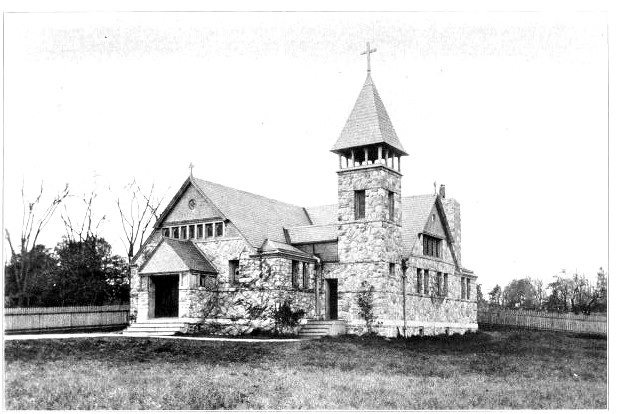
Embury's pastoral site sat on the southwest corner of Broadway and 181st Street, surrounded with farmland and summer estates.  R. D. Chandler produced a one-story vernacular structure clad in fieldstone befitting to the country setting.  A sturdy porch sheltered the entrance and the corner tower rose to the belfry under a pyramidal cap.  Importantly, Chandler forewent the Gothic style in favor of more provincial square-headed openings.

A wooden picket fence surrounds the original structure.  from Fort Washington, 1902 (copyright expired)

The neighborhood around Holywood Episcopal Church was historic.  The Brooklyn Daily Eagle said, "The church is known as the Little Church at the old fort."  It had been the site of Fort Washington and on November 16, 1776, was the scene of the Battle of Fort Washington when the British devastated George Washington's army.

On the 125th anniversary of the battle, on November 16, 1901, "A marble, bronze and granite memorial commemorating the battle of Fort Washington was unveiled," reported the Brooklyn Daily Eagle.  The impressive ceremony included a police platoon, the 8th Artillery Band of the U.S. Army, two companies of the U.S. Coast Artillery, and, "Then came the colors of the Empire State society, Sons of the Revolution, with a guard composed of delegations of the two continental organizations," and the "bank of the New York Juvenile Asylum and three platoons of the boys from the Deaf and Dumb Asylum brought up the rear."

A second historical plaque was installed the following year, on September 23, 1902.  The Evening Post reported, "Mollie Pitcher was not the only woman who fought in the war of the Revolution."  That day the Mary Washington Colonial Chapter of the Daughters of the American Revolution unveiled the tablet in honor of Margaret Corbin.  After the war, Corbin had been recognized by Congress.

In reporting about the ceremony, The Bulletin explained,

Margaret Corbin was the wife of John Corbin, a patriot in the war for Independence.  He was in charge of a piece of artillery at fort Washington when the fort was assailed by the Hessian troops.  Margaret Corbin stood at her husband's side as he fired the gun.  When he was killed by a rifle shot she sprang to his place and kept the gun in action until she was herself shot and disabled.

On October 4, 1903, The Sun reported that plans had been filed for a "parish house, 30 feet front and 125 feet deep."  The article noted it "will contain a clubroom, gymnasium, bowling alleys, meeting hall and Sunday school and also a library for the Women's Guild of the church."  The cost of the extension was $9,000--about $321,000 in 2024 terms.

Holyrood Episcopal Church was the custodian of a significant collection of Revolutionary relics within the new parish house.  Among them, according to the New-York Tribune on August 7, 1904, were, "Exploded shells, bent spikes, broken bayonets and swords, a bent lance head and other weapons, in one case with the bones of the dead attached."  The article said in part,

The collection includes buttons of the 16th Foot, the regiment taken by "Mad" Anthony Wayne at Stony Point in 1779, the 23d Welsh Fusiliers, which fought in every engagement of the war; the 10th Regiment, which took part in the attack on Fort Washington, and the 44th, which was engaged in the building the earthworks still bearing the names of King George and Governor William Tryon.

In the guild room of the parish house was "a great fireplace built entirely of stones and bricks from old Colonial fireplaces and Revolutionary houses," said The Sun, later.

The historic fireplace.  New-York Tribune Illustrated Supplement, August 7, 1904 (copyright expired)

In only fifteen years after Holywood Episcopal Church opened its doors, the Fort Washington district was bustling with development.  On June 4, 1910, the Record & Guide reported, "The trustees of the Holyrood Church at the southwest corner of Broadway and 181st st., have voted to accept an offer for the church and site, which is said to exceed $200,000."   (The article mentioned the property "cost $30,000 15 years ago.")

With the massive windfall, equal to $6.62 million today, the congregation planned to erect "a new church in the English perpendicular Gothic style," nearby at 179th Street and Fort Washington Avenue.

When this photograph was taken around 1910, the church property was engulfed by apartment buildings.  from the collection of the Museum of the City of New York.

The following year, on September 23, 1911, the Record & Guide reported, "The picturesque churchyard which once made the Holywood chapel at 181st street and Broadway so attractive has disappeared and two-story brick taxpayers cover the site."

Today's site.  photograph by Jesus Rodriguez

thanks for reader Jim Lesses to prompted this post

Monday, February 26, 2024

The Lost Hamilton Grange Church - 149th Street and Convent Avenue


The New York Architect, August 1907 (copyright expired)


In 1802, Alexander Hamilton's 18-room mansion was completed at approximately what would become Convent Avenue and West 143rd Street.  Designed by the eminent architect John McComb, Jr., the Federal style residence was named The Grange.  Eight decades later, in 1887, the newly-formed Hamilton Grange Church was formed.  The New York Times would later explain, "The name of the church is derived not merely from the locality, but from the fact that the congregation at first worshipped in the old Hamilton mansion."

Before long a "graystone Gothic Church," as described by the Inventory of the Church Archives of New York City, was erected at the corner of Convent Avenue and 145th Street.  But in 1906 The New York Times reported, "The old Hamilton Grange Church...is now too small for the needs of the congregation."  That spring the architectural firm of Bannister & Schell began plans for a new church building and parish house four blocks to the north at 149th Street and Convent Avenue.  Interestingly, the corner property was owned by the Collegiate Church, which had purchased the four building lots several years earlier.  The New-York Tribune stressed, "Although the property is owned by the Collegiate Church, that corporation exercised no ecclesiastical control over the congregation."

In reporting on the cornerstone laying on June 24, 1906, the New-York Tribune noted, "the new church...will be modern in its appointments, with ample facilities for Sunday school and neighborhood work."  Construction was completed in less than a year and the dedication services were held on April 26, 1907.  The New-York Tribune described the structure was "one of the handsomest and most complete church homes on the Heights."

The side-by-side church and three-story parish house were designed in the English Gothic style.  Clad in red brick, the church's design was dominated by a square corner tower, which the New-York Tribune called on April 27, "a feature particularly pleasing because [it is] so generally lacking in recent church architecture."  Gothic pinnacles rose from each corner and ornate crosses topped each gable.

The interior was finished "throughout in dark wood," said the article.  The two-story "Sabbath school" was cleverly designed.  The article said it was "surrounded at the second story by a horseshoe shaped gallery, in which are little classrooms, like boxes in a theatre."

The configuration lent itself to public meetings as well as Sunday school purposes.  On December 23, 1909, for instance, a meeting was held here headed by Postmaster Edward M. Morgan and Congressman William S. Bennett.  They spoke "on the question of retiring superannuated and disabled United States Government employees."  To date, there was no retirement plan for Federal employees.  Morgan, who had been connected with the Post Office for nearly four decades, urged that a retirement plan would, for one thing, "do away with the present humiliating of the old clerks by gradually reducing their salary in proportion to the quality and quantity of work they are able to perform."

In 1913 the handsome Bloomingdale Reformed Church on West End Avenue between 106th and 107th Streets was demolished.  Five magnificent stained glass memorial windows, two of which were the work of John LaFarge, were salvaged and installed in the Hamilton Grange Church.  The Yearbook of the (Collegiate) Reformed Protestant Dutch Church of the City of New York noted, "These windows have served to beautify and enrich the Hamilton Grange Church."

The New-York Tribune, April 27, 1907 (copyright expired)

The congregation merged with the Fort Washington Collegiate Church in 1937.  The demographics of the neighborhood had greatly changed since 1906.  The inherent racism of the early 20th century was evident in newspaper reports on the sale of the property to a mostly Black congregation.

In reporting on the first service of the Protestant Episcopal Church of the Crucifixion in the building on December 20, 1937, The New York Times explained, "The church, whose congregation includes many Negroes, has been acquired from the Hamilton Grange Reformed Church."  A massive crowd attended the opening service, celebrated by Bishop William T. Manning.  The New York Times wrote, "In his address delivered to nearly 1,000 persons, many of whom could not get closer than the church door, Bishop Manning paid tribute to the Negro rector, the Rev. Dr. Egerton E. Hall."   

During the initial service, a marble altar was dedicated, "given by the congregation 'as an expression of their affection for the Bishop of the Diocese,'" reported The New York Times.

Edward Henry Margetson had been the organist and choir master of the Church of the Crucifixion since 1920.  He was, as well, the composer of sacred and concert music and had founded the Schubert Choral Society in 1927.

Edward Henry Margetson, from the collection of the St. Kitts National Archives.

Born in St. Kitts in 1892, Margetson's father, Henry Francis, was a choral director and his mother, Marie Thomas, was an accomplished pianist.  A musical prodigy, he mastered the piano early on.  According to The New York Age, he was five years old when his mother's funeral was held in the family's living room.  As the mourners sang the first hymn, "At first it was thought that Edward's father was playing the piano, but upon investigation, the player proved to be Edward himself, whose feet were barely able to reach the pedals."

Margetson strove to bring sacred music to the Black community.  On June 27, 1992, the New York Amsterdam News recalled, "the existence of the [Schubert] society is believed to have helped open the door for black classical musicians, who at the time may have been denied the opportunity to sit as members of established orchestras in this city and state."

On November 13, 1954, The New York Age reported, "A committee of organists, headed by Hugo Bornn, organist of St. Andrews church, will pay a musical tribute to Edward Margetson on Sunday afternoon, Nov. 21."  The article noted that Margetson was "now very ill."  He had suffered what The New York Age had described in 1953 as "a severe stroke," adding, "little hope was held for his recovery."  His condition necessarily resulted in his retirement from the Church of the Crucifixion.

The following year, on December 31, 1955, the newspaper updated its readers, saying that Margetson was "making remarkable progress" under the therapists of Bellevue Rehabilitation center.  "In spite of the loss of the use of his right side and his speech, great hopes are held for a recovery."

Deemed by The New York Age as a "music maestro" and "one of the most distinguished musicians of our time," Margetson was at the apartment of a relative in January 1962 when a fire broke out.  He died on January 22, 1962 in Mother Cabrini Hospital from "smoke poisoning," as reported by The New York Times.

A year later, fire destroyed the Church of the Crucifixion.  Architect Costa Machlaouzarides was commissioned to design the replacement structure, completed in 1967.  It is widely compared to Le Corbusier's 1954 church at Ronchamp, France.

photo by Jim Henderson

LaptrinhX.com has no authorization to reuse the content of this blog

Monday, August 8, 2022

The Lost Libbey Castle (Woodcliff) - 196th Street and Fort Washington Avenue


from the collection of the New-York Historical Society

Augustus C. Richards's vast wealth was reflected in the $25,000 in personal taxes he paid in 1857, according to the New York City Tax-Book.  That year his spectacular country home was completed far north of the city west of the Kingsbridge Road (later Broadway) near what today is 196th Street.  He had purchased the land two years earlier from the estate of Lucius Chittenden.  Designed by architect Alexander Jackson Davis, the New York Herald later described Woodcliff as "a four story stone mansion, massive and costly in construction."  Davis typically worked in historic styles, and Woodcliff mimicked a Norman castle with an imposing tower and crenellated battlements.  The World later wrote, "This mansion was built from the rock quarried away for its foundation...It is a veritable castle, turreted and picturesque."

It was undoubtedly Richards who commissioned this unsigned painting of Woodcliff, completed prior to 1869.  from the collection of the New-York Historical Society.

Like many other affluent businessmen, Richards became involved in relief efforts during the Civil War.  His interest was highly focused on loyal American refugees from the South who were arriving in New York City.  He was an active member of the Committee In Aid of the Union Refugees from Florida.  The New York Times described the refugees as having been "stripped of large portions of their property by forced levies for the support of a cause which they heartily abhorred."

Simultaneously, he lobbied for a project much closer to home.  On March 5, 1863 he was appointed a vice-president of a group of residents and property owners of the Manhattanville, Carmansville, Fort Washington, and Tubby Hook districts "to advocate the construction of a distributing reservoir for the upper end of the City," according to The New York Times.

Richards added oil wells to his business interests around 1863.  He was president of the California Petroleum Company, an 18,000-acre property of "natural oil wells of the largest size," according to an article in The New York Times on March 4, 1865.  The San Francisco Mercantile Gazette placed the output of the wells in 1863 at $14 million--just under $300 million in today's money.

Richards sold Woodcliff on February 26, 1869 to Civil War General Daniel Butterfield for $275,000 (about $5.4 million today).  Butterfield had just resigned as Assistant Treasurer of the United States following a scandal that connected him with Jay Gould and James Fisk in the scheme that resulted in the panic of collapsing gold prices known as Black Friday, on September 24, 1869.

General Daniel Butterfield, from the collection of the Library of Congress

Butterfield's ownership would be extremely short-lived.  Only weeks after taking title, he sold it to Tammany Hall leader William Magear Tweed.   His residency, too, was brief.  According to The World later, "Tweed never inhabited this beautiful home, but sold it to his son."  The New York Herald had a slightly different slant to the story, saying, "When William M. Tweed jumped his bail it was from this house that he escaped."

Whichever version is true, "Boss" Tweed's downfall began in 1871.  Influential publications like the New York Times and Harper's Weekly relentlessly attacked Tweed Ring corruption, and Tweed was arrested in October for fraud.  Released on $1 million bail, he fled to Europe.  (He was later tracked down, and returned to New York.  He died in jail in April 1878.)

Tweed's son sold Woodcliff to millionaire drygoods merchant Alexander Turney Stewart, whose magnificent marble city house sat across 34th Street from the brownstone mansion of William Backhouse Astor, Jr.   But, like Butterfield and Tweed, he and his wife, the former Cornelius M. Clinch, would enjoy their country estate only briefly.  Around the first of April 1876, Stewart contracted a cold which progressed to what the The New York Herald indiscreetly described as an "inflammation of the bowels."  On April 10 the newspaper reported that "the great merchant millionaire" was critically ill in his Fifth Avenue mansion.   Later that same day the tycoon died.

Cornelia Stewart sold Woodcliff to her husband's business partner, William Libbey.  Born on March 7, 1820, Libbey and his wife, the former Elizabeth Marsh, had three sons, William Jr., Jonas and Frederick.  Libbey's family had been in America since 1630 when John Libbey first came from England.

Reputedly Libbey brought back Alexander Jackson Davis to modernize and enlarge the mansion.  It was used as William's and Elizabeth's year-round home following William's retirement in 1883.  Only Jonas was still unmarried at the time.  He was the editor and owner of The Princeton Review.  William Jr. was a professor in the College of New Jersey, and Frederick was associated with his father "in looking after various investments," according to America's Successful Men in 1895.

from the collection of the Museum of the City of New York

By the end of the 19th century, as the city swelled northward and engulfed the former country estates, the house now known as the Libbey Castle, had become a landmark.  On July 8, 1894 the New York Herald remarked, "Mr. and Mrs. William Libbey occupy the most conspicuous residence on the ridge.  It is known as Libbey Castle and is situated on Fort Washington avenue at what would be about 194th street."

The article addressed the many urban legends surrounding the house.  "All sorts of questions are asked and as many different answers are given with regard to the castle.  It is often taken for an old fort as anything else.  It looks cold and uninviting, but its surroundings, with its granite walls covered with ivy, are very beautiful."  A writer for the New York Herald four years earlier had said, "A chance acquaintance...once told me it was used during the late war as a prison for Confederal captives...The first driver who ever took me over the road gave me still another version of the old mansion's history.  It was built in Revolutionary times and rebuilt many years ago."

Local myths aside, Libbey Castle was a comfortable and luxurious home.  In 1895 America's Successful Men said, "Mr. Libbey spends his leisure time in the enjoyment of his beautiful home on Washington Heights on the upper part of this island overlooking the Hudson."  Ironically, that same year on November 7, The Sentinel reported, "William Libbey, A. T. Stewart's partner, died Tuesday of apoplexy at his home, the Libbey Castle, New York."

Nine years later Frederick A. Libbey sold the portion of property on which the mansion stood to former New York City Mayor Hugh J. Grant for a reported $300,000 ($9 million today).  On December 8, 1904 the New York Herald reported, "He is to make his home in the castle, which is a celebrated structure, occupying an imposing site."  The article noted, "Besides the mansion the grounds contain a stable and some fine hothouses."  The New-York Tribune reported on the size of the property the Libbeys had sold:

It is on a plot of more than 750 feet in depth, running from Broadway to Fort Washington-ave., with a frontage of 320 feet in Fort Washington-ave. and 510 feet in Broadway.  As the streets have not yet been cut through the tract, it is difficult to say just what would be the street boundaries of the parcel.

In 1917, John D. Rockefeller began buying up large parcels in the Fort Tryon district with the intention of developing a majestic park with sweeping views of the Hudson.  Among the first of his acquisitions was Libbey Castle.  While he worked on amassing an adequate amount of land, he leased the mansion to the Paulist Choristers and Father Finn's Paulist Choir School.  The house accommodated 50 live-in students as well as faculty.  

Musical American, June 18, 1921 (copyright expired)

On June 15, 1930 The New York Times reported on the progress of Rockefeller's plan, including additional land from the Libbey heirs.  "His first offer was made in June, 1917, to Mayor Purroy Mitchel.  The present offer includes four or five additional acres in the southern section, acquired by Mr. Rockefeller in 1922 from the estate of James M. Libbey, and it exempts four acres on the site of the Revolutionary Fort Tryon."

The mansion looked a bit beleaguered not long before its destruction.  from the collection of the Library of Congress.

Rockefeller commissioned the landscaping firm of Olmsted Brothers to design what would become Fort Tryon Park in 1931, the year he donated the land to the City of New York.  Construction began that year and was the park was dedicated in 1935 by Rockefeller and Robert Moses.   Although The New York Times had earlier reported that Libbey Castle would be used as a museum, it was demolished.

A photograph dated 1931 documented the demolition Libbey Castle.  image via the Metropolitan Museum of Art

LaptrinhX.com has no authorization to reuse the content of this blog

Friday, January 14, 2022

The 1910 Riviera - 790 Riverside Drive


image via 6tocelbrate.org

Construction of Riverside Drive began in 1872.  Snaking along the landscaped Riverside Park above the Hudson River, it saw the rise of lavish mansions that rivaled those of Fifth Avenue.  By the turn of the century, when the Drive had reached 155th Street, high-end residential hotels and apartment buildings had become fashionable among affluent Upper West Side residents.  In 1908 engineer and historian Reginald Pelham Bolton described the area in the Real Estate Record & Guide as suitable "for the highest class of institutional buildings."

Among the flurry of apartment buildings that went up was The Riviera, designed by Rouse & Goldstone for the Riviera Realty Co.  Engulfing 13 building lots between 156th and 157th Street, the Real Estate Record & Guide predicted on March 12, 1910 that "when completed [it] will be one of the largest and most magnificently constructed and equipped apartment houses in the city."  The writer said the location "on the turn of the new Riverside Drive extension," provided "an unsurpassed view of the Hudson and magnificent scenery to the west and northward."

Completed later that year, the Renaissance Revival style, 13-floor structure held 12 apartment per floor, ranging from five to 10 rooms.  Construction cost $1.7 million--or about $47.8 million in today's money.  Residents would enjoy luxurious surroundings.  The spacious entry hall, or lobby, was finished in Bottocino marble with a heavy, plaster coffered ceiling.

A pierced stone parapet originally crowned the structure.  from the brochure The Rivieria, 1910 (copyright expired)

Rouse & Goldstone deftly managed the downward slope of West 156th as well as the massive footprint of the site.  The deep light courts that provided ventilation and sunlight into the apartments gave The Riviera the first impression of four structures.

A marketing brochure boasted:

The arrangement of the apartments is unsurpassed, the parlor, library and dining room being en suite at the entrance of the apartment and separated by glass folding doors.  Bedrooms are entirely apart from the living rooms, thereby insuring quiet and privacy in the sleeping chambers.

Among the cutting-edge amenities were clothes driers in the kitchens, telephones, mail chutes, and "electrical outlets for small electric stoves or heating irons."  On the roof were the laundry and "steam drying" rooms. 
 
The Riviera filled with a variety of residents.  Among the initial occupants was Edward Rovde Fearn, an advertising agent.  His would be a short residency.  On the night of September 13, 1911 the 21-year-old felt ill and a friend gave him some tablets to help him "straighten up."  He died of bichloride of mercury poisoning in Harlem Hospital two days later.

That year, lithographer Gustave Cerf and his wife, the former Frederika Wise, moved in with their 13-year old son, Bennett.  Frederika was wealthy in her own right, having inherited a fortune from her father, tobacco distributor Nathan Wise.  Bennett became friends with two other teens in the building, Howard Dietz and Merryle Rukeyser.  All three would go on to prominent careers: Cerf would found the publishing firm, Random House.  Dietz became the director of advertising of Goldwyn Pictures and, later, MGM (often credited with creating that studio's mascot, Leo the Lion), and collaborated with composer Arthur Schwartz for decades in songwriting.  And Rukeyser became a well-known financial journalist and author.

What appeared to have been a lamentable accident occurred on December 7, 1913.  Florence McGregor had been an actress, known as Florence Worden, before her marriage to Shubert Theater manager Edger J. McGregor in 1904.  McGregor was a member of exclusive clubs like the Lambs and the Friars' Club. 

That evening the couple argued.  Later McGregor said that Florence, "had been deeply hurt by a conversation at the dining table."  According to him, around 10:00 he realized that Florence had been in the bathroom an inordinately long time.  He knocked on the door and she told him she would be out soon.  After another ten minutes he knocked again, but got no response.

The New York Clipper reported, "The body of Mrs. McGregor was discovered a few moments later by the superintendent of the building in the courtyard.  Death was instantaneous."  Although police appear to have been satisfied that Florence threw herself to her death, modern minds might suspect foul play.  The McGregor apartment was on the second floor.

The comfortable financial status of The Riviera residents was reflected in a law suit filed by Caroline M. Frame in March 1913.  She was the widow of broker Charles P. Frame, who died in 1903 and a granddaughter of Samuel Willets.  Caroline had inherited large amounts from both men.  Now she (and several other women) filed suits against her lawyer, Frederick Prentiss Forster, of Forster & Forster.  She had entrusted him with the administration of her $948,549 estate (more than $25.6 million today) and, according to her, he had absconded with $270,000.


photo by Irving Underhill from the collection of The Museum of the City of New York

Retired merchant J. L. Doherty and his family lived in The Riveria in 1915 with their son and daughter.  That year 24-year old Lionel got into serious trouble.  On April 22, he left Jack's Restaurant on Sixth Avenue and 43rd Street "in an intoxicated condition," according to the New-York Tribune, and got behind the wheel of his automobile.  In his car were two men and three young women.

Lionel made it only three blocks northward before he smashed into a truck at the corner of 45th Street.  One of his passengers, Daisy Hawkins, was taken to the hospital with a broken collar bone.  Lionel was arrested for drunk driving.

J. L. Doherty appeared in court to beg for leniency for his son.  Justice Herrmann was unmoved.  "The situation in New York is dangerous enough for autoists who are sober without having it made worse by drivers who are intoxicated," he said.   Doherty was sentenced to three months incarceration.  Justice Herrmann explained, "We are sending him to prison, not only as a punishment to himself, but principally as a determent to others of his kind."

The New-York Tribune reported, "The prisoner's mother fainted when sentence was passed...Mrs. Doherty was carried unconscious into an adjoining room and there revived."

Ironically, it was Lionel's parents who were involved in a car wreck later that year.  The Dohertys' summer home was near Montclair, New Jersey and on the night of September 26 the couple went for an evening ride.  The following day The New York Times reported, "Oscar Frahn, who has a garage in Park Ridge...heard a crash last evening and ran out to the stone bridge at Glenn and Spring Valley Roads, where he found a wrecked automobile, which had skidded and crashed into the bridge."

In the car with the Dohertys and their chauffeur, Henry Henkle, was "Harry Jackson, a negro living in Allendale, who had been hired there to guide the New Yorkers to Park Ridge after they had lost their way."  Henkle had lost control at the turn in the road.  He was cut on the face by broken glass and Doherty was cut on the back.  "Jackson was hurt so badly he was hurried to the Patterson Hospital," said the article.  Once again Doherty made excuses, telling a reporter, "the accident was due to the condition of the road, which was full of ruts that set the car skidding."

Resident M. E. Berry offered her piano music for social affairs in 1915.  The New-York Tribune, September 19, 1915 (copyright expired)

Former United States Senator Charles A. Towne lived here in 1917.  Now a partner of the law firm Towne & Spellman, The New York Times described him saying, "He has always been noted for his oratorical powers."  On March 3, 1917 his apartment was the scene of his wedding to Alice M. Elkin.  The affair may have raised social eyebrows in New York and Washington, D.C.   While both had previously been married (Alice had divorced Ernest Elkin two years earlier), it was their age difference that was a bit startling.  Towne was 58 years old and his bride was 29.

Another Riviera tenant to have a socially visible wedding was Maria Esther Tallez, the daughter of a Havana sugar plantation owner and niece of the Cuban Minister to the United States, Carlo de Cespedes.  On July 29 1919 she married operatic tenor Eduardo Ferrari-Fontana, who had sung with the Chicago and Metropolitan Opera Companies.  Maria's new husband had a complicated domestic past.

The 40-year-old had married Metropolitan Opera mezzo-soprano Mme. Margarete Matzenauer in June 1912 in Buenos Aires.  According to The Sun, they "lived happily until the outbreak of the war brought conflicting opinions, as she was an Austrian and he an Italian."  He returned to Italy to fight in the war in January 1916, and she filed for divorce.  "The diva alleged misconduct on the part of her husband with two servants," said The Sun.  

The divorce was finalized in January 1919, just six months before Eduardo's and Maria's wedding.  But the terms of the divorce precluded his remarrying in New York, so they had to cross the river to New Jersey for the civil service ceremony.  The New-York Tribune noted, "For the same reason it was impossible to have a church ceremony."

The marble and caen stone clad lobby exudes Edwardian taste.  image via compass.com

In 1919 electrical engineer and inventor William Dubillier and his wife, Marie, lived in The Riviera.  The young couple's only child was born in July that year.  Dubillier was the head of the Dubilier Condenser Company, Inc. on Centre Street.  

On the night of January 25 the couple prepared to go to dinner with a friend, Joseph M. Berlinger.   Berlinger arrived at the apartment around 7:o0 and after speaking for a few minutes, Marie (whom the New York Herald described as "twenty-two years old and handsome) excused herself and went into her bedroom.  The New York Herald reported, "Her husband and the guest waited for her reappearance and when after some time she failed to return, the husband went into the bedroom to hasten her.  She was gone, and a window of the room was open."

The New-York Tribune took up the story, saying, "Cries and shrieks from the street caused William Gubillier [sic] to open a window of his apartment on the eleventh floor of 790 Riverside Drive last night and look out.  He saw several persons, among them a patrolman, clustered around the body of a woman that lay on the sidewalk."

Policeman Loughram reported the case as a suicide.  The New York Herald reported, "No possible motive for suicide, however, could be ascribed to Mrs. Dubilier.  Their neighbors in the apartment...declare that they were apparently most happy."  The article noted, "The husband was prostrated by the tragedy and could not be seen during the evening."

Concert violinist and conductor Alexander Bloch and his pianist/accompanist wife, Blanche, moved into The Riviera in October 1922.  The couple had a daughter, Janet, and a son, Alan.  They were on tour when their furnishings were brought from 57 West 87th Street and so a relative supervised the move.  When they arrived at their new apartment about a week later, a horrible mistake was discovered.  Four valuable violins had been left behind.

One of them had been loaned to Bloch by musician and broker E. E. Levenson.  The New York Times said, it "is said to be the work of an Italian master named Montegarcia" and was valued at $2,500, or around $38,600 today.  Another was a family heirloom "which had been in the family of Mr. Bloch for four generations."  When the vacated apartment was checked, there was nothing there.

The New York Times said, "Mrs. Bloch was sure the instruments had been picked up as abandoned property and not actually stolen."  She explained that the Montegarcia violin could not be sold "because a dealer with enough knowledge to place a true valuation on the instrument would insist on a complete history of it."

Living in The Riviera was not inexpensive.  Rents in 1921 ranged from $1,600 to $3,800 per year--or around $4,575 a month for the most expensive apartments.

A peculiar incident occurred on April 28, 1930.   That day 17-year old Selma Seigenfeld, the daughter of Henry (known as Harry) Seigenfeld and his wife, the former Helen Retner, went to school as usual.  But she did not come home.  Selma had never been late or had gone missing, so her parents were understandably panicked.  The following day there was still no trace of her.

In the meantime, the night before Patrolman Manuel Borgoes found a confused girl walking along the Bronx River Parkway.  She was taken to the Lawrence Hospital where she was unable to identify herself, nor remember anything about where she was or where she came from.  The Yonkers Statesman reported, "Doctors said she was not suffering from any injuries, and that there were no marks of any kind upon her.  She complained of a pain in the head, back of the right ear, when the spot was pressed by physicians."

For nearly 24 hours, physicians and nurses tried to pull information from the girl.  Finally, Police Sergeant Elmer Tewey of the Parkway police was put on the case.  He worked on clues like clothing labels and then found an eyeglass case imprinted with an optometrist's name and phone number.  The office identified the glasses as belonging to Selma Seigenfield.

Selma's brother arrived at the hospital to bring her home.  Two days after disappearing, she was resting in her bed in The Riviera apartment.  But while "in an improved condition," according to her brother, she still said she could remember nothing.  The Daily Argus reported, "physicians said they believed she was suffering from amnesia."

In November 1937 two wings of the building were evacuated and extensive renovations begun.  On July 11, 1938 The New York Sun reported, "Alterations to The Riviera, large Washington heights apartment house...will be completed in time for October 1 occupancy."  Architect D. Everett Wald had been commissioned to reduce the size of the apartments in those sections from 7 or 9 rooms to "2, 3, 4 and 6-room layouts," according to an advertisement.  The Sun reported, "formerly composed of fifty-two apartments...[the section] will now contain seven apartments on a floor, or ninety-one in all, which raises the total of suites in the entire building to 191."

The Riviera continued to be home to white collar residents.  Among them were Justice Michael A. Ford and his wife, the former Margaret Rogers.  A son of Irish immigrants, Ford worked his way through Cornell University, graduating in 1902.  He was appointed to the Magistrate's Court by Mayor James J. Walker in February 1930.  His no-nonsense approach to justice was described by The New York Times on August 10, 1944, which said that he was noted for "his paternal attitude toward both the defendants and their accusers, but:

Judge ford was known also to be tough on wife beaters, drunken drivers and the like, but any citizen who lost his temper in dealing with an overbearing policeman found a friend in him.  He once ruled that it was not disorderly conduct to "tell a policeman to go to hell."

One of his signature rulings was over the value of a stolen violin.  It would mean the different between grand and petit larceny.  Judge Ford picked up the instrument and played Turkey in the Straw from the bench.  When he was finished, he ruled, "This is worth $1,000--grand larceny."

Upheaval came in 1964 when The Riviera's management decided to automate the elevators--which since 1910 had been operated by uniformed staff.   The residents sued, claiming that the reduced staff would make the lobby "wide-open to intruders and virtually without security."  The residents lost their case.

The names of residents of The Riviera rarely appeared in newsprint for being arrested.  But that was the case for 21-year old student Alan Egelman on May 21, 1971.  He had joined a rally of 1,000 supporters of the United Federation of Teachers and the Municipal Employees Union outside of Governor Nelson Rockefeller's Midtown office to protest budget cuts.  As teachers' union president Albert Shanker was speaking, a man with a bull horn drowned him out, shouting for a strike.  Several fist fights broke out in the crowd, resulting in four arrests and many more summonses for disorderly conduct.  One of the unfortunate men arrested was Egelman.

image via compass.com

The Riviera still affords the "unsurpassed views of the Hudson."  And although the crowning parapets have been removed and the marble lobby is bereft of the welcoming Edwardian furniture and rugs the occupants enjoyed in 1910, it still exudes a commanding presence. 

LaptrinhX.com has no authorization to reuse the content of this blog
many thanks to reader Bruce Dennis for suggesting this article