Showing posts with label ralph samuel townsend. Show all posts

Tuesday, April 14, 2026

Ralph S. Townsend's 1887 200 West 102nd Street


photo by Anthony Bellov

Born in 1854, Ralph Samuel Townsend listed his profession as an architect by his late 20s.  His designs for houses and apartment buildings in the 1880s and '90s routinely reflected the highly-popular and often whimsical Queen Anne style.  In 1886, Townsend received a substantial commission from Charles G. Tomlinson to design a flat-and-store building on the southwest corner of Tenth Avenue and 102nd Street.  (The avenue would be renamed Amsterdam Avenue in 1890.)

Completed at a cost of $28,000 (about $963,000 in 2026), the building was faced in red brick and trimmed in stone and terra cotta.  Townsend centered the residential entrance on the 102nd Street elevation.  His neo-Grec design included stone bandcourses that connected the sills and lintels of the windows.  At the top floor, however, Townsend expressed his penchant for Queen Anne.  On the avenue side, a sunflower rondel sat within the faux gable that fronted the parapet and terminated in fanciful volutes.  Large square panels of sunbursts decorated the chimney backs on 102nd Street.  Smaller terra cotta tiles dotted the top floor facade.

Gracefully scalloped lintels, and tiles of sunflowers and sunbursts were typical of the Queen Anne style.  photograph by Anthony Bellov

Charles G. Tomlinson was not only the building's developer and owner, he and his family were original residents.  He and his wife, Harriet A., had at least five children:  Charles H., Florence J., Arthur R., Herbert and Hattie May.  

Herbert Tomlinson was 12 years old when his family moved into the newly completed building.  The following year, he wrote to The Evening World regarding the newspaper's contest.  His command of language and composition reflected his youthful education:

Being interested in your instructive paper, I thought I would take part in the word-building contest.  As we have no lessons to study in the month of June, I made up my mind to try for the prize.  Inclosed you will find the result of my efforts, which I hope will gain for me the prize.

(The spelling of "enclosed" with an "e" did not come along until the 20th century in America.)

The Tomlinson apartment was the scene of Florence's wedding to George T. Johnson on the afternoon of February 25, 1892.  The Sun remarked, "Miss Tomlinson's gown was of dove-colored silk, with opal trimmings, and she wore diamonds and pearls."

The building can be seen across the partially developed block between 103rd and 102nd Street.  In the foreground is the Boulevard Hotel, by then owned by Julia D. Downs, daughter of the original proprietor, Hiram B. Downs. (original source unknown)

The family suffered a horrific tragedy two years later.  On July 5, 1894, the New York Herald reported, "Hattie Tomlinson, six years old, of No. 200 West 102d street, was discharging fire crackers about half-past three o'clock yesterday afternoon when her dress took fire."  The New York Times added that her "arms and lower part of her body [were] severely burned" and that she "was taken home."

Hattie's injuries were, indeed, severe.  The following day, the New York Herald reported her death.  Her funeral was held in the apartment on July 7.

Terra cotta plaques on the brick brackets compliment the wonderful sunflower-filled rondel.  photograph by Anthony Bellov

In the meantime, the other residents of 200 West 102nd Street were professional.  Among the early tenants was John R. Onderdonk, Jr.  An 1889 graduate of the Stevens Institute of Technology, he was granted a patent in 1890 for "a freight-car coupler of very simple construction."

Also living here at the time were George F. Bender and his wife, the former Ada M. Crawford.  Born in 1881 in Hicksville, Long Island, his first job was a fireman on the Long Island Railroad.  He changed course, working in various undertaking establishments before opening his own business in 1890.  He was, as well, the sexton of  the nearby West End Presbyterian Church at 105th Street and Amsterdam Avenue.

On October 21, 1895, The New York Evening Post reported that 20-year-old C. H. Tomlinson "was arrested yesterday for riding too rapidly on a bicycle around the circle at One Hundred and Sixth Street in Central Park."  He was fined $3 (about $115 today).

The young man appears to have been attending pharmacy school at the time.   As early as spring 1896, the C. H. Tomlinson drugstore occupied the storefront here.  An advertisement in The World on July 11, 1896 sought, "Drug Clerk, junior, must be strictly honest and sober; references.  Tomlinson, 856 Amsterdam."  Three years later, on October 14, 1899, C. H. Tomlinson advertised, "Porter--Wanted, young man as porter for drug store, 856 Amsterdam Ave., 102d st."

It appears that the young druggist was married around that time.  His ad in the Brooklyn Daily Eagle on January 23, 1900 sought, "Wanted--Flat--Small family want 5 or 6 room flat in Brooklyn."

David and Sarah Olive Cogswell Mitchell lived in the building at the time.  Married in 1867, the couple had seven children.  David Mitchell was born in Dumbarton, Scotland in 1846, and was brought to America at the age of three-and-a-half.  He graduated from Brown University and attended the University of Bonn.  Back home, he opened a law office with his brother, Peter.  David Mitchell would become Chief Assistant District Attorney in 1897.

The C. H Tomlinson drugstore was supplanted by a Larimer A. Cushman bakery as early as 1904.  It was one of five bakeries operated throughout the city by the firm.

Cascading fish scales decorate the elongated brackets that flank the entrance.  photograph by Anthony Bellov

The Alfred Nickel family occupied an apartment here in 1908 when their daughters, Vera and Bertha, underwent tonsillectomies at the Manhattan Eye, Ear, and Throat Hospital on March 17.  The operations went horribly wrong.

The New York Times titled an article, "Girl's Death Remarkable," and reported, "The death of Bertha Nickel, four years old...is said by the physicians of the institution to be one of the most unusual in its history."  The surgeon, Dr. Frank Van Fleet, insisted, "It is one case in ten thousand.  Immediately after the tonsils had been cut there was a gush of blood and every effort to stop it was unsuccessful.  The little girl died in a few minutes."  Van Fleet noted, "The little girl went to the hospital with her older sister Vera, who went through a similar operation successfully."  The Evening World contradicted that report, saying on March 23, that Vera "was in a very critical condition in the hospital."

Former City Councilman Stewart M. Brice suffered a nervous breakdown in the summer of 1900.  On September 12, The Evening World reported that his wife said she would not commit him to an insane asylum, "notwithstanding the physicians had declared his mental breakdown incurable."  Brice's brother, W. Kilpatrick Brice, was a lawyer.  Mrs. Brice said that the two of them would manage her husband's financial affairs.  "He has no idea of the value of money, or the obligations connected with it," she said.  "Meanwhile, he will remain with me and my son, and I will take care of him."

Wilburt Weingarth and his bride, the former Florence Stewart, moved into the building shortly after their wedding on January 7, 1928.  On Friday night, March 29, 1929, police officers knocked on their door and arrested the 29-year-old Weingarth.  Another Mrs. Weingarth, this one with the first name of Mabel, accused him of bigamy.  She told the court on March 30 that she and Wilburt were married on April 18, 1922 "and he disappeared some time later."

The parapet detailing was intact in as late as 1940 when Moran's Restaurant occupied the store space.  via the NYC Dept of Records & Information Services.

The building underwent significant alterations in 1947 and it was possibly at this time that the chimney tops and peaks of the gables were shorn off.

A colorful tenant beginning in the early 1960s was artist Louis Abolafia.  In 1964, the 23-year-old smuggled one of his paintings into the Metropolitan Museum of Art and hung it on a wall.  The New York Times reported, "It was taken down almost immediately."  Abolafia told a reporter, "The Met told me my work is too modern for them."

On December 15, 1965, Abolafia began a hunger strike.  Five days into his protest, The New York Times explained that he, "believes that he is being discriminated against by museums because he is not internationally famous."  The abstract-expressionist painter told The Times reporter, "They keep telling me 'You don't have a name.'"  He called his hunger strike "a symbol of my attitude; I must call attention to it," adding, "speaking out does more for the cause of young artists than remaining silent."

Louis Abolafia was still living in 200 West 102nd Street in 1968 when he ran for President on the Love ticket.  Then, days after the election, on November 15, he and three young women were arrested at Chase Manhattan Plaza, "after one of the women had partially disrobed," explained The New York Times.

The female had dropped her fur coat to reveal her bare breasts.  The article said that police "suspected the other women were also about to go topless, which in Mr. Abolafia's lexicon is called a 'bust out.'"  The three women were charged with public lewdness and Abolafia with "prompting the exposure of a female."


Today there are nine apartments in the building.  Most of the red brick facade has been painted brick red, and the stone and terra cotta painted the color of bread mold.  But most of Ralph S. Townsend's 1887 design survives.

many thanks to historian Anthony Bellov for suggesting this post

Tuesday, October 24, 2023

The George W. Fairchild House - 329 West 85th Street


Somewhat surprisingly, the stained glass parlor transoms survive.

In 1890, real estate developer Perez Stewart commissioned Ralph S. Townsend to design a row of first-class houses along the north side of West 85th Street, between Riverside Drive and West End Avenue.  The 46-year-old architect created a striking group of nearly identical three-story-and-basement residences, completed in 1891.  They were designed in the Romanesque Revival style and splashed with a touch of Queen Anne at the delightful attic level with its pyramidal caps.

The parlor levels sat above especially high English basements, both of which were faced in rough-cut stone.  The otherwise identical facades were distinguished by individual carved elements--the keystones above each entrance and incidental medieval style decorations.  The upper two stories were faced in brick and trimmed in undressed stone.  Shallow stone bowls at the second floor, and smaller versions at the third, most likely held decorative cast iron railings.

Five days after the houses were completed, operator P. T. Radiker purchased 329, 331 and 333 West 85th Street.  Known as "the House Merchant" within the real estate community, he initially leased them to affluent families.

The George Winfield Fairchilds first rented 329 West Street.  Fairchild had married Helen Louis Booth in 1889.  Helen's father, Ralph W. Booth, had died in 1884 and following the death of her mother in 1893, at least one of Helen's unmarried sisters (there were two, Lizzie A. and Lucy Dailey Booth), lived with the couple.

Helen's sister was an animal lover.  Once-a-year "Miss Booth" donated a horse blanket to the Society for Prevention of Cruelty to Animals.  

The Fairchilds' fashionable lifestyle was typical of the residents along the row.  On February 11, 1894, for instance, the New York Herald reported, "Mrs. George Fairchild, of No. 329 West Eighty-fifth street, gave a handsome dinner party on Thursday night."  And five months later, The New York Times remarked, "Mr. and Mrs. George Winfield Fairchild...have gone to Avon-by-the-Sea for the Summer."

It would be one of the last summer seasons for the Fairchilds in the 85th Street house.  In February 1896 the 20-foot-wide residence was offered for rent again.  The ad noted that it contained "all improvements; just decorated."  The annual rent was listed at $1,500, an affordable $4,500 per month by 2023 terms.

image via the NYC Dept of Records & Information Services.

No. 359 West 85th Street became home to Emanuel Hayman, known professionally as Harry Mann.  He had already had a colorful career.  When he entered the theatrical field in 1876 at the age of 23 he changed his name.  He started out managing minstrel shows, starting with Primrose and West's Minstrels, and then J. H. Haverly's Minstrels.  He moved on to the legitimate stage when he became manager of the Fourteenth Street Theatre.  When he moved into the 85th Street house, he was the business manager of the Knickerbocker Theatre, of which his brother Albert Hayman was proprietor.  (Another brother, Alfred, worked with theater manager and producer Charles Frohman.)

In April 1901 Mann's health began to fail.  Doctors diagnosed him with "Bright's disease, with complications," according to The New York Times.  After the diagnosis, he spent much of his time in Saratoga.  In July, The New York Times remarked, "although he visited the city several times, he has not been well since Spring."

He was at Saratoga in late June when his condition worsened.  On July 9 the 48-year-old fell into unconsciousness and he died thirty hours later.  His body was brought back to 329 West 85th Street where his funeral was held on July 14.

Two months later, Mary Harrison and Nancy Crozier purchased the house.  Like its former owners, they leased it.  When it was sold again in June 1905, the house finally had a resident owner.  

Louis Bassave was described by the New York Herald as "a wealthy Cuban planter."  (The Rome Daily went further, saying he was a "millionaire Cuban planter.")  Living with him and his wife, Antonia M. Aciego de Bassave, were their daughter and her husband, John Lynch.

On February 25, 1912, the Bassaves were in Cuba.  Only the butler, Eugene Berand, was at home at 5:00 that afternoon when he heard the opening of drawers and the sound of clinking silverware coming from the downstairs.  The New York Herald reported, "he armed himself with a club made from a sawed off billiard cue and descended to the dining room."  At the sideboard was a man wearing a mask, who turned and aimed a revolver at Berand.  The courageous butler "tried to knock down the weapon with his club.  They exchanged half a dozen blows, but at last the burglar struck Berand on the head with the butt of his revolver."

Berand was knocked unconscious.  But seconds later John Lynch came home.  When the burglar heard the door being unlocked, he fled leaving behind a suitcase packed with silverware and other valuable objects.  The New York Herald reported, "When Berand revived, Mr. Lynch, who had entered as the scuffle ended, was leaning over him."

On April 1, 1918, The Sun reported that Antonia M. Aciego de Bassave had leased 329 West 85th Street to Alice Verlet.  Known to opera lovers as Madame Verlet, the coloratura soprano was born in Belgium in 1873, and had appeared on the stages of Europe's most prestigious opera houses.  In 1916 she had begun recording for Edison Records, but on August 1, 1918 The Musical Leader reported that she "will enter the concert and recital field again this fall."  

Madame Alice Verlet as she appeared in the 1912 production of Mozart's Magic Flute.  from the collection of the Biblioteque Nationale de France.

After leasing the house, Alice Verlet began giving vocal lessons.  The article noted:

During the past four months she has been giving much time to a class which is assuming portentous size.  Mme. Verlet has taken an interesting house in New York at 329 West Eighty-fifth street.  Its rooms are large, particularly suitable for musicals, and Mme. Verlet plans to present some of her pupils there in recital.

The Bassaves sold 329 West 85th Street in February 1920.  The new owner, Mathilda Tarafa leased it on October 1, 1921 to another operatic voice coach, Alfredo Martimo.

The New York Courier, February 1922

The house would be sold twice before Patrick J. O'Keeffe purchased it in December 1931.  O'Keeffe was patiently buying up the row.  On December 15, The New York Evening Post noted that he already owned 331 and 335.  His first purchase was 335 West 85th Street in 1920, following by 331 in 1922.  Eight days after buying 329 West 85th Street, he added 337 to his collection.  He would not live to see the complete row under his ownership.  In 1938 his estate took title to 333 West 85th Street.


In the meantime, 329 West 85th Street was being operated as rented rooms.  Living here in the summer of 1937 was 41-year-old James Mackie, a waiter.  On August 18 he walked into Fred Katz's butcher shop at 2551 Broadway and, according to 
The New York Post, "ordered all the beefsteak he could carry."  Katz was "delighted" according to the article, and handed $23.87 worth of steaks over the the "apparently affluent man."  (The bill would translate to around $485 today.) 

The newspaper continued, "Less delighted was Katz when the customer walked out without paying, got into his car and sped away."  Katz gave chase, joined by a policeman, and they caught Mackie two blocks away.  Calling Mackie a man "who knew a steak when he saw one," The New York Post reported that in night court he "denied intent to steal."

On October 5, 1954, the row of homes was sold to Havens Enterprises, Inc.  The firm hired the architectural firm of Wechsler & Schimenti to renovate them into apartments.  The stoops were removed and the doorways replaced with windows.  There were now two apartments per floor within 329 West 85th Street.


Despite the regrettable loss of the stoops and an ill-advised coating of chocolate- and cream-colored paint, Ralph Townsend's overall design still draws attention.

photographs by the author
no permission to reuse the content of this blog has been granted to LaptrinhX.com

Tuesday, February 15, 2022

Ralph S. Townsend's 1900 303-305 West 80th Street


Architect Herbert Spencer Styne-Harde (who most often dropped the "Styne" from his surname, professionally) would partner with Richard Thomas Short in 1901 to form the firm of Harde & Short.  They would be responsible for 
lavish apartment buildings, like the Alwyn Court and Red House.  

But three years before that partnership began, in the summer of 1898, Harde began a significant project with Charles H. Lowen to erect two apartment buildings at the northwest corner of West End Avenue and 80th Street.  Surprisingly, the men hired Ralph S. Townsend to design the structures, with the plans listing Styne-Harde merely as "associate architect."

Completed in 1900, 303-305 West 80th Street was the little brother of the larger corner structure.  Narrower and one story shorter, it was architecturally harmonious with an identical enclosed portico, Roman brick and limestone facade, and rounded bays.  Townsend flexed the Italian Renaissance motif with heavily carved classical pediments at the third floor a romantic stone balcony at the fourth. 

There were two apartments per floor in the new building, containing either seven or eight rooms.  They filled with well-to-do residents.  Among the first was Peter Gilsey, the grandson of hotelier Peter Gilsey.  Although only 22 years old when the building opened, Gilsey was a highly-successful real estate operator and partner in Gilsey Brothers.  In 1903 The Finance and Commerce of New York and United States said, "Among the properties the firm controls are a number of large hotels, office buildings and apartment houses in the city, most of them situated along Broadway."

Peter Gilsey.  from The Finance and Commerce of New York and United States, 1903 (copyright expired)

In 1873 the British Consul to the United States, Thomas Henry Whitney, married Lucy Williams Hallam.  He had co-founded the firm of Suzarte & Whitney in 1877.  The wealthy importer died in their home on West End Avenue in February 26, 1907.  Lucy almost immediately moved into 305-305 West 80th Street.

Somewhat surprisingly, mourning did not get in the way of Lucy's many social activities.  On April 3, only five weeks after Whitney's death, she headed what The Indian's Friend described as "a Programme Meeting of the New York State Chapter of the Colorado Cliff Dwellings Association" at Duryea's restaurant.  The group had been founded in 1900 with the sole purpose of preserving the cliff dwellings of the Mesa Verde area.  That afternoon, the new song The Breath of the Forest was performed, and the article advised, "This beautiful song can be obtained from Mrs. Thomas Henry Whitney, 303 West Eightieth Street, New York City.  Price 75 cents."

Lucy was proud of her deep American roots and was a member of the Colonial Dames, the Daughters of the American Revolution, and the Society of Mayflower Descendants (she descended, in fact, from three Mayflower passengers).

Equally visible in club and charity work was Mary Farrell Lerscher, the wife of John N. Lerscher.  Lerscher had been a clerk in the Supreme Court since 1890.  Mary was treasurer of the Guild of the Infant Savior on East 22nd Street, the object of which was "to support, care for or maintain destitute mothers and infants."

Neither Lucy Whitney nor Mary Lerscher outshone the colorful Adelaide Dorn Wallerstein.  She and her husband, Henry (known as Harry), moved into the building in 1907.  On October 29 the New York Herald announced, "Beginning with the first Monday of next month, Mrs. Harry Wallerstein, formerly of No. 121 West Eighty-sixth street, and now of No. 305 West Eightieth street, will be informally at home after four o'clock."

Adelaide was an intriguing woman.  She balanced her role as socialite with attorney and physician.  She had earned her law degree from New York University in 1898, and her medical degree from the New York Medical College in 1905.  That year she founded the East Side Clinic for Children and would head it for 25 years.

Dr. Adelaide Wallerstein approved of high-necked garments for women.  Marsh's Magazine, October 1908 (copyright expired)

While it would appear that Adelaide Wallerstein was a thoroughly modern Edwardian woman, she had one foot firmly planted in the Victorian era.   On November 16, 1907, The New York Times reported that she and 23 other women had founded the Philocalian Club, "to wage a crusade against girls who ride from the theatre in hansom cabs, drink highballs, and wear décolletée gowns and openwork waists."  (The plunging décolletée, or décolletage, neckline was made famous in John Singer Sergeant's portrait, Madam X.)

While insisting she was not a reformer, Adelaide told the reporter in part:

We have all pledged ourselves not to wear décolletée gowns--that is, so décolletée that the neck will be cut lower than the collarbone...Then, we have pledged ourselves not to drink highballs or cocktails.  And about hansom cabs.  It is wrong for two young people to ride about in hansom cabs at night.  A couple should go straight home from the theatre, instead of seeking the bright lights of a restaurant.

New York socialites were shocked on December 3, 1910 when they picked up their morning newspapers.  An article on the front page of The Post-Standard began, "Dr. Adelaide Wallerstein of No. 305 West Eightieth street, who is said to hold membership in more clubs than any other New York woman and who is a prominent society woman of independent wealth, has been a divorcee for six weeks."  The proceedings had been conducted "with extreme secrecy," and when Adelaide's attorney was asked about grounds, he replied, "the doctor had a naughty husband and that is all there is to it."

Adelaide would not remain single for long.  Six months later, on June 28, 1911, she married Noble McConnell and left West 80th Street.  

In the meantime, Lucy Whitney had died in her apartment on April 27, 1910 at the age of 68.  The Evening Post remembered her as being "active in church and charitable work."

Architect Max G. Heidelberg of Heidelberg & Levy, lived here in 1915.  That year he attended a conference at City Hall "on 'the boy problem,'" as reported by The Sun on November 23.  He was one of 100 "prominent men" who had received invitations from Acting Mayor George McAneny regarding a campaign to raise a fund of $200,000 for the Boy Scouts of America.

Considering conditions in Europe at the time, Heidelberg was suspicious of the group, founded five years earlier.  The Sun said he "startled" the assembly "by demanding to know whether or not the Boy Scout organization, concerning which many fine things were being said, was a military body."  The New York Herald added, "The speaker said he knew the State and city heads of the schools were opposed to militarism in the schools."  Heidelberg was advised that the "movement was military only in its outward appearance."

The days of society teas and charity gatherings along the block had passed by the World War II era.  In 1941, 303-305 West 80th Street was converted to a warren of single room occupancy spaces--16 per floor.  As the building became seedier with the passage of decades, the down-and-out residents were sometimes violent.

On October 27, 1973, The New York Times reported that 32-year-old Dianne Brown, who had been arrested for robbing an elderly man three weeks earlier, had snatched a woman's purse on Broadway between 82nd and 83rd Streets.  Brown was armed with a razor.  "A bystander tried to intercede and was slashed across the face," said the article.  "Another man then tried to intercede and was slashed on the hand."  Police officers who pursued Brown caught her in the hallway of a building at 312 West 80th Street.

Six years later John West and Lester Prather lived in the building, when they were arrested on April 21, 1979.  They had beaten a homeless man to death with a pipe just around the block on West End Avenue between 80th and 81st Street.

In the early 1980's the ground floor windows and doorway were bricked up.  photo by the Landmarks Preservation Commission

That year Arthur Leeds and Morton Corwin contracted to buy the building, but litigation tied up the transaction until 1982.  The partners laid plans to convert the beleaguered building into 30 rental apartments.  But a sequence of circumstances changed their plans, and in 1983 they began a renovation to condominium apartments, including wood burning fireplaces.


Although the limestone base has been painted gray, and the once-rounded window panes in the curved bays are now flat, Ralph S. Townsend's building has regained the prim appearance that attracted affluent residents in 1900.

photographs by the author
LaptrinhX.com has no authorization to reuse the content of this blog

Wednesday, September 15, 2021

Ralph S. Townsend's 450-454 Sixth Avenue

 
photo by Beyond My Ken


The First Colored Presbyterian Church was founded in 1822.  By the time it relocated to 146 Sixth Avenue in 1874 its name had been changed to the Shiloh Presbyterian Church and it had been central to the anti-Slavery movement in New York City.  The congregation moved again in 1879, at a time when Sixth Avenue was increasingly becoming a commercial thoroughfare.

In 1891 the former church property at 144 through 148 Sixth Avenue (renumbered 450-454 in 1925) was demolished to be replaced by a six-story loft and store building.  Designed by Ralph S. Townsend, it was a late, commercial version of the Romanesque Revival style.  Divided both vertically and horizontally into three sections.

Townsend gave the two-story base a striped effect by alternating layers of stone and brick.  The central, three-story mid-section featured three large arches, the spandrels of which were decorated with terra cotta panels.  The brick piers were ornamented with fearsome masks between the third and fourth floors, and foliate capitals at the fifth.  Three groupings of round-arched windows along the top section  were visually overwhelmed by the exuberant decoration directly above.  The parapet featured engaged, clustered colonnetes and intricate panels.  The central, raised section announced the date of construction.


The ground floor store was leased to Henry B. Cowels by 1898.  He listed himself in directories as "grocer and liquor dealer," suggesting he divided the space into two shops--one a grocery store and the other a saloon.

In 1904 the lithographic shop of Julius Bien & Co. was in the building.  Tensions between the union and the business owners that year resulted in a ultimatum on the part of management.  On March 16 The Brooklyn Daily Eagle reported, "The employers declared last night that the men would have to sign the arbitration plan this morning individually or they would not be allowed to work."

At Julius Bien & Co., it said, "Each of the employe[e]s of this firm received a copy of the plan this morning.  On the back of it was the request that it be signed before Saturday."  The plan seems to have backfired and Bien's staff walked out.  The following week a help-wanted ad appeared in The Sun:

Lithographic Establishment offers permanent positions and highest wages to thoroughly experienced artists, provers, transferrers, pressmen, cutters and feeders; security in positions guaranteed.  Julius Bien & Company 140 & 142 Sixth Avenue.

The massive building was home to a wide variety of firms.  In 1912 the Artistic Waist Company took the entire sixth floor.  Waists, or shirtwaists, had been the most popular item of women's apparel for at least a decade.  The tailored shirt was worn in one form or another by everyone from shop girls to socialites.  Its popularity was exemplified in a September 16, 1906 article in the Pittsburgh Press that said, "A very fashionable woman with a half a hundred waists boasts that there are no two alike."

The 1899 Sears catalog displayed a variety of shirtwaists.  (copyright expired)

In 1917 the ground floor became home to the Charles French Restaurant.  It was run by Charles Sebestyen, who came to New York from his native Hungary in 1906.  He started out in the restaurant industry as a busboy.  Eventually he became maitre d'hôtel of the upscale Churchill's restaurant and then manager of the famous Delmonico's before striking out on his own.

Garment firms continued to share the building with more industrial businesses.  In the post World War I years the Edison Electric Appliances Company was here.  It touted its new Hotpoint Automatic Iron in December 1922.

An article in the New-York Tribune told housewives they were not to blame if they left their hot iron when a child shrieked, "or perhaps the phone chooses that moment to ring, the roast to burn, the asparagus to cook dry, or the iceman appears with his dripping fifty."  Disaster was avoided with the new appliance.  Outfitted with a thermostat, it automatically turned itself off at a certain temperature.

Silk merchants Greenberg Bros. moved into the ground floor store in 1925.  Among the apparel firms on the upper floors was the Premier Raincoat Company.

Because employees were paid in cash until the third quarter of the 20th century, bringing the payroll from the bank to the office was always a tense and dangerous routine.  On October 26, 1927 Joseph Heller, president of Premier Raincoat, personally cashed three checks equaling $2,350 ($35,000 in today's money) on East Broadway, safely carried the package on the Third Avenue Elevated train, and then along the "crowded sidewalks" to 452 Sixth Avenue.

The threat of robbers seemed to have been averted once again.  But Heller's movements had been watched for weeks.  The New York Times reported, "As he reached the door of his office a man stepped off the stair way and pointed a revolver at him.  A second man stepped off the stair leading to the fourth floor and came up behind him."

When Heller started to resist, the first man kicked him in the stomach.  As he reeled, the second man grabbed the payroll and the pair ran down the stairway.  Heller's cries alerted a secretary, who ran down the staircase after the thieves, "but they had vanished n the rush-hour crowd in the street."

A notable tenant of 452 Sixth Avenue came in 1932 when the John Reed Club opened.  Formed by Communist-leaning artists, writers and other intellectuals, the club was named after activist and journalist John Reed.  The Sixth Avenue venue would be the scene of social events, art exhibitions and lectures for several years.

On December 1, 1932, for instance, The Daily Worker announced, "A first-hand account of the barbarous conditions on southern chain gangs will be given by John L. Spivak...in a talk tomorrow night at 8 o'clock at the John Reed Club, 450 Sixth Avenue."  And on April 21 the following year Professor H. W. L. Dana, "leading authority on Soviet Drama, gave an illustrated lecture "with many lantern slides" about Soviet theatrical productions.

Earlier that year a major art exhibition had been held in the club's space.  On February 25, 1933 The New York Sun reported, "More than 3,000 people have visited the John Reed Club exhibition, 'The Social Viewpoint in Art,' at 450 Sixth avenue, since it's opening on January 26.  Well-known artists like Thomas Hart Benton, Reginald Marsh, and Stuart Davis were represented.

The article mentioned the Socialist bent of the show.  "A feature of the attendance which is probably unique in the history of New York art exhibitions is that trade unions and workers' organizations have been visiting the exhibition in a body.  A good half of the visitors have been members of the working class."  The John Reed Club was disbanded in 1935.    

The marquee and blade sign of Charles French Restaurant were notable features in this photograph, taken about 1941.  via the NYC Dept. of Records & Information Services.

Charles Sebestyen died in August 1942.  His restaurant, already a destination in the space for a quarter of a century, would survive for more than three more decades.

New York Magazine, December, 15, 1969

The long-time French restaurant made way for Hopper's, a jazz supper club, in 1976.  That same year Dennis Wayne took space in the building, establishing DancerSchool.  On April 3, 1977 Joanna Ney, writing in The New York Times, said, "Since 1970, Dennis Wayne has relentlessly pursued his vision for a dance company that would be different from all others."  A veteran of the Harkness, Joffrey and American Ballet Theater, he had now reached that goal with Dancers, a troupe of 12.

Dancers and DancerSchool shared the studio space.  The school, which offered classes in ballet, jazz dance, gymnastics and modern dance, opened on April 4, 1977.

The end of the line for dance studios and factory space came in 1987 when a renovation resulted in 33 apartments on the upper floors.  


By 1997 the ground floor was home to Jefferson Market, which remained at least through 2008.  Ralph S. Townsend's hulking Romanesque building commands as much attention today as it did in 1891.

photographs by the author
LaptrinhX.com has no authorization to reuse the content of this blog

Friday, February 26, 2021

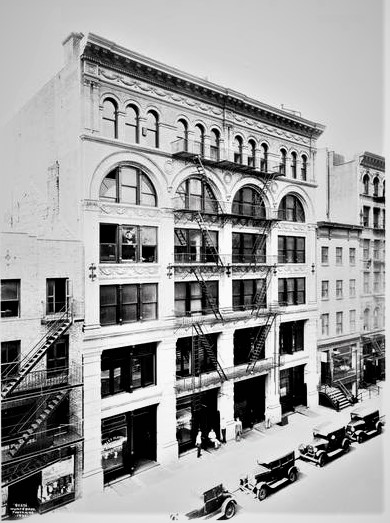
Ralph S. Townsend's 1895 35-39 Bond Street


The block of Bond Street between Broadway and Bowery was lined with elegant homes in the 1830's.  Wealthy merchants George Sharp and James Hagarty lived in Nos. 35 and 37 Bond Street, respectively, while Judge William Kent occupied No. 39.  That high-tone residential tenor would be long gone by the last quarter of the 20th century.

In 1892 Havens & Winters purchased the three properties.  The real estate developers were well known for erecting modern factory buildings.  For the Bond Street project they turned to architect Ralph S. Townsend who designed several Havens & Winters buildings.

Townsend produced two identical structures that successfully pretended to be one.  His tripartite Renaissance Revival style structures were faced in brick and stone and lavishly decorated with terra cotta.  Each two-story rusticated limestone base held a storefront.  The brick-faced midsection featured three-story arches.  The panels between the floors were decorated with elaborate terra cotta swags.  Egg-and-dart terra cotta eyebrows above the grand arches sprung from Renaissance faces.  The top floor featured triple arcades below a pressed metal cornice and frieze.

Havens & Winters were developers, not landlords.  On March 11, 1893 The Real Estate Record & Guide noted "Last week builders Havens & Winters sold their recently-completed stores on Bond street."  The journal noted, 'The district is one of the most active in the city now; every new building rents quickly, often in advance of completion, and the demand is unsupplied."

The upper floors filled with apparel firms.  Among them was neckwear manufacturer Berliner, Strauss & Denzer whose massive factory on Elizabeth Street had burned on January 9.  Within a month the firm had relocated to No. 35 Bond Street and on February 4 the management showed its appreciation to brave employees.  The Sun reported that the staff "assembled at 35 Bond street yesterday afternoon to witness a presentation of medals by the firm to employees whose coolness and courage had helped in saving the lives of over 600 persons."

The three young men had, indeed, showed bravery.  The elevator boy, Samuel Bernstein, refused to retreat from the burning building until he had successfully brought all the female employees down.  Another, Solomon Altschuler, rushed back into the offices to close the fireproof safe which contained $40,000 in cash; and Nathan Ullman had directed some of the young females to the roof where they were rescued.

Berline, Strauss & Denzer was undoubtedly the largest tenant in the building.  In 1895 it employed 35 men, five boys under 18 years old, 400 women, and 26 females under 21 (five of them under 16 years old).  They worked a grueling 54-hour work week. 

Other early tenants included the start-up firm, the Bloomingdale Company.  In its February 1894 issue The Clothier & Furnisher reported "There is a new concern in the manufacture of specialties in clothing line to be found at 39 Bond street.  Its founder, Larry Bloomingdale, "is ready now for business in garments for the Spring and Summer trade," said the article.  The size of Bloomingdale's operation paled when compared with Berliner, Strauss & Denzer.  In 1896 he was employing just three men.

The other tenants in the 1890's were clothing makers Cohen Mfg. Co., A. Robinowitz, J. Lamkay & Co., and Joseph Carmel & Co.  Unrelated to the garment trade was the Pacific Press Publishing Co., which operated from No. 39 by 1896.

Pacific Press Publishing was edited by Alonzo T. Jones.  It published books and pamphlets, most with a decided religious theme.  Among the books offered in 1899 were Sunbeams of Health and Temperance, Heralds of the Morning, and Almost A Man.  An advertisement for Almost A Man promised, "every boy will read it, and be better for it as was the boy in the story.  It is intended to help mothers and teachers in the delicate task of teaching the lad concerning himself, purely, yet with scientific accuracy."

The firm also published the weekly American Sentinel, "published in the interests of [issues] Religious, Liberty-Christian and Constitutional."  The articles shared a similar theme.  In the September 14, 1899 issue, for example, were articles entitled "Rome Aims to Rule the State," "Papal Titles for Sale," and "Political Religion."

The American Sentinel, July 13, 1899 (copyright expired)

The turn of the century saw a diversification of the tenant list.  In 1901 the ungainly named Standard Cloth Examining, Sponging and Refinishing Works was here, employing 11 men who worked 59 hours per week.  Restoff & Bettman, manufacturers of "leather dressings" occupied space in 35 by 1905, and advertising agent Martin J. Ott's office was here in 1907. 

Ott found himself in hot water on April 1 that year.  He was at a an office in No. 28 Ann Street where an illegal horse betting operation, known as a pool room, was conducted.  Suddenly Police Captain E. J. Toole and six detectives rushed in.  Ott was among those arrested, charged with aiding and abetting a poolroom.  It was no doubt a humiliating incident for him, and one which could be damaging to his professional reputation.  The New-York Tribune said "A large crowd watched the men being put into the patrol wagon."

Clothing manufacturer Jacob Cohn had operated from No. 39 as early as 1896.  His was a modest business with a staff of only about ten.   For several months in 1910 orders of cloth to be made into clothing mysteriously disappeared before making it to Bond Street.  On December 12 the New-York Tribune reported "Cohn has been missing bills of lading for goods shipped over the New York Central and other railroads.  Detectives discovered that the original bills of lading for shipments of goods to Cohn had been presented and the goods delivered."

When the freight depot turned over the signed bills of lading to detectives, they showed Jacob Cohn's signature--except "Cohn said the signatures on the bills were forgeries."  Investigation soon focused on the 19-year old office boy, Abe Silverberg.

As it turned out, the teen had been "impelled by one man to open letters and purloin bills of lading," explained the New York Press.  He would deliver them to Moses Trosky, who then signed the documents and claimed the freight.  The incentive was hard to resist.  Following Silverberg's arrest on December 18, Detective David Brown told reporters that "Not long ago...Trosky handed him $70 as his share of the loot.  Silverberg had $30 when arrested."  The $70 would equal nearly $2,000 in today's money.

The first decades of the 20th century continued to see a mix of tenants.  In 1917 the Columbia Dye Works, Inc. was in No. 39.  When a client failed to pay its invoice in August 1917, the firm sold the finished goods at auction--"2,000 opposum skins, dyed black."

The appearance of the buildings in 1932 is essentially unchanged today.  Photo by Wurts Bros. from the collection of the Museum of the City of New York

In 1922 the start-up firm of Israel Brothers, manufacturers of "fabric and imitation leather belts," opened in No. 39.  Other tenants of the buildings in the 1920's included the Boston Ladies' Hat Company, the Exclusive Hat Frame Company, and the American Mirror Works.  

Mid-century saw a more industrial type tenant.  Greenwich Village Plumbers Supply, Inc. moved in in the mid-1950's and remained through 1997.  But the last quarter of the 20th century were dark days for the neighborhood.  Most of the building sat vacant throughout the 1970's.

But little-by-little the block revived as artists discovered the Noho neighborhood.  In 1973 photographer Harold Feinstein rang a ten-week creative photography workshop in his studio in No. 39.  The course, open to beginners and advanced students, cost $100 (a little more than five times that much in today's dollars).

In 1977 the Carat Conway Dance Studio opened.  It staged works like the 70-minute work "Zero As A Value" presented on December 19, 1980.  The Villager described it as "a trilogy comprised of a monologue, a film and a dance that become interwoven."

In 1994 the buildings were joined internally and the upper floors converted to joint living-work quarters for artists, just two or three sprawling spaces per floor.  In 2000 the Soho shop Peter Roberts Antiques relocated to No. 39, and shortly after Modernlink furniture store moved into No. 35.   Lobel Modern Gallery replaced Peter Roberts Antiques in 39 around 2007.


After its more than 125 years, Ralph S. Townsend's handsome commercial structure continues to be a handsome architectural presence.

photographs by the author