Showing posts with label amsterdam avenue. Show all posts

Tuesday, April 14, 2026

Ralph S. Townsend's 1887 200 West 102nd Street


photo by Anthony Bellov

Born in 1854, Ralph Samuel Townsend listed his profession as an architect by his late 20s.  His designs for houses and apartment buildings in the 1880s and '90s routinely reflected the highly-popular and often whimsical Queen Anne style.  In 1886, Townsend received a substantial commission from Charles G. Tomlinson to design a flat-and-store building on the southwest corner of Tenth Avenue and 102nd Street.  (The avenue would be renamed Amsterdam Avenue in 1890.)

Completed at a cost of $28,000 (about $963,000 in 2026), the building was faced in red brick and trimmed in stone and terra cotta.  Townsend centered the residential entrance on the 102nd Street elevation.  His neo-Grec design included stone bandcourses that connected the sills and lintels of the windows.  At the top floor, however, Townsend expressed his penchant for Queen Anne.  On the avenue side, a sunflower rondel sat within the faux gable that fronted the parapet and terminated in fanciful volutes.  Large square panels of sunbursts decorated the chimney backs on 102nd Street.  Smaller terra cotta tiles dotted the top floor facade.

Gracefully scalloped lintels, and tiles of sunflowers and sunbursts were typical of the Queen Anne style.  photograph by Anthony Bellov

Charles G. Tomlinson was not only the building's developer and owner, he and his family were original residents.  He and his wife, Harriet A., had at least five children:  Charles H., Florence J., Arthur R., Herbert and Hattie May.  

Herbert Tomlinson was 12 years old when his family moved into the newly completed building.  The following year, he wrote to The Evening World regarding the newspaper's contest.  His command of language and composition reflected his youthful education:

Being interested in your instructive paper, I thought I would take part in the word-building contest.  As we have no lessons to study in the month of June, I made up my mind to try for the prize.  Inclosed you will find the result of my efforts, which I hope will gain for me the prize.

(The spelling of "enclosed" with an "e" did not come along until the 20th century in America.)

The Tomlinson apartment was the scene of Florence's wedding to George T. Johnson on the afternoon of February 25, 1892.  The Sun remarked, "Miss Tomlinson's gown was of dove-colored silk, with opal trimmings, and she wore diamonds and pearls."

The building can be seen across the partially developed block between 103rd and 102nd Street.  In the foreground is the Boulevard Hotel, by then owned by Julia D. Downs, daughter of the original proprietor, Hiram B. Downs. (original source unknown)

The family suffered a horrific tragedy two years later.  On July 5, 1894, the New York Herald reported, "Hattie Tomlinson, six years old, of No. 200 West 102d street, was discharging fire crackers about half-past three o'clock yesterday afternoon when her dress took fire."  The New York Times added that her "arms and lower part of her body [were] severely burned" and that she "was taken home."

Hattie's injuries were, indeed, severe.  The following day, the New York Herald reported her death.  Her funeral was held in the apartment on July 7.

Terra cotta plaques on the brick brackets compliment the wonderful sunflower-filled rondel.  photograph by Anthony Bellov

In the meantime, the other residents of 200 West 102nd Street were professional.  Among the early tenants was John R. Onderdonk, Jr.  An 1889 graduate of the Stevens Institute of Technology, he was granted a patent in 1890 for "a freight-car coupler of very simple construction."

Also living here at the time were George F. Bender and his wife, the former Ada M. Crawford.  Born in 1881 in Hicksville, Long Island, his first job was a fireman on the Long Island Railroad.  He changed course, working in various undertaking establishments before opening his own business in 1890.  He was, as well, the sexton of  the nearby West End Presbyterian Church at 105th Street and Amsterdam Avenue.

On October 21, 1895, The New York Evening Post reported that 20-year-old C. H. Tomlinson "was arrested yesterday for riding too rapidly on a bicycle around the circle at One Hundred and Sixth Street in Central Park."  He was fined $3 (about $115 today).

The young man appears to have been attending pharmacy school at the time.   As early as spring 1896, the C. H. Tomlinson drugstore occupied the storefront here.  An advertisement in The World on July 11, 1896 sought, "Drug Clerk, junior, must be strictly honest and sober; references.  Tomlinson, 856 Amsterdam."  Three years later, on October 14, 1899, C. H. Tomlinson advertised, "Porter--Wanted, young man as porter for drug store, 856 Amsterdam Ave., 102d st."

It appears that the young druggist was married around that time.  His ad in the Brooklyn Daily Eagle on January 23, 1900 sought, "Wanted--Flat--Small family want 5 or 6 room flat in Brooklyn."

David and Sarah Olive Cogswell Mitchell lived in the building at the time.  Married in 1867, the couple had seven children.  David Mitchell was born in Dumbarton, Scotland in 1846, and was brought to America at the age of three-and-a-half.  He graduated from Brown University and attended the University of Bonn.  Back home, he opened a law office with his brother, Peter.  David Mitchell would become Chief Assistant District Attorney in 1897.

The C. H Tomlinson drugstore was supplanted by a Larimer A. Cushman bakery as early as 1904.  It was one of five bakeries operated throughout the city by the firm.

Cascading fish scales decorate the elongated brackets that flank the entrance.  photograph by Anthony Bellov

The Alfred Nickel family occupied an apartment here in 1908 when their daughters, Vera and Bertha, underwent tonsillectomies at the Manhattan Eye, Ear, and Throat Hospital on March 17.  The operations went horribly wrong.

The New York Times titled an article, "Girl's Death Remarkable," and reported, "The death of Bertha Nickel, four years old...is said by the physicians of the institution to be one of the most unusual in its history."  The surgeon, Dr. Frank Van Fleet, insisted, "It is one case in ten thousand.  Immediately after the tonsils had been cut there was a gush of blood and every effort to stop it was unsuccessful.  The little girl died in a few minutes."  Van Fleet noted, "The little girl went to the hospital with her older sister Vera, who went through a similar operation successfully."  The Evening World contradicted that report, saying on March 23, that Vera "was in a very critical condition in the hospital."

Former City Councilman Stewart M. Brice suffered a nervous breakdown in the summer of 1900.  On September 12, The Evening World reported that his wife said she would not commit him to an insane asylum, "notwithstanding the physicians had declared his mental breakdown incurable."  Brice's brother, W. Kilpatrick Brice, was a lawyer.  Mrs. Brice said that the two of them would manage her husband's financial affairs.  "He has no idea of the value of money, or the obligations connected with it," she said.  "Meanwhile, he will remain with me and my son, and I will take care of him."

Wilburt Weingarth and his bride, the former Florence Stewart, moved into the building shortly after their wedding on January 7, 1928.  On Friday night, March 29, 1929, police officers knocked on their door and arrested the 29-year-old Weingarth.  Another Mrs. Weingarth, this one with the first name of Mabel, accused him of bigamy.  She told the court on March 30 that she and Wilburt were married on April 18, 1922 "and he disappeared some time later."

The parapet detailing was intact in as late as 1940 when Moran's Restaurant occupied the store space.  via the NYC Dept of Records & Information Services.

The building underwent significant alterations in 1947 and it was possibly at this time that the chimney tops and peaks of the gables were shorn off.

A colorful tenant beginning in the early 1960s was artist Louis Abolafia.  In 1964, the 23-year-old smuggled one of his paintings into the Metropolitan Museum of Art and hung it on a wall.  The New York Times reported, "It was taken down almost immediately."  Abolafia told a reporter, "The Met told me my work is too modern for them."

On December 15, 1965, Abolafia began a hunger strike.  Five days into his protest, The New York Times explained that he, "believes that he is being discriminated against by museums because he is not internationally famous."  The abstract-expressionist painter told The Times reporter, "They keep telling me 'You don't have a name.'"  He called his hunger strike "a symbol of my attitude; I must call attention to it," adding, "speaking out does more for the cause of young artists than remaining silent."

Louis Abolafia was still living in 200 West 102nd Street in 1968 when he ran for President on the Love ticket.  Then, days after the election, on November 15, he and three young women were arrested at Chase Manhattan Plaza, "after one of the women had partially disrobed," explained The New York Times.

The female had dropped her fur coat to reveal her bare breasts.  The article said that police "suspected the other women were also about to go topless, which in Mr. Abolafia's lexicon is called a 'bust out.'"  The three women were charged with public lewdness and Abolafia with "prompting the exposure of a female."


Today there are nine apartments in the building.  Most of the red brick facade has been painted brick red, and the stone and terra cotta painted the color of bread mold.  But most of Ralph S. Townsend's 1887 design survives.

many thanks to historian Anthony Bellov for suggesting this post

Monday, July 21, 2025

The Lost Home for the Relief of the Destitute Blind - Amsterdam Av. and 104th Street


The building's large chapel occupied the second floor corner.  photograph from the New-York Historical's Robert Bracklow Collection.

The soldiers who returned to New York City from the Civil War were often maimed.  Institutions were established to help them reintegrate into society.  One organization, for instance, taught veterans who had lost their right arms to write with their left hands and to function despite their new disability.  In 1868, the Reverend Eastburn Benjamin founded the New York Home for the Relief of the Destitute Blind.

The institution was not relegated to men and, although Rev. Benjamin was Episcopalian, it was non-sectarian.  The blind were given lodging and trained in a trade like "mattrass-making [sic], re-seating chairs, and all kinds of knitting-work," according to King's Handbook of New York, and they were given "fair wages" for their work.  "Inmates," as they were called, who could not afford to pay the $10 per month fee were accepted at no charge.  The Home for the Destitute Blind received no city nor state support, and relied solely on private donations.  

On July 4, 1885, The Record & Guide reported, "The Home for the Relief of the Destitute Blind intends to erect a large building up town."  The 125-by-100 foot southwest corner of Tenth Avenue (shortly to be renamed Amsterdam Avenue) and 104th Street had been acquired and architect F. Carlos Merry hired.  The article said, "The material will be of native stone to the first story and brick and brown stone above."  The three-story-and-basement structure would cost $55,000 to erect, or about $2 million in 2025 terms.

Socialites flocked to support fundraising for the building.  On February 28, 1886, for instance, The Sun reported, 

There will be a brilliant and crowded audience at the Academy of Music to-morrow evening, when Delibe's opera, 'Lakemé,' will be produced for the first time in this city by the American Opera Company, in aid of the Home for the Relief of Destitute Blind...All the boxes and more than half of the seats have been sold, and the performance will be witnessed by one of the largest society gatherings that have ever assembled in the Academy of Music.

As the building neared completion, a two-day fundraising fair was "held in the most beautiful ballroom of New York," reported The Sun on December 12, without mentioning which ballroom it was.  The tables were manned by "rosebuds," said the article, a term referring to the season's debutantes, adding that "butterflies of fashion hovered in swarms."

Completed early in 1887, Merry had created a delightfully organized jumble of shapes and gables and roofs.  On February 19, 1887, The Record & Guide said, "It has architecturally two fronts...the principal one on the avenue and one on the side street."  Merry gave both elevations projecting sections, which were connected with iron balconies.  The center section of the avenue side rose to what The Record & Guide described as a "separate roof [with] an ogee curve."  The Hershey Kiss-shaped cap was in effect a stylized onion dome and gave the building a slightly Oriental flavor.

A terra cotta band on 104th Street read "Home for the Relief of the Destitute Blind."  The architect splashed the Renaissance Revival design with touches of Queen Anne.  The half-circle window in one of the 104th Street side gables, for instance, "radiates terra cotta flames over the panel above."  The critic praised Merry's treatment of the corner.  "One of the cleverest points in the design is the feature by which the awkwardness of the junction of these two gables at right angles is dissembled, a small half-round bay at the corner ending below the eaves."  The critic ended his critique saying that Merry "is much to be congratulated upon his work."

The fish scale tiles of the dome and the terra cotta "waved surface" of the gable tiles can be seen in this photo.  King's Handbook of New York, 1893 (copyright expired)

In 1891, according to King's Handbook of New York, the Home took in 150 residents.  In reporting on an upcoming benefit performance held in the Waldorf-Astoria ballroom on April 3, 1901, the New-York Tribune explained, "The home is conducted in an economical manner, and the cost of maintaining it is only about $9 a month for each of the inmates."  The article noted, "The home has a workshop in which many of the inmates are employed, and a slight profit is derived from their work."  Nevertheless, said the article, "The income of the society is barely sufficient" and donations were always needed.

Presumably, it was a generous donor who made possible the purchase of two five-story apartment buildings at 208 and 210 West 104th Street by the Home.  In reporting the transaction on February 17, 1912, The New York Times explained, "The purchase was made to prevent the erection of any tall structure adjoining the home."

Nevertheless, nothing the Home did would stem the incursion of modern apartments in the neighborhood.  On October 14, 1916, The Record & Guide reported that the Society for the Relief of the Destitute Blind had hired M. L. & H. G. Emery to design a new facility in the Bronx.  Three years later, on June 20, 1919, the New-York Tribune reported that Harris and Albert Sokolski had purchased the Amsterdam Avenue corner as well as 208 and 210 West 104th Street.  The article said, "The purchasers plan to begin work immediately on an apartment house to cover the entire plot."

Architect George F. Pelham filed plans for "two six-story brick and limestone apartments, with stores," on the site.  The buildings survive.

image via brownstoner.com

many thanks to historian Anthony Bellov for suggesting this post

Tuesday, October 29, 2024

Charles See's 1895 200 West 80th Street


Real estate developers Noble & Gauss hired architect Charles See in 1894 to design an ambitious project at the southwest corner of Amsterdam Avenue and West 80th Street--four five-story apartment buildings with stores.  Interestingly, the corner building, with its residential entrance at 200 West 80th Street, stood apart from its fraternal siblings.  Instead of their arched fourth floor openings and dramatic splayed voussoirs at the second floor, its windows were all square-headed.  Only at 200 West 80th Street were decorative spandrels between the third and fourth floors carved with wreaths and ribbons.


Among the initial residents was Civil War veteran General John Hayes, who had served on the staff of General Ulysses S. Grant.  He was now, unfortunately, an alcoholic.  On August 24, 1897, the New York Press began an article saying, "Age, a need for stimulants to make up the waste of nature, and the loss of comrades were the excuses for drunkenness which a tall, soldierly looking man gave to the police yesterday."  The article noted, "He was drunk at Trinity place and Rector street."

The police, who described Hayes as "a man with a brilliant record," would have released him as soon "as sleep would have sobered him" if this had not been his second offense within a week.  And so he was incarcerated for the night.  When asked to confirm for police court records that he was General John Hayes, he responded, "'John Hayes' was near enough to be correct."  The New York Press recounted, "He said that he had reached the stage when he considered stimulants a necessity, and yet had not strength of body to withstand them as he could in the years ago."

The corner building is subtly different from the other three buildings.

The corner store became a James Butler Grocery in 1901, opening on April 6.  The first American chain of grocery stores, this newest branch was the 97th James Butler Grocery Company store. 

In the meantime, Arnold Daly was perhaps the first resident involved in the entertainment industry.  Born on October 4, 1875, he debuted in The Jolly Squire with Fanny Rice in 1892.  He opened in the role of Hamilton Travers in Are You a Mason? at Wallack's Theatre on April 1, 1901.  But his name appeared in newspapers for other than theatrical reasons when Marie Christie, the maid of actress Fay Templeton, called police after a man "poked his cane through a window."

When arrested, Daly initially gave his name as James Reilly, but his true identity was quickly discerned.  The New York Times reported, "He said he had gone to Miss Templeton's house in reference to business, but had not been able to see her."  Why he had resorted to breaking a pane of glass was never explained.

Arnold Daly in the role of Eugene Marchbanks in Candida.  from The American Stage of To-Day, 1910 (copyright expired)

While living here in 1903, Daly introduced American audiences to playwright George Bernard Shaw with his Candida.  It was the first of several Shaw plays in which Daly would appear.  With the emergence of silent films, Daly became a matinee idol known to audiences nationwide.

Also living here was actor Jerome Sykes and his wife, Jessie Wood.  Born in Washington, D.C. in 1868, the well-rounded entertainer was a singer, comedian and actor.  He debuted in Baltimore in The Mikado.  The New York Times described him as being "known for his strength and agility as an athlete.  Though a large man, he was very graceful and an expert dancer."

Jerome Sykes, The Players Blue Book, 1901 (copyright expired)

While living here, Sykes opened in The Billionaire in 1902.  It would be his greatest Broadway success.  Sadly, it would also be the cause of his death.  After playing a year on Broadway, The Billionaire went on the road in 1903, opening at the Illinois Theatre in Chicago.  On Christmas Eve, Sykes hosted a dinner for the cast.  The New York Times said he was "thinly clad during an amateur theatrical performance" that night, and he caught pneumonia.  The 35-year-old died at the Stratford Hotel in Chicago four days later.

The Billionaire closed following Sykes's death.  Ironically, several of the cast members skipped his memorial service on December 30, 1903, going instead to the matinee at the Iroquois Theatre.  A horrendous blaze broke out, killing 602 of the 1,700 patrons, two of whom were The Billionaire cast members.

Coloratura prima donna Julia Allen lived at 200 West 80th Street by 1908.  She arrived in New York around the turn of the century and became soprano at the Church of the Holy Name of Jesus at Amsterdam Avenue and 96th Street.  In June 1903, she debuted in the role of Micaela in Carmen.  Five months later, The Sun titled an article, "This New York Girl A Singer," and said the unknown's "voice and her method of singing attracted favorable attention.  Miss Allen seemed worth finding out about."  The singer traveled to England that summer to study.  On November 1, The Sun reported, "She has no idea of returning to her own country until she has made a reputation in all the European countries."

Having done that, she returned to New York and moved into 200 West 80th Street.  In 1908 she was a member of the Italian Grand Opera Co.

The building became the scene of what the Daily News called "a bizarre murder mystery" in 1938.  The night of January 19 was described by the newspaper as "one of the Winter's coldest nights."  Mrs. Amelia Holm, who lived on the fifth floor, heard footsteps on the roof at around 4 a.m., "followed by a rattling of ropes and a crash," said the article.  Around the same time, nine-year-old Theresa D'Arcy, whose family lived in the basement apartment, was awakened by cries of help.

The building superintendent, Louis Mielitez, had left the large dumbwaiter on the fifth floor.  The following afternoon, at around 4:00, he discovered it was in the basement with its rope off the pulley.  The North Shore Daily Journal reported on January 20, "On the roof of the box-like compartment, police found [an] overcoat and suitcoat, neatly folded."  There were also a derby hat and another coat, also neatly folded.  When the dumbwaiter was raised, the body of 40-year-old Ruland Thompson was discovered.  He was described by the North Shore Daily Journal as a "sales executive and member of a wealthy Manhasset family."

image via the NYC Dept of Records & Information Services

The Yale-educated Thompson, who was recently estranged from his wife, was living in the Tudor Hotel.  The Daily News said, "To fall into the shaft accidentally would be impossible.  Tenants told of hearing the cry of 'Help!' three times at 4 A. M. yesterday.  They also heard footsteps on the roof, followed by a crash.  But no one investigated, they told police."  Despite the wide-spread coverage of the mysterious murder, it does not appear that the case was ever solved.

Born later that same year, Dorothy Pitman Hughes was living here by the third quarter of the century.  The indefatigable woman was a feminist, child-welfare advocate, author, entrepreneur, and activist.  She organized New York City's first shelter for abused women; co-founded the New York City Agency for Child Development; and with Gloria Steinem founded the Women's Action Alliance.  In 1972, she signed the Ms. magazine campaign, "We Have Had Abortions," which demanded an end to "archaic laws" that limited reproductive freedoms.  

Gloria Steinem and Dorothy Pitman Hughes in 1971.  Dan Wynn Archive and Farmani Group, Co.Ltd

In her 2000 book Wake Up and Smell The Dollars!  Whose Inner City is This Anyway!, Hughes includes several letters addressed to her at 200 West 80th Street from the likes of Hubert Humphrey, Hugh L. Carey, and Charles S. Rangel.

While its storefronts have been brutalized over the decades, 200 West 80th Street retains its architectural integrity after nearly 130 years.

photographs by the author
no permission to reuse the content of this blog has been granted to LaptrinhX.com

Tuesday, August 2, 2022

The 1917 Central Baptist Church - Amsterdam Avenue and 92nd Street


As early as 1898 Central Baptist Church, located on West 42nd Street near Broadway, was closely affiliated with the West Park Baptist Church at 92st Street and Amsterdam Avenue.  That year Central Baptist's Embroidery Class and its Carpentry and Chair Caning Class were held at the uptown location.  The relationship would become even closer a decade later.

Central Baptist was an outgrowth of the 1842 Laight Street Baptist Church.  When the congregation erected its handsome church at 220 West 42nd Street, the Longacre Square district was the center of the carriage making industry, its side streets lined with brownstone homes.  The New-York Times remarked in 1911, "It was one of the first Baptist churches to be built in the upper part of New York, which at that time was considered a suburb of the city."  But at the time of that article, Longacre Square had been renamed Times Square and was the center of Manhattan's theater district.

On March 29, 1910, The New York Times reported that "The changed conditions in the Times Square district led the officers of the Central Baptist Church to contemplate moving to a more residential locality."  The article said that the West Park Baptist Church had been authorized by the State Supreme Court "to transfer the church property on the southeast corner of Amsterdam Avenue and Ninety-second Street to the Central Baptist Church of West Forty-second Street."  The two congregations had merged and "a new Central Baptist Church will be organized."

Services continued in both locations until October 1911 at which time The Sun reported that the theatrical firm of Frazee & Lederer and P. Chauncey Anderson had purchased the vintage 42nd Street church as the site of a theater for $500,000--a substantial $14.7 million today.  The article noted that the old West Park Church was also for sale.  "When this is disposed of a new edifice that will accommodate both congregations will be erected in the neighborhood of the uptown church."

But the Central Baptist Church trustees decided not to sell the Amsterdam Avenue structure, but to replace it.  On March 2, 1912 the New York Globe reported that the congregation intended to build "a splendid new edifice" which would be "one more important, influential church added to the residential section of New York's upper west side."  Architects Walter Cook and Edward F. Pallme were hired to design the structure.

The plans, filed in June 1915, placed the cost of construction at $200,000.  The Real Estate Record & Guide noted it would be 78 feet wide on Amsterdam Avenue, and stretch back 115 feet on 92nd Street.  "The building will contain accommodations for a Sunday school and parish house.  The church auditorium will seat approximately 1,000 people."  (That left little room for increasing membership, which was currently at 700.)

The New-York Tribune reported, "Simplicity is to be the feature of the exterior, and utility of the interior."  The article noted, "So extensive is the Central's new enterprises that it is not expected to complete it before September, 1916."

Demolition of the old church along with a house on 92nd Street began on August 1, 1915.  Nine months later, on May 6, the cornerstone was laid "with a simple service of hymns and Scripture readings by the Rev. Dr. Frank M. Goodchild, the pastor," according to The New York Times.  Inside the box were the church's yearbook and annual report, a history of the Baptist Church, newspapers, 1916 coins, and such.  With World War I raging in Europe, Dr. Goodchild commented, "Let us hope that when this stone is removed and this box taken out a hundred years from today there will be peace on earth and accord of nations."  It was an optimistic wish.

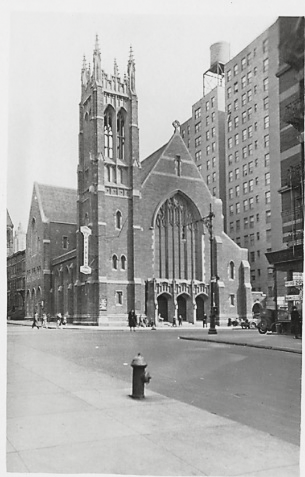
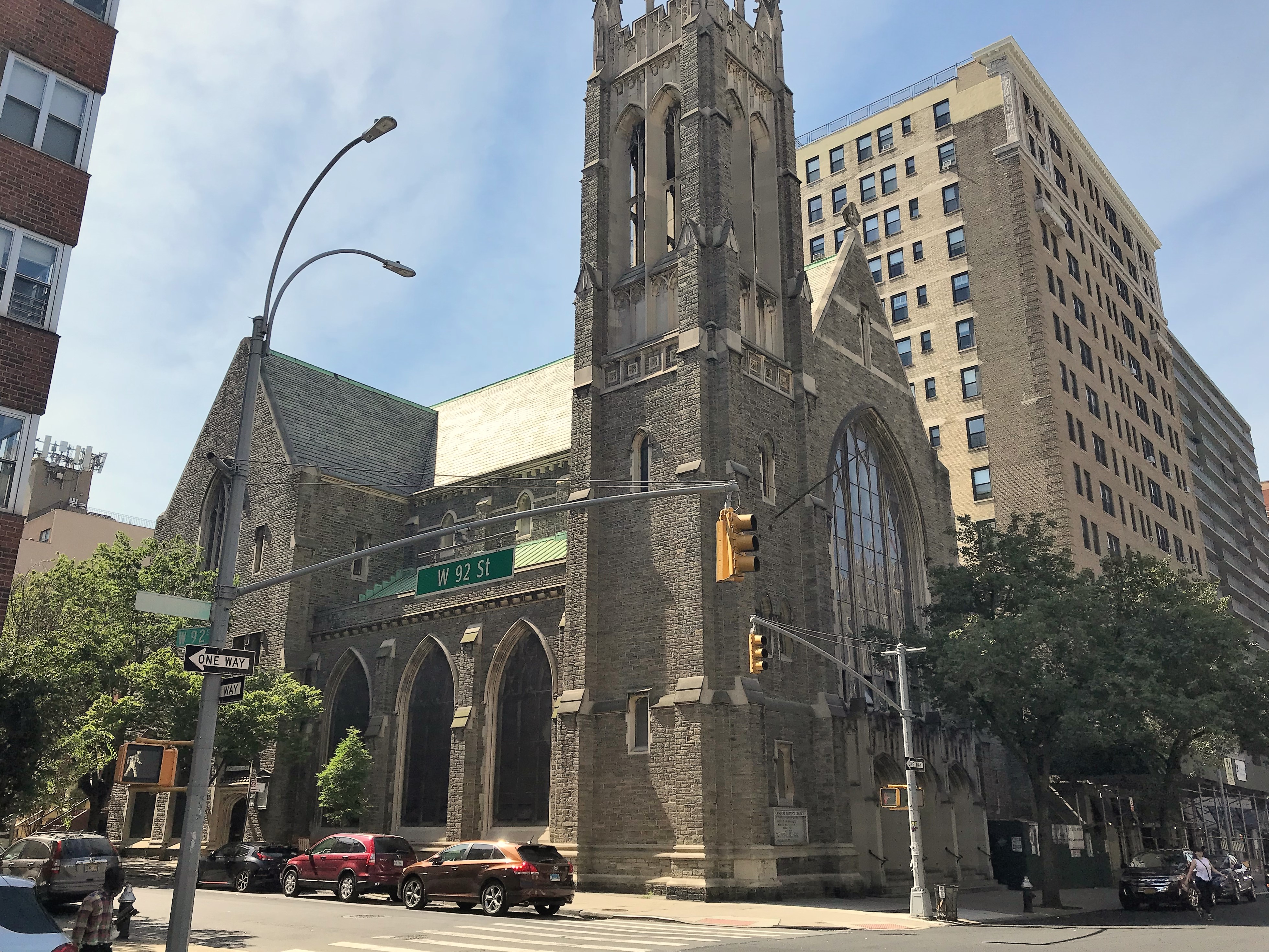
Completed in 1917, Central Baptist Church was designed in "the modified English Gothic order."  Built of Germantown stone (a type of granite) and Indiana limestone, a corner tower,  118-feet high, dominated the design.  

from the collection of the New York Public Library

Although the New-York Tribune had promised that the interior would be designed with utility in mind, the stained glass windows, by Gorham Studios, were by no means utilitarian.  The New York Globe, on October 6, 1917, said "But the glory of the auditorium is the great west window, thirty-eight feet in height by twenty-two feet wide.  It consists of seven panels in three groups...and the whole is of such marvelous depth and splendor of color as is impossible to describe."  Gorham Studios also designed the ten side windows which depicted scenes of the Life of Christ.

The great West Window.

The Rev. Dr. Frank Marsden Goodchild had been pastor of Central Baptist Church since 1895.  It was he who recognized the need to relocate the church immediately upon taking the pulpit.  Seemingly indefatigable, he wrote three religious books, was a "visiting preacher," and was president of the American and Foreign Bible Society, president of the Ministers' Home Society, and vice president of the Baptist Union for Ministerial Education.

As the church rose, he got into a heated confrontation with U. S. Army General Frederick Funston for the latter's "attitude toward the activities of clergymen in the army."  Goodchild insisted that clergymen be permitted "to preach without restrictions to soldiers," while the general demanded that preachers "must not tell the soldiers that they were lost and were in need of being saved."  He added that he did not "wish the emotions of the soldiers stirred, and wanted no such thing as a revival," said The New York Times on November 21, 1916.  From the pulpit, Dr. Goodchild called Funston a "religious dictator" and demanded that Congress investigate conditions in the army."  The well-publicized feud prompted other Baptist ministers to distance themselves from the fiery pastor.

Goodchild's health began to fail in 1923.  That year he and his wife sailed to France for six months "in the hope that the long vacation would restore his health," said The New York Times.  Instead, upon his return he suffered a stroke.  He preached his farewell sermon on January 6, 1924, during which he dedicated the life of his six-month-old grandson, Robert Mardsden Goodchild, "to the Christian life, and to the Christian ministry, if God so wills."  (He presumably did not consult his infant grandson on the decision.)  In tribute to his long service to the church, the congregation gave him cash equal to a year-and-a-half's salary.  Goodchild died on February 18, 1928.

Dr. Goodchild was replaced by the Rev. Dr. John Falconer Fraser, who, in 1931, also found himself in a heated confrontation.  In his sermon on November 1, he declared that the name of the Central Baptist Church had been dragged "into scandalous notoriety by the reckless villainy operating in the name of the United States Government."  The previous week the church had been named as co-defendant in a "padlock suit" for running a speakeasy disguised as a bird store on West 91st Street.

Falconer told his congregants that he was not used to speaking about political issues from the pulpit, but "It seems incumbent on your minister to make a statement on this unseemly subject."  He insisted the church had no connection with the owners of that building nor the shop and said, "God knows, the speakeasies stoop low enough in their practices in evading the law, but it is doubtful if they an equal the latest publicity stunt of the Federal authorities in New York City."

As the decades passed, the neighborhood, the congregation, and the church's outreach changed.  The youth of the neighborhood caught the attention of Richard "Pee Wee" Kirkland in 1994, who began the School of Skillz basketball camp at Central Baptist Church every Saturday. 

Kirkland was born in Harlem in 1945 and learned basketball on the streets.  A sensation in high school and college, he was drafted by the Chicago Bulls in 1969, but he turned down the offer, presumably because he was making more money as a drug dealer, money launderer and jewel thief on the streets.  He was arrested in 1971 and sent to the Lewisburg Federal Penitentiary in Pennsylvania on a ten-year sentence.

He told The New York Times journalist Vincent M. Mallozzi in January 1997, "Thirty years ago, I was part of the problem.  Thirty years later, I'm part of the solution."  The solution included mentoring young Upper West Side boys through basketball.  He said that while in prison he thought of the people who had wanted to see him go into the N.B.A.  "I knew the only way to repay those people was to one day work with kids, because somewhere out there there's another Pee Wee Kirkland, and until that kid turns his life around, I will always feel his pain."  Kirkland ran his School of Skillz at Central Baptist Church for years.

In the summer of 1997, Mayor Rudolph W. Giuliani created a task force to examine the relations between the city residents and the New York City Police Department.  It followed the beating and torture of Abner Louima in a Brooklyn precinct station house.  Among the members was Central Baptist Church minister Rev. Michel Faulkner.  He called the group "the most diverse task force in the history of New York City," saying the members "poured their heart and soul into a process that they truly believed in."

Faulker was crestfallen when, a year later, Giuliani essentially dismissed the task force's findings, saying "the panel had failed to recognize the department's recent success in reducing crime."  Of the task force's recommendations, he said "Some of the things we've already done.  Some of the things I've opposed in the past, I'll continue to oppose them.  And some of the things are unrealistic and make very little sense."

The uneasy relationship between Faulker and Giuliani continued.  In March 2000 an unarmed Black man, Patrick M. Dorismond, was shot dead by police.  Three months later Giuliani had still not expressed condolences to the victim's family.  On June 3, Elisabeth Bumiller, writing in The New York Times, reported, "He has not reached out to Representative Charles B. Rangel of Harlem...or to former allies like the Rev. Calvin O. Butts and the Rev. Michel Faulkner."

Faulkner told Bumiller, "I've sent him a couple of messages.  I haven't heard back from him.  I don't know what it means, to be honest with you.  To me it's not good."


The Central Baptist Church continues to serve a noticeably dwindling congregation.  And while the handsome 1917 structure with its stunning stained glass windows is little changed, rumbles on the street speak of a possible sale and demolition of the structure, which has no landmark protection.

 photographs by the author
LaptrinhX.com has no authorization to reuse the content of this blog

Tuesday, July 27, 2021

1894 Triplets -- 462 through 466 Amsterdam Avenue


On May 12, 1894 the Real Estate Record & Guide reported, "Gordon Bros. have purchased three lots, 75x100, on Amsterdam avenue, between 82d and 83d streets, for immediate improvement."  The "improvement" of the vacant plots would be in the form of three identical flat--or apartment--houses with stores.

The partners commissioned architect Gilbert A. Schellenger to design the structures.  His tripartite design was, for the most part, Renaissance Revival, with touches of the Romanesque Revival style.

Completed within the year, each was five stories tall.  The brick and stone bases held cast iron store fronts, and short stoops led to the residential entrances.  The three-story midsections were clad in beige brick and separated by full-height piers.  Schellenger used bull-nosed brick to round the corners of the piers and the openings.  Above an intermediate cast metal cornice, the top level featured an arcade of windows joined by a continuous thin eyebrow.  Each structure was crowned with an elaborate pressed metal cornice and triangular pediment.

There were two apartments per floor, front and rear.  An advertisement in The World on May 29, 1897 offered "Four rooms & bath, all light, finely decorated, low rents, 1 month free."  The "low rents" ran from $20 to $24 per month--just over $750 for the more expensive apartment today.

Among the early tenants of 466 Amsterdam Avenue was Fanine Milne, who was known as Fannie.  She lived in the rear flat on the fourth floor and worked at the printing shop of George E. Shepard on Chambers Street.  Shepard and his wife, Lola, had been married since 1886 and had three children.

Fannie and her boss became friendly and around 1895 she was invited to the Shepard home.  Shortly after that Lola Shepard discovered "that her husband was untrue to her, but forgave him," reported the Brooklyn Daily Eagle.  George Shepard traveled to Europe for two months in February 1897.  Upon his return Lola began unpacking his bags.

She discovered a parcel of letters from Fannie Milne.  They included phrases such as "To my own foreign baby," "Goodnight, my own dear love, think of me as often as you can, with love and kisses to yourself and baby. Fannie," and "Try and not forget me and try to always think of me as your best girl.  If I had you here to-day, I am afraid you would never live after it to tell the tale."

Lola was understandably upset and went to unexpected lengths to gain additional evidence.  She somehow got access to the other apartment on Fannie's floor.  On the evening of August 14 she went there with three friends "and with them watched the place all night."  According to Lola in court, at about 7 a.m. George Shepard "left the apartment of Fannie Milne, who soon afterward followed him out."

She sued Shepard for divorce, naming Fannie Milne as the other woman and using her incriminating letters as evidence.  Fannie's attorney denied the allegations, saying she was "a family friend and although the letters seemed to indicate undue familiarity, such was not the fact."  He said the letters found in the bag were "simply a good joke on Shepard," and that the overnight visit to her apartment was "on business connected with his office."  The judge did not buy the defense and granted the divorce, allowing Lola $25 per week alimony (about $795 today).

It would not be the last time Fannie Milne and George E. Shepard appeared in court together.   George's attorney in the divorce case had been Benjamin Levy and Fannie's was a lawyer named McKinney.  According to Fannie, she gave Levy $150 which he was to turn over to McKinney for his fees. 

Around February 10, 1900 Fannie accosted Levy on Park Row, accusing him of keeping the money for himself.  She demanded to accompany him to his office where she insisted he sign a confession that read, "I acknowledge the receipt of $150, which I obtained on false pretenses."

Levy's story about the money was different.   He said, "Shepard had given it to me for my services and not to be paid to McKinney, and I told her I wouldn't give it to her."  It was not the answer Fannie was looking for.  "She began to abuse me, and used such language that I told her to get out of my office," said Levy later.  "I was going to get up and go out into the hall for some of the employe[e]s of the building, when Shepard came in."

Shepard, too, demanded that Levy sign the confession.  Levy testified, "I said I wouldn't give anything to him.  I told him I had earned the money all right, and he should be the last one to kick, as I had saved him a lot of money."

Levy tried to get to the office door, but the pair pushed him back and blocked it.  When the lawyer attempted to use the annunciator (a speaking tube) to have a clerk call a policeman, he was stopped short by a firearm.  "The first thing I knew I was looking right at a revolver," he said.

On February 16 Fannie Milne and her father appeared in the Center Street Police Court.  She confidently handed Magistrate Cornell the signed confession, fully expecting him to demand Levy to pay her the money.  Cornell asked Levy if the signature were genuine.  Levy admitted it was, but then explained it was signed under intimidation.

"I was afraid of the man," he told the judge.  "This man Shepard, Your Honor, was held in the court here for pouring acid on a man.  He was very nervous, and I didn't know but he would pull the trigger of the revolver at any time.  That man is liable to do anything when he is excited.  I was scared, and I let him push me down into the chair, and I wrote what he told me to.  No one who isn't crazy would sign a paper like that unless he was in fear of his life."

Magistrate Cornell told Fannie, "On your own admission, Miss Milne, you used duress.  I will not accept the complaint."  Fannie's father indignantly replied, "We will take the case into General Term."  "That's the best thing you can do," said Cornell, "as I won't have anything to do with the matter.

Another tenant of 466 Amsterdam Avenue at the time was William C. Hurst.  He was affluent enough to afford a Locomobile (a stream-powered automobile).  On April 30, 1901 he appeared in the West Side Police Court charged with "scorching" (i.e, speeding).  The New-York Tribune said "Hurst had no excuse to make when he was arraigned, and a fine of $5 was imposed on him.  He sent a messenger out to pawn his gold watch in order to get the money to pay the fine."

In the meantime, Policeman McIntee took his prisoner to the stationhouse using Hurst's own Locomobile.  The New-York Tribune reported, "The water in the boiler was very low, and McIntee had not gone more than a block when the safety valve began to screech in the most ear splitting manner."

Fearing the boiler was about to explode, the policeman jumped out and ran back to the courtroom where Magistrate Meade was hearing another case.  Breathless from his sprint, McIntee rush to the bench and shouted "Judge, the machine is in the middle of the street.  It is going to blow up!  Give me an order for the prisoner or the whole street will be blown up!"

The New-York Tribune continued, "Several women in the courtroom became almost hysterical.  Magistrate Meade shouted: 'Don't wait for an order; go down and get the prisoner at once!  Run quickly!"


McIntee returned to the scene and removed Hurst from the car.  His handcuffs were removed and he "turned off one or two valves and then raked the fire.  Over a thousand persons had gathered at the spot."  All danger was now squelched.

Officer McIntee walked Hurst to the stationhouse, then returned to push the automobile to the station.  Once there, the sergeant told him to take it to Pierce's Stables at 58th Street and Seventh Avenue.  The New-York Tribune reported, "McIntee pushed the machine all the way to this place, and just as he reached the stable in an almost exhausted condition, Hurst, who had paid his fine, appeared and claimed it."

In 1903 a branch of the James Butler grocery stores opened in 462 Amsterdam Avenue.  It was the chain's 110th store in the metropolitan area.  The store at 464 was home to the Wing Sing Chinese laundry, and Edward Unterman's wine and liquor store occupied 466 Amsterdam Avenue around the same time.  Unterman's shop would remain in the space at least through 1919.

Living in 464 Amsterdam in 1918 was Custom House broker Samuel Harry Pomerance.  He was estranged from his wife, whose professional name was Dorothy Green.  A silent movie actress, Dorothy was described by The Sun as "a slightly built brunette."  She had appeared in numerous films and was best known for playing "vamps."

Pomerance was born in Russia and arrived in America around 1898.  He married Dorothy in 1911 and, initially, their marriage went well.   According to Pomerance, when Dorothy was working in the movies in California, she "would send him as many as six love letters a day."  But in 1916 things changed.  She began an affair with wine merchant Emanuel S. "Manny" Chapelle.

The unfaithful Dorothy Green.  Shadowland, December 1919 (copyright expired)

In court Pomerance said, "When Chappelle began paying attention to my wife early in 1916 we quarreled and finally separated.  She told me frankly she did not intend to change her way of living, and that if I didn't like it I could get out."  Pomerance went to Chappelle's office and told him to leave his wife alone.  The merchant responded saying that since the couple was not living together, Pomerance should "go about his own business and let her have a good time."

Chappelle was also married.  His wife was the ice skater Grace Helaine, the sister of actress Billie Burke.  Pomerance hired a private detective to follow Chappelle and Dorothy.  They raided Dorothy Green's apartment where they found the couple together.  The scandalous divorce trials--Pomerance sued Green and Helaine sued Chappelle--became fodder for gossip and screen magazines nationwide.

World War I took a toll on several of the families who lived here.  On November 30, 1918 the War Department's casualty list included John M. Donahue, "killed in battle."  And on February 20, 1919 the New-York Tribune reported that Thomas J. Rowley had been been wounded, "degree undetermined."

At 3:00 p.m. on September 25, 1946 Patrolman Kenneth Heil was directing traffic at 82nd Street and Amsterdam Avenue when several children ran up and told him Louis Cafiero's stationery store at 462 Amsterdam Avenue was being held up.  The Daily News reported, "The patrolman drew his gun and sprinted."  As he neared the store John O'Neill, a longshoreman, ran out and ducked into the cellar of 460 Amsterdam Avenue.  He had robbed Cafiero of $30 at gunpoint.

Heil followed the gunman into the darkened cellar.  A tense cat-and-mouse game continued for 15 minutes.  Then, as reported by the Daily News, O'Neil shouted, "If you try to come near me, I'll kill you."  The article continued, "Heil aimed at the voice and answered--with two bullets from his service revolver, one of which found its mark."  The wounded 27-year-old was booked on assault and robbery.

Officer Heil displays the gunman's weapon to Police Inspector James Mulholland.  Daily News, September 26, 1946

The following year, on October 3, 1947 the store was targeted again.  At around 5:30 a.m. Thomas Connelly broke in and stole $20 in coins and a wrist watch.  He was spotted by a bakery driver who telephoned police.  As police cars pulled up to the store, the 22-year-old crook ran out the back door.  He was captured after a "chase across the rooftops during which several shots were fired," according to the Daily News.

The Amsterdam Avenue neighborhood became one of trendy shops and nightspots in the last quarter of the 20th century.  In 1992 The Insomnia Hotel & Bar occupied the former stationery store at 462 Amsterdam Avenue.  It was replaced in 1998 by Mason's Bar, owned by former child actor Mason Reese.

Next door at 464 Amsterdam was Gelateria Richard, described by The New York Times food critic Florence Fabricant on November 23, 1994 as capturing "the flavors and textures of sumptuous Old-World Italian ice creams, called gelati."  Falcon's Peruvian Restaurant occupied 464 Amsterdam Avenue.


The commercial spaces continue to house restaurants.  And other than replacement windows, the upper floors of the 1894 trio remain  essentially unchanged since the colorful Fanine Milne moved into her fourth floor flat.

photograph by the author
LaptrinhX.com has no authorization to reuse the content of this blog

Tuesday, July 13, 2021

The 1906 St. Agnes Library - 444 Amsterdam Avenue


Around the turn of the century the former West End Club building at 444-446 Amsterdam Avenue was taken over by the Century Wheelmen Club--a men's bicycling group.  They renamed it the Century Lyceum.  At the time, the St. Agnes Library was operating from rented quarters.  Organized by the St. Agnes Chapel on West 91st Street, it had twice outgrown its original space.

The management of a continuously expanding circulating library may have become too ponderous for the chapel to handle.  On August 1, 1901 the St. Agnes Library was sold to the New York Public Library for the consideration of $1.00.

Five months earlier millionaire Andrew Carnegie had offered the City of New York a gift of $5.2 million to build free circulating libraries.  The condition was that the city would provide the land and maintain the libraries.   In 1904 the city acquired the Century Lyceum property and on January 13, 1905 the New-York Tribune announced, "Plans have been filed...for a Carnegie library to be erected at Nos. 444 and 446 Amsterdam-ave., and to be known as library No. 3."

The architectural firm of Babb, Cook & Willard designed the three-story building in the Renaissance Revival style.  Faced in limestone and granite, it featured arched openings on the first floor, grand French windows with prominent molded cornices on the second, and a bracketed stone cornice crowned by a classical balustrade.  Construction costs for the 50-foot-wide structure were $80,000, or about $2.4 million today.

By the time construction neared completion in the spring of 1906, the building was no longer being referred to as Public Library #3.  On March 23, three days before the opening, The New York Times explained it would serve "the double purpose of a home for the St. Agnes' Branch Library and for the Library for the Blind."

The Library for the Blind had been established in 1895 by Richard Randall Ferry.  Opening with 60 volumes, it now offered more than 4,000 books and 1,000 pieces of sheet music.  Just as the St. Agnes Library had done, the Library for the Blind had transferred its collection of books to the New York Public Library.  The New York Times said, "The front part of the main floor of the new building will be devoted to the Library for the Blind, which has now one of the largest collections of books for the blind in the United States."

On the second floor were the children's circulating and reading rooms, and on the third was the adult reading room where current newspapers and magazines were available.  There were also workrooms, meeting rooms and the adult circulating room.

from the collection of the New York Public Library

The Library for the Blind flourished in the new building.  On October 27, 1907 the New-York Tribune reported:

In the library for the blind, at No. 444 Amsterdam avenue, there are about 4,000 volumes, printed in the New York point, Braille, Moon and line letter systems of typography.  Here also are most of the magazines printed for the blind, in English, French and German.  Printing for the blind is such an expensive operation that few of the books of current fiction are included, the last popular novel to be issued in this form being 'The Virginian.'  A feature of the library for the blind is the furnishing of a teacher without charge for the adult blind of the city.

By 1911 the Library for the Blind's music department nearly equaled its book distribution.  On April 14 The Sun reported, "Nearly 4,000 sheets of music, which include all the best compositions, are done in American braille and sent out to the musical blind throughout this State, New Jersey and Connecticut."  The Library for the Blind operated on a tighter schedule than the St. Agnes Library, open to readers from 1:00 to 5:00 daily.  The Sun pointed out, however, that "comparatively few persons avail themselves of the opportunity, since books [for the blind] are delivered free either by post or express."

The Library for the Blind outgrew the shared space by the 1940's, when it was relocated to 137 West 25th Street.  The St. Agnes Library expanded into the entire building, and, like all branch libraries, offered programs for the neighborhood residents.  On the evening of October 19, 1950, for instance,  a screening of the New York Public Library's film forum for teen-agers was held.  The New York Times announced Inside Opera "will be shown and discussed.  Free."

from the collection of the New York Public Library

The third quarter of the 20th century posed financial problems for the city and the library system.  In 1973 the St. Agnes Library, "like many other branch libraries," according to The New York Times, was closed on Saturdays "for lack of funds."  The closure had nothing to do with a lack of interest.  The newspaper noted that "during the week--even in summer, with no air-conditioning--it is bustling and crowded."

Living in the neighborhood in 1983 were Miles and Lillian Cahn, co-owners of the Coach Leatherware Company.  Lillian Cahn was disturbed that the branch was not open on Saturdays, saying "that's the best time for families."  She researched the cost of operating the library on a Saturday, discovering that $22,000 would cover a full year.  On July 19, 1983 Laurie Johnston and Susan Heller Anderson, writing in The New York Times, reported, "So her company has given three times that to assure Saturday service for the next three years."

The article noted, "The branch, near 81st Street, has a large collection of books in Spanish and books for children, and particularly attracts the young and the elderly."  A follow-up article nine months later said, "More than 750 users have crammed the tiny branch some Saturdays, most of them families, people who work during the week and children."

The library continued to host activities, like a poetry reading and a book discussion on Time of the Hero by Marion Vargar Llosa on October 16, 1989.  And in celebration of Black History Month in 1991 the library was the venue of "A Celebration in Word and Song" by the students of the Harlem School of the Arts.

In October 2007 the St. Agnes Library was closed for an extensive $9.75 million renovation.  Aside from restoration of the façade and interior elements, the building received a new elevator and an air conditioning system.   The roof was replaced, a new "story hour room" was created, and all new furniture brought in.  Visitors could now log onto the internet through free wi-fi.

More than two years after the project began, it was finally opened on February 11, 2010.  Writing in the Daily News, Mike Jaccarino said, "Hundreds of people, including neighborhood residents and public officials, showed up at the old library...clamoring for a chance to see the refurbishment and borrow books for the first time since October 2007."


While The St. Agnes Library is easily recognizable as a Carnegie library, its fascinating history is less obvious.  

photographs by the author
no permission to reuse the content of this blog has been granted to LaptrinhX.com